
























Last week’s news that China had delivered a new batch of army tanks to Cambodia was greeted with dissatisfaction, if not anger, by ultranationalist Thais.
The initial batch of Chinese T-59D main battle tanks was part of a total procurement exceeding 100 units, and many Thais reacted angrily, claiming China had betrayed Thailand.
Prominent military-beat reporter Wassana Nanuam, regarded by some as an unofficial spokesperson for the Thai armed forces, and who infamously posted an AI-generated video of Phnom Penh being attacked by the Thai Air Force, claimed in a social media post that Thai security personnel were upset by China’s move. She said these officials questioned the validity of the longstanding motto that Thais and Chinese are like siblings, asking whether these were empty words.
One can’t help but wonder why Thai security agencies are still stuck with propaganda slogans like “Thailand and China are brothers.”
Every nation pursues its own national interests. China, too, wants to sell more tanks and weapons. Only fools would believe that, if Thailand and Cambodia were to fight, arms-exporting countries would not be pleased. The more conflict there is, the more taxpayers’ money must be spent on additional weapons.
Warmongers should not be surprised. They should try to live in the real world of international politik. China has to compete against the United States in this region, and that means keeping Cambodia happy. It would be naive to expect China to take sides. China will sell more tanks and submarines to us, too, if we want to buy them — or waste more precious taxpayers’ money. The Chinese Embassy quickly clarified that the procurement order was placed by Cambodia before last year’s clashes with Thailand.
Meanwhile, America does not sufficiently trust us, despite Thailand being the Asian country with the oldest diplomatic ties with the United States — or one of Washington’s oldest allies in Asia — to sell us F-35 fighter jets, as then junta leader-turned-prime minister Gen Prayut Chan-o-cha tried to procure them. This is most likely because the US fears the technology could fall into Chinese hands through spies in Thailand. We should not place unrealistic expectations on either China or the US. Unrealistic expectations lead to irrational views and are counterproductive to our national interests.
We should not cling to unrealistic expectations in the real world. They do not merely set us up for disappointment; they cloud our judgement and leave Thai society less able to compete, adapt and defend its interests in the international arena.
The realistic way to look at Thailand’s place in the international community is that we are a small country, if not an aspiring middle power at best. This necessitates Thailand avoiding the creation of unnecessary enemies, particularly among her neighbours, such as Cambodia, which would drag both nations down. While other nations focus on economic development, Thailand and Cambodia end up spending more and more money on arms.
We should also recognise that the prolonged closure of the border between Thailand and Cambodia affects some of our major allies, including Japan.
Foreign Minister Sihasak Phuangketkeow was in Japan recently. While he heaped praise on Japan, the Thai government continues to ignore Japan’s call for the reopening of Thai-Cambodian border checkpoints, the closure of which has severely affected cross-border supply chains for Japanese manufacturers in the two countries. I recently perused clothing items at Uniqlo in Bangkok, Japan’s largest fashion retailer, and noticed that some were made in Cambodia. It made me wonder how the continued border closure has affected them.
No matter how much Sihasak praises Japan, he and the Thai government have failed to ease the impact on Japanese businesses in Thailand and Cambodia from the prolonged border closure.
This writer was briefly approached by the foreign minister last week at the Foreign Ministry, and Sihasak stressed to me that he is doing what he can to try to resolve Thai-Cambodian conflicts diplomatically. It was kind of him to explain the matter in some detail, but I am afraid that even the Anutin government, his boss, and Thai society in general may have been held hostage to ultranationalism, making any solution or renormalisation of ties between Thailand and Cambodia more difficult. It is like the Thai saying: once you ride the back of a tiger, you cannot get off without the risk of being devoured by it.
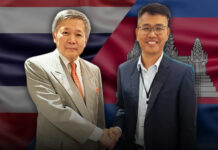
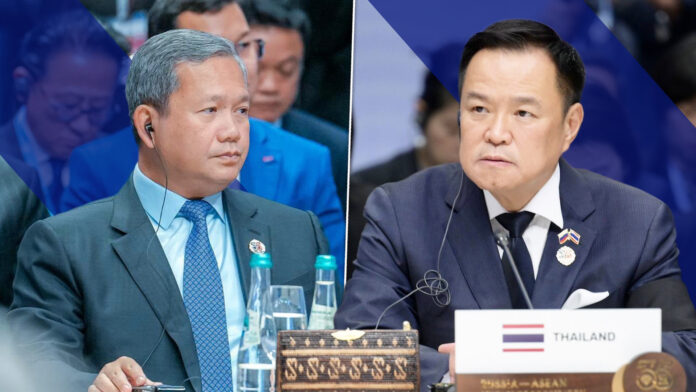
A clear symptom of that was the Thai prime minister having to publicly defend himself for merely shaking hands with Cambodian Prime Minister Hun Manet last week while both were in Vietnam.
Anutin was quoted as saying:
“If not a handshake, then what should it be?
Before a leaders’ meeting, there is usually a reception room. Whoever walks in, we have to greet them with a handshake. Regardless of any issues involving that person, we must show respect for them as the leader of their country.”
On Wednesday, Khaosod English reported that “the Royal Thai Air Force has reviewed and adjusted its force deployment at U-Tapao Airport to address potential threats from the east, while strengthening its ability to protect Thailand’s sovereignty and maritime interests.
“The move comes alongside AIM-9 air-to-air missile training as part of efforts to enhance air-defence capabilities and maintain round-the-clock readiness.”
Such news is nothing to celebrate. It is tragic that both Thailand and Cambodia have allowed this utterly avoidable situation to escalate to the point where we are in a state of de facto cold war, spending more and more time and resources on defence and portraying — as well as perpetuating — our neighbours as the enemy instead of cooperating on trade, tourism, culture and beyond.
Speaking of culture, our two countries wasted more time last week arguing over whether mango and sticky rice is actually Thai or originally Cambodian, thus inducing more negative sentiment against one another. Such a feud was not the first and will not be the last, however, as other nations focus their time and energy on something more productive and constructive.
As sensible Thais and the country itself are virtually hostage to ultranationalism, Thai society is becoming increasingly unrealistic and jingoistic. Let’s face it: while the brief war last year has ceased for the time being, it has now been replaced by a needless cold war between the two neighbouring countries. And the UNCLOS process is just beginning.