



































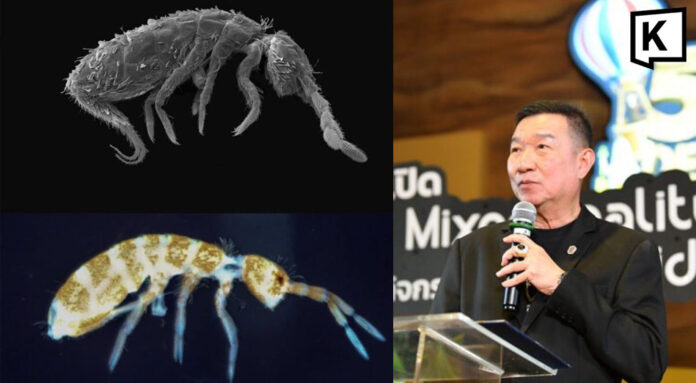
PATHUM THANI — 10 June 2026, A joint research team from the National Science Museum (NSM), Thaksin University, and Prince of Songkla University have discovered a new insect species, “Rama IX Springtail,” at Rama IX Museum’s forest park, marking the latest addition to the world’s known biodiversity.
On Wednesday, Acting NSM director, Suwarong Wongsiri, revealed that researcher team from NSM, Thaksin University, and Prince of Songkla University have discovered a new-to-science insect species called the “Rama IX Springtail” at the Rama IX Museum’s forest park.
The “Rama IX Springtail” belongs to the subfamily Heteromurinae within the family Orchesellidae and has been named Alloscopus ramani sp. nov., after its discovery site in the forest park of the Rama IX Museum building.
Suwarong added that measuring just 1.1 to 1.4 millimetres in length, the Rama IX springtail has a slender body, white coloration patterned with orange-brown bands and eye patches on its head. It resembles Alloscopus tetracanthus (Börner, 1906), a more widely distributed species, but can be distinguished by the unique arrangement of body hairs.
Regarding its distribution, current research data indicates that the species has been found only in Pathum Thani province, Thailand, making it endemic to a single known location in Thailand. Springtails are typically found in moist environments.
Suwarong further stated that more than 9,000 species of springtails have been reported worldwide. They inhabit a remarkable range of environments, from forest floors and tree canopies to volcanic craters and deep cave systems. Seventeen species within the same genus have been reported globally, seven of which have been recorded in Thailand.
“We must give importance to these tiny springtails that are near invisibility to the naked eye, because in reality, springtails serve a monumental role as the “housekeepers” or heroes of the ecosystem,” Suwarong stated. He added, “They break down organic matter into soil nutrients and act as natural regulators, keeping microbes and fungi in check. They are truly vital links that keep the food chain cycling smoothly.”
“The discovery of the Rama IX springtail is more than a taxonomic achievement,” he said. “It is a reminder for us to look back and appreciate the importance of the biodiversity that closest to us. With every step we take on damp ground, these tiny creatures may be hard at work. This collaboration between academic institutions and the museum represents a major stride toward expanding our knowledge, empowering us to understand and protect the smallest of living things, and their homes, to preserve our beautiful ecosystem forever.”
The world’s newest insect, the “Rama IX Springtail,” is now on display in the “Hidden Paradise” exhibition at Rama IX Museum, located within the National Science Museum complex in Khlong Ha sub-district, Khlong Luang district, Pathum Thani province. Visitors can view the exhibit from Tuesday to Friday between 09:30 and 15:00, and from 09:30 to 17:00 on weekends and public holidays.