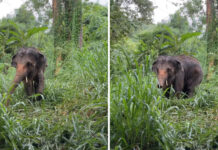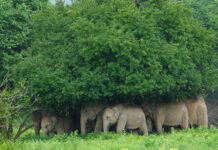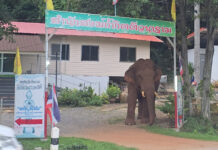


































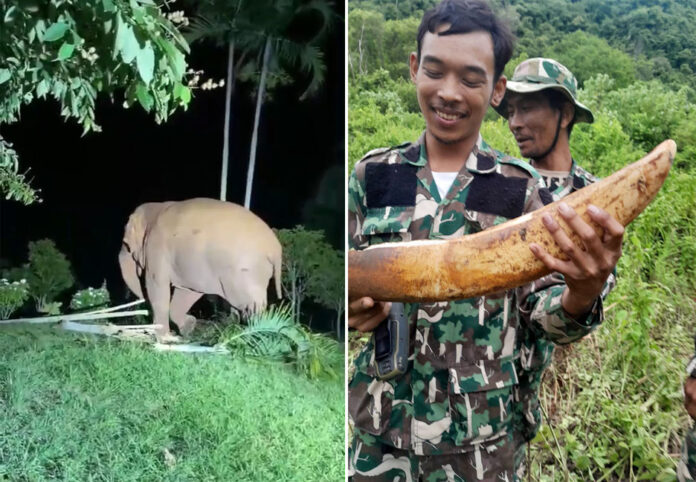
NAKHON RATCHASIMA — Wildlife teams discovered on Monday that a male elephant named “Plai Duan,” a 47-year-old wild elephant that has long resided in the Khao Yai area, had his left tusk broken off, leaving only his right tusk remaining.
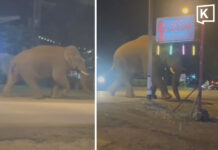
The cause was found to be a fight with another wild elephant, “Plai Biang Lek,” a 38-year-old elephant famous from a viral video clip showing him raiding snacks at a grocery store, which made international news in June.
Chaiya Huayhongthong, Chief of Khao Yai National Park, said officials received confirmation from local residents that on July 20 at 9:00 p.m., two male elephants were seen fighting outside the park boundaries – “Plai Duan” and “Plai Biang Lek.” When Plai Duan emerged, they discovered his left tusk was broken, prompting officials to investigate.
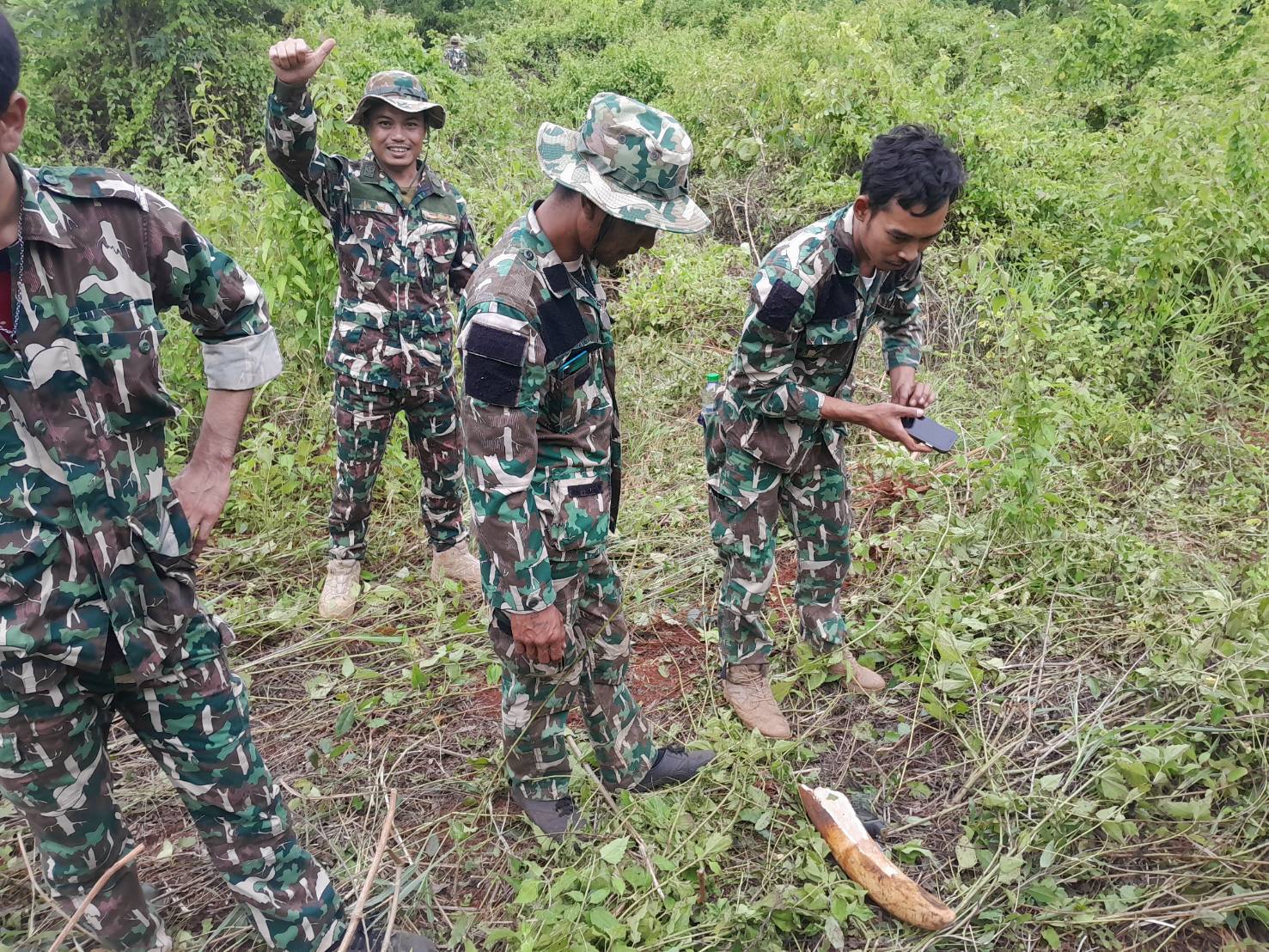
The area inspection in Moo 3, Nong Nam Daeng Subdistrict, Pak Chong District, Nakhon Ratchasima Province on July 21, revealed one fallen elephant tusk measuring 50-60 cm in length and weighing approximately 5 kg. This is called a “scattered tusk,” considered rare and worth millions of baht.
Chaiya said they are currently preparing records to transfer the tusk to the Department of National Parks, Wildlife and Plant Conservation. Regarding concerns about whether this stems from elephants’ nutritional deficiencies, he noted that two years ago, Plai Thongkham also had a broken tusk. He personally believes that when elephants weighing 5-6 tons collide, tusks can break.
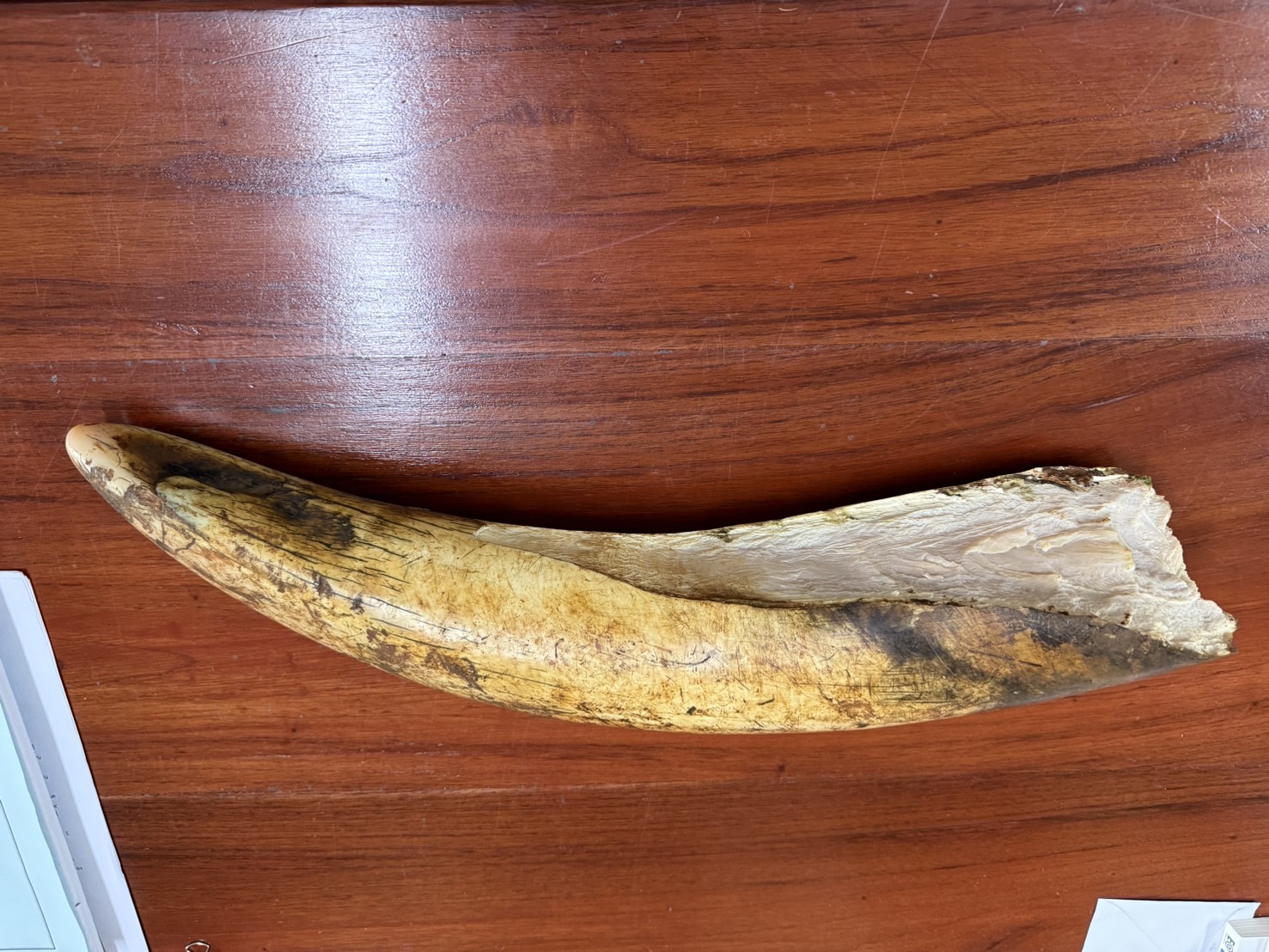
In 2022, Plai Thongkham fought with Plai Nga Thong over a female in Khao Yai National Park, resulting in Plai Thongkham’s broken tusk. The veterinary team from the Department of National Parks, Wildlife and Plant Conservation sent the elephant tusk and soil samples from Khao Yai for synchrotron light analysis at the National Synchrotron Research Institute, suspecting a possible link to elephant nutrition.
Test results showed the mass ratio of calcium was no more than 1.76 parts to 1 part phosphorus, which is lower than the reference value for Asian elephant samples of 2.16 parts calcium to 1 part phosphorus.
This corresponds to the condition of soil licks at various locations containing diverse minerals essential for elephants and wildlife, including major and trace minerals: potassium, magnesium, calcium, sodium, iron, manganese, and zinc.
Chaiya noted an important observation: the low calcium content found in elephant tusks stems from elephants not consuming soil licks due to the scent of tourists who have trampled the areas, affecting the elephants’ nutritional status. In Plai Duan’s case, the tusk will also need to be studied.
__________