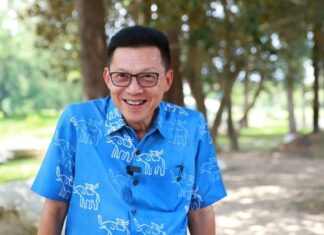










Yesterday morning, shortly after waking up, I saw a post from my Facebook friend, Suchart Sawadsri, a former National Artist. He posted in bold letters on Facebook: ‘I protest against the Chinese government’s interference with freedom of artistic expression in Thailand.’
After I read it I was fully awake even before I had a chance to drink my tea. I quickly showered and headed straight to the exhibition that had been censored by the Chinese Embassy in Thailand at the Bangkok Art and Culture Centre (BACC). On the way, on the Skytrain, I read the news from Reuters, the first agency to report on the incident.
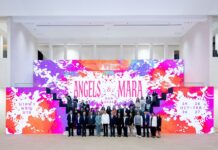
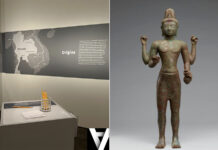
When I arrived at the exhibition, curated by a Myanmar artist named Sai (who fled the military dictatorship but doesn’t reside in Thailand), I found that black tape had been placed over the name of China on the wall of the exhibition entitled: ‘Complicity.’
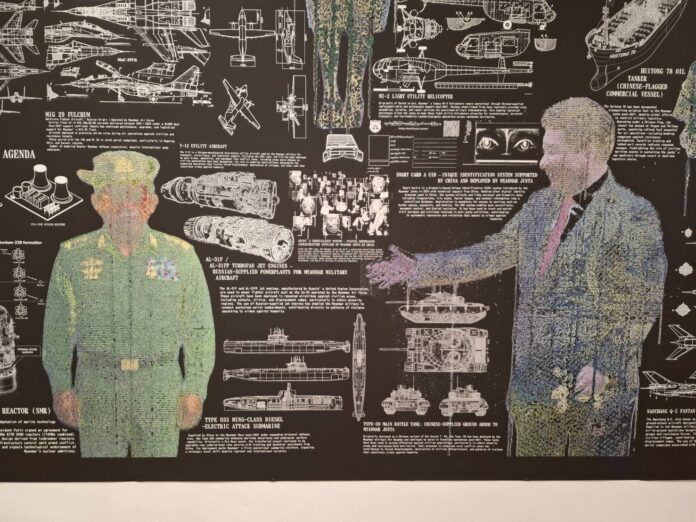
“This exhibition brings together works from Myanmar, Iran, Russia, Syria [and the name of China was covered with black tape, both in the Thai and English descriptions of the exhibition] — regions too often framed as isolated crises. Yet through these practices, we witness a re-mapping: a shared grammar made visible through diplomacy, economic exchange, and militarised suppression. These regimes collaborate, affirm one another, and reproduce forms of violence under the guise of sovereignty and order,” read an introduction to the exhibit on a wall at the entrance.
I saw a female security guard at the exhibition and asked her about the Chinese censorship incident. She told me the Chinese Embassy ‘requested’ the removal of a Tibetan flag, the censoring of one art video, and the removal of one art installation, among other things.
A moment later, a BACC staff member came to ask me what I was doing. I explained who I was and why I was there and that I wanted to interview them about what happened late last month.
As I was leaving the exhibition on the 8th floor, four BACC officials approached me. I requested an interview and received the following response: “We cannot give any interviews. We need to discuss this first [among ourselves]. We are trying to stand by our mission to be an open public space, and the exhibition is still on show.”
They also informed me that on the day the censorship took place (July 26, 2025), which was two days after the exhibition opened, a diplomat from the Chinese Embassy in Bangkok simply walked in [which led to the eventual censorship of some parts of the exhibition related to China, including issues concerning Uyghurs, Hong Kong, and Tibet].
One of the BACC staff I spoke with seemed very anxious after the news broke and was concerned about the reputation of BACC.
We exchanged views on how the centre should have handled the situation and should handle it going forward. I made some observations and offered the following suggestions to the staff:
* Thailand is not a colony or a vassal state of China (or any nation). We should look at neighbouring countries for a sobering lesson. The Chinese Embassy has no right to give orders, and we should not allow them to dictate what can and cannot be displayed at a Thai art centre. (The Reuters report mentioned that officials from the Bangkok Metropolitan Administration were also present, but the BACC official said only the Chinese Embassy people were there.) In this case, BACC should have asked the Chinese Embassy to submit a formal letter of complaint and first consult with the Thai Ministry of Foreign Affairs about how to proceed and what the centre’s legal rights were, rather than simply complying with the censorship demands. They should have insisted that the Chinese Embassy not overstep its bounds and act as if Thailand is part of China.
* The BACC should quickly summarise the incident and release a statement to the media and the public for transparency and credibility.
* If a mistake was made, they should learn from it and create a protocol for how the BACC should handle such cases in the future to protect its artistic freedom and reputation.
P.S. I reassured the staff by mentioning that Dr Rosalia Sciortino, the founder and executive director of SEA Junction—an organisation focused on freedom and democracy in Southeast Asia that has been renting space at the BACC since 2016—told me by phone just an hour ago that the BACC is considered the most liberal space for artistic expression in Thailand.
‘I’m not going to be a negative voice,’ Sciortino told me on the phone. ‘BACC has been the best [place] for free expression [in Bangkok].’
I also told the staff that Sciortino reminded me that this can be seen in a past exhibition on political prisoners organised by the Thai Lawyers for Human Rights there. Additionally, I stressed to the staff that I still see some of Sai’s works critical of China on display, especially the large-scale graphics showing which weapons China and other countries, including Russia and North Korea, sell to the Myanmar military dictatorship and what were used to attack Myanmar civilians.
P.S. 2 I sent a Line message to a Chinese Embassy official I have contact with on Saturday afternoon, but have not received a reply as of press time on Sunday. I don’t expect one, as the Reuters report noted they had contacted the Chinese Embassy in Thailand multiple times without a response.
P.S. 3 I would like to thank the Chinese Embassy for helping to unintentionally promote this exhibition and for making it even clearer than the exhibition itself how the Chinese dictatorship wields its power abroad and how complicity works.
(The exhibition runs until October 19, 2025, but to be sure, it’s a good idea to go and see it sooner rather than later.)
P.S. 4 I emailed Sai to ask if the BACC had consulted him before the censorship, etc., and he eventually replied last night.
Here is my Q&A with Mr Sai.
1. Did you expect this censorship?
Sai: We knew there was a risk. In our risk assessment sessions with BACC, we discussed possible diplomatic pushback. To reduce exposure, we selected works that focused on the lived experiences and cultures of Tibetan, Uyghur, and Hong Kong communities rather than direct political statements. But what happened went far beyond what we anticipated: it became a clear case of foreign interference in Thailand’s cultural space.
2. Did BACC inform you in advance prior to the censorship?
Sai: There was an ongoing and transparent dialogue with BACC. They never wanted to censor the exhibition. In fact, the institution showed remarkable courage and professionalism in resisting repeated demands from the Chinese Embassy. But the pressure escalated, with the Embassy visiting in person alongside Bangkok Metropolitan Administration officials. As always, BACC tried their best, but the Chinese Embassy’s demands kept coming, again and again, until compliance was excessively forced.
3. What were the key items censored?
Sai: The names and regional affiliations of three artists, from Hong Kong, Tibet, and the Uyghur diaspora, were covered with black tape. The Tibetan and Uyghur flags in one installation were removed. Later, all of Tibetan artist Tenzin Mingyur Paldron’s video works were taken down, and postcards referencing Xi Jinping and a book were removed. What’s left is a visible scar where an artist’s identity and work used to be.
This is what the Tibetan artist said in his own words:
‘1 and 2. Tibetan and Uyghur flags’
‘3. We Measure the Earth with Our Bodies, a novel by Tsering Yangzom Lama. This novel was also recently censored by the Guimet Museum of Asian Arts after Chinese government pressure. After the Guimet nominated the author’s novel for a literary prize, they described her as a Chinese and then subsequently erased all mention of the author and the novel from their website. (Read more here from The Globe and Mail.)’
‘4. Illustrated postcard by Liz Hee titled: China, Israel, and the “Xinjiang” Mode (@lizar_tistryInstagram)’
‘5. Film. Listen to Indigenous People: A Trans Tibetan Scholar & Survivor Speaks on the Dalai Lama (YouTube)’
‘6. Film. Earth is Heard. Description: In the film Earth is Heard, the centuries-old Tibetan practice of distance prostration is invoked in a new context. In April 2024, I joined other LGBTIQ+ Tibetans in a two-hour distance prostration in New York City. Supported by allies, we prostrated to the Palestinian flag and carried with us the Tibetan flag and flags of other oppressed peoples.’
4. Going forward, what’s your suggestion to BACC, the Thai government, the Chinese Embassy, and the Thai public?
Sai: My only suggestion is to the public: it is time to confront the reality of neocolonialism and transnational repression. What happened here is a physical reminder that when oppressed communities stand together, authoritarian regimes feel threatened. This is why they act in concert to silence us. The Myanmar Peace Museum and the artists involved hold deep respect for BACC: for its ethics, its professionalism, and its willingness to defend freedom of expression under extraordinary pressure. Working with them has been an honour.
5. Were you aware whether officials from the Thai government were involved in the censorship process?
Sai: Thai citizens would know best how much institutional orchestration it would take to pull this kind of move from the Chinese Embassy. For the sake of freedom of expression, I have addressed this question on other news outlets.
6. Can you briefly explain the complicity between China and Myanmar, as well as Thailand?
Sai: I am an artist-curator and my work poses the questions more directly than any statement could. I love Thailand, its art, culture, and people, which makes it all the more wrenching to leave in such an abrupt and forced way. I would urge readers to ask themselves why I had to go and how many actors must be involved for such an act of complicity to take place.
Myanmar today is becoming what Tibet has endured for decades, a place where the Chinese Communist Party wields deep, unprecedented control over our internal affairs. To understand the extent of this reach, look into what happened in Lashio in 2025.
Thank you for giving us the platform; Thai people’s support is integral for us when we go back to rebuild our nation.
________