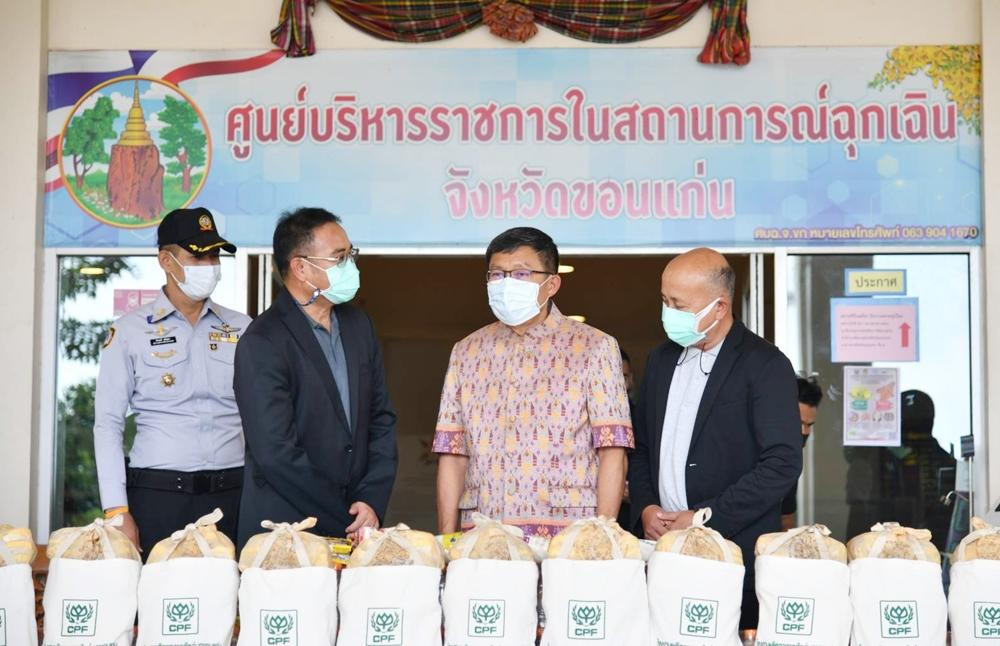
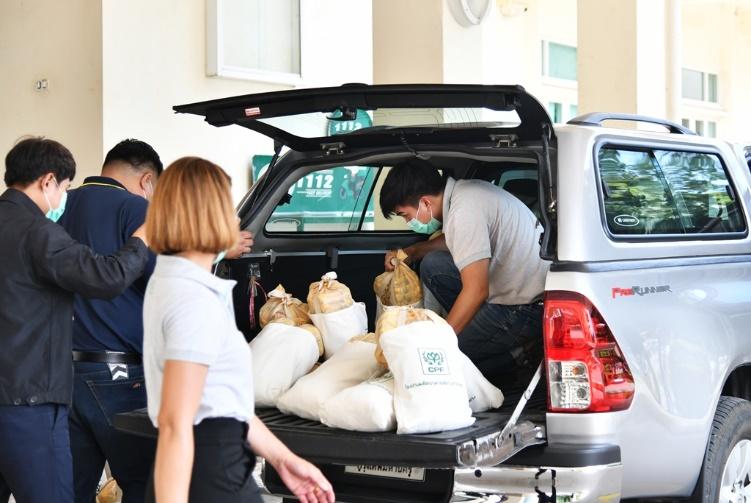
Charoen Pokphand Foods Public Company Limited (CP Foods) handed over survival bags to Khon Kaen governors to help flood victims in the province as a part of on-going “CPF food from the heart against floods” project. The flood aids efforts were made with an aim of relieving the hardship faced by flood victims and giving them moral support to ensure they are able to recover from the impact.
Khon Kaen governor, Somsak Jangtrakul, received 200 sets of survival bags, consisting of 5 kg of rice, canned food, 1,200 fresh eggs, 1,200 bottles of CP drinking water and other food supplies to help alleviate the hardship that flood victims in the province have to go through. The donated supplies were given by CP Foods volunteers led by the company’s vice presidents, Banjong Somsanguan and DVM Kunnawutt Krualoy.
“Khon Kaen was severely flooded. In some areas, the flood level was 1-2 meters high, affecting the well-being of the locals. Some of the villagers’ farmland were damaged. Although the situation is improving, there are still some vulnerable areas that needs helping hands and access the essential supplies, like food and drinking water.” The Khon Kaen governor said. “CP Foods’ volunteers came to support them with survival bags and fresh food and drinking water this time. I would like to thank the company for being by our side in every crisis”
CP Foods vice president, Banjong Somsanguan, said the company, as a member of the community, is responsible for helping the communities nearby our operations. Therefore, CP Foods has initiated the “CPF food from the heart against floods” project and constantly rally its volunteers to help people in various provinces such as Phitsanulok, Phetchabun, Nakhon Sawan, Ang Thong, Phra Nakhon Si Ayutthaya, Saraburi, Nakhon Ratchasima, Chaiyaphum and Khon Kaen, supplying flood victims with fresh food, pork, chicken, eggs, rice, dryfood, CP drinking water and survival bags.
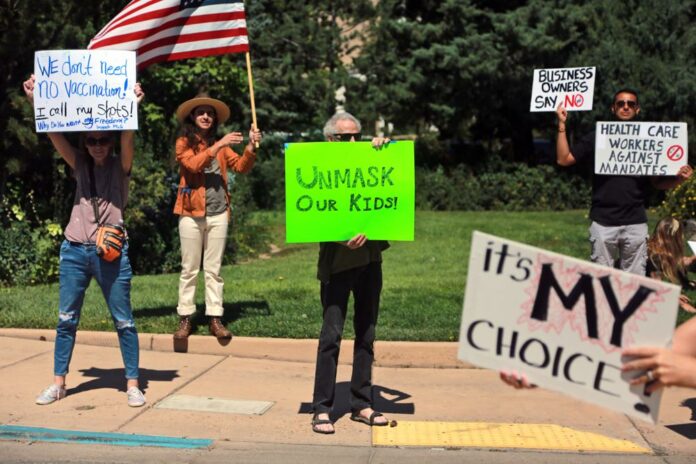
In this Aug. 20, 2021, file photo, protesters against vaccine and mask mandates demonstrate near the state capitol, in Santa Fe, New Mexico. (AP Photo/Cedar Attanasio, File)
WASHINGTON (AP) — In March, as claims about the dangers and ineffectiveness of coronavirus vaccines spun across social media and undermined attempts to stop the spread of the virus, some Facebook employees thought they had found a way to help.
By altering how posts about vaccines are ranked in people’s newsfeeds, researchers at the company realized they could curtail the misleading information individuals saw about COVID-19 vaccines and offer users posts from legitimate sources like the World Health Organization.
“Given these results, I’m assuming we’re hoping to launch ASAP,” one Facebook employee wrote, responding to the internal memo about the study.
Instead, Facebook shelved some suggestions from the study. Other changes weren’t made until April.
When another Facebook researcher suggested disabling some comments on vaccine posts in March until the platform could do a better job of tackling anti-vaccine messages lurking in them, that proposal was ignored at the time.
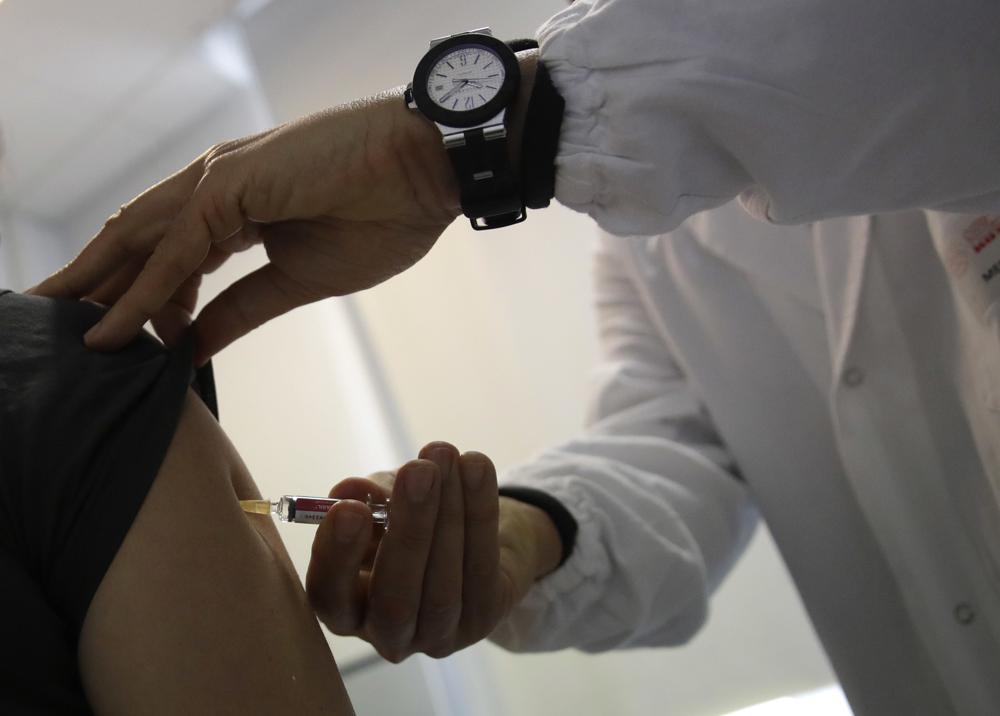
In this Feb. 23, 2018, file photo, doctor Roberto Ieraci vaccinate a woman in a vaccine center in Rome. (AP Photo/Alessandra Tarantino, File)
Critics say the reason Facebook was slow to take action on the ideas is simple: The tech giant worried it might impact the company’s profits.
“Why would you not remove comments? Because engagement is the only thing that matters,” said Imran Ahmed, the CEO of the Center for Countering Digital Hate, an internet watchdog group. “It drives attention and attention equals eyeballs and eyeballs equal ad revenue.”
In an emailed statement, Facebook said it has made “considerable progress” this year with downgrading vaccine misinformation in users’ feeds.
Facebook’s internal discussions were revealed in disclosures made to the Securities and Exchange Commission and provided to Congress in redacted form by former Facebook employee-turned-whistleblower Frances Haugen’s legal counsel. The redacted versions received by Congress were obtained by a consortium of news organizations, including The Associated Press.
The trove of documents shows that in the midst of the COVID-19 pandemic, Facebook carefully investigated how its platforms spread misinformation about life-saving vaccines. They also reveal rank-and-file employees regularly suggested solutions for countering anti-vaccine content on the site, to no avail. The Wall Street Journal reported on some of Facebook’s efforts to deal with anti-vaccine comments last month.
Facebook’s response raises questions about whether the company prioritized controversy and division over the health of its users.
“These people are selling fear and outrage,” said Roger McNamee, a Silicon Valley venture capitalist and early investor in Facebook who is now a vocal critic. “It is not a fluke. It is a business model.”
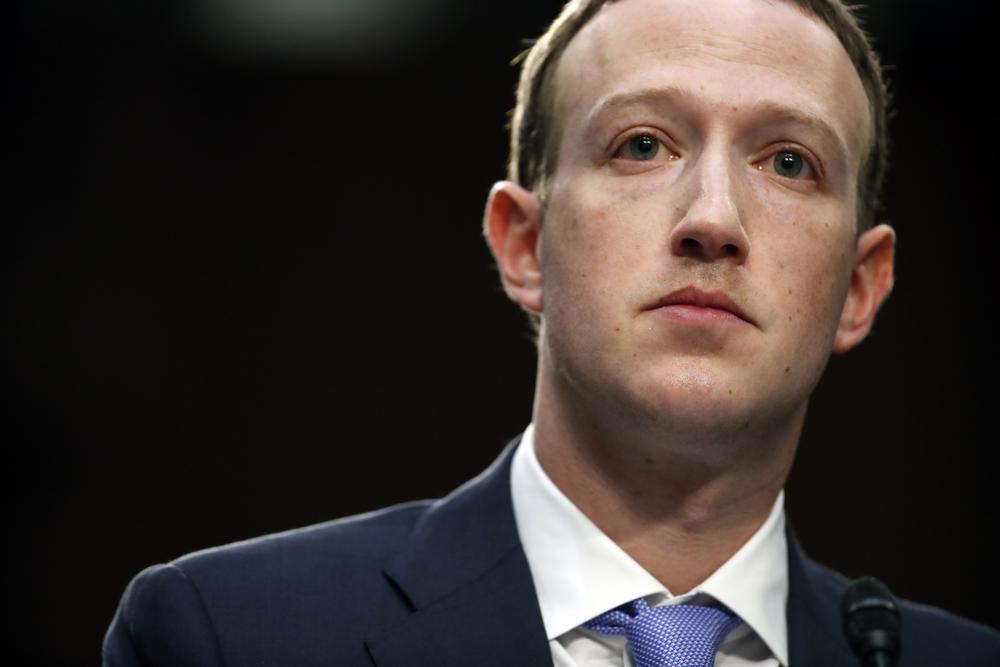
In this April 10, 2018, file photo, Facebook CEO Mark Zuckerberg testifies before a joint hearing of the Commerce and Judiciary Committees on Capitol Hill in Washington. (AP Photo/Alex Brandon, File)
Typically, Facebook ranks posts by engagement — the total number of likes, dislikes, comments, and reshares. That ranking scheme may work well for innocuous subjects like recipes, dog photos, or the latest viral singalong. But Facebook’s own documents show that when it comes to divisive public health issues like vaccines, engagement-based ranking only emphasizes polarization, disagreement, and doubt.
To study ways to reduce vaccine misinformation, Facebook researchers changed how posts are ranked for more than 6,000 users in the U.S., Mexico, Brazil, and the Philippines. Instead of seeing posts about vaccines that were chosen based on their popularity, these users saw posts selected for their trustworthiness.
The results were striking: a nearly 12% decrease in content that made claims debunked by fact-checkers and an 8% increase in content from authoritative public health organizations such as the WHO or U.S. Centers for Disease Control. Those users also had a 7% decrease in negative interactions on the site.
Employees at the company reacted to the study with exuberance, according to internal exchanges included in the whistleblower’s documents.
“Is there any reason we wouldn’t do this?” one Facebook employee wrote in response to an internal memo outlining how the platform could rein in anti-vaccine content.
Facebook said it did implement many of the study’s findings — but not for another month, a delay that came at a pivotal stage of the global vaccine rollout.
In a statement, company spokeswoman Dani Lever said the internal documents “don’t represent the considerable progress we have made since that time in promoting reliable information about COVID-19 and expanding our policies to remove more harmful COVID and vaccine misinformation.”
The company also said it took time to consider and implement the changes.
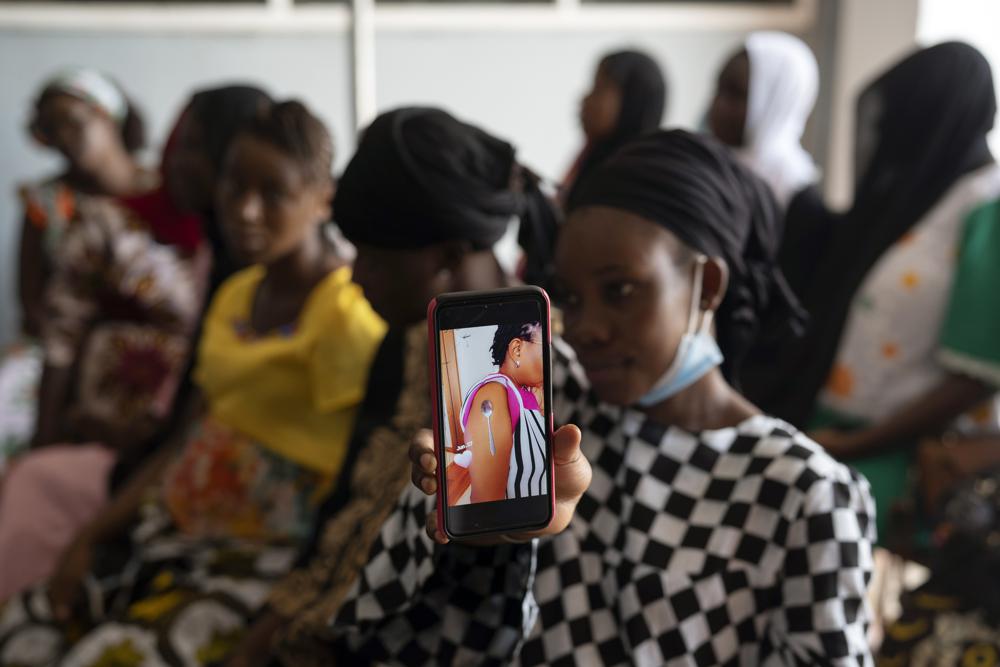
In this Sept. 23, 2021, file photo, Oumie Nyassi shows a video circulating on the internet and that has been confirmed as fake news of a woman claiming she was magnetized after receiving the COVID-19 vaccine, in a doctor’s office at Serrekunda, Gambia hospital. (AP Photo/Leo Correa, File)
Yet the need to act urgently couldn’t have been clearer: At that time, states across the U.S. were rolling out vaccines to their most vulnerable — the elderly and sick. And public health officials were worried. Only 10% of the population had received their first dose of a COVID-19 vaccine. And a third of Americans were thinking about skipping the shot entirely, according to a poll from The Associated Press-NORC Center for Public Affairs Research.
Despite this, Facebook employees acknowledged they had “no idea” just how bad anti-vaccine sentiment was in the comments sections on Facebook posts. But company research in February found that as much as 60% of the comments on vaccine posts were anti-vaccine or vaccine reluctant.
“That’s a huge problem and we need to fix it,” the presentation on March 9 read.
Even worse, company employees admitted they didn’t have a handle on catching those comments. And if they did, Facebook didn’t have a policy in place to take the comments down. The free-for-all was allowing users to swarm vaccine posts from news outlets or humanitarian organizations with negative comments about vaccines.
“Our ability to detect (vaccine hesitancy) in comments is bad in English — and basically non-existent elsewhere,” another internal memo posted on March 2 said.
Los Angeles resident Derek Beres, an author and fitness instructor, sees anti-vaccine content thrive in the comments every time he promotes immunizations on his accounts on Instagram, which is owned by Facebook. Last year, Beres began hosting a podcast with friends after they noticed conspiracy theories about COVID-19 and vaccines were swirling on the social media feeds of popular health and wellness influencers.
Earlier this year, when Beres posted a picture of himself receiving the COVID-19 shot, some on social media told him he would likely drop dead in six months’ time.
“The comments section is a dumpster fire for so many people,” Beres said.
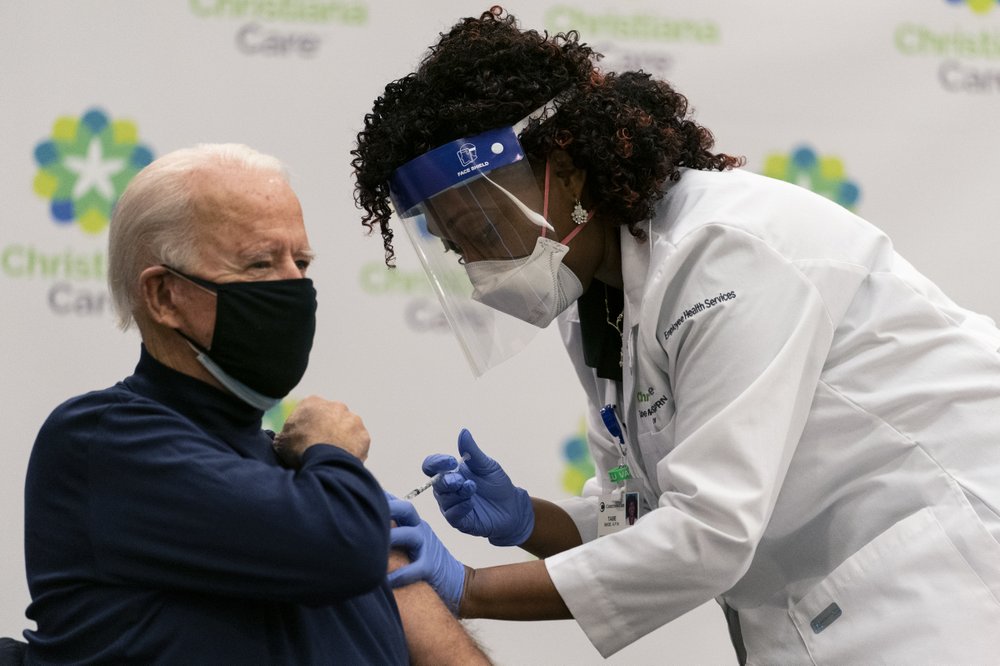
President-elect Joe Biden receives his first dose of the coronavirus vaccine from Nurse partitioner Tabe Mase at Christiana Hospital in Newark Del., Monday, Dec. 21, 2020, from nurse practitioner Tabe Mase. (AP Photo/Carolyn Kaster)
Anti-vaccine comments on Facebook grew so bad that even as prominent public health agencies like UNICEF and the World Health Organization were urging people to take the vaccine, the organizations refused to use free advertising that Facebook had given them to promote inoculation, according to the documents.
Some Facebook employees had an idea. While the company worked to hammer out a plan to curb all the anti-vaccine sentiment in the comments, why not disable commenting on posts altogether?
“Very interested in your proposal to remove ALL in-line comments for vaccine posts as a stopgap solution until we can sufficiently detect vaccine hesitancy in comments to refine our removal,” one Facebook employee wrote on March 2.
The suggestion went nowhere until mid-April, when Lever said the company stopped showing previews of popular comments on vaccine posts.
Instead, Facebook CEO Mark Zuckerberg announced on March 15 that the company would start labeling posts about vaccines that described them as safe.
The move allowed Facebook to continue to get high engagement — and ultimately profit — off anti-vaccine comments, said Ahmed of the Center for Countering Digital Hate.
“They were trying to find ways to not reduce engagement but at the same time make it look like they were trying to make some moves toward cleaning up the problems that they caused,” he said.
It’s unrealistic to expect a multi-billion-dollar company like Facebook to voluntarily change a system that has proven to be so lucrative, said Dan Brahmy, CEO of Cyabra, an Israeli tech firm that analyzes social media networks and disinformation. Brahmy said government regulations may be the only thing that could force Facebook to act.
“The reason they didn’t do it is because they didn’t have to,” Brahmy said. “If it hurts the bottom line, it’s undoable.”
Bipartisan legislation in the U.S. Senate would require social media platforms to give users the option of turning off algorithms tech companies use to organize individuals’ newsfeeds.
Sen. John Thune, R-South Dakota, a sponsor of the bill, asked Facebook whistleblower Haugen to describe the dangers of engagement-based ranking during her testimony before Congress earlier this month.
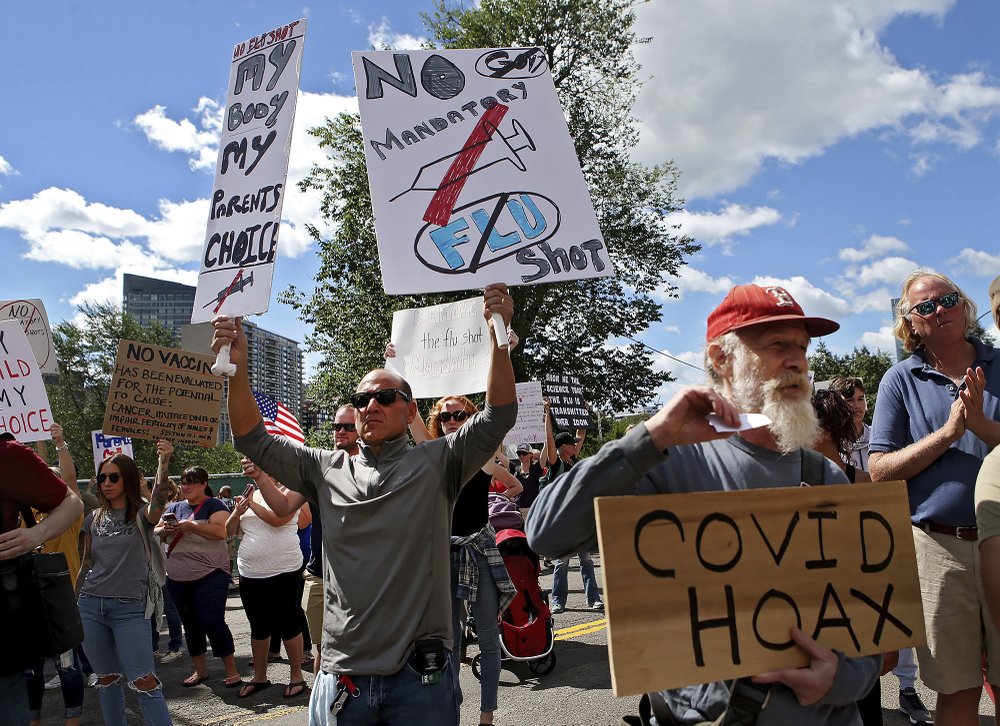
In this Aug. 30, 2020 file photo, Sal Lando, left, of Sterling, holds up signs during a protest against mandatory flu vaccinations, outside the Massachusetts State House, in Boston. (Nancy Lane/Boston Herald via AP, File)
She said there are other ways of ranking content — for instance, by the quality of the source, or chronologically — that would serve users better. The reason Facebook won’t consider them, she said, is that they would reduce engagement.
“Facebook knows that when they pick out the content … we spend more time on their platform, they make more money,” Haugen said.
Haugen’s leaked documents also reveal that a relatively small number of Facebook’s anti-vaccine users are rewarded with big pageviews under the tech platform’s current ranking system.
Internal Facebook research presented on March 24 warned that most of the “problematic vaccine content” was coming from a handful of areas on the platform. In Facebook communities where vaccine distrust was highest, the report pegged 50% of anti-vaccine pageviews on just 111 — or .016% — of Facebook accounts.
“Top producers are mostly users serially posting (vaccine hesitancy) content to feed,” the research found.
On that same day, the Center for Countering Digital Hate published an analysis of social media posts that estimated just a dozen Facebook users were responsible for 73% of anti-vaccine posts on the site between February and March. It was a study that Facebook’s leaders in August told the public was “faulty,” despite the internal research published months before that confirmed a small number of accounts drive anti-vaccine sentiment.
Earlier this month, an AP-NORC poll found that most Americans blame social media companies, like Facebook, and their users for misinformation.
But Ahmed said Facebook shouldn’t just shoulder blame for that problem.
“Facebook has taken decisions which have led to people receiving misinformation which caused them to die,” Ahmed said. “At this point, there should be a murder investigation.”
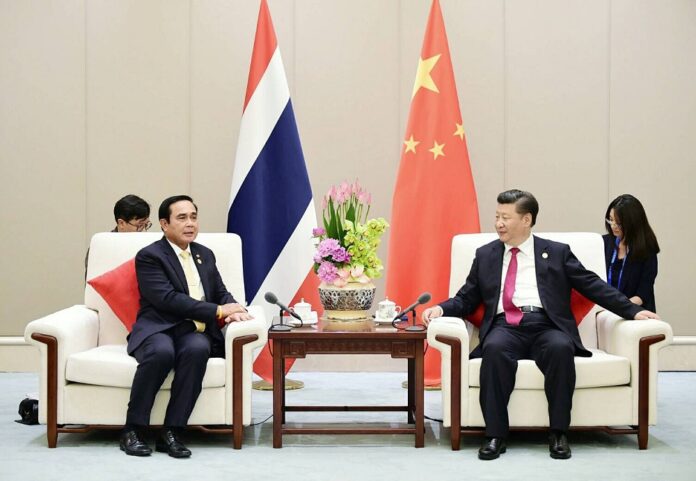
PM Prayut Chan-o-cha meets with Chinese president Xi Jinping to discuss the progress in Thai-China railway project in Hangzhou, China, on Sep. 4, 2016.
BANGKOK — PM Prayut Chan-o-cha called for closer cooperation between ASEAN and China in many aspects during his remark at the summit between the two parties, which took place virtually this year due to the pandemic.
According to a report on China’s state media agency Xinhua, the Prime Minister made the statement at the 24th ASEAN-China Summit via video conferencing, saying that the environment, vaccine cooperation, trade, and other security matters remain the top mutual priority that which both ASEAN and China should continue to work together in response to COVID-19 and future emerging diseases.
He also said Thailand supports China’s development as a “responsible great power” and expects China to continue its leading role in promoting cooperation in all aspects with the international community, including ASEAN and other developing countries.
A particular focus should be put on research and development of safe and effective vaccines and medicines as well as the establishment of vaccine production and distribution centers in ASEAN, the Xinhua report quoted Prayut as saying.
The Prime Minister then stressed on the importance of “durable peace” for ASEAN and China to move towards a comprehensive strategic partnership, and urged both parties to pursue win-win cooperation like marine environmental protection.
The ASEAN-China summit took place in conjunction with the 38th ASEAN Summit, which was similarly held through online platforms.
At the ASEAN summit, PM Prayut called upon the member states to seriously cooperate on COVID-19 solutions, stimulate regional economy and promote balanced growth, according to a transcript provided by the government.
Gen Prayut suggested the community attach importance to three areas simultaneously: implementation of ASEAN’s initiatives to effectively combat threats posed by COVID-19; a better management of travel and cargo transportation within the region; and a balanced growth for its sustainable development by focusing on both economic interest and environmental conservation.
Andrea Bocelli, at left, and Lalisa “Lisa” Manobal.
BANGKOK — The government insists on its plan to spend up to 100 million baht on securing the appearance of K-pop star “Lisa Blackpink” and Italian tenor Andrea Bocelli for the New Year’s Eve festivities on Phuket island.
Tourism and Sports Minister Phiphat Ratchakitprakarn told reporters that both superstars will bring in much needed tourism revenues for the country, and said most of the cost will be covered by sponsorships from the private sector, though he did not name any organizations in particular.
Phiphat said the plan is endorsed by PM Prayut Chan-o-cha himself, but a formal decision on the matter will have to be decided in a Cabinet meeting scheduled for Nov. 16. The tourism ministry will review draft contracts by the end of this month, he added.
Government officials have said that hiring Lalisa “Lisa” Manobal, the Thailand-born singer from the K-pop band Blackpink, and Bocelli will help promote tourism and generate considerable economic boon to the southern island of Phuket.
Their superstar performance in Phuket would coincide with the upcoming reopening to tourists on Nov. 1, the government said.
Bocelli was also initially set to perform in Bangkok as well, but the government already scrapped the idea.
But the plan to hire the two global celebrities has come under intense criticism on social media, where critics point to the huge cost involved, which they believe should have been spent on supporting the small businesses hit by the pandemic instead. Others suggested the government give priority to domestic musical talents, many of whom have been unemployed since the coronavirus outbreak in April.
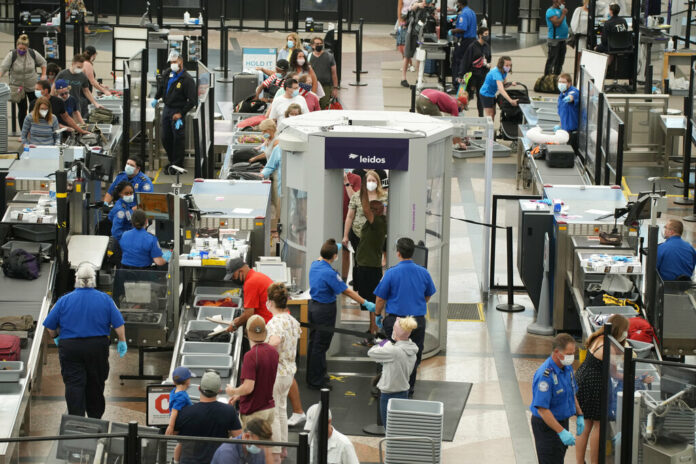
Travelers wear face coverings in the line for the south security checkpoint in the main terminal of Denver International Airport on Aug. 24, 2021, in Denver. Photo: David Zalubowski / AP
WASHINGTON (AP) — Children under 18 and people from dozens of countries with a shortage of vaccines will be exempt from new rules that will require most travelers to the United States be vaccinated against COVID-19, the Biden administration announced.
The government said Monday it will require airlines to collect contact information on passengers regardless of whether they have been vaccinated to help with contact tracing, if that becomes necessary.
Beginning Nov. 8, foreign, non-immigrant adults traveling to the United States will need to be fully vaccinated, with only limited exceptions, and all travelers will need to be tested for the virus before boarding a plane to the U.S. There will be tightened restrictions for American and foreign citizens who are not fully vaccinated.
The new policy comes as the Biden administration moves away from restrictions that ban non-essential travel from several dozen countries — most of Europe, China, Brazil, South Africa, India and Iran — and instead focuses on classifying individuals by the risk they pose to others.
It also reflects the White House’s embrace of vaccination requirements as a tool to push more Americans to get the shots by making it inconvenient to remain unvaccinated.
Under the policy, those who are vaccinated will need to show proof of a negative COVID-19 test within three days of travel, while the unvaccinated must present a test taken within one day of travel.
Children under 18 will not be required to be fully vaccinated because of delays in making them eligible for vaccines in many places. They will still need to take a COVID-19 test unless they are 2 or younger.
Others who will be exempt from the vaccination requirement include people who participated in COVID-19 clinical trials, who had severe allergic reactions to the vaccines, or are from a country where shots are not widely available.
That latter category will cover people from countries with vaccination rates below 10% of adults. They may be admitted to the U.S. with a government letter authorizing travel for a compelling reason and not just for tourism, a senior administration official said. The official estimated that there are about 50 such countries.
The U.S. will accept any vaccine approved for regular or emergency use by the U.S. Food and Drug Administration or the World Health Organization. That includes Pfizer, Moderna, Johnson & Johnson, AstraZeneca and China’s Sinopharm and Sinovac vaccines. Mixing-and-matching of approved shots will be permitted.
The Biden administration has been working with airlines, who will be required to enforce the new procedures. Airlines will be required to verify vaccine records and match them against identity information.
Quarantine officers from the Centers for Disease Control and Prevention will spot-check passengers who arrive in the U.S. for compliance, according to an administration official. Airlines that don’t enforce the requirements could be subject to penalties of up to nearly $35,000 per violation.
The new rules will replace restrictions that began in January 2020, when President Donald Trump banned most non-U.S. citizens coming from China. The Trump administration expanded that to cover Brazil, Iran, the United Kingdom, Ireland and most of continental Europe. President Joe Biden left those bans in place and expanded them to South Africa and India.
Biden came under pressure from European allies to drop the restrictions, particularly after many European countries eased limits on American visitors.
“The United States is open for business with all the promise and potential America has to offer,” Commerce Secretary Gina Raimondo said after Monday’s announcement.
The main trade group for the U.S. airline industry praised the administration’s decision.
“We have seen an increase in ticket sales for international travel over the past weeks, and are eager to begin safely reuniting the countless families, friends and colleagues who have not seen each other in nearly two years, if not longer,” Airlines for America said in a statement.
The pandemic and resulting travel restrictions have caused international travel to plunge. U.S. and foreign airlines plan to operate about 14,000 flights across the Atlantic this month, just over half the 29,000 flights they operated during October 2019, according to data from aviation-research firm Cirium.
Henry Harteveldt, a travel-industry analyst in San Francisco, said the lifting of country-specific restrictions will help, but it will be tempered by the vaccination and testing requirements.
“Anyone hoping for an explosion of international inbound visitors will be disappointed,” he said. “Nov. 8 will be the start of the international travel recovery in the U.S., but I don’t believe we see full recovery until 2023 at the earliest.”
The Biden administration has not proposed a vaccination requirement for domestic travel, which the airlines oppose fiercely, saying it would be impractical because of the large number of passengers who fly within the U.S. every day.
__
Story: Zeke Miller and David Koenig. Koenig reported from Dallas.
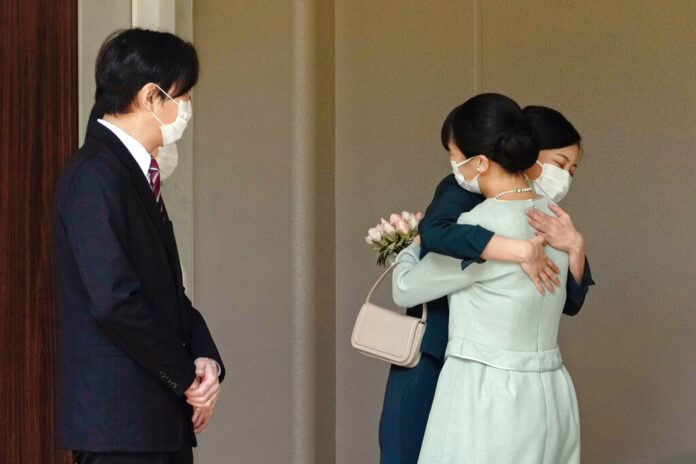
Japan's Princess Mako, right, hugs her sister Princess Kako, watched by her parents Crown Prince Akishino and Crown Princess Kiko, before leaving her home in Akasaka Estate in Tokyo Tuesday, Oct. 26, 2021. Photo: Koki Sengoku / Kyodo News via AP
TOKYO (AP) — Japanese Princess Mako married a commoner and lost her royal status Tuesday in a union that has split public opinion after a three-year delay caused by a financial dispute involving her new mother-in-law.
The marriage document for Mako and Kei Komuro was submitted by a palace official Tuesday morning and is now official, the Imperial Household Agency said.
No longer a royal, Mako has now taken the surname of her husband and become Mako Komuro — the first time she has had a family name. In Japan’s imperial family, only male members are given household names, while female members only have titles and must leave if they marry commoners.
This example of prewar-era paternalism, still kept alive by the imperial family, is also reflected in Japanese gender policies that many criticize as outdated, including a law that requires married couples to use only one surname, almost always the husband’s.
The newlyweds will make statements at a news conference in the afternoon but will only provide written answers to questions because Mako showed fear and unease over what would be asked, the agency said.
Mako is recovering from what palace doctors described earlier this month as a form of traumatic stress disorder that she developed after seeing negative media coverage about their marriage, especially attacks on Komuro.
There will be no wedding banquet and there have been no other marriage rituals for the couple. Their marriage is not celebrated by many people, the agency has said.
Mako, who turned 30 three days before the wedding, is a niece of Emperor Naruhito. She and Komuro were classmates at Tokyo’s International Christian University when they announced in September 2017 that they intended to marry the following year, but the financial dispute surfaced two months later and the wedding was suspended.
The dispute involves whether money his mother received from her former fiancé was a loan or a gift. Mako’s father asked Komuro to clarify, and he wrote a statement defending himself, but it is still unclear if the dispute has been fully resolved.
Komuro, 30, left for New York in 2018 to study law and only returned to Japan last month. His hair, tied in a ponytail, captured attention as a bold statement for someone marrying a princess in the tradition-bound imperial family and only added to the criticism.
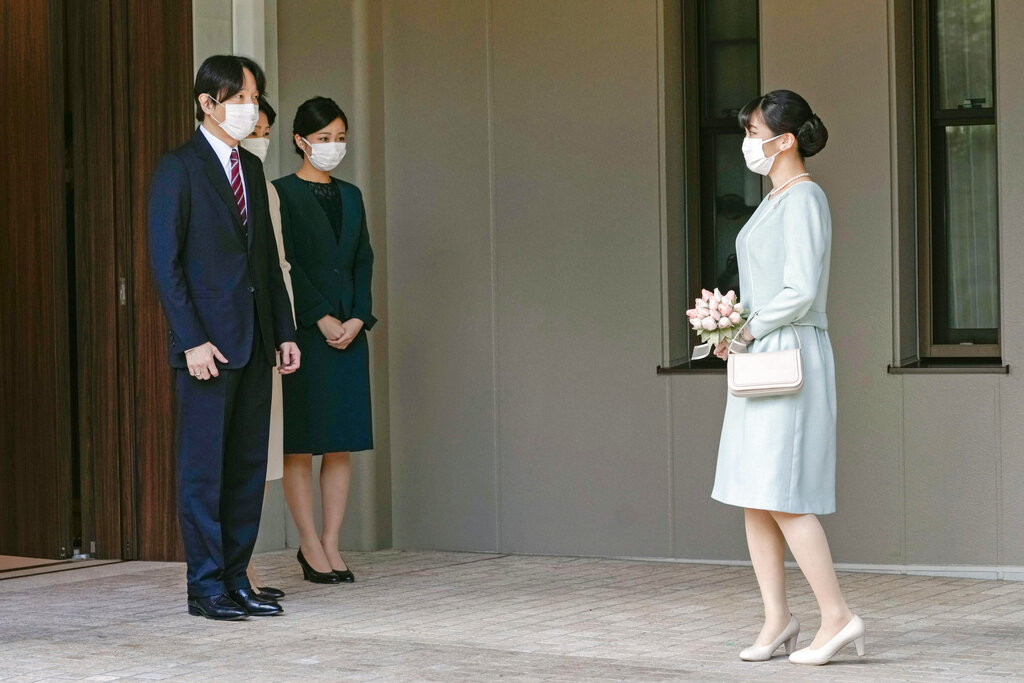
Japan’s Princess Mako, right, talks with her parents Crown Prince Akishino, Crown Princess Kiko and her sister Princess Kako, third from left, before leaving her home in Akasaka Estate in Tokyo Tuesday, Oct. 26, 2021. Photo: Koki Sengoku / Kyodo News via AP
Mako has also declined the 140 million yen ($1.23 million) dowry to which she was entitled for leaving the imperial family, palace officials said. She is the first imperial family member since World War II to not receive the payment while marrying a commoner and chose to do so because of the criticism over her marrying a man some consider unfit for the princess.
On Tuesday morning, she left the palace wearing a pale blue dress and holding a bouquet. She bowed outside the residence of her parents, Crown Prince Akishino and Crown Princess Kiko, and her sister Kako, and then the sisters hugged each other.
The Imperial House Law allows only male succession and requires women to renounce their royal status when they marry a commoner, a practice that has reduced the number of royal family members and the successors to the throne.
After Naruhito, there are only Akishino and his son, Prince Hisahito, in the line of succession. A panel of government-appointed experts are discussing a stable succession of the Japanese monarchy, but conservatives still reject female succession or allowing female members to head the imperial family.
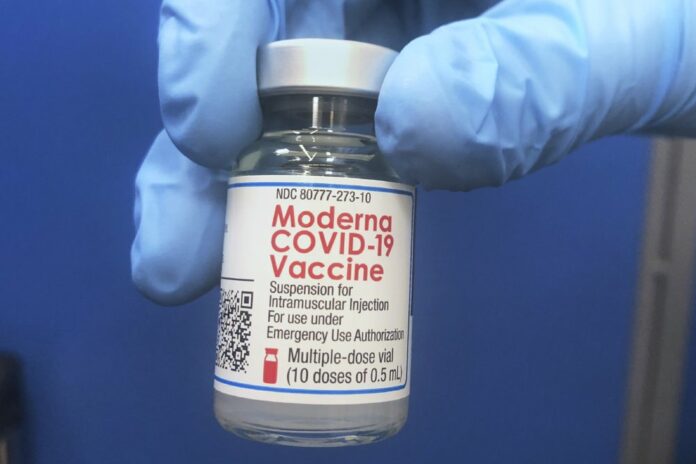
A vial of Moderna COVID-19 vaccine is held at a vaccination site Friday, Feb. 19, 2021, in Oklahoma City. (AP Photo/Sue Ogrocki)
BANGKOK — The Ministry of Foreign Affairs appears to have scuttled an offered donation of 3 million doses of Moderna vaccine from a government agency in Poland to a hospital in Thailand, citing the need to conduct the deal through an “appropriate” diplomatic channel.
The MFA’s effort to block the shipment of the mRNA vaccines to Thailand was revealed in an internal document published by Than Setthakit newspaper on Monday. According to the letter, which was sent by the MFA to Thammasat University Hospital, the ministry said it cannot facilitate the donation, since it was not conducted on a government-to-government basis.
“The Ministry of Foreign Affairs was not informed about the aforementioned donation through formal diplomatic channels by Poland’s Ministry of Foreign Affairs or the Polish Embassy in Thailand,” the letter said. “Therefore, we believe a direct communication between the vaccine donor in Poland and the vaccine recipient in Thailand would be more appropriate.”
The MFA also warned that Thammasat University, who runs the hospital, should consult health authorities in Thailand first about its wishes to receive the donation of Moderna vaccines from Poland, lest there be any issue about indemnity or damages related to the donation.
“Thammasat University should carefully consider the protocols involved in the donation of Moderna vaccines to avoid any complaints from any side in the future,” the letter said.
Thammasat University Hospital previously said it secured a shipment of 3 million shots of COVID-19 vaccine made by Moderna from Rzadowa Agencja Rezerw Strategicznych, a government agency in Poland, free of charge. The donation was supposed to take place this month.
Moderna was approved by Thai health authorities in July as an “alternative” vaccine that private hospitals and clinics can sell to customers. The sales typically come with a no-refund clause.
But the vaccines have yet to arrive, following multiple delays, a cause of frustration for many Thais who already pre-ordered the vaccines from private hospitals and clinics.
In October, Zuellig Pharma, the company responsible for distribution of the Moderna vaccine, said the doses will arrive in weekly shipments starting in November, though The firm did not give any precise date.
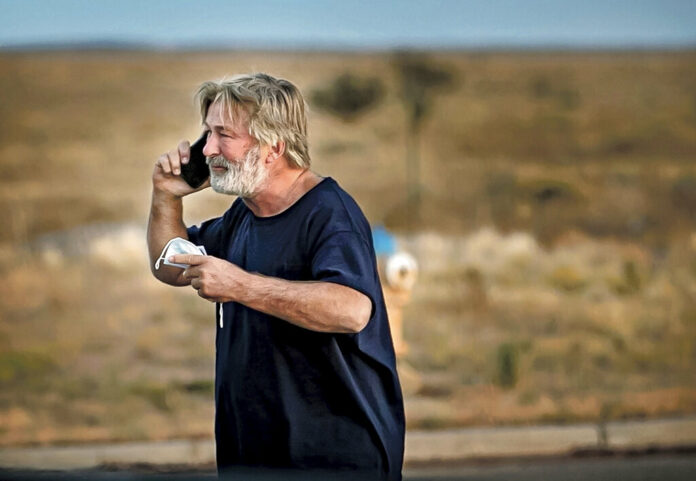
Alec Baldwin speaks on the phone in the parking lot outside the Santa Fe County Sheriff's Office in Santa Fe, N.M., after he was questioned about a shooting on the set of the film "Rust" on the outskirts of Santa Fe, Thursday, Oct. 21, 2021. Photo: Jim Weber / Santa Fe New Mexican via AP
LOS ANGELES (AP) — A camera operator told authorities that Alec Baldwin had been careful with weapons on the set of the film “Rust” before the actor shot and killed a cinematographer with a gun he’d been told was safe to use, court records released Sunday show.
Cameraman Reid Russell told a detective that Baldwin was rehearsing a scene Thursday in which he was set to draw his gun while sitting in a church pew and point it at the camera. The camera wasn’t rolling when the gun went off, killing cinematographer Halyna Hutchins, Russell told a detective according to a search warrant affidavit.
Authorities said Friday that the assistant director, Dave Halls, had handed the weapon to Baldwin and announced “cold gun,” indicating it was safe to use. When asked about how Baldwin treated firearms on the set, Russell said the actor was very careful, citing an instance when Baldwin made sure a child actor was not near him when a gun was being discharged.
The affidavit released Sunday also includes statements by director Joel Souza, who was standing behind Hutchins and was also wounded.
This aerial photo shows a film set at the Bonanza Creek Ranch in Santa Fe, N.M., Saturday, Oct. 23, 2021. Actor Alec Baldwin fired a prop gun on the set of a Western being filmed at the ranch on Thursday, Oct. 21, killing the cinematographer, officials said. Photo: Jae C. Hong / AP
It detailed the moments before the shooting and shows that there was turmoil on the set the day of the shooting. Several members of the camera crew walked off the production in a dispute over payment and lodging, Russell said, and he was left with a lot of work to do. Only one camera was available to shoot, and it had to be moved because the light had shifted and there was a shadow.
He said he was unsure whether the weapon was checked before it was handed to Baldwin.
Souza said that he was focused on how the scene would appear on camera. He said he recalled hearing the phrase “cold gun” being used before the shooting.
He said the scene they were shooting did not call for the use of live rounds.
Souza described the gunshot as sounding like a whip and a loud pop.
On Sunday, a crew member who worked with Halls on another project said she had raised safety concerns about him in 2019.
Maggie Goll, a prop maker and licensed pyrotechnician, said in a statement that she filed an internal complaint with the executive producers of Hulu’s “Into the Dark” series in 2019 over concerns about Halls’ behavior on set. Goll said in a phone interview Sunday that Halls disregarded safety protocols for weapons and pyrotechnics and tried to continue filming after the supervising pyrotechnician lost consciousness on set.
Halls has not returned phone calls and email messages seeking comment.
The fatal shooting and previous experiences point to larger safety issues that need to be addressed, Goll said, adding that crew member safety and wellbeing were top issues in recent contract negotiations between a union that represents film and TV workers and a major producers’ group.
“This situation is not about Dave Halls. … It’s in no way one person’s fault,” she said. “It’s a bigger conversation about safety on set and what we are trying to achieve with that culture.”
The film’s chief electrician Serge Svetnoy blamed producers for Hutchins’ death in an emotional Facebook post on Sunday. Svetnoy said he had worked with Hutchins on multiple films and faulted “negligence and unprofessionalism” among those handling weapons on the set. He said producers hired an inexperienced armorer.
Hollywood professionals say they’re baffled by the circumstances and production crews have quickly stepped up safety measures.
Jeffrey Wright, who has worked on projects including the James Bond franchise and the upcoming movie “The Batman,” was acting with a weapon on the set of “Westworld” when news broke of the shooting Thursday at a New Mexico ranch. “We were all pretty shocked. And it informed what we did from that moment on,” he said in an interview Sunday at the Newport Beach Film Festival.
“I don’t recall ever being handed a weapon that was not cleared in front of me — meaning chamber open, barrel shown to me, light flashed inside the barrel to make sure that it’s cleared,” Wright said. “Clearly, that was a mismanaged set.”
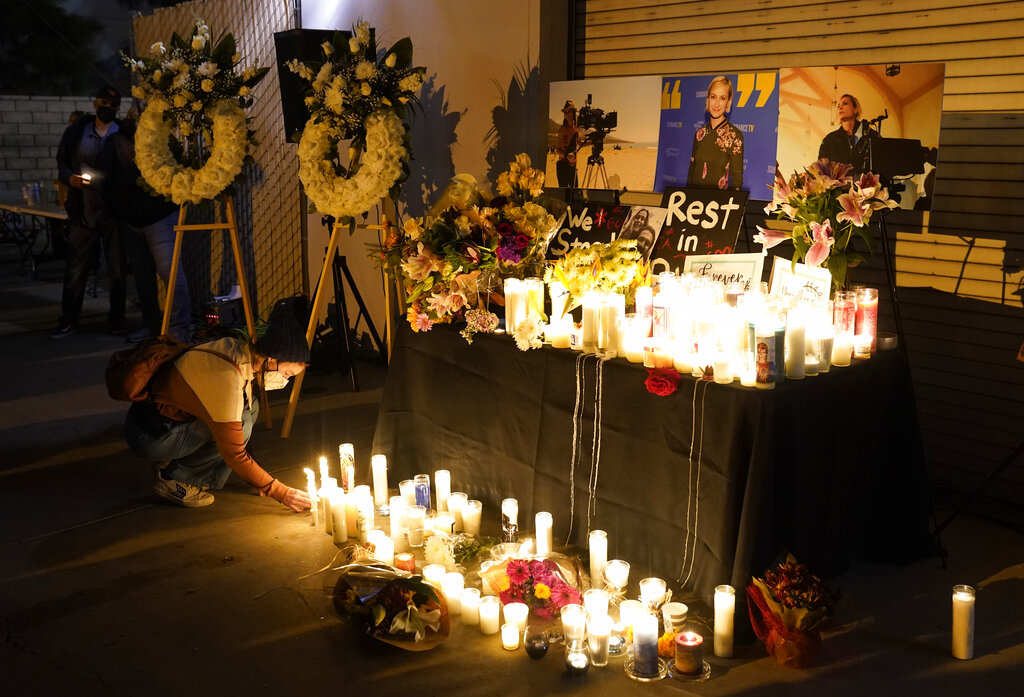
A woman lays down a candle during a vigil for the late cinematographer Halyna Hutchins, seen in photographs at top right, Sunday, Oct. 24, 2021, in Burbank, Calif. Photo: Chris Pizzello / AP
Actor Ray Liotta agreed with Wright that the checks on firearms are usually extensive.
“They always — that I know of — they check it so you can see,” Liotta said. “They give it to the person you’re pointing the gun at, they do it to the producer, they show whoever is there that it doesn’t work.”
A vigil for Hutchins was held Sunday in Southern California, where attendees exchanged tearful hugs and speakers echoed calls for heightened safety standards.
Baldwin, who is known for his roles in “30 Rock” and “The Hunt for Red October” and his impression of former President Donald Trump on “Saturday Night Live,” has described the killing as a “tragic accident.”
___
Story: Ryan Pearson and Gillian Flaccus. Flaccus reported from Portland, Oregon. Michelle Eaton in Newport Beach, California, contributed to this report.
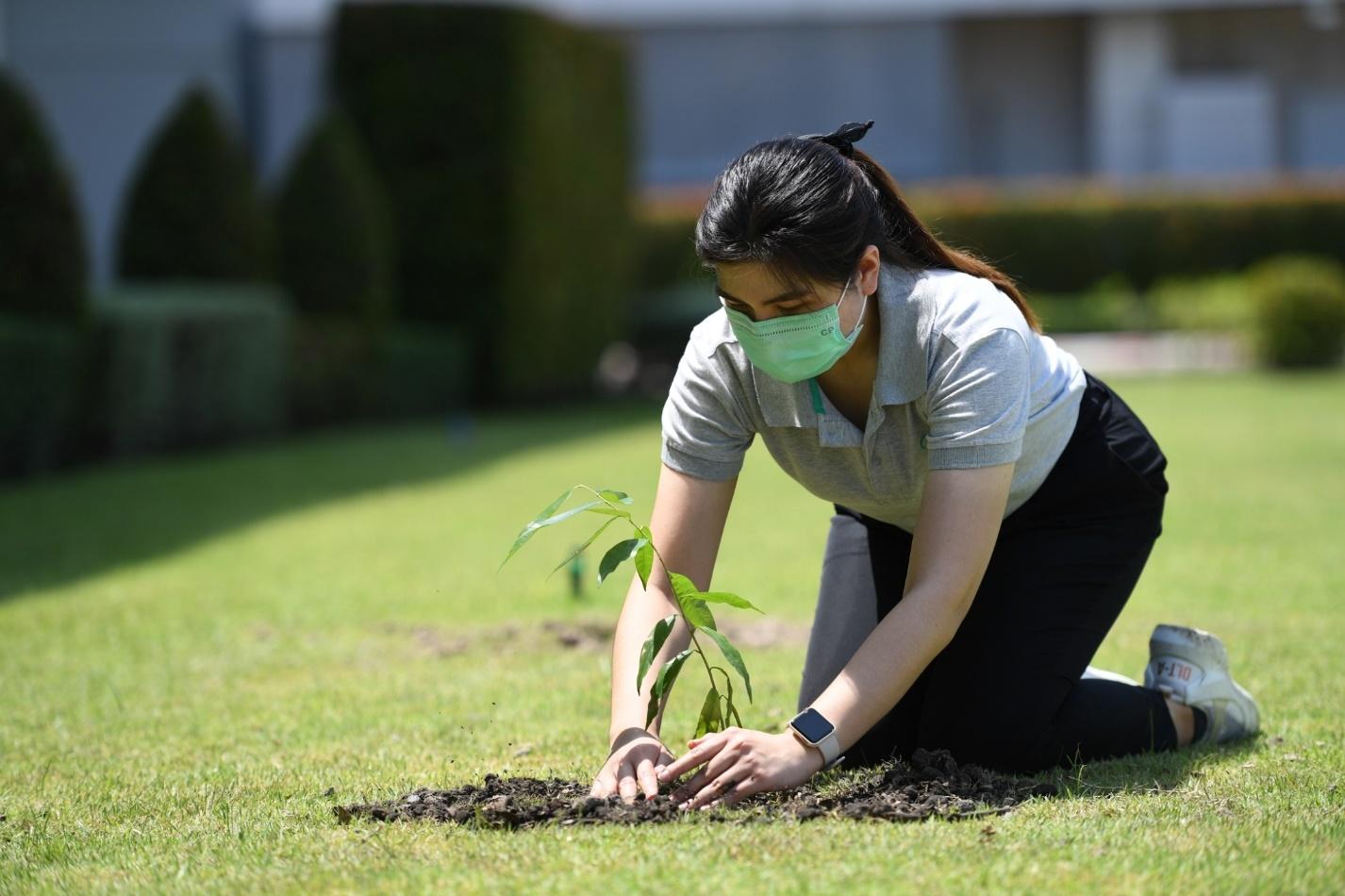
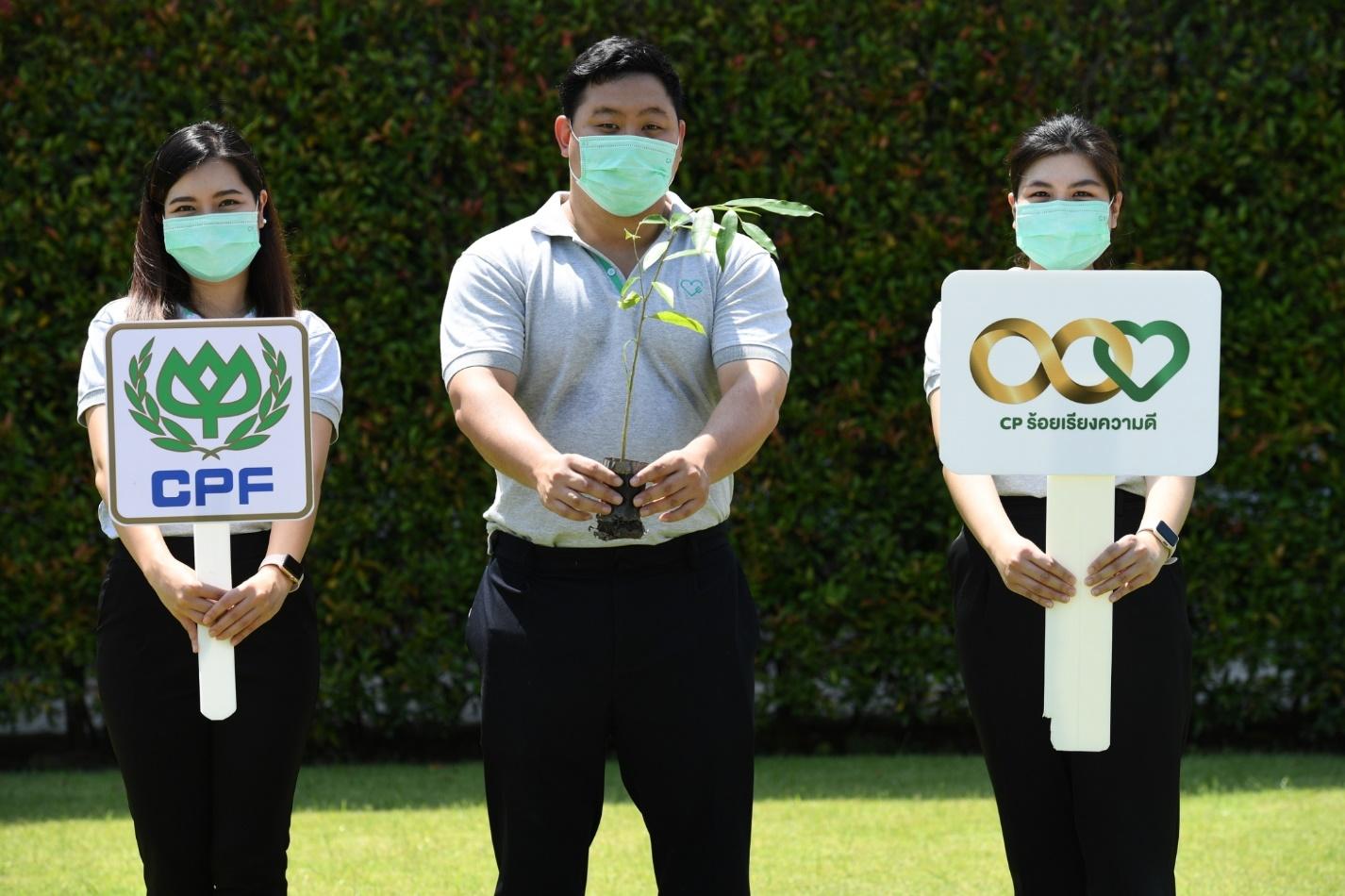
Charoen Pokphand Foods PCL (CP Foods), has encouraged employees across the countries to join grow trees at their workplaces or their homes to increase green space across Thailand, under the “CP Roi Save the World”, initiated by CP Group to join do good deeds with the target growing 10 million plants. The effort help support to CP Group’s target to achieve zero emission with 2030 as well as supporting the United Nations Sustainable Development Goals (SDGs) and Thai government’s goal of planting 100 million trees by 2022.
Mr.Prasit Boonduangprasert, chief executive officer of CP Foods, hoped the employee’s contribution will help increase green areas, preserve biodiversity, reduce greenhouse emissions as well as sustain our planet. This is in line with the new strategy “CPF 2030 Sustainability in Action”, that adheres to the 3 pillars of food security, a self-sufficient society, and balance of nature.
Moreover, CP Foods has kicked off the “Sustainability in Action, Sustainability in Our Hands” Project, to encourage all employees’ participation in the path towards sustainability. All are urged to individually get their hands on the Company’s two activities: to grow trees at home under “Forest in the City” ; and to achieve zero waste by emptying one’s plate under “Empty Plate…Save the Planet”.
Under the “Forest in the City” campaign gives employees economic trees as well as small plants that help trap PM 2.5 particles to grow at home or operational areas or the participants are allowed to grow their own trees to join the activities. All participants will record the data of growth to be later used for calculating carbon absorption. The company targets employees to grow 20,000 trees in this year and achieve 100,000 trees within 2025.
Aside environmental impact, both projects will create jobs and generate income for many communities that cultivate the seedlings for CP Group.
No doubt you’ve seen or certainly heard about generations of our ancestors going to the market; touching, squeezing and sampling the produce they want to buy. Carefully selecting items that are in season and of the finest quality. But now things are moving online more and more, it can be easy to feel a little concerned and perhaps even disconnected from the produce we’re purchasing. Despite this, we firmly believe that the benefits of online grocery shopping in Malaysia certainly outweigh any negatives. Let us explain a little more…
1: Online grocery shopping in Malaysia is a timesaver
Your time is precious. By turning to online grocery shopping in Malaysia, you can save time travelling to and from the supermarket, as well as the time spent searching the aisles for the items on your list. Let someone else take on the hassle of grocery shopping when you buy your products online instead.
2: Avoid temptation
Ever gone grocery shopping when you’re hungry? Yep, us too. We’ve all done it. Suddenly the chocolate and sweets you would have avoided otherwise are far too tempting. And how about those offers on products you never knew you needed or had any intention of buying? It’s easy to waste valuable money indulging in snacks and items that are on offer. All of which can be avoided if you make a move to online grocery shopping!
3: Stick to your budget
Buying your groceries online makes it easier to compare prices and select the items that suit your budget best. Instead of having to browse the shelves and search for prices, everything is easily displayed for you to make a comparison. This makes shopping on a budget far easier than when you shop in-store. And as mentioned above, it also avoids any temptation to buy items that aren’t on your shopping list!
4: Shop anytime
The beauty of shopping online is that you can do it anytime you like. Don’t be restricted by store opening hours, order your groceries online and have them delivered at a time that suits you best. So if you have a job or a demanding family that means you prefer to shop late at night or early in the morning, online grocery shopping in Malaysia is perfect for you.
5: Avoid the crowds
Covid may have left you a little reluctant of being in a crowd. Online shopping means that you only have to interact with the person who delivers your groceries, helping to keep you and your family safe.
As you can see, online grocery shopping in Malaysia could be a huge game changer for you and your family. Save time, money and energy and spend it on those things that really matter in life.