






















34.4 C
Bangkok
Monday, June 8, 2026
Home Blog Page 1020

Biden To Meet Pope Francis Amid Some Rifts With US Bishops

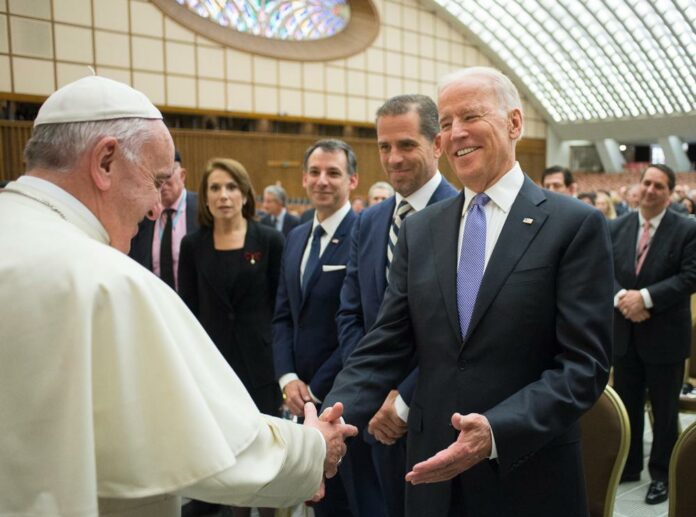
In this April 29, 2016, file photo, Pope Francis shakes hands with Vice President Joe Biden as he takes part at a congress on the progress of regenerative medicine and its cultural impact, being held in the Pope Paul VI hall at the Vatican. (Pablo Martinez Monsivais/L'Osservatore Romano/Pool photo via AP)

There’s an intriguing subplot to President Joe Biden’s upcoming meeting with Pope Francis. The world’s two most prominent Roman Catholics will be celebrating a shared outlook on church teaching and vital social issues even as Biden faces unwavering opposition from many U.S. Catholic bishops over his stances on abortion and LGBTQ rights.

Less than three weeks after Biden’s visit to the Vatican on Friday, the American bishops will convene in Baltimore, with one of the agenda items inspired in part by conservatives who contend that Biden’s support for abortion rights should disqualify him from receiving Communion. Though any document that emerges is not expected to mention Biden by name, it’s possible there could be a clear message of rebuke.

“This is way beyond embarrassing,” said Massimo Faggioli, a professor of historical theology at Villanova University who recently authored a book about Biden and Catholicism.

“For some of the bishops, it’s an act of intimidation” toward Biden, Faggioli said. “And they have a pope who is protecting a Catholic president’s access to the sacraments — he’s had to send a signal from the Vatican saying, ‘We don’t think this is wise.’”

The pope upholds Catholic doctrine opposing abortion and same-sex marriage, but he has irked some conservative Catholics in the U.S. and elsewhere by emphasizing other issues that mesh with Biden’s priorities — protecting the environment, combating racial injustice and poverty, for example.

The pope and Biden “see eye to eye on many issues,” Faggioli said. “But they both are really embattled, facing very strong headwinds … fighting against different kinds of ideologues.”

Biden is only the second Catholic president of the United States., after John F. Kennedy, and displays his faith openly, often wearing a rosary and attending Mass routinely. The devotion dates to childhood; he has expressed gratitude to the nuns who helped bolster his confidence while he struggled with stuttering as a schoolboy.

“Wherever there were nuns, there was home,” he wrote in his 2007 memoir “Promises to Keep.” “My idea of self, of family, of community, of the wider world comes straight from my religion.”

His faith was tested, but not weakened, after his wife and baby daughter were killed in a traffic accident in 1972.

“I never doubted that there was a God, but I was angry with God,” he told The Christian Science Monitor in 2007.

In that same interview, Biden conveyed why he considers himself a faithful Catholic despite his views on abortion.

“My views are totally consistent with Catholic social doctrine,” Biden said. “There are elements within the church who say that if you are at odds with any of the teachings of the church, you are at odds with the church. I think the church is bigger than that.”

Francis already has made clear he won’t shun U.S. political leaders who support abortion rights. On Oct. 9 he met at the Vatican with House Speaker Nancy Pelosi, whose abortion stance has drawn the wrath of the top Catholic in her hometown of San Francisco, Archbishop Salvatore Cordileone.

Cordileone has been urging the U.S. bishops conference to send a message to Biden, Pelosi and others “that would move them in their conscience.”

“They need to understand the scandal that is caused when they say they are faithfully Catholic and yet oppose the church on such a basic concept,” he told The Associated Press in April.

Under Catholic policy, decisions regarding exclusion from Communion are left to individual bishops. While Cordileone has discouraged Pelosi from receiving Communion in his archdiocese, Cardinal Wilton Gregory, the archbishop of Washington, has made clear that Biden is welcome to receive Communion when he attends services there.

Francis, asked last month whether Biden and like-minded politicians should be denied Communion, avoided a “yes” or “no” answer, saying bishops must minister to such people with “compassion and tenderness.” He warned that clerics shouldn’t let politics influence decisions about receiving Communion.

Abortion is not the only issue placing Biden in opposition to the U.S. bishops. He is a strong supporter of the proposed Equality Act, which would extend federal civil rights protections to LGBTQ people nationwide. The bishops say the bill, currently stalled in the Senate, would violate the religious freedom of churches and individuals opposed to same-sex marriage and various transgender-rights policies.

The meeting this coming week will be Biden’s first encounter with Francis since becoming president, but he has met him three times before: first when Francis was inaugurated as pope in 2013; later during the pontiff’s 2015 visit to the U.S.; and in 2016, when Biden visited the Vatican for a conference on regenerative medicine, where he spoke on cancer prevention.

Francis repeatedly reaffirmed his opposition to abortion in recent weeks, calling the procedure “murder” and defending the right of conscientious objectors to refuse to participate in it. He has likened abortion to “hiring a hitman” to solve a problem.

Chad Pecknold, a professor of theology at The Catholic University of America, doubts that the pope will confront Biden over his support for abortion rights, but said many Catholics — bishops included — may wish that would happen.

“I think the Catholic faithful have a right to hope for this, and to express their concern for the soul of Mr. Biden,” Pecknold said.

The Biden-Francis visit “could actually highlight the urgent need to unite around a clear and coherent view of how the bishops should respond to politicians who publicly hold the Church’s teaching in contempt while presenting themselves for Holy Communion,” Pecknold added via email.

Steven Millies, a professor of public theology at Catholic Theological Union in Chicago, said the meeting will affect the debate over abortion and Communion “in a way that will produce a lot of heat and very little light.” He doubts Francis will see a need to discuss abortion with Biden.

“It’s not going to get anybody anywhere,” Millies said. “On the other hand, there’s a great deal to be accomplished by focusing on areas of aligned concerned and shared interest.”

When Kennedy became the first Catholic president in 1960, abortion was not the divisive issue that it is today. Not until 1973 was there a nationwide right to abortion, and Kennedy felt no pressure to take a public stance.

Anti-Catholic prejudice was common as Kennedy campaigned. Some Protestant ministers questioned whether he could maintain independence from the Catholic Church.

Unlike Biden, Kennedy enjoyed overwhelming support from Catholic voters, winning about 80% of their votes in 1960, according to researchers at Georgetown University. Biden was backed by about half of Catholic voters in the 2020 election.

___

AP News Researcher Rhonda Shafner in New York contributed to this report.

___

Associated Press religion coverage receives support from the Lilly Endowment through The Conversation U.S. The AP is solely responsible for this content.
Advertisement

It’s Time To Talk About the Lese Majeste Law

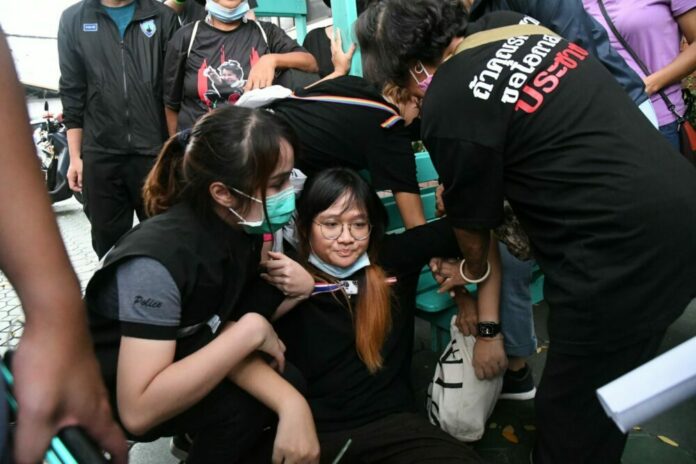
Monarchy-reform movement protest co-leader Benja Apan, 22, arrested by police on charges of lese-majeste Oct. 7 in Bangkok. She is charged with defaming the King through her speech Sept. 10 in front of Sino-Thai Tower.

Consider this an open letter to fellow Thai journalists.

A year has passed since the students-led monarchy reform movement descended to the streets of Bangkok and beyond in large numbers. One year on, over 140 have been charged with lese majeste crimes, or defaming the monarchy. It’s punishable by a maximum imprisonment term of 15 years. Around half a dozen of them are currently being incarcerated as I type these words.

As Thai journalists, as well as foreign correspondents in Thailand, the lese-majeste law continue to be the biggest impediment to a free press. Only journalists in chronic denial would say they can carry out critical coverage of the monarchy institution in Thailand despite the law. No, censorship and self-censorship are the norm, combined with self-denial or silence to due fears of repercussions or political expediency. As the Thai press watches more people slowly taken to prison under the law, they should bear in mind that we as journalists and media organizations and press associations have an obligation to honour in this unfolding repression of fundamental rights to free expression. 

Parit “Penguin” Chiwarak, a Thammasat University protest leader, Jatupat “Pai Dao Din” Boonpattararaksa and Arnon Nampa, all have been behind bars for nearly 80 days now. Repeated bail applications have been denied.

The press could continue to watch and simply report about more prosecutions as more youths take the risks, are taken to jail, repeatedly denied bail, and refrain from questioning the anachronistic law. Such stance means the Thai press continue to be part of the problem for their lack of courage and commitment to greater press freedom.

It means the mostly young political activists feel the need to express themselves publicly on the streets or on social media, despite the risks as they regard the current situation as not just abnormal but unacceptable, untolerable and undemocratic. (Their next major protest is next Sunday, Oct 31, BTW.)

The least that journalists and media associations can do is to call out publicly and say we need to talk about the lese majeste law and something needs to be done about it. Even if they do not support the abolition of the law, there are crucial details worth reforming: the severity of the law which is disproportionate and more.

Instead of saying this is not our problems, the Thai press can take a leap of faith and public say we need to at least reform the law so the press can function more normally and freely and cease to continue to function as a de facto PR machinery, willingly or not, for the monarchy institution because they can only report positive and more positive news, and non-critical news due to the draconian law.

For those Thai journalists still in denial, one has to only watch footage of the BBC Southeast Asia chief correspondent Jonathan Head spelling it out on air for you. Back in Oct 2016, when Head reported Live about the death of the late king, Rama IX, on Oct 13, he was asked by the news host in London what he thought about the successor, Crown Prince Vajiralongkorn, now the current king, Rama X. Head reminds the BBC news host and its global viewers that he’s not at liberty to freely criticize due to the law (and the fact that he’s in Thailand).

When Head was asked what kind of king Rama X would be, Head replied. “We can’t frankly, because of the law against [defaming] the monarchy, talk very safely about his personality,” Head said, matter of fact.

That’s the next best thing a journalist can do if you have to censor yourself. Let the public know that you are censoring yourself and why. Many Thai journalists took the road more commonly travelled – self-denial and silence, however. 

The lese-majeste law is not just about young activists wanting to critically discuss the monarchy and reform the institution but about the press being unable to do a proper job in providing critical reporting about one of the most important institutions in Thai society. This has gone on for too long and to the detriment of Thai society and basic freedom.

To fellow Thai journalists I say: If not now then when? How many more have to be taken to prison or flee into life-long exile simply because they want to discuss the monarchy critically – something that’s taken for granted in the United Kingdom or Japan. The time is now, the Thai press in general are already a year, if not many many years, late.

It’s time to muster fortitude and publicly say we need to publicly discuss the law and make it in line with the changing world now. Reduce the maximum imprisonment term, bar the general public from being able to file a lese majeste complaint and add into the law a stipulation that if criticism against the monarchy if conducted with good intention for the public interests, it is not a crime. And more. These can be a good start and a compromise.

To not have the courage to do so, to continue the silence and docility, the Thai press will certainly be condemned by history as not just for being part of the problems but for abandoning their duty due to the lack of courage to fight for the very fundamental prerequisites of their profession – press freedom and honesty to the public.

Advertisement

Thailand Easing Tourist Quarantine Rules in November

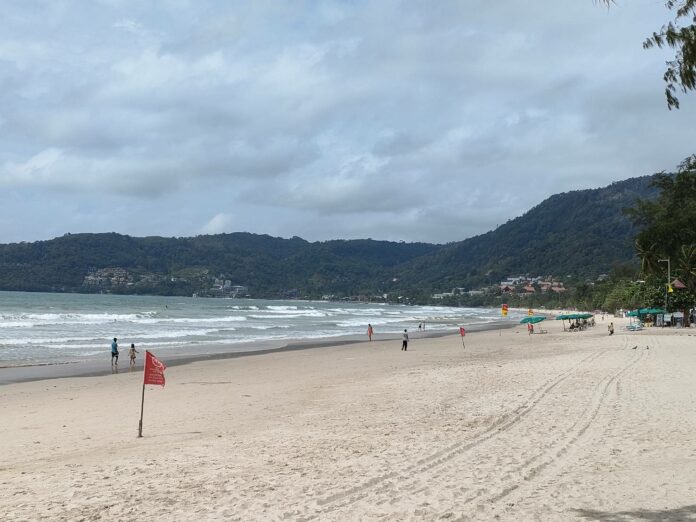
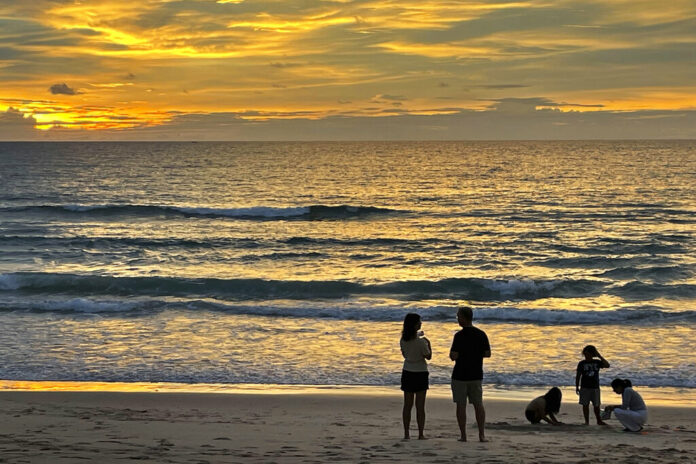
Tourists stand on Bang Tao Beach in Phuket, southern Thailand, Friday, Oct. 22, 2021. Photo: Patrick Quinn / AP

BANGKOK (AP) — Thailand is accelerating plans to reopen the country to foreign tourists, slashing mandatory quarantines beginning Nov. 1 for fully vaccinated visitors arriving by air from 46 countries and territories, officials announced Friday.

The Center for COVID-19 Situation Administration also announced a loosening of local restrictions, including cancellation of a curfew in some areas where risks have lessened and tourists can move freely.

Prime Minister Prayuth Chan-ocha announced earlier this month that Thailand no longer planned to require visitors from at least 10 low-risk nations to quarantine if they are fully vaccinated for COVID-19. He said the list would be expanded on Dec. 1, and then made even more extensive on Jan. 1.

Under the new rules, vaccinated travelers to Thailand from the approved 45 countries plus Hong Kong will be required to show negative results from RT-PCR tests before flying and upon their arrival. They will need to spend their first night in a government-approved hotel awaiting their test results, though the government is not calling that a quarantine. If the results are negative, the person can travel anywhere in Thailand.

Prayuth, announcing the expanded list of countries with eased quarantine rules late Thursday on his Facebook page, wrote: “To wait until everything is ready might be too late. Tourists may decide to visit other countries instead.”

Thailand shut its borders to most foreign visitors in April last year after local transmission of the coronavirus started to climb. Foreign tourist arrivals in 2019 were almost 40 million but plunged to 6.7 million in 2020. Tourism is estimated to have accounted for 12-20% of GDP before the pandemic.

Visitors from other countries are also allowed to enter Thailand but face additional restrictions.

The new rules coming into effect Nov. 1 include ending a late-night curfew in some areas, including Bangkok. The consumption of alcoholic drinks in public places, including restaurants, bars and nightclubs, remains banned, though the government has said the ban will be lifted in December to promote tourism during the New Year holiday season.

Advertisement

Phuket Declares ‘Sandbox’ a Success, Plans More Campaigns

Undated file photo of a beach on Phuket island.

PHUKET — Officials on the southern island of Phuket said the tourism “sandbox” program was so successful that they are now planning to launch more initiatives to attract more travelers under a brand new campaign called “Together Phuket Stepping Forward.”

Phuket Gov. Narong Woonciew says the new campaign will build on top of the success of the island’s sandbox scheme. Discussions to launch “Together Phuket Stepping Forward” were held at a town hall meeting, which was attended by representatives from the authorities and private sectors, Narong said.

“Together Phuket Stepping Forward” would see Phuket turning into a tourism, education, and service innovation hub between 2023 and 2027, according to the Governor.

Phuket was one of Thailand’s top tourist destinations prior to the pandemic, generating 442 billion baht in tourism revenue in 2019, according to government data. The island was hit hard by the coronavirus pandemic, with tourist numbers plummeting and many businesses shutting down.

Officials say the revival of tourism, through the “Phuket Sandbox” program, has generated 2.14 billion baht from over 70,000 tourists between July and September, though only 31,000 of them were foreign visitors.

Bhummikitti Ruktaengam from the Phuket Tourist Association told the media the latest figures show that 51,748 tourists spent around 62,000 baht each per trip during the sandbox stay.

In order to attract more visitors, Bhummikitti suggested a number of measures, including lowering insurance policy conditions for COVID-19, and reducing related fees for low-risk groups.

Meanwhile, the Disease Control Department said half a million vaccine doses are being sent to four southern provinces where local health authorities are struggling with a surge in coronavirus cases.

Department director Opart Karnkawinpong said the four southern provinces of Yala, Narathiwat, Pattani, and Songkhla have already received an earlier allocation of 500,000 vaccine doses, but more are urgently needed to combat the outbreak.

Advertisement

Official: US at Turning Point in Dealing With Myanmar Crisis

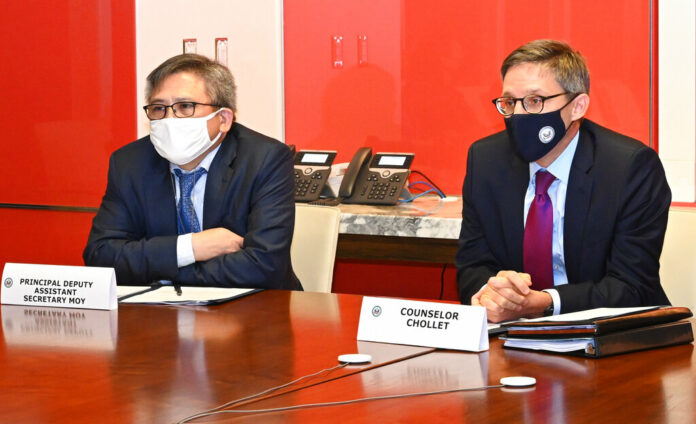
In this photo released by U.S. Embassy in Indonesia, Derek Chollet, right, counselor of the U.S. Department of State, and Kin Moy, principal deputy assistant secretary for the Bureau of East Asian and Pacific Affairs, attend an exclusive interview with The Associated Press at the embassy in Jakarta, Indonesia, Thursday, Oct. 21, 2021. Photo: U.S. Embassy in Indonesia via AP

JAKARTA, Indonesia (AP) — The United States is at a turning point in deciding how to handle the crisis in military-ruled Myanmar, weighing further political and economic steps to pressure the government to change its behavior, a senior U.S. official said Thursday.

“The situation is getting worse inside Burma, both from a humanitarian point of view, from a security point of view, in terms of the economy and the lack of progress on the politics,” U.S. State Department Counselor Derek Chollet told The Associated Press in an interview.

The U.S. has been one of the most vocal opponents of the military takeover that ousted Aung San Suu Kyi’s elected government in February. Suu Kyi was arrested and detained with top members of her National League for Democracy party, including President Win Myint.

A detailed accounting by the Assistance Association for Political Prisoners blames security forces for the killings of almost 1,200 civilians and arresting over 9,043 others since Feb. 1. The government now faces a growing insurgency in many parts of the country.

Chollet, who serves as an adviser to the secretary of state, gave an online interview while the U.S. delegation was in Indonesia after visiting Thailand and Singapore ahead of an annual summit of the Association of Southeast Asian Nations in Brunei, where the situation in Myanmar is likely to dominate.

“We think that we have tools that can help stem the worst from happening in the near term. But as I said, I think we are at an inflection point in the process,” Chollet said. There are political and economic levers that can be pulled by the U.S. and other governments to “pressure the regime to try to give them the kinds of incentives to change their behavior.”

“Part of what we are trying to do as the United States is to come in and not dictate the terms, but to offer our best perspectives and also hear from different partners here in the region,” he said. In talks with the three key ASEAN members, the U.S. delegation was able to to get “a sense of their ideas of the best way forward.”

The U.S., along with the United Kingdom and the European Union, has already placed sanctions on high-ranking Myanmar military members and state-owned enterprises — including those dealing in lucrative timber and gems — that are considered revenue streams for the military.

But activists have been quick to point out that the sanctions have not included American and French oil and gas companies working in Myanmar, allowing the military to maintain its single-largest source of foreign currency revenue. It allows them to make purchases such as refined petroleum, weapons, packaged medicines and other imported goods.

“Not having sanctions is allowing these massive multination companies that have huge stakeholder investment to be potentially complicit in ongoing atrocities and crimes in Myanmar,” said Manny Maung, a Myanmar researcher for Human Rights Watch. “These business relationships are basically going directly to criminal junta. The failure to take reasonable steps … is really quite reckless and allowing businesses to be complicit.”

Chollet admitted there is “no question” that sanctioning of the oil business is a tool available to the U.S. But he also cautioned that Washington would need to “keep in mind the interests” of allies and partners in the region.

“That’s why we’re here is to think through what’s the way forward, what could actually work to try to change the outlook of the junta,” he said. “But then also how can we do so in a way that doesn’t make our problems worse.” He said the Biden administration has not made a final decision.

On Friday, ASEAN announced that it would not invite Myanmar’s military leader Senior Gen. Min Aung Hlaing to the summit, a major repudiation for the country after it refused to allow an ASEAN envoy meet with Suu Kyi. The envoy, a Brunei diplomat, subsequently canceled his trip to Myanmar.

The decision was applauded by the U.N. special rapporteur on human rights in Myanmar, Tom Andrews. He said the military government was seeking money, weapons and legitimacy from the international community.

“ASEAN’s announcement that the junta will not be welcome at its upcoming summit denies the junta the … legitimacy,” he said Monday. “Sustained pressure on all three fronts … is the best way the international community can support the people of Myanmar to protect their human rights and save their country.”

Story: Victoria Milko

Advertisement

Beijing Offering COVID-19 Booster Shots Ahead of Olympics

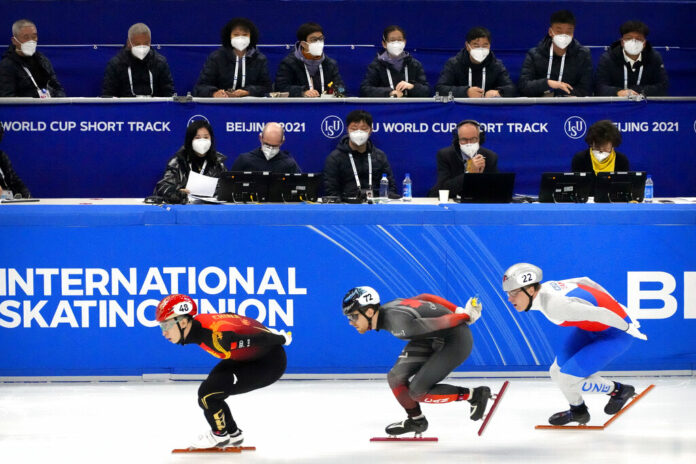
Race officials wearing face masks to protect against COVID-19 watch as skaters compete in a preliminary for men's 1000m at the ISU World Cup Short Track speed skating competition, a test event for the 2022 Winter Olympics, at the Capital Indoor Stadium in Beijing, Friday, Oct. 22, 2021. Photo: Mark Schiefelbein / AP

BEIJING (AP) — China’s capital Beijing has begun offering booster shots against COVID-19, four months before the city and surrounding regions are to host the Winter Olympics.

Anyone 18 or older who have received two-dose Chinese vaccines and belong to at-risk groups, including those participating, organizing or working on games facilities, would be eligible for the additional shot, state media reported Friday.

The booster has been rolling out in cities across the vast nation since late September, but Beijing authorities have been extra cautious in who receives the extra jab.

The games are set to begin on Feb. 4 with only residents of China allowed in the stands. Indoor events with sliding, skiing and jumping will be held in the suburb of Yanqing and the neighboring city of Zhangjiakou.

China has been largely successful in preventing local transmission through strict requirements on mask wearing, quarantining and contact tracing. Cases continue to pop up however, with 28 new ones reported Friday, including one in the Beijing suburb of Fengtai.

The pandemic is believed to have originated in the central Chinese city of Wuhan in late 2019, leading to a total lockdown that affected more than 50 million people.

China has been accused of covering up the initial outbreak and stymying investigations into the coronavirus’ origins, although it said earlier this week that it would cooperate with a renewed investigation by the World Health Organization while “firmly opposing any forms of political manipulation.”

WHO on Wednesday released a proposed list of 25 experts to advise it on next steps in the search for the virus’ origins after its earlier efforts were attacked for going easy on China.

Advertisement

Russians to Stay Off Work for a Week as Virus Deaths Rise

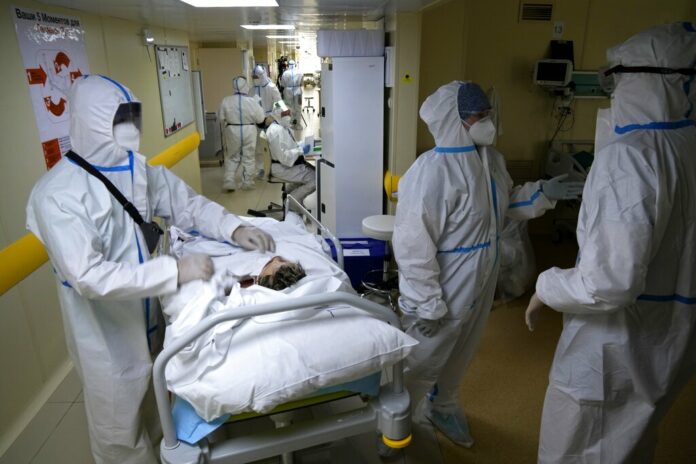
Medics wearing special suits to protect against coronavirus prepare to move a patient with coronavirus at an ICU at the Moscow City Clinical Hospital 52, in Moscow, Russia, Tuesday, Oct. 19, 2021. Photo: Alexander Zemlianichenko / AP

MOSCOW (AP) — President Vladimir Putin on Wednesday ordered most Russians to stay off work for a week starting later this month amid rising COVID-19 infections and deaths, and he strongly urged reluctant citizens to get vaccinated.

The government coronavirus task force reported 1,028 deaths in the past 24 hours, the highest number since the start of the pandemic. That brought Russia’s death toll to 226,353, by far the highest in Europe.

Putin said he supports the Cabinet’s proposal to introduce a nonworking period starting Oct. 30 and extending through the following week, when four of seven days are already non-working, including a two-day state holiday. In some regions where the situation is the most threatening, he said the nonworking period could start as early as Saturday and be extended past Nov. 7.

“Our task today is to protect life and health of our citizens and minimize the consequences of the dangerous infection,” Putin said in a video call with top officials. “To achieve that, it’s necessary to first of all slow the pace of contagion and mobilize additional reserves of the health care system, which is currently working under a high strain.”

Russia’s daily coronavirus mortality numbers have been surging for weeks and topped 1,000 for the first time over the weekend amid sluggish vaccination rates, lax public attitudes toward taking precautions and the government’s reluctance to toughen restrictions. Only about 45 million Russians — roughly a third of its nearly 146 million people — are fully vaccinated.

The nonworking period should help limit the spread by keeping people out of offices and off crowded public transportation, but Moscow and many other cities haven’t curbed access to restaurants, cafes, bars, theaters and gyms.

When the Cabinet proposed the measure Tuesday, many Russians rushed to book flights to Black Sea resorts to take advantage of the break.

Deputy Prime Minister Tatyana Golikova, who leads the task force, emphasized that the nonworking week should imply limiting access to restaurants, theaters and other entertainment venues, adding that regional authorities will be expected to impose restrictions.

She particularly urged Russians to refrain from traveling to other regions during the period and emphasized the need for relatives of those infected to stay home.

It wasn’t immediately clear what private businesses would be required to stop working in line with Putin’s decree, in addition to state workers and employees of state-owned companies. During a similar measure early in the pandemic, many private and state-owned companies in “vital” economic sectors were allowed to keep operating.

The Cabinet has drafted measures on compensation to businesses to help absorb the economic blow, including one-time payments equivalent to a minimum monthly pay per worker and low-interest credits.

In urging Russians to get the shots, Putin said “it’s a matter of your life and security and the health of your dear ones.”

“There are only two ways to get over this period — to get sick or to receive a vaccine,” he said. “It’s better to get the vaccine. Why wait for the illness and its grave consequences? Please be responsible and take the necessary measures to protect yourself, your health and your close ones.”

The Russian leader, who got the domestically developed Sputnik V vaccine earlier this year, said he’s puzzled by the vaccine hesitancy, even among his close friends, who told him they would get the shot after he does and then kept delaying it.

“I can’t understand what’s going on,” Putin said. “We have a reliable and efficient vaccine. The vaccine really reduces the risks of illness, grave complications and death.”

He approved a Cabinet proposal giving two days of paid leave to those getting the shot to help encourage vaccination.

Even though Russia in August 2020 became the first country in the world to authorize a coronavirus vaccine and has plentiful supplies, there has been reluctance among its citizens to get the shots, a skepticism blamed on conflicting signals from authorities.

While extolling Sputnik V and three other domestic vaccines, state-controlled media often criticized Western-made shots, a message that many saw as feeding doubts about vaccines in general.

Golikova emphasized that most of those who have died recently were unvaccinated. She said 87% of hospital beds allocated for COVID-19 patients are filled, with the number reaching 95% in some provinces.

Rising infections forced some regional authorities to suspend certain medical services as health care facilities were focusing on coronavirus patients. Kremlin spokesman Dmitry Peskov admitted the situation is “very sad,” noting that the level of vaccination in those regions was particularly low.

Putin warned regional leaders against trying to embellish statistics, saying a “high number of new infections doesn’t mean poor work” by the authorities. “It shows the efficiency of regional teams, not the other way round,” he said.

Until now, the Kremlin ruled out a nationwide lockdown like the one early in the pandemic that dealt a heavy blow to the economy and sapped Putin’s popularity, instead empowering regional authorities to decide on local restrictions.

Many of Russia’s 85 regions already have restricted attendance at large public events and introduced digital codes proving vaccination or past illness for access to restaurants, theaters and other venues. Some have made vaccinations compulsory for certain public servants and people over 60.

In Moscow, however, life has continued as usual, with restaurants and movie theaters brimming with people, crowds swarming nightclubs and karaoke bars, and commuters widely ignoring mask mandates on public transportation even as ICUs have filled.

Medical workers expressed bewilderment over the vaccine skepticism and lax attitude to precautions. “I think about sleepless nights when we get a huge number of patients who didn’t even bother to use banal protective means,” said Dr. Natavan Ibragimova of Moscow’s Hospital No. 52, where an ICU was filled to capacity.

Moscow Mayor Sergei Sobyanin said unvaccinated people over 60 will be required to stay home. He also told businesses to keep at least a third of their employees working remotely for three months starting Oct. 25.

Dr. Catherine Smallwood, the COVID-19 incident manager at the World Health Organization’s European branch, said vaccination levels at or below 30% in Russia and eastern European countries like Bulgaria and Romania were “particularly concerning.”

“It’s very clear that in countries that have lower vaccine uptake, that’s where we’re seeing the serious pandemic effects at the moment in terms of deaths and people ending up in hospital,” she said.

The government task force has registered more than 8 million total infections and its official COVID-19 death toll ranks Russia as having the fifth-most pandemic deaths in the world, behind the United States, Brazil, India and Mexico.

However, state statistics agency Rosstat, which also counts deaths in which the virus wasn’t considered the main cause, has reported a much higher death toll — about 418,000 as of August.

___

Story: Vladimir Isachenkov. Associated Press writers Jamey Keaten in Geneva and Kostya Manenkov in Moscow contributed.

Advertisement

Gov’t Rules Hint at More Quarantine After Nov. 1 Reopening

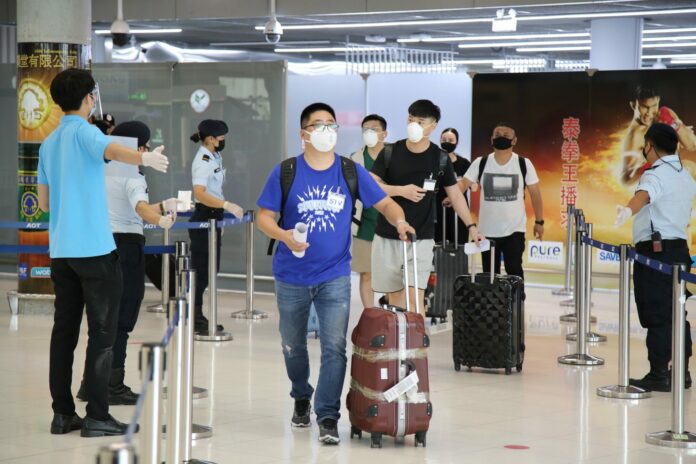
Travelers arrive at Suvarnabhumi Airport under the Special Tourist Visa program on Oct. 26, 2020.

BANGKOK — The upcoming launch of the “quarantine-free” reopening for tourists on Nov. 1 may still require travelers to quarantine at least for a night after all, according to a guideline published by a public health agency.

There are only 10 days to go before the date where fully vaccinated tourists from 10 countries designated as “low risk” would be allowed to enter the country without any quarantine, as announced by PM Prayut Chan-o-cha. The travelers would need to take a coronavirus test once before arriving in Thailand, and another upon their arrival.

But the government has yet to clarify on many issues related to the supposed reopening, including the list of the 10 countries deemed to be low-risk of infection. So far, Prayut has only named five of them: the US, UK, China, Germany, and Singapore.

The government also has not communicated whether vaccinated adults travelling with unvaccinated children, and where the tourists who arrive at the airport would be staying until the result of their coronavirus test comes back.

A document published by the Disease Control Department suggested that the travelers would still have to book a hotel while they wait for the coronavirus test result. As reported by Thai PBS, the document details the following rules for the Nov. 1 reopening:

1. Foreign visitors must arrive by air and come from a list of “low-risk” countries approved by the Public Health Ministry

2. Have proof of vaccination with 2 doses of a recognised Covid-19 vaccine

3. Have a negative PCR test result taken within 72 hours of landing in Thailand

4. Have at least US$50,000 in Covid-19 insurance coverage

5. Have proof of a hotel booking

6. Travellers must download the Mor Chana app and take a second PCR test on arrival or within 24 hours of arrival

7. If the second test is negative, visitors can continue their journey without any further quarantined.

The document fails to mention whether travellers would still need proof of a hotel booking beyond their first night as they wait for the coronavirus test result, and whether this also applies to expats who have homes here.

Advertisement

Queen Cancels Northern Ireland Trip Out of Medical Reason

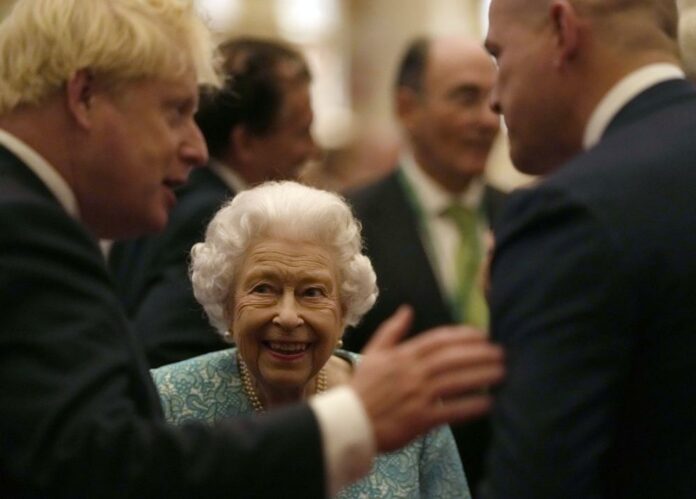
Britain's Queen Elizabeth II and Prime Minister Boris Johnson, left, greet guests at a reception for the Global Investment Summit in Windsor Castle, Windsor, England, Tuesday, Oct. 19, 2021. (AP Photo/Alastair Grant, Pool)

LONDON (AP) — Queen Elizabeth II has reluctantly accepted medical advice to rest for a few days and has canceled a trip to Northern Ireland, Buckingham Palace said Wednesday.

The palace didn’t offer specifics on the decision, but says the 95-year-old monarch is “in good spirits,″ and disappointed that she will no longer be able to visit Northern Ireland for engagements Wednesday and Thursday.

“The Queen sends her warmest good wishes to the people of Northern Ireland, and looks forward to visiting in the future,″ the palace said.

She is resting at Windsor Castle, where she has stayed since the onset of the COVID-19 pandemic last year. The decision to cancel the trip was understood to not be COVID related.

The decision comes just days after Elizabeth was seen using a walking stick at a major public event when attending a Westminster Abbey service marking the centenary of the Royal British Legion, an armed forces charity.

She had previously been photographed using a cane in 2003, but that was after she underwent knee surgery.

Britain’s longest-lived and longest-reigning monarch, Elizabeth is due to celebrate her Platinum Jubilee — 70 years on the throne — next year.

The queen, who was widowed this year when Prince Philip died at age 99 in April, still keeps a busy schedule of royal duties. On Tuesday, she held audiences with diplomats and hosted a reception at Windsor Castle for global business leaders.

Despite her great age, the monarch has politely declined the honor of being named “Oldie of the Year” by a British magazine. The Oldie magazine on Tuesday published the queen’s response to its suggestion that she follow in the footsteps of former recipients, such as actor Olivia de Havilland and artist David Hockney.

“Her Majesty believes you are as old as you feel, as such The Queen does not believe she meets the relevant criteria to be able to accept, and hopes you will find a more worthy recipient,” said a letter from her assistant private secretary, Tom Laing-Baker. He ended the letter “with Her Majesty’s warmest best wishes.”

Advertisement

70% of Bangkokians Now Fully Vaxxed as City Readies for Reopening

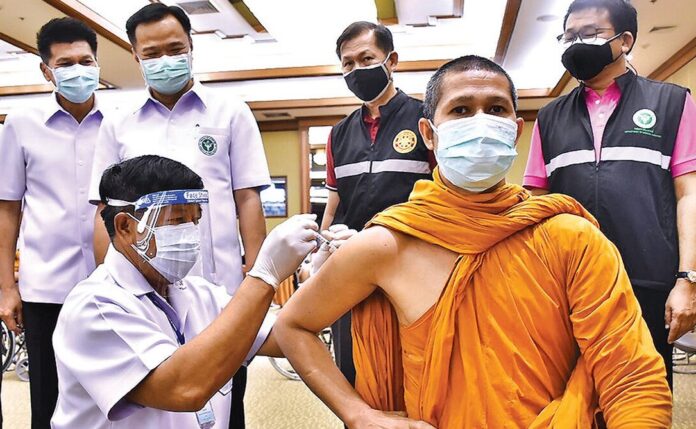
A Buddhist monk in Bangkok receives COVID-19 vaccine on May 31, 2021.

BANGKOK — The inoculation campaign against COVID-19 has now covered more than two thirds of the capital’s population, deputy governor Sophon Phisutthiwong said.

As of Monday, 8.13 million Bangkok residents have received at least 1 dose of vaccine, with 5.43 million, or 70 percent of the population, having received both doses, according to the deputy governor. Officials expect to have fully vaccinated 80 percent of the capital’s residents by the end of the month, Sophon said.

The development came just as Bangkok authorities and businesses are gearing up to welcome back international tourists on Nov. 1, the date of the tourism reopening announced by PM Prayut Chan-o-cha.

The authorities and private sector are planning to set up swab hubs and preparing for an influx of travellers. The Tourism Authority of Thailand, for instance, said its officials will set up testing stations outside the airport and come up with new strategies to avoid congestion and bottlenecking as international travellers arrive into Thailand.

According to data published by the government, there were 1,037 new infections reported in the capital yesterday, along with 10 additional deaths.

The TAT said it has been marketing aggressively to attract travellers in time for the reopening, focusing on long stay travellers, businessmen and investors, and the health wellness market.

The deputy governor of the TAT said there is significant demand for travel to Thailand and reopening Bangkok is the main entry point to welcome those travellers back into the country.

The agency said 250 million baht is predicted to be generated from now until the end of the year from meetings, incentives, conventions and exhibitions events.

Advertisement

Hot News

LATEST NEWS

Bangkok
overcast clouds
34.4 ° C
34.4 °
32.7 °
71 %
4.2kmh
99 %
Mon
33 °
Tue
34 °
Wed
35 °
Thu
31 °
Fri
30 °