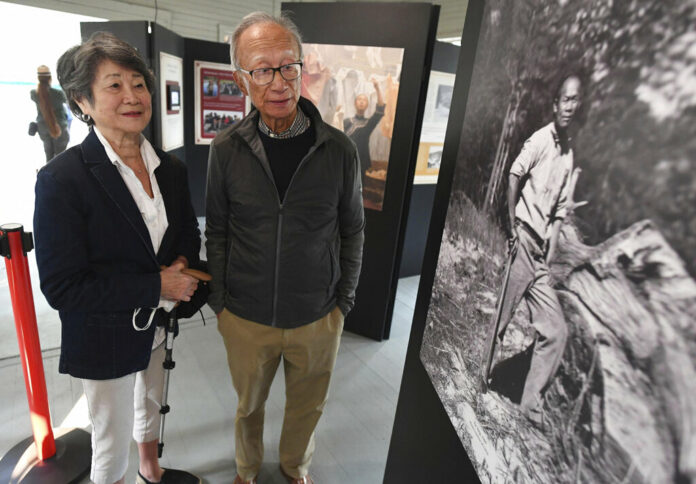
In this Friday, Oct. 1, 2021, photo principal donors, Franklin and Sandra Yee from Sacramento, Calif., tour the dedication ceremonies of the restored 1917 Chinese Laundry building at Wawona in Yosemite National Park, Calif. Photo: John Walker / The Fresno Bee via AP
YOSEMITE NATIONAL PARK, Calif. (AP) — A century-old building originally used as a laundry by Chinese workers at Yosemite’s iconic Wawona Hotel has been restored and turned into a visitor’s attraction, recognizing Chinese Americans’ contributions to the early history of the national park.
Officials unveiled a new sign Friday marking the Chinese Laundry Building in Yosemite Valley, the Fresno Bee reports. New exhibits inside tell the story of Chinese workers who helped build Tioga Road and Wawona Road, critical infrastructure that made tourism to the park possible.
The building — later used as a storage facility — is part of a cluster of structures that will make up the new Yosemite History Center, which will tell the histories of immigrants who made the park what it is today, said Park Ranger Adam Ramsey.
“Chinese people have been a big part of communities throughout the Sierra Nevada for a really long time, and it’s about time that we started sharing that history here in Yosemite,” Ramsey said.
According to research conducted by Park Ranger Yenyen Chan, in 1883 Chinese workers helped build the 56-mile (90-kilometer) Tioga Road in just 130 days. The stunning route across the Sierra Nevada reaches 10,000 feet (3,000 meters) in elevation and serves as one of the park’s main roads.
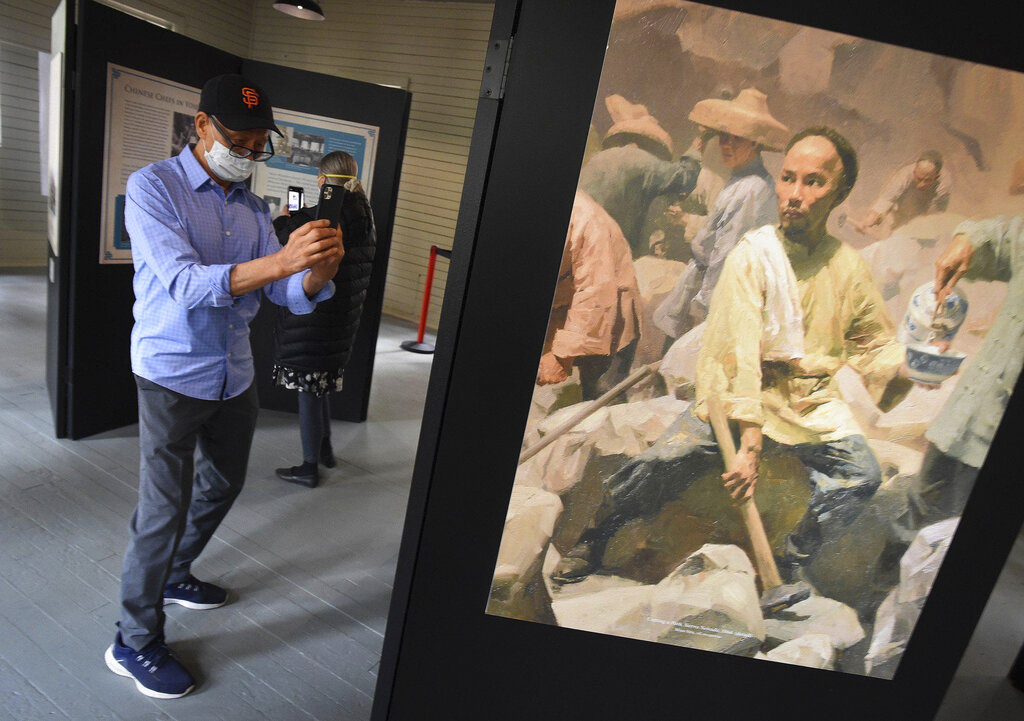
In this Friday, Oct. 1, 2021, photo Ed Hung of San Francisco takes a photo of a Chinese laborer in an exhibit in the restored 1917 Chinese laundry building, after its dedication at Wawona in Yosemite National Park, Calif. Photo: John Walker / The Fresno Bee via AP
Chinese workers were also employed in Yosemite as cooks, laundry workers and gardeners.
Many first came to California during the Gold Rush, bringing with them skills learned in China about construction, engineering, agriculture, medicine and textiles that made a significant impact in America’s early success, Chan said.
She said Yosemite’s Chinese history and their contributions were erased from memory because of the 1882 Chinese Exclusion Act passed by Congress to prevent any more Chinese from entering this country in search of work. The law blocked Chinese immigration for 60 years in this country.
Members of the Chinese Historical Society of Southern California, who supported the building’s renovation, said they were gratified to see Yosemite include the Chinese in the park’s origin story.
“Something like this really resonates with a lot of people in my generation,” said Eugene Moy, a past president of the society. “We’ve been here since the 1870s, so to be able to see this has deep meaning, because a lot of us, oftentimes, are relegated to the margins. We aren’t always perceived as being full-fledged Americans when the reality is that people have been here for three, four, five generations, for 150 years.”
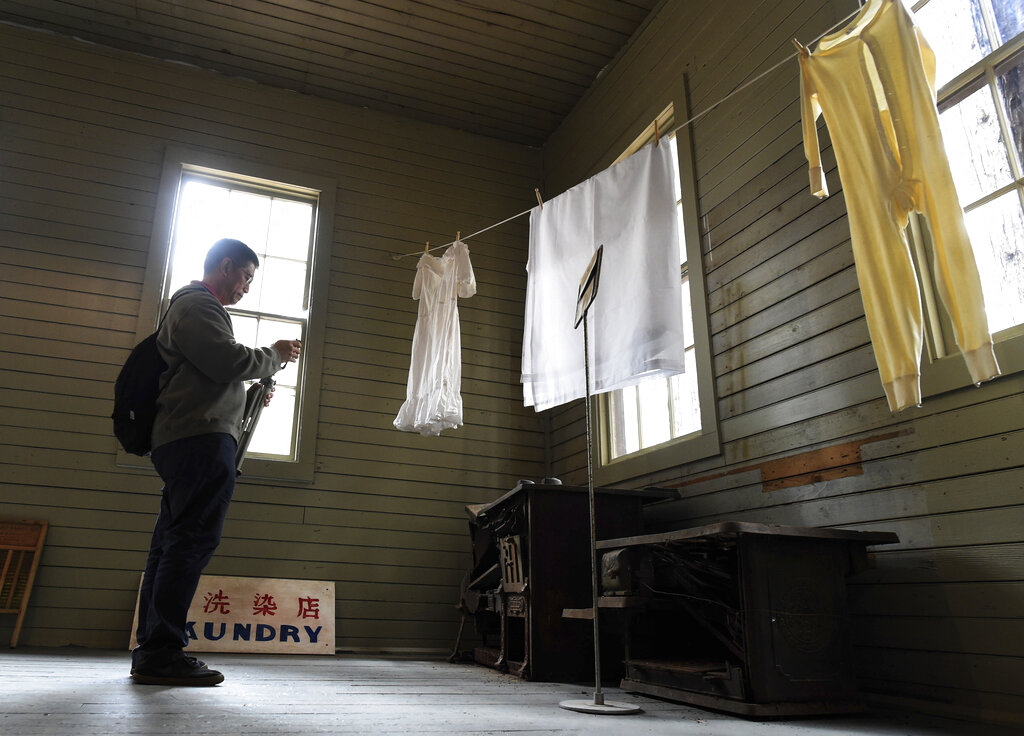
In this Friday, Oct. 1, 2021, photo Ricky Leo of Thousand Oaks takes a photo of old stoves in the restored 1917 Chinese laundry building at Wawona at Wawona in Yosemite National Park, Calif. Photo: John Walker / The Fresno Bee via AP
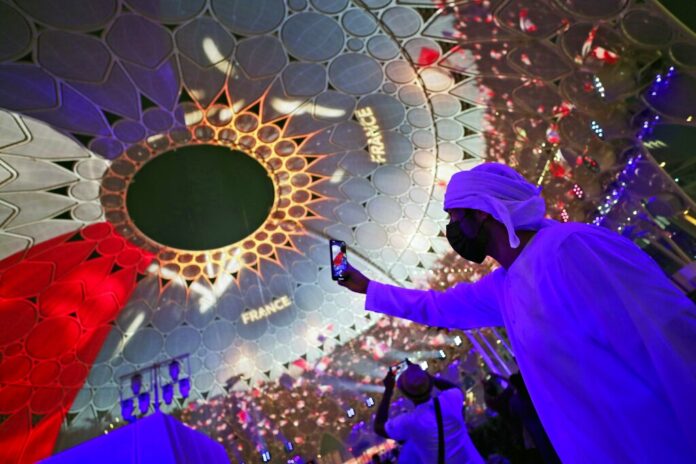
A man takes selfie under the dome of Al Wasl Plaza coloured in French national flag, during a French ceremonial day at the Dubai Expo 2020 in Dubai, United Arab Emirates, Saturday, Oct. 2, 2021. Photo: Kamran Jebreili / AP
DUBAI, United Arab Emirates (AP) — After eight years of planning and billions of dollars in spending, the Middle East’s first world’s fair opened Friday in Dubai, with hopes that the months-long extravaganza will draw both visitors and global attention to this desert-turned-dreamscape.
The coronavirus pandemic pushed Expo 2020 back a year and may affect how many people flock to the United Arab Emirates. But the six-month-long exhibition still offers Dubai a momentous opportunity to showcase its unique East-meets-West appeal as a place where all are welcome for business.
Not long ago, the site of the 1,080 acre (438 hectare) Expo was barren desert. Now, it’s a futuristic landscape buzzing with robots that bark automated orders at bare-faced visitors to mask up, a new metro station, multi-million dollar pavilions and so-called districts with names like “sustainability” and “opportunity” — all built, like much of the Gulf, by low-paid migrant workers.
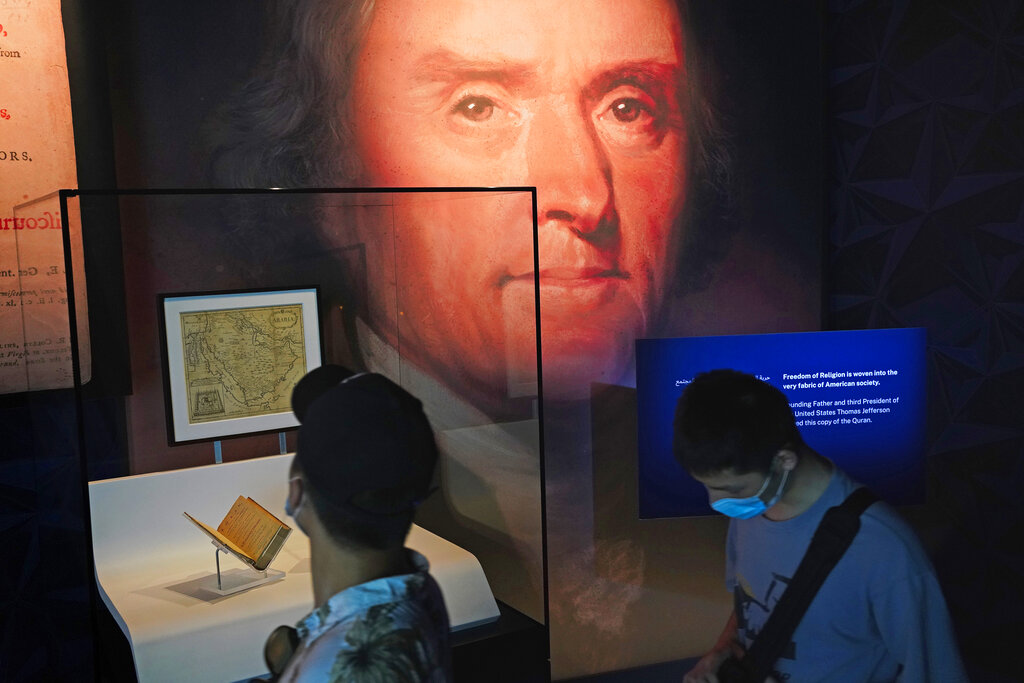
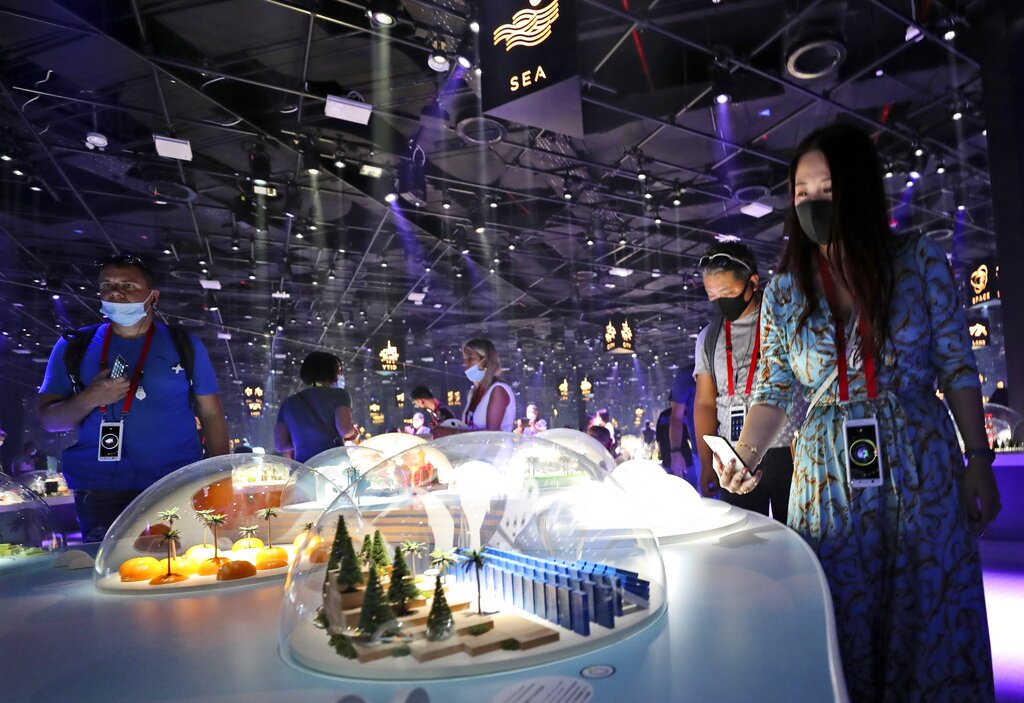
More than 190 nations are using their pavilions to spotlight their greatest tourist attractions, discoveries and ambitions. The American pavilion, paid for by the UAE after the U.S. could not raise the funds in time, boasts a replica of the Space X Falcon 9 rocket and takes visitors on a conveyor belt past multimedia infomercials for American inventions. It also displays a Quran that belonged to the nation’s third president, Thomas Jefferson, as an example of how religious freedom ”is woven into the very fabric of American society.”
Former American President Thomas Jefferson’s Quran, which has been used by American politicians at swearing-in ceremonies, sits on display at the U.S. pavilion at the Expo 2020 in Dubai, United Arab Emirates, Friday, Oct. 1, 2021. Photo: Jon Gambrell / AP
China’s vast, lantern-shaped pavilion focuses on the nation’s space ambitions and future inventions, featuring a Transformer-like car that SAIC Motor hopes will function one day also as a submarine and helicopter.
Draped over Italy’s pavilion is 70 kilometers (40 miles) of rope made from 2 million plastic bottles. The main attraction, though, is a marble 3-D replica of Michelangelo’s biblical hero, David. The 5.2 meters (17 feet) high nude giant is not easily accessible — visitors must must enter separate floors of a building to view it at eye-level or peer up from its feet. Public nudity is outlawed in the UAE, where traditional Muslim norms largely prevail.
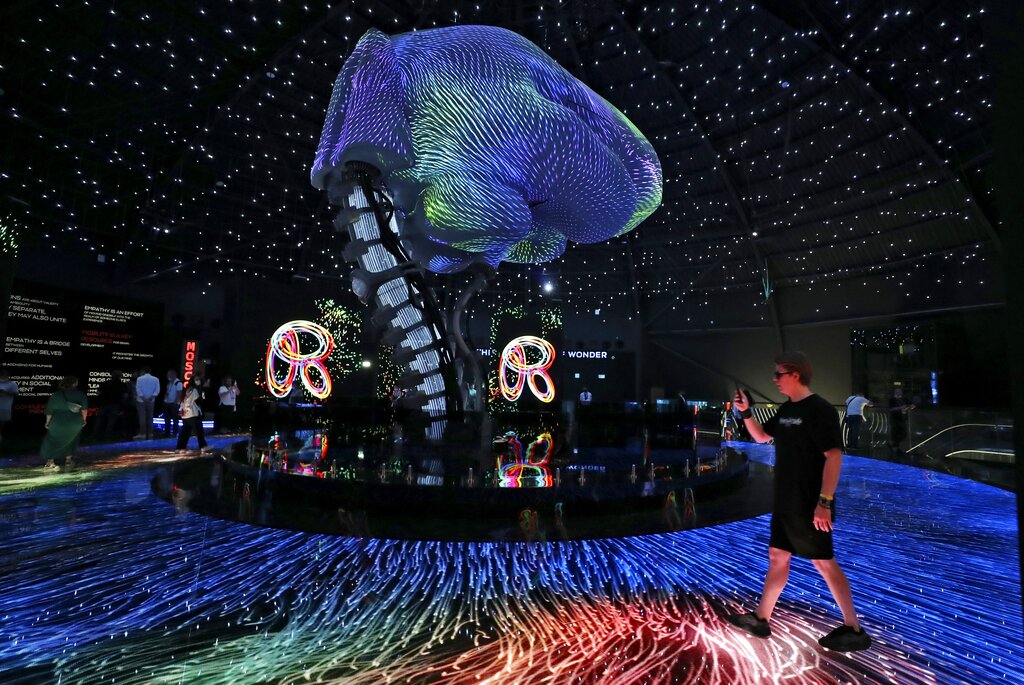
The UAE’s falcon-shaped pavilion, by far the site’s largest, takes visitors on a two-hour-long immersive experience through dunes of real orange sand and footage from the country’s 50-year history.
Other attractions include an African food hall, a massive mirror-like fountain with silver cascades of water flowing back and forth, a recently excavated royal Egyptian mummy, concerts and performances from around the world, and the option to dine on a $500 three-course meal with glow-in-the-dark cuisine.
As night fell and the call to prayer echoed musically through the grounds, pavilions came to life with lights, lasers and kaleidoscopic shows.
Journalists visit the Spain Pavilion themed Intelligence For Life at the Expo 2020 Dubai, in Dubai, United Arab Emirates, Friday, Oct, 1, 2021. Photo: Kamran Jebreili / AP
Isabel Fu, 50, said she flew in for Expo all the way from Beijing to see “the kind of changes that we’ll see in the future, the technology that makes us look forward to the next era.” Upon her return to China, she faces 21 days of quarantine.
Since first making a splash in London in 1851, world fairs have long served as an opportunity for nations to meet, exchange ideas, showcase inventions, promote culture and build business ties.
For more than a century, global exhibitions have captured the imagination and showcased some of humanity’s most important innovations. The first world’s fair held in the United States in 1876 debuted Alexander Graham Bell’s telephone, the typewriter, a mechanical calculator and Heinz Ketchup. One of its main buildings, Memorial Hall, is now a museum.
Other fairs introduced inventions like the sewing machine, the elevator, carbonated soda, the Ferris wheel and, in 1939 in New York, the television.
People visit an interior exhibition at the Japan pavilion during the first day of the Dubai Expo 2020 in Dubai, United Arab Emirates, Friday, Oct, 1, 2021. Photo: Kamran Jebreili / AP
This year’s Expo is unfolding as the virus continues to course across the world, with untold numbers still working and studying remotely — and connecting to the world virtually. It’s unclear how many visitors Dubai can attract, and how much the Expo will stimulate its tourism-driven economy — especially in the blistering early autumn heat, which on Friday caused tempers to flare, some visitors to faint and most people to sweat through their shirts.
“We’re dying! Humans can’t tolerate this weather,” exclaimed 35-year-old Warda Abadi from Saudi Arabia as she shepherded her limping mother into the shade.
To enter the Expo site, visitors must show a negative PCR test or proof of COVID-19 vaccination.
Dubai’s ruler and the force behind the emirate’s transformation, Sheikh Mohammed bin Rashid Al Maktoum, described Expo 2020 as a chance to showcase the best of human excellence.
A man takes a video inside the Russia pavilion during the first day of the Dubai Expo 2020 in Dubai, United Arab Emirates, Friday, Oct, 1, 2021. Photo: Kamran Jebreili / AP
“It offers a platform to forge a united worldwide effort to build a more sustainable and prosperous future for all of mankind,” he told guests at theExpo’s opening ceremony.
Sheikh Mohamed bin Zayed Al Nahyan, crown prince and de-facto ruler of the UAE’s seat of power, Abu Dhabi, emphasized “the ethos of this land” as a meeting point for cultures and tolerance.
Whether Iran or Israel, every nation is welcome at Dubai’s Expo. The space marked for Afghanistan’s pavilion, however, appeared vacant weeks after the Taliban takeover of Kabul.
“It makes me very proud to see so many different kinds of cultures, countries and traditions coming to my country for the first time,” said Isa Nuaimi, a 25-year-old government pilot from the Emirati city of Al Ain.
Human Rights Watch, however, said that the UAE’s efforts to promote itself as an “open and tolerant country” remain at odds with its human rights abuses, including the suppression of peaceful criticism, jailing of activists and pervasive government surveillance.
Artists carry national flags during the opening ceremony of the Dubai Expo 2020, in Dubai, United Arab Emirates, Thursday, Sept. 30, 2021. Photo: Kamran Jebreili / AP
“The UAE has embarked on a decades-long effort to whitewash its reputation on the international stage,” the rights group said.
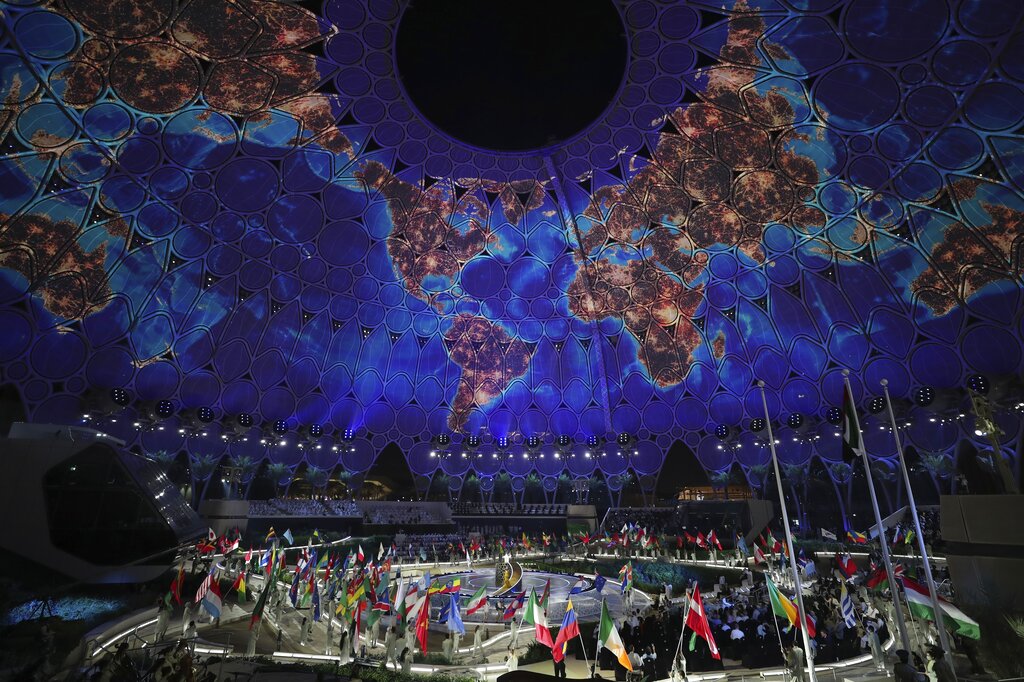
The Expo site will attempt to dazzle visitors with a centerpiece dome, marketed as the world’s largest 360-degree projection screen.
Some world’s fair structures remain iconic markers of the human journey and our industrial evolution. None more so than the Eiffel Tower, which was constructed in Paris, not only to be the tallest structure in the world at the time, but to serve as the entrance to the 1889 world’s fair. The Space Needle in Seattle, Washington, built for the 1962 world’s fair, also continues to enjoy global prominence.
While most fairs were held in Europe and the United States, none have been hosted in the Middle East until now.
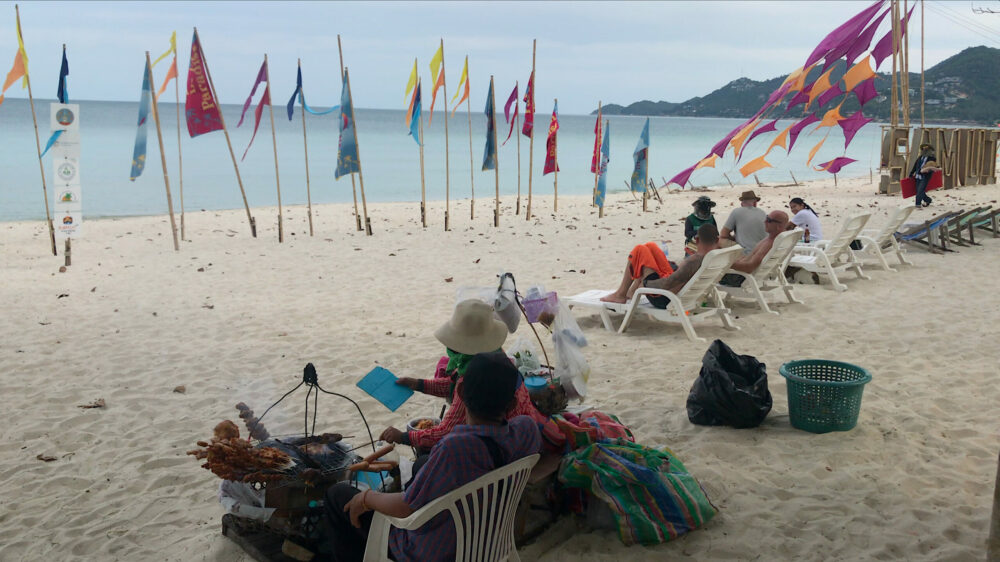
A tourists on Koh Samui on Oct. 1, 2021, the first day of the Samui Sandbox.
Thailand took a major step in trying to revive its devastated tourism industry on Friday as it reduced quarantine time for fully vaccinated travelers arriving to Thailand from 15 days to 7. No one should expect a quick surge in tourism anytime soon and should be cautious in treading the path to tourism recovery, however.
Among major factors that would work against any quick rebound are troublesome paperwork, uncertainties of the durability of the new relaxation measures, and continued shutdown of pubs and bars in highly-infected areas, including Bangkok.
Let’s start with the still lengthy and costly alternative quarantine requirements. Although the length has been halved, seven-days alternative quarantine inside a hotel room where you can venture outside will still be a major deterrent factor for any foreign tourists to consider long before they decide to fly to Thailand. With the government’s plan to assess the COVID-19 situations after two weeks, it’s highly recommended that they send a clear signal as soon as possible if all quarantine requirements will be fully lifted on Nov. 1 as some speculated or not. The truth is, it will be up to how well the pandemic has been contained in the next two to three weeks.
The number of new infections nationwide is still precariously high at 10,000 plus and death toll around a hundred per day is still high by international standards and will be factored in by some potential foreign tourists currently mulling a visit to Thailand. The ranking of Thailand’s COVID-19 situations, currently at 28th worst hit, will affect possible quarantine time upon the return of these foreign tourists to their home country.
A tourists on Koh Samui on Oct. 2, 2021. Koh Samui’s Sandbox program allows vaccinated visitors to travel freely on the island, as well as nearby Koh Tao and Koh Pha Ngan.
Virtual paperwork such as the online Certificate of Entry (COE) that everyone entering Thailand must fill should be made more user friendly and quicker to process. Last week when this writer returned to Thailand from Austria, the Thai Embassy’s website in Vienna stated that the form will be processed within 72 hours. That should be reduced to 48 if not 24 hours. (I was unable to complete the forms and had to call the Thai Embassy from Vienna Airport that I only have eight minutes left before missing the flight. Fortunately the Embassy’s staff were agile and able to send the forms to me via email at the last minute.)
Hotel quarantine is no fun as you cannot leave the room – it’s basically a glorified state-sanctioned incarceration. When I returned from Vienna last week after a speaking engagement I developed a rash, swollen eyelids and allergies on other parts of my body very soon after entering my hotel room. I suspect it was due to the over-chemicalized environment due to anti-coronavirus cleaning. The nurse working in collaboration with the hotel administered anti-anxiety pills (hydroxyzine) for me instead of anti-allergy medication.
Many who decided to travel to Bangkok, which was the most visited city on earth pre-coronavirus in 2019 with 22.7 million foreign visitors (arrivals nationwide in 2019 was 39.8 millions), will continue to be disturbed by the fact that restaurants do not serve alcohol and pubs and bars as well as red light districts continue to be closed. Many of the estimate two hundred thousand sex workers continue to be unemployed as a result. This is a big factor for drinkers as people want to drink at restaurants, pubs or bars on vacation and not inside their hotel rooms.
A tourists on Koh Samui on Oct. 2, 2021.
As long as the ban continues, along with the curfew now slightly reduced by an hour to 10pm to 4am, it will work against a quick foreign tourist rebound, particularly among younger foreign tourists who frequent places like Khao San Road which will continue to be dead due to the alcohol ban. To many foreign tourists, a dry vacation is no vacation. It’s time for the Thai government to introduce COVID-19 passport and ATK test as a pass to enter pubs and bars, both for Thais and locals so these businesses could be reopened after many months of shutdown. Other countries have done it and there’s no reason why the Thai government should wait.
Despite the bold move by the government, uncertainties loom large as we do not know how the COVID-19 situation will be two or three weeks from now with some foreign tourists returning. The re-opening of Thailand might be too little too late for this year’s high tourist season as it chiefly was delayed by the slow inoculation of people in Thailand. The government of Gen. Prayut Chan-o-cha has failed to vaccinate Thais quickly enough over the past months, leading to a delay in restarting Thailand to mass tourism.
As of Friday, less than one third of the population, or less than 20 million Thais out of 70 million have been fully inoculated. Less than half of the population, or 32 millions received their first jab. Now the last thing we want to see is a failed plan to reopen Thailand to foreign tourists after a few weeks from now. Being one of the world’s major tourist destinations cannot and should not be taken for granted.
Reinforcing commitment to sustainable water management
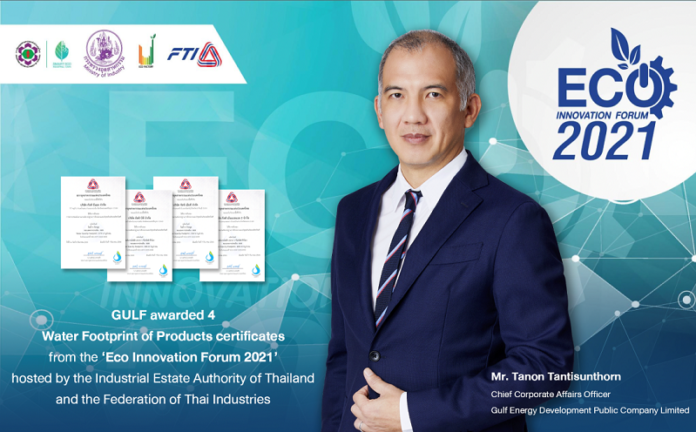
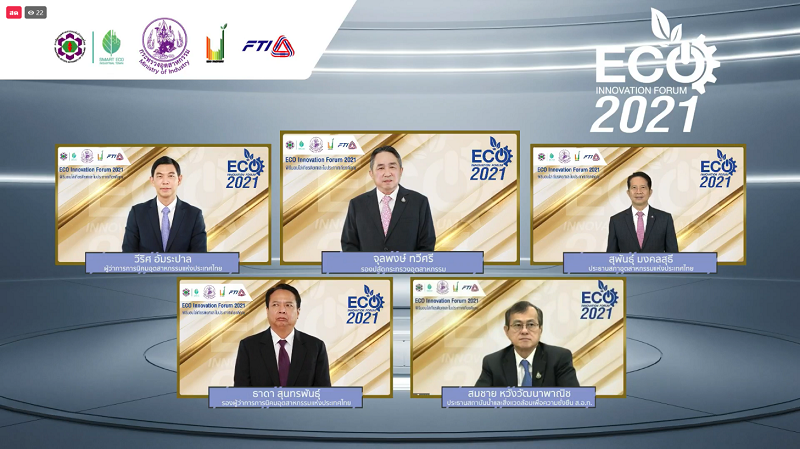
Recently, Gulf Group (GULF)was awarded four ‘Water Footprint of Products’ certificates at the Eco Innovation Forum 2021 hosted virtually by the Industrial Estate Authority of Thailand (IEAT) in collaboration with the Ministry of Industry and the Water and Environment Institute for Sustainability (WEIS) via Zoom. The awards reinforce the company’s capabilities in managing water resources efficiently and sustainably in accordance with international standards while remaining socially and environmentally responsiblein the areas where the company operates – as reflected by the efforts to lower greenhouse gas emissions both directly and indirectly in a move towards a low-carbon society.
GULF conducts water footprint assessments on all of its power plants that have been in operation for at least one full year. Efficient useof water at various stages of the electricity production cycle results in saving production costs as well as increasing power plants’ competitive edge. GULF also continues to place great importance on resource management and positive environmental impact, which contributes to sustainable development.
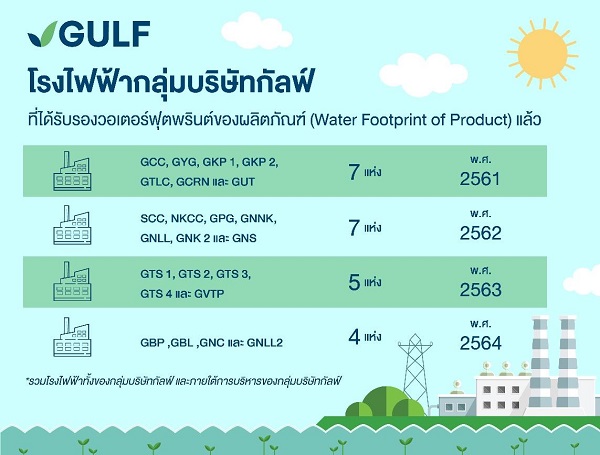
This year, four power plants under Gulf Group, consisting of GBP and GBL in Phra Nakhon Si Ayutthaya, GNC in Prachinburi and GNLL 2 in Rayong, received Water Footprint of Products (WFP) certificates. Since 2018, 23 power plants owned or managed by Gulf Group have received WFP certification.
Eco Innovation Forum 2021 was presided over by Mr. Chulapong Taweesri, Deputy Permanent Secretary of the Ministry of Industry. Mr. Veerit Amrapal, Governor of IEAT; Mr. Suphan Mongkolsuthee, Chairman of the Board of Directors of the FTI; Mr. Tada Soontonphan, Deputy Governor (Special Affairs), IEAT and Mr. Somchai Wangwattanapanich, Chairman of the Water and Environment Institute for Sustainability also joined the ceremony to give out awards and certificates to recognize industrial estates, industrial ports and a wide range of eco-industrial plants as well as companies that have demonstrated outstanding water resource management in line with international standards.
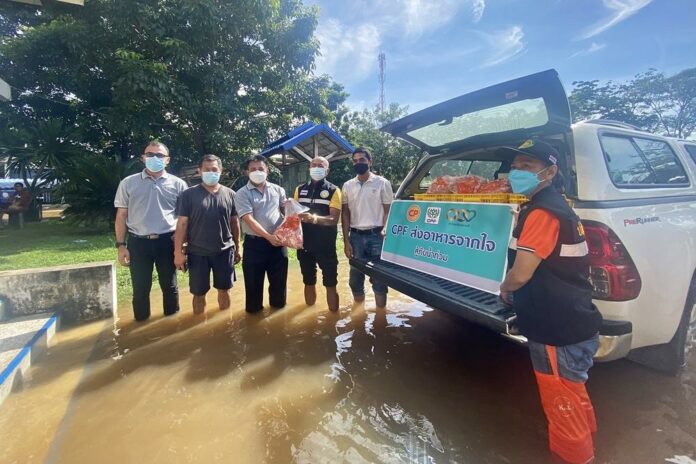
Charoen Pokphand Foods Public Company Limited (CP Foods) extends the helping hands to people affected by the tropical storm Dianmu in multiple provinces, including Chaiyaphum, Nakhon Sawan, Phetchabun and Nakhon Ratchasima. This is part of newly-launched program, “CPF food from the heart for flood relief”, aiming to enable suffering people access needed food and supplies.
This week, CP Foods’ volunteers have teamed up with Commerce in Chaiyaphum Province and the Northeastern Swine Raisers Association to provide fresh pork, chicken eggs, drinking water and cooked food to support the work of the Royal Kitchen at Chaiyaphum Municipality Office. The supplies, which were received by the province’s Deputy Governor, Phumisit Wangkheeree, and its mayor, Dheevara Vittanakorn, to distribute to the flood victims in the province.
Chaiyaphum’s Mayor, Mr. Dheevara, thanked CP Foods and partners for supplying ingredients for the Royal Kitchen, which has a mission to cook 5,000 meals per day for delivering to the flood victims that are unable to access food and water supplies.
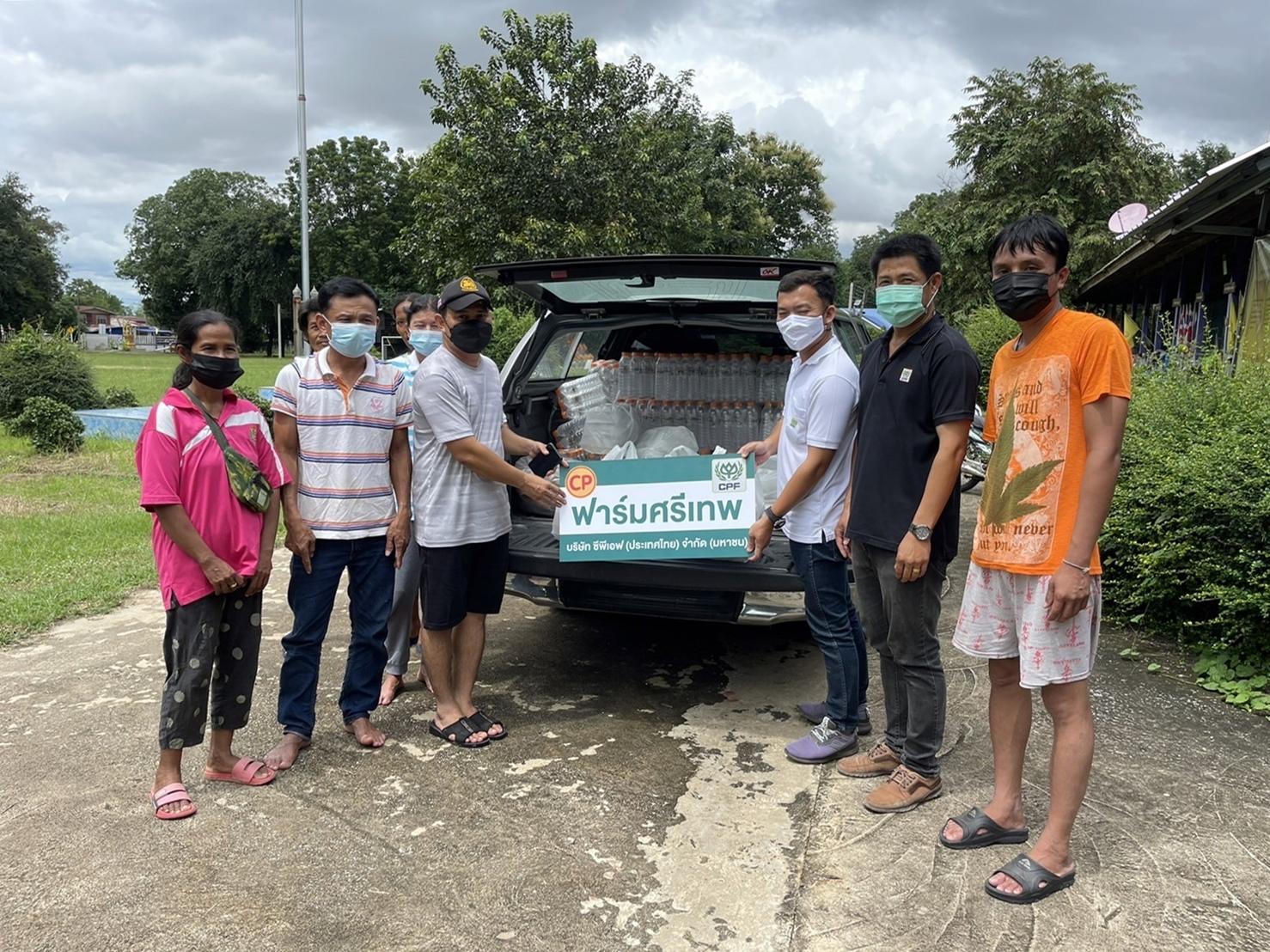
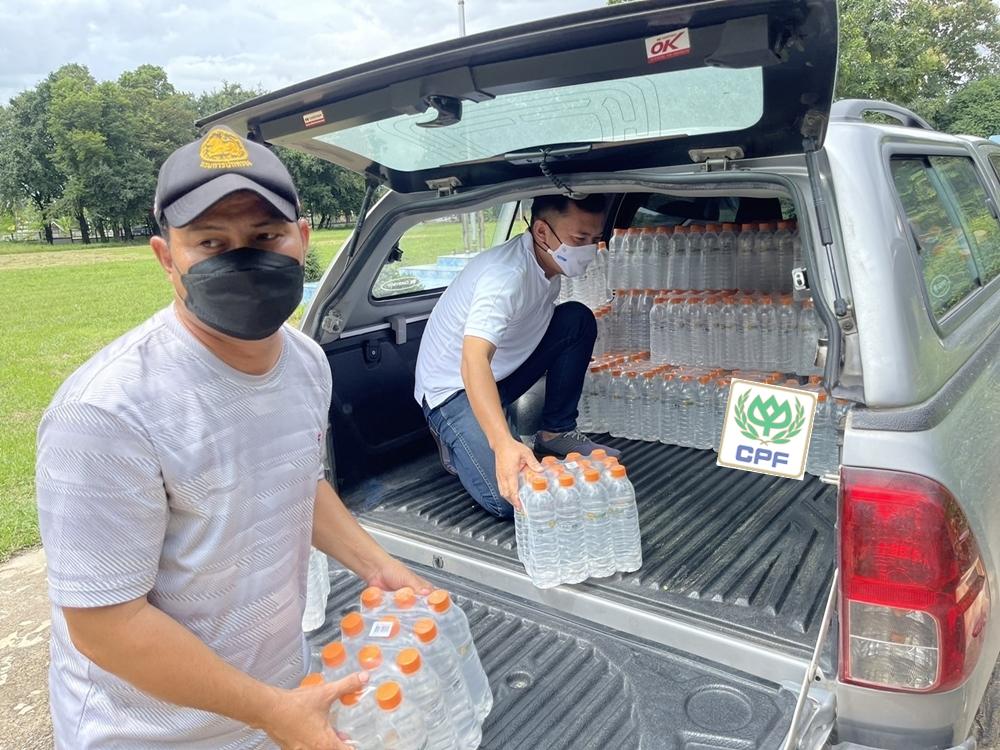
In Nakhon Ratchasima, the company donated 3,000 eggs, 200 kg of fresh pork and 1,000 bottles of drinking water to support the Army’s field kitchen in an effort to help people of Bang Lang Sub-District and the people of Non Thai District. The Swine Business Group in Nakhon Ratchasima Province also visited nearby villages to help people who suffered from flooding near Lam Chiang Krai Reservoir, by donating ready-to-eat food and drinking water to aid people in the area.
Mr. Worawit Wiensanthea, Village Headman of Village No. 6, and Mr. Boonmee Prakhontan, Village Headman of Village No. 7, Kampang Sub-district, Non Thai District, Nakhon Ratchasima Province, both joined the CP Foods volunteer team in visiting the area, said the two villages had been flooded, and causing the population of 400 households to be affected. There are still villagers whose houses are still highly flooded and had to use a boat to access to food supplies.
Volunteers from swine farm in Si-thep, Phetchabun, rallies support for communities nearby the farm, including Ban Nong Suang, Ban Muang Chum, and Ban Khao Klang, by delivering 600 meal boxes and 1,200 bottles of water.
Mr. Prachuap Naktien, Klong Krachang Subdistrict Headman, told that this year flood is the worst in 20 years since 2002. The community has suffered from heavy rain and flash flood. Many villagers had to be evacuate to schools and temples, at some points they had to bring boats to help the elderly and other vulnerable group because of a high water level and electricity cut. The Subdistrict Headman also thank CP Foods’ Si-thep farm for giving a helping hand to surrounding villages in time of crisis.
CP Foods’ volunteers also handed out food supplies to people in Lada Yao area and Tha Tako District in Nakhon Sawan Province.
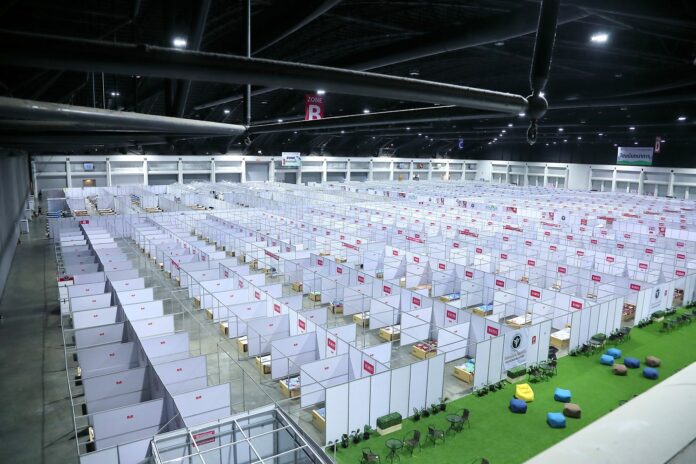
An undated file photo of Bussarakham field hospital.
BANGKOK — The country’s largest and most prominent field hospital for COVID-19 patients closed its door earlier this week, while the number of seriously ill patients continues to fall in the capital.
The “Bussarakham” hospital first opened in May to cope with the rising number of infections and serious cases at the time. But a drop in new admissions in recent weeks, followed by the last patient being discharged, means the facility is no longer needed to be operational, said public health ministry official Kiatiphum Wongrajit.
In July, as many as 200 patients a day were admitted due to the outbreaks of the Delta variant, Kiatiphum told reporters, but admissions started to decline in September, when there were as few as six cases per day.
The last patients were eventually discharged on Sept. 20, he said. The hospital has treated around 20,400 people for COVID-19 throughout its five months of operation.
Speaking at a news conference that marks the hospital’s closure, Kiatiphum praised the staff for their dedication. The healthcare workers were pooled in from different hospitals, and they have since returned to their respective workplace. Equipment and supplies at Bussarakham will also be sent to other facilities in need around the country.
Bussarakham first began its operation on May 14. It was housed at the Impact exhibition and convention centre northwest of Bangkok.
Originally housing 1,000 beds, the facility later expanded to hold 3,700 beds, thanks to contributions from the private and civil sectors, as well as some government funding.
The field hospital boasted intensive care and semi-intensive care units and its presence ensured beds at regular hospitals could be kept free for critically ill patients.
On Friday, the government’s coronavirus center reported 11,754 new cases and 123 fatalities linked to the pandemic. There have been 12,473 recoveries in the last 24 hours, the government said.
Up to 115,233 people are still receiving treatment for COVID-19 nationwide, government reports say.
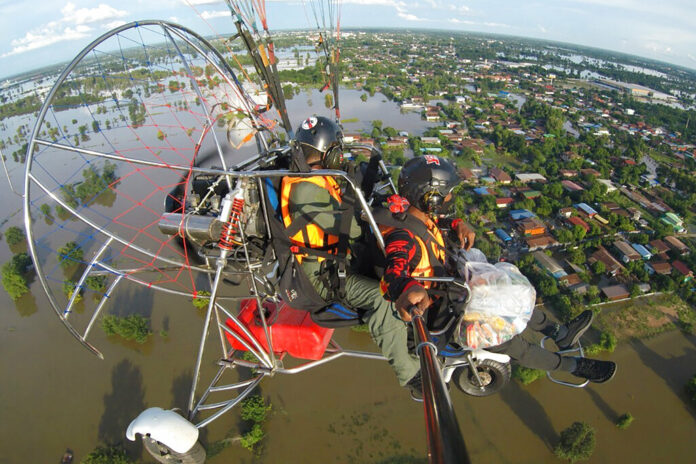
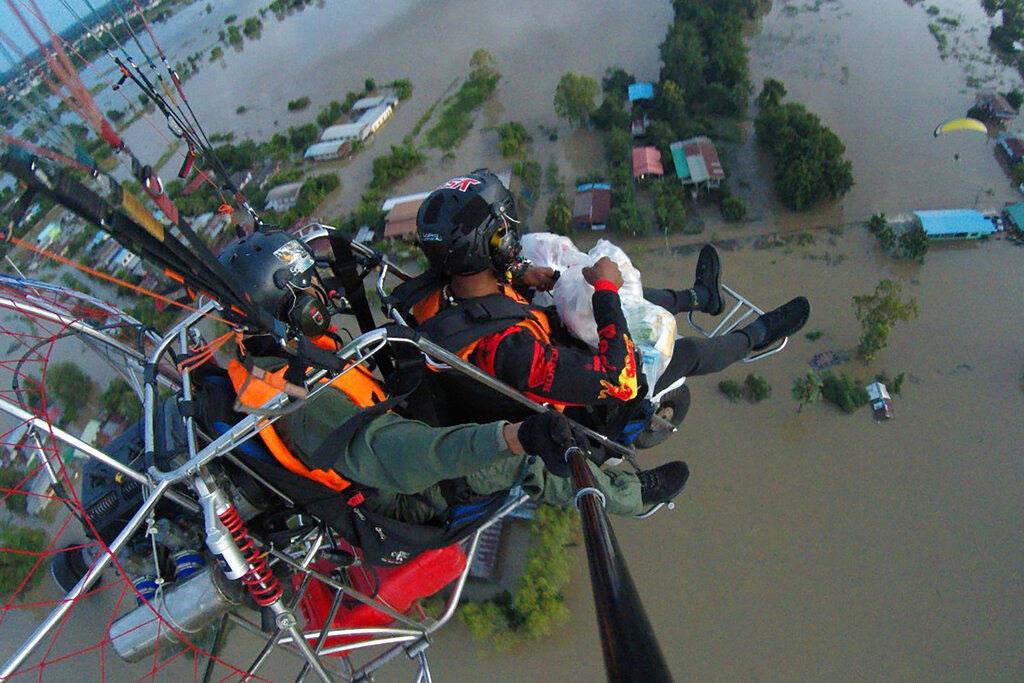
In this photo provided by Disaster Response Association of Phitsanulok, Thai paragliding team of Disaster Response Association of Phitsanulok fly while preparing to drop relief supplies over flood-hit villages in Sukhothai province, northern Thailand, Wednesday, Sept. 29, 2021. Photo: Wichai Tiyasan / Disaster Response Association of Phitsanulok via AP
BANGKOK (AP) — Authorities sandbagged low-lying areas in the Thai capital and checked pumping stations Thursday along the Chao Phraya River in preparation for possible flooding as dams upstream, swollen by heavy rains, were forced to release water as a precaution.
Flooding in the northern and central regions has already displaced thousands. Seven people have died and one woman is missing.
Bangkok Gov. Aswin Kwanmuang said that with heavy rains still in the forecast, both the Chao Phraya Dam, 190 kilometers (120 miles) north of Bangkok, and the Pasak Jolasid Dam, about 100 kilometers (60 miles) north of the capital, have been forced to release water, raising the possibility of flooding in areas of the city that are often inundated during the monsoon season.
Bangkok has been spared so far, but memories of the 2011 floods that submerged parts of the capital still loom large for many residents. At that time, a combination of a strong monsoon season and several tropical storms led to the disastrous flooding.
Since then, more levees and water retention areas have been constructed and authorities have sought to allay fears.
The floods have affected 227,470 households in 31 provinces — one province and 30,000 households more than Wednesday, according to Thailand’s Department of Disaster Prevention and Mitigations.
In this photo provided by Disaster Response Association of Phitsanulok, Thai paragliding team of Disaster Response Association of Phitsanulok fly while preparing to drop relief supplies over flood-hit villages in Sukhothai province, northern Thailand, Wednesday, Sept. 29, 2021. Photo: Wichai Tiyasan / Disaster Response Association of Phitsanulok via AP
In Sukhothai province, a team of paraglider enthusiasts has been doing what it can to help out areas cut off by the waters, flying sorties over villages and dropping aid packages to the stranded residents.
Using powered paragliders, also known as paramotors, the 15-member group has been dropping packages of water, instant noodles, rice and other dried foods to villagers to help them make it through until the floods recede.
On Wednesday they dropped 200 parcels, some also containing basic medicines and sanitary items.
“We can arrive in the area quite fast,” volunteer Wichai Tiyasan told The Associated Press. “We can check out coordinates, leading rescue boats to locations that need help. We can use paragliders to drop supplies fast as we can reach affected areas well before others.”
The group started its operations on Saturday after Tropical Storm Dianmu combined with annual monsoon rains to inundate the area.
As waters receded, the group took a break Thursday after five days of straight work, and planned to take to the skies again Friday to help authorities survey the area.
“We are proud that we can help those in need. We are happy to see their smiles when they receive supplies,” said volunteer Wachirachan Tangkasemwiboon. “Do we face any obstacles? Yes … but if it happens when we are trying to help others, it is fine, at least we can say we have done our best.”
_____
Story: David Rising. Associated Press writers Chalida Ekvittayavechnukul and Tassanee Vejpongsa contributed to this report.
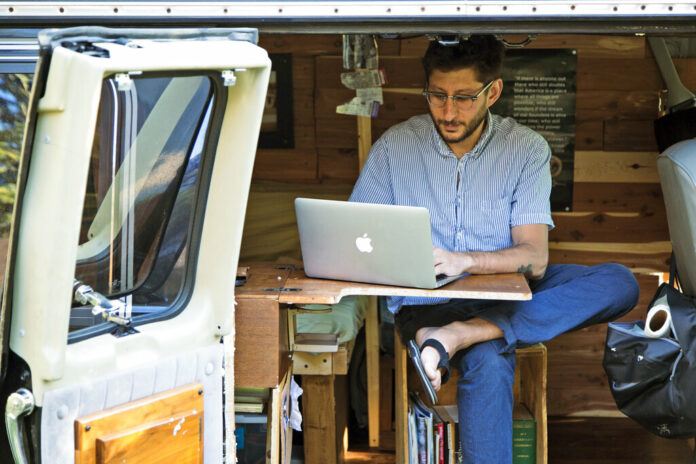
In this 2018, photo, U.S. journalist Danny Fenster works out of his van that he made into a home/office in Detroit. Photo: Fenster Family photo via AP
BANGKOK (AP) — Myanmar’s military-installed government on Thursday defended its detention of an American journalist it has now held for four months, without offering any details of the crimes it alleges.
Military spokesman Maj. Gen. Zaw Min Tun did not elaborate in his response at a news conference to a question about Danny Fenster, who is awaiting trial on a charge of incitement, also called sedition. Fenster, 37, is managing editor of the Yangon-based online news and business magazine Frontier Myanmar.
The charge, used frequently against dissidents and journalists, criminalizes “any attempt to cause fear, spread false news, or agitate directly or indirectly a criminal offense against a government employee.” It is punishable by up to three years in prison.
Asked about the reason for the arrest, Zaw Min Tun responded: “As for journalists, if they do only journalist’s work, there is no reason to arrest them. Danny Fenster did more than just what a journalist does.” He said he could not say more, other than that Fenster was kept detained because he has been charged.
Fenster’s lawyer and colleagues have denied any wrongdoing on his part.
Fenster was among about 100 journalists detained since the Feb. 1 military takeover ousted the elected government of Aung San Suu Kyi. More than half have since been released, but free speech remains under tight restrictions, with independent media forced to operate underground or from outside the country. Resistance to military rule was initially met with widespread peaceful street protests, but security forces used deadly force against demonstrators — killing more than 1,100 — and now face violent counterattacks.
Zaw Min Tun denied Fenster’s statement in mid-July that he believed he had contracted COVID-19 and was not given medicine he had requested. The authorities at Yangon’s Insein Prison also have denied he is infected. He also told his lawyer on Sept. 20 that he had not received a COVID-19 vaccination.
“Danny Fenster is in good health,” said Zaw Min Tun. “The COVID-19 vaccine is being given to all those in prisons. It is up to him to decide whether or not to get vaccinated.”
Fenster’s lawyer Than Zaw Aung said Fenster seemed demoralized when he last spoke with him in a video conference during a Sept. 20 court hearing.
“His hair grew longer. He seemed disappointed and he told me in a frustrated tone that ‘I have nothing to say,’” the lawyer said. “I asked him if he had been vaccinated by the prison authorities, and he said no. His words showed that he is not feeling well. He didn’t request anything.”
Fenster was detained at Yangon International Airport on May 24 as he was trying to board a flight to the Detroit area in the United States to see his family, who are now leading a campaign for his release. The U.S. government and international media organizations backed their call for the release of Fenster and other journalists.
Than Zaw Aung said in July that his client was charged in connection with his previous job as a reporter and copy editor for the online news site Myanmar Now.
Myanmar Now, along with several other media outlets, had its license revoked in early March, banning it from publishing on any platform. However, it has continued to operate online.
Fenster resigned from Myanmar Now in July last year and joined Frontier Myanmar a month later, and it was unclear why he was arrested, his lawyer said.
“What I can say is that he was accused as a staff member of Myanmar Now. I’m not clear if it concerns a story posted on Myanmar Now or not,” he said.
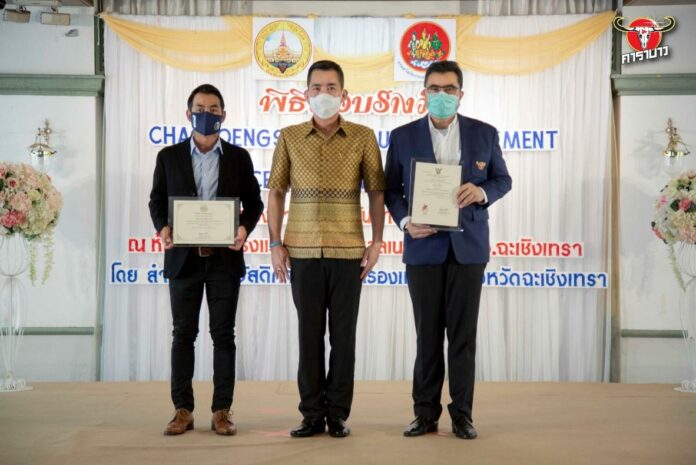
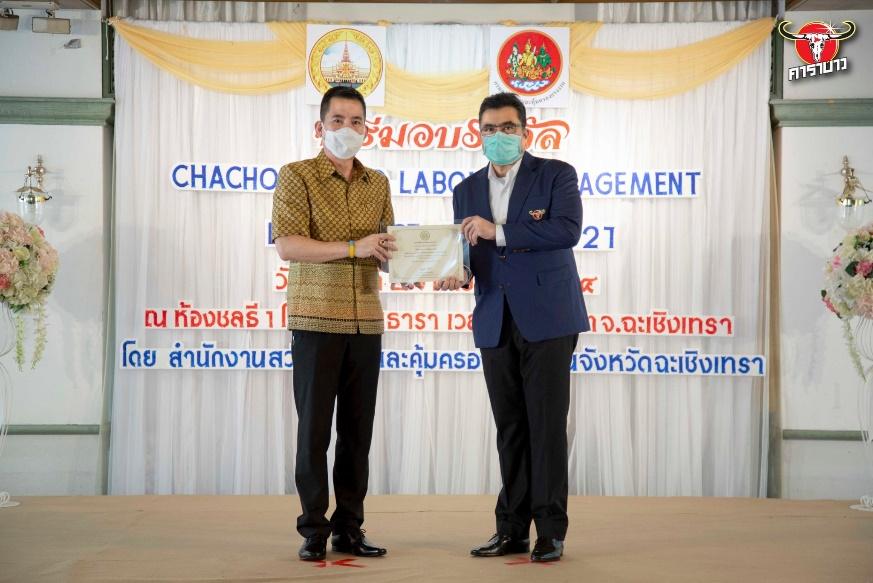
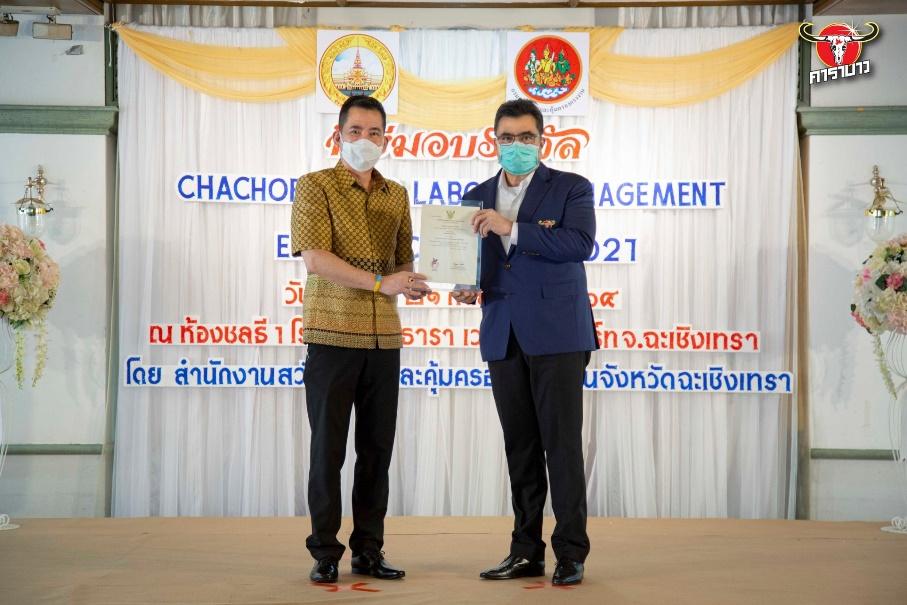
Carabao Tawandang Co., Ltd., has won two labour management excellence awards for 2021 from Chachoengsao Province. The accolades bestowed to the manufacturer of Carabao Dang energy drink are the Thai Labour Standard Award (TLS 8001-263) and the Good Labour Practices Award (GLP).
Mr Kamoldist Smuthkochorn, Chief Operations Officer at Carabao Group PLC, said the awards underscore the norms of labour practices that show social responsibility by focusing on creating a management system capable of dealing with changes that occur both from internal and external factors affecting the operations.
The management system is clearly defined and prioritises human rights, employment conditions, welfare and safety and occupational health in the working environment – all conducive to raising the quality of working life sustainably.
The ceremony for Chachoengsao Labour Management Excellence Awards 2021 was held on 21 September 2021 and was presided over by Chachoengsao Governor Maitree Tritilanan. In attendance was Prasit Patangkaro of the Office of Labour Protection and Welfare, Chachoengsao Province, along with relevant government agencies, companies and educational institutions.
The annual awards are organised by the Office of Labour Protection and Welfare, Chachoengsao Province, to honour business establishments located in the province for their good management.
Mr Kamoldist said that in addition to the labour standards that the company has been vigorously implementing, Carabao Tawandang has also attached importance to helping communities around Bang Pakong District where its manufacturing facilities are located.
The company has conducted several social activities such as providing scholarships to schools in its neighbourhood, promoting education, music and sports. Its support of sports activities includes football coaching and the provision of sports equipment.These activities form part of the company’s endeavour to improve the quality of life for society and communities around Bang Pakong District.
Carabao Tawandang is the beverage production arm of the Carabao Group with all of its facilities covering a total area of 180 rai in Bang Pakong District. The facilities consist of a glass bottle production factory known as APG, an energy drink bottling plant (CBD), an aluminium can production plant (ACM) and a packaging production plant producing boxes, labels and transparent film (APM). These plants form Carabao’s integrated production process of beverages which are shipped across Thailand and exported to more than 40 countries around the world.
The vast majority of businesses in every country in the world are SMEs. They are the lifeblood of every economy. They are represented in the place on the corner where you buy your groceries, the place that dry-cleans your clothes, and the place that fixes your air-conditioner. Even if a shop has a world-famous brand on the sign, there’s a good chance that it’s a privately-owned franchise.
The prevalence of SMEs in every community presents financial institutions (FIs) with a strange dilemma. To start any of these businesses would normally take an SME loan. But with the sheer volume of loan applications coming from the SME sector in every industry, every FI has to stick to their qualification regulations more rigorously.
A good portion of business owners launching SMEs have never owned or run a business before. From the talented dress designer who wants to launch her own line of clothing, to the young startup entrepreneurs looking to make life easier with their innovations.
What they have is plenty of talent, ambition and drive; what they lack is loan collateral. For the FIs who are witnessing hundreds of viable business partners having to be turned down, the problem is too much volume. And for the business owners, it’s not having independent resources you can access until you get your company off the ground.
An Elegant Solution
Syarikat Jaminan Pembiayaan Perniagaan (SJPP) was created as a wholly-owned subsidiary of the Minister of Finance Incorporated to bridge the gap between the business owners and the FIs and to enable them to work together.
The government of Malaysia set the schemes up in 2009 to address the problems associated with providing financing to viable SMEs that didn’t meet commercial lender eligibility requirements. The government saw these requirements, though necessary to ensure stability on the part of the FIs, as preventing the economy from developing fully.
Government Guarantee
By stepping up as a guarantor of working capital extended to SMEs by the lenders, the Malaysian economy was given a kick-start. Today there are nine of these working capital guarantee funds to address all areas and business sectors.
What they offer is available funding within a specific maximum and minimum depending on the scheme you apply under. These nine schemes cover the following areas:
Working Capital Guarantee Scheme (WCGS)
Working Capital Guarantee Scheme – Start Up (WCGS-SU)
Working Capital Guarantee Scheme – Bumiputera (WCGS-B)
Working Capital Guarantee Scheme – Export (WCGS-X)
Working Capital Guarantee Scheme – Women (WCGS-W)
Automation & Digital Guarantee Scheme (ADGS)
Special Schemes for COVID-19 under BNM
PENJANA Tourism Financing Facility (PTF)
Bus and Taxi Hire Purchase Rehabilitation Scheme
Each of these schemes has its own qualifications and funding amounts that reflect the industry and type of owners it’s aimed at.
These schemes allow FIs to offer an alternative source of financing to viable businesses that nevertheless fall short of qualifying under the lender’s eligibility requirements. For thousands of SMEs across Malaysia, these schemes have helped boost the local economy and provide much-needed jobs.
To find out more about what these schemes could mean for the success of your SME, please contact your financial institution or visit the SJPP website.