31.8 C
Bangkok
Sunday, June 7, 2026
Home Blog Page 1032

C.P. Group invited to share experience on driving sustainable food systems in the Animal Protein Industry 

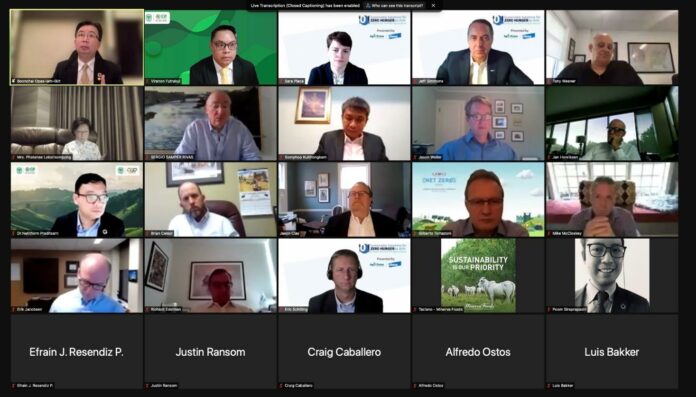
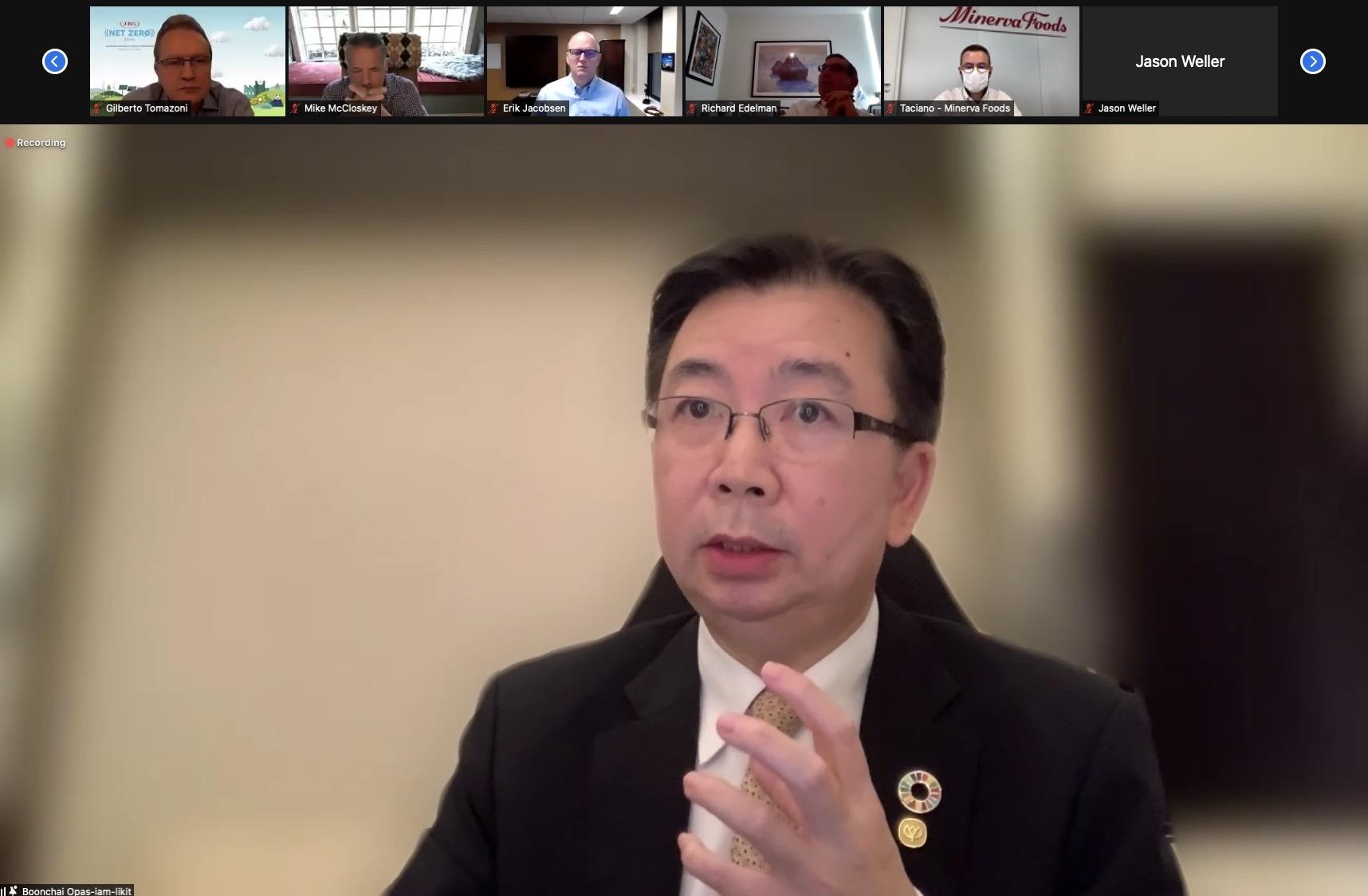
Wednesday 14 September 2021, Washington D.C. – Mr. Boonchai Opas-Iam-Likit, Chairman of U.S. Business, Charoen Pokphand Group, represented C.P. Group in the CEO-level roundtable discussion on ‘The Sustainability Journey of Animal Agriculture’ hosted by Elanco, the world’s second largest animal health pharmaceutical company. The event was organized to exchange experiences on the critical challenges and opportunities in achieving net zero and zero hunger. 

image2 9

Mr. Boonchai shared C.P. Group’s journey stating “We need to do more with less – produce enough safe, nutritious food to feed the growing global population with less resources and less impact on the environment. Technological innovation in operations and data management as well as partnership will help us achieve both economic and sustainable viability of our business.”  He provided real examples from C.P. Group’s work in implementing precision farming within the Group’s own farms as well as partner farmers – including IoT sensors, agricultural drones, and AI-powered closed-circuit cameras, which can help farmers reduce waste, enhance resource and energy efficiency, and significantly raise overall productivity.

The event was attended by high-level executives from leading agri-food companies and representatives from the World Wildlife Fund and the UN Food Systems Summit.

Advertisement

Bangkok Tourism Reopening Delayed to Oct. 15

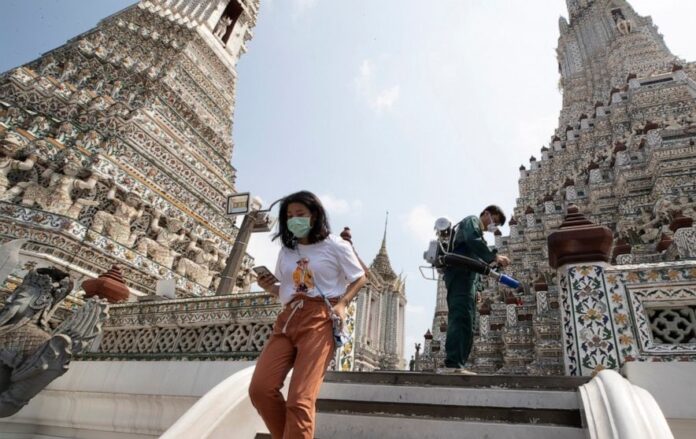
A tourist wearing a protective mask as a worker sprays disinfectant at Temple of Dawn in Bangkok, Thailand, Thursday, March 12, 2020. (AP Photo/Sakchai Lalit)

BANGKOK — The government’s proposal to reopen Bangkok to vaccinated foreign tourists will be postponed from Oct. 1 to Oct. 15 due to the low number of vaccinated residents inside the capital city, a top tourism official said Wednesday.

Tourism and sports minister Pipat Ratchakitprakarn told reporters the reopening can only go ahead if 70 percent of Bangkok’s population is fully vaccinated against COVID-19. As of this week, only 37 percent of the population is fully inoculated, Pipat said.

He added that the decision to postpone the reopening was made after a meeting between the tourism ministry and Bangkok Gov. Aswin Kwanmuang.

It is also unclear what Pipat meant by “reopening.” He made no mention of whether foreign tourists will still have to be quarantined for 14 days upon their arrival in Bangkok, or whether they will be free to travel around the city like the “Phuket Sandbox” program.

The delay is a setback to Prime Minister Prayut Chan-o-cha’s pledge to reopen Bangkok and four other provinces to foreign tourism by Oct. 1. The four provinces are Chon Buri, Chiang Mai, Phetchaburi, and Prachuap Khiri Khan.

The plan came under scrutiny from some health experts, who feel that the number of the vaccinated population is not high enough. A number of business owners also fear they may not be able to prepare the health and safety measures in time for the Oct. 1 deadline.

For instance, Dr Prasit Watanapa from the Faculty of Medicine at Siriraj Hospital, told the media that Thailand is not ready to re-open given its low vaccination rate.

He said the government should take heed of the recent outbreaks in Phuket, which is seeing a large number of infections everyday.


Advertisement

China Affirms UN Peacekeeping Role With Multinational Drills

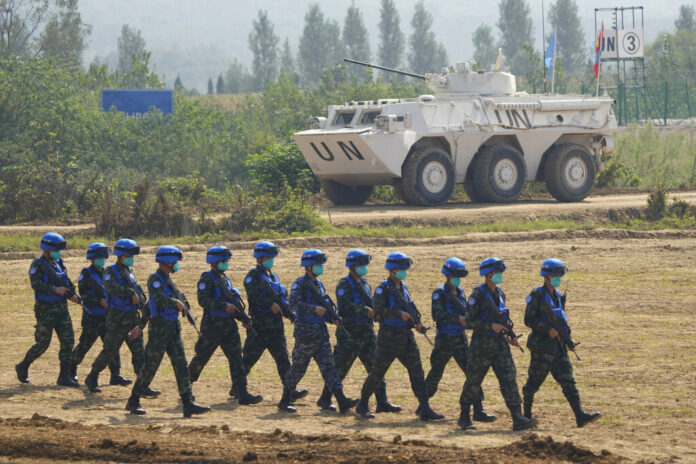
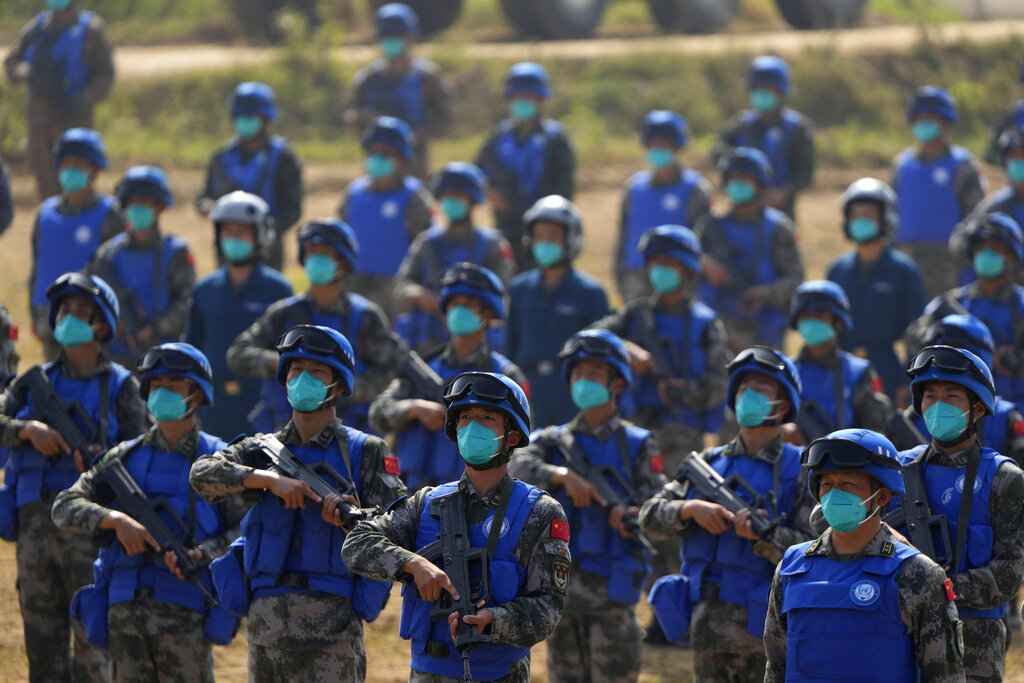
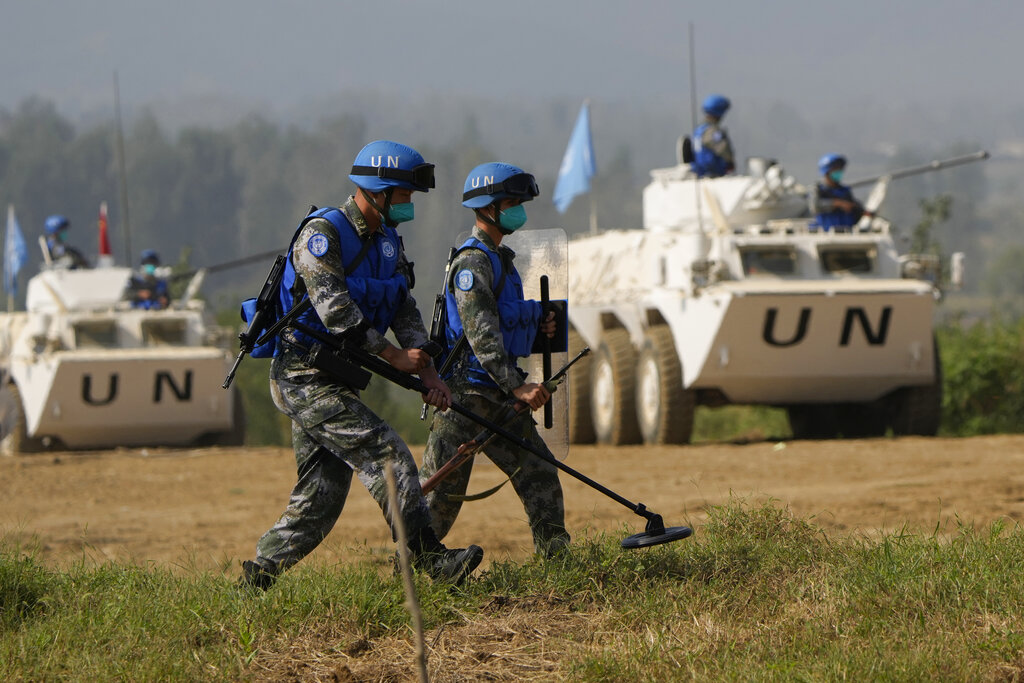
United Nations troops from Thailand take part in the Shared Destiny 2021 drill at the Queshan Peacekeeping Operation training base in Queshan County in central China's Henan province Wednesday, Sept. 15, 2021. Photo: Ng Han Guan / AP

QUESHAN, China (AP) — China has emphasized its role in United Nations peacekeeping operations with its hosting of multinational exercises that ended Wednesday.

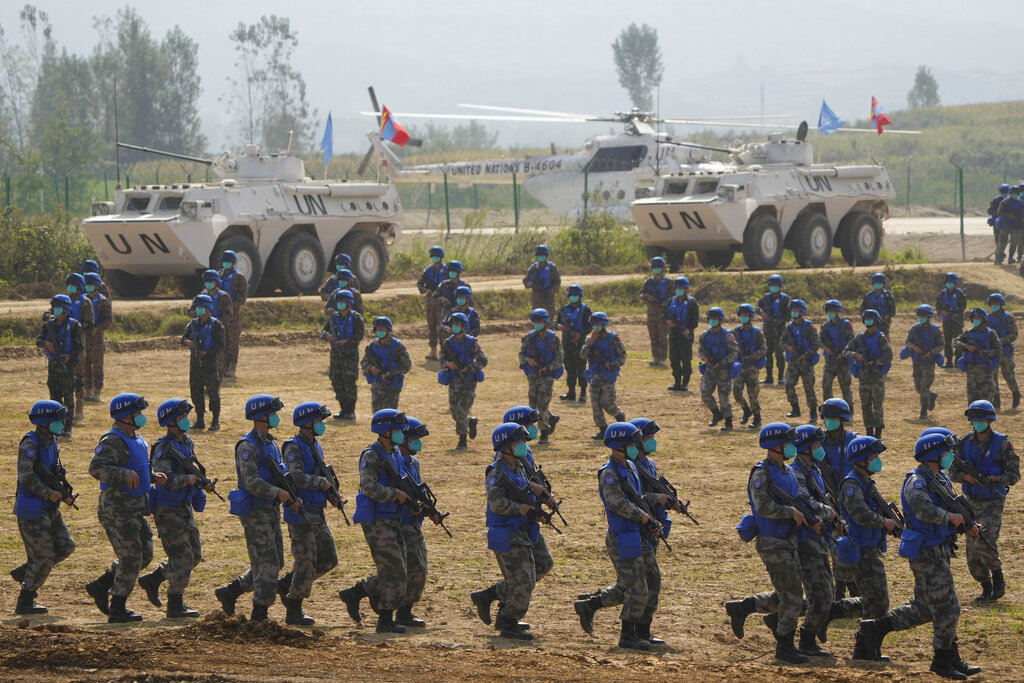
The 10 day-long drills in the central province of Henan featured around 1,000 troops from China, Mongolia, Pakistan and Thailand.

They practiced mounting armed escorts, security patrols, construction of temporary bases, civilian protection and counterterrorism.

Chinese weapons, equipment and facilities were in the forefront throughout the exercises, underscoring the country’s standing as the largest contributor of peacekeeping forces among the seven permanent members of the U.N. Security Council. China has the world’s largest standing military with increasingly sophisticated capabilities to challenge the United States, its main global strategic rival.

AP21258187900844
Chinese United Nations troop take part in the Shared Destiny 2021 drill at the Queshan Peacekeeping Operation training base in Queshan County in central China’s Henan province Wednesday, Sept. 15, 2021. Photo: Ng Han Guan / AP

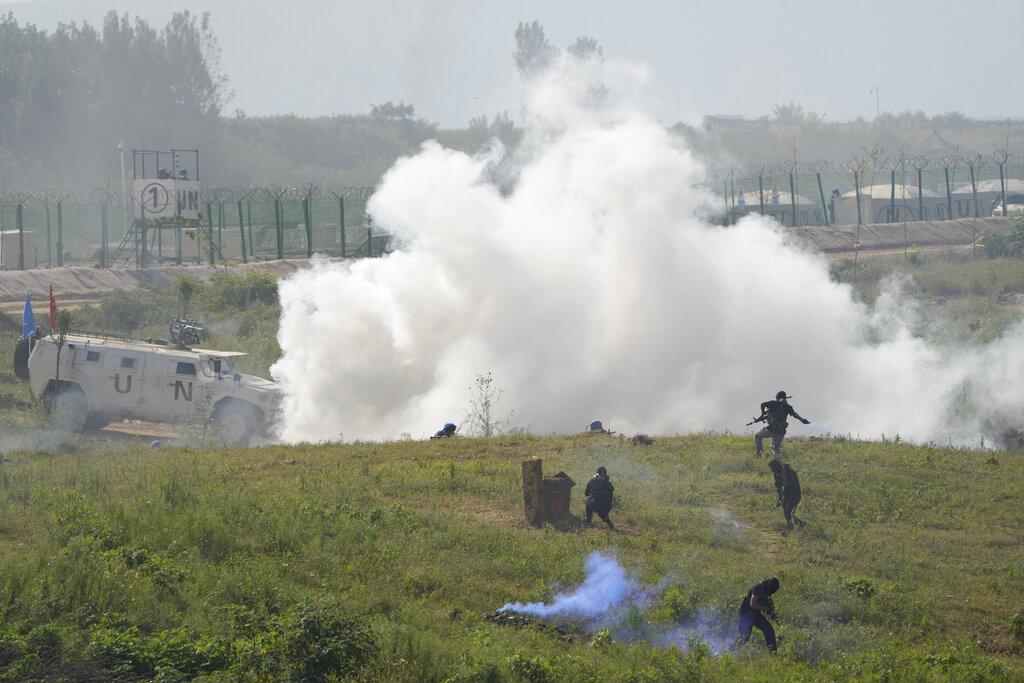
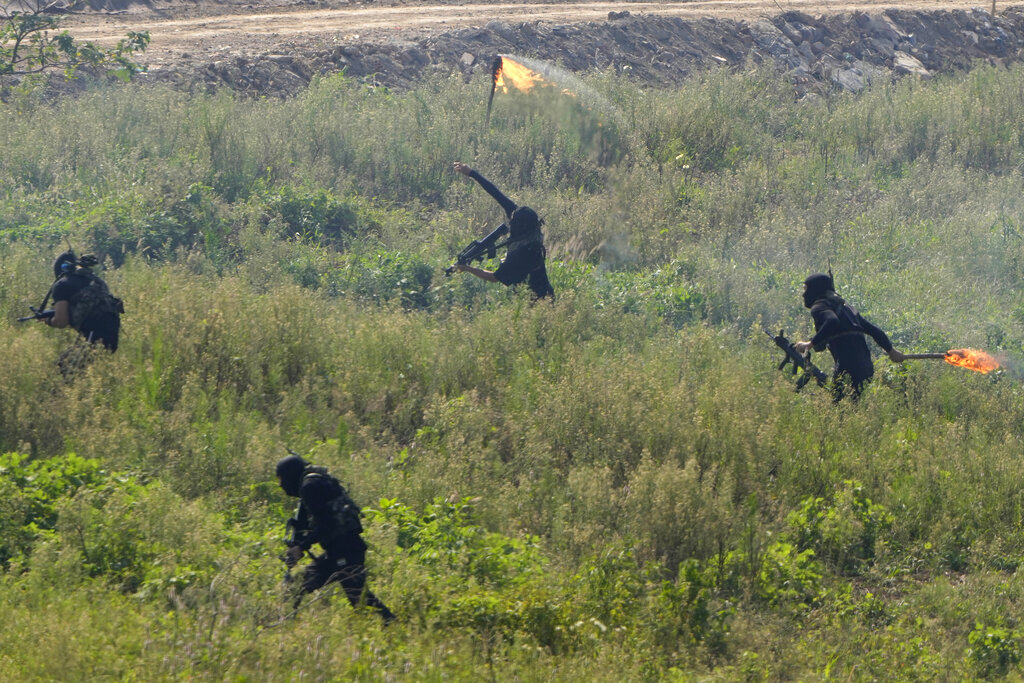
In one simulated counterterrorism drill, an explosive-laden vehicle was driven toward a U.N. base while attackers shot at peacekeepers and threw Molotov cocktails. The drill was based on an incident where a Chinese peacekeeping base in Mali came under attack.

China currently has around 2,500 peacekeepers assigned to eight separate missions.

The exercise comes on the 50th anniversary of the recognition of the People’s Republic as the representative of China at the United Nations, resulting in the expulsion of Taiwan, which Beijing continues to claim as its own territory to be brought under its control by military force if necessary.

The drills also come at a time of prolonged tensions between China and India over their disputed border and uncertainty over Afghanistan’s security after U.S. and foreign forces withdrew from the country in August.

Among the other participants in the exercises, Pakistan is a longtime ally of Beijing, while China in recent years has been courting Thailand through investment and military cooperation. Mongolia is sandwiched between China and Russia and is heavily dependent on its southern neighbor to purchase its natural resources.

Story: Emily Wang Fujiyama

AP21258187468801
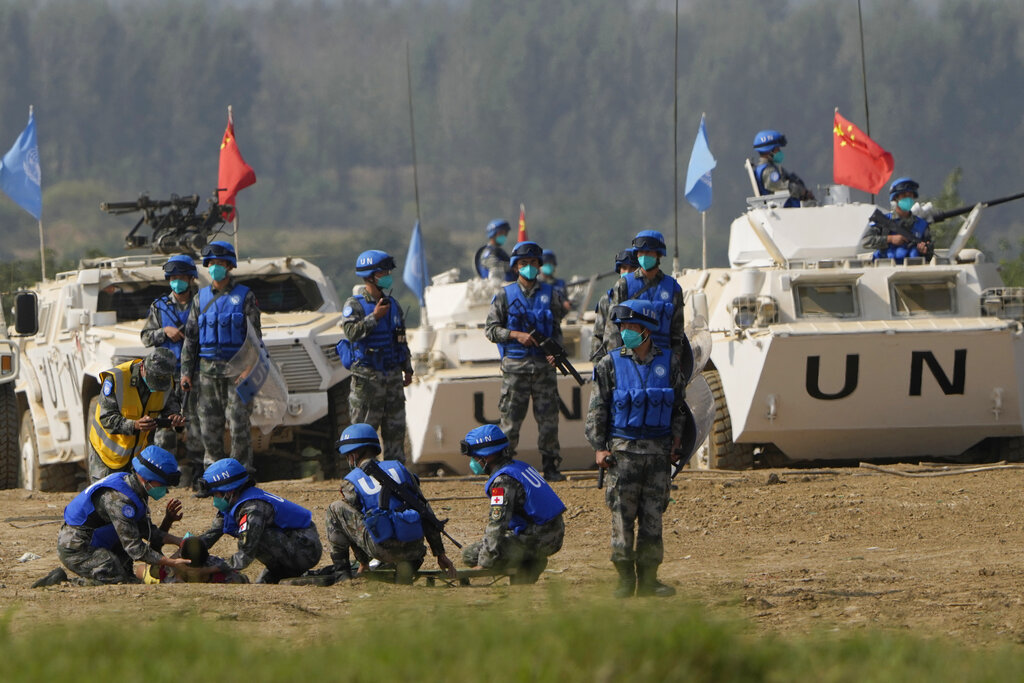
Chinese United Nations troop take part in the Shared Destiny 2021 drill at the Queshan Peacekeeping Operation training base in Queshan County in central China’s Henan province Wednesday, Sept. 15, 2021. Photo: Ng Han Guan / AP
AP21258187246357
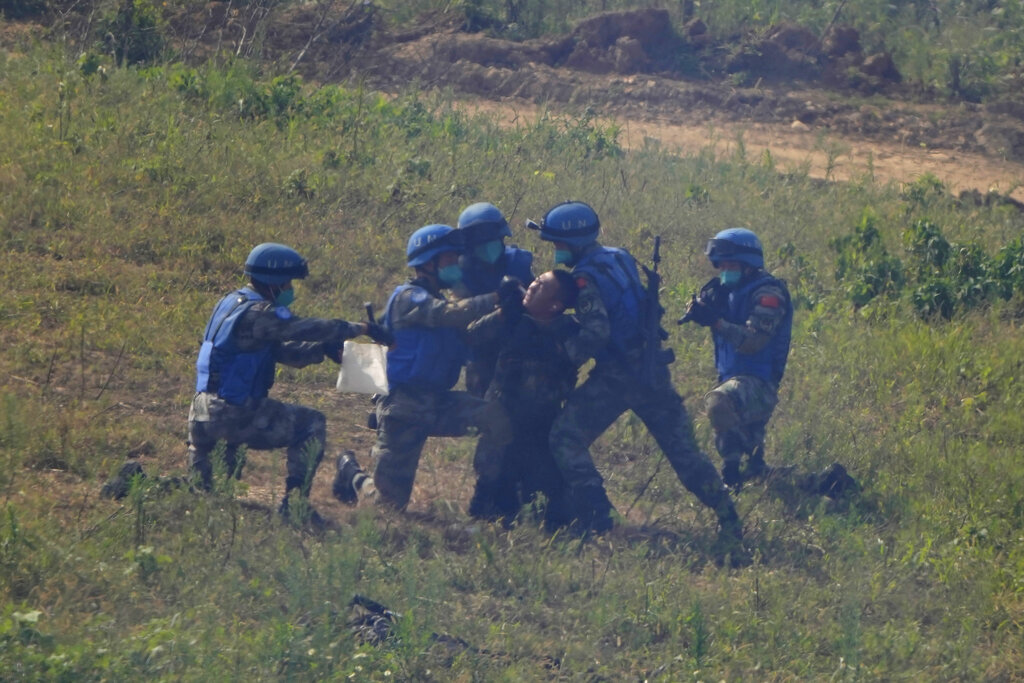
United Nations troops extract samples of a mock terrorist who surrendered after a failed attack on a United Nations base during the Shared Destiny 2021 drill at the Queshan Peacekeeping Operation training base in Queshan County in central China’s Henan province Wednesday, Sept. 15, 2021. Photo: Ng Han Guan / AP
AP21258187066542
Participants playing the role of terrorists attack a United Nations base during the Shared Destiny 2021 drill at the Queshan Peacekeeping Operation training base in Queshan County in central China’s Henan province Wednesday, Sept. 15, 2021. Photo: Ng Han Guan / AP
AP21258186948836
Participants playing the role of terrorists attack a United Nations base during the Shared Destiny 2021 drill at the Queshan Peacekeeping Operation training base in Queshan County in central China’s Henan province Wednesday, Sept. 15, 2021. Photo: Ng Han Guan / AP
AP21258186945772
Chinese United Nations troop practice sweeping for mines during the Shared Destiny 2021 drill at the Queshan Peacekeeping Operation training base in Queshan County in central China’s Henan province Wednesday, Sept. 15, 2021. Photo: Ng Han Guan / AP
AP21258175469496
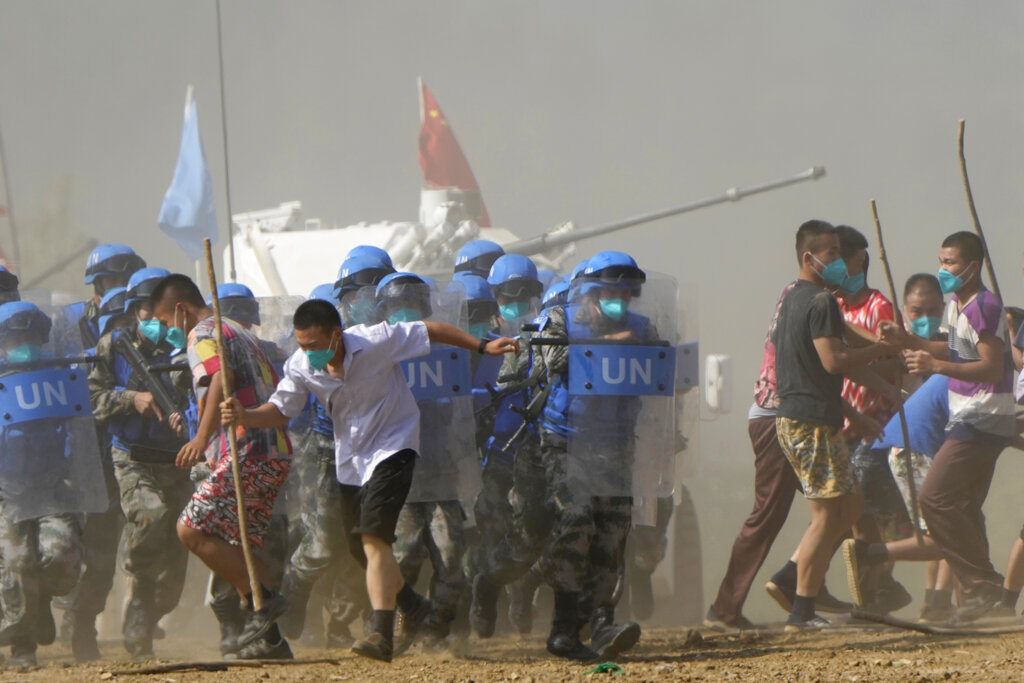
United Nations troop tend to a participant playing the role of injured civilian during a scenario where they pacify local civilians fighting over water resource during the Shared Destiny 2021 drill at the Queshan Peacekeeping Operation training base in Queshan County in central China’s Henan province Wednesday, Sept. 15, 2021. Photo: Ng Han Guan / AP
AP21258175168569
United Nations troop break up fighting in a scenario where participants playing the role of civilians fighting over water resource during the Shared Destiny 2021 drill at the Queshan Peacekeeping Operation training base in Queshan County in central China’s Henan province Wednesday, Sept. 15, 2021. Photo: Ng Han Guan / AP
AP21258159105222
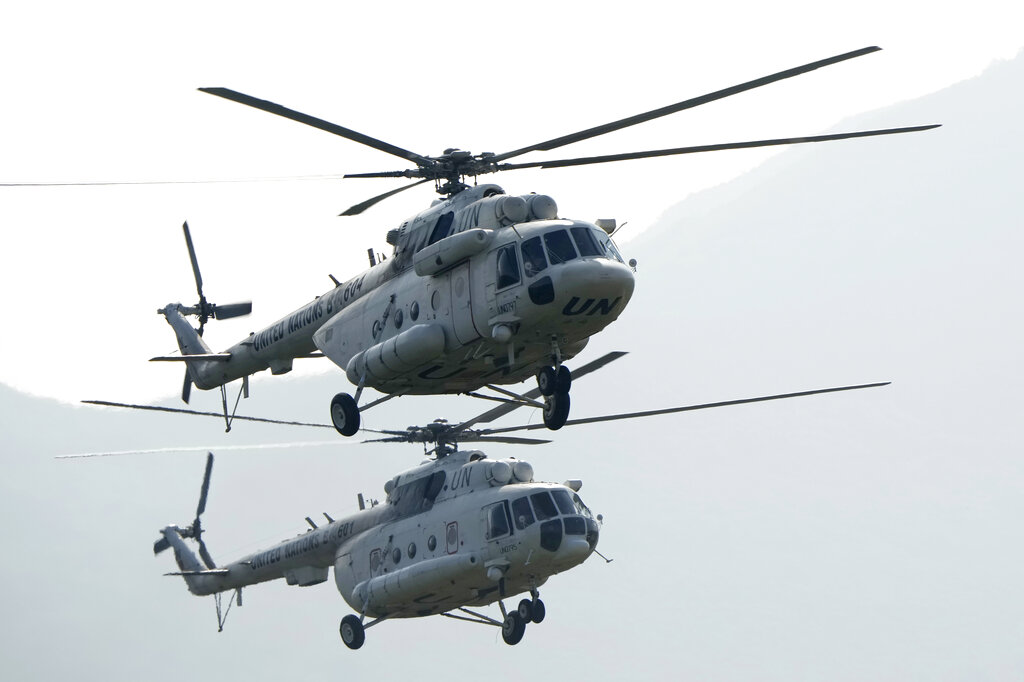
United Nations helicopters take art in the Shared Destiny 2021 drill at the Queshan Peacekeeping Operation training base in Queshan County in central China’s Henan province Wednesday, Sept. 15, 2021. Photo: Ng Han Guan / AP
Advertisement

Report: Most Nations Fall Far Short in Plans To Curb Warming

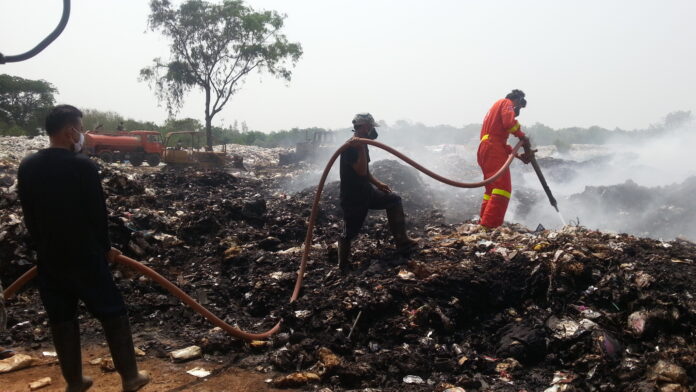
Officials put out a fire at a landfill the morning of April 25, 2017 in Uthai Thani province, which began due to the hot weather. This landfill in Muang Uthai Thani district receives 50 tons of trash per day.

Nearly every nation is coming up short — most of them far short — in their efforts to fight climate change, and the world is unlikely to hold warming to the internationally agreed-upon limit, according to a new scientific report.

Only one nation — tiny The Gambia in Africa — is on track to cut emissions and undertake its share of actions to keep the world from exceeding the Paris agreement goal of limiting warming to 1.5 degrees Celsius (2.7 degrees Fahrenheit) of warming since pre-industrial times, the report said.

Only one industrialized nation — the United Kingdom — is even close to doing what it should to cut emissions of heat-trapping gases and finance clean energy for poorer nations, the Climate Action Tracker reported Wednesday.

In May, after U.S. President Joe Biden’s climate summit, enough nations had promised big enough carbon pollution cuts that the tracker said the “emissions gap” — the difference between emissions projections with pledges and what’s required to meet the 1.5 degree goal — dropped 11%.

“That momentum has not been maintained,” said report co-author Bill Hare, CEO of Climate Analytics. “We’re running short of countries stepping up with additional emission commitments to close the gap.”

Unlike its previous reports, which just looked at promises to cut carbon pollution and policy changes, the new ratings include money issues. Finance is critical to climate negotiations this fall in Scotland, so the report examined commitments by rich nations to help pay for clean energy for poor nations, said Hare, a climate scientist.

That hurt the United States and European Union rankings.

The report called efforts by the United States, the European Union, Germany and Japan “insufficient” and more in line with global warming of 3 degrees Celsius (5.4 degrees Fahrenheit) since the late 19th century.

The world has already warmed 1.1 degrees Celsius (2 degrees Fahrenheit) since that time, so these countries are on track to make the world 1.9 degrees Celsius (3.4 degrees Fahrenheit) warmer than now.

While the U.S. official emissions pledge is almost sufficient, the overall grade “reflects that Biden hasn’t got his policies in place,” said Hare. The report gave U.S. financial aid commitments the worst grade possible.

China, the highest carbon emitter, and third highest carbon polluter India are what the report calls “highly insufficient” or more in line with 4 degrees Celsius (7.2 degrees Fahrenheit) of warming since pre-industrial times.

“We just don’t see enough action coming from China,” Hare said.

Hare said Brazil and Mexico “went backwards” on their fight to curb warming. The report lists Iran, Russia, Saudi Arabia, Singapore and Thailand on the bottom.

___

Story: Seth Borenstein. Read more of AP’s climate coverage at http://www.apnews.com/Climate

The Associated Press Health and Science Department receives support from the Howard Hughes Medical Institute’s Department of Science Education. The AP is solely responsible for all content.

Advertisement

Japan to Donate 300,000 More AZ Shots to Thailand

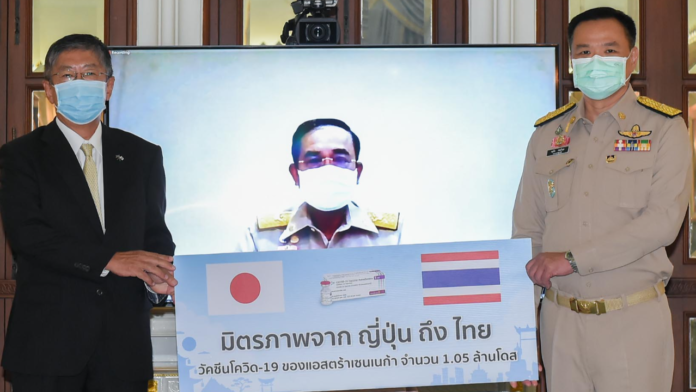
PM Prayut Chan-o-cha virtually presides over a ceremony to welcome Japan's donation of over 1 million AstraZeneca vaccines to Thailand at Government House on July 12, 2021. (Image: Government House)

BANGKOK — The Japanese government said on Monday it will donate 1.3 million AstraZeneca vaccines to several Asian countries and territories, including 300,000 doses to Thailand.

Japanese Foreign Minister Toshimitsu Motegi said the country’s newest round of vaccine donation will include 400,000 doses for Vietnam, 300,000 for Thailand, 100,00 doses for Brunei, and 500,000 doses for Taiwan.

So far, Japan has given out more than 23 million doses of the AstraZeneca vaccine produced in Japan to countries in South Asia and the Pacific islands, Motegi said.

The vaccines have been dispersed throughout Southeast Asia and the Pacific Islands, the minister said. Thailand alone has received 1.3 million doses of AstraZeneca from Japan as donations.

Japan has also pledged $1billion and 30 million doses to the Covax programme, which is overseen by the GAVI Alliance and the World Health Organization.

Half of Japan’s population has been fully vaccinated, according to published government data, compared to just 17 percent in Thailand.

The vaccination program in Thailand was meant to rely on AstraZeneca doses produced domestically by Siam Bioscience, but the palace-owned company failed to meet its target, citing delays and production issues.

The Chulabhorn Royal Academy also announced on Monday that it will buy 8 million doses of COVID-19 vaccine from Moderna.

The doses will be administered as booster shots next year, said the royal academy, which is 1 out of only 5 agencies with the authority to seek alternative vaccine sources. The academy has already imported shipments of Sinopharm vaccine from China and sold them to private entities.

Advertisement

Myanmar Court Moves Venue for Secrets Trial of Australian

In this Nov. 25, 2005, file image taken from video, Sean Turnell, an economist at Australia's Macquarie University, speaks during an interview at his university office in Sydney. Photo: Australian Broadcasting Corporation via AP

BANGKOK (AP) — A court in Myanmar has agreed to change the venue for the trial of an Australian economist and adviser to ousted Myanmar leader Aung San Suu Kyi on charges of violating the nation’s official secrets law, lawyers said Tuesday.

Sean Turnell was charged along with Suu Kyi and three former Cabinet ministers under the law in March, a month after the military ousted Suu Kyi’s elected government and seized power.

The decision by the country’s Supreme Court will move the trial from Yangon, Myanmar’s biggest city where Turnell was arrested, to the capital, Naypyitaw, said one of Suu Kyi’s lawyers, Kyi Win.

That will consolidate most of the legal cases against Suu Kyi in a single location. The cases, lodged at the behest of the military-installed government, are widely seen as an effort to discredit Suu Kyi and prevent her from returning to politics.

Violating the official secrets law carries a maximum penalty of 14 years in prison. The colonial-era statute criminalizes the possession, collection, recording, publishing, or sharing of state information that is “directly or indirectly, useful to an enemy.”

The exact details of Turnell’s alleged offense and those of the others have not been made public, though state television, citing government statements, has said the Australian academic had access to “secret state financial information” and had tried to flee the country.

Turnell has been confined in Yangon’s Insein Prison, known for decades for holding political prisoners.

Meanwhile, the trial of Suu Kyi, 76, and two colleagues continued Tuesday at a special court in Naypyitaw, a day after she had to cancel her participation because of illness. The court on Monday allowed her to return to her place of detention — which is kept secret by the authorities — after she explained that she was suffering from cold symptoms and felt dizzy on the ride to the court.

Another of her lawyers, Khin Maung Zaw, said her condition had visibly improved Tuesday when she returned to court, though she informed her legal team that she still felt some dizziness. Her co-defendants on several charges, former President Win Myint and Naypyitaw ex-Mayor Myo Aung, were also in attendance.

Suu Kyi is being tried in Naypyitaw on charges of sedition, defined as spreading information that could cause public alarm or unrest, and sometimes termed incitement; two counts of flouting COVID-19 pandemic restrictions during the 2020 election campaign; illegally importing walkie-talkies for her bodyguards to use; and unlicensed use of the radios.

Suu Kyi’s lawyers have argued in court that the sedition case should not be prosecuted, and both her team and the prosecution on Tuesday presented arguments to the court on that matter, Khin Maung Zaw said.

Two prosecution witnesses failed to show up to testify about the COVID-19 restrictions case and the testimony of a third was postponed, he said.

Khin Maung Zaw also told reporters that the defense lawyers had Suu Kyi sign documents appointing them to represent her in corruption cases filed in the central city of Mandalay.

The military seized power just before Suu Kyi and her National League for Democracy party would have begun a second five-year term in office. It said it acted because last November’s election was marred by widespread fraud, an assertion that is widely doubted. Protests over the army takeover are continuing, along with growing armed resistance.

Story: Grant Peck

Advertisement

US COVID-19 Cases Climbing, Wiping Out Months of Progress

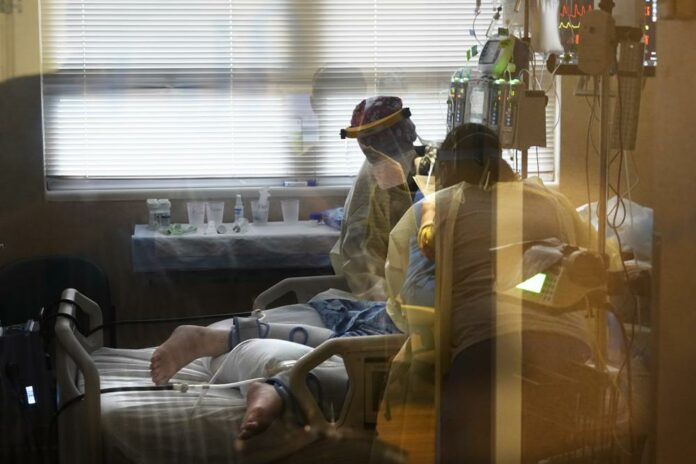
In this Aug. 18, 2021, file photo, medical staff tend to a patient with coronavirus, on a COVID-19 ward inside the Willis-Knighton Medical Center in Shreveport, La. (AP Photo/Gerald Herbert, File)

COVID-19 deaths and cases in the U.S. have climbed back to levels not seen since last winter, erasing months of progress and potentially bolstering President Joe Biden’s argument for his sweeping new vaccination requirements.

The cases — driven by the delta variant combined with resistance among some Americans to getting the vaccine — are concentrated mostly in the South.

While one-time hot spots like Florida and Louisiana are improving, infection rates are soaring in Kentucky, Georgia and Tennessee, fueled by children now back in school, loose mask restrictions and low vaccination levels.

The dire situation in some hospitals is starting to sound like January’s infection peak: Surgeries canceled in hospitals in Washington state and Utah. Severe staff shortages in Kentucky and Alabama. A lack of beds in Tennessee. Intensive care units at or over capacity in Texas.

The deteriorating picture nine months into the nation’s vaccination drive has angered and frustrated medical professionals who see the heartbreak as preventable. The vast majority of the dead and the hospitalized have been unvaccinated, in what has proved to be a hard lesson for some families.

“The problem now is we have been trying to educate based on science, but I think most of the education that is happening now is based on tragedy, personal tragedy,” said Dr. Ryan Stanton, an emergency room physician in Lexington, Kentucky.

In Kentucky, 70% of the state’s hospitals — 66 of 96 — are reporting critical staff shortages, the highest level yet during the pandemic, the governor said.

“Our hospitals are at the brink of collapse in many communities,” said Dr. Steven Stack, Kentucky’s public health commissioner.

The U.S. is averaging over 1,800 COVID-19 deaths and 170,000 new cases per day, the highest levels respectively since early March and late January. And both figures have been on the rise over the past two weeks.

The country is still well below the terrifying peaks reached in January, when it was averaging about 3,400 deaths and a quarter-million cases per day.

The U.S. is dispensing about 900,000 vaccinations per day, down from a high of 3.4 million a day in mid-April. On Friday, a Food and Drug Administration advisory panel will meet to discuss whether the U.S. should begin giving booster shots of the Pfizer vaccine.

On a positive note, the number of people now in the hospital with COVID-19 appears to be leveling off or even declining at around 90,000, or about where things stood in February.

Last week, the president ordered all employers with more than 100 workers to require vaccinations or weekly tests, a measure affecting about 80 million Americans. And the roughly 17 million workers at health facilities that receive federal Medicare or Medicaid also will have to be fully vaccinated.

“We read about and hear about and we see the stories of hospitalized people, people on their deathbeds among the unvaccinated over the past few weeks,” Biden said in announcing the rules. “This is a pandemic of the unvaccinated.”

The requirements have met with resistance and threats of lawsuits from Republicans.

Arizona on Tuesday reported 117 deaths, the most in a single day since last February. Tennessee now ranks first in the U.S. in new cases per capita. Hundreds of students there have been forced to quarantine. Some schools have closed because of staffing shortages. Others have asked to switch to remote learning.

But measures aimed at containing the virus have run into opposition. Last week, a Tennessee high school student who spoke at a school board meeting in favor of a mask mandate was heckled by adults while he talked about his grandmother dying from the virus.

Stanton, the ER doctor in Kentucky, said he has admitted families where the delta variant has swept through generations, especially if the older members are unvaccinated.

“Now in Kentucky, one-third of new cases are under age 18,” he said. Some children brought it home from summer camp and spread it to the rest of the family, and now, “between day care and schools and school activities, and friends getting together, there are just so many exposures.”

In Alabama, hundreds of COVID-19 patients fill intensive care units, and one hospital contacted 43 others in three states to find a specialty cardiac ICU bed for Ray Martin DeMonia. It wasn’t soon enough. The 73-year-old died Sept. 1.

“In honor of Ray, please get vaccinated if you have not, in an effort to free up resources for non-COVID related emergencies,” his family pleaded in his obituary.

In Hidalgo County, Texas, along the Mexican border, about 50 patients were in the hospital with COVID-19 on a given day in July. By early August, the number had soared to over 600.

“Back in July we were almost celebrating. Little did we know,” said Ivan Melendez, public health authority for Hidalgo County. The situation has improved, with just under 300 people in the hospital as of Monday, but ICUs are still above 90% capacity, Melendez said.

The biggest surge over the summer occurred in states that had low vaccination rates, particularly in the South, where many people rely on air conditioning and breathe recirculated air, said Linsey Marr, a professor of civil and environmental engineering at Virginia Tech. She said states farther north could see upticks as the onset of cold weather sends people indoors.

Vaccination rates are not as low in some Northern states, but “there’s still a lot of unvaccinated people out there. Delta is going to find them,” Marr said.

___

Associated Press Writers Ken Sweet, Kimberlee Kruesi, Adrian Sainz and Tali Arbel contributed to this report.

Advertisement

‘Lisa Blackpink’ MV Turns Ancient Headgear Into Pop Icon

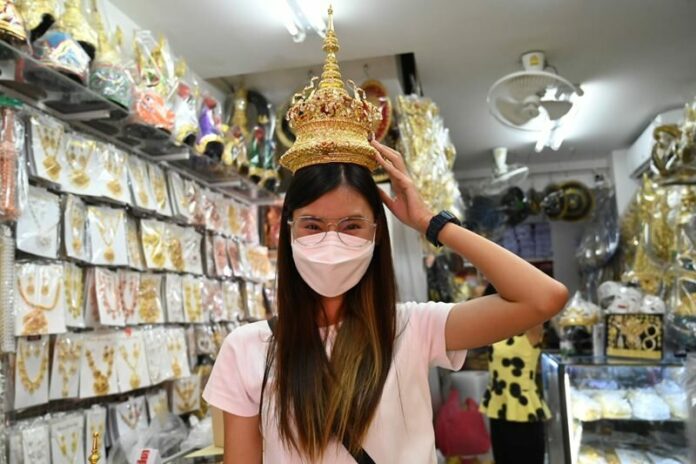
A traditional headgear is seen at a shop in Pahurat, Bangkok, on Sept. 13, 2021.

BANGKOK — Vendors at wholesale markets in Bangkok report a surge in the sale of traditional golden headgears after Thai-born K-pop star “Lisa Blackpink” wore one in a recent hit music video.

“Lalisa” is the first solo song by Lalisa “Lisa” Manoban of the Blackpink girl group. The video, which has gained more than 100 million views on YouTube since its debut on Friday, features a scene showing Lisa wearing the traditional headdress while sitting on a golden throne.

The pointed headgear, commonly known as chada, is typically worn during traditional dances and religious rituals, but vendors in Pahurat and Sampeng markets said many people have been buying them since Lisa’s video dropped.

Chalita Thongdeetae, a shop owner in Pahurat, said she started receiving orders for chada soon after the MV was released. She said the fad helped revive businesses in the Pahurat neighborhood, which has been suffering under the coronavirus pandemic.

“The lively atmosphere returned here. Many vendors get to sell their goods once again,” Chalita said. “I’d like to thank Lisa very much for bringing back this atmosphere.”

Many netizens also posted photos and videos of themselves wearing chada on social media, especially on TikTok application, where they imitated Lisa’s dances.

Advertisement

Once Inmates, Taliban Now in Charge in a Kabul Prison

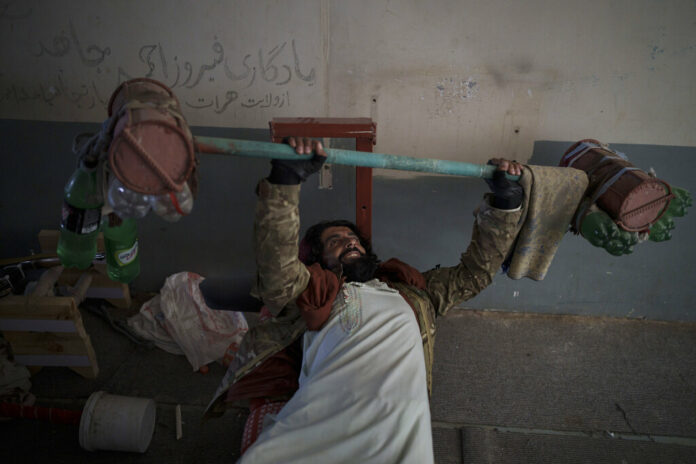
A Taliban fighter lifts a makeshift weight left behind by former prisoners at an empty area of the Pul-e-Charkhi prison in Kabul, Afghanistan, Monday, Sept. 13, 2021. Photo: Felipe Dana / AP

KABUL (AP) — Once, Kabul’s main prison was crowded with thousands of Taliban captured and arrested by the government. On Monday, a Taliban commander strolled through its empty halls and cell blocks, showing his friends where he had once been imprisoned.

It was a sign of the sudden and startling new order in Afghanistan after the militant group swept into the capital nearly a month ago and threw out the crumbling, U.S.-backed government it had fought for 20 years.

The Taliban now run Pul-e-Charkhi Prison, a sprawling complex on Kabul’s eastern outskirts. After capturing the city, the fighters freed all the inmates there, the government guards fled, and now dozens of Taliban fighters are running the facility.

The commander, who refused to give his name, was on a personal visit to the complex with a group of his friends. He told The Associated Press he had been arrested around a decade ago in eastern Kunar province and was brought to Pul-e-Charkhi, bound and blindfolded.

“I feel so terrible when I remember those days,” he said. He said prisoners suffered abuses and torture. He was imprisoned for around 14 months before he was released. “Those days are the darkest days of my life, and now this the happiest moment for me that I am free and come here without fear.”

Many Afghans as well as governments around the world have been alarmed by the swift Taliban seizure of power, fearing the movement will impose a similar, harsh rule as they did during their first time ruling in the 1990s. But for the Taliban fighters, it’s a moment to savor a victory after years of grueling fighting — and to see a city few of them have entered since the war began.

For some of the Taliban guards accompanying the AP, it was the first time they’d entered the abandoned cell blocks. They looked with curiosity through the cells, still littered with things the last inmates left behind — fabrics hanging from the walls and windows, small rugs, water bottles.

One fighter exchanged his sandals for a better pair he found in a cell. Then he found yet a better pair and exchanged again. Others played with the former prisoners’ makeshift weight bars.

AP21256695631786
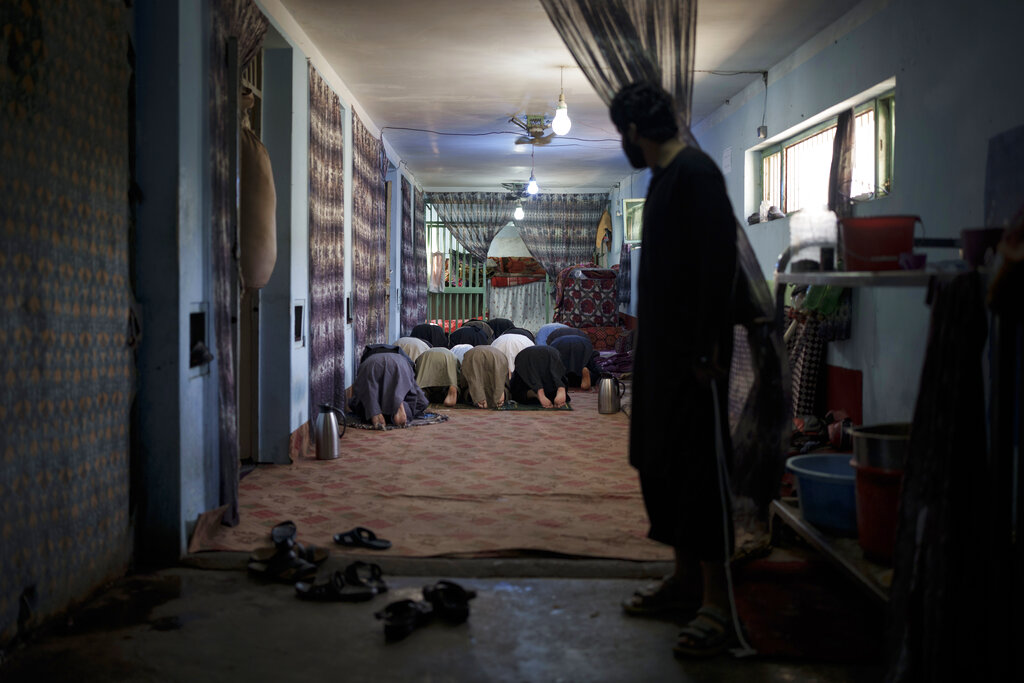
Recently arrested prisoners pray inside the Pul-e-Charkhi prison in Kabul, Afghanistan, Monday, Sept. 13, 2021. Photo: Felipe Dana / AP

Pul-e-Charkhi had a long, disturbing history of violence, mass executions and torture. Mass graves and torture cells were uncovered dating from the Soviet-backed governments of the late 1970s and 1980s. Under the U.S.-backed government, it was more known for poor conditions and overcrowding — its 11 cell blocks were built to house 5,000 inmates, but were often packed with more than 10,000, including Taliban prisoners and criminals.

Taliban prisoners often complained of abuses and beatings, and there were regular riots. Still, they kept up their organization behind bars, winning concessions like access to cell phones and longer time outside their cells.

Some of the Taliban now guarding the site were former inmates. The government guards have fled and don’t dare return, fearing reprisals. Though the facility remains largely empty, one section holds around 60 people imprisoned in the past few weeks, who the guards said were mostly accused criminals and drug addicts.

Story: Felipe Dana

AP21256696000711
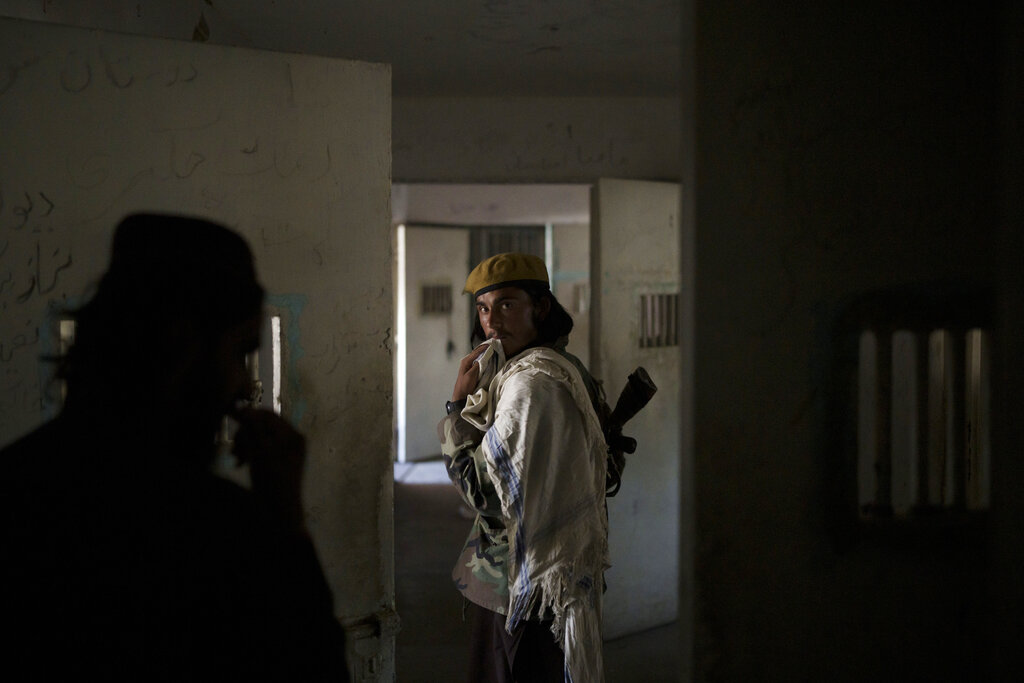
Taliban fighters walk through the alleys of an empty area at the Pul-e-Charkhi prison in Kabul, Afghanistan, Monday, Sept. 13, 2021. Photo: Felipe Dana / AP
Advertisement

Chinese Students Hit by US Visa Rejections Amid Tension

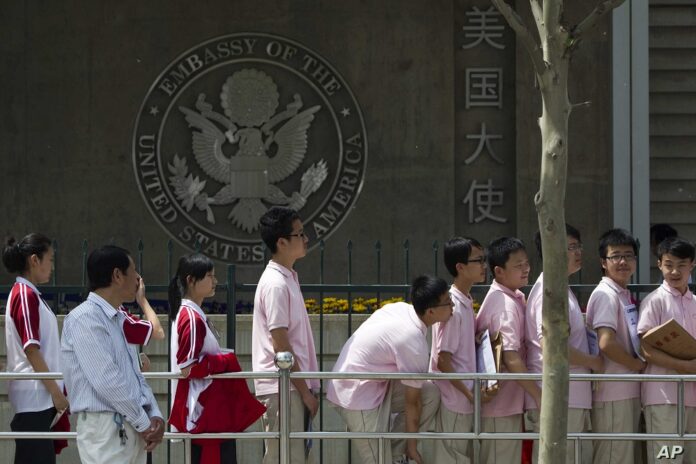
In this May 2012 file photo, Chinese students wait outside the U.S. Embassy for their visa application interviews in Beijing, China. (AP Photo/Alexander F. Yuan, File)

After a semester online, Wang Ziwei looked forward to meeting classmates who are returning to campus at Washington University in St. Louis. But the 23-year-old finance student said the U.S. revoked his student visa on security grounds.

Wang is among at least 500 students the Chinese government says have been rejected under a policy issued by then-President Donald Trump to block Beijing from obtaining U.S. technology with possible military uses. Students argue it is applied too broadly and fume at what they say is an accusation they are spies.

“The whole thing is nonsense,” Wang said. “What do we finance students have to do with the military?”

The students join companies and individuals whose plans have been disrupted by U.S.-Chinese tension over technology and security, Beijing’s military buildup, the origins of the coronavirus, human rights and conflicting claims to the South China Sea and other territory.

The policy blocks visas for people who are affiliated with the ruling Communist Party’s military wing, the People’s Liberation Army, or universities deemed by Washington to be part of military modernization efforts.

U.S. officials say they believe thousands of Chinese students and researchers participate in programs that encourage them to transfer medical, computer and other sensitive information to China.

Washington cites Beijing’s strategy of “civil-military fusion,” which it says treats private companies and universities as assets to develop Chinese military technology.

“Joint research institutions, academia and private firms are all being exploited to build the PLA’s future military systems — often without their knowledge or consent,” the State Department said in a 2020 report.

Trump’s successor, Joe Biden, has given no indication of what he might do.

Chinese officials appealed to U.S. Deputy Secretary of State Wendy Sherman to drop the visa restrictions when she visited in July, according to The Paper, a Shanghai online news outlet.

The policy is necessary to “protect U.S. national security interests,” the U.S. Embassy in Beijing said in a statement. It said the policy is a response to “some abuses of the visa process” and is “narrowly targeted.”

More than 85,000 visas for Chinese students have been approved over the past four months, according to the embassy.

“The numbers show clearly that the United States stands ready to issue visas to all those who are qualified — including Chinese students and scholars,” it said.

China is the biggest source of foreign students in the United States, according to U.S. government data. The number fell 20% in 2020 from the previous year but at 380,000 was nearly double that of second-ranked India.

An engineer at a state-owned aircraft manufacturer said he was turned down for a visa to accompany his wife, a visiting scholar in California studying pediatric cancer.

The engineer, who would give only his surname, Huang, has undergraduate and graduate degrees from the Harbin Institute of Technology in China’s northeast. It is one of seven schools Chinese news reports say are associated with visa rejections because they are affiliated with the Ministry of Industry and Information Technology.

“I was insulted,” Huang said. “That I graduated from this school means I am a spy? What’s the difference between this and racism?”

Huang said his wife’s fellowship was two to three years, but she will cut that to one, “sacrificing her career” to avoid being away from their two children for too long.

“It’s a pretty big impact on individuals when one country fights with another,” Huang said.

Rejection letters received by several students cited Trump’s order but gave no details of the decision. However, some students said they received rejections immediately after being asked which university they attended.

Wang, the finance student, said he obtained a visa, but the U.S. Embassy called later and said it was revoked.

Wang graduated from the Beijing Institute of Technology, another university associated with visa rejections due to its connection with the industry ministry. Others include Beijing Aerospace University, Nanjing University of Science and Technology, Nanjing University of Aeronautics and Astronautics, Harbin Engineering University and Northwestern Polytechnical University.

Graduates of the Beijing University of Posts and Telecommunications also say they have been rejected.

Five Chinese scientists at universities in California and Indiana were charged last year with lying about possible military connections on visa applications. Those charges were dropped in July after the Justice Department said an FBI report indicated such offenses often had no connection to technology theft.

The Chinese government complained in August that three students who had visas were refused entry into the United States at the Houston airport after military training photos were found in their phones.

Beijing “strongly deplores and rejects” the policy and appealed to the U.S. government to make changes, Foreign Ministry spokesperson Wang Wenbin said.

A group that says it represents more than 2,000 students and scholars has announced plans for a lawsuit asking a court to throw out or narrow the restrictions.

At Washington University in St. Louis, a “handful of student visas” were affected, according to Kurt Dirks, vice chancellor for international affairs.

Students can start the semester online or wait until next year, Dirks said in an email.

“Should they continue to face challenges, the university will work with them so they can complete their program online,” Dirks said.

Monica Ma, 23, said she was turned down for a U.S. visa to complete a master’s degree in information management at Carnegie Mellon University.

The graduate of the Beijing University of Posts and Telecommunications said after spending a year in Australia working on her degree, she needs to attend classes in person at Carnegie Mellon in Pittsburgh because they no longer are taught online.

Ma said she has a job offer from an internet company that requires her to complete her degree. She has postponed her attendance for classes until next year in hopes she can obtain a visa by then.

“I cannot change it through my efforts. That’s the saddest part,” Ma said.

Li Quanyi, an electrical engineering student from the southern city of Guiyang, said he was accepted by Columbia University but failed to obtain a visa. Li graduated from the Beijing University of Posts and Telecommunications.

Carnegie Mellon and Columbia didn’t respond to questions sent by email.

Li has moved to Hong Kong and said he is happy there.

“I am not going, even if the rule changes,” Li said. “The United States rejected me, and I am not going.”


Advertisement

Hot News

LATEST NEWS

Bangkok
overcast clouds
31.8 ° C
33.3 °
30 °
76 %
4.5kmh
100 %
Sun
32 °
Mon
36 °
Tue
38 °
Wed
35 °
Thu
35 °