


















29.7 C
Bangkok
Monday, June 8, 2026
Home Blog Page 1033

CP Foods proclaims “2030 Sustainability in Action” Strategy, to address all 17 SDGs

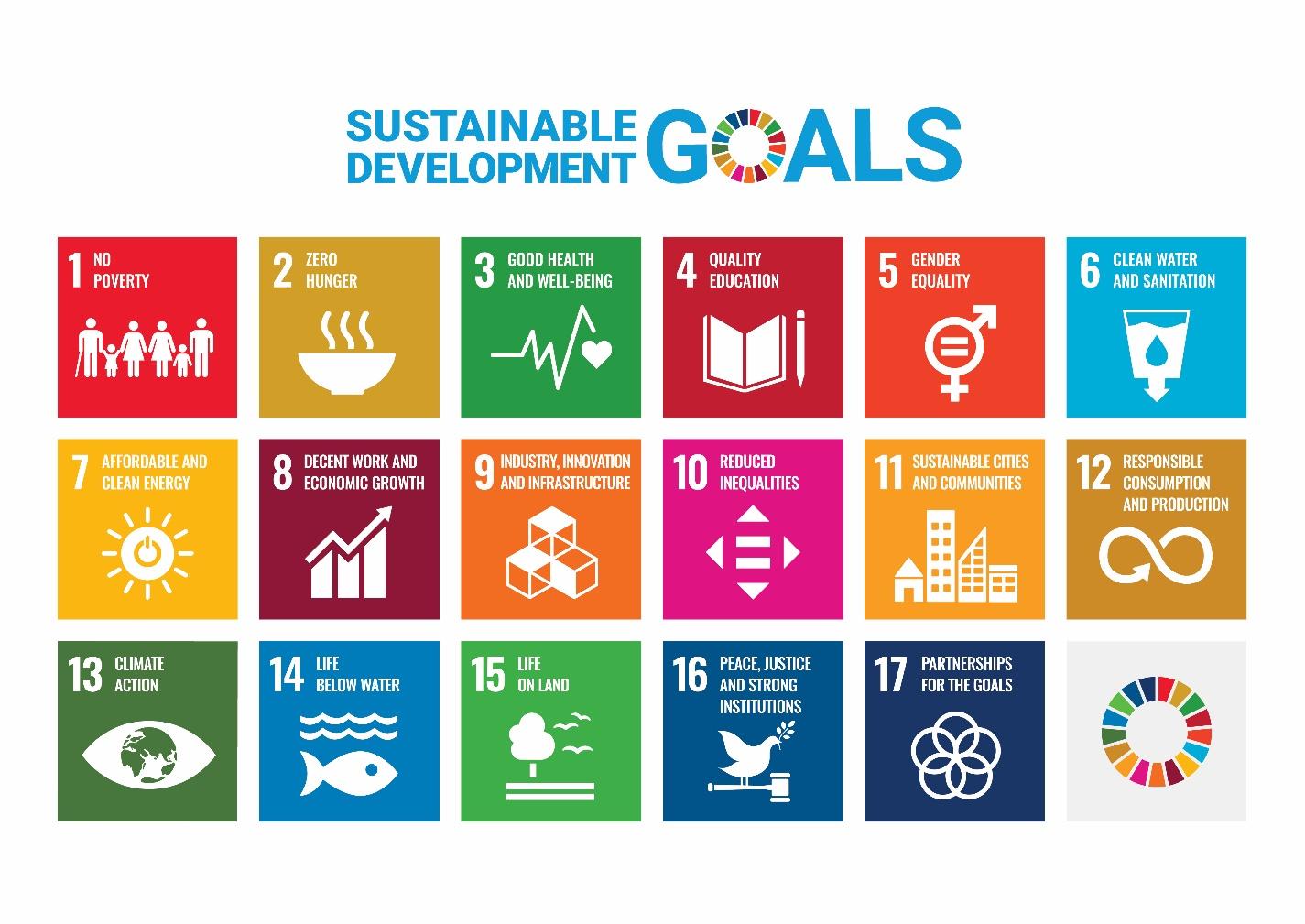
Charoen Pokphand Foods Public Company Limited (CP Foods) unveils CP Foods “2030 Sustainability in Action” Strategy, vowing to drive the operations with 9 commitments shaped around its pillars towards sustainability – “Food Security”, “Self-Sufficient Society” and “Balance of Nature”.The main goals are to ensure food security based on environmental-friendly production and mutual growth of society; mitigate Climate Change impacts; and achieve all 17 United Nations Sustainable Development Goals (SDGs). 

    CP Foods3

Mr. Wuthichai Sithipreedanant, Senior Vice President – Corporate Social Responsibility and Sustainable Development of CP Foods, said that CP Foods “2030 Sustainability in Action” outlines the action plans to be implemented in the next 10 years (2021-2030), to strengthen the Company’s resilience against rapid changes and promote the Environmental, Social, and Corporate Governance (ESG). The action plan reaffirms the Company’s philosophy in operating under the 3 sustainability pillars – Food Security, Self-Sufficient Society and Balance of Nature and supports to Charoen Pokphand Group’s target to achieve zero emission within 2030 as well as all 17 SDGs.

“As we have achieved our 2020 sustainability targets, we carve a new strategy with an emphasis on intense actions. We set new targets to create positive impacts on society and the environment in support of SDGs. We’re entering the decade of actions for positive changes to the world. And we’re establishing sustainability at the individual level, to the employees of the organization and outside,” 

Mr. Wuthichai said. 
CP Foods2

The 9 commitments under the 3 sustainability pillars are as follows:

On Food Security, the focus is placed on food security and continuous creation of innovations to address consumer demand with nutritious food suitable for all ages; the application of digital and robotic systems in the production; responsible marketing through knowledge in nutritions and health food; adherence with the international Animal Welfare standards; and the application of Smart Farm technology. Under these actions, CP Foods expects half of its new products will promote a better health and provide greater nutritional values, while low-carbon products will hit 40% of sales revenue. 

On Self-Sufficient Society, new targets are set. CP Foods aims to create positive impacts for 3 million people, employees and people in general, and to achieve 3 million hours of knowledge training for employees with respect to human rights and equal treatments. CP Foods will promote lifelong learning and positive experiences for employees on its quest to become a learning organization, to enhance the values of employees who are the heart of the engine towards sustainability. For the greater society, about 5,000 farmers under the 40-year Contract Farming Scheme will gain supports to raise their income. Knowledge has been shared with corn growers under the “Self-Sufficient Farmers, Sustainable Corn Project”. The Raising Layers for School Lunch project has been running for more than 30 years and involved 880 primary schools nationwide. It helps improve the quality of life and skills for the youth and their access to high-protien food. Meanwhile, CP Foods has offered jobs for people with disabilities.  

On Balance of Nature, the Circular Economy concept has been integrated in the operations for resource optimization. CP Foods aims to raise the renewable energy portion, develop sustainable and environmental-friendly packaging, and source raw materials with responsibility for society and the environment. CP Foods shows zero tolerance to deforestation and ensures traceability of raw materials. CP Foods strives to turn waste to value, concerning both packaging and food waste, with the target to achieve zero food waste within 2030. CP Foods also emphasizes the conservation and rehabilitation of terrestrial and mangrove forests and the increase of green areas at workplace, to ensure the balance of nature and protect biodiversity. The conservation program has covered more than 10,000 rai  (equivalent 1,600 hectares) of forest areas and the second phase (2021-2025) has been rolled out. 

To support the “2030 Sustainability in Action” strategy, CP Foods has created a logo featuring three sustainability pillars inside a heart. The logo presents CP Foods commitment towards food security for global population, added value for society and rebalancing of the nature, on its path to be the “Kitchen of the World”.
Advertisement

Next 2 Weeks ‘Crucial’ in Lockdown Lifting Decisions

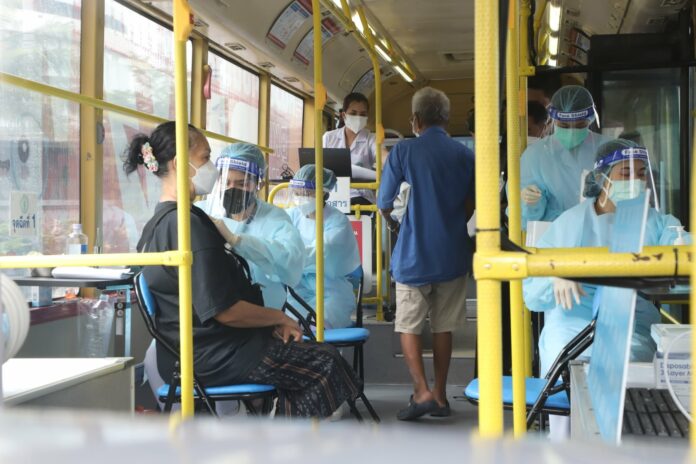
Residents in Bangkok receive coronavirus tests on Sept. 8, 2021.

BANGKOK — The question of whether to lift or reimpose coronavirus restrictions in Bangkok would depend on the situations in the next two weeks, a health official said.

Centre for Covid-19 Situation Administration senior advisor Udom Kachintorn said any further relaxing of restrictions will only be made if officials are certain that the outbreak is well under control.

Thailand logged approximately 12,000 new infections on Monday. The daily infection number has been decreasing in recent days, but so has the number of daily tests conducted.

But Udom said the downward trend is the result of the lockdown measures introduced back in July, and more vaccination coverage.

In order to keep the infections in manageable range, Udom urged members of the public not to let their guard down.

The Public Health Ministry also launched the official “Digital Health Pass” on Monday. All residents in Thailand are encouraged to download the pass from the government’s Mor Prom application.

The pass includes a person’s proof of vaccination, details of their most recent coronavirus test, and their antibody readings, if available.

This key information will be used by businesses and services to verify the safety status of the pass holder. Some Airlines, like Bangkok Airways, Lion Air, Nok Air, Thai AirAsia, and Thai Smile are already accepting the health pass, according to media reports.

Soon restaurants, salons, gyms, spas and more may adopt them to verify their customers as the government is pushing ahead with its plans to reopen some provinces for tourism by Oct. 1.

Advertisement

Fire Damages Pattaya Nightclub Popular With Indian Tourists

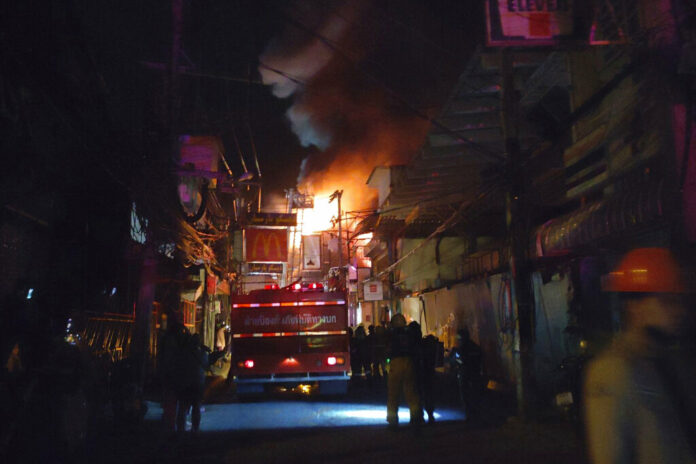
In this Sunday, Sept. 12, 2021, photo, firefighters work the scene of a structure fire at the Nashaa Club, Pattaya, Chonburi province, Thailand. Photo: Narong Sattayakun / AP

PATTAYA (AP) — A fire in Pattaya, the Thai seaside resort city southeast of Bangkok known for its racy nightlife, has badly damaged a large nightclub catering to Indian tourists, officials said Monday.

There were no injuries or deaths in the Sunday night blaze, said Suptawee Ongnonyang, chief of Pattaya’s land disaster prevention agency. The Nashaa Club was closed, as are most entertainment establishments due a a government-ordered coronavirus lockdown.

The fire, which began in the Nashaa Club, spread to several adjoining structures on the city’s famous Walking Street that were also damaged, Suptawee told The Associated Press.

Pattaya is filled with bars, discos and restaurants that — before the pandemic — were patronized by millions of tourists each year. The city is notorious for its sex industry.

The pandemic devastated the city’s economy after Thailand closed its borders in April 2020 to most foreign visitors. The Nashaa Club was shuttered, then reopened in February this year but closed again in April as Thailand suffered badly from a third wave of the coronavirus.

Suptawee said the fire spread quickly due partly to the soundproofing material used in the club, and that a strong wind Sunday night spread the blaze to three other nearby establishments.

He said that it took about two hours to control the fire, which was extinguished around midnight. The cause is being investigated, he said.

An announcement on the club’s Facebook page said the fire resulted in “big damage.”

Its management vowed to reopen business “very soon” and requested people “not to comment or support any rumors or wrong information on social media regarding the unfortunate incident as Investigative agencies are working on that.”

Advertisement

Taliban: Women Can Study in Gender-Segregated Universities

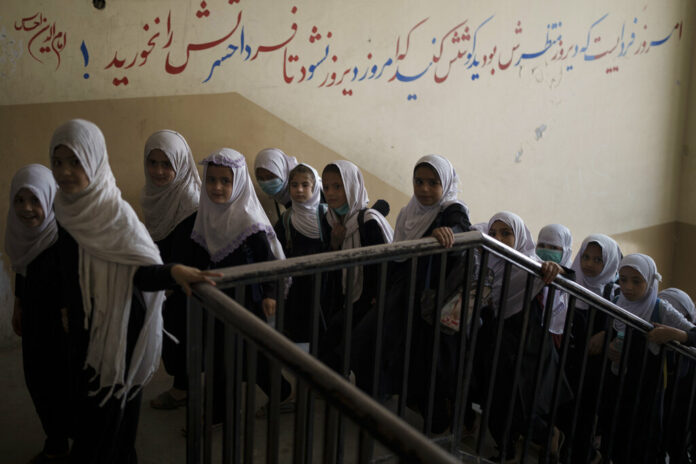
Girls walk upstairs as they enter a school before class in Kabul, Afghanistan, Sunday, Sept. 12, 2021. Photo: Felipe Dana / AP

KABUL, Afghanistan (AP) — Women in Afghanistan can continue to study in universities, including at post-graduate levels, but classrooms will be gender-segregated and Islamic dress is compulsory, the Taliban government’s new higher education minister said Sunday.

The announcement came as a Taliban official said Qatar’s foreign minister arrived in the Afghan capital of Kabul — the highest level visitor since the Taliban announced their interim Cabinet. There was no immediate confirmation of the visit by Qatari officials.

Earlier Sunday, the higher education minister, Abdul Baqi Haqqani, laid out the new policies at a news conference, several days after Afghanistan’s new rulers formed an all-male government. On Saturday, the Taliban had raised their flag over the presidential palace, signaling the start of the work of the new government.

The world has been watching closely to see to what extent the Taliban might act differently from their first time in power, in the late 1990s. During that era, girls and women were denied an education, and were excluded from public life.

The Taliban have suggested they have changed, including in their attitudes toward women. However, women have been banned from sports and the Taliban have used violence in recent days against women protesters demanding equal rights.

Haqqani said the Taliban did not want to turn the clock back 20 years. “We will start building on what exists today,” he said.

However, female university students will face restrictions, including a compulsory dress code. Haqqani said hijabs will be mandatory but did not specify if this meant compulsory headscarves or also compulsory face coverings.

Gender segregation will also be enforced, he said. “We will not allow boys and girls to study together,” he said. “We will not allow co-education.”

AP21254575947363
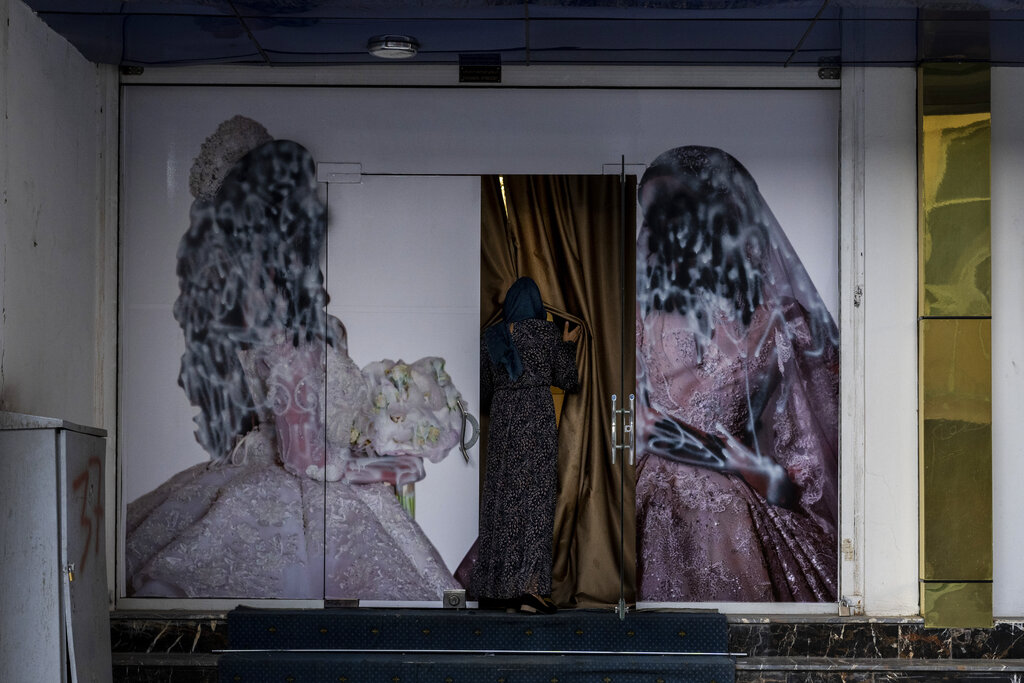
An Afghan woman enters a beauty salon in Kabul, Afghanistan, Saturday, Sept. 11, 2021. Photo: Bernat Armangue / AP

Haqqani said the subjects being taught would also be reviewed. While he did not elaborate, he said he wanted graduates of Afghanistan’s universities to be competitive with university graduates in the region and the rest of the world.

The Taliban, who subscribe to a strict interpretation of Islam, banned music and art during their previous time in power. This time around television has remained and news channels still show women presenters, but the Taliban messaging has been erratic.

In an interview on Afghanistan’s popular TOLO News, Taliban spokesman Syed Zekrullah Hashmi said last week that women should give birth and raise children. While the Taliban have not ruled out the eventual participation of women in government, the spokesman said “it’s not necessary that women be in the Cabinet.”

The Taliban seized power on Aug. 15, the day they overran Kabul after capturing outlying provinces in a rapid military campaign. They initially promised inclusiveness and a general amnesty for their former opponents, but many Afghans remain deeply fearful of the new rulers. Taliban police officials have beaten Afghan journalists, violently dispersed women’s protests and formed an all-male government despite saying initially they would invite broader representation.

The new higher education policy signals a change from the accepted practice before the Taliban takeover. Universities were co-ed, with men and women studying side by side, and female students did not have to abide by a dress code. However, the vast majority of female university students opted to wear headscarves in line with tradition.

In elementary and high schools, boys and girls were taught separately, even before the Taliban came to power. In high schools, girls had to wear tunics reaching to their knees and white headscarves, and jeans, makeup and jewelry were not permitted.

Taliban political spokesman Suhail Shaheen tweeted Sunday about the Qatari delegation, saying it included Sheikh Mohammad bin Abdur Rahman Al-Thani, the deputy prime minister who is also Qatar’s foreign minister.

The Qatari foreign minister met with Taliban Prime Minister Mohammad Hasan Akhund, Shaheen said. The Qatari delegation also met with former president Hamid Karzai and Abdullah Abdullah, the previous government’s chief negotiator in peace talks with the Taliban.

The Taliban have maintained a political office in the Qatar capital of Doha since 2013. Last week, Qatar Airways became the first international airline to begin operating international flights out of Kabul airport, transporting more than 250 foreign nationals, including U.S. citizens, out of the capital.

AP21255318320532
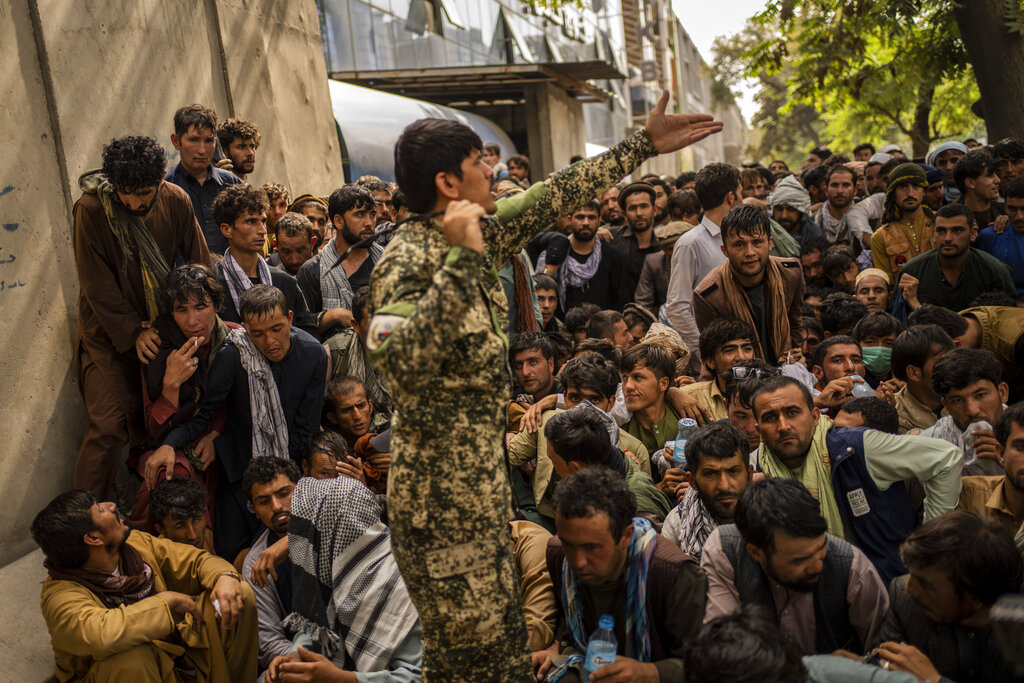
Afghans wait in front of a bank as they try to withdraw money in Kabul, Afghanistan, Sunday, Sept. 12, 2021. Photo: Bernat Armangue / AP

Qatar has also provided technical assistance, along with Turkey, to restart the airport, which had been damaged by departing U.S. troops who left Afghanistan on Aug. 30 after evacuating tens of thousands of Afghans fleeing the Taliban.

Meanwhile, the Taliban government faces enormous economic challenges with near daily warnings of an impending economic meltdown and a humanitarian crisis. The United Nations warns it could drive 97% of Afghans below the poverty level by the end of the year.

Thousands of desperate Afghans wait daily outside Afghanistan’s banks for hours to withdraw the $200 weekly allotment. In recent days, the Taliban appear to have been trying to establish a system for allowing customers to withdraw funds but it rapidly deteriorates into stick-waving as crowds surge toward the bank gates.

Outside the New Kabul Bank, Afghanistan’s first private bank established in 2004, nearly 2,000 people demanded their money Sunday.

For Zaidullah Mashwani, Sunday was the third day he had come to the bank hoping to get his $200. Each night the Taliban make a list of eligible customers for the following day and by morning Mashwani said a whole new list is presented.

“This is our money. The people have the right to have it,” he said. “No one has money. The Taliban government needs to do something so we can get our money.”

Story: Kathy Gannon

Advertisement

China’s FM Wang Offers Aid and Friendship on Cambodia Visit

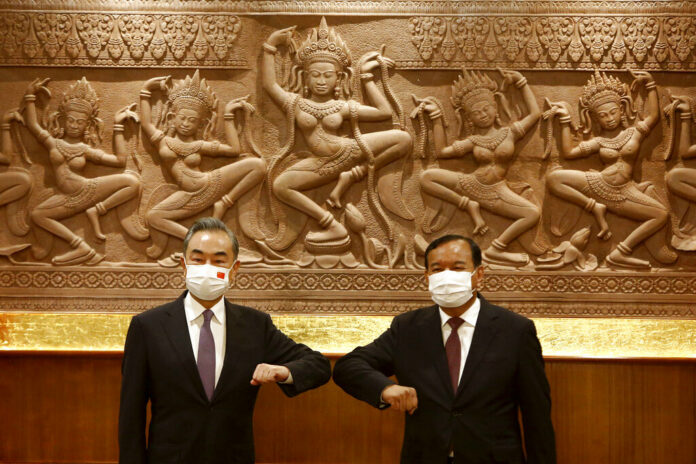
Chinese Foreign Minister Wang Yi, left, greets with Cambodian counterpart Prak Sokhonn in Phnom Penh, Cambodia, Sunday, Sept. 12, 2021. Photo: Kith Serey / AP

PHNOM PENH, Cambodia (AP) — Cambodian Prime Minister Hun Sen said Sunday that China has agreed to provide the Southeast Asian nation with grant aid of 1.75 billion yuan ($272 million), announcing the assistance during a visit by Chinese Foreign Minister Wang Yi.

Wang met with Hun Sen and other officials for bilateral talks on combating COVID-19, trade and investment, education and security issues. Cambodia’s foreign ministry said earlier that Wang’s meetings on Sunday and Monday also would include discussions of regional and international issues of shared interest.

China is Cambodia’s biggest investor and closest political partner whose assistance largely underpins the Southeast Asian nation’s economy. Hun Sen did not detail what the aid from Beijing would be used for.

Hun Sen spoke on a live television broadcast in which he praised China for its aid at a handover ceremony for a new 60,000-person capacity stadium built on the outskirts of the capital, Phnom Penh. The Chinese government provided the $160 million funding for the project, Cambodia’s state news agency AKP reported Tourism Minister Thong Khon as saying.

“Before, we could not imagine that Cambodia would have such a large stadium here, but China helps make it happen for us,” AKP quoted Hun Sen saying at the ceremony. He called the stadium “the fruit of the ironclad Cambodian-Chinese friendship.”

Speaking to the press after meeting separately with Cambodian Foreign Minister Prak Sokhonn, Wang made a similar point, saying, “Let Chinese-Cambodian friendship be steadier than iron and stronger than steel.”

Hun Sen pointed out other assistance from China for the construction of more than 2,000 kilometers (1,200 miles) of roads and seven big bridges across the Mekong, Tonle Sap and Bassac rivers. He noted as well that vaccines sold and donated by China had helped Cambodia battle the pandemic.

Hun Sen added, however, that Cambodia is not reliant solely on China but makes friends with all the world’s countries, and welcomes their aid for development. The U.S. has also donated COVID-19 vaccines to Cambodia.

Washington’s relations with Hun Sen’s government are frosty, as Beijing’s support allows Cambodia to disregard Western concerns about its poor record in human and political rights, and in turn Cambodia generally supports Beijing’s geopolitical positions on issues such as its territorial claims in the South China Sea.

In recent months, the U.S. has expressed concern about their ties and urged Cambodia’s leaders to maintain an independent and balanced foreign policy that would be in its people’s best interests.

The concerns have focused partly on China’s construction of new facilities at Ream Naval Base in Cambodia and the potential for its military to have future basing rights there.

Ream faces the Gulf of Thailand that lies adjacent to the South China Sea. Holding basing rights in Cambodia would extend Beijing’s strategic military profile considerably.

Wrapping up a visit to neighboring Vietnam on Saturday, Wang said China planned to donate 3 million vaccine doses to that country, which is under a lockdown to contain a COVID-19 surge.

Story: Sopheng Cheang

Advertisement

‘Free Solo’ Filmmakers Swap Peaks for Depths in ‘The Rescue’

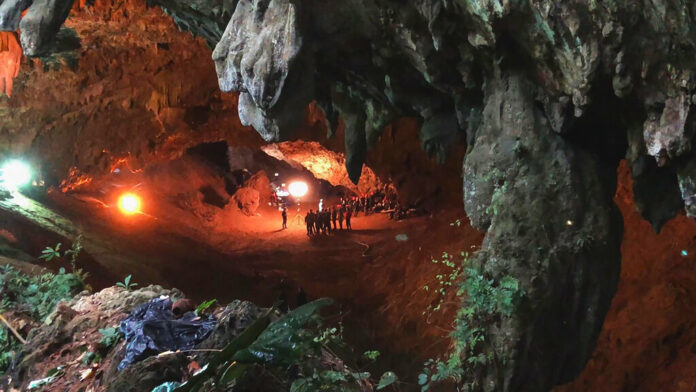
In this image provided by National Geographic is a scene from "The Rescue" documentary, which chronicles the 2018 rescue of 12 Thai boys and their soccer coach, trapped deep inside a flooded cave. Photo: National Geographic via AP

I“The Rescue,” Oscar-winning “Free Solo” filmmakers E. Chai Vasarhelyi and Jimmy Chin trade climbing peaks for watery depths.

Their documentary, which premieres Sunday at the Toronto International Film Festival, retraces the 2018 rescue of the youth soccer team from Thailand’s Tham Luang cave, detailing the daring underwater maneuvers of an international group of elite cave divers. The National Geographic release, due out in theaters Oct. 8, is a pulse-thumping, nerve-inducing non-fiction standout at the festival and the first major big-screen documentary of a real-life drama that captivated the world.

“It is ironic that we went from these great heights to subterranean,” chuckles Chin, who as a professional climber and skier has typically done his filming around sheer cliffs.

In comparison to Vasarhelyi and Chin’s two acclaimed previous films — “Meru” and “Free Solo” — “The Rescue” might seem like an easier task. Most filmmaking that doesn’t include dangling off the side of the Shark’s Fin on Meru Peak in the Indian Himalayas, or suspended alongside free-solo rock climber Alex Honnold on the Yosemite granite monolith of El Capitan would, naturally, seem like tamer stuff.

Yet the challenges of “The Rescue” were in many ways steeper. Vasarhelyi and Chin, who are married with two children together, were for the first time not shooting the event itself. They had to track down footage — which included copious news broadcasts from outside the cave but little from within — and piece together a compelling and clear view of a rescue that took place overwhelmingly in cloudy, pitch-black waters.

While the world watched and rain loomed in the forecast, an international coalition of some 5,000 worked tirelessly to free the 12 boys and their coach from the flooded caves, an operation that ultimately relied on the singular cave-diving talents of mostly civilian hobbyists.

“I’ve been to the cave. There are certain things about this story that are really challenging. It’s really hard to conjure the enchantment of the cave,” says Vasarhelyi. “The first two minutes I was in there, I was like, ‘This is terrifying. Why would anyone ever do it?’ And then it’s kind of like this siren. It’s cool, it’s fun, it’s mysterious, it’s a little scary.”

To stitch the story together, the filmmakers, working through the pandemic, relied on interviews over Zoom and recreations carefully shot with the real divers in the U.K. Much of the footage from inside the cave they got from the Thai Navy Seals, who were instrumental in the overall operation but lacked the diving skills to pull off the improbable 2 1/2 hour swims that saved the boys. Those documentary trials, though, aren’t visible in “The Rescue,” which with underwater footage and 3D graphic maps makes a murky tale remarkably lucid.

The documentary isn’t the only version of the story. On the fiction side, there has already been 2019’s little-seen “The Cave,” which featured diver Jim Warny playing himself. Rights to the boys’ stories were sold to Netflix, which is plotting a miniseries for 2022. To be released next year by MGM, Ron Howard is also making a drama titled “Thirteen Lives,” with Viggo Mortensen, Colin Farrell and Joel Edgerton.

National Geographic, though, owned the rights to the divers’ stories. One thing “The Rescue” thoroughly captures is just how difficult it was to find and reach the boys, and harder still to come up with a plausible path of rescue. Expecting fatalities, on day 16, with the threat of monsoons that would further submerge the cave, the cave divers swam each child out, one at a time, while they were sedated.

For those who casually followed the ordeal, “The Rescue” brings home just how anxious and nail-biting the plot was.

“We just went in and found the boys, according to the media. Then every day we went in and brought the boys out and it all seemed to go without drama. Nobody saw, really, what was involved,” says Richard Stanton, the decorated British civilian cave diver who spearheaded much of the mission. “We possibly made it look to easy. This is the first time, apart from maybe our books, that people get to engage with what actually happened and what risky a decision it was and how close to the line it was.”

Story: Jake Coyle

Advertisement

Sinovac: The ‘Slandered Vaccine’ for Thailand

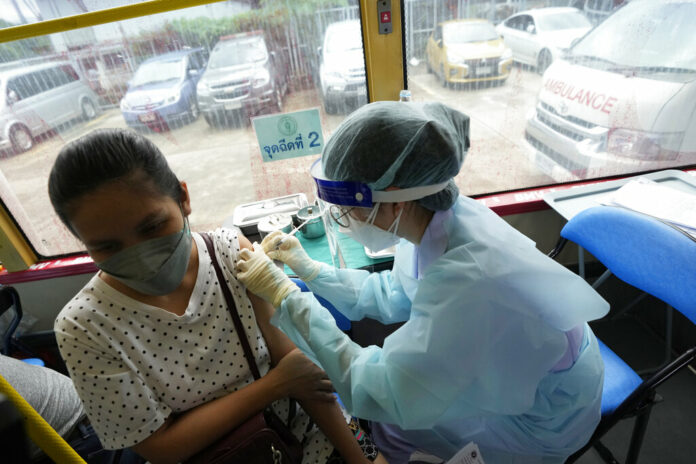
A health worker administers a dose of the AstraZeneca COVID-19 vaccine inside a mobile vaccination unit in Bangkok, Thailand, Wednesday, Sept. 8, 2021. Photo: Sakchai Lalit / AP

China-made Sinovac vaccine is no doubt the most politicized and controversial vaccine in Thailand. And its controversy went up a few more notches after the Chinese Embassy issued a statement defending the vaccine against criticisms by some Thais last Saturday.

To make it more dramatic, a Thai-royalist group vocally apologized to China for the controversies.

In the Chinese Embassy’s statement on Facebook, a spokesman for the embassy urged in Thai language for Thais to stop devaluing the reputation of the Sinovac vaccine.

“Recently, some people and organizations have devalued and slandered [Sinovac vaccine] without reason, which is an attack with no respect to scientific information and fact. It’s an assault to the good intention of China in supporting the Thai people’s fight against the pandemic. The Chinese Embassy totally opposes this and calls on related people and organizations to cease their severely wrong actions,” the statement released on its Facebook page last Saturday read.

This led some to question whether the Chinese Embassy has become too brash and unduly try to interfere with local Thai affairs. After all, Sinovac is supposedly privately-owned and largely bought by Thai tax-payers’ money – but now the Chinese Embassy is defending it.

This was followed a day later by ultra-royalist Thai Raksa Group apologizing to the “Chinese brothers and sisters” and insisting that they love and are sincere to the Chinese people.

Only two people representing the group showed up holding placards near the Chinese Embassy on Sunday but they insist they speak for a million if millions or Thais.

On the other extreme, you have some Thais and Thai-Chinese trash-talking Sinovac and swear they would never take “Sinocrap” and insist it’s no better than injecting oneself with saline or plain water. A few others derogatorily called it “Shenzhen” vaccine, a reference to the city known for copycats among Thais. 

In a normal circumstances, people should have the right to believe or not believe in the efficacy of any vaccines – just like people can have an opinion whether a Toyota is better than a BMW or not. Each of us has the freedom to decide whether we want Sinovac or not and the Chinese Embassy’s words were not only undiplomatic but will likely make Thais who are already skeptical even more so. The Chinese Embassy is essentially doing more harm to themselves and Sinovac than good because many Thais are already wary about the growing economic and political clout of China in Thailand and the region. The Chinese government might better put more effort in convincing countries in the West like France to recognize Sinovac as valid so Thais can feel that Sinovac is as good as other COVID-19 vaccines. At present, Thais fully vaccinated with Sinovac cannot enter France and a few European nations so the onus is on the Chinese government to convince them otherwise. Don’t blame Thais who have doubt because some countries do not recognize Sinovac and would not allow you to enter their countries if you have been Sinovaccinated. Do not lose your temper so easily and tell Thais what to do or what not to do. 

Now, Thais on both sides of the Sinovac divide should also be open minded. For Sinovac opponents, I say please admit the fact that it’s better to be vaccinated with Sinovac than nothing. The Thai government has failed to secure the 10-million dose of Oxford-AstraZeneca per month after they placed the bet on one Thai manufacturer, crown’s owned Siam Bioscience, but the company failed to meet the production targets.

The Prayut Chan-o-cha administration should take the blame for ending up making Sinovac the most prevalent vaccine by default because they are most accessible to Thais. With the more contagious and deadly Delta variant, information is abundant that it’s better to be vaccinated with Sinovac, which is approved by the World Health Organization, or nothing.

For die-hard China and Sinovac supporters in Thailand, I say wake up, smell the oolong tea and accept the facts that even the Thai government have conducted studies and found that two doses of Sinovac is substantially less effective than two doses of AstraZeneca when it comes to the Delta variant. A study released by the Department of Medical Science and Siriraj Hospital on Aug 20 shows that two doses of Sinovac produce an immunity level of 24.31 per cent compared to 76.52 per cent for those receiving two jabs of AstraZeneca. That’s not an insignificant difference but three times less in terms of the level of immunity. But all of that should be taken with a huge grain of salt: the CDC says antibody testing is not recommended as a method to assess COVID-19 immunity.

Also, frontline medical staff have been given a booster shot of Pfizer or AstraZeneca vaccine soon after they got two doses of Sinovac speaks volume about the level of Sinovac’s efficacy against the Delta variant of COVID-19.

Those too happy to defend Sinovac should also acknowledge lingering doubts whether some people within the Thai government may be involved with accepting kickbacks or tea money in exchange for keeping ordering more and more Sinovac vaccines or not. Despite the controversies, an order of 12 million more doses were approved by the Cabinet earlier this week on Tuesday.

Sinovac diehards might actually want to focus on the fact that in terms of side effects, short-term and long-term, Sinovac is arguably safer compared to AstraZeneca or mRNA vaccines as it relies on a tried-and-tested technology and there’s little or no risk of long-term adverse effects. 

Both sides should be reasonable, open minded and understand and acknowledge the arguments from the other side and that’s how Sinovac as well as other vaccines should be treated.

Advertisement

Parliament Approves Election System Charter Change

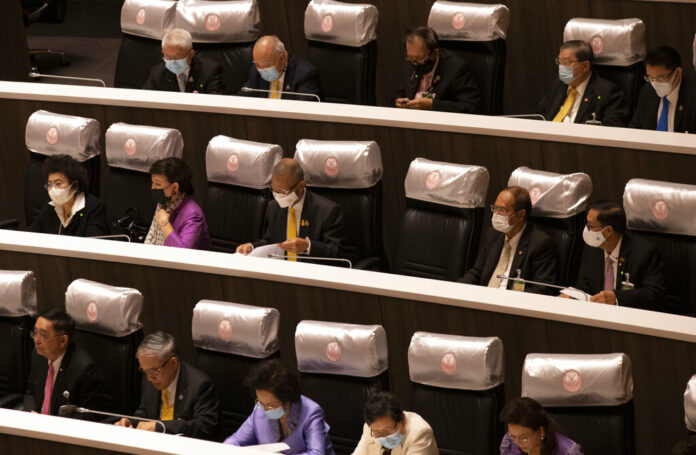
In this Nov. 17, 2020, file photo, the Senate members attend a joint session of the House and Senate at the Parliament in Bangkok, Thailand. Photo: Sakchai Lalit / AP

BANGKOK (AP) — Thailand’s Parliament on Friday approved a constitutional amendment changing how lawmakers are elected, a move expected to allocate more seats to big parties at the expense of smaller ones.

The change, passed at a joint session of the House and Senate by a vote of 472 to 33, with 187 abstentions, comes into effect after the expected approval of King Maha Vajiralongkorn.

The amendment is a legacy of the long and bitter political struggle between supporters and opponents of former Prime Minister Thaksin Shinawatra, a billionaire populist who was ousted as prime minister by a 2006 military coup.

The system of mixed-member proportional representation approved Friday will give voters two separate ballots instead of the single one used in the 2019 election. One will be for their favored candidate in single-seat constituencies, and the other for the political party they support. Four hundred members of the House will be directly elected, while the 100 party list posts will be divided according to the nationwide party preference votes.

Clauses remain in the constitution that critics charge are undemocratic, including the power of the unelected Senate to vote jointly with the House to elect the prime minister.

“It does not matter which election systems we use as long as the senators still have voting power for the prime minister. The election system is almost meaningless,” tweeted Prajak Kongkirati, a political scientist at Bangkok’s Thammasat University.

Current Prime Minister Prayuth Chan-ocha took power in 2014 by leading a coup as army commander. He was chosen by the joint houses of Parliament to be prime minister after the 2019 general election, in which he did not run.

Friday’s amendment to election rules is a throwback to the system implemented under a 1997 constitution that sought to disadvantage smaller parties which had held leverage over the formation of coalition governments by trading their loyalty for Cabinet posts, perpetuating a political spoils system.

That change allowed Thaksin to use his fortune to bring regional political power brokers into his own party and build what his critics charged was a parliamentary dictatorship after he won the 2001 general election.

Thaksin fled into exile after his 2006 ouster from power, but his political machine retained its power and popularity. A 2017 constitution implemented under a military government set up new election rules designed to reduce his machine’s influence by handicapping bigger parties.

The 2017 charter provided for 350 lawmakers elected directly by their constituents, and 150 from party lists under a complicated system of proportional representation that, roughly speaking, awarded seats in inverse proportion to those won by parties under the constituency vote.

The system backfired when the military-backed Palang Pracharath party performed more poorly than expected in 2019 and a new reformist party proved more popular than anticipated. Palang Pracharath was able to form a government, but only by assembling a messy coalition of smaller parties.

Story: Chalida Ekvitthayavechnukul

Advertisement

Biden Marks 9/11 Anniversary With Tribute, Call for Unity

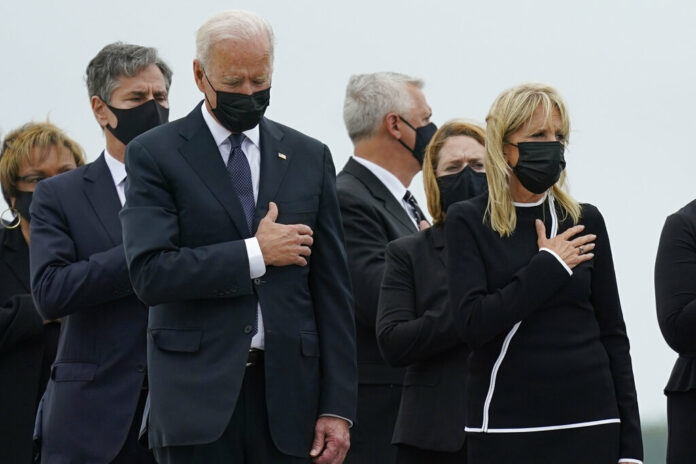
President Joe Biden and first lady Jill Biden watch as a carry team moves the transfer case containing the remains of Navy Corpsman Maxton W. Soviak, 22, of Berlin Heights, Ohio, during a casualty return Sunday, Aug. 29, 2021, at Dover Air Force Base, Del. Photo: Carolyn Kaster / AP

NEW YORK (AP) — President Joe Biden is making an appeal for the nation to reclaim the spirit of cooperation that sprung up in the days following the 9/11 terror attacks as he commemorates those who died 20 years ago.

Biden was a senator when hijackers comandeered four planes and exacted the nation’s worst terror attack in 2001. Now he marks the 9/11 anniversary for the first time as commander in chief.

The president planned to pay his respects at the trio of sites where the planes crashed, but he was leaving the speech-making to others.

Instead, the White House released a taped address late Friday in which Biden spoke of the “true sense of national unity” that emerged after the attacks, seen in “heroism everywhere — in places expected and unexpected.”

“To me that’s the central lesson of September 11,” he said. “Unity is our greatest strength.”

AP21254050905512
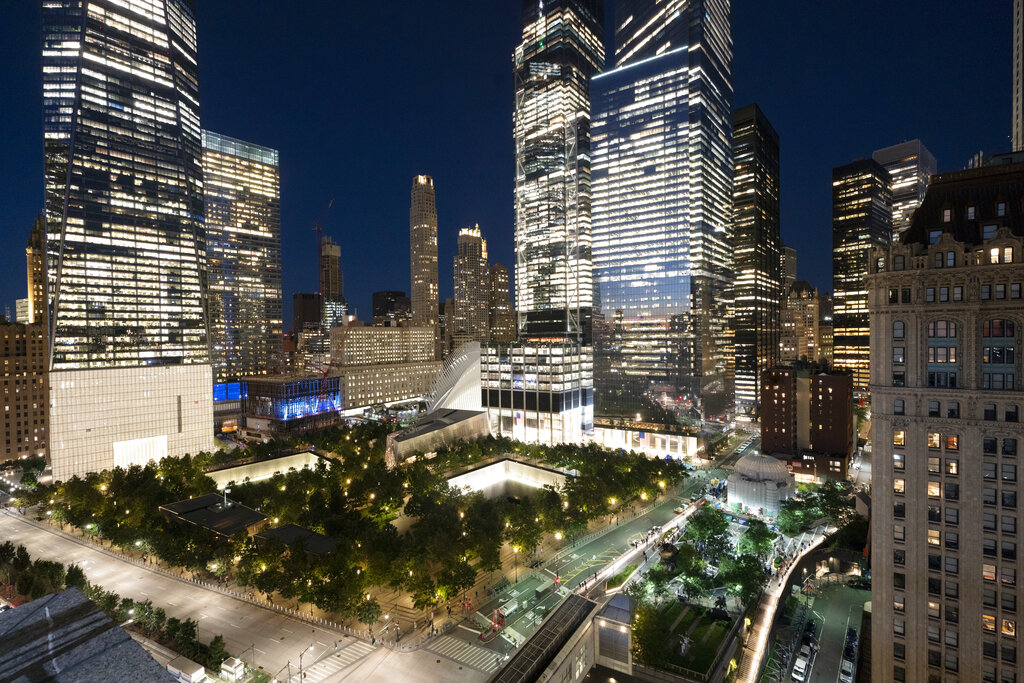
The World Trade Center is shown on the evening of Friday, Sept. 10, 2021, in New York. Photo: Mark Lennihan / AP

Biden arrived in New York on Friday night as the skyline was illuminated by the “Tribute in Light,” hauntingly marking where the towers once stood. His first stop on Saturday was to be the National September 11 Memorial, where the twin towers of the World Trade Center were toppled as a horrified world watched on television.

From there he was to visit the field near Shanksville, Pennsylvania, where a plane fell from the sky after heroic passengers fought terrorists to prevent it from reaching its Washington destination. And finally, he was headed to the Pentagon, where the world’s mightiest military suffered an unthinkable blow to its very home.

Biden’s task, like his predecessors before him, was to mark the moment with a mix of grief and resolve. A man who has suffered immense personal tragedy, Biden speaks of loss with power.

He gave voice to the pain that comes with memories of 9/11 in his video message, saying, “No matter how much time has passed, these commemorations bring everything painfully back as if you just got the news a few seconds ago.”

AP21241702141165
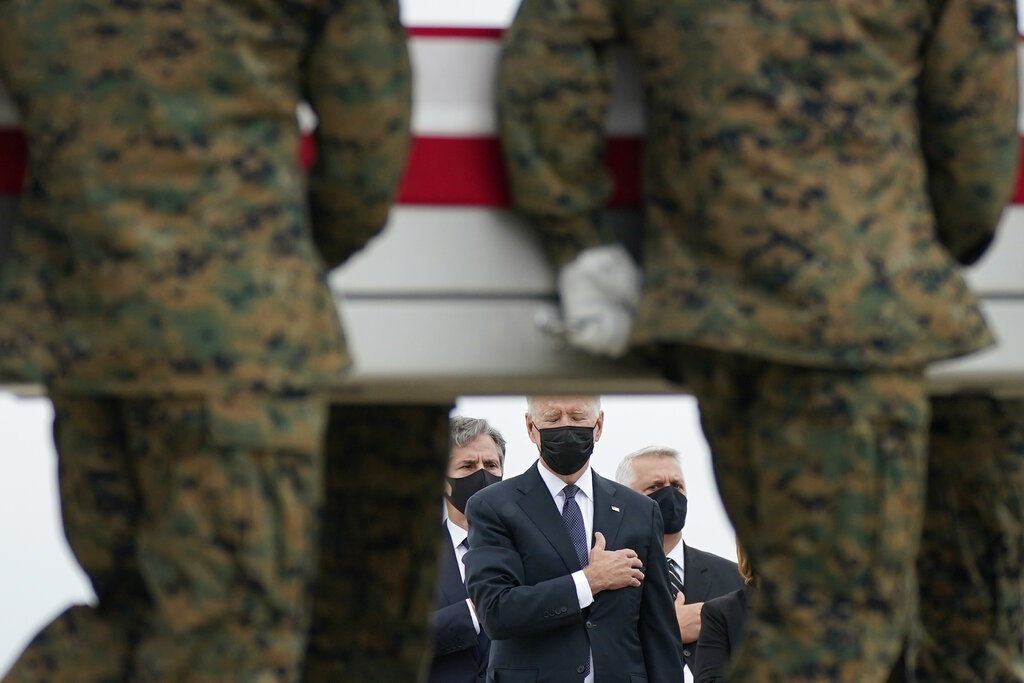
President Joe Biden watches as a carry team moves a transfer case containing the remains of Marine Corps Lance Cpl. Kareem M. Nikoui, 20, of Norco, Calif., during a casualty return Sunday, Aug. 29, 2021, at Dover Air Force Base, Del. Photo: Carolyn Kaster / AP

Robert Gibbs, who served as President Barack Obama’s press secretary, said that for Biden, “It’s a moment for people to see him not as Democratic president, but as president of the United States of America,.”

“The American people are somewhat conflicted about what they have seen out of Afghanistan the last couple of weeks,” Gibbs said. “For Biden, it’s a moment to try to reset some of that. Remind people of what it is to be commander in chief and what it means to be the leader of the country at a moment of such significance.”

On the 20th anniversary of the attacks, Biden now shoulders the responsibility borne by his predecessors to prevent future tragedy, and must do so against fresh fears of a rise in terror after the United States’ hasty exit last from the country from which the Sept. 11 attacks were launched.

Biden will be the fourth president to console the nation on the anniversary of that dark day, one that has shaped many of the most consequential domestic and foreign policy decisions made by the chief executives over the past two decades.

AP21236734276357
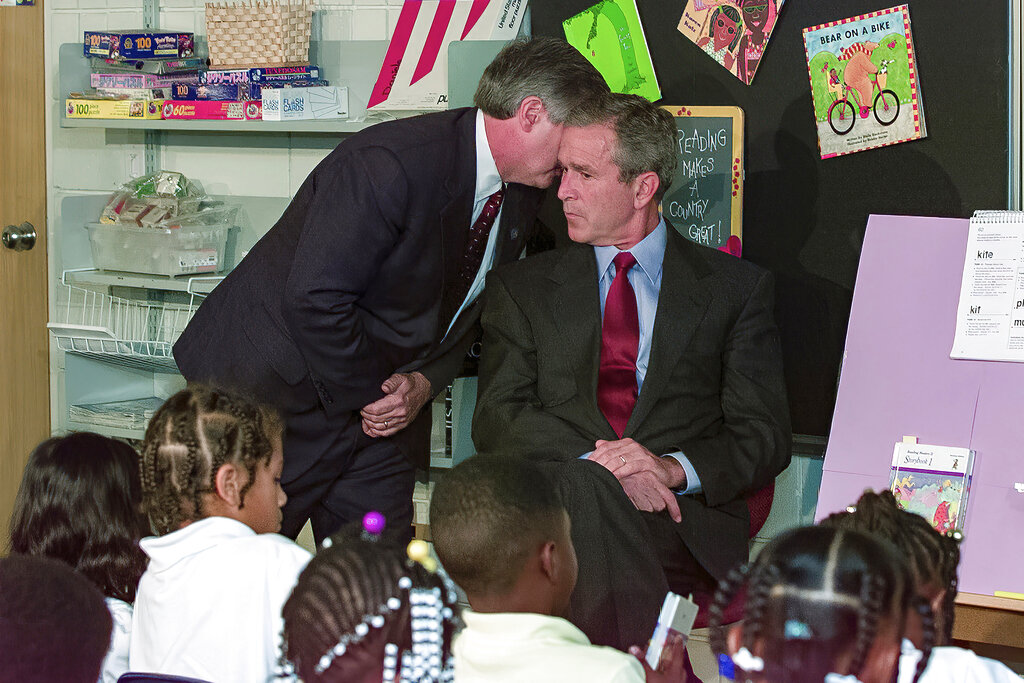
In this Tuesday, Sept. 11, 2001 file photo, White House chief of staff Andrew Card whispers into the ear of President George W. Bush to give him word of the plane crashes into the World Trade Center, during a visit to the Emma E. Booker Elementary School in Sarasota, Fla. Photo: Doug Mills / AP

The terror attack defined the presidency of George W. Bush, who was reading a book to Florida schoolchildren when the planes slammed into the World Trade Center. He spent that day being kept out of Washington for security reasons — a decision that then-Senator Biden urged him to reconsider, the current president has written — and then delivered a brief, halting speech that night from the White House to a terrified nation.

The following year, Bush chose Ellis Island as the location to deliver his first anniversary address, the Statue of Liberty over his shoulder as he vowed, “What our enemies have begun, we will finish.”

The wars in Iraq and Afghanistan were still deadly when President Barack Obama visited the Pentagon to mark his first Sept. 11 in office in 2009.

“No words can ease the ache of your hearts,” said Obama.

“We recall the beauty and meaning of their lives,” he said. “No passage of time, no dark skies can dull the meaning of that moment.”

AP21238792036632
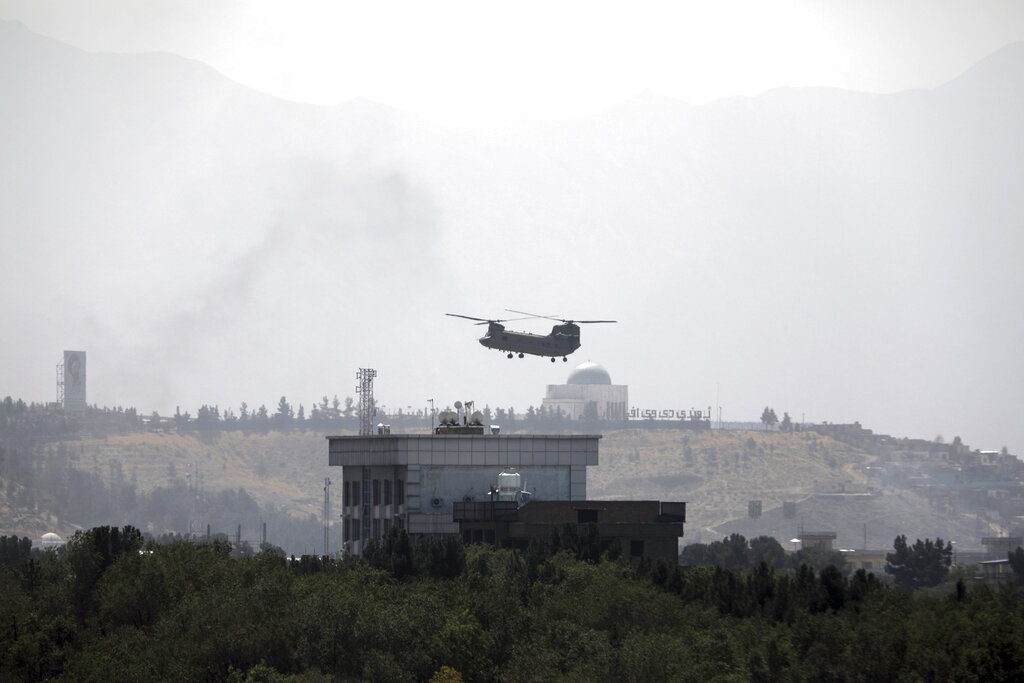
In this Sunday, Aug. 15, 2021 file photo, a U.S. Chinook helicopter flies over the U.S. embassy in Photo: Rahmat Gul / AP

By the time Obama spoke at the 10th anniversary, attack mastermind Osama bin Laden was dead, killed in a May 2011 Navy SEAL raid. Though the nation remained entangled overseas, and vigilant against terror threats, the anniversary became more about healing.

President Donald Trump pledged to get the U.S. out of Afghanistan, but his words during his first Sept. 11 anniversary ceremony in 2017 were a vivid warning to terrorists, telling “these savage killers that there is no dark corner beyond our reach, no sanctuary beyond our grasp, and nowhere to hide anywhere on this very large earth.”

On Saturday, as Biden was making his way to all three sites, Bush was to pay his respects in Shanksville while Obama did likewise in New York. Trump planned at least one stop in Manhattan and was to deliver ringside commentary at a boxing match at a casino in Hollywood, Florida.

Story: Zeke Miller and Jonathan Lemire

Advertisement

From 9/11’s Ashes, a New World Took Shape. It Did Not Last.

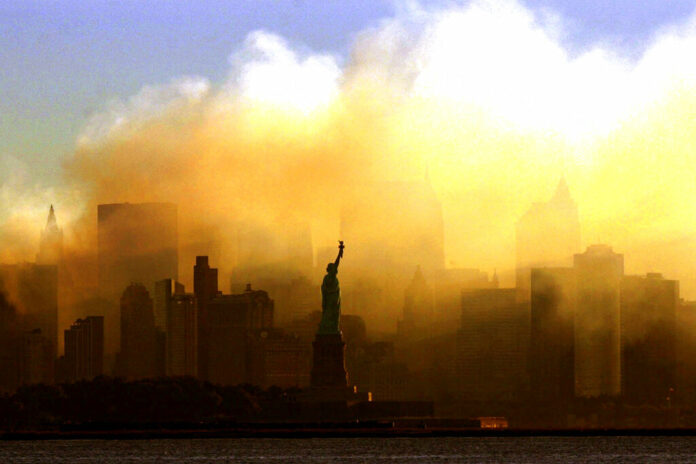
In this Saturday, Sept. 15, 2001 file photo, the Statue of Liberty stands in front of a smoldering lower Manhattan at dawn, seen from Jersey City, N.J. Photo: Dan Loh / AP

In the ghastly rubble of Ground Zero’s fallen towers 20 years ago, Hour Zero arrived, a chance to start anew.

World affairs reordered abruptly on that morning of blue skies, black ash, fire and death.

In Iran, chants of “death to America” quickly gave way to candlelight vigils to mourn the American dead. Vladimir Putin weighed in with substantive help as the U.S. prepared to go to war in Russia’s region of influence.

Libya’s Moammar Gadhafi, a murderous dictator with a poetic streak, spoke of the “human duty” to be with Americans after “these horrifying and awesome events, which are bound to awaken human conscience.”

From the first terrible moments, America’s longstanding allies were joined by longtime enemies in that singularly galvanizing instant. No nation with global standing was cheering the stateless terrorists. How rare is that?

Too rare to last, it turned out.

Civilizations have their allegories for rebirth in times of devastation. A global favorite is that of the phoenix, a magical and magnificent bird, rising from ashes. In the hellscape of Germany at the end of World War II, the concept of Hour Zero, or Stunde Null, offered the opportunity to start anew.

For the U.S., the zero hour of Sept. 11, 2001, meant a chance to reshape its place in the post-Cold War world from a high perch of influence and goodwill. This was only a decade after the Soviet Union’s collapse left America with both the moral authority and the military and financial muscle to be unquestionably the lone superpower.

Those advantages were soon squandered. Instead of a new order, 9/11 fueled 20 years of war abroad. In the U.S., it gave rise to the angry, aggrieved, self-proclaimed patriot, and heightened surveillance and suspicion in the name of common defense.

AP21238791659253
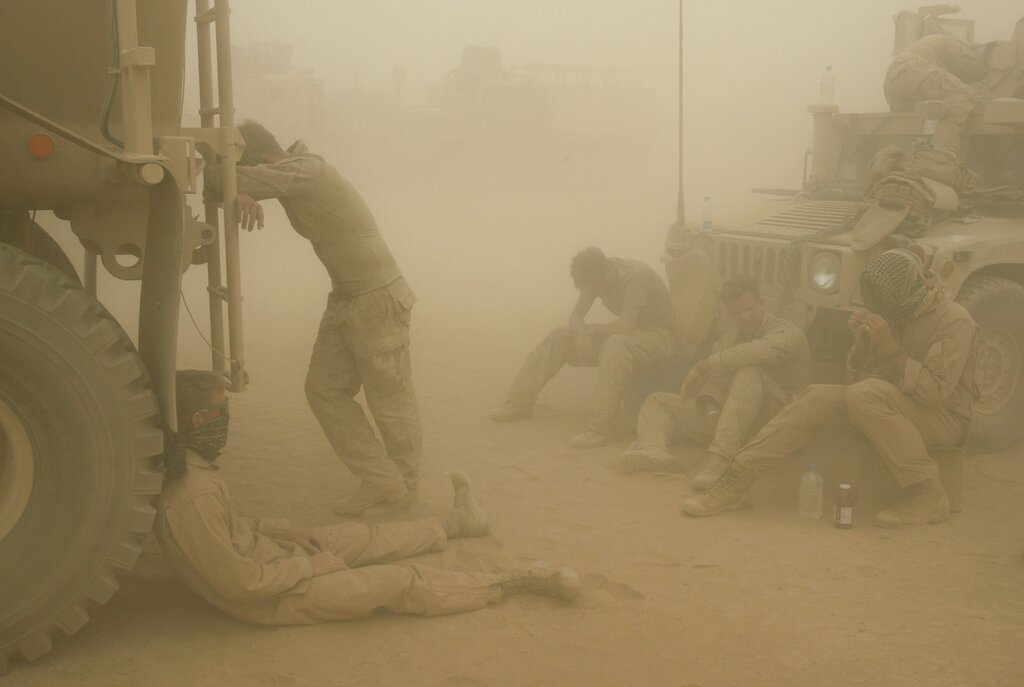
In this Wednesday, May 7, 2008 file photo, U.S. Marines from the 24th Marine Expeditionary Unit try to take shelter from a sand storm at forward operating base Dwyer in the Helmand province of southern Afghanistan. Photo: David Guttenfelder / AP

It opened an era of deference to the armed forces as lawmakers pulled back on oversight as presidents gave primacy to the military over law enforcement in counterterrorism. It sparked anti-immigrant sentiment, primarily directed at Muslim countries, that lingers today.

What most nations agreed was a war of necessity in Afghanistan was followed two years later by a war of choice as the U.S. invaded Iraq on false claims that Saddam Hussein was hiding weapons of mass destruction.

Thus opened the deep, deadly mineshaft of “forever wars.” Convulsions ran through the Middle East and U.S. foreign policy — long a force for ballast — gave way to a head-snapping change from Bush to Obama to Trump. Trust in America’s leadership and reliability waned.

Other parts of the world were not immune. Far-right populist movements coursed through Europe. Britain voted to break away from the European Union. China steadily ascended in the global pecking order.

Now, President Joe Biden is trying to restore trust, but there is no easy path. He is ending war, but what comes next?

AP21238791684287
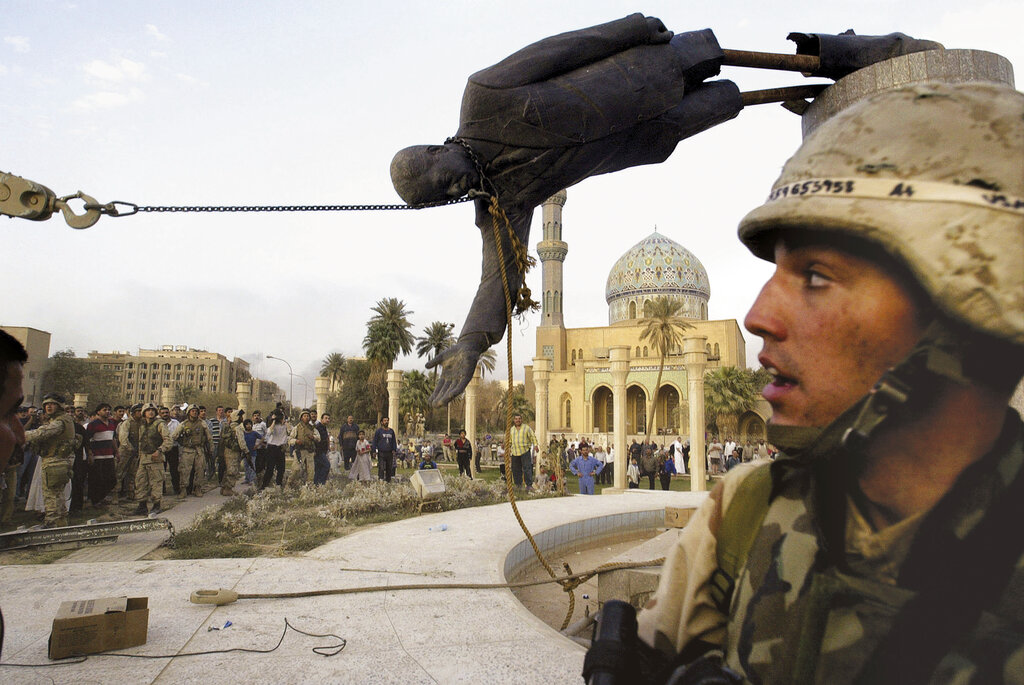
Iraqi civilians and U.S. soldiers pull down a statue of Saddam Hussein in downtown Baghdad, in this April 9, 2003 file photo. Photo: Jerome Delay / AP

In Afghanistan in August, the Taliban seized control with menacing swiftness as the Afghan government and security forces that the U.S. and its allies had spent two decades trying to build collapsed. No steady hand was evident from the U.S. in the disorganized evacuation of Afghans desperately trying to flee the country.

In the United States, the 2001 attacks had set loose a bloodlust cry for revenge. A swath of American society embraced the binary outlook articulated by Bush — “Either you are with us, or you are with the terrorists” — and has never let go of it.

Factionalism hardened, in school board fights, on Facebook posts, and in national politics, so that opposing views were treated as propaganda from mortal enemies. The concept of enemy also evolved, to include immigrants as well as terrorists.

The patriot under threat became a personal and political identity. Trump would harness it to help him win the presidency.

AP21238791857107
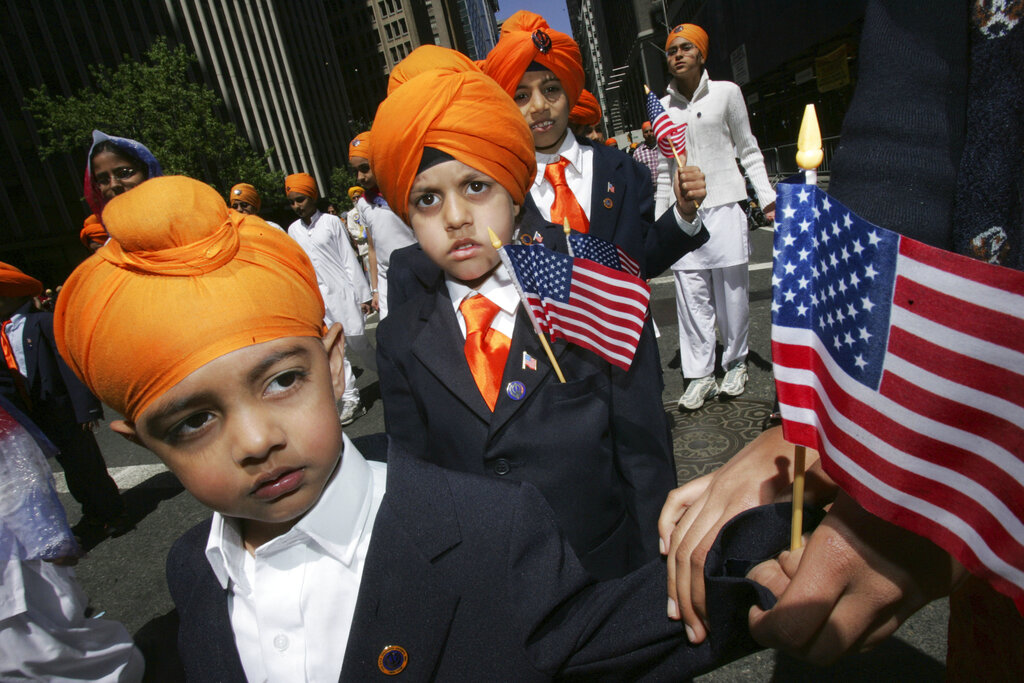
In this Saturday, April 29, 2006 photo, children holding U.S. flags march down Broadway during the 19th Annual Sikh Day Parade in New York. Since Sept. 11, 2001, many Sikhs have been mistaken for Muslims and have become targets. As a result, they have been at the forefront of civil rights advocacy against religious and racial profiling. Photo: Hiroko Masuike / AP

For the U.S., the presidencies since Bush’s wars have been marked by an effort to pull back the military from the conflicts of the Middle East and Central Asia.

The perception of a U.S. retreat has allowed Russia and China to gain influence in the regions and left U.S. allies struggling to understand Washington’s place in the world. The notion that 9/11 would create an enduring unity of interest to combat terrorism collided with rising nationalism and a U.S. president, Trump, who spoke disdainfully of the NATO allies that in 2001 had rallied to America’s cause.

To be sure, the succession of U.S. presidents since 9/11 scored important achievements in shoring up security, and so far U.S. territory has remained safe from more international terrorism anywhere on the scale of that Sept. 11.

Globally, U.S.-led forces weakened al-Qaida, which has failed to launch a major attack on the West since 2005. The Iraq invasion rid the world of a murderous dictator in Saddam.

Yet deadly chaos soon followed his overthrow. The Bush administration, in its nation-building haste, had failed to plan for keeping order, leaving Islamist extremists and rival militias to fight for dominance.

AP21238791746284
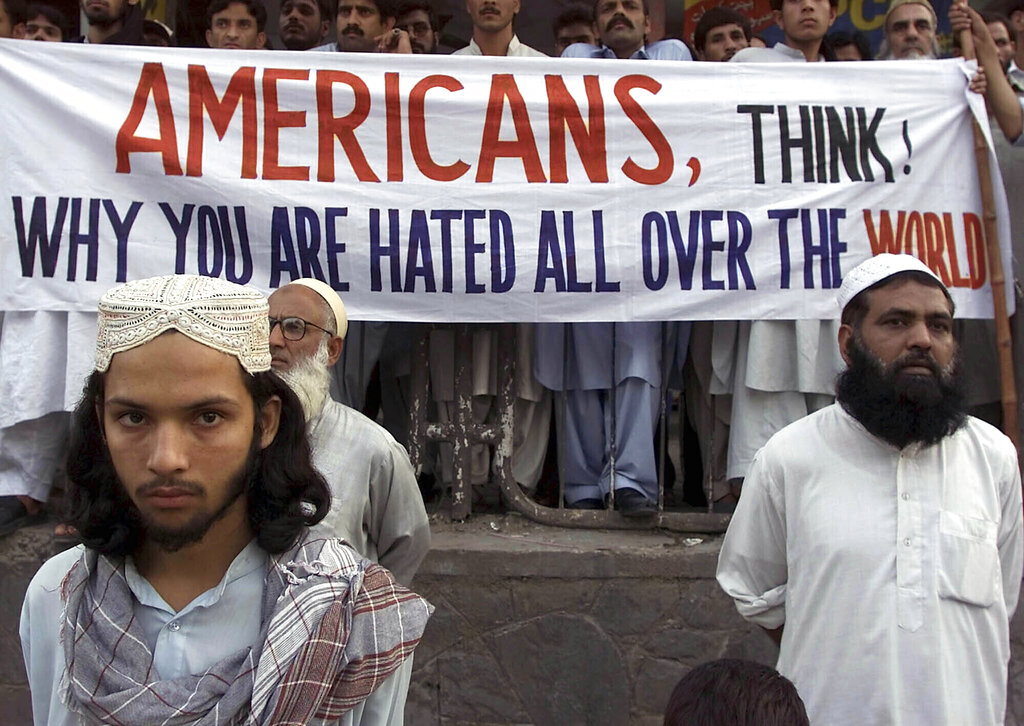
In this Saturday, Sept. 15, 2001 file photo, activists of Pakistan militant religious parties stand with a banner which reads, “Americans, think why you are hated all over the world,” during a rally in Islamabad, Pakistan to condemn possible U.S. attacks on neighboring Afghanistan. Photo: B.K. Bangash / AP

Today, the legacies of 9/11 ripple both in obvious and unusual ways.

Most directly, millions of people in the U.S. and Europe go about their public business under the constant gaze of security cameras while other surveillance tools scoop up private communications. The government layered post-9/11 bureaucracies on to law enforcement to support the expansive security apparatus.

Militarization is more evident now, from large cities to small towns that now own military vehicles and weapons that seem well out of proportion to any terrorist threat. Government offices have become fortifications; airports a security maze.

But as profound an event as 9/11 was, its effect on how the world has been ordered was temporary and largely undone by domestic political forces, a global economic downturn and now a lethal pandemic.

The awakening of human conscience predicted by Gadhafi didn’t last. Gadhafi didn’t last.

Osama bin Laden has been dead for a decade. Saddam was hanged in 2006. The forever wars now are over or ending. The days of Russia tactically enabling the U.S., and China not standing in the way, petered out.

Only the phoenix lasts.

AP21238791741009
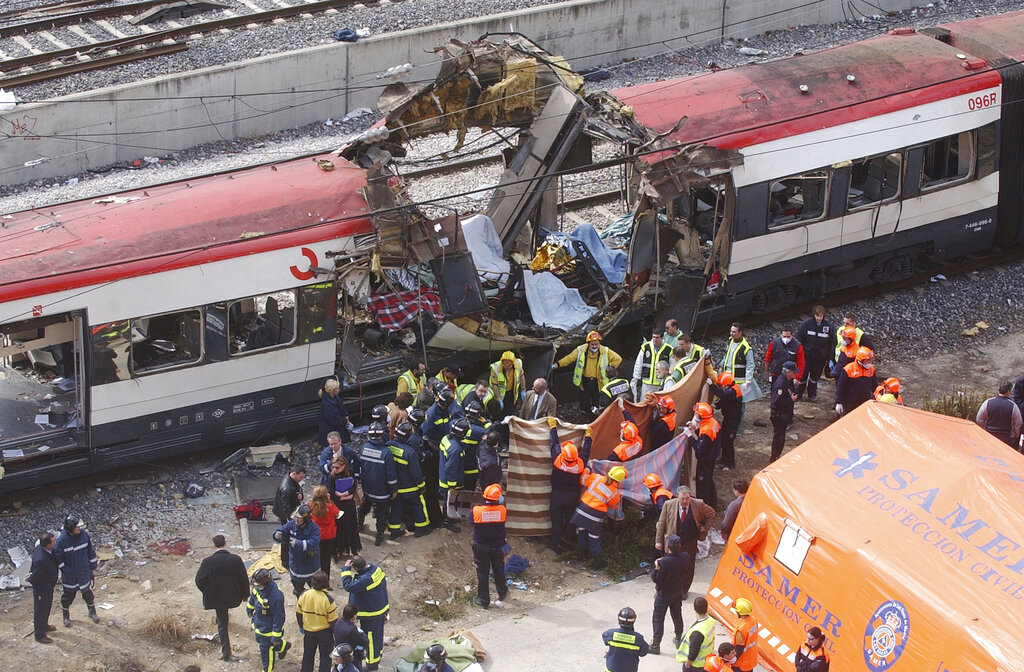
In this March 11, 2004 file photo, rescue workers cover bodies alongside a bomb-damaged passenger train, following a number of explosions in Madrid, Spain, which killed more than 170 rush-hour commuters and wounded more than 500 in Spain’s worst terrorist attack ever. Photo: Paul White / AP
AP21238791791593
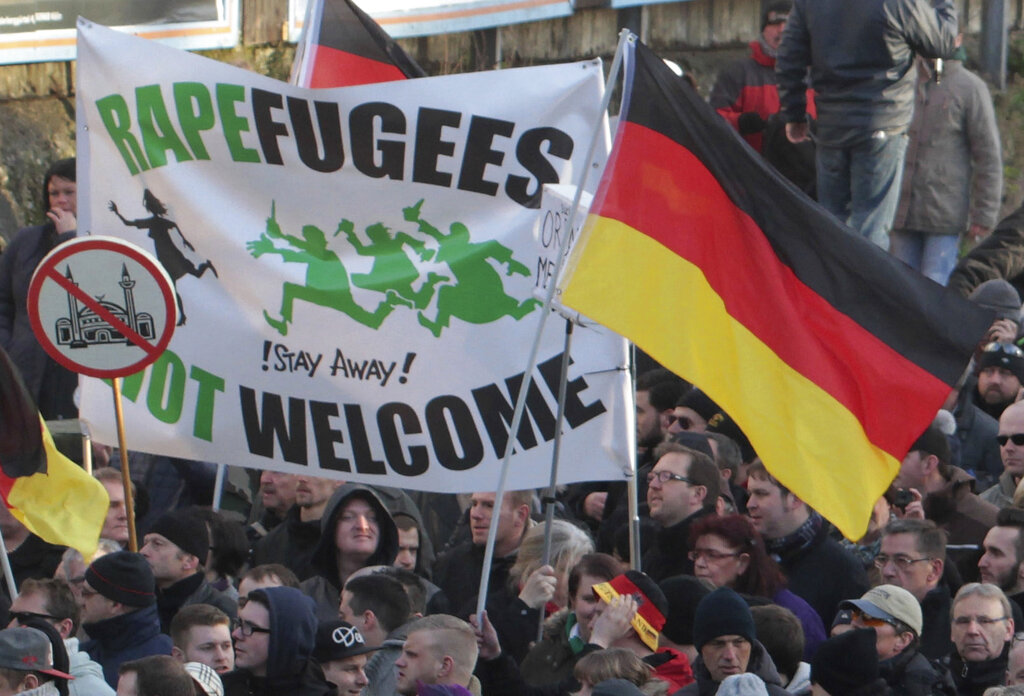
In this Saturday Jan. 9, 2016 file photo, right-wing demonstrators hold a sign which reads, “Rapefugees not welcome – !Stay away!” and a sign with a crossed out mosque as they march in Cologne, Germany. Photo: Juergen Schwarz / AP

___

Story: Calvin Woodward, Ellen Knickmeyer and David Rising. Rising reported from Bangkok; Knickmeyer and Woodward from Washington. AP National Security Writer Robert Burns contributed to this report.

Advertisement

Hot News

LATEST NEWS

Bangkok
overcast clouds
29.7 ° C
31.6 °
28.8 °
81 %
3.7kmh
100 %
Mon
35 °
Tue
36 °
Wed
34 °
Thu
33 °
Fri
32 °