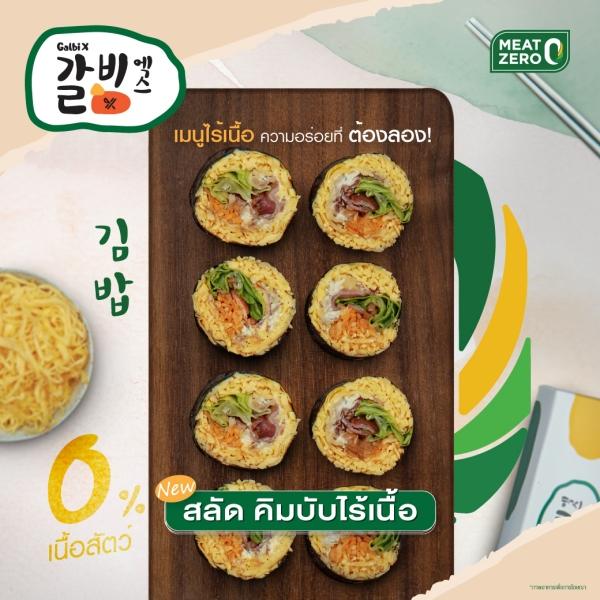
DAK GALBI Group Co., Ltd., restaurant operator of DAK GALBI, DGB, GALBI X and WOK station, has launched a variety of Thai and Korean plant-based dishes from the Meat Zero, an innovative plant-based meat that has the taste and feel like real meat, for attracting health conscience consumers.
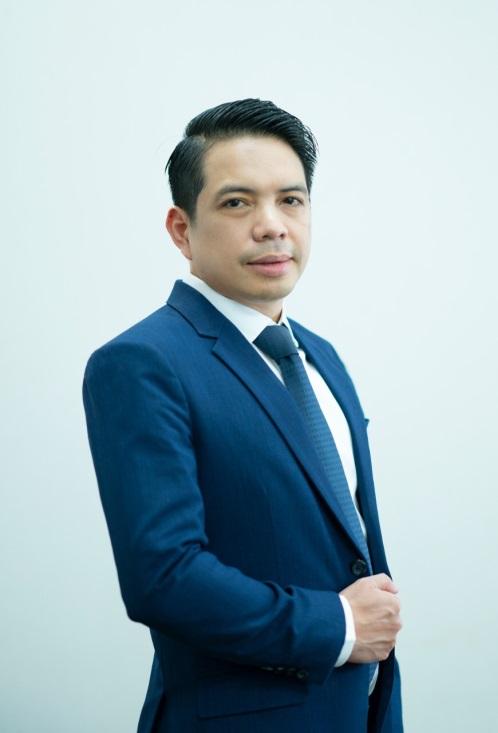
Tossaporn Wanichaworapong, Director of Dak Galbi Group, said that plant-based meat is becoming more and more popular in many countries, including Thailand, especially among health conscience consumers, and vegan and Flexitarian. DAK GALBI see opportunity in this upcoming trend and, therefore, joins forces with Thai plant-based producers Meat Zero to produce high quality ingredients for the company.
Starting today onwards, Dak Galbi initially creates special menus for the brands Dak Galbi, DGB. and Galbi-X, including Kimbap Zero (Beefless Kimbap Salad and Beef Bologna Pokki), Kimbap Zero 2 (Beefless Kimbap Salad with fish flakes and soup).
Besides, the WOK Station also introduces variety of plant-based menus including WOK Zero Set 1 (Roasted Crispy plant-based Pork with Chili and Salt and plant-based Roasted Pork with Garlic and Roasted Pork on Rice), WOK Zero Set 2 (plant-based Roasted Minced Pork with Holy Basil on Rice) and WOK Zero Set 3 (plant-based Roasted Crispy Pork Belly with Basil and Rice and plant-based Crispy Pork Rice with Fried Egg). These set menus are available at WOK Station nationwide.
CP Foods’ Vice president, Supara Sriboon, added that the company, as a leading food producer, developed the plant-based protein under brand “Meat Zero” to response surge of consumers demand . The brand has created innovative raw materials from plant proteins that is easy to access for all people. Meat Zero’s products are now available via convenience stores, leading department stores and restaurants nationwide.
“The collaboration of Dak Galbi Group and Meat Zero will help both parties to expand its customer base, as well as giving opportunity for consumers to taste delicious and healthy foods. CP Foods plans reach more restaurants and making new delicious products to access consumers of all age groups,” said Ms. Supara
The plant based menus are available via Grab, Lineman and Robinhood, and Line Official of Dak Galbi, DGB, Galbi X, and WOK Station.
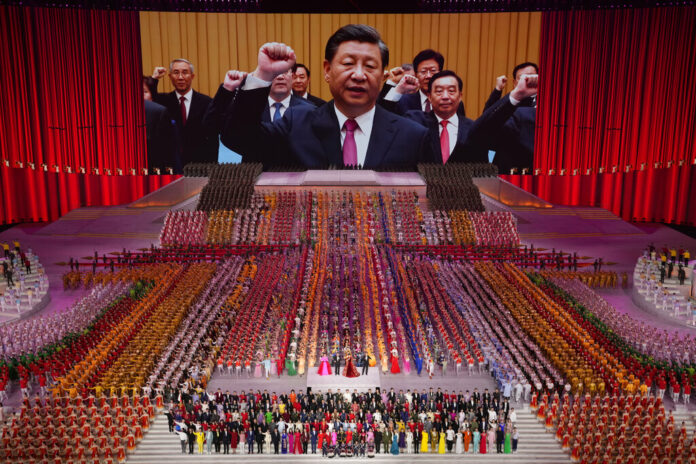
In this June 28, 2021, file photo, Chinese President Xi Jinping is seen leading other top officials pledging their vows to the party on screen during a gala show ahead of the 100th anniversary of the founding of the Chinese Communist Party in Beijing. Photo: Ng Han Guan / AP
BEIJING (AP) — An avalanche of changes launched by China’s ruling Communist Party has jolted everyone from tech billionaires to school kids. Behind them: President Xi Jinping’s vision of making a more powerful, prosperous country by reviving revolutionary ideals, with more economic equality and tighter party control over society and entrepreneurs.
Since taking power in 2012, Xi has called for the party to return to its “original mission” as China’s economic, social and cultural leader and carry out the “rejuvenation of the great Chinese nation.”
The party has spent the decade since then silencing dissent and tightening political control. Now, after 40 years of growth that transformed China into the world’s factory but left a gulf between a wealthy elite and the poor majority, the party is promising to spread prosperity more evenly and is pressing private companies to pay for social welfare and back Beijing’s ambition to become a global technology competitor.
To support its plans, Xi’s government is trying to create what it deems a more wholesome society by reducing children’s access to online games and banning “sissy men”who are deemed insufficiently masculine from TV.
Chinese leaders want to “direct the constructive energies of all people in one laser-focused direction selected by the party,” Andrew Nathan, a Chinese politics specialist at Columbia University, said in an email.
Beijing has launched anti-monopoly and data security crackdowns to tighten its control over internet giants, including e-commerce platform Alibaba Group and games and social media operator Tencent Holdings Ltd., that looked too big and potentially independent.
In response, their billionaire founders have scrambled to show loyalty by promising to share their wealth under Xi’s vaguely defined “common prosperity” initiative to narrow the income gap in a country with more billionaires than the United States.
Xi has yet to give details, but in a society where every political term is scrutinized for significance, the name revives a 1950s propaganda slogan under Mao Zedong, the founder of the communist government.
Xi is reviving the “utopian ideal” of early communist leaders, said Willy Lam of the Chinese University of Hong Kong. “But of course, huge question marks have arisen, because this will hurt the most creative and lucrative parts of the economy.”
In this Oct. 21, 2017, file photo, Chinese women walk past advertisement featuring teen idol Lu Han, also known as China’s Justin Bieber in Beijing. China’s government banned effeminate men on TV and told broadcasters Thursday, Sept. 2, 2021 to promote “revolutionary culture,” broadening a campaign to tighten control over business and society and enforce official morality. Photo: Ng Han Guan / AP
Alibaba, Tencent and others have pledged tens of billions of dollars for job creation and social welfare initiatives. They say they will invest in developing processor chips and other technologies cited by Beijing as priorities.
The party’s anti-monopoly enforcement and crackdown on how companies handle information about customers are similar to Western regulation. But the abrupt, heavy-handed way changes have been imposed is prompting warnings that Beijing is threatening innovation and economic growth, which already is declining. Jittery foreign investors have knocked more than $300 billion off Tencent’s stock market value and billions more off other companies.
“I expect that over the next year or two we are likely to see a very rocky relationship develop between the political elite and the business elite,” Michael Pettis, a finance professor at Peking University’s Guanghua School of Business, said in a report.
Chinese officials say the public, consumers and entrepreneurs will benefit from higher incomes and more regulatory oversight of corporate giants. Parents welcome curbs announced last month that limit children under 18 to three hours of online games a week and only on weekends and Friday night.
“I feel this is a good rule,” said Li Zhanguo, the father of an 8-year-old boy and a 4-year-old girl in the central city of Zhengzhou. “Games still have some addictive mechanisms. We can’t count on children’s self-control.”
The crackdowns reflect party efforts to control a rapidly evolving society of 1.4 billion people.
Some 1 million members of mostly Muslim ethnic groups have been forced into detention camps in the northwest. Officials deny accusations of abuses including forced abortions and say the camps are for job training and to combat extremism.
A surveillance initiative dubbed Social Credit aims to track every person and company in China and punish violations ranging from dealing with business partners that violate environmental rules to littering.
“Our responsibility is to unite and lead the entire party and people of all ethnic groups, take the baton of history and to work hard to achieve the great rejuvenation of the Chinese nation,” Xi said when he and the six other members of the new party Standing Committee appeared in public for the first time in November 2012.
The party Central Committee shifted its economic emphasis “from efficiency to fairness” in late 2020, a researcher at a Beijing think tank wrote in August in Caixin, China’s most prominent business magazine.
The party moved from “early prosperity for some to ‘common prosperity’” and “from capital to labor,” wrote Luo Zhiheng of Yuekai Securities Research Institute. He said leaders are emphasizing science, technology and manufacturing over finance and real estate.
Prominent economists have tried to reassure entrepreneurs.
“It is impossible to achieve common prosperity through ‘robbing the rich and helping the poor,’” the dean of the school of economics at Shanghai’s Fudan University, Zhang Jun, told the news outlet The Paper on Aug. 4.
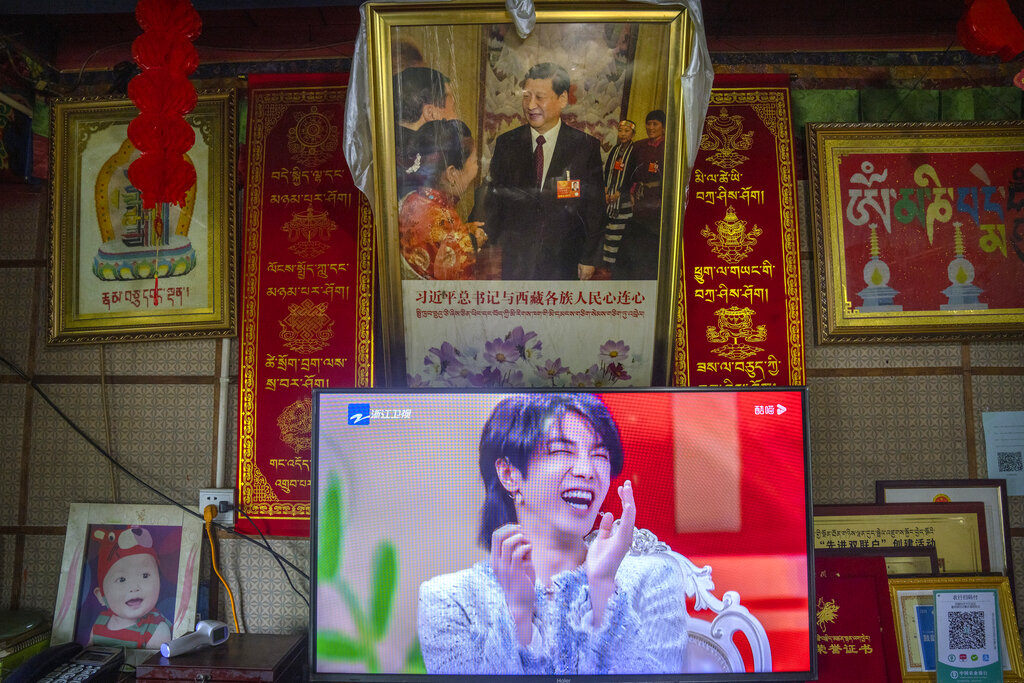
In this June 4, 2021, file photo, a television shows a broadcast of a Chinese talk show program as it sits beneath a photo of Chinese President Xi Jinping in a home converted into a tourist homestay in Zhaxigang village near Nyingchi in western China’s Tibet Autonomous Region. Photo: Mark Schiefelbein / AP
The 1979 launch of market-style economic reform under then-leader Deng Xiaoping prompted predictions abroad that China would evolve into a more open, possibly even democratic society.
The Communist Party allowed freer movement and encourages internet use for business and education. But leaders reject changes to a one-party dictatorship that copied its political structure from the Soviet Union and watch entrepreneurs closely. Beijing controls all media and tries to limit what China’s public sees online.
As the previous decade’s economic boom fades, “Xi sees himself as the only person capable of recreating the momentum,” said June Teufel Dreyer, a Chinese politics specialist at the University of Miami.
Party members who worry reforms might weaken political control appear to have decided China’s rise is permanent and liberalization is no longer needed, said Edward Friedman, a political scientist at the University of Wisconsin.
That means “anti-totalitarian elements of the reform agenda could be rolled back,” Friedman said in an email. “That is what Xi is doing, as manifest in his attack on purportedly gay and girlie culture as a supposed threat to a so-called virile militarism.”
An Aug. 29 commentary by an obscure writer, Li Guangman, described “common prosperity” as a “profound revolution.” Writing on the WeChat message service, Li said financial markets would “no longer be a paradise for capitalists to get rich overnight” and said the party’s next targets might include high housing and health care costs.
The commentary was reposted on prominent state media websites including the ruling party newspaper People’s Daily. That prompted questions about whether Beijing might veer into an ideological campaign with echoes of the violent 1966-76 Cultural Revolution, when some 5 million people were killed.
Hu Xijin, the editor of the Global Times, a newspaper published by People’s Daily that is known for its nationalist tone, responded by criticizing Li’s commentary. Hu warned in a blog post against a return to radicalism.
“The Cultural Revolution was a period of chaos, purposely unleashed by Mao because he felt comfortable in chaos,” Nathan said.
“This is almost the exact opposite,” he said. “It is an effort to create tightly structured orderliness.”
___
Story: Joe McDonald. AP researcher Chen Si in Shanghai contributed to this report.
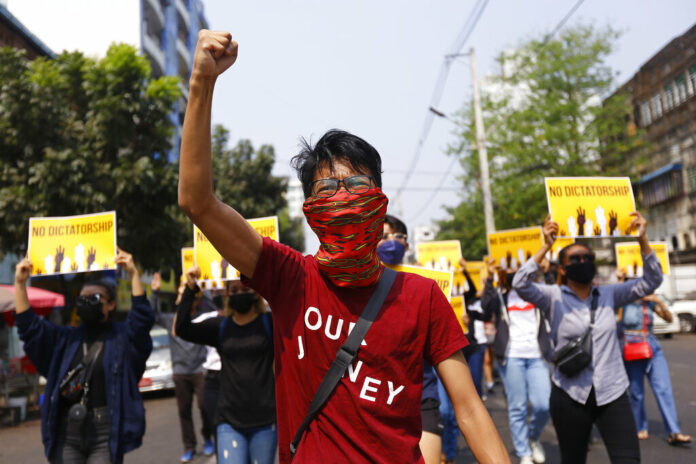
In this March 26, 2021, file photo anti-coup protesters gesture during a march in Yangon, Myanmar. Photo: AP
BANGKOK (AP) — Several prominent former U.N. human rights experts expressed regret Wednesday that a leading resistance organization in Myanmar has called for a nationwide armed uprising against the country’s military government.
The underground National Unity Government declared a “people’s defensive war” on Tuesday to remove the military from power. The group, which claims to be the legitimate government, was established by elected legislators who were barred from taking office when the military seized power in February, toppling the elected government of Aung San Suu Kyi.
The Special Advisory Council for Myanmar, which includes Yanghee Lee, the former U.N. special rapporteur on human rights in Myanmar, said in a statement that it understands the frustration of people in Myanmar “after seven months of brutality by the junta and inaction by the international community,” but said the call to arms was ”unfortunate.”
“Violence is the cause of the suffering of the people of Myanmar, it is not the solution,” council member Chris Sidoti said. “We fear for what will happen as a result of this decision.”
Sidoti and a third council member, Marzuki Darusman, both worked with the U.N. Independent International Fact-Finding Mission on Myanmar, which investigated human rights abuses including the army’s brutal 2017 counterinsurgency campaign that drove more than 700,000 members of the Muslim Rohingya minority to flee to neighboring Bangladesh.
The February military takeover was met by large-scale peaceful protests that security forces suppressed with deadly force. More than 1,000 civilians were killed. In response, some protesters adopted increasingly violent methods, including killings and sabotage.
A low-level insurrection is occurring in urban areas, while more traditional combat is taking place in the countryside, especially between the army and ethnic minority militias, some of which have formed a loose alliance with the National Unity Government.
There were no immediate actions in response to Tuesday’s call for an uprising, though peaceful protest marches were reported by Myanmar media, as well as a continuation of the shootings and sabotage that have gone on for months.
A spokesman for the military, Maj.-Gen. Zaw Min Tun, has dismissed the uprising announcement as an effort to spread rumors and attract attention ahead of next week’s U.N. General Assembly session.
The call to arms was enthusiastically welcomed by many users of social media, who also expressed dismay that the U.N. and other countries have not done more to help opponents of the army’s takeover.
The Special Advisory Council also criticized the international community, saying it “has had ample opportunity to come to the aid of the people of Myanmar but has consistently failed.”
Flash Express and AIF Group Laos announce a joint investment to step into CLMV market and launch Flash Laos – a full service of express logistic by land and air in Laos. Customers will be able to deliver parcels between Thailand and Vientiane Capital to support the growth of E-Commerce business, boost the economics between the two countries and seamlessly connect.
Flash Express Co., Ltd., Thai full service logistic provider, the first Thai start up that becomes an international unicorn by Mr. Komsan Lee-CEO says that Flash service expansion to Laos pride the Thai start up, expanding full service logistic business in CLMV with a strong strategic partner, AIF Group Laos. We will be partners for both land and air full logistic service provider. With economic and social study of CLMV market, Flash foresees an opportunity for full service logistic to our neighbor countries, being well prepared in terms of labors and resources. Moreover, Thai government is continuously developing the infrastructure system between Thailand and neighbor countries which will be an opportunity and good direction for logistic business.“From a successful business model of Flash Express in Thailand and a technology that we have been developing for 3 years, we are now ready to launch “Flash Laos” – a full service logistic by land and air with the same concept we are using in Thailand. The concept is the first and only express logistic service provider that open 365days. We will also provide booking in advance via Flash Express Application where customer can prebook a delivery service, from in-person pick up, receiving parcels, tracking, to checking for service fee by themselves. Thus, the cooperation between Flash Express and AIF Group Laos will have 2 main parts. The first parts, “Flash Laos”, will provide logistic service from Thailand to Vientiane. The second part will be the key cooperation of both companies, expanding the service to cover all areas of Laos. In addition, the second part will include the cross border logistic service between Thai and Laos to support customer demand of B2B, B2C, and C2C. However, the second parts will be launched in November 2021 and will also recruit new local business partners of Flash Laos with the concept of house opening as a parcel pick up. This will provide job and income opportunity for our Laos’ partners.” says Komsan Lee.
Mr. Rithikone Phoummasack, Chairman of AIF Group Laos said: “We are pleased to partner with the first Thai unicorn and rely on both AIF Group and Flash Thailand expertise to bring best practices and ease cross-border deliveries to the fast-growing Laos logistic industry”.
“Flash Laos, a fully integrated digital service provider, will help support the continuous growth of our E-Commerce division, already bolstered by the recent integration of a local marketplace platform within the group activities”, emphasized Mr. Rithikone Phoummasack. “The strategic venture further enhances our capacity to deliver superior digital services and better serve Lao’s fast-growing consumer base” he confirmed, “and leverages AIF Group’s strong understanding and expertise of the Lao and regional markets to enable local consumers to seamlessly exchange goods between Thailand and Laos.
About Flash Express Thailand
Flash Express (Thailand) Company Limited is a Thai full service logistic provider, is the first Thai startup to become an international unicorn under the concept “In mind, In delivery”. The company was established in 2018 by Mr. Komsan Saelee, the Chief Executive Officer and the management team and Thai officers. It is the first express service provider to implement a policy of receiving free parcels at the front door (Door-to-Door Service) and is available 365 days a year. Flash Express is a subsidiary of the Flash Group, a Thai-based fully integrated E-Commerce service provider. Flash Logistics services include large-scale transportation, Flash Fulfillment, product warehousing, and financial services (Flash Money/Flash Pay).
About AIF Group Laos
AIF Group is one of the biggest and the most dynamic business groups in Laos employing more than 3,000 workers across 17 countries. The group’s core business activities include Banking & Financial Services; Energy Utilities; Construction, Property & Infrastructure Development; E-Commerce, Telecom & Technology Services; Trading; as well as Agriculture, with operations in Laos, Vietnam, Cambodia, Thailand, and Singapore.
Chef Cares Ready Meals has launched a new ready meal menu, “Stir-fried Duck with Southern Curry Paste and Ginger Rice” by Master Chef Nooror Somany Steppe of a top-tier Thai restaurant, Blue Elephant, which has won the hearts of food lovers around the world for more than 40 years, to promote charity and healthy consumption.
The new premium ready-to-eat meal is a healthy choice made by the finest ingredients. This includes carefully selected duck meat, an easily digestible protein source, rich in iron, and amino acids, mixed with Blue Elephant’s secret recipe for southern curry paste and high nutrient herbs served with ginger rice.
“Stir-fried Duck with Southern Curry Paste and Ginger Rice” is now available at 7-Eleven and Makro (selected branches in Bangkok area) for only 69.- baht, with all proceeds will go to public charities through the Chef Care Foundation.
With deep and passionate love on Thai food and culture, Chef Nooror Somany Steppe, an experienced chef has created authentic Thai dishes with the finest local ingredients, showing the world “Thainess” and Thai wisdom through Blue Elephant, a luxurious restaurant with 4 branches around the globe, which has been very popular among Thais and foreigners for more than 40 years.
Chef Care project was founded by Marisa Chearavanont as a collaborative effort of Thailand’s award-winning chefs, who came together in volunteering spirit to cook delicious and healthy meals for doctors, nurses and other medical personnel during the initial fight against Covid-19 in 2020. To fulfil the potential of this well-received project, into “Chef Cares Foundation” to give back to society through their culinary artistry through initiatives such as “Chef Cares Dream Academy” project that provide underprivileged youth with the chance to pursue their culinary dreams.
The Chef Cares Ready Meals project was initiated to provide funds to sustain the foundation’s activities as 100% of the profits from the tasty and healthy meals go directly towards the foundation’s charitable activities.
About Chef Cares: Chef Cares began in March of 2020 as a collaborative effort combining Thailand’s top chefs with generous sponsors of quality ingredients to create and donate delicious and nutritious meals to frontline hospital and transit personnel during the initial fight against COVID-19. Over a period of three and a half months the project successfully delivered over 30,000 meals and helped to lift spirits during a difficult time. The overwhelmingly positive response led founder Marisa Chearavanont to create Chef Cares Foundation with a mission to “Promote Thai gastronomy and contribute to society through the care and compassion of chefs”.
This combination photo shows Jamie Spears, left, father of Britney Spears, as he leaves the Stanley Mosk Courthouse on Oct. 24, 2012, in Los Angeles and Britney Spears at the Clive Davis and The Recording Academy Pre-Grammy Gala on Feb. 11, 2017, in Beverly Hills, Calif. Photo: AP
LOS ANGELES (AP) — Britney Spears’ father filed Tuesday to end the court conservatorship that has controlled the singer’s life and money for 13 years.
James Spears filed his petition to terminate the conservatorship in Los Angeles Superior Court.
“As Mr. Spears has said again and again, all he wants is what is best for his daughter,” the document says. “If Ms. Spears wants to terminate the conservatorship and believes that she can handle her own life, Mr. Spears believes that she should get that chance.”
Judge Brenda Penny, who oversees the case, will need to approve the move.
Britney Spears attorney Matthew Rosengart said in an email the filing “represents another legal victory for Britney Spears — a massive one — as well as vindication for Ms. Spears.”
James Spears had been the target of much of the anger surrounding the conservatorship from both his daughter and the public.
James Spears said in a filing on Aug. 12 that he was planning to step down as the conservator of her finances, but offered no timetable. He gave up his control over her life decisions in 2019, keeping only his role overseeing her money.
Theconservatorship was established in 2008 when Britney Spears’ began to have very public mental struggles as media outlets obsessed over each moment, hordes of paparazzi aggressively followed her everywhere, and she lost custody of her children.
Tuesday’s filing cites how Britney Spears’ “impassioned plea” to end the legal arrangement in a June 23 speech in court gave a jolt to those who wanted to see her freed from it, quoting from the transcript of that afternoon.
“I just want my life back,” Britney Spears said. “And it’s been 13 years and it’s enough. It’s been a long time since I’ve owned my money. And it’s my wish and my dream for all of this to end without being tested.”
Tuesday’s filing notes that Spears said she did not know she could file a petition to end the conservatorship, which she has yet to do. It says that Penny’s decision to allow her to select Rosengart as her attorney demonstrates that the court trusts her with major choices. And it says evidence shows she has apparently “demonstrated a level of independence” by doing things like driving herself around Southern California.
It also cites her desire to make her own decisions on therapy and other medical care.
Spears had said in her June 23 speech that she was being compelled under the conservatorship to take certain medications and to use an intrauterine device for birth control against her will.
James Spears called for a court investigation of these and other allegations, saying they were issues that were beyond his control because he had stepped down as conservator of his daughter’s person, handing the role off to court-appointed professional Jodi Montgomery.
Rosengart said when he was hired in July that he intended to help end the conservatorship, and questioned whether it needed to be established in the first place, though he had not yet filed to terminate it.
He said instead that his first priority was getting rid of James Spears, whom he challenged to resign on the spot in his first appearance before the court.
In his email responding to the request to terminate, Rosengart indicated that his tactics wouldn’t change.
“It appears that Mr. Spears believes he can try to avoid accountability and justice,” Rosengart said, “including sitting for a sworn deposition and answering other discovery under oath, but as we assess his filing (which was inappropriately sent to the media before it was served on counsel) we will also continue to explore all options.”
Spears gave the conservatorship’s initial existence credit for keeping her career afloat, though she has now put her work entirely on hold for more than two years.
Fans objecting to her circumstances and seeing what they believed were pleas for help in the pop star’s Instagram posts began calling online to #FreeBritney, and began appearing outside her court hearings to protest.
Famous names from Miley Cyrus to Britney Spears’ ex Justin Timberlake have joined the outcry in recent months, especially after Spears’ pair of passionate speeches to the court in June and July.
Penny, the judge with the ultimate power over the conservatorship, has not appeared inclined to end it before, but she has also never been presented with such a clear opportunity.
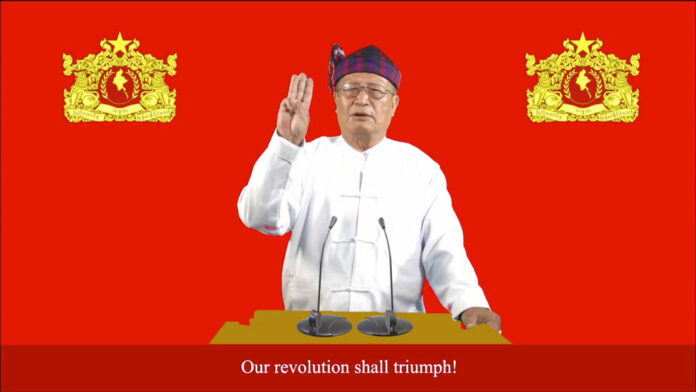
This image made from video by National Unity Government (NUG) via Facebook, shows Duwa Lashi La, the acting president of the National Unity Government (NUG), posted on Tuesday, Sept. 7, 2021 in Myanmar. Photo: National Unity Government via Facebook via AP
BANGKOK (AP) — The main underground group coordinating resistance to Myanmar’s military government issued a sweeping call for a nationwide uprising on Tuesday, raising the prospect of spiraling unrest.
The National Unity Government, which views itself as a shadow government, was established by elected legislators who were barred from taking their seats when the military seized power in February.
The group’s acting president Duwa Lashi La declared what he called a “state of emergency” and called for revolt “in every village, town and city in the entire country at the same time.” A video of his speech was posted on Facebook.
Some 1,000 civilians have been killed in the seven months of clashes that followed the army takeover.
A spokesman for the ruling military downplayed the call for renewed protests.
Maj. Gen. Zaw Min Tun blamed exile media for exaggerating the opposition’s strength, in a statement posted on the Telegram app by state television MRTV.
Myanmar has been wracked by unrest since the military ousted the elected government of Aung San Suu Kyi, with initially peaceful demonstrations against the ruling generals morphing into a low-level insurrection in many urban areas after security forces used deadly force.
There has been more serious combat in rural areas, especially in border regions where ethnic minority militias have been engaging in heavy clashes with the government troops.
The shadow government’s prime minister, Mahn Winn Khaing Thann, said in a separate statement posted online that the new move was taken due to “changing circumstances” that required the complete abolition of the ruling military government. He did not elaborate.
The call for an uprising came a week ahead of the convening of the U.N. General Assembly. The National Unity Government is hoping to have the assembly formally recognize Kyaw Moe Tun, who supports the opposition group, as Myanmar’s legitimate envoy to the world body. He had been the official representative of the government previously, but switched his loyalty to the resistance in late February.
“It’s not uncommon for armed resistance forces to seek media attention ahead of a major event,” noted David Mathieson, an independent analyst of Myanmar politics.
“Calls for an armed insurrection, beyond what is already unfolding, will likely evince concern from many U.N. members states”, Mathieson said.
Military spokesman Zaw Min Tun also suggested the call for an uprising was timed to coincide with the U.N. General Assembly’s opening.
Mathieson said the call to arms was unlikely to be welcomed by the Association of Southeast Asian Nations, which has been seeking to broker an end to Myanmar’s crisis. The organization’s special envoy for Myanmar recently proposed a four-month ceasefire to carry out humanitarian activities.
Duwa Lashi La called on the ethnic militias, some of whom have declared themselves in alliance with the resistance, to “immediately attack” government forces.
There were no immediate signs of heightened resistance activity, though solidarity was expressed online by some student groups and two of the most powerful ethnic armed groups, from the Kokang and Kachin minorities. Fighting was reported in the eastern area controlled by the Karen, the ethnic group perhaps most sympathetic to the resistance.
The National Unity Government is popular inside Myanmar, but its previous statements declaring the military government and its actions invalid and illegal have had little measurable political impact. The group controls no territory or state armed forces, nor has it won any diplomatic recognition from the international community. Members of its shadow cabinet are in hiding inside Myanmar and in exile.
Fighting in the ethnic areas generally predates February’s military takeover, often by many decades.
The ethnic armed groups have an ambivalent relationship with the shadow government, which is closely identified with the former civilian government of Suu Kyi. Her ousted administration failed to offer regional minorities the local autonomy they have sought.
Analyst Mathieson noted that some of the ethnic militias have offered only limited opposition to the army rulers or are “sitting the whole post-coup crisis out.”
Duwa Lashi La’s statements, however, appeared to offer confidence in his group’s calls for resistance.
He warned people to avoid unnecessary travel, as well as to stock up on food and medicine, ahead of a “people’s revolution”.
At one usually quiet supermarket in Yangon, Myanmar’s biggest city, about 60-80 shoppers crowded checkout counters to purchase meat, rice, cooking oils, and other essentials. There were reports of similar scenes in other food stores and open-air markets in the city.
It was not immediately clear if these crowded markets were driven by concerns over further unrest.
In his statement, military spokesman Zaw Min Tun dismissed “rumors” that people should stock up any essential commodities.
Duwa Lashi La also called on people to help the opposition forces where they can, including with information they can gather about the government’s military.
The resistance movement has established “people’s defense forces” in many areas, but these usually carry out small hit-and-run guerrilla operations.
Myanmar’s military is one of the largest in Southeast Asia and has a reputation for toughness and brutality from years of jungle warfare. Although many Western nations maintain an arms embargo against Myanmar, the military buys equipment from countries such as Russia, China and Ukraine.
Charlie Thame, a political scientist at Thammasat University in Bangkok, Thailand, told The Associated Press that it would be wrong to underestimate the resistance’s strength or popular opposition to what he described as “generations of brutal oppression” by the military.
Mathieson suggested that the country was facing further instability.
“Either way, it portends even greater violence and suffering, regardless of any attainable political gain,” he said.
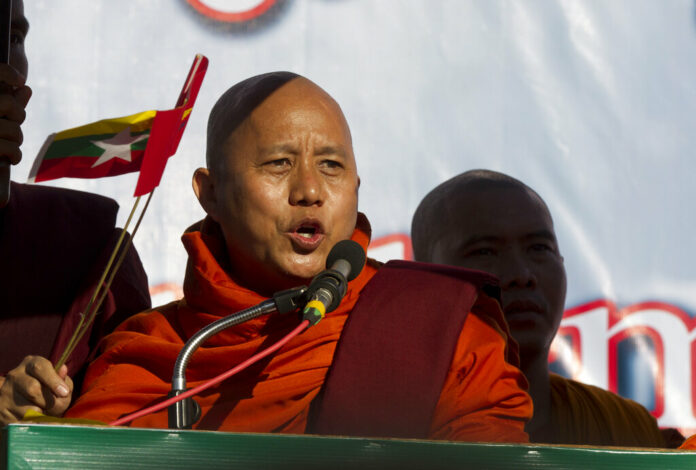
In this Sunday, Oct. 14, 2018 file photo, Buddhist monk and anti-Muslim community leader Wirathu speaks during a pro-military rally in front of city hall in Yangon, Myanmar. Photo: Thein Zaw / AP
BANGKOK (AP) — A nationalist Buddhist monk in Myanmar notorious for anti-Muslim remarks was freed from prison on Monday after charges that he tried to stir up disaffection against the country’s previous civilian government were dropped.
The monk, Wirathu, became prominent in 2012 after deadly riots broke out between Buddhists and ethnic minority Rohingya Muslims in the western state of Rakhine. He founded a nationalist organization that was accused of inciting violence against Muslims.
Muslims from other ethnic groups and in other areas also faced disrespect and occasional violence after Wirathu and his supporters launched their nationalist campaign. Time Magazine called Wirathu “The Face of Buddhist Terror” in a cover story in 2013.
Wirathu and his supporters were also successful in lobbying for laws making interfaith marriages difficult.
Par Mount Kha, another activist monk and friend of Wirathu, confirmed late Monday that the case had been dropped.
“I am 100% sure that Wirathu has been released. We welcome his release, ” he said.
People Media, an online news site, said it had received confirmation of Wirathu’s release from Maj. Gen. Zaw Min Tun, a spokesman for the Myanmar military, known as the Tatmadaw.
“The case was closed and he was released this evening. Even though U Wirathu was released, he is still receiving medical treatment at the Tatmadaw Hospital,” it quoted Zaw Min Tun as saying.
No reason was given for dropping the case.
Wirathu had turned himself in for arrest last November after being a fugitive from justice since May 2019, when a court issued a warrant for his arrest under under a section of the penal code that criminalizes comments that “bring into hatred or contempt” or “excite disaffection against” the government.
The charge was brought by the Yangon Region government for remarks he made in early May 2019 that included crude insults of Aung San Suu Kyi, who was then Myanmar’s leader. Her government was ousted in February this year in a military takeover.
Wirathu was able to build upon widespread prejudice in Buddhist-majority Myanmar against the Rohingya Muslims, who are seen as having immigrated illegally from Bangladesh, even though many of their families have lived in Myanmar for generations.
In 2017, attacks by Rohingya militants on police posts triggered a brutal counterinsurgency campaign by the army that caused more than 700,000 Rohingya villagers to flee across the border to Bangladesh for safety.
The Rohingya Muslims’ plight put the spotlight on Wirathu, who was accused of hate speech, and Facebook shuttered his account in 2018, However, he managed to stay on other social networks and gave speeches around the country. The National Monks Council banned him from giving public talks for a year, but its ruling was not tightly enforced.
Wirathu had a large following and was seen as maintaining close links with the military. But in a video released on social media while he was in prison, he complained bitterly about his treatment by the military-installed government.
PM Prayut Chan-o-cha points to a shipment of Sinovac vaccines during a handover ceremony at Suvarnabhumi Airport on Feb. 24, 2021.
BANGKOK — The government on Tuesday said it will spend 4.25 billion baht to buy 12 million more Sinovac vaccine doses for its “mix-and-match” vaccination program.
The doses will go to people with underlying health conditions putting them at risk; people aged 60 years and over; and officials and workers involved in controlling the pandemic, including quarantine facilities, soldiers, police officers, and garbage collectors, according to government spokesman Thanakorn Wangboonkongchana.
Any remaining vaccines will go to members of the public, he said.
The vaccine will be delivered to Thailand either this month or in October, Thanakorn said. Under the government’s “mix-and-match” approach, people will receive Sinovac’s CoronaVac as their first jab, and doses made by AstraZeneca as the second.
About 15 percent of the Thai population is fully vaccinated against COVID-19, while approximately 38 percent received at least one jab so far.
Although CoronaVac has been approved by the World Health Organization for emergency use, based on the results of the vaccine’s clinical trials, many on social media remain skeptical of the vaccine’s efficiency, especially against the highly contagious Delta variant.
The Chinese embassy in Thailand on Friday responded to the criticism by alleging that there are people who are undermining Beijing’s good intentions of helping Thailand fight the coronavirus pandemic.
Writing on its Facebook account, the embassy said every dose of the Covid-19 vaccine which China has supplied to Thailand represents the “friendship and sincerity” extended by the Chinese authorities to Thailand and its people.
To most people, the shade of white is associated with purity, elegance and simplicity. In the design world, white is often used to accentuate and highlight specific pieces of furniture and colourful accents in the room. When you add a white kitchen design in the form of cabinets, shelves and islands, you achieve all the symbolic and practical association with the shade of white.
Hygienic Benefits
A white kitchen design represents purity and precision in the preparation of foods. It highlights the care you take in preserving the hygiene of both the kitchen environment and the food itself. The design assures family members and guests to your kitchen that this is a place that values the safe and hygienic elements of fine cuisine preparation.
Having white cabinets and fixtures also makes cleaning less of a guessing game and more of a certainty. Soiled areas stand out on white surfaces, making them easier to see and clean thoroughly.
Kitchen Practicality
Having white fixtures also adds to a kitchen’s practicality and its décor. A white kitchen tends to make bowls of brightly coloured vegetables and fruits dishes look more fresh and tasty. This adds to the dining and socialising experience in the kitchen. When fresh food aromas are added, it can present a holistic image of everything elegant and enjoyable about preparing food for loved ones and friends.
Colourful, ripe ingredients and finished dishes cooling on countertops are what tends to draw a crowd of guests. Being able to show them off against white background simply accentuates the healthy appeal of your kitchen. The brightness factor of white can also make the kitchen a welcome place to gather and socialise.
The colour white also makes a small kitchen seem bigger, or one that doesn’t have access to natural light seem brighter. The greater the expanse of white, the more noticeable the effect.
Part of Your Lifestyle
Most busy and active families congregate in the kitchen at some point in the day. You can always tell the warmth and value of a family kitchen by looking at the refrigerator door. School schedules, shopping lists, appointment reminders, and mementoes from past holidays are the decorations of refrigerators.
But the other walls of the kitchen are often decorated with the artistic contributions of family members as well. Whether found at flea markets or made by the children in art class, this art is cherished by the family and the most fitting place for it is often unanimously chosen to be the kitchen.
A white design scheme serves to make all this collected art ‘pop’. It also makes the kitchen seem less like just a room in the house and more like the heart of the home.
Contact Kvik in Thailand to see all the white kitchen design schemes they have. You may just find one that accentuates everything warm, colourful and perfect about your family’s life.