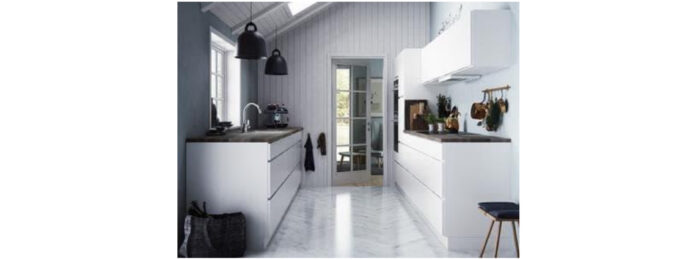
To most people, the shade of white is associated with purity, elegance and simplicity. In the design world, white is often used to accentuate and highlight specific pieces of furniture and colourful accents in the room. When you add a white kitchen design in the form of cabinets, shelves and islands, you achieve all the symbolic and practical association with the shade of white.
Hygienic Benefits
A white kitchen design represents purity and precision in the preparation of foods. It highlights the care you take in preserving the hygiene of both the kitchen environment and the food itself. The design assures family members and guests to your kitchen that this is a place that values the safe and hygienic elements of fine cuisine preparation.
Having white cabinets and fixtures also makes cleaning less of a guessing game and more of a certainty. Soiled areas stand out on white surfaces, making them easier to see and clean thoroughly.
Kitchen Practicality
Having white fixtures also adds to a kitchen’s practicality and its décor. A white kitchen tends to make bowls of brightly coloured vegetables and fruits dishes look more fresh and tasty. This adds to the dining and socialising experience in the kitchen. When fresh food aromas are added, it can present a holistic image of everything elegant and enjoyable about preparing food for loved ones and friends.
Colourful, ripe ingredients and finished dishes cooling on countertops are what tends to draw a crowd of guests. Being able to show them off against white background simply accentuates the healthy appeal of your kitchen. The brightness factor of white can also make the kitchen a welcome place to gather and socialise.
The colour white also makes a small kitchen seem bigger, or one that doesn’t have access to natural light seem brighter. The greater the expanse of white, the more noticeable the effect.
Part of Your Lifestyle
Most busy and active families congregate in the kitchen at some point in the day. You can always tell the warmth and value of a family kitchen by looking at the refrigerator door. School schedules, shopping lists, appointment reminders, and mementoes from past holidays are the decorations of refrigerators.
But the other walls of the kitchen are often decorated with the artistic contributions of family members as well. Whether found at flea markets or made by the children in art class, this art is cherished by the family and the most fitting place for it is often unanimously chosen to be the kitchen.
A white design scheme serves to make all this collected art ‘pop’. It also makes the kitchen seem less like just a room in the house and more like the heart of the home.
Contact Kvik in Thailand to see all the white kitchen design schemes they have. You may just find one that accentuates everything warm, colourful and perfect about your family’s life.
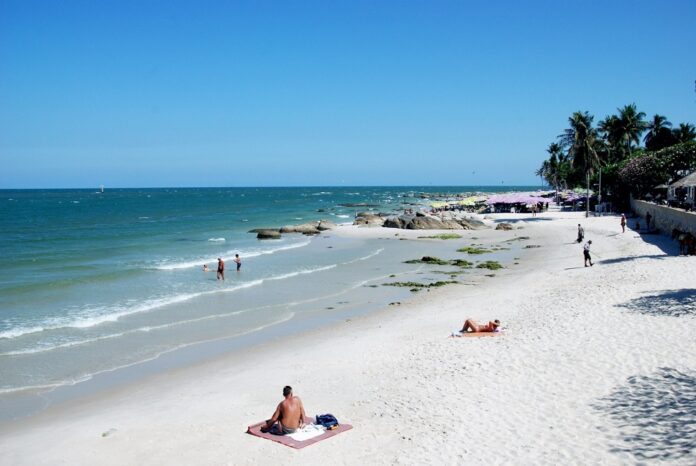
PRACHUAP KHIRI KHAN — Tourism officials remain adamant that the reopening plan for the resort town of Hua Hin will go ahead as scheduled on Oct. 1, but a local trade representative on Tuesday urged a delay.
Hua Hin, which is located in Prachuap Khiri Khan province, currently has the highest rate of infection in the province and many business operators are not yet ready to reopen their doors, said chamber of commerce honorary chairman Nipon Suwannawa.
“Hua Hin is still not 100% ready,” Nipon said. “There’s a lack of participation from the public. A lot of hoteliers and restaurant owners still have to adapt their standards. They’d need a big investment to prepare for tourists.”
Under a proposal submitted by the Tourism Authority of Thailand, travelers will be able to visit Hua Hin by travelling non-stop in a vehicle from Suvarnabhumi airport or via a transit flight to Hua Hin airport, starting Oct. 1.
The program, called Hua Hin Recharge, will also allow tourists to travel without quarantine once they receive a negative test result upon arrival. Travelers who already spent the first seven days of their trip in the Phuket Sandbox are eligible for the Hua Hin program.
TAT governor Yuthasak Supasorn told reporters earlier this week that flights from Phuket to Hua Hin are possible. Thai AirAsia operated flights to Hua Hin Airport prior to the pandemic.
Minister of tourism and sports Phiphat Ratchakitprakarn said the government will procure more vaccines for Hua Hin residents in order to facilitate the reopening.
The Hua Hin Recharge program is set to cover Hua Hin municipality and Nong Kae district. As of Tuesday, about 75 percent of residents in that area are reported to have received at least one dose of COVID-19 vaccine. The number of those fully vaccinated stood at only 25 percent.
In this 2018 photo, Danny Fenster works out of his van that he made into a home/office in Detroit. A court in Myanmar extended for two weeks the pre-trial detention of Fenster, an American journalist in the military-led Southeast Asian nation who was arrested in May. Photo: Fenster Family photo via AP
BANGKOK (AP) — A court in Myanmar on Monday extended the pre-trial detention of Danny Fenster, an American journalist in the military-led Southeast Asian nation who was arrested in May.
Fenster was detained at Yangon International Airport on May 24, as he was about to board a flight to go to the Detroit area in the United States to see his family. He is the managing editor of Frontier Myanmar, an online magazine based in Yangon, Myanmar’s biggest city.
“Danny’s next trial date is set for September 20,” said his lawyer, Than Zaw Aung. “The court held a video conference with Danny Fenster this afternoon and he is healthy, according to the clerk from the court.”
Fenster has been charged with incitement for which he could be sentenced to up to three years’ imprisonment. The charge against him does not make clear specifically what he is accused of doing.
Court hearings in Myanmar have been held by video for several months since a new wave of the coronavirus began ravaging the country. Lawyers do not take part in the video remand hearings but are informed afterward of their results.
Fenster has told his lawyer he fears he has COVID-19, though the authorities at Yangon’s Insein Prison have denied he is infected.
“We are very disappointed at the repeated delays in Danny’s case,” Frontier’s Editor-in-Chief Thomas Kean told The Associated Press. “Because of these delays he has now been in prison for more than 100 days and also had very little contact with his family or his lawyer. We know he has done nothing wrong and we are hopeful the case will soon be withdrawn so he can finally go home to his family.”
The military-installed government that took power in February in Myanmar — also known as Burma — has tried to silence independent news media by withdrawing their licenses and by arresting dozens of journalists.
“We remain deeply concerned over the continued detention of U.S. citizen Danny Fenster who was working as a journalist in Burma,” State Department spokesman Ned Price said last week after Fenster marked his 100th day in detention.
“Journalism is not a crime. The detention of Daniel Fenster and other journalists constitutes an unacceptable attack on freedom of expression in Burma. We continue to press Burma’s military regime to release Danny immediately. We will do so until he safely returns home to his family.”
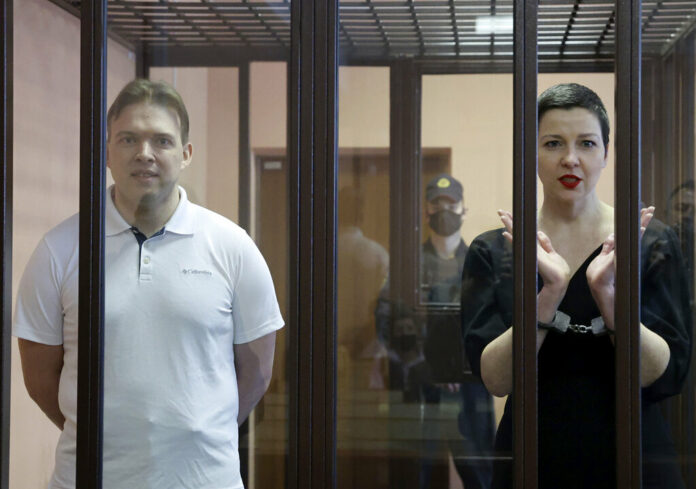
Belarus' opposition activists Maria Kolesnikova, right, and Maxim Znak attend a court hearing in Minsk, Belarus, Monday, Sept. 6, 2021. Photo: Ramil Nasibulin / BelTA pool photo via AP
KYIV, Ukraine (AP) — A court in Belarus on Monday sentenced two leading opposition activists to lengthy prison terms, the latest move in the relentless crackdown that Belarusian authorities have unleashed on dissent in the wake of last year’s anti-government protests.
Maria Kolesnikova, a top member of the opposition Coordination Council, has been in custody since her arrest last September. A court in Minsk found her guilty of conspiring to seize power, creating an extremist organization and calling for actions damaging state security and sentenced her to 11 years in prison.
Lawyer Maxim Znak, another leading member of the Coordination Council who faced the same charges, was sentenced to 10 years in prison.
U.S. Secretary of State Antony Blinken said the convictions were unjust, adding “we call for their immediate, unconditional release and for that of all other political prisoners held by the Lukashenko regime.” Western European officials also denounced the sentences.
Kolesnikova, who helped coordinate monthslong opposition protests that erupted after an August 2020 presidential vote, resisted authorities’ attempts to force her to leave the country.
Kolesnikova and Znak went on trial behind closed doors, with their families only allowed to be present at the sentencing hearing on Monday.
“For many, Maria has become an example of resilience and the fight between good and evil. I’m proud of her,” Kolesnikova’s father, Alexander, told The Associated Press on Monday. “It’s not a verdict, but rather the revenge of the authorities.”
Belarus was rocked by months of protests fueled by President Alexander Lukashenko’s being awarded a sixth term after the August 2020 presidential vote that the opposition and the West denounced as a sham. He responded to the demonstrations with a massive crackdown that saw more than 35,000 people arrested and thousands beaten by police.
Kolesnikova, 39, has emerged as a key opposition activist, appearing at political rallies and fearlessly walking up to lines of riot police and making her signature gesture — a heart formed by her hands. She spent years playing flute in the nation’s philharmonic orchestra after graduating from a conservatory in Minsk and studying Baroque music in Germany.
In 2020, she headed the campaign of Viktor Babariko, the head of a Russian-owned bank who made a bid to challenge Lukashenko, but was barred from the race after being jailed on money laundering and tax evasion charges that he dismissed as political. Babariko was sentenced to 14 years in prison two months ago.
Kolesnikova then joined forces with former English teacher Sviatlana Tsikhanouskaya, who was running in place of her jailed husband Sergei, an opposition blogger, as the main candidate standing against Lukashenko, and Veronika Tsepkalo, wife of another potential top contender who had fled the country fearing arrest.
The three appeared together at colorful campaign events that were in stark contrast to Lukashenko’s Soviet-style gatherings.
Shortly after the election, Tsikhanouskaya left Belarus under pressure from the authorities and is currently in exile in Lithuania.
In September 2020, as Belarus was shaken by mass protests, the largest of which drew up to 200,000 people, KGB agents drove Kolesnikova to the border between Belarus and Ukraine in an attempt to expel her. In the neutral zone between the two countries, Kolesnikova managed to rip up her passport, broke out of the car and walked back into Belarus, where she was immediately arrested.
Just before the start of her trial last month, Kolesnikova said in a note from prison that authorities offered to release her from custody if she asks for a pardon and gives a repentant interview to state media. She insisted that she was innocent and rejected the offer.
Speaking to the AP on Monday, Tsikhanouskaya described Kolesnikova’s ripping up her passport as “a historic deed.”
“Along with it (her passport), she tore apart all the plans of the regime,” Tsikhanouskaya said.
“The regime would want to see Maxim and Maria broken and weakened. But we see our heroes and strong and free inside. They will be free much earlier. Prison terms invented for them shouldn’t scare us — Maxim and Maria wouldn’t want that. They would want us to remember how Maria smiles, and to listen to Maxim singing,” Tsikhanouskaya added.
In London, U.K. Foreign Secretary Dominic Raab said “the sentencing of Maria Kolesnikova and Maxim Znak shows the Belarusian authorities continuing their assault on the defenders of democracy and freedom.”
“Locking up political opponents will only deepen the pariah status of the Lukashenko regime,” Raab said.
In Brussels, European Commission spokesman Peter Stano said that “the EU … reiterates its demands for the immediate and unconditional release of all political prisoners in Belarus (now numbering more than 650),” including Kolesnikova and Znak.
The verdicts Monday are “a symbol of the ruthless methods, the repression and intimidation by the Belarusian regime of opposition politicians and civil society,” German Foreign Ministry spokeswoman Andrea Sasse said in Berlin.
___
Story: Yuras Karmanau. Associated Press writers Lorne Cook in Brussels, Geir Moulson in Berlin and Danica Kirka in London contributed.
Retired NYPD Officer Mark DeMarco, is seen in a reflection off a display cabinet where he keeps memorabilia from 9/11 including the small flashlight which he used to help him navigate his way out of the rubble of the fallen skyscrapers, in his home in the Staten Island borough of New York on Tuesday, Aug. 3, 2021. Photo: Wong Maye-E / AP
NEW YORK (AP) — Trapped deep in the wreckage of the World Trade Center, Will Jimeno lived through the unthinkable. Twenty years later, he’s still living with it.
A brace and a quarter-sized divot on his left leg reflect the injuries that ended his police career, a lifetime dream. He has post-traumatic stress disorder. He keeps shelves of mementoes, including a cross and miniature twin towers fashioned from trade center steel. He was portrayed in a movie and wrote two books about enduring the ordeal.
“It never goes away, for those of us that were there that day,” he says.
Nearly 3,000 people were killed when hijackers in Osama bin Laden’s al-Qaida terror network rammed four commercial jets into the trade center, the Pentagon and a Pennsylvania field on Sept. 11, 2001. Yet an estimated 33,000 or more people successfully evacuated the stricken buildings.
They navigated mountains of smoky stairs in the World Trade Center’s twin towers or streamed out of a flaming Pentagon. Some fled an otherworldly dust cloud at ground zero. Others willed their way out of pitch-dark rubble.
Sept. 11 survivors bear scars and the weight of unanswerable questions. Some grapple with their place in a tragedy defined by an enormous loss of life. They get told to “get over” 9/11. But they also say they have gained resilience, purpose, appreciation and resolve.
“One of the things that I learned,” Jimeno says, “is to never give up.”
‘IT’S ALMOST LIKE YOU’RE REBORN’
It wasn’t Bruce Stephan’s first incredibly close call.
Twelve years later, the engineer and lawyer was settling into his workday on the 65th floor of the trade center’s north tower when one of the planes crashed about 30 stories above .
Only after his roughly hourlong walk down the crowded stairs did Stephan learn that another plane had hit the south tower — the building where his wife, Joan, also an attorney, worked on the 91st floor. Above the impact zone.
Unable to reach her by cell phone, Bruce Stephan dashed to a payphone and called her relatives, who told him she’d gotten out.
“My experience from the first disaster was that it’s a strangely happy moment when you know that you’ve survived,” Bruce Stephan says. “It’s almost like you’re reborn… to know that you’re alive and that you still have a shot at life, and here’s your chance to do something.”
“When it happened a second time, it’s just like, ‘Oh, my God.’”
After the earthquake, the New York City natives resolved to change their workaholic lives. After 9/11, they did.
Within two months, the couple moved to Essex, a northern New York town of roughly 700 people. While telecommuting and sometimes actually commuting, they made time for other things — church, a book club, amateur theater, gardening, zoning meetings, a local newsletter. They cherished a newfound sense of community.
But a work opportunity pulled them back to San Francisco in 2009. They loved it, until the pandemic made them rethink their lives again.
“One of the things that that we discovered as a result of the disasters was that being in a community … is maybe the biggest reward you can have,” Stephan, 65, says from their front porch in Essex. They moved back last year.
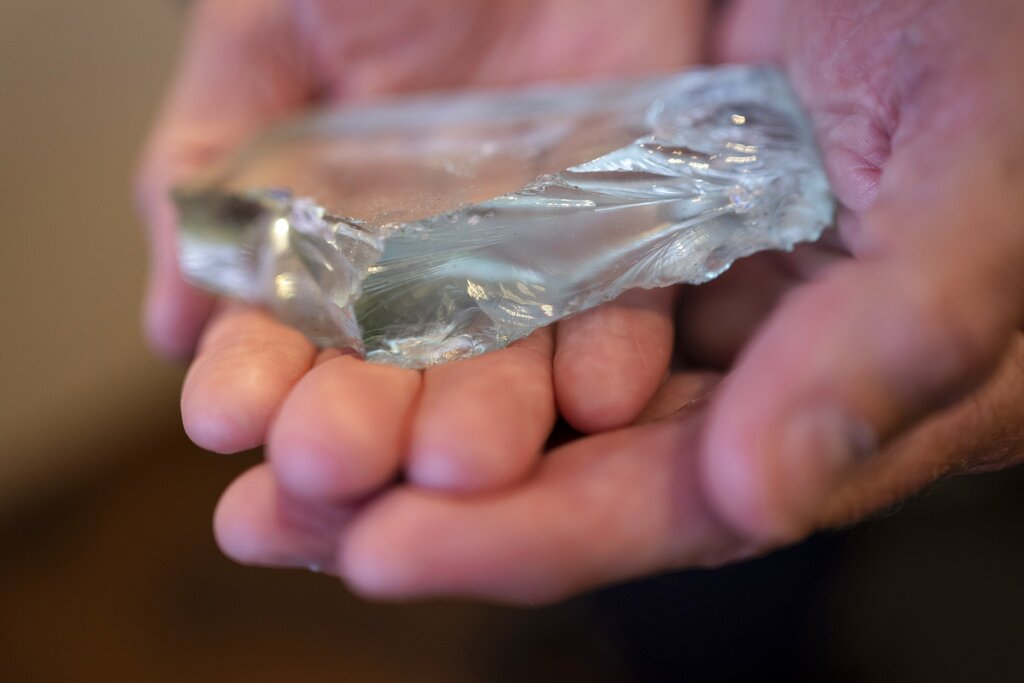
Retired NYPD Officer Ken Winkler, holds a broken piece of glass that he kept from the fallen World Trade Center skyscrapers, which he keeps in his office on Tuesday, Aug. 3, 2021, in New York. Photo: Wong Maye-E / AP
‘I WAS A WALKING ZOMBIE’
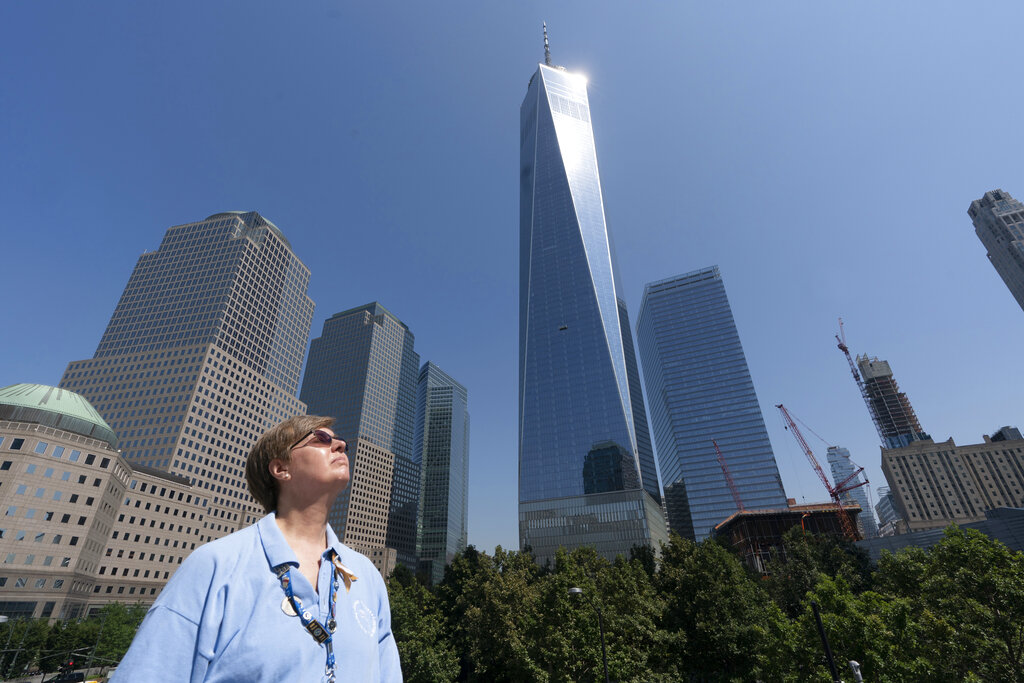
Désirée Bouchat pauses by one of the inscribed names on the 9/11 memorial:James Patrick Berger. She last saw him on the 101st floor of the trade center’s south tower.
“Some days, it feels like it happened yesterday,” she says.
At first, people figured the plane crash at the north tower was accidental. There was no immediate evacuation order for the south tower. But Berger ushered Bouchat and other Aon Corp. colleagues to the elevators, then turned back to check for more people.
Just as Bouchat exited the south tower, another plane slammed into it. Nearly 180 Aon workers perished, including Berger.
For a while, Bouchat told everyone, including herself: “I’m fine. I’m alive.”
But “I was a walking zombie,” she says now.
She couldn’t multitask anymore. Remarks that used to bother her stirred no reaction. She was functioning, but through a fog that took more than a year to lift.
Bouchat eventually felt that she needed to talk about 9/11. The Springfield, New Jersey, resident has now led about 500 tours for the 9/11 Tribute Museum (it’s separate from the larger National September 11 Memorial & Museum).
Bruce Powers has traveled from Alexandria, Virginia, to lead Tribute Museum tours, too. And every Sept. 11, the 82-year-old repeats his seven-mile (11 km) walk home from the Pentagon after the attack that killed 184 people, 10 of whom he knew.
The walk, the tours and hearing other guides’ personal stories “serve well in helping me deal with what happened,” says Powers, a now-retired Navy aviation planner.
The public hasn’t fully recognized the losses survivors felt, says Mary Fetchet, a social worker who lost her son Bradon 9/11 and founded Voices Center for Resilience, a support and advocacy group for victims’ families, first responders and survivors. “Although they are still living, they’re living in a very different way.”
‘I COULDN’T FIGURE OUT HOW I GOT OUT OF THERE ALIVE’
For a time after 9/11, Police Department Officer Mark DeMarco replayed the what-ifs in his mind. If he’d gone right instead of left. A bit earlier. Or later.
“I couldn’t figure out how I got out of there alive,” he says.
After helping evacuate the north tower, the Emergency Service Unit officer was surrounded by a maze of debris when parts of the skyscraper tumbled onto a smaller building where he’d been directed. Some officers with him were killed.
Barely able to see his own boots with a small flashlight, DeMarco inched through the ruins with two officers behind him.
Then he took a step and felt nothing underfoot. He looked below and saw utter darkness.
Only later — after the officers turned around and eventually clambered through shattered windows to safety — did DeMarco realize he’d nearly tumbled into a crater carved by the collapse.
Now 68 and retired, DeMarco still wears a wristband with the names of the 14 ESU members killed that day. He worries that the public memory of the attacks is fading, that the passage of time has created a false sense of security.
“Have fun with life. Don’t be afraid,” he says. “But be mindful.”
Désirée Bouchat poses for a photo at the World Trade Center, Friday, Aug. 6, 2021, in New York. Photo: Mark Lennihan / AP
‘IT’S NOT SOMETHING TO BE GOTTEN OVER’
A tsunami of dust washed over emergency medical technician Guy Sanders, so thick that it clogged his surgical mask.
The 47-story building at 7 World Trade Center had just collapsed, about seven hours after the burning towers fell and debris ignited fires in the smaller high-rise.
A part-time EMS supervisor for a private ambulance company in the city, Sanders had scrambled to respond from his day job at a Long Island collections agency. He was en route when the towers collapsed, killing eight EMA workers, including his colleague Yamel Merino. Sanders went to funeral after funeral for EMTs, firefighters and police.
Yet 9/11 only deepened his commitment to EMS. Though it was tricky financially, he soon went full-time.
“I never wanted to be in a situation where people needed me and I couldn’t immediately respond,” he says.
He still doesn’t. But health problems — including a rare cancer that the federal government has linked to trade center dust exposure — forced his 2011 retirement, says Sanders, 62, now living near Orangeburg, South Carolina.
“You get people telling you, ‘Well, (9/11) happened so long ago. Get over it.’ But it is a trauma,” says Sanders, who joined a first responders’ and survivors’ support group. “It’s not something to be gotten over. It’s something to be addressed.”
‘SURVIVING IS ONLY THE FIRST PIECE OF THE JOURNEY’
Breathing through an oxygen mask in a hospital bed, Wendy Lanski told herself: “If Osama bin Laden didn’t kill me, I’m not dying of COVID.”
Nearly two decades earlier, the health insurance manager escaped the north tower’s 29th floor and ran, barefoot, through the dust cloud from the south tower’s collapse. Eleven of her Empire Blue Cross Blue Shield colleagues died.
“The only good thing about surviving a tragedy or a catastrophe of any kind is: It definitely makes you more resilient,” says Lanski, who was hospitalized with the coronavirus — as was her husband — for two touch-and-go-weeks in spring 2020.
But “surviving is only the first piece of the journey,” says Lanski, 51, of West Orange, New Jersey.
She has the twin towers, “9/11/01” and “survivor” tattooed on her ankle. But the attacks also left other marks, ones she didn’t choose.
Images and sounds of falling people and panes of glass lodged in her memory. She was diagnosed in 2006 with sarcoidosis, she said; the federal government has concluded the inflammatory disease may be linked to trade center dust. And she has asked herself: “Why am I here and 3,000 people are not?”
Over time, she accepted not knowing.
“But while I’m here, I’ve got to make it count,” says Lanski, who has spoken at schools and traveled to conferences about terror victims. “I’ve got to make up for 3,000 people who lost their voice.”
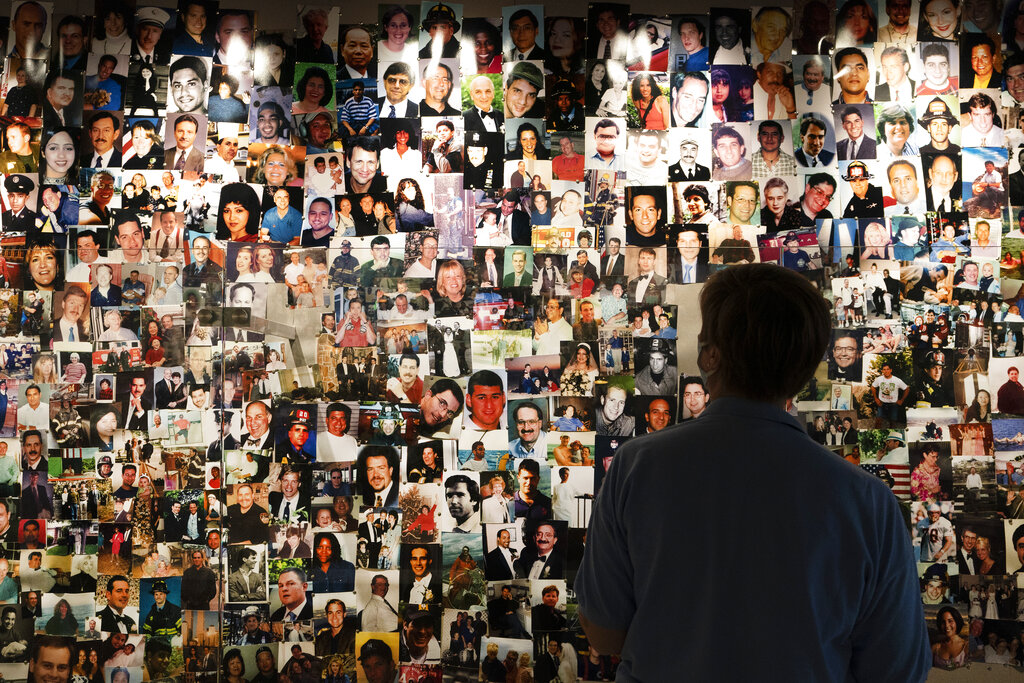
Désirée Bouchat, a survivor of the 9/11 attacks on the World Trade Center, looks at photos of those who perished, in a display at the 9/11 Tribute Museum, Friday, Aug. 6, 2021, in New York. Photo: Mark Lennihan / AP
‘IT MOTIVATES ME TO LIVE A BETTER LIFE’
Buried in darkness and 20 feet (6 meters) or more of rubble from both towers, Will Jimeno was ready to die.
The Port Authority of New York and New Jersey Police Department rookie was in searing pain from a fallen wall pinning his left side. Fellow officer Dominick Pezzulo had died next to him. Flaming debris had fallen on Jimeno’s arm and heated the cramped area enough that Pezzulo’s gun fired, sending a flurry of bullets past Jimeno’s head. He had yelled for help for hours. He was terribly thirsty.
“If I die today,” he remembers thinking, “at least I died trying to help people.”
Then Jimeno, who is Catholic, had what he describes as a vision of a robed man walking toward him, a bottle of water in his hand.
We’re going to get out, he told Sgt. John McLoughlin, who was trapped with him.
It was hours — of pushing back pain, thinking of rescues in past disasters, talking to keep alert — before they were found and gruelingly extricated by former U.S. Marines, NYPD officers, a onetime paramedic and firefighters as blazes flared and debris shifted and fell.
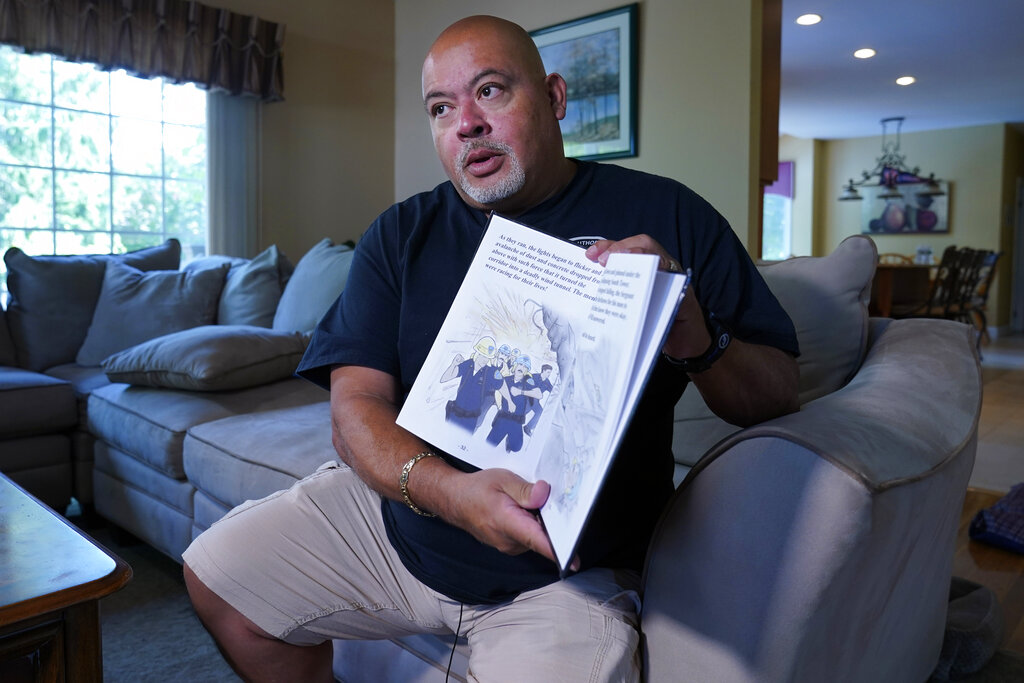
Will Jimeno, the former Port Authority police officer who was rescued from the rubble of the Sept. 11, 2001 attacks at the World Trader Center after many hours, holds the children’s book he wrote, “Immigrant, American, Survivor,” that draws on his experience, during an interview at his home in Chester, N.J., Monday, Aug. 2, 2021. Photo: Richard Drew / AP
“If you wanted to picture what hell looked like, this was probably it,” recalls then-NYPD Officer Ken Winkler.
Jimeno was freed around 11 p.m., McLoughlin the next morning. Jimeno underwent surgeries and lengthy rehabilitation.
But he says his psychological recovery was harder. Trivial things made him lose his temper — fueled, he now realizes, by anger about the deaths of colleagues and people rescuers couldn’t help. At times, he says, he thought of suicide. It took three years and multiple therapists before he mastered warding off the outbursts.
It has helped to tell his story in talks, in the 2006 Oliver Stone movie “World Trade Center,” and in Jimeno’s two newly released books — the illustrated “Immigrant, American, Survivor”for children, and “Sunrise Through the Darkness,” about coping with trauma.
The Colombian-born U.S. Navy veteran hopes that people see in his story “the resiliency of the human soul, the American spirit,” and the power of good people stepping up in bad times.
Sept. 11 “motivates me to live a better life,” says Jimeno, 53, of Chester, New Jersey. “The way I can honor those we lost and those that were injured is to live a fruitful life. To be an example to others that Sept. 11 did not destroy us.”
___
Story: Jennifer Peltz. New York City-based AP reporter Jennifer Peltz has covered the aftermath of 9/11 for more than a decade, including the rebuilding and memorial efforts at ground zero.
Charoen Pokphand Foods Public Company Limited (CP Foods) has partnered with the CP Group’s Feed Ingredient Trading Business (FIT) to encourage corn farmers to join the corn traceability program. This campaign is line with the company’s policy to source corn used in animal feed from traceable legal crop plantation. The traceability system ensure transparency along CP Foods entire poultry and swine supply chain.
Mr. Paisarn Kruawongvanich, Executive Vice President of FIT, which provide raw materials for animal feed production to CP Foods, said that the company has sourced it corn practice in line with the CP Foods’ sustainable sourcing policy in which focusing on transparency and sustainability. As a result, the company has worked together with farmers to ensure that they can prove their non-involvement with forest encroachment and biomass burning.
The growing season this year, the company encourages maize growers enroll the corn traceability program via the website: https://traceability.fit-cpgroup.com/ or the company’s local corn purchase partners. “The Registration will ensure farmers having market to purchase their crop at appropriate and fair prices. This system will also help encourage farmers to pay attention to planting and harvesting processes that help build sustainability in the feed raw material supply chain,” said Mr. Paisan.
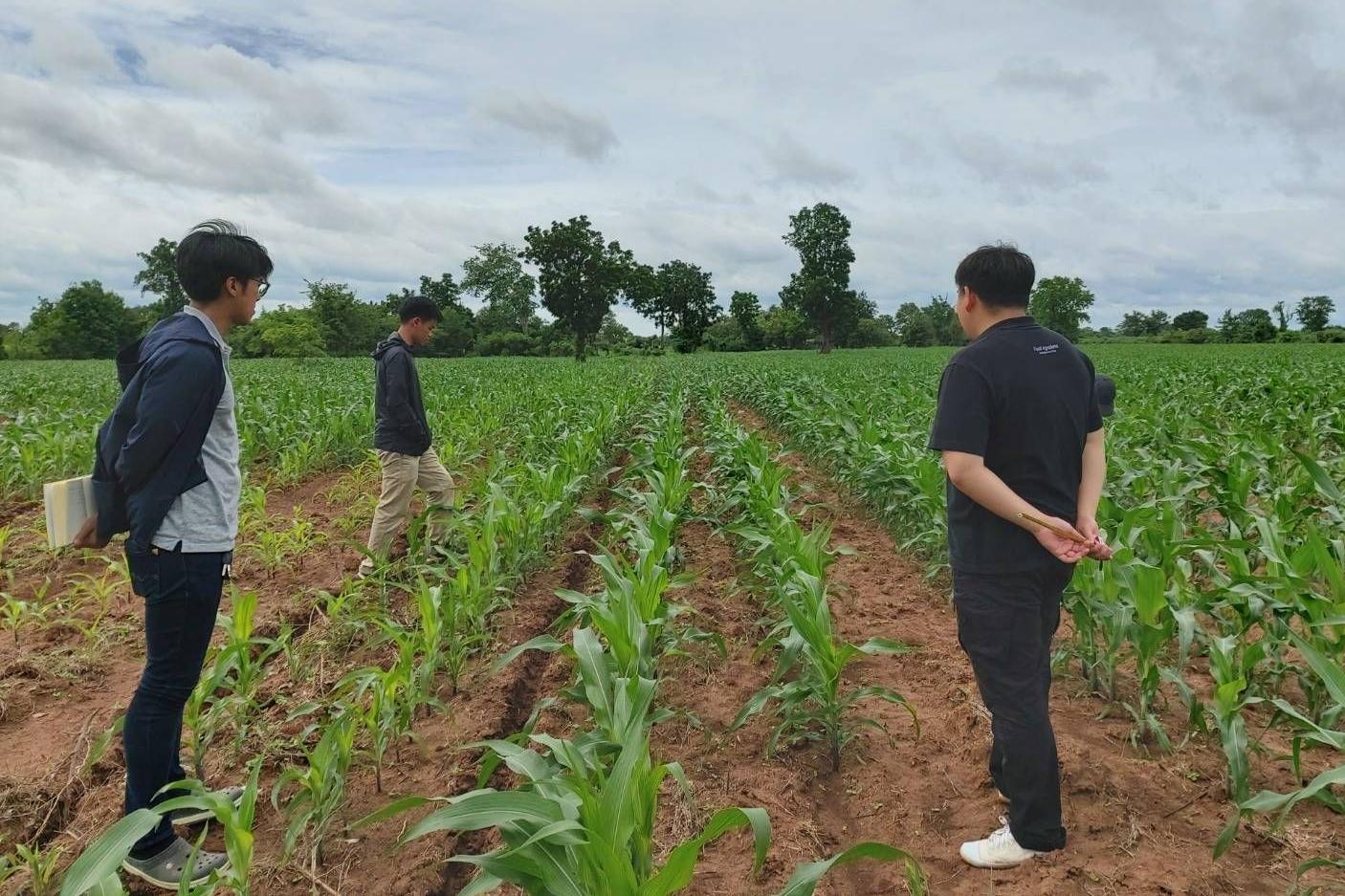
He added that, aside corn tractability system, plantation knowledge and techniques are passed on to corn farmers to raise output and quality while reducing fertilizer cost and preserving the environment as a part of the “Self-Sufficient Farmers, Sustainable Corn Project”. These include zero burning of the corn stubble and zero forest encroachment. The company also provides other in-depth information to improve farming efficiency, enable the farmers to produce better quality corn that meets the market demand.
In addition, FIT also works with farmers participating in the project in Nakhon Ratchasima Province and Uthai Thani Province to promote a model for sustainable corn farming, using satellite technology to detect crop burning, helping to make that feed raw material used by CP Foods are from sustainable origin.
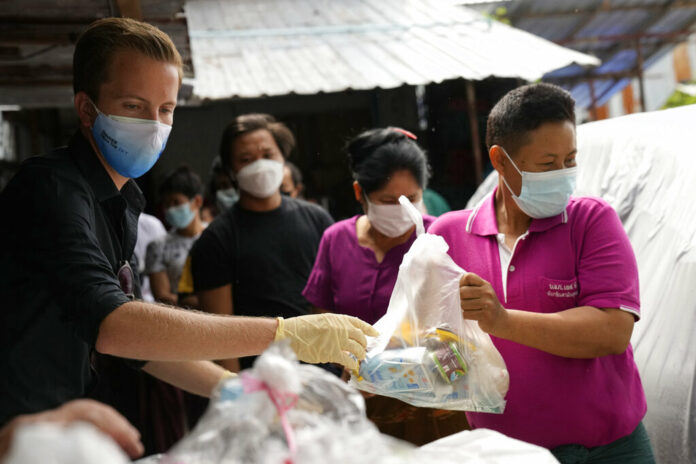
Bangkok Community Help Foundation co-founder Friso Poldervaart, left, from the Netherlands distributes food supplies at a construction camp in Bangkok, Thailand, on Aug. 31, 2021. Photo: Sakchai Lalit / AP
BANGKOK (AP) — For two months, carpenter Tun Nye hasn’t been able to send any money home to his parents in Myanmar to help them care for his 11-year-old son, after authorities in Thailand shut down his construction site over coronavirus concerns.
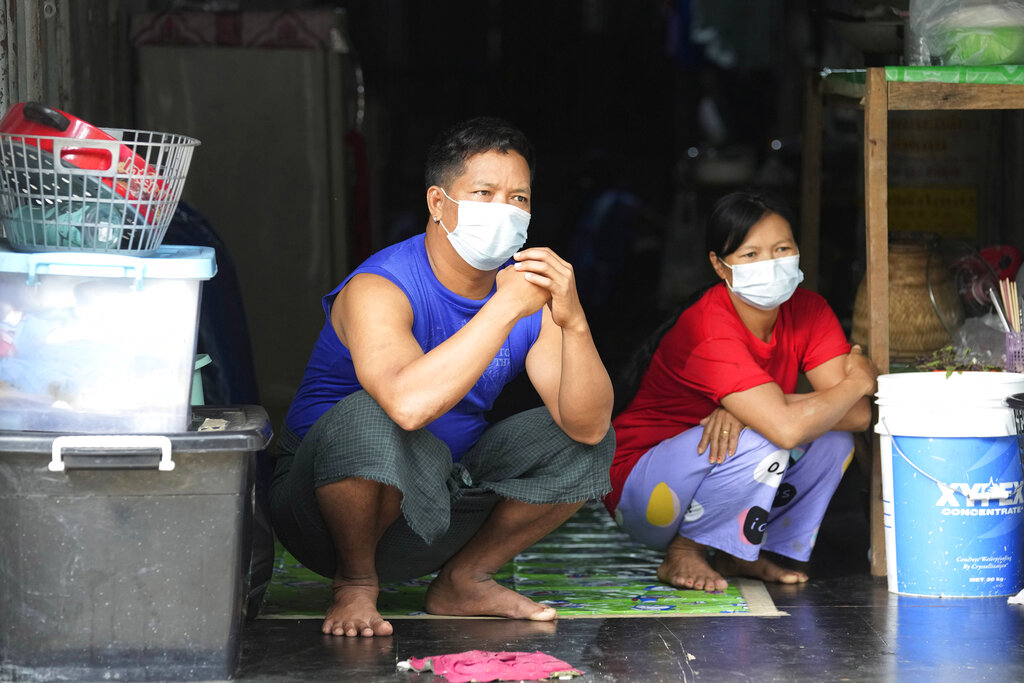
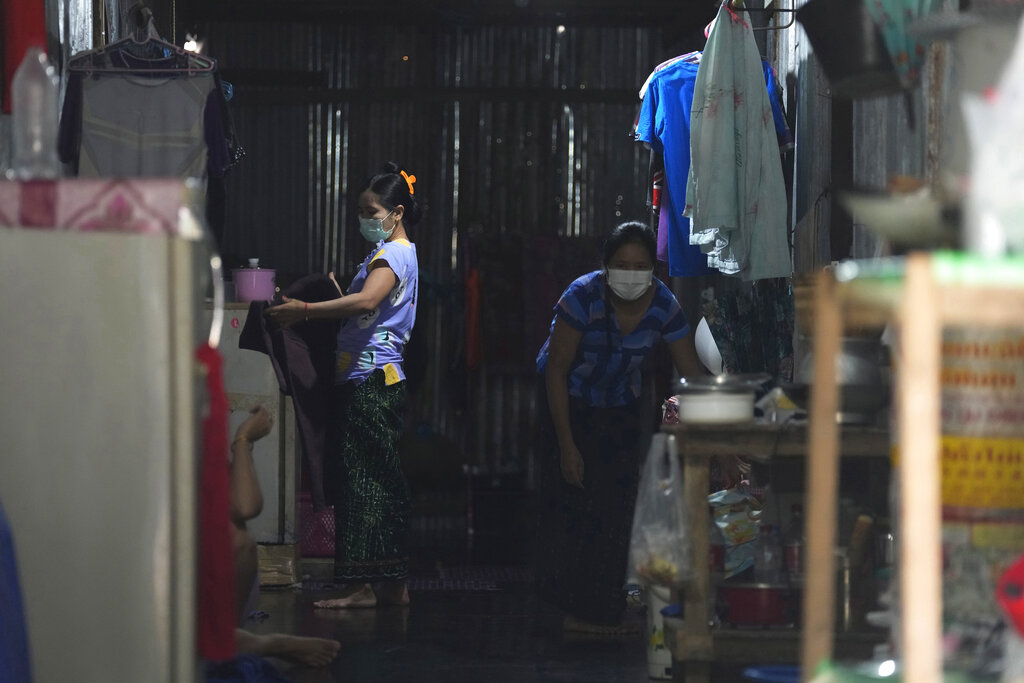
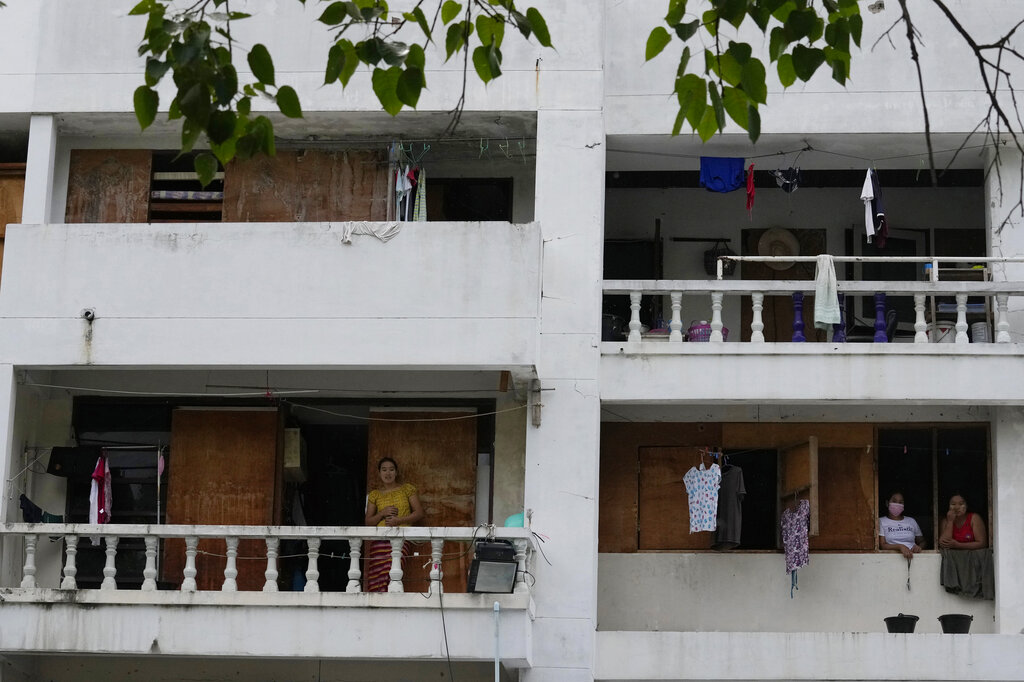
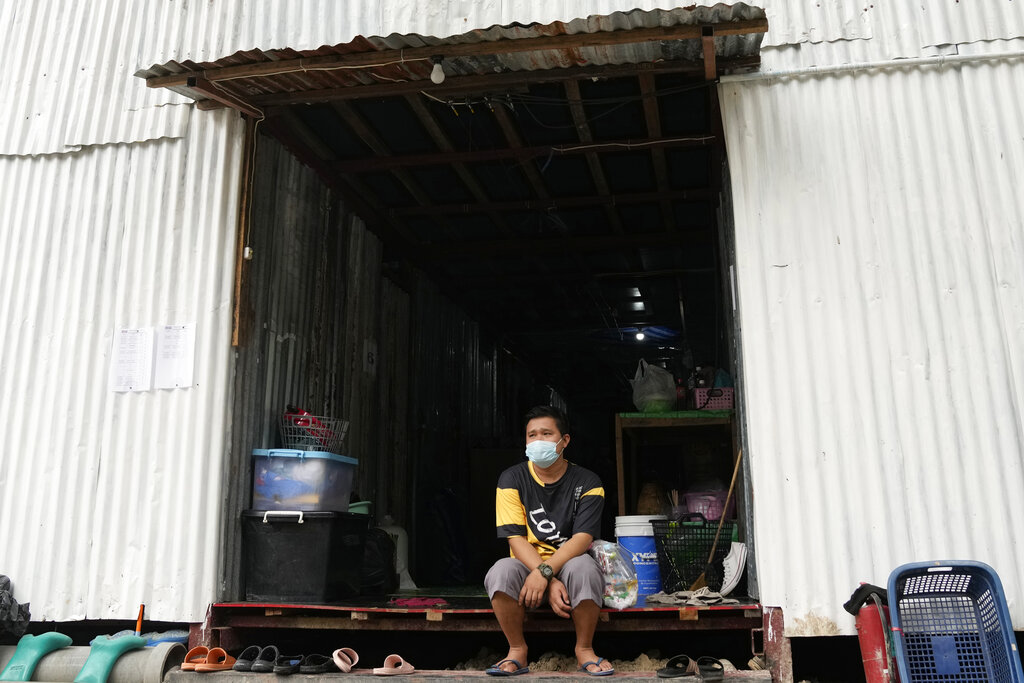
No work has meant no income for him or his wife, who have been confined to one of more than 600 workers’ camps dotted around Bangkok, living in small room in a ramshackle building with boards and blankets to cover missing windows.
In Thailand’s worst virus surge yet, lockdown measures have reduced what little Bangkok’s have-nots had to zero. Volunteer groups are working to ensure they survive.
For Tun Nye, 31, the bag of rice, canned fish and other staples dropped off by Bangkok Community Help volunteers meant not having to go hungry that week.
“It’s been three or four months with no money and we don’t have enough to eat,” he said after collecting his supplies. “And there’s no option to go home to Myanmar, it’s worse there.”
Myanmar migrant workers living their daily lives sit at a construction camp in Bangkok, Thailand, on Aug. 31, 2021. Photo: Sakchai Lalit / AP
The government shut down the camps at the end of June after clusters of delta-variant infections spread among the workers living in the close quarters, further escalating a COVID-19 spike in Thailand. Many lost all income, and while employers were supposed to ensure all had enough food and water, many didn’t.
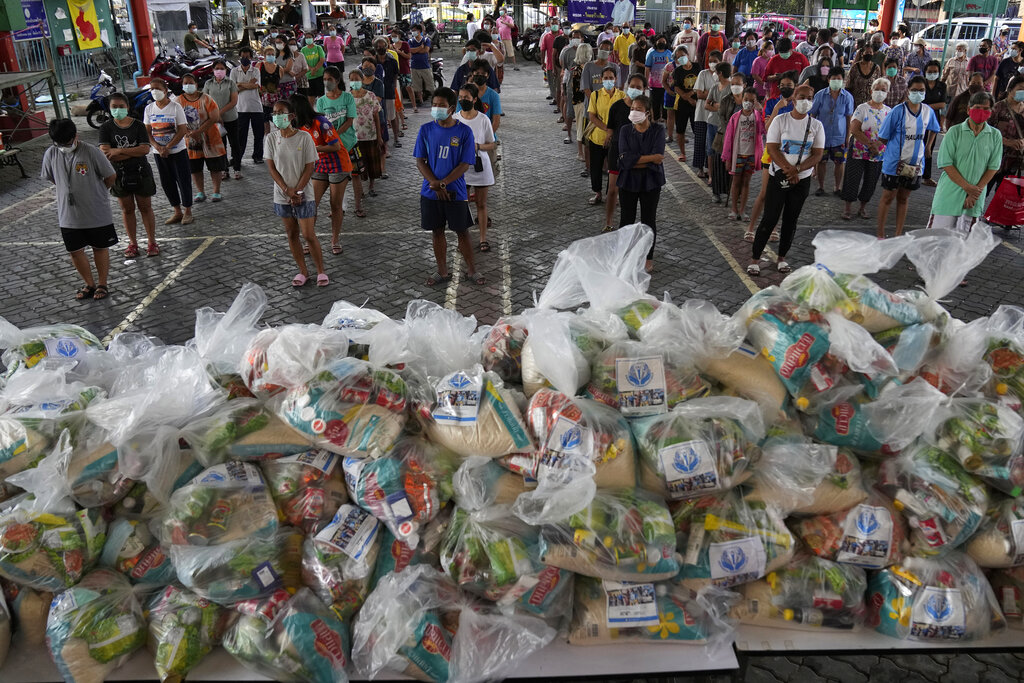
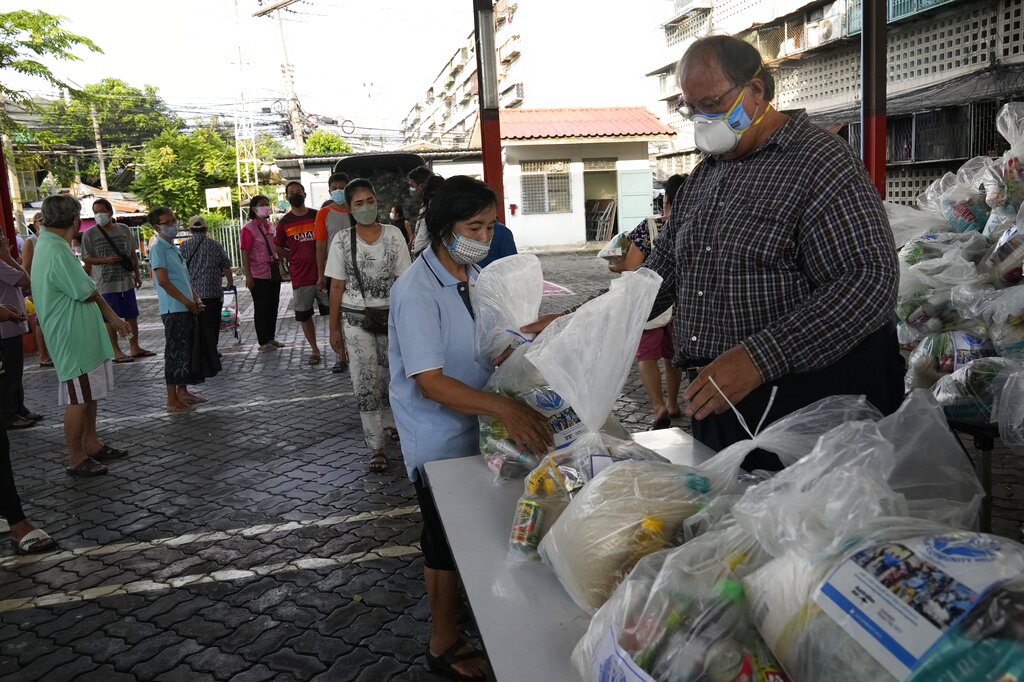
“You would have one camp that had a lot of supplies, they were provided for, and you’d walk 30 meters (yards) to another and they hadn’t seen their boss in two weeks and were told to go fish for food,” said Greg Lange, one of the co-founders of Bangkok Community Help, which delivers about 3,000 hot meals a day and up to 600 “survival bags” like the one Tun Nye got.
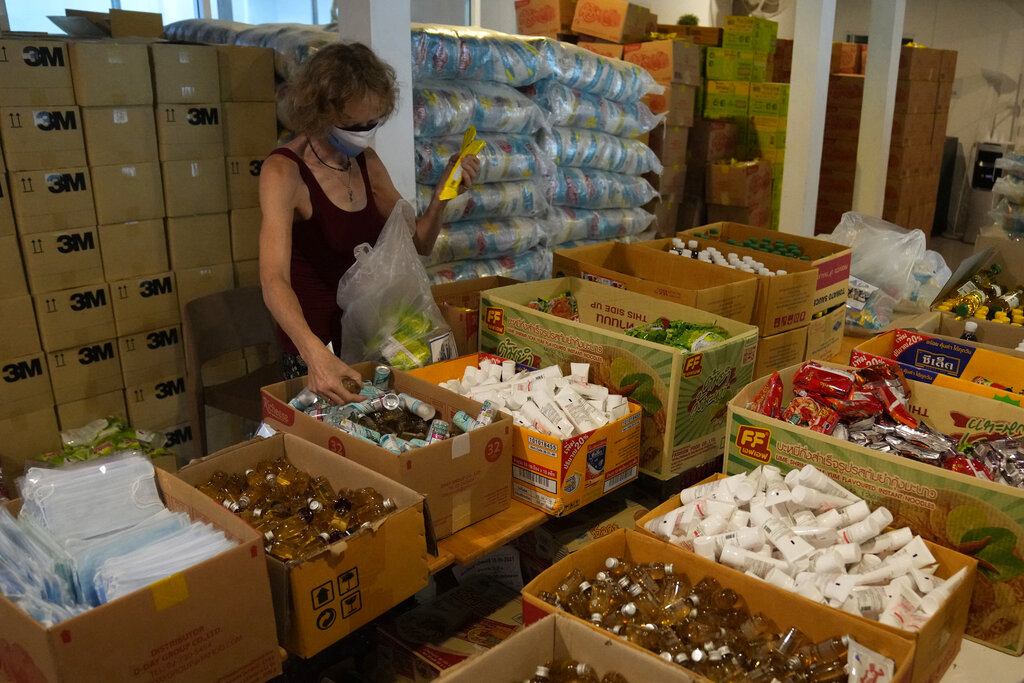
Founded early in the pandemic last year, the organization has grown to more than 400 Thai and foreign volunteers like Lange, a 62-year-old native of Florida in the restaurant business who has lived in Thailand for two decades, and relies heavily on social media to spread the word and solicit help.
People wait for food supplies distributed from Bangkok Community Help Foundation in Bangkok, Thailand, on Aug. 31, 2021. Photo: Sakchai Lalit / AP
Donations come from corporations, individuals and even governments. Some give meals they’ve prepared themselves, others packaged goods or cash. Rice in survival packages recently distributed in the slums near Bangkok’s main commercial port facilities was paid for through Australian Aid; apples were donated by the New Zealand-Thai Chamber of Commerce.
When hospitals became so overcrowded that COVID-19 patients couldn’t get admitted, volunteer doctors and others brought oxygen to their homes, hoping to keep them alive long enough for an ICU bed to become free.
“We were mostly dealing with helping people get through this time with food supplies, necessities, but suddenly we were dealing with lives, people were dying in our arms — literally,” said Lange’s co-founder, Friso Poldervaart, a Dutchman who has lived in Thailand for more than a third of his 29 years.
Bangkok Community Help Foundation co-founder Greg Lange, right, from Florida distributes food supplies to people living in a slum Bangkok, Thailand, on Aug. 31, 2021. Photo: Sakchai Lalit / AP
“That situation is luckily a little bit better now, more beds are free and the home isolation program of the government works better, but we’re still sending 20 to 30 people to the hospital every day, we’re still administering oxygen,” he said.
Thailand’s new infections have ranged around 15,000 in recent days after peaking above 23,400 in mid-August, while deaths from COVID-19 have remained high, with 224 reported Sunday. The country has confirmed 1.2 million cases and more than 12,800 deaths in the pandemic.
The government hopes the country is now on its way out of this deadliest wave of the pandemic, which has accounted for 97% of Thailand’s total cases and more than 99% of its deaths.
Volunteer of Bangkok Community Help Foundation Inge Groot from the Netherlands prepare supplies for people living in a slum in Bangkok, Thailand, on Aug. 31, 2021. Photo: Sakchai Lalit / AP
After a much-criticized slow start to vaccinations, some 35% of the population has now had at least one shot and about 12% are fully vaccinated. In Bangkok, more than 90% have had one shot and more than 22% have had two.
“In terms of the number of cases, we see that it’s still in the high numbers but the trend is getting better,” said Dr. Taweesap Siraprapasiri, an epidemiologist who is a senior adviser at the government’s Disease Control Department.
Lockdown restrictions were relaxed last week, and many construction projects have been green-lighted to resume work, under tight supervision.
Taweesap said many of the construction workers have now received at least a first vaccine dose, and that many worksites have begun operating under what authorities have dubbed “bubble and seal” regulations — a “bubble” of workers are kept together and sealed off from outside contact to prevent COVID-19 from entering the site, or spreading beyond it.
Myanmar migrant workers live their daily lives at a construction camp in Bangkok, Thailand, on Aug. 31, 2021. Photo: Sakchai Lalit / AP
“We are also applying this concept to other workplaces like factories,” he said.
When the camps were first shut, a group of Bangkok residents formed the We Care For Ourselves group, saying it was immediately evident to them that many workers had been left in crisis situations.
They created an online platform to match needs in the camps with donations available to better target the help, sharing their information with Bangkok Community Help and other groups.
Even though things are improving, group member Yuwadee Assavasrisilp said many unregistered workers still aren’t vaccinated and as word has spread about their group, they’re beginning to hear more about ongoing needs in the city’s slums.
When people test positive, they’re forced to isolate in their own homes, which usually means the virus spreads to family members, she said. And many are so poor they sneak out of isolation to work just so they can feed their families.
Myanmar migrant workers live their daily lives at a construction camp in Bangkok, Thailand, on Aug. 31, 2021. Photo: Sakchai Lalit / AP
“Without the volunteers, we would have seen many more people die because they could not access the government’s system in time,” said 32-year-old Yuwadee. “The number of volunteers in Thailand has been surging — this shows the generosity of people in Thailand during the crisis — but at the same time, it reflects the government’s big failure in handling this pandemic.”
A recent outbreak in Tun Nye’s camp, housing a 112-person crew building a mansion for an oil tycoon, meant that it had to stay shut longer than most but the worksite was approved for reopening last week. He and his wife both had the virus, but without serious symptoms and a negative test about a week ago means he can now get back on the job.
“Everyone’s looking forward to it,” he said, his smile broad enough to be visible through his surgical mask. “We’ve been without an income for so long.”
For the volunteer groups, it’s just another phase of a long pandemic.
Bangkok Community Help, in conjunction with the local government, last week opened a 52-bed isolation center in a primary school, unused due to the pandemic. And over the weekend volunteers comprehensively tested an entire neighborhood to get better data on infection rates.
“We don’t stop,” said Poldervaart. “We just adapt.”
Myanmar migrant worker Tun Nai sits at a construction camp in Bangkok, Thailand, on Aug. 31, 2021. Photo: Sakchai Lalit / AP
___
Story: David Rising. Associated Press journalists Chalida Ekvitthayavechnukul and Tassanee Vejpongsa contributed to this report.
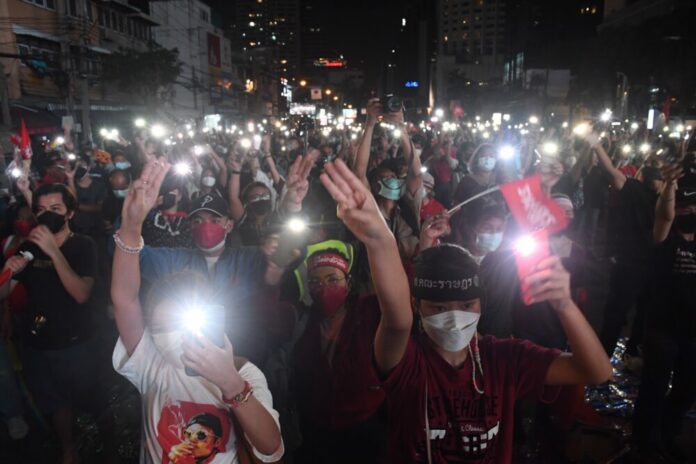
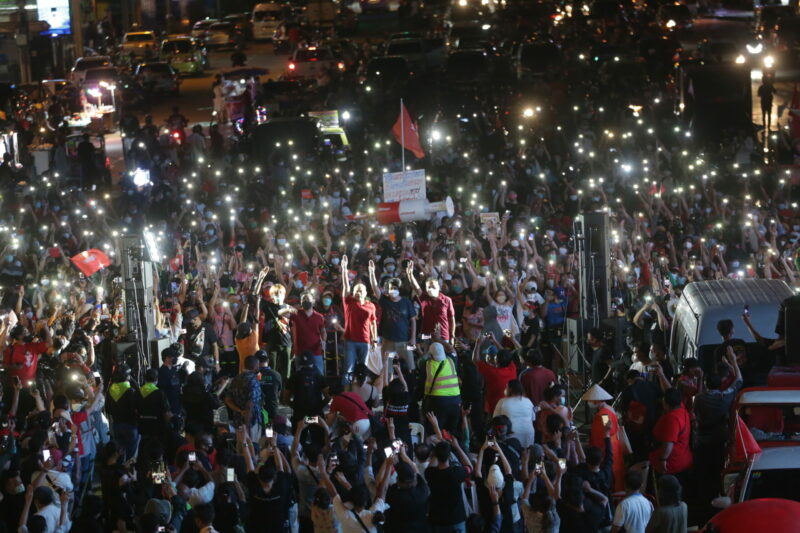
Anti-government protesters at Asoke Intersection on Sept. 5, 2021.
BANGKOK (AP) — Protesters gathered Sunday in the Thai capital Bangkok, seeking to rejuvenate their movement to oust the country’s prime minister and institute political reforms.
More than 1,000 people gathered peacefully at central Bangkok’s busy Asoke intersection, while a militant faction that has made a tactic of confronting the authorities clashed with police elsewhere.
Protest organizer Nattawut Saikua, a veteran activist and former deputy Cabinet minister, said the rallies at the Asoke intersection will continue every evening.
The protests came a day after Prime Minister Prayuth Chan-ocha survived a no confidence vote in Parliament. That offered him a brief respite from widespread criticism that his government had botched its response to the pandemic by failing to secure timely and adequate supplies of COVID-19 vaccines.
The protesters’ targeting of Prayuth predates any controversy over vaccines, and began last year as a pro-democracy movement. Their three core demands had been resignation of Prayuth, who initially came to power as army commander by staging a coup in 2014; amending the constitution; and reforming the monarchy to make it more accountable.
Anti-government protesters at Asoke Intersection on Sept. 5, 2021.
The movement lost steam due to its leaders’ arrests, COVID-19 restrictions and controversy over its critical view of the monarchy, an institution fiercely guarded by the country’s ruling elite, including the military.
But Prayuth’s sinking popularity over the vaccine issue and accusations of corruption have given the protesters an opportunity to garner fresh support, even though attendance at recent rallies has failed to match those held last year, which sometimes attracted upward of 20,000 people.
Sunday’s rally drew disparate groups together. They included participants in recent “car mobs” who had staged mobile protests in their vehicles; “Red Shirt” supporters of former Prime Minister Thaksin Shinawatra, who was ousted by a military coup in 2006; and progressive students with the tongue-in-cheek moniker “Bad Students,” whose focus has been education reform.
Speakers from the protest stage also included Tanat Thanakitamnuay, the heir to a real estate fortune who had once been active on the other side of the political fence in his support of the military and the monarchy. He now is a prominent protest voice whose profile was raised last month when he suffered a major eye injury as police tried to disperse demonstrators with tear gas.
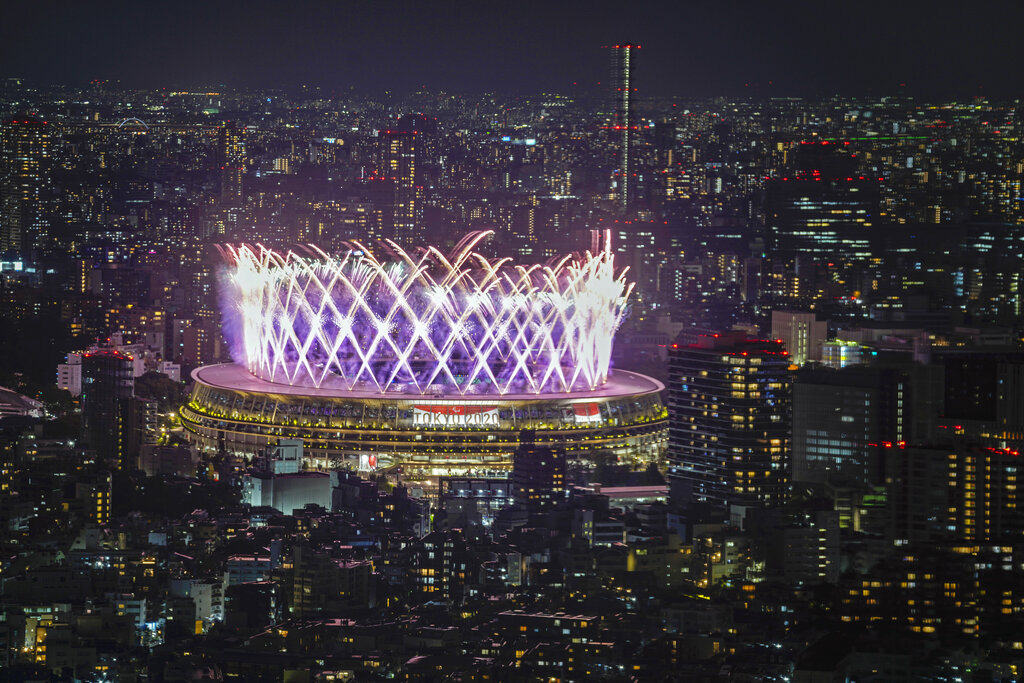
Fireworks are set off around the Olympic Stadium during the closing ceremony of the Tokyo 2020 Paralympic Games in Tokyo, Japan, Sunday, Sept. 5, 2021. Photo: Joe Toth for OIS via AP
TOKYO (AP) — The final act of the delayed Tokyo Olympics and Paralympics came Sunday, almost eight years to the day after the Japanese capital was awarded the Games.
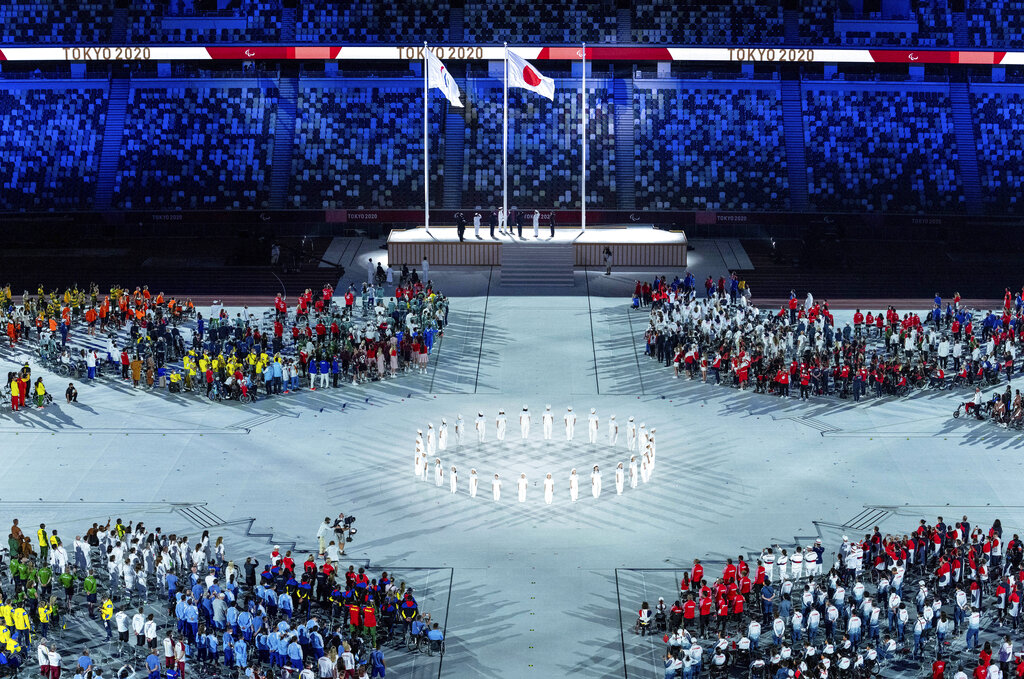
The Paralympics ended a 13-day run in a colorful, circus-like ceremony at the National Stadium overseen by Crown Prince Akishino, the brother of Emperor Naruhito. The Olympics closed almost a month ago.
These were unprecedented Olympics and Paralympics, postponed for a year and marked by footnotes and asterisks. No fans were allowed during the Olympics, except for a few thousand at outlying venues away from Tokyo. A few thousand school children were allowed into some Paralympic venues.
“There were many times when we thought these games could not happen,” Andrew Parsons, president of the International Paralympic Committee, said on Sunday. “There were many sleepless nights.”
The closing ceremony was entitled “Harmonious Cacophony” and involved both able-bodied actors and others with disabilities. The theme was described by organizers as a “world inspired by the Paralympics, one where differences shine.”
Like the Olympics, the Paralympics went ahead as Tokyo was under a state of emergency due to the pandemic. Like the Olympics, testing athletes frequently and isolating them in a bubble kept the virus largely at bay, though cases surged among a Japanese population that is now almost 50% fully vaccinated.
“I believe that we have reached the end of games without any major problems,” said Seiko Hashimoto, the president of the Tokyo organizing committee.
But there was fallout, however. Lots of it.
Fireworks illuminate over National Stadium viewed from Shibuya Sky observation deck during the closing ceremony for the 2020 Paralympics in Tokyo, Sunday, Sept. 5, 2021. Photo: Kiichiro Sato / AP
Japanese Prime Minister Yoshihide Suga announced Friday — two days before the closing — that he would not continue in office. Suga hoped to get a reelection bump from the Olympics. He got the opposite as his approval rating plummeted after a slow vaccine rollout in Japan, and a contentious decision to stage the Games during the pandemic.
Suga succeeded Shinzo Abe, who resigned a year ago for health reasons. It was Abe who celebrated in the front row of a Buenos Aires hotel ballroom on Sept. 7, 2013, when then-IOC President Jacques Rogge announced Tokyo as the 2020 host — ahead of Istanbul and Madrid.
“Now that Prime Minister Suga is forced out, taking the blame for his failure to combat the coronavirus, it would be impossible to claim that the Olympics and Paralympics were successful, a unifying moments for Japan,” Koichi Nakano, a political scientist at Sophia University, wrote in an email to The Associated Press.
The Paralympics may leave a more tangible legacy in Japan than the Olympics, raising public awareness about people with disabilities and the provision of accessible public space.
The Paralympics involved a record number of athletes — 4,405 — and a record number of countries won medals. They also saw two athletes from Afghanistan compete, both of whom arrived several days late after fleeing Kabul.
“The Tokyo Games were a model of efficiency and friendliness,” Olympic historian David Wallechinsky said in an email to The Associated Press. “If it hadn’t been for the COVID-related difficulties, these would be right at or near the top of the best-organized of the 19 Olympics — Summer and Winter — I have attended.”
The costs also set records.
A study by the University of Oxford found these to be the most expensive Games on record. Japan officially spent $15.4 billion to organize the Olympics and Paralympics, double the original estimate. Several government audits suggested the real costs are twice that. All but $6.7 billion is public money.
The pandemic probably cost organizers almost $800 million in lost ticket sales, a budget shortfall that will have to be made up by more government funds. In addition, local sponsors contributed more than $3 billion to the operating budget, but got little return with few fans.
Members of the Japan Self-Defense Forces hoist the Japanese flag, center back, during the closing ceremony of the Tokyo 2020 Paralympic Games in Tokyo, Japan, Sunday, Sept. 5, 2021. Photo: Joe Toth for OIS via AP
Toyota, a major Olympics sponsor, pulled its Games-related television advertising in Japan because of public opposition to the Games.
Toshiro Muto, the CEO of the organizing committee and a former deputy governor of the Bank of Japan, framed the costs as an investment. He acknowledged that it’s difficult to sort out what are — and what are not — Olympic costs.
“It has to be scrutinized further to segregate which part is investment and which part is expenditure,” Muto said in an interview last week. “It’s difficult to define the difference.”
Tokyo was also haunted by a vote-buying scandal during the bid process that forced the resignation 2 1/2 years ago of Japanese Olympic Committee president Tsunekazu Takeda. He was also an International Olympic Committee member.
Next up are the Beijing Winter Olympics, opening in five months. They have been billed as the “Genocide Games” by rights groups that want the Games pulled from China because of the reported internment of at least 1 million Uyghurs and other largely Muslim ethnic groups in Xinjiang in northwestern China.
The US Department of State and several other governments have called the human rights violations in Xinjiang a genocide, and one major IOC sponsor — Intel — has said it agrees with the characterization.
The mayor of Paris, Anne Hidalgo, waves the Paralympic flag during the closing ceremony for the 2020 Paralympics at the National Stadium in Tokyo, Sunday, Sept. 5, 2021. Photo: Shuji Kajiyama / AP
“The COVID-related restrictions that were imposed in Tokyo are like a dream come true for the Chinese dictatorship,” Wallechinsky said. “No foreign spectators, fewer foreign media; just what the Communist Party leadership would want. Will athletes protest, and if they do, what will the Chinese do? Deport them? Arrest them? We don’t know.”
The IOC, which pushed for Tokyo to go ahead and generated about $3 billion-$4 billion in television income, has already lined up the next three Summer Olympics; Paris in 2024, Los Angeles in 2028, and Brisbane, Australia, in 2032.
The Winter Olympics after Beijing are in Milan-Cortina in Italy in 2026.
“I believe the IOC has to be greatly relieved that the next Games will be in France, Italy and the United States,” Wallechinsky said. “Both Paris and Los Angeles are cities with venues and infrastructure that are already well in place.”
Hashimoto, the head of the organizing committee, indicated Sunday that Sapporo would bid for the 2030 Winter Olympics. It was the host city in 1972.
“For 2030, Sapporo will definitely become a candidate,” Hashimoto said. “I would hope this would become a reality.”
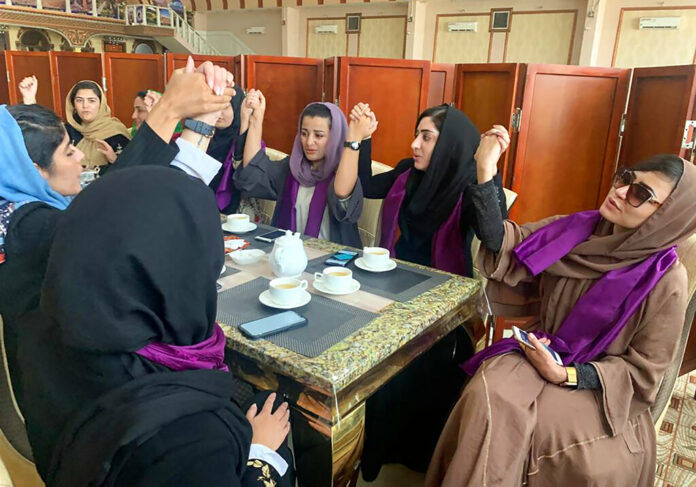
Women gather to demand their rights under the Taliban rule during a protest in Kabul, Afghanistan, Saturday, Sept. 4, 2021. Photo: Kathy Gannon / AP
KABUL, Afghanistan (AP) — Taliban special forces in camouflage fired their weapons into the air Saturday, bringing an abrupt and frightening end to the latest protest march in the capital by Afghan women demanding equal rights from the new rulers.
Also on Saturday, the chief of Pakistan’s powerful intelligence agency, which has an outsized influence on the Taliban, made a surprise visit to Kabul.
Taliban fighters quickly captured most of Afghanistan last month and celebrated the departure of the last U.S. forces after 20 years of war. The insurgent group must now govern a war-ravaged country that is heavily reliant on international aid.
The women’s march — the second in as many days in Kabul — began peacefully. Demonstrators laid a wreath outside Afghanistan’s Defense Ministry to honor Afghan soldiers who died fighting the Taliban before marching on to the presidential palace.
“We are here to gain human rights in Afghanistan,” said 20-year-old protester Maryam Naiby. “I love my country. I will always be here.”
As the protesters’ shouts grew louder, several Taliban officials waded into the crowd to ask what they wanted to say.
Flanked by fellow demonstrators, Sudaba Kabiri, a 24-year-old university student, told her Taliban interlocutor that Islam’s Prophet gave women rights and they wanted theirs. The Taliban official promised women would be given their rights but the women, all in their early 20s, were skeptical.
As the demonstrators reached the presidential palace, a dozen Taliban special forces ran into the crowd, firing in the air and sending demonstrators fleeing. Kabiri, who spoke to The Associated Press, said they also fired tear gas.
The Taliban have promised an inclusive government and a more moderate form of Islamic rule than when they last ruled the country from 1996 to 2001. But many Afghans, especially women, are deeply skeptical and fear a roll back of rights gained over the last two decades.
For much of the past two weeks, Taliban officials have been holding meetings among themselves, amid reports of differences among them emerging. Early on Saturday, neighboring Pakistan’s powerful intelligence chief Gen. Faiez Hameed made a surprise visit to Kabul. It wasn’t immediately clear what he had to say to the Taliban leadership but the Pakistani intelligence service has a strong influence on the Taliban.
The Taliban leadership had its headquarters in Pakistan and were often said to be in direct contact with the powerful Inter-Services Intelligence agency. Although Pakistan routinely denied providing the Taliban military aid, the accusation was often made by the Afghan government and Washington.
Faiez’ visit comes as the world waits to see what kind of government the Taliban will eventually announce, seeking one that is inclusive and ensures protection of women’s rights and the country’s minorities.
The Taliban have promised a broad-based government and have held talks with former president Hamid Karzai and the former government’s negotiation chief Abdullah Abdullah. But the makeup of the new government is uncertain and it was unclear whether hard-line ideologues among the Taliban will win the day — and whether the rollbacks feared by the demonstrating women will occur.
Taliban members whitewashed murals Saturday that promoted health care, warned of the dangers of HIV and even paid homage to some of Afghanistan’s iconic foreign contributors, like anthropologist Nancy Dupree, who singlehandedly chronicled Afghanistan’s rich cultural legacy. It was a worrying sign of attempts to erase reminders of the past 20 years.
The murals were replaced with slogans congratulating Afghans on their victory.
A Taliban cultural commission spokesman, Ahmadullah Muttaqi, tweeted that the murals were painted over “because they are against our values. They were spoiling the minds of the mujahedeen and instead we wrote slogans that will be useful to everyone.”
Meanwhile, the young women demonstrators said they have had to defy worried families to press ahead with their protests, even sneaking out of their homes to take their demands for equal rights to the new rulers.
Farhat Popalzai, another 24-year-old university student, said she wanted to be the voice of Afghanistan’s voiceless women, those too afraid to come out on the street.
“I am the voice of the women who are unable to speak.” she said. “They think this is a man’s country but it is not, it is a woman’s country too.”
Popalzai and her fellow demonstrators are too young to remember the Taliban rule that ended in 2001 with the U.S.-led invasion. The say their fear is based on the stories they have heard of women not being allowed to go to school and work.
Naiby, the 20-year-old, has already operated a women’s organization and is a spokesperson for Afghanistan’s Paralympics. She reflected on the tens of thousands of Afghans who rushed to Kabul’s Hamid Karzai International Airport to escape Afghanistan after the Taliban overran the capital on Aug. 15.
“They were afraid,” but for her she said, the fight is in Afghanistan.