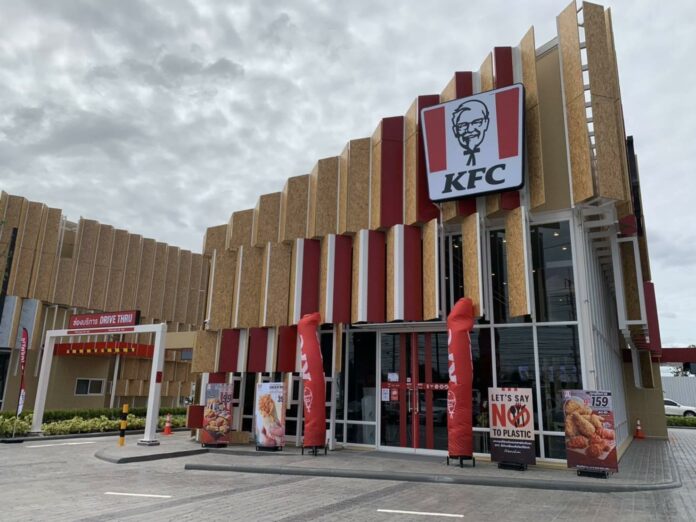
Yum Brands’ KFC Thailand works with “Meat Zero” to create new plant-based fried chicken menus aimed at attracting new generations who become more conscientious about their health and sustainable consumption. The plant-based menus, that satisfy consumers’ demand and offer the taste of real meat, will be initially served at two KFC Green Stores in Thailand.
Ms. Waewkanee Assoratgoon, general manager of KFC for Yum Restaurants International (Thailand) Co., Ltd., said that the demand for plant-based diets has been on the rise in several countries including Thailand, posing challenges to food companies including KFC in presenting alternative plant-based menus for Thai consumers.
Experimentations showed that Thailand’s “Meat Zero”-branded plant-based chicken offers the look, taste, texture and smell of real meat. Cooked with KFC recipes for the Thai market, the plant-based chicken promises the exquisite delicacy that KFC has been offering for years.
“Opting for Meat Zero as the material for our plant-based Chicken Pop and spicy rice bowl with plant-based Chicken Pop menus, we can create very delicious products. Consumers will barely notice that the chicken they are eating is made from plants. Whenever they want to skip real meat, they can come to us and they will still enjoy the familiar delicacy. Part of KFC’s green concept, the special menus will be initially served at both of our KFC Green Stores,” Ms. Waewkanee said.
Mr. Prasit Boondoungprasert. Chief Executive Officer of Charoen Pokphand Foods PLC (CPF), added that the Meat Zero innovation has witnessed warm responses from consumers. It is a major milestone that Meat Zero is selected for the first plant-based menus of KFC, Thailand’s top fast-food chain, that offers good taste and concurrently helps save the environment. That the product successfully makes its way to KFC green stores coincides with CPF’s aspiration to create food innovations that are both friendly to the environment and satisfying to the vegans and flexitarians on their quest to reduce real meat consumption
Starting from today, consumers are invited to show their environmental concerns and taste the Plant-based Chicken Pop and spicy rice bowl with plant-based Chicken Pop menus at KFC Green stores, at Saengsom Building and Wanachai Depot Chachoengsao. The green stores are now serving 6 sets: 1) 7 pieces of Plant- Based Chicken Pop for 49 baht 2) plant-based Zabb Rice Bowl for 75 baht 3) Chick N’ Share plant-based Pop for 119 baht 4) Combo plant-based Pop for 79 baht 5) Combo plant-based Zabb Rice Bowl for 119 baht and 6) The box plant-based at 179 baht.
The plant-based menus are part of KFC’s sustainability roadmap built on the three pillars of Planet (Earth-friendly supply chain through selective construction materials, energy saving, lower consumption of single-use plastic), Food (quality and responsibly-produced menus), and People (feeding people’s potential to fight inequality.
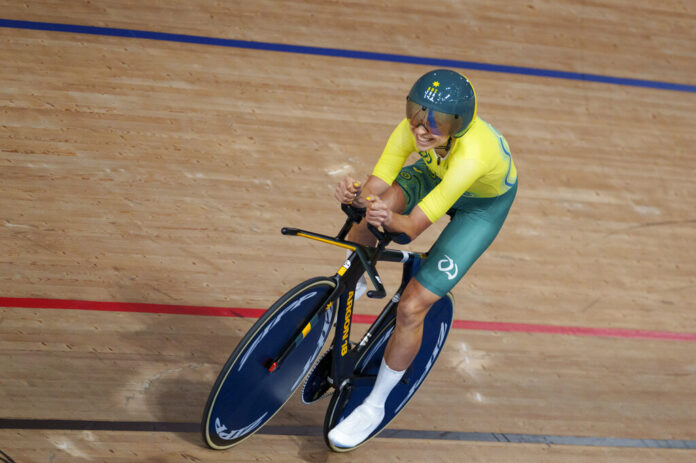
Australia's Paige Greco wins the Gold Medal in the Track Cycling Womens C3 3000m Individual Pursuit at the Izu Velodrome in Tokyo 2020 Paralympic Games in Tokyo, Wednesday, August 25, 2021. Photo: Thomas Lovelock for OIS via AP
TOKYO (AP) — Australian cyclist Paige Greco earned the first gold medal of the Tokyo Paralympics, winning the 3,000-meter pursuit on Wednesday on the track at the velodrome.
It was the first of 24 gold medals up for grabs on Wednesday as the Paralympics got underway in the middle of a pandemic that has seen new cases in Tokyo soar since the Olympics opened just over a month ago.
Medals were also contested in swimming and wheelchair fencing on Wednesday.
Greco was born with cerebral palsy, which mostly affects the right side of her body. It was her first Paralympic Games medal, winning her race in 3 minutes, 50.815 seconds.
“It feels amazing,” Greco said. “I still can’t believe it. I keep looking down and seeing (the gold medal). It’s not really sunk in yet.”
Wang Xiaomei of China was second and bronze went to Denise Schindler of Germany.
Greco took up cycling just over three years ago after competing in track and field for seven years.
Australian teammate William Martin also won gold in the first swimming final of the Paralympics, taking the 400-meter freestyle in the S9 class in 4:10.25 seconds. Ugo Didier of France took silver and Alex Tuckfield of Australia won bronze.
In the first wheelchair fencing final, Li Hao of China won gold in the men’s individual saber. He defeated Artem Manko of Ukraine 15-12 in the final.
Away from the competition, organizers confirmed Wednesday that two more athletes have tested positive for COVID-19 in the Paralympic Village. That brings to three the total of positive tests by athletes in the village over the last two days.
Daniel Brazil’s De Faria Dias in action during the swimming Men’s 200m Freestyle S5 heats at the Tokyo Aquatics Centre at the Tokyo 2020 Paralympic Games in Tokyo, Wednesday, Aug. 25, 2021. Photo: Joel Marklund for OIS via AP
Organizers have confirmed nine positive tests in the village over the last three days. The additional six, who are not athletes, are described as “Games-related personnel.”
Organizing committee spokesman Masa Takaya said the athletes were “from different sports and different countries.” But he gave few details and said the athletes have been placed in isolation.
He was asked if there was a COVID-19 cluster in the village.
“Whether or not there is a cluster should be based on the advice from specialists,” he said.
Japan is expanding its coronavirusstate of emergency for a second week in a row, adding several more prefectures as a surge in infections fueled by the delta variant strains the country’s health care system.
The Japanese capital has been under the emergency since July 12, but new daily cases have increased more than tenfold since then to about 5,000 in Tokyo and 25,000 nationwide. Hospital beds are quickly filling and many people must now recover at home, including some who require supplemental oxygen.
Japan has weathered the pandemic better than many other countries, with around 15,600 deaths nationwide since the start, but its vaccination efforts lag behind other wealthy nations. About 40% of the population has been fully vaccinated, mainly elderly people.
Dr. Shigeru Omi, a medical advisor for the government, criticized International Olympic Committee President Thomas Bach for returning to Tokyo to attend Tuesday’s opening of the Paralympics.
“Right now, the government is requesting people to telework and (Bach) is coming back just for that,” Omi said, responding to a question from an opposition lawmaker in parliament.
“When the government is making those requests to the people, why is the Olympic leader, President Bach, coming all the way to Tokyo. Anyone with normal, common sense should be able to think that he has already come once and even visited Ginza.”
International Paralympic Committee spokesman Craig Spence confirmed the IPC is in contact with two Paralympic athletes from Afghanistan who have left the country. He declined to speculate whether they might eventually reach Tokyo for the Paralympics.
“There’s a lot of speculation going on where these Afghan athletes are,” Spence said. “I’m not going to tell you where they are because this isn’t about sport, this is about human rights and keeping people safe.”
He added they were in a “safe place.”
Several reports say the two athletes — Hossain Rosouli and Zakia Khudadadi — may have arrived in Australia.
___
Story: Stephen Wade. Associated Press writer Mari Yamaguchi contributed to this report.
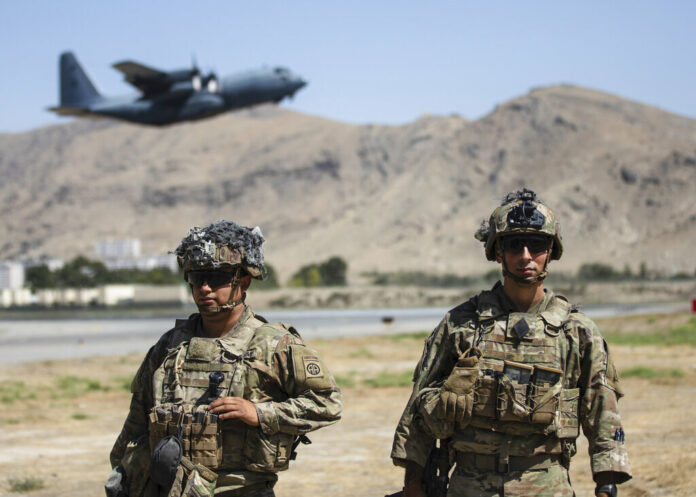
In this image provided by the Department of Defense, two paratroopers assigned to the 1st Brigade Combat Team, 82nd Airborne Division conduct security while a C-130 Hercules takes off during a evacuation operation in Kabul, Afghanistan, Wednesday, Aug. 25, 2021. Photo: Department of Defense via AP
WASHINGTON (AP) — Secretary of State Antony Blinken said as many as 1,500 Americans may be awaiting evacuation from Afghanistan, a figure that suggests the U.S. may accomplish its highest priority for the Kabul airlift — rescuing U.S. citizens — ahead of President Joe Biden’s Tuesday deadline despite growing concerns of terror threats targeting the airport.
Untold thousands of at-risk Afghans, however, were still struggling to get into the Kabul airport, while many thousands of other Afghans already had been flown to safety in 12 days of round-the-clock flights.
On Wednesday, several of the Americans working phones and pulling strings to get out former Afghan colleagues, women’s advocates, journalists and other vulnerable Afghans said they have seen little concrete U.S. action so far to get those Afghans past Taliban checkpoints and through U.S-controlled airport gates to promised evacuation flights.
“It’s 100% up to the Afghans to take these risks and try to fight their way out,” said Sunil Varghese, policy director with the International Refugee Assistance Project.
Blinken, echoing Biden’s earlier declarations during the now 12-day-old evacuation, emphasized at a State Department briefing that “ evacuating Americans is our top priority.”
He added, “We’re also committed to getting out as many Afghans at-risk as we can before the 31st,” when Biden plans to pull out the last of thousands of American troops.
On Wednesday, the U.S. Embassy in Kabul issued a security alert warning American citizens away from three specific airport gates, but gave no further explanation. Senior U.S. officials said the warning was related to ongoing and specific threats involving the Islamic State and potential vehicle bombs, which have set U.S. officials on edge in the final days of the American drawdown. The officials insisted on anonymity because they were not authorized to discuss ongoing military operations.
Blinken said the State Department estimates there were about 6,000 Americans wanting to leave Afghanistan when the airlift began Aug. 14, as the Taliban took the capital aftera stunning military conquest. About 4,500 Americans have been evacuated so far, Blinken said, and among the rest “some are understandably very scared.”
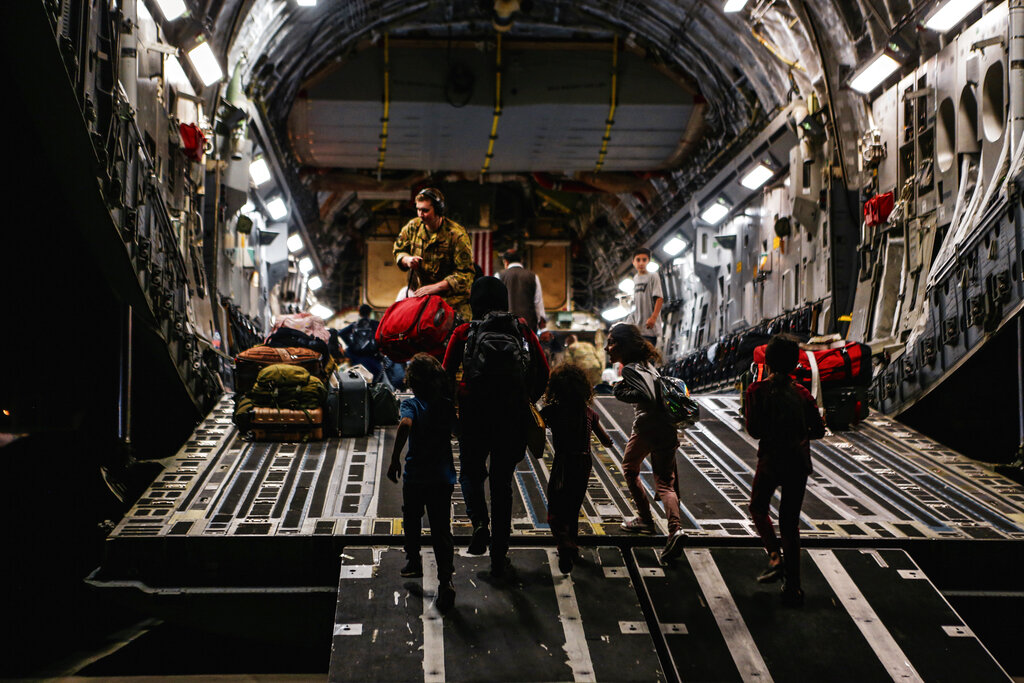
In this image provided by the U.S. Marine Corps, board a Boeing C-17 Globemaster III, at Hamid Karzai International Airport, Kabul, Afghanistan, Monday, Aug. 23, 2021. Photo: Sgt. Isaiah Campbell/U.S. Marine Corps via AP
The 6,000 figure is the first firm estimate by the State Department of how many Americans were seeking to get out. U.S. officials early in the evacuation estimated as many as 15,000, including dual citizens, lived in Afghanistan. The figure does not include U.S. Green Card holders.
About 500 Americans have been contacted with instructions on when and how to get to the chaotic Kabul airport to catch evacuation flights.
In addition, 1,000 or perhaps fewer are being contacted to determine whether they still want to leave. Blinken said some of these may already have left the country, some may want to remain and some may not actually be American citizens.
“We are providing opportunity,” White House press secretary Jen Psaki said of those Afghans, who include dual Afghan-American citizens. “We are finding ways to get them to the airport and evacuate them, but it is also their personal decision on whether they want to depart.”
On a lighter note, the U.S. military said an Afghan baby girl born on a C-17 military aircraft during the massive evacuation will carry that experience with her. Her parents named her after the plane’s call sign: Reach.
She was born Saturday, and members of the 86th Medical Group helped in her birth aboard the plane that had taken the family from Kabul to Ramstein Air Base in Germany.
Two other babies whose parents were evacuating from Afghanistan have been born over the past week at Landstuhl Regional Medical Center, the U.S. military hospital in Germany.
In Washington on Wednesday, Blinken emphasized that the U.S. and other governments plan to continue assisting Afghans and Americans who want to leave after next Tuesday, the deadline for Biden’s planned end to the evacuation and the two-decade U.S. military role in Afghanistan. “That effort will continue, every day, past Aug. 31,” he said.
Biden has cited what he U.S. says are rising security threats to U.S. forces, including from an affiliate of the Islamic State terror group, for his determination to stick with Tuesday’s withdrawal deadline. Germany has said Western officials are particularly concerned that suicide bombers may slip into the crowds surrounding the airport.
The U.S. Embassy has already been evacuated; staff are operating from the Kabul airport and the last are to leave by Tuesday.
Biden said this week he had asked his national security team for contingency plans in case he decides to extend the deadline. Taliban leaders who took control of Afghanistan this month say they will not tolerate any extensions to the Tuesday deadline. But Taliban spokesman Suhail Shaheen tweeted that “people with legal documents” will still be able to fly out via commercial flights after Tuesday.
U.S. troops are anchoring a multinational evacuation from the airport. The White House says the airlift overall has flown out 82,300 Afghans, Americans and others on a mix of U.S., international and private flights.
The withdrawal comes under a 2020 deal negotiated by President Donald Trump with the Taliban.
Refugee groups are describing a different picture than the Biden administration is when it comes to many Afghans: a disorganized, barely-there U.S. evacuation effort that leaves the most desperate to risk beatings and death at Taliban checkpoints. Some Afghans are reported being turned away from the Kabul airport by American forces controlling the gates, despite having approval for flights.
U.S. military and diplomatic officials appear to still be compiling lists of eligible Afghans but have yet to disclose how many may be evacuated — and how — private Americans and American organizations said.
“We still have 1,200 Afghans with visas that are outside the airport and haven’t got in,” said James Miervaldis with No One Left Behind, one of dozens of veterans groups working to get out Afghans who worked with the U.S. military during America’s nearly 20 years of combat in the country.. “We’re waiting to hear from the US. government and haven’t heard yet.”
Marina LeGree of Ascend, a U.S.-based nonprofit that worked to develop fitness and leadership in Afghan girls and young women, described getting calls from U.S. officials telling the group’s interns and staffers to go to the airport for evacuation flights, only to have them turned away by American forces keeping gates closed against the throngs outside.
One Afghan intern who went to the airport with her family saw a person killed in front of them, and a female colleague was burned by a caustic agent fired at the crowd, LeGree said.
“It’s heartbreaking to see my government fail so badly,” said LeGree, the group’s American director, who is in Italy but in close contact with those in Kabul.
U.S.-based organizations, speaking on background to discuss sensitive matters, cite accounts from witnesses on the ground as saying some American citizens, and family members of Afghans with green cards, still were having trouble pushing and talking their way into the Kabul airport for flights.
Kirby said the U.S. military will preserve as much airlift capacity at the airport as possible in the coming days, ahead of Tuesday’s deadline. The military will “continue to evacuate needed populations all the way to the end,” he said. But he added that in the final days and hours there will have to be a balance in getting out U.S. troops and their equipment as well as evacuees.
Maj. Gen. Hank Taylor, the deputy director of regional operations for the Joint Chiefs of Staff, said U.S. forces had conducted another helicopter mission beyond the perimeter of the airport to pick up people seeking to evacuate.
The number of U.S. troops at the airport has dropped by about 400, to 5,400, but the final withdrawal has not begun, Kirby said Wednesday.
___
Story: Robert Burns, Ellen Knickmeyer and Matthew Lee. Associated Press writers Lolita C. Baldor in Washington and James LaPorta in Boca Raton, Florida, contributed to this report.
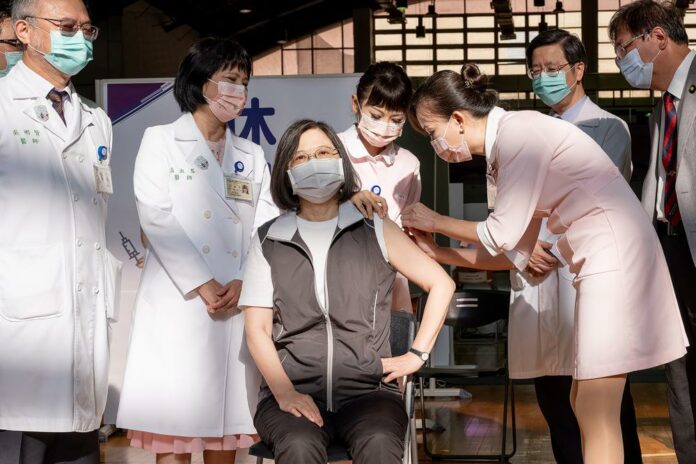
Taiwanese President Tsai Ing-wen receives her first shot of the island's first domestically developed coronavirus vaccine made by Medigen Vaccine Biologics Corp. at the Taiwan University Hospital in Taipei, Taiwan on Monday, Aug. 23, 2021. (Image: Taiwan Presidential Office)
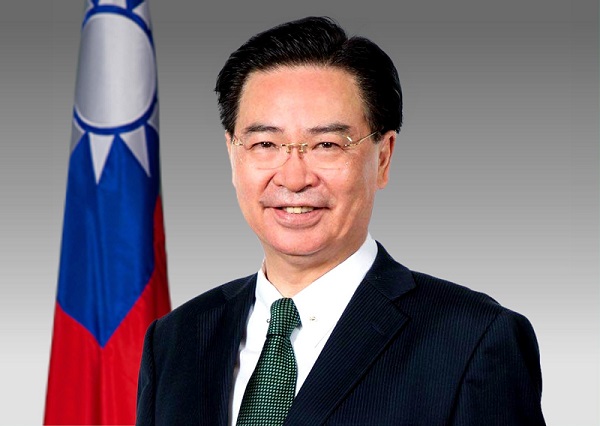
By Jaushieh Joseph Wu Minister of Foreign Affairs, Republic of China (Taiwan)
After more than 200 million infections and over 4 million deaths and counting, the COVID-19 pandemic has raged across the globe. This has created a profoundly devastating socio-economic impact on our interconnected world, with virtually no countries spared. The pandemic has disrupted global trade, exacerbated poverty, impeded education, and compromised gender equality, with middle to low income nations bearing the brunt of the burden.
As many countries brace for another spike of the virus, prompted by the highly contagious Delta variant, the world looks up to the United Nations (UN) to ramp up comprehensive efforts to resolve the crisis. This is a daunting task that requires all hands on deck. It is time for the global body to welcome Taiwan, a valuable and worthy partner that stands ready to lend a helping hand.
Over the past few months, Taiwan has been dealing with a surge of COVID-19 cases after almost a year of success in containing the virus. Yet, it got a handle on the situation and emerged even more ready to work with allies and partners to tackle the challenges posed by the pandemic.
Jaushieh Joseph Wu
Taiwan’s effective response to the pandemic, its rapid capacity expansion to meet global supply chain demand, and its substantive assistance toward partner countries around the world all stand as compelling reasons for Taiwan to play a constructive role in the UN system.
However, the absurdity of excluding Taiwan from the UN system also obstructs the participation of Taiwan’s civil society. Taiwanese passport holders are denied access to UN premises, both for tours and meetings, while Taiwanese journalists cannot obtain accreditation to cover UN events. The only reason for this discriminatory treatment is their nationality. Barring Taiwan’s civil society from the UN defeats the ideal of multilateralism, contravenes the UN’s founding principles of promoting respect for human rights and fundamental freedoms, and hampers the UN’s overall efforts.
For six decades, Taiwan has been providing assistance to partner countries around the world. Since the adoption of the UN 2030 Agenda, Taiwan has focused on helping partners achieve the Sustainable Development Goals (SDGs), and, more recently, engage in antipandemic response and postpandemic recovery. Meanwhile, at home, Taiwan has fulfilled its SDGs in gender equality, clean water and sanitation, and good health and well-being, among others. Our innovative, community-based solutions are harnessing public-private partnerships for the benefit of society as a whole.
The World Happiness Report 2021, released by the Sustainable Development Solutions Network, ranked Taiwan the happiest in East Asia, and 24th in the world. The ranking indicates how the people of a country feel about the social support they receive, and reflects in large part a country’s implementation of the SDGs. Taiwan is willing to pass on its experience and work with global partners to build a better and more resilient future for all.
At a time when the world is sounding the clarion call for climate actions and to achieve net-zero carbon emissions by 2050, Taiwan is actively charting a roadmap toward the goal, and has drafted dedicated legislation to facilitate this process. Climate change knows no borders, and concerted efforts are a must for a sustainable future. Taiwan knows this, and is working on the best ways to turn the challenges of carbon reduction into new opportunities.
In his oath of office in June this year, UN Secretary-General António Guterres stressed that the COVID-19 pandemic has revealed our shared vulnerability and interconnectedness. He said that the UN, and the states and people it serves, can only benefit from bringing others to the table.
Denying partners that have the ability to contribute is a moral and material loss to the world as we seek to recover better together. Taiwan is a force for good. Now is the time to bring Taiwan to the table and let Taiwan help.
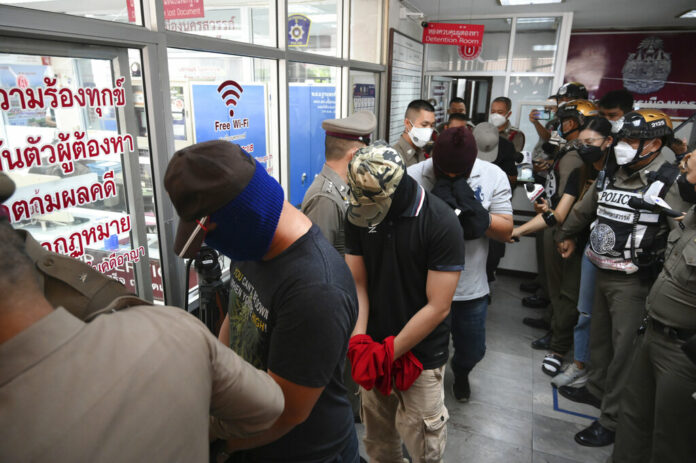
Four police officers wanted in connection with the murder of a suspect in their custody arrive at the Nakhon Sawan police station for interrogations in Nakhon Sawan province, Thailand, Wednesday, Aug. 25, 2021. Photo: Surat Sappakun / AP
BANGKOK (AP) — Four Thai police officers charged with murder in connection with the deadly shakedown of a suspected drug dealer in custody were arrested Wednesday after a video clip of the incident shared on social media caused a public furor.
Three other officers were still being sought in connection with the Aug. 5 incident at their police station in the province of Nakhon Sawan, north of Bangkok, said police Col. Kissana Phathanacharoen, deputy national police spokesman. They include a police colonel with the nickname “Jo Ferrari” because of his collection of expensive sports cars, Thai media reported.
Allegations of police brutality and corruption are not rare in Thailand, but the leaked video showing the suspected drug dealer suffocating after officers placed plastic bags over his head in an alleged extortion effort and an initial dilatory investigation stoked outrage.
Police have also come under harsh criticism recently for their use of force in trying to quell anti-government street protests in Bangkok. While some demonstrators employ violent tactics, police have been accused of overreacting and using dangerous methods of crowd control, including firing rubber bullets at close range.
“This case of police torture and murder is shocking. But this is not the first case and it is unlikely to be the last case until and unless the police conduct serious interrogations and investigations and leave no stones unturned,” said Sunai Phasuk, a senior researcher for Human Rights Watch.
Police started investigating the case only after a well-known lawyer, Decha Kittiwittayanan, published an account of it on his Facebook page.
Decha said he had received a complaint from a junior policeman in Nakhon Sawan who said that police had arrested two drug suspects, a 24-year-old man and his female companion, with over 100,000 methamphetamine tablets.
The policemen first demanded 1 million baht ($30,560) from the suspects, which they agreed to pay for their release, according to the account. But the senior officer at the scene, police Col. Thitisan Uttanapol, demanded double that amount and ordered his subordinates to cover the male suspect’s head with a plastic bag and beat him until he agreed, said the junior policeman, whose name was not revealed.
When the suspect died, Thitisan allegedly ordered his men to take the body to the hospital and tell the doctor the death was caused by a drug overdose. The junior policeman said the woman was released but told not to say anything about it, and that Thitisan paid the victim’s father to remain silent.
The initial police response to the furor over the story posted by the lawyer was to transfer Thitisan to another post.
On Tuesday, however, a video clip of the incident was shared on the Facebook page of another lawyer, Sittra Biabanggerd, who said he had received it from a police officer at the Nakhon Sawan station.
It shows the male suspect in handcuffs being led into a room, his head covered with a black plastic bag. He is then assaulted and thrown to the floor by officers who put more bags on his head. One of them appears to briefly kneel on him. The man, identified by Thai media as Jeerapong Thanapat, then goes limp. Police try in vain to revive him with a jug of water and CPR.
“We are proceeding with this case, pursuing both criminal cases and disciplinary action,” police spokesman Kissana said Wednesday.
Small-scale corruption, such as soliciting bribes from motorists, is not rare among poorly paid police officers. Some also have a reputation for beating suspects to elicit confessions
But cases occasionally emerge of corruption at a higher level. A case known as the “Blue Diamond Affair,” involving the 1989 theft of jewelry by a Thai overseas worker from the palace of a Saudi prince, cast a harsh spotlight on the police force after much of the loot went unrecovered and a police general was convicted of kidnapping and killing relatives of a witness in the case.
Human Rights Watch’s Sunai charged that Thai police often act with total impunity, protecting each other.
“This is no longer an individual issue. It’s a corrupt system that allows abusive acts,” he said.
——-
Story: Chalida Ekvitthayavechnukul. Associated Press video journalist Tassanee Vejpongsa contributed to this report.
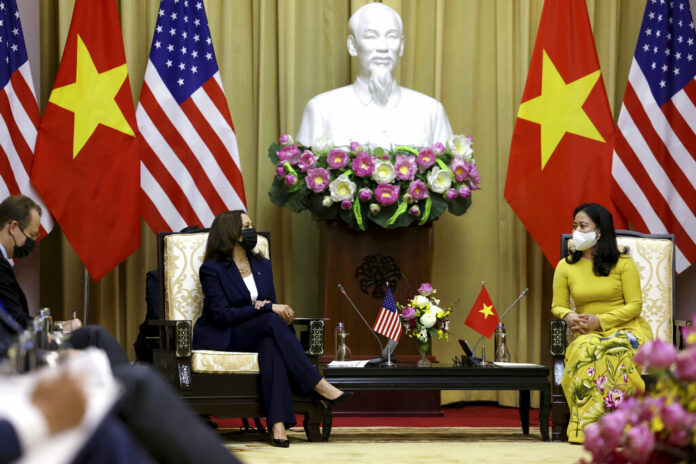
U.S. Vice President Kamala Harris, left, speaks with Vietnam's Vice President Vo Thi Anh Xuan at the Presidential Palace in Hanoi, Vietnam, Wednesday, Aug. 25, 2021. Photo: Evelyn Hockstein / Pool Photo via AP
HANOI (AP) — Vice President Kamala Harris called on Vietnam to join the U.S. to challenge China’s “bullying” in the South China Sea, a continuation of her sharp rhetoric against Beijing as she tours Southeast Asia this week.
“We need to find ways to pressure and raise the pressure, frankly, on Beijing to abide by the United Nations Convention on the Law of the Sea, and to challenge its bullying and excessive maritime claims,” she said, in remarks at the opening of a bilateral meeting with Vietnamese President Nguyen Xuan Phuc.
Her comments follow sharp words towards Beijing during a speech in Singapore Tuesday, where she said their actions in the South China Sea amount to “coercion” and “intimidation.”
On Wednesday in Vietnam, Harris also said that the U.S. supports sending the country an additional U.S. Coast Guard cutter, to help defend its security interests in the South China Sea. And she embraced elevating the relationship with Vietnam from a comprehensive partnership to a strategic partnership, a diplomatic designation that would reflect the deepening relationship between the two former foes.
They’re the latest moves by the Biden administration to strengthen its alliances in the Indo-Pacific region in an effort to counter China’s influence. Harris’ trip there, which included a stop in Singapore earlier this week, is aimed at broadening U.S. engagement with both nations and affirming the U.S. commitment to the region.
Harris, who is the first U.S. vice president to visit Vietnam, told the nation’s president that “our relationship has come a long way in a quarter of a century.”
She also announced the launch of a new Centers for Disease Control and Prevention Southeast Asia regional office. The new CDC office will be one of four regional offices globally, and it’s focused on collaborating with regional governments on research and training to deal with and prevent global health crises.
The announcement comes as Vietnam is grappling with record high coronavirus infections in Vietnam driven by the delta variant and stubbornly low vaccination rates in the country. The surge in cases prompted a recent lockdown in Ho Chi Minh City, the nation’s business hub and the epicenter of the latest outbreak.
Harris is expected to offer further U.S. support to help the nation expand its vaccination rate, which hovers around 2%. She’ll also emphasize the opportunity for greater collaboration to address climate change and economic aid to the country.
In the afternoon, Harris will join a health security event with the health ministers from the Association of Southeast Asian Nations group and Papua New Guinea, where she’ll speak more about the launch of the CDC center.
But even as Harris hopes to keep her focus squarely on those key agenda items in Vietnam, her visit will be shadowed by a recent security scare in Vietnam and the ongoing developments in the U.S. exit from Afghanistan.
Harris’ flight to Vietnam was delayed for hours Tuesday afternoon after the vice president’s office was made aware of an investigation into two possible cases of the so-called Havana Syndrome in Hanoi, according to administration officials. The Havana Syndrome is the name for a rash of mysterious health incidents first reported by American diplomats and other government employees in the Cuban capital beginning in 2016.
Harris has yet to comment publicly on the developments, but they’ll weigh heavily on officials while she participates in a lease signing for the U.S. Embassy in Hanoi, with embassy staff attending.
And her swing through Vietnam is certain to draw some unwanted comparisons between the humiliating withdrawal of U.S. troops in 1975 and the tumultuous effort this week to evacuate Americans and allies from Afghanistan.
U.S. Sen. Bill Hagerty, a Tennessee Republican and a former U.S. ambassador to Japan, noted that those images are unavoidable for many Americans as Harris stops in the country.
“She’s going to have a challenge from a domestic public relations standpoint, because everyone in America right now is associating the images that they’re seeing on TV with the collapse of Kabul, with the images of Americans being lifted from the rooftop of our embassy in Saigon,” he said.
Hagerty also said that Harris will need to reassure the Vietnamese that America remains a “beacon of liberty and freedom in the world” and a “strong partner” in the region.
But Gregory Poling, a senior fellow for Asia at the Center for Strategic and International Studies, suggested that Vietnam could offer the vice president an opportunity to offer a more optimistic vision for what a relationship with a former foe can become.
“Simply by being there and engaging in this process, it shows the remarkable progress in rapprochement between the U.S. and Vietnam,” Poling said. “It’s possibly marginally good for them to show that — who in 1975 would believe that this is where the U.S. economic relationship would be?”
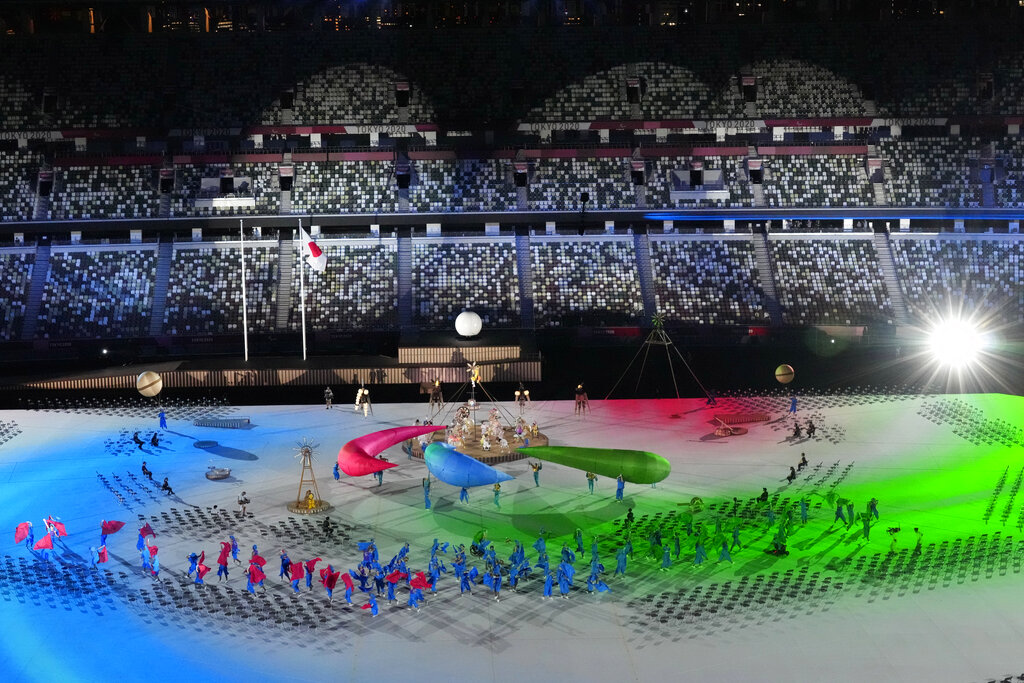
Fireworks are set off during the Paralympic Opening Ceremony over the Olympic Stadium for the Tokyo 2020 Paralympic Games, Tokyo, Tuesday, Aug. 24, 2021. Photo: Bob Martin for OIS via AP
TOKYO (AP) — The Paralympics began Tuesday in the same empty National Stadium — during the same pandemic — as the opening and closing ceremonies of the recently completed Tokyo Olympics.
Japanese Emperor Naruhito got it all started again, this time under the theme “We Have Wings.” Among the few on hand were Douglas Emhoff, husband of U.S. Vice President Kamala Harris, International Paralympic Committee President Andrew Parsons and International Olympic President Thomas Bach.
It was a circus-like opening with acrobats, clowns, vibrant music and fireworks atop the stadium to mark the the start of the long parade of athletes.
“I cannot believe we are finally here,” Parsons said in his opening remarks. “Many doubted this day would happen. Many thought it impossible. But thanks to the efforts of many, the most transformative sport event on earth is about to begin.”
The opening ceremony featured the national flags of the 162 delegations represented, which included the refugee team. In addition, the flag of Afghanistan was carried by a volunteer despite the delegation not being on hand in Tokyo.
Comparisons to the Olympics stop with the colorful jamboree, save for the logistical and medical barriers during the pandemic, and the hollowing out of almost everything else.
Tokyo and Paralympic organizers are under pressure from soaring new infections in the capital. About 40% of the Japanese population is fully vaccinated. But daily new cases in Tokyo have increased four to five times since the Olympics opened on July 23. Tokyo is under a state of emergency until Sept. 12, with the Paralympics ending Sept. 5.
Organizers on Tuesday also announced the first positive test for an athlete living in the Paralympic Village. They gave no name or details and said the athlete had been isolated.
Actors perform during the opening ceremony for the 2020 Paralympics at the National Stadium in Tokyo, Tuesday, Aug. 24, 2021. Photo: Eugene Hoshiko / AP
The Paralympics are being held without fans, although organizers are planning to let some school children attend, going against the advice of much of the medical community.
Parsons and Seiko Hashimoto, the president of the Tokyo organizing committee, say the Paralympics can be held safely. Both have tried to distance the Paralympics and Olympics from Tokyo’s rising infection rate.
“For the moment we don’t see the correlation between having the Paralympics in Tokyo with the rising number of cases in Tokyo and Japan,” Parsons told The Associated Press.
Some medical experts say even if there is no direct link, the presence of the Olympics and Paralympics promoted a false sense of security and prompted people to let down their guard, which may have helped spread the virus.
The Paralympics are about athletic prowess. The origin of the word is from “parallel” — an event running alongside the Olympics.
Markus Rehm — known as the “Blade Jumper” — lost his right leg below the knee when he was 14 in a wakeboarding accident, but earlier this year he jumped 8.62 meters, a distance that would have won the last seven Olympics, including the Tokyo Games. Tokyo’s winning long jump was 8.41 meters.
“The stigma attached to disability changes when you watch the sport,” said Craig Spence, a spokesman for the International Paralympic Committee. “These games will change your attitude toward disability.
“If you look around Japan, it’s very rare you see persons with disabilities on the street,” Spence added. “We’ve got to go from protecting people to empowering people and creating opportunities for people to flourish in society.”
Actors perform during the opening ceremony for the 2020 Paralympics at the National Stadium in Tokyo, Tuesday, Aug. 24, 2021. Photo: Eugene Hoshiko / AP
Archer Matt Stutzman was born with no arms, just stumps at the shoulders. He holds a world record — for any archer, disabled or otherwise — for the longest, most accurate shot, hitting a target at 310 yards, or about 283 meters.
Wheelchair fencer Bebe Vivo contracted meningitis as a child and to save her life, doctors amputated both her forearms and both her legs at the knees.
“So many people told me that it was impossible to do fencing without any hands,” Vivo said in a recent interview. “So it was so important to me to demonstrate and show people that it doesn’t matter if you don’t have hands, or you don’t have legs or whatever. If you have a dream and you really want to achieve it, just go and take it.”
Stutzman and Vivo are both set to compete in Tokyo and have already won medals in previous games, superstars who told their stories last year in the Netflix documentary about the Paralympics called “Rising Phoenix.”
The rest of the 4,403 Paralympic athletes in Tokyo — a record number for any Paralympics — will be telling their stories until the closing ceremony.
“I feel like I’m meeting movie stars,” said 14-year-old Ugandan swimmer Husnah Kukundakwe, who is competing for the first time.
She acknowledged being a self-conscious adolescent, even more so because of a congenital impairment that left her with no lower right arm, an her left hand slightly misshapen.
“Since it’s the Paralympics and everybody else is disabled, I feel really comfortable with myself,” she said. “In Uganda, there are very few people who have disabilities who want to come out and be themselves.”
Paralympic organizers played a part last week in launching “WeThe15,” a human-rights campaign aimed at 1.2 billion people — 15% of the global population — with disabilities. They’ve also produced a 90-second video to promote the cause of social inclusion.
“Difference is a strength, it is not a weakness,” Parsons said, speaking in the largely empty stadium. “And as we build back better in the post-pandemic world, it must feature societies where opportunities exist for all.”
Shingo Katori, a member of boy band SMAP that had its roots in the 1980s, now works with Paralympic organizers. He acknowledged his early fears of working with people with disabilities.
“Frankly speaking, people in wheelchairs or people with artificial legs — I hadn’t had an opportunity to meet these people and I didn’t know how to communicate with them,” he said. “But through Paralympic sports, such hesitation faded away.”
Stutzman, known as the “Armless Archer,” has a disarming sense of humor — pardon the pun. He jokes about growing up wanting the be like former NBA star Michael Jordan.
“I gave it up,” he deadpans. “I wasn’t tall enough.”
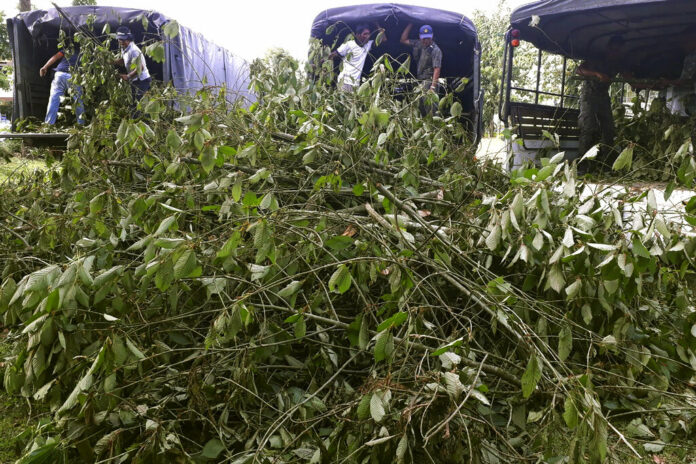
In this July 30, 2019, photo, officers gather illegally-grown kratom plants in Phang Nha province, Thailand. Photo: AP
BANGKOK (AP) — Thailand on Tuesday decriminalized the possession and sale of kratom, a plant native to Southeast Asia whose leaves are used as a mild stimulant and painkiller and which has a following in the United States for its pain-relieving qualities.
Justice Minister Somsak Thepsuthin said thousands of legal cases for the possession or sale of kratom were being dropped, and 121 inmates convicted in such cases would be released immediately. Possession of kratom had been punishable by up to two years in prison and a fine of as much as 200,000 baht ($6,077) for quantities of 10 kilograms (22 pounds) or more.
The decriminalization of kratom, which involved removing the drug from the official list of controlled narcotics, is the country’s latest move to liberalize its drug laws. In the past two years, Thailand has allowed regulated medical marijuana use as well as the licensed buying and growing of marijuana, and permitted households to grow up to six plants. Harsh penalties remain for hard drugs such as heroin and methamphetamine.
Easing pressure on Thailand’s justice system and its overcrowded prisons has been a major impetus for the new drug policy.
When he proposed the action on kratom to the Cabinet last year, Somsak said the move would not only help reduce costs in the legal system, but also allow the drug to be used as a low-cost substitute for expensive painkillers such as morphine and create income for people cultivating the plant, which is mostly grown and used in the impoverished south.
In Thailand, kratom leaves typically would be chewed to give the user a mild energy boost, although it can also be smoked. But it’s sometimes mixed with other drugs to make a narcotic tea, or cocktail, a form in which it remains illegal.
“At low doses, kratom produces stimulant effects with users reporting increased alertness, physical energy and talkativeness. At high doses, users experience sedative effects. Kratom consumption can lead to addiction,” says a website of the U.S. Drug Enforcement Administration that lists kratom among the agency’s “drugs of concern.”
The DEA says people have used kratom to relieve muscle strains and as a substitute for opium; the drug also has been used to manage withdrawal symptoms from opioids.
Nimu Makaje, a Muslim community leader in Thailand’s southern province of Yala, expressed concern about abuse of the plant.
“If we are legalizing it, we need to have proper controlling measures,” he told The Associated Press. “Currently, a lot of people have lost their jobs and they may use it to reduce their stress. This is very dangerous.”
Ramdin Areeabdulsorma, a local politician in nearby Pattani province, said kratom has been part of local people’s daily life since a long ago, helping them feel refreshed.
“To decriminalize kratom is the right thing to do. Local people or patients who need it will be able to access it more easily. However, I am concerned that teenagers will use it in a wrong way, for example, mixing kratom with other narcotics. We have to control this strictly, otherwise, it can cause damage,” he said.
In the U.S., kratom is generally unregulated, although it is illegal in several states. It’s typically found in smoke shops that also sell vaping devices and CBD products, but there is also an industry lobby which promotes its use as a legitimate painkiller that’s a safe alternative to powerful opioids.
___
Story: Chalida Ekvitthayavechnukul. Associated Press journalists Tassanee Vejpongsa and Sumeth Panpetch contributed to this report.
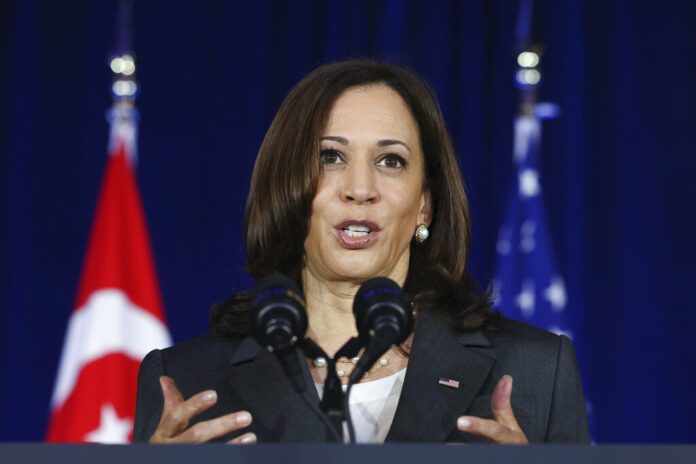
U.S. Vice President Kamala Harris delivers a speech at Gardens by the Bay in Singapore before departing for Vietnam on the second leg of her Southeast Asia trip, Tuesday, Aug. 24, 2021. Photo: Evelyn Hockstein / Pool Photo via AP
SINGAPORE (AP) — U.S. Vice President Kamala Harris delivered a sharp rebuke to China for its incursions in the South China Sea, warning its actions there amount to “coercion” and “intimidation” and affirming that the U.S. will support its allies in the region against Beijing’s advances.
“We know that Beijing continues to coerce, to intimidate and to make claims to the vast majority of the South China Sea,” she said in a major foreign policy speech Tuesday in Singapore in which she laid out the Biden administration’s vision for the Indo-Pacific. “Beijing’s actions continue to undermine the rules-based order and threaten the sovereignty of nations.”
Harris, who is on a weeklong swing through Southeast Asia, declared that the U.S. “stands with our allies and our partners” in the face of threats from China.
The speech sought to cement the U.S. commitment to supporting its allies in an area of growing importance to the Biden administration, which has made countering China’s influence globally a centerpiece of its foreign policy. And it came during a critical moment for the United States, as the Biden administration seeks to further solidify its pivot toward Asia while America’s decades-long focus on the Middle East comes to a messy end with the chaotic withdrawal from Afghanistan.
Harris underscored this shift, calling the Indo-Pacific “critically important to our nation’s security and prosperity.” She said that while the U.S. is focused on closing out its Afghanistan engagement by evacuating as many people as possible, “it is also imperative that as we address developments in one region, we continue to advance our interests in other regions, including this region.”
Her rebuke to Beijing amounted to her sharpest comments yet on the U.S. foe. And China hit back, with Chinese Foreign Ministry spokesperson Wang Wenbin invoking Afghanistan in his response to a question about Harris’ comments, saying the messy withdrawal from Kabul showed the U.S. had lost credibility. He charged that the U.S. “can smear, suppress, coerce, and bully other countries at will in order to maintain America first, without paying any price.”
“This is the order that the U.S. wants. The U.S. always tries to make use of the rules and order to justify its own selfish, bullying and hegemonic behavior, but who still believe it now?” Wang said.
In her remarks, Harris was careful to emphasize that the U.S. is seeking greater engagement in the Indo-Pacific region not just to counter China, but to advance an “optimistic vision that we have for our participation and partnership in the region.” In deference to Singapore’s staunch neutrality in the U.S.-China dispute, Harris also affirmed that the U.S. isn’t looking to “make anyone choose between countries.”
Speaking in a country that serves as the anchor of the U.S. naval presence in Southeast Asia, Harris emphasized the significance the region holds for U.S. defense. She also emphasized the significant U.S. economic ties there, noting that Southeast Asia represents America’s fourth largest export market.
On Monday, Harris told sailors aboard a U.S. combat ship at the Changi naval base in Singapore that “a big part of the history of the 21st century will be written about this very region” and that their work defending the region was pivotal.
“It is in our vital interest to stand united with our allies and our partners in Southeast Asia in defense of a free and open Indo-Pacific,” she said.
Harris also met Monday with Singapore President Halimah Yacob and Prime Minister Lee Hsien Loong. The vice president’s office announceda number of agreements out of that meetingaimed at combating cyberthreats, tackling climate change, addressing the COVID-19 pandemic and alleviating supply chain issues.
After her speech Tuesday, Harris held a roundtable discussion with business leaders on supply chain issues. Later, she planned to travel to Vietnam, where she’ll meet with top officials Wednesday.
President Joe Biden himself has repeatedly emphasized his focus on China as one of America’s main adversaries. In recent months, his administration has ramped up outreach to the Indo-Pacific region, with Defense Secretary Lloyd Austin and Deputy Secretary of State Wendy Sherman both visiting the area in the spring and summer. Secretary of State Antony Blinken also held a number of virtual meetings with Southeast Asian officials earlier this month.
The chaotic U.S. withdrawal from Afghanistan, however, complicated that message of support to the region, raising questions about the U.S. commitment to its allies. While Biden said last week that an indefinite engagement would have benefited “true strategic competitors” China and Russia, China has seized on the images of violence from the evacuation to slam the U.S. for its engagement there.
But Harris, during a joint news conference with Prime Minister Lee on Monday, said that her presence in the country, combined with the agreements around greater cooperation that the Biden administration has pursued with Indo-Pacific countries, speak “volumes in terms of the integrity of the relationships that the United States has around the world on many issues.”
The world-famous traffic jams of Bangkok are still an unfortunate reality. But whether you’re in town for business or pleasure, booking a hotel near the Saladang BTS station can save you hours of valuable commute time.
The location has a lot of bearing on the popularity of where people stay in the vast metropolis of Bangkok, Thailand. And this matters just as much for residents as it does for tourists and business visitors to the city. Many condo complexes and entire neighborhoods become more valuable as a place of residence because they’re close to a BTS or MRT station in Bangkok.
Many city residents wouldn’t even think of driving to work if their place of work was anywhere near the center of town. Bangkok’s traffic jams simply make this unthinkable. Luckily commuters, both the BTS Skytrain and the MRT, have made venturing into traffic during commute hours largely a thing of the past.
Make the Most of Your Time in the City
By booking a hotel near the Saladang BTS station in the Sathorn area of the city, you can take a page from the city’s residents and avoid the notorious traffic jams entirely. They say, “When in Rome, do as the Romans do.” And no old sayings could be any more relevant than this one when it comes to Bangkok traffic.
You can make better use of the time you have to spend in the city by taking advantage of both the BTS Skytrain and the MRT. And both of these systems are interconnected to the Airport Express rail system. This means you can get from Suvarnabhumi Airport to your hotel near the Saladang BTS Station quickly and easily, and more importantly, without having to waste time in traffic.
Business Travelers Target Sathorn and Silom
For business travelers, time is usually of the essence. They typically have a limited amount of time they can spend in town, so they try to book non-stop meetings and engagements. The Saladang Station is right in the heart of the Silom area of Bangkok. This area, along with its next-door neighbour, Sathorn, forms the commercial and financial heart of the city.
Booking a hotel right near the Saladang BTS station means you’ll be able to maximize your productivity while you’re in town. With several MRT and BTS stations in the Sathorn and Silom areas, you’ll be able to maintain a full schedule of meetings and even host valuable clients at some of the excellent restaurants in the area catering to business people.
Pleasure Travelers Have Seen Traffic Before
For pleasure travelers, having to sit in traffic means they’re not making the most of their vacation. They’ve seen traffic before, and it’s not why they’re visiting Bangkok.
By booking a hotel near the Saladang BTS station, they can join the business traveler in making the most of their time in Bangkok. They’ll be able to maximize the time they spend sightseeing and eliminate any thoughts of spending their vacation sitting in Bangkok traffic.