A Woody Drink, a subsidiary under Carabao Group Public Company Limited, are launching their latest vitamin C drink, Woody C+ Lock Collagen Mixed Berry, the first drink in Thailand with 2,000 milligrams of collagen along with 200% vitamin C content. Powered by a 100-million-baht investment, the new product is being offensively launched in every distribution channel and is also endorsed by presenter Peechaya “Min” Wattanamontree to attract consumers in the beauty market and increase the market share. Only 10 months after the launch, Wood C+ Lock has become the number 2 best seller in the vitamin C market with the aspiration to become the number 1 in 3 years.
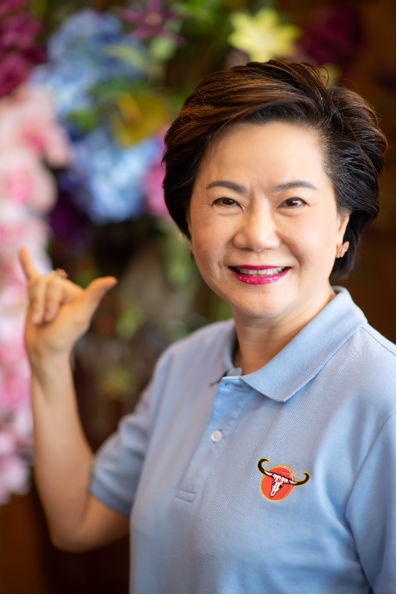
Ms. Nutchamai Thanombooncharoen, Managing Director of Carabao Group PCL, revealed that the company has successfully tapped into the vitamin C market after the launch of Woody C+ Lock Lemon earlier in March 2020, followed by orange flavor in June. Woody C+ Lock has since ranked number 2 in the health shots market, worth 6,700 million baht, within just 10 months.
Following this success, the increasing market share and the continuing expansion of its consumer base, the company launching Woody C+ Lock Collagen Mixed Berry. The drink will be the first of its kind in Thailand to have as much as 2,000 milligrams of collagen and as high as 200% vitamin C (based on the report by the Foundation for Consumers, released in December 2020). Marketed with the tagline “Radiant skin from collagen and vitamin C in a single bottle’’, Woody C + Lock Collagen Mixed Berry features collagen taken from fish imported from Japan. The new product retails at 15 baht per bottle, the same price as the previous two products and is considered the market’s most competitive price considering the amount of vitamin C and collagen with the newly designed packaging to distinguish each three flavors and create maximum visibility on shelves and chillers nationwide.
The launch also aims to create a new brand image for Woody C+ Lock to expand its customer base in the vitamin C drinks market and, tap into the beauty market and attract skincare loving women, students, office workers and factory workers after successfully creating brand awareness among health-conscious consumers. Woody C+ Lock Collagen Mixed Berry is backed by a 100-million-baht investment, and is heavily promoted through both online and offline channels, marketing activations, modern and traditional trade as well as convenience stores, which are the main distribution channels for vitamin C drinks.
The product is endorsed by presenter, Peechaya “Min” Wattanamontree, an actress with attractive fair, radiant skin. And as a representation of modern women, lively and healthy, Min takes great care of herself, both internally and externally, and is revered as the actress with a “forever baby face”. The first two Woody C+ Lock flavors were endorsed by Vuthithorn” Woody” Milintachinda as brand ambassador.
Ms. Nutchamai also adds that the key success that has driven Woody C + Lock to number 2 in the market within such a short time is its vitamin C content that is currently the highest in the market, the C+ Lock innovation, nitrogen filling and double-lock cap that preserve and prolongs the effectiveness of the vitamin C. The famous brand ambassador, Woody, also effectively communicates the brand’s health benefits to the right target. Combined with suitable marketing plans, Woody C+ Lock has become successful as planned in a very short period of time.
Presently, the functional drinks market is seeing constant growth, due to the new consumer trend for health-boosting products. In 2020, the market was valued at 9,100 million baht, considered a 9% growth. The healthy shot market is worth 6,700 million baht and is considered a 14% growth. However, the highest growing market is the vitamin C shot market, which is worth 4,000 million baht and is considered a 45% growth from last year. One success factor is also Carabao Group’s strategic marketing plans that shake up the market, shifting from passive to offensive marketing. New entrants to the market also have much room to grow and thrive.
The vitamin C drinks market is, so far, the most competitive segment, especially with the strategy of presenters communicating directly to target groups. However, with the company’s distinguished innovation, Carabao Group’s high production standard and high potential distribution network that covers 180,000 retail shops all over Thailand, Woody C+ Lock Collagen Mixed Berry can quicky and successfully penetrate the market and become the top-of-mind product.
Woody C+ Lock Collagen Mixed Berry will be available in convenience stores such as CJ More, 7-Eleven and TooKDee Shops as well as leading stores all over Thailand. The first batch will be shipped out mid-April 2021 and will reach consumers nationwide by the end of April 2021. A Woody Drink, under Carabao Group, expects a 20% market share from Woody C+ Lock products before year end, and to become the number one in the healthy shot market within 3 years.
In the post-pandemic world, Industrial Artificial Intelligence (AI) will come of age as a driving force and enabler of innovative operational applications for capital-intensive industries. Fuelled by significant volatile market forces, this new normal will be anything but business as usual. Combined with shifts in new technologies, the transformational impact of Industrial AI is unprecedented. Companies need to adopt a business-first mentality and applying AI technology to domain-specific industrial challenges, by focusing on critical outcomes. With workforce shifts and a resulting loss of domain expertise, there is an increased adoption of AI and automation across these industries.
With the need to automate operational knowledge, there is a greater need for intelligence-rich applications. A lack of in-house data science skills continues to be a key barrier to AI adoption. Industrial businesses can mitigate this challenge with the convergence of AI, data science, purpose-build software, as well as domain expertise – to overcome skills shortage and deploy built-for-industry AI applications.
Benefitting from Industrial AI
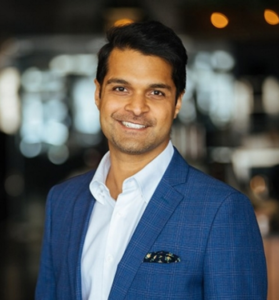
Adi Pendyala, Senior Director, Market Strategy, Aspen Technology.
Embedded AI applications enable users to carry out domain-specific operations with increased accuracy, quality, reliability, and sustainability across the industrial asset lifecycle. The biggest benefit of Industrial AI is a significant increase in productivity, as well as benefits in sustainability. The next-generation asset optimization solutions that have embedded AI can overcome resource barriers, which significantly reduces the need for organizations to recruit many data scientists and reap benefits. Efficiency and value capture are cornerstones in this economy. For example, with a relatively fragile supply chain, industrial companies cannot risk errors and machine failures slowing them down.
Predictive and prescriptive maintenance technology, with Machine Learning (ML) and Industrial AI, can identify precise failure patterns to predict equipment degradation weeks or even months in advance. This ensures that action can be taken to mitigate unplanned downtime, as well as safety and environmental risks. Companies are implementing specific process metrics that consider emissions and resource use, as well as efficiency enhancements through digital technology. The International Energy Agency (IEA) has found that Industrial AI and digital solutions can boost energy efficiency by up to 30% for industrial operations. Multi-dimensional optimization, predictive analytics, and other digital solutions also help in meeting sustainability goals.
Artificial Intelligence of Things
According to Maciej Kranz, a leading technologist, AI, and the Industrial Internet of Things (IIoT), these technologies become transformational when they integrate, interconnect and interwork – with intelligence – to solve complex industry problems. Collectively, they are like the body and brain of industrial digital transformation: IIoT is the body, creating and transmitting data from a variety sources that is sometimes acted upon, while AI is the brain, turning data into intelligence for smarter decisions and enabling the digital future of industrial organizations.
The confluence of these technological forces gives rise to a new digital solution category – the Artificial Intelligence of Things (AIoT) – that centres on unlocking the hidden business value in industrial data. This category describes the combination of AI technologies with the IIoT to enable the next generation of Industrial AI infrastructure, allowing organizations to achieve more efficient IIoT operations, enable seamless human-machine workflows, harmonize industrial data management, and rapidly transform raw data into tangible business outcomes.
According to Accenture, nearly 69% of executives acknowledge they know how to pilot a program but struggle to scale their Industrial AI strategy across the enterprise. Organization strategy needs to start with the identification of business problems, corporate objectives, and strategic goals. Companies need to democratize the application of AI by focusing on business outcomes, making the technology valuable and actionable to create real business value.
Scaling Towards an AIoT Strategy
Sharp market volatility means capital-intensive industries have to be more agile in an unprecedented way to survive and thrive. Companies need to capitalize on the rapid convergence of IT and OT. The rise of the digital executive is reshaping the digital transformation strategy of industrial organizations. There is a critical and growing need to access industrial analytics and actionable insights in making business decisions across the enterprise. Organizations need to focus on strategic industrial data management, as well as using AI-enabled technologies to unlock the hidden value in these previously unoptimized and undiscovered sets of industrial data.
Industrial organizations are increasing investment in lowering barriers to AI adoption by deploying fit-for-purpose Industrial AI applications that combine data science and AI with software and domain expertise. This is key to overcoming a lack of in-house skills and drastically reduce the need for an army of data scientists. To scale, many enterprises are adopting new measures to reduce complexity in interoperability, overcome information silos and harmonize towards a cloud-ready infrastructure that bridges legacy systems with next-generation solutions.
A Business-First AIoT Ecosystem
In serving as the foundational infrastructure for industrial companies to evolve and accelerate towards the Self-Optimizing Plant, the Aspen AIoT also addresses organizational challenges today. First, the main challenge lies in data integration and mobility. Between 60 – 73% of enterprise data is not utilized and exacerbated by a lack of scalable data infrastructure to power Industrial AI models. Organizations need to access and fully leverage integrated data across the enterprise. A cloud-ready infrastructure is necessary to scale in AI with the right tools, infrastructure, and workflows to power Industrial AI across the solution lifecycle. This is a critical success factor for organizations to mature beyond sporadic AI proof-of-concepts to an enterprise-wide Industrial AI strategy.
Secondly, Deloitte’s recent article on the state of AI in the enterprise highlighted “modernizing our data infrastructure for AI” as the top reason for 20% of the companies surveyed to increase competitive advantage via AI. The AIoT Hub provides a cloud-ready, robust, and highly scalable infrastructure for Industrial AI applications to realize the vision for the Self-Optimizing Plant. Third, industrial organizations need to translate real-time data into faster, smarter, profitable business decisions. The AIoT Hub enables access to real-time data, analytics and enterprise-wide workflow and governance.
Finally, enterprises need a purpose-built, fully integrated AI environments for data scientists to collaborate with domain experts to accelerate the transformation of raw data into purposefully guided AI/ML products, driven by fit-for-industry algorithms and models. The AIoT Hub provides an embedded workbench for feature engineering, training, rapidly turning ML models into products, as well as supporting version upgrades and collaboration. Data scientists and domain experts, across customers and partners, are empowered to collaborate and build their own data-rich AI apps and models.
Indeed, 2021 looks set to be a year where Industrial AI goes mainstream – powered by a robust AIoT strategy. This bullish sentiment is further bolstered with a 2021 Artificial Intelligence Award from the Business Intelligence Group for the AIoT Hub’s ability to accelerate optimal ROI and drive industrial digital transformation.
Britain's Queen Elizabeth II sits alone in St. George’s Chapel during the funeral of Prince Philip, the man who had been by her side for 73 years, at Windsor Castle, Windsor, England, Saturday April 17, 2021. Prince Philip died April 9 at the age of 99 after 73 years of marriage to Britain's Queen Elizabeth II. (Jonathan Brady/Pool via AP)
WINDSOR, England (AP) — Queen Elizabeth II is sitting alone in the quire of St. George’s Chapel during the funeral of Prince Philip, the man who had been by her side for 73 years.
Philip, who died April 9 at the age of 99, was being laid to rest in the Royal Vault at Windsor Castle after a funeral service steeped in military and royal tradition — but also pared down and infused with his own personality. People across Britain have observed one minute of silence in honor of Philip just before his royal ceremonial funeral got under way.
Following strict social distancing rules during the pandemic, the queen set an example even in grief, sitting apart from family members arrayed around the church. Just 30 mourners were allowed to attend the service at St. George’s on the grounds of Windsor Castle, where the queen has stayed to avoid getting COVID-19.
Other royals who are in family bubbles are sitting together.
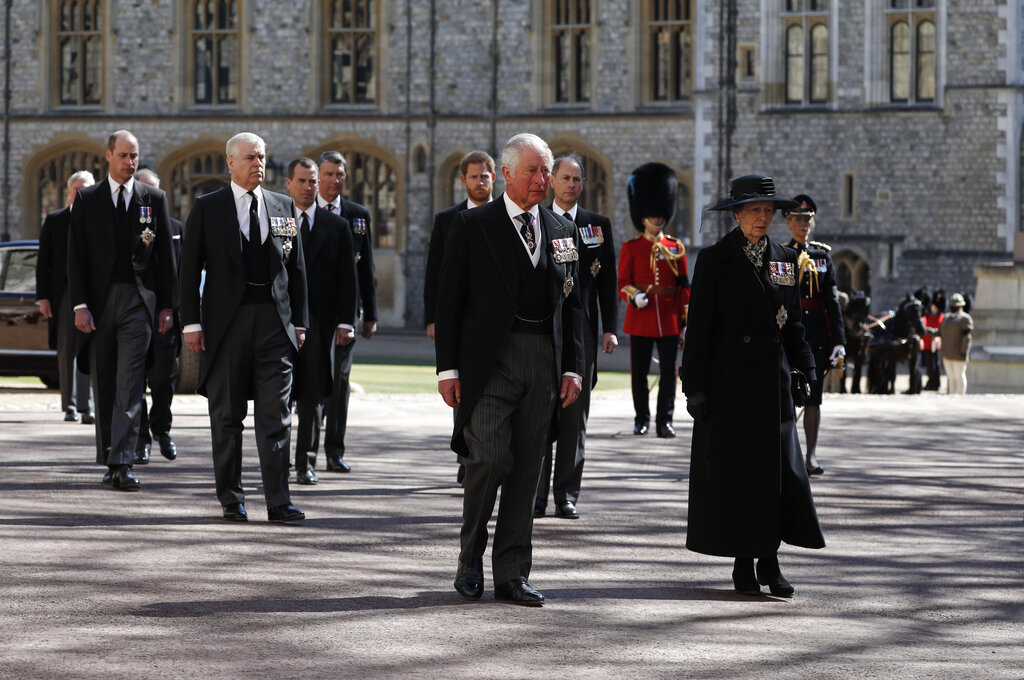
From front left, Britain’s Prince Charles, Princess Anne, Prince Andrew. Prince Edward, Prince William, Peter Phillips, Prince Harry, Earl of Snowdon and Tim Laurence follow the coffin in a ceremonial procession for the funeral of Britain’s Prince Philip inside Windsor Castle in Windsor, England Saturday April 17, 2021. Photo: Alastair Grant / Pool via AP
The service began with Archbishop of Canterbury Justin Welby entering the chapel ahead of the coffin, followed by Philip’s children and three of his eight grandchildren, as a four-member choir sang “I am the resurrection and the life.”
THIS IS A BREAKING NEWS UPDATE. AP’s earlier story follows below.
WINDSOR, England (AP) — Military bands played and Queen Elizabeth II joined a procession Saturday at Windsor Castle ahead of a funeral where her husband Prince Philip was being remembered as a man of “courage, fortitude and faith.” The service was saluting both his service in the Royal Navy and his support for Britain’s monarch over three quarters of a century.
Philip, who died April 9 at the age of 99 after 73 years of marriage, was being laid to rest in the Royal Vault at Windsor Castle after a funeral service steeped in military and royal tradition — but also pared down and infused with his own personality.
The coffin arrives at St George’s Chapel for the funeral of Britain’s Prince Philip inside Windsor Castle in Windsor, England, Saturday, April 17, 2021. Photo: Kirsty Wigglesworth / Pool via AP
Coronavirus restrictions mean that instead of the 800 mourners included in the longstanding plans for his funeral, there will be only 30 inside the castle’s St. George’s Chapel, including the widowed queen, her four children and her eight grandchildren.
His coffin emerged from the State Entrance of Windsor Castle as those taking part in the ceremonial procession for his funeral took their places. It was loaded on a specially adapted Land Rover, designed by Philip himself, for the eight-minute journey to St. George’s Chapel. Senior military commanders lined up in front of the vehicle, with members of the royal family following behind.
The queen rode in a state Bentley at the rear of the procession. The entire procession and funeral was taking place out of public view within the grounds of the castle, a 950-year-old royal residence 20 miles (30 kilometers) west of London. It will be shown live on television.
Members of the 1st Battalion Grenadier Guards place the coffin of Britain’s Prince Philip onto a modified Jaguar Land Rover in the Quadrangle at Windsor Castle in Windsor, England, Saturday, April 17, 2021 ahead of the funeral of Britain’s Prince Philip. Prince Philip died April 9 at the age of 99 after 73 years of marriage to Britain’s Queen Elizabeth II. Photo: Adrian Dennis/Pool via AP
Under spring sunshine, some locals stopped outside the castle to leave flowers on Saturday, but people largely heeded requests by police and the palace not to gather because of the coronavirus pandemic.
Philip’s coffin coffin was draped in his personal standard, and topped with his Royal Navy cap and sword and a wreath of flowers.
The funeral will reflect Philip’s military ties, both as a ceremonial commander of many units and as a veteran of war. More than 700 military personnel are taking part, including army bands, Royal Marine buglers and an honor guard drawn from across the armed forces.
Those marching into place included soldiers of the King’s Troop Royal Horse Artillery, who were firing a gun salute, Guards regiments in scarlet tunics and bearskin hats, Highlanders in kilts and sailors in white naval hats.
Military personnel in parade dress uniform march past flowers which where placed on the grass for the funeral of Britain’s Prince Philip inside Windsor Castle in Windsor, England, Saturday, April 17, 2021. Photo: Justin Tallis/Pool via AP
Philip was deeply involved in the funeral planning, and aspects of it reflect his personality, including his love of the rugged Land Rover. Philip drove several versions of the four-wheel drive vehicle for decades until he was forced to give up his license at 97 after a crash. His body will be carried to the chapel on a modified Land Rover Defender that he designed himself.
The children of Philip and the queen — heir to the throne Prince Charles, Princess Anne, Prince Andrew and Prince Edward — will walk behind the hearse, while the 94-year-old queen will travel to the chapel in a Bentley car.
Grandsons Prince William and Prince Harry will also walk behind the coffin, although not side by side. The brothers, whose relationship has been strained amid Harry’s decision to quit royal duties and move to California, will flank their cousin Peter Phillips, the son of Princess Anne.
The King’s Troop Royal Horse Artillery arriving at Windsor Castle in preparation for the Gun Salute on the palace grounds, before the funeral of Britain’s Prince Philip, in Windsor, England, Saturday, April 17, 2021. Photo: Antonio Olmos/Pool photo via AP
The moment is likely to stir memories of the image of William and Harry at 15 and 12, walking behind their mother Princess Diana’s coffin in 1997, accompanied by their grandfather Philip, in a London ceremony televised around the world.
Armed forces bands played hymns and classical music before the funeral service, which was being preceded by a nationwide minute of silence.
Inside the Gothic chapel, the setting for centuries of royal weddings and funerals, the service was to be simple and somber. There will be no sermon, at Philip’s request, and no family eulogies or readings, in keeping with royal tradition. But Dean of Windsor David Conner will say the country has been enriched by Philip’s “unwavering loyalty to our queen, by his service to the nation and the Commonwealth, by his courage, fortitude and faith.”
A woman wears a face covering with a picture of the Duke of Edinburgh as he walks along the Long Walk in Windsor, Saturday, April 17, 2021. Photo: Frank Augstein / AP
Philip spent almost 14 years in the Royal Navy and saw action in the Mediterranean Sea, the Indian Ocean and the Pacific during World War II. Several elements of his funeral have a maritime theme, including the hymn “Eternal Father, Strong to Save,” which is associated with seafarers and asks God: “O hear us when we cry to thee/For those in peril on the sea.”
As Philip’s coffin is lowered into the Royal Vault, Royal Marine buglers will sound “Action Stations,” an alarm that alerts sailors to prepare for battle — a personal request from Philip.
Former Bishop of London Richard Chartres, who knew Philip well, said the prince was a man of faith, but liked things kept succinct.
A picture of Britain’s Prince Philip with Queen Elizabeth ahead of his funeral in Windsor, England Saturday April 17, 2021. Philip died April 9 at the age of 99 after 73 years of marriage to Britain’s Queen Elizabeth II. Coronavirus restrictions mean there will be only 30 mourners for the service, including the widowed queen, her four children and her eight grandchildren. Photo: Frank Augstein / AP
“He was at home with broad church, high church and low church, but what he really liked was short church,” Chartres told the BBC. “I always remember preaching on occasions which he was principal actor that the instruction would always come down: ‘No more than four minutes.’”
Along with Philip’s children and grandchildren, the 30 funeral guests include other senior royals and several of his German relatives. Philip was born a prince of Greece and Denmark and, like the queen, is related to a thicket of European royal families.
Mourners have been instructed to wear masks and observe social distancing inside the chapel, and not to join in when a four-person choir sings hymns. The queen, who has spent much of the past year isolating with her husband at Windsor Castle, will sit alone.
Artist Kaya Mar carries a portrait of Prince Philip ahead of the Prince’s funeral in Windsor, England Saturday April 17, 2021. Philip died April 9 at the age of 99 after 73 years of marriage to Britain’s Queen Elizabeth II. Photo: Frank Augstein / AP
Ahead of the funeral, Buckingham Palace released a photo of the queen and Philip, smiling and relaxing on blankets in the grass in the Scottish Highlands in 2003. The palace said the casual photo was a favorite of the queen.
For decades, Philip was a fixture of British life, renowned for his founding of the Duke of Edinburgh’s Awards youth program and for a blunt-spoken manner that at times included downright offensive remarks. He lived in his wife’s shadow, but his death has sparked a reflection about his role, and new appreciation from many in Britain.
“He was a character, an absolute character,” said Jenny Jeeves as she looked at the floral tributes in Windsor. “He was fun, he was funny. Yes, he made quite a few gaffes, but it depends which way you took it really. Just a wonderful husband, father, and grandfather, and a good example to all of us, really.”
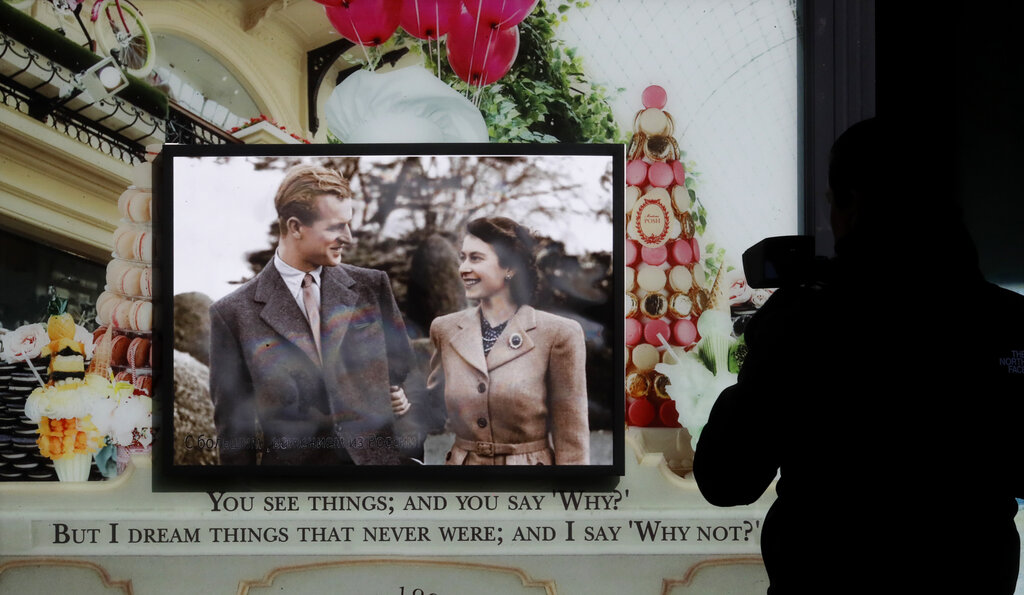
Images of Britain’s Prince Philip are displayed on a giant screen at Piccadilly Circus, London Saturday, April 17, 2021. Prince Philip, husband of Queen Elizabeth II, died Friday April 9 aged 99. His funeral service is taking place at St. George’s Chapel inside Windsor Castle Saturday. Photo: Rui Vieira / AP
___
Story: Danica Kirka and Jill Lawless. Jill Lawless reported from London.
British actor Helen McCrory, who starred in the television show “Peaky Blinders” and the “Harry Potter” movies, has died, her husband said Friday. She was 52 and had been suffering from cancer.
Her husband, fellow actor Damian Lewis, said McCrory died “peacefully at home” after a “heroic battle with cancer.”
“She died as she lived. Fearlessly,” Lewis wrote on Twitter. “God we love her and know how lucky we are to have had her in our lives. She blazed so brightly. Go now, Little One, into the air, and thank you.”
McCrory was one of Britain’s most respected actors, making her mark by playing a succession of formidable and sometimes fearsome women.
She played the matriarch of a crime family on ”Peaky Blinders” and the scheming Voldemort ally Narcissa Malfoy in the “Harry Potter” movies.
Cillian Murphy, who plays the central role of gangland boss Tommy Shelby in “Peaky Blinders,” set in the early 20th-century English underworld, said he was “broken-hearted to lose such a dear friend.”
“Helen was a beautiful, caring, funny, compassionate human being,” he said in a statement. “She was also a gifted actor — fearless and magnificent.
Actors Helen McCrory, left, and Damian Lewis appear at the premiere of “Once Upon A Time in Hollywood,” in London on July 30, 2019. Photo by Joel C Ryan/Invision/AP, File
“She elevated and made humane every scene, every character she played,” Murphy said. “It was a privilege to have worked with this brilliant woman, to have shared so many laughs over the years. I will dearly miss my pal. My love and thoughts are with Damian and her family.”
McCrory also starred as a human rights lawyer dragged into international intrigue in the TV thriller “Fearless,” played lawyer Cherie Blair, wife of British Prime Minister Tony Blair, in the 2006 movie “The Queen,” and had roles in Martin Scorsese’s film “Hugo” and the James Bond thriller “Skyfall.”
Actor Michael Sheen, who played Tony Blair in “The Queen,” said McCrory was “so funny, so passionate, so smart and one of the greatest actors of our time.”
“Harry Potter” author J.K. Rowling tweeted that she was “devastated to learn of the death of Helen McCrory, an extraordinary actress and a wonderful woman who’s left us far too soon.”
Onstage, McCrory’s roles included the vengeful Greek heroine “Medea” at the National Theatre in 2014. At the same theater, she excelled as a woman caught between a dull husband and a feckless lover in Terence Rattigan’s “The Deep Blue Sea” in 2016.
While many performers struggle to find meaty female roles in film and television, McCrory played a string of them.
“Having said that, there are a lot of things I turn down,” she told The Associated Press in 2016, describing the sort of roles where “all your lines are ‘But what did you do at work?’ ‘That’s so clever, darling.′ ‘How did you do that?’ ‘And then what did you do?’”
“Of course, there’s so much sexism within the profession,” McCrory said. “But I think you approach it in different ways, and my approach is just to forge forward.”
Others remembered McCrory for her charity work, including on FeedNHS, a campaign to provide meals for frontline health care workers during the coronavirus pandemic.
“Helen McCrory will be remembered not just for her remarkable stage and screen performances, but also for her selflessness and generosity,” comedian Matt Lucas tweeted. “She and Damian were the motor driving FeedNHS, working tirelessly during the pandemic to raise millions for others. What a tremendous loss.”
McCrory and Lewis, star of the TV series “Homeland” and “Billions,” married in 2007 and had two children.
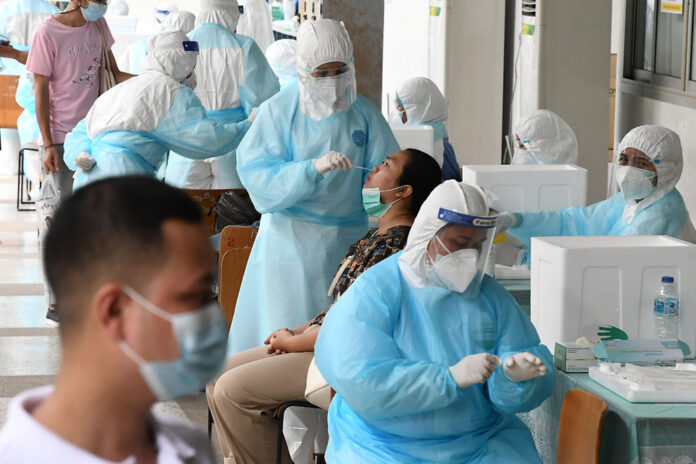
A woman takes a coronavirus test at Bangkok Youth Center on Apr. 17, 2021.
The third COVID-19 outbreak is upon us. As the number of the newly infected rose above 1,000 mark for the four consecutive days on Saturday, it would do well for Thais to try not to mix COVID-19 with politics.
COVID-19 alone is deadly enough. Likewise, politics can turn deadly as well. And we are not even talking about the COVID-19 induced economic crisis.
Yes, the rot in Thai high society for the third outbreak of the pandemic if you like. We need to hold those who gathered at posh nightlife establishments unprotected and spread a big chunk of the third outbreak responsible. Celebrities, socialites and even a top foreign diplomat.
Then there’s the infected Cabinet minister and the less than capable Prime Minister Gen. Prayut Chan-ocha, who while able to maintain 111 as of Friday, failed to thwart waves of economic tsunamis. This year, Thailand Development Research Institute predicts that as many as 1.3 million new graduates may not be able to find job and the total unemployment number could reach 6 million.
But no schadenfreude bitter (please)! That someone from the opposite political spectrum has become infected is no cause for celebration.
Thai politics can become intoxicating and contagious to the point where I have seen some Thais expressing gratification, schadenfreude, at police and politicians infected or undergoing self-isolation due to the latest outbreak.
In the end, we are on the same boat, if not facing the same storm. It is true that the rich and powerful are better sheltered and those involved in the latest outbreak must be condemned and more pressure needs to be applied in order to prevent future irresponsible behaviour disregard of their political belief of social class.
Laughing at the fact that more Thais are becoming infected because you hate their politics or their social class will not help make Thai society better. More infections, no matter from which side of the political divide or which social class is collectively bad news for Thailand. Thais of all political stripes and social class must recognize this and do whatever they can to prevent the society as a collective from facing more severe crises.
Yes, we may be on the same boat but some are traveling first-class while others third-class if not clinging to a raft in the middle of the ocean. Some said a better analogy is Thais are facing the same storm on the sea but the privileged few are on a luxury yacht while most others on a small boat, and many more holding on to a life saver ring to survive economically.
Be that as it may, we all need to take account of Thai society as a collective and ensure that the situation keeps degenerate moves from bad to worse. For example, a number of condominiums in Bangkok are temporarily shutting down their gym facilities and swimming pool despite the government not ordering it on Friday to prevent possible infection.
We cannot lose sight of the immediate danger facing all of us. To mitigate the latest outbreak we need to be united, behave as a responsible member of Thai society. Being a responsible citizen entails we do not put oneself and others unnecessarily at risk of coronavirus but also be sympathetic for people who really need to keep their heads above the water, economically.
If some of the elites will not care for the common goods, it’s up to the rest of us to rise above the occasion and carry on with our civic duties. It’s not time to merely point a finger of blame, indulge in political schadenfreude or abandon our responsibilities.
We also need to push for more rapid inoculation. Just over 500,000 people, or less than 1 percent of the population, have been vaccinated so far. We need pressure to ensure the government to strike a good balance between health and the economy and not unnecessarily impose imbalance measures.
As stated earlier, already 1.3 million new graduates may become unemployed and unemployment number at 6 million this year. The tourism industry is dying after a year of no foreign tourists and some malls heavily dependent of foreign shoppers resemble ghost malls.
Let us be cautious, calm and carry on. If we shall sail through this pandemic, if will be as a house united, not as a house divided against itself. As of now, less than 100 people have died from COVID-19 while the survival rate of those infected is still 99.97 percent while. Only 17 patients are on respiratory ventilators.
The stats and situation should remind us that we’re in this together even though we’re not affected equally. That’s also why in the long run, greater economic equality must be a goal in order to achieve a more equitable Thailand.
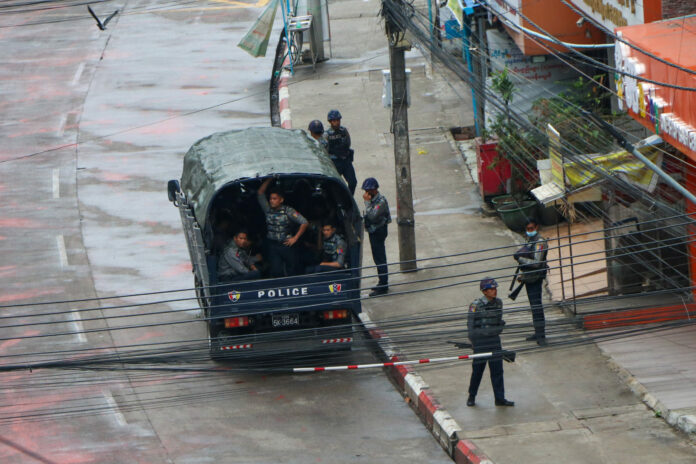
Police security forces stand by inside a police vehicle and on the sidewalk of Hledan Road in Kamayut township in Yangon, Myanmar Friday, April 16, 2021. Photo: AP
YANGON (AP) — Opponents of Myanmar’s ruling junta went on the political offensive Friday, declaring they have formed an interim national unity government with members of Aung San Suu Kyi’s ousted cabinet and major ethnic minority groups.
The move comes on the eve of a diplomatic initiative to solve Myanmar’s crisis by the Association of Southeast Asian Nations, which is expected to hold a summit next week.
A violent crackdown by the junta has failed to stem opposition to the coup, and as the army has spread the fight to ethnic minorities in border areas, some ASEAN members believe the crisis threatens regional stability.
Opponents of the coup have been seeking an alliance with ethnic minority groups as a way of strengthening their resistance. The minorities for decades have kept up on-again, off-again armed struggles for greater autonomy in the borderlands.
While it was not clear if the minority political organizations had formally joined an alliance, the appointment of prominent personalities from their ranks showed a commitment to a joint struggle against the military, which is certain to boost morale to the anti-coup cause.
Security forces have killed at least 726 protesters and bystanders since the Feb. 1 military takeover, according to the Assistance Association for Political Prisoners, which monitors casualties and arrests. The protests and the killings have been continuing on a daily basis.
The National Unity Government is nominally an upgrade from what had been called the Committee Representing Pyidaungsu Hluttaw, which was formed shortly after the coup by elected lawmakers who were barred by the army from taking their seats. The CRPH sought international recognition as Myanmar’s sole legitimate government body, but won only popular support from those opposed to military rule.
The junta declared the CRPH an illegal organization, and issued arrest warrants for its leading members.
A video posted Friday on social media showed veteran activist Min Ko Naing announcing the formation of the new body. He was a leader of the failed 1988 uprising against a previous military dictatorship and is one of the country’s most respected political figures aside from Suu Kyi. He went quickly underground after the coup and apparently has been active in political organizing against the junta since then.
“Please support the National Unity Government for the future of our citizens and our younger generation.” he said. “The people are the decision makers and the people will fight the final battle. Victory is coming, We must win our revolution.”
More details were provided in a statement on social media by Dr. Sasa, a physician and philanthropist who though in hiding has been the online public face of the CRPH..
“Today, at the end of Thingyan on the eve of Myanmar’s new year, we are proud to announce the formation of a new National Unity Government and the dawn of a new era for the people of Myanmar,” said Sasa. “For the first time in our history, Myanmar has a unity government that will reflect one of our nation’s greatest strengths – the diversity of our people.”
The CRPH announced that Suu Kyi retains her post as state counsellor and Win Myint as president, though both were arrested in the coup and remain in detention, with criminal charges against them that supporters call politically motivated.
Sasa said the interim’s government’s vice president — its acting president – is Duwa Lashi La, a political leader of the Kachin minority from the country’s north, while the prime minister is Mahn Win Khaing Than, from the Karen minority in eastern Myanmar, who had been speaker of the elected upper house of Parliament.
Sasa himself comes from the Chin minority, while Myanmar’s government and military have always been dominated by the Burman majority.
It is not the first time in recent decades that opponent to military rule in Myanmar have formed a shadow government. In 1990, they formed the National Coalition Government of the Union of Burma after a military regime refused to recognize the results of a general election won in a landslide by Suu Kyi’s party.
That shadow government maintained a presence in territory controlled by the Karen on Myanmar’s eastern frontier, but also operated as a lobbying group based in Maryland in the United States. It dissolved itself in September 2012 after Suu Kyi’s party took part in by-elections earlier that year, capturing 43 of the 44 seats it contested.
King's Troup Royal Horse Artillery rehearses on the long walk towards Windsor Castle in Windsor, Thursday, April 15, 2021. Britain's Prince Philip, husband of Queen Elizabeth II, died Friday April 9 aged 99. His funeral service will take place on Saturday at Windsor Castle. Photo: Frank Augstein / AP
LONDON (AP) — Here is the full list of guests who will attend the funeral of Prince Philip on Saturday at St. George’s Chapel at Windsor Castle.
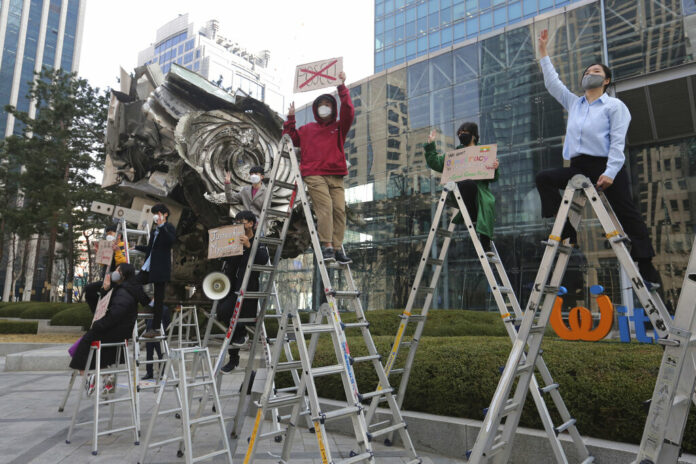
South Korean peace activists on the ladders stage a rally supporting Myanmar's democracy, outside the POSCO office in Seoul, South Korea on Feb. 22, 2021. Photo: Ahn Young-joon / AP
SEOUL, South Korea (AP) — A South Korean steelmaker on Friday said it plans to end a joint venture with a military-controlled firm in Myanmar following criticism that its business has benefited military leaders who have violently suppressed pro-democracy protests there.
POSCO Coated & Color Steel said it has decided to discontinue its partnership with Myanmar Economic Holdings Public Company Limited, which is about 40% owned by Myanmar’s Defense Ministry. However, the South Korean company said it would not pull out of Myanmar.
POSCO C&C owns 70% of its joint venture with MEHL, Myanmar POSCO C&C. Min Ji-hyun, an official from POSCO C&C, said the company has informed MEHL it wants to buy the Myanmar firm’s 30% stake so that it can continue operating the venture with full ownership. MEHL has yet to respond to POSCO C&C’s offer, Min said.
Min said he couldn’t provide detailed estimates on how much the deal would cost POSCO C&C, saying that would depend on when it goes through. He said the company will look for “other ways” to continue doing business in Myanmar if MEHL refuses to sell its stake, but did not elaborate on what those might be.
Human rights activists have been pressuring many companies around the globe to end any financial support for the military. The U.S. government has imposed sanctions on MEHL and a similar military-controlled conglomerate, Myanmar Economic Corp.
POSCO C&C is an affiliate of South Korean steel giant POSCO that manufactures steel sheets. The company issued a statement saying it hopes its steel business will “continue to contribute in improving living environments in Myanmar and facilitate the country’s economy.”
A military junta took over Myanmar from an elected civilian government in a Feb. 1 coup. Security forces have killed at least 700 civilian protesters and bystanders, have detained the former government’s leaders, and have charged doctors, entertainers and others with crimes over their opposition to the coup.
In a statement, the rights group Justice for Myanmar said it cautiously welcomed Posco C&C’s decision but urged it to “immediately end all other business ties with the Myanmar military junta and its conglomerates.”
That includes rent on land leased by entities associated with the military, it said.
The statement was jointly issued with the Korean Civil Society in Support of Democracy in Myanmar, a network of more than 100 rights groups. That group said that it had joined with other advocacy organizations to file a complaint with South Korea’s National Human Rights Commission and other agencies to protest business ties between Korean companies and the military. That complaint was filed in November, long before the coup.
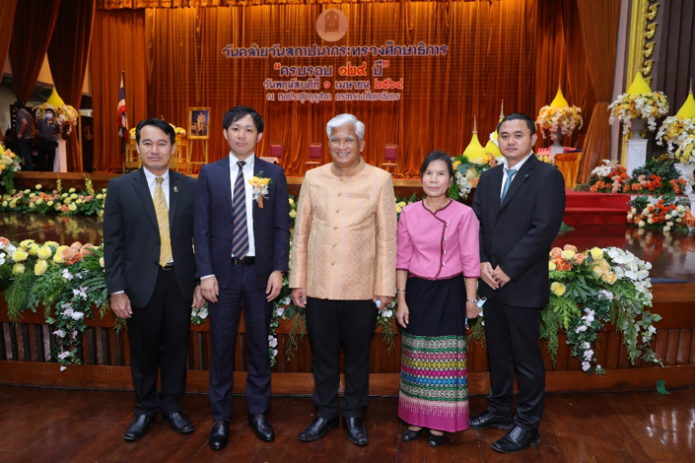
Kouhei Shibata, Assistant General Manager of Technical Engineer Division, represented Siam Daikin Sales Co., Ltd. to receive honorary pin and certification from the Ministry of Education in 2021. The award ceremony was presided by officials from Office of Vocational Education Commission including Dr.Suthep Kaengsanthia, Secretary of Office of Vocational Education Commission, Bubpha Pedthip, Director of International Cooperation Division, Sanga Taechersai, Director Bureau of Cooperation and Supakit Atikajonsuk, Department Manager of Technical Engineer Division from Siam Daikin Sales Co., Ltd. In 2020, Siam Daikin Sales Co., Ltd. singed an MOU with Office of Vocational Education Commission to create and develop personnel in the field of air conditioning technology to accommodate to the skilled labor market. The ceremony was held at the Teachers’ Council of Thailand Conference Room on 1 April 2021.
In the pictures, from left:
Sanga Taechersai, Director Bureau of Cooperation, Office of Vocational Education Commission
Kouhei Shibata, Assistant General Manager of Technical Engineer Division, Siam Daikin Sales Co., Ltd.
Suthep Kaengsanthia, Secretary of Office of Vocational Education Commission
Bubpha Pedthip, Director of International Cooperation Division
Supakit Atikajonsuk, Department Manager of Technical Engineer Division, Siam Daikin Sales , Ltd.
Thailand’s automation and intelligent robotics industry has gone from strength to strength in recent years, driven by increasing demand from both domestic and overseas industries along with its well-established ecosystem. The country’s globally competitive supply chains, most notably in the automotive, food and food processing, and electronics industries, have boosted the demand for industrial automation and robotics as businesses embrace their transformative effects on productivity. Thailand’s service robot industry has also grown by leaps and bounds with a proliferation of innovations addressing the more pronounced needs of caring for the elderly and providing healthcare services in the COVID-19 pandemic era.
Having already reached the advanced development stage for the Internet of Things, machinery, information and communication technology, and electronics, Thailand has strong foundations in the automation and robotics supply chain. Thailand also enjoys a large and passionate talent pool in robotics as well as progressive support from the government in the development of its intelligent robotics technology.
At present, Thailand’s US$20-23 billion robotics industry includes homegrown robots that incorporate AI, 5G connectivity, and cloud communications technologies to enable smart manufacturing.
According to the International Federation of Robotics (IFR)1, Thailand had the highest number of industrial robots within the 10-member Association of Southeast Asian Nations (ASEAN) in 2019, with roughly 3,000 units in operation accounting for almost 1% of the total 373,000 industrial robots installed globally.
With 45 industrial robots for every 10,000 employees in 2019, Thailand was the second largest market for robotics and automation in ASEAN after Singapore. Across Asia, the average number of industrial robots per 10,000 employees was 63.
The IFR predicts that the use of automated guide vehicles to serve logistical roles across factories, warehouses, and service providers such as hospitals will grow by around 60% annually to well over 700,000 units by 2022. Furthermore, local businesses are increasingly using automation and robotics for a wide range of processes, from welding and assembling, to dispensing and cleaning in industries as diverse as automotive, food and food processing, electronics, and plastics and rubber.
Thailand is home to the world’s most significant automotive producer, ranking top in ASEAN for overall vehicle production and 6th globally for commercial vehicle production in particular. The country is also one of the world’s most important producers of food and processed food. In electronics, it is the second-largest global producer of data storage units, including hard disk drives. As businesses across ASEAN look to become more automated and adapt to the frequent changes taking place in the post-pandemic era, the expansion of automation and robotics will provide substantial opportunities for local businesses and investors.
More importantly, Thailand is situated at the centre of one of the world’s most vibrant and fastest-growing collection of markets: the CLMV countries (Cambodia, Lao PDR, Myanmar, Vietnam, and Thailand). As such, the robotics & automation industry in Thailand is poised for future growth as the industrial sectors in these countries adopt more robots and automated systems going forward.
A Well-Established Robotics and Automation Ecosystem
The multinational companies involved in Thailand’s global supply chain of key industries and investors have spearheaded the development of the country’s automation and robotics industry. A majority of the firms in the local automation and robotics industry are in the business of system integration and mechanical brain and software development.
Ever since the early stage of its development more than a decade ago, Thailand’s automation and robotics industry has continued to evolve into a comprehensive supply chain with less reliance on imports while also exporting finished robots and parts across Asia.
Over the years, Thailand has developed its capability to produce home-grown robots, giving birth to a vibrant startup scene. This is possible due to the creative ability of local entrepreneurs, as well as government support on both the demand and supply sides of the robotics and automation industry.
Realising the role of the automation and robotics industry in increasing the value of businesses, strengthening small and medium-sized enterprises, and driving economic growth, the Thai government has highlighted automation and robotics as one of the industries targeted under the “Thailand 4.0” vision. Two key pillars of the government’s commitment to fostering the development of the automation and robotics industry’s ecosystem are to promote R&D for supplying the industry with new innovations and to enhance the skill training for providing its talented human resources.
In a push to develop the automation and robotics industry, the Ministry of Industry, working through the Thai-German Institute, has collaborated with the country’s top science and engineering academies to run the Center of Robotics Excellence (CoRE)2. Among the key missions of the centre are encouraging the creation of robotics prototypes, promoting technology transfers from academia to industrial sectors, fostering technological networking internationally and developing related skills in human resources.
Prior to this, the National Science and Technology Development Agency (NSTDA) established the Institute of Field Robotics (FIBO)3 which offers undergraduate and graduate programs in automation and robotics engineering and manages a number of research laboratories, including the Bio-Inspired and Educational Robotics Lab, the Micro Robotics Lab, and the Unmanned-Vehicles and Autonomous Robots for Exploration Laboratory (UVAX).
The Thai Automation and Robotics Association (TARA)4 is also playing a key role in developing Thailand’s automation and robotics industry. In addition to working extensively with the Thailand Board of Investment (BOI) and CoRE to foster multi-sector collaboration linkages, TARA has developed an ecosystem to support local investment in automation and robotics systems by providing a list of registered system integrators (SI), arranging training for local SI, and promoting design and integration for factory automation.
A Leading Innovator of Service and Field Robots
Thailand is not short of achievements in service and field robotics. Equipped with 5G, AI, cloud computing and sensors which enable robots to perceive and respond to the environment, Thai companies and academies have produced many robots to serve various functions in this sector.
Examples include caring robots for the elderly which can perform the tasks of providing constant monitoring, alerting caregivers and interacting with the elderly. In the agricultural sector, robots are used in smart farming to serve various functions from monitoring plantations to irrigation and harvesting. Meanwhile, medical robots have been utilised in many areas, from diagnosis and surgery, to rehabilitation and general services.
Back in 2017, Ramathibodi Hospital, a reputable medical school in Thailand, successfully performed Asia’s first robot-assisted brain surgery. Robot-assisted surgery has since been widely used for different operations. Robots have also played an important role in assisting patients’ rehabilitation and therapy, supporting children with autism spectrum disorder as well as refilling medical supplies and prescriptions.
The pandemic has also driven the development of Thai medical robots used to assist frontline medical practitioners and reduce the risk of infection. The robots allow doctors to speak with coronavirus patients through video chats and measure patients’ temperature without exposing themselves to the risk of infection.
A Large Pool of Passionate Talent
As a result of the government’s investment in educational resources in the fields of science and engineering, Thailand is currently producing around 80,000 new graduates each year (roughly one-fifth of all graduates) in fields related to automation and robotics industries.
Many Thai students have triumphed in global robotics contests such as the World RoboCup and the World Robot Olympiad5 in recent years. These achievements reflect not only their passion for robotics but also their competency in scientific studies particularly mechanics and both electrical and robotics engineering.
The Thai government continues to strengthen the skills of the country’s human resources by facilitating nationwide collaboration among CoRE, universities, research institutions and businesses to offer real-world work experience, skill development and robot prototyping. The collaboration allows those participating to leverage each other’s expertise to enhance the capacity of teachers to prepare students with the skills required in this fast-changing environment.




































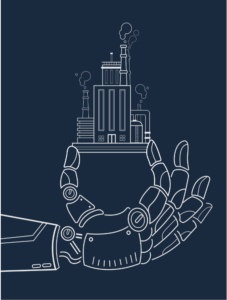 Sharp market volatility means capital-intensive industries have to be more agile in an unprecedented way to survive and thrive. Companies need to capitalize on the rapid convergence of IT and OT. The rise of the digital executive is reshaping the digital transformation strategy of industrial organizations. There is a critical and growing need to access industrial analytics and actionable insights in making business decisions across the enterprise. Organizations need to focus on strategic industrial data management, as well as using AI-enabled technologies to unlock the hidden value in these previously unoptimized and undiscovered sets of industrial data.