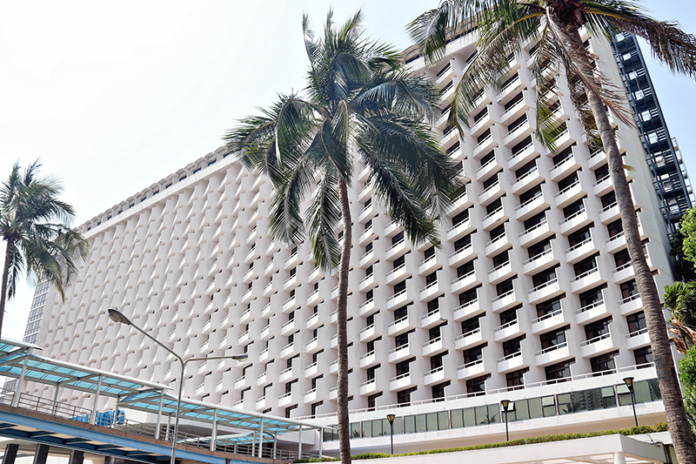
PATTAYA — The executive of a hotel that went viral last month over the alleged reports of terrible room conditions said Monday it will soon open as an Alternative State Quarantine, or ASQ.
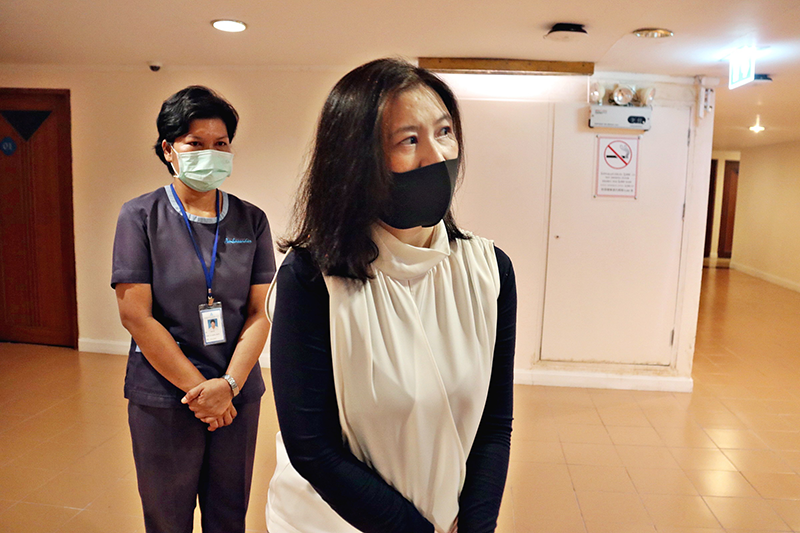
Ambassador City Jomtien director Chawanet Tungsumpan said a stay at her hotel for an ASQ experience would cost travelers between 30,000 and 100,000 baht. She also defended the hotel’s service in the aftermath of the viral review, which purported to document an unhygienic environment, poor service, and even cockroaches in the food.
“Everyone has always complimented us for good service, especially our maids, reception, and handymen,” Chawanet told reporters during a press tour of the hotel.
The review was written by Facebook user Topp Dunyawit Phadungsaeng, who reportedly stayed at Ambassador City Jomtien in February when the hotel was enrolled in the state quarantine program for Thai nationals returning from overseas.
Top: Ambassador City Jomtien refutes some of allegations made by Dunyawit.
Dunyawit, who flew in from San Francisco, called the stay “the worst 14 days in my life” in his Facebook post, which has been shared more than 34,000 times. But Chawanet said the review was misleading, and she said the hotel actually lost money as a state quarantine facility.
“Please open your mind. Understand what it means to be a state quarantine,” she said. “So many people say we’ve made sacrifices, which is true.”
When asked about the mishap and poor conditions Dunyawit allegedly experienced, Chawanet said the hotel allowed state officials to take over operations in the area where travelers were quarantined, so the hotel management had no say in some of the services.
“We thought we were doing this for CSR. Of the 4,200 people who have stayed here, none got COVID,” Chawanet said. “We’ve heard for years that our employees are all polite and service-minded.”
A bathroom in the room in the Ambassador City Jomtien.
She added that the hotel has since dropped out of the state quarantine list, and would reopen as an ASQ venue instead.
When Dunyawit’s review went viral in February, Ambassador City Jomtien responded by threatening unspecified legal actions, drawing even more ill gotten attention from social media users.
It is unclear what actions will be taken against Dunyawit; the hotel manager made no mention of it during the media tour, and an operator at Ambassador City Jomtien who picked up the phone was evasive.
“We’re in the legal process,” the operator said, adding that the hotel is currently closed for three months.
On Saturday, the Ambassador City Jomtien went on the offensive and refuted some of the allegations made by Dunyawit. For instance, in order to counter his claim that his bedding was moldy, the hotel said that the stain was found on the bottom mattress, which was covered with a mattress skirt.
“Why did you pull out the mattress skirt from the bottom mattress?” the hotel asked in the post.
Chawanet Tungsumpan.
The hotel did not directly address the complaints about bugs found in the food, but said many other guests who stayed at Ambassador City Jomtien the same time as Dunyawit were very positive about their experience.
Speaking to reporters today, hotel manager Chawanet said that Dunyawit changed his rooms three times, and that the hotel’s food was clean, and used vegetables from their own garden and fish from a natural pond.
“The Ambassador has been open for 50 years, the Jomtien branch for 30 years. We are confident in our standards of taking care of our customers,” she said.
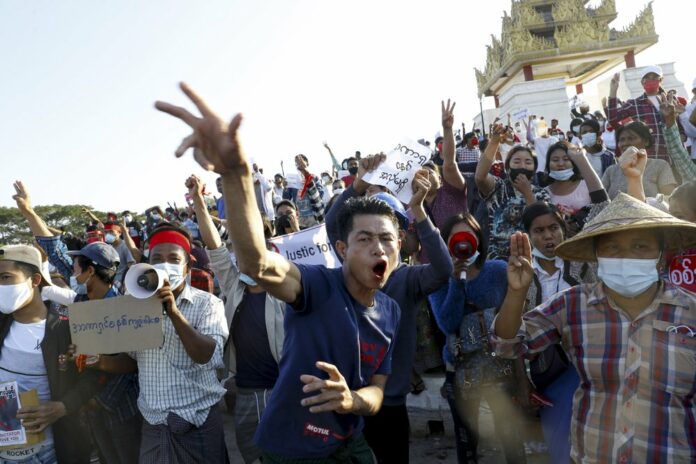
Demonstrators flash the three-fingered symbol of resistance against the military coup and shout slogans calling for the release of detained Myanmar leader Aung San Suu Kyi during a protest in Mandalay, Myanmar, Wednesday, Feb. 10, 2021. (AP Photo)
By Mon Mon Myat, Reporting ASEAN.
The 1988 pro-democracy protests in Myanmar were heady days, a time when danger and excitement mixed freely among university students like me in the streets of Magway, my hometown in the country’s central region. Soon after, the terror of the military regime of the 1990s era kicked in, until the country’s supposed transition to democracy started around 2010.
But the 1 Feb military coup has sent us back into the streets – and singing and listening to many of the same protest songs, despite the gap of 33 years between then and now.
I never expected to be singing these songs again, this time together with my son’s generation. Until the coup, I had thought that this generation was only interested in three things: eating, sleeping and play computer games. They have been proving me wrong.
Very quickly in fact, younger people have learned to sing three songs in particular that were a product of the 1988 pro-democracy movement. They were not even born at that time, but many now know the songs’ lyrics by heart, after they brought printouts of these to the protests and sharing them with friends. Many have heard the tunes from their parents.
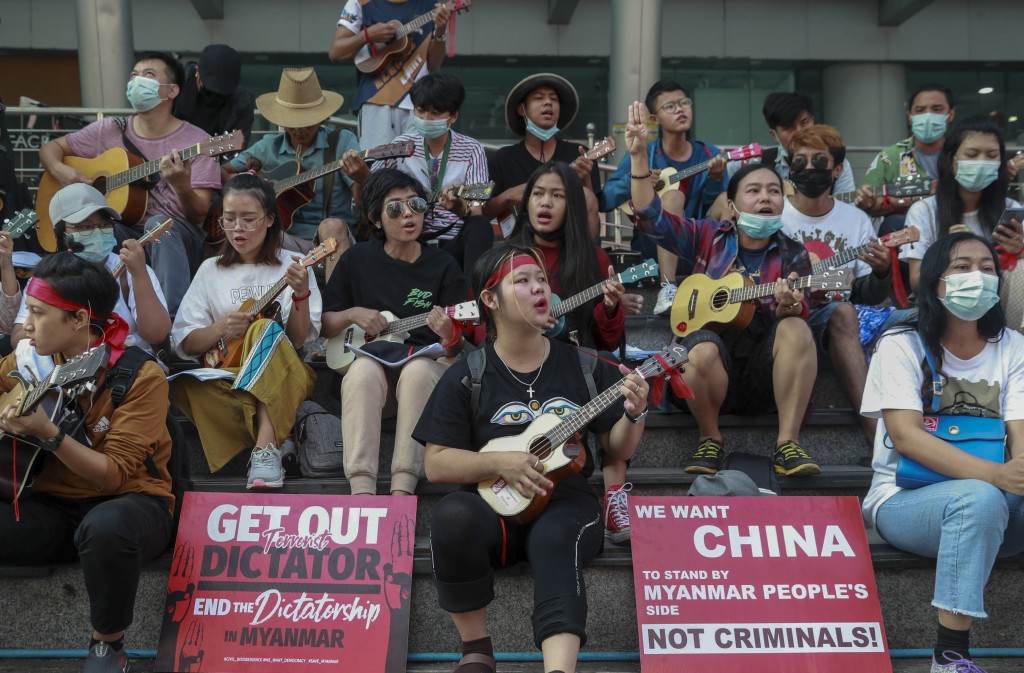
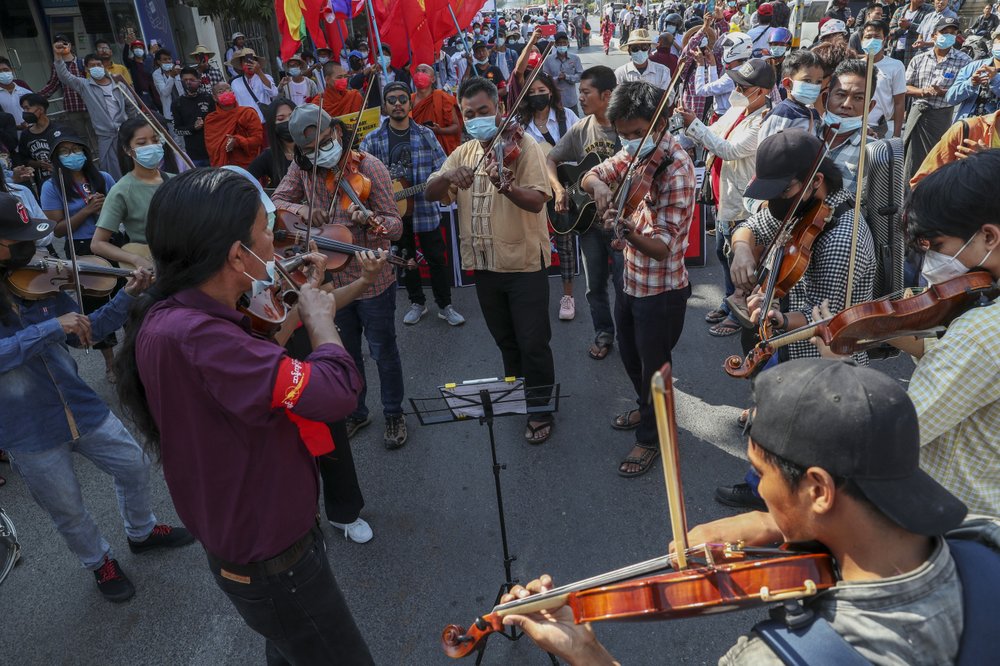
Anti-coup protesters play instrument and sing during a rally in Yangon, Myanmar, on Feb. 23, 2021. Image: The Associated Press.
Today’s young pro-democracy protester, too, are discovering the power that has music has to call people into joining the street protests, and to boost one another’s morale. Take a close look at the scenes in Myanmar these days: While armed soldiers and riot police stand watch with guns, protective shields, and batons, anti-coup protesters wield weapons such as ukuleles, violins, guitars and drums.
Crowds gather, and everyone around seems to be instantly ready to sing, as soon as they hear the drum rolls get underway.
They then usually warm up a rally with the first song, Blood Oath, which was written by the late singer and songwriter Htoo Ein Thin, a former student activist who went into exile after the 1988 uprising and joined the All Burma Students’ Democratic Front (ABSDF).
He had written ‘Blood Oath’ (‘Thway Thitsar’) beside the Thaungyin River, during his time with ABSDF in Thai-Myanmar border area and recorded it in a Bangkok studio. Subsequently, his album of revolutionary songs was smuggled into Myanmar and spread among students there. I remember first hearing this song from a cousin who had brought it in from Mawlamyaine, on the border with Thailand. In English, its lyrics go:
“It’s a crucial time, brothers,
Let’s unite and march together.
We wrote our new history with our blood,
Here we keep blood oath.”
“We give our lives for the nation,
We will march together with the peacock’s blood (a reference to the students’ resistance movement, whose symbol is the fighting peacock)
For our freedom and peace,
we must fight the last battle.”
After more crowds gather while ‘Blood Oath’ is being sung, protesters usually move to the song “We Shall Not Surrender Till The End Of The World” (‘Kabar Makyay Bu’), which uses the melody of the 1977 hit song ‘Dust in Wind’ by the American group rock band, Kansas. Clips of protesters singing this song in unison have gone viral.
The well-known songwriter Naing Myanmar, who penned the lyrics during the 1988 protests, told ‘The Irrawaddy’ news that he had written the song for the unknown heroes who gave up their lives during the pro-democracy revolution. The song starts this way:
“We will not forget the history written by our blood,
Till the end of the world.
Oh our fallen heroes, you gave your lives for the revolution.
This is the country of the martyrs and brave people.”
The song honours historical figures such as Aung San, called the father of modern Myanmar, and poet and political thinker Thakin Kodaw Hmaing, remembered for initiating the peace movement in the country.
To many of us, this song brings back painful memories of the bloody military crackdown on the streets of Yangon in 1988. Singing it these days is our reminder to today’s military regime that they should not make the same mistake, but I fear that this reminder will not work.
A third popular protest song in the rallies is Encourage Mi Nge (‘Khon Ar Phyait Mi Nge’), which many political prisoners used to encourage one another while behind bars. Composed by the legendary songwriter Ko Ne Win, part of the song’s lyrics go like this:
“After passing through the night after the sunset,
the new day will come with the sunrise.
If we endeavor with commitment,
we will succeed and escape one day.
As the road of ‘samsara’ (the endless cycle of birth and suffering in Buddhism) is not smooth,
please keep your spirit alive to face hardship, Mi Nge (younger sister).
These words of encouragement follow:
“Don’t give up my young sister.
You can cross the rough road with your brave heart.
When you take responsibility for the sake of others,
you have to sacrifice your life.”
Over the past weeks, I have run into many friends from the 1988 protests – often with their sons and daughters too – at various rallies.
“I can’t stop my daughter from joining this movement of her generation,” a poet friend said. “I can’t be at peace staying at home while she is out in the streets, so I follow wherever she goes.”
These songs of protest run through us, whether we are from Generation X, Y or Z. As the ‘88 Generation student leader Min Ko Naing, who has been in hiding since the coup, said in a pre-recorded message on 17 Feb: “This revolution represents a combination of Generation X, Y and Z in fighting against the military dictatorship.”
New Revolution, New Songs
The 2021 people’s revolt is already leading to the creation of new songs that denounce the military regime and exhort Myanmar’s people to join the civil disobedience movement, such as one entitled ‘The Dictatorship must End’ (‘Arnarshin Sanit Asone That Ya Myee’).
The song, whose original composers and singers are unknown, goes:
“Our bones and blood are to defeat the dictator.
We can’t be tied up by fear.
We are ready for the revolution. They are power–crazy people.
We all have to stand up to end the dictatorship.
We must end the dictatorship.”
I first heard this song, which opens with drums, at a 17 Feb protest in Yangon where, apart from calling for the release of “Mother Suu”, in reference to State Counsellor Aung San Suu Kyi who has been detained with President Win Myint, rallyists were shouting, “We must end the dictatorship!”
Anti-coup protesters play instruments and sing after riot policemen blocked their march in Mandalay, Myanmar, Wednesday, Feb. 24, 2021. (AP Photo)
The protests against the military takeover continue, but the police and military’s use of force have also been increasing in past days in Yangon, the former capital, and the military-built capital Nyapidaw, as well as Mandalay, Myitkyina and Mawlamyaing.
A central force driving the rallies is the 2021-generation students, who enjoy playing online and video games but put the same concentration into playing the drums, violins and other traditional musical instruments when they gather in the streets.
The music they have been making echo the unfulfilled dreams of their grandparents and parents – as well as the call of Myanmar’s future.
About the author
Mon Mon Myat is a journalist and a PhD candidate in the peacebuilding programme at Payap University in Chiang Mai, Thailand. This article is part of the Lens Southeast Asia series of Reporting ASEAN.
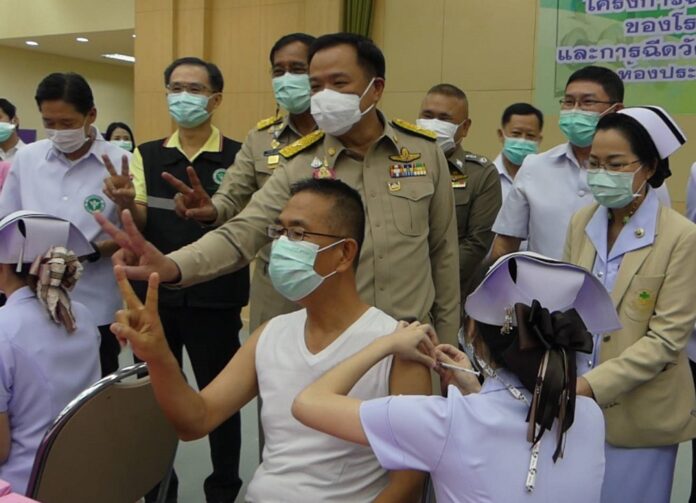
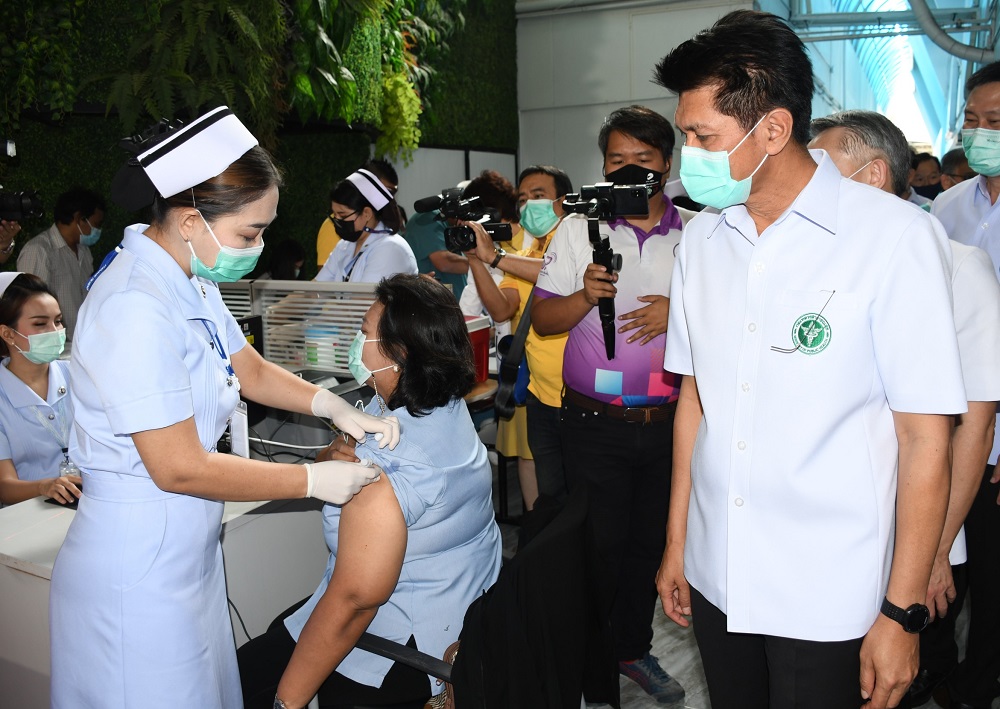
Health workers and officials receive vaccine to protect them from COVID-19 disease in Pathum Thani province on March 1, 2021.
BANGKOK — Frontline health workers, volunteers, and local officials are lining up Monday to receive their shot of vaccine against COVID-19, kicking off the long awaited inoculation drive that hopes to reopen the country.
The first shots in Pathum Thani were witnessed by health minister Anutin Charnvirakul, using the vaccine made by Chinese pharmaceutical Sinovac. Shipments of the vaccine also arrived in provinces that largely depended on foreign tourists, like Chonburi and Phuket.
Key members of the government, including Anutin, were already inoculated in a media event on Sunday, though PM Prayut Chan-o-cha will have to wait for the vaccine developed by AstraZeneca, since he was deemed too old for the Sinovac jabs.
Vials of COVID-19 vaccine developed by Sinovac are seen in Phuket province on March 1, 2021.
“[The government] is aiming to provide Thai people with immunity and safety from the outbreak of the 2019 coronavirus,” Anutin told reporters at Pathum Thani Hospital, where healthcare professionals in the province were receiving the vaccine.
“I’d like to give my moral support to all of you,” Anutin said of the medical workers. “I hope we will continue to have the energy and dedication to work for the wellbeing of Thai people.”
Doctors and health workers in Bangkok received the shots against COVID-19 at Bang Khun Thian Hospital in the southern part of the capital, while the vaccination drive in Samut Sakhon – the city hardest hit by the resurgence of the coronavirus outbreak – is being rolled out from the provincial hospital.
Governors, their deputies, and healthcare officials were also eligible for the first batch of the vaccine.
Health workers and officials receive COVID-19 vaccine in Chonburi province on March 1, 2021.
Thailand is lagging behind many of Asian countries in starting an inoculation campaign against the coronavirus pandemic. The drive was supposed to take place earlier, on Feb. 14, but was delayed due to a supply dispute in the European Union, according to the government.
Even under the current vaccine strategy, the general public won’t be getting their shots until the latter half of 2021. A majority of the 61 million AstraZeneca doses to be used in the national vaccine drive will be produced locally by Siam Bioscience, a company wholly owned by the palace.
The first round of vaccination was also extended to hospitality workers in five provinces and towns most popular among foreign visitors: Chiang Mai, Chonburi, Phuket, Krabi and Samui island in Surat Thani.
Government officials said the inclusion of hotel staff in the vaccine drive will pave way for reopening of the country’s borders to tourists and reinvigorate the tourism industry, which has been devastated by the pandemic.
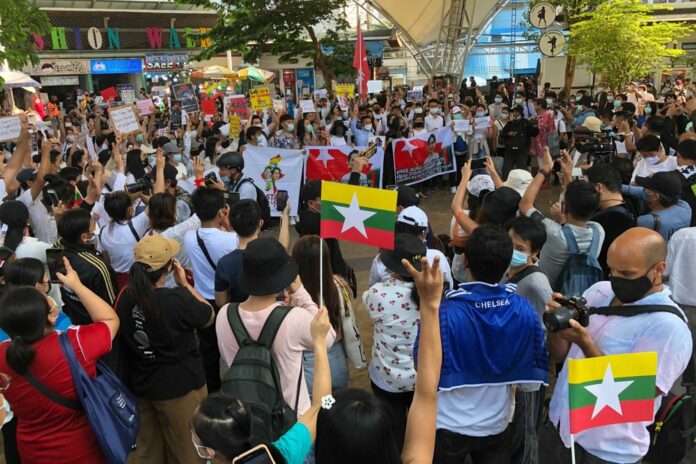
Migrant workers from Myanmar gather before participating in a march by Thai pro-democracy activists to the residence of Thai Prime Minister Prayuth Chan-ocha Sunday, Feb. 28, 2021 in Bangkok, Thailand. (AP Photo/Fu Ting)
BANGKOK (AP) — A new faction of Thailand’s pro-democracy movement staged a protest march Sunday, linking their cause with that of demonstrators in Myanmar battling that neighboring country’s coup-installed military government.
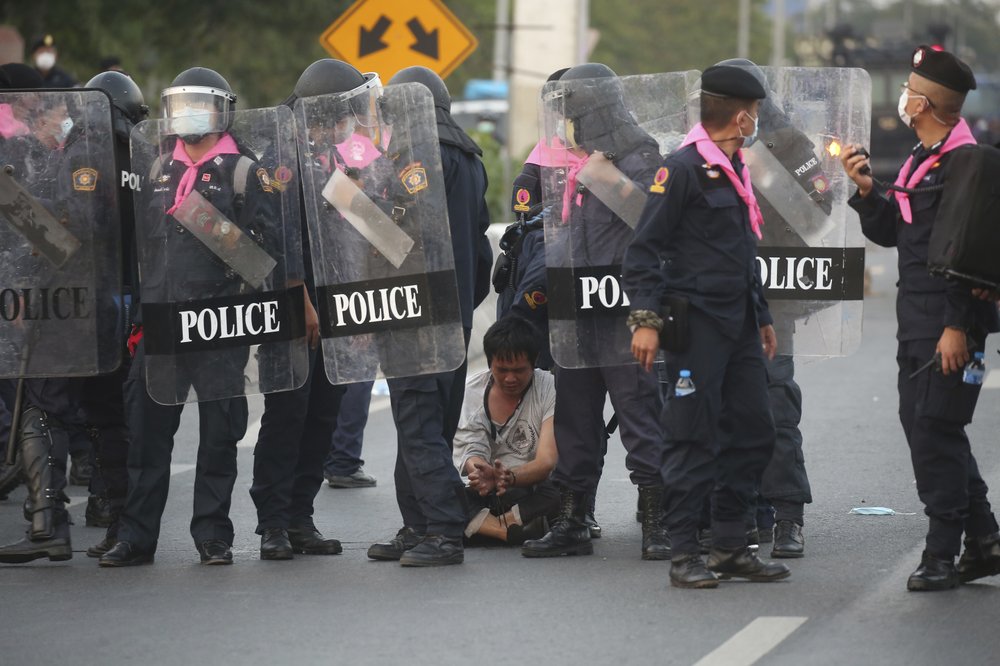
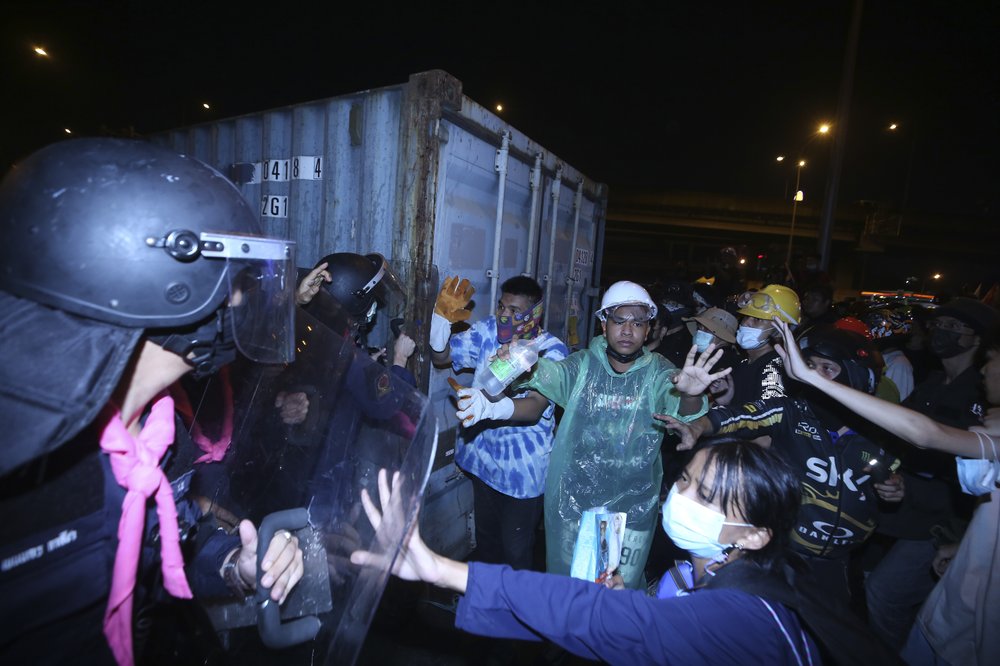
Marchers sought but failed to go to Thai Prime Minister Prayuth Chan-ocha’s house, which is on an army base in Bangkok. Shipping containers were situated to block them, and police using water cannons, rubber bullets and tear gas barred the way.
The demonstrators abandoned their plan several hours later after taking an online vote of their supporters.
Police said a 41-year-old officer died in the tumult, with local media reported he had a heart attack. According to the Erawan EMS center, 23 policemen and 10 protesters were injured.
Thai pro-democracy demonstrations have recently become marred by increasing violence. Much of it has been initiated by particularly confrontational protesters using tactics including throwing small homemade “ping-pong” bombs with the power of big firecrackers at police, who sometimes react with disproportionate force.
Sunday’s action was linked to the informal Milk Tea Alliance of pro-democracy activists from Hong Kong, Taiwan, Thailand and Myanmar, which called for efforts Sunday online and in real life in support of the protests in Myanmar.
Riot policemen arrest an anti-government protester, during a protest in Bangkok, Thailand, Sunday, Feb. 28 , 2021. (AP Photo)
In Myanmar on Sunday, a crackdown on protesters by security forces left at least 18 people dead, according to the U.N. Human Rights Office.
Prayuth was targeted in part because he met Wednesday in Bangkok with the new foreign minister appointed by Myanmar’s junta.
The protest in Bangkok was the first to be led by a new group calling itself REDEM, short for Restart Democracy, whose self-proclaimed goals are to build democratic socialism and minimize political and economic inequality.
Anti-government protesters clash with riot police, during a protest in Bangkok, Thailand, Sunday, Feb. 28 , 2021. (AP Photo)
REDEM was launched last week as an offshoot of Free Youth, one of the main groups that began rallying against the Thai government last year.
Last year’s original protest coalition campaigned for Prayuth and his government to step down, the constitution to be amended to make it more democratic and the monarchy reformed to make it more accountable.
The demand about the monarchy is the most controversial, because the institution has been widely considered an untouchable, bedrock element of Thai nationalism.
The protest movement lost steam when it took a break in December and January as Thailand was hit by a second wave of coronavirus infections. It is now trying to reinvigorate itself but has been hampered by the recent jailing of some of its leaders who are pending trial on several charges, including defaming the monarchy.
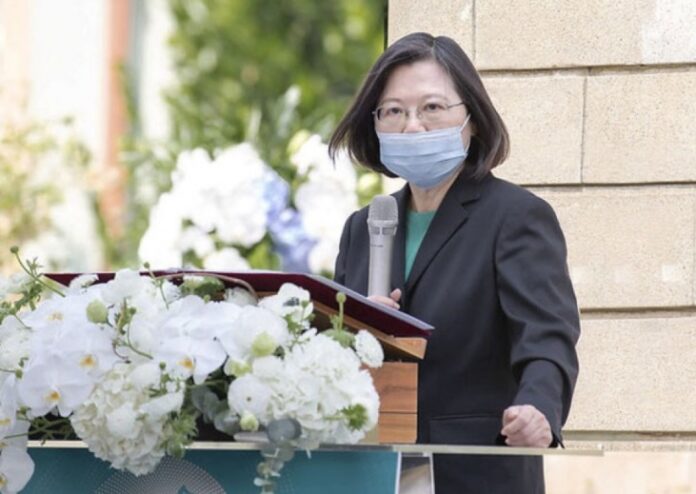
Taiwan President Tsai Ing-wen speaks at a ceremony held at Kaohsiung's 228 Peace Memorial Park on Feb. 28, 2021 to mark the 74th anniversary of the Feb. 28, 1947 massacre. (Photo courtesy of the presidential office via Kyodo)
TAIWAN (Kyodo) — Taiwan President Tsai Ing-wen on Sunday reiterated her government’s commitment to promoting freedom and democracy as she attended an annual ceremony to commemorate a 1947 massacre of civilian protesters.
“We must adhere to our values of freedom and democracy, which cannot be exchanged for anything else,” Tsai said at a ceremony held at Kaohsiung’s 228 Peace Memorial Park to mark the 74th anniversary of the Feb. 28, 1947 massacre.
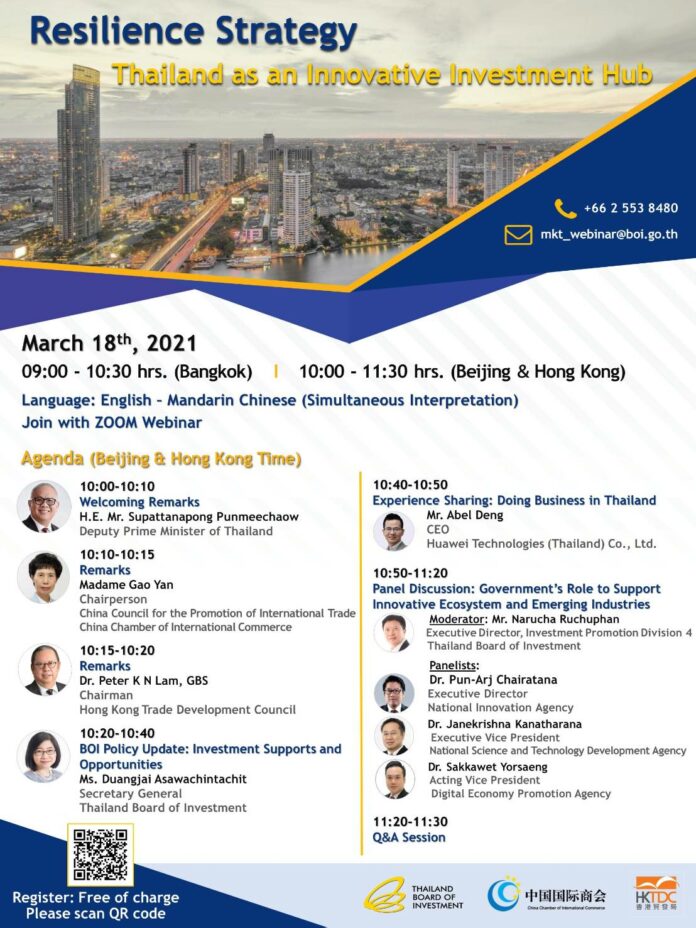
The Thailand Board of Investment (BOI) would like to cordially invite you to a webinar on “Resilience Strategy: Thailand as an Innovative Investment Hub” to share the latest information regarding the BOI’s investment supportive measures as well as investment opportunities in Thailand.
Date: 18 March 2021 (Thursday)
Time: 10.00 – 11.30 a.m. (Beijing and Hong Kong Time) // 09.00 – 10.30 a.m. (Thailand Time)
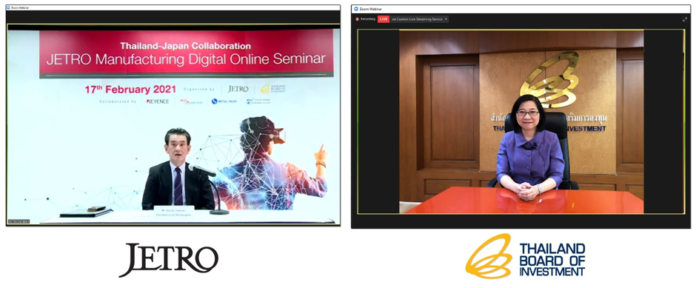
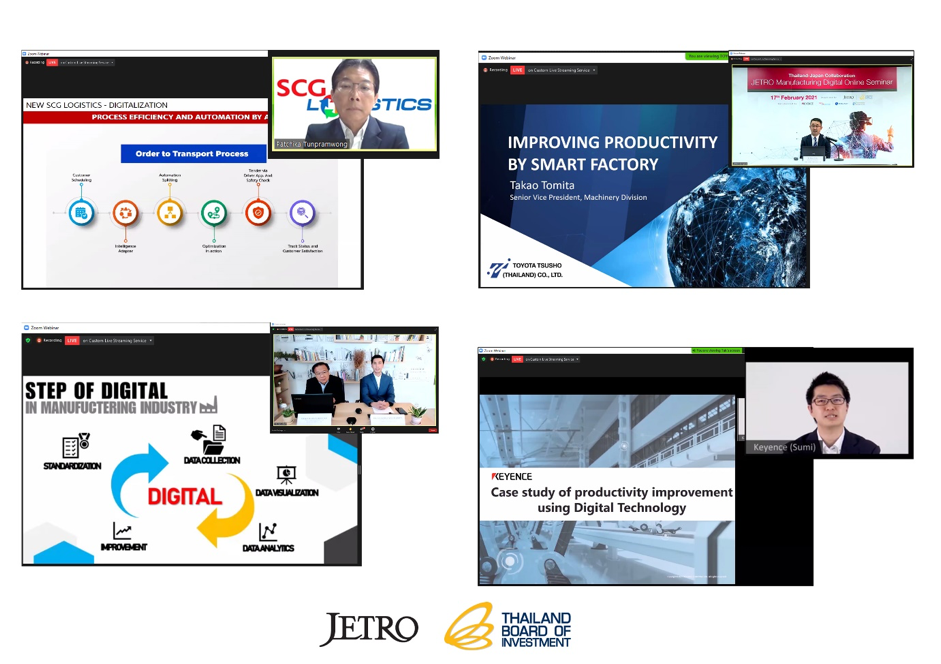
The Japan External Trade Organization (JETRO) together with BOI’s Thai Enterprise Development Division, held the “Thailand-Japan Collaboration JETRO Manufacturing Digital Online Seminar”. Attended by over 350 Thai and Japanese investors, the online seminar discussed the importance of digital technology in manufacturing and service industries. Besides the online seminar, between 19 February and 5 March, JETRO and BOI also jointly held more than 100 online business matching activities to connect Thai and Japanese investors in the digital ecosystem and created a website to introduce BOI policies and Thai and Japanese companies: https://mfgdigital-build.boi.go.th/.
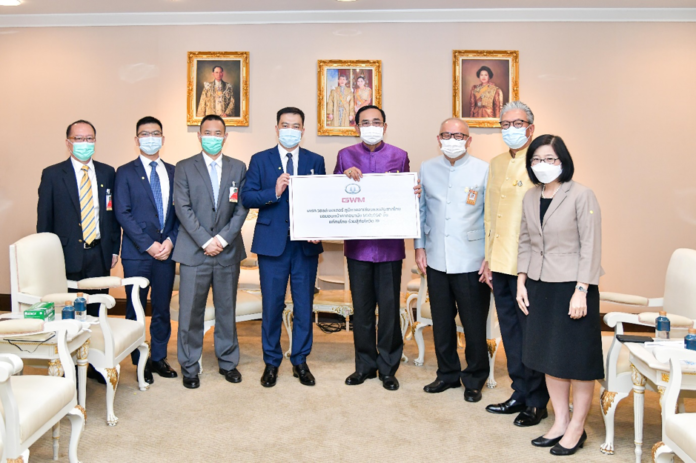
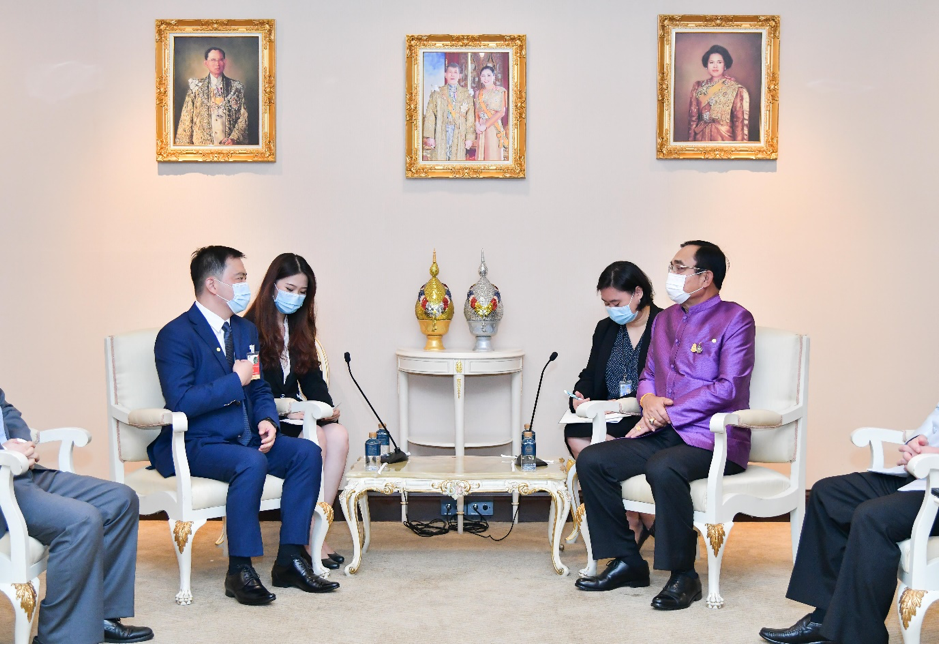
Mr. Elliot Zhang, President of ASEAN and Thailand Project at Great Wall Motor (GWM), and other company executives, met Gen Prayuth Chan-o-cha, Prime Minister of Thailand, and Ms. Duangjai Asawachintachit, Secretary General of the Thailand Board of Investment, to thank the Thai authorities for supporting GWM’s investment in Thailand. Mr. Zhang praised Thailand’s strength in the automobile sector, and said that the country, with its strategic location and government policies to promote electric vehicles, is at an advantage to serve as a regional EV production base.
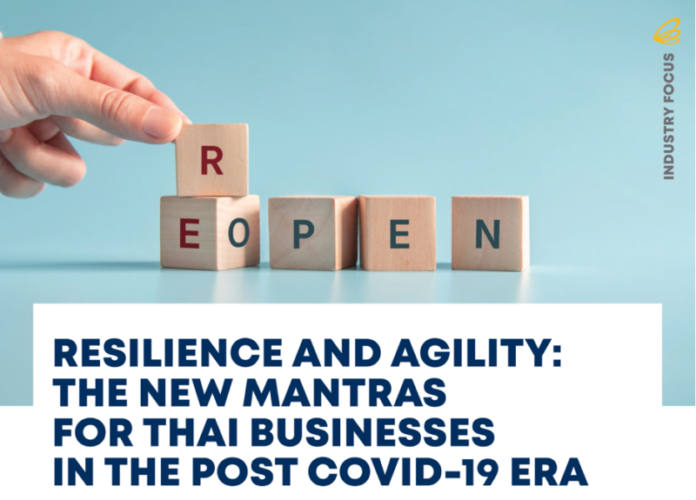
The Thai government has introduced many measures in recent years to support a vibrant ecosystem for startups, with an aim to drive innovations and strengthen competitiveness of the overall economy. The country’s rapidly advancing digital industry has driven the development across the economy from hardware to software, data, system integration, application development, logistics services and the creative economy. The trend also boosts the prospects of Thai startups which thrive on its resilient and agile business models looking to scale up to the global market.
Thailand’s e-commerce, which is currently standing at 3% of the country’s total retail sales, is growing rapidly in light of Thai people’s shift towards online transactions and their strong entrepreneurship. This, along with the Thai government’s proactive actions to accelerate digital transformation in business and public services, expand hard infrastructure investment, improve human resource development and revamp regulatory frameworks towards a business-friendly environment have promoted the country’s startup industry to blossom, resulting in more successful deals and funds raised since 2011.
As the COVID-19 pandemic has a profound impact on businesses and people’s daily lives, an increasing number of Thai tech startups are leveraging core technologies such as 5G, AI, machine learning and robotics as well as the country’s strength in e-payment business, highly-competitive telecommunications infrastructure, robust medical and healthcare, automobile, agricultural and biotechnology sectors as well as the strong ecosystem of the government’s support to create innovations and attract investors.
Arising Opportunities for Thai Startups
While the COVID-19 pandemic serves as a litmus test for growth strategies of businesses across the globe, some of Thailand’s most successful startups are reaping revenue, including e-commerce, e-payment, payment processing, blockchain and software that promotes remote working1 sectors as a result of the surge in transactions via digital platforms.
Thailand’s vibrant startup scene is a result of a robust ecosystem of the public sector support from agencies such as the National Innovation Agency (NIA)2, the Digital Economy Promotion Agency (DEPA)3, the Ministry of Science and Technology’s Startup Thailand4 and Thailand Board of Investment (BOI), whose missions are to support entrepreneurs, investors and accelerators through accommodative regulatory framework, various funding programs and technical support to tech-savvy talents to build innovations.
Since the beginning of 2020, Thai startups have raised over US$130 million, compared with around US$97.55 million by 35 Thai startups in 2019, and US$61.15 million raised by the same number of startups in 2018. Fintech had the most successful startup deals in 2019, at 20% of the total, followed by e-commerce at 17%, property tech at 9%, and food and restaurant tech, health tech, auto tech and education tech, each at 6%5. As at the end of September, around 314 startups had registered with Startup Thailand, the main agency supporting local startups.
To date, Thai corporates are the largest investors in Thai startups at the growth stage both in the form of fund-of-fund shareholding and direct investment. Meanwhile corporate venture capital funds (CVCs) support most of the Thai startups at the pre-seed and Series A levels.
There have been several major startup funding rounds during the past few years, including Series C, highlighting the growing prospects of the Thai startup ecosystem. Some of them do not limit their ambitions to Thailand, but plan to earn most of their revenue and raise funds from the international market. On the reverse side, the resilience and prospects of Thai supply chains are proving a prominent market for investment by global unicorns.
A Dynamic Backbone
With the COVID-19 pandemic having caused major disruptions to international travel, global trade and connectivity, MSMEs in Thailand and elsewhere have taken a severe hit due to weakened demand and unfavourable market conditions. As many industries are comprised almost entirely of MSMEs, these small enterprises are crucial to the supply chain continuation of several products. The Thai Government is gearing up aid packages in order to help the country’s many affected MSMEs revive and expand their operations.
Thailand’s MSMEs are the backbone of its economy, accounting more than one-third of the country’s GDP in 2019, at 3% YoY growth. MSMEs in manufacturing are the largest contributors to the economy, followed by MSMEs in retail, wholesale, and automotive repair businesses, respectively.
The Office of SMEs Promotion (OSMEP) reported that in 2019, MSMEs exported approximately US$33 billion worth of goods, or 13 percent of the country’s total exports. The top three exported products are gems and jewellery, sugar and confectioneries, and machinery and electrical appliances.
Led by OSMEP, a new focus of support has seen the policy expand from covering small and medium enterprises (SMEs) to include micro-sized business. Hence the coining of the new term – micro, small, and medium enterprises (MSMEs) to include enterprises with less than five employees and a net income of less than 1.8 million THB per year. Nationwide, the MSME sector accounts for more than 3.1 million entrepreneurs.
For MSMEs affected by the pandemic, the Thai government has swiftly rolled out a COVID-19 relief package composed of three key measures. Overseen by the Ministry of Finance and the Bank of Thailand, these measures include a six-month loan payment holiday for all MSMEs with a credit line not exceeding THB 100 million (around USD 3.2 million), soft loans to support liquidity for SMEs with a credit line not exceeding THB 500 million (around USD 16 million), and a reduction of the Financial Institutions Development Fund (FIDF) fee to ease the burden of loan interest.
In addition to the immediate relief package put forward by the government, investment promotion measures and non-tax incentives are available for MSMEs which adopt technology to enhance productivity.
BOI Encouraging Technology Application
Under the BOI’s 2020 vision of “Think Resilience, Think Thailand” a comprehensive package has been made available to enhance the competitiveness of MSMEs. In the first two quarters of 2020, the number of applications for investment promotions under the SME scheme has grown by 86% from the same period in 2019.
The BOI allows the ceiling of the Corporate Income Tax (CIT) exemption for Thai majority MSMEs with investment in high technology (A1-A4) such as automation and robotics as well as digital technology to be at 200% of the total investment capital, excluding land fees and working capital. This measure is intended to support MSMEs in developing their capabilities, achieving sustainable growth, and gaining access to funding and opportunities on the international market. Also, additional CIT exemption is granted on merit-based activities such as a 300% CIT exemption of the total investment amount on research, technological development, and innovation. Meanwhile, investment in high technology training and original packaging design can enjoy an additional 200% of CIT exemption.
Besides the tax incentives, the BOI also offers local activities that support business linkage and connection with the supply chain. Through the Thai Enterprise Development Division (BUILD), various business matching opportunities are made available. These include a marketplace where suppliers can showcase their products to potential buyers, a joint venture network where BUILD matches potential investment requests with MSMEs and start-ups, and the vendors meet customers (VMC) initiative where potential suppliers will be invited to visit buyers’ factories to learn and receive insights into the buyers’ procurement selection criteria as well as specific know-how concerning product manufacture.
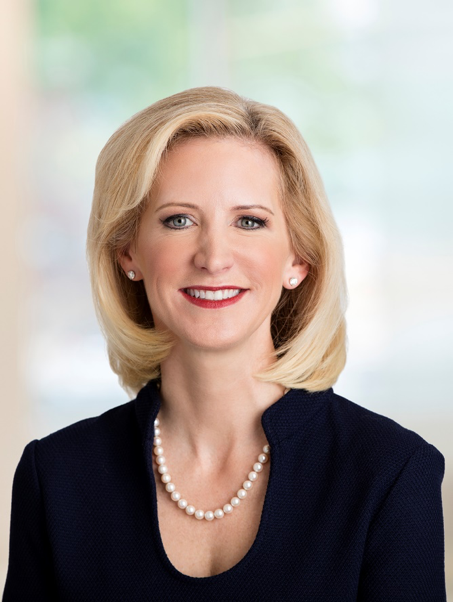
Marriott International’s (NASDAQ: MAR) Board of Directors announced today that Anthony “Tony” Capuano has been appointed Chief Executive Officer and has joined the company’s Board of Directors, effective immediately. He was previously Group President, Global Development, Design and Operations Services. The Board of Directors also announced that Stephanie Linnartz, previously Group President, Consumer Operations, Technology and Emerging Businesses, has been appointed President, effective immediately. Mr. Capuano’s and Ms. Linnartz’s appointments follow the unexpected passing of Marriott President and CEO Arne Sorenson on February 15, 2021.
“Tony has played a critical role in Marriott’s growth over the last decade,” said J.W. “Bill” Marriott, Jr., Executive Chairman and Chairman of the Board, Marriott International. “He will be a terrific leader as we continue to advance our growth strategy while also navigating the market dynamics of the COVID-19 pandemic. He works thoughtfully and pragmatically with our owner and franchisee community and has been steadfast in ensuring Marriott delivers operational excellence and elevated customer experiences at our properties. Tony has a deep appreciation for Marriott’s thousands of associates who ultimately deliver on our customer and brand promise and I know he will be a superb steward of our culture. Together with Stephanie in the role of President, and the rest of our exceptional leadership team, Marriott could not be in better hands,” Mr. Marriott said.
“I am honored to be appointed to take the helm of Marriott, but it is a bittersweet moment,” said Mr. Capuano. “Arne was a mentor, a champion and a friend to each member of his close-knit leadership team. It is because of Arne’s efforts that we are prepared to move forward with this transition. Together, we will advance the strategy we have in place, which is laser-focused on recovery, expansion, providing opportunities for our associates, maintaining constructive relationships with our owners and franchisees, delivering safe and innovative experiences for our guests and customers, and building value for our shareholders.”
Prior to this appointment, Mr. Capuano, 55, was Group President, Global Development, Design and Operations Services. In this role, he was responsible for leading global development and design efforts and overseeing the company’s Global Operations discipline. During Mr. Capuano’s tenure leading global development, the company grew its footprint from just over 3,200 properties in early 2009 to over 7,600 properties by year-end 2020. In addition, Mr. Capuano has overseen the tremendous growth and globalization of Marriott’s development pipeline to 498,000 rooms as of December 31, 2020, with more than half of the pipeline representing projects outside of the U.S. During the COVID-19 pandemic, Mr. Capuano has led Marriott’s work on its Commitment to Clean initiative, which was designed to enhance Marriott’s already substantial cleaning protocols to provide additional peace of mind for travelers.
Mr. Capuano began his Marriott career in 1995 as part of the Market Planning and Feasibility team. Between 1997 and 2005, he led Marriott’s full-service development efforts in the Western U.S. & Canada. From 2005 to 2008, Mr. Capuano served as Senior Vice President of full-service development for North America. In 2008, his responsibilities expanded to include all of U.S. & Canada and the Caribbean and Latin America, and he became Executive Vice President and Global Chief Development Officer in 2009. Mr. Capuano began his professional career in Laventhol and Horwath’s Boston-based Leisure Time Advisory Group. He then joined Kenneth Leventhal and Company’s hospitality consulting group in Los Angeles. Mr. Capuano earned his bachelor’s degree in Hotel Administration from Cornell University. He is an active member of the Cornell Hotel Society and a member of The Cornell School of Hotel Administration Dean’s Advisory Board. Mr. Capuano is also a member of the American Hotel and Lodging Association’s Industry Real Estate Financial Advisory Council.
Stephanie Linnartz Takes on President Role
As President, Ms. Linnartz will be responsible for developing and executing all aspects of the company’s global consumer strategy, including brand, marketing, sales, revenue management, customer engagement, digital, information technology, emerging businesses and loyalty strategies. In addition, Ms. Linnartz will oversee Marriott’s global development organization, which is responsible for the strategic growth of the company’s 30 lodging brands, as well as the global design and operations services functions. Ms. Linnartz will also spearhead the company’s progress on issues including the intersection of technology and hospitality, the continued growth of the Marriott Bonvoy loyalty platform, the excellence of our brand portfolio, and environmental sustainability.
“Stephanie has a leadership track record and clear vision for how our core lodging business, travel platform initiatives and loyalty strategies can work together to accelerate growth,” said Mr. Marriott. “Her deep experience across our business will enable her to work seamlessly with our owners and franchisees, innovate for our guests and customers, and champion new opportunities for our associates. Tony and Stephanie are exactly the CEO and President we need as we continue to push forward towards recovery and growth in the years ahead.”
“Every member of the leadership team feels a profound sense of loss at Arne’s passing. He was not just a friend and a leader for us, he was a guidepost for the hospitality industry,” said Ms. Linnartz. “The best way we can honor Arne’s memory is to continue to move the company forward. It is my privilege to take on the role of President and to work with Tony and the rest of the executive team to ensure a seamless transition and to successfully execute our strategy.”
Prior to this appointment, Ms. Linnartz, 52, was Group President, Consumer Operations, Technology and Emerging Businesses, where she was responsible for brand, marketing, sales, revenue management, customer engagement, digital, information technology, emerging businesses and loyalty strategies. Ms. Linnartz played a pivotal role during Marriott’s acquisition of Starwood Hotels & Resorts, overseeing the integration of business-critical systems including reservations, property management, revenue management and loyalty. In 2019, under her leadership, the company combined the Marriott and Starwood loyalty programs to create the world’s largest hospitality loyalty program, Marriott Bonvoy, which currently has more than 147 million global members.
Ms. Linnartz, who began her Marriott career in 1997, served as Global Chief Commercial Officer from 2013 to 2019; Global Officer, Sales and Revenue Management from 2009 to 2013; Senior Vice President, Global Sales from 2008 to 2009; Senior Vice President, Sales and Marketing Planning and Support from 2005 to 2008; and prior to that, various roles in Marriott’s Finance and Business Development Department. She currently serves on the board of directors of The Home Depot, the world’s largest home improvement retailer. She holds a bachelor’s degree in political science and government from the College of the Holy Cross, where she is a member of the Board of Trustees, and earned her Master of Business Administration from the College of William and Mary.