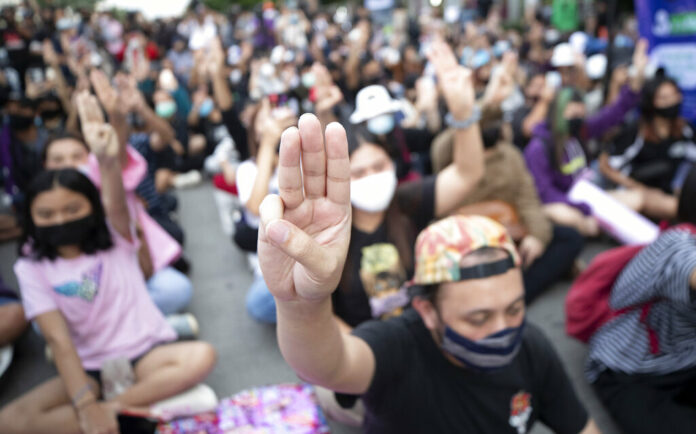
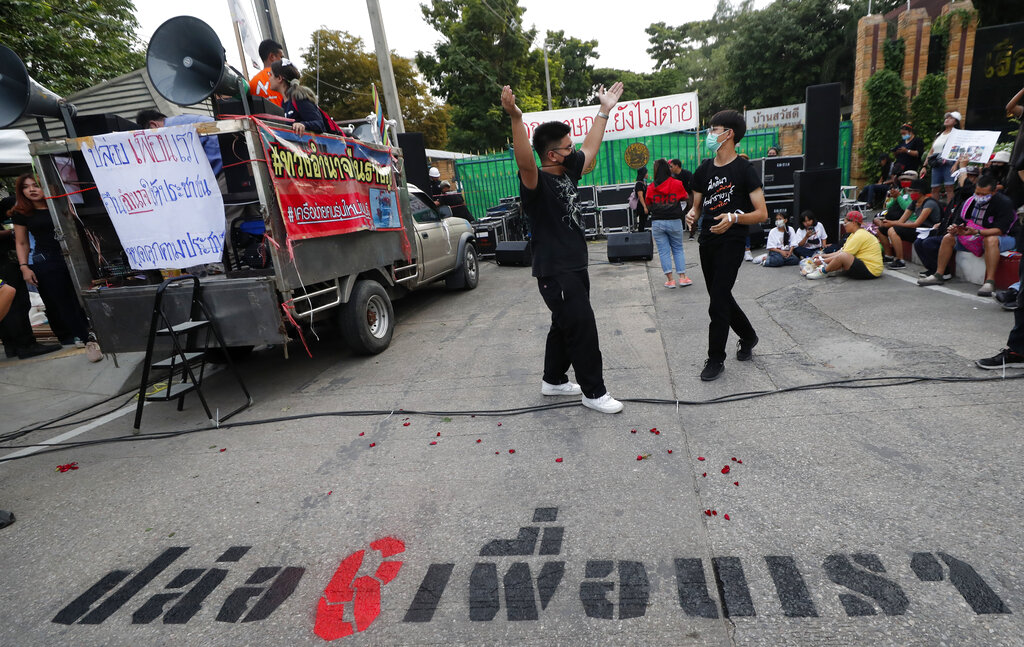
In this Oct. 23, 2020 file photo, pro-democracy activists flash three-fingered salutes outside Bangkok Remand Prison, in which some of the activists are kept, in Bangkok, Thailand. Photo: Sakchai Lalit / AP
BANGKOK (AP) — Thailand is considering an expansion of prison space as it arrests more political prisoners, the justice minister said Wednesday.
Somsak Thepsuthin said Bangkok Remand Prison and Klong Prem Central Prison, where most recently detained political prisoners are held, become congested when families and supporters come to visit.
“Therefore, we are discussing finding a larger area that can accommodate more people for everyone’s convenience,” he told reporters. He denied speculation that a separate new prison would be built for political prisoners.
“Everyone should be treated equally,” Somsak said.
The legal aid group Thai Lawyers for Human Rights recently said at least 382 people, including 13 minors, are facing charges related to political demonstrations and expressing political views from July 2020 through the end of last month.
A student-led pro-democracy movement took hold last year that is calling for Prime Minister Prayuth Chan-ocha and his government to step down, the constitution to be amended to make it more democratic and the monarchy to be reformed to make it more accountable.
In this Oct. 23, 2020 file photo, pro-democracy activists flash three-fingered salutes outside Bangkok Remand Prison, in which some of the activists are kept, in Bangkok, Thailand. Photo: Sakchai Lalit / AP
When the protests became more critical of the monarchy, the authorities stepped up their prosecutions of activists. More than 60 of the people cited by the Thai Lawyers for Human Rights have been charged under the lese majeste law, which makes defaming the monarchy punishable by up to 15 years in prison per incident.
On Wednesday, the Criminal Court sentenced a 22-year-old man to 4 1/2 years in prison for violating the Computer Crime Act by creating several accounts on Facebook on which he allegedly made nine posts criticizing the monarch in April 2020.
The man, a waiter, had his sentence halved from the original nine years because he pleaded guilty, a standard practice in Thai courts.
The Department of Corrections website says Bangkok Remand Prison holds 3,195 prisoners, while Klong Prem Central Prison accommodates 7,009.
On March 9, 2021, Samitivej Hospital launched a campaign to target and solve pain points for patients who wish to avoid hospital visits, are worried about illnesses, or have concerns about high medical expenses. In addressing these issues, we offer patients the option of online doctor consultations, and we provide people with excellent healthcare via preventive health check-up programs, artificial intelligence technology for the detection of diseases before they occur, cost reduction management through our expense management dashboard system and smart equipment pooling system, and added value through vouchers for cash with values of up to 25%, in line with Samitivej’s ongoing goal of keeping people healthy and preventing illness.
Chairat Panthuraamphorn, M.D., Managing Director and CEO of Samitivej and BNH Hospitals, stated: “At present, many people throughout the country are experiencing a wide variety of economic, physical health, and mental health problems. At Samitivej, we aim to be a segment of society that is part of the solution for people. There are many pain points that need to be targeted and resolved—there are those who avoid hospital visits due to fear of contracting disease; there are those who are worried about illnesses in general, knowing that if they get sick they will suffer not only physically, but mentally as well; and there is the issue of healthcare expenses, where maintaining one’s health becomes a significant cost of living. Samitivej, therefore, continues to hold true to its vision of ‘we want people to stay healthy, and not fall ill’ by launching a campaign to meet these needs and to create value in every dimension of healthcare.
“We started our online doctor visitation services as an alternative for patients even before COVID-19. During the COVID-19 pandemic we saw a huge increase in the number of users of the service. In addition, self-care has become increasingly important to people, and Samitivej met this need with Engage Care, a technology designed to help patients suffering from diabetes and high blood pressure to better care for themselves while at home. From the time they awake in the morning, patients can easily measure their own sugar levels. If these levels are outside the target range, the system will send an alert to the hospital so that a doctor can immediately follow-up and provide treatment. We also provide services that connect the hospital’s healthcare to patients’ homes, such as through TytoCare devices that can be used to measure temperature and heart rate, listen to lung functions, etc., allowing doctors to provide accurate diagnoses and consultation online with greater confidence. We offer at-home vaccination and drug delivery services as well.”
The campaign creates value in all areas of healthcare, as detailed below:
For patients who wish to avoid hospital visits because they are afraid of contracting disease, we offer technology designed to save lives as follows:
Samitivej Virtual Hospital: Online doctor consultation 24/7, alongside TytoCare, an examination kit that can be used for lung examination, capture images inside the ear, examine the back of the throat, capture images of the skin, measure body temperature, and listen to and record heart rate.
Engage Care: An application to monitor and track health indicators for patients with diabetes or high blood pressure and connect them with a team of medical professionals providing services 24 hours a day.
Samitivej PACE: Technology enabling families to monitor the status of each stage of a patient’s surgery via smartphone.
Samitivej Prompt: A system providing access to inpatient treatment plans and for monitoring status during treatment.
For those who wish to prevent illness, Samitivej emphasizes its Early Detection Technology to save lives, as follows:
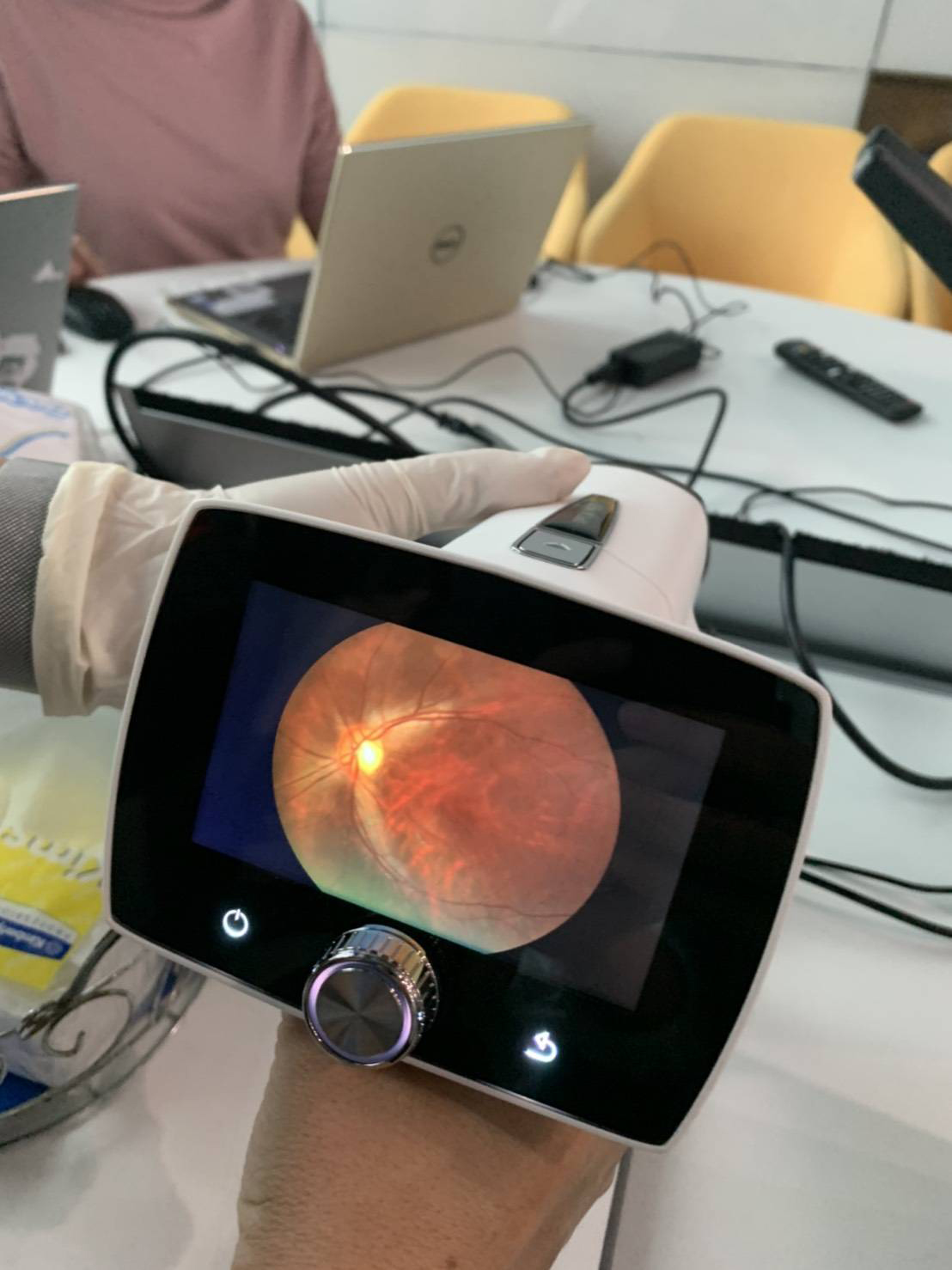
TrueEye® artificial intelligence technology which uses retinal images to predict risk factors for cardiovascular diseases and diabetes. This deep tech project is supported by the Chulalongkorn University Technology Center (UTC).
Total Health Solutions, with a focus on preventive screening to prevent the occurrence of disease in specific age groups.
Gene Testing with deep sequencing, in order to identify future disease risks.
Vaccine Club, a vaccination care program for all age
Innovation to facilitate greater convenience, create value and save costs, as follows:
Payment Dashboard, a system to track and manage expenses within insurance limits.
Smart Equipment Pooling System for better management of medical equipment and the reduction of patient costs.
Vouchers for cash with values of up to 25% to apply toward hospital services.
– Pay 5,000 THB and receive privileges valued up to 5,750 THB
– Pay 10,000 THB and receive privileges valued up to 12,000 THB
– Pay 30,000 THB and receive privileges valued up to 37,500 THB
Participating Hospitals: Samitivej Sukhumvit Hospital, Samitivej Srinakarin Hospital, Samitivej Children’s Hospital, Japanese Hospital by Samitivej, Samitivej Thonburi Hospital, Samitivej Chinatown Hospital, Samitivej Sriracha Hospital, and Samitivej Chonburi Hospital.
Available through June 30, 2021. Call 02-022-2222 or email [email protected]for more information.
About Samitivej Hospitals
Samitivej Hospitals started operation on June 4, 1979. Our hospitals are among the 43 members of Bangkok Dusit Medical Services Public Company Limited, which operates leading hospitals in Thailand and South East Asia. We offer healthcare services certified to meet both local standards and standards set forth by Joint Commission International (JCI) from America. There are currently eight member hospitals—Samitivej Sukhumvit Hospital, Samitivej Japanese Hospital, Samitivej Srinakarin Hospital, Samitivej Children’s Hospital, Samitivej Chinatown Hospital, Samitivej Thonburi Hospital, Samitivej Sriracha Hospital, and Samitivej Chonburi Hospital.
For more information, please contact Sasikan Lertsittichai, Brand Communication Manager at [email protected]or Tel 020-222-443.
Kazumi Endo stands on the beach in Soma, Fukushima Prefecture on Dec. 9, 2020. (Kyodo)
VIENNA — Michiyo Suzuki remains undecided on whether to return to her hometown of Futaba in Fukushima Prefecture, where the crippled Fukushima Daiichi nuclear plant is located.
When a massive earthquake and tsunami struck on March 11, 2011, her family was unable to find a space in an evacuation center and was forced instead to spend the night in their car. The next morning, they were simply instructed to “flee to the west.”
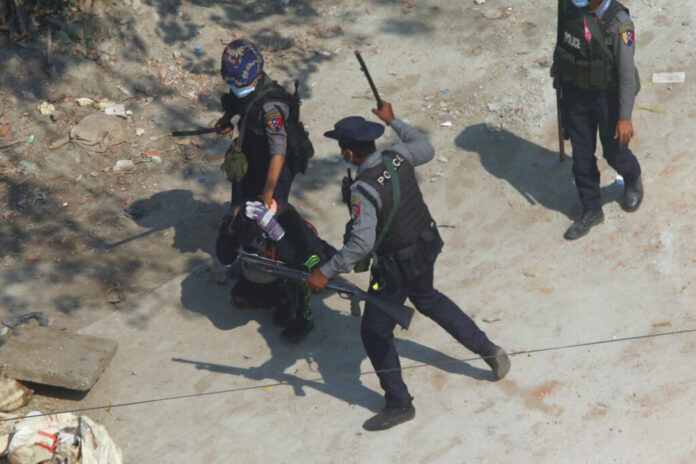
In this March 6, 2021, file photo, riot police officers hold down a protester as they disperse protesters in Tharkata Township on the outskirts of Yangon, Myanmar. Myanmar’s military-controlled government is seeking to suppressing media coverage of protests against their seizure of power as journalists and ordinary citizens strive to keep people inside and outside of the country informed about what is happening. Photo: AP
BANGKOK (AP) — Myanmar’s military-controlled government is cracking down on coverage of mass protests, raiding media companies and detaining dozens of journalists since its Feb. 1 coup,including Thein Zaw of The Associated Press.
The crackdown comes as the military has escalated violence against mass protests and as independent media continue to cover the arrests and shootings by troops in cities across Myanmar. In some instances, journalists are using social media to get the information out.
How has the media landscape in Myanmar changed since the coup? Here’s a look:
HOW IS THE GOVERNMENT SUPPRESSING NEWS?
Authorities raided the offices of Kamayut Media on Monday, detaining its co-founder, Han Thar Nyein, and editor-in-chief, Nathan Maung. Witnesses said seven military trucks were involved in the raid, according to a member of Han Thar Nyein’s family. The military also raided the offices of Mizzima News.
A day earlier, five local outlets — Mizzima, DVB, Khit Thit Media, Myanmar Now and 7Day News — were banned from broadcasting or providing any information on any media platform or using any technology after their licenses were canceled, state broadcaster MRTV reported. All had covered the protests extensively and often livestreamed video.
Myanmar Now, an independent news service, reported that police broke down the door of its office Monday and seized computers, printers and parts of the newsroom’s data server. It cited unnamed witnesses and showed a photo of CCTV footage. But it said the office had been evacuated in late January.
Human rights groups an journalism organizations have condemned the attacks on freedom of the press.
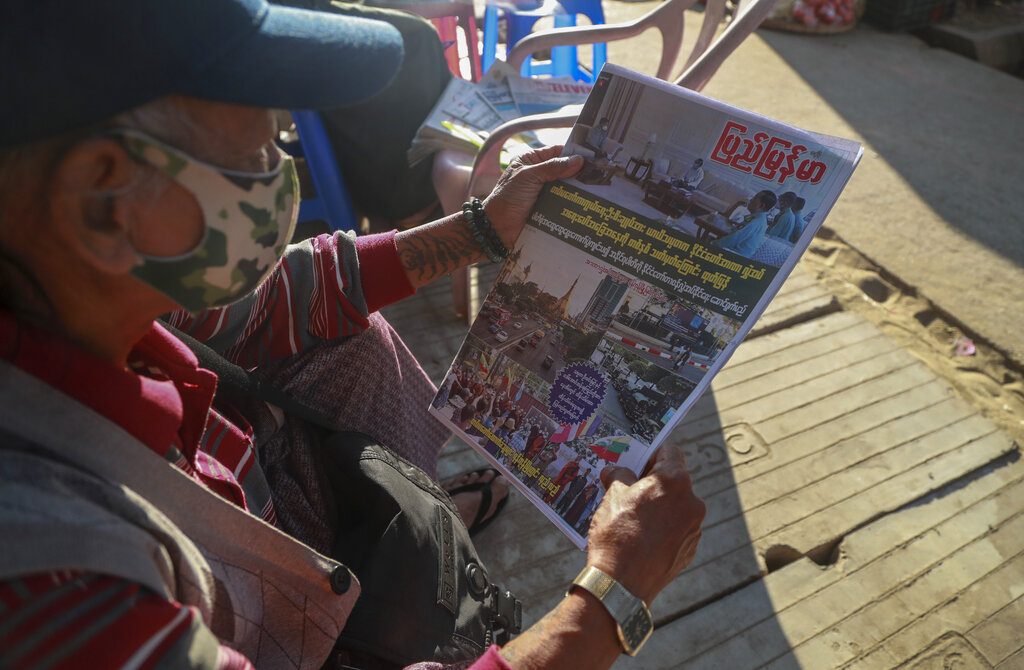
In this Feb. 2, 2021, file photo, a man looks at a newspaper, which reports “1 year of State of Emergency and Acting President transferred Power to Military Chief” on the front page, in Yangon, Myanmar. Photo: AP
HOW ARE INDEPENDENT MEDIA OUTLETS RESPONDING?
For now, they are vowing to press on despite the risks.
“What is certain is that we will not stop covering the enormous crimes the regime has been committing throughout the country,” said Swe Win, Myanmar Now’s editor-in-chief.
Mizzima, another privately owned, independent local news outlet, put out a statement on its website saying it “continues to fight against the military coup and for the restoration of democracy and human rights” using various online and multimedia platforms. Other outlets also still reported on protests Tuesday. Some media organizations are trying to operate from abroad.
WHAT KIND OF MEDIA ARE STILL LEGALLY OPERATING IN MYANMAR?
Myanmar seems to be reverting to its old system where officially sanctioned media are entirely state-controlled, as they were before August 2012. Even before the coup, under the military-dominated, quasi-civilian government led by Aung San Suu Kyi, journalists faced arrest and harassment for reporting on sensitive topics such as abuses against its Rohingya Muslim ethnic minority.
Reuters journalists Wa Lone and Kyaw Soe Oo were given seven-year prison sentences, but later pardoned, for trying to investigate a massacre of Rohingya civilians. Myanmar ranked 139th of 180 countries in Reporters Without Borders’ 2020 World Press Freedom index. Journalists often have faced criminal prosecution for online defamation.
The English-language Myanmar Times announced it had suspended all publications for three months beginning Feb. 21. That move came after many of its staff quit to protest the paper’s agreement to follow a junta order not to use the word “coup” to describe the military takeover.
Another state-controlled newspaper, the Global New Light of Myanmar, is still publishing. Other state media include the Myanmar News Agency and army-controlled Myawaddy TV.
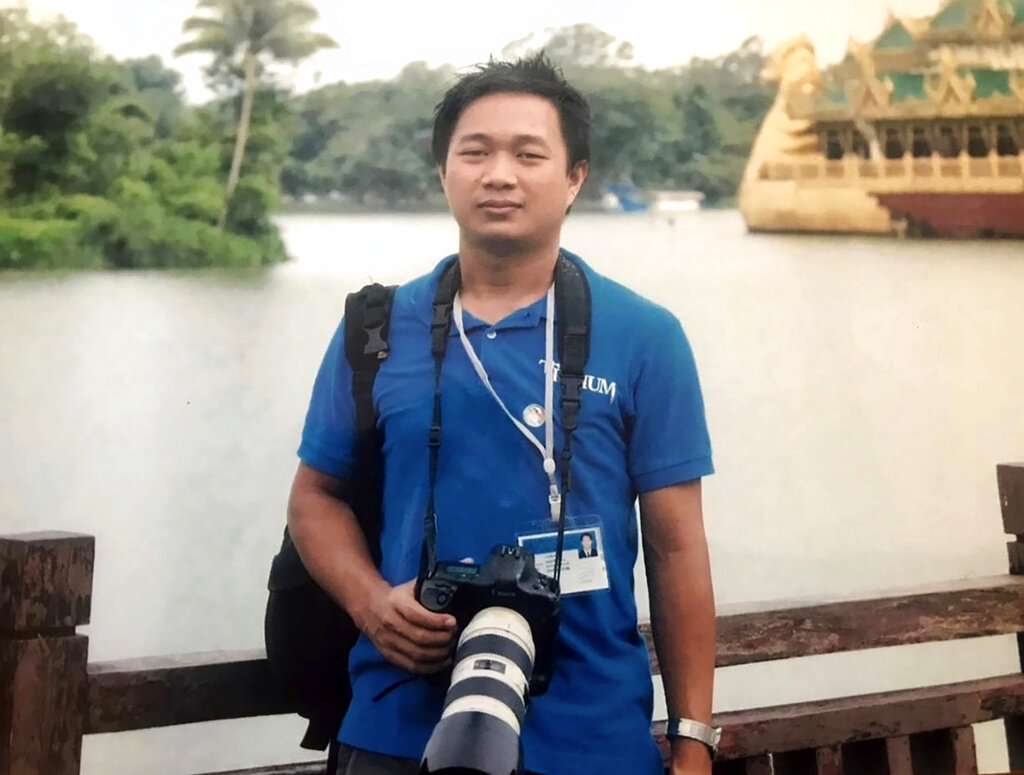
This undated family file photo provided on Wednesday, March 3, 2021 shows Associated Press journalist Thein Zaw in Yangon, Myanmar. Photo: Thein Zaw family via AP, File
WHAT ARE THE LONGER-TERM RAMIFICATIONS?
Suppressing all reporting would require a complete blackout of all internet and satellite communications. Apart from the legal and human rights implications, that would be a huge setback for the country’s economy. Myanmar’s businesses are highly reliant on the internet and on digital platforms like Facebook, having developed quickly in the past few years after decades of relative isolation under previous military governments.
So far, the junta has chosen to shut down internet links at night, hindering but not completely stopping such communications. Because modern businesses rely heavily on the internet and the free-flow of communication and information, the military’s actions are further damaging a business environment already devastated by the coup and its aftermath.
In this March 5, 2018, file photo, a Vietnamese passenger boat sails past U.S. aircraft carrier USS Carl Vinson as it docks in Danang bay, Vietnam. Photo: Hau Dinh / AP
SAN DIEGO (AP) — A former executive for a Malaysian defense contractor linked to a sweeping corruption scandal that cost the Navy some $35 million appeared Tuesday in a California courtroom to face federal charges.
Pornpun “Yin” Settaphakorn appeared before a judge in San Diego and was ordered detained pending another hearing next month.
Settephakorn, of Thailand, was extradited from that country last week, according to a statement from the U.S. attorney’s office.
Settphakorn oversaw the Thailand office of Glenn Defense Marine Asia, which provided fuel, food and other services to Navy ships in Pacific ports.
Prosecutors said the firm and its owner, known by his nickname of “Fat” Leonard Francis, bribed Navy officers with fancy gifts, trips and prostitutes to provide classified information in order to beat competitors and overcharge for services.
The scheme cost the Navy some $35 million.
Settaphakorn was charged in 2014 with involvement in a conspiracy to submit fraudulent price quotes, claims and invoices to the Navy.
It wasn’t clear whether she had an attorney in California to speak on her behalf.
More than a dozen Navy and company officials, including Leonard and an admiral, have pleaded guilty in the case.
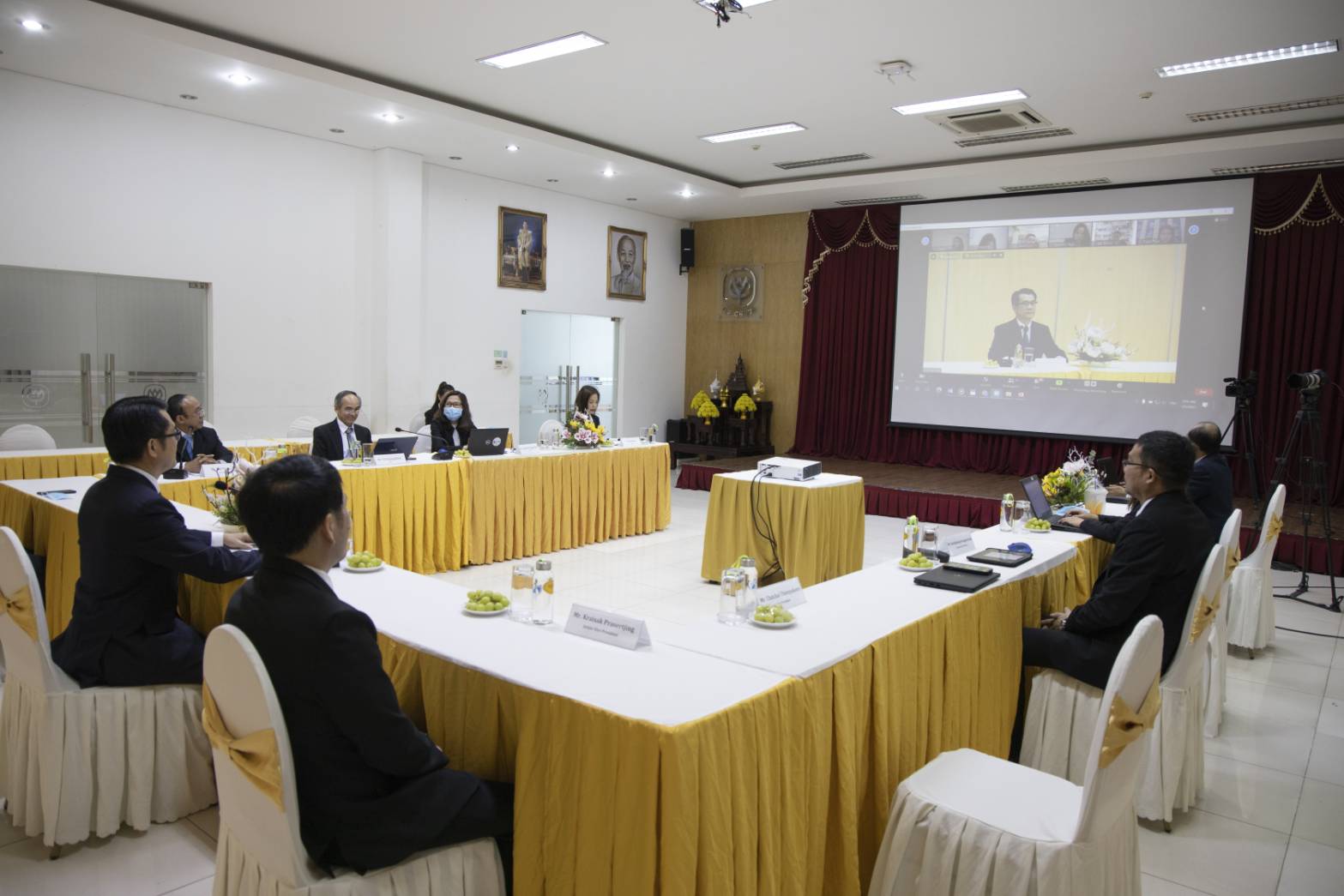
CP Vietnam Corporation (CP Vietnam) hosted the second edition of “Capacity building for partnership” training programme for critical suppliers to help them transition toward a more sustainable working culture, especially in the areas of human rights and labour practices.
Mr. Chamnan Wangakkarangkul, Executive Vice President – Agro Feed and Food Products Business and President of Sustainable Sourcing Committee of CP Vietnam, said the company has applied and communicated CP Foods’ sourcing policy, covering four main areas that are product and services’ traceability (Product), fair treatment of employees and human rights (People), environmental-friendly process (Process), and verifiability performance and risk management (Performance).
To achieve this goal, CP Foods has shared its expertise in sustainable practices, including its knowledge in human rights, workplace safety and good labour practices, to the suppliers. He added that, good and sustainable practices will raise their competitive advantage at a global stage.
“Nowadays, companies around the world are looking for a partner with ESG (Environmental Social and Governance) practice. This training program will guide our critical suppliers to be one of them, a supplier of choice for leading corporate and government organizations.” Mr. Chamnan said.
Mr. Worawit Arunraksa, Assistant Vice President Corporate Social Responsibility & Sustainable Development (CSR&SD) of CP Vietnam, added that “Capacity building for partnership” training programme which initiated following the success of the same program by CP Foods in Thailand. The first batch was held in 2019 for 78 critical suppliers in the southern part of Vietnam. Meanwhile, this year program was made for 70 suppliers in the northern part, covering packaging, ingredient, services, machinery etc.
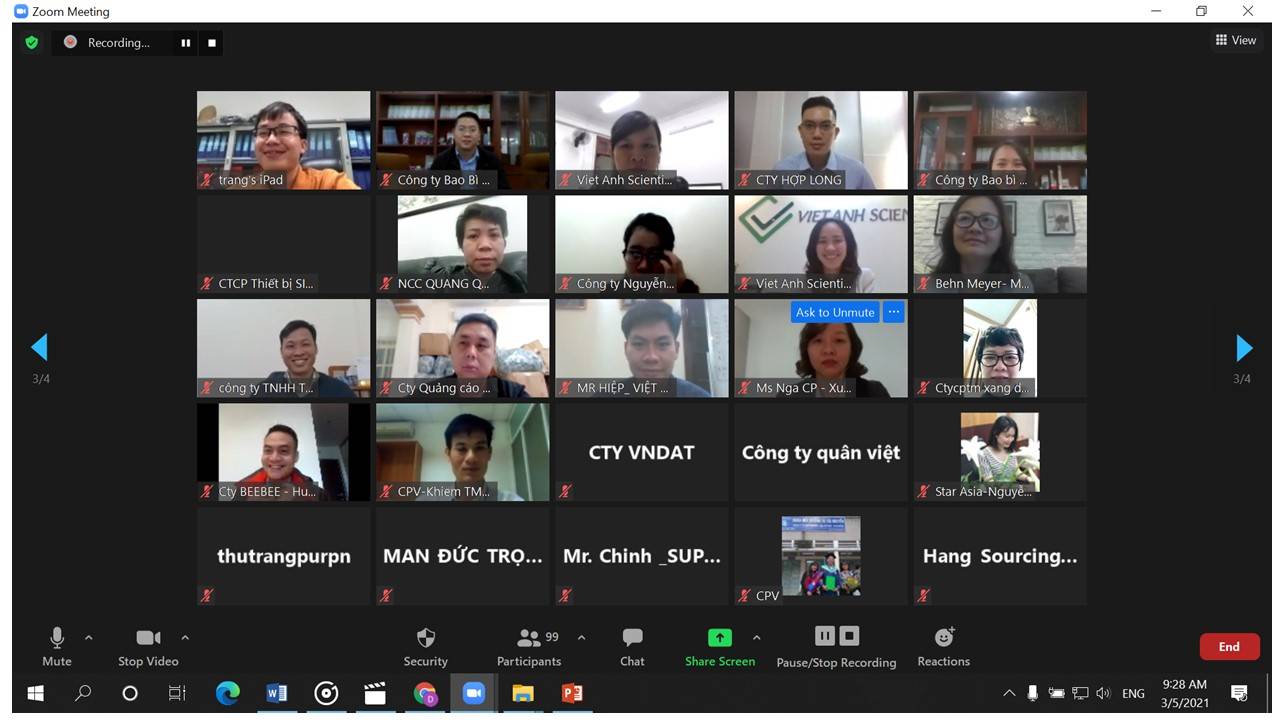
This year training program was held online to avoid the risk of COVID-19 with specialists from SGS, the world’s leading inspection, verification, testing and certification company, in charge of labour laws and human rights training and CP Vietnam’s SHE&EN team on occupational health and safety measures.
CP Vietnam also encourage its suppliers to apply the company’s Online Supplier Sustainability Self-Assessment to ensure that they are stringently comply with law and international trade regulations.
Mr. Worawit added that, after the training program, the company will work closely with the suppliers, providing a guidance to help them transition toward a better practice.
Being recognized for its sustainable practices, the Vietnam Business Council for Sustainable Development (VBCSD) has named CP Vietnam Corporation (CP Vietnam) among Top 10 sustainable companies in the manufacturing sector in 2020. Moreover, it was listed in the Corporate Sustainability Index (CSI) 100 for the third consecutive year.
Charoen Pokphand Foods Public Company Limited (CPF) proceeds with its effort to promote responsible operations among business partners and suppliers, to engage them in the development of agricultural supply chain and food industry for sustainable development.
Mr. Siripong Aroonratana, chief operating officer of CPF, said that as a world-class producer and exporter of quality food to over 30 countries, CPF is striving to continually enhance business partners’ and suppliers’ capability in strictly complying with laws and regulations as well as international standards. The goal is to reinforce economic, social and environmental responsibility throughout the supply chain by uniting all in the delivery of high quality, safe and traceable food in response to increasing demand for products from responsible production process and sources as well as the New Normal way of life following the COVID-19 outbreak.
“In producing and delivering quality food in a sustainable manner requires suppliers’ engagement. Considered our “business partners”, they must responsibly produce products and source raw materials and ensure their operations meet international standards. This will not only help address consumers’ preferences and challenges in the global scene, but also contribute to mutual growth for both CPF and the suppliers and sustainable development for society and the environment,” Mr. Siripong stressed.
CPF has informed and communicated with suppliers the Company’s Sustainable Sourcing Policy and Suppliers Guiding Principle since 2015. Each year, CPF has organized a seminar to promote knowledge and understanding in labor management. It has also conducted an annual assessment on suppliers’ sustainability, to help suppliers improve their operations and conform with CPF’s and international sustainable development principles.
In 2021, CPF will proceed with the suppliers’ capability building and sustainability assessment, to ensure their conformity with CPF’s Sustainability Policy’s 4P principles which entail Product, People, Process and Performance; as well as international sustainable sourcing standards that involve treatment of labor, human rights principles, environmental management, and optimization of energy and resources. The conformity is aimed at enhancing the confidence of customers and consumers, through the delivery of high-quality, nutritious, safe and traceable food products that come from a sustainable supply chain.
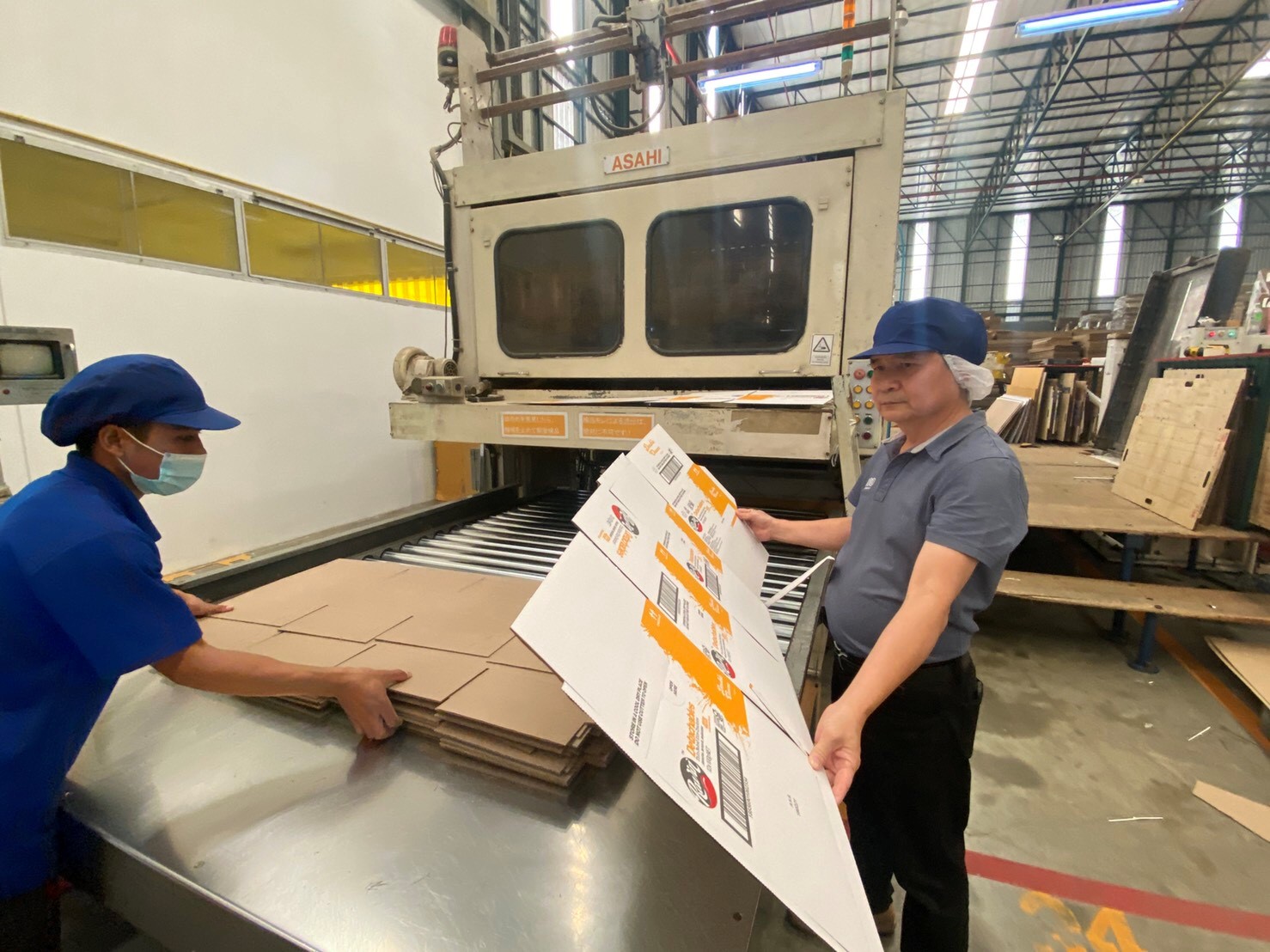
Mr. Vichapoom Kantanarumitrakul, managing director of A.N.B. Packaging Co., Ltd. which has supplied corrugated boxes for CPF’s product delivery to the world for more than 20 years, said that aside from cost and profit, A.B.N. Packaging has to be concerned with business ethics, fair treatment of employees and sustainable material sourcing which must not violate laws or harm forests. The concerns have fostered solid growth for the company and won trust from CPF and customers for a long period.
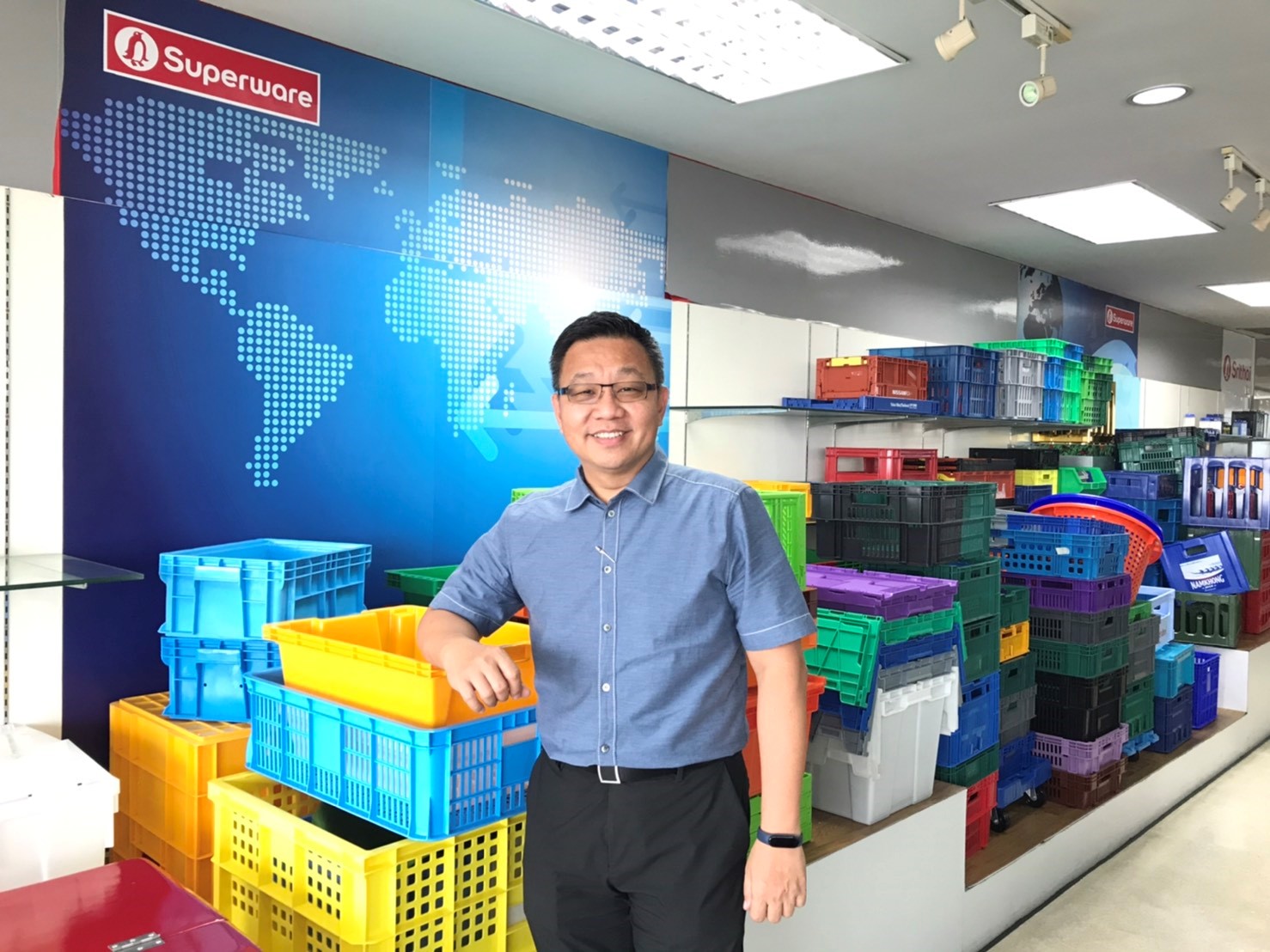
Mr. Khajadpai Areeprasertsook, Director of marketing and sales – industrial products of Srithai Superware PLC.
Mr. Khajadpai Areeprasertsook, Director of marketing and sales – industrial products of Srithai Superware PLC which is a packaging supplier of CPF, said that by integrating sustainability into the company’s business strategies, Srithai Superware has enjoyed increasing trust from customers and consumers. Business stability in turn draws talented employees who have further driven the company forward. Importantly, operating business under sustainability principles has introduced new trade and marketing opportunities to the company.
Mr. Chatchai Wachiratienchai, managing director of Aur-Aree Food Product Co., Ltd.
Mr. Chatchai Wachiratienchai, managing director of Aur-Aree Food Product Co., Ltd., added that as a supplier of garlics and chili for CPF for 12 years, the company is required to emphasize organizational development and conformity with CPF’s standards. As a result, the company’s employee benefits and product quality and development are closer to international standards. Meanwhile, the company has applied the knowledge obtained from CPF with its sustainable garlic peeling project and a program dedicated to uplift organic vegetable farming in Chiang Mai Province.
Corporate Mission “Grow in Thailand, Contribute to Thailand”
aims to support digital transformation while giving back to society
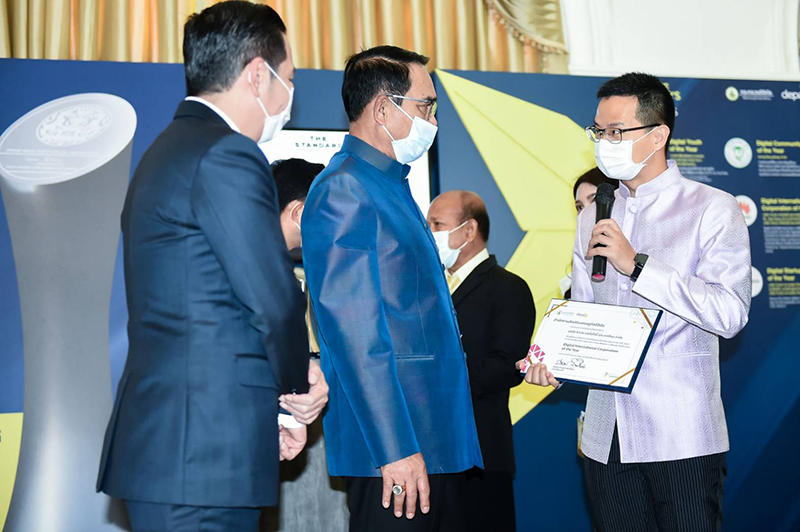
[Bangkok, Thailand/ 9 March 2021] Huawei Technologies (Thailand) Co., Ltd. has been chosen for the Special Prime Minister Award for the “Digital International Corporation of the Year” category. The award recognizes Huawei Thailand for its valuable support and outstanding contributions to Thai society since its establishment in the country 21 years ago and its efforts to support digital transformation. It is the only company to receive this award.
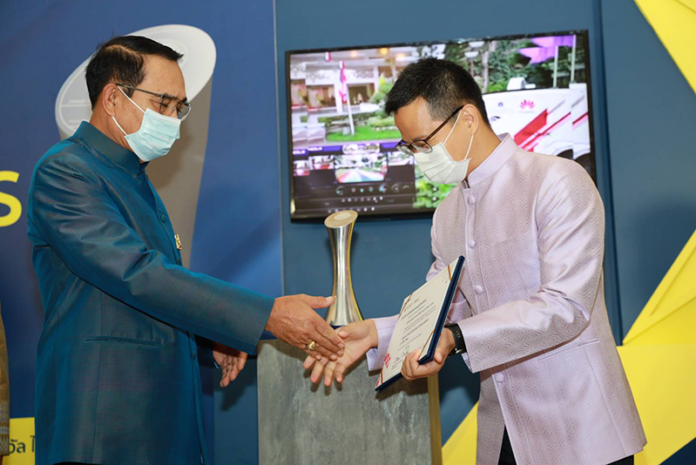
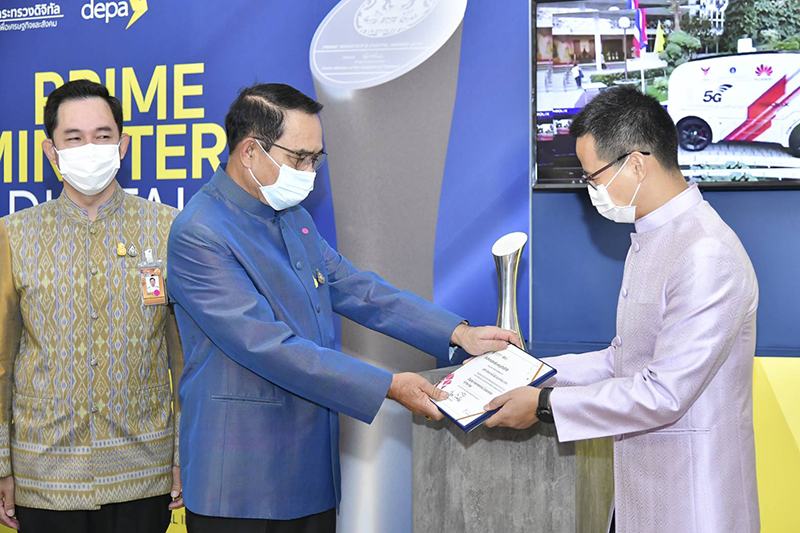
Mr. Abel Deng, CEO of Huawei Technologies (Thailand) Co., Ltd., accepted the award from HE General Prayut Chan-o-cha, Prime Minister of Thailand in the presence of Mr. Nuttapon Nimmanphatcharin, President/CEO of Digital Economy Promotion Agency (depa), during the award ceremony held at Government House.
The Prime Minister congratulated this year’s awardees. He commended the younger generation for being able to apply digital technology creatively and for leveraging on innovation to create new businesses to move ahead together. He also added that the government gives importance to the development of 5G and AI systems to drive Thailand forward and expressed hope that today’s success will inspire university students to make use of digital technology to create business opportunities for the country in the future. In addition, the Prime Minister congratulated Huawei executives and asked them to continue the company’s mission to drive Thailand forward.
“The PM’s Digital Awards recognize organizations whose products and solutions help drive digital technology and innovation development. For the PM’s Special Award: Digital International Corporation of the Year, the criteria for this distinction includes excellence in development of digital technology that supports enterprises, services and the society; application of digital technology that drives better economy, society, culture and security for Thais; investment that creates jobs in Thailand; social and environmental development that support local and international economy. Huawei received the highest scores from our distinguished committee,” said Mr. Nuttapon Nimmanphatcharin, President of Digital Economy Promotion Agency. “Our collaboration with Huawei has been central not just for the country’s development, but also crucial when technology is used for emergency responses to unforeseen events such as natural disasters, security threats, health crises and others. During the COVID-19 pandemic, the company instantly applied the world’s leading technology called AI-assisted solutions and 5G technology to support the country’s medical working teams at government hospitals. Recently, Thailand’s first 5G Ecosystem Innovation Centre (5G EIC) was launched at depa’s office, thanks to a collaboration between the Digital Economy and Society Ministry, Digital Economy Promotion Agency (depa) and Huawei. Our partnership with Huawei and our ability to leverage on 5G technology give us an edge in enhancing our business competitiveness. I would like to congratulate the company on this achievement. We are grateful for Huawei’s goodwill and continuous efforts to help drive the digital economy in the country,” he added.
“It is an honor for me to accept the Prime Minister’s Award on behalf of Huawei Technologies,” said Mr. Abel Deng, CEO of Huawei Thailand, during the ceremony. “At Huawei, we value long-term partnership. We are committed to collaborating with customers and partners to help keep Thailand at the forefront of the digital age. With the mission of ‘Grow in Thailand, Contribute to Thailand, Huawei reinforces its commitment to helping the country move forward to Thailand 4.0 and become a digital hub in the Asia Pacific region, and to ensuring that no one is left behind. We will bring digital to every person, every home and organization, for a fully connected, and intelligent Thailand.”
This year’s award is another recognition of Huawei’s leadership in Thailand’s digital scene. Among its success factors for this special recognition are:
For digital economy: • Open Lab Bangkok: one-stop support to provide industry solutions for the IoT, Big Data, and cloud computing, a verification platform, and ICT training services for customers and ICT industry entrepreneurs in Thailand and Southeast Asia • 5G EEC Testbed: established the first 5G Test Bed in a real world-setting in Southeast Asia located in Kasetsart University, Sri Racha campus (Eastern Economic Corridor). • Thailand 5G Ecosystem Innovation Center: Jointly established by Digital Economy Promotion Agency, Ministry of Digital Economy and Society, the center serves as a sandbox for SMEs, startups, developers, educational institutions to develop the digital innovations for 5G applications and service, incubate local digital talents and upgrade digital skills.
For social advancement: • AI-assisted solutions for government hospitals: AI-powered software provided to Ramathibodi and Siriraj Hospitals to help make COVID-19 diagnosis solutions faster and more efficient using 5G technology. • Huawei Telemedicine Video Conference Solution for the Ministry of Public Health: Real-time and full-functional teleconference system that can facilitate Thai medical staff and teams without risk of infection; doctors can conduct remote online consultations; patients can be diagnosed, treated and monitored through their own smart devices. • Unmanned vehicles using 5G: contactless delivery of medical goods within the hospital to reduce infection risks of frontline workers.
For human capital development:
• Huawei ASEAN Academy: partnering with local business, technical and engineering schools to “produce 100,000 digital and tech-related workers within 5 years”
• 5G courses by global experts and chief scientists from Huawei: topics such as 5G trends, commercial plans, 5G standards, use cases, business model ideas, etc. to promote multi-dimensional thinking
The leading tech company announced that more projects will be organized later this year to help Thailand strengthen its 5G ecosystem. In partnership with depa, Huawei will host the 5G Summit, 5G Industry Alliance and 5G Hackathon aiming to incubate local tech talents. The two parties will also release a 5G Whitepaper to help guide the industry towards the next-generation economy.
About Huawei
Huawei is a leading global information and communications technology (ICT) solutions provider. Our aim is to enrich life and improve efficiency through a better-connected world, acting as a responsible corporate citizen, innovative enabler for the information society, and collaborative contributor to the industry. Driven by customer-centric innovation and open partnerships, Huawei has established an end-to-end ICT solutions portfolio that gives customers competitive advantages in telecom and enterprise networks, devices and cloud computing. Huawei’s 180,000 employees worldwide are committed to creating maximum value for telecom operators, enterprises and consumers. Our innovative ICT solutions, products and services are used in more than 170 countries and regions, serving over one-third of the world’s population. Founded in 1987, Huawei is a private company fully owned by its employees.
For more information, please visit Huawei online at www.huawei.com or follow us on:
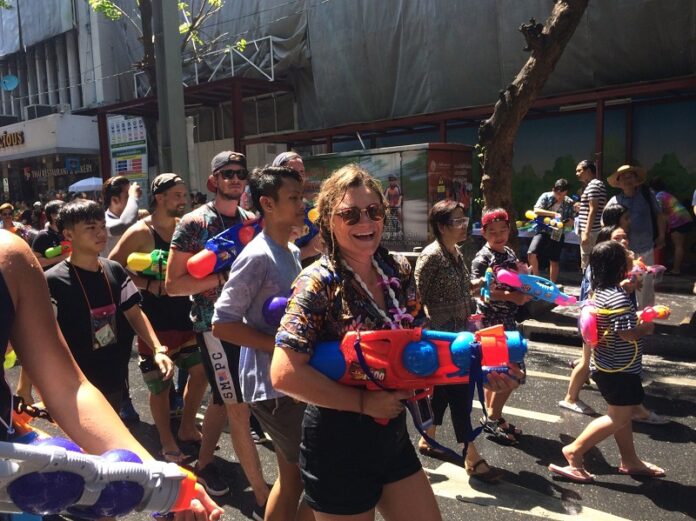
People with water guns on Silom Road during Songkran 2017.
BANGKOK — Water splashing will most likely be allowed this coming Songkran, the culture minister said Tuesday.
Culture minister Ittipol Khunpluem said that Songkran festivities had the go-ahead from the government, in the upcoming Thai New Year holiday from April 13 to 15.
“From infection numbers in the three digits, we’re seeing two digits,” Ittipol said.
Tuesday saw 60 new infections, a third of which were found from active case-finding missions, the government pandemic center announced Tuesday.
The current COVID-19 was stable enough to handle Songkran’s annual interprovincial travel back home, as well as family meetups including older relatives, Ittipol said, although social distancing must still be maintained.
The Wan Lai Festival in Chonburi province, usually celebrated from April 16 to 20 after Songkran, also has the green light. The sand sculpture festival is usually held at Bang Saen Beach and surrounding areas.
Gen. Prayut Chan-o-cha had said that he hoped Songkran could boost the tourism-bereft economy.
“I want the economy to improve during Songkran for commerce, tourism, and hotels to make up for lost income during the COVID-19 pandemic,” Prayut said Monday. “Plans are in the pipeline, and will be made clear before Songkran for sure.”
“We have to do what we can to make sure there’s not another COVID-19 wave,” he said.
In 2020, Songkran in April was cancelled, before being postponed to September. Water-splashing was prohibited – a Songkran, without Songkran.
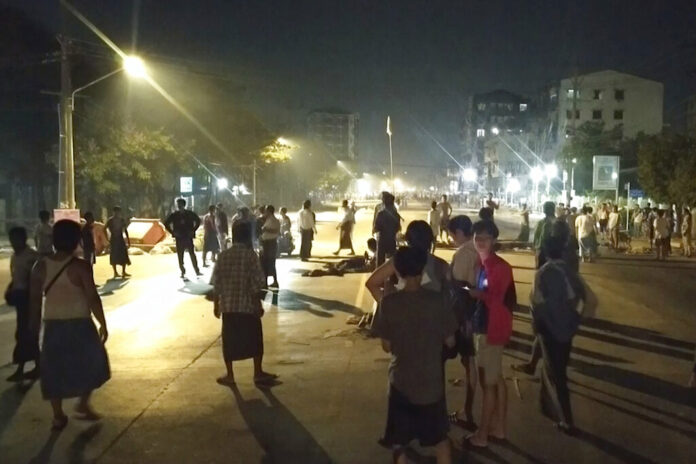
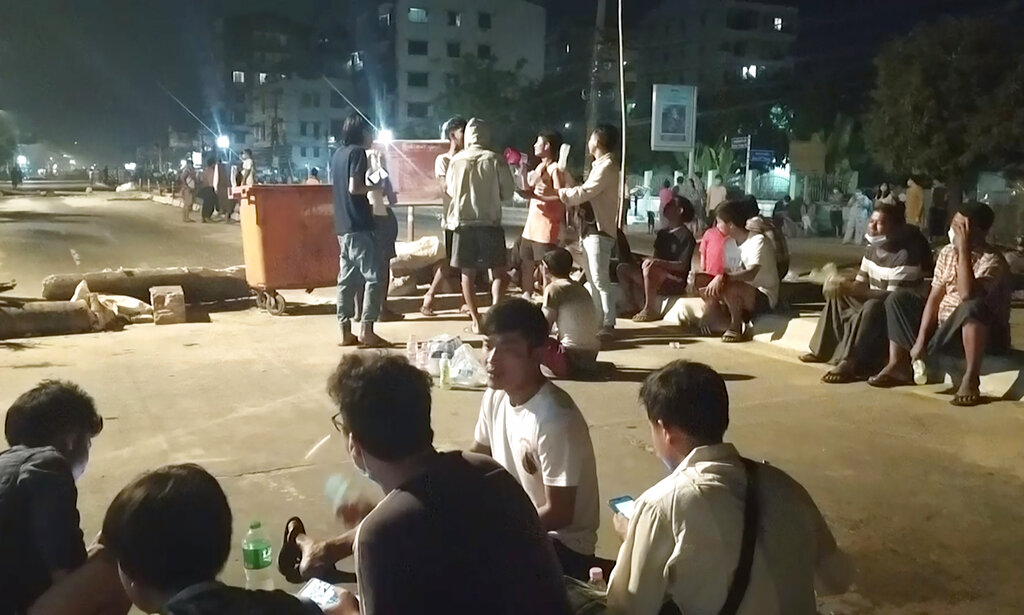
In this image taken from video, people stand outside their homes and gather together on a road in Insein township in Yangon, Myanmar, Monday, March 8, 2021. Demonstrators in Myanmar’s biggest city came out Monday night for their first mass protests in defiance of an 8 p.m. curfew, seeking to show support for an estimated 200 students trapped by security forces in a small area of one neighborhood. (AP Photo)
YANGON, Myanmar (AP) — Demonstrators in Myanmar’s biggest city came out Monday night for their first mass protests in defiance of an 8 p.m. curfew, seeking to show support for an estimated 200 students trapped by security forces in a small area of one neighborhood.
The students and other civilians earlier took part in one of the many daily protests across the country against the military’s seizure of power last month that ousted the elected government of Aung San Suu Kyi.
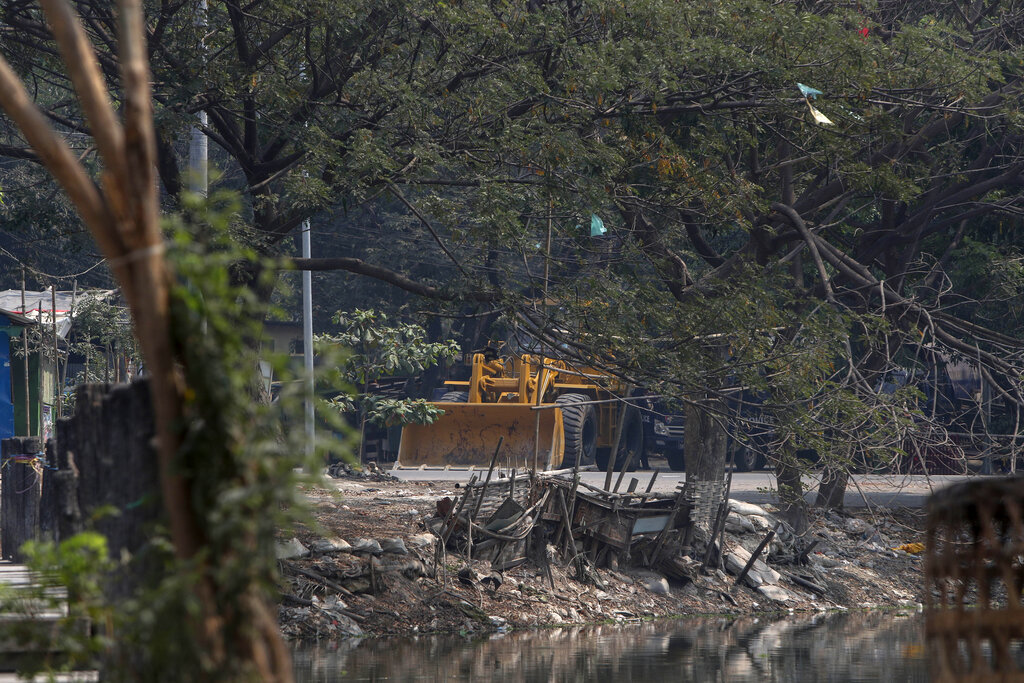
A convoy of soldiers and policemen led by a bulldozer, move to remove makeshift barricades made by anti-coup protesters in Mandalay, Myanmar, Tuesday, March 9, 2021. (AP Photo)
The military government also placed a major curb on media coverage of the crisis. It announced that the licenses of five local media outlets — Mizzima, DVB, Khit Thit Media, Myanmar Now and 7Day News — have been canceled.
“These media companies are no longer allowed to broadcast or write or give information by using any kind of media platform or using any media technology,” it said on state broadcaster MRTV.
All five had been offering extensive coverage of the protests, often with livestreaming video online. The offices of Myanmar Now were raided by the authorities Monday before the measure was announced.
DVB said it was not surprised by the cancellation and would continue broadcasting on satellite TV and online.
“We worry for the safety of our reporters and our staff, but in the current uprising, the whole country has become the citizens’ journalists and there is no way for military authorities to shut the information flow,” Executive Director Aye Chan Naing told The Associated Press.
The government has detained dozens of journalists since the coup, including a Myanmar Now reporter and Thein Zaw of AP, both of whom have been charged under a public order law that carried a penalty of up to three years in prison.
The night’s street protests began after police cordoned off part of Yangon’s Sanchaung neighborhood and were believed to be conducting door-to-door searches for those who fled attacks by security forces to seek shelter in the homes of sympathetic strangers.
News of their plight spread quickly on social media, and people poured into the streets in neighborhoods all over the city to show solidarity and in hopes of drawing some of the pressure off the hunted protesters. On some streets, they constructed makeshift barricades with whatever was at hand.
In the Insein district, they spread across road junctions, singing songs, chanting pro-democracy slogans and banging objects together.
The diplomatic missions of the United States, Britain, Canada and the European Union all issued statements urging the security forces to allow the trapped people to return safely to their homes. Although all have been sharply critical of the Feb. 1 coup and police violence, it is unusual for such diplomatic statements to be issued in connection with a specific, ongoing incident.
In this image taken from video, people stand outside their homes and gather together on a road in Insein township in Yangon, Myanmar, Monday, March 8, 2021. Demonstrators in Myanmar’s biggest city came out Monday night for their first mass protests in defiance of an 8 p.m. curfew, seeking to show support for an estimated 200 students trapped by security forces in a small area of one neighborhood. (AP Photo)
“There is heightened tension caused by security forces surrounding Kyun Taw Road in Sanchaung Township, Yangon. We call on those security forces to withdraw and allow people to go home safely,” said the U.S. Embassy’s statement.
Reports on social media citing witnesses said as many as 50 people were arrested overnight in Sanchaung and other parts of the city, but many of those who had been hiding were able to leave safely at dawn Tuesday, a few hours after police abandoned their search.
On Monday night, security forces chased crowds, harassed residents watching from windows, and fired stun grenades. They also were some reports of injuries from rubber bullets.
U.N. Secretary-General Antonio Guterres was following developments in the Sanchaung district where “many of those trapped are women, who were peacefully marching in commemoration of International Women’s Day,” U.N. spokesman Stephane Dujarric said.
“He calls for maximum restraint and urges for the safe release of all without violence or arrests,” Dujarric said, and for respect of the rights to freedom of assembly and expression for peaceful demonstrators voicing “their hopes and desires for the future of their country.”
Guterres also called the occupation of a number of public hospitals in Myanmar by security forces “completely unacceptable,” the U.N. spokesman said.
The nighttime hours have become increasingly dangerous in Myanmar. Police and army units routinely range through neighborhoods, shooting randomly to intimidate residents and disrupt their sleep, and making targeted arrests.
People watch as a convoy of soldiers and policemen arrive with bulldozers to remove makeshift barricades made by anti-coup protesters in Mandalay, Myanmar, Tuesday, March 9, 2021. (AP Photo)
Security forces shot and killed two people in northern Myanmar during the day, local media reported.
The Irrawaddy online newspaper said the victims were shot in the head during anti-coup protests in Myitkyina in Kachin State. Graphic video on social media showed protesters backing away from tear gas, responding with rocks and then fleeing after a fusillade of what seemed to be automatic gunfire.
Demonstrators hurriedly carried away the injured, including one apparent fatality, a person with a severe head wound. A second body was seen later on a stretcher, his head covered with a cloth.
Another shooting death took place in Pyapon, a city about 120 kilometers (75 miles) south of Yangon.
To date, the government’s violent crackdown has left more than 50 protesters dead. At least 18 people were fatally shot Feb. 28 and 38 on Wednesday, according to the U.N. Human Rights Office.
Security forces also clamped down on anti-coup protesters elsewhere Monday, firing tear gas to break up a crowd of about 1,000 people demonstrating in Pyinmana, a satellite town of the capital, Naypyitaw. The protesters deployed fire extinguishers to create a smokescreen as they fled from authorities.
Thousands of protesters who marched in Mandalay, the second-largest city, dispersed on their own amid fears that soldiers and police were planning to break up their demonstration with force.
Meanwhile, an armed force from one of Myanmar’s ethnic groups was deployed to protect anti-coup marchers in the wake of a brutal crackdown by the junta.
The unit from the Karen National Police Force arrived shortly after dawn to accompany about 2,000 protesters near Myitta in Tanintharyi Region in southeastern Myanmar. They carried an assortment of firearms including assault rifles as they marched ahead of the column down dusty rural roads.
The Karen police force is under the control of the Karen National Union, one of many ethnic organizations that have been fighting for greater autonomy from the central government for decades. The KNU employs both political and, through its armed wing, military means to achieve its aims.
Large-scale protests have occurred daily in many cities and towns since Myanmar’s military seized power, and security forces have responded with ever greater use of lethal force and mass arrests.
On Sunday, police occupied hospitals and universities and reportedly arrested hundreds of people involved in protesting the military takeover.