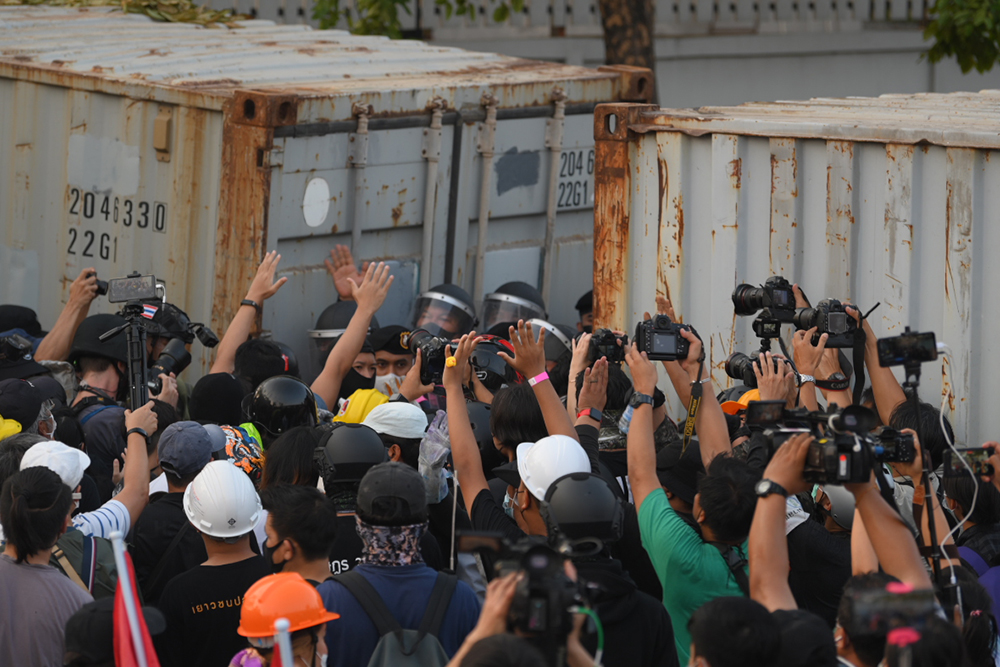
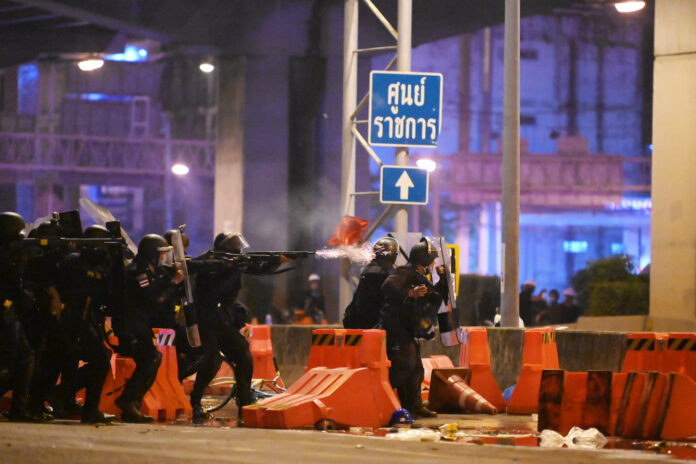
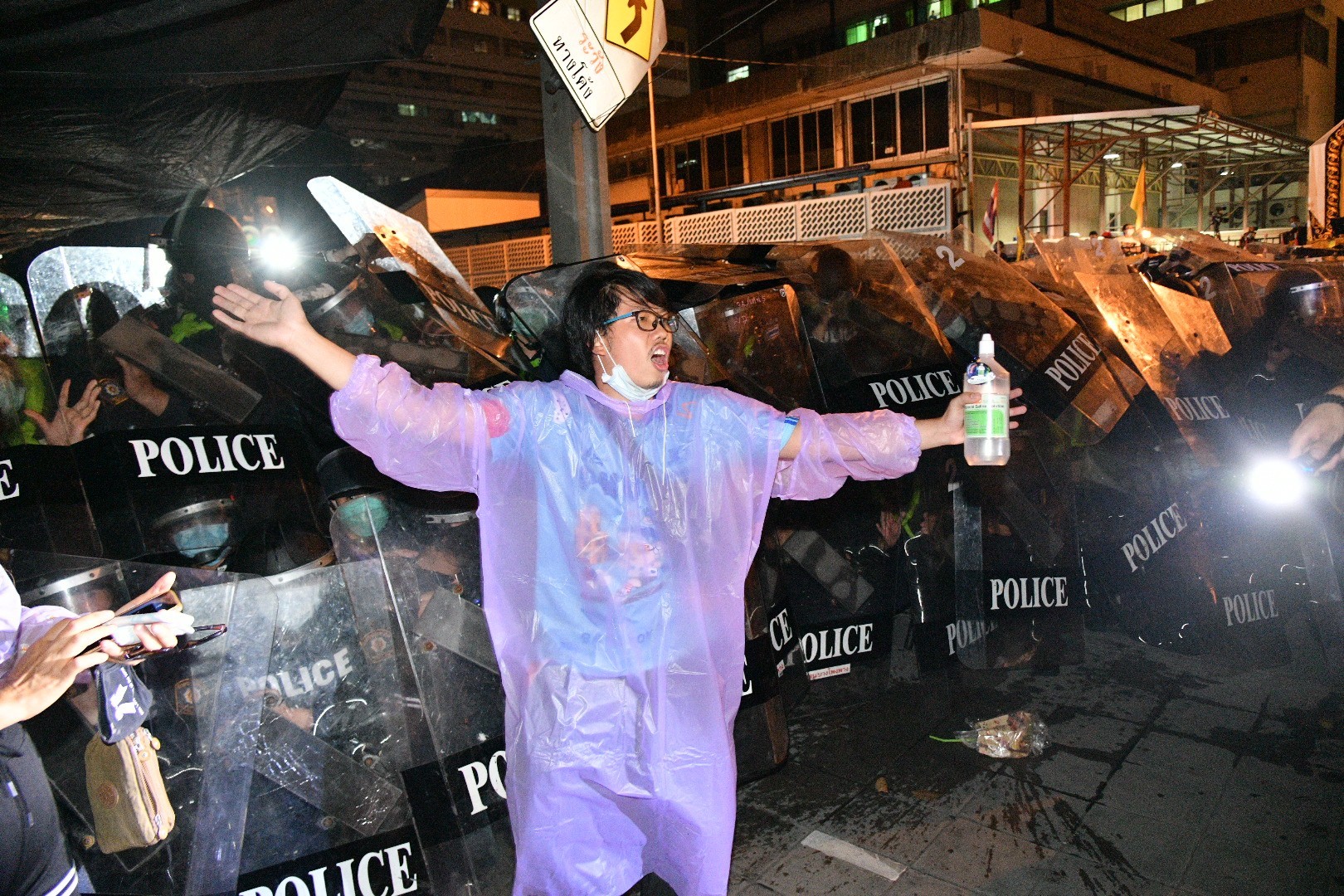
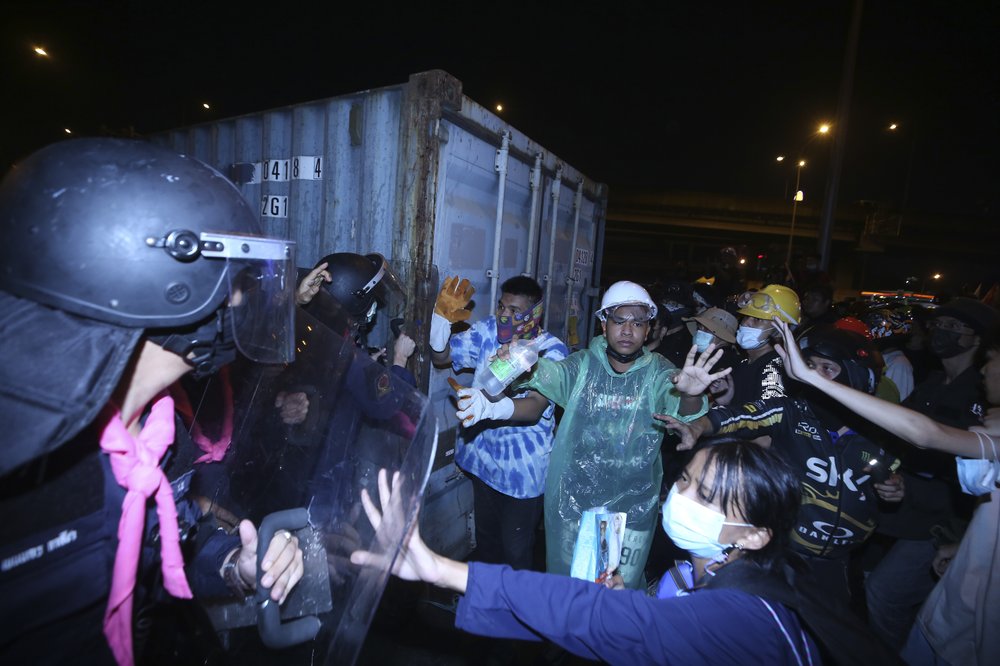
Riot police armed with rubber bullet rifles advance on a group of protesters on Feb. 28, 2021.
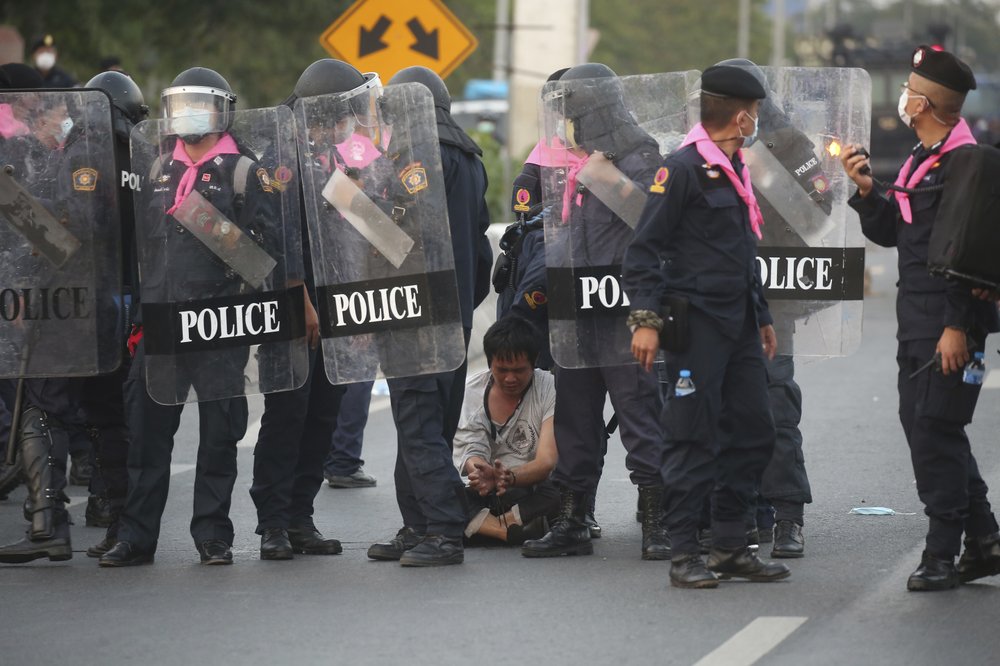
BANGKOK — A newspaper journalist was taken into custody while covering an anti-government protest close to PM Prayut Chan-o-cha’s residence on Sunday. He was released on bail a day later, on Monday.
The Thai Lawyers for Human Rights group said Buncha Chansombun, a reporter for Naewna newspaper, was arrested by riot police during clashes in front of the 1st Infantry Regiment, where Prayut’s taxpayer-funded residence is located. He was among at least 22 people, including four youths, arrested during a crackdown on protesters Sunday night.
“The journalist is now freed on bail,” the group’s chairwoman Yaowalak Anuphan said. “He faced six charges, same as the demonstrators.”
The newspaper is known for its staunch pro-establishment editorial stance.
Top: The clashes between riot police and demonstrators on Feb. 28, 2021.
Buncha’s arrest was confirmed by his parent agency. Naewna said in its news report that the reporter was detained overnight alongside other demonstrators at the regional headquarters of the Border Patrol Police north of Bangkok.
Police said the suspects were charged with breaking the Emergency Decree’s ban on mass gatherings, resisting arrests, carrying weapons, and three other related offenses.
Deputy metropolitan police commander Piya Tawichai said police who made the arrests could not tell Buncha apart from the protesters. But investigators will recommend the prosecutors not to indict Buncha since he was proven to be a journalist working in the field.
“We are doing everything according to the procedures,” Maj. Gen. Piya said.
Demonstrators clash with riot police in front of the 1st Infantry Regiment army base on Feb. 28, 2021.
Yaowalak of the Thai Lawyers for Human Rights said the attorneys from her group are submitting bail requests for the remaining suspects.
Bangkok’s emergency medical service center said a total of 33 people were injured during Sunday’s protest. Ten of them were civilians, while 23 of them were police officers. One policeman on crowd control duties also suffered a fatal heart attack and died at a hospital.
Journalists were generally free to conduct their duties on protest grounds, though a reporter for Prachatai news agency was arrested on Oct. 16 while he was covering the crackdown on demonstrators close to Pathumwan Intersection.
Police initially tried to charge the journalist, Kitti Pantapak, with breaching the Emergency Decree, but he was later charged with a lesser offense of resisting arrests and freed on bail.
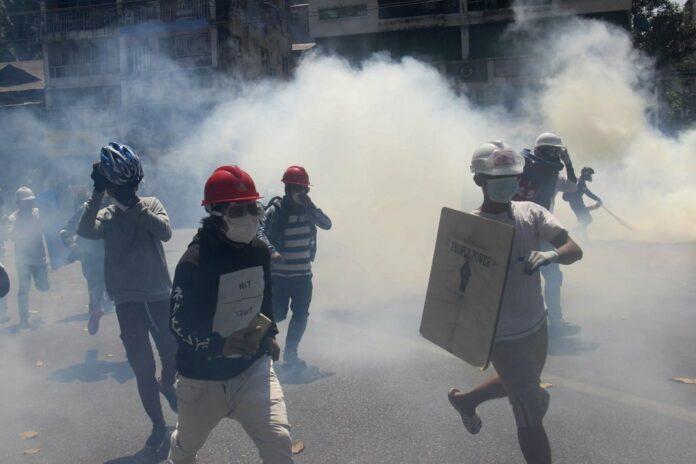
Anti-coup protesters run away from tear gas launched by security forces in Yangon, Myanmar, Monday, March 1, 2021. (AP Photo)
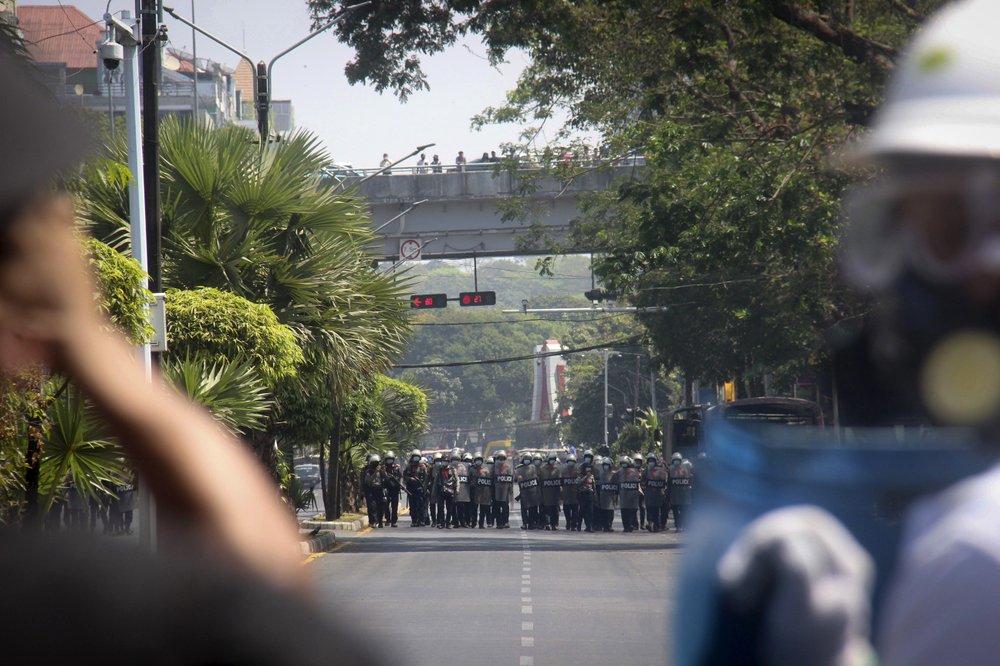
YANGON, Myanmar (AP) — Police in Myanmar’s biggest city fired tear gas Monday at defiant crowds who returned to the streets to protest last month’s coup, despite reports that security forces had killed at least 18 people a day earlier.
The protesters in Yangon were chased as they tried to gather at their usual meeting spot at the Hledan Center intersection. Demonstrators scattered and sought in vain to rinse the irritating gas from their eyes, but later regrouped.
The coup reversed years of slow progress toward democracy in Myanmar after five decades of military rule. It came Feb. 1, the same day a newly elected Parliament was supposed to take office. Ousted leader Aung San Suu Kyi’s party would have led that government, but instead she was detained along with President Win Myint and other senior officials.
The army has leveled several charges against Suu Kyi — an apparent effort by the military to provide a legal veneer for her detention and potentially to bar her from running in the election the junta has promised to hold in one year. On Monday, Suu Kyi made a court appearance via videoconference and was charged with two more offenses, her lawyer Khin Maung Zaw told reporters.
Protesters monitor as police is deployed during an anti-coup protest march in Yangon, Myanmar, Monday, March 1, 2021. (AP Photo)
Accused of inciting unrest, she was charged under a law that dates from British colonial days and has long been criticized as a vaguely defined catch-all statute that inhibits freedom of expression. That charge carries a maximum sentence of two years in prison. The other charge from Monday carries a one-year sentence.
Following her detention on the day of the coup, the 75-year-old Suu Kyi was initially held at her residence in the capital of Naypyitaw, but members of her National League for Democracy party now say they don’t know where she is.
Since the takeover, a movement of protests in cities across the country has been growing — and the junta’s response has become increasingly violent.
The U.N. said it had “credible information” that at least 18 people were killed and 30 were wounded across Myanmar on Sunday. Counts from other sources, such the Democratic Voice of Burma, an independent television and online news outlet, put the death toll in the 20s.
Any of the reports would make it the highest single-day death toll since the military takeover. The junta has also made mass arrests, and the independent Assistance Association for Political Prisoners reported that as many as 1,000 people were detained Sunday. Several journalists have been among those detained, including one for The Associated Press.
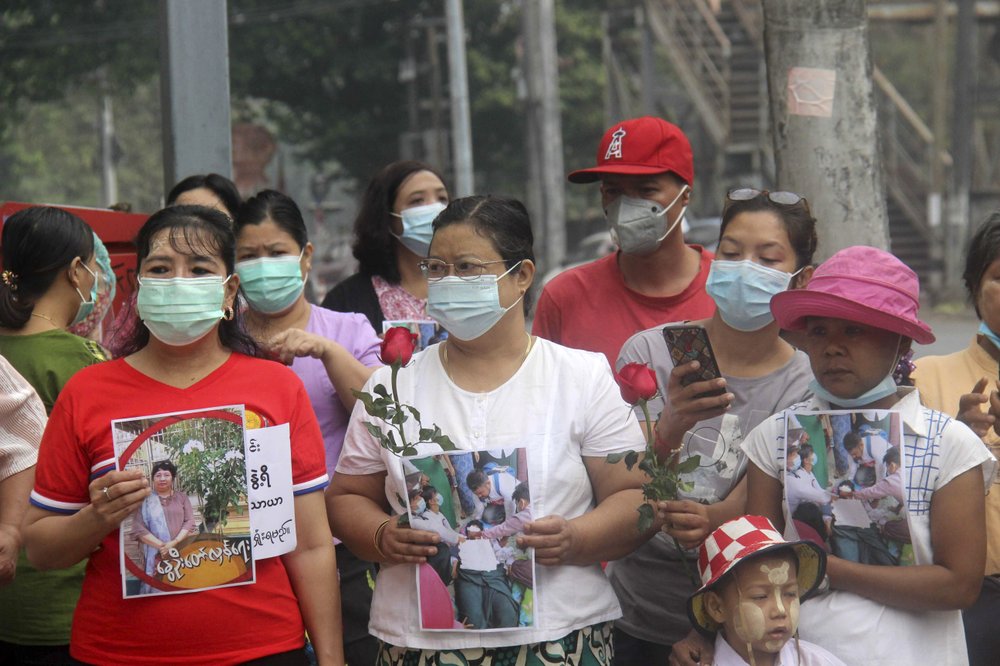
People offer flowers as a tribute to a teacher who died in a protest on Feb 28, during a memorial service in Yangon, Myanmar, Monday, March 1, 2021. (AP Photo)
At least five people are believed to have been killed Sunday in Yangon when police shot at protesters, who have remained nonviolent despite provocation from the security forces and pro-military counter-demonstrators.
People erected makeshift sidewalk shrines Monday at the spots where several of the victims were shot and also paid their respects by standing outside the hospitals where the bodies were being released to families.
In Dawei, a small city in southeastern Myanmar where five people were reported killed Sunday, the number of protesters on the streets Monday was lower than usual, but they paraded to the applause of bystanders.
Confirming the deaths of protesters has been difficult in areas outside Yangon, Mandalay and Naypyitaw. But in many cases, there was evidence posted online such as videos of shootings, photos of bullet casings collected afterwards and gruesome pictures of bodies.
In a statement published Monday in the state-run Global New Light of Myanmar newspaper, Myanmar’s Foreign Ministry declared that the junta “is exercising utmost restraint to avoid the use of force in managing the violent protests systematically, in accordance with domestic and international laws in order to keep minimum casualties.”
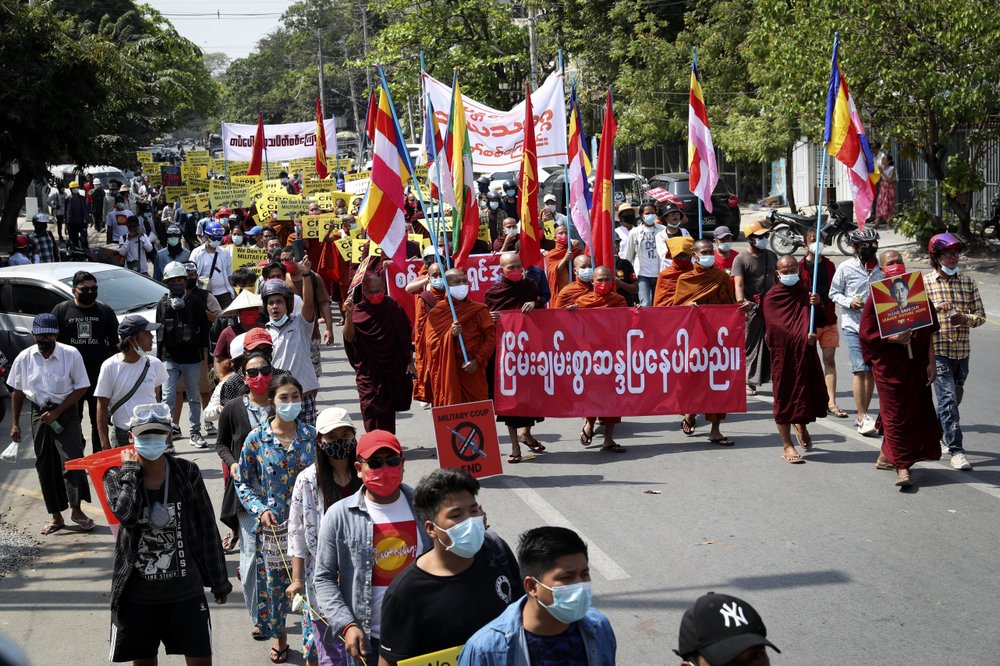
Buddhist monks holding signs and banners lead an anti-coup protest march in Mandalay, Myanmar, Monday, March 1, 2021. (AP Photo)
But U.N. Secretary-General Antonio Guterres called the use of lethal force against peaceful protesters and arbitrary arrests “unacceptable,” said U.N. spokesperson Stephane Dujarric.
“Words of condemnation are necessary and welcome but insufficient. The world must act. We must all act,” the U.N.’s independent expert on human rights in Myanmar, Tom Andrews, said in a separate statement.
He proposed that countries could institute a global embargo on the sale of arms to Myanmar and “tough, targeted and coordinated sanctions” against those responsible for the coup, the crackdown and other rights abuses.
Social media posts from Myanmar have increasingly urged the international community to invoke the doctrine of the “responsibility to protect” to intervene directly to restrain the junta.
Any kind of coordinated action at the United Nations, however, would be difficult since two permanent members of the U.N. Security Council, China and Russia, would almost certainly veto it.
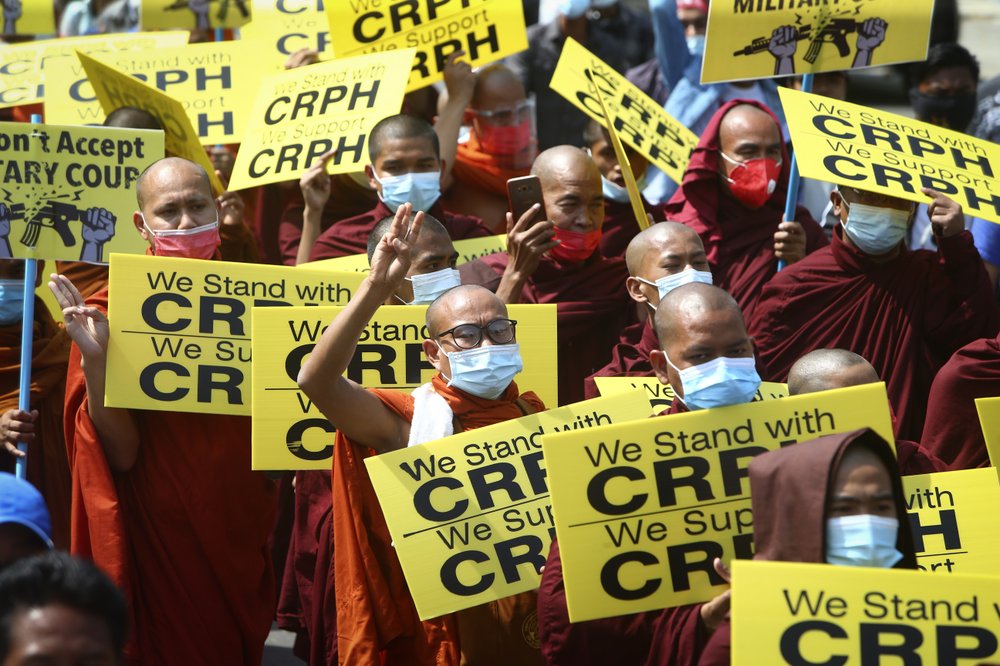
Buddhist monks displaying signs and flashing three-finger salutes lead an anti-coup protest march in Mandalay, Myanmar, Monday, March 1, 2021. (AP Photo)
Instead, some countries have imposed or are considering imposing their own sanctions. In Washington, White House National Security Adviser Jake Sullivan issued a statement saying the U.S. is “alarmed” by the violence and stands in solidarity with Myanmar’s people.
Washington is among those that have levied sanctions, and Sullivan said it would “impose further costs on those responsible,” promising details “in the coming days.”
Members of Suu Kyi’s party have also created a committee that they are asking other countries to recognize as a provisional government and the true representatives of Myanmar’s people.
The committee recently appointed a doctor and philanthropist from the ethnic Chin minority to be a special envoy to the United Nations.
In an interview Sunday night with the AP, the envoy, Sasa, who uses one name, said he would discuss with U.N. human rights expert Andrews pursuing legal actions against the generals through international courts.
“We are looking at international criminal courts and other U.N. mechanisms. It will be a little bit difficult to do it though the United Nations Security Council but we are looking at great length what can be done” to bring these generals to account, he said, speaking from a secret location due to fears for his safety.
Many expect Myanmar’s military to be intractable, but Sasa said he believes the junta is already beginning to see the difficulty of running a functioning government.
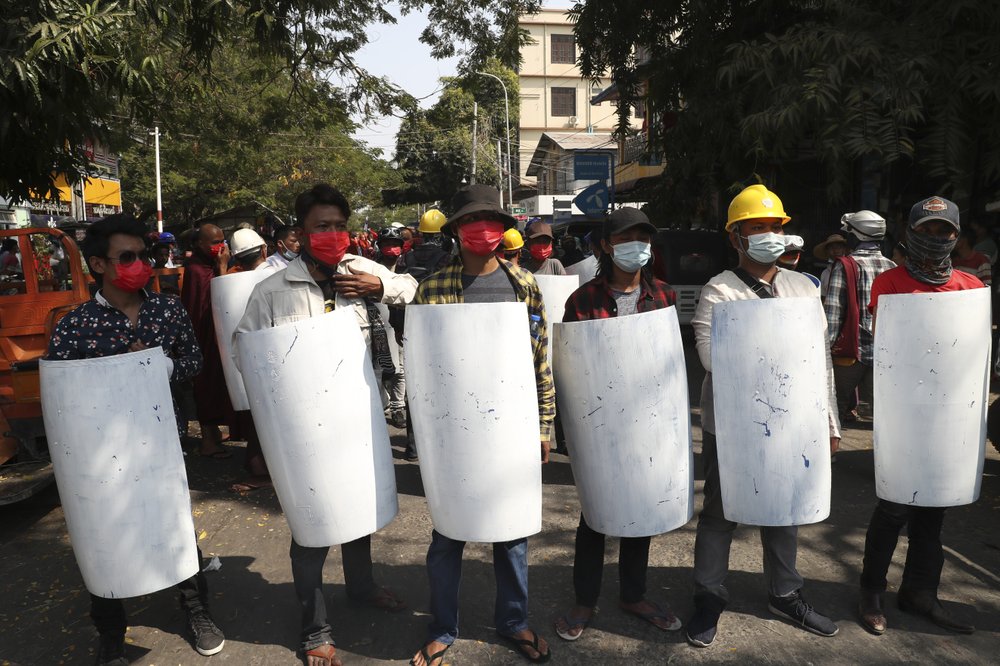
Protesters hold homemade shield during an anti-coup protest march in Mandalay, Myanmar, Monday, March 1, 2021. (AP Photo)
“I hope that they will come to the negotiating table, so we can talk together,” said Sasa.
Among the arrests made Sunday, the independent Assistance Association for Political Prisoners was able to identify about 270 people, bringing to 1,132 the total number of people the group has confirmed has been arrested, charged or sentenced since the coup.
Thein Zaw, an AP journalist, was taken into police custody on Saturday morning while providing news coverage of the protests. He remains in police custody.
The AP called for his immediate release.
“Independent journalists must be allowed to freely and safely report the news without fear of retribution. AP decries in the strongest terms the arbitrary detention of Thein Zaw,” said Ian Phillips, the AP’s vice president for international news.
According to information collected by the Assistance Association for Political Prisoners and local media reports, at least seven other journalists were detained over the weekend — all of whom work for local media. At least another 13 have been detained since the coup.
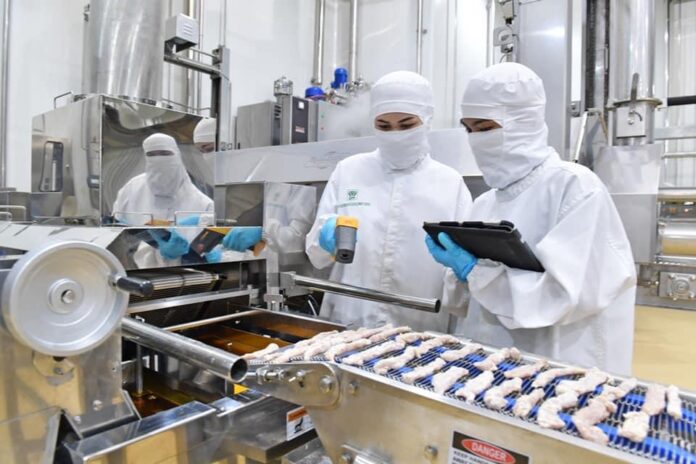
Charoen Pokphand Foods PCL (CPF) reported Bt26,022 million net profits in 2020, an increase by 41% from 2019, while the earnings before interest, taxes, depreciation and amortization (EBITDA) jumped 72% on year to Bt81,692 million. The performance improved from the previous year despite the COVID-19 outbreak and African Swine Fever (ASF) thanks mainly to the adoption of advanced technology and innovations including AI in the production process, to attain optimal standards.
Mr. Prasit Boondoungprasert, Chief Executive Officer of CPF, attributed the outstanding results to in-house technology and innovations that involved new animal breeding and farming practices; the integration of Bio-security into the process; and the effective and preventive measures against the spread of diseases especially in the swine and shrimp businesses.
CPF’s profitability improved significantly as the Company gave importance to efficiency and cost control, banking on technology and innovations in farming, production and distribution. In addition, pork prices in Asia increased particularly in Vietnam and China while the aquaculture business in Thailand showed a significant improvement following adjustments in marketing strategies and an operational efficiency program.
Amid the COVID-19 outbreak which put grave pressure on the economy and consumers’ purchasing power, CPF’s products remained essential for everyday life. In the year, CPF also modified distribution channels to reach more consumers while the work process embraced more technology. The process had effectively shielded CPF from the pandemic.
Looking forward, Mr. Prasit expected an improvement in purchasing power in 2021 as the COVID-19 outbreak is easing. Domestic and international demand for Thai food products will hence increase. Coupled with the Company’s capacity expansion and technology-based production efficiency enhancement, CPF is confident of continual competitiveness and expects the continuation in impressive results in 2021.
At the 1/2021 shareholders meeting, the Board of Directors proposed the Bt1 dividend payment for the 2020 performance. (The interim payment of Bt0.40 per share was paid on 11 September 2020).
Charoen Pokphand foods PCL (CP Foods) has jointed hand with ProVeg Asia to host the regional food competition entitled “Asean Food Innovation Challenge 2021” in bid to encourage young-generation researchers to create more innovative foods for the future that made form plants.
Mrs. Onanuch Tuppasarndamrong, Vice President for Food Regulations of CP Foods, said CP Foods has put in place on the research and development both food and food product under its vision “Kitchen of the World”. The vision straights toward on manufacturing food safety and building food security in line with social responsibility through sustainable development principles. In addition, the company also focuses on creating more choices of alternative foods to ensure accession of high-quality food and food available to people around the world. At present, more than 30% of its new products are nutrition foods while 1.3 billion people involving youth, children, and consumers able to access food and knowledge for sustainable consumption. This is to ensure that food producer and consumer are stepping toward together to alleviate environmental impacts.
Mrs. Onanuch Tuppasarndamrong, Vice President for Food Regulations of CPF.
In 2021, CP Foods has supported ProVeg Asia to host “Asean Food Innovation Challenge 2021” through “plant-based innovation” concept. The contest aims to encourage young generation researcher focusing on food science, whose proposal would lead to create startup business in the future. There are some 20 universities in nine countries including Singapore, Malaysia, Vietnam, Cambodia, Laos, Myanmar, Indonesia, the Philippines, and Thailand will participate in this competition. The winner will win cash prizes up to US$ 5,000. Interesting students able to apply for the contest from now on until March 13, 2021. The award announcement ceremony will be held on June, this year.
Mrs. Onanuch added that CP Foods has defined innovation topic on developing a series of plant-based in Asian-style main meal, which help boost immunity and are environmentally friendly, creating a brand name, identify target consumers, and develop the product launch plan”. The company will coach the selected teams via online meeting every week to monitor their working plan and advise them to achieve their targets. Potential proposal would be developed as a startup business in the future. This strategy will not only enhance their creation but also expand those young researcher network who are interested in alternative protein in Asia.
“As a leading food producer, CP Foods has concentrated on research and development continuously and ready to drive the country through Bio-Circular-Green Economy (BCG Model), Bio-economy, Circular Economy and Green Economy. This is to encourage sustainable consumption through the development of various kind of alternative proteins both from meat and other alternative proteins such as plants, insects, which is an essential protein of all ages,” said Mrs. Onanuch.
ProVeg Asia also mentioned to the World Economic Forum, saying that expanding middle class in the Asean region, along with a rise in health awareness, is leading to an increasing demand for plant-based food. The Asia-Pacific region has the largest share of plant-based consumer globally. The region is also expected to constitute the largest share of the global plant-based food sector in the near future. ProVeg wants to help transform the most innovative, impactful, and sustainable plant-based food ideas into successful quality products.
A riot police fires rubber bullet at anti-government demonstrators in front of the 1st Infantry Regiment army base on Feb. 28, 2021.
BANGKOK — Pro-democracy campaigners on Monday are forced to reassess the strategy of holding street protests without clear leadership, a day after the rally close to PM Prayut Chan-o-cha’s residence ended in violence.
Sunday’s march took the protesters from the Victory Monument to the 1st Infantry Regiment, where PM Prayut’s taxpayer-funded residence is located. The rally took a chaotic turn after hardline groups of demonstrators refused to disperse and police fired rubber baton rounds into the crowds. At least 22 people were arrested, and 33 injured.
Activists interviewed for this story criticized the protest organizers for not doing enough to defuse the tension and bring the situation under control.
“There’s no clear communication,” student and former activist Bunkueanun “Francis” Paothong said in a phone interview. “The organizers have a duty to find a way to avoid confrontations since no demonstrators would come to a protest to get themselves hurt.”
The protest on Sunday was called by the Free Youth group, now rebranding itself as Restart Democracy following a backlash over its promotion of communist ideology. It was billed as a leaderless movement, and no representatives from Free Youth were present at the march.
Instead of the organizers taking control of the protest they called, key decisions were made by opinion polls on Telegram, an encrypted messaging app.
Free Youth leader Tattep “Ford” Ruangprapaikitseree could not be reached for comments as of publication time.
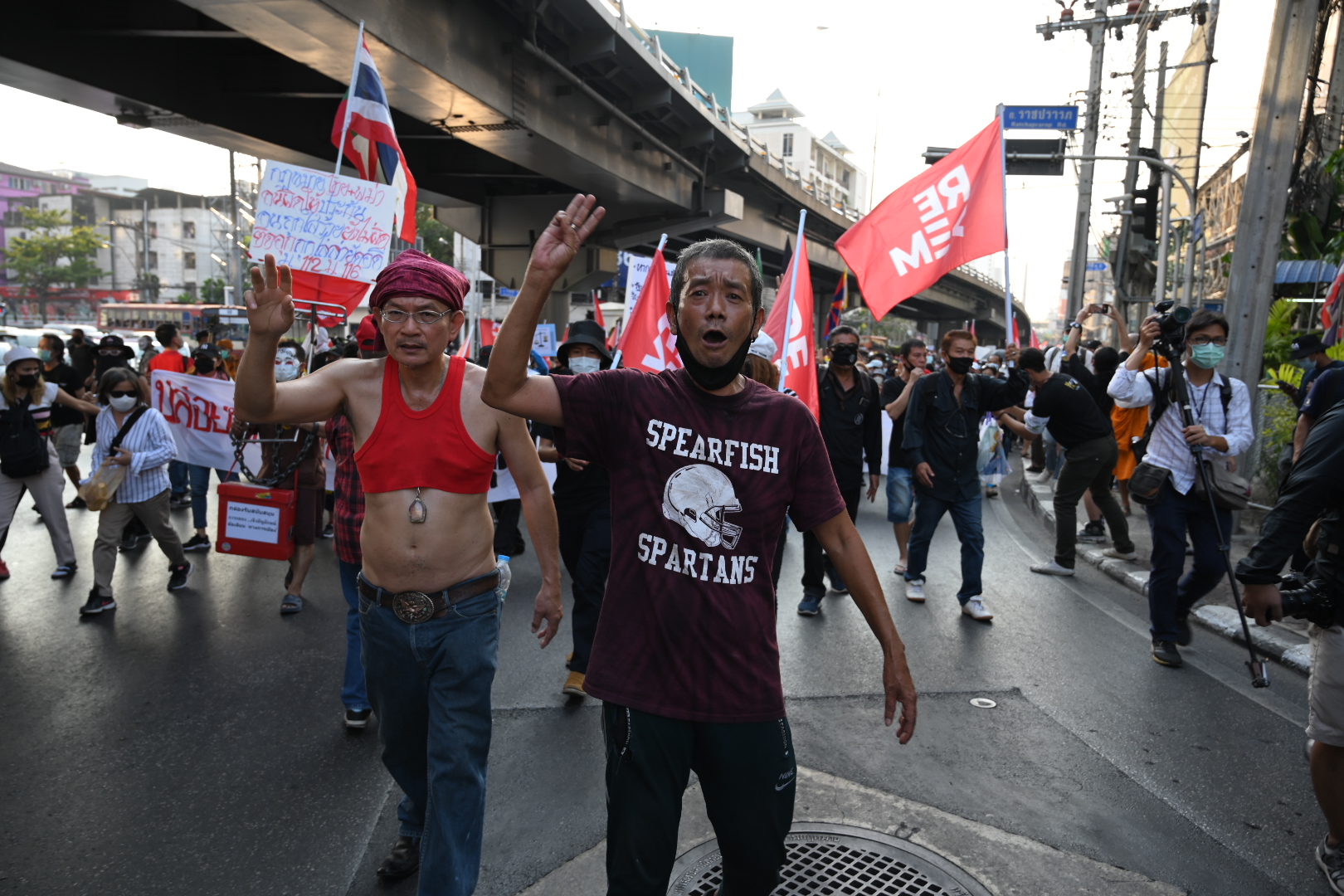
A demonstrator flashes the three-finger salute during the march to PM Prayut Chan-o-cha’s residence on Feb. 28, 2021.
Red Shirt activist Anurak Jeantawanich, who was at yesterday’s protest, said the leaderless tactic brings both pros and cons for the pro-democracy movement.
“Protesters would feel more equal and involved with the movement,” Anurak said. “However, there was no one to decide when the protesters faced critical situations.”
He went on, “Several people like myself or Dr. Totsaporn [former Pheu Thai MP Totsaporn Serirak] had to negotiate with the police when there was a clash. Some of the protesters listened to me, but some weren’t, and they insisted on engaging with the police.”
The decision to call off the protest was made at around 9.30pm, hours after the first skirmish broke out between demonstrators and riot police. Clashes continued throughout the night as police moved in to disperse and arrest the remaining protesters who stood their ground around the vicinity of the army base.
Police also fired rubber-coated metal rounds at the demonstrators – marking an escalation in the use of force since the street protests began in early 2020.
Bangkok’s emergency medical service center said a total of 33 people were injured during Sunday’s protest. Ten of them were civilians, while 23 of them were police officers. One policeman on crowd control duties also suffered a fatal heart attack and died at a hospital.
A reminder that “Rubber bullets” are in essence metal shells coated in rubber and they can cause injuries, as evident on the body of this protester who was struck by one of the bullets fired by riot police on Vibhavadi Rangsit Road. #Thailand#KE#ม็อบ28กุมภาpic.twitter.com/ZRFJjR2BwQ
Bunkueanun said crowdsourcing is not an effective way of making immediate decisions since not everyone at the protest is connected to the app.
“They used a voting system on Telegram to make decisions, but not everyone is using the app,” Bunkueanun said. “In fact, it was a tie-vote. It was 50-50 between the decisions to disperse or continue the protest.”
The student continued, “The leaderless tactic only works in certain situations such as when the protest is going to be stationary, where there are clear plans and agenda.”
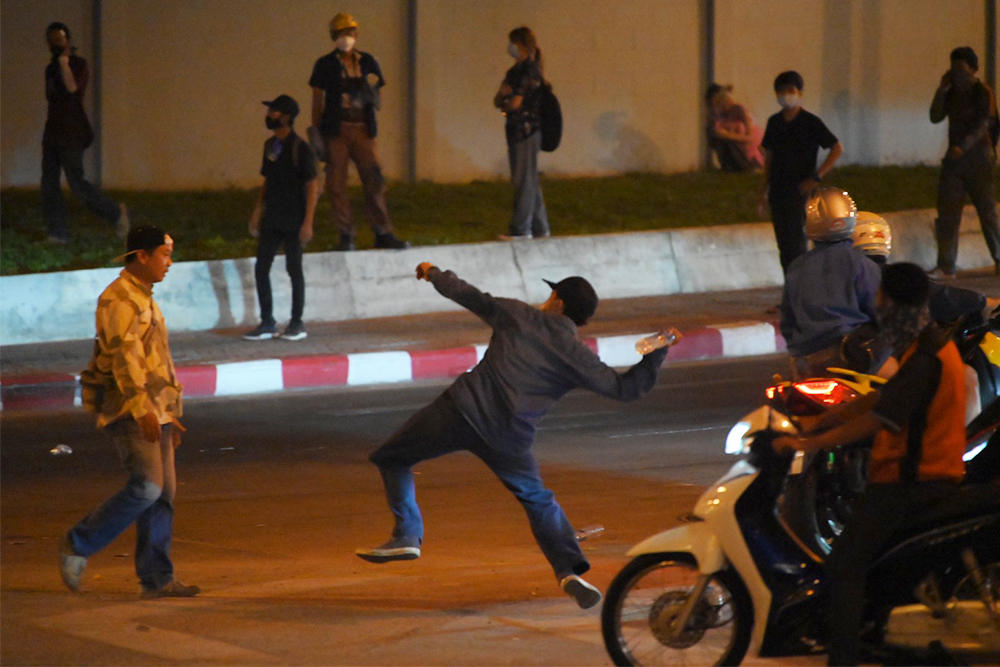
A protester throws a water bottle at riot police during the clash on Vibhavadi Rangsit Road.
Several demonstrators at Sunday’s protest could be heard by Khaosod English correspondents shouting “there’s no negotiation, there’s no leader” during one of the clashes.
Protesters hurled objects they could find at the police, while the police retaliated with rubber bullets, tear gas, and water jets from anti-riot vehicles.
Another activist who served as a coordinator between the demonstrators and police told Khaosod English during Facebook Live coverage that the commotions resulted from the detention of key protest leaders who were denied bail over royal defamation charges.
“This is what happens when there’s no leader,” he said. “There’s no one to lead or listen to.”
A protester uses his body to prevent fellow demonstrators from hurling objects at riot police officers during the clash near the Veterans General Hospital on Feb. 28, 2021.
Anurak, the Redshirt activist, suggested there should be a clear schedule and details for the future protests to prevent further confusions at the protest site.
“The organizers should set a time when they will end the protest beforehand,” Anurak said. “Personally, I think it should be before 7pm. I want to see a peaceful protest, if the protesters stay longer, the police can use it as an excuse to disperse them.”
The Free Youth has yet to announce the date and venue for the next protest.
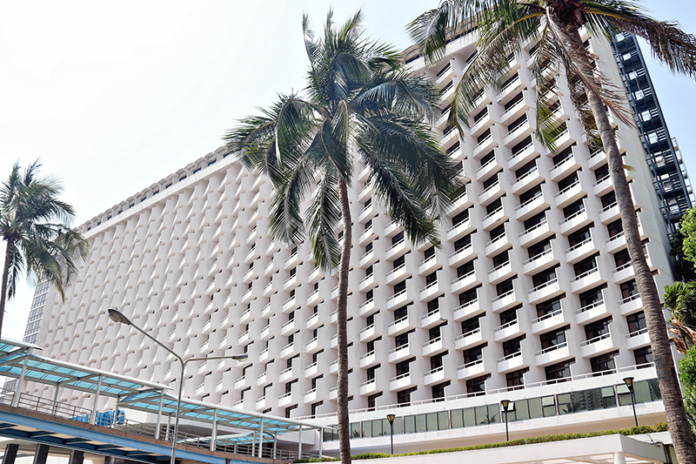
PATTAYA — The executive of a hotel that went viral last month over the alleged reports of terrible room conditions said Monday it will soon open as an Alternative State Quarantine, or ASQ.
Ambassador City Jomtien director Chawanet Tungsumpan said a stay at her hotel for an ASQ experience would cost travelers between 30,000 and 100,000 baht. She also defended the hotel’s service in the aftermath of the viral review, which purported to document an unhygienic environment, poor service, and even cockroaches in the food.
“Everyone has always complimented us for good service, especially our maids, reception, and handymen,” Chawanet told reporters during a press tour of the hotel.
The review was written by Facebook user Topp Dunyawit Phadungsaeng, who reportedly stayed at Ambassador City Jomtien in February when the hotel was enrolled in the state quarantine program for Thai nationals returning from overseas.
Top: Ambassador City Jomtien refutes some of allegations made by Dunyawit.
Dunyawit, who flew in from San Francisco, called the stay “the worst 14 days in my life” in his Facebook post, which has been shared more than 34,000 times. But Chawanet said the review was misleading, and she said the hotel actually lost money as a state quarantine facility.
“Please open your mind. Understand what it means to be a state quarantine,” she said. “So many people say we’ve made sacrifices, which is true.”
When asked about the mishap and poor conditions Dunyawit allegedly experienced, Chawanet said the hotel allowed state officials to take over operations in the area where travelers were quarantined, so the hotel management had no say in some of the services.
“We thought we were doing this for CSR. Of the 4,200 people who have stayed here, none got COVID,” Chawanet said. “We’ve heard for years that our employees are all polite and service-minded.”
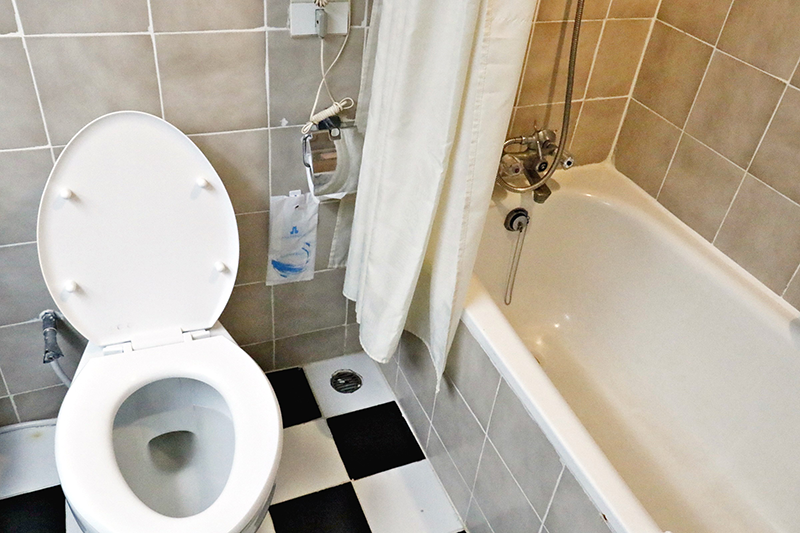
A bathroom in the room in the Ambassador City Jomtien.
She added that the hotel has since dropped out of the state quarantine list, and would reopen as an ASQ venue instead.
When Dunyawit’s review went viral in February, Ambassador City Jomtien responded by threatening unspecified legal actions, drawing even more ill gotten attention from social media users.
It is unclear what actions will be taken against Dunyawit; the hotel manager made no mention of it during the media tour, and an operator at Ambassador City Jomtien who picked up the phone was evasive.
“We’re in the legal process,” the operator said, adding that the hotel is currently closed for three months.
On Saturday, the Ambassador City Jomtien went on the offensive and refuted some of the allegations made by Dunyawit. For instance, in order to counter his claim that his bedding was moldy, the hotel said that the stain was found on the bottom mattress, which was covered with a mattress skirt.
“Why did you pull out the mattress skirt from the bottom mattress?” the hotel asked in the post.
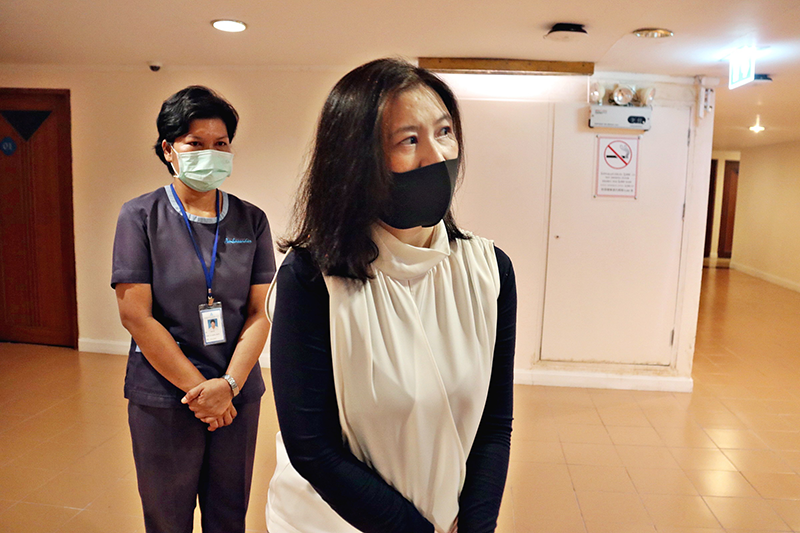
Chawanet Tungsumpan.
The hotel did not directly address the complaints about bugs found in the food, but said many other guests who stayed at Ambassador City Jomtien the same time as Dunyawit were very positive about their experience.
Speaking to reporters today, hotel manager Chawanet said that Dunyawit changed his rooms three times, and that the hotel’s food was clean, and used vegetables from their own garden and fish from a natural pond.
“The Ambassador has been open for 50 years, the Jomtien branch for 30 years. We are confident in our standards of taking care of our customers,” she said.
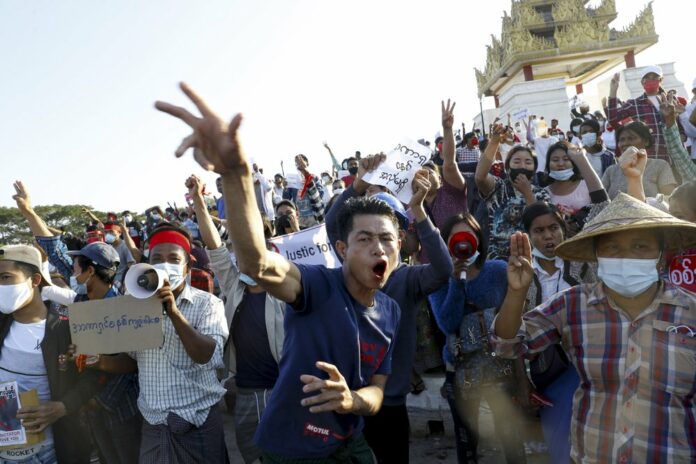
Demonstrators flash the three-fingered symbol of resistance against the military coup and shout slogans calling for the release of detained Myanmar leader Aung San Suu Kyi during a protest in Mandalay, Myanmar, Wednesday, Feb. 10, 2021. (AP Photo)
By Mon Mon Myat, Reporting ASEAN.
The 1988 pro-democracy protests in Myanmar were heady days, a time when danger and excitement mixed freely among university students like me in the streets of Magway, my hometown in the country’s central region. Soon after, the terror of the military regime of the 1990s era kicked in, until the country’s supposed transition to democracy started around 2010.
But the 1 Feb military coup has sent us back into the streets – and singing and listening to many of the same protest songs, despite the gap of 33 years between then and now.
I never expected to be singing these songs again, this time together with my son’s generation. Until the coup, I had thought that this generation was only interested in three things: eating, sleeping and play computer games. They have been proving me wrong.
Very quickly in fact, younger people have learned to sing three songs in particular that were a product of the 1988 pro-democracy movement. They were not even born at that time, but many now know the songs’ lyrics by heart, after they brought printouts of these to the protests and sharing them with friends. Many have heard the tunes from their parents.
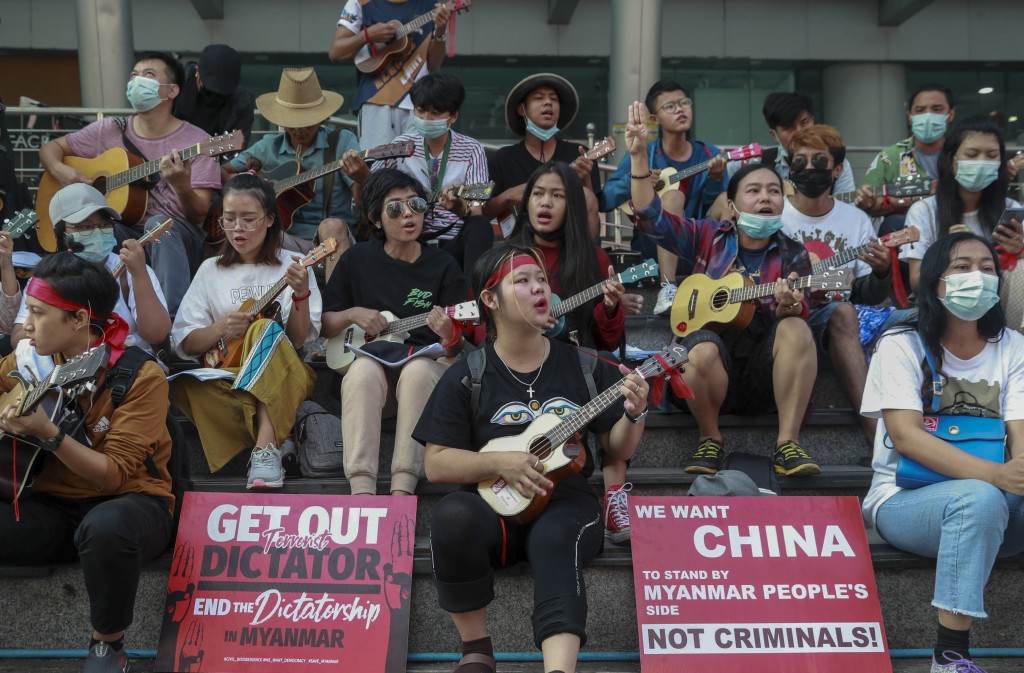
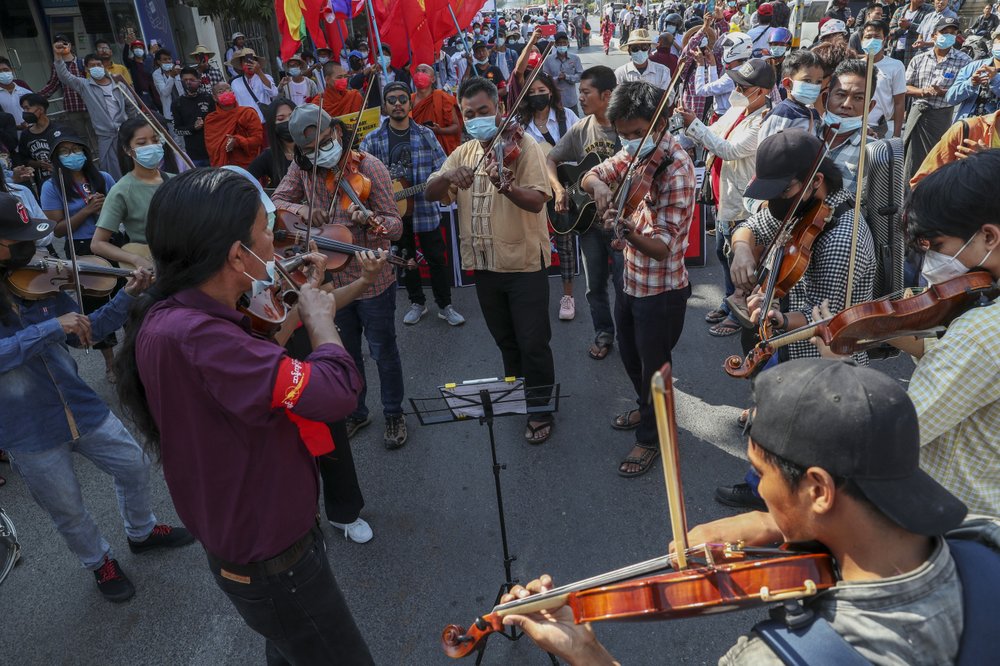
Anti-coup protesters play instrument and sing during a rally in Yangon, Myanmar, on Feb. 23, 2021. Image: The Associated Press.
Today’s young pro-democracy protester, too, are discovering the power that has music has to call people into joining the street protests, and to boost one another’s morale. Take a close look at the scenes in Myanmar these days: While armed soldiers and riot police stand watch with guns, protective shields, and batons, anti-coup protesters wield weapons such as ukuleles, violins, guitars and drums.
Crowds gather, and everyone around seems to be instantly ready to sing, as soon as they hear the drum rolls get underway.
They then usually warm up a rally with the first song, Blood Oath, which was written by the late singer and songwriter Htoo Ein Thin, a former student activist who went into exile after the 1988 uprising and joined the All Burma Students’ Democratic Front (ABSDF).
He had written ‘Blood Oath’ (‘Thway Thitsar’) beside the Thaungyin River, during his time with ABSDF in Thai-Myanmar border area and recorded it in a Bangkok studio. Subsequently, his album of revolutionary songs was smuggled into Myanmar and spread among students there. I remember first hearing this song from a cousin who had brought it in from Mawlamyaine, on the border with Thailand. In English, its lyrics go:
“It’s a crucial time, brothers,
Let’s unite and march together.
We wrote our new history with our blood,
Here we keep blood oath.”
“We give our lives for the nation,
We will march together with the peacock’s blood (a reference to the students’ resistance movement, whose symbol is the fighting peacock)
For our freedom and peace,
we must fight the last battle.”
After more crowds gather while ‘Blood Oath’ is being sung, protesters usually move to the song “We Shall Not Surrender Till The End Of The World” (‘Kabar Makyay Bu’), which uses the melody of the 1977 hit song ‘Dust in Wind’ by the American group rock band, Kansas. Clips of protesters singing this song in unison have gone viral.
The well-known songwriter Naing Myanmar, who penned the lyrics during the 1988 protests, told ‘The Irrawaddy’ news that he had written the song for the unknown heroes who gave up their lives during the pro-democracy revolution. The song starts this way:
“We will not forget the history written by our blood,
Till the end of the world.
Oh our fallen heroes, you gave your lives for the revolution.
This is the country of the martyrs and brave people.”
The song honours historical figures such as Aung San, called the father of modern Myanmar, and poet and political thinker Thakin Kodaw Hmaing, remembered for initiating the peace movement in the country.
To many of us, this song brings back painful memories of the bloody military crackdown on the streets of Yangon in 1988. Singing it these days is our reminder to today’s military regime that they should not make the same mistake, but I fear that this reminder will not work.
A third popular protest song in the rallies is Encourage Mi Nge (‘Khon Ar Phyait Mi Nge’), which many political prisoners used to encourage one another while behind bars. Composed by the legendary songwriter Ko Ne Win, part of the song’s lyrics go like this:
“After passing through the night after the sunset,
the new day will come with the sunrise.
If we endeavor with commitment,
we will succeed and escape one day.
As the road of ‘samsara’ (the endless cycle of birth and suffering in Buddhism) is not smooth,
please keep your spirit alive to face hardship, Mi Nge (younger sister).
These words of encouragement follow:
“Don’t give up my young sister.
You can cross the rough road with your brave heart.
When you take responsibility for the sake of others,
you have to sacrifice your life.”
Over the past weeks, I have run into many friends from the 1988 protests – often with their sons and daughters too – at various rallies.
“I can’t stop my daughter from joining this movement of her generation,” a poet friend said. “I can’t be at peace staying at home while she is out in the streets, so I follow wherever she goes.”
These songs of protest run through us, whether we are from Generation X, Y or Z. As the ‘88 Generation student leader Min Ko Naing, who has been in hiding since the coup, said in a pre-recorded message on 17 Feb: “This revolution represents a combination of Generation X, Y and Z in fighting against the military dictatorship.”
New Revolution, New Songs
The 2021 people’s revolt is already leading to the creation of new songs that denounce the military regime and exhort Myanmar’s people to join the civil disobedience movement, such as one entitled ‘The Dictatorship must End’ (‘Arnarshin Sanit Asone That Ya Myee’).
The song, whose original composers and singers are unknown, goes:
“Our bones and blood are to defeat the dictator.
We can’t be tied up by fear.
We are ready for the revolution. They are power–crazy people.
We all have to stand up to end the dictatorship.
We must end the dictatorship.”
I first heard this song, which opens with drums, at a 17 Feb protest in Yangon where, apart from calling for the release of “Mother Suu”, in reference to State Counsellor Aung San Suu Kyi who has been detained with President Win Myint, rallyists were shouting, “We must end the dictatorship!”
Anti-coup protesters play instruments and sing after riot policemen blocked their march in Mandalay, Myanmar, Wednesday, Feb. 24, 2021. (AP Photo)
The protests against the military takeover continue, but the police and military’s use of force have also been increasing in past days in Yangon, the former capital, and the military-built capital Nyapidaw, as well as Mandalay, Myitkyina and Mawlamyaing.
A central force driving the rallies is the 2021-generation students, who enjoy playing online and video games but put the same concentration into playing the drums, violins and other traditional musical instruments when they gather in the streets.
The music they have been making echo the unfulfilled dreams of their grandparents and parents – as well as the call of Myanmar’s future.
About the author
Mon Mon Myat is a journalist and a PhD candidate in the peacebuilding programme at Payap University in Chiang Mai, Thailand. This article is part of the Lens Southeast Asia series of Reporting ASEAN.
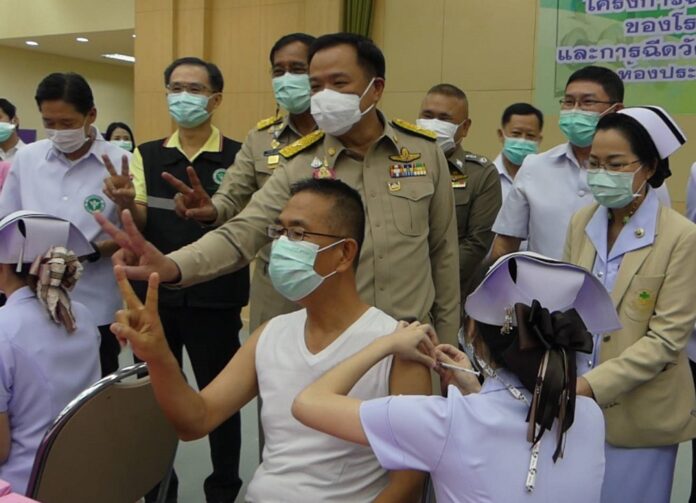
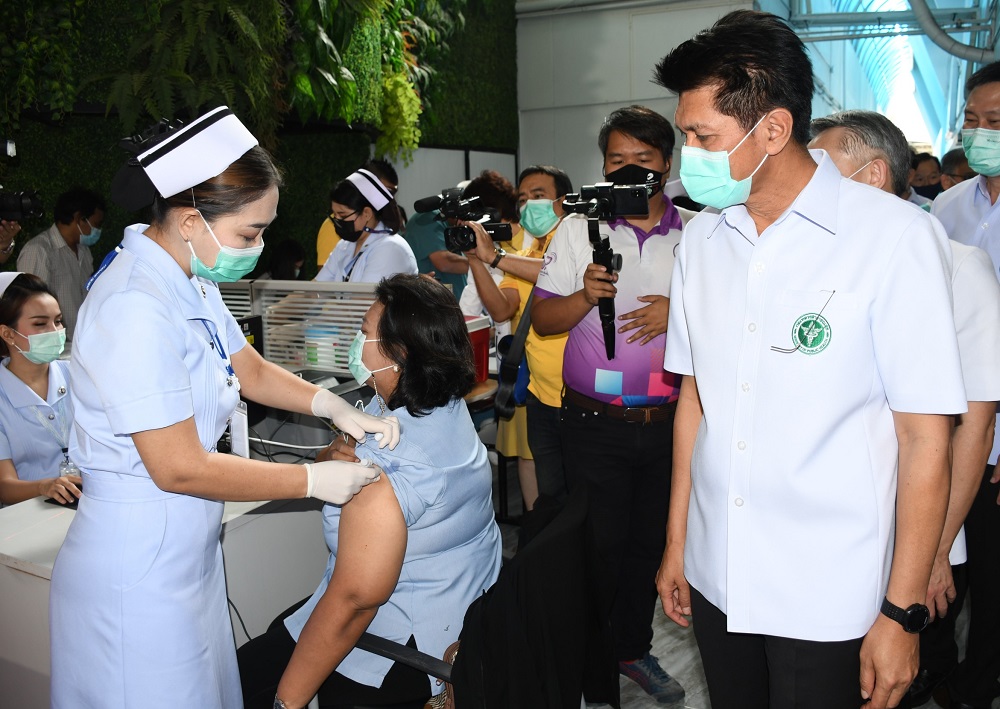
Health workers and officials receive vaccine to protect them from COVID-19 disease in Pathum Thani province on March 1, 2021.
BANGKOK — Frontline health workers, volunteers, and local officials are lining up Monday to receive their shot of vaccine against COVID-19, kicking off the long awaited inoculation drive that hopes to reopen the country.
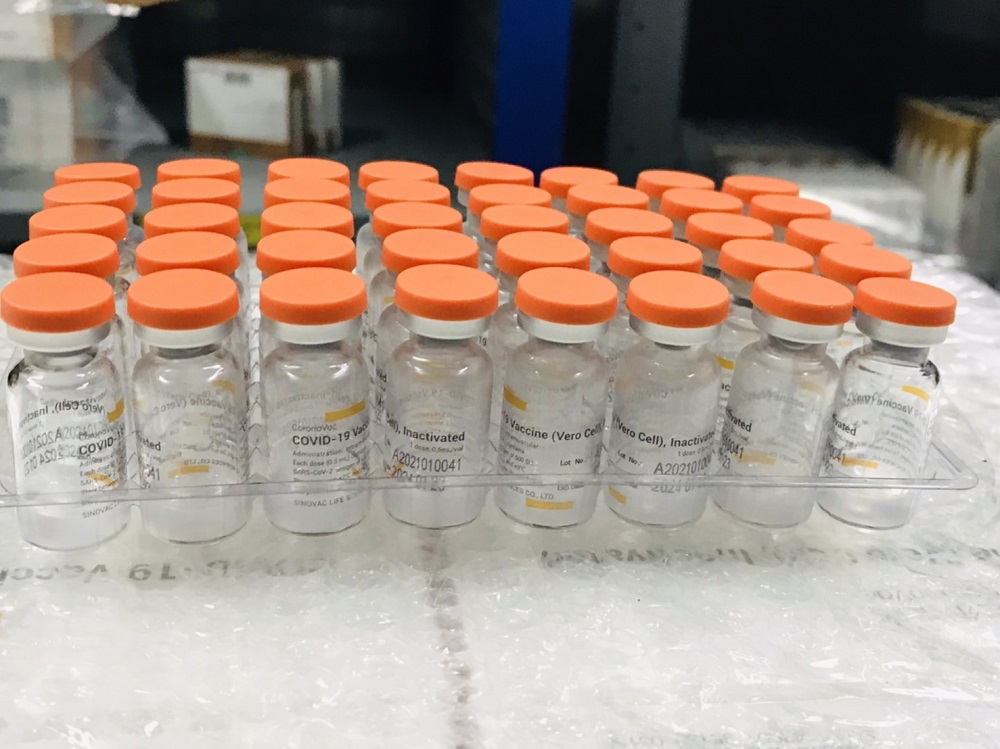
The first shots in Pathum Thani were witnessed by health minister Anutin Charnvirakul, using the vaccine made by Chinese pharmaceutical Sinovac. Shipments of the vaccine also arrived in provinces that largely depended on foreign tourists, like Chonburi and Phuket.
Key members of the government, including Anutin, were already inoculated in a media event on Sunday, though PM Prayut Chan-o-cha will have to wait for the vaccine developed by AstraZeneca, since he was deemed too old for the Sinovac jabs.
Vials of COVID-19 vaccine developed by Sinovac are seen in Phuket province on March 1, 2021.
“[The government] is aiming to provide Thai people with immunity and safety from the outbreak of the 2019 coronavirus,” Anutin told reporters at Pathum Thani Hospital, where healthcare professionals in the province were receiving the vaccine.
“I’d like to give my moral support to all of you,” Anutin said of the medical workers. “I hope we will continue to have the energy and dedication to work for the wellbeing of Thai people.”
Doctors and health workers in Bangkok received the shots against COVID-19 at Bang Khun Thian Hospital in the southern part of the capital, while the vaccination drive in Samut Sakhon – the city hardest hit by the resurgence of the coronavirus outbreak – is being rolled out from the provincial hospital.
Governors, their deputies, and healthcare officials were also eligible for the first batch of the vaccine.
Health workers and officials receive COVID-19 vaccine in Chonburi province on March 1, 2021.
Thailand is lagging behind many of Asian countries in starting an inoculation campaign against the coronavirus pandemic. The drive was supposed to take place earlier, on Feb. 14, but was delayed due to a supply dispute in the European Union, according to the government.
Even under the current vaccine strategy, the general public won’t be getting their shots until the latter half of 2021. A majority of the 61 million AstraZeneca doses to be used in the national vaccine drive will be produced locally by Siam Bioscience, a company wholly owned by the palace.
The first round of vaccination was also extended to hospitality workers in five provinces and towns most popular among foreign visitors: Chiang Mai, Chonburi, Phuket, Krabi and Samui island in Surat Thani.
Government officials said the inclusion of hotel staff in the vaccine drive will pave way for reopening of the country’s borders to tourists and reinvigorate the tourism industry, which has been devastated by the pandemic.
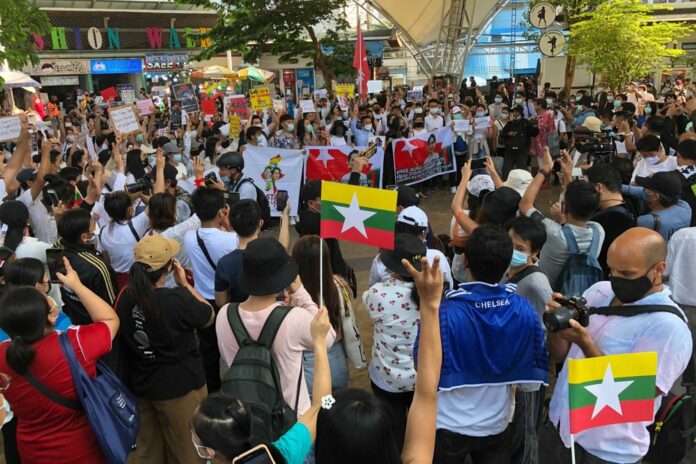
Migrant workers from Myanmar gather before participating in a march by Thai pro-democracy activists to the residence of Thai Prime Minister Prayuth Chan-ocha Sunday, Feb. 28, 2021 in Bangkok, Thailand. (AP Photo/Fu Ting)
BANGKOK (AP) — A new faction of Thailand’s pro-democracy movement staged a protest march Sunday, linking their cause with that of demonstrators in Myanmar battling that neighboring country’s coup-installed military government.
Marchers sought but failed to go to Thai Prime Minister Prayuth Chan-ocha’s house, which is on an army base in Bangkok. Shipping containers were situated to block them, and police using water cannons, rubber bullets and tear gas barred the way.
The demonstrators abandoned their plan several hours later after taking an online vote of their supporters.
Police said a 41-year-old officer died in the tumult, with local media reported he had a heart attack. According to the Erawan EMS center, 23 policemen and 10 protesters were injured.
Thai pro-democracy demonstrations have recently become marred by increasing violence. Much of it has been initiated by particularly confrontational protesters using tactics including throwing small homemade “ping-pong” bombs with the power of big firecrackers at police, who sometimes react with disproportionate force.
Sunday’s action was linked to the informal Milk Tea Alliance of pro-democracy activists from Hong Kong, Taiwan, Thailand and Myanmar, which called for efforts Sunday online and in real life in support of the protests in Myanmar.
Riot policemen arrest an anti-government protester, during a protest in Bangkok, Thailand, Sunday, Feb. 28 , 2021. (AP Photo)
In Myanmar on Sunday, a crackdown on protesters by security forces left at least 18 people dead, according to the U.N. Human Rights Office.
Prayuth was targeted in part because he met Wednesday in Bangkok with the new foreign minister appointed by Myanmar’s junta.
The protest in Bangkok was the first to be led by a new group calling itself REDEM, short for Restart Democracy, whose self-proclaimed goals are to build democratic socialism and minimize political and economic inequality.
Anti-government protesters clash with riot police, during a protest in Bangkok, Thailand, Sunday, Feb. 28 , 2021. (AP Photo)
REDEM was launched last week as an offshoot of Free Youth, one of the main groups that began rallying against the Thai government last year.
Last year’s original protest coalition campaigned for Prayuth and his government to step down, the constitution to be amended to make it more democratic and the monarchy reformed to make it more accountable.
The demand about the monarchy is the most controversial, because the institution has been widely considered an untouchable, bedrock element of Thai nationalism.
The protest movement lost steam when it took a break in December and January as Thailand was hit by a second wave of coronavirus infections. It is now trying to reinvigorate itself but has been hampered by the recent jailing of some of its leaders who are pending trial on several charges, including defaming the monarchy.
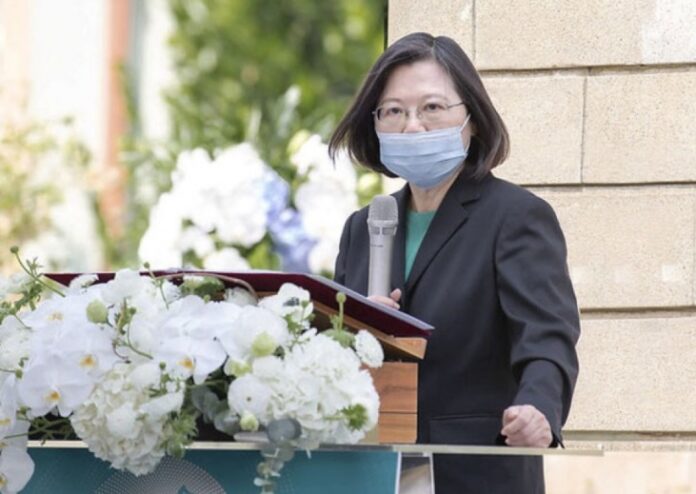
Taiwan President Tsai Ing-wen speaks at a ceremony held at Kaohsiung's 228 Peace Memorial Park on Feb. 28, 2021 to mark the 74th anniversary of the Feb. 28, 1947 massacre. (Photo courtesy of the presidential office via Kyodo)
TAIWAN (Kyodo) — Taiwan President Tsai Ing-wen on Sunday reiterated her government’s commitment to promoting freedom and democracy as she attended an annual ceremony to commemorate a 1947 massacre of civilian protesters.
“We must adhere to our values of freedom and democracy, which cannot be exchanged for anything else,” Tsai said at a ceremony held at Kaohsiung’s 228 Peace Memorial Park to mark the 74th anniversary of the Feb. 28, 1947 massacre.