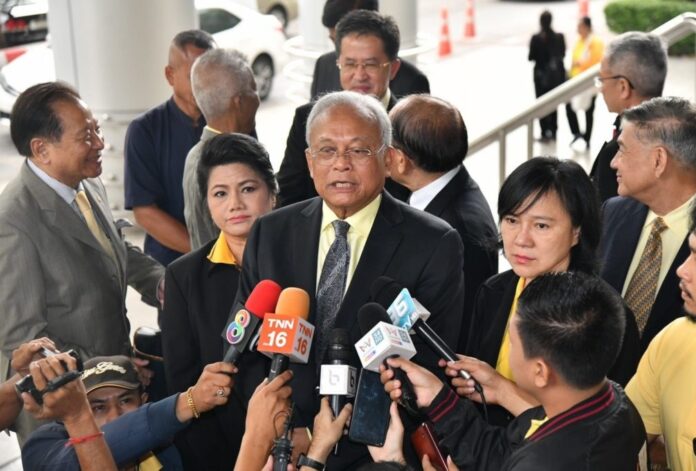
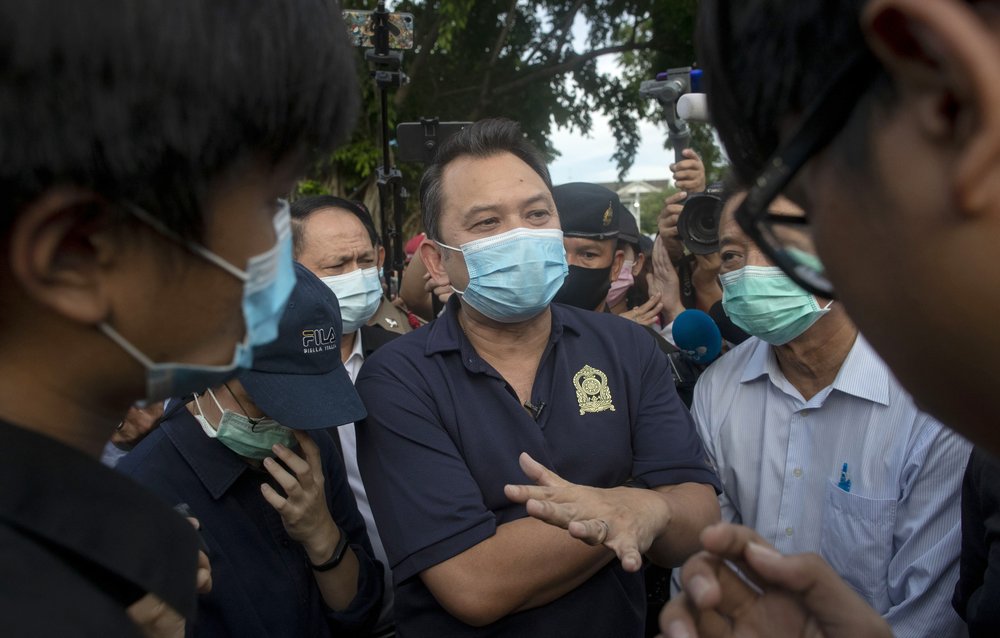
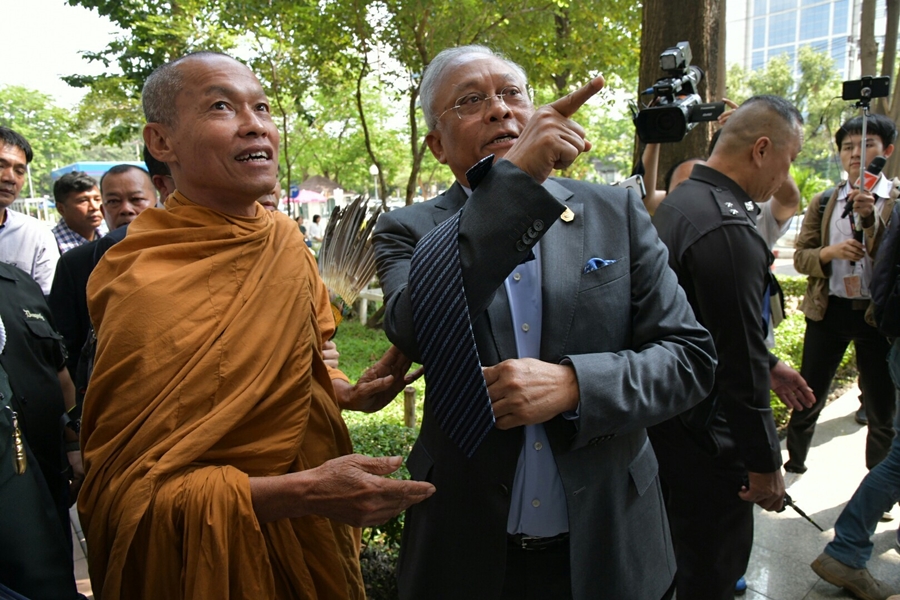
Suthep Thaugsuban speaks to reporters at the Criminal Court in Bangkok on May 14, 2019.
BANGKOK — An appeal court on Friday approved a temporary release for former deputy PM Suthep Thaugsuban and seven other defendants found guilty earlier this week of inciting sedition against the elected government.
Suthep and seven of his lieutenants who campaigned alongside him during the “Shutdown Bangkok” street protests in 2013 and 2014 were deemed to pose no flight risk by the Court of Appeals. Their bond was set at 800,000 baht each.
The eight defendants were set to be released later today from Bangkok Remand Prison. Suthep and others are seeking to appeal the verdict, which sent them to jail on Wednesday on a number of charges, including insurrection and suppressing an election.
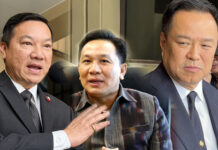
Those convicted in Wednesday’s verdict include three former Cabinet members who now lost their post: Digital Economy Minister Buddhipongse Punnakanta, Education Minister Nataphol Teepsuwan, Deputy Transport Minister Thaworn Senneam.
They also include politicos Issara Somchai, Chumpol Julsai, Samdin Lertbut, and former monk activist Buddha Issara, who is now known by his secular name Suwit Thongprasert.
Suthep served as the Deputy Prime Minister from 2008 to 2011. He was also the Deputy Chairman of the pro-establishment Democrat Party.
The eight defendants were leaders of a group called the People’s Committee for Absolute Democracy With the King as Head of State, which is known in its official English name as the People’s Democratic Reform Committee, or PDRC.
The movement led the demonstrations against the elected government of then-Prime Minister Yingluck Shinawatra from late 2013 through May 2014. The protesters seized government buildings, shut down intersections, and sometimes clashed with the police and counter demonstrators.
At Suthep’s behest, the movement also blocked the snap election called by Yingluck. Suthep and other leaders say an unspecified number of reforms must be implemented before a new election can be held.
Instability caused by the street protests led to the army under Gen. Prayut Chan-o-cha staging a coup in 2014 and keeping power until 2019. Up to 27 people were killed in the months of sometimes-violent protest.
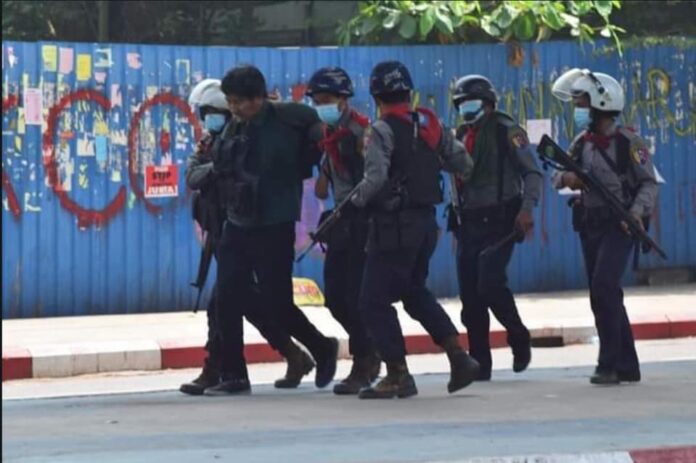
TOKYO (Kyodo) — A Japanese freelance journalist was detained in Myanmar’s largest city Yangon on Friday while covering an anti-coup protest there, local media reported.
He is believed to be Yuki Kitazumi. The Japanese Embassy in Yangon is trying to ascertain the identity of the detained man.
President Donald Trump, left, hugs Senate Majority Leader Mitch McConnell of Ky., right, as he comes up on stage during a campaign rally in Lexington, Ky., Monday, Nov. 4, 2019. (AP Photo/Susan Walsh)
WASHINGTON (AP) — Less than a month after excoriating Donald Trump in a blistering floor speech, Senate Minority Leader Mitch McConnell said Thursday that he would “absolutely” support the former president again if he secured the Republican nomination in 2024.
The Kentucky Republican told Fox News that there’s still “a lot to happen between now” and the next presidential election.
“I’ve got at least four members that I think are planning on running for president, plus governors and others,” McConnell said. “There’s no incumbent. Should be a wide open race.”
But when directly asked if he would support Trump again were he to win the nomination, McConnell responded: “The nominee of the party? Absolutely.”
McConnell’s remarks underscore an awkward balancing act he sought to maintain since Trump lost the election, reflecting the reality that McConnell’s own path back to power in the Senate hinges on enthusiasm from a party base that still ardently supports Trump.
McConnell’s comments precede an annual gathering of conservative activists that this year is expected to showcase Trump’s vise-grip hold on the GOP base.
Trump, along with most other leading 2024 presidential prospects, is set to address the Conservative Political Action Conference, which will be held in Orlando this year because of coronavirus restrictions. McConnell, a regular at the annual conference, will not be on the program following his condemnation of Trump.
Shortly after voting to acquit Trump at his second impeachment trial, McConnell delivered a scalding denunciation of Trump from the Senate floor, calling him “morally responsible” for the Jan. 6 attack on the U.S. Capitol. In turn, an angry Trump blistered McConnell as a “dour, sullen and unsmiling political hack.”
The 36-year Senate veteran had an expedient relationship with Trump while he was in office. He made a habit of saying little about many of Trump’s outrageous comments.
But together they secured key Senate victories, such as the 2017 tax cuts and the confirmations of three Supreme Court justices and more than 200 other federal judges.
Their relationship soured after Trump’s denial of his Nov. 3 defeat and relentless efforts to reverse the voters’ verdict with his baseless claims that Democrats fraudulently stole the election.
It deteriorated further last month, after Republicans lost Senate control with two Georgia runoff defeats they blamed on Trump, followed by the attack on the Capitol by Trump supporters. The day of the riot, McConnell railed against “thugs, mobs, or threats” and described the attack as “this failed insurrection.”
Still, McConnell likes to pride himself on playing the “long game,” which was the title of his 2016 memoir. And his comments on Thursday may yet prove prescient.
Recently, Republican Sen. Mitt Romney of Utah, a longtime Trump opponent, predicted the former president would win the nomination if he ran again.
“I don’t know if he’ll run in 2024 or not, but if he does, I’m pretty sure he will win the nomination,” Romney said during an online forum hosted by The New York Times.
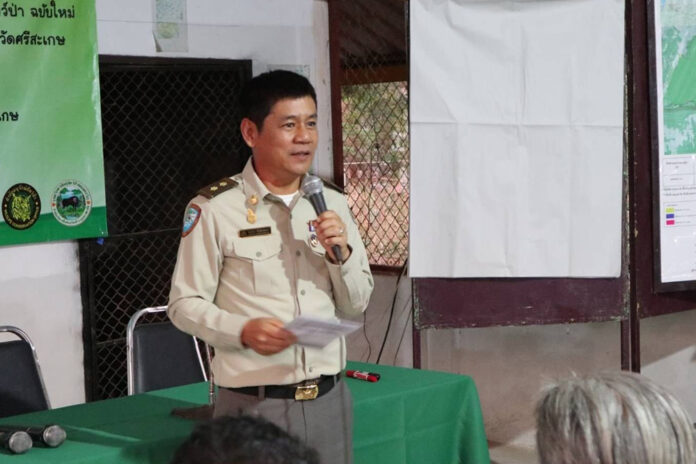
BANGKOK — An anti-graft agency on Thursday announced that a former national park director committed malfeasance for ordering the violent eviction of Karen families nearly a decade ago and ordered him to leave his post.
The investigation was launched after Chaiwat Limlikhit-aksorn, who served as the director of Kaeng Krachan National Park in Phetchaburi at the time, was accused by community rights activists of engineering the destruction of over a hundred Karen homes inside the forest in 2011.
The Office of Public Sector Anti-Corruption Commission said Chaiwat, who is now serving as the head of the environmental protection office in Pattani province, will be removed from the public office while legal actions are taken against him.
“The commission will forward the case to his parent agency, the Royal Forest Department, where they will launch a disciplinary procedure against Chaiwat,” the commission said in a statement. “The case will also be forwarded to the state prosecutors for indictment.”
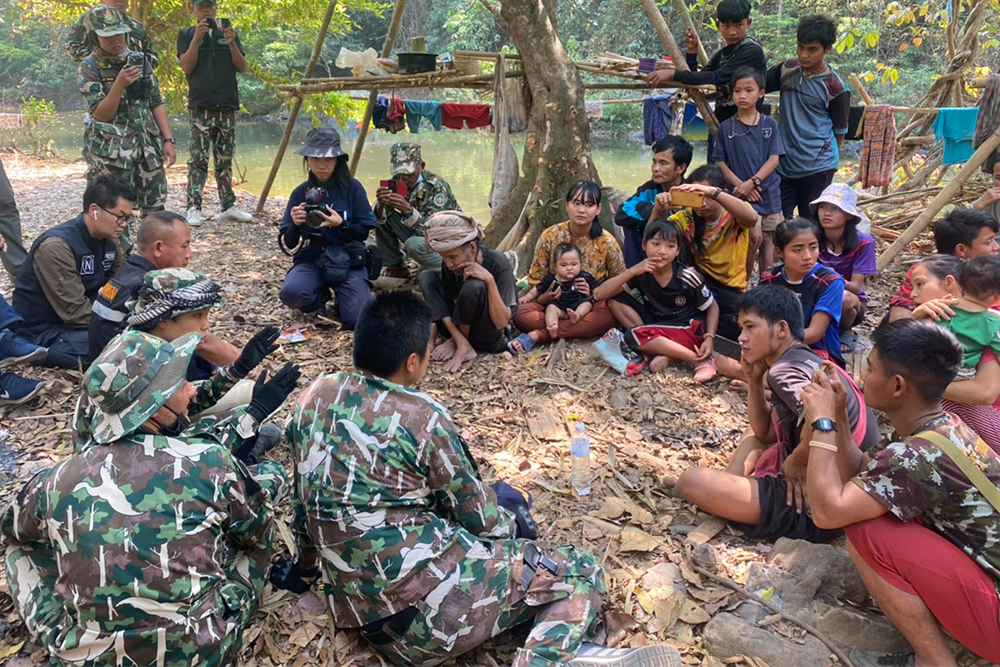
Park rangers negotiate with the remaining Karen villagers inside Kaeng Krachan National Park on Feb. 24, 2021.
The forest is home to Karen communities who settled on the land before the national park was established in 1981. Despite evidence that the settlement predated the law, the authorities accused the Karen villagers of encroaching on protected land and damaging the forest with their shifting cultivation practices.
The threats to remove the Karens from their ancestral homeland were finally carried out in 2011, when a group of six park rangers led by Chaiwat evicted them and set about 100 of their houses on fire, the anti-graft agency said.
The community’s spiritual leader Ko-ee Mimee and five villagers filed a case against Chaiwat a year later, in 2012. The administration court in 2018 ordered the national park department to pay 50,000 baht to each of the Karen in compensation of their destroyed homes, though it rejected Karens’ request to return to the national park.
Chaiwat also stands accused of involvement in the disappearance of activist Porlajee “Billy” Rakchongcharoen, who went missing in 2014 after he was briefly detained by Chaiwat and several officials in the national park.
He denied the allegations, insisting that he only held Porlachee for questioning for several hours and released him afterward.
The missing activist was confirmed dead in 2019 after investigators found bone fragments belonging to Porlajee inside an oil drum submerged in a lake inside the national park.
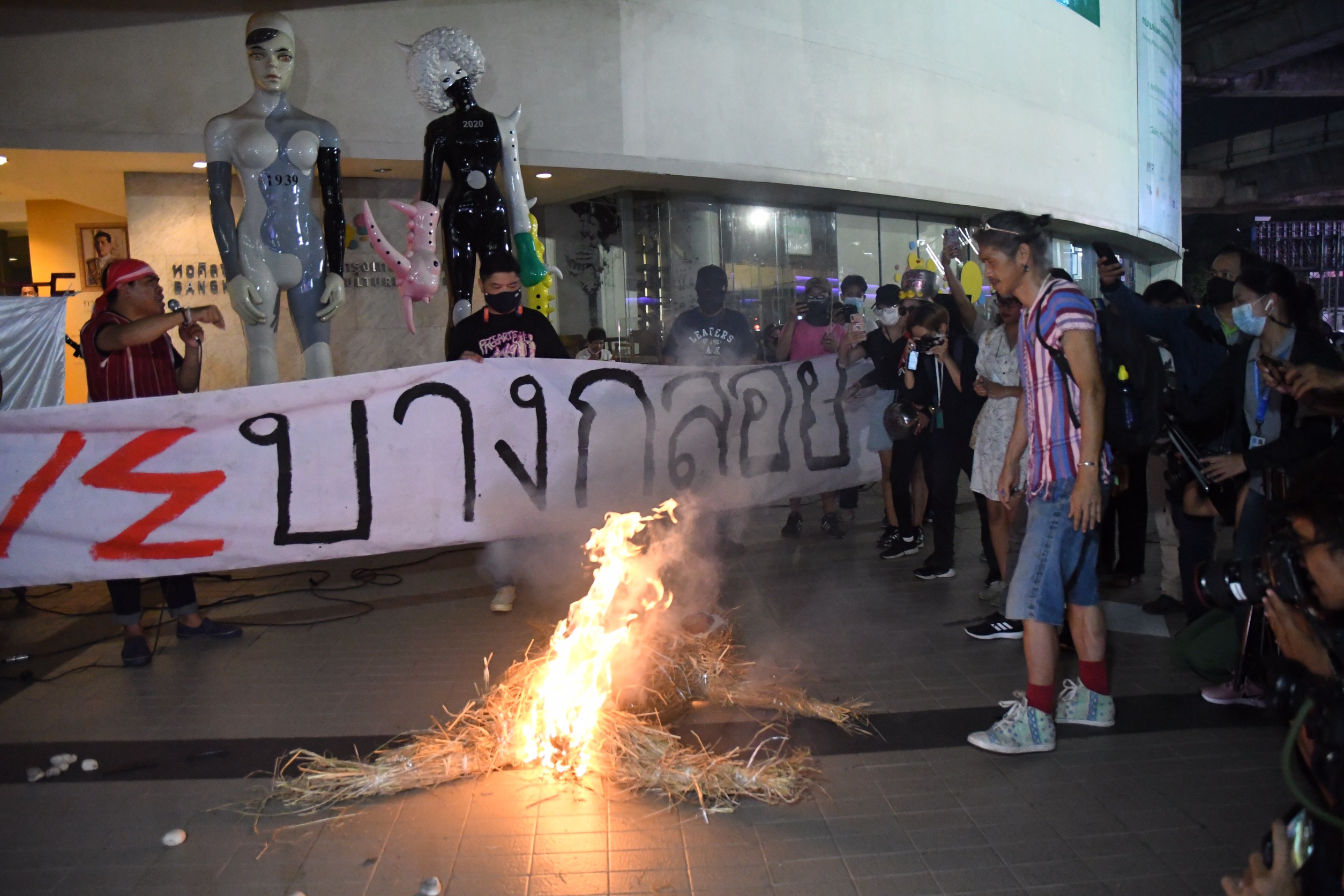
An activist sets fire to an effigy of environmental minister Varawut Silpa-archa during a protest in front of the Bangkok Arts and Cultural Center on Feb. 22, 2021.
Despite multiple serious accusations against them, Chaiwat and his aides were never brought to prison as they were released on bail. The court case against them is still ongoing.
The plight of Karen villagers was brought to attention in recent days after the authorities mounted another eviction campaign against the remaining Karen families on Monday.
Rallies were held in Bangkok and Chiang Mai on the same evening to demand environmental minister Varawut Silpa-archa to keep his promise to withdraw security forces from the village.
Officials said 13 villagers voluntarily left the forest after negotiations, while the rest 21 people refused to relocate.
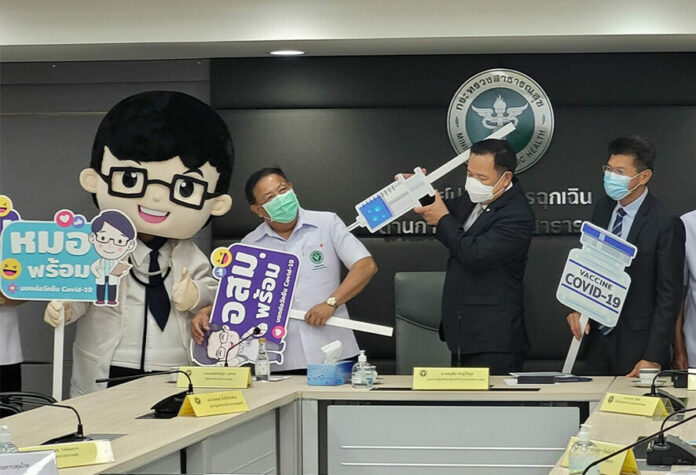
Health minister Anutin Charnvirakul holds a syringe prop during a press conference at the Ministry of Public Health on Feb. 25, 2021.
BANGKOK — Samut Sakhon, Bangkok, and Pathum Thani are among the first provinces to begin vaccinating its health workers and vulnerable populations against COVID-19 by next month, officials said Thursday.
The first shipment of 200,000 doses of vaccine developed by Chinese firm Sinovac arrived in Bangkok on Wednesday amid an elaborate welcoming ceremony presided over by PM Prayut Chan-o-cha and the Chinese ambassador. The pandemic response center said the vaccines will go straight to the provinces hardest hit by the outbreak as soon as they pass quality inspections.
“Health workers, including the Aor Sor Mor village health volunteers, will get the vaccines first,” the center’s spokeswoman Apisamai Srirangsan said.
“Each province will also allocate vaccines to officials who are close to the patients such as defense or interior officials who oversee quarantine facilities, and airport officials who screen incoming passengers. Vulnerable populations, especially those who have underlying diseases, will also be prioritized.”
According to the health ministry, a total of 169,000 doses will be distributed to Samut Sakhon, western districts of Bangkok, Pathum Thani, Nonthaburi, Samut Prakan, Tak’s Mae Sot district, Nakhon Pathom, Samut Songkhram, and Ratchaburi, where they will be used to inoculate health workers and vulnerable populations.
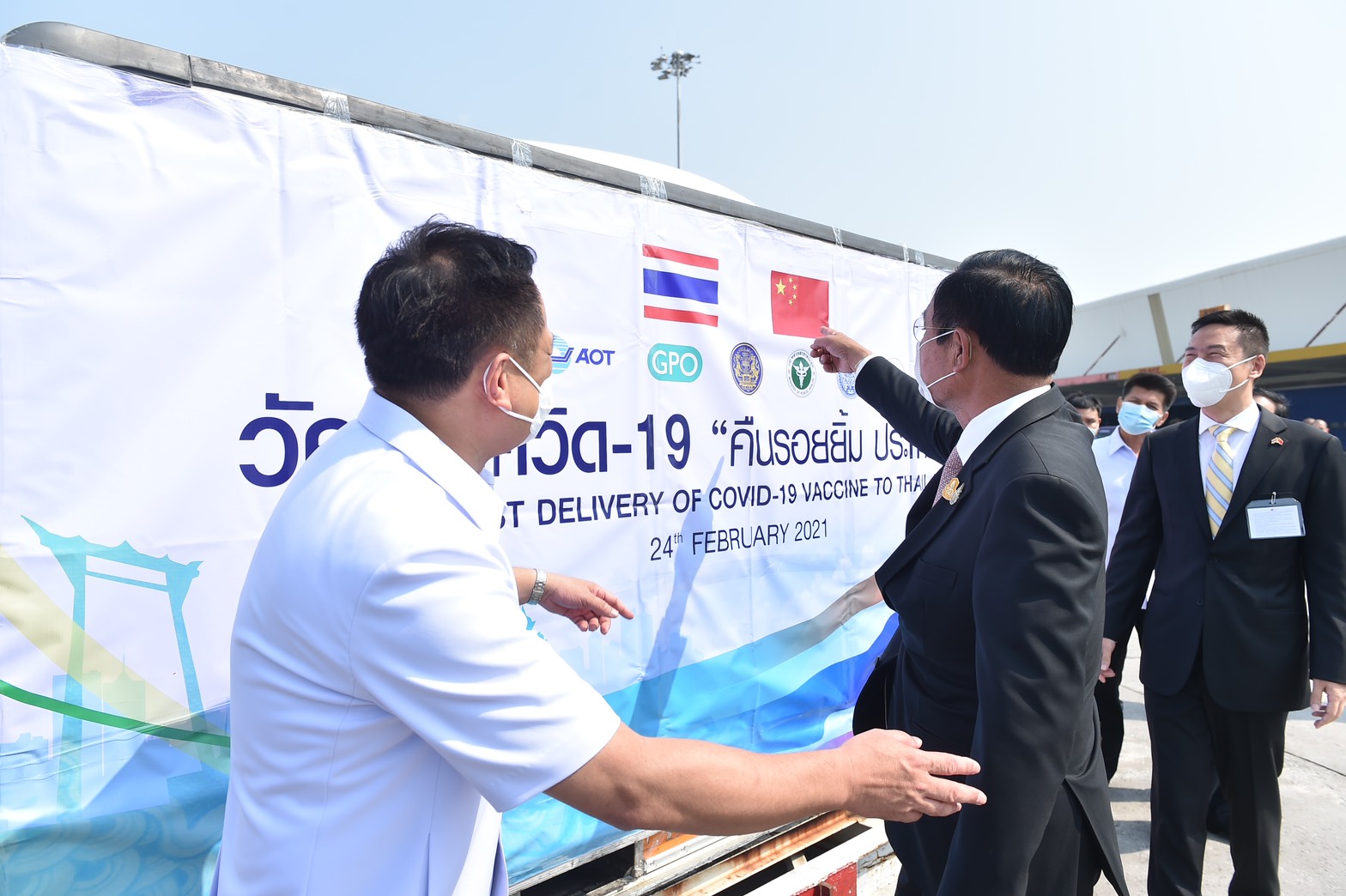
Health minister Anutin Charnvirakul, PM Prayut Chan-o-cha, and acting Chinese ambassador Yang Xin during the welcoming ceremony for Sinovac vaccines at Suvarnabhumi Airport on Feb. 24, 2021.
Another 14,700 doses will be sent to the four provinces popular among foreign travelers, which include Chonburi, Phuket, Surat Thani’s Samui Island, and Chiang Mai, in a bid to reopen the country for tourism. The remaining 16,300 doses will be put in a reserve stockpile.
Health minister Anutin Charnvirakul said at a news conference that the government will not charge any fee for the vaccine.
“The vaccines are for every Thai citizen and everyone residing in Thailand,” Anutin said. “If anyone claims that the vaccines have to be paid for, they will be prosecuted without exception.”
A Secretive Delivery
Today’s daily briefing by the government’s pandemic center made no mention of the 117,000 doses of AstraZeneca vaccines, which also arrived at Suvarnabhumi Airport on the same day as their Chinese counterparts.
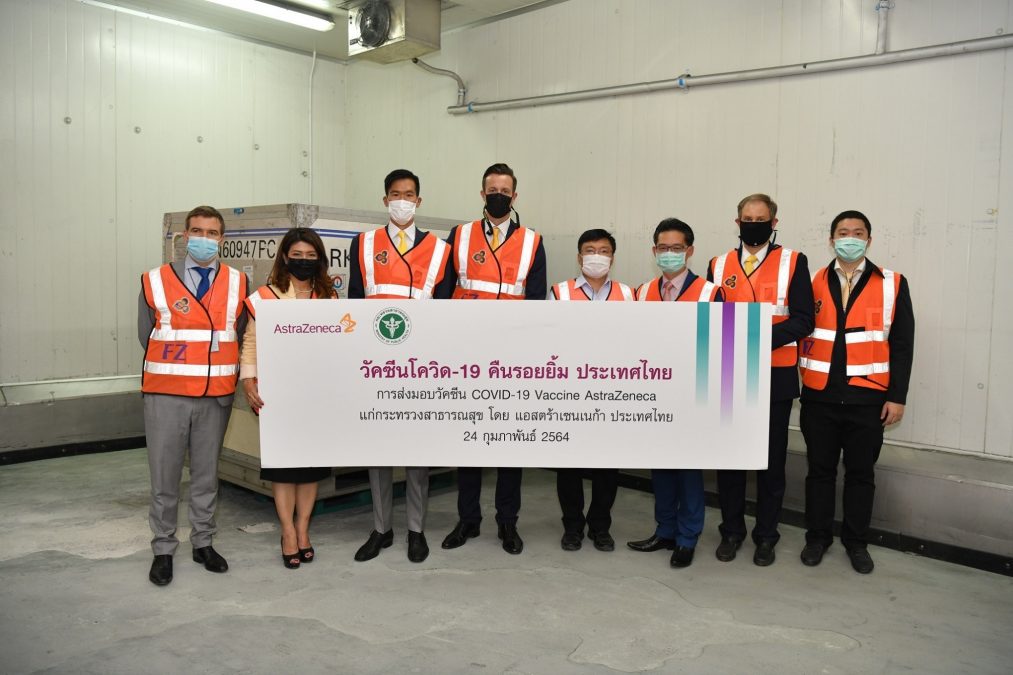
In a handout photo released by AstraZeneca, only a handful of company’s representatives and health officials were present at their photo op that marks the batch’s arrival on Wednesday’s afternoon – a stark contrast to the fanfare and pomp afforded to the Sinovac shipment, which featured luminaries like PM Prayut, Anutin, and acting Chinese ambassador Yang Xin.
AstraZeneca’s representatives and health officials take a photo with the container containing Thailand’s first shipment of AstraZeneca vaccines on Feb. 24, 2021.
The British pharmaceutical told Khaosod English that it has no plans to hold a welcome ceremony, since the vaccines are currently being inspected by health authorities.
“There will be no ceremonies,” AstraZeneca’s spokesperson for Thailand said. “The vaccines arrived in Thailand Wednesday’s afternoon and were transferred directly to a warehouse. They will be inspected by health authorities and will be issued a lot release certificate.”
AstraZeneca vaccines were previously slated to arrive in Thailand on Valentine’s Day, but it was delayed following the vaccine supply dispute between the company and the European Union, according to Anutin.
Speaking to reporters today, Anutin credited health officials for negotiating with the British company to secure the doses for Thailand, though he was evasive when asked where the first 117,000 doses originated from.
However, photos circulated online show that the shipment flew from Seoul’s Incheon Airport, where AstraZeneca has a production plant.
“That’s not the point,” Anutin said. “Health officials made every effort to negotiate for the imported doses. This will clear out accusations that we have procured the vaccines slowly and there is no backup plan.”
The arrival of AstraZeneca doses was also unexpected. When health minister Anutin announced last week that the first shipment of vaccines would land in Thailand on Feb. 24, he said it would only consist of the jabs made by Sinovac.
He only revealed that the shipment would also contain AstraZeneca’s vaccine less than 24 hours before the expected delivery. Anutin said he kept it secret because he “didn’t want to cause further drama.”
The 117,000 doses from AstraZeneca were meant to “fill in the gap” of Thailand’s vaccine supply chain before a local manufacturer can start the vaccine production per a technology agreement with the British firm.
Up to 61 million doses of the AstraZeneca-developed vaccine will be produced domestically by Siam Bioscience, a company wholly owned by the Crown Property Bureau, the government said. Production is said to start in June.
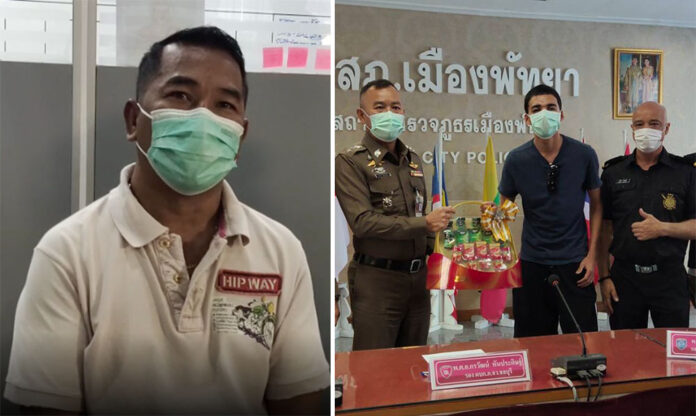
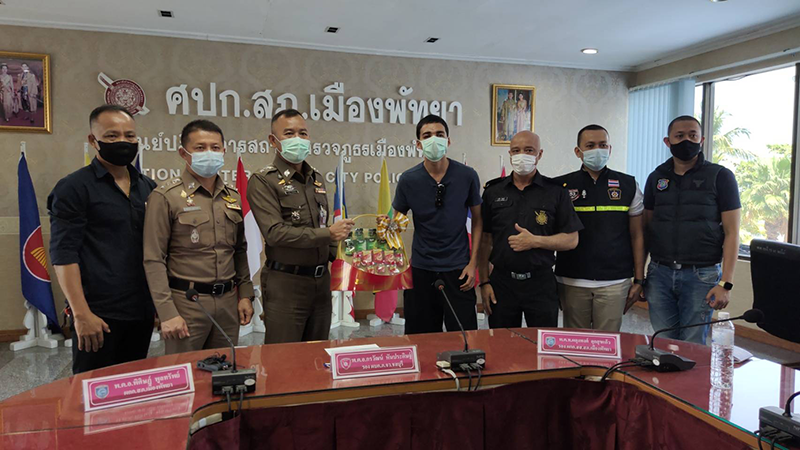
Left, Amorn Boonmee at Pattaya City Police Station on Feb. 25, 2021. Right, Salvatore Andrews Castromedina receives a basket of chicken essence soup from police.
PATTAYA — Police on Thursday arrested a man who confessed to attacking a Chilean national in the resort town of Pattaya.
Amorn “Jeab” Boonmee, a motorcycle taxi driver, was apprehended at his home after he allegedly slapped and kicked Salvatore Andres Castromedina, 24, breaking his nose. Speaking at the police station, Amorn said he acted in a blind moment of fury because he was annoyed by the Chilean man.
“I apologize,” Amorn said at the Pattaya City Police Station on Thursday afternoon. “I was annoyed at the tourist who came up to speak to me and I didn’t understand what he was saying. He wouldn’t go when I told him to. I’m someone who gets annoyed easily, especially at people who talk a lot.”
The attack took place close to the red light district of Walking Street at about 2am Thursday. It was also captured on a security camera.
Police Col. Pisit Poonsap said investigators were still waiting for a full medical report of Castromedina’s injuries in order to determine Amorn’s charges.
“This incident has damaged the image of Pattaya and the country’s tourism,” Pisit said, attributing the cause to a “misunderstanding in communication. “We don’t want these images to happen.”
Speaking via an interpreter, Castromedina said this was his first time in Thailand. The man said he tried to ask the motorcycle taxi driver for a ride to Soi Buakhao prior to the incident.
The other person seen in the CCTV footage was Rittisak Kulsumaso, 45, another motorcycle taxi driver. Rittisak said he tried to stop Amorn from attacking Castromedina and turned himself into the police at noon.
Rittisak said he was also the one who brought Castromedina to the police to file a complaint.
“I really didn’t want this to happen. It’s already hard to make money,” Rittisak said. “[Castromedina] had also been drinking alcohol.”
At the station, police officers also gave Castromedina a basket of chicken essence soup and wished him a speedy recovery.
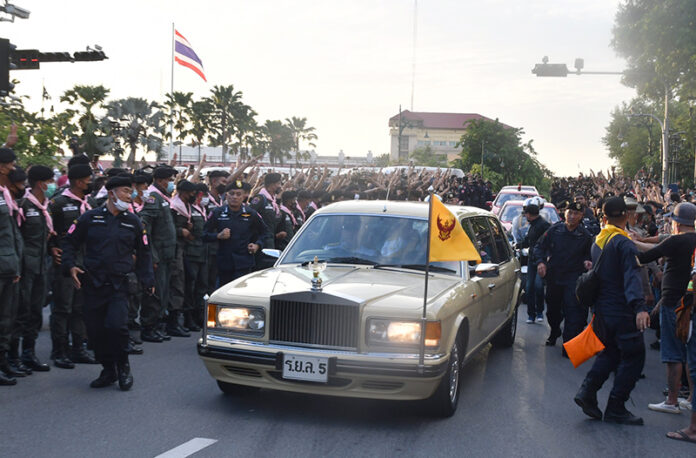
A royal motorcade drives through a crowd of anti-government protesters in front of Government House on Oct. 14, 2020.
BANGKOK — Prosecutors on Thursday deferred their decision on whether to indict a group of five activists accused of blocking Her Majesty the Queen’s motorcade to March 31, a defense attorney said.
The indictment was initially expected today, but prosecutors delayed it because they needed more time to study the case file, defense lawyer Winyat Chatmontree said by phone. Five activists were charged with harming Her Majesty the Queen or Her Liberty under Article 110 of the Criminal Codes, which carries a lifetime prison sentence.
Winyat, who represents three of the five suspects, said he already filed a letter to the prosecutors asking them to reconsider the case, but it’s too premature to assume how they will proceed.
“It’s too soon to tell, but usually if someone asks for fairness, they have to consider the issue,” the lawyer said.
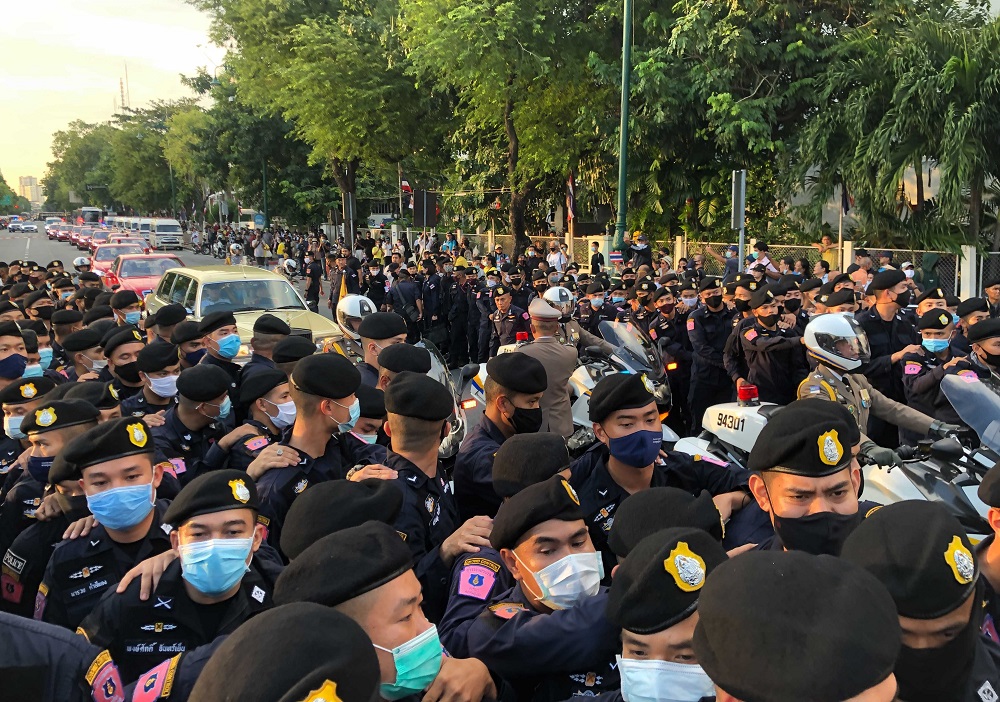
Charges were filed against the five activists following an incident on Oct. 14, when Her Majesty the Queen’s motorcade passed through a group of pro-democracy protesters in front of Government House without any warning. The authorities accused the demonstrators of attempting to block the convoy and harming Her Majesty.
In the letter submitted to the Office of the Attorney General, Winyat questioned why the authorities did not inform the demonstrators in advance about the royal motorcade.
“Did they ever investigate this incident? If not, then they should do so,” Winyat said by phone. “Usually when security details are deployed [to protect the motorcade], even a dog can’t walk through. How did the motorcade pass through the protesters? Why did they not clear the protesters from the area first?”
A royal motorcade pushes through protesters in front of Government House on Oct. 14, 2020.
Three people were charged with Article 110 in the days after the confrontation: political activist and former lese majeste convict Ekachai Hongkangwan, Mahidol University student and activist Bunkueanun “Francis” Paothong, and children welfare campaigner Suranat Paenprasert.
Two were later charged with the same offense: Panupat Paikor, 31, an office worker and Chanathip Chanintayangoon, 50, an artist.
One of the suspects, Ekachai, said to be charged with the harsh law of Article 110 is a new experience for him, even though he’s been through many legal battles as an activist.
“It’s an unprecedented case,” Ekachai said.
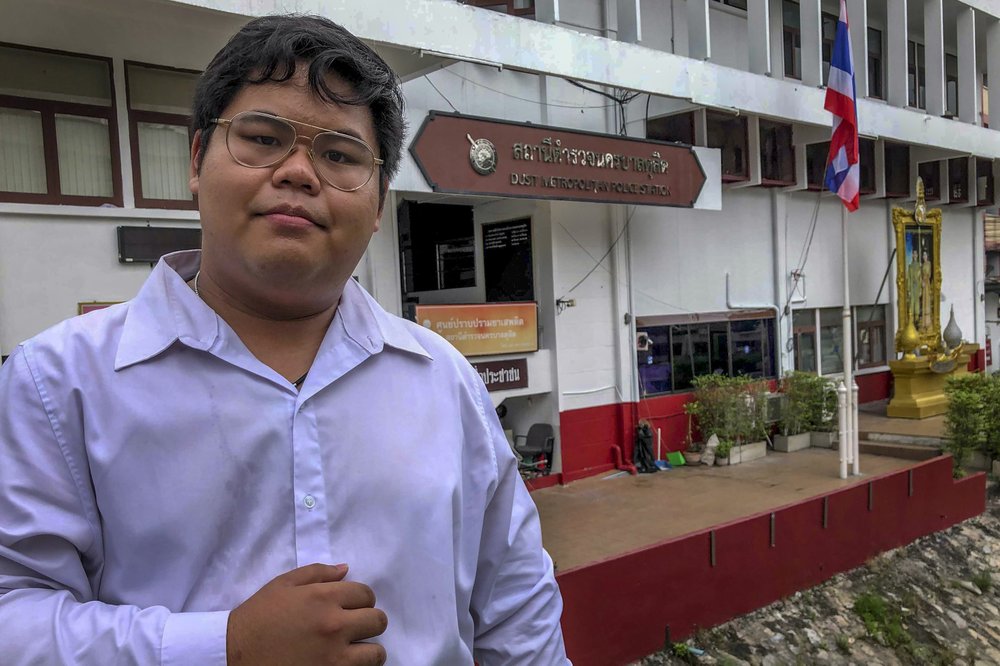
In this Oct. 16, 2020, file photo, activist Bunkueanun Paothong poses for a photo outside a police station in Bangkok, Thailand. (AP Photo/Jerry Harmer, File)
Bunkueanun, the Mahidol student, said he feels optimistic that the prosecutors may drop the allegation once they’ve looked into the full picture.
“I’m kind of not surprised especially when the case is supposed to have this kind of impact and especially it has no historical precedent,” Bunkueanun said by phone. “And I think the folk there at the Office of the Attorney General might want to get the facts straight, like how the police carried out the investigation.”
He continued, “I was near the motorcade but didn’t intend to do harm. I am certainly optimistic about the whole aspect of what’s going to happen. But then again, we must expect the unexpected. We probably have to wait and see.”
Ekachai and Bunkeanun have insisted that they did not pose any threat to Her Majesty the Queen; a video of the incident shows Ekachai standing close by and flashing the three-finger salute, but did not physically touch the vehicle carrying the Queen.
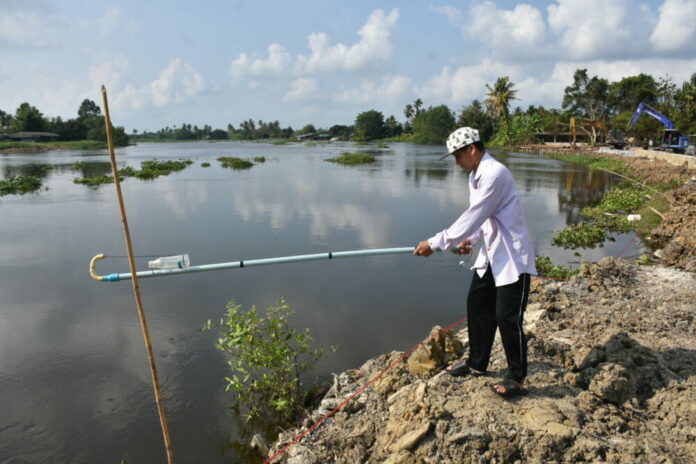
Suwat Kanjanawaha, 58, collects a water sample on Feb. 15, 2021 from Tha Chin River in Nakhon Pathom. Suwat, an orchid gardener, has had all his crops die since the river’s salinity reached levels as high as 4 grams per liter.
BANGKOK — Starting on March 1, experts from Chulalongkorn University will offer to test if the tap water and filter in your home has too much salt – free of charge.
The free service is part of a campaign to raise awareness about the ongoing phenomenon of salty tap water in the capital, which officials blame on the rise of the sea level that spilled onto Bangkok’s water supplies.
Residents concerned that their tap water may be too unhealthy are encouraged to bring their samples to Professor Aroon Sorathesn Center of Excellence in Environmental Engineering, which will open to the public Mondays to Fridays, from 9am to 4pm.
“People have a limit of salt per day, and that limit is 2000 milligrams,” Pisut Painmanakul, a professor in environmental engineering at Chulalongkorn University’s Faculty of Engineering, said by phone.
“Since the water is already 200 or 250 milligrams per liter, and you drink maybe two liters per day, you have to make up for that by eating less salty food.”
Pisit warned that the problem of salty tap water would only escalate in the coming days due to rising sea levels and Chao Phraya tributaries being diverted for agricultural use.
He added that people should decrease their intake of mineral water, since the salty water already has an ample amount of minerals. Those living upriver from Bangkok should also try to conserve water usage.
Both the World Health Organization and the U.S. Environmental Protection Agency say that drinking water should have no more than 0.2 grams of sodium per liter, but Bangkok is seeing as much as 0.33 grams as of press time, down from levels of 0.96 in earlier February.
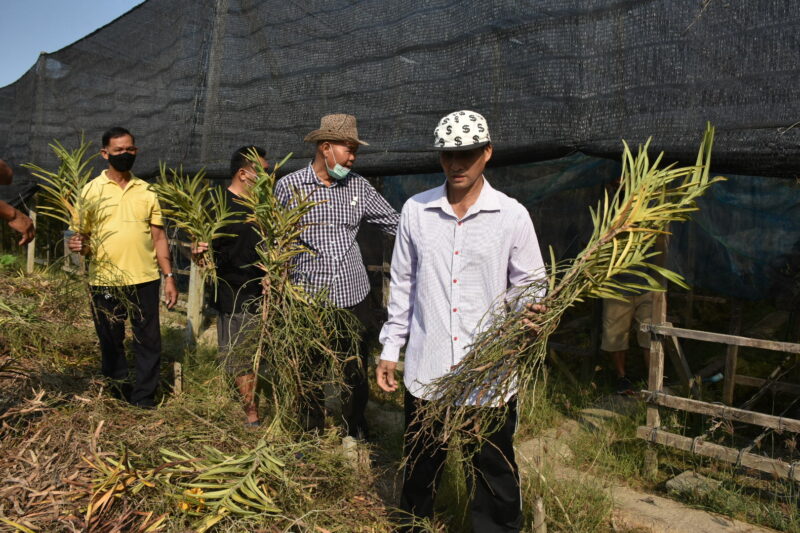
Orchid farmers in Nakhon Pathom hold up their orchids that have died due to salty river water on Feb. 15, 2021.
Although that’s time-worn advice previously given by government officials, Pisit illustrated just how much sodium is in Thai food.
“To put it easily, one fried snake skin fish has 1,200 milligrams of sodium. One tablespoon of fish sauce is almost the daily limit,” he said.
Ingesting too much salt puts one at the risk of kidney disease and high blood pressure. The professors recommended that people use Reverse Osmosis filtration systems.
Chulalongkorn University said in a statement that its experts have been working on creating water filter membranes that minimize wastewater and are longer-lasting than common ones. The professors have used electrodialysis, a method which separates salt from water, used ultra membranes to filter out pollutants.
Director Jenyuk Lohwacharin of the environmental engineering center said the university did not have plans to create and sell filtration systems yet, but if they had the budget they could create filtration systems for areas in dire need of them.
The public is also advised to avoid filling up their water jugs with tap water anything between 2pm to 5pm – since it’s the time of the day when the sea levels are at the highest.
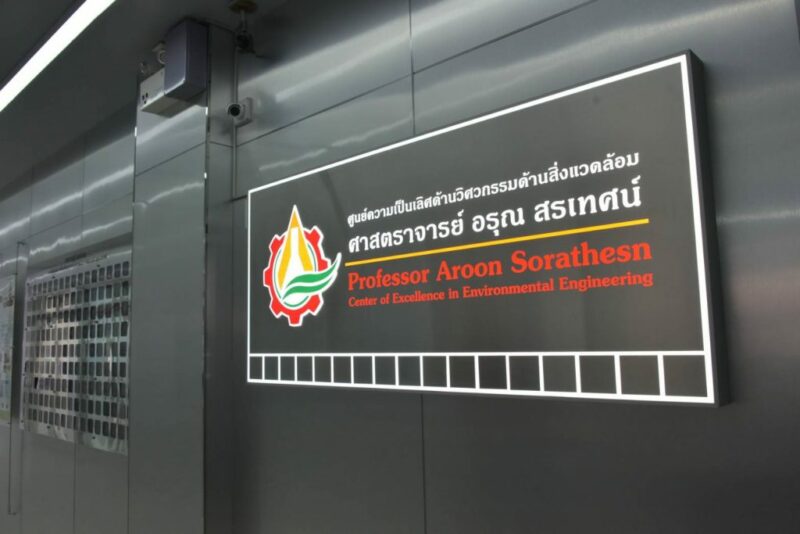
The Professor Aroon Sorathesn Center of Excellence in Environmental Engineering. Photo: Chulalongkorn University
To bring in your water samples or filters for testing, go to the Professor Aroon Sorathesn Center of Excellence in Environmental Engineering (ศูนย์ความเป็นเลิศด้านวิศวกรรมสิ่งแวดล้อม) on the third floor of the Department of Environmental Engineering at the Faculty of Engineering, Chulalongkorn University.
The center is open from 9am to 4pm, and is a walkable distance from either BTS Siam or MRT Sam Yan.
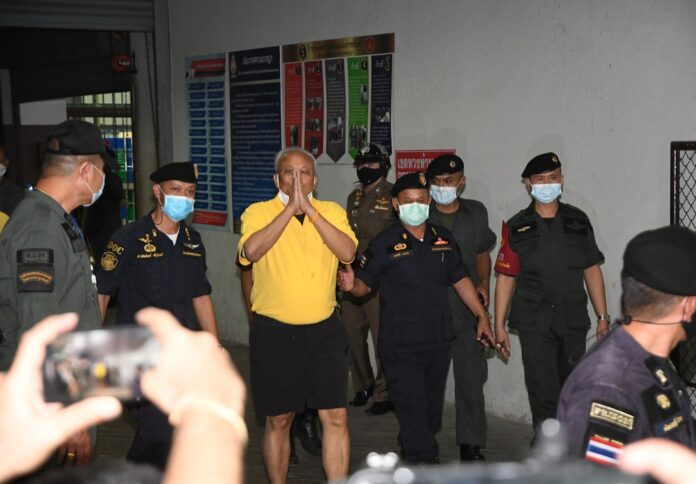
Suthep Thaugsuban gestures to reporters as he is led away to Bangkok Remand Prison on Feb. 24, 2021.
BANGKOK (AP) — Three Cabinet ministers in Thailand were forced to leave their posts Wednesday after a court found them guilty of sedition for taking part in sometimes-violent protests in 2013-2014 against the government then in power.
The Criminal Court in Bangkok found Digital Economy Minister Buddhipongse Punnakanta, Education Minister Nataphol Teepsuwan and Deputy Transport Minister Thaworn Senneam guilty along with about two dozen other defendants in a case that was launched in 2018.
Nataphol was among 10 Cabinet member who survived a no-confidence vote on Saturday over their performance in the current government.
The verdicts can be appealed to a higher court but under the law the Cabinet ministers must relinquish their jobs immediately.
In this Saturday, Sept. 5, 2020, file photo, the Thai Education Minister Nataphol Teepsuwan, center negotiates with student representatives ahead of a rally of high school students in Bangkok, Thailand. N (AP Photo/Gemunu Amarasinghe, file)
Another prominent person convicted Wednesday was Suthep Thaugsuban, a former deputy prime minister who helped found the People’s Democratic Reform Committee, which led the demonstrations against the elected government of then-Prime Minister Yingluck Shinawatra. Instability caused by the street protests led to the Thai army staging a coup in 2014 and keeping power until 2019.
Suthep and the Cabinet ministers each received prison sentences ranging from five to about seven years. Another prominent defendant, Suwit Thongprasert, who was a Buddhist monk known as Buddha Issara during the protests, was sentenced to 4 years and 8 months in prison. All were remanded into custody pending appeals procedures.
“We are prepared. Whatever happens, will happen,” Suthep said outside the court. “But I have to assure you that the protest leaders and those who share our same belief, that we are fighting for our country and our land. We firmly believe in responsibility in our actions and not violating the law.”
The protests marked the tail end of almost a decade of intense political contention in Thailand that began in 2006 after then-Prime Minister Thaksin Shinawatra was ousted by a coup after being accused of corruption and abuse of power. Thaksin is Yingluck’s brother, and they are both currently in exile.
Suthep Thaugsuban greets Buddha Issara at the court on March 14, 2018.
Thaksin’s ouster set off years of sometimes violent conflict between his supporters and opponents, both of which engaged in aggressive street protests against governments led by the other’s faction. The People’s Democratic Reform Committee was in the anti-Thaksin camp, which in an earlier incarnation as the People’s Alliance for Democracy occupied the prime minister’s offices and Bangkok’s international airport for about a week in 2008.
Thaksin’s supporters were known as the Red Shirts, and in 2010 wreaked havoc by occupying part of central Bangkok. Their protest was suppressed by the army in several weeks of violence that took almost 100 lives.
The court in Bangkok on Wednesday dismissed charges of insurrection and terrorism against the defendants, on the ground that they had not used force to hurt anyone.
However, Suthep and 26 other defendants were found guilty on several other lesser charges carrying prison terms as short as four months. The court suspended for two years the sentences of 12 people because they considered them participants rather than leaders of the protests.
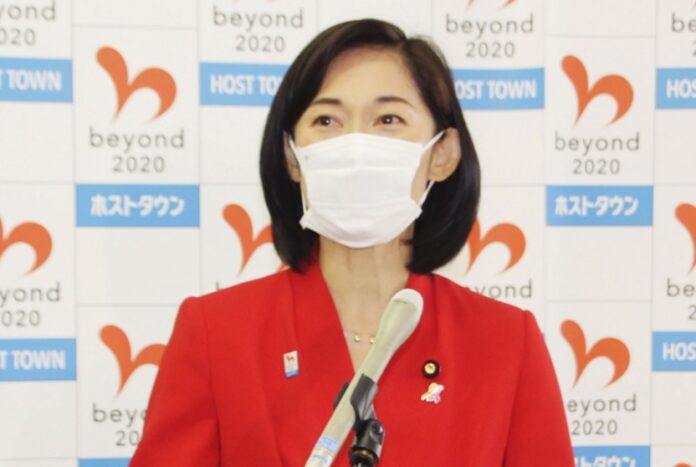
Japan's new Olympic minister Tamayo Marukawa meets the press in Tokyo on Feb. 20, 2021. (Kyodo)
TOKYO (Kyodo) — Japan’s Olympics minister said Wednesday that coronavirus vaccinations would not be a prerequisite for participation at this summer’s Olympics and Paralympics, despite a World Anti-Doping Agency appeal that athletes be inoculated.
“We are putting together a number of comprehensive measures to realize a safe and secure event without needing vaccinations to be a prerequisite,” Tamayo Marukawa, who last week took over as Olympics minister, told a press conference.