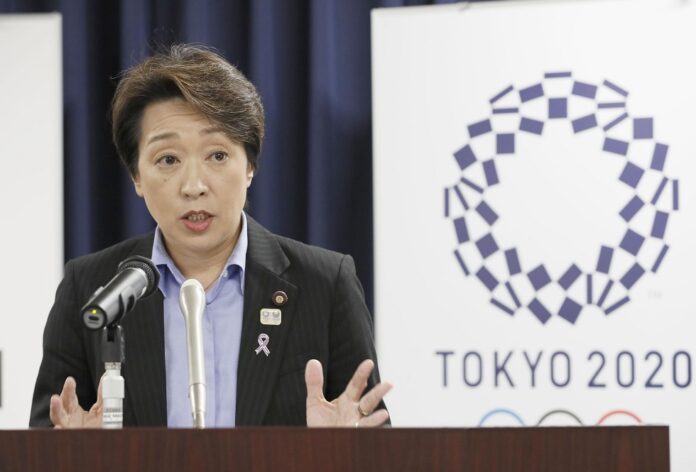
TOKYO (Kyodo) — Japan’s former Olympic minister Seiko Hashimoto on Thursday took over as head of the Tokyo Games organizing committee, succeeding Yoshiro Mori who resigned last week amid an uproar over sexist remarks.
Hashimoto, a seven-time Olympian, said that preparing effective measures against the novel coronavirus is the “most important” task and pledged to stage a “safe and secure” games this summer.
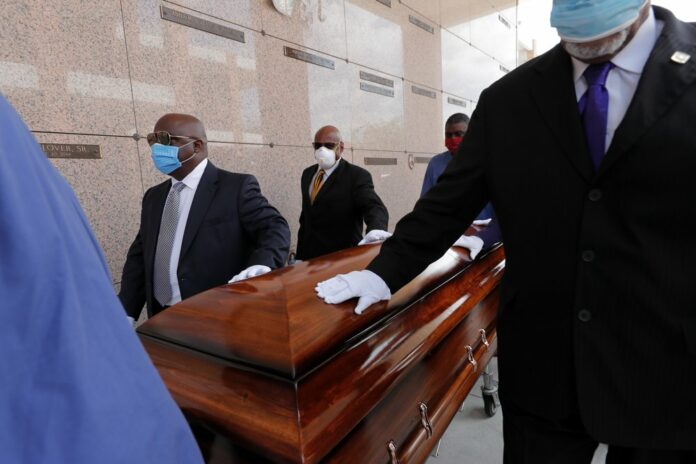
In this April 22, 2020, file photo, pallbearers, who were among only 10 allowed mourners, walk the casket for internment at the funeral for Larry Hammond, who died from the coronavirus, at Mount Olivet Cemetery in New Orleans. (AP Photo/Gerald Herbert, File)
By The Associated Press
Life expectancy in the United States dropped a staggering one year during the first half of 2020 as the coronavirus pandemic caused its first wave of deaths, health officials are reporting.
Minorities suffered the biggest impact, with Black Americans losing nearly three years and Hispanics, nearly two years, according to preliminary estimates Thursday from the Centers for Disease Control and Prevention.
“This is a huge decline,” said Robert Anderson, who oversees the numbers for the CDC. “You have to go back to World War II, the 1940s, to find a decline like this.”
Other health experts say it shows the profound impact of COVID-19, not just on deaths directly due to infection but also from heart disease, cancer and other conditions.
“What is really quite striking in these numbers is that they only reflect the first half of the year … I would expect that these numbers would only get worse,” said Dr. Kirsten Bibbins-Domingo, a health equity researcher and dean at the University of California, San Francisco.
This is the first time the CDC has reported on life expectancy from early, partial records; more death certificates from that period may yet come in. It’s already known that 2020 was the deadliest year in U.S. history, with deaths topping 3 million for the first time.
Life expectancy is how long a baby born today can expect to live, on average. In the first half of last year, that was 77.8 years for Americans overall, down one year from 78.8 in 2019. For males it was 75.1 years and for females, 80.5 years.
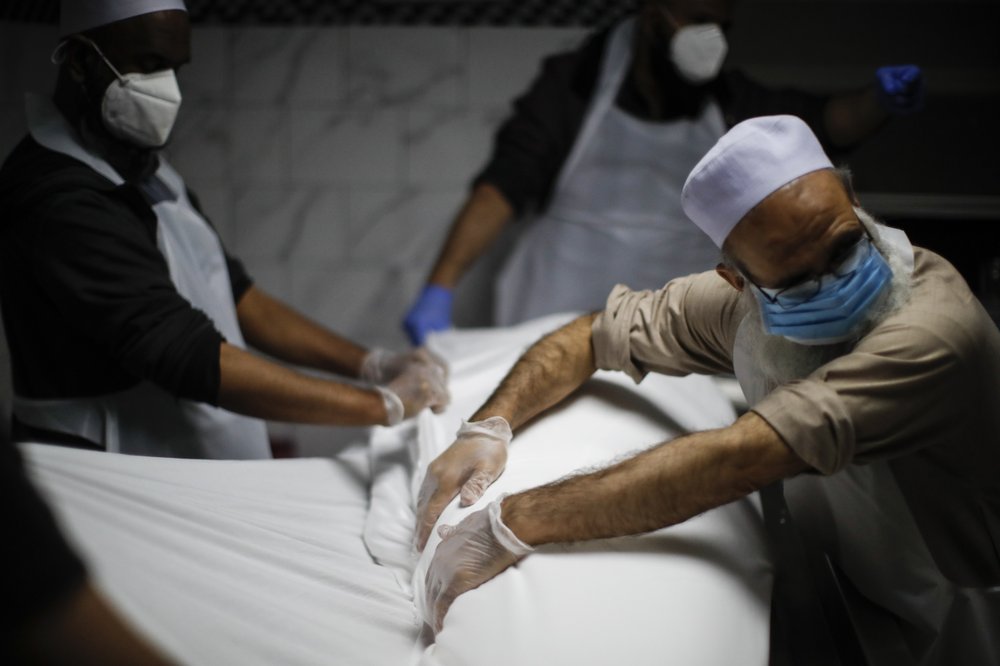
The body of Mohammad Altaf, who died at 48 of COVID-19, is ritually washed and wrapped before being given funeral prayers at Al-Rayaan Muslim Funeral Services, Sunday, May 17, 2020, in the Brooklyn borough of New York. (AP Photo/John Minchillo)
As a group, Hispanics in the U.S. have had the most longevity and still do. Black people now lag white people by six years in life expectancy, reversing a trend that had been bringing their numbers closer since 1993.
Between 2019 and the first half of 2020, life expectancy decreased 2.7 years for Black people, to 72. It dropped 1.9 years for Hispanics, to 79.9, and 0.8 years for white people, to 78. The preliminary report did not analyze trends for Asian or Native Americans.
“Black and Hispanic communities throughout the United States have borne the brunt of this pandemic,” Bibbins-Domingo said.
They’re more likely to be in frontline, low-wage jobs and living in crowded environments where it’s easier for the virus to spread, and “there are stark, pre-existing health disparities in other conditions” that raise their risk of dying of COVID-19, she said.
More needs to be done to distribute vaccines equitably, to improve working conditions and better protect minorities from infection, and to include them in economic relief measures, she said.
Dr. Otis Brawley, a cancer specialist and public health professor at Johns Hopkins University, agreed.
Health care workers wave to a departing patient, who recovered from being stricken with COVID-19, outside the Southern New Hampshire Medical Center in Nashua, N.H., Wednesday, May 27, 2020. (AP Photo/Charles Krupa)
“The focus really needs to be broad spread of getting every American adequate care. And health care needs to be defined as prevention as well as treatment,” he said.
Overall, the drop in life expectancy is more evidence of “our mishandling of the pandemic,” Brawley said.
“We have been devastated by the coronavirus more so than any other country. We are 4% of the world’s population, more than 20% of the world’s coronavirus deaths,” he said.
Not enough use of masks, early reliance on drugs such as hydroxychloroquine, “which turned out to be worthless,” and other missteps meant many Americans died needlessly, Brawley said.
“Going forward, we need to practice the very basics” such as hand-washing, physical distancing and vaccinating as soon as possible to get prevention back on track, he said.
___
The Associated Press Health and Science Department receives support from the Howard Hughes Medical Institute’s Department of Science Education. The AP is solely responsible for all content.
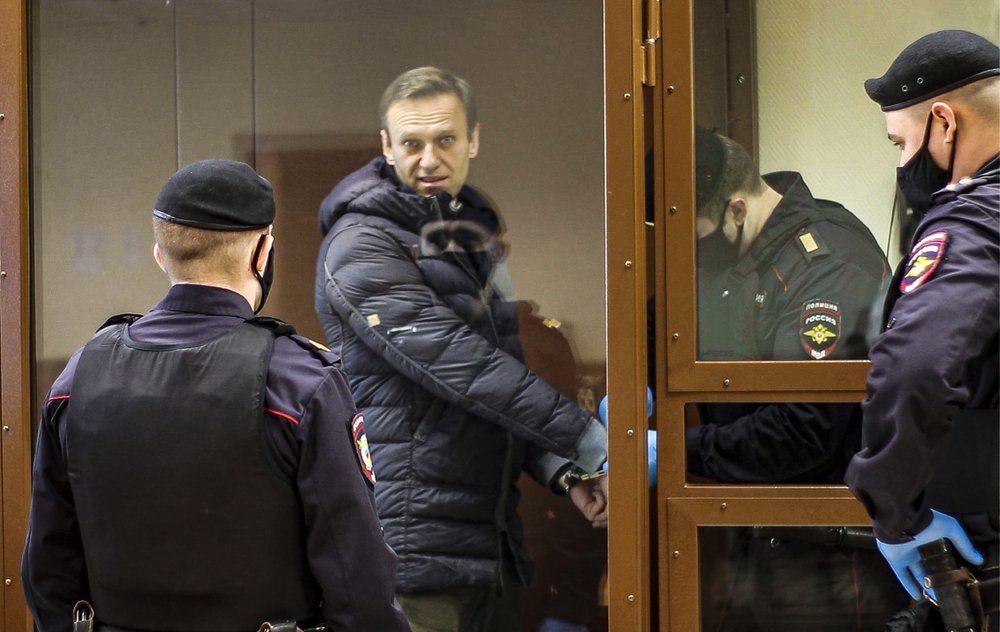
In this photo taken from a footage provided by the Babuskinsky District Court Tuesday, Feb. 16, 2021, Russian opposition leader Alexei Navalny gestures during a hearing on his charges for defamation in the Babuskinsky District Court in Moscow, Russia. (Babuskinsky District Court Press Service via AP)
MOSCOW (AP) — Europe’s top human rights court has ordered Russia to release jailed opposition leader Alexei Navalny, a ruling quickly rejected Wednesday by Russian authorities who are bent on isolating the Kremlin’s most prominent foe.
The decision by the European Court of Human Rights had demanded that Russia free Navalny immediately and warns that failing to do so would mark a breach of the European human rights convention.
Russia’s justice minister dismissed the court’s demand as “unfounded and unlawful” and the Foreign Ministry denounced it as part of Western meddling in the country’s domestic affairs.
Navalny, 44, an anti-corruption investigator and President Vladimir Putin’s most prominent critic, was arrested last month upon returning from Germany, where he spent five months recovering from a nerve-agent poisoning that he blames on the Kremlin. Russian authorities have rejected the accusation.
In this photo taken from a footage provided by the Babuskinsky District Court Tuesday, Feb. 16, 2021, Russian opposition leader Alexei Navalny, center, enters a cage to attend a hearing on his charges for defamation in the Babuskinsky District Court in Moscow, Russia. (Babuskinsky District Court Press Service via AP)
Earlier this month, a Moscow court sentenced Navalny to two years and eight months in prison for violating terms of his probation while recuperating in Germany. The sentence stems from a 2014 embezzlement conviction that Navalny has rejected as fabricated and the European court has ruled to be unlawful.
In its Tuesday’s ruling, the ECHR pointed to Rule 39 of its regulations and obliged the Russian government to release Navalny, citing “the nature and extent of risk to the applicant’s life.”
“This measure shall apply with immediate effect,” the Strasbourg-based court said in a statement.
The court noted that Navalny has contested Russian authorities’ argument that they had taken sufficient measures to safeguard his life and well-being in custody following the nerve agent attack.
Russian Justice Minister Konstantin Chuichenko rejected the court’s ruling as a “clear and crude interference” into Russia’s judicial system.
“This demand is unfounded and unlawful because it doesn’t indicate a single fact or a legal norm that would allow the court to make such verdict,” Chuichenko said in a statement carried by Russian news agencies.
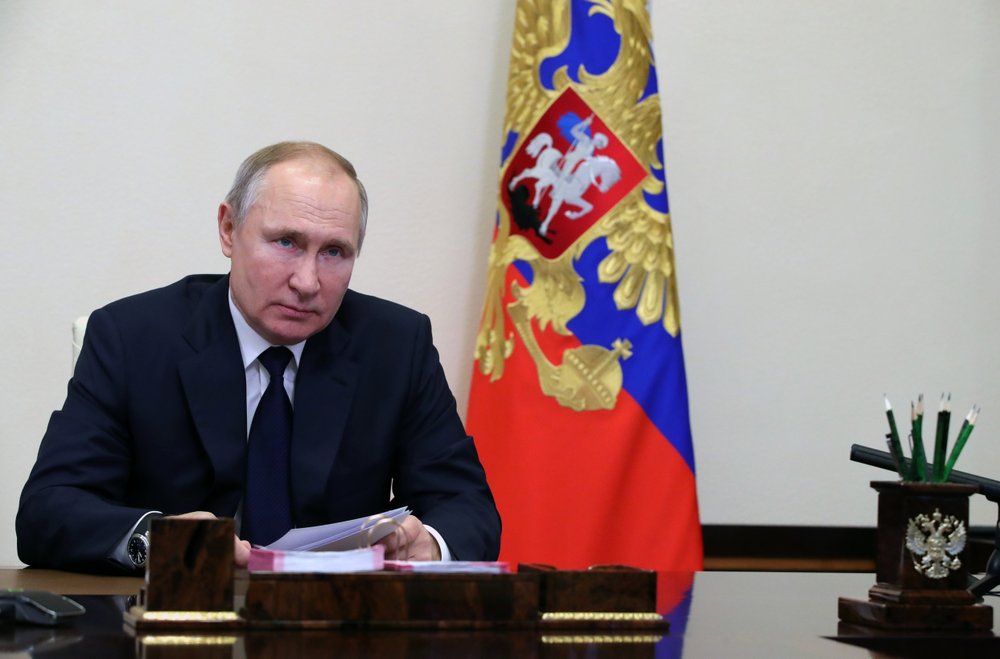
Russian President Vladimir Putin attends a meeting with leaders of the State Duma, the Lower House of the Russian Parliament factions via video conference residence at the Novo-Ogaryovo outside Moscow, Russia, Wednesday, Feb. 17, 2021. (Mikhail Klimentyev, Sputnik, Kremlin Pool Photo via AP)
“This demand can’t be fulfilled because there is no legal reason for that person to be released from custody under Russian law. Well aware of that, the European judges clearly have made a political decision that could only exacerbate restoring constructive relations with the Council of Europe’s institutions.”
In the past, Moscow has abided by the ECHR’s rulings awarding compensations to Russian citizens who have contested verdicts in Russian courts, but it never faced a demand by the European court to set a convict free.
In a reflection of its simmering irritation with the European court’s verdicts, Russia last year adopted a constitutional amendment declaring the priority of national legislation over international law. Russian authorities might now use that provision to reject the ECHR’s ruling.
Mikhail Yemelyanov, a deputy head of the legal affairs committee in the Kremlin-controlled lower house of parliament, pointed at the constitutional change, noting that it gives Russia the right to ignore the ECHR’s ruling, according to the Interfax news agency.
But Navalny’s chief strategist Leonid Volkov argued that Russia’s membership in the Council of Europe obliges it to fulfill the court’s ruling. He warned on Facebook that the country risks losing its membership in the continent’s top human rights organization if it fails to abide by the order.
Navalny’s arrest and imprisonment fueled a wave of protests across Russia. Authorities responded with a sweeping crackdown, detaining about 11,000 people, many of whom were fined or given jail terms ranging from seven to 15 days.
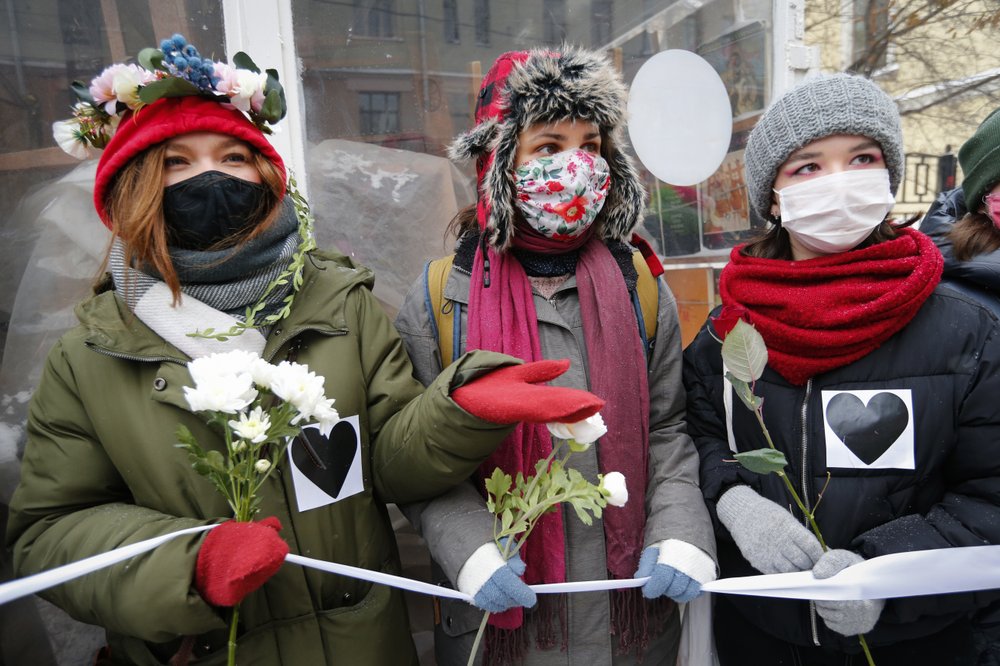
Women, wearing face masks to protect against coronavirus, attend a rally in support of jailed opposition leader Alexei Navalny and his wife Yulia Navalnaya, in Moscow, Russia, Sunday, Feb. 14, 2021. (AP Photo/Alexander Zemlianichenko)
Russia has rejected Western criticism of Navalny’s arrest and the crackdown on demonstrations as meddling in its internal affairs.
In televised remarks, Russian Foreign Ministry spokeswoman Maria Zakharova denounced the ECHR’s ruling as a blow to international law and “part of a campaign to exert pressure on our country and meddle in our country’s internal affairs.”
A court hearing on Navalny’s appeal of his sentence is scheduled for Saturday.
He also has faced court proceedings in a separate case on charges of defaming a World War II veteran. Navalny, who called the 94-year-old veteran and other people featured in a pro-Kremlin video “corrupt stooges,” “people without conscience” and “traitors,” has rejected the slander charges and described them as part of official efforts to disparage him.
With his usual sardonic humor, Navalny compared his conditions at the maximum-security Matrosskaya Tishina prison in Moscow to the isolation of a space traveler.
“People in uniforms who come to me say only a few formulaic sentences, a light indicating a working video camera is seen on their chests — they look just like androids,” he said in remarks posted on Instagram. “And just like in a movie about space travel, the ship’s command center communicates with me. A voice from the intercom would say: ‘3-0-2, get ready for sanitary treatment.’ And I would answer: ‘OK, just give me 10 minutes to finish my tea.’”
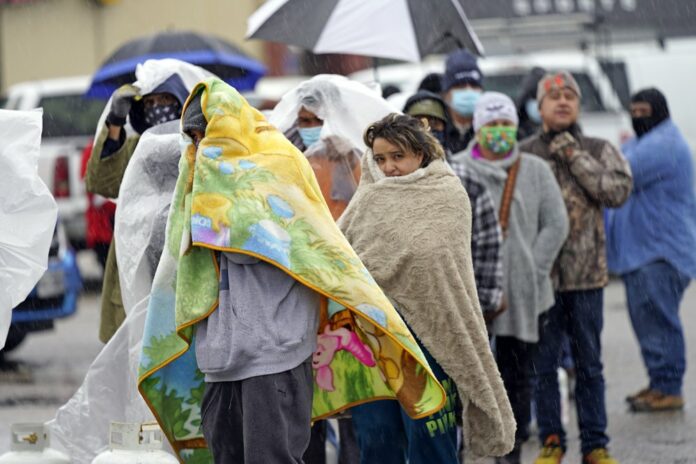
People wait in line to fill propane tanks Wednesday, Feb. 17, 2021, in Houston. Customers waited over an hour in the freezing rain to fill their tanks. (AP Photo/David J. Phillip)
AUSTIN, Texas (AP) — Millions of Americans endured another frigid day without electricity or heat in the aftermath of a deadly winter storm as utility crews raced to restore power before another blast of snow and ice sowed more chaos in places least equipped to deal with it.
Nearly 3.4 million customers around the U.S. were still without electricity, and some also lost water service. Texas officials ordered 7 million people — a quarter of the population of the nation’s second-largest state — to boil tap water before drinking it following days of record low temperatures that damaged infrastructure and froze pipes.
The latest storm front was certain to complicate recovery efforts, especially in states that are unaccustomed to such weather — parts of Texas, Arkansas and the Lower Mississippi Valley.
“There’s really no letup to some of the misery people are feeling across that area,” said Bob Oravec, lead forecaster with the National Weather Service, referring to Texas.
Top: Millions of Texas residents are without power amid frigid temperatures. Now, some must also cope with bursting water pipes – the latest effect of a winter storm that has pummeled much of the U.S.
The system was forecast to move into the Northeast on Thursday. More than 100 million people live in areas covered by some type of winter weather warning, watch or advisory, the weather service said.
This week’s extreme weather has been blamed for the deaths of more than 30 people, some of whom perished while struggling to keep warm inside their homes. In the Houston area, one family succumbed to carbon monoxide from car exhaust in their garage. Another family died while using a fireplace to keep warm.
Weather-related outages have been particularly stubborn in Oregon, where some customers have been without power for almost a week.
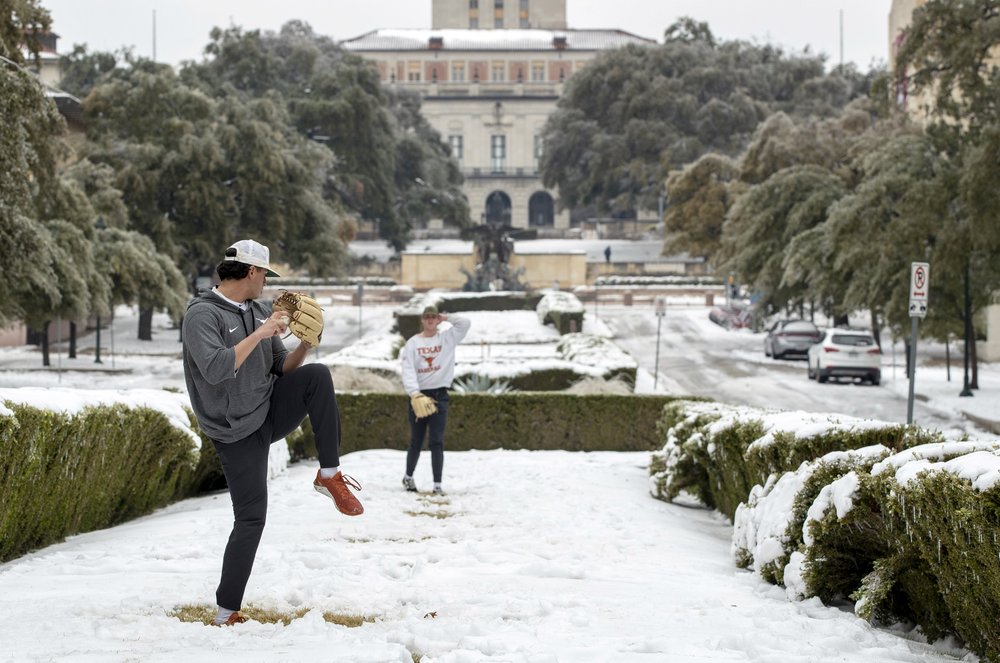
Jared Southard, left, and Sam Walbridge, pitchers on the University of Texas baseball team, work out at the AT&T Hotel & Conference Center on the UT campus on Wednesday, Feb. 17, 2021, in Austin, Texas. (Jay Janner/Austin American-Statesman via AP)
The worst U.S. outages by far have been in Texas, where 3 million homes and businesses remained without power as of midday Wednesday. More than 200,000 additional customers were in the dark in four Appalachian states, and nearly that many in the Pacific Northwest, according to poweroutage.us, which tracks utility outage reports.
The president of the Texas power grid manager, the Electric Reliability Council of Texas, said he hoped many customers would see at least partial service restored by later Wednesday or Thursday.
Dashawn Walker, 33, was thrilled to find the power back on in his Dallas apartment. He stayed at a suburban hotel Tuesday night after being without power since Sunday, but said he was charged $474 for one night.
“It’s crazy,” Walker said. “I mean why would y’all go up on the hotels in the middle of a crisis?”
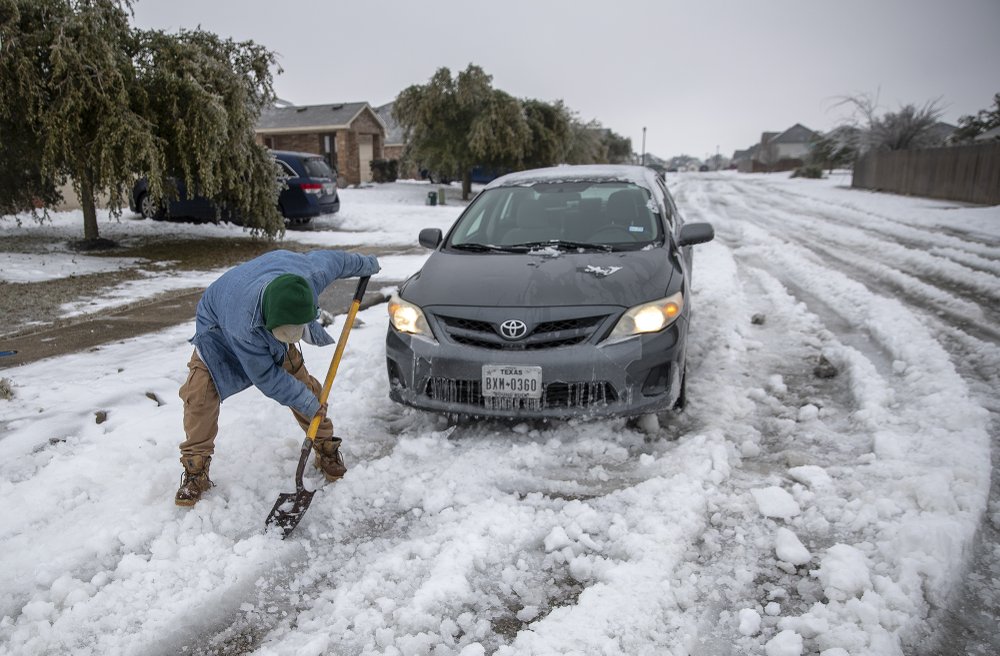
Jose’ Nives tries to shovel his way out after getting stuck in the middle of the street on Wednesday, Feb. 17, 2021 in Austin, Texas. (Ricardo B. Brazziell/Austin American-Statesman via AP)
Water pressure has fallen across the state because lines have frozen, and many residents are leaving faucets dripping in hopes of preventing pipes from freezing, said Toby Baker, executive director of the Texas Commission on Environmental Quality.
Texas Gov. Greg Abbott urged residents to shut off water to their homes, if possible, to prevent more busted pipes and preserve pressure in municipal systems.
The outages in and around Portland, Oregon, affected nearly 150,000 customers nearly a week after a massive snow and ice storm toppled many trees and took out hundreds of miles of power lines.
The damage to the power system was the worst in 40 years, said Maria Pope, CEO of Portland General Electric. At the peak of the storm, more than 350,000 customers in the Portland area were in the dark.
“These are the most dangerous conditions we’ve ever seen in the history of PGE,” said Dale Goodman, director of utility operations, who declined to predict when all customers would have power restored.
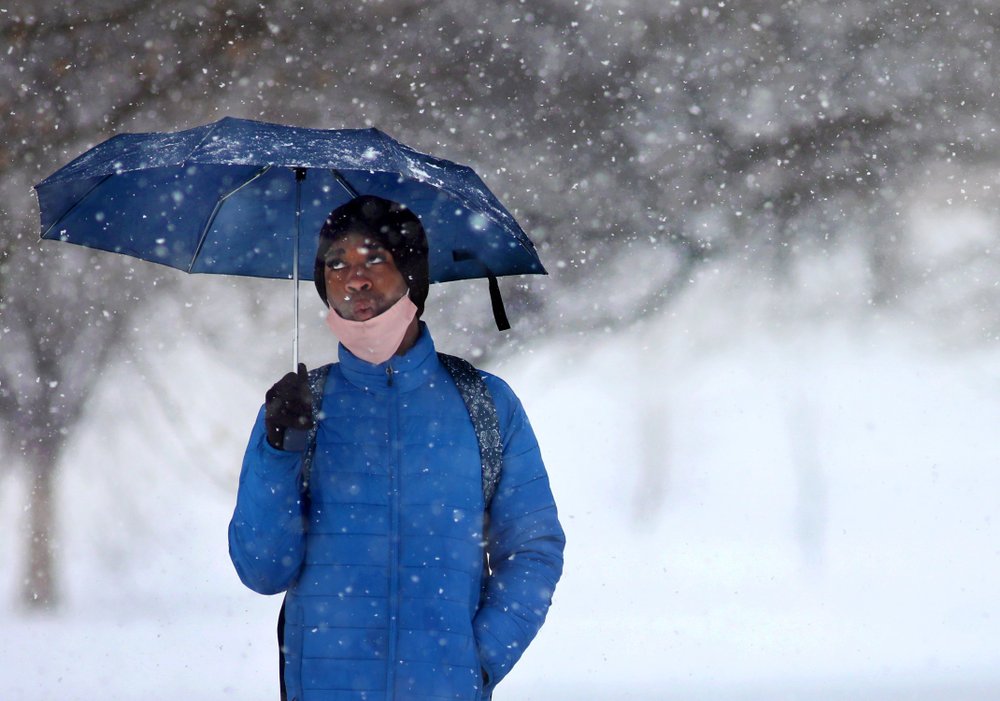
“I’m happy to have snow, but this much is overwhelming,” says Malik Marmon as he waits to take the bus to work along North Grand Boulevard and Natural Bridge Avenue in St. Louis, on Wednesday, Feb. 17, 2021. (Colter Peterson/St. Louis Post-Dispatch via AP)
Utilities from Minnesota to Texas implemented rolling blackouts to ease the burden on strained power grids. The Southwest Power Pool, a group of utilities covering 14 states, said the blackouts were “a last resort to preserve the reliability of the electric system as a whole.”
The weather also disrupted water systems in several Southern cities, including in New Orleans and Shreveport, Louisiana, where city fire trucks delivered water to several hospitals, and bottled water was being brought in for patients and staff, Shreveport television station KSLA reported.
Power was cut to a New Orleans facility that pumps drinking water from the Mississippi River. A spokeswoman for the Sewerage and Water Board said on-site generators were used until electricity was restored.
In the southwest Louisiana city of Lake Charles, Mayor Nic Hunter said Wednesday that water reserves remained low and local hospitals were faced with the possibility they might have to transfer patients to other areas.
Travel remains ill-advised in much of the United States, with roadways treacherous and thousands of flights canceled. Many school systems delayed or canceled face-to-face classes. But staying home carried risks too in places without power.
Authorities said a fire that killed three young children and their grandmother in the Houston area likely was caused by the fireplace they were using to keep warm. In Oregon, authorities confirmed Tuesday that four people died in the Portland area of carbon monoxide poisoning.
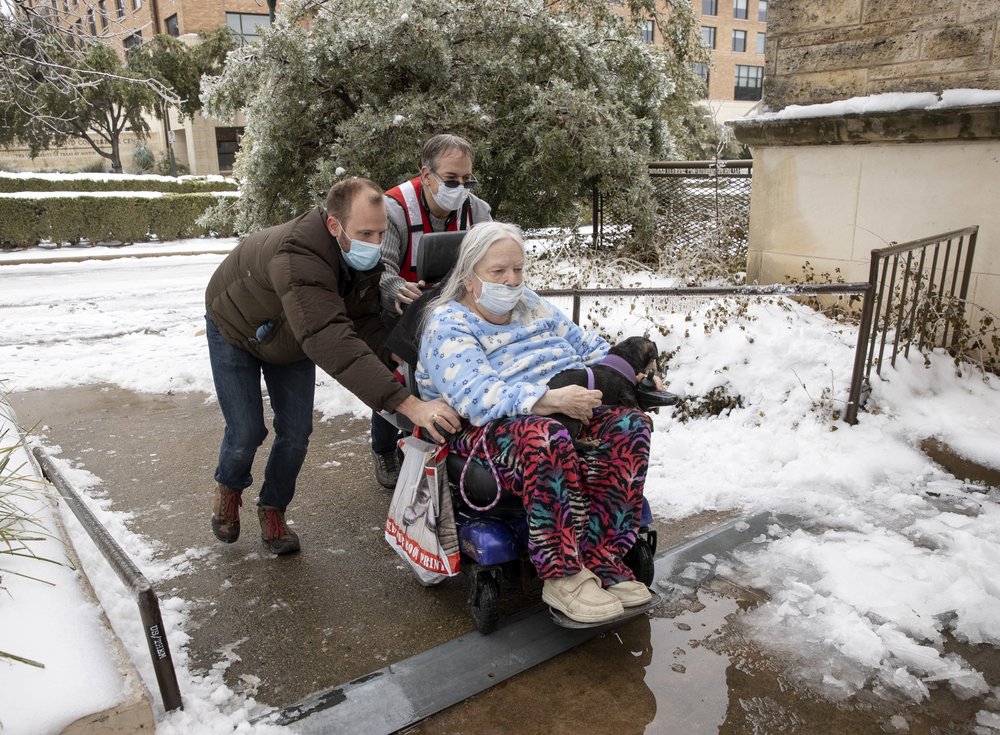
Dori Ann Upchurch is helped by Austin Disaster Relief Network volunteer Cody Sandquist, left, and a Red Cross volunteer to a warming station at University Avenue Church of Christ in Austin, Texas, after being evacuated from her home on Wednesday Feb. 17, 2021. (Jay Janner/Austin American-Statesman via AP)
The crisis also produced stories of kindness.
In Clinton, Mississippi, Army veteran Evelyn Fletcher has been cooking and delivering meals to sidelined truck drivers, travelers and people staying at hotels after losing power at home.
“They’re stranded, they’re isolated — people are in need of support right now,” Fletcher said.
On Monday, Fletcher made 85 meals. On Tuesday, she made 30 plates, while a local restaurant, T’Beaux’s Crawfish and Catering, cooked 75 plates of shrimp and gumbo that she and other volunteers delivered. And on Wednesday, Fletcher was cooking a pot of turkey noodle soup, hoping to deliver another 70 meals.
“People are worried about more snow,” she said. “We are going to keep people fed and keep them feeling hopeful.”
___
Bleed reported from Little Rock, Arkansas. Associated Press journalists Gillian Flaccus in Portland, Oregon; Julie Walker in New York; Jake Bleiberg in Dallas; Josh Funk in Omaha, Nebraska; Kevin McGill in New Orleans; Leah Willingham in Jackson, Mississippi; Sean Murphy in Oklahoma City; and Tammy Webber in Fenton, Michigan, contributed to this report.
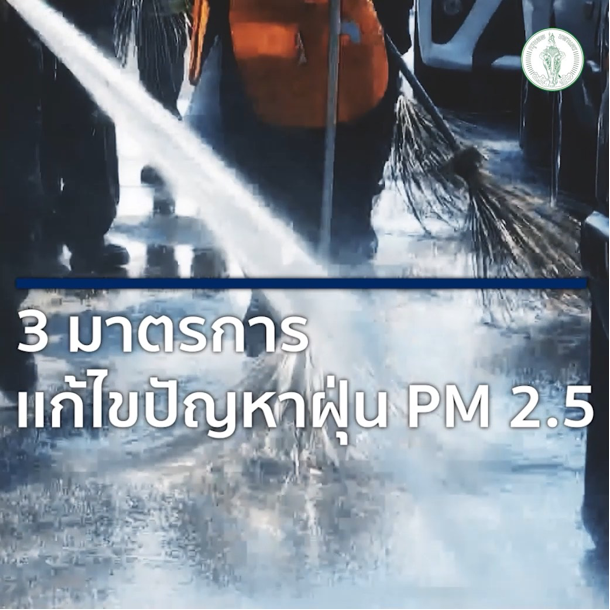
PM2.5 permeates the air and spreads all over Bangkok. Some of the people are familiar with it and getting used to it, thinking that it is normal. However, this can induce serious adverse health effects. As good physical health is important, every time before leaving home, do not forget to check the level of dust particles in their area using AirBKK Application. It can help you plan activities and comfortably prevent yourself from dust.
Three formula to fight against dust in the Bangkok Metropolitan Administration (BMA) style:
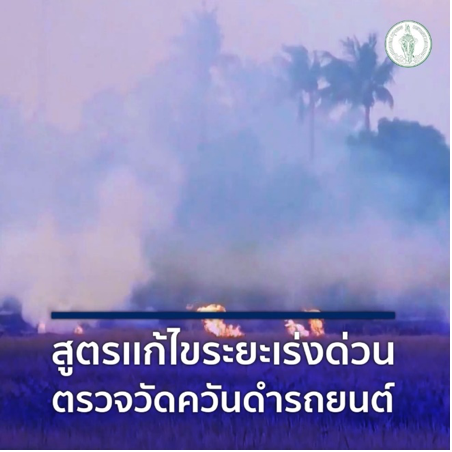
Urgent dust fighting formula – inspection and measuring of black smoke emissions from vehicles, the ban on the outdoor burning, and control of construction site
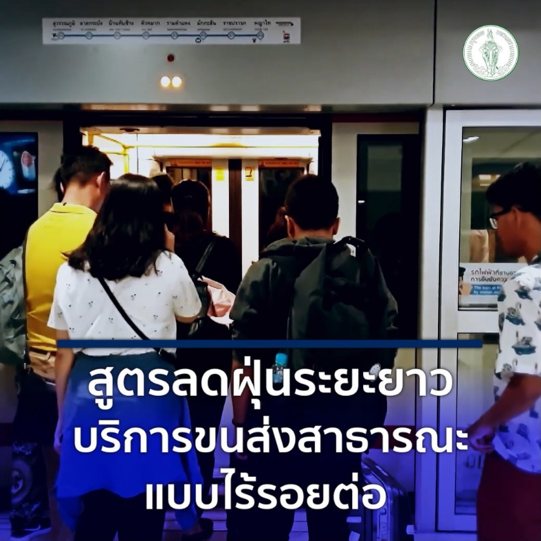
Long-term dust reducing formula – seamless public transport service
Sustainable dust reducing formula – increase green area in Bangkok
Other than the strict inspection of black smoke belching out of diesel vehicles and smoke coming out of factory chimneys, the BMA requests the public to stop dust-producing construction activities and control not to have waste burning and outdoor burning. These are considered short-term and temporary solutions under the urgent dust fighting formula.
Seamless public transport service is part of the long-term dust reducing formula. The BMA will provide seamless public transport service with the target to expand the highest number of service networks to cover all areas and to promote easy access to urban public transport service.
Reduce the use of private vehicles and use more public transport service
Help reduce traffic congestion
Reduce pollutants emitted from exhaust pipes of motor vehicles as much as possible
As for the sustainable solution, the BMA sets a target to increase green area for at least 550 rai each year to help purify dust, like natural air purifier. It is also the solution for dust problem in various countries around the world.
All these will be done because good quality of life and clean air without toxic dust for Bangkok residents are the objectives of the BMA.
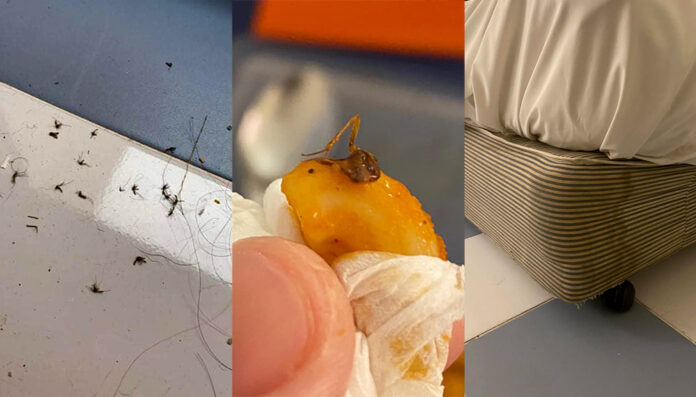
Mosquitos, a cockroach in the macaroni, and moldy bedding in the state quarantine at Ambassador City Jomtien in photos taken between Jan. 28 and Feb. 11, 2021. Photos: Topp Dunyawi Phadungsaeng / Facebook
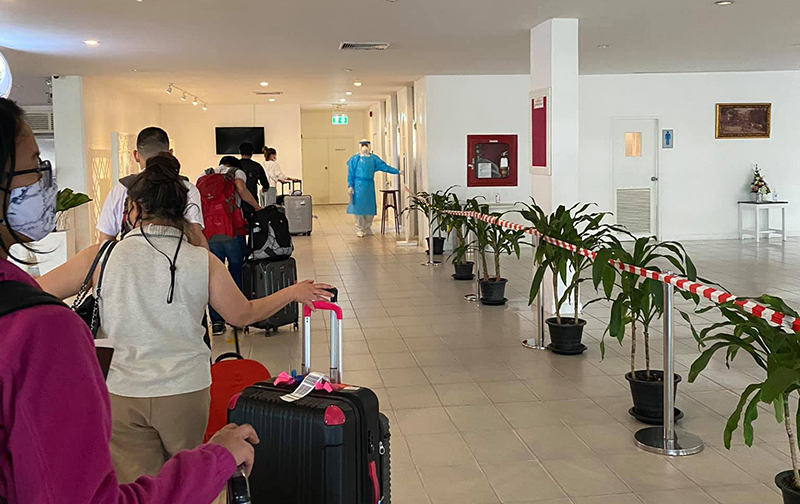
PATTAYA — His journey began like any other traveler who arrived in Thailand amid the coronavirus pandemic. Dunyawit Phadungsaeng landed at Suvarnabhumi, got on the bus headed to a quarantine hotel, and probably felt even a little excitement.
But the experience at Ambassador City Jomtien Hotel soon took a nightmarish turn – Dunyawit would later call it “the worst 14 days of my life.” In the order of inconvenience, his stay reportedly included a Wi-Fi network that didn’t reach his room, a bed sheet with suspicious black spots, water dripping down from the ceiling, armies of cockroaches, and even bugs inside his food.
And that may not even be the end of it – the hotel management is threatening to take unspecified legal action after Dunyawit’s reviews of his ordeal went viral on social media.
“All individuals should cease and desist all actions that damage the Ambassador City Jomtien and violate the laws,” the hotel said in an online statement. “Or else, the Ambassador City Jomtien will be forced to pursue criminal cases to the fullest extent.”
The statement did not mention Dunyawit or any individual by name, but said it would report the wrongdoers to the police for “spreading false information on Facebook to damage the Ambassador City Jomtien’s reputation.”
Dunyawai arrives at his state quarantine hotel. Photo: Topp Dunyawit Phadungsaeng / Facebook
Travelers to Thailand, whether they are foreigners or Thai nationals, must agree to spend 14 days in isolation at the state quarantine (SQ) or alternative state quarantine (ASQ). The former is free and only available to Thai citizens, while the latter is more luxurious in general and comes with a costly bill to match.
When Dunyawit flew from San Francisco to Bangkok on Jan. 28, he chose to try his luck with the state quarantine. Writing in his post, Dunyawit said he wasn’t worried too much; Ambassador City Jomtien was a reputable hotel, and he’s read that many travelers enjoyed the SQ experience to a certain degree.
Photo: Topp Dunyawit Phadungsaeng / Facebook
To his mild annoyance, the discomfort started to creep in. The Wi-Fi network was non-existent. The TV in the bedroom was too ancient to use Netflix. The bathroom door shows signs of disrepair.
The rest escalated in a flash.
Water leaked from the ceiling. Spots of fungi were found on bed sheets. Hordes of cockroaches and mosquitoes invaded his room. When he complained, Dunyawit said, the hotel told him to buy his own broom and insect spray.
“Breathing in the fumes right now. Let’s see whether the cockroaches or the quarantine resident dies first,” Dunyawit wrote on his Facebook.
But all Thais forget half their grudges at mealtime. Unfortunately for Dunyawit, his meals did little to soothe his misery.
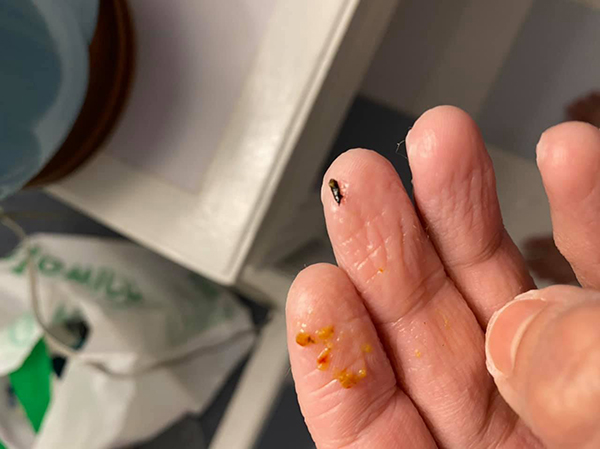
A flour beetle Dunyawait found in his food. Photo: Topp Dunyawit Phadungsaeng / Facebook
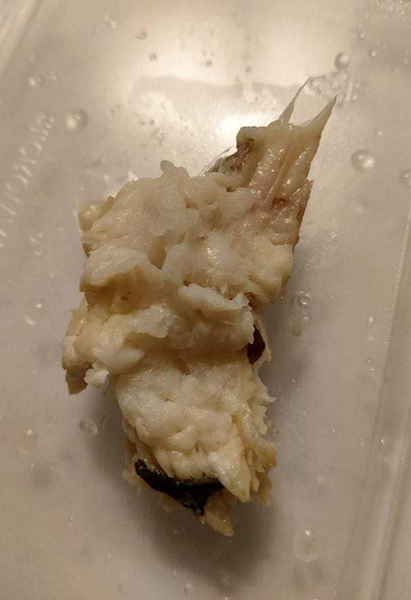
“Every day, we ate stinky fish. Many people tossed it and opted for Mama instant noodles. There were so many scales, no matter if it was stir-fry or tom yum. You needed to spit out the scales while you chewed. It was filthy, sometimes raw,” he wrote in the review. “I want to puke just thinking of it.”
Somtum, with alum. Photo: Topp Dunyawit Phadungsaeng / Facebook
If he needed to wash away the taste, he could only drink from the two free water bottles given a day, or buy one for 30 baht each from the housemaid via Line chat. A “coffee” was a cup with a pack of instant coffee, priced at 65 baht – water not included.
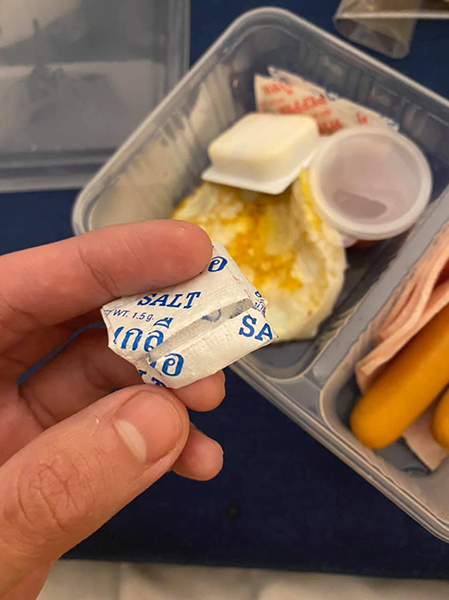
A 129 baht somtum came with two lumps of alum, an empty salt packet was pasted to his breakfast sausage, and his panang curry came cooked with flour beetles. Worms were found inside salad leaves.
Almost at his wit’s end, Dunyawit called the local health department and said, “Please, save my life!” The officers arrived and had a chat with the chef, who said he would improve.
Yet on the last day of his hell, Dunyawit found half a cockroach in his stir-fried macaroni.
“I prayed that it was a piece of egg or spring onion, or any spice. But looking closely, it was my nightmare,” he wrote. “Puke rocketed out of me. I cried, shaking all over. For hours, I cried and puked in turns.”
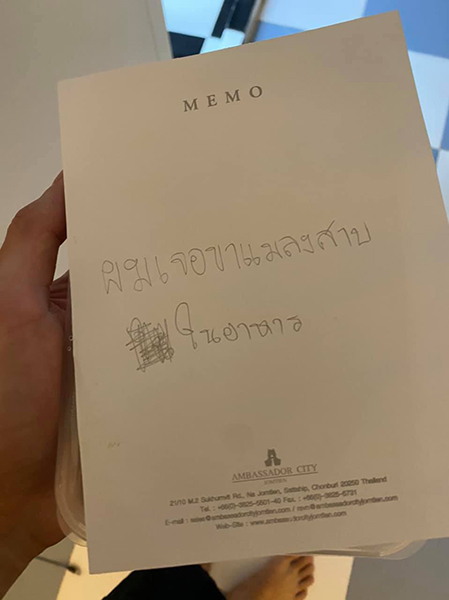
He scrawled, “I found a cockroach leg in my food,” on the hotel stationery and left it outside the door.
‘I found a cockroach leg in my food.’ Photo: Topp Dunyawit Phadungsaeng / Facebook
“I literally wept. I can tell you, as a man, I wept,” Dunyawit wrote in the closing portion of his reviews.
Paying for an alternative state quarantine can cost tens of thousands of baht, but he said he would have done that, in hindsight. “I regret not paying for my quarantine. It’s one of the biggest mistakes of my life,” he wrote.
Defense Ministry Enters the Chat
As of publication time, his scathing review of the “worst 14 days” of Dunyawit’s life has been shared nearly 30,000 times.
The post remains up despite the hotel management’s vague threat to sue. The hotel did not mention what charge they would pursue, but some businesses and influential people routinely use the defamation law to silence negative comments directed against them.
In September, an American expat spent two nights in police jail after he was charged with libel for writing harsh reviews of a resort on Koh Chang on the TripAdvisor. The charge was later withdrawn, but TripAdvisor added an unprecedented disclaimer on the hotel’s account to warn other users about the incident.
Ministry of Foreign Affairs spokesman Tanee Saengrat said his agency is aware of the complaints and will pass them along to the defense ministry, one of the authorities who run state quarantine operations across the country.
But in a confounding move, the Ministry of Defense appeared to defend Ambassador City Jomtien on Wednesday. Speaking to reporters, ministry spokesman Kongcheep Tantravanich urged Dunyawit to “have some sympathy” for the hotel.
“You cannot expect it to function like a normal hotel since people are in their room for 24 hours for 14 days,” Lt. Gen. Kongcheep said.
“As for the food, it is in accordance with the standards of quality, portion size, and hygiene,” he said.
Calls to the Ambassador City Jomtien management for comments were unsuccessful. An employee said by phone that the hotel is now closed, and none of the managers were present.
The employee also said the hotel has withdrawn from the state quarantine program since Feb. 12 – possibly to the sigh of relief from so many future travelers.
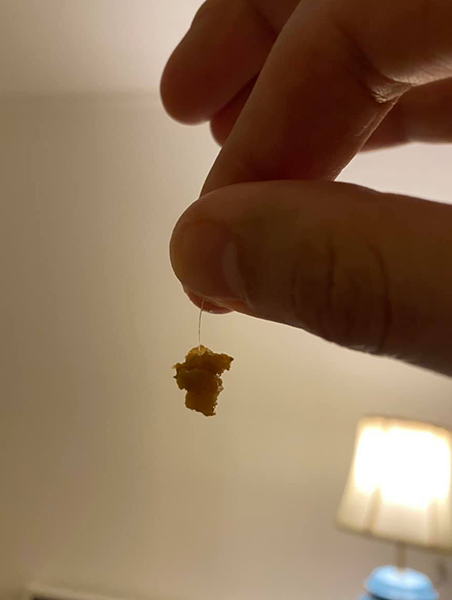
Dunyawit holds up what he believes is a pig’s hair. Photo: Topp Dunyawit Phadungsaeng / FacebookPhoto: Topp Dunyawit Phadungsaeng / FacebookPhoto: Topp Dunyawit Phadungsaeng / Facebook‘Let me inform the chef,’ hotel staff replies after Dunyawit alerts staff about the cockroach leg in his macaroni. Photo: Topp Dunyawit Phadungsaeng / Facebook
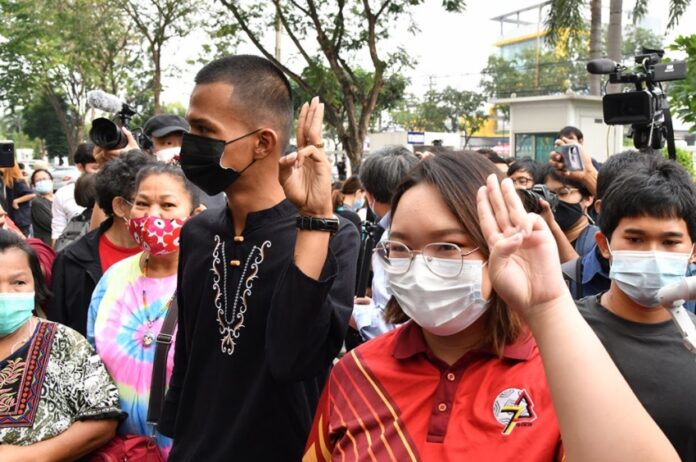
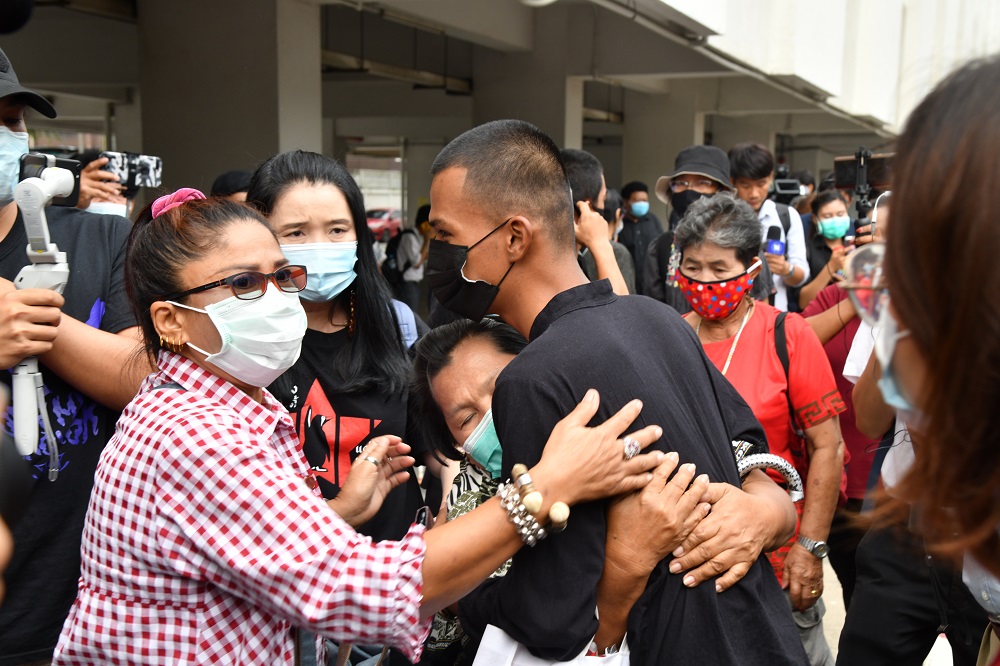
Panupong “Mike” Jadnok, left, and Panusaya “Rung” Sithijirawattanakul, right, flash the three-finger salute as they walk into the Office of the Attorney General on Feb. 17, 2021.
BANGKOK — Public prosecutors on Wednesday delayed a decision on whether to indict pro-democracy activists on charges of royal defamation for leading a large protest last year.
Three protest leaders, which include Panusaya “Rung” Sithijirawattanakul, Panupong “Mike” Jadnok, and Jatupat “Pai Dao Din” Boonpattararaksa, were charged with lese majeste for their roles in the rally at Sanam Luang over the weekend of Sept. 19 and 20. Fifteen other activists were charged with sedition. The group was summoned to report themselves at the Office of the Attorney General this morning.
“There’s no indictment today. The suspects only signed a document to acknowledge their next appointment and were let go,” prosecutor spokesman Ittiporn Kaewtip said. “They will hear their indictment decision on March 8.”
Prosecutors said they need more time to analyze the case, which was only submitted by police this morning.
Prior to the announcement, many feared that an indictment could see the 18 activists jailed as they await their trial, landing a further blow to the movement. Four other protest leaders already had their bail denied earlier this week.
All were present at the attorney’s office this morning except Jatupat, who was on a campaign to march from Nakhon Ratchasima to Bangkok.
On Monday, the Court of Appeals rejected the bail requests submitted by the four protest organizers who were indicted for the same offenses earlier: Arnon Nampa, Parit “Penguin Chiwarak, Somyot Prueksakasemsuk, and Patiwat “Bank” Saraiyam.
The court said in its ruling that their offenses “hurt the feelings of Thai loyal subjects” and they pose a flight risk. They are being held at the Bangkok Remand Prison.
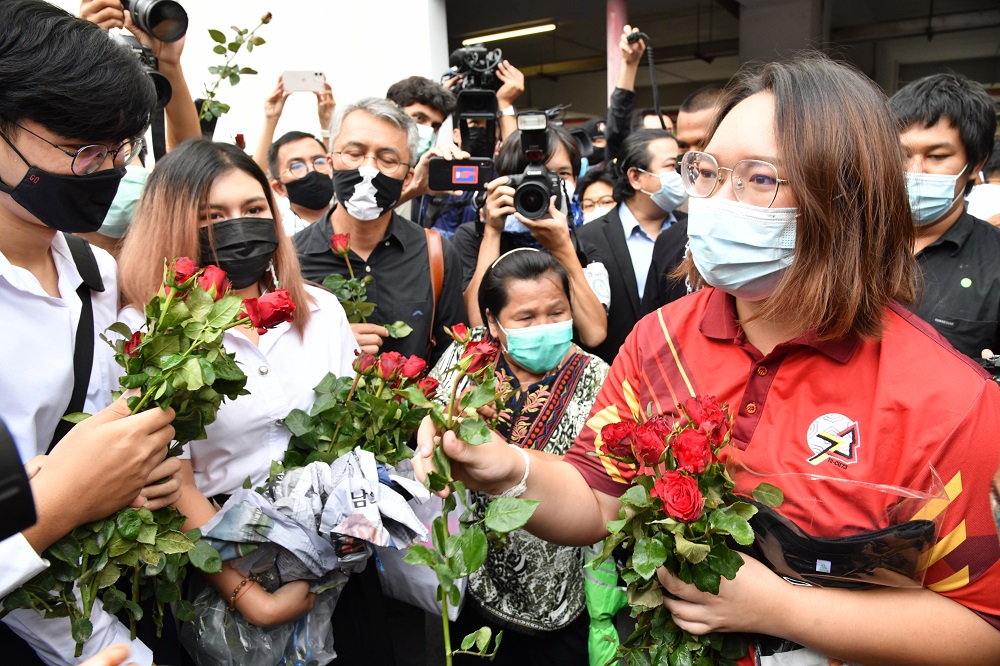
Panusaya “Rung” Sithijirawattanakul receives roses from her supporters on Feb. 17, 2021.
A few dozen supporters gathered in front of the Attorney General’s office earlier today before the activists met with prosecutors, giving them roses and embracing them. Panusaya broke into tears as she believed there was only a slim chance that she would walk free by the end of the day.
“I’m worried, but I’m prepared for it,” Panusaya said. “There’s 80 percent chance that I will face the same fate as the four protest leaders who were denied bail earlier. However, I still believe by the rest 20 percent that justice will be served.”
Panusaya said the prosecutors’ decision would not affect the anti-government protest scheduled to take place this Saturday. The venue is yet to be announced by the Ratsadon group.
“We want everyone to be courageous,” Panusaya added. “Please don’t give up. It’s not the end yet. There’s still a long way to go. Everyone is our hope.”
Panupong “Mike” Jadnok embraces his supporters on Feb. 17, 2021.
Another activist, Panupong Jadnok, appeared to be more cheerful.
“I don’t feel anything. Whatever will be, will be,” Panupong said. “I don’t know whether we will be free or not, but we will keep on fighting no matter if we are behind bars or not.”
Prajak Kongkirati, a political scientist at Thammasat University, said he is worried that the activists could end up being detained indefinitely while awaiting their trial, especially those who are still students.
“The trial hasn’t begun yet, we have to emphasize this,” Prajak, who was hoping to use his academic position as a bail surety, said. “All of them are innocent as of now until proven guilty, but the trial can drag for so long. This could go on for a decade. By denying the bail, they could be in prison for quite a long time.”
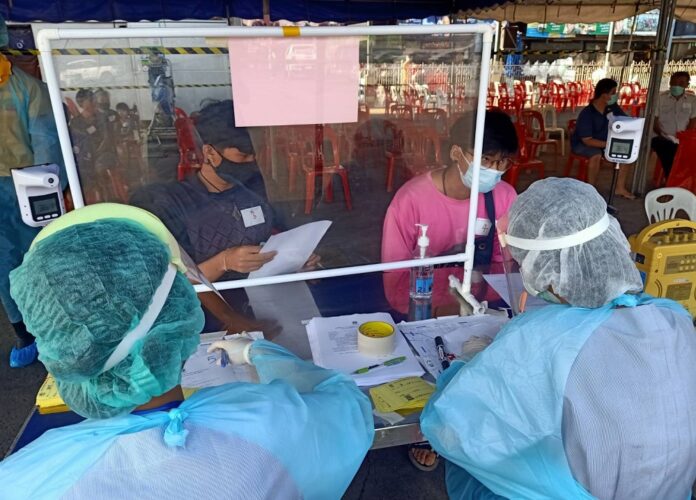
Health workers conduct coronavirus tests at Pornpat fresh market in Pathum Thani province on Feb. 15, 2021.
PATHUM THANI — Health officials on Wednesday said they are conducting an aggressive testing operation in Pathum Thani, where a new cluster of coronavirus infection was reported in recent days.
The government’s pandemic center said people who visited the Pornpat Market in the province are being reached out for a test. As of Wednesday, at least 134 cases were already reported in connection with the 140-stall fresh market.
The pandemic response center said more than 8,000 people were already tested.
The government also found a total of 175 new cases of coronavirus on Wednesday. Of these, 114 were detected in active case-finding operations, including 74 cases in Pathum Thani, 39 in Samut Sakhon, and one in Bangkok.
The Pathum Thani provincial administration has closed Pornpat Market until Feb. 25, while buildings nearby are being used as quarantine facilities.
COVID-19 tests taken of vendors and visitors to the market on Feb. 14 and Feb. 16 show the infections spreading out from the market’s center.
Earlier this week, Thailand also logged its first infection of the South African variant of the coronavirus in a 41-year-old Thai gems businessman who visited Tanzania for two months, before returning through Ethiopia on Jan. 29.
The infection was found on Feb. 3, while the man was in a state-run quarantine, said Opas Karnkawinpong, director of the Department of Disease Control.
In a move that could herald more reopening in the tourism sector, pandemic center spokesman Taweesin Visanuyothin announced that a group of around 70 “international socialites” will land in Phuket as part of a travel bubble.
The group will undergo a luxury “villa quarantine” at Sri Panwa Resort, he said. The cost wasn’t mentioned.
“We designed a villa quarantine system,” Taweesin said. “This system will give us worldwide trust for tourism in this new era.”
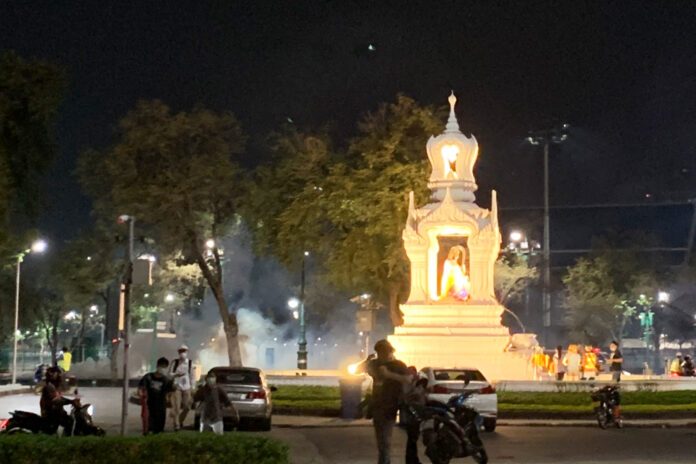
A cloud of smoke emerges near the Phra Mae Thorani Shrine during the police crackdown on demonstrators on Feb. 13, 2021.
BANGKOK — Eyewitnesses on Wednesday said they saw police using tear gas during clashes with anti-government protesters on Saturday – contradicting police’s claims.
Several people who were present on Ratchadamnoen Avenue on Saturday night reported that they saw clouds of smoke and experienced eye irritation – one of the effects of tear gas exposure. Photos and videos captured on that day also show riot police were armed with tear gas launchers while they drove out demonstrators from the area in front of the Grand Palace.
“I can confirm that tear gas was used on that day,” said volunteer health worker Purapon Wongchiak, who was riding a motorcycle near the Phra Mae Thorani Shrine.
Purapon was later shoved and beaten repeatedly with truncheons by riot police in the area. He was charged with violating the emergency decree, held in custody for two days, and freed on bail Monday.
“They used both smoke grenades and tear gas rounds. My eyes were irritated,” Purapon recalled.
Another witness, Adisak Pharam, said his friend was also struck with tear gas. Adisak said he was trying to clean the tear gas from his friend’s face when riot police hit him with batons and took him into custody without asking any questions.
“I was there to help wash my friend’s face,” Adisak said. “Police just hit me and arrested me.”
A policeman can be seen carrying what appears to be a tear gas launcher at 1:02:00 mark.
Police have insisted that no tear gas or rubber bullets were used during the crackdown on Saturday night, although several police officers could be seen carrying tear gas launchers and shotguns at the scene.
“No one used rubber bullets or tear gas. We got the tools but we didn’t use it,” national police commissioner Suwat Chaengyodsuk said Sunday. “We must look at the whole picture. Don’t just take a piece of it and wage information attacks out of it.”
The former Miss Universe Thailand contestant Chayathanus “Cheraim” Saradatta also claimed that she was affected by the tear gas. She said she was trying to hail a cab near the Phra Mae Thorani Shrine.
A policeman can be seen carrying what appears to be a tear gas launcher at 02:05:38mark.
“My name is Cheraim, Chayathanus Saradatta, the first beauty pageant to be hit by tear gas,” Chayathanus wrote online Sunday. “No one wants to be hit by tear gas, I was only waiting for a cab. I didn’t think that something would happen. This could happen to anyone regardless of their occupation, but my question is whether this is necessary?”
Police spokesman Kissana Phattanacharoen also maintained that crowd control police were only using “shields and bare hands” to push the protesters from Ratchadamnoen Avenue – but the claim was quickly challenged by videos of riot police beating several people with their sticks.
Khaosod English correspondents at the scene observed an unmarked metallic canister on the ground in the area of the clashes. They also saw white smoke, but were too far away to experience any effects from it.
Police had previously denied using tear gas during the crackdown close to Pathumwan Intersection on Oct. 16 – only to admit during a parliamentary hearing a month later that the chemical was indeed deployed on the demonstrators.
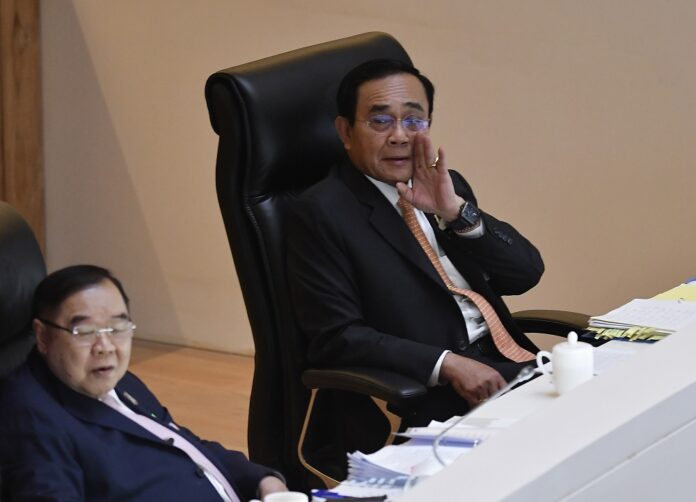
Prime Minister Prayuth Chan-ocha gestures during a no-confidence debate at the parliament in Bangkok, Thailand, Tuesday, Feb. 16, 2021.
BANGKOK (AP) — Opposition parties in Thailand on Tuesday began debating a no-confidence motion against Prime Minister Prayuth Chan-ocha and nine members of his Cabinet who face accusations of mismanaging the economy, bungling the provision of COVID-19 vaccines, abusing human rights and corruption.
It is the second no-confidence debate that Prayuth’s government has faced since taking office in July 2019. In February last year, Prayuth and five Cabinet ministers easily turned back a no-confidence vote in the lower house. All 10 being grilled this year are expected to coast through again with the backing of the governing coalition.
The current debate is scheduled over four days, with voting to take place Saturday.
On the first day, the opposition parties concentrated on Prayuth, accusing him of responsibility for the government’s alleged failures.
“I’m not afraid of anything,” Prayuth said in defending himself. “This is a good opportunity for both sides to do something together for our country and people. And I am ready to clarify every allegation.”
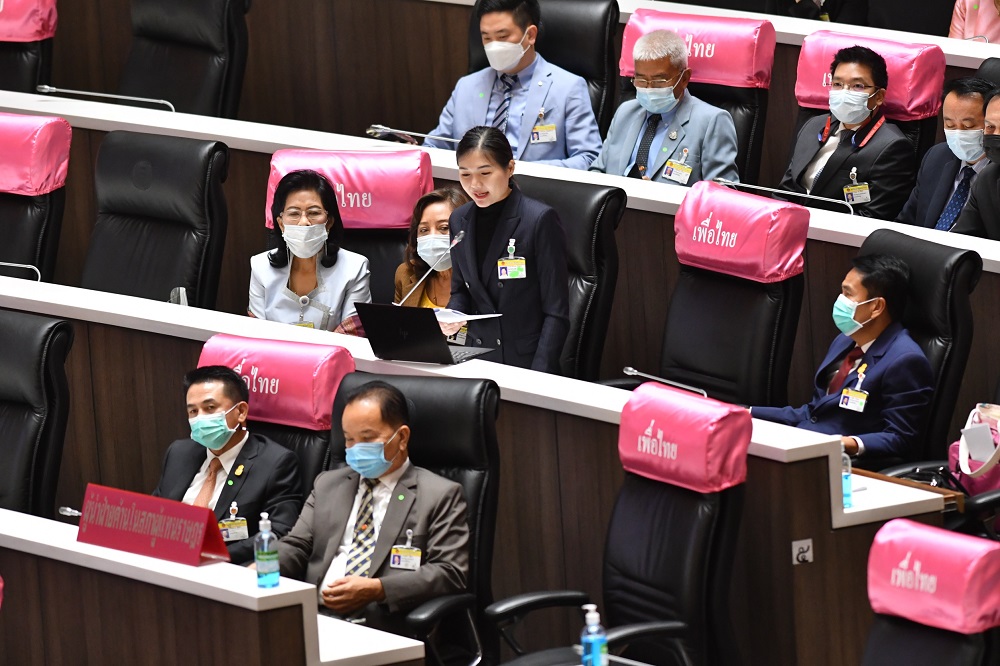
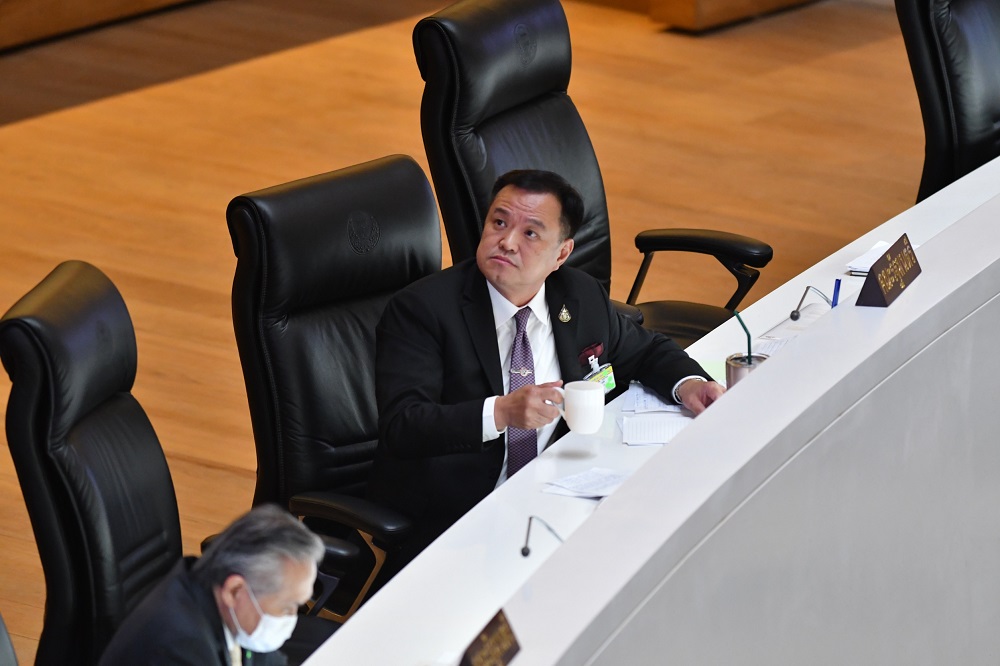
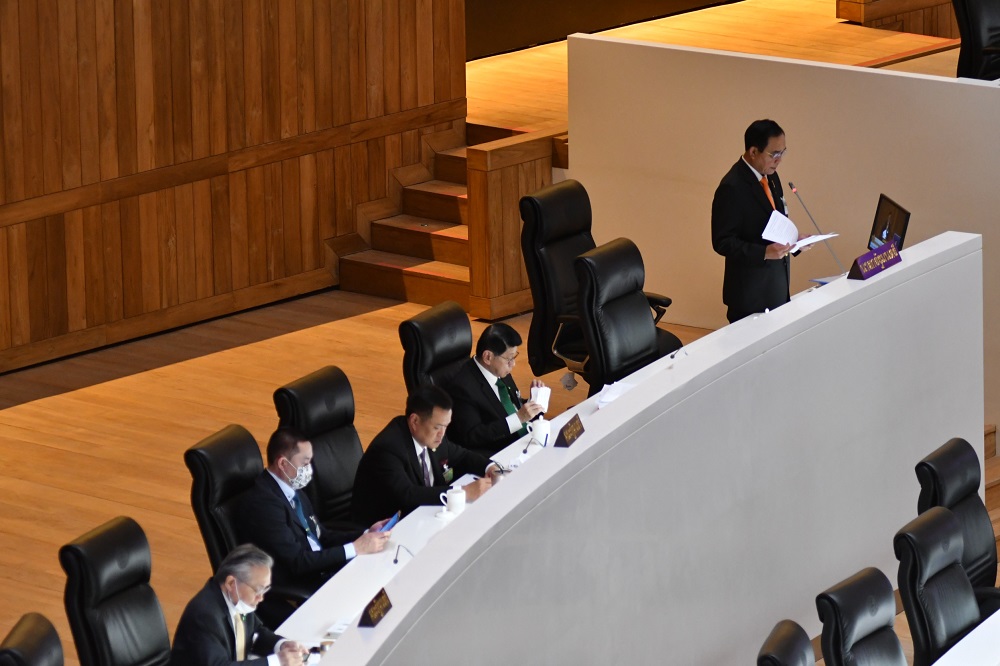
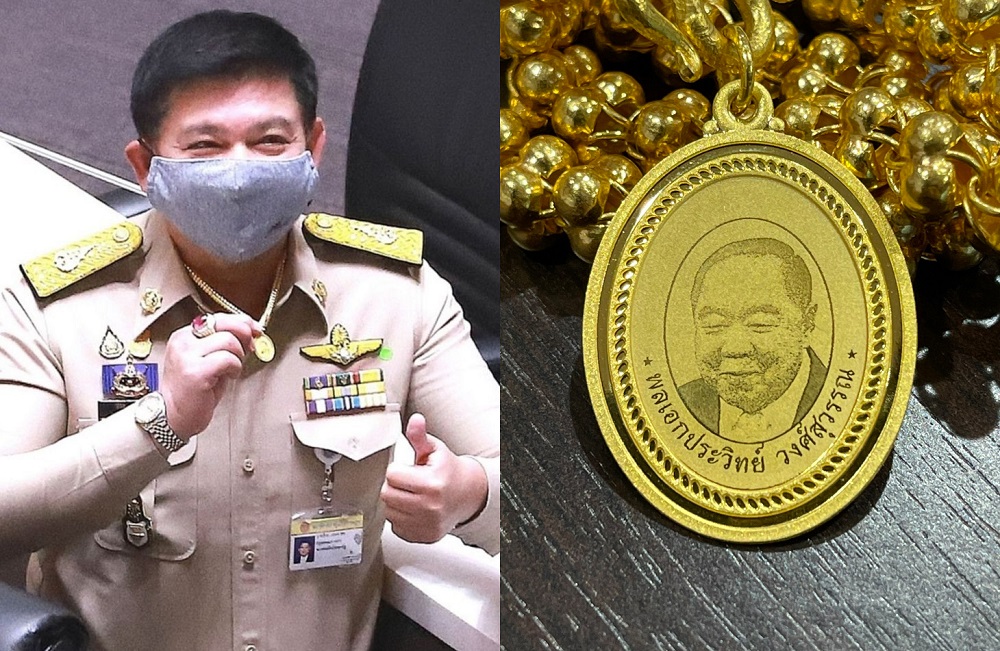
Opposition politicians speak at a no-confidence debate at the parliament in Bangkok, Thailand, Tuesday, Feb. 16, 2021.Health minister Anutin Charnvirakul looks at a screen during a no-confidence debate at the parliament in Bangkok, Thailand, Tuesday, Feb. 16, 2021.Prime Minister Prayut Chan-o-cha speaks at a no-confidence debate at the parliament in Bangkok, Thailand, Tuesday, Feb. 16, 2021.Pro-government Phalang Pracharath Party lawmaker Sira Jenjaka shows his amulet depicting Deputy Prime Minister Prawit Wongsuwan to reporters during a no-confidence debate at the parliament in Bangkok, Thailand, Wednesday, Feb. 17, 2021.