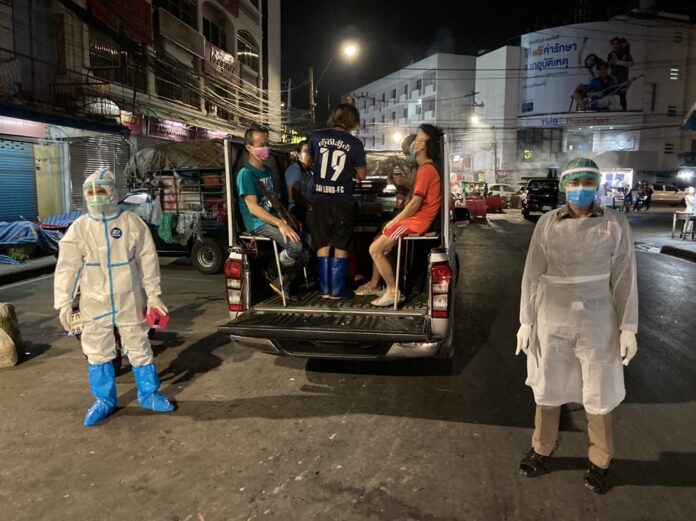
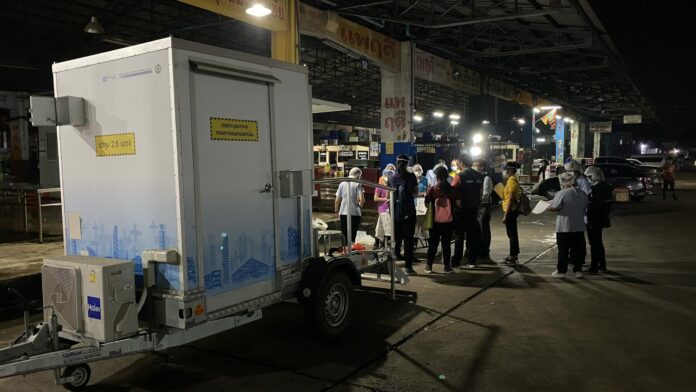
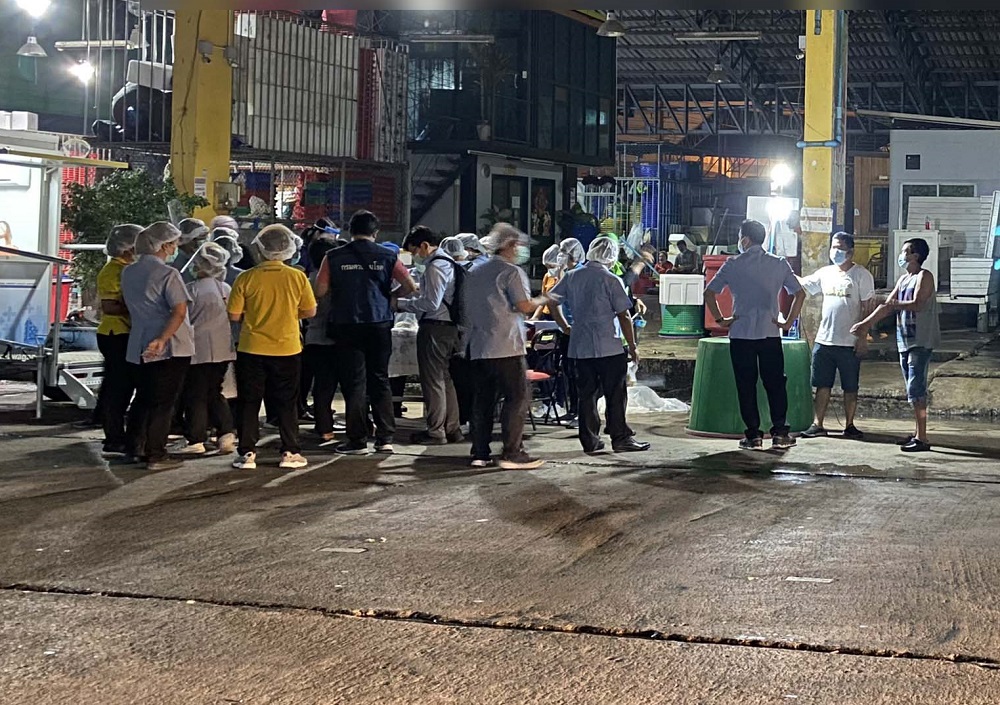
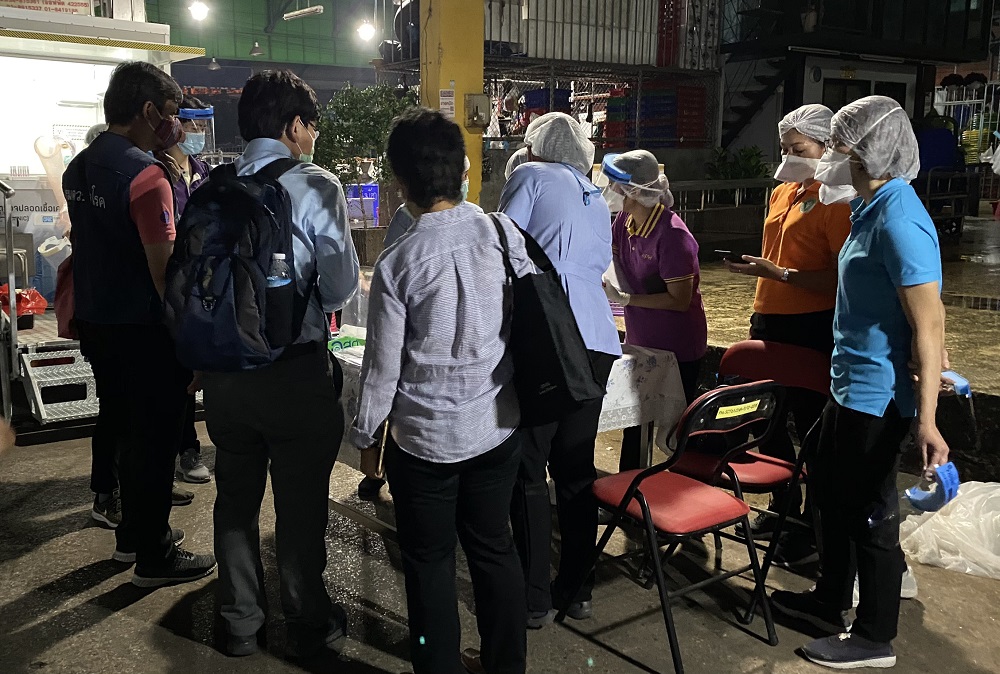
Health officials escort people away for coronavirus tests at a seafood market in Samut Prakan province on Dec. 19, 2020.
Major update: Samut Sakhon reported 146 fresh coronavirus cases for Sunday, several media agencies quoted deputy provincial governor Surasak Polyangsong as saying.
BANGKOK — A second wave of coronavirus epidemic appears to be a reality on Sunday with the discoveries of new infections linked to the recent cluster of over 500 cases at the country’s largest wholesale seafood market.
New virus cases reported today include two in Bangkok. One of them was identified as a 78-year-old seafood seller who traveled to the Central Shrimp Market in Samut Sakhon province some time between Dec. 1 and Dec. 11. She reportedly tested positive on Dec. 18 after falling ill with the virus. No details on the other patient are available as of publication time.
The government’s coronavirus response center urged anyone who have visited the seafood market in Samut Sakhon from Dec. 1 onwards to report themselves for testing at any hospital, free of charge. Bangkok City Hall spokesman Pongsakorn Kwanmuang posted a similar announcement in an online post.
“If there is any information update, Bangkok Metropolitan Administration will inform you immediately,” Pongsakorn wrote. “I’d like to ask everyone to keep wearing facemasks, washing their hands, and maintaining social distancing.”
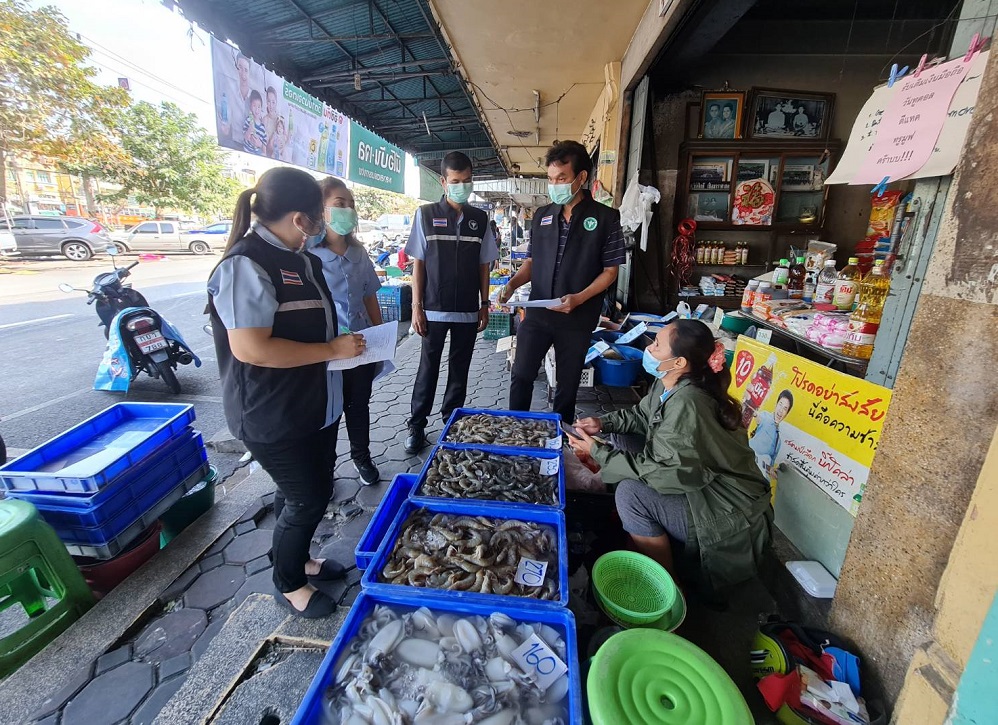
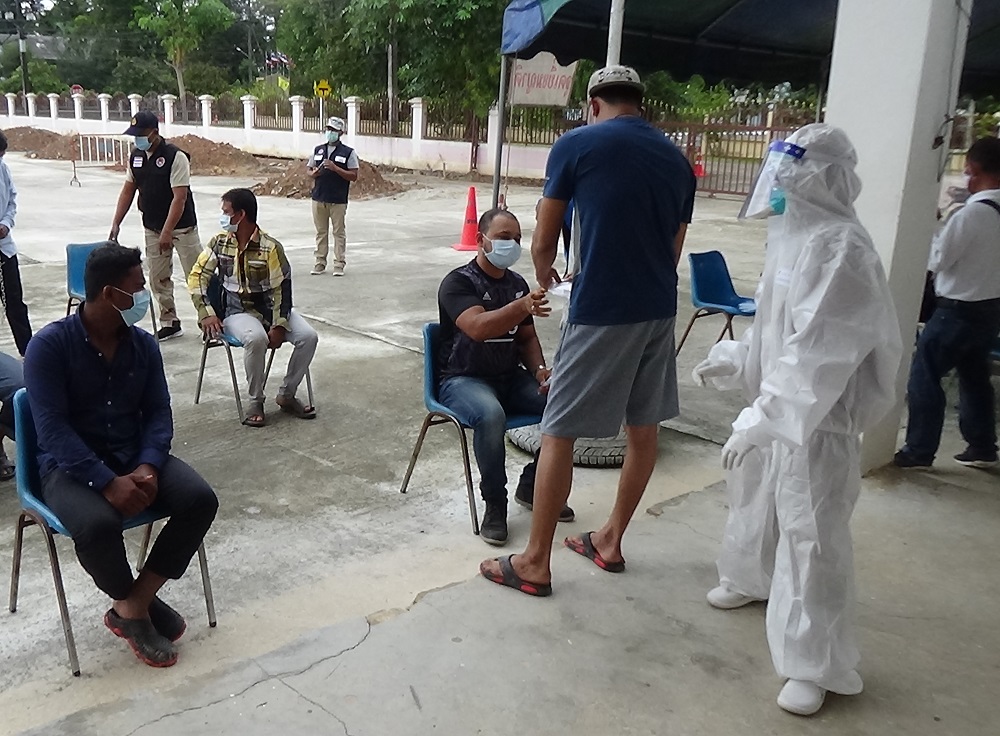
Health officials question vendors at a seafood market in Nakhon Pathom province about their travel history on Dec. 20, 2020.
Health officials also reported that two people in Nakhon Pathom tested positive for the virus; both of them seafood vendors who had a history of travels to the Central Shrimp Market. More cases are discovered in Samut Sakhon (146), Samut Prakan (3), and Ayutthaya (1).
The Central Shrimp Market is part of the sprawling Mahachai Market in Samut Sakhon, about 50 kilometers away from Bangkok. Officials said at least 548 coronavirus cases were connected to the market, most of them migrant workers from Myanmar.
Pandemic response center spokesman Taweesin Visanuyothin said health officials are aiming to test at least 10,000 people in Samut Sakhon in the coming days. The center is also set to advise PM Prayut Chan-o-cha to cancel all New Year celebration events in areas deemed to be at risk of coronavirus, media reports said.
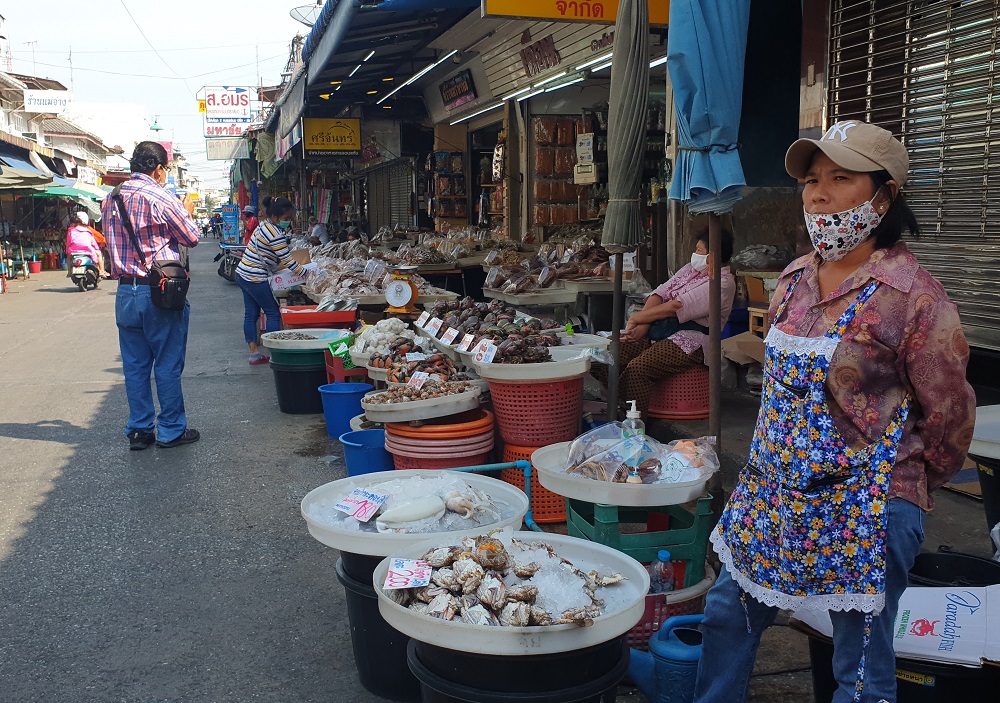
Few shoppers are seen at Mahachai Seafood Market in Samut Sakhon province on Dec. 20, 2020.
The discoveries come after Thailand saw only a small number of infections over the past several months due to strict border and quarantine controls, though some health professionals have repeatedly said that a return of the coronavirus was an expected outcome.
“Judging from the situations, the second wave of the outbreak is inevitable for us, which is something we must do our best to prepare for,” Chulalongkorn Hospital virologist Yong Poovorawan said back in October.
Samut Sakhon Gov. Veerasak Vichitsangsri said late Saturday that strict measures, including a 10 p.m.-5 a.m. curfew and other travel restrictions, will be taken in the province to combat the outbreak. Shopping malls, gyms, schools, nurseries and sport venues were ordered closed. Migrant workers are also banned from leaving or entering Samut Sakhon.
The restrictions will be in effect until Jan. 3. Thailand currently has fewer than 6,000 cumulative coronavirus cases and 60 deaths linked to the disease.
Myanmar nationals detained for illegal border crossing are given coronavirus tests in Satun province on Dec. 20, 2020.
Health officials question workers at a shrimp market in Samut Sakhon province on Dec. 18, 2020.
BANGKOK — Health officials said 548 new coronavirus infections were found in connection with the outbreak at Thailand’s largest wholesale seafood market.
All of the new infections – an unprecedented number – were linked to a 67-year-old seafood vendor who tested positive for the coronavirus earlier, Opas Karnkawinpong, Director-General of the Department of Medical Sciences said in a news conference broadcast to all TV channels on Saturday night.
About 90 percent of the patients did not display any symptoms, Opas said. He said up to 1,192 people working at the fish market were tested for the coronavirus after the vendor’s infection was discovered. A majority of the new cases are migrant workers, according to Opas.
“We are confident that this situation will be brought under control, since the outbreak is limited in its areas,” he said. “Even though we tend to find more cases among the residence quarters of foreign workers, an escalation in the outbreak remains low.”
People who have traveled to Samut Sakhon since Dec. 1 are also advised to isolate themselves and monitor for any symptoms.
Today’s case number is the largest figure ever recorded since Thailand first witnessed a coronavirus infection back in January. The previous highest daily count of cases was back in March, at 188. The discovery also shattered Thailand’s unique feat of having near-zero local transmissions since the epidemic subsided in May.
Samut Sakhon Governor Veerasak Vichitsaengsri said a number of venues will be closed down across the province in a bid to curb the spread of the virus, including shopping centers, schools, nurseries, gyms, and sport stadiums.
“The situation is certainly more severe than many of us had thought,” Veerasak said at the news conference.
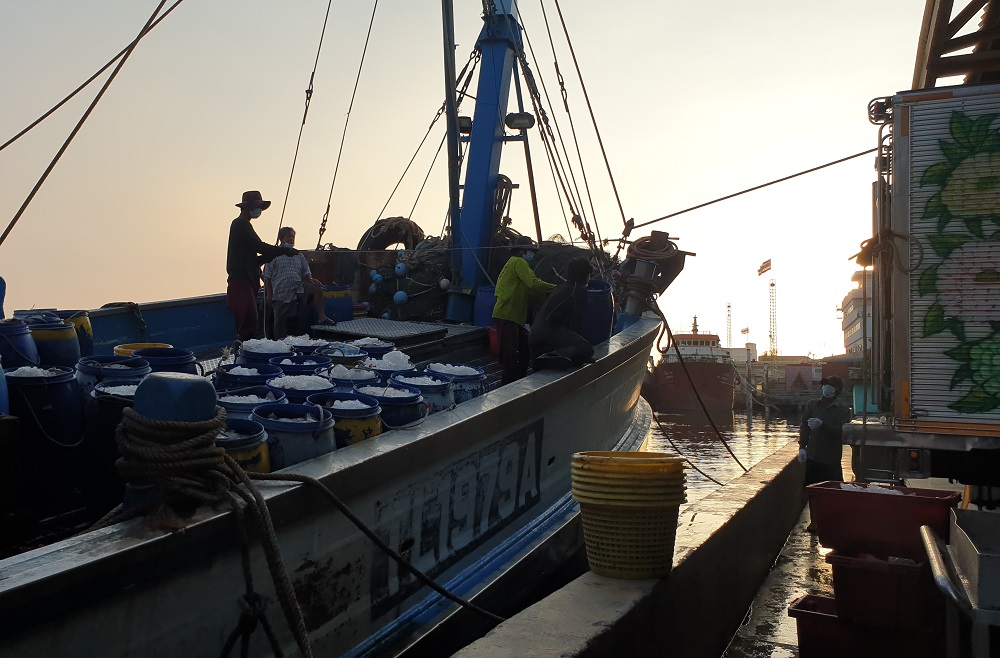
Fishing boats seen at Samut Sakhon province on Dec. 19, 2020.
Convenience stores will be shut down from 10pm to 5am, and restaurants will not be allowed to offer dine-in services, except in hospitals and hotels. Samut Sakhon residents are also “requested” to refrain from traveling from 10pm to 5am, though Veerasak did not outright declare a curfew.
He added that voting in local elections for Samu Sakhon will still go ahead as planned on Sunday , but facemasks must be worn at all times at the polling stations.
“We understand that the measures will cause great inconvenience to the people of Samut Sakhon,” Veerasak said. “But they are necessary to ensure we can all overcome this together.”
“Alien nationals,” a term that typically refers to migrant workers, will also be banned from entering or leaving Samut Sakhon, he said.
The sprawling wholesale market at the epicenter of the latest outbreak is home to a large community of migrant workers, most of them from Myanmar.
Health minister Anutin Charnvirakul said earlier this week the migrant workers might have been responsible for transmitting the virus to the 67-year-old vendor, though without providing specific evidence.
Thailand currently has about 4,300 total number of coronavirus infections, most of them having already recovered. Officials said 60 people have died because of the virus.
Royal Thai Air Force's Airbus A340-500 taxis at Don Mueang International Airport. Photo: Alec Wilson / Wikimedia Commons
BANGKOK — Government critics on Friday were outraged by the revelation that the Royal Thai Air Force is set to spend nearly 55 million baht to refurbish a lavatory on board a VIP aircraft.
The 54.43 million baht project is detailed in a document published on a military-run website earlier this week. The air force said the price tag for the flying toilet is “reasonable” since it involves sophisticated engineering, though many remain skeptical at the exorbitant budget.
“If we use 54 million baht to renovate toilets for students, we can revamp toilets at more than 180 schools,” Move Forward MP Wiroj Lakkhanaadisorn tweeted Thursday. “Roughly 20,000 students would benefit from it.”
The proposed refurbishment will take place on the Airbus A340-500 passenger jet with the tail number HS-TYV, according to a procurement document published on the air force’s website.
The force’s spokesman Air Marshal Thanat Chanampai could not be reached for comments as of publication.
But in a statement to the media, the air force said the refurbishment will lay down an entirely new set of plumbing and sewage equipment, employing “highly advanced engineering technology from Germany,” hence the seemingly steep price.
The four-engined airliner was previously used by Thai Airways for long haul flights to Europe before the air force acquired it back in 2016 for a price of reportedly 1.7 billion baht – paid from the state coffers.
The plane was later converted for use in “VVIP” transport missions and entered into service under the 602 Royal Flight squadron.
Another procurement document shows that the air force also awarded Thai Airways a 750 million baht contract to renovate the interiors of a Boeing 777-800 royal aircraft with the tail number HS-MVS.
Little is known publicly about the details of the project or the aircraft itself, though official records said the twin-engine jet entered into service in 2007 and is under direct command of King Vajiralongkorn’s Deachochai 3 Royal Flight Unit.
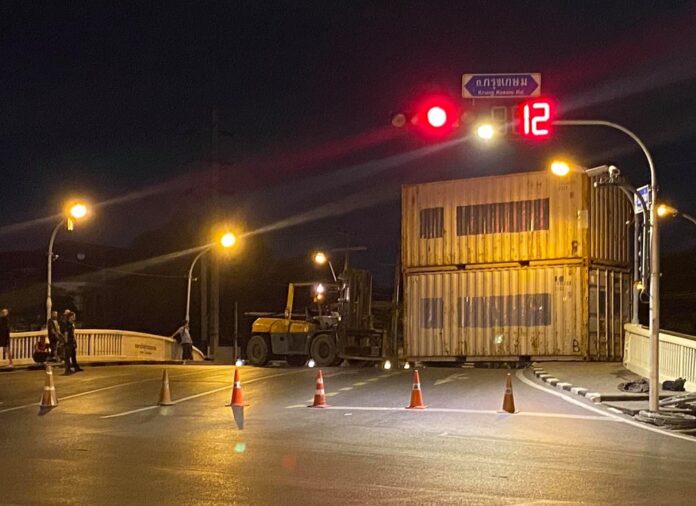
Security officers place shipping containers on the streets of Bangkok on the night of Dec. 9, 2020.
Objects and symbols have meanings independent of what those behind may intend to communicate.
I thought of four such examples when it comes to the latest development in Thai politics.
The Great Container Wall of Thailand
Could anyone have missed that the latest tactic used by the government of Gen Prayut Chan-ocha to stop anti-government protesters / monarchy reformists from marching from point A to B is to block the streets and bridges with shipping containers?
Most were two layers tall. While its efficacy is debatable, as demonstrators are nimble and change the protest site to avoid being contained, the walls of containers reflect not just a siege mentality on part of the powers that be, but also a symbolic unwilling to have a genuine dialogue and negotiate with the protesters.
The protest guards said they received complaints from local residents that the massive obstacles laid by police are preventing them from leaving their homes and commuting in the area. #Thailand#ม็อบ10ธันวา#KEpic.twitter.com/fhyHdClVHV
Good politics means building bridges. Here, however, the government is literally installing walls and some walls such as the one near the Bangkok office of the UN agencies even blocked a real bridge.
Last week, I even saw one such wall blocking the road leading up to the Grand Palace despite protesters not making any announcement that they would head there. This means the siege mentality is filled with distrust, thus the need to build or install container walls to keep not zombies and the demonstrators out.
Restart Thailand or Republic of Thailand?
The recent announcement by the Free Youth movement, a key faction within the larger protest movement, to introduce the RT or Restart Thailand symbol, which uncannily resembles the hammer and sickle led many to ask whether they were commies or whether RT in fact stands for the Republic of Thailand.
What’s clear, however, is that the Thai political system is too restrictive for it’s unconstitutional to change the Thai political system from that of a kingdom to anything else.
In fact, a mere desire to even set up a political party with the word socialist or socialism in its name illegal under Thai law.
Much of what we hear was thus more like innuendo. And whether you are a communist or a die-hard capitalist, a republican or ultra-royalist, the country remains unfree to publicly imagine and suggest an alternative Thailand, as a republic or communist state.
Traditional Thai Dress and a Surprising Tattoo
Is mocking another person a basic human right? In Thailand, the answer likely depends on whom you mock.
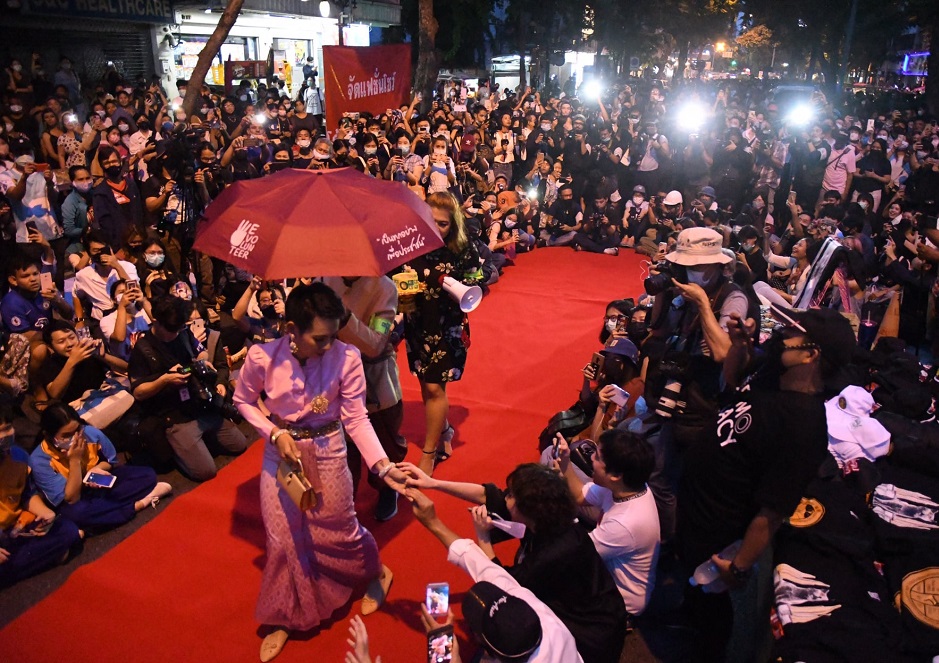
Jatuporn Sae Ung, a 23-year-old transgender and a core demonstrator, appeared at a protest site in late October dressed like a noble woman in a splendid pink traditional Thai silk dress, complete with a servant holding an umbrella for her.
As she walked past a long red carpet laid out for her at the protest site on Silom Rd that evening, fellow demonstrators were either kneeling or squatting to have an audience with her. Some exclaimed, ‘Long Live Your Majesty’.
Jatuporn Sae Ung during the “fashion walk” on Silom Road on Oct. 29, 2020.
On Thursday she was charged with defaming the queen by the act of mocking. Since when is mocking a crime, I do not know.
If found guilty, Jatuporn could face up to 15 years in prison under archaic and draconian lese majeste law. At least 31 are either charged or in the process of being charged for violating the law with the youngest being just 16.
The latest person to be charged was identified on Friday as activist Pimsiri Petchnamrob, who has campaigned for LGBT rights and freedom of speech for many years. Like in other cases, police did not make clear what she did to deserve lese majeste.
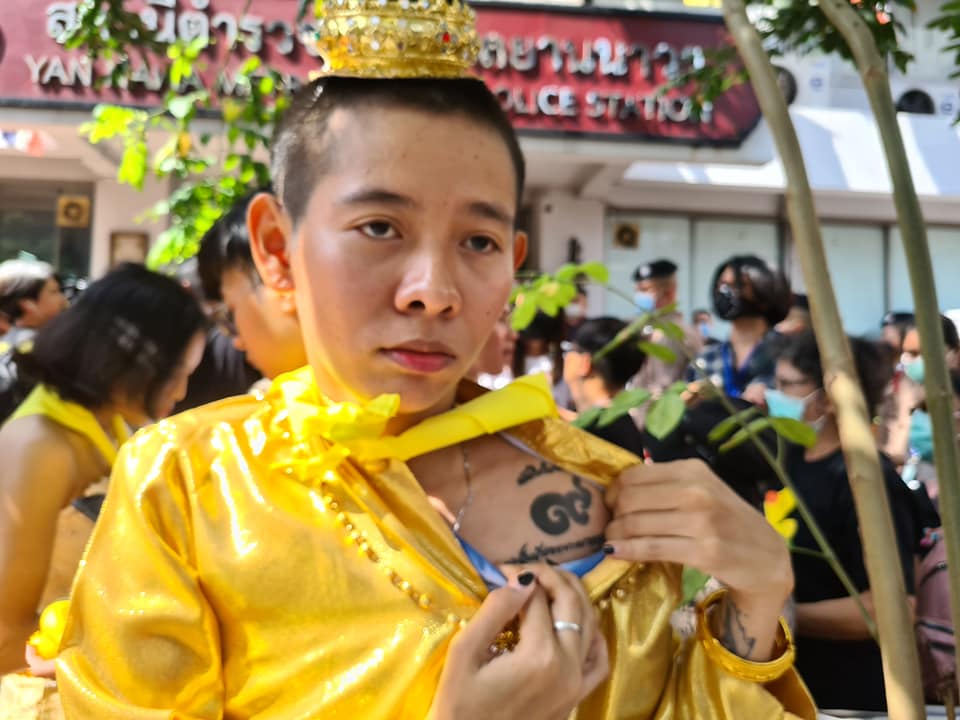
Back to Jatuporn, while waiting to hear the charges made against her per police summon letter, she summoned me briefly first in front of the Yannawa Police station to show me a tattoo on her upper left chest.
I saw a large traditional thai numeral 9, a symbol of the late king Rama IX, or king Bhumibol, and a tattoo message, part of it read ‘I vow to serve your majesty beneath your few through all my reincarnations’.
King Bhumibol passed away in Oct 2016. Die-hard royalists tattooed themselves after his death and Jatuporn was one of them. She told me her political ideology has since changed.
When I asked if she would remove the tattoo, now that she has been charged with committing lese majeste offence under the reign of a new king, who’s the only son of the late Rama IX. Jatuporn replied saying she will keep the tattoo as “a reminder” of her past.
The royalist tattoo on a chest of a person accused lese majeste offender, I think, is a reminder of a changing time.
People using the Gold Line on Dec. 18, 2020. Photo: Krungthep Thanakom / Facebook
BANGKOK — The newly inaugurated Gold Line monorail will be open to passengers for free until Jan. 15 – all three stations in the route.
The line opened formally earlier this week, with PM Prayut Chan-o-cha in attendance. With just three stations – Krung Thonburi, Charoen Nakhon, and Khlong San – it is the shortest line of all elevated railways serving Bangkok. It’s also the only self-driving public transportation in Thailand.
Key landmarks along the short route include Taksin Hospital and the luxury shopping mall IconSiam, both of which can be reached via Khlong San Station.
After the free trial ends on January 15, the fare will be 15 baht for the entire route.
Construction of the Gold Line began after the military seized power in 2014. Transparency activists have questioned whether the project was solely for moving people to a shopping mall, though officials denied there was any collusion.
There was also a plan to build a massive “observation tower” on the Gold Line, but it was shelved amid widespread criticism and concerns of corruption.
Workers disinfect a shrimp market in Samut Sakhon province on Dec. 18, 2020.
BANGKOK — Family members of a vendor at the country’s largest seafood market who tested positive for coronavirus earlier this week were found to have the virus themselves, health officials said Friday.
The three new patients were identified as the seller’s 95-year-old mother, her 73-year-old sister, and her 57-year-old sister-in-law. Efforts are also underway to test hundreds of workers at Samut Sakhon’s Mahachai shrimp market, where the unnamed vendor was based.
Although officials have yet to establish how she contracted the coronavirus, Sophon Iamsirithavorn, director of the health ministry’s communicable disease division, insisted these fresh domestic transmissions do not amount to a new wave of virus outbreak.
“We’re conducting an outbreak investigation, but the patient must have been infected from another patient,” Sophon said.
Health officials question workers at a shrimp market in Samut Sakhon province on Dec. 18, 2020.
“This means that she may not be the first case to be discovered in the area. However, please be rest assured this does not mean a new wave of outbreak since that would only occur when the source of infection can’t be identified,” he continued.
“In this case, we can still track the patients.”
Health minister Anutin Charnvirakul instructed officials to “close the case” within one week in order to reassure the public safety for the upcoming New Year celebrations. He went on to suggest that foreigners might have been the source of the virus transmissions at the market.
“I suspect that the patient might have been in close contact with the migrant workers,” Anutin said. “I’m confident that we can contain the infections.”
The 67-year-old seafood seller tested positive for the coronavirus on Thursday after she reportedly went to see a doctor for her muscle aches and loss of smell. She had no recent history of travelling outside the province, officials said.
Up to 165 people may have been in close proximity with the woman, officials said.
Health officials question workers at a shrimp market in Samut Sakhon province on Dec. 18, 2020.
Samut Sakhon governor Veerasak Vijitsaengsri ordered the shrimp market to be closed for three days for disinfection. Hundreds of workers, many of them Myanmar nationals, were also put to the coronavirus tests, though none showed a positive so far. The shrimp market is part of the sprawling Mahachai wholesale market, where most of the country’s seafood is traded.
Earlier this month, two people caught the coronavirus after coming into contact with a group of Thai workers who illegally crossed the border from Myanmar.
The virus scare was fueled even further with the discovery of seven domestic cases stemming from an infected health worker who worked inside a quarantine facility in Bangkok.
Thailand also reported new 15 virus cases found among returnees and travelers inside the state-run quarantine.
As of Friday, 232 coronavirus patients remain in hospitals across Thailand, while 4,005 patients have recovered so far. The country’s cumulative case number now stands at 4,297, with 60 deaths reported by the authorities.
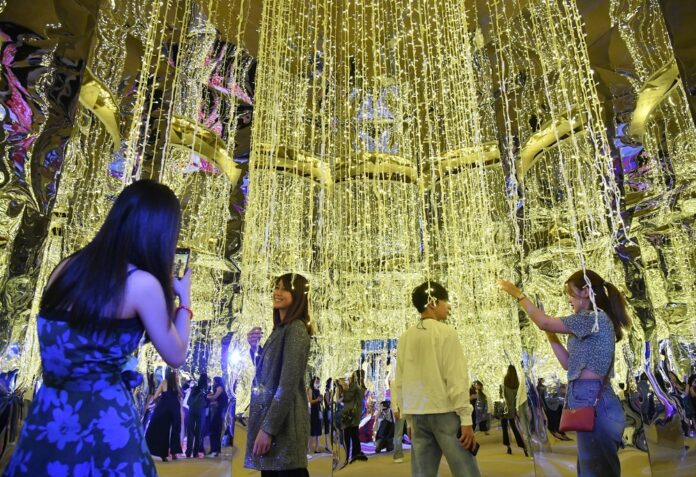
Revelers pose for photos with Christmas lighting decorations at Siam Paragon shopping mall in Bangkok on Nov. 24, 2020.
Top: Revelers pose for photos with Christmas lighting decorations at Siam Paragon shopping mall in Bangkok on Nov. 24, 2020.
For almost every year during the 10 years she’s lived in Thailand, American expat Aimee Seaman embarked on a 40-hour flight from Bangkok to her hometown of Fairbanks, Alaska to celebrate Christmas with her family.
“We always open Christmas stockings, go to the Christmas Eve service, and get new pyjamas,” she recalled wistfully. “We open presents on Christmas morning and bake cinnamon rolls for breakfast, then watch Christmas movies as the kids play with their new stuff.”
But like many other foreign nationals residing in Thailand, Seaman will have to skip the family get together this year, thanks to strict travel restrictions that remain in place amid the coronavirus pandemic.
“COVID is the reason I can’t go home, and that’s really sad,” she said. “I had plans to surprise my sister for her 40th birthday, and that’s been dumped into the ocean.”
Although the notion of being forced to spend Christmas in a relatively safe place like Thailand doesn’t seem to be a punishment – the kingdom has recorded 4,246 infections since the start of the year, a fraction of a daily count in many countries – the comfort comes wrapped with a sense of guilt, loneliness, and the persistent worries for the loved ones struggling to live with the pandemic back home.
“I had anxiety whenever my mom had to travel,” said Jessica Teal from Iowa. “I thought, ‘Is my family gonna get COVID?’ I feel almost guilty, since it seems safe here in Thailand and in the U.S. it seems crazy.”
She added, “Seeing family is a part of being human. If I could go home right now, I totally would.”
It’s not uncommon for expats here to know someone who’s been infected with the coronavirus in their home countries, like Seaman, whose sister – a single mom – reportedly contracted the virus from her boss.
Aimee Seaman’s sister Katie Padron with her boys at the Santa Clause House in Alaska in 2012.
“She had to be isolated in one part of the house away from her teenage sons while grandma dropped off groceries, and her sons cooked for themselves and did online learning,” Seaman said.
Her sister, fortunately, has recovered, but the ordeal took a toll for Seaman.
“I had a minor mental breakdown,” she said. “It’s a scary thing to be so far away from your family.”
Teal said the coronavirus also infected her best friend’s family; the woman and her baby were thankfully asymptomatic, but her husband had fallen ill because of the virus for a staggering 52 days.
“Every day that passes I think, ‘Am I gonna get a call that someone in my immediate family got it?’” Teal said.
Although it’s possible for expats to leave Thailand and visit their home countries for Christmas, the bureaucratic hurdles of paperwork and financial costs for a return trip are too forbidding for many.
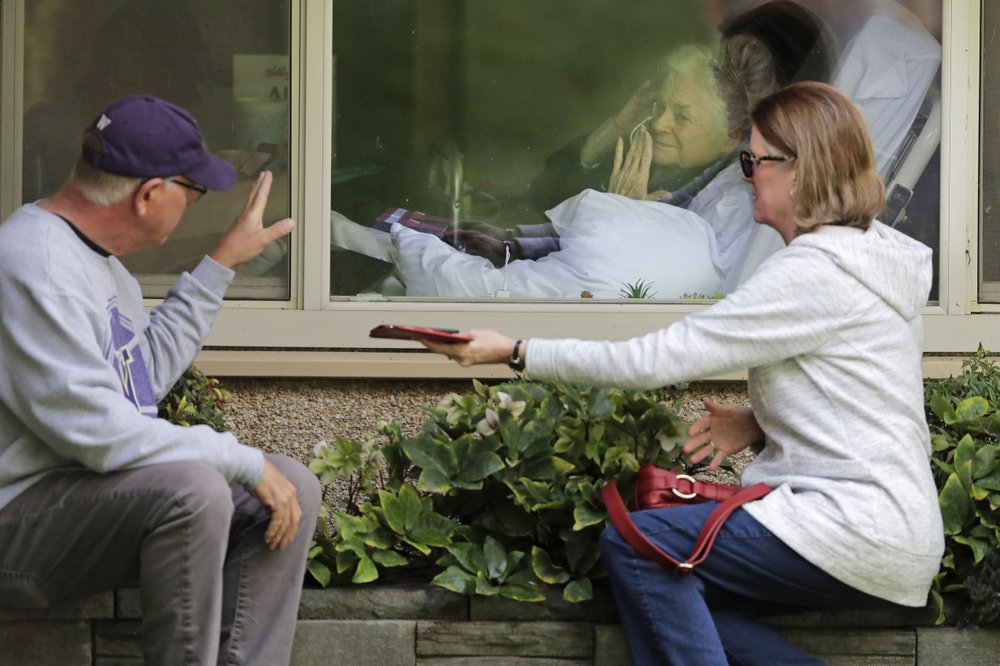
A woman who has tested positive for the coronavirus blows a kiss to her family members, Wednesday, March 11, 2020, as they visit on the phone and look at each other through a window at the Life Care Center in Kirkland, Wash., near Seattle. (AP Photo/Ted S. Warren)
To re-enter Thailand, the travelers must apply for a number of documents, including coronavirus test results acquired 72 hours prior to departure time or less, a proof of 14-day quarantine facility booking (paid by the travelers), a health insurance with a coverage of no less than 100,000 USD eligible for coronavirus treatment, a Fit-to-Fly Health Certificate, and a Certificate of Entry issued by the embassy.
The last requirement, the Certificate of Entry or CoE, can only be handed out to family members of Thai nationals, work permit holders, residence owners, students, those in need of medical treatment, and diplomats.
Eugenia Ivaschenko, 29, hailed from Russian’s Kamchatka Peninsula, just across the Bering Sea from Alaska. The mother of two currently lives in Bangkok with her husband and two young sons.
Ivaschenko is planning to spend Christmas here in Bangkok rather than going back to Russia, where infection rate has spiked since October and eclipsed the first wave of the outbreak.
“I actually know many people who got it,” Ivaschenko said. “Many of them recovered quite fast and are doing well now. Unfortunately a few people died, like one old relative with a chronic disease. The virus aggravated it.”
Eugenia and her family with Santa at the St.Nicholas Church in Bangkok.
For Abigail Smith, a native of Buffalo, New York, Christmas each year means a trip to visit her parents, who live right by Niagara Falls and the Great Lakes, where ice and snow cover the surface.
“It’s a very normal, Rockwell-esque Christmas,” she said. “A very dreamy, American middle class Christmas. We decorate the house and exchange gifts.”
The seasonal delight turned into dread this year. She said her father, who has pre-existing medical conditions, has barely left the house since March.
“Every American knows someone who got COVID. I’m blessed it wasn’t my close family or friends,” Smith, 35, said. “I miss my brother and parents. It’s 100 percent for the people.”
Lily Festus, from The Gambia, is a fourth year student at a university in Thailand. She had planned to fly home to visit her family who live in Serrekunda, close to the capital city of Banjul, but of course her travel plans were torpedoed by COVID. Festus had last been home in 2018 for Christmas, during her second year of study.
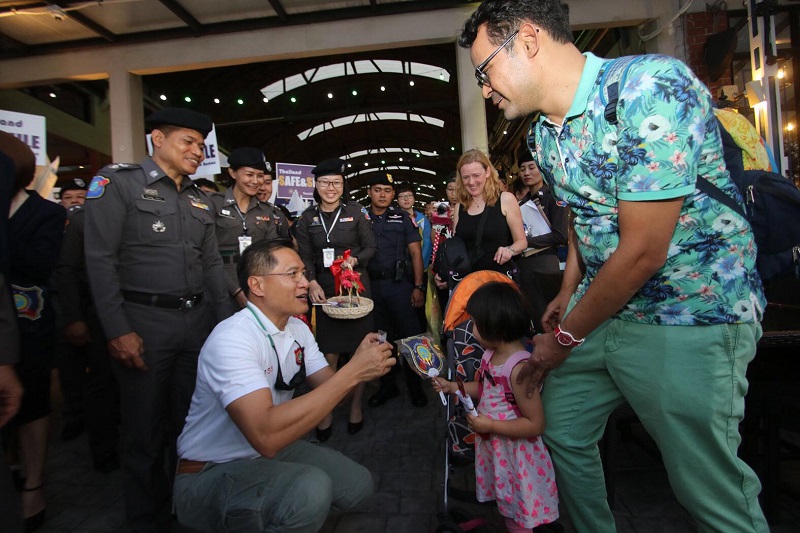
Government officials and police officers hand out Christmas souvenirs to tourists in Bangkok on Dec. 22, 2018.
While the majority of people are Muslims in The Gambia – a small West African country surrounded almost entirely by Senegal – Festus said Christmas is still celebrated publicly. During the holiday season, people usually donate clothes, foods, and amenities to hospitals and orphanages throughout the country.
“Christmas is all about sharing what you have with others in need,” Festus said.
Festus had looked forward to seeing her family of five: dad, mom, younger brother, and sister. Although she doesn’t know anyone who got COVID – the nation of 2 million people has seen 3,743 cases and 123 deaths as of press time – her father has lost his job as an IT specialist, while her mother, a teacher, had to hold classes via the internet, with mixed results.
“It’s a developing country, so it’s stressful and harder to learn online. Wi-fi keeps fluctuating,” she said.
No one knows when people can travel freely across the borders again. The Airport of Thailand predicted in April that air travels won’t be back to pre-virus levels by October 2021 – an optimistic forecast considering the current circumstances. Some other airlines, like AirAsia, now estimate that normalcy will only return by 2022.
A Christmas tree is seen in Sakon Nakhon province on Dec. 23, 2018.
And while mass vaccination programs are underway in the U.S. and U.K., the majority of the doses are going to frontline healthcare workers and hospitalized elderly. Experts believe it will take months before the general population is inoculated against the virus.
Until then, the joy of reunions will have to wait.
“I’ve already missed two babies being born. It’s hard being gone all year. I’m about to cry,” Smith, the Buffalo native, said. “It will be nice to sit down and break bread together again. When we do get back together it will be a huge sigh of relief, not just for us but for the world.”
Teal the Iowan said, “Being around family is the thing I miss most. As an expat, it can get a little lonely since you’re not around family.”
“I don’t know if I can see them next year,” Seaman from Fairbanks, Alaska, said. “I’ll cry if I don’t get to see my family, but I’m super thankful that I live in a time when I can Facetime them.”
Is your Christmas a little less merry and bright this year without family? Tell us your story at [email protected].
Russian Olympic Committee building is seen in Moscow, Russia after The World Anti-Doping Agency (WADA) handed a four-year ban to Russia for major sporting events including the 2020 Tokyo Olympics and 2022 World Cup on December 09, 2019. (Anadolu Agency/Getty/Kyodo)
GENEVA (Kyodo) — The Court of Arbitration for Sport announced Thursday it upheld Russia’s ban from next year’s postponed Tokyo Olympics, but shortened a four-year suspension to two years.
Russia’s anti-doping agency RUSADA had appealed the sanctions imposed by the World Anti-Doping Agency in December last year that barred Russia’s flag, anthem and country name from competitions, including the Olympics, for four years.
French President Emmanuel Macron reacts as he meets Portuguese Prime Minister Antonio Costa, Wednesday, Dec. 16, 2020 in Paris. (AP Photo/Francois Mori)
PARIS (AP) — French President Emmanuel Macron has tested positive for COVID-19, the presidential Elysee Palace announced on Thursday.
It said the president took a test “as soon as the first symptoms appeared.” The brief statement did not say what symptoms Macron experienced.
It said he would isolate himself for seven days. “He will continue to work and take care of his activities at a distance,” it added.
It was not immediately clear what contact tracing efforts were in progress. Macron attended a European Union summit at the end of last week, where he notably had a bilateral meeting with German Chancellor Angela Merkel. He met Wednesday with the prime minister of Portugal. There was no immediate comment from Portuguese officials.
Macron on Wednesday also held the government’s weekly Cabinet meeting in the presence of Prime Minister Jean Castex and other ministers. Castex’s office said that the prime minister is also self-isolating for seven days.
The French presidency confirmed that Macron’s trip to Lebanon scheduled for next week is being canceled.
Macron and other government officials repeatedly say that they are sticking to strict sanitary protocols during the pandemic, including not shaking hands, wearing a mask and keeping distance from other people.
Macron is following French health authorities’ recommendations that since September have reduced the self-isolation time from 14 days to seven. Authorities said at the time that this is the period when there is the greatest risk of contagion and that reducing it allows better enforcement of the measure.
French health authorities argued this week that the 14-day quarantine was not well-respected by many in the country who considered it too long.
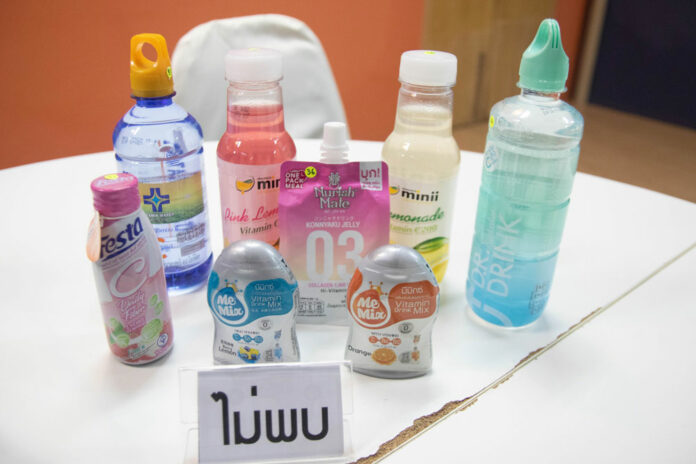
Eight Vitamin C drinks that were tested by the Consumer Foundation and found no Vitamin C. Photo: Consumer Foundation / Facebook
BANGKOK — A worrying number of beverages marketed as healthy drinks with Vitamin C are giving customers less-than-accurate information about their products, a consumer watchdog said.
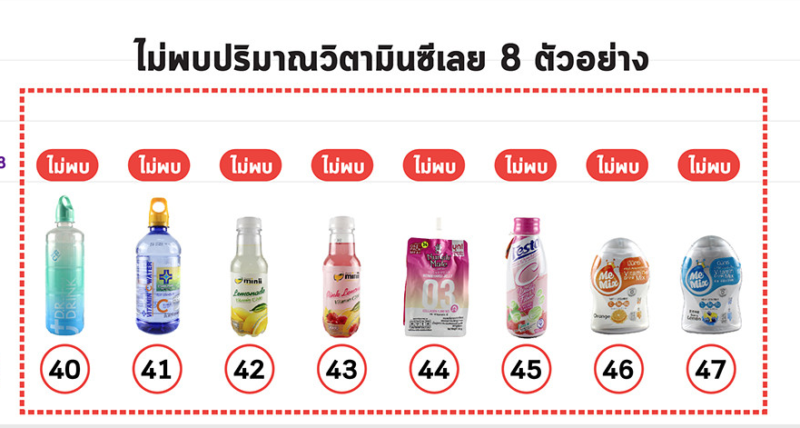
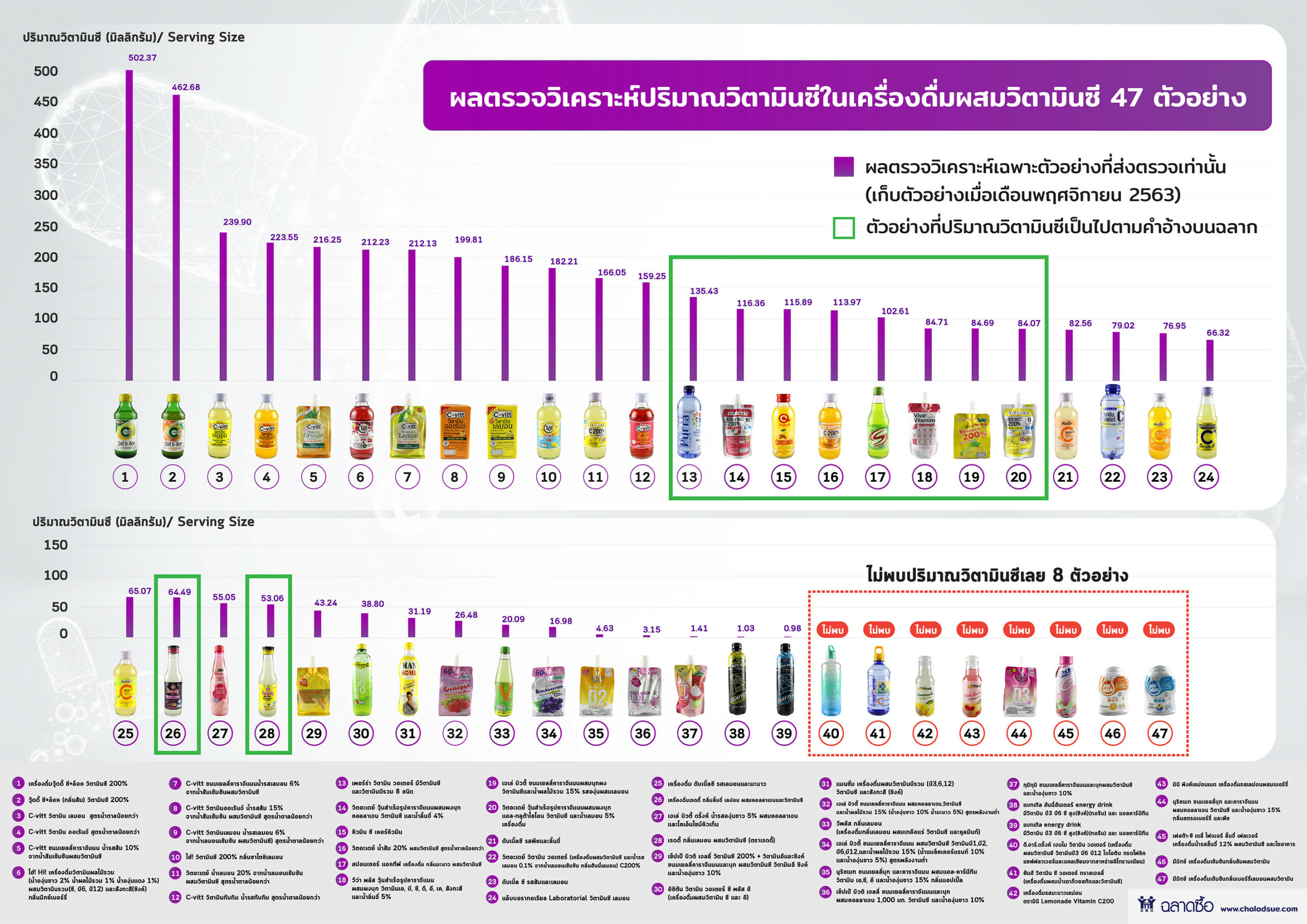
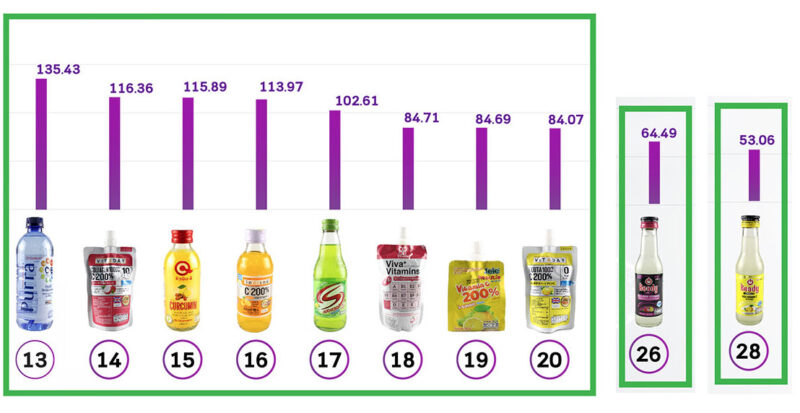
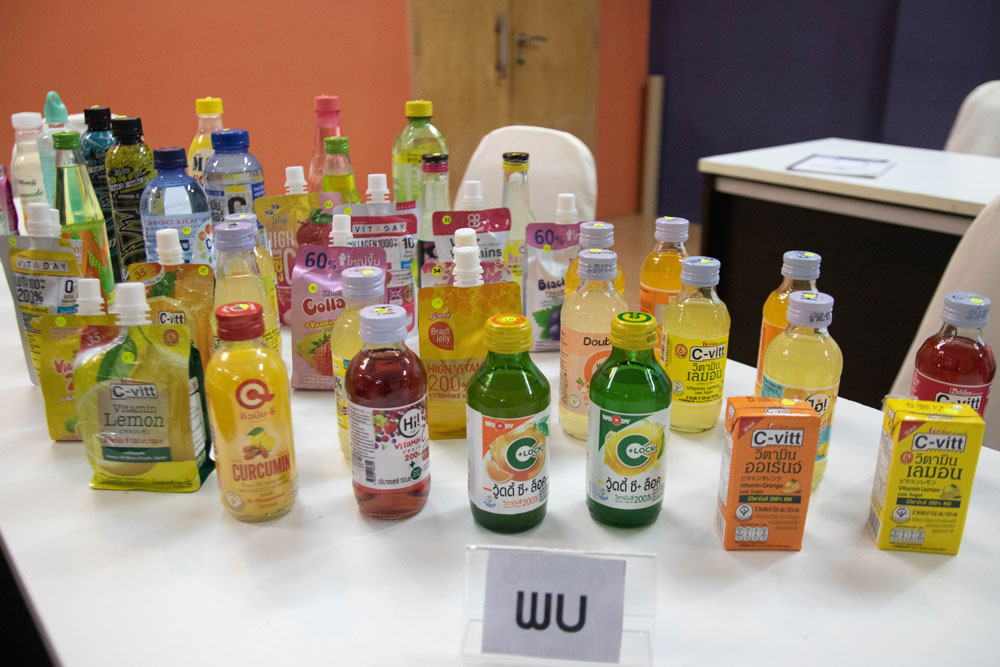
In a report released earlier this week, the Foundation for Consumers said it sampled 47 brands of bottled drinks claiming to contain Vitamin C, and found that many of them either had less Vitamin C than advertised, or more than the recommended amount. Eight samples turned out to have no Vitamin C at all, the researchers said.
“When Vitamin C is dissolved in water, there is a high chance of it deteriorating,” Kaew Kangsadalampai, a professor on food and nutrition at Mahidol University, said at a news conference held by the foundation. “It will be gone in a month or two, Therefore it’s not surprising that many brands have no Vitamin C.”
“They were very audacious to make these drinks,” he said.
Eight Vitamin C drinks that were tested by the Consumer Foundation and found no Vitamin C. Graphic: Consumer Foundation
The market of so-called Vitamin C health beverages is estimated to worth about 5-8 billion baht, said Foundation for Consumers president Saree Ongsomwang.
“Let’s build a culture of calling out the brand’s names, so the quality of products in the market will be improved,” she said.
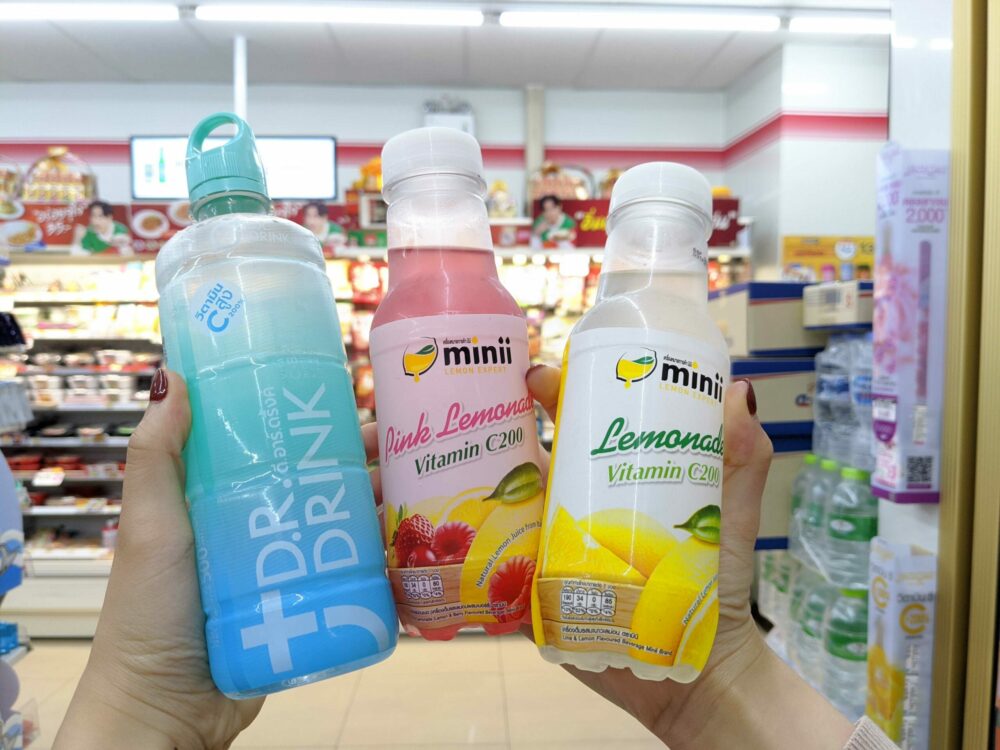
The eight drinks that did not have Vitamin C when tested are identified as Yanhee Vitamin C water (grass jelly flavor), Nourish Mate Konnyaku Jelly and Carrageenan (strawberry and peach flavor), Me Mix Vitamin Drink Mix in both of their orange and lemon flavors, Minii brand’s lemonade and pink lemonade, Festa C Daily Fiber in lychee flavor, and D.R. Drink’s Genmai Vitamin Water.
Kaew said that the time between production and packaging could be one reason why vitamins are not present in the drinks, as well as a lack of good manufacturing practices.
Vitamin C supplement pills, on the other hand, are rarely exposed to UV light and are better at retaining the vitamin.
Foundation for Consumers' Tests on Vitamin C Drinks
1 of 4
Graphic: Consumer Foundation
Graphic: Consumer Foundation
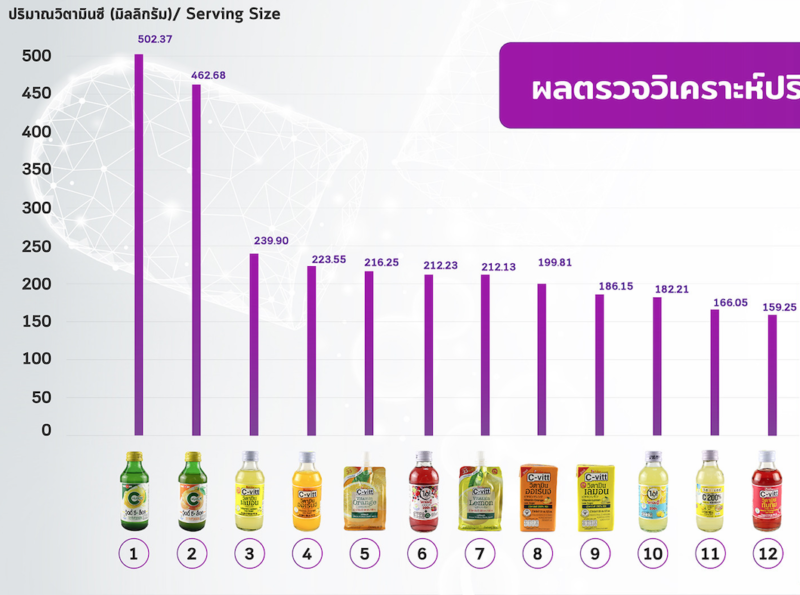
Drinks tested by the Consumer Foundation that found more Vitamin C than stated on the packaging. Graphic: Consumer Foundation
Drinks tested by the Consumer Foundation that found more Vitamin C than stated on the packaging. Graphic: Consumer Foundation
Drinks tested by the Consumer Foundation that found the same amount of Vitamin C as stated on the packaging. Graphic: Consumer Foundation
Drinks tested by the Consumer Foundation that found the same amount of Vitamin C as stated on the packaging. Graphic: Consumer Foundation
Eight Vitamin C drinks that were tested by the Consumer Foundation and found no Vitamin C. Graphic: Consumer Foundation
Eight Vitamin C drinks that were tested by the Consumer Foundation and found no Vitamin C. Graphic: Consumer Foundation
In response to the report, Yanhee Vitamin Water said in a statement Wednesday night that they added Vitamin C in their water during production, but it could have dissolved during contact with heat, light, and moisture.
The company also said the dissolved Vitamin C still contains nutrients that could benefit the consumers’ health in the same way.
Visith Chavasit, an expert from the Institute of Nutrition at Mahidol University who is not involved in the studies, said ultraviolet light can contribute to deterioration of Vitamin C in those drinks. He suggested an innovation on packaging material as a possible solution.
“The packaging can be clear, but the bottle would have to be engineered to prevent UV light from getting through. [But] that makes the packaging more expensive,” Visith said.
Too Little, Too Much
Some other brands tested by the Consumer Foundation also contain less Vitamin C than what customers are led to believe.
For instance, Gumi Gumi jelly has 1.41mg of Vitamin C and advertised itself as having “120 percent” of daily recommended intake of the vitamin – the daily recommended amount is actually 60 mg.
Battle energy drinks had as little as 1 milligram, yet their honey flavor drinks said that they had “45 percent” of the daily recommended amount.
Three drinks tested by the Consumer Foundation that contain no Vitamin C.
A number of brands also have an entirely different kind of problem: they were found to have higher amounts of Vitamin C than what’s written on their labels, and some even exceeding the daily recommended intake, such as Woody C Lock in lemon flavor, which has 502 milligrams of Vitamin C per serving.
Megadoses of Vitamin C, or consuming beyond the recommended daily amount, is usually harmless, as people usually release the excess vitamins via urine. However in some individuals, Kaew said excess Vitamin C could lead to kidney stones.
Drinks tested by the Consumer Foundation that found more Vitamin C than stated on the packaging. Graphic: Consumer Foundation
Food regulatory agencies have yet to make a comment on the latest finding by the Consumer Foundation.
Section 4 of the Article 27 of the Food Act bans food and beverage labels that mislead consumers about “amount, benefits, special properties, or place and country of production,” with a maximum penalty of 10 years in prison and a fine of 100,000 baht.
Vitamin C drinks that were tested by the Consumer Foundation and contained Vitamin C. Photo: Consumer Foundation / Facebook
Kaew, the nutritionist at Mahidol University, said there should be more transparency in the market of so-called healthy drinks.
“It’s good to have water with helpful vitamins to make it even more useful than water, but please be honest in your practices so that consumers get the benefits,” he said.
“But don’t make us nutritionists worried,” Kaew continued. “Emphasize fruits and vegetables to get Vitamin C, since they have other nutrients and fiber as well.”
Drinks tested by the Consumer Foundation that found the same amount of Vitamin C as stated on the packaging. Graphic: Consumer Foundation
And here’s the honorable mentions: Consumer Foundation said brands of drinks that have the exact amount of Vitamin C as advertised on their packaging include Purra Vitamin Water, Vit A Day’s lychee and lemon jelly drinks and their orange drink, Cumin C Curcumin drink, Sponsor Active in lemon, Viva+ Vitamins lychee flavor, Jele Beaute’s lemon jelly, and Ready drinks in lemon and lychee.