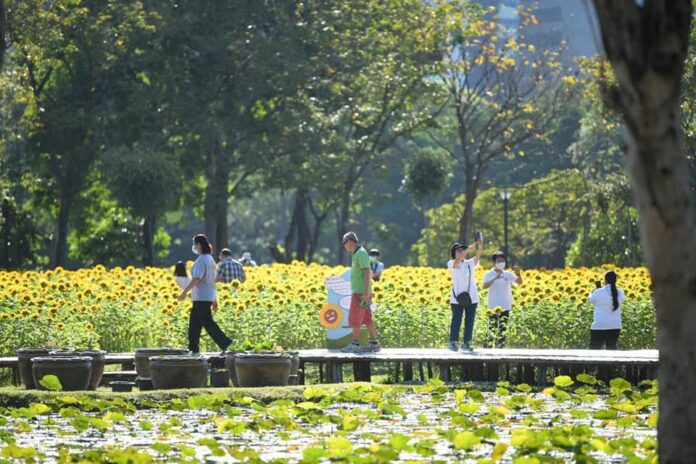
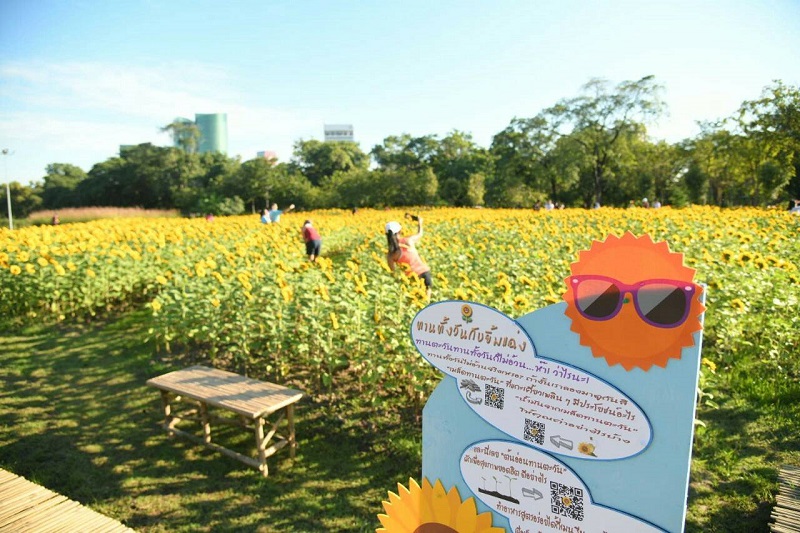
Tourists at a New Year fair in Nakhon Phanom, Dec. 23, 2019.
BANGKOK (Xinhua) — Thailand’s Ministry of Finance on Wednesday announced that the Thai cabinet had greenlighted another 43.5 billion baht (1.438 million U.S. dollars) package to boost domestic consumption and local travel, as Thailand is still reeling from a flagging economy triggered by COVID-19.
About 22.5 billion baht (744 million U.S. dollars) will be offered to 5 million new consumers, at 3,500 baht (115 U.S. dollars) each, under the current co-payment scheme, said Pornchai Theeravet, advisor to the ministry’s Fiscal Policy Office (FPO).
Pornchai said that the 10 million consumers who had already signed up would get a further 500 baht (16.53 U.S. dollars).
The new package would be given in small amounts from January to March, while 1,500 baht (49.60 U.S. dollars) would be offered to some 14 million low-income earners.
Pornchai said that the 43.5 billion baht (1.438 million U.S. dollars) package is intended as a New Year gift to Thai people who are still struggling to purchase goods and travel within the country.
“The extra money in their pockets will ease some of their financial woes, as well as spur the local economy,” said Pornchai.
Meanwhile, Finance Minister Arkhom Termpittayapaisith suggested that the Thai economy will need at least two years to recoup the 9 percent of the gross domestic product (GDP) lost to the pandemic crisis.
The minister said the Thai economy would have expanded by around 3 percent this year if the pandemic crisis did not erupt.
The pandemic crisis will make the economy contract by around 6 percent in 2020, therefore there is a 9 percent gap that needs to be recuperated, Arkhom said.
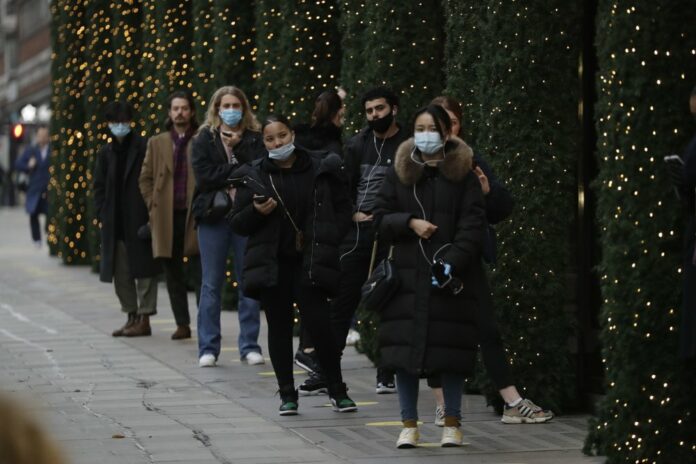
People queue up as they wait for the Selfridges department store to open as non-essential shops are allowed to reopen after England's second lockdown ended at midnight, on Oxford Street, in London, Wednesday, Dec. 2, 2020. (AP Photo/Matt Dunham)
LONDON (AP) — Britain became the first country in the world to authorize a rigorously tested COVID-19 vaccine Wednesday and could be dispensing shots within days — a historic step toward eventually ending the outbreak that has killed more than 1.4 million people around the globe.
In giving the go-ahead for emergency use of the vaccine developed by American drugmaker Pfizer and Germany’s BioNTech, Britain vaulted past the United States by at least a week. The U.S. Food and Drug Administration is not scheduled to consider the vaccine until Dec. 10.
“This is a day to remember, frankly, in a year to forget,” British Health Secretary Matt Hancock said.
The announcement sets the stage for the biggest vaccination campaign in British history and came just ahead of what experts are warning will be a long, dark winter, with the coronavirus surging to epic levels in recent weeks in the U.S. and Europe.
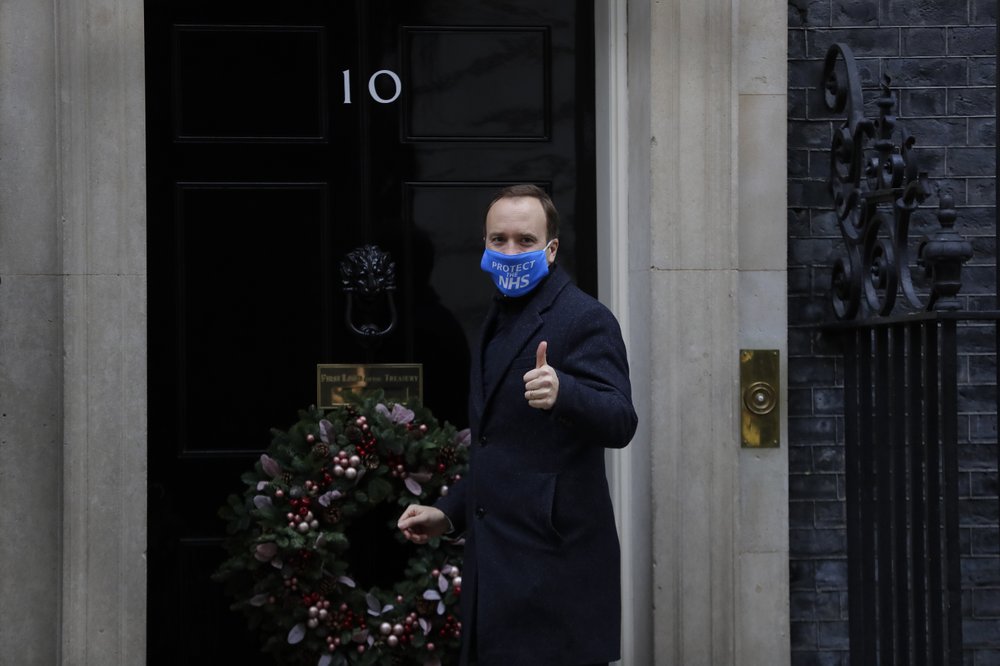
Britain’s Health Secretary Matt Hancock gestures as he arrives at Downing Street in London, Wednesday, Dec. 2, 2020. (AP Photo/Kirsty Wigglesworth)
Officials cautioned that several tough months still lie ahead even in Britain, given the monumental task of inoculating large swaths of the population. Because of the limited initial supply, the first shots will be reserved for those most in danger, namely nursing home residents, the elderly and health care workers.
Britain’s Medicines and Healthcare Products Regulatory Agency recommended the vaccine after clinical trials involving tens of thousands of volunteers showed it was 95% effective and turned up no serious side effects. The vaccine is still considered experimental while final testing is done.
“This is an unprecedented piece of science,” given that the vaccine was authorized less than a year after the virus was discovered, said David Harper, senior consulting fellow in global health at the Chatham House think tank.
Prime Minister Boris Johnson declared that the “searchlights of science” had picked out the “invisible enemy,” which has been blamed for close to 60,000 deaths in Britain. He said that in developing the vaccine, scientists had performed “biological jujitsu” by turning the virus on itself.
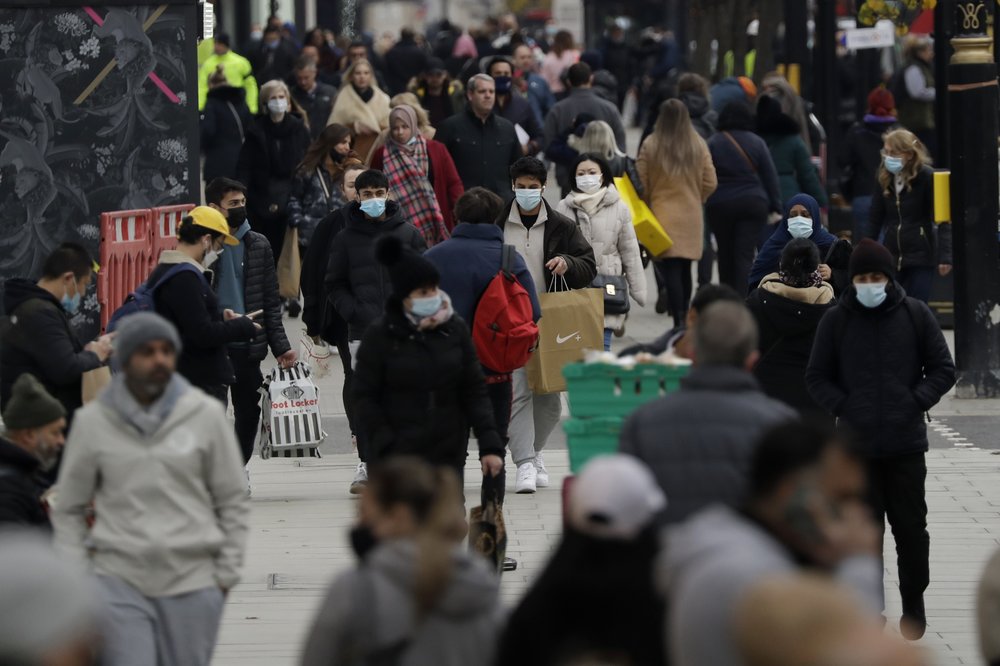
People carry shopping bags as non-essential shops are allowed to reopen after England’s second lockdown ended at midnight, on Oxford Street, in London, Wednesday, Dec. 2, 2020. (AP Photo/Matt Dunham)
Amid growing concern that Americans will greet vaccines with skepticism, U.S. Health and Human Services Secretary Alex Azar said Britain’s decision “should give Americans additional confidence in the quality of such a vaccine.” The virus has killed more than 270,000 in the U.S. On Wednesday, the head of the U.S. Centers for Disease Control and Prevention signed off on an expert panel’s recommendation that health care workers and nursing home residents be the first to be vaccinated when shots become available.
Hancock said Britain will begin receiving the first shipment of 800,000 doses from Belgium within days, and people will start getting the shotsas soon as it arrives. Two doses three weeks apart are required. The country expects to receive millions of doses by the end of this year, Hancock said, though the exact number will depend on how fast it can be manufactured and checked for quality.
BioNTech, which owns the vaccine, said it has so far signed deals to supply 570 million doses worldwide in 2021, with options to deliver 600 million more. It hopes to supply at least 1.3 billion in 2021.
That is only a fraction of what will be needed as public health officials try to vaccinate much of the world’s population. Experts have said several vaccines will be required to quickly end the pandemic that has infected more than 64 million people globally.
This handout photo taken in Oct. 2020 and provided by Pfizer shows part of a “freezer farm,” a football field-sized facility for storing finished COVID-19 vaccines, in Puurs, Belgium. (Pfizer via AP)
In Britain, the first shots will go to nursing home residents and those who care for them, followed by everyone over 80 and health care workers. From there, the program will be expanded as the supply increases, with the vaccine offered roughly on the basis of age groups, starting with the oldest people.
Amid the burst of optimism, Pfizer CEO Albert Bourla warned governments against any immediate move to relax restrictions and reopen their economies.
“The time that we will have to go back to normality is not far away,” he said. “But it is definitely not now.”
Despite the speed with which they approved the vaccine, and the intense political pressure surrounding the worldwide race to solve the crisis, British regulators insisted “no corners have been cut” during the review process.
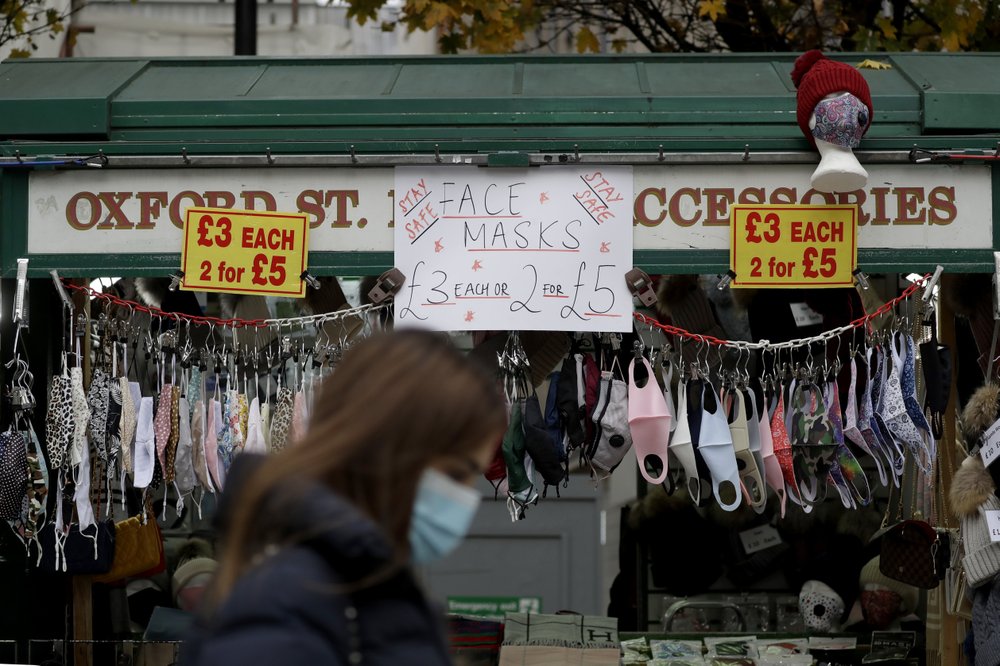
Face masks to curb the spread of coronavirus are displayed for sale on a stall as non-essential shops are allowed to reopen after England’s second lockdown ended at midnight, on Oxford Street, in London, Wednesday, Dec. 2, 2020. (AP Photo/Matt Dunham)
The MHRA made its recommendation after a so-called rolling review that allowed it to assess information about the vaccine as it came in, starting back in October.
“The safety of the public will always come first,” said Dr. June Raine, the agency’s chief executive. “And I emphasize again that this recommendation has only been given by the MHRA following the most rigorous scientific assessment of every piece of data.”
Getting that message to the public will be critical if any vaccination program is to be successful. Some people are worried about getting any vaccine, never mind a new one.
“But I think once they understand and see everyone else having it without hesitation, I think you’ll find that people will go and have it,” Jacqueline Roubians, a 76-year-old retired nurse, said at Brixton Market in London. “People are dying of COVID, so you make that decision: Do you want to die or do you want the vaccine?”
In addition to the huge logistical challenges of distributing the vaccines, the Pfizer-BioNTech one must be stored and shipped at ultra-cold temperatures of around minus 70 degrees Celsius (minus 94 degrees Fahrenheit).
Pfizer said it has developed shipping containers that use dry ice and GPS-enabled sensors will allow the company to track each shipment and ensure it stays cold.
Every country has different rules for determining when an experimental vaccine is safe and effective enough to use. China and Russia have offered different vaccines to their citizens before they had gone through large-scale, late-stage testing.
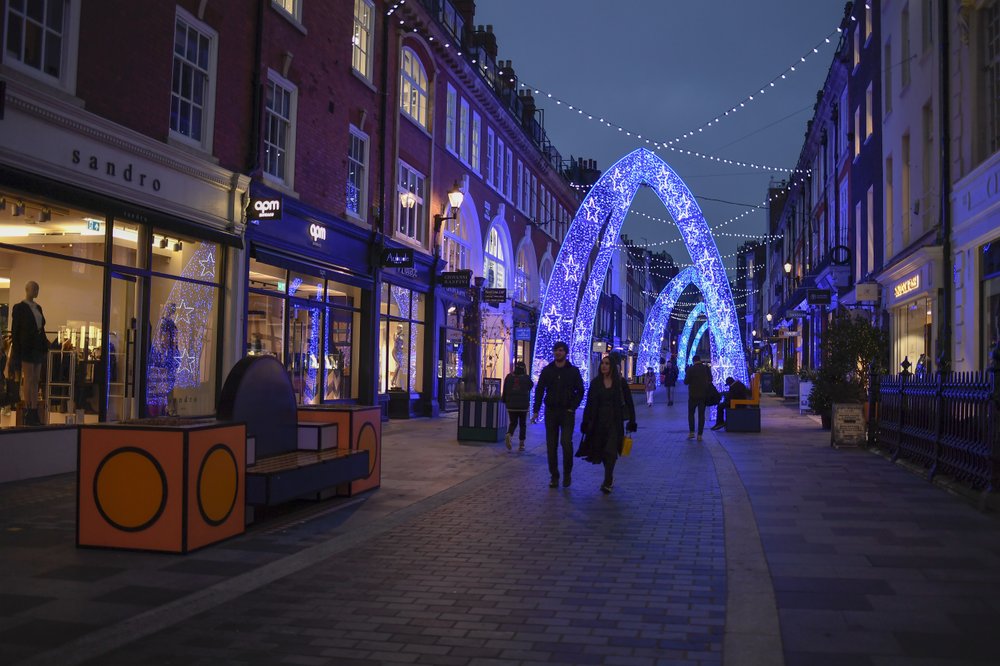
People walk under a light installation, holding shopping bags in Mayfair area of London, as non-essential shops are allowed to reopen after England’s second lockdown ended Wednesday, Dec. 2, 2020. (AP Photo/Alberto Pezzali)
Hours after Britain’s announcement, Russian President Vladimir Putin, not to be outdone, ordered the start of a large-scale COVID-19 vaccination campaign by late next week, with doctors and teachers to be first in line to receive the Sputnik V shot, whose name was inspired by the 1957 satellite that was one of Moscow’s proudest technical achievements.
The Russian vaccine won regulatory approval in August but has yet to complete advanced studies of its effectiveness and safety. Health Minister Mikhail Murashko said more than 100,000 people in Russia have been given the shots.
Still to be determined is whether the Pfizer-BioNTech shots prevent people from spreading the virus when they have no symptoms. Another question is how long protection lasts.
The vaccine also has been tested in only a small number of children, none younger than 12, and there’s no information on its effects in pregnant women.
___
Neergaard reported from Alexandria, Virginia. Associated Press writers Frank Jordans in Berlin and Lawless, Pan Pylas and Jo Kearney in London contributed.
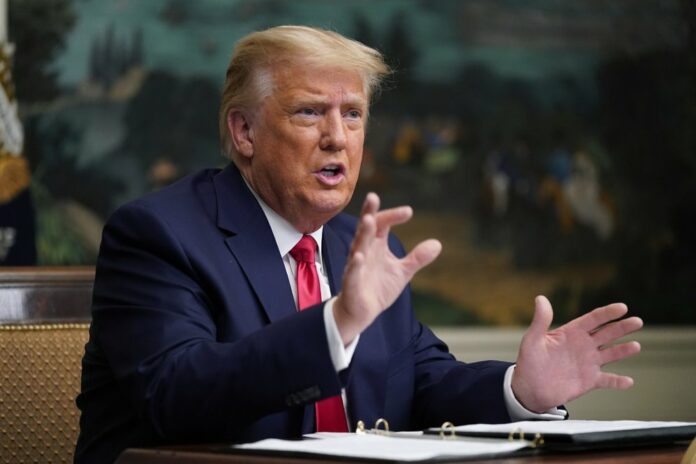
In this Nov. 26, 2020, photo, President Donald Trump speaks with reporters after participating in a video teleconference call with members of the military on Thanksgiving, at the White House in Washington. (AP Photo/Patrick Semansky)
WASHINGTON (AP) — Increasingly detached from reality, President Donald Trump stood before a White House lectern and delivered a 46-minute diatribe against the election results that produced a win for Democrat Joe Biden, unspooling one misstatement after another to back his baseless claim that he really won.
Trump called his address, released Wednesday only on social media and delivered in front of no audience, perhaps “the most important speech” of his presidency. But it was largely a recycling of the same litany of misinformation and unsubstantiated allegations of voter fraud that he has been making for the past month.
Trump, who spoke from the Diplomatic Reception Room, kept up his futile pushback against the election even as state after state certifies its results and as Biden presses ahead with shaping his Cabinet in advance of his inauguration on Jan. 20.
Trump’s remarks raised questions about how far he may be willing to go in his campaign to overturn Biden’s win, including whether he might press Republicans in Congress to block certification of the vote, a move that’s been floated by the president’s allies.
Biden received a record 81 million votes compared to 74 million for Trump. The Democrat also won 306 electoral votes compared to 232 for Trump. The Electoral College split matches Trump’s victory over Hillary Clinton four years ago, which he described then as a “landslide.”
Trump dug further into his contention of a “rigged election” even though members of his own administration, including Attorney General William Barr, say that no proof of widespread voter fraud has been uncovered. Courts in multiple battleground states have thrown out a barrage of lawsuits filed on behalf of the president.
“This is not just about honoring the votes of 74 million Americans who voted for me,” Trump said. “It’s about ensuring that Americans can have faith in this election. And in all future elections.”
In fact, his baseless claims are having the opposite effect — undermining public faith in the integrity of U.S. elections.
About an hour after it was posted, Trump’s video had been viewed hundreds of thousands of times on Facebook and shared by more than 60,000 Facebook users. Both Facebook and Twitter flagged the president’s posting as problematic, with Twitter noting that Trump’s claims about election fraud are disputed.
Julian Zelizer, a professor of political history at Princeton University, said the nation has seen close elections before — 1800, 1876 and, most recently, 2000. But this year’s election does not fit in that category.
“This is just a random baseless attack on the entire election,” Zelizer said. “Trump has no turning point. I often say there are parallels or precedents, but there aren’t in this case. He keeps bending norms.”
Trump said the election results should be “overturned immediately” in several battleground states and suggested the Supreme Court should intervene in his favor, saying, “Hopefully, they will do what’s right for our country because our country can’t live with this kind of an election.”
But chances are remote that the Supreme Court would get involved. No appeals claiming fraud have been filed at the high court. Pennsylvania Republicans want the justices to prevent certification of Biden’s win in the state, but their appeal alleges Pennsylvania’s vote-by-mail law is unconstitutional, not fraud. The state Supreme Court already has dismissed the lawsuit.
Many of Trump’s claims have been debunked repeatedly in recent weeks.
His overarching claim: “This election is about great voter fraud, fraud that has never been seen like this before.”
In fact, Christopher Krebs, the director of the Department of Homeland Security’s Cybersecurity and Infrastructure Security Agency, voiced confidence in the integrity of the election ahead of the November vote. And afterward, he knocked down allegations that the count was tainted by fraud.
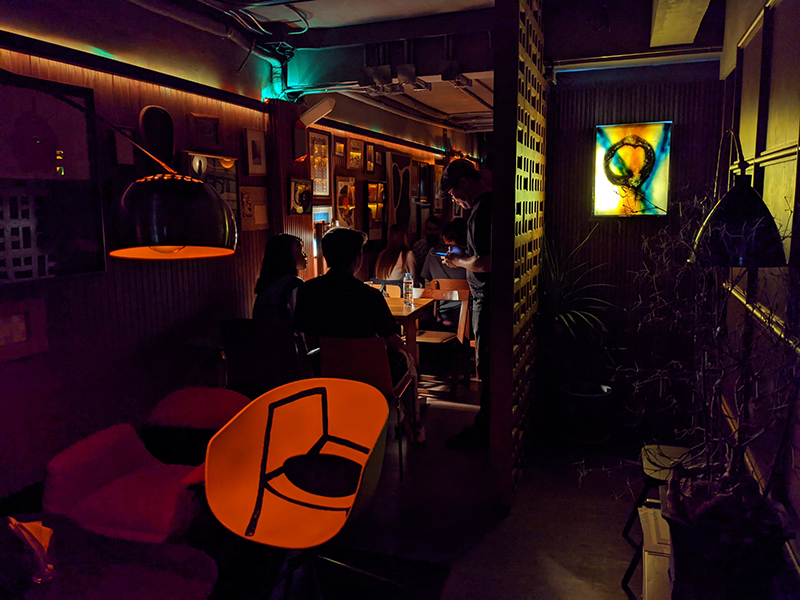
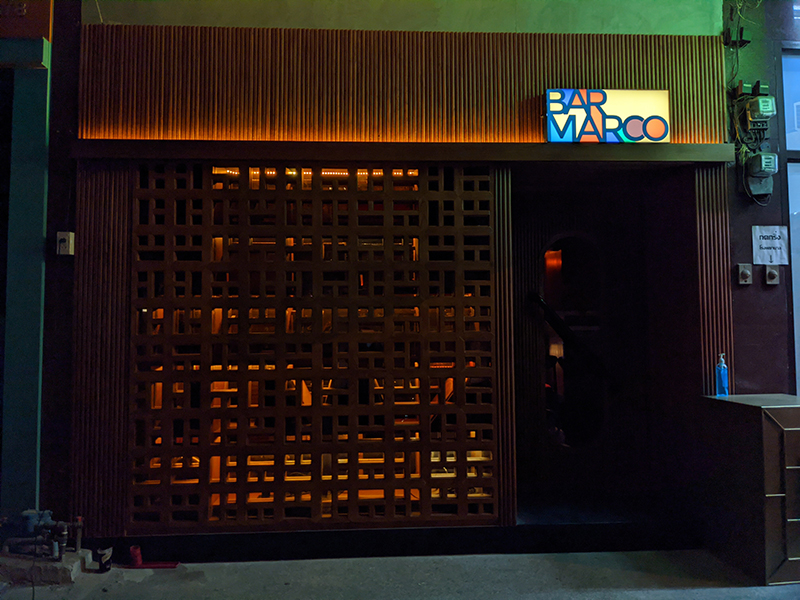
BANGKOK — Retro vinyls, playful cocktails inspired by James Dean, and groovy lighting are the name of the game at Bar Marco, a newly opened hangout spot in Thonglor.
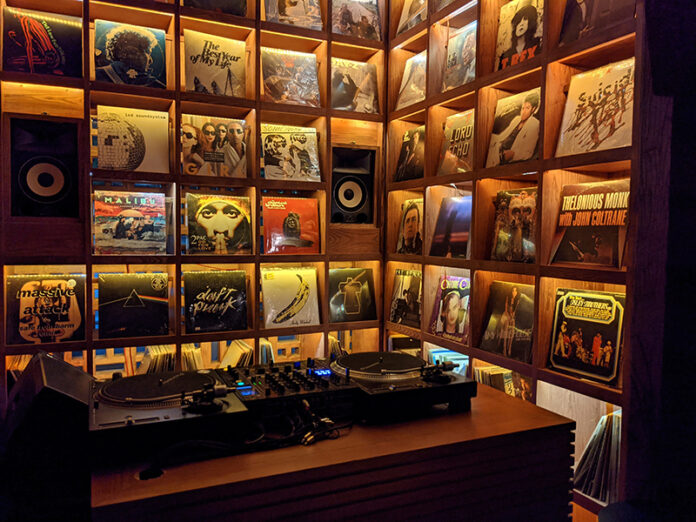
A DJ table and a wall of vinyls greets the customer at “Bar Marco,” which opened late November at Thonglor Soi 20 with a vague 50s to 70s theme.
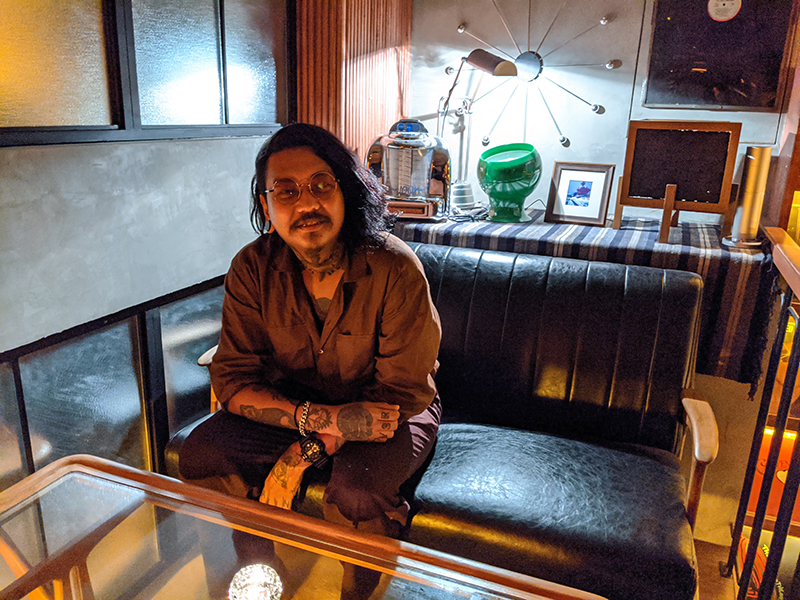
“It’s like hanging at a friend’s house, not drinking serious cocktails,” senior bartender Danuwat Into, 31, said. “The host has to welcome his friends, both old and new.”
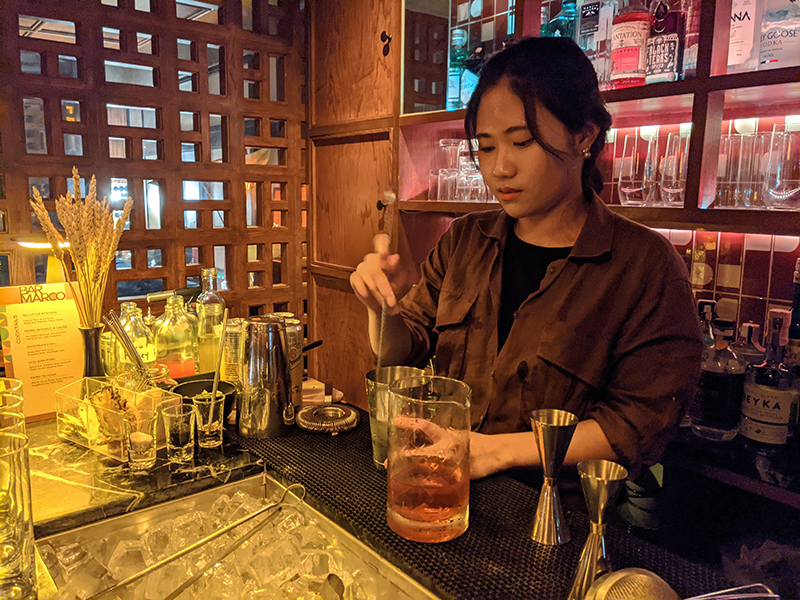
Danuwat said he hopes Bar Marco is somewhere on the range between a serious cocktail bar and flashy EDM clubs. The bar is by the same team behind Rabbit Hole, Michelin-starred fine dining Canvas, and draft tea cocktail bar Draft Land.
“We imagined that this is Marco’s house, this guy who loves to party,” Danuwat said. “Marco’s parents are into interior design and architecture, so that’s why the place looks like this.”
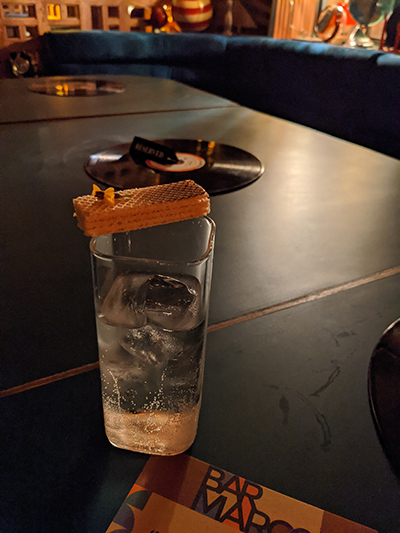
“130 Little Bastard” (330 baht).
Cocktails are in the 300 to 400 baht range. We enjoyed the “130 Little Bastard” (330 baht) a coconut rum drink with absinthe and cacao liqueur named after James Dean’s silver Porsche 550 Spyder. The burnt wafer on top brought back memories of childhood of snacking on cheap snacks, or perhaps the imagined carefree nostalgia of the 50s.
“Rebel Without a Cause” (396 baht) seemed a tad expensive for a sake cup with yuzu sake, gin, vermouth, and ice, but “Daydream Eyes” (308 baht) continued the sweet-loving trend with a grape bitter milk punch with elderflower tonic that reminds one of Yakult.
Our least favorite of the drinks we tried was the “Non-Ban-Puen” (418 baht), a puzzling combo of spiced rum, Campari, and sweet vermouth that was reminiscent of strange coffee.
“Daydream Eyes” (308 baht).
Still, the decor was impressively in-theme – the fake vinyls on the tables (the ones on the wall are real though), seating booths, and lampshades of little mirror beads transported us from the Thong Lor soi into the imagined past for a short evening.
Bar Marco also plans to have live DJs soon to make use of the bar’s vinyl collection.
Bar Marco is open 6pm to 1am every day and is located in Soi Thonglor 20, a motorcycle ride from BTS Thong Lo. This review is based on a hosted visit.
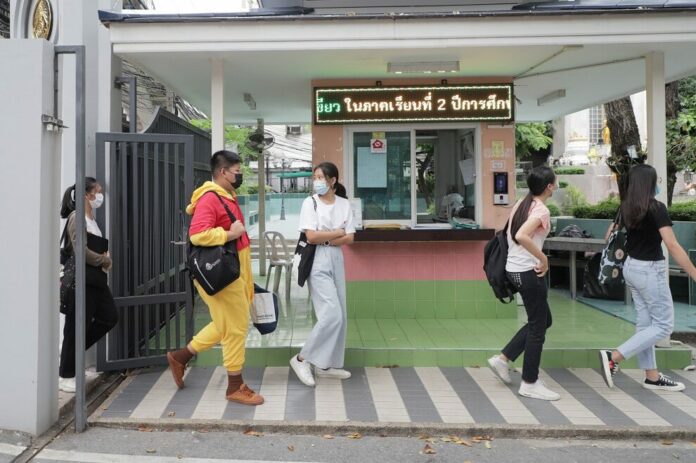
Students, some wearing casual outfits, arrive at Samsen Witthayalai School in Bangkok on Dec. 1, 2020.
BANGKOK — Education minister Nataphol Teepsuwan on Wednesday threatened a legal action against high school activists who run a website where students can report abuses at their school.
Nataphol said during an interview with MCOT’s “Inside Thailand” news show this morning that the disclosure of teachers’ and schools’ names on the website is considered a violation of privacy and therefore a probable cause for lawsuits.
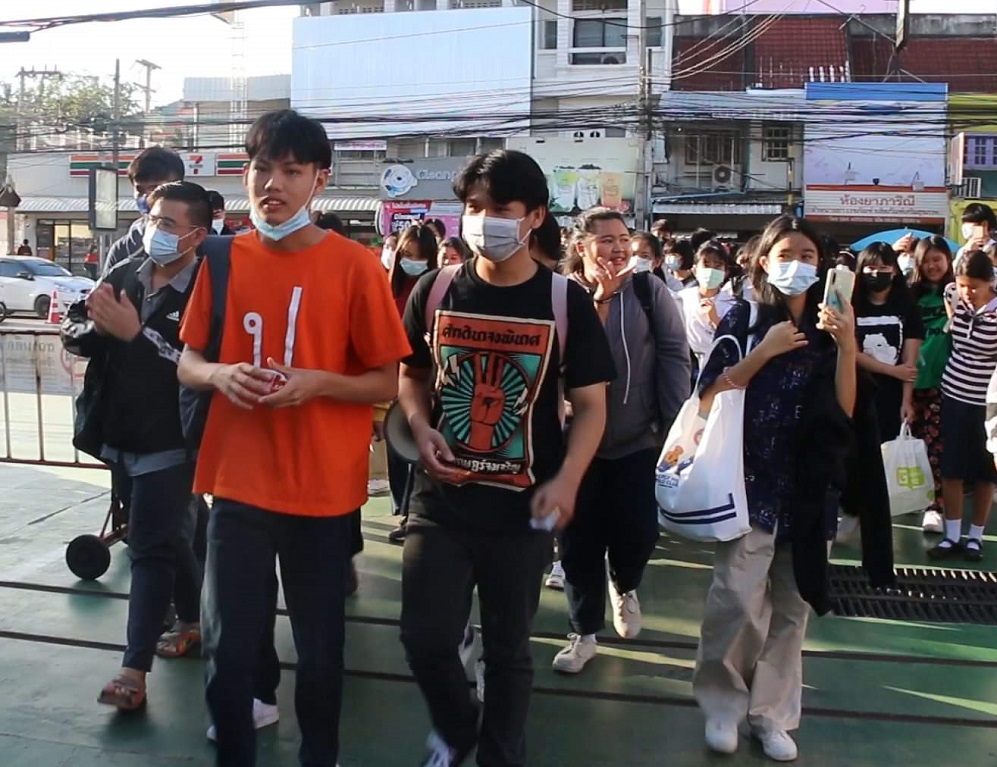
His comment came after a hundred of students staged a protest in front of the education ministry to demand an end to compulsory uniforms and other rules deemed as excessive.
“[The website] can cause problems in the future,” Nataphol said. “Some people may expose personal information of students who did not wear uniforms. It also affects teachers as well, so this may infringe their rights.”
He continued, “I asked the legal department to look into ways to close down the website. I want them to think of legal consequences.”
Students, some wearing casual outfits, arrive at a school in Khon Kaen province on Dec. 1, 2020.
“It’s just a demand from a certain group of people,” Nataphol went on. “I believe most students are still willing to comply with the rules and understand their roles as a student.”
The website was launched Tuesday by the “Bad Students” group to coincide with their campaign for students to wear casual clothes to school instead of uniforms, which they perceived as an outworn rule that infringes on students’ freedom of choice.
Although a number of schools did not interfere with students wearing casual outfits, others were met with harassment from their teachers and threatened with disciplinary action.
The website allows students to report issues they faced from wearing casual outfits by submitting the teacher’s name, the name of the school where the incident took place, and details of the incident. The forms were later published on the website.
Mint, one of the members of the group, said her group is not concerned about the legal threat made by the education minister. She said the information submitted to the website will be compiled into statistical data, though her group is still discussing how to take action against teachers accused in the list.
“We have our own legal advisors,” Mint said. “We’re still figuring out what to do with the data.”
Under the ministerial regulation, school uniform, which consists of a white shirt and a pair of shorts or a skirt, is compulsory for students in both public and private school systems from kindergarten through high school. The dress code typically comes with strict military-styled haircut rules.
PM Prayut Chan-o-cha himself expressed support for maintaining the uniform system.
Speaking at a government event in which he chatted with some kindergarteners, Prayut said uniforms help members of the public to distinguish students, and they are less costly than casual attire.
“Uniforms can be easily noticed if students fall in danger,” Prayut said on Tuesday. “It’s also less waste of money than casual outfits.”
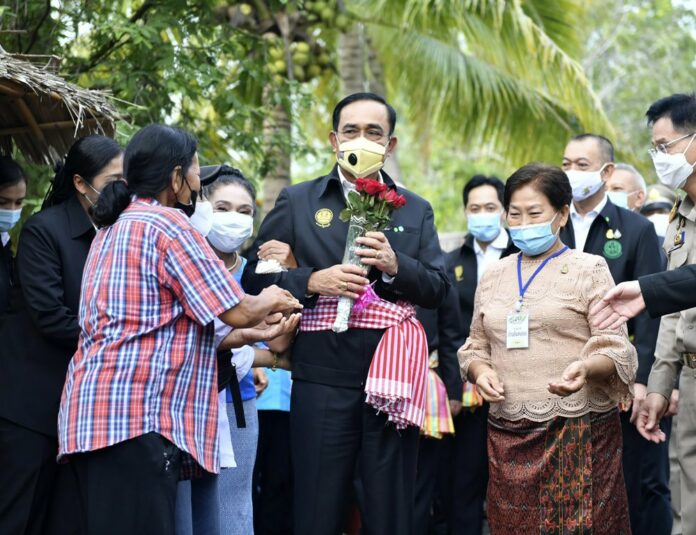
In this photo released by Government Spokesman Office, Thailand's Prime Minister Prayuth Chan-ocha receives flowers from well wishers in Samut Songkhram province, Thailand, Wednesday, Dec. 2, 2020. (Government Spokesman Office via AP)
BANGKOK (AP) — Thailand’s highest court on Wednesday acquitted Prime Minister Prayuth Chan-ocha of breaching ethics clauses in the country’s constitution, allowing him to stay in his job.
The Constitutional Court ruled on a complaint brought by the Pheu Thai party, the largest opposition grouping in Parliament, that Prayuth had broken the law by continuing to live in his military residence after he retired as army commander in September 2014.
The complaint alleged that he broke constitutional articles barring government ministers from receiving special benefits from state agencies or enterprises because that would amount to a conflict of interest. If a minister is found guilty of violating ethical standards, the official is to be disqualified and forced to step down.
The ruling comes as Prayuth has been dealing with a persistent student-led pro-democracy movement that has been holding frequent well-attended rallies demanding that he and his government step down, charging that they came to power illegitimately.
As army commander, Prayuth led a coup in May 2014 that ousted an elected government led by the Pheu Thai party. He then headed the junta that ruled for five years, and was also prime minister in the military-guided government.
A general election last year brought to power a proxy party established by the military, which with its allies selected Prayuth to serve again as prime minister. The ongoing protests charge that the 2017 constitution established under military rule gave the military’s proxy Palang Pracharath Party an unfair advantage in the election.
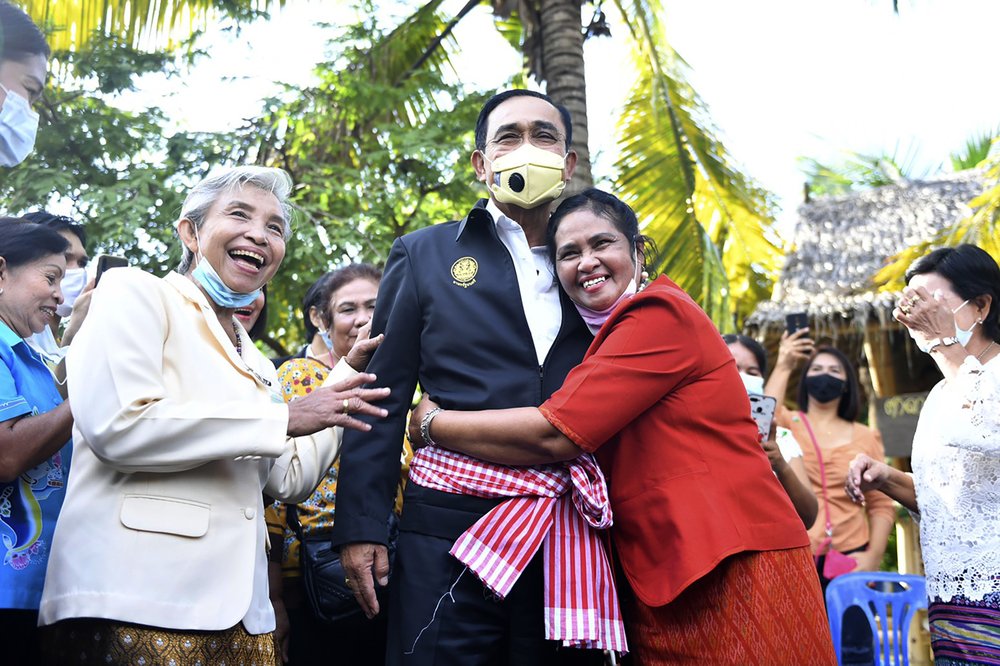
In this photo released by Government Spokesman Office, a well-wisher hugs Thailand’s Prime Minister Prayuth Chan-ocha in Samut Songkhram province, Thailand, Wednesday, Dec. 2, 2020. (Government Spokesman Office via AP)
When Prayuth and several of his Cabinet ministers faced a censure debate in Parliament in February, opposition leader Sompong Amornwiwat of the Pheu Thai party raised the issue of whether Prayuth had acted illegally by continuing to live at his army residence at a base in Bangkok.
Prayuth’s defense has been that the official residence of the prime minister is undergoing renovation, and also that he faces security concerns.
The army has argued on his behalf that his military housing is actually a VIP guest house, though critics suggest that if he did not pay at least for water and electricity, he may be breaking the law.
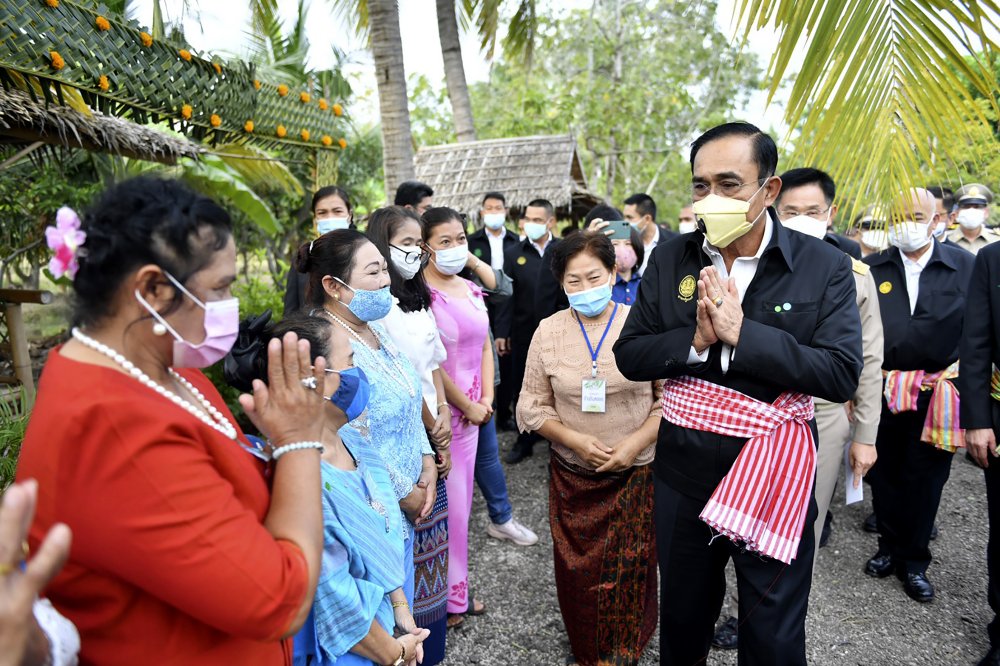
In this photo released by Government Spokesman Office, Thailand’s Prime Minister Prayuth Chan-ocha right, gives the traditional greeting or “wai” in Samut Songkhram province, Thailand, Wednesday, Dec. 2, 2020. (Government Spokesman Office via AP)
In the past 12 years, court rulings have ousted three Thai prime ministers.
The court, like the military, is considered a pillar of the country’s royalist establishment, and the ultimate bulwark against threats to it. The three ousted politicians were associated with a former prime minister, populist billionaire Thaksin Shinawatra, who was ousted by a 2006 military coup after being accused of abuse of power, corruption and disrespect to the monarchy.
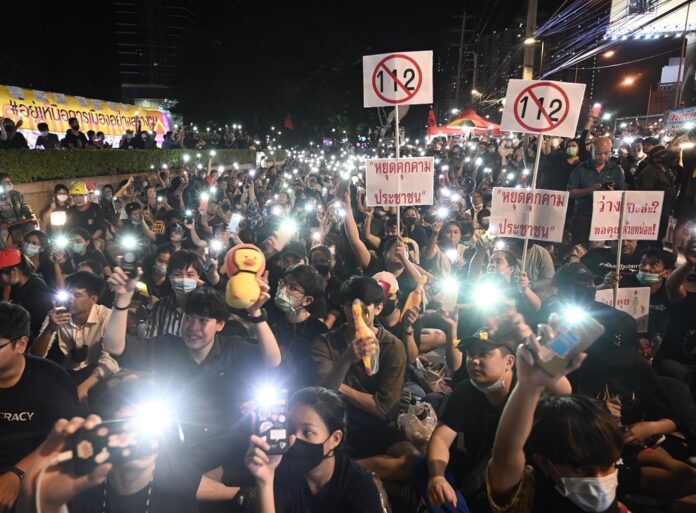
Protesters hold up signs denouncing Article 112 of the Criminal Codes, or lese majeste, during a rally in Bangkok on Nov. 25, 2020.
The revival of the use of the lese majeste law against a dozen protest leaders is unprecedented in at least three ways.
First, Prime Minister Gen Prayut Chan-ocha denied last month that it was him who initiated the revival of the charges under the law, which carries a maximum imprisonment term of 15 years. Instead, Prayut said police will have to carry out their duty by enforcing the law.
This came after Prayut himself had said in June that His Majesty the King had instructed him that the law should not be used.
While it marked a reversal in the policy after half a year, no one wants to claim responsibility. It reflects the controversial nature of this anachronistic law which has been criticized and opposed by critics over the decade.
It has become a hot potato that no one wants to claim the responsibility for using it again. That means the law is increasingly fragile and its ‘legitimacy’ increasingly questioned, particularly now that one of the 10 demands to reform the monarchy includes abolishing the law.
Some already said why is it that millions still revere Buddha when there is no blasphemy law protecting the Buddha from being criticized in Thailand?
The second unprecedented factor is that not only a dozen people are being charged at around the same time, but those charged remained adamant, with some like Panupong “Mike” Jadnok saying last week that it’s an ‘honour’ to be charged under the law. This is contrary to past cases when those charged with lese majeste were deemed as pariahs.
What’s more, the third interesting factor is that in all the 13 cases, the court has declined the request by the police to issue arrest warrants. Instead, all are being summoned and some showed up at the police station on Monday per summon letters.
This could be read as the court not fully supporting the latest use of the law as in the past, most of which were detained while fighting the charges.
The authorities are now caught in a Catch 22 situation where they try to use the law in order to contain unprecedented criticism, verbal and written attacks against the monarchy as a result of the growing monarchy-reform protest movement. By doing so, the controversial law returns to the spotlight of not just the Thai but also foreign media.
It’s perceived disproportionate penalty where defaming an ordinary citizen carries a maximum imprisonment term of one year or fine of no more than 20,000 baht under Article 326 of the Criminal Code.
Compare one-year maximum imprisonment terms to that to 15 years maximum imprisonment term under the lese majeste law, which is Article 112 of the same Criminal Code, then it’s hard to justify how an ordinary citizen is 15 times less important than a monarch, particularly in the 21th century.
It’s unclear how many more can be charged under the law before the lese majeste law is lost not just in efficacy but legitimacy and reaches a tipping point where it is seen as unjust, if not illegitimate, by a large sector of the Thai population.
This is the challenge facing the law and the monarchy institution. A severe punishment of more and more people comes at a price. The use of cruel and disproportionate law such as this may end up producing the exact opposite effect – making more Thais hate not just the law but the monarchy.
As the battle for the hearts and minds of the people, particularly young Thais, continue, some measures may do more harm than good to the monarchy institution itself.
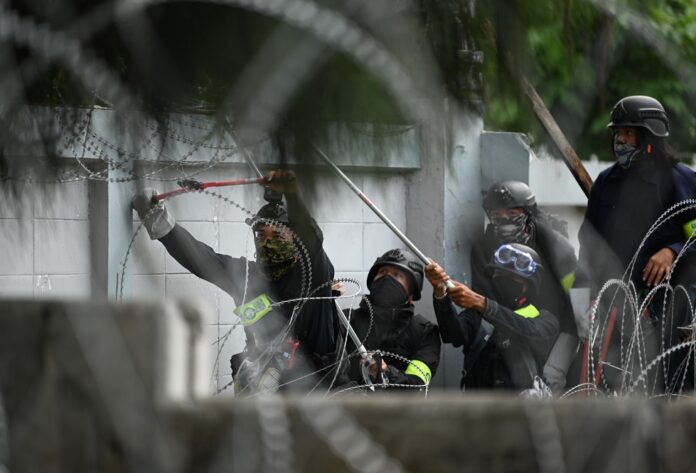
Frontline protest guards cut razor wires installed by police close to the Parliament during a protest on Nov. 17, 2020.
BANGKOK — One of the largest groups of protesters’ security details on Tuesday announced they will no longer provide their service after one of their members was assaulted by another guard unit.
Piyarat “Toto” Chongthep, the leader of the “We Volunteer” network, said his group will not resume working until protest organizers could find a way to reconcile infighting among different frontline guards – some of whom had resorted to violence.
“Since we’re close to the protest leaders, some newly formed groups are saying that we’re arrogant or egoistic,” Piyarat, who is also a longtime activist, said in an interview. “We’re willing to work with anyone, but please understand that our men have to follow their commanders and assigned missions.”
The decision to call it quits was made after a member of “We Volunteer” was punched in the face while trying to question a group of students who identified themselves as guards during a rally on Sunday, Piyarat said.
Top: Piyarat “Toto” Chongthep and members of the WeVo guard unit after they were teargassed by riot police close to the Parliament on Nov. 17, 2020.
“Our group was assigned by protest leaders to provide security at Sunday’s rally,” Piyarat said. “We approached the group of vocational students and asked them to leave the area since they were not given a mission on that day.”
“However, they refused and surrounded me, so my guards tried to pull me out and a brawl broke out,” he continued.
Piyarat said his group will file a police complaint against the assailant. He identified the man as a member of the “Guard Coalition for the People,” an umbrella group consisting of 10 different guard units, including students from polytechnic colleges.
Due to the leaderless nature of the ongoing protests, which seek to oust PM Prayut Chan-o-cha as well as reforming the monarchy, security at demonstrations is usually provided by multiple networks of volunteer guards, without any central leadership.
Since each group has their own chain of command, operational area, and set of rules and tactics, misunderstanding and mutual suspicion are fast becoming an issue among the guard units, Piyarat said.
The fracture within the security networks at the protests was already seized by police commanders to put a blame on a recent shooting, which wounded a protest guard volunteer.
“The fight broke out due to work issues. There’s no outsiders involved,” Deputy metropolitan police chief Piya Tawichai said in the aftermath of the shooting.
A reporter for Channel 3 also wrote online that he was shoved off a concrete barrier by a protester guard at the rally in front of Siam Commercial Bank headquarters on Nov. 26, causing him to fall and bruise his torso.
Protest leader Panupong “Mike” Jadnok wrote on his Facebook that all the guards are now required to submit their name to him in an effort to sort out security operations at rally sites.
Organizers of large scale street demonstrations in previous years – whether by Redshirt or Yellowshirt factions – generally employed their own guards, with clear structure of leadership, though that did not stop them from committing violence in some situations.
The next protest is set to take place at Lat Phrao Intersection on Wednesday afternoon.
Rice harvesting in progress at a paddy field in Surin province, Nov. 23, 2016.
BANGKOK (Xinhua) — Thailand’s cabinet approved the National Rice Policy Committee’s proposal on Tuesday to raise the budget for the rice farmers’ income guarantee scheme from 28.711 billion baht (948 million U.S. dollars) to 46.807 billion baht (1.54 billion U.S. dollars).
The increased budget was designed to help Thai rice farmers at a time when the price of rice had plummeted sharply, said government deputy spokeswoman Ratchada Thanadirek.
The price of jasmine rice had dropped due to export slowdown and limited tourism from the COVID-19 fallout, she said.
“Hence, the cabinet has green-lighted the go-ahead for the budget increase to facilitate the rice-guarantee scheme for farmers in their rice harvest,” Ratchada said.
Under the scheme, the price per ton of rice will be guaranteed at 15,000 baht (495.54 U.S. dollars) for jasmine, 14,000 baht (462.50 U.S. dollars) for off-season jasmine, 10,000 baht (330.36 U.S. dollars) for ordinary rice, 11,000 baht (363.40 U.S. dollars) for Pathum Thani rice and 12,000 baht (396.43 U.S. dollars) for sticky rice.
Meanwhile, the Ministry of Agriculture and Cooperatives said it expects more rice to be produced this year thanks to a sufficient supply of water, adding that 2018 and 2019 had been harsh years for rice farmers due to severe drought.
Rot Fai Park on Dec. 2, 2020. Photo: Bangkok Metropolitan Administration
BANGKOK — Frolic among tropical blooms throughout December and deep into 2021 at Bangkok’s public parks.
The Bangkok Flora Festival was inaugurated by junta-appointed Bangkok governor Aswin Kwanmuang on Wednesday.The opening ceremony was held at Wachirabenchatat Park, also known as Rot Fai Park, which features the festival’s highlight of a 4 rai (0.64 hectares) field filled with 30,000 sunflowers.
The sunflowers are expected to bloom until Dec. 20. They are of the Vincent’s Choice variety, which is suitable for those with allergies. Zinnias, lotuses, and rice plants are also on display in the park. Fifty new metal benches were donated to the park by a private company for this occasion.
Rot Fai Park on Dec. 2, 2020. Photo: Bangkok Metropolitan Administration
Other parks in the city are ready for the selfie crowds as well. Queen Sirikit Park, just steps away from Rot Fai Park, has planted Siam tulips and hollyhocks in a Valentine’s-themed garden.
The 60th Anniversary of Queen Sirikit Park in Lat Krabang has a cactus garden, while the HM King’s 80th Anniversary Parkin Sathorn, boasts a variety of lotuses in its ponds. Lumpini Park in downtown Bangkok is also hosting a variety of flowers.
The festival’s other blooms are expected to run through 2021:
Wanapirom Romklao Park will have a display of Madagascar Periwinkles from Jan 12 to 31.
Later in the summer, Mahakan Fort Park will have a display of cosmos plants from Apr. 10 to 20, and Chatuchak Park in June and July will have marigolds, cosmos flowers, and asters.
Lumpini Park from September to October will have cockscombs, Chinese wool flowers, and Madagascar Periwinkles.
Rot Fai Park on Dec. 2, 2020. Photo: Bangkok Metropolitan Administration