































30.5 C
Bangkok
Sunday, June 28, 2026
Home Blog Page 1389

Sanders Comments on Castro Could Pose Hurdles in Florida

Democratic presidential candidate Sen. Bernie Sanders, I-Vt., right, with his wife Jane, speaks during a campaign event in San Antonio, Saturday, Feb. 22, 2020. (AP Photo/Eric Gay)

MIAMI (AP) — Like many young voters in Florida, Jared Machado is concerned about rising sea levels, college tuition and landing a job when he graduates from the University of Florida in a few months.

But the political science and history major can’t ignore how his father and grandparents came to the United States: as refugees fleeing communist Cuba.

As he considers his options for president in Florida’s March 17 primary, Machado was disappointed and disturbed when U.S. Sen. Bernie Sanders, a self-described democratic socialist, seemed to praise former Cuba dictator Fidel Castro in a recent interview.

“He doesn’t understand the traumatizing experience endured by the Cuban people,” said Machado, 22, whose grandparents left the island more than a half century ago, carrying his father, then just a few months old.

Making inroads into Latino communities has been a priority among Democrats and Republicans alike — and Sanders’ big win in the Nevada caucuses Saturday demonstrated his progress toward that goal. But the 78-year-old senator’s remarks, aired Sunday as the candidate was still celebrating, may also show where Sanders’ outreach hits a speed bump.

Sanders’ socialist identification and his willingness to praise leftist regimes have given his Democratic opponents ammunition to question his electability in a state with a large Cuban American population that remains fiercely skeptical of leftist governments.

In Florida, where Hispanics account for nearly one in every five voters, that skepticism could present a major hurdle for Sanders in the state’s primary, and for Democrats hoping to win Florida’s 29 electoral votes in November.

“Candidates need to understand our immigrant communities’ shared stories, as well as provide solutions to issues that matter to all Floridians,” Florida Democratic Party Chair Terrie Rizzo said Monday.

During an interview aired Sunday on the CBS news program “60 Minutes,” Sanders said he opposes Cuba’s authoritarian regime but “it’s unfair to simply say everything is bad.”

He went on to say: “You know, when Castro came in office, you know what he did? He had a massive literacy program. Is that a bad thing, even if Fidel Castro did it?

A Sanders spokesman on Monday downplayed the controversy.

“Senator Sanders has clearly and consistently criticized Fidel Castro’s authoritarianism and condemned his human rights abuses, and he’s simply echoing President Obama’s acknowledgment that Cuba made progress, especially in education,” said the spokesman, Mike Casca.

During a CNN town hall on Monday night, Sanders forcefully stood by his comments, saying he’d criticized “authoritarian regimes all over the world,” including Cuba, Nicaragua and Saudi Arabia, But he added that, after Castro took power in 1959, “the first thing he did” was initiate a literacy program.

“I think teaching people to read and write is a good thing,” Sanders said on CNN, adding: “That is a fact. End of discussion.”

Pressed about congressional Democrats from Florida who have criticized him as too sympathetic to Castro, Sanders shot back, “All of those congresspeople just so happen to be supporting other candidates — accidentally, no doubt.”

His rivals seized on the unforced error to deepen questions about his ability win support in November among independents and Hispanic voters in Florida, particularly those whose families escaped repressive regimes.

“Fidel Castro left a dark legacy of forced labor camps, religious repression, widespread poverty, firing squads, and the murder of thousands of his own people,” former New York City Mayor Mike Bloomberg tweeted Monday afternoon. “But sure, Bernie, let’s talk about his literacy program.”

Florida Sen. Marco Rubio, arguably the most prominent Cuban American in the country, also railed against his Senate colleague from Vermont.

While democratic socialism might sound benign, Rubio said in a video that he tweeted, at the core it’s Marxism and “this fake offer” of security, free healthcare and education.

The state Democratic party has hired scores of Spanish-speaking staffers to fan out into Hispanic communities in preparation for November. Republicans widely view Florida as a must-win state for President Donald Trump and Democrats are determined to force him into an expensive fight to defend it.

Nationally, two-thirds of Hispanic voters casting ballots in 2018 supported Democratic candidates for the U.S. House, according to AP VoteCast, a survey of voters. In Florida, only 53% favored Democratic House candidates.

And Cuban Americans in Florida were more likely to support Republicans than other Hispanic voters, 56% to 42%.

According to the AP survey, about a third of Cuban American midterm voters identified as Democrats.

However, Democrats hardly have a lock on that vote in battleground Florida, particularly among the nearly 2 million Floridians of Cuban, Venezuelan and Nicaraguan origin.

In 2018, Republican Ron DeSantis narrowly won Florida’s governor’s mansion. While more than two-fifths of Florida Latinos voters favored DeSantis overall, a clear majority of Cuban American voters — 57% — cast their support for the Republican.

Critics say Sanders needs to more strongly disavow Cuba and other authoritarian regimes.

“It’s not just about Cuban American voters, it’s Hispanic voters as well, many of whom would never consider voting for an avowed socialist …,” said Fernand Amandi, a Cuban American pollster based in Miami.

Geraldo Cadava, a professor of history and Latino studies at Northwestern University, says Sanders must address his stance on left-wing governments, such as when he traveled to Nicaragua to celebrate the sixth anniversary of the Sandinista revolution with Daniel Ortega.

“He is in a bit of a difficult spot trying to figure out how to answer these questions,” said Cadava, who wrote a book about how the Republican party has rallied Hispanics.

For the past decade, Cadava says, Democrats have courted the younger generation of Cuban-Americans, seeing that more new voters in the Miami area register as independent.

Machado, the University of Florida student, is among them.

Until the Florida primaries arrive, he said, he remains undecided — even if he’s currently leaning toward supporting former South Bend, Indiana, mayor Pete Buttigieg.

Machado comes from a politically split household, the product of a Puerto Rican mother and Cuban father.

“My parents definitely vote, but they split between Democrat and Republican,’” he said. “That’s how you get a centrist child like me.”

Calvan reported from Tallahassee, Florida. Associated Press reporters Hannah Fingerhut in Washington and Will Weissert in Houston contributed to this report.


Advertisement

Siam Winery Continues on With Development of Hornbill Nests From Recycled Wine Barrel

Siam Winery carries on with the success of nature conservation initiative “Development of Hornbill Nests from Recycled Wine Barrels”. The success rate, considered from actual nesting of hornbills in various spots in the wild, prompts the firm to further pursue the project to preserve and nurture the forests throughout Thailand.

Wine 1

Since 2015, in collaboration with the Hornbill Ecology Study Project at Mahidol University’s Science Faculty, Siam Winery has spearheaded an innovative environmental protection effort under an experimental project titled “Development of Hornbill Nests from Recycled Wine Barrels”. The project, overseen by Emeritus Professor Dr Pilao Poolsawas, uses old wine barrels to create man-made nest for hornbills. The artificial hornbill nests were designed by Chakorn Pasuwan of the School of Interior Design, Silpakorn University to broaden the birds’ nesting choices and opportunities, as large trees which are their natural habitats are now rare to find. Of late, the situation has been worrying amid the decline in the highly endangered hornbill population that was on the verge of extinction. The lack of natural habitat is the second factor, after poaching, that drives these majestic birds to extinction.

Wine 3

The Development of Artificial Hornbill Nests from Used Wine Barrels showcases the world’s first success of replacing hornbills’ natural habitat with artificial ones made from industrial waste. The innovation for the benefit of the forests and wildlife has proved to be highly successful in various areas, such as Monsoon Valley vineyard of Siam Winery in Hua Hin district, Prachuap Khiri Khan; Peat Swamp and Rainforest Research Station of the Hala-Bala Wildlife Reserve, Wang district, Narathiwat; Paramapithai forest of the Bang Lang National Park in Thanto district, Yala; Budo Su-ngaipadi National Park in Bajok district, Narathiwat; Haad Sai Yai Forest Project under the patronage of His Majesty the King in Hua Hin district, Prachuap Khiri Khan and Kui Buri National Park in Kui Buri district, Prachuap Khiri Khan.

Wine 4

The success of the project fosters the regrowth of the endangered hornbill population while using recycled materials to balance with the forests. A survey by the Hornbill Research Foundation shows that hornbills are forest-growing birds. They do this by eating more than 100 varieties of wild fruits and each bird eats more than 100 seeds per day. The dispersal of seeds in the rainforests by hornbills is a crucial part to theprocess of natural reforestation. While it is true that only 5 percent of the dispersed seeds can grow into seedlings and eventually tall trees, but there’s a greater opportunity of seeds to be eaten and dispersed by the birds.

Wine 5

Consequently, more trees will grow. With the birds able to fly long distances, the chances are that more seeds will be dispersed in other remote forested areas, which automatically helps with propagation of plants and trees. With hornbills being the fertility indicator of forest land, the existence of, and an increase in, hornbill population is necessary.

Advertisement

Chula, Kasetsart Students Protest Party Dissolution (Photos)

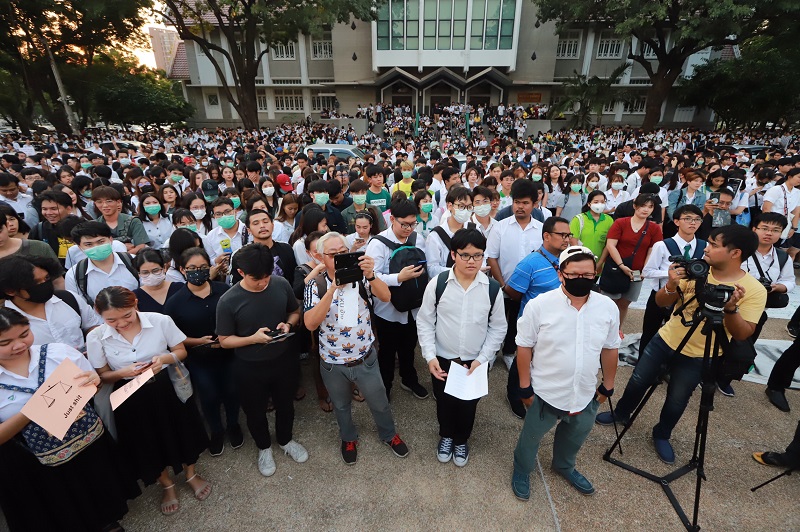
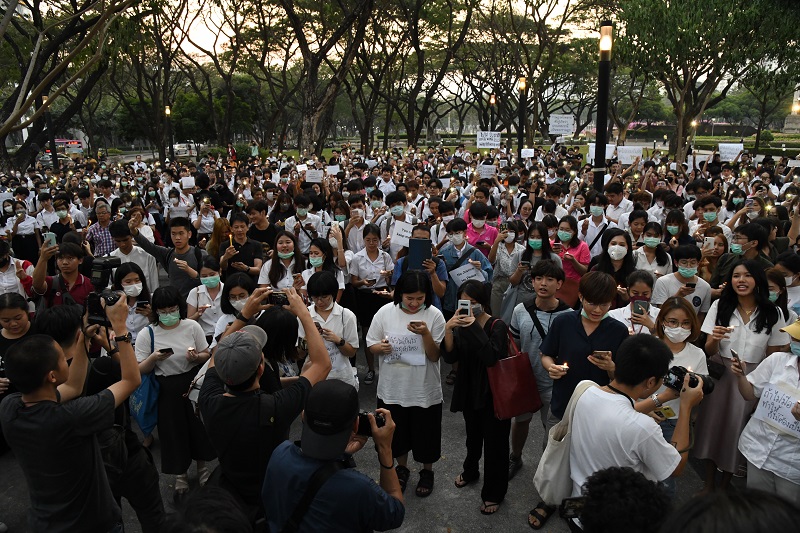
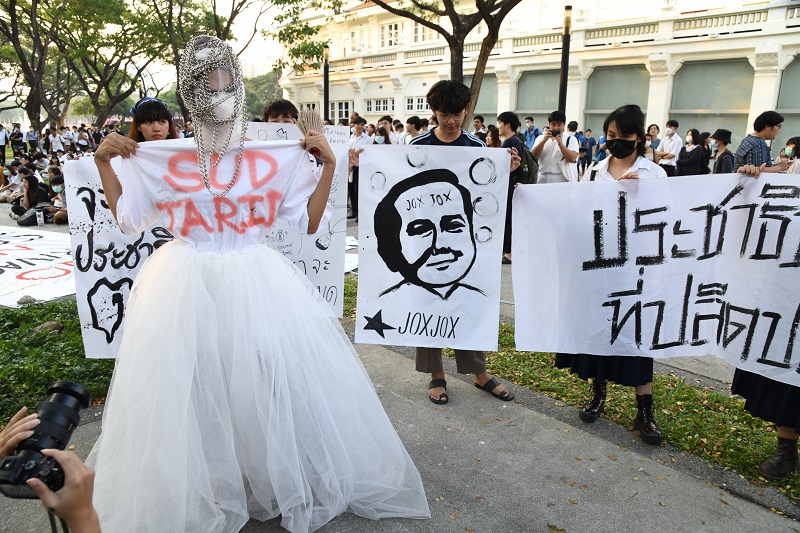
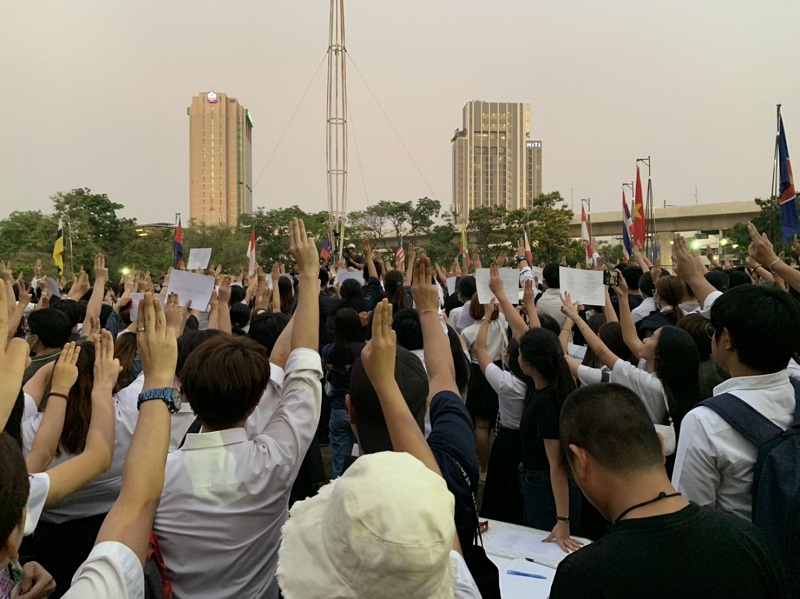
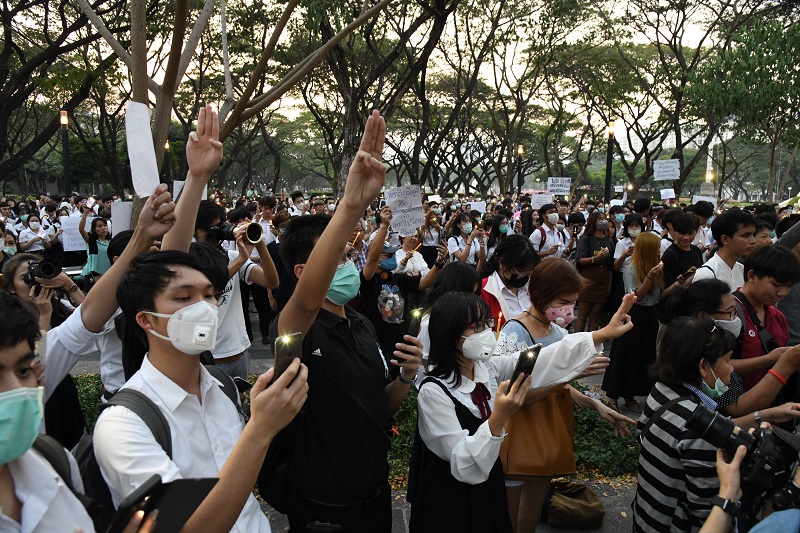
Protest at Chulalongkorn University on Feb. 24, 2020.

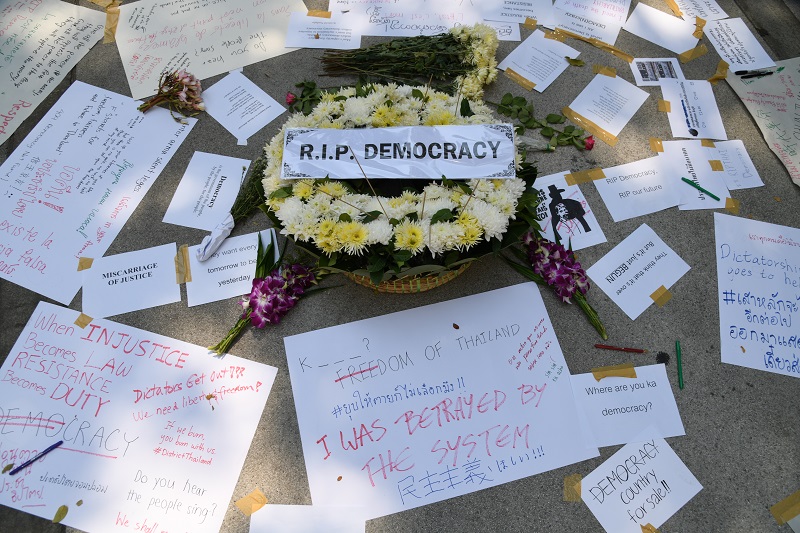
BANGKOK — Hundreds of students at two of Thailand’s top universities staged two rallies simultaneously on Monday afternoon to voice their dissent at a court verdict that disbanded a popular opposition party.

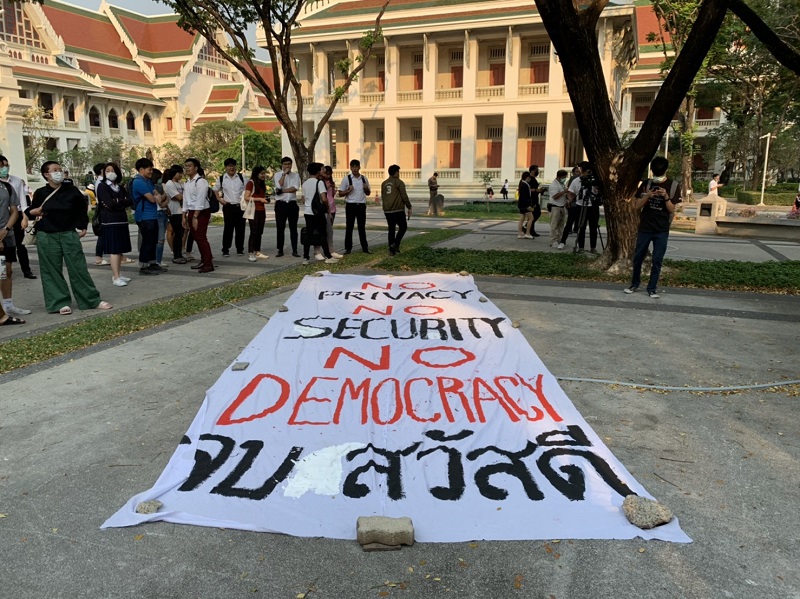
At Chulalongkorn and Kasetsart Universities, students listened to speeches and wrote messages denouncing the Friday’s dissolution of Future Forward Party, which enjoys a widespread support among many young Thais and urbanites fed up with the traditional establishment.

“They called us keyboard trolls, only good at typing keyboards. Today, we have come out to show our strength!” a speaker said at a rally close to Chulalongkorn University’s auditorium, where several hundred students gathered.

“We weren’t misled by anyone to come out today,” another speaker said. “We are here to fight for our own future. We are not afraid to come out. We’re afraid of only one thing: having a stupid leader.”

Another protest also attracted about 1,000 students and non-students at Kasetsart University in northern Bangkok, where speakers took turn lambasting what they believed to be the absence of justice and democratic values in the country.

Student-led protests on such scale are extremely rare in Thailand, where the young have been generally seen as politically apathetic in recent decade. However, the founding of Future Forward in 2018 appeared to energize many among the newer generations.

S 19653187 1
Protest at Kasetsart University on Feb. 24, 2020.
S 19653191 1
Protest at Chulalongkorn University on Feb. 24, 2020.
lopburi v 4
Protest at Chulalongkorn University on Feb. 24, 2020.
33606 1
Protest at Chulalongkorn University on Feb. 24, 2020.
CBBB4A3C 61C5 4E1A 8C4E 8688441738CB 2
Protest at Kasetsart University on Feb. 24, 2020.
S 10027023 5
Protest at Chulalongkorn University on Feb. 24, 2020.
ช่อ.อภิปรายนอกสภาฯ แฉเรื่องฉาวโฉ่รัฐบาลฯ ๒๐๐๒๒๓ 0039 1
Protest at Chulalongkorn University on Feb. 24, 2020.
DSC 2723 8
Protest at Kasetsart University on Feb. 24, 2020.
377441 6
Protest at Chulalongkorn University on Feb. 24, 2020.
Uttaradit V 1
Protest at Chulalongkorn University on Feb. 24, 2020.
Advertisement

Censure Debate: Prayut Accused of Favoring Big Businesses, Amassing Wealth

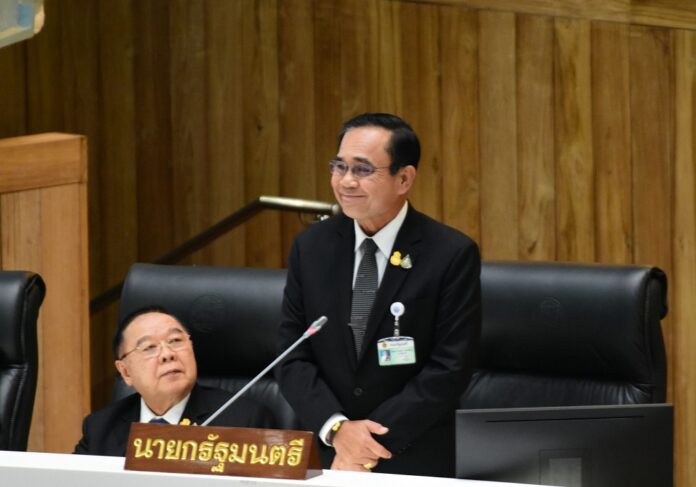
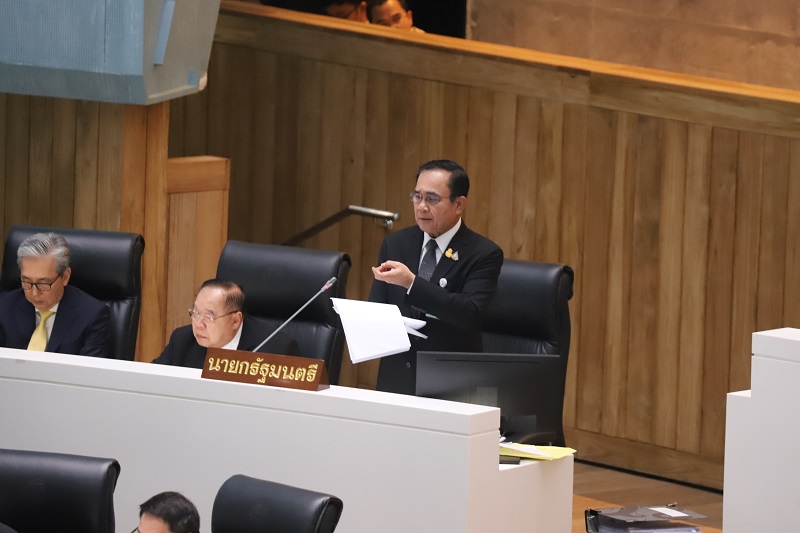
PM Prayut Chan-o-cha addresses the Parliament on Feb. 24, 2020.

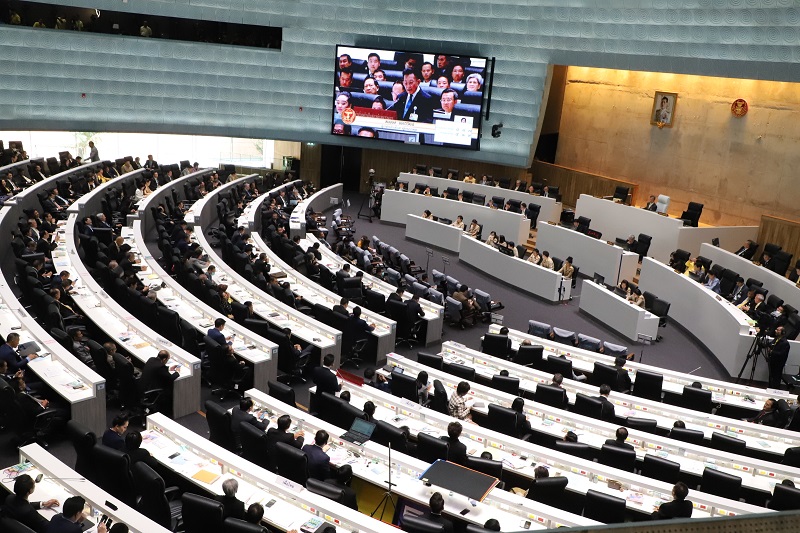
BANGKOK — The first day of a much anticipated no-confidence debate kicked off Monday with the opposition slamming PM Prayut Chan-o-cha for allegedly granting a conglomerate privilege in a state contract and amassing personal wealth during his tenure.

The debate, the first of its kind in nearly seven years, targets Prayut and five of his Cabinet members, all of whom were present during the session today. Leading the charge was Pheu Thai MP Yuttapong Charatsathien who said the government granted privilege to Thai Charoen Corporation Group (TCC) by extending a 50-year lease of land without due cause.

Yuttapong said despite oppositions by the Office of the Attorney General, the new lease at where Queen Sirikit National Convention Center is located was awarded to the corporation without any competitor in January 2017.

“It didn’t fall under fair competition,” Yuttapong said, accusing Prayut of being in “cahoots” with TCC.

The MP also said Prayut’s father sold a 50 rai land plot in Bueng Kum district to entities linked to TCC at the inflated price of 600 million baht in 2013, well above the estimated market price of 197 million baht. The sales were made through a company registered just several days prior, he said.

“My suspicion is that it may be money laundering,” Yuttapong said. “The property company was set up seven days before the transaction was made.”

S 19653187

He added that Prayut received 540 million from his father, who recently died, in the 2013 deal.

In response to the allegation, Prayut said the company has the right to buy his father’s land at whatever price they see fit.

He also said the allegation that his government favored TCC is unfounded, because the transaction took place when he was army chief.

“Could I promise them that I would become PM?” Prayut addressed the House.

Deputy Prime Minister Wissanu Krue-ngam also said the government has listened to the cencerns expressed by the Office of the Attorney General in July 2016 before extending the land lease at the Queen Sirikit Convention Center.

“The government listened to the AOG because it will help our case if we are sued,” Wissanu said. “As to whether we are in cahoots with TCC or not is a matter of opinion.”

General Not Mister

The opposition has been banking its hope of ousting Prayut on the outcome of the censure debate, though it is unclear whether they would manage to rally enough votes in the government-dominated Parliament.

Under the law, if half of the lower house votes for a no-confidence motion against any Cabinet member after hearing the debate, the individual must leave the post. If the Prime Minister is dealt with a no-confidence vote, then his or her entire Cabinet must leave, and a new election be held.

Today’s debate was marked by moments of heated argument and challenges to the House Speaker, including a protest by six coalition MPs who demanded that the opposition address Prayut by his military title, “General.”

S 19653191
PM Prayut Chan-o-cha addresses the Parliament on Feb. 24, 2020.

The opposition MPs had been addressing the retired general as “Mr. Prayut” before the government lawmakers took offense. House Speaker Chuan Leekpai rejected their protest, saying the honorific of “Mr.” is already polite enough for a parliamentary debate.

Opposition leader Sompong Amornvivat also accused Prayut of running a fake democracy and failed economy. Prayut hit back by insisting that he won his second term as PM under the rules of the current charter.

The Prime Minister appeared to show a relatively high level of self-restraint throughout the debate despite his reputation for his quick temper; he once walked out on a Parliament session out of anger.

Prayut reportedly credited his composure to his wife, Naraporn Chan-o-cha. According to a government source, he told his Cabinet members he was instructed by his wife to refrain from “frowning and making an angry face” today.

Additional writing Teeranai Charuvastra

Advertisement

Gov’t Mulls Lawsuit Against Future Forward Over 1MDB Allegations

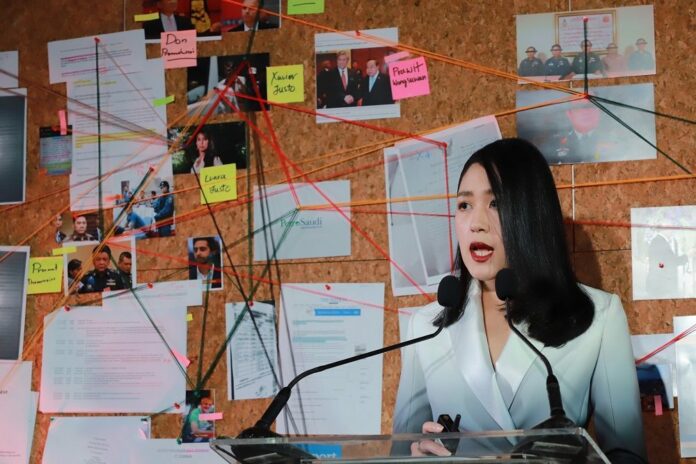
Future Forward Party spokeswoman Pannika Wanich at the news conference held in Bangkok on Feb. 23, 2020.

BANGKOK — The government on Monday said it is considering a legal action against a disbanded opposition party for linking the Prime Minister to a massive embezzlement in Malaysia.

Government spokeswoman Naruemon Pinyosinwat said the accusations made by the Future Forward Party, which alleged that PM Prayut Chan-o-cha helped cover up Malaysia’s 1MDB investment fund scandal, are groundless, though a party official maintained she has evidence to back up her claims.

“I insist that the accusations are untrue,” Naruemon said. “It is causing public confusion, and relevant authorities are considering a legal action against them. We will make an announcement later.”

Other key members of the government including PM Prayut himself dismissed the opposition’s claim.

“Let relevant authorities do their job,” Prayut said. “If it’s false, we have to sue them back.”

Future Forward spokeswoman Pannika Wanich accused Prayut of forming a “dark alliance” with former Malaysian leader Najib Razak to arrest the whistleblower in Thailand, and harbor the alleged mastermind from prosecution in Malaysia.

Responding to threats made by the government against her faction, Pannika on Monday said she is disappointed with the reaction.

“People want the truth, but all they did was threaten to sue us,” she said in an interview. “If they have evidence to refute our claims, then present it to the public.”

ช่อ.อภิปรายนอกสภาฯ แฉเรื่องฉาวโฉ่รัฐบาลฯ ๒๐๐๒๒๓ 0039
Future Forward Party spokeswoman Pannika Wanich at the news conference held in Bangkok on Feb. 23, 2020.

Pannika hinted that the party has more evidence to reveal.

“Sunday’s new conference is just a slice of what we have gathered,” she said. “We will continue to push this forward.”

At the news conference held yesterday, Pannika said Thai authorities denied the FBI, who is investigating the case, access to the imprisoned Xavier Justo, a Swiss national who leaked information related to the graft.

She also said the government allowed Low Taek Jho, a Malaysian national who is the alleged mastermind behind the scandal, to repeatedly visit Thailand despite being issued an Interpol “Red Notice” at Singapore’s request.

The revelation was billed by the now-defunct party as “Censure Debate Outside Parliament,” and came ahead before Monday’s launch of censure debate against Prayut and five other Cabinet members.

In response to Pannika’s allegation, deputy PM Prawit Wongsuwan said the government has no involvement with the wrongdoing, while foreign minister Don Pramudwinai said the accusations are “completely erroneous.”

Police spokesman Kissana Phathanacharoen also said police are studying Pannika’s remarks to see whether there was any libelous material.

“The case had taken place almost six years ago, I don’t understand how they can relate it to the government,” Col. Kissana said. “Our investigators are looking into the case to see whether the information presented has been distorted.”

Advertisement

Mahathir Offers Resignation in Malaysian Political Upheaval

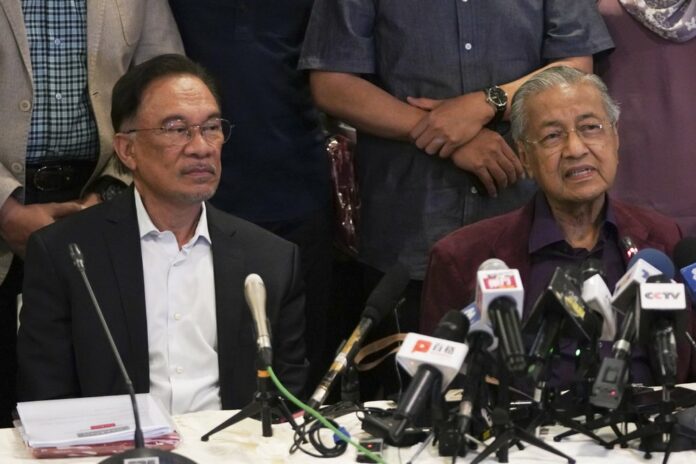
In this Feb. 22, 2020, photo, Malaysian Prime Minister Mahathir Mohamad, right, talks to media next to his successor Anwar Ibrahim in Putrajaya, Malaysia. (AP Photo/Vincent Thian)

KUALA LUMPUR, Malaysia (AP) — Prime Minister Mahathir Mohamad tendered his resignation to Malaysia’s king Monday while his political party quit the ruling alliance in a shocking political upheaval less than two years after his election victory.

The prime minister’s office said in a brief statement that Mahathir submitted his resignation to the palace at 1 p.m. but gave no further details.

The stunning turn of events come amid plans by Mahathir supporters to team with opposition parties to form a new government and thwart the transition of power to his named successor Anwar Ibrahim, replaying their decades-old feud.

Minutes before his resignation was offered, Mahathir’s Bersatu party announced it would leave the alliance and support Mahathir as the premier. Eleven other lawmakers, including several Cabinet ministers, also announced they are quitting Anwar’s party.

With some 50 lawmakers from Bersatu and Anwar’s party leaving the ruling alliance, the maneuvers leave doubt whether Anwar has enough support to take power.

Mahathir and Anwar were Malaysia’s top two leaders in Mahathir’s first stint as premier but fell out politically before reuniting in the political pact that ousted a corruption-tainted government in the May 2018 election. Their relationship has been testy, with Mahathir refusing to set a date to relinquish power despite a preelection agreement to hand over power.

Anwar said earlier Monday that he was satisfied the government’s reform agenda will continue. He refused to say more.

Ironically, the maneuvers could restore to power the Malay party of disgraced former leader Najib Razak, who with several of his party leaders are standing trial for corruption. It could also propel to national power a fundamentalist Islamic party that rules two states and champions Islamic laws. The two Malay parties still have strong support from ethnic Malays, who account for 60 percent of Malysia’s 32 million people.

Anwar and his wife Wan Azizah Wan Ismail, who is currently the country’s deputy prime minister, were due to meet the king on Monday. Wan Azizah tweeted that “men can plan but Allah decides,” urging supporters to believe God will side with those who are patient.

Analysts said King Sultan Abdullah Sultan Ahmad Shah could decide which faction has the majority support in Parliament or call a snap election. They warned that such a new government could give rise to Malay Islamic supremacy that will derail Malaysia’s multiethnic society.

“Mahathir’s top political priority is to stave off Anwar’s increasingly vigorous claim on the premiership. So he had to work with otherwise unsavory opposition parties to form a working parliamentary majority to counter and warn off Anwar,” said Oh Ei Sun, a senior fellow at the Singapore Institute of International Affairs. “If the new government goes through, Malaysia is heading toward a a very regressive stage whereby racial supremacy and religious extremism would become the rule of the day.”

Advertisement

Thai Electrosynth Meets ‘Battleship Potemkin’ This Sunday

Left: White Rose Band. Right, a still from “Battleship Potemkin.”

BANGKOK — Rebel with your Imperial Russian Navy comrades against eating maggot-ridden meat to a smooth synthwave soundtrack by one of Thailand’s top soundtrack composers this Sunday.

“Battleship Potemkin” will screen 7pm Sunday at the Bangkok Screening Room – set to the tune of experimental electronic music by Viveka duo, which includes popular actor Pachara “Peach” Chirathivat.

“Usually live music played to classic films in Thailand is a single pianist or violinist,” Sarinya Manamuti, co-founder of Bangkok Screening Room said. “This is really experimental, with synthesizers. I don’t think it’s ever been done before here.”

Viveka is an electronic music duo of Pakorn Musikaboonlert, a film composer known for his soundtracks for critically-acclaimed Vanishing Point (2015) and role as bassist in the Siam Secret Service band, and actor Pachara “Peach” Chirathivat. Viveka composed for Ten Years Thailand, the 2018 film anthology of dystopian Thai films shown for that year’s Cannes Film Fest.

The duo also perform electronic music, with Peach as the lead vocals, under the name White Rose band. 

Composing new sound for “Battleship Potemkin” isn’t new – the 2005 restored version has a soundtrack by another duo – English ‘80s synthpop pair Pet Shop Boys.

“Battleship Potemkin” portrays the 1905 mutiny of a Russian battleship crew against their officers, an incident that later paved the way for the Russian Revolution. The movie is a silent era masterpiece of director Sergei Eisenstein and has been called one of the best films ever made.

Sunday’s screening will have both English and Thai subtitles.

Tickets are 400 baht for adults and 360 baht for students and include one drink. Film and performance start at 7pm at Bangkok Screening Room on Soi Saladaeng 1 and can be reached on foot from BTS Sala Daeng exit No. 4 or MRT Lumphini’s exit No. 2.

Advertisement

20-Year-Old Twitter User Denied Bail for Royal Insult

An illustration depicting Niranam by cartoonist Kaimaew.

Update: An appeal court later granted bail to “Niranam” and freed him from prison at about 7.20pm.

BANGKOK — A 20-year-old jailed on allegations of insulting the monarchy was again denied a bail release on Monday, his attorneys said.

The Thai Lawyers for Human Rights, who’s campaigning for the man’s freedom, said the court rejected his bail on the grounds that he might flee the country while the trial is ongoing. The refusal came after the online communities raised over 500,000 baht for his bond money.

The man was identified by the group as Twitter user ssj_2475, who allegedly posted content critical of the monarch under a pseudonym Niranam (anonymous in Thai). He is being held at a prison in Chonburi province.

The lawyers said the man was arrested at his home in Chonburi on Feb. 19 and charged with violating Section 14 of the Computer Crime Act, which bans importing information that threatens “national security” into the computer system.

Although he was not charged with insulting the monarchy under Section 112 of the Criminal Codes, his attorneys said the police and the court adopted the same protocol of secrecy associated with royal insult trials.

Due to the harsh enforcement of royal defamation laws, Khaosod English cannot republish the content Niranam wrote in his Twitter account.

As of Monday morning, many Twitter users were calling for Niranam’s release from custody, sending #FreeNiranam to a top trending hashtag.

Advertisement

Son of Fugitive Gov’t Politician Wins Northern By-Election

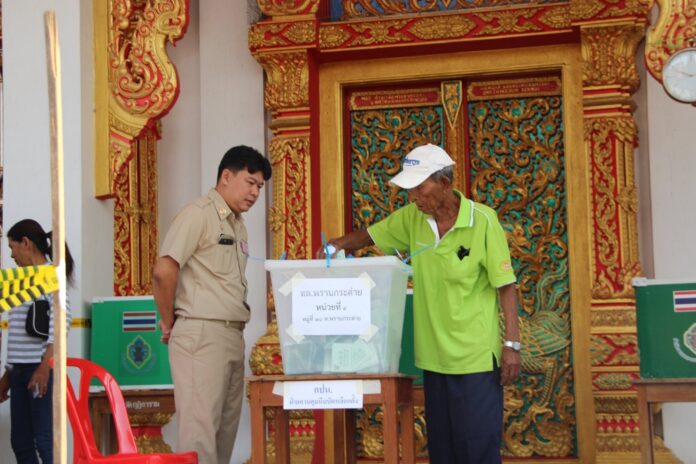
A man casts a ballot at the by-election in Kamphaengphet province on Feb. 23, 2020.

BANGKOK (Xinhua) — A ruling government party has won over an opposition party in Sunday’s by-election for MP in northern Thailand.

Palang Pracharath Party candidate Phetphum Apornrat won 45,687 votes in the by-election in Constituency 2 of Kamphaengphet province, compared to 37,989 votes for candidate Kamphol Pankul of the opposition Pheu Thai Party, according to unofficial results of the by-election.

Phetphum is replacing his father, Waipoj Apornrat, a former Palang Pracharath MP whom the Supreme Court has sentenced, among several others, to four years in prison for offenses involving 2009’s Red Shirt mass protests which disrupted an ASEAN summit in Pattaya.

Despite an arrest warrant issued by the court, Waipoj had managed to remain at large and then agreed to turn himself in to authorities, following his son’s electoral race for the constituency where he used to represent in parliament.

Advertisement

Japan Woman Cleared of Cruise Quarantine Tests Positive for Virus

Kyodo file photo

TOKYO (Kyodo) — A Japanese woman who left the coronavirus-hit Diamond Princess cruise ship earlier this week was confirmed to be infected after returning to her home in eastern Japan despite an initial negative test result, a local government said Saturday.

She became the first person found to have been infected with the pneumonia-causing virus out of a total of 969 people who disembarked from the ship over three days through Friday. Following a two-week monitoring period through Wednesday, she had tested negative for the illness.

Continue reading the story here.

Advertisement

Hot News

LATEST NEWS

Bangkok
overcast clouds
30.5 ° C
32.2 °
30.5 °
76 %
4.9kmh
100 %
Sat
30 °
Sun
35 °
Mon
35 °
Tue
33 °
Wed
32 °