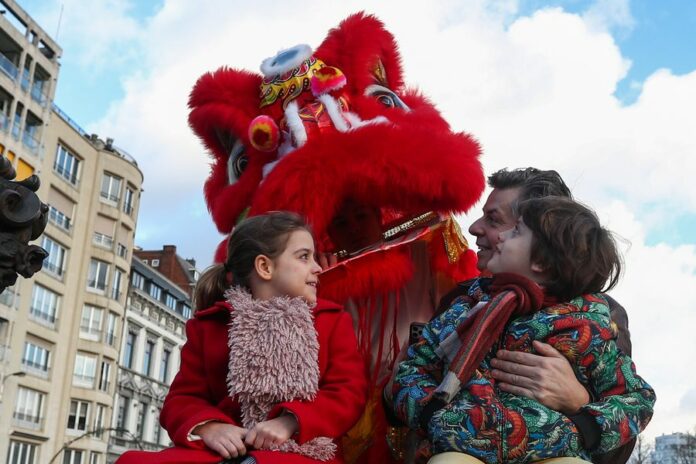
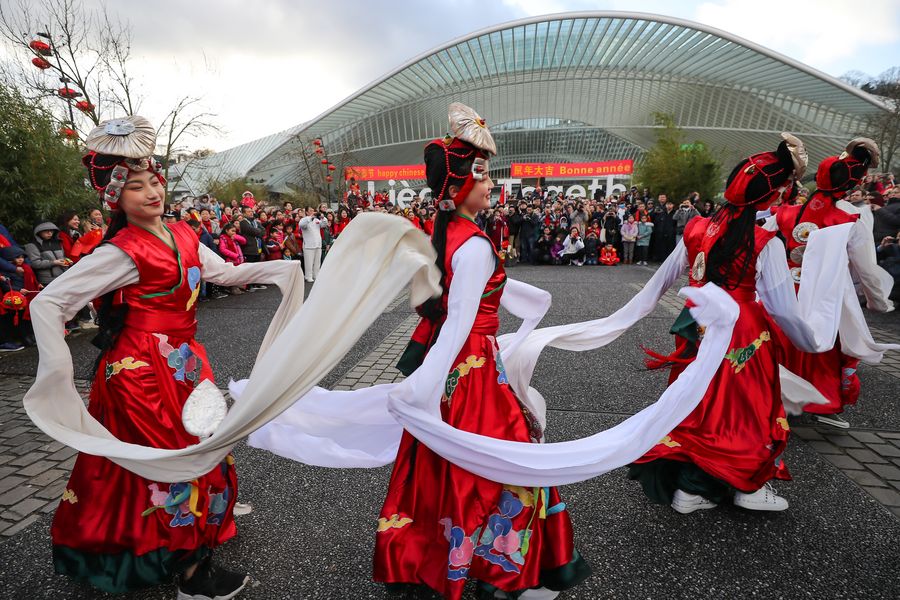
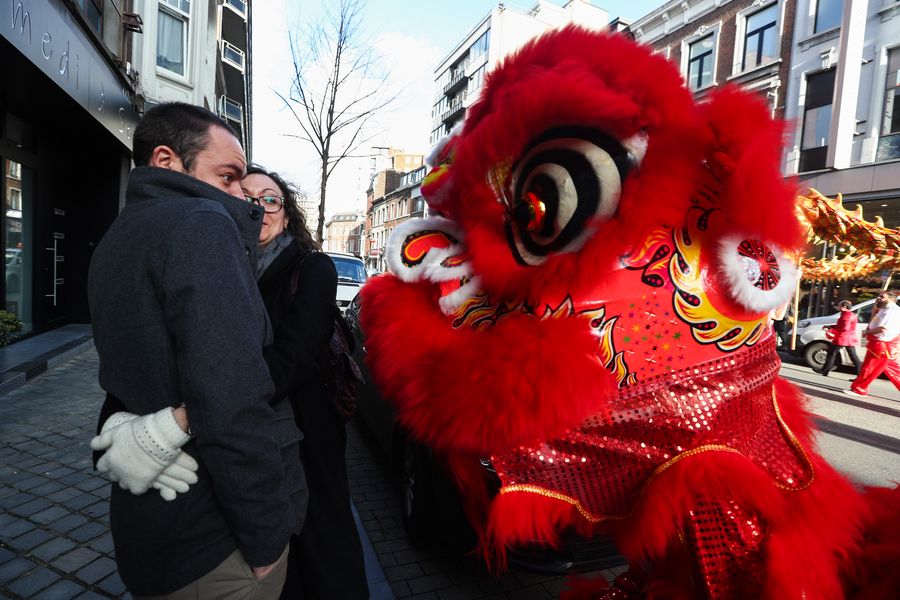
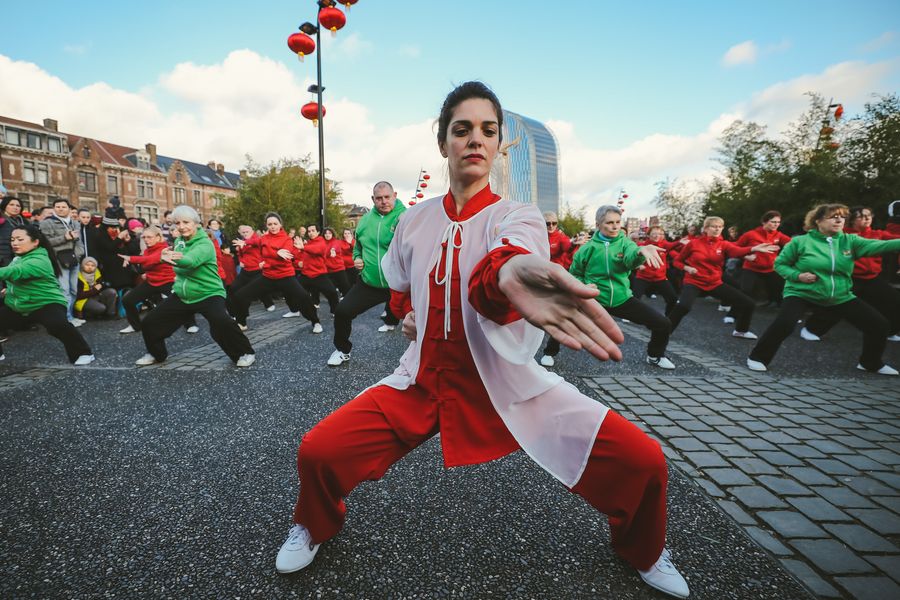
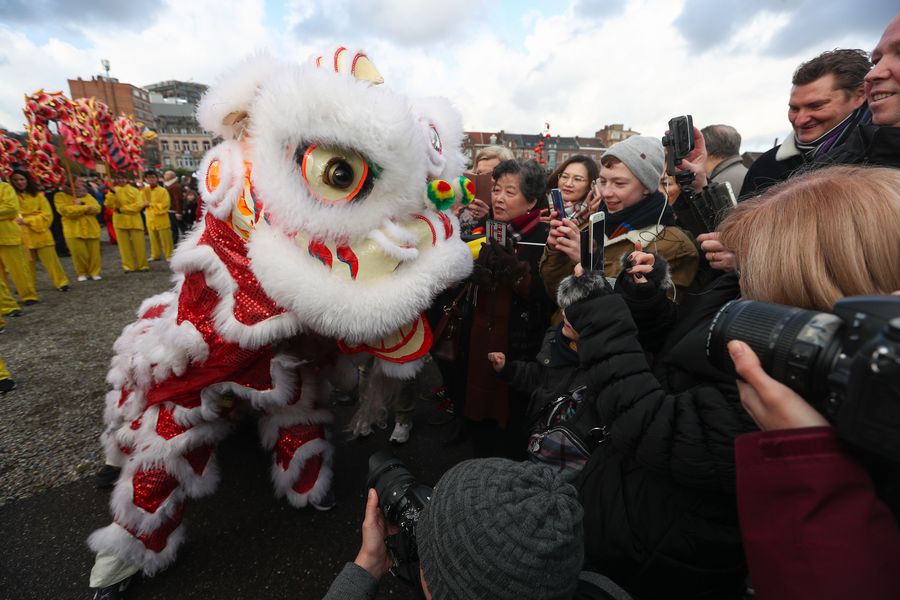
LIEGE, Belgium (Xinhua) — A multicultural festival was held in the eastern Belgian city of Liege during the weekend to greet the upcoming Chinese Spring Festival, a celebration also known as the Chinese Lunar New Year.
The upcoming Chinese Year of the Rat will start on Jan. 25, 2020. The event is celebrated all over the world by the Chinese community.
Performers dance before a Chinese Spring Festival parade in downtown Liege, Belgium. (Xinhua/Zhang Cheng)A lion dance performer interacts with the audience during a Chinese Spring Festival parade in downtown Liege, Belgium. (Xinhua/Zheng Huansong)People perform Qigong before a Chinese Spring Festival parade in downtown Liege, Belgium. (Xinhua/Zhang Cheng)A man watches performances before a Chinese Spring Festival parade in downtown Liege, Belgium. (Xinhua/Zhang Cheng)A lion dance performer interacts with the audience during a Chinese Spring Festival parade in downtown Liege, Belgium. (Xinhua/Zheng Huansong)An artist from China’s Wuhan City performs Peking opera during a Chinese Spring Festival gala at the Liege Convention Center in Liege, Belgium. (Xinhua/Zheng Huansong)
An bible is inside the improvised temple where a pregnant woman, five of her children and a neighbor were killed in a religious ritual in a jungle community in El Terron, Panama, Friday, Jan. 17, 2020.The indigenous residents were rounded up by about 10 lay preachers on Monday and tortured, beaten, burned and hacked with machetes to make them “repent their sins”, authorities said. (AP Photo/Arnulfo Franco)
EL TERRON, Panama (AP) — Bibles rest on a wooden altar next to percussion instruments — a guiro and a drum — in the room where a religious sect allegedly forced a pregnant woman and five of her children to walk through fire in this remote hamlet.
The makeshift sanctuary littered with muddy boots and scorched clothing belonged to a cult whose indigenous members professed to be “anointed by God” to sacrifice non-believers, even if the heretics were members of their own families, people in El Terron say.
Seven villagers were slain by the cult last Monday, while 14 more were rescued the next day by police who found them bound and beaten in the temple, authorities have said. Several more villagers escaped with burns.
Nine villagers have been arrested and charged with murder, reportedly including a grandfather and two uncles of the five children who died alongside their pregnant mother and a neighbor.
“Nobody expected this,” said a distraught tribal leader, Evangelisto Santo.
El Terron is nestled in the jungle of the indigenous Ngabe Bugle enclave on Panama’s Caribbean coast, and it is largely cut off from the modern world. Residents must walk hours along steep and muddy narrow roads to hail boats that can transport them along a river to other villages that have electricity, telephones, health clinics and a police presence.
Many in the community, which gets by growing yuca and rice, are Roman Catholics. The tiny mountain hamlet is home to about 300 people who live in palm-thatched huts. Many are related to one another.
Residents say they had largely ignored the religious group. The sect arose after a villager returned to the community several months ago following a stint abroad, bringing back unusual religious beliefs with him.
“People were dancing and singing and nobody paid attention because we knew that they were in the presence of God,” Santo said.
Nobody paid attention, that is, until one of the cult members announced that he had had a vision: Everyone in the hamlet had to repent their sins, or die.
Last weekend, members of “The New Light of God” sect began to drag victims to an improvised church, where they beat them into submission with sticks. Cult members stood ready with machetes to take down those who failed to repent to their satisfaction.
Farmer Josué González rescued two of his children — a 5-year-old girl and a 7-year-old boy — from the embers Monday, while a 15-year-old son managed to escape on his own.
Outnumbered, González sought help for his pregnant wife and five of their other children. By the time authorities arrived via helicopter Tuesday, González’s wife, the five children and a neighbor had been decapitated and buried.
The cult members charged in the case reportedly include González’s own father, and villagers say two of González’s brothers had declared themselves prophets of the cult. Authorities have not confirmed that González’s father and two brothers have been arrested.
“Within the logic of religious sacrifices in some extremist cults, there’s no greater proof of faith than to turn over the life of a loved one or family member,” said Andrew Chesnut, a professor of religious studies specializing in Latin America at Virginia Commonwealth University.
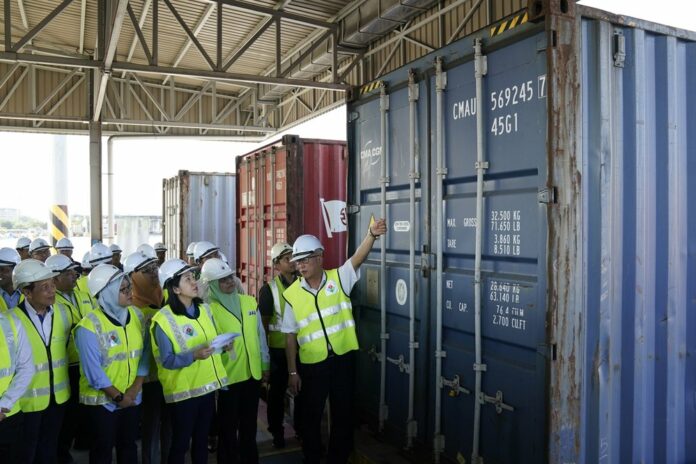
PENANG, Malaysia (AP) — Malaysia has sent back 150 containers of plastic waste to 13 mainly rich countries since the third quarter last year, with the environment minster warning on Monday that those who want to make the country a rubbish bin of the world can “dream on.”
Shipments of unwanted rubbish have been rerouted to Southeast Asia since China banned the import of plastic waste in 2018, but Malaysia and other developing countries are fighting back.
Environment Minister Yeo Bee Yin said another 110 containers are expected to be sent back by the middle of this year.
Yeo said the successful repatriation of a total 3,737 metric tonnes (4,120 U.S. tons) of waste followed strict enforcement at key Malaysian ports to block smuggling of waste and shuttering more than 200 illegal plastic recycling factories.
Of the 150 containers, 43 were returned to France, 42 to the United Kingdom, 17 to the United States, 11 to Canada, 10 to Spain and the rest to Hong Kong, Japan, Singapore, Portugal, China, Bangladesh, Sri Lanka and Lithuania, her ministry said.
She said the Malaysian government didn’t pay a single cent, with the costs of sending back the waste fully borne by the shipping liners and companies responsible for importing and exporting the waste.
Yeo said talks were ongoing with U.S. authorities to take back another 60 containers this year. Canada also has 15 more containers, Japan 14, the U.K. 9 and Belgium 8 from 110 more containers that are still being held at Malaysian ports, she said.
“If people want to see us as the rubbish dump of the world, you dream on,” Yeo told reporters during inspection at a port in northern Penang state.
Yeo said the government will launch an action plan on illegal plastic importation next month that will help the different agencies coordinate enforcement and speed up the process of returning the waste.
“Our position is very firm. We just want to send back (the waste) and we just want to give a message that Malaysia is not the dumping site of the world,” she added.
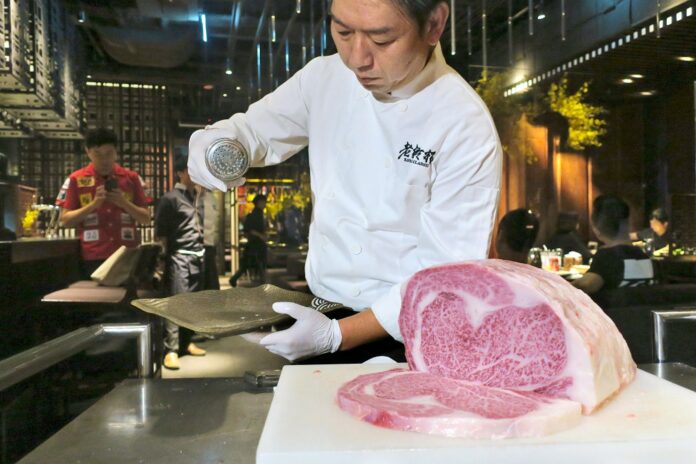
TOKYO (Kyodo) — Japan’s farm ministry on Monday proposed legislation to protect the intellectual property in fertilized eggs and sperm taken from Japan’s famous wagyu beef cattle as concerns grow about overseas breeding efforts.
The envisioned law allows for injunctions against unauthorized trading, production and export and will penalize business operators who obtain and sell materials without following required procedures as well as third parties who knowingly export such materials.
In this image from video, Sen. Lindsey Graham, R-S.C., left, Sen. Patrick Leahy, D-Vt., Sen. Dianne Feinstein, D-Calif., and Sen. Roy Blunt, R-Mo., escort Supreme Court Chief Justice John Roberts into the Senate chamber in the Senate at the U.S. Capitol in Washington, Thursday, Jan. 16, 2020. (Senate Television via AP)
WASHINGTON (AP) — No cellphones. No talking. No escape.
That’s the reality during the Senate’s impeachment trial of President Donald Trump, which will begin each day with a proclamation: “All persons are commanded to keep silence, on pain of imprisonment.” After that, 100 senators will sit at their desks for hours on end to hear from House prosecutors, Trump’s defense team and possibly a series of witnesses.
The first time the proclamation was used, in the 1868 trial of President Andrew Johnson, lawmakers couldn’t have imagined life in the modern era. The pace of today’s politics would have been hard to foresee even in early 1999, at the start of the impeachment trial of President Bill Clinton, when smartphones didn’t exist.
And so the senators will have a throwback experience in 2020, disconnected from the outside world, asked only to listen. The normally chummy senators won’t even be allowed to talk at length to people nearby or walk on certain areas of the Senate floor. Mostly they will sit, trapped in the chamber, focused on the issue at hand.
While senators might privately grumble about the restrictions — and will likely violate them at times — they agree that the rules are justified as they execute their most solemn duty: considering whether to remove the president of the United States from office.
An impeachment trial “deserves our undivided attention,” said Sen. Chris Coons, D-Del.
The ban on cellphones on the Senate floor isn’t new, but enforcement has become more relaxed in recent years. Coons said that when he came to the Senate a decade ago, he would be reprimanded if he even took his phone out of his pocket. Today, senators are often spotted texting or looking at their phones while waiting to speak or vote — and a ring tone has sounded more than once.
Republican Sen. Joni Ernst of Iowa joked that if there weren’t restrictions, senators would be “Googling stuff” and playing games on their phones. Or worse, live tweeting the trial.
“As much as I hate it, not being connected to a device, I just think we need to pay attention,” Ernst said.
Sen. Ben Cardin, D-Md., said it’s a “healthy situation,” and he compared it to when his wife asks him to leave the phone at home when they go out to dinner.
“There will be some withdrawal symptoms,” Cardin said. “We might have to take some tranquilizers.”
Cardin spent the first hours of the trial on Thursday taking notes. As senators were sworn in as jurors and Senate Majority Leader Mitch McConnell, R-Ky., announced the next steps, Cardin jotted notes on the process and what was happening. He said the note-taking is “one of my work habits” that helps him keep his emotions in check, understand what’s going on and also record history as it happens.
Other senators were still adjusting. Democratic Sen. Dianne Feinstein of California stole a few moments on her cellphone before an aide motioned to her that it was time to escort Chief Justice John Roberts into the chamber.
After the swearing-in, as their colleagues stepped forward one by one to sign an oath book, Vermont Sen. Bernie Sanders, who is running for the Democratic presidential nomination, clapped his hands quietly as if he was ready to get moving. Sen. Sheldon Whitehouse, D-R.I., read through a stack of papers. Republican Sen. Jerry Moran of Kansas peeked under the lid of his desk.
The ban on cellphones and any other materials unrelated to impeachment means that other Senate business will have to wait. Decorum rules circulated to Senate offices say that “reading materials should be confined to only those readings which pertain to the matter before the Senate.”
“The rest of the world keeps going on,” said Sen. James Lankford, R-Okla. “That’s the challenge that all of us have, is that we’re used to tracking international news and certainly news in our state, all the time, and now suddenly as things are moving along in our state, or around the world, we’ll be a little slower to be able to get to it.”
The challenge is particularly acute for the four senators running for the Democratic nomination for president who are competing in the Feb. 3 Iowa caucuses. While their rivals are busy crossing the state and appealing to voters, the senators in the race will be still in their chairs in Washington. And there won’t be many made-for-TV moments in the trial; in most cases, senators aren’t allowed to speak.
Sanders said Thursday that he’s concerned about how it’s affecting his campaign.
“I would rather be in Iowa today, there’s a caucus there in two-and-a half weeks. I’d rather be in New Hampshire and in Nevada and so forth,” Sanders said. “But I swore a constitutional oath as a United States senator to do my job and I’m here to do my job.”
In addition to Sanders, Sens. Amy Klobuchar of Minnesota, Elizabeth Warren of Massachusetts and Michael Bennet of Colorado are running in the Democratic primary.
Senators won’t be totally out of touch. If there’s something they really need to know, staff can pass them notes through the Senate cloakrooms.
“It’s going to be a new experience for a lot of my colleagues to not be able to talk and not be able to consult our email or text messages,” said Sen. John Cornyn, R-Texas, who said that as a former judge he’s used to sitting through long trials.
“But we’ll live through it, it’ll be all right. This is obviously a very serious and grave matter, so we should be paying attention.”
___
Associated Press writers Lisa Mascaro and Padmananda Rama contributed to this report.
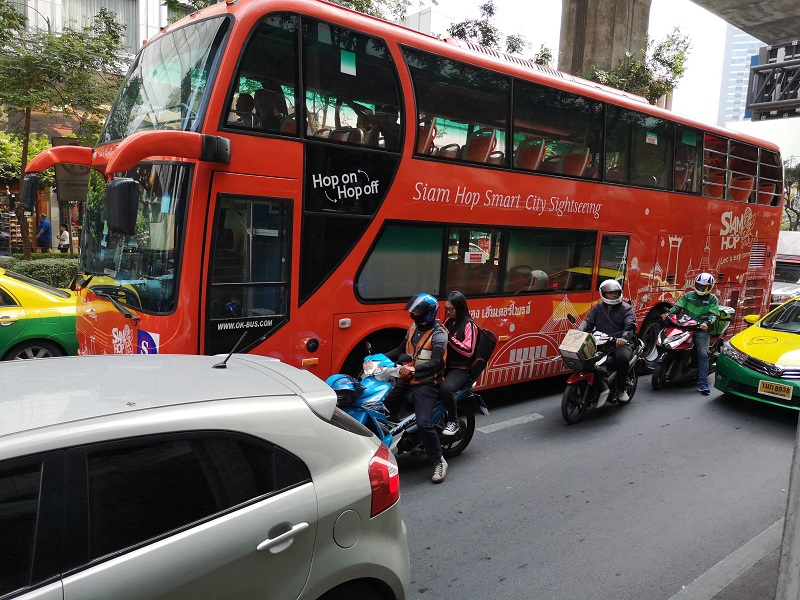
BANGKOK — When I heard that Bangkok now has its own hop-on hop-off buses, I was intrigued.
You see, love it or hate it, I have tried these hopping buses in nearly every major city I’ve visited – London, New York, Paris, or Rome. It’s a lazy but convenient way to peruse a new city from a “close enough” distance and get a sense of the city environment.
So, when words reached me that a company called Siam Hop is operating a hop-on hop-off tour bus in my own city, I wonder how well the concept would fare against Bangkok’s unique challenges of nightmarish traffic and dust-choked pollution.
To find out, I recently boarded Siam Hop bus after paying 350 baht for a hop-on hop-off service from its ticket booth at MBK. The ticket is good for 24 hours after purchase. As it turns out, it wasn’t a bad idea at all, especially if you are a first-time visitor to Bangkok who wants to explore the city with minimal sweat and PM 2.5 microdust in your lung.
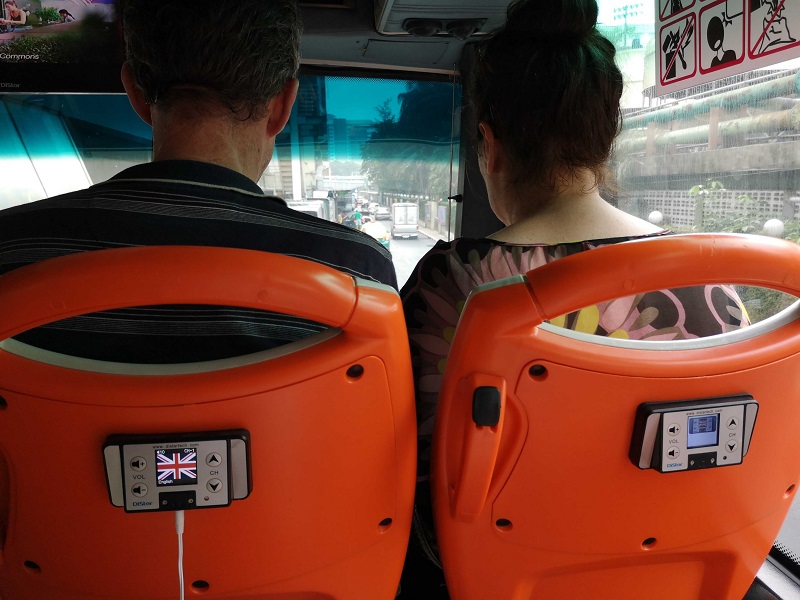
Let’s start with what is good. The air conditioner on the Chinese-made bus is neither too cold nor too hot. There’s also an option of an outdoor area.
English-language audio is well done. Alternative audio comes in ten other languages including not just Chinese, French, German and Japanese, but also Russian, Korean, Bahasa Indonesia, Hindi, and even Thai.
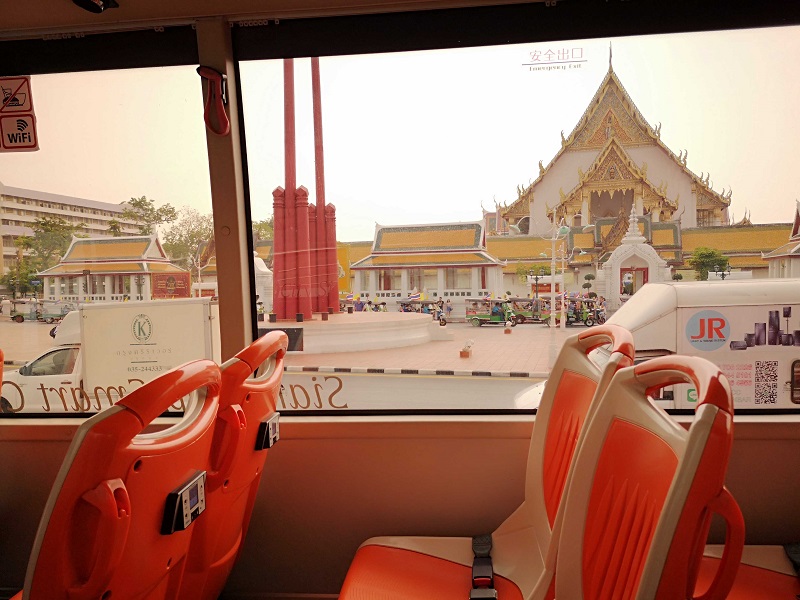
I chose the “Heritage Route,” one of the four available options. It takes you through a good chunk of old historic Bangkok, in roughly two and a half hours, depending on the traffic.
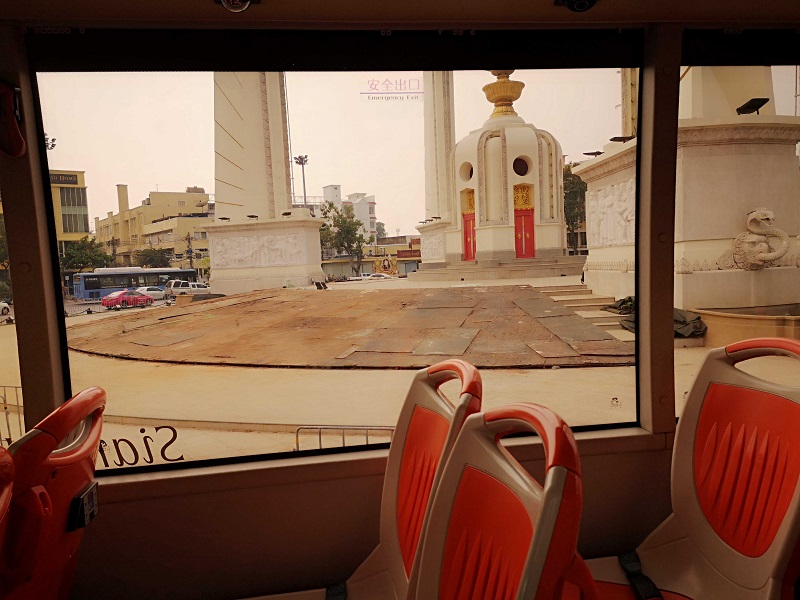
Covered attractions include the Grand Palace, Wat Suthat and the towering Giant Swing, Phra Sumen Fort and its riverside garden, Democracy Monument, Chinatown, and Charoen Krung Road.
Although technically not part of Bangkok’s historical heritage, the bus also makes a stop at River City Antique Market and King Power Duty Free Shop on Soi Rangnam in case you develop temple and palace fatigue.
As it navigates through the city, the bus audio gives you some details that even an average Bangkokian may not know about. For example, the Samyan area is named that way because it’s where three neighborhoods meet – Si Phraya, Sala Daeng and Saphan Lueng (not that this knowledge will be very useful, anyway).
Bus passenger Suparna Kar, a 47-year-old sociology lecturer from India, said she likes it.
“Staff are very friendly and it’s very convenient,” she said.
Suparna’s husband, Sudep, said he was even expecting a far worse congestion, and he was pleasantly surprised that the traffic around noon wasn’t as bad. I did tell him to wait until it’s rush hour and think again. Bangkok’s traffic is unpredictable and slow, at its best.
Certainly this is not the fault of Siam Hop, though it lowered the level of attractiveness for such services in the city.
What Siam Hop could do better, however, is the low number of signage and location announcements. Besides a handful of major stops, there was no indicator where the bus was passing through. It’s as if the operator wants to encourage people to simply stay on the bus, instead of hopping on and off to explore.
Passing through Chinatown, the audio guide still recommend tourists to try its sharkfin soups, despite growing worldwide efforts by animal welfare groups to put an end to the practice.
Another passenger, Phillip Jones from Melbourne, said the earphone’s sound quality could have been clearer.
“The sound quality is pretty average,” Jones said, adding that the signage issue needs some improvement. “Nobody told us where to get off to board the cruise.”
Pricewise, it’s not cheap, but not extortionate either, if you only go for the Heritage Route like I did. This option appears to be available when buying in person only. A more pricey ticket sold on Siam Hop website, which covers all four routes served by Siam Hop with a validity of 24 hours, costs 799 baht.
But in my opinion, that’s not the most ideal way to go about Bangkok as a tourist, since you’d spend most of the time bogged down in traffic, which is too much of an authentic Bangkok experience.
Heritage Routes starts from 9am at MBK with the last bus leaving at 8pm Check out siamhopgroup.com or call 02-066-6600 for details.
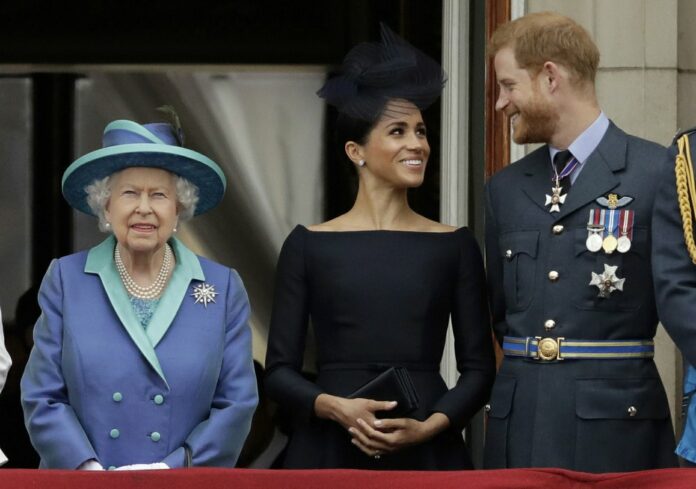
In this Tuesday, July 10, 2018 file photo Britain's Queen Elizabeth II, and Meghan the Duchess of Sussex and Prince Harry watch a flypast of Royal Air Force aircraft pass over Buckingham Palace in London. (AP Photo/Matt Dunham, File)
LONDON (AP) — Goodbye, your royal highnesses. Hello, life as — almost — ordinary civilians.
Prince Harry and wife Meghan will no longer use the titles “royal highness” or receive public funds for their work under a deal that lets the couple step aside as working royals, Buckingham Palace announced Saturday.
Releasing details of the dramatic split triggered by the couple’s unhappiness with life under media scrutiny, the palace said Harry and Meghan will cease to be working members of the royal family when the new arrangements take effect in the “spring of 2020.”
The radical break is more complete than the type of arrangement anticipated 10 days ago when the royal couple stunned Britain with an abrupt announcement that they wanted to step down. They said they planed to combine some royal duties with private work in a “progressive” plan, but that is no longer on the table.
Harry and Meghan will no longer use the titles His Royal Highness and Her Royal Highness but will retain them, leaving the possibility that the couple might change their minds and return sometime in the future.
Harry’s late mother, Diana, was stripped of the Her Royal Highness title when she and Prince Charles divorced.
They will be known as Harry, Duke of Sussex, and Meghan, Duchess of Sussex. Harry will remain a prince and sixth in line to the British throne.
The agreement also calls for Meghan and Harry to repay 2.4 million pounds ($3.1 million) in taxpayers’ money spent renovating a house for them near Windsor Castle, Frogmore Cottage. The use of public funds to transform the house’s five separate apartments into a spacious single family home for them had raised ire in the British press. They will continue to use Frogmore Cottage as their base in England.
The deal came after days of talks among royals sparked by Meghan and Harry’s announcement last week that they wanted to step down as senior royals and live part-time in Canada.
The couple’s departure is a wrench for the royal family, and Queen Elizabeth II did say earlier this week that she wished the couple had wanted to remain full-time royals, but she had warm words for them in a statement Saturday.
The 93-year-old queen said she was pleased that “together we have found a constructive and supportive way forward for my grandson and his family. Harry, Meghan and Archie will always be much loved members of my family.”
“I recognize the challenges they have experienced as a result of intense scrutiny over the last two years and support their wish for a more independent life,” Elizabeth said.
“It is my whole family’s hope that today’s agreement allows them to start building a happy and peaceful new life,” she added.
Despite the queen’s kind words, the new arrangement will represent an almost complete break from life as working royals, especially for Harry. As a devoted Army veteran and servant to the crown, the prince carried out dozens of royal engagements each year,
Royal expert and author Penny Junor said the new setup will benefit both sides of the family.
“There are no blurred lines. They are starting afresh and they are going with the queen’s blessing, I think it is the best of all worlds,” she said.
It is not yet clear whether Harry and Meghan will continue to receive financial support from Harry’s father, Prince Charles, who used revenue from the Duchy of Cornwall to help fund his activities and those of his wife and sons.
The duchy, chartered in 1337, produced more than 20 million pounds ($26 million) in revenue last year. It is widely regarded as private money, not public funds, so Charles may opt to keep details of its disbursal private. Much of the royals’ wealth comes from private holdings.
Though Harry and Meghan will no longer represent the queen, the palace said they would “continue to uphold the values of Her Majesty” while carrying out their private charitable work.
The withdrawal of Harry from royal engagements will increase the demands on his brother, Prince William, and William’s wife, Kate, the Duchess of Cambridge.
Buckingham Palace did not disclose who will pay for the couple’s security going forward. It currently is taxpayer-funded and carried out primarily by a special unit of the Metropolitan Police, also known as Scotland Yard.
“There are well established independent processes to determine the need for publicly funded security,” it said.
Harry and Meghan have grown increasingly uncomfortable with constant media scrutiny since the birth in May of their son, Archie. They married in 2018 in a ceremony that drew a worldwide TV audience.
Meghan joined the royal family after a successful acting career and spoke enthusiastically about the chance to travel throughout Britain and learn about her new home, but disillusionment set in fairly quickly.
She launched legal action against a newspaper in October for publishing a letter she wrote to her father. Harry has complained bitterly of racist undertones in some media coverage of his wife, who is biracial.
There has also been a breach in the longtime close relationship between Harry and William, a future king, over issues that have not been made public.
The couple’s desire to separate from the rest of the family had been the subject of media speculation for months. But they angered senior royals by revealing their plans on Instagram and a new website without advance clearance from the queen or palace officials.
Elizabeth summoned Harry, William and Charles, to an unusual crisis meeting at her rural retreat in eastern England in an effort to find common ground.
The result was Saturday’s agreement, which is different from Harry and Meghan’s initial proposal that they planned to combine a new, financially independent life with a reduced set of royal duties.
It is not known where in Canada the couple plan to locate. They are thought to be considering Vancouver Island, where they spent a long Christmas break, or Toronto, where Meghan filmed the TV series “Suits” for many years.
It is not clear what Harry and Meghan’s immigration and tax status will be in Canada, or whether Meghan will follow through on plans to obtain British nationality.
Maj Gen Rienthong Nanna at a pro-government rally on Jan. 12, 2020.
As political tension flares up anew following pro- and anti-government rallies last weekend, some took additional steps to ensure their ideological purity.
One of them is ultraroyalist private hospital director Maj Gen Rienthong Nanna, who announced on Tuesday that new applicants hoping to work at his hospital must furbish their social media records to ensure that the person doesn’t belong to the opposite political camp.
After anti-government netizens called for a boycott of the hospital as a result, Rienthong went further and declared that the sick and infirmed who hold opposite political views should feel free to move elsewhere to other hospitals.
“I challenge you, just transfer to other hospitals,” Rienthong wrote on Facebook, referring to his political opponents as “rotten oranges and red water buffaloes,” which are derogatory terms meaning the Future Forward Party and Redshirts supporters, respectively.
He added that people who disagree with him should also make sure that if and when they happened to be donating blood to the Thai Red Cross, they should specify to ensure that their precious bodily fluid would not end up at his hospital. The doctor boasted that he has enough blood donated from his peers in the same political camp anyhow.
Although Rienthong stopped short of barring his opponents from seeking medical service at his hospital – which would have been a severe violation of medical ethics – but it might be getting close.
Thai politics has become so toxic that, after a decade and half of struggles in which no side emerged as the outright victor, more and more people have been consumed by the toxicity of their political hatred.
People like Rienthong wanted to cleanse his hospital of any staff holding differing political views, and compared dissidents who already work there as “parasites.” In his own words, Rienthong wanted to hire people who can differentiate good from evil, and not “nefarious” people.
It is as if Rienthong (and his hospital) was convinced he would become purer if he has nothing to do with those who oppose him politically.
But he should bear in mind that we cannot solve political and ideological disagreements by disengaging with people we disagree with; instead, we should seek solutions through debate and dialogues.
Surely, this will take a long time. The past decade and a half has proven not to be sufficient and we should be prepared to go through an even longer period of political divide.
Political boycott, banning and political segregation is not the way out. If anything, it will plunge Thailand deeper into the political abyss. The belief that a society would become an ideal society if only we could get rid of those who disagree with us is not only simplistic, but also dangerous.
It’s a recipe for a totalitarian society where people who disagree are either eliminated or subjugated into remaining silent. We have seen enough of those examples in history, and we should never repeat such mistakes again.
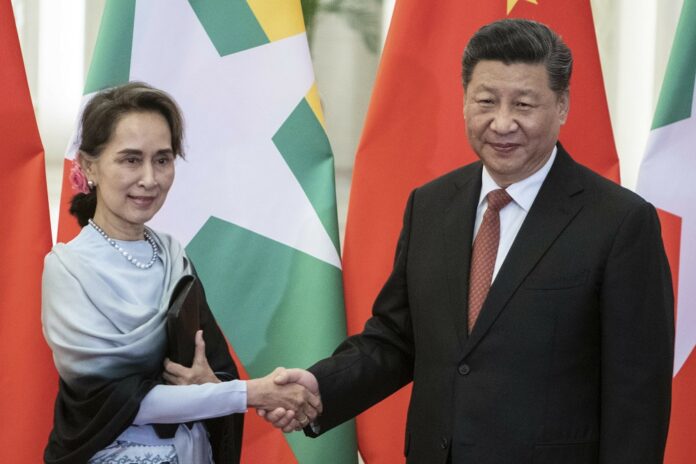
In this April 24, 2019, file photo, Chinese President Xi Jinping, right, shakes hands with Myanmar State Counsellor Aung San Suu Kyi at the Great Hall of the People in Beijing. President Xi was heading to Myanmar on Friday, Jan. 17, 2020, for a state visit likely to deepen the countries’ already close bilateral relations at a critical time. Image: AP
By Aung Zaw, editor of the Irrawaddy
Amid the general excitement at the arrival of Chinese President Xi Jinping, individual Myanmar citizens will have a range of responses, both positive and negative, to the high-level visit. But no one in Myanmar can doubt its significance.
Our giant neighbor to the north is simply too prosperous and too powerful to ignore.
Xi’s visit poses both opportunities and risks. Myanmar will have to mitigate the risks and challenges while making sure to take advantage of every opportunity—in other words, we must be pragmatic, and we must be careful.
In a signed opinion piece published in state-run newspapers in Myanmar on Thursday, Xi said China wants to “write a new chapter” in the two countries’ long friendship.
China’s geopolitical, economic and strategic interests in Myanmar are currently the subject of much debate, with critics saying that Myanmar is moving back into China’s orbit—or even that Myanmar is struggling to maintain its neutrality and independence.
One thing is certain: many Myanmar citizens, including even military generals, have developed a deep-seated fear of China. In fact it wouldn’t be overstating the case to describe it as a kind of sinophobia.
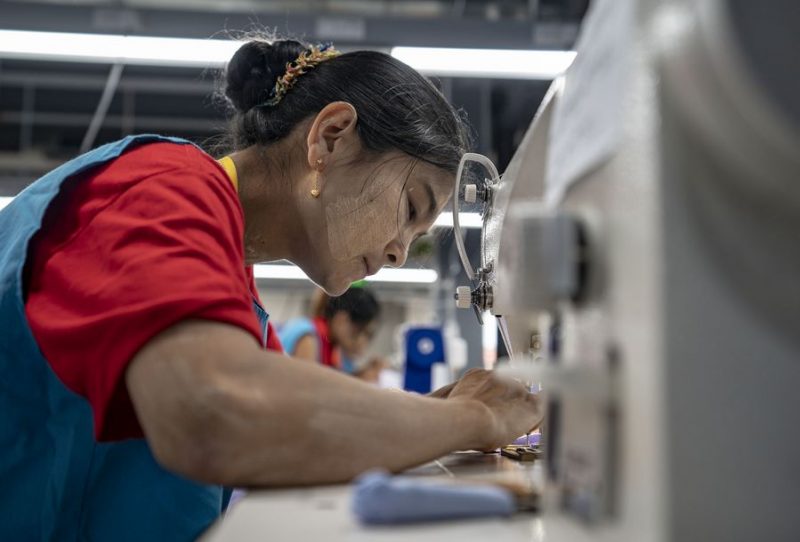
An employee from Myanmar works at a clothing company in China (Yunnan) Pilot Free Trade Zone (FTZ) Dehong Area in Dehong, southwest China’s Yunnan Province, Nov. 4, 2019. (Xinhua/Jiang Wenyao)
In the past, many oppressed people in Myanmar were repulsed by China’s support for the brutal military regime that ruled their country with an iron fist. But today, Myanmar’s business community would be only too glad to see even more Chinese investment.
Myanmar’s activist community, on the other hand, has called on China to terminate a number of controversial projects in the country once and for all. Which voices will China listen to as it writes this “new chapter”?
Either way, the simple fact is that the fates of China and Myanmar are inseparable.
Chinese officials jokingly say that Myanmar and China can’t afford to divorce, or indeed are more like two siblings, or “paukphaw”.
Given Myanmar’s strategically important position in Southeast Asia, Beijing can’t afford to ignore Myanmar and will continue to cement and strengthen its friendship with the country. As the neighbors celebrate the 70th anniversary of the establishment of diplomatic relations this year, Beijing is eager to promote closer ties.
Xi’s short visit will be more symbolic than substantive, the officials say, and they are adamant that the China-Myanmar relationship will not be held hostage to any issue, including the controversial Myitsone Dam project.
China invited Daw Aung San Suu Kyi, now Myanmar’s State Counselor, to visit in 2015 when she was opposition leader. Xi received her in Beijing months before the election in Myanmar, in which Daw Aung San Suu Kyi’s party was elected in a landslide.
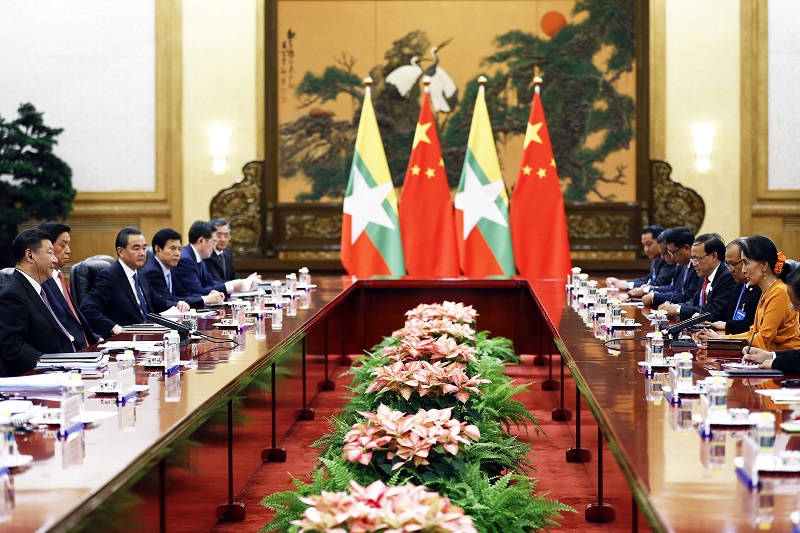
Myanmar State Counsellor Aung San Suu Kyi, right, and Chinese President Xi Jinping, left, attend their meeting at the Great Hall of the People in Beijing (AP).
This was seen as a calculated move by Beijing to assert itself in the rapidly changing political landscape in Myanmar. Today, China firmly backs the Suu Kyi government and wants to see it win in November’s election. Beijing believes she keeps her promises, and that Myanmar will be better off if she wins a second term.
Xi is no stranger to Myanmar; he visited as vice president in 2009, when Daw Aung San Suu Kyi was under house arrest.
Since coming to power, she has visited China several times in her capacity as State Counselor and received a red carpet welcome. The view from Beijing is that she remains popular in Myanmar, can be trusted and has the authority to make deals.
Poor image
But China has its work cut out for it. It needs to repair its image in Myanmar. Unlike Japan, it can’t rely on soft power to win the hearts and minds of the Myanmar people.
Indeed, in Myanmar the conversation about our giant neighbor most often revolves around the Belt and Road Initiative (BRI) projects —which are often perceived as the greedy moves of an ambitious, up-and-coming superpower — as well as resource exploitation, Beijing’s support for ethnic armed groups based on the China-Myanmar border, and the proxy insurgent war that was fought along the border in the past.
In his op-ed, Xi makes a point of putting a positive spin on several key projects, including the China Myanmar Economic Corridor, the China-Myanmar Border Economic Cooperation Zone, the Kyaukphyu Special Economic Zone and the New Yangon City projects.
China is eager to see the New Yangon City project go ahead, but it is rumored that the Myanmar side is still reluctant. Nonetheless, the two sides have formally agreed to conduct a survey, and an advance team from Beijing pushed through some mega-projects when they met with Myanmar officials in Naypyitaw. So far, these mega-projects have lacked transparency and public information, and they face resistance on the ground.
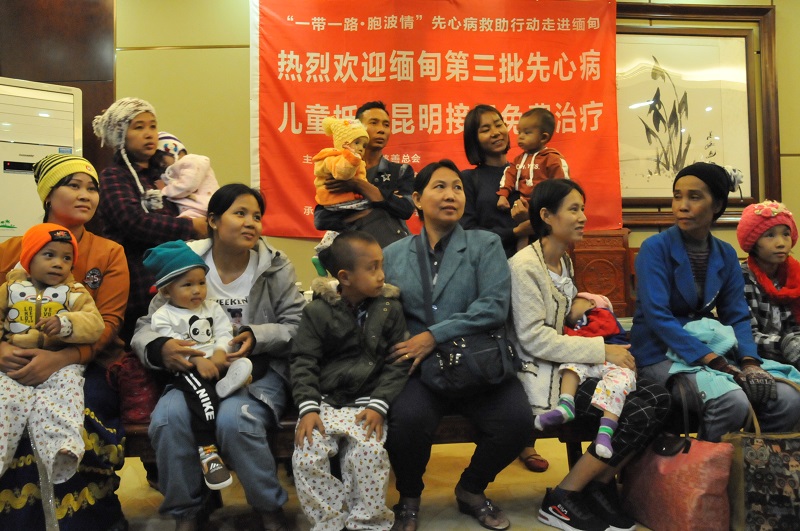
Eight Myanmar children, accompanied by their parents, arrived for heart disease treatment funded by China at Kunming, capital city of southwest China’s Yunnan Province on Dec. 4, 2019. (Xinhua/Yao Bing)
Moreover, China’s warmth toward the civilian government is also a sore spot for Myanmar military leaders, and has certainly created a new dynamic in domestic politics. As we all know, Myanmar today is jointly administered by two forces: a civilian government and the military.
Beijing should know that the strong resentment toward China over its infrastructure projects in Myanmar will continue to grow, and that ill feeling toward ethnic rebels who receive support from China can’t be suppressed.
But what values do we share with the Chinese? This is also a lingering question among Myanmar people.
A tough, perhaps related, question follows: Is China a reliable and trustworthy neighbor? Myanmar people continue to ask this question as the two countries prepare to celebrate the 70th anniversary of the establishment of diplomatic relations.
New friends
Will China be content to coexist with the newfound friends Myanmar has made in the past decade?
Myanmar is no longer the isolated country China used to know—it is undergoing a democratic transition and has opened up. China is no longer Myanmar’s only friend; close ties have been established with such Asian economic powerhouses as Japan, South Korea, India and even Taiwan, which has expressed interest in investing in many sectors in Myanmar. With the exception of Taiwan, the leaders of all those countries have visited Myanmar. Singapore is also one of the largest investors in Myanmar.
Not least, the same applies to ties with the US. US President Barack Obama visited Myanmar twice and President Donald Trump has invited Daw Aung San Suu Kyi to attend the Asean-US summit in the US in March.
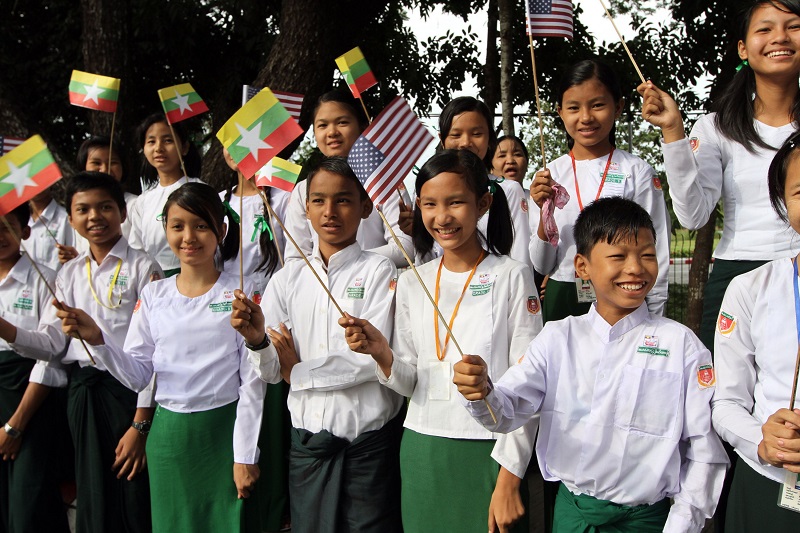
Myanmar students wave Myanmar and U.S. flags as they wait to welcome the arrival of U.S. President Barack Obama at Yangon International Airport Monday, Nov. 19, 2012, in Yangon, Myanmar. (AP Photo/Khin Maung Win)
In October 2019, a meeting between Daw Aung San Suu Kyi and David Stilwell, US assistant secretary of state for East Asian and Pacific affairs, produced a positive outcome. The US reaffirmed its long-term commitment to Myanmar’s democratic transition and economic transformation, referring to Myanmar as “a partner and friend” during a four-day visit to the country by Stilwell.
US Secretary of State Mike Pompeo sent a message to mark Myanmar’s Independence Day on Jan. 4, saying, “The United States remains committed to partnering with the people of Myanmar in support of the country’s continued democratic transition, national reconciliation, and economic transformation—as we have done for decades.”
It added, “We will continue to work with your government, civil society, and youth to help achieve a peaceful, democratic, and prosperous Myanmar that respects the dignity and rights of all people.”
Pundits have grown fond of pointing out that Myanmar is a battleground in the geopolitical contest. This geopolitical competition could serve Myanmar’s national interest, but the country will have to tread carefully and play it safe with the various players involved.
Weak, unstable?
In recent years, as many are aware, Myanmar’s dramatic shift to embrace the West produced more conflict along the Chinese border and elicited wrath from Beijing. The Chinese are suspected of discouraging ethnic rebels along the border from signing a ceasefire with the Myanmar government.
We can only expect more powerful ethnic armies along the border and more conflict on the horizon, despite China’s promise to bring peace to Myanmar. These developments don’t convince us that China is a reliable and trustworthy friend.
A weak and unstable Myanmar can’t stand tall and will only experience chaos, conflict and turmoil. The cynical view is that China wants to see a weak and unstable Myanmar in order to maintain control and influence over the country.
However, a strong and stable—and independent—Myanmar would be able to contribute to the region, a situation that would be mutually beneficially for all.
So the question is, what sort of country does China want Myanmar to become? The importance of Xi’s visit lies in his answer to that question.
About the author
Aung Zaw is the founding editor-in-chief of the Yangon-based Irrawaddy media group. A recipient of CPJ International Press Freedom Award in 2014, he is the author of “The Face of Resistance – Aung San Suu Kyi and Burma’s Fight for Freedom.”
Note: This article was originally published on The Irrawaddy
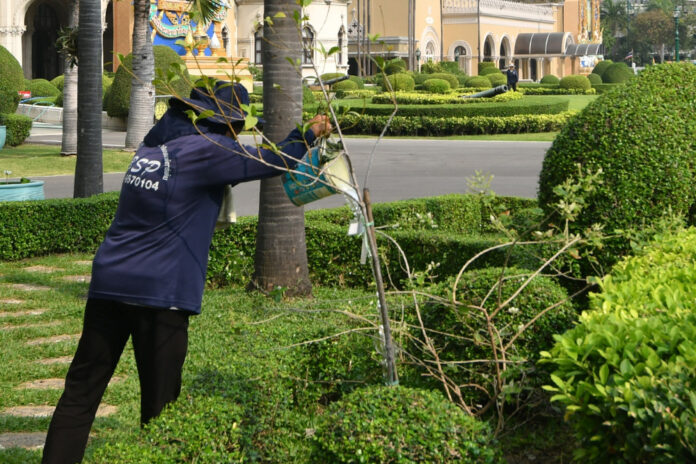
A gardener at the Government House waters plants with specially-treated water on Jan. 17, 2020.
BANGKOK — Even the powerful are now affected by the ongoing salty tap water crisis in the capital.
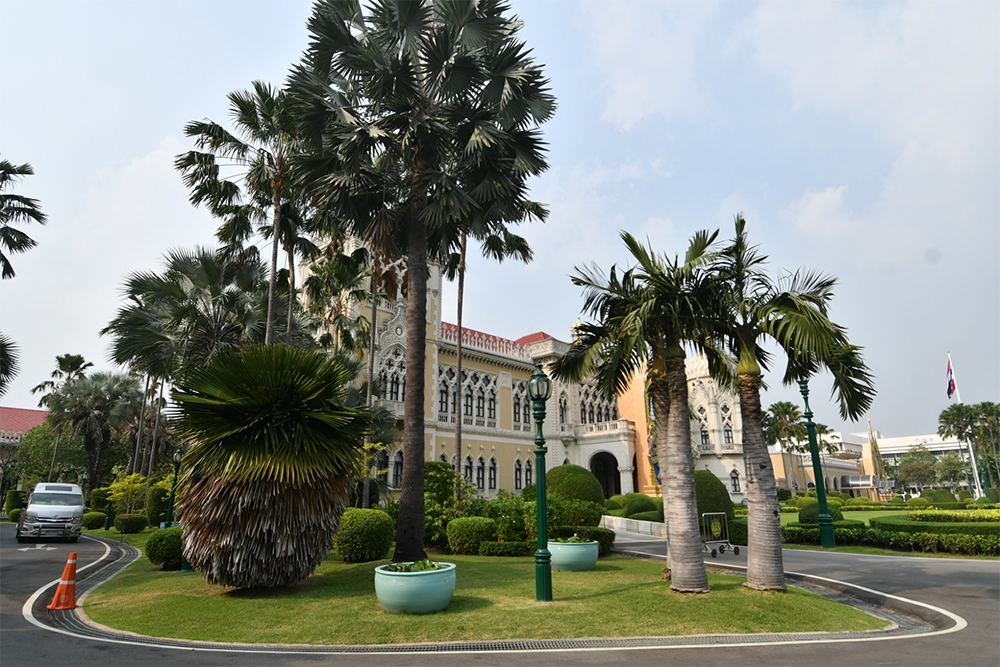
Officials today rushed in to save “auspicious trees” planted at Government House after they showed signs of withering under salty water pumped from the nearby Prem Prachakorn Canal. The salt-loaded water phenomenon, which struck the capital two weeks ago, is blamed on contamination of seawater.
According to reporters at Government House, the affected victims include white cheesewood (lamduan), sweet osmanthus (hom muen li), and butterfly bush (rachawadee). The flora is believed to bring in fortunes.
Gardening experts from the Department of Agriculture were summoned to alleviate the plant’s agony. Some plants that are sensitive to salinity were sprinkled with specially-treated water rather than the usual canal or tap water.
Beyond Government House’s well trimmed garden, residents of the capital continue to put up with their brackish tap water. Officials said the phenomenon was caused by storm surges at sea, which allowed salty seawater to interfere with the fresh water supply.
Readings from the Metropolitan Waterworks Authority measured salinity at 0.48 grams/litre on Friday afternoon, nearly twice as much from the standard salinity of 0.25 grams/litre.
Although the agency maintained that tap water is still safe for consumption, health officials warned that patients with kidney disease should take caution of their salt intake.
PM Prayuth Chan-ocha’s advice for the public to boil water before use was widely ridiculed and criticized as tonedeaf on social media, though the government said it’s also trying other measures to alleviate the crisis.
The plans include diverting water down the Chao Phraya River in order to push salty water back to sea.