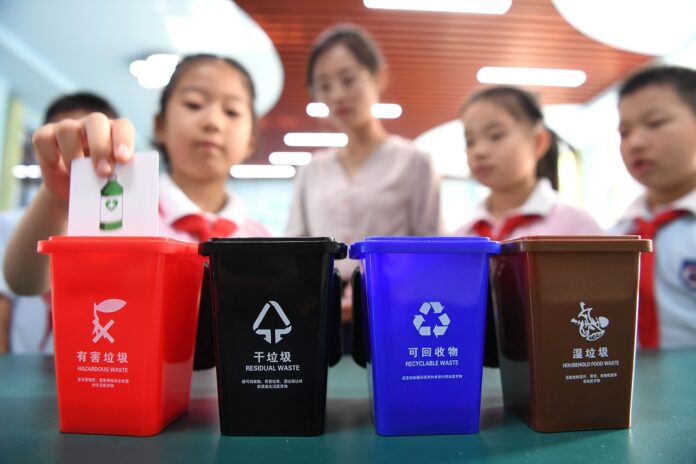
Pupils take part in a garbage sorting game at Jianping Experimental Primary School in Hefei, capital of east China's Anhui Province, July 11, 2019. (Xinhua/Liu Junxi)
BEIJING (Xinhua) — A total of 237 cities at the prefectural level or above in China have adopted waste sorting schemes as the country continues to embrace the green lifestyle, authorities said.
Waste sorting has been implemented in 53.9 percent of residential communities in the 46 cities required to carry out mandatory waste sorting by a 2017 nation-wide plan, among which 14 cities have seen more than 70 percent of neighborhoods following through on the practice, according to the Ministry of Housing and Urban-Rural Development (MHURD).
Thirty cities across China have rolled out waste sorting regulations, and 16 more are mulling legislature on the matter.
The MHURD reclassified residential waste from eight categories to 11 in a revised standard for waste sorting on Friday and launched a mini-application accessible by smartphone to promote the new classification.
China pledged to establish a basic system of laws and regulations on waste sorting by the end of 2020. Starting this year, waste sorting has been promoted in all cities at the prefectural level or above after being piloted in 46 cities.
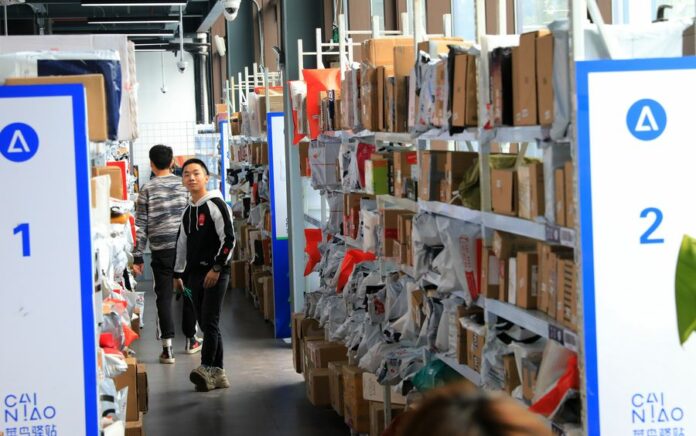
Students of Shanghai Jiaotong University are looking for their deliveries at a self pick-up station on Nov. 13, 2019. (Xinhua/Fang Zhe)
BEIJING (Xinhua) — A survey has found that nearly 87 percent of college student respondents bought things they do not actually need online and 77.53 percent felt regret about it.
The survey was conducted by Xiaomei, a shared platform for campus media created by the China Youth Daily, on 792 students across the country.
Reflecting on the reason of such purchases, 68.77 percent said it was just impulse buying, while nearly 20 percent admitted that they bought the add-on items to meet the threshold for free shipping or bigger discounts.
About 50 percent said the unnecessary items often end up in some forgotten places, said the survey report published Monday.
Sales of Alibaba’s e-commerce platform Tmall hit 268.4 billion yuan (about 38.3 billion U.S. dollars) in the “Double 11” online shopping spree on Nov. 11.
HONG KONG (Xinhua) — Despite escalating violence in Hong Kong, many residents have stepped out to clear road barricades and mourn a cleaner killed by rioters in a bid to say “no” to violence.
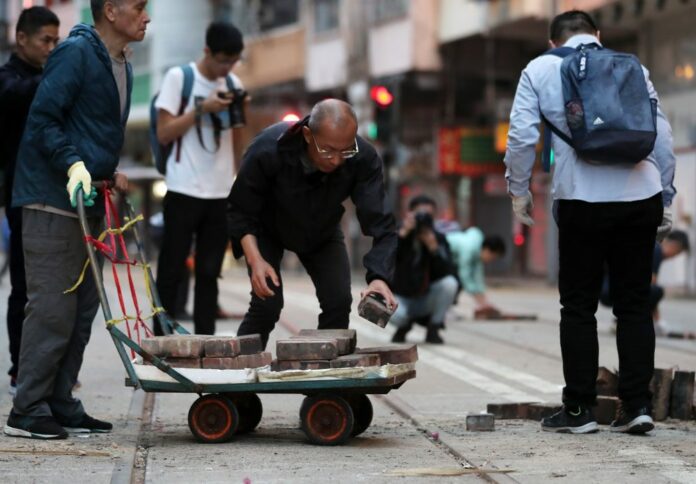
In multiple locations of Hong Kong in recent days, people, young and old, have gathered to clear the bricks and rocks blocking roads, and carry them away with carts.
In Mong Kok, a businesswoman surnamed Fan came out on the street with her husband. “I am doing what every Hong Kong resident should do,” she said. “I do not want anybody to ‘speak’ for me. I just want to have the peaceful life back.”
Thirty-year-old Tsang was working near the Sai Wan Ho mass transit railway (MTR) station. “The rioters made our life so inconvenient,” he complained. “They are selfish and irresponsible with the unlawful and violent acts. There is nowhere in the world that people could make demand in this way!”
In Yuen Long people not only cleaned the community, but also drove away the rioters who attempted to thwart their efforts. “You are not welcome here,” someone shouted.
When rioters tried to prevent doors of the MTR train from closing at the Kam Sheung Road station, some young people scolded them: “Some one died because of your conduct” and “who will feed us if we do not go to work, as you claimed?”
Unrest in Hong Kong has entered its fifth month, during which rioters’ violent acts have posed great threat to people’s life and safety.
A senior sanitation worker died on Thursday after being hit by a brick in the head hurled by rioters. It was the first death of an innocent civilian since the now-withdrawn ordinance amendments concerning fugitives’ transfers sparked unrest.
Many people went to the site to mourn for the 70-year-old man.
“The sanitation workers clear up the mess for them every day,” said a man in his 20s, who declined to be named for fear of being targeted by the rioters. “But the black-clad thugs beat him to death in cold blood. Now that he is dead, they even speak ill of him online. That is totally inhuman.”
Mr. Lam, who is also a sanitation worker, felt sad for the dead. “Now our fellow colleagues are both sad and worried,” he said. “Hopefully our government could end this chaos soon, and may peace return to Hong Kong.”
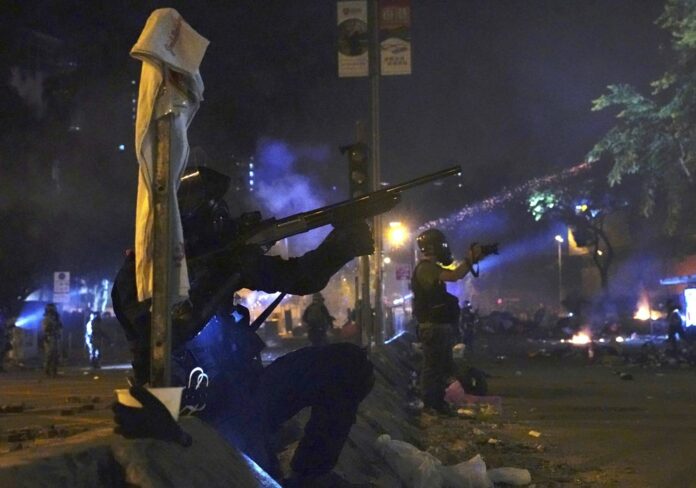
Police in riot gear prepare to fire as they move into the campus of Hong Kong Polytechnic University in Hong Kong, early Monday, Nov. 18, 2019. (AP Photo/Vincent Yu)
HONG KONG (AP) — Police breached a Hong Kong university campus held by protesters early Monday after an all-night siege that included firing repeated barrages of tear gas and water cannons.
Anti-government protesters have barricaded themselves inside Hong Kong Polytechnic University for days. Police surrounded the area Sunday night and began moving in after issuing an ultimatum for people to leave the area. The crowd wore raincoats and carried umbrellas to shield themselves.
Riot officers broke in one entrance before dawn as fires raged inside and outside the school, but they didn’t appear to get very far. Fiery explosions could be seen as protesters responded with gasoline bombs. Police, who have warned that everyone in the area could be charged with rioting, reportedly made a handful of arrests.
At daybreak, protesters remained in control of most of the campus. In one outdoor area, some demonstrators made gasoline bombs while others dozed while wearing gas masks. Two walked about with bows and quivers of arrows, while many stared at their smartphones.
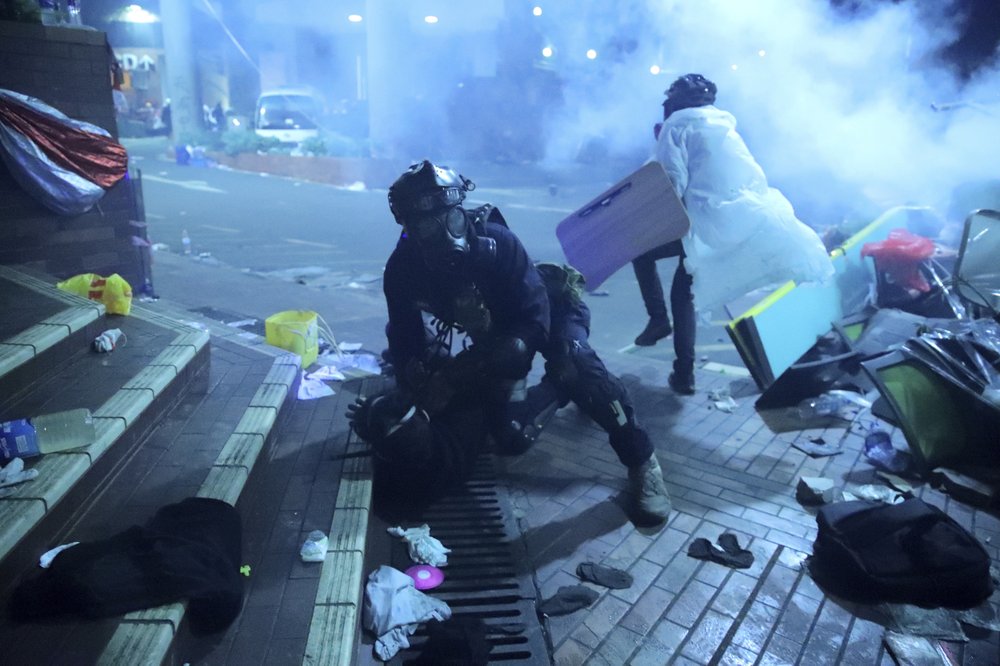
A policeman in riot gear detains a protester outside of Hong Kong Polytechnic University as police storm the campus in Hong Kong, early Monday, Nov. 18, 2019. (AP Photo/Kin Cheung)
A lull settled on the area as the president of the university said in a video message that that police have agreed to suspend their use of force.
Jin-Guang Teng said police would allow protesters to leave and he would accompany them to the police station to ensure their cases would be processed fairly.
“I hope that you will accept the proposed temporary suspension of force and leave the campus in a peaceful manner,” he said.
It seemed unlikely the protesters would accept the offer given that they would all likely be arrested.
A few hundred streamed out of the campus about 8:15 a.m. in an apparent bid to escape, but they were driven back by police tear gas. Some wearing gas masks calmly picked up smoking tear gas canisters and dropped them into heavy-duty bags, but the protesters decided to retreat with a phalanx of officers lined up across the road in the distance.
On Sunday, protesters used bows and arrows, and one arrow struck a media liaison officer in the calf. Photos on the department’s Facebook page show the arrow sticking out of the back of the officer’s leg through his pants.
As riot police moved in from all sides, some protesters retreated inside the university. Others set fires on bridges leading to it.
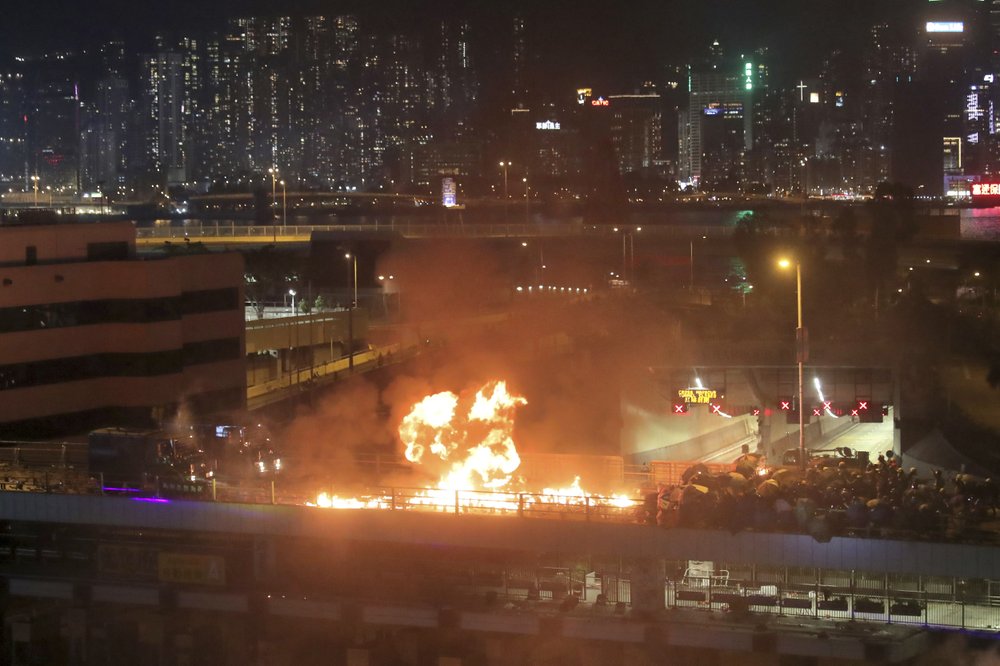
A huge blaze burned along much of a long footbridge that connects a train station to the campus over the approach to the Cross-Harbour Tunnel, a major road under Hong Kong’s harbor that has been blocked by protesters for days.
The use of bows and arrows and gasoline bombs was a sharp escalation of violence by the protesters, who are trying to keep the pressure on Hong Kong leaders, who have rejected most of their demands.
The protests started peacefully in early June, sparked by proposed legislation that would have criminal suspects to be extradited to the mainland. But by the time the bill was withdrawn, the protests had hardened and broadened into a resistance movement against the territory’s government and Beijing.
Activists see the extradition bill as an example of Hong Kong’s eroding autonomy under Beijing rule since the 1997 handover from colonial power Britain.
Protestors hurl molotov cocktails as armored police vehicles approach their barricades on a bridge over a highway leading to the Cross Harbour Tunnel in Hong Kong, Sunday, Nov. 17, 2019. (AP Photo/Kin Cheung)
Several hundred people formed a human chain Sunday in central Hong Kong in a peaceful rally in support of the movement.
Azaze Chung, a university student, said the government should respond to the protesters’ demands, not just use force against them.
Police and protesters faced off all day outside Polytechnic after a pitched battle the previous night in which the two sides exchanged tear gas and gasoline bombs that left fires blazing in the street.
A large group of people arrived Sunday morning to try to clean up the road but were warned away by protesters. Riot police shot several volleys of tear gas at the protesters, who sheltered behind a wall of umbrellas and threw gasoline bombs into nearby bushes and trees, setting them on fire.
The protesters held their ground for most of the day, as water cannon trucks drove over bricks and nails strewn by protesters to spray them at close range — some with water dyed blue to help police identify protesters afterward.
Protesters began retreating into the university near sunset, fearing they would be trapped as police approached from other directions. The protesters barricaded the entrances to the campus and set up narrow access control points.
They are the holdouts from larger groups that occupied several major campuses for much of last week.
Another group threw bricks in the street to block a main thoroughfare in the Mongkok district, as police fired tear gas to try to disperse them. The disruption to Nathan Road traffic may have been an attempt to distract police during the standoff at Polytechnic.
Opposition lawmakers criticized the Chinese military for joining a cleanup to remove debris from streets near Hong Kong Baptist University on Saturday.
Dozens of Chinese troops, dressed in black shorts and olive drab T-shirts, ran out in loose formation and picked up paving stones, rocks and other obstacles that had cluttered the street.
The Chinese military is allowed in Hong Kong to help maintain public order, but only at the request of the Hong Kong government. The government said that it had not requested the military’s assistance, describing it as a voluntary community activity.
The Education Bureau announced that classes from kindergarten to high school would be suspended again on Monday because of safety concerns. Classes have been canceled since Thursday, after the bureau came under criticism for not doing so earlier.
___
Associated Press journalist Dake Kang contributed to this report.
Charoen Pokphand Foods PLC (CPF) reported Bt6,062 million earnings in the third quarter, an increase by 23% from the same period last year.
The earnings increased despite lower sales revenue. In the quarter, sale revenue totaled Bt132,597 million, declining 6% on quarter. Nevertheless, excluding impacts from the strengthening of Thai baht as well as the adjustment of financial reporting standards (TFRS), sale revenue would have increased by 8% on year.
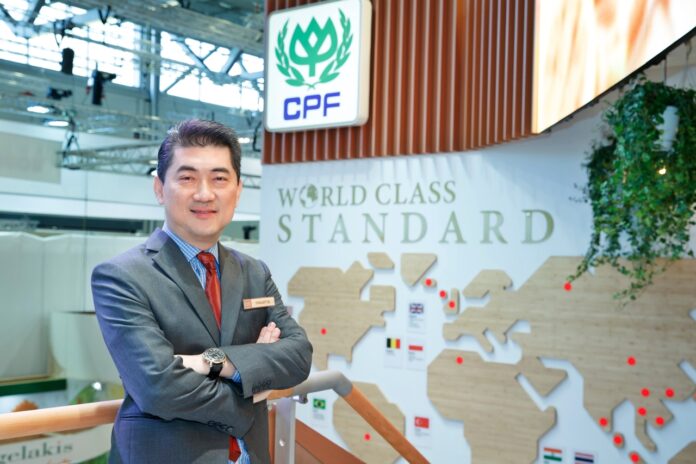
Mr. Prasit Boondoungprasert, Chief Executive Officer of CPF, attributed a drop in sale revenue to the stronger baht as well as changes in TFRS. In the quarter, overseas businesses contributed 67% of total sale revenue. The rest was contributed by the operations in Thailand, 27%; and exports from Thailand, 6%. CPF maintains the strategy to further expand businesses in potential markets and targets to raise overseas sales as well as exports to 80% of total sale revenue in the next 5 years.
In the third quarter, the net profit surged 23% on year thanks mainly to a recovery in the swine industry following a glut that pressured down pork prices. The net profit was also driven by the better financial results of overseas aquaculture business as well as investment divestiture.
The African Swine Fever (ASF) outbreak in several countries leads to an expected decrease in global pork output and pork prices have consequently moved up. Such condition may last years as affected farmers may not be able to restore their businesses in a short period. Furthermore, such farmers have to invest more in an effective biosafety management system, to prevent another outbreak.
Pork prices in Vietnam have hit 57,000-60,000 dong per kg, or about Bt75-Bt78, above the third-quarter average price of 38,422 dong or Bt50 per kg. Farm pigs now fetch about 28-38 yuan per kg in China or approximately Bt121-Bt164, above the third-quarter average of 22 yuan or about Bt95.
Prasit is confident that CPF will meet financial targets in 2019, as earnings in the fourth quarter is expected to improve in line with an increase in pig prices. The annualized earnings in 2020 are also expected to further increase as a result of the strategy to add value of existing businesses as well as an improvement in economic conditions.
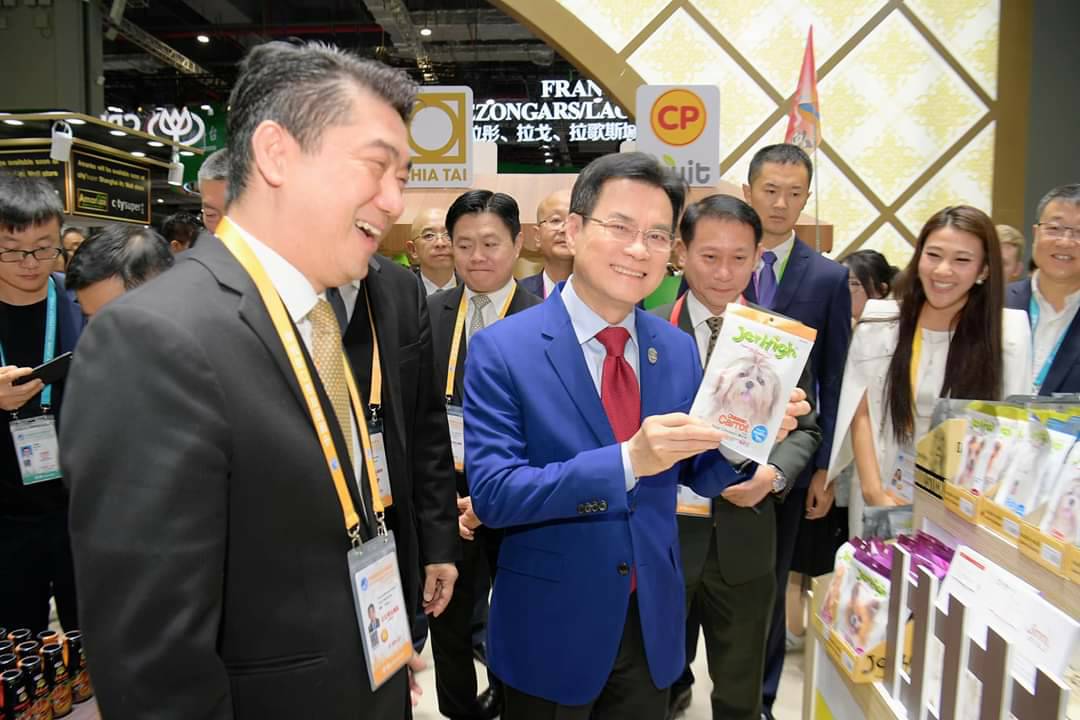
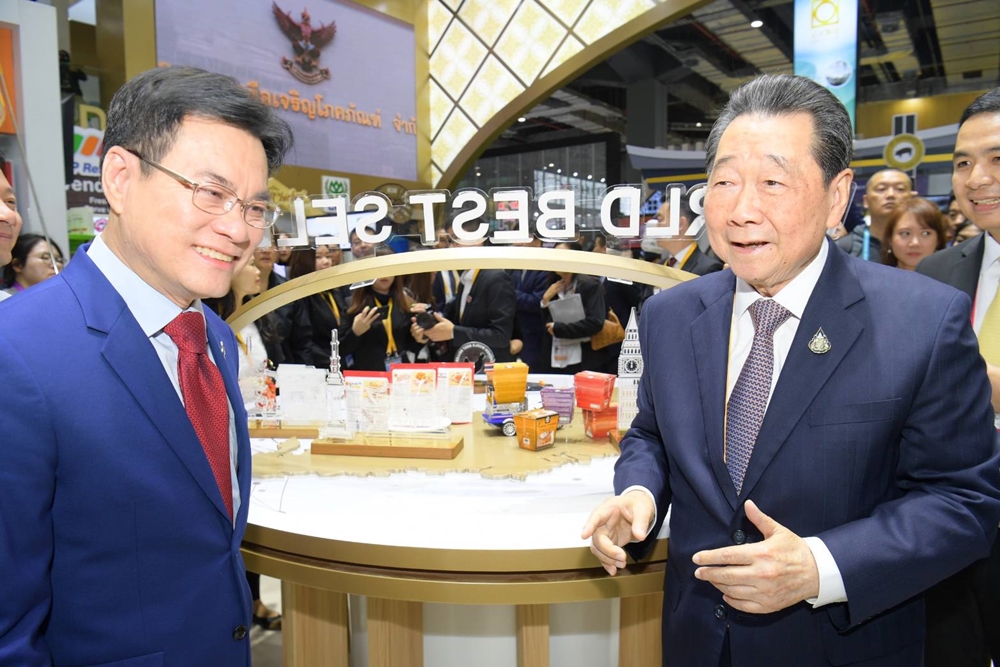
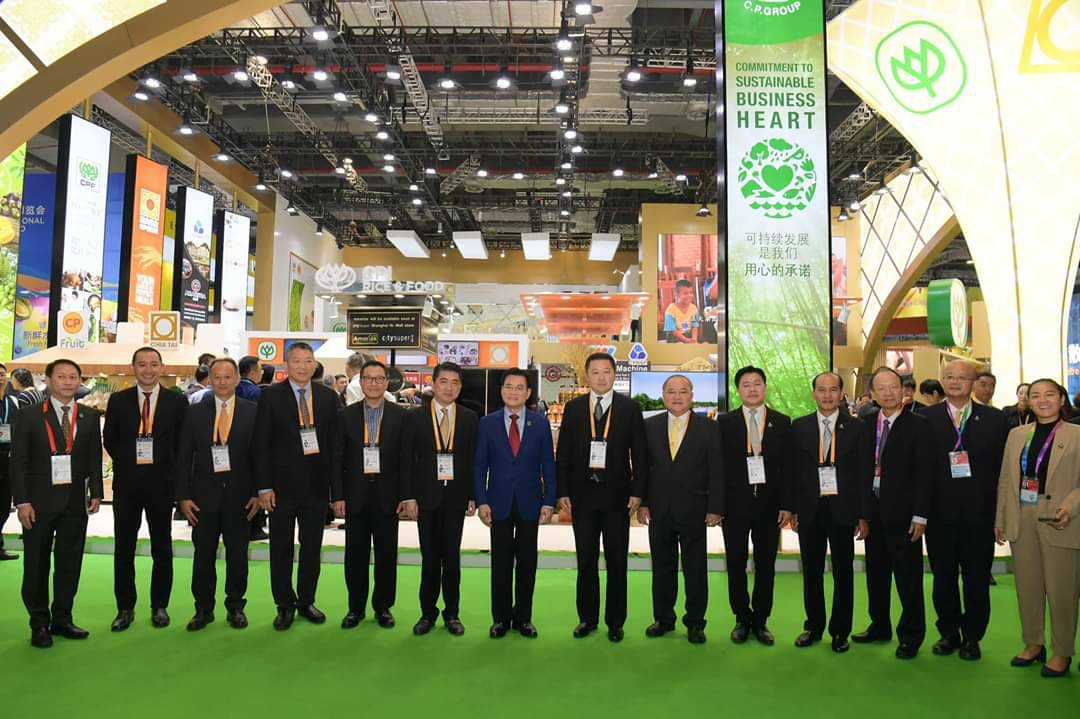
Mr. Jurin Laksanawisit, deputy prime minister and commerce minister of Thailand, and government officials attended the China International Import Expo 2019 (CIIE 2019) arranged during 5-10 November 2019 where displaying Thai Pavilion to promote foods and agri-products to Chinese market.
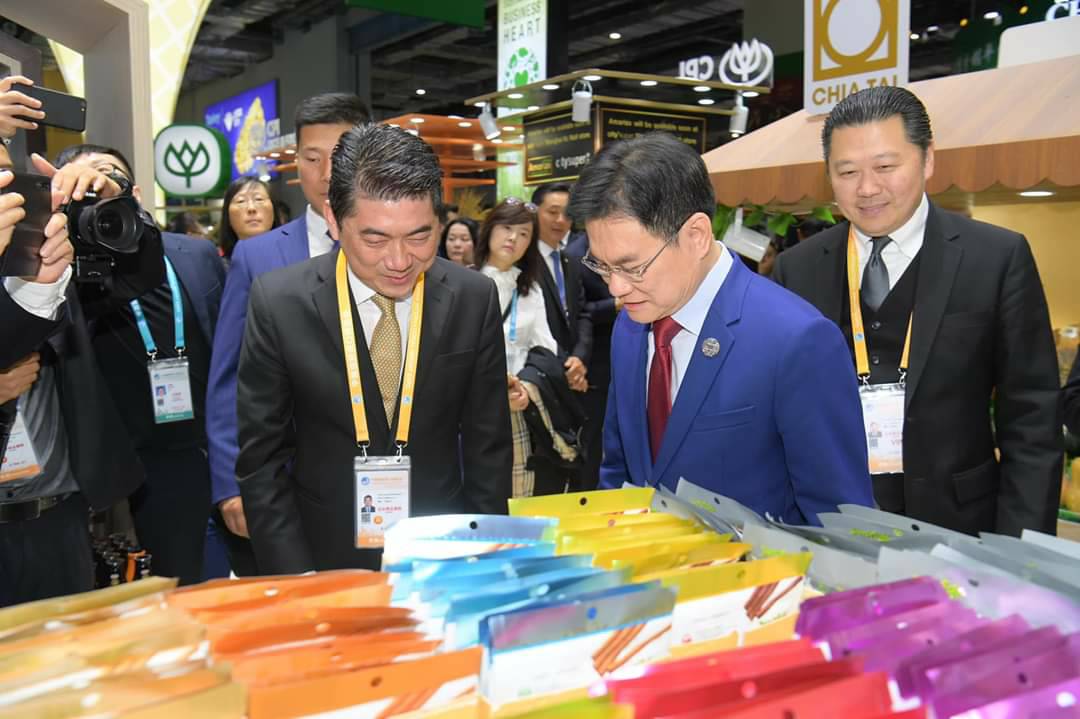
The minister also visited to CP exhibition booth presenting various foods under the concept “Kitchen of the World”. The minister was welcome by CP Senior Chairman Dhanin Chearavanont and CP and CPF Chairman Soopakij Chearavanont at the booth to explore about several CP products including Charoen Pokphand Foods PCL (CPF)’s various innovative food products such as Benja Chicken, Shrimp, Shrimp dumpling, desserts and healthy beverage to find more opportunities in Chinese market.
Mr. Sukhawat Dansermsuk CPF’s Vice Chairman of the Executive Committee and Mr. Prasit Boondoungprasert CEO of CPF, jointly presented products at the National Exhibition and Convention Center in Shanghai, China.
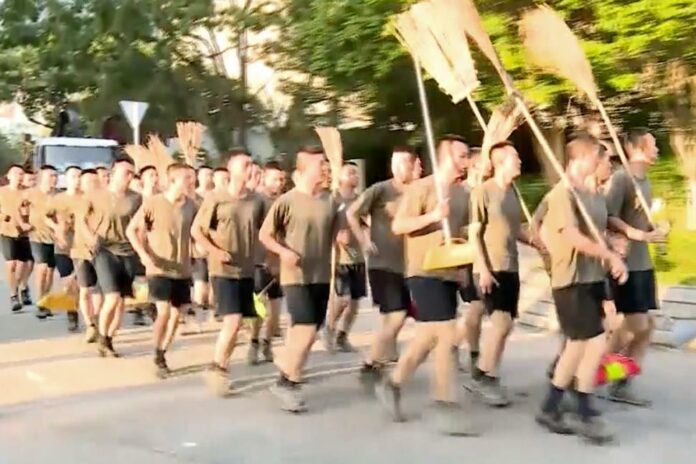
In this image made from video, People’s Liberation Army soldiers, with brooms, arrive to clean up the protest area at Hong Kong Baptist University in Hong Kong, Saturday, Nov. 16, 2019. (Television Broadcasts Limited Hong Kong via AP)
HONG KONG (AP) — Chinese troops came out of the barracks in Hong Kong on Saturday — not to quell protests but to help clean up.
It was a rare public appearance by the People’s Liberation Army on the streets of the semiautonomous territory, where the local government’s inability to end more than five months of often violent protest has fueled speculation that Beijing could deploy its troops.
Running in formation with brooms instead of rifles, they chanted in military cadence before joining street cleaners removing debris near Hong Kong Baptist University, where police fired tear gas during at protesters earlier this week.
Most anti-government protesters left Hong Kong’s universities Saturday after occupying them for about a week. Small contingents that remained harassed some of those cleaning up and kept a major cross-harbor tunnel closed.
For a city now accustomed to fierce weekend clashes between police and protesters, Hong Kong had a relatively quiet Saturday. About 1,000 people turned out for an annual Gay Pride event in the center of the city.
Dozens of Chinese troops, dressed in black shorts and olive drab T-shirts, came out from a nearby barracks to pick up paving stones, rocks and other obstacles that had cluttered the street and prevented traffic from flowing. Hong Kong riot police kept watch from nearby streets.
China, which maintains a garrison of about 10,000 soldiers in Hong Kong, publicly noted several times earlier during the protests that it could deploy them, though technically it would have to be requested by Hong Kong’s government.
Doing so, however, would incur international criticism and revive memories of the army’s bloody crackdown on pro-democracy protesters at Tiananmen Square in 1989.
There were scattered incidents of protesters arguing with people clearing roadways, and in one instance, throwing a gasoline bomb near City University of Hong Kong.
Protesters also massed near Hong Kong University in the evening to try to block a main road again, but they were stopped by police firing pepper-spray balls.
Several dozen protesters remained at the Hong Kong Polytechnic University, some keeping watch on the blocked access road to the Cross-Harbour Tunnel, where they torched the toll booths on previous nights.
Traffic disruptions continued to plague parts of Hong Kong, and schools and universities remained closed in the city of 7.5 million people.
Now in their sixth month, the anti-government protests have grown increasingly violent even as they have shrunk in size, often causing chaos in the streets.
The protests were sparked by a government decision to submit legislation that would have allowed the extradition of criminal suspects to the mainland. Activists saw it as an erosion of Hong Kong’s autonomy under the “one country, two systems” formula implemented in 1997, when Britain returned the territory to China.
The bill has been withdrawn, but the protests have expanded into a wider resistance movement against what is perceived as the growing control of Hong Kong by Communist China, along with calls for more autonomy for the territory.
Universities have become the focus of the protests in the past week and the main battleground between pro-democracy activists and the police.
Police retook control of suburban Chinese University of Hong Kong after students and protesters left.
Authorities said that all lanes of Tolo Highway, which the Chinese University protesters had blocked, were reopened around midday.
Police and protesters fought intense running battles at the Chinese University campus Tuesday, which had been transformed into a fortress by hundreds of protesters.
Except for the Polytechnic University in Kowloon, most of the remaining nine major universities in the city were for the most part no longer occupied, except by a handful of protesters. A hardcore group retained their grip on Polytechnic.
Students there have amassed a huge arsenal that includes hundreds of Molotov cocktails, rocks and paving stones. The campus is adjacent to a major road tunnel under the water to Hong Kong island that has been closed for days after protesters set toll booths on fire.
Service remained partially suspended on at least three of Hong Kong’s 12 rail lines because of damage to stations and other facilities, and many of the city’s buses were not running.
The presidents of nine universities issued a joint statement late Friday calling on the government to resolve the political deadlock and restore safety and public order.
“No political viewpoint gives a license to damage property, employ physical threats, or use violence against individuals,” the statement read in part. “It is regrettable that societal disagreement has led to university campuses becoming major political battlefields, and that the government response has so far not been effective.”
Many universities have canceled classes for the rest of the year and hundreds of foreign students, and from mainland China, had left or were leaving Hong Kong. Some protesters targeted mainland students, while foreign students were asked to leave by their universities or governments.
Hong Kong media reported Saturday that at least 300 Dutch exchange students were asked by their home universities to return home because of the violence.
___
Associated Press news assistant Nadia Lam contributed to this story.
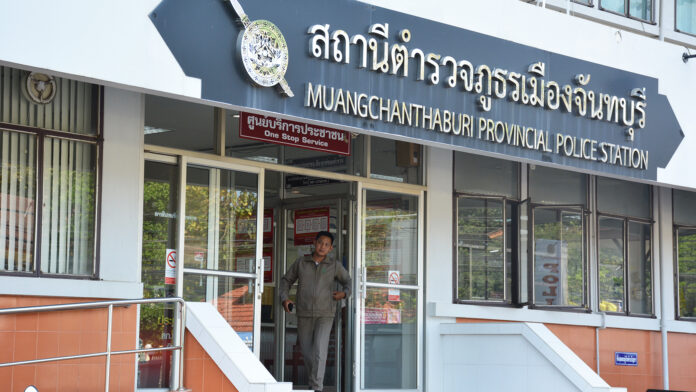
CHANTHABURI — Police on Friday said a policeman was placed under investigation after security camera footage revealed moments he handed his sidearm to a clerk during a deadly shooting incident on Tuesday.
The video contradicted previous statements by the authorities who said the shooter was brought down by an on-duty police officer inside the Chanthaburi courtroom, which were then revised to say that clerk Thanakorn Theerawaradom, 22, grabbed the handgun from the officer, Capt. Kajorn Banjong.
But in a CCTV footage leaked to the media, Capt. Kajorn is seen standing outside the courtroom with Thanakorn when land dispute defendant Thanin Chantratip shot the plaintiff and his lawyers inside.
Kajorn, holding his handgun, then peeked into the courtroom, and looked back at Thanakorn. The two appeared to talk to each other before the officer apparently gave his sidearm to the legal clerk.
Thanakorn then moved to the door, assumed a firing position, shot the handgun, and entered the room.
Region 2 police commander Montri Yimyam said he ordered an inquiry into Capt. Kajorn. Despite the footage, Montri said more investigation is needed to ascertain whether Kajorn intentionally surrendered his firearm to Thanakorn.
“The officer declined his involvement. He said that he was responding to the shooting inside the court before his gun was taken away by Thanakorn,” Montri said. “We have not concluded whether Capt. Kajorn deliberately handed the gun to Thanakorn, but we expect the findings to be concluded soon.”
Khaosod English was instructed by its management not to show the footage due to fears of possible legal action from the court.
Kajorn previously told the media that he suddenly suffered from an unspecified health condition which prevented him from bringing down the shooter. Yet the video showed him leaning against the wall after the weapon was removed from him.
Kajorn’s supervisor, Col. Khomsorn Mabumrung of Chanthaburi provincial police, said the officer is not ready to give his testimony as he is currently “depressed.”
Autopsy examination found Thanin was shot six times. He died at a hospital.
Those killed by Thanin included plaintiff Bancha Porameesanaporn and his lawyer Wijai Sukharom. Bancha’s wife Supaporn Porameesanaporn and another lawyer Wichai Udomthanapat were injured, but they are now reportedly in stable condition.
Thanin’s ex-wife Khemjira Bantoonnipit, who divorced him four years ago, said Wednesday her ex-husband was waiting to surrender himself after the shooting, but he was shot by Thanakorn before the police arrived.
“I offer my condolences to all of the victims,” Khemjira said. “Think of it as the consequence of their karma because the dispute is over a monk’s land.”
Thanakorn was arrested Wednesday morning on murder charges for shooting Thanin dead. He is currently freed on bail.
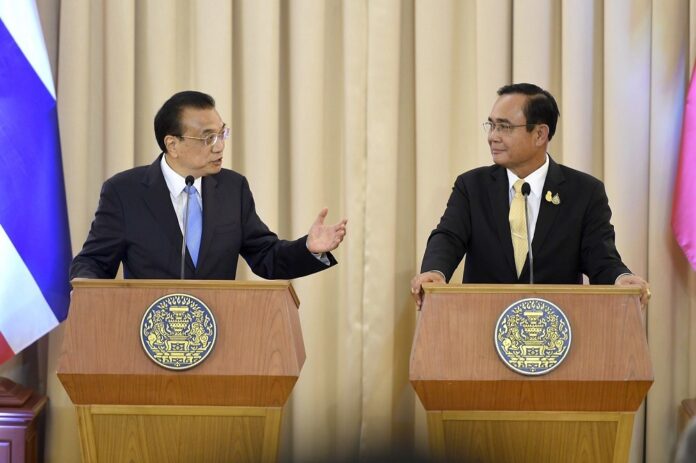
PM Prayuth Chan-ocha meets Chinese PM Li Keqiang at Government House in Bangkok on Nov. 6, 2019.
When Prime Minister Gen Prayuth Chan-ocha recently compared Thailand to an ant and China to a lion in front of Chinese Premier Li Keqiang in Bangkok, it raised a few Thai eyebrows.
While some might say Prayuth was merely being humble and wanting to flatter his Chinese counterpart (he did say the ant could at times be helpful to the lion), or even realistic about the situation today, others found his remark disturbing.
Prachachart Party deputy chairman Nitiphumthanat Ming-rujiralai chastized Prayuth on his Facebook as something that shouldn’t have come out of Prayuth’s mouth because he is a national leader.
“Making such comparison may made the status of Thailand to seem low in the international arena. Every nation which sovereignty has equal dignity. Those wanting to compare itself as small should be a vassal state, a protectorate of a colony.”
The debate is actually not new. Over a century ago, in a 1889, author George B. Bacon wrote in his book “Siam: The Land of the White Elephant” that: “There still remains some trace of a remote period of partial vassalage to the Chinese Empire, in the custom of sending gifts – which were originally understood, by the recipients at least, if not the givers, to be tribute to Peking.”
Those who have the chance to visit the National Palace Museum in Taipei should see and admire the prized Xuande incense burner stored there. Made in 1428, the 8.2-centimeter tall bronzework was a gift sent by Ayutthaya Kingdom as a tribute to the Ming Emperor.
Nearly three centuries and a half later, when King Taksin established Thonburi as the new capital after Ayutthaya was destroyed by the Burmese in 1767, he sent a letter seeking recognition to the Qing Court. The letter, in Chinese, is now also kept at the National Palace Museum in Taiwan.
While historians can continue to debate as to whether Thailand, then known as Siam, was ever a semi-vassal of Imperial China, the Ming and Qing Dynasties are no more, and there is no need for Thais today to willingly want to become China’s vassal state.
There was a “Century of Humiliation” from the latter years of Qing Dynasty and the founding of modern China in 1945 when China was weak and “the Sick man of Asia.” During this period, Thais developed a very different and more equal attitude towards China and its people.
They welcomed an untold number of Chinese migrants, including my paternal grandfather who left the island of Hainan for Bangkok, seeking a better life.
For a century, up until the past decade or so, Thais do not feel inferior compared to Chinese, be it culturally or economically. We also do not have any bitter history that may poison Sino-Thai relations, unlike Vietnam, who was subjugated by the Chinese for almost a millennia and had a brief war with China just 40 years ago. Or Indonesia, which descended into an anti-Chinese riots in 1998 in Jakarta, Medan and Surakarta.
On the other hand, Thailand should not wish to let itself be overwhelmed by Chinese investments to the point of becoming a virtual economic colony.
Cambodia, for example, is increasingly under the Sinosphere just as the Western nations are wary about its lack of democratic credentials under strongman Hun Sen. In fact, Cambodian Foreign Ministry quickly issued a statement siding itself with the Chinese government in the early stages of the Hong Kong protests.
Statista, an online statistics website, reported last month that Cambodia and Laos are among the countries owing external loan debt to China at a level above 25 percent of its GDP. The two ASEAN member states and neighbors joined countries like Niger, Djibouti, Kyrgyzstan and the Maldives in similar situations.
Thailand, which is listed as having less than one percent of its GDP owed to China, should steer clear of such debt trap.
Any loan as part of the high-speed rail connecting Kunming to Bangkok as part of China’s Belt and Road Initiative should be considered very carefully, not just by the Thai government but the Thai people as to its economic sustainability.
Napoleon Bonaparte was right in a quote attributed to him two centuries ago when the French emperor supposedly said: “China is a sleeping giant. Let her sleep, for when she wakes she will move the world.”
China is no longer asleep and if you cannot feel the rise of China in Bangkok and elsewhere then probably you are asleep.
China is now Thailand’s main export destination, standing at 12.5 percent of total exports compared to 11.3 per cent to the United States, according to the latest edition of The Economist’s Pocket World in Figures. China is also Thailand’s main origins of imports at 20 percent of total imports, followed by Japan at 14.5 per cent.
Yet Thailand can be more than just an ant and not a semi-vassal state of China if its people cherish its independence and national pride. Thailand should always be a good friend of China, as a much smaller partner, while fostering better relations with the EU, Japan, South Korea, India, the US and other nations, to neutralize China’s influence.
VATICAN CITY — The Pope on Friday night said he wished to forge friendships with Thailand’s Buddhists when he arrives in the kingdom for an official visit next week.
In the video lasting nearly 3 minutes, Pope Francis said he was looking forward to visiting the multi-ethnic and diverse nation that has “worked hard to promote harmony and peaceful coexistence not only among its own people but also throughout the region of Southeast Asia.” His trip in Thailand is set to take place from Nov. 20 to 23.
“I also hope to strengthen the bonds of friendship that we share with many Buddhist brothers and sisters who bear eloquent witness to the values of tolerance and harmony that are so characteristic of your people,” he said.
Thailand is home to a minority population of Catholics numbering 0.58 percent of the population, or about 388,000 people with 524 churches, in contrast to 93.5 percent of Buddhists.
“During my journey I will have the opportunity to meet with the Catholic community of Thailand, to encourage them in their faith and in the contribution they make to the whole of society,” he said in the video.
Lifting his eyes from his script and breaking from a monotone reading voice, the Pope said, “They are Thais and must work for their country.”
He said he hoped his visit would underline the importance of inter-religious dialogue, service of the poor, and peace.
Lastly, he thanked the people preparing for his visit.
“In these days I bring you all, dear friends, to my prayers,” he said, signing off. “I pray for you, for your family, for your country; and I ask you, please, not to stop praying for me too.”