A Nov. 7, 2019, photo of a funeral of one of the 15 people killed in checkpoint attack in Yala province.
BANGKOK — Prime Minister Prayuth Chan-ocha granted himself an authority to impose curfew on certain areas of the restive southern border provinces as the head of a government counterinsurgency agency.
The order delegates the decision of declaring curfew to the director of the Internal Security Operation Command, a position held by PM Prayuth. The measure is intended to “prevent, contain, and manage the situation in the area where there are threats to national security in an orderly and effective manner.”
Although the announcement did not mention any specific cause for changes, it came days after an attack at a security checkpoint in Yala that killed 15 people on Tuesday night.
PM Prayuth told reporters he is not planning to impose any curfew, but said some areas might be closed for investigations into the raid.
“I will try to make it short for measures announced in the order,” Prayuth said. “I don’t want the suspects to cross over to other areas.”
The order was signed by Prayuth himself and published in the Royal Government Gazette website. Apart from the power to declare curfew, the order also permits director and other appointed executives of the Internal Security Operations Command, or ISOC, to prevent individuals from entering or leaving venues related to security operations.
Government officials will also be required to assist ISOC authorities and its operations, though the order does not mention punishments should they refuse.
The order will be effective from Dec. 1, 2019 to Nov. 30, 2020 and will only cover Mae Lan district of Pattani province, Betong district of Yala province, Su-ngai Kolok, Sukhirin, and Si Sakhon districts of Narathiwat provinces, and Chana, Na Thawi, Thepha, and Saba Yoi districts of Songkhla province.
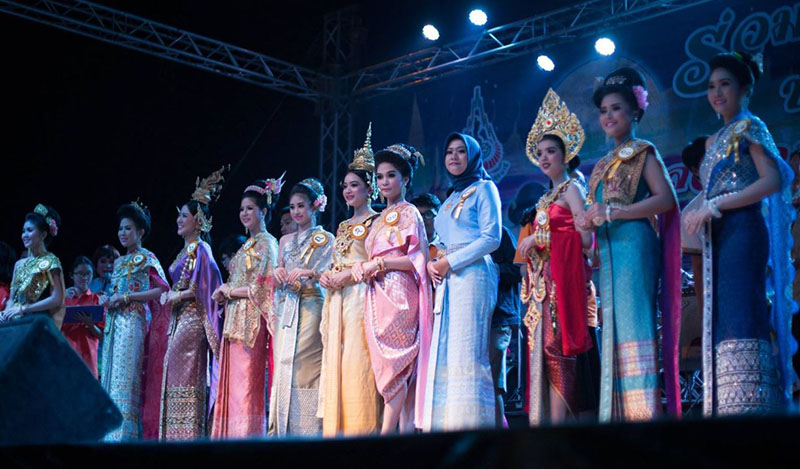
Promotional models pose for photos at a government event promoting Loy Krathong festival in Bangkok on Oct. 30, 2018.
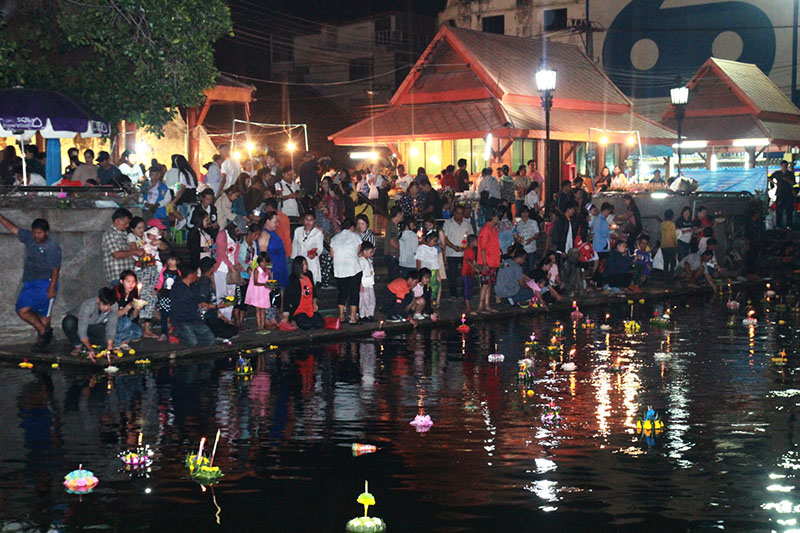
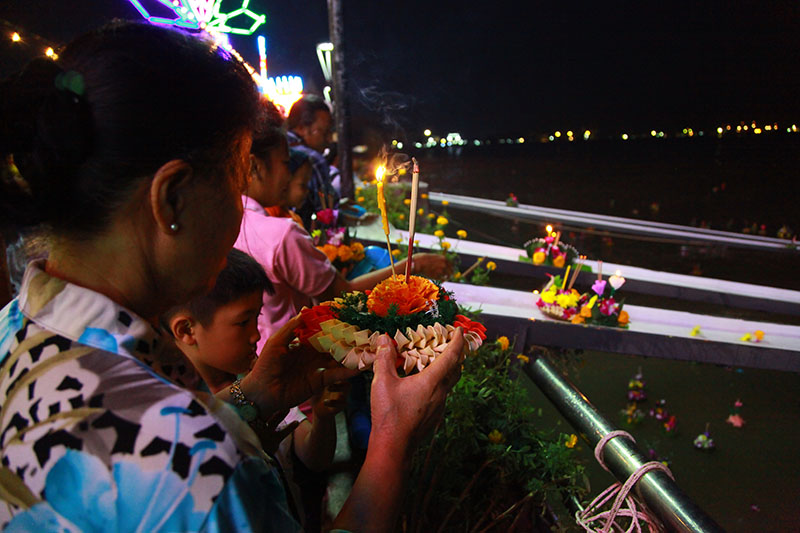
As revelers around the country are gearing up for Monday’s Loy Krathong festival, the day means nothing to about five million Thais who would be absent on that night.
To the country’s second largest religious group, the river festival is empty of meaning, and to pay homage to it through gaiety is profane. Celebrating Loy Krathong remains a taboo for Muslims – a dogma enforced by the highest Islamic authority which many young Muslims interviewed for this story said they intend to follow.
“I do not celebrate Loy Krathong. As Islam is a monotheistic religion, we believe in one God,” Noorulhuda Chalermthai, 26, said in an interview. “The purpose of Loy Krathong, from what I have known is, to pay respect and worship the goddess of water.”
Another Muslim, 21-year-old Pitchaya Vimonthammawath, echoed a similar message, “My family and friends told me that it’s not for us, and not our place or business, but for Thai Buddhists.”
On the other hand, followers of another major monotheistic religion in Thailand – Christians – said they had no issues with Loy Krathong, albeit having minor reservations about some gestures in the ritual that could be seen as acts of idolatry.
In a country where religions and animistic superstitions are mixed beyond recognition, and whose calendar is peppered with holidays inspired by multiple faiths, it is forgivable to forget that Loy Krathong is deeply rooted in Hinduism. The colorful krathongs are tributes to the Indian goddess of water, Ganga, which Thais call Phra Mae Kongka.
Due to the tradition’s ties with divine worship, Islamic clerics banned participation in the holiday, said Wisut Binlateh, an official from the Sheikul Islam Office, who wields authority on matters of Islamic beliefs.
“We don’t believe in other gods or goddesses who rules over mountains and rivers,” Wisut said in an interview. “There is only one God who we believe in, who created everything.”
The traditional belief that one can drive away past transgressions, or bad karma, by floating a boat made of banana stalk also goes agaisnt Islam’s tenets concerning forgiveness.
“If we have sins or karma, it’s from our actions. The only way to ask for forgiveness from Allah, and to do good,” he said. “You can’t just float away your sins.”
‘Not Going to Loy Krathong’
A 2018 census by National Statistics Office of Thailand found that 5.4 percent of the Thai population is Muslim, or around 3.7 million people. Many of them are in the southern region, where they make up almost 30 percent of the population.
To preserve their religious belief in a society where up to 93.5 percent of the population follows Buddhism, many Muslims often take to social media every year when Loy Krathong is around the corner to remind each other not to participate.
“Islam doesn’t have Loy Krathong tradition,” reads one popular messagethat’s been widely reposted by Muslims on Facebook.
“Not going to Loy Krathong, because we are Muslims,”reads another banner, shared over 500 times.
In a reply to a Facebook thread debating who one should invite as a date to Loy Krathong festivals, a Muslim user wrote, “Never had this problem. Islam doesn’t have Loy Krathong anyway.”
“Nang Noppamas” contestants at the 2018 Loy Krathong festival at Suranaree University of Technology. Photo: Suranaree University of Technology
Even without these reminders, ignorantia juris non excusat – Muslims cannot claim they didn’t know it was a taboo, Wisut from Sheikul Islam Office said.
“Muslims can’t just say go and then later say they didn’t know about what loy krathong really means, or just go along with fads and trends,” he said.
Bukhari Alkaremi, 33, works a TV station dedicated to broadcasting Islamic teachings. He said Buddhists may see Loy Krathong as a purely cultural matter, but to him it is different.
“If it’s related to other faiths, Muslims cannot participate, even if it’s part of the culture,” he said. “To participate is to accept the rituals.”
It’s not just Loy Krathong either: Muslims also cannot participate in other festivals with religious roots, such as Christmas, Buddhist Lent, and even the New Year. Celebrations are only allowed on Eid al-Fitr and Eid al-Adha, called Eid Lek (“small Eid”) and Eid Yai (“big Eid”) in Thai, respectively.
Can Christians Do It?
On the other hand, Loy Krathong is a non-issue for Christians in the kingdom. A Catholic priest and a Protestant pastor said they recognize a distinction between culture and faith.
“We can fully separate the culture from Buddhism, and go to the festivals in a celebratory nature. We can just be sitting around quietly if they’re doing chants,” Vissanu Thanya-anan, who holds a position in the Catholic Bishops’ Conference of Thailand, said in an interview.
He added, “Culture is culture, religion is religion. Appreciation of water isn’t limited to one religion. Everyone treasures the country and culture they’re born in.”
“Although a Christian has no obligation to go, of course they can go to to enjoy the festival with family and friends,” said Thongchai Pradabchananurat, the founder of New Vision Church in Bangkok. “Don’t go if you don’t want to, but there’s no need to berate others for going and ruin the mood for everyone else.”
Nuns attending Loy Krathong festival held on Nov. 21, 2010 at Assumption Convent School in Bangkok. Photo: Assumption Convent School
Christians are a minority population, amounting to 1.1 percent according to a 2018 census, or around 617,000 Thais, with almost equal numbers of Catholics and Protestants.
Just as Thailand imports different influences, whether from Brahmin or animist origins, the local branch of Christianity also adopts some of the ‘Thainess’ as well, Vissanu said. “We can wai or even graab,” he said, referring to the acts of paying respect and prostrating.
Thongchai the pastor is also one of the editors of booklet series called “Can Christians Do It?” – which offers advice to Thai Christians on navigating religious holidays in Thailand like Loy Krathong and Songkran.
For the booklet on Loy Krathong, the book suggests praying to God while floating a krathong, or putting a small cross in the krathong instead of joss sticks, which are considered to be a religious objects used to venerate spirits. Still, Thongchai believes there’s nothing sinful per se about attending the festival.
“Muslims are more strict and inflexible, and do not go out of the Qu’ran so they won’t attend Loy Krathong or get involved at all,” he said. “Their concern is on purity.”
A loy krathong event at Hathainiramon School. Photo: Hathainiramon School
Purity and Harmony
Indeed, critics of Islam in Thailand – from secular liberals to Buddhist hardliners – often take issue with what they see as Thai Muslims’ resistance to integration, which they say could lead to conflicts and widen societal gaps.
Their concern is shared by a number of younger Muslims, who attempt to strike a balance between spiritual purity and social harmony in the Buddhist-majority nation. One of them is a popular Muslim preacher on social media who goes by the name Matty Ibnufatim Hamady.
In a Facebook postthat drew over 4,500 reactions, Matty said Muslims should be culturally sensitive even when discussing celebrations or festivities that they had no intention of joining.
“If we can’t participate, then we should stay silent. If we see Chinese people celebrating Chinese New Year and post ‘Muslims say no to Chinese New Year’ then their Chinese friends will feel bad,” he wrote. “No Muslims would like it if we see someone posting ‘Buddhists say no to Hari Raya Day.’”
Several people interviewed for this story, like Bukhari and Pitchaya, also said they know some Muslims who do attend Loy Krathong festivals.
“Some people just see it as a party, or a cultural tradition,” said Pitchaya, a communication arts student in Bangkok.
Bukhari, who lives in a “melting pot” of mosque neighborhood close to Khaosan Road, said his experience taught him that participation in religious festivities isn’t necessary for building good ties. Instead, Muslims can always attend non-religious activities like sports and cleanups with members of other faiths.
“Buddhists respect us if we don’t participate, such as in Loy Krathong or Songkran,” he said.
Wisut, the cleric from the Sheikul Islam Office, suggested a similar solution.
“You shouldn’t go to the festival at all, because none of it is okay,” he said. “But afterwards, if people invite you to clean up the river, you can and should go, because it’s something good to do for the community.”
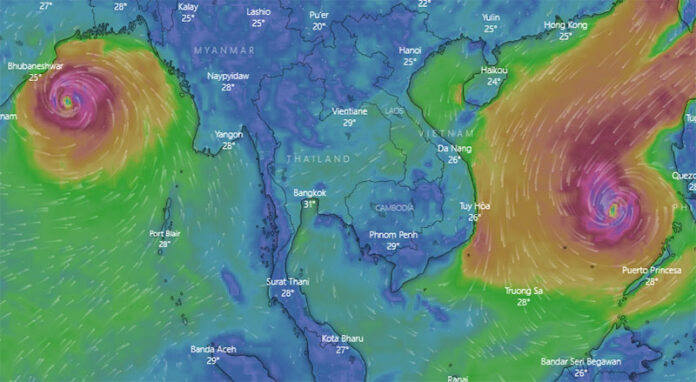
BANGKOK — Sandwiched between two storms on the globe, Thailand is in a safe haven against a tropical storm and a cyclone, according to Thai meterologists.
Neither tropical storm Nakri, which is approaching the southern Vietnam coast, or Cyclone Bulbul, scheduled to hit Bangladesh and India, will significantly impact Thai weather, the Thai meteorological department said Friday afternoon.
Thai travellers to Vietnam, India, and Bangladesh should take note and monitor local weather conditions.
Nakri won’t have a large impact on Thai weather except for additional showers in the North and Northeast through Tuesday. Rains from China may pepper said region Nov. 13 to 15, meteorological department director Phuwiang Prakummin said.
Meanwhile, nationwide temperatures are expected to dip 2C to 4C, with 70 percent of rain showers in the south. Bangkok is expected to see lows of 21C to highs of 33C, with a slim chance of rain.
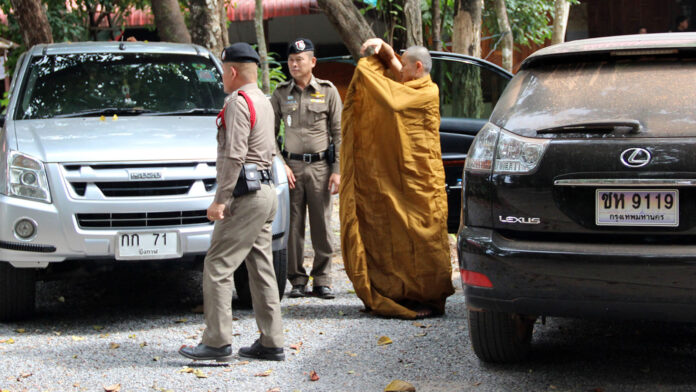
A hermit, who goes by the name Paiboon, being taken to Bueng Kan city patriarch by the police on Nov. 7, 2019.
BUENG KAN — An ascetic forest hermit on Thursday denied police allegations that he raped and impregnated his teenage daughter.
Paiboon, 45, the head hermit of a monastery in Bueng Kan city, was charged with sexual assault of a minor Wednesday after his ex-wife told the police he repeatedly assaulted their 15-year-old daughter until she was pregnant.
Paiboon says he is innocent. During a ceremony to defrock him on Thursday, the suspect also refused to chant the phrase that would confirm his exit from monkhood.
“I refused to leave the monkhood because I’m innocent,” Paiboon said, “I didn’t rape my daughter as my ex-wife is saying. If someone does that to their very own daughter, that person is worse than a dog.”
According to the victim’s diary shown to the media by her family, the girl said she was assaulted by her father for at least three times over a period of one year, but she had to keep it a secret as his father had threatened to beat her and declare her a sinner if she told anyone about it.
The family did file a criminal complaint to the police on Oct. 27. They said the girl was acting unusual after she came back from visiting her father at the monastery. The girl reportedly confessed to the family and police that she had been raped by her father.
Medical diagnosis showed she was one month pregnant, police said.
Col. Sukrit Korruamkid from Bueng Kan city police said the hermit is in custody.
Sexually assaulting someone under 15 is punishable by 15 years in jail and a fine up to 30,000 baht. The punishment increases by a third if the crime is committed by close family members, like parents.
It’s latest case involving holy men and sexual assault to hit the Buddhist faith in recent months. In September, an abbot confessed to raping a 18-year-old girl before offering to pay her family 150,000 baht in return for them to withdraw the case, which the family agreed.
Hermit sages, or ruu see, spend their time meditating in the forest, developing their mystic arts, communicating with animals, creating natural remedies, imbuing artifacts and teaching devotees. The mystics considered themselves to be part of Buddhism and most of them were ordained into the monkhood.
Recent photos of Brian Hyland, left, and Peggy March, right.
BANGKOK — American legendary teen idols Brian Hyland and Peggy March will swing the capital with their sixties bubblegum pop this Dec.
The duo will take the stage together for the first time in Bangkok on Dec. 21 at Thailand Cultural Center.
Born in 1943, Brian Hyland was a musical prodigy whose comical hit “Itsy Bitsy Teenie Weenie Yellow Polkadot Bikini” soared to the top of the Billboard Hot 100 Chart in 1962 – when he was only at the age of 16. Two years later, his ballard “Sealed with a Kiss” reached the third rank on both the American and UK Singles Charts. His songs are still heard occasionally by young listeners in movies and TV shows nowadays.
Joining him in tune will be Peggy March, who is best known for her single “I Will Follow Him,” released in 1963. Although critics often remembered her as a one-hit wonder, her stardom continued to shine outside the US throughout the 1970s with German songs like “Mit 17 hat man noch Träume” and “Romeo und Julia.”
Tickets are on sale now starting from 800 to 2,500 baht via ThaiTicketMajor.
Workers build a bullet train at a factory of CRRC Tangshan Co., Ltd. in Tangshan, north China's Hebei Province, March 23, 2018. (Xinhua/Yang Shiyao)
SHIJIAZHUANG (Xinhua) — A newly developed driverless metro train has passed further testing with a higher level of automation, faster speeds and lower energy consumption, its developer said.
Developed by the CRRC Tangshan Co. Ltd., one of China’s major high-speed train manufacturers, the metro train can operate automatically at all times, including opening and closing doors, detecting obstacles and handling emergencies.
The train, with six carriages, can carry up to 2,300 people in one trip. The test model is designed to run at a maximum speed of 120 km per hour, 50 percent faster than the normal subways in cities at home and abroad.
Made of lightweight stainless steel, the intelligent metro train is much lighter than traditional ones, and each metro can save around 4 million kilowatt-hours of electricity per year.
“I believe that this driverless metro train can improve China’s international competitiveness in the field of rail transit, upgrade industries and provide a better travel experience for passengers,” said Cao Zeqian, a designer of the company’s product research and development center.
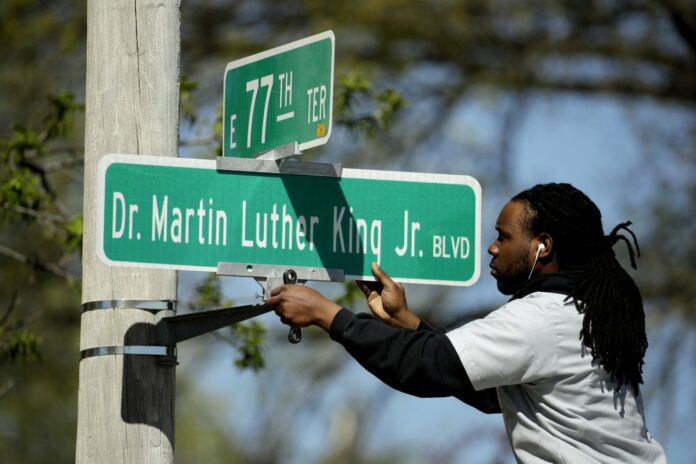
In this April, 20, 2019, file photo, public works employee Jerry Brooks changes a street sign from The Paseo to Dr. Martin Luther King Jr. Blvd. in Kansas City, Mo. (AP Photo/Charlie Riedel, File)
KANSAS CITY, Mo. (AP) — Kansas City voters have overwhelmingly approved removing the name of Dr. Martin Luther King Jr. from a city boulevard in favor of the street’s original name, The Paseo.
Unofficial results show the vote to remove King’s name received nearly 70% of the Tuesday’s vote, with just over 30% voting to retain King’s name.
The vote came after months of heated debate that began shortly after the city council voted in January to name the 10-mile (16.09-kilometer) boulevard that runs through a mostly black area of the city after the civil rights icon. Kansas City was one of the last large cities in the U.S. to name a street for King.
A group called “Save the Paseo” in April turned in far more than the 1,700 signatures needed to get the issue on the ballot. They argued the city council didn’t follow proper procedures when it renamed the street.
Mostly black civil rights leaders who worked for years to secure King’s name accused “Save the Paseo” of being racist and warned the city’s reputation would suffer if his name is removed.
MOSCOW (Xinhua) — The Moscow government held grand celebrations at Red Square on Thursday to mark the 78th anniversary of the military parade in 1941 when Soviet troops marched directly from the square to fight Nazi invaders outside Moscow.
About 4,000 people took part in the celebrations, including honor guards, a military orchestra, military school cadets, the 1st Tank Army of the Western Military District, performers and volunteers, according to a statement from the mayor’s office.
Groups of performers dressed in military uniforms of the 1941-1945 Great Patriotic War passed by the stands carrying historical combat banners on Red Square.
A total of 1,200 participants of the Great Patriotic War and four participants of the 1941 parade were invited to the event with the oldest of them having just turned 97 years old.
After the march, Muscovites were able to see part of the weapons and equipment used by Soviet soldiers during the war.
The organizers also prepared thematic interactive platforms and photo zones, showing military chronicles and domestic films about the war throughout the day.
A march in memory of the 1941 parade has been held by the Moscow government annually since 2003.
Hospital staff walk out from the ICU ward where a university student who critically injured during a protest, is treated at Queen Elizabeth Hospital in Hong Kong, Friday, Nov. 8, 2019. (AP Photo/Dita Alangkara)
HONG KONG (AP) — A Hong Kong university student who fell off a parking garage after police fired tear gas during clashes with anti-government protesters died Friday, in a rare fatality after five months of unrest that is expected to intensify anger in the semi-autonomous Chinese territory.
A hospital official, identified only as Chow, said the 22-year-old died Friday morning, but couldn’t give further details.
Although the cause of his fall has not been determined, his death is bound to deepen anger among youths against police, who have been accused of heavy-handed tactics since protests demanding democratic reforms started in June.
Local media reported that Chow Tsz-Lok has been in a coma with brain injury since he was found early Monday sprawled in a pool of blood on the second floor of the building. Police believed he plunged from an upper floor but it wasn’t captured by security cameras.
Minutes earlier, television footage showed riot police firing tear gas at the building after objects were hurled down at the officers in the street when they chased off a mob. Police didn’t rule out the possibility he was fleeing from tear gas but noted officials fired from a distance. Police also denied claims that officials pushed the victim down and had delayed emergency services.
There have been only few fatalities amid the unrest, with previous reports of deaths by suicide and a man who fell to his death while hanging pro-democracy banners on a building.
At the University of Science and Technology, Chow’s colleagues staged rallies this week and on Thursday disrupted a graduation ceremony. The university president dabbed away tears as he announced Chow’s death Friday on the second day of the convocation, with the audience standing to observe a moment of silence.
Calls emerged online for memorial events Friday to mourn Chow in multiple locations including at the garage in the suburb where he fell.
The protests were sparked by a now-shelved extradition bill to mainland China that many sees as Beijing’s creeping interference on legal and other rights guaranteed to Hong Kong when the former British colony returned under Chinese rule in 1997.
The movement has since expanded to include other demands, including direct elections for the city’s leaders and an independent investigation into alleged police brutality.
Swans are seen at the Yellow River Wetland in Pinglu County, north China's Shanxi Province, Jan. 4, 2018. (Xinhua/Zhan Yan)
HARBIN (Xinhua) — In a “black swan” event, a video clip went viral showing a university worker paddle a boat out to rescue three black swans stuck on a frozen lake, only to get stranded in the ice himself.
In the footage that raised a lot of eyebrows on Sina Weibo, the Chinese equivalent of Twitter, an old man struck his paddles on the ice to get the boat moving, while two swans nearby sat motionless on the icy lake.
The somewhat embarrassing sight of the otherwise graceful birds surprised and amused Chinese netizens, providing many with an excuse to make fun of the inclement winter in northern China.
“What does it feel like being a swan in northeast China?” a netizen asked tongue-in-cheek under a picture showing one of the swans standing on the ice. “Getting cold feet,” another responded.
Li Xuejie, the protagonist in the video, confirmed that the “rescue” at Harbin Normal University on Thursday morning lasted one hour in the “icy city” of Harbin, capital city of China’s northernmost Heilongjiang Province.
It happened after it snowed overnight causing the lake to freeze, “trapping” the three waterfowls, though none of them were literarily “frozen” as described in some video clips, Li told Xinhua.
“It was not actually a rescue mission but more of a yearly routine to bring them back to their winter nests in an temperature-controlled room,” said the 64-year-old whose job includes taking care of the swans.
“The swans seemed to read my mind and knew I was there to pick them up. They voluntarily got on the boat,” he said, adding that the three swans are now resting comfortably in a pond inside an temperature-controlled room.
According to the university, the three black swans were introduced to the campus lake in 2017 as a “beautiful sight.” Every winter, they return to their indoors nests under the care of specialists.