BANGKOK — A proposed tax hike on salty processed food will soon be introduced in an effort to curb salt consumption and promote healthier diets, the Excise Department said Wednesday.
Department director Patchara Anuntasilpa said the agency is working with the Ministry of Public Health to finalize details of the proposed tax, which will be submitted to the Finance Minister Uttama Savanayana for approval by the end of this year.
“The salt tax has never been imposed before in Thailand, but it has already been levied in many developed countries,” Patchara said. “The department is studying the effects of salt intake on health to determine should the tax be collected.”
He said the exact tax rate is to be announced and the “salt tax” will be levied only on processed foods such as frozen food, canned food, instant noodles, and instant food products.
However, high-sodium seasonings, condiments, and snacks will not be affected by the new tax.
The proposal will follow the same model as a tax on sugary drinks, which generated more than 2 billion baht a year for the government since it was implemented on Sept. 16, 2017. There will be a grace period of one to two years to allow manufacturers to adjust the salt content in their products.
This is not the first time the idea has been discussed. Last December, then-Finance Minister Apisak Tantivorawong opposed the plan, saying that the tax would produce adverse effects for consumers, despite it producing revenue.
According to the World Health Organization, excessive sodium consumption kills about 20,000 Thais every year. Thais consume an average of 10 grams of salt per day – twice the WHO recommended level of 5 grams.
High-sodium processed foods are often blamed for the rise of kidney and heart diseases in Thai people. Surasak Kantachuvesiri, chairman of the advocacy Thai Low Salt Network, said more than seven million Thais are suffering from chronic kidney disease.
This image released by Disney shows Angelina Jolie as Maleficent in a scene from "Maleficent: Mistress of Evil." Photo: Disney via AP
For a moment, “Maleficent: Mistress of Evil” seems poised to turn into a wonderful take on “Father of the Bride” only with fangs and wings.
Princess Aurora (Elle Fanning), the beauty who escaped the curse of sleep, merrily accepts the proposal of Prince Phillip (Harris Dickinson), a marriage that could unite the fairy and human worlds. Aurora cautiously asks if Maleficent (Angelina Jolie), her now-redeemed fairy godmother, might go with her to meet the parents: Queen Ingrith (Michelle Pfeiffer) and King John (Robert Lindsay). It’s so much fun watching Maleficent prepare for the meeting by practicing such basic cordialities as smiling and small talk that it’s hard not to wish the movie sees the fearsome sorceress through the entire battery of wedding planning. Maleficent at a bridal shower. Maleficent choosing the table settings.
Sadly, such fun is not to be had in “Mistress of Evil,” a needless sequel to the 2014 “Sleeping Beauty” riff that fails to fully value the entire of appeal of these films: Jolie’s Maleficent. The first movie, a box-office hit, was a mess but its star attraction was the one thing it had going for it. Jolie, an unfortunately infrequent presence on the screen these days, slid into the role so perfectly, dominating all around her with Norma Desmond command and cheekbones that could slice your throat.
The character had its roots in those ’50s melodrama stars; Marc Davis, animator of the 1959 Disney film, also sculpted Cruella de Vil. And in teaming Jolie with the equally potent Pfeiffer, whose queen quickly turns into Maleficent’s bitter foe, “Mistress of Evil” had the potential of summoning the intoxicating stuff of Joan Crawford and Bette Davis.
But the movie, with Joachim Rønning (“Pirates of the Caribbean: Dead Men Tell No Tales”) taking over for Robert Stromberg, overcomplicates itself. Instead of aiming for the elemental simplicity of a fairy tale, “Mistress of Evil” fills itself with the politics and detail of the fairy-human struggle, building inevitably to a PG-friendly war between Queen Ingrith’s army and the magical spirits of the Moors, spread out across impressively vast computer-generated palace grounds.
It’s starting to seem like every franchise film, when in search of a story, throws a battle against the wall and hopes something sticks. Not only has this gotten tiresome, but it also sacrifices what we came here for in the first place: Jolie and Pfeiffer glowering at each other. But all the necessary buildup to the clash (including Chiwetel Ejiofor as among an exiled group of winged creatures called the dark fey) robs us of enough screen time with Jolie’s Maleficent.
The plot in “Maleficent” drew largely from its inventive redemption of a classic Disney villain. But it didn’t really follow through on the possibilities of fairy tale revisionism. It simply offered up another villain (Aurora’s father King Stefan), just as “Mistress of Evil” does with its dastardly Queen Ingrith. A better film would have kept playing with inverted archetypes.
What saves “Mistress of Evil” from a worse fate, in the end, is Fanning. Aurora, like many of Fanning’s performances, is a welcome dash of naturalism amid all the CGI action. She’s such an innocent and wholesome young bride, though, that perhaps she’s ripe for reconsideration, too. Next time, maybe Beauty breaks bad.
“Maleficent: Mistress of Evil,” a Walt Disney Co. release, is rated PG by the Motion Picture Association of America for intense sequences of fantasy action/violence and brief scary images. Running time: 118 minutes. Two stars out of four.
___
MPAA Definition of PG: Parental guidance suggested. Some material may not be suitable for children.
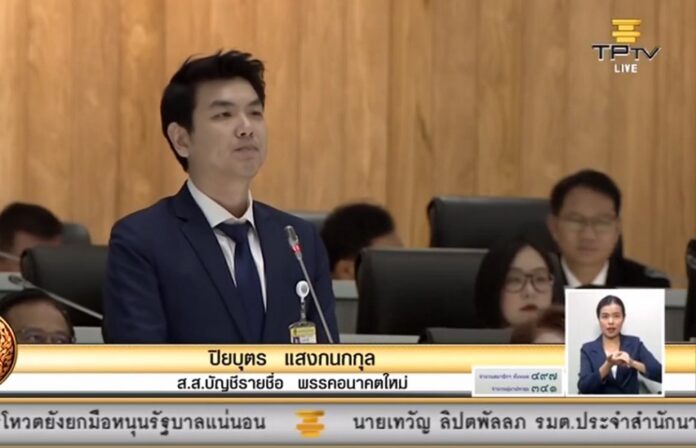
Future Forward sec-gen Piyabutr Saengkanokkul seen in a livestream of the parliament's debate on Oct. 17, 2019.
BANGKOK — A government emergency decree that granted His Majesty the King a personal control over two army units was approved today by all parties in Parliament except the Future Forward.
The party was the lone faction to vote against the decree, which party co-leader Piyabutr Saengkanokkul said was issued in an unnecessary haste and bypassed the usual scrutiny in Parliament. The bill was passed by 376 to 70. Two MPs abstained.
The rest of the opposition bench, including Pheu Thai and Puea Chart, voted in favor of the decree, which was enacted unilaterally by the government on Sep. 30 without approval from the lawmakers.
The government insisted there was an unspecified “emergency” that required the bill to be passed immediately.
Explaining his party’s opposition to the decree in parliament earlier, Piyabutr said the government’s actions amount to disrespecting democratic channels. He compares it to the use of absolute power under the previous junta.
“Gen. Prayuth [Chan-ocha] exercises his power without a care for the constitution,” the former law scholar said.
The Sep. 30 decree cut off the 1st and 11th Infantry Divisions from the army’s structure and put them under the king’s personal command, with the stated aim of better coordination in providing security to the Royal Family.
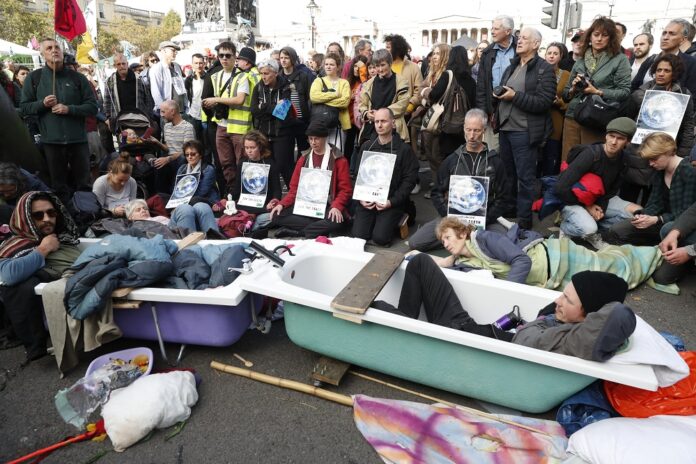
Climate change protesters lie in to joined bathtubs as the demonstrate in Trafalgar Square in London, Thursday, Oct. 10, 2019. Image: AP
LONDON (AP) — Angry commuters have scuffled with climate activists who climbed onto the roofs of trains, snarling services in the busy morning rush hours in the British capital.
Television images showed at least one man reaching up and grabbing the leg of a protester on top of a Tube train, dragging him onto the platform.
British Transport Police say they were called to three stations in east London early Thursday after protesters climbed onto the roofs of trains or glued themselves to the carriages.
Robin Boardman, a spokesman for the Extinction Rebellion protesters, says that if such action is necessary to make the government take notice, “then this is what we must do.”
Police say they arrested a total of eight people and urged protesters not to target London’s underground rail network.
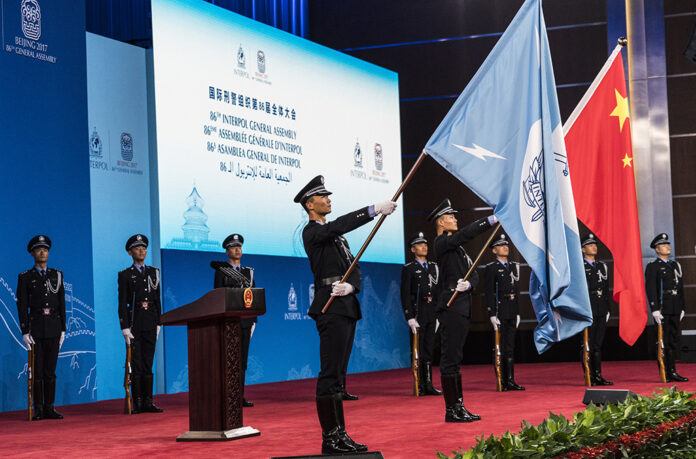
The 86th Session of the Interpol General Assembly opened in Beijing, China, on Sep. 26, 2017. Image: Interpol.
BEIJING (Xinhua) — Taiwan is not eligible to join Interpol because the latter is an inter-governmental international organization, a Chinese mainland spokesperson said Wednesday.
Taiwan’s participation in activities of international organizations must be based on the one-China principle and rules of international organizations, said Ma Xiaoguang, a spokesperson for the State Council Taiwan Affairs Office, at a press conference.
It must be handled through consultation between the two sides across the Taiwan Strait, said Ma.
“Our stance has been clear and consistent,” he added.
Responding to Taiwan’s participation in activities of the Asia-Pacific Economic Cooperation (APEC), Ma said it must comply with the one-China principle and relevant stipulations in the memorandum of understanding of the APEC.
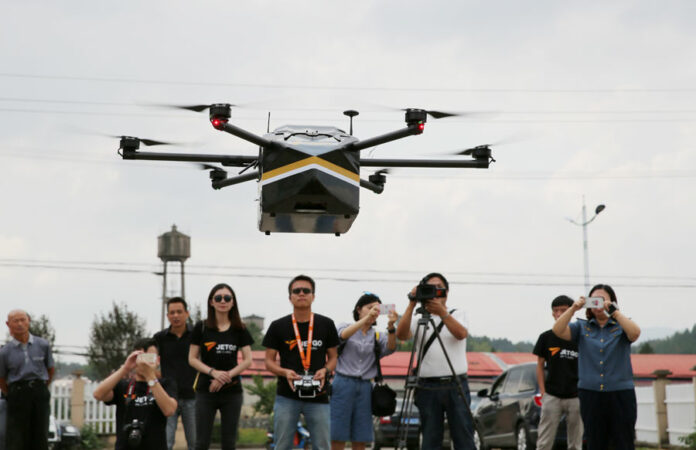
A file photo of a drone carrying mail of China Post in Anji county, East China's Zhejiang province, in September 2016. [Photo by Xiang Fei/For China Daily]
HANGZHOU (Xinhua) — China’s first license for the test-running of drone deliveries has been granted to Antwork Technology, a drone delivery company based in eastern province of Zhejiang, by the Civil Aviation Administration of China (CAAC).
Since the idea of drone deliveries was proposed by Amazon in 2013, leading logistics companies and e-commerce giants in China have been testing the water of the drone-delivery market.
Drone deliveries can help expand coverage of logistics, reduce the pressure on traditional logistics services and cut labor costs.
To ensure flight safety, 90 percent of the routes, which Antwork maps, are over urban rivers, and the drones can also reduce their speed and change routes when faced with emergencies or extreme weather, according to Zhao Liang, CEO of Antwork Technology.
Before Antwork obtained the license, it had conducted more than 20,000 logistical trials in urban and mountainous areas in Zhejiang and passed risk evaluation and flight tests supervised by the CAAC.
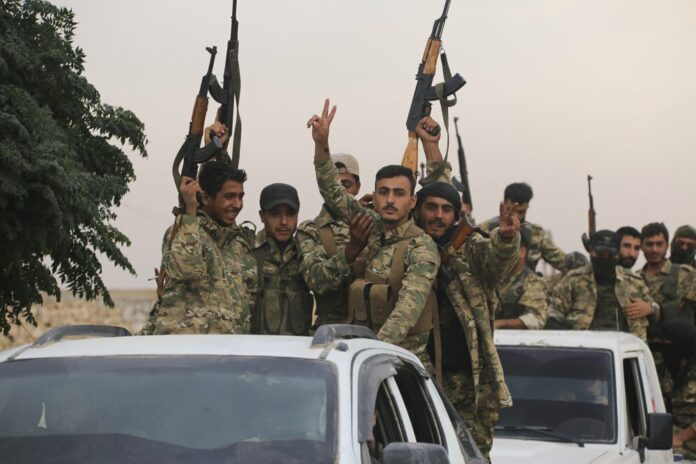
A convoy of Turkish backed Free Syria Army is about to cross into Turkey near the town of Azaz, Syria, Wednesday, Oct. 16, 2019. (AP Photo)
CEYLANPINAR, Turkey (AP) — Syrian forces on Wednesday night rolled into the strategic border town of Kobani, blocking one path for the Turkish military to establish a “safe zone” free of Syrian Kurdish fighters along the frontier as part of its week-old offensive.
The seizure of Kobani by forces loyal to Syrian President Bashar Assad also pointed to a dramatic shift in northeastern Syria: The town was where the United States military and Kurdish fighters first united to defeat the Islamic State group four years ago and holds powerful symbolism for Syrian Kurds and their ambitions of self-rule.
The convoys of government forces drove into Kobani after dark, a resident said. The resident, who spoke on condition of anonymity for fear of reprisal, was one of the few remaining amid fears of a Turkish attack on the town. Syria’s state-run media confirmed its troops entered the town.
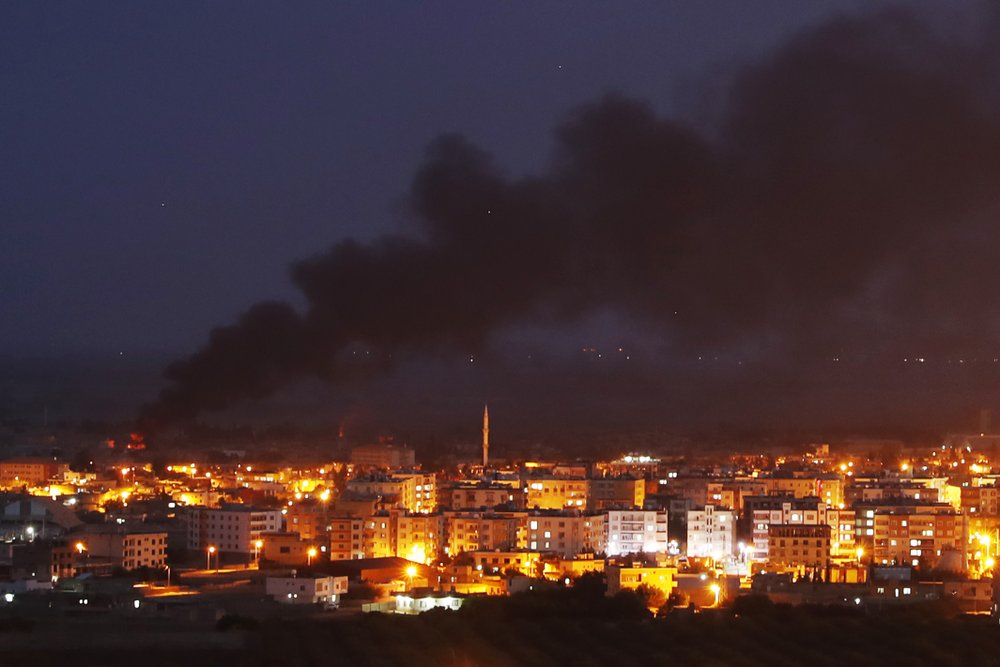
In this photo taken from the Turkish side of the border between Turkey and Syria, in Ceylanpinar, Sanliurfa province, southeastern Turkey, smoke billows from fires in Ras al-Ayn, Syria, caused by bombardment by Turkish forces, Wednesday, Oct. 16, 2019. (AP Photo/Lefteris Pitarakis)
Syria’s presence in Kobani puts a firm limit on Turkish ambitions in its offensive. The town lies between a Turkish-controlled enclave farther west and smaller areas to the east that Turkey seized in the past week.
Turkey had talked of creating a 30-kilometer (19-mile) deep “safe zone,” driving out Kurdish fighters from the border region. Turkish forces had shelled Kobani in recent days as part of the offensive but had not advanced ground troops on it.
The battle for Kobani turned the once-nondescript town into a centerpiece of the international campaign against IS, with TV cameras flocking to the Turkish side of the border to track the plumes of smoke rising from explosions in the besieged town. Then-U.S. Secretary of State John Kerry declared it would be “morally very difficult” not to help Kobani.
The IS extremists were finally driven out in early 2015 in their first major defeat, and an alliance was cemented that would eventually bring down the group’s “caliphate” in Syria.
Now the Kurdish authority agreed to allow Damascus to deploy its military in the town and other parts of northeast Syria to protect them from Turkey’s offensive launched after U.S. President Donald Trump pulled back American troops working with the Kurds.
On Wednesday, the U.S-led coalition said it had vacated a cement factory south of Kobani, which had served as a coordination center with the Kurdish-led forces. Coalition spokesman Col. Myles Caggins said that after troops left the base, two U.S. fighter jets launched pre-planned airstrikes to destroy ammunition that was left behind.
The coalition also said its forces had left Raqqa, the former capital of the Islamic State that was liberated in 2017, and Tabqa, a town to the west.
“Coalition forces continue a deliberate withdrawal from northeast Syria,” Caggins tweeted.
After being effectively abandoned by the U.S., the Kurds’ turn to the Syrian government for protection has allowed Damascus’ ally, Russia, to step in as the biggest power player.
Moscow further asserted that role Wednesday, offering to mediate a resolution to the conflict, one day before U.S. Vice President Mike Pence was to begin a mission to press Turkey for a cease-fire.
On Monday, Trump imposed limited economic sanctions on Turkey to raise the pressure on Ankara. The move came five days after Trump raised the specter of sanctions in a letter to Turkish President Recep Tayyip Erdogan, in which he also said that if the Turkish leader invaded Syria he would be remembered as a “devil.” Trump told Erdogan he wouldn’t want to be responsible for “slaughtering thousands of people,” and warned, “don’t be a tough guy. Don’t be a fool!”
Erdogan defied the sanctions, saying the only way its military offensive would end was if Syrian Kurdish fighters leave a designated border area.
Erdogan also said he had “no problem” accepting an invitation from Russian President Vladimir Putin to visit Russia soon to discuss Syria. But he threw into doubt a planned Nov. 13 meeting with Trump, citing anger over the sanctions that Washington imposed Monday on the NATO ally.
Despite an outcry among both Democratic and Republican lawmakers over the pullout and the Turkish invasion, Trump insisted a fight between Turkey and the Kurds was not a U.S. problem and that things are “very nicely under control” in northern Syria.
“Syria’s friendly with the Kurds. The Kurds are very well-protected. Plus, they know how to fight. And, by the way, they’re no angels,” Trump told reporters at the White House while meeting with Italian President Sergio Mattarella.
Trump added that U.S. troops are “largely out” of the region, adding that if Russia wanted to get involved with Syria, “that’s really up to them. It’s not our border. We shouldn’t be losing lives over it.”
Still, the repercussions from America’s abrupt withdrawal were expanding. Assad’s forces are returning to regions of northern Syria they abandoned at the height of the 8-year-old civil war. Moscow has taken a more prominent role as an interlocutor among Assad, the former U.S.-allied Kurds and Turkey.
Erdogan’s office confirmed the Turkish leader would meet Thursday with Pence and Secretary of State Mike Pompeo, and said he would travel to Sochi, Russia, for talks on Tuesday.
Erdogan said he was not concerned by the U.S. sanctions. He told reporters that chances for his November trip to Washington are “something to be assessed” after the talks with the American delegation, he said, adding that the sanctions and criticisms in the U.S. constituted “great disrespect toward the Turkish Republic.”
In an address to his ruling party legislators, Erdogan said Turkey would not be coerced into halting its offensive or accepting offers for mediation with the Kurdish fighters, which Turkey considers to be terrorists.
“Our proposal is for the terrorists to lay down their arms, leave their equipment, destroy the traps they have created, and leave the safe zone we designated, as of tonight,” Erdogan said. “If this is done, our Operation Peace Spring will end by itself.”
In a speech to Parliament, Turkish Foreign Minister Mevlut Cavusoglu said Turkey won’t be affected by “sanctions and threats.” He also said Turkey would “give the appropriate answer to these sanctions.”
Turkish forces and Kurdish fighters also battled over the border town of Ras al-Ayn. Turkey said it had captured the town days ago, but its hold appeared uncertain.
Russian Foreign Minister Sergey Lavrov said in remarks carried by Russian news agencies that Moscow is committed to mediating between Syria and Turkey.
Russia already has announced it had deployed troops outside the flashpoint town of Manbij to keep apart the Syrian military and Turkish-led forces. Syrian forces took control of Manbij as U.S. troops completed their pullout from the town Tuesday.
Lavrov also said Moscow will also continue to encourage Syria’s Kurds and government to seek rapprochement following the U.S. withdrawal. The Kurds are hoping to reach a deal with Damascus that preserves at least some degree of the autonomy they seized for themselves during the civil war.
Lavrov also blamed the U.S. and the West for undermining the Syrian state, saying this pushed “the Kurds toward separatism and confrontation with Arab tribes.”
In another sign of Moscow’s rising profile, France suggested it will also work more closely with Russia in Syria.
French Foreign Minister Jean Yves Le Drian said told French TV channel BFM that France is now looking to Russia, given their “common interests” in defeating the Islamic State group in Syria.
A U.N. Security Council meeting concluded with no call for Turkey to end its military offensive against the Kurds. Instead, the diplomats issued a brief statement expressing concern about the dispersal of “terrorists” from the region and the humanitarian impact.
___
Mroue contributed from Beirut. Associated Press writer Suzan Fraser in Ankara, Turkey, and Albert Aji in Damascus, Syria, contributed.
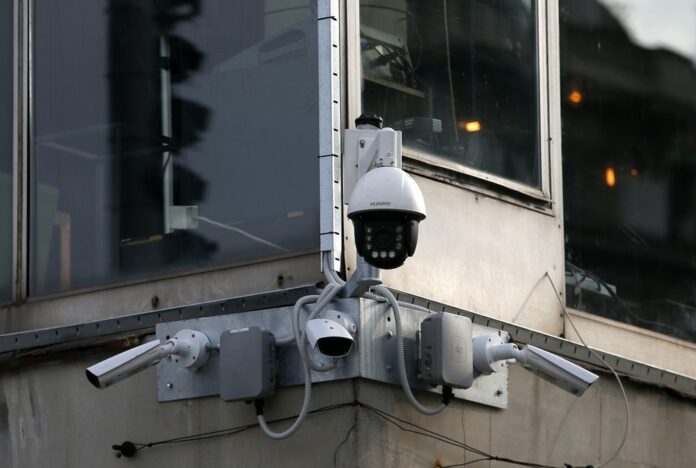
In this photo taken Sept. 25, 2019, high-tech video cameras hang from an office building in downtown Belgrade, Serbia. (AP Photo/Darko Vojinovic)
BELGRADE, Serbia (AP) — When hundreds of video cameras with the power to identify and track individuals started appearing in the streets of Belgrade as part of a major surveillance project, some protesters began having second thoughts about joining anti-government demonstrations in the Serbian capital.
Local authorities assert the system, created by Chinese telecommunications company Huawei, helps reduce crime in the city of 2 million. Critics contend it erodes personal freedoms, makes political opponents vulnerable to retribution and even exposes the country’s citizens to snooping by the Chinese government.
The cameras, equipped with facial recognition technology, are being rolled out across hundreds of cities around the world, particularly in poorer countries with weak track records on human rights where Beijing has increased its influence through big business deals. With the United States claiming that Chinese state authorities can get backdoor access to Huawei data, the aggressive rollout is raising concerns about the privacy of millions of people in countries with little power to stand up to China.
“The system can be used to trail political opponents, monitor regime critics at any moment, which is completely against the law,” said Serbia’s former commissioner for personal data protection, Rodoljub Sabic.
Groups opposed to Serbian President Aleksandar Vucic say police are leaking video of protests to pro-government media, which publish the images, along with the identities of participants. Vucic himself has boasted the police have the capability to count “each head” at anti-government gatherings. During a recent rally, protesters climbed up a pole and covered a camera lens with duct tape scrawled with the word “censored.”
Serbian police deny any such abuse of the Huawei system, which will eventually encompass 1,000 cameras in 800 locations throughout Belgrade. Huawei said in a statement that it “complies with all applicable laws and regulations” in Serbia and anywhere else it does business.
Members of a rights group paint a woman’s face in an effort to confuse surveillance cameras in Belgrade. (AP Photo/Darko Vojinovic)
While facial recognition technology is being adopted in many countries, spurring debate over the balance between privacy and safety, the Huawei system has gained extra attention due to accusations that Chinese laws requiring companies to assist in national intelligence work give authorities access to its data.
As a result, some countries are reconsidering using Huawei technology, particularly the superfast 5G networks that are being rolled out later this year.
Still, Huawei, which denies accusations of any Chinese government control, has had no trouble finding customers eager to install its so-called Safe Cities technology, particularly among countries that China has brought closer into its diplomatic and economic orbit.
Besides Serbia, that list includes Turkey, Russia, Ukraine, Azerbaijan, Angola, Laos, Kazakhstan, Kenya and Uganda, as well as a few liberal democracies like Germany, France and Italy. The system is used in some 230 cities, exposing tens of millions of people to its screening.
In a promotional brochure, Huawei says its video surveillance technology can scan over long distances to detect “abnormal behavior” such as loitering, track the movement of cars and people, calculate crowd size and send alerts to a command center if it detects something suspicious. Local authorities can then act upon the information they receive.
In one case advertised on its website, the company says a suspect in a hit-and-run accident in Belgrade was later discovered in China with the help of face recognition data shared by the Serbian police with their Chinese counterparts.
In view of the cybersecurity accusations leveled by the U.S. and international rights groups against Huawei, the relationship between China and countries that use the company’s technology is coming under renewed scrutiny.
China’s influence in Serbia, a European Union candidate that Beijing views as a gateway to the continent, has significantly expanded in recent years through Beijing’s global Belt and Road investment programs. The populist Serbian regime has been keen to develop closer ties and the country’s fragile democracy allows China’s economic interests to grow relatively unchecked, without raising too many questions about human rights, environmental standards or transparency.
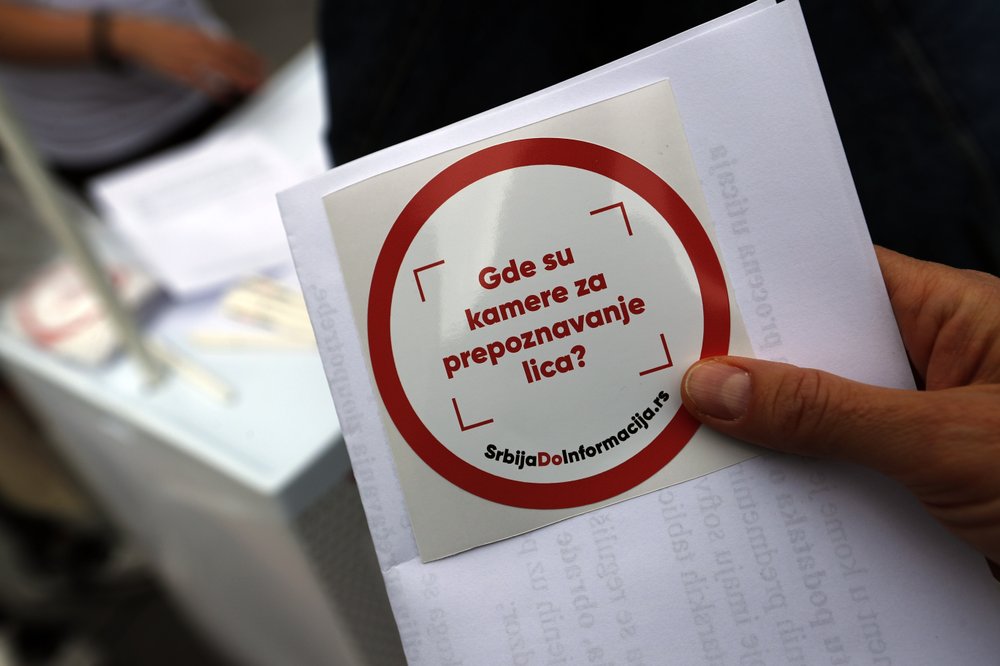
An activist in Belgrade shows a sticker that reads: ”Where are cameras for face recognition? (AP Photo/Darko Vojinovic)
China’s state investment bank has granted billions of dollars in easy-term loans to build coal-powered plants, roads, railroads and bridges. Chinese police officers even help patrol the streets of Belgrade, a security presence officially billed as assisting the growing number of Chinese tourists who visit the city.
It’s a similar story in Uganda, where China has invested heavily in infrastructure like highways and a hydropower dam on the Nile.
When longtime President Yoweri Museveni launched a $126-million project to install Huawei facial recognition systems a year ago, he said the cameras were “eyes, ears and a nose” to fight rampant street crime in the sprawling capital, Kampala. Opposition activists say the real goal is to deter street protesters against an increasingly unpopular government.
“The cameras are politically motivated,” said Joel Ssenyonyi, a spokesman for the musician and activist known as Bobi Wine who has emerged as a powerful challenger to Museveni. “They are not doing this for security. The focus for them is hunting down political opponents.”
In neighboring Kenya, the government has also renewed its focus on public safety after a spate of extremist attacks. It has been pushing to register people digitally, including by recording DNA, iris and facial data. To do so, it turned to China, which helped finance the installation of surveillance cameras in Kenya as far back as 2012.
The Kenyan government wants to pool into one database all the information from public and private CCTV cameras, including those with facial recognition technology, a move that activists warn would vastly expand its surveillance powers in a country that does not have comprehensive data protection laws.
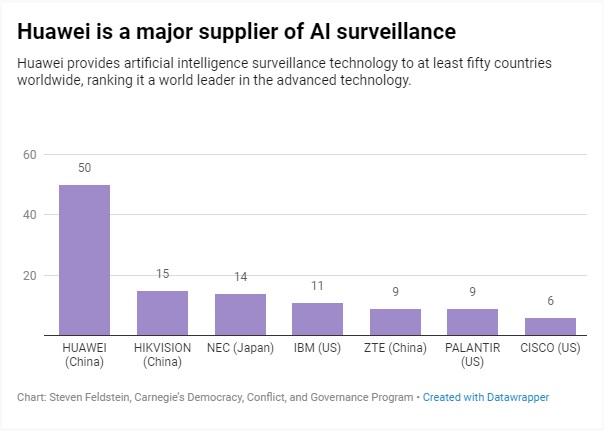
A growing number of countries are following China’s lead in deploying artificial intelligence to track citizens, according to the Carnegie Endowment for International Peace. The group says at least 75 countries are actively using AI tools such as facial recognition for surveillance — and Huawei has sold its systems in 50 of those countries, giving it a far wider reach than competitors such as Japan-based NEC and U.S.-based IBM.
“It’s very unclear what safeguards are being put in place,” said Steven Feldstein, a Carnegie Endowment fellow who authored a report on the issue. “Where are images being stored? How long are they being stored for? What kind of accountability procedures will there be? What type of operations will be linked to these surveillance cameras?”
Huawei said in an emailed statement that it “complies with all applicable laws and regulations in our countries of business. This is the most fundamental principle of our business operations. We are dedicated to bringing people better connectivity, eliminating digital gaps, and promoting the sustainable development of our societies and economies.”
In Belgrade’s bustling downtown Republic Square, high-tech video cameras are pointed in all directions from an office building as pedestrians hurry about their everyday business.
With public authorities disclosing little about how the cameras work, a rights group has set up a tent to ask pedestrians whether they know they are being watched.
“We don’t want to be in some kind of Big Brother society,” said rights activist Ivana Markulic. “We are asking: Where are the cameras, where are they hidden, how much did we pay for them and what’s going to happen with information collected after this surveillance?”
___
Associated Press writers Jovana Gec in Belgrade, Serbia; Rodney Muhumuza in Kampala, Uganda; Tom Obula in Nairobi, Kenya, and Matt O’Brien in Providence, Rhode Island, contributed to this report.
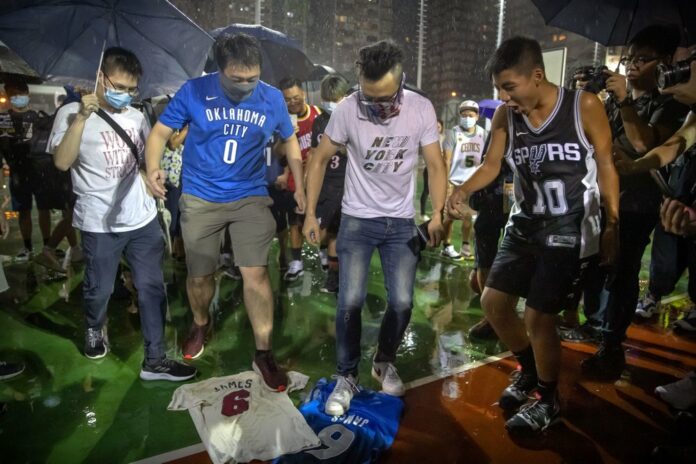
Demonstrators stamp on Lebron James jerseys during a rally at the Southorn Playground in Hong Kong, Tuesday, Oct. 15, 2019. Protesters in Hong Kong have thrown basketballs at a photo of LeBron James and chanted their anger about comments the Los Angeles Lakers star made about free speech during a rally in support of NBA commissioner Adam Silver and Houston Rockets general manager Daryl Morey, whose tweet in support of the Hong Kong protests touched off a firestorm of controversy in China. (AP Photo/Mark Schiefelbein)
HONG KONG (Xinhua) — The Hong Kong police said Wednesday they had seized explosives in several cases before and after one homemade bomb was detonated near a police vehicle on Sunday.
In a press conference, the police said evidences have shown that rioters in the months-long violence were planning lethal attacks similar to terrorism.
On Tuesday evening, two males, aged 17 and 23, were arrested after police found six petrol bombs and a suspected mobile phone-modified bomb detonator, said Raymond Chou, superintendent of Narcotics Bureau (Operations).
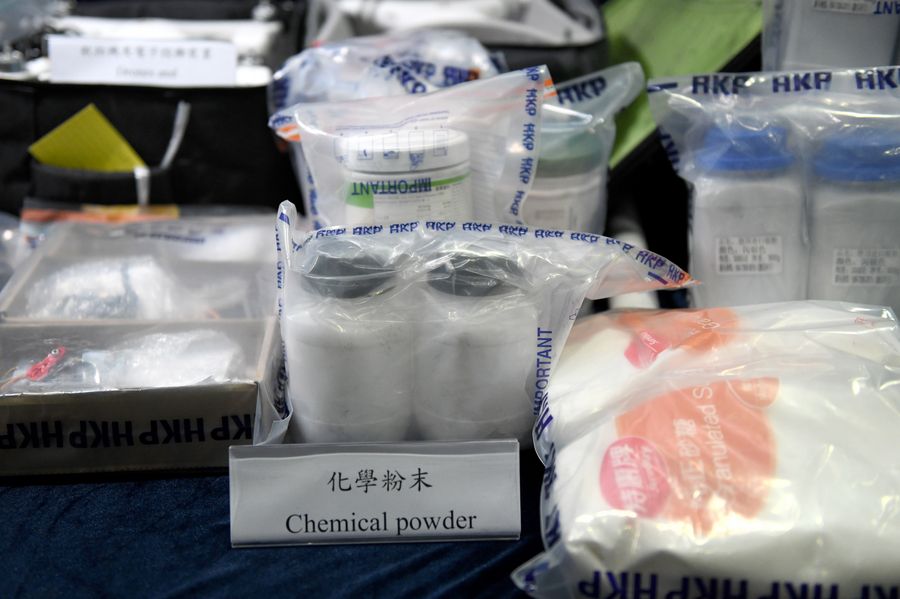
The Hong Kong police show at a press conference on Oct. 16, 2019 the materials used to make petrol bombs which were seized recently. (Xinhua)
They faced charges including possession of explosives, unlawful assembly and possession of offensive weapons.
The arrests followed a remote-controlled homemade bomb was detonated near police officers who were clearing roadblocks set by rioters on Nathan Road, Kowloon, on Sunday. Police said it was the same explosive device used by terrorists all around the world.
Chou said three drones and projecting devices, as well as knifes and smoke shells, were also confiscated during the Tuesday swoop. The superintendent said using drones to project dangerous objects in densely populated places could cause heavy casualties.
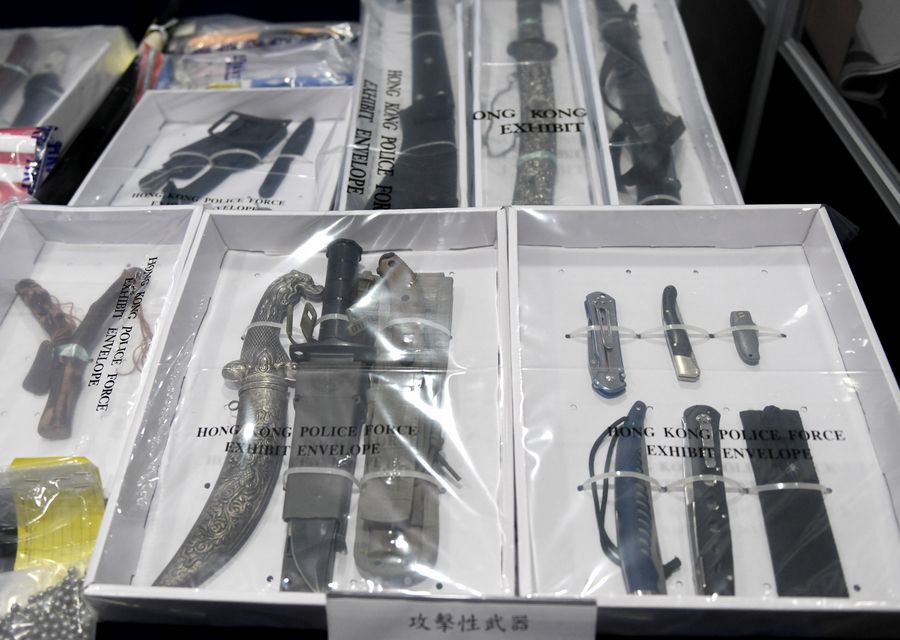
The Hong Kong police show at a press conference on Oct. 16, 2019 the assault weapons and the tools to make the assault weapons which were seized recently. (Xinhua)
The police have seized explosives or bomb-producing materials in several cases since July. On July 20, explosives, fire bombs and offensive weapons were found in a building in Tsuen Wan. On Aug. 1, materials for making explosives were seized inside a residential building in Tin Shui Wai.
Suryanto Chin-chiu, superintendent of the Explosive Ordnance Disposal Bureau, warned that homemade bombs are unstable and could explode during production and transportation, posing a big threat to public safety.
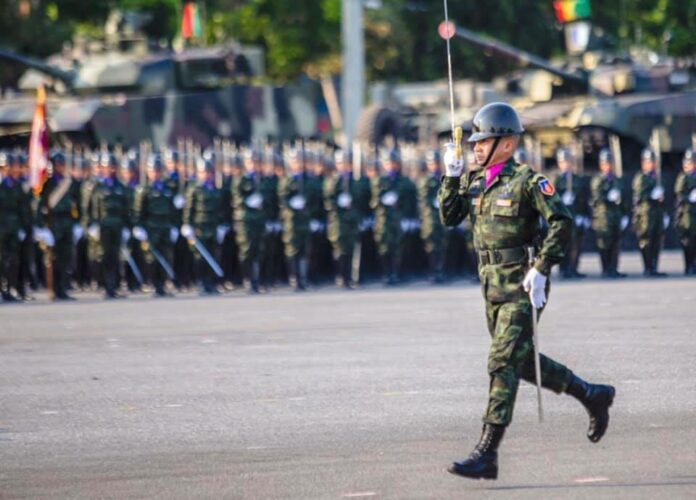
The army's 1st Division seen at a military parade on Jan. 18, 2019. Image: Royal Thai Army.
BANGKOK — The government is set to defend its emergency decree that handed two army units to His Majesty the King’s direct control when the parliament meets on Thursday.
The order was issued on Sep. 30 by Prime Minister Prayuth Chan-ocha without parliament’s approval, citing unspecified “emergency” for its urgent enactment. Under Thai laws, such decrees must be scrutinized and debated in parliament after they are proclaimed.
The decree transferred the 1st and 11th Infantry Divisions from the army’s structure and put them under the king’s personal command, ostensibly for better coordination in providing security to the Royal Family.
Tomorrow’s session will focus mostly on whether the government’s decision to enact the law unilaterally without going through the usual parliamentary channel was appropriate, and not the merits of the transfer itself.
Pro-democracy activist Arnon Nampha urged the opposition to vote down the decree because there was no real emergency that warrants its bypassing of parliament. He also said severing the army’s chain of command over the two units would lead to legal complications.
“Members of the Parliament must have the courage to stand up and prevent the risks of expanding royal power, in order to protect the principle of democracy with the King as head of state,” Arnon wrote online on Tuesday.
But there are signs that the opposition will not put up much of a fight due to the sensitive nature of the Royal Decree. Major parties are expected to pose no challenge, while a BBC Thai report said some MPs in the Future Forward Party have urged their executives to abstain.
Responding to the article, Future Forward leader Thanathorn Juangroongruangkit said on Tuesday the party has not made any decision regarding the votes.
PM Prayuth said today he will let the parliament discuss the decree without interference from the executive branch.
Thursday’s parliament session will also debate the government’s budget of 3.2 trillion baht for the 2020 fiscal year.
Note: Some details were omitted from this article due to legal concerns.