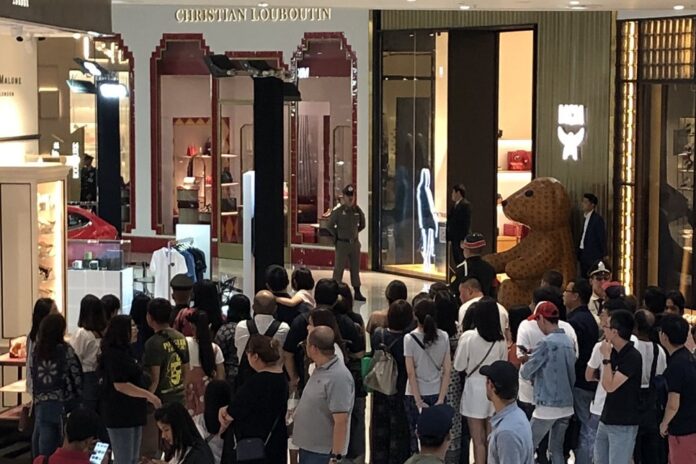
Police block a passage in Siam Paragon shopping mall on Sep. 28, 2019. Image: @pattmon_m / Twitter
After sending me messages that he has deactivated his Facebook page because he received a warning as a result of criticizing a recent royal motorcade, I rang up the young political activist.
The activist, who asked not to be named, is known for being critical of the monarchy on Facebook and is usually rather cocky – a political exhibitionist.
But now, he sounded fearful.
The man pulled the plug off Facebook on Thursday night after receiving an SMS claiming to be from the palace.
“Please delete all your social network accounts by tonight for your safety,” the English-language message reads. There is no available phone number to call back, only the ominous sender’s identification as “Royal Thai Palace.”
Such method was never deployed before, I told him on the phone, and therefore its usage is really dubious.
Normally either the police or soldiers will contact you by phone or in person for infringements against the lese-majeste law. Then there is the issue of the language. Why English? And why no number to call back? Also, the office is known as the Royal Household Bureau in English, not “Royal Thai Palace.”
Thus, I think it’s fake and from an imposter, not the Royal Household Bureau and suggested he to go to his mobileservice provider to check the number of the sender, or just call the Royal Bureau Household for verification.
However, he didn’t commit himself and told me his lawyers told him to lie low for the meantime.
“I think you are being taken for a ride. It’s most likely a bluff from [Thai] social media users who are out to scare you and create a climate of fear,” I told him.
I tried to contact the Royal Household Bureau several times, but with no luck as of press time (a palace official told Prachatai website he hasn’t heard of the message, and suggested that it’s probably a hoax).
While I think it’s most likely an impostor sending him the SMS as a bluff, his fear was real. And the climate of fear in critically speaking your mind about the monarchy is very real.
As we were winding down our conversation on the phone Friday afternoon, the activist told me a brief SMS message in English without number was sent to him just now.
“Thanks for your cooperation,” it read.
This came after a few days of netizens, particularly Twitter users, airing their anger at traffic woes caused by a royal motorcade on Tuesday which forced many roads and intersections to shut down during rush hour.
A Twitter hashtag in Thai-language #RoyalMotorcade quickly trended on Wednesday and reached a height of over 716,000 tweets by Thursday morning.
Those affected said they were stranded in traffic for nearly an hour. Some said they saw police instructing an on-duty ambulance to turn off the siren. One such Tweet, from user @peeoioixx was retweeted 63,900 times as of Friday afternoon despite the user having just 1,261 followers.
While it’s not clear which member of the royal family was travelling on Tuesday, what’s clear is the wrath expressed by the anonymous netizens – many using avatars on Twitter and Facebook.
Some feel invisible and unrestrained by the draconian lese-majeste law because they feel they cannot be easily identified on Twitter and won’t be held accountable.
The activist who contacted me used his real name and family name on Facebook, however. He is fairly well-known among political activists and beyond.
If anything, the fact that the mainstream media simply censored themselves from reporting about the incident only made social media the only option for people to vent out their frustration.
The incident reminds us that in Thailand, certain topics cannot be publicly deliberate without severe risks.
It also tells us that many are now taking the risks to express critical views about the monarchy anonymously on social media.
Social media has become Thai public sphere of last resort to discuss what most of the mainstream mass media won’t even dare consider.
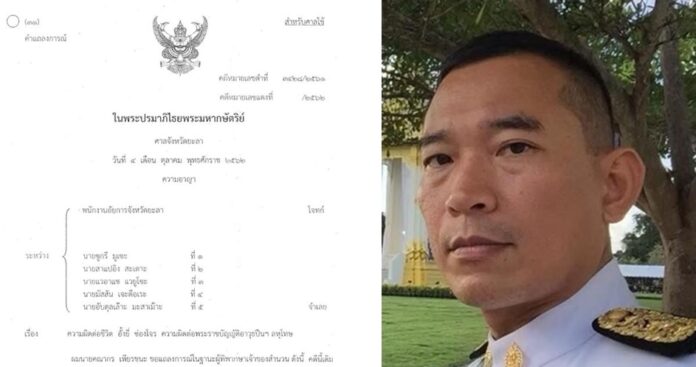
An undated file photo of Khanakorn Pianchana and his verdict.
YALA — Thailand’s courts find themselves under intense scrutiny Friday after a judge shot himself to protest alleged interference in a trial that would have sent five men to death row.
Yala senior judge Khanakorn Pianchana pulled out a handgun and shot himself in the chest inside a courtroom moments after he acquitted five defendants of murder and firearm charges. In a court filing leaked on social media after his suicide attempt, Khanakorn said he was pressured by his supervisor to find the men guilty despite lack of evidence.
Khanakorn’s statements were written inside a full court verdict, which is typically released to the press after a ruling.
The judge said he was threatened by regional justice chief Permsak Saisrithong to deliver a guilty verdict on the five defendants, or Khanakorn himself would be placed under a disciplinary hearing if he disobeys.
Khanakorn said he could not bring himself to condemn the men due to lack of hard evidence. If found guilty, the defendants would have faced death penalty.
“Return justice to the people,” Khanakorn wrote at the end of the 25-page verdict. “My statements might hold weight as light as a feather, but a judge’s heart must be as firm as a mountain.”
Court spokesman Suriyan Hongvilai said the matter is under investigation and told reporters that a preliminary inquiry established that Khanakorn attempted suicide due to “personal stress.” However, that didn’t stop a wave of outcry and concerns for fairness in Thailand’s justice system on social media.
“If even a judge has to fight for justice, then what we the people do?” one popular Facebook page wrote.
Suspicions of interference in other cases were also raised because Khanakorn wrote in his statement that his experience was far from unique.
“At this moment, other fellow judges in Courts of First Instance across the country are being treated the same way as I was,” he wrote. “[If] I cannot keep my oath of office, I’d rather die than live without honor.”
Eyewitnesses at the scene told the media Khanakorn rose from his dais, turned to face the king’s portrait hung at the front of the courtroom, then shot himself. He remains in critical condition at the hospital.
Future Forward Party deputy leader Piyabutr Saengkanokkul said he doesn’t believe the official explanation that Khanakorn shot himself out of personal stress.
Writing in a Facebook post, Piyabutr said he has received information from the defendants that appears to confirm Khanakorn’s allegation of interference in the case. Piyabutr, who taught law before entering politics, said he will release the information “soon.”
The trial that led to Khanakorn’s suicide attempt involves murders of five people at a home in Yala province in June 2017. Police later arrested five suspects and accused them of engineering the murders.
But in his verdict, Khanakorn said investigators failed to produce evidence that would have implicated the five men beyond reasonable doubt.
He also filmed himself in a short video, leaked to social media after his suicide attempt, saying that the men weren’t necessarily innocent of the crimes, but there was no enough grounds to condemn them.
“When we punish someone, the punishment wasn’t limited to them alone. Their family is punished, too,” Khanakorn says in the video, which appears to have been filmed on the judge’s dais. “Therefore, if we are not absolutely sure, we shouldn’t punish someone.”
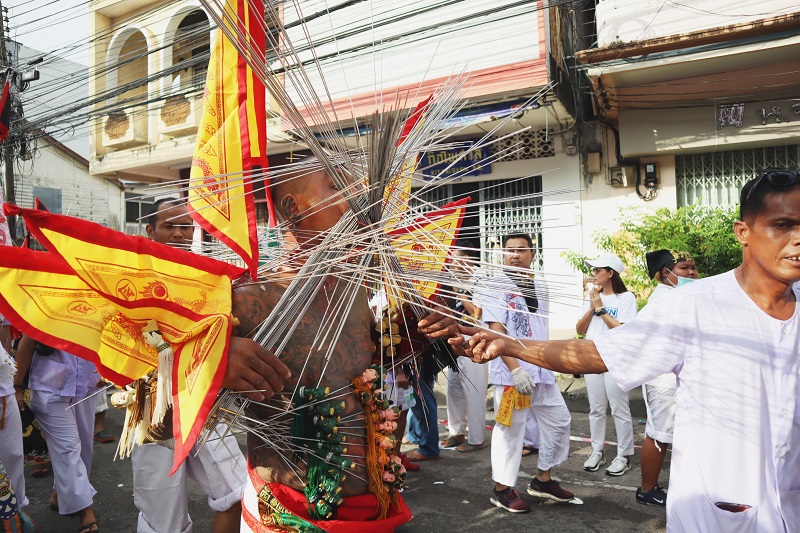
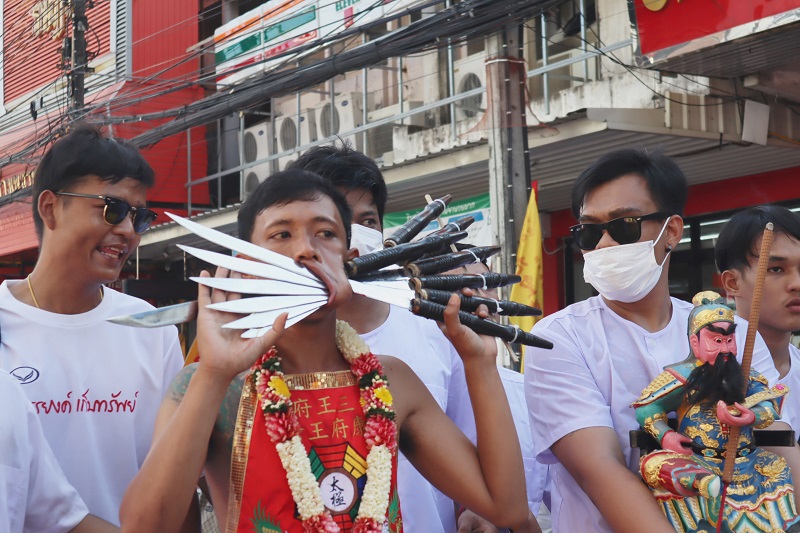
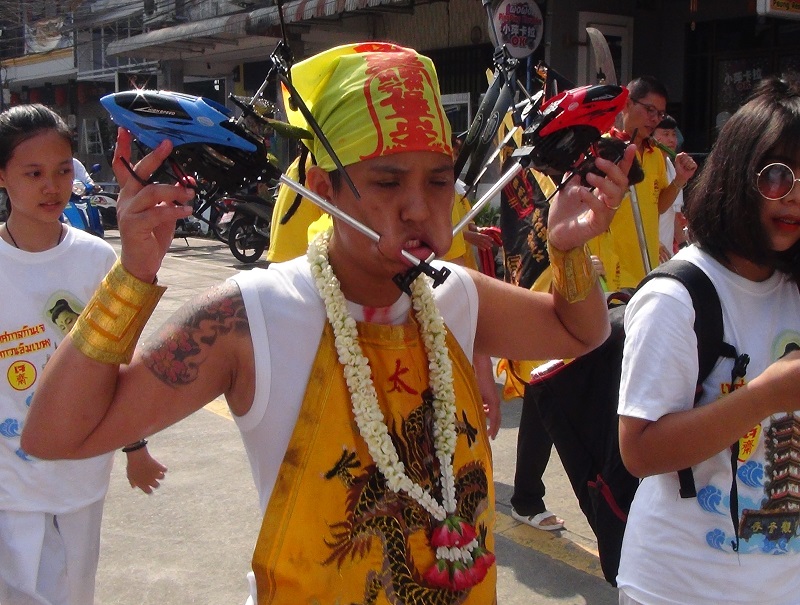
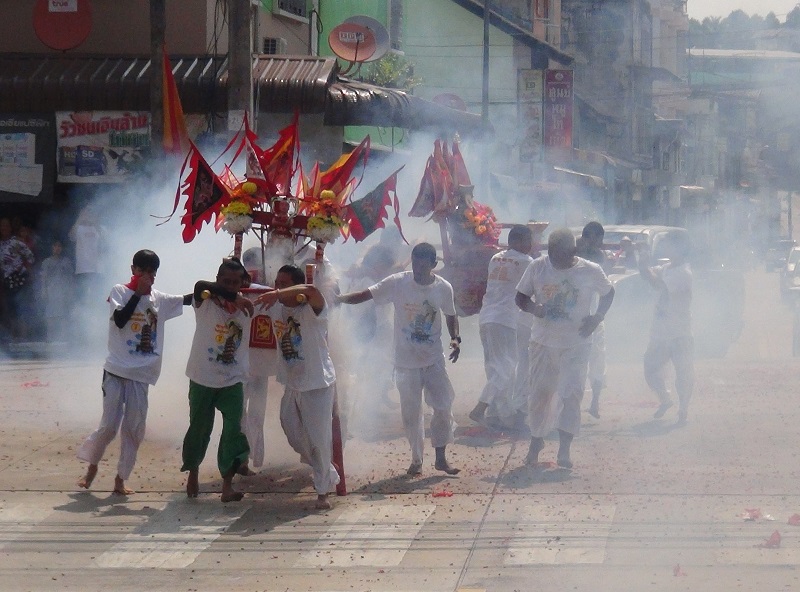
PHUKET — The purification week of 2019 vegetarian festival, or Kin Jae, entered its sixth day with parades of mediums channeling divine powers by shoving swords and blades into their bodies.
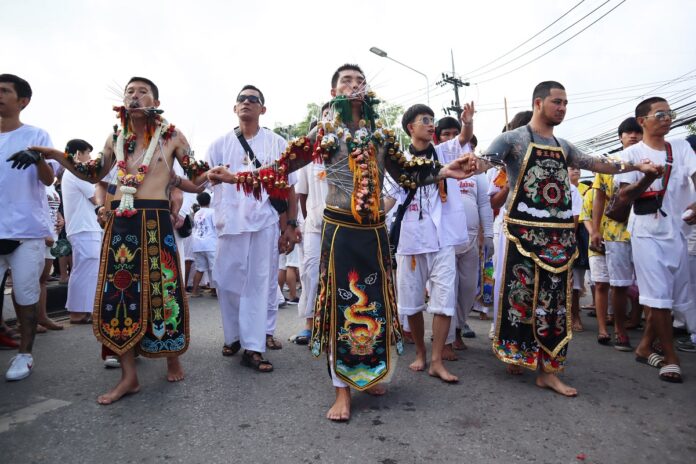
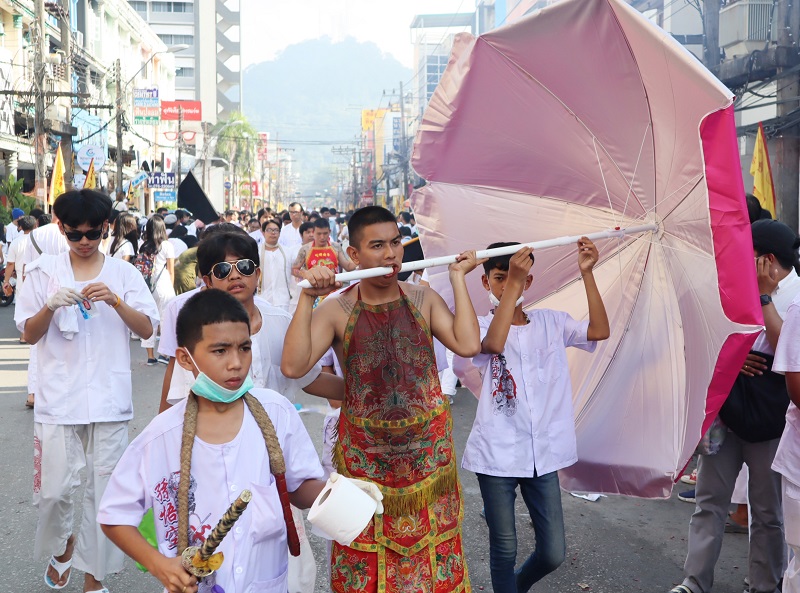
The iconic spectacle of Kin Jae returned to the streets of Phuket today, where dozens of the ma song, or spiritual channelers, walked in parades with swords, knives, needles, umbrellas, flags, and all kinds of imaginable pointy devices stuck in their faces, mouths, and torsos.
Kin Jae festivities in Phuket on Oct. 4, 2019.
Similar self-mutilation rituals also took place in Trang and Yala provinces.
Rooted in the Taoist belief of self-purification, followers of Kin Jae festival are required to refrain from eating animal products or committing impure acts until the holy week is over on Oct. 8.
Kin Jae festivities in Phuket on Oct. 4, 2019.
The ma song are regarded by the faithfuls to be possessed by the gods, who bring pain and misfortune to themselves on behalf of those who follow the Kin Jae rituals.
Less extreme displays of Kin Jae zeal can be found in Prachuap Khiri Khan province, where a giant bowl of vegetarian rice bowl was cooked for hundreds of people. Festival worshipers, mostly with Thai-Chinese backgrounds, also head to temples while dressed in white and prayed for spiritual purity.
Kin Jae festivities in Phuket on Oct. 4, 2019.Kin Jae festivities in Yala on Oct. 4, 2019.Kin Jae festivities in Yala on Oct. 4, 2019.Kin Jae festivities in Hua Hin on Oct. 4, 2019.
BANGKOK — A Belgian journalist was briefly detained while he was preparing to interview a prominent Redshirt activist, a media organization said Friday.
The Foreign Correspondents’ Club of Thailand said Kris Janssens, a Belgian freelance reporter, was taken into custody for over four hours by the immigration police on Thursday morning when he was about to interview Anurak “Ford” Jeantawanich, who has been assaulted several times this year.
“It is deeply disturbing when authorities anywhere try to dictate who foreign journalists should or should not interview,” the statement said. “The Thai government should continue to allow foreign journalists to report on political issues here without facing threats of unspecified legal action.”
According to the statement, the Phnom Penh-based journalist was escorted from his hotel to the immigration bureau headquarters on Thursday morning. During his questioning, he was advised by officials not to continue his plan to interview Anurak and told to leave the country immediately.
Immigration police declined to comment on the news. National police spokesman Krissana Pattanacharoen said he is investigating the matter.
Although Kris was eventually released without any charges, he was threatened not to tell Anurak about his detention or report on Thai politics, Anurak said on his public Facebook post.
“The Special Branch Police called me about Kris two days ago. I believe the bureau knows exactly which unit detained him and attempted to conceal it with intimidation,” Anurak said, referring to the police intelligence unit.
Kris, who described himself as a “freelance media producer … with a strong focus on human rights and environmental issues” in his website, could not be reached for comment as of press time.
In May, Anurak was beaten by six men in front of his home in Samut Prakan. Two months earlier, two men also broke into his home and assaulted him with wooden sticks. No one has been arrested in both cases.
Volunteers for Scholars of Sustenance cooking food from leftover ingredients at FREC Bangkok on June 17.
BANGKOK — A former girls’ school abandoned for more than 20 years will become a hub for family and environmentally-friendly activities for the public this Saturday.
A sustainable cooking class made from food surplus, a fertilizer workshop showing ways to compost food scraps, and a neighborhood tour around the historic Nang Loeng will be among the activities held for free at the Ford and Resources and Engagement Center (FREC) Bangkok this Oct. 5. There will also be activities for kids such as hands-on mapmaking and ecological lessons.
The all-day event will be held in celebration of the opening of the first FREC in Asia, where the three-story elementary school building has been revamped into a multi-purpose space for several non-profit organizations.
“Like our first FREC in Detroit, Michigan, FREC Bangkok is a long-term commitment to a neighborhood brimming with untapped potential,” president of Ford Motor Company Fund Jim Vella said. “Through food rescue programs, conservation projects, plastic upcycling, our FREC stewards an opportunity to deliver services that directly benefit people in the neighborhood and the city as a whole.”
Under the same roof, eight NGOs will co-host the activities in the shared office and meeting spaces. There is also a kitchen, where food security organization Scholars of Sustenance can cook meals from leftovers from hotels to feed orphans, and a vertical farm, where plants are grown to be used as ingredients.
Apart from food programs, attendees can also learn how to revitalize plastic waste into handcrafted products from Precious Plastic, learn how to rescue injured birds from the Bird Conservation Society of Thailand, and learn how to bring changes to communities from Urban Studies Lab.
In front of the center is a 120-year-old house that used to belong to a Siamese reformer Chao Phraya Thammasakmontri, a former education minister who pioneered the country’s first university Chulalongkorn University. The historic house has been turned to an arts hub Bangkok 1899, where food and drink from guest chef and urban refugee communities will be served.
“FREC Bangkok Open House” will be held at FREC Bangkok on Nakhonsawan Road. The event will run from 11am to 9pm on Oct. 5. Entry is free. The venue is reachable by a 5 minute walk from Phan Fa Lilat Pier stop of the Saen Saep Boat Service.
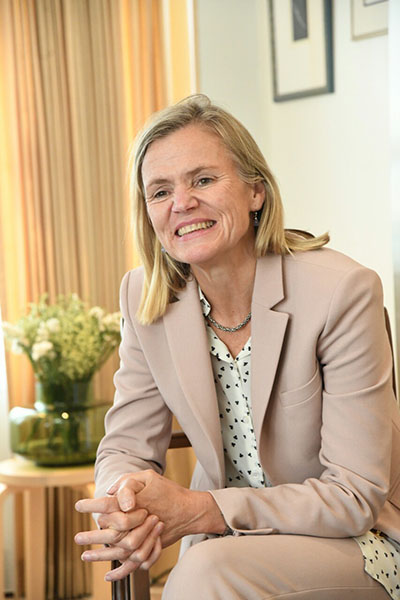
Norwegian ambassador to Thailand Kjersti Rodsmoen.
BANGKOK — Is your Bangkokian friend bragging on their Instastory about gorging on piles upon piles of “authentic” Japanese sashimi at a 999++ baht buffet? Chances are, they’re shoveling down kilos of one of Norway’s most important exports to Thailand.
Thailand is the fastest growing market in Southeast Asia for Norwegian seafood, especially salmon, said Kjersti Rodsmoen, the Norwegian ambassador.
“Thais are buying more and more salmon, and we’re very happy about that,” Rodsmoen said in a private interview with Khaosod English.
In 2018 alone, Norway exported 29,000 tons of seafood worth USD135 million to Thailand, or more than 4 billion baht, an increase of about 10 percent from the year before. This amount is about one percent of the total 2.7 million tons exported by Norway in that year.
Seafood trade, largely composed of salmon and mackerel, alone amounts for more than 21 percent of the entire worth of bilateral trade between Norway and Thailand, which was around USD640 million in 2018.
The amount is significant enough that the Norwegian Seafood Council, a public company by Norway’s fisheries ministry, officially relocated its Southeast Asian office from Singapore to Thailand earlier in 2019.
Norwegian salmon for sale at a Thai supermarket.
Other than all-you-can-eat buffets of salmon commonly found around the country, Norway’s mark on Thailand is also in the form of third-largest mobile phone provider Dtac, which is owned by Norwegian company Telenor.
On the other hand, Thais are selling machinery, vehicles and oil industry modules to Norway. In fact, Norwegian oil and gas supplier Aibel even has a Eastern Economic Corridor factory in Laem Chabang port in Chonburi producing parts for making oil platforms.
Of course, salmon isn’t the only thing Norway is sending downstream to Thailand.
Thailand is the second most popular tourist destination for Norwegians second only to Spain, with 130,000 to 140,000 Norwegians, both tourists and business travellers, visiting every year.
About Norwegian 5,000 expats reside in Thailand, with the number bumping up to almost 9,000 during the Norwegian winter. Some are retired and live in Pattaya, Hua Hin, and Phuket.
Rodsmoen says the Scandinavian “flygskam,” or flight shame movement which discourages plane travel for environmental reasons, hasn’t put a noticeable dent in any incoming tourist numbers to Thailand but said that eco-conscious Norwegians are “putting more and more pressure” on developing cleaner ways to fly.
Kjersti Rodsmoen.
Four times as many Thai expats reside in Norway, 20,000, but only 8,500 Thais visited Norway as tourists in 2018. Still, from January to August 2019, there was a 20 percent increase in Thai tourist numbers to the Land of the Midnight Sun.
Rodsmoen, 56, has worked in the Norwegian foreign service since 1988 and been stationed in places like New York, Mexico, and Latin America before taking up her Thai post in 2018.
Norwegians really are that gender-conscious and lovers of the outdoors, Rodsmoen said when asked to confirm or deny a stereotype about the country.
“A good stereotype is that we are really outdoorsy and love nature. I can confirm that Norwegians really love to wander in the mountains and the cold,” she said. “There really is a market for Norwegians to trek in the north of Thailand.”
A panel on a campaign to amend the junta-drafted constitution in Pattani province on Sep. 28, 2019.
BANGKOK — An army representative on Friday said he filed criminal complaints against 12 opposition leaders and academics who spoke in favor of amending the military-backed constitution last month.
Pheu Thai leader Sompong Amornwiwat, Future Forward Party chairman Thanathorn Juangroongruangkit and Songkram Kitlertphairote of Puea Chart Party were among those named in the complaint filed by Col. Burin Thongprapai to the police yesterday.
Political scientist Chalita Bundhuwong and news show host Sirote Klampaiboon were also accused in the same complaint. It alleged that the 12 incited unrest and sedition against the authorities when they spoke on Sep. 28. at a public panel in Pattani province about the opposition’s campaign to amend the current charter.
Burin said he represented the Internal Security Operation Command, an army-run agency tasked with counter-insurgency tasks.
In his filing, Col. Burin asked the police to prosecute the accused under Section 116 of the Criminal Code, which carries a maximum penalty of seven years in jail. Pattani police have yet to take action on Burin’s complaints.
Burin, who routinely filed similar complaints against critics of the military government in the past, did not cite any specific wrongdoing, but pro-establishment social media accounts have been slamming Chalita’s remarks at the panel in recent days.
Speaking in the Muslim-majority province known for its long history of independence movements against Bangkok, the academic said amending the Constitution’s very first chapter – “Thailand is one and indivisible Kingdom” – should be one option to help ease the tension.
“I hope the efforts to rewrite the constitution will give us space to discuss this. We must make it a normal thing to debate about amending many sections in the constitution … which may include Section 1,” Chalita said at the panel. “It’s not something strange.”
Pro-military news outlets soon seized her quote to accuse Chalita of advocating for a republic. In its headline on Oct. 1, prominent conservative newspaper Thai Post described Chalita as an academic “who proposed abolishing the Kingdom of Thailand.”
But Chalita said her detractors were taking her words out of context, as she clearly said in the speech that she was referring to Thailand’s unitary state, which may not grant adequate powers to local communities.
“We want a diverse and flexible state who wields a sovereign power with tolerance of differences,” Chalita said at the panel. “Thailand may not necessarily have a unitary or centralized state.”
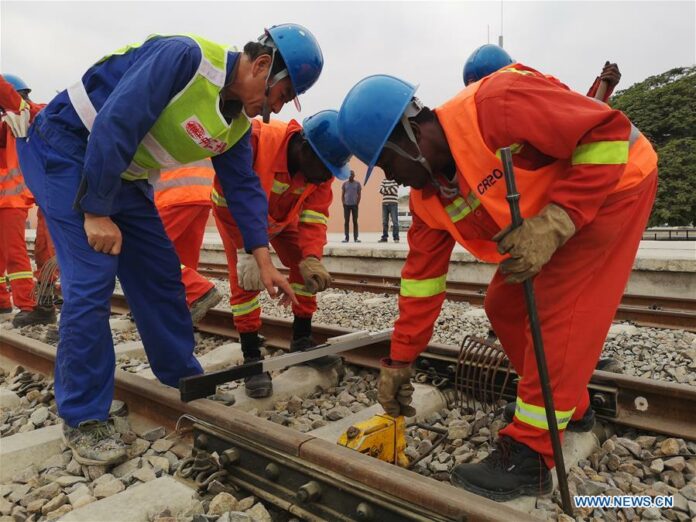
Workers of China Railway 20th Bureau Group Corporation perform maintenance work for the Benguela Railway in Lobito, Angola, Aug. 2, 2019. (Photo by Liu Zhi/Xinhua)
LOBITO, Angola (Xinhua) — The Benguela Railway, which was built by the China Railway 20 Bureau Group Corporation (CR20), was officially handed over to Angola in the port city of Lobito on Thursday.
The 1,344-km railway runs through Angola, from west of the Atlantic port city of Lobito, eastward through important cities such as Benguela, Huambo, Kuito and Luena, and reaches the border city of Luao, bordering the Democratic Republic of the Congo.
According to Han Shuchen, General Manager of CR20 Angola International Company, the Benguela Railway, which started construction in January 2006, was one of the most important projects in Angola after the civil war.
The total investment of the railway was about 1.83 billion U.S. dollars. It was contracted by CR20 for design, procurement and construction with Chinese standards.
During the construction, CR20 created more than 25,000 jobs for locals, and trained more than 5,000 technicians, including drivers, line workers, communication and signal technicians, said Han.
“Because of natural disasters, diseases and landmines, more than 20 Chinese employees and two local employees sacrificed their lives in the construction of the project. Their lives were honored for the unbreakable friendship between China and Angola.” he said.
On August 21, 2014, the Benguela Railway was announced to be completed and was delivered to the Angola authorities on July 27, 2017.
Luis Lopes Teixeira, chairman of the Benguela Railway company(CFB-EP), spoke at the handover ceremony that the official handover of the railway marked the beginning of a new era, with more cooperation projects and new investment for Angola.
Teixeira expressed confidence with CR20 in the future cooperation, and hoped that CR20 would have more cooperation and support in railway technology, practical operation, line maintenance and other aspects.
Ottoniel Mauro de Almeida Manuel, Director of the National Railways of Angola, stated that the official handover ceremony meant the transfer of responsibility.
Manuel said all the projects of the Benguela Railway are of good quality, and the test results of the equipment also prove that they meet the international standards of railway operation and traffic.
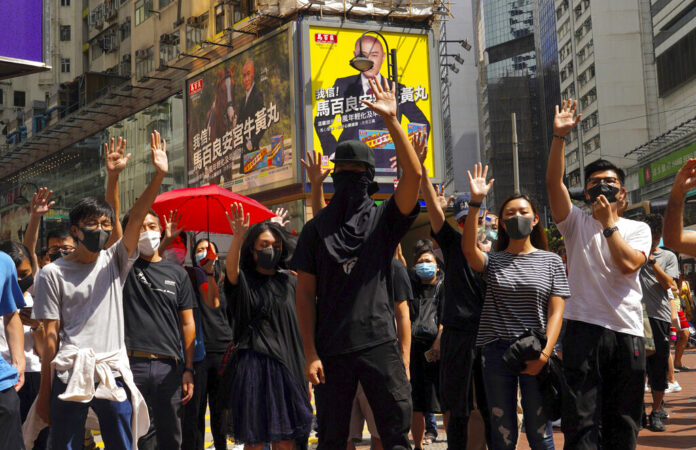
Protesters wear masks and hold up their hands to represent their five demands in Hong Kong Friday, Oct. 4, 2019. Hong Kong pro-democracy protesters marched in the city center Friday ahead of plans by the city’s embattled leader to deploy emergency powers to ban people from wearing masks in a bid to quash four months of anti-government demonstrations. Photo: Vincent Yu / AP
HONG KONG (AP) — Hong Kong leader Carrie Lam banned protesters from wearing masks in a hardening of the government’s stance on the territory’s most disruptive crisis since it reverted to Chinese rule in 1997.
Lam announced the ban at an afternoon news conference where she decried the escalation of violence recently after four months of anti-government demonstrations. The mask ban takes effect Saturday and applies to people at “illegal” gatherings who use violence and exempts those who wear masks for “legitimate need.” Lam said she would go to the legislature later to get legal backing for the rule.
Thousands of masked protesters chanted slogans calling for greater democracy as they marched in the city’s business district before Lam spoke. They chanted “I want to wear face masks” and “Wearing mask is not a crime” as many cars, stuck in traffic due to the march, honked in support.
“Will they arrest 100,000 people on the street? The government is trying to intimidate us but at this moment, I don’t think the people will be scared,” one protester, who gave his surname as Lui, told an online live broadcast.
At the nearby Causeway Bay shopping area, a huge crowd also occupied streets to protest the mask ban. Smaller rallies were also held in several other areas.
Analysts warned the use of the Emergency Ordinance for the first time in over half a decade set a dangerous precedent. The law, a relic of British rule enacted in 1922 to quell a seamens strike and last used to crush riots in 1967, gives broad powers to the city’s chief executive to implement regulations in an emergency.
“Even though the mask ban is just a small move under the Emergency Ordinance, it is a dangerous first step. If the anti-mask legislation proves to be ineffective, it could lead the way to more draconian measures such as a curfew and other infringement of civil liberties,” said Willy Lam, adjunct professor at the Chinese University.
The ban followed widespread violence in the city Tuesday that marred China’s National Day and included a police officer shooting a protester, the first victim of gunfire since the protests started in June over a now-shelved extradition bill. The wounded teenager was charged with attacking police and rioting.
The movement has since snowballed into an anti-China campaign amid anger over what many view as Beijing’s interference in Hong Kong’s autonomy. More than 1,750 people have been detained so far.
Activists and many legislators have warned the mask ban could be counter-productive, impractical and difficult to enforce in a city bubbling with anger and where tens of thousands have often defied police bans on rallies to take to the street.
“Five demands, not one less,” many protesters shouted during Friday’s rallies as they held up five fingers.
The government last month withdrew the extradition bill, widely slammed as an example of the erosion of Hong Kong’s freedom, but protesters have widened their demands to include direct elections for the city’s leaders, an independent inquiry into alleged police brutality, the unconditional release of protesters and not characterizing the protests as riots.
Anti-government protesters make fire to block traffic as they clash with police in Hong Kong, Tuesday, Oct. 1, 2019. Image: AP /Vincent Thian
HONG KONG (Xinhua) — Lavish pageants, cheerful dancers and crowds of photo-snapping tourists, all familiar sights at Hong Kong’s Disneyland, but a frequent visitor may notice something missing from the jamboree.
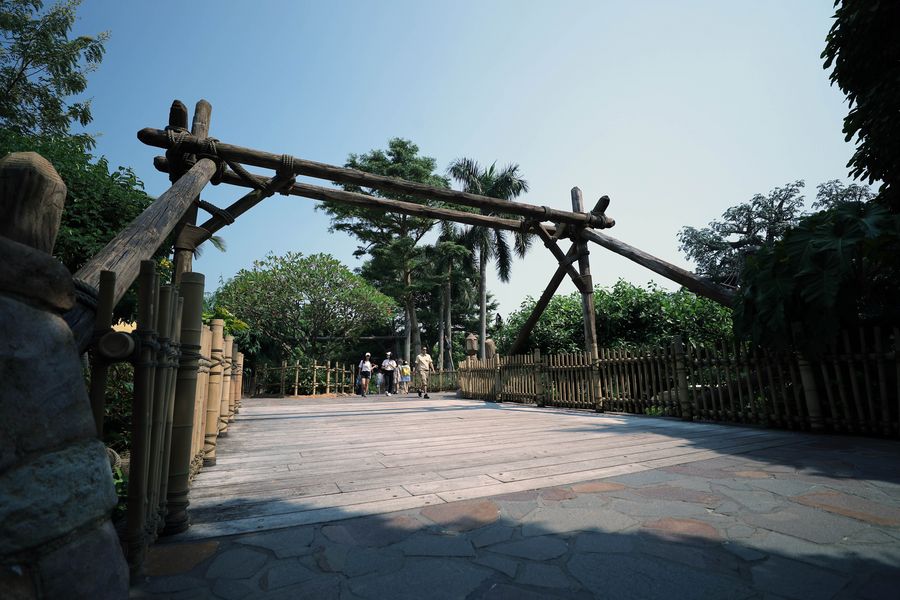
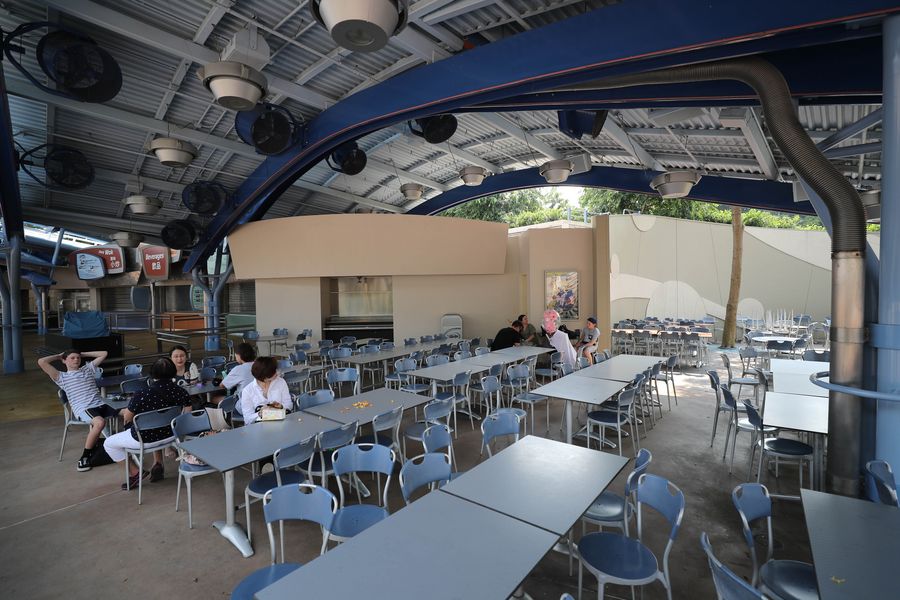
Long lines outside the theme park’s facilities were missing. So were many Mandarin-speaking visitors from the Chinese mainland.
It took Lin Fei less than five minutes to get a boat ride for “It’s a Small World,” a popular attraction for families with children. In the past, the line extended far outside the facility’s iconic clock tower, she said.
Photo taken on Sept. 30, 2019 shows the Disneyland Resort in Hong Kong, south China. (Xinhua/Lu Ye)
“We came here because we heard the park was less crammed than usual,” said Lin, who came with her father from Shenzhen, a neighboring city in the mainland’s Guangdong Province.
“But we had to be very cautious in Hong Kong because of the recent unrest,” she said.
The week-long National Day holiday on the mainland, often dubbed as the “Golden Week” holiday, is also a peak season for Hong Kong’s tourism sector. But this year, a prolonged unrest has led many tourists to shun the city for safety reasons, taking a toll on Hong Kong’s pillar sectors such as tourism and retailing.
Photo taken on Sept. 30, 2019 shows the Disneyland Resort in Hong Kong, south China. (Xinhua/Lu Ye)
GOLDEN WEEK TURNS TO BE “CHILLY WINTER”
Hunan Overseas Travel, a leading travel agency in central China’s Hunan Province, recruited no one for its package to Hong Kong for the National Day holiday this year, compared with more than 460 last year.
“Most of our clients balked at Hong Kong tours due to safety concerns,” said Liao Yan, a manager of the company. “This has never happened before.” Instead, tourists booked packages to Macao and Zhuhai in Guangdong.
Hong Kong Disneyland Resort told Xinhua that it “had been affected by the recent developments in Hong Kong,” without revealing the tourist data.
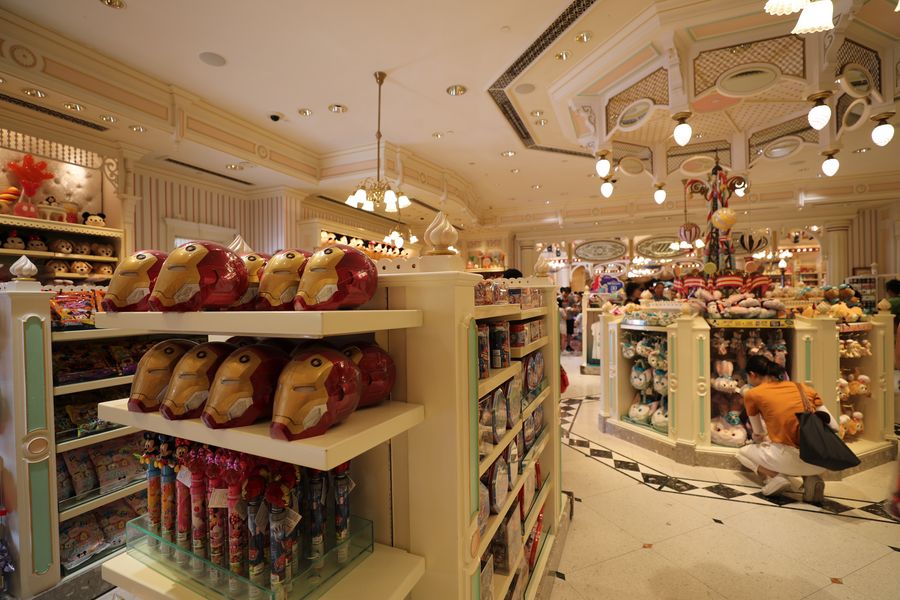
Photo taken on Sept. 30, 2019 shows a souvenir shop at the Disneyland Resort in Hong Kong, south China. (Xinhua/Lu Ye)
Statistics from the Hong Kong Special Administrative Region (HKSAR) government’s Immigration Department showed a plummet of nearly 40 percent in Hong Kong’s visitor arrivals in August.
On Tuesday, the first day of the “Golden Week” holiday, Hong Kong saw a 62-percent plunge in the arrivals of mainland visitors compared with last year, and a 33.8-percent drop in the arrivals of other non-local visitors.
Wong Ka-ngai, president of Hong Kong Tour Guides General Union, said the unrest has turned the peak tourist season into a “chilly winter” and local tourist guides were among the hardest hit. “Many of our union members were forced to take unpaid leave,” Wong said.
HEAVY TOLL ON RETAILING SECTOR
The prolonged unrest has also dealt a heavy below to Hong Kong’s retail sector.
The HKSAR government’s Census and Statistics Department said Wednesday that Hong Kong’s total retail sales dropped by 23 percent in August from a year earlier.
This is the steepest year-on-year decline for a single month on record, said a government spokesperson, adding that the impact is even worse than that during the Asian financial crisis in 1998.
Compared with last August, the number of overnight visitors decreased by nearly half, leading to a sharp drop in the sales of retail goods, including jewelery, watches and clocks, and medicines and cosmetics, said Annie Yau Tse, chairwoman of Hong Kong Retail Management Association (HKRMA).
To Kwa Wan in Kowloon, a well-preserved community that used to be packed with visitors recently saw few tourist coaches. At about 1 p.m. in a restaurant which used to be bustling with tour groups, only a handful of customers are dining inside. The chocolate store next door, whose products used to be snapped up by mainland visitors as gifts, was also empty.
“Our business has been poor since June,” said a salesperson. “Sometimes when there were few customers, we were asked to take a leave, without pay.”
The owner of a pharmacy in the Man Lok Street, who declined to be named, said that fewer visitors came after a mainland journalist was assaulted by rioters in August.
“Our sales was just about 10 percent of that last year,” he said. Closing time of the store used to be 5 p.m. To save electricity cost, now he pulls down the shutter earlier.
Many retailers told Xinhua they did not expect the National Day holiday to reverse the trend.
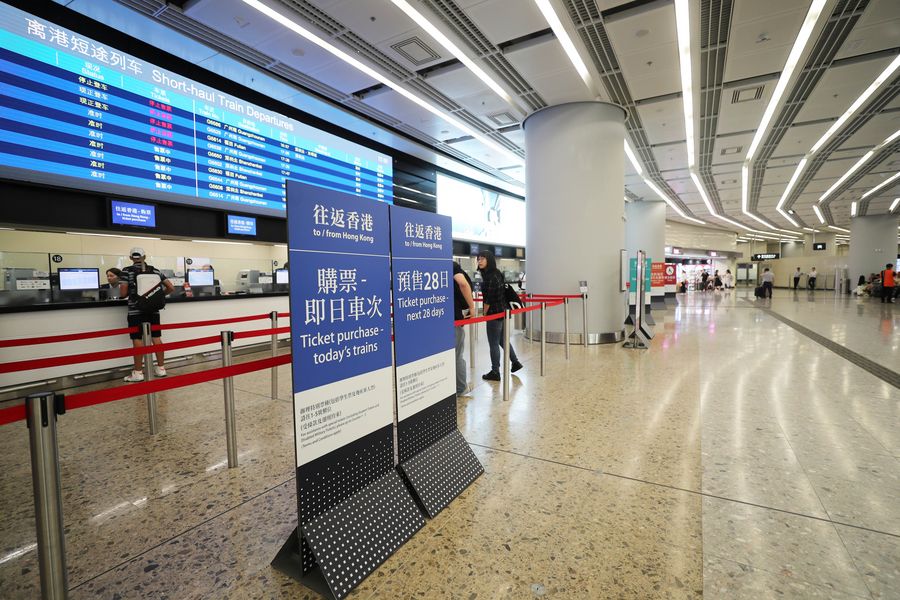
At the West Kowloon high-speed railway station, long queues were not seen these days. In an accessory store inside the station, a shopping guide surnamed Cheung had been leaning against the counter for a long time.
“It’s been like this for days, and few customers came in,” she said, adding that monthly sales since August have fallen by half compared with a few months ago, not to mention the previous “Golden Week,” when the newly-commissioned high-speed rail link between the mainland and Hong Kong attracted over 78,000 travelers on Oct. 1, 2018.
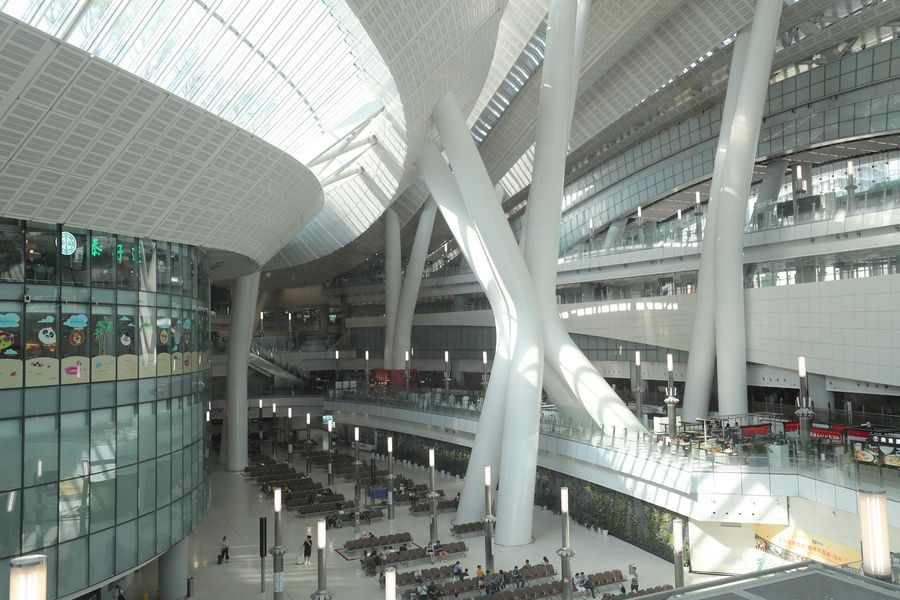
Photo taken on Oct. 2, 2019 shows the West Kowloon high-speed railway station in Hong Kong, south China. (Xinhua/Lu Ye)
Statistics from the Immigration Department show that tourist arrivals at the West Kowloon high-speed railway station dropped by more than half on the National Day from a year earlier.
The bleak sales has made Cheung laden with anxiety. “If the situation continues, we could be fired. And it’s hard to find another job elsewhere as almost every industry in Hong Kong is suffering.”
Photo taken on Oct. 2, 2019 shows the West Kowloon high-speed railway station in Hong Kong, south China. (Xinhua/Lu Ye)
WISH HONG KONG BACK TO PEACE
In front of the ticketing machine at the station, a frequent visitor to Hong Kong surnamed Chen said he was surprised to find the tourist city turned empty during the peak season.
“I saw much fewer visitors in the shopping malls and streets. There were also many vacant seats on the high-speed train,” he said.
Chen, leaving Hong Kong on Wednesday, said his trip was not as satisfactory as expected because he only went to Kowloon this time. “I did not go to the Hong Kong Island as usual because I heard that assemblies were held there and violent incidents may occur.”
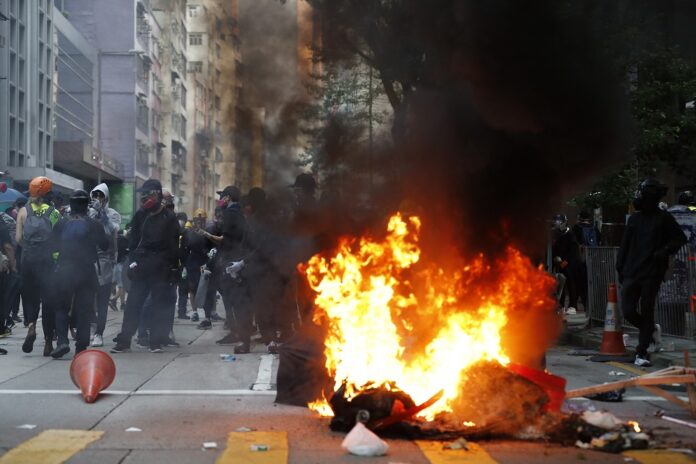
Escalated violence and vandalism occurred on Tuesday in different parts across Hong Kong, with black-clad rioters damaging properties, assaulting police, setting fires and paralyzing traffic. Many shops, restaurants and businesses were targeted by radicals.
Tse said the fresh bout of violence had brought the most tremendous challenge in their life time for many retailers. Many of the HKRMA members were forced to close. Some managed to open, but their sales dropped to only 10 to 20 percent, she said.
The Hong Kong General Chamber of Commerce said the radicals’ chilling disregard for rule of law is not only affecting Hong Kong’s reputation as an international financial and business center, but also crippling many small businesses and threatening the livelihoods of hundreds of thousands of ordinary citizens.
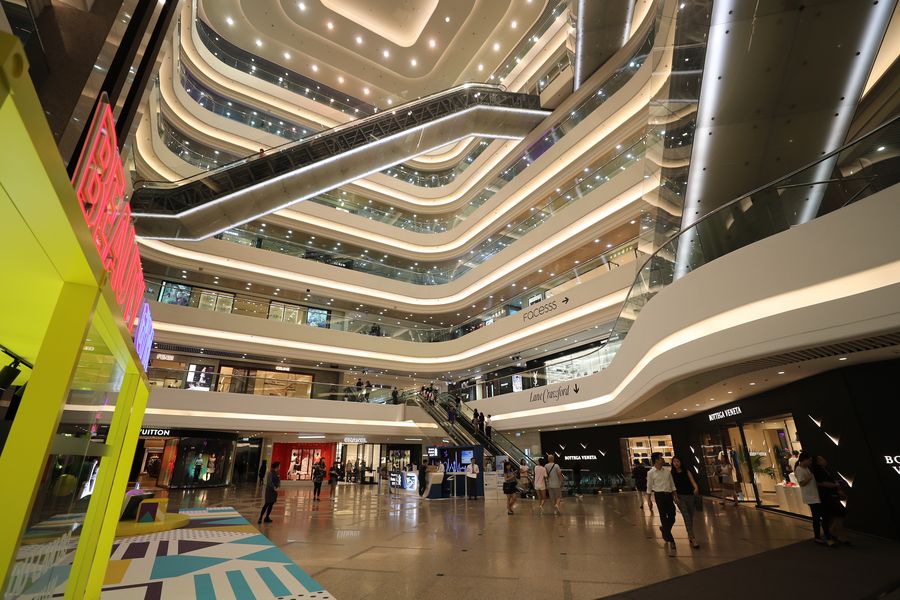
Photo taken on Oct. 2, 2019 shows the Times Square in Causeway Bay in Hong Kong, south China. (Xinhua/Lu Ye)
In a post on her social media account late Tuesday, Hong Kong resident Michelle Ma complained about her exhausting journey home from West Kowloon Station, with a photo of her husband and son dragging luggage in an empty street in the evening.
“Last year, also on this day, we arrived at West Kowloon Station, enjoyed the National Day fireworks display at Victoria Harbor and went home happily. Today, the fireworks display is canceled, nearby Kowloon metro station is closed, bus services stop and there is no available taxi…” she wrote.
After making a detour and transfer in the metro system, Ma and her family finally reached a station three stops away from their home on Hong Kong Island, but had to finish the last leg of journey on foot due to the station closure and bus service suspension.
“My greatest wish at the moment is for Hong Kong to return to peace soon,” she said.