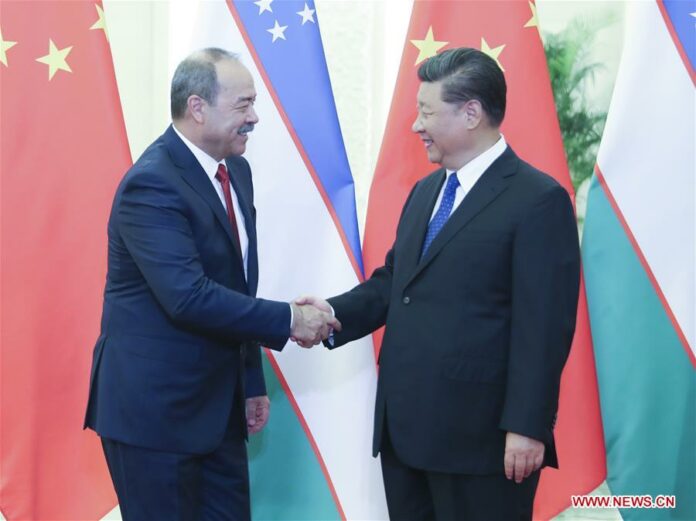
Chinese President Xi Jinping meets with visiting Uzbek Prime Minister Abdulla Aripov at the Great Hall of the People in Beijing, capital of China, Aug. 28, 2019. (Xinhua/Yao Dawei)
BEIJING (Xinhua) — Chinese President Xi Jinping met with visiting Uzbek Prime Minister Abdulla Aripov here on Wednesday, calling on the two countries to jointly push forward the high-quality construction of the Belt and Road.
Xi asked Aripov to convey his sincere regards to Uzbek President Shavkat Mirziyoyev.
The key to the constant leap-forward development of China-Uzbekistan relations is that both sides always adhere to the spirit of good-neighborliness, mutual benefit and mutual assistance, according to Xi.
Xi stressed that he attaches great importance to the development of the China-Uzbekistan comprehensive strategic partnership, which is in line with the fundamental interests of the two countries and their peoples.
Hailing the achievements of the fifth meeting of the China-Uzbekistan intergovernmental committee of cooperation, Xi said that the cooperation goals set by the two sides will certainly be realized as long as the bilateral relationship stays on the right track.
Xi called on both countries to further promote the high-quality construction of the Belt and Road, enhance synergy between national development strategies, strengthen connectivity through cross-border roads and railways, expand cooperation in trade, investment, high and new technology, energy and other fields, as well as foster new highlight in people-to-people and cultural exchanges.
China is willing to increase imports of Uzbek quality agricultural products, Xi said, adding that Uzbekistan is welcome to attend the second China International Import Expo as guest of honor later this year.
In addition, Xi said that the two sides should work together to combat the “three evil forces” of terrorism, separatism and extremism, fight against drug trafficking and other transnational organized crimes.
The rejuvenation of the Chinese nation is to seek happiness for the Chinese people and will also benefit world peace and human progress, Xi said, stressing that China will absolutely not follow the old path of “a strong country must seek hegemony.”
China is ready to enhance coordination with Uzbekistan on international affairs, safeguard common interests of the two countries, uphold multilateralism and promote democracy in international relations, Xi said.
He also called on the two countries to work with other members of the Shanghai Cooperation Organization (SCO) to raise the awareness of a community with a shared future and lift cooperation in various fields, so as to promote further development of the SCO and benefit peoples of various countries in the region.
Aripov conveyed President Mirziyoyev’s sincere greetings and lofty respect to President Xi and his warm congratulations on the 70th anniversary of the founding of the People’s Republic of China.
President Mirziyoyev sincerely hopes China will achieve greater prosperity and early national rejuvenation under the leadership of President Xi, according to Aripov.
Calling China “the closest and most reliable neighbor and partner” of Uzbekistan, Aripov said that Uzbekistan will work with China to firmly implement the important consensus reached by the two heads of state.
Mirziyoyev has appointed a special agency to synergize development strategies with the Chinese side, actively promote cooperation with China on the construction of the Belt and Road, and expand people-to-people and cultural exchanges, according to Aripov.
Uzbekistan firmly supports China in safeguarding its sovereignty, security and unity, and will continue to actively work with China to combat the “three evil forces” of terrorism, separatism and extremism, said Aripov.
Aripov is paying an official visit to China from Tuesday to Thursday at the invitation of Chinese Premier Li Keqiang.
The Federation of Thai Shrimp Farmers pointed out that shrimp farming in Thailand is under tight supervision of Department of Fisheries in line with international standards through the biosecurity system which help prevent diseases, increase productivity, protect environment, and tractability to ensure safe foods for consumers around the world.
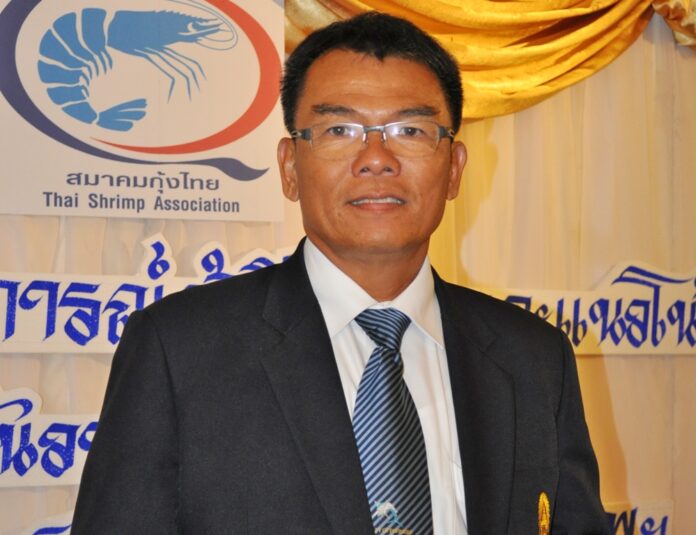
Mr. Bunjonk Nissapawanich, Adviser of The Federation of Thai Shrimp Farmers and the Aquaculture Eminent of National Fisheries Policy Committee, revealed that the case sharing shrimp farming documentary on social media by an international organization was found in 2012. The outdated information was recently reposed by Free High Quality Documentaries’ website which persuaded that Thai shrimp farming destroyed mangrove forests and environment, employed illegal labor and violated human rights, used antibiotics without any controls are “incorrect” and “irresponsible”. The documentary shows only one-side of information, without appropriate investigation causing social misunderstanding and impairment to the image of Thai shrimp export industry.
At present, shrimp farming in Thailand has been operated under the supervision of the Department of Fisheries, Ministry of Agriculture and Cooperatives. It has a clear policy to promote the Kingdom’s shrimp farming relevant to international standards focusing responsibility and sustainability. The close collaboration between concerned agencies including farmers, private sector, association, shrimp farmers’ club and the federation throughout Thailand has helped develop technologies and good practices that increase productivity, prevent diseases and supported all stakeholders in the supply chain. This also directly serves the needs of consumers around the world.
“Thai shrimp farmers from small to large-scaled shrimp operators have to comply with the department’s laws and regulations as well as international standards which covers economic, social and environmental aspects in line with food safety production guidelines for all consumers. While labor in this industry sector will have equal treats under international human rights standards,” stressed Mr. Bunjonk.
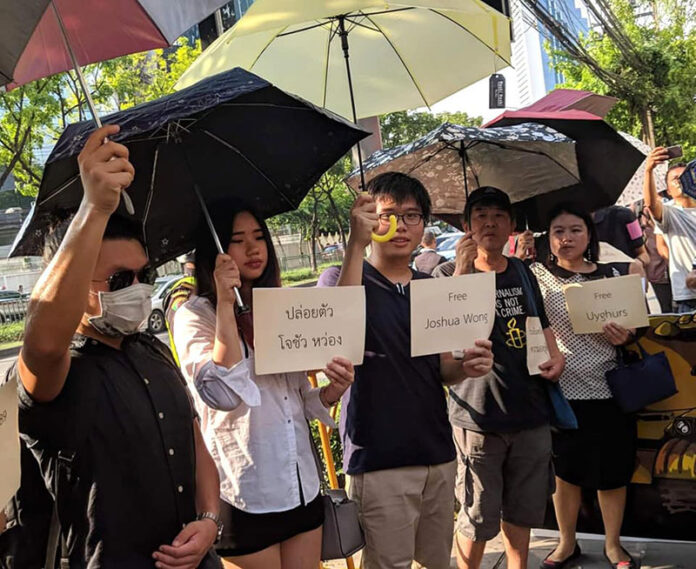
Netiwit Chotiphatphaisal, center, protests in front of the Chinese Embassy in Bangkok on June 4, 2019.
Thai-Chinese Millenials of the Internet World
This is the second of a two-part series exploring Thai-Chinese views on the Hong Kong protests, and how Thai-Chinese citizens stay informed.
While their agong and amashuffle through Chinese newspapers, Thai-Chinese millennials are reading US-based online news and scanning the Twitters and Instagrams of their Hong Kong friends.
On the Thai internet, most posts are in favor of the Hong Kong protesters. Some millennials are even trilingual and scan through feeds in three languages: Thai, English, and Chinese.
On June 4, Suphanut “Jui” Aneknumwong, 19, took his passion from the online to the offline world. He protestedin front of the Chinese embassy with the likes of student activist Netiwit Chotiphatphaisal to mark a brutal crackdown that ended the Tiananmen Square protests in 1989.
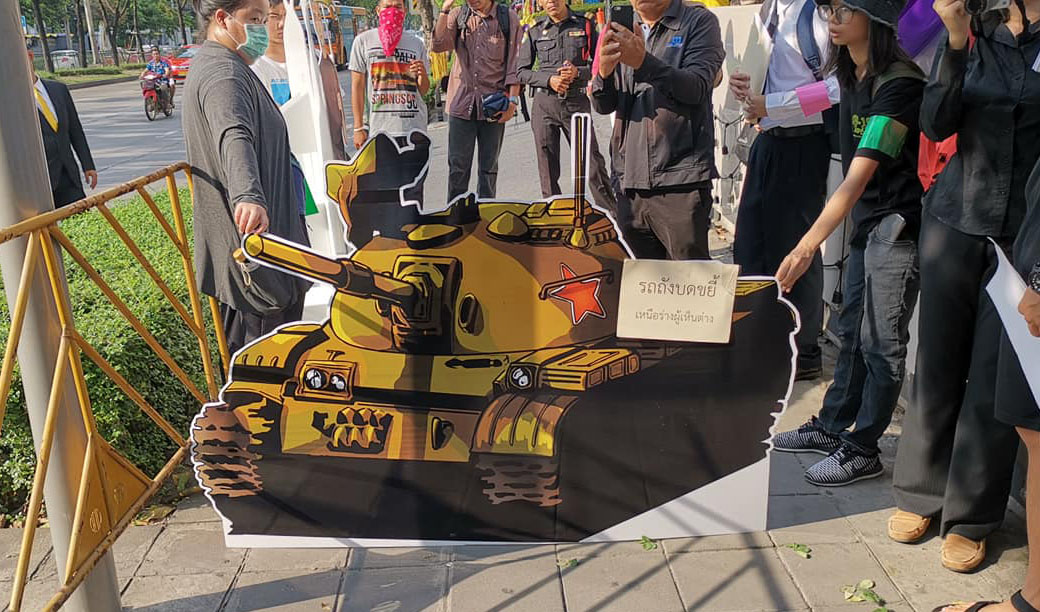
They propped up cardboard tanks and held signs in support of then-jailed activist Joshua Wong.
“I agree with the protests because they need to rebel against the Chinese government’s control and interference,” Jui, the first-year political science student at Chulalongkorn University, said. “I think the protest methods are completely okay. They haven’t killed anyone. The economy has to be sacrificed to fulfill this mission.”
To keep up with Hong Kong protest news, he reads either Thai sources – new liberal media like The Standard or The Matter – or English-language publications such as The Guardian. He said he read somewhere that the Hong Kong police are using real bullets, but isn’t completely sure.
“There’s an information war, where each side is only reading the pages they agree with and believe. But I don’t think there’s a way out for that, unless you fact check everything,” Jui said.
A third-generation Teochew Chinese immigrant, Jui cannot read Chinese and so doesn’t read Chinese media. He says he doesn’t feel any sort of ethnic connection with the Chinese diaspora in other countries.
As an activist and someone who largely reads pro-Hong Kong news, what would it take to change his mind about the protests?
“If [the protesters] start viciously hurting people, lose their direction, or lose sight of their mission, this would make a lot of people change to being pro-China,” Jui said.
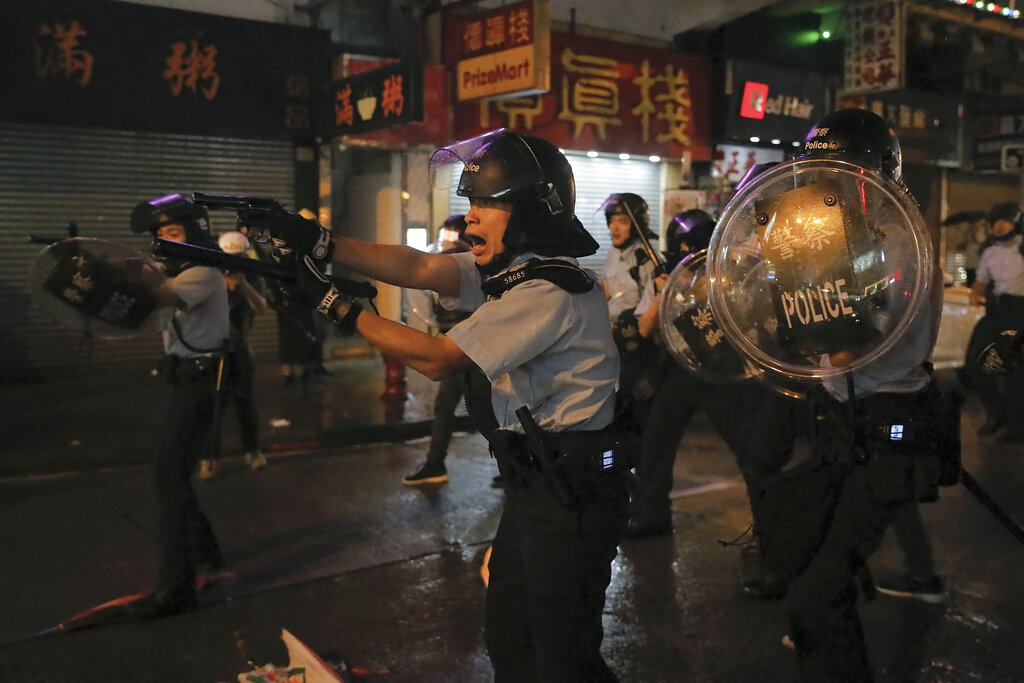
Policemen pull out their guns after a confrontation with demonstrators during a protest in Hong Kong, Sunday, Aug. 25, 2019. Hong Kong police have rolled out water cannon trucks for the first time in this summer’s pro-democracy protests. Photo: Vincent Yu / AP
Pichaya “Coco” Petrachaianan, 26, is trilingual and also declares himself staunchly pro-Hong Kong. He scrolls on Instagram to check out a Hong Kong-based account for protest updates, before reading an article or two from the New Yorker or Straits Times.
“I would much rather read and believe Western news because news from the mainland isn’t so reliable. It could be propaganda, who knows?” Coco said.
A digital lifestyle writer for upscale magazine Thailand Tatler, Coco said he never looks at mainland media. His reading skills are better in English than Chinese, so naturally English-language news is more accessible.
Pichaya “Coco” Petrachaianan
“I know about Hong Kong from my IG friends in Hong Kong and Taiwan. They’re young and they all cheer for Hong Kong,” he said. “Of course, I’m not cheering for the mainland. I feel sympathetic for Hong Kong. It feels like it’s something close to me because some of my friends are in the protests.”
To him, the divide between mainland China and Hong Kong is not just political but also cultural.
“I think only old people like my grandpa think that there’s one big Chinese cultural unity. Hong Kong has its own identity apart from China. Ideally, Hong Kong should get complete freedom, but that may not be possible since China is so powerful,” Coco said.
He added, “I relate more to Hongkongers because they have more manners. Plus I love Wong Kar Wai films.”
In contrast to Coco and Jui, trilingual Nidawan Asavataweechok, 27, reads news in all three languages to gauge what to make of the situation. She works as an MC for Chinese culture-related events, and as a singer.
“I think English and Chinese news is polarized, while I feel like Thai media is more neutral,” she said. “In my master’s course, I like to talk to mainland Chinese about the issue. Everyone knows that you can’t just use Chinese news as a sole reference.”
She says she applies the same standards to news from Western outlets.
Nidawan Asavataweechok.
“Western sources try to tone down the protests to make them look much softer,” Nidawan said. “Imagine the backlash if protests closed a Western airport. Some sources were apologists for the airport closing, while others explicitly ignored it.”
For Nidawan, the war on information was best exemplified when Liu Yifei, the lead actress in the upcoming Disney live-action remake of “Mulan,”announced her supportfor the Hong Kong police. “I support the Hong Kong police,” Liu Yifei wrote on her Weibo account. “You can all attack me now. What a shame for Hong Kong.”
“So the critics are tweeting #BoycottMulan, while her supporters are on Weibo,” Nidawan says. “Neither side is looking at the other, each in spaces where the other side doesn’t look.”
As a Thai-Chinese, Nidawan said she feels some pan-Chinese sentiments for her overseas brethren.
“Personally, I think Hong Kong and China are all ethnically Chinese, like Thai-Chinese people. We have Chinese blood that binds us, no matter the background. No matter what the result is, I hope they work it out,” Nidawan said.
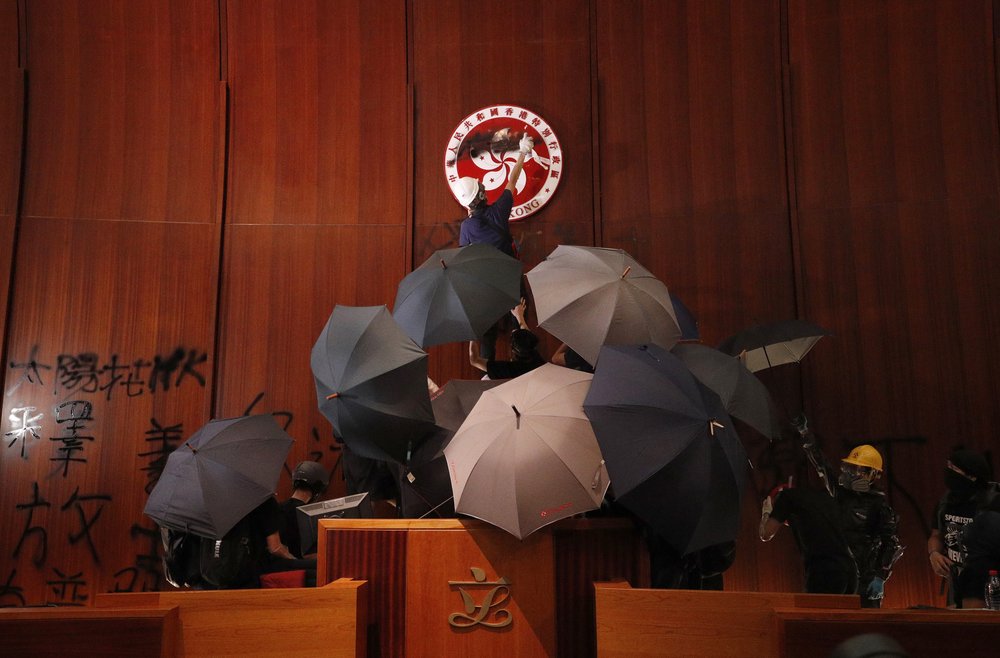
In this July 1, 2019, file photo, protesters deface the Hong Kong logo at the Legislative Council to protest against the extradition bill in Hong Kong. Photo: Vincent Thian Yu, File / AP
Finally 25-year-old Subhanath “Sammy” Chatdecha, who works in a legal office, is a proud Sinophile. He says he’s been raised on Confucianism and would politically identify most with an American Republican.
“Of course there’s a clear bias in Western media, because in today’s world being left is a cool thing. It’s cool to side with the protestors and be all anti-establishment,” he said.
According to the Hong Kong Free Press, Hong Kong’s Chief Executive Carrie Lam said she was most immediately motivated to push for the extradition bill by pleading from the Poon family, whose daughter Poon Hiu-wing, 20, was allegedly murdered in Taiwan by her boyfriend Chan Hong-kai. Chan was not charged with murder due to the lack of extradition treaty.
“The parents of the victim have not stopped writing letters to the government. …If you have read these letters from Mr. and Mrs. Poon, you would also feel that we must try to help them,” Lam said.
After mounting protests, Lam suspended the bill on June 15.
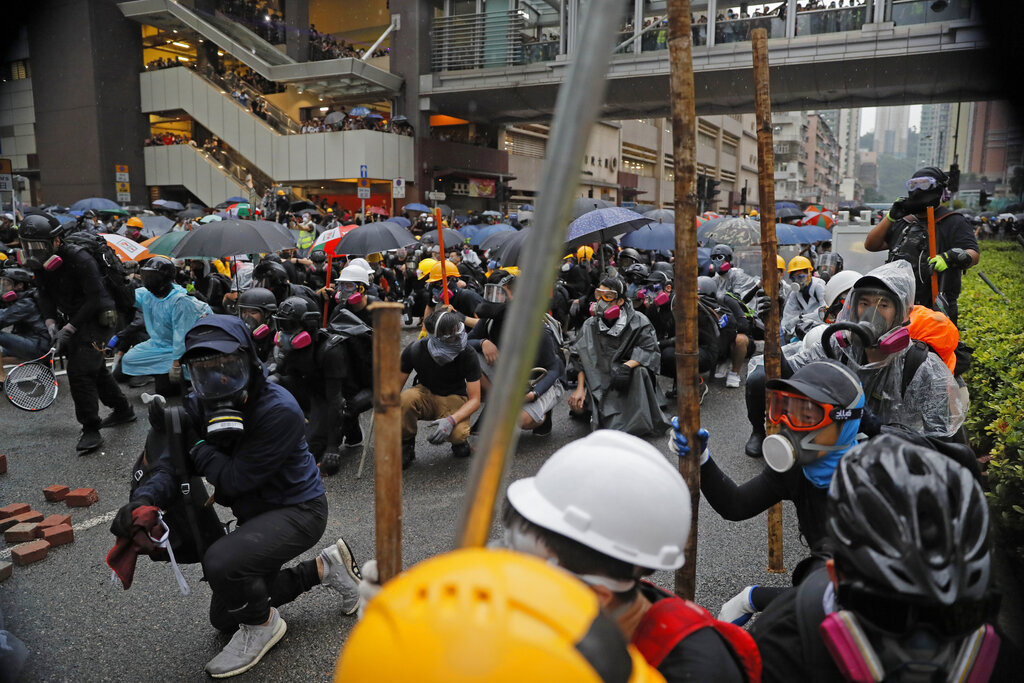
Protesters crouch behind a barricade during a protest in Hong Kong, Sunday, Aug. 25, 2019. Photo: Kin Cheung / AP
“It’s like they’re afraid of activists being sent to China way more than criminals coming to Hong Kong,” Sammy said. “Coming out to protest like this shows that they can’t take having to come under Chinese rule. I think the One Country, Two Systems idea is already extremely generous.”
As for media consumption, Sammy says he doesn’t really read mainland Chinese news, but is on a steady diet of Bloomberg, BBC, and the South China Morning Post (“So left!”).
“After you read what the left is saying, you can guess what the right will write, so it’s not necessary,” he said. “No matter how fluent I am in English, I won’t be radicalized by reading English articles.”
After describing his “impossible” dream of a pan-Sinosphere where China, Hong Kong, and Taiwan are all under Kuomintang rule, Sammy said he believes Westerners should consume media more responsibly.
“Calm down and look at all sides, not just what you want to look at or agree with. If you want to be a leftist, then be the smart kind,” Sammy said.
This is the second of a two-part series exploring Thai-Chinese views on the Hong Kong protests, and how Thai-Chinese citizens stay informed.
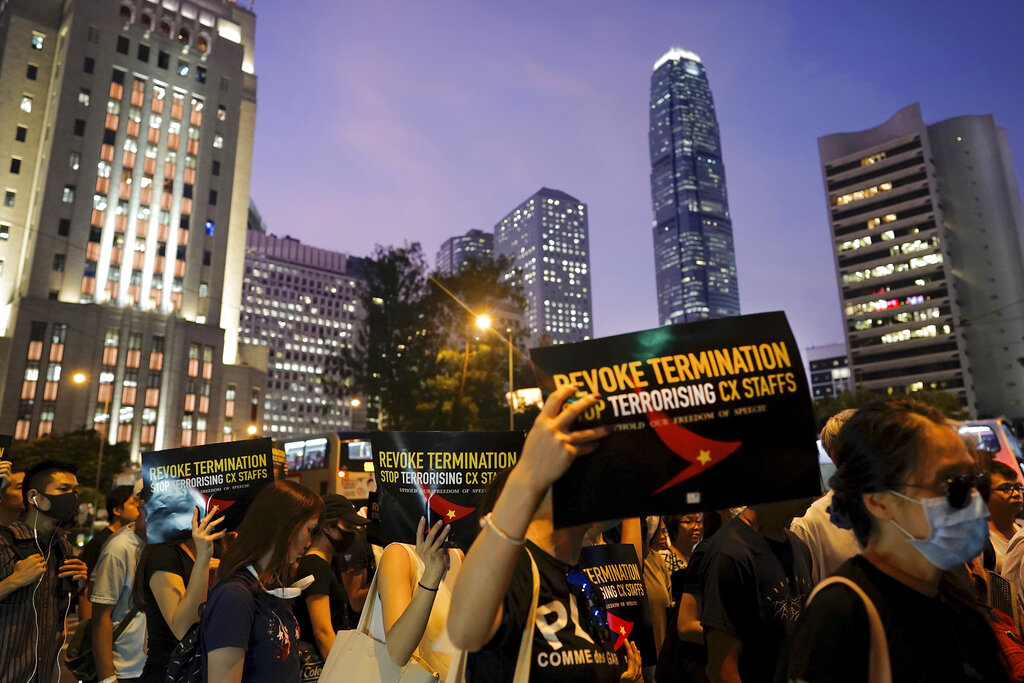
Demonstrators hold signs opposing the recent firings of Cathay Pacific employees as they gather for a demonstration at the Edinburgh Square in Hong Kong, Wednesday, Aug. 28, 2019. Photo: Vincent Yu / AP
This is the first of a two-part series exploring Thai-Chinese views on the Hong Kong protests, and how Thai-Chinese citizens stay informed.
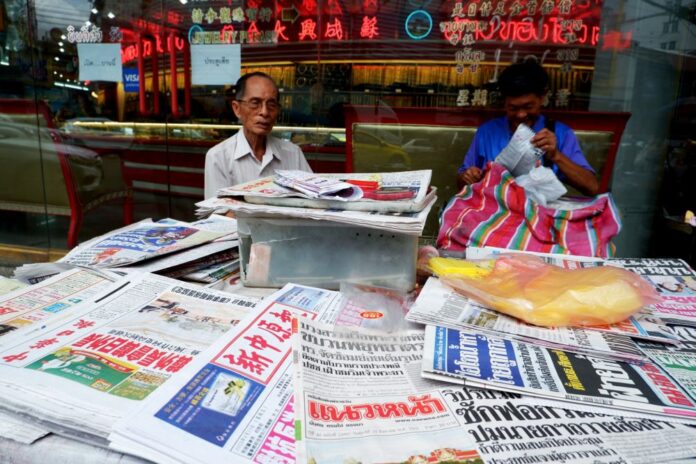
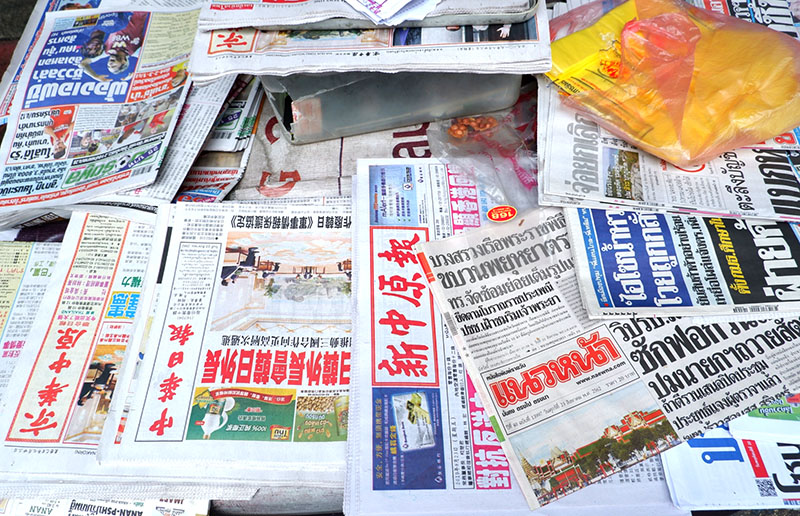
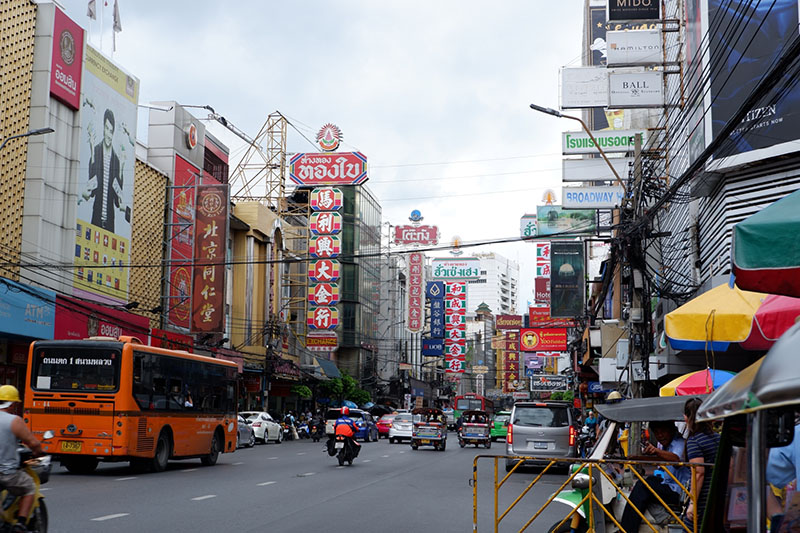
On the main street of Yaowaraj – home to Chinese immigrants who sailed to Thailand over a century ago and their descendants – Wan Pek Tang sits selling both Thai and Chinese newspapers.
“We have to be neutral. We have to filter our news,” 80-year-old Wan Pek said, rifling through copies of Tong Hua Daily News, Universal Daily News, and Kia Hua Tong Nguan.
While pundits and internet idols preach their views about the ongoing protests in Hong Kong online, the uncles and aunties of Chinatown, say they’ve weathered enough Cold War-era media storms to be on guard against modern “fake news.” Some also said they still felt a blood tie with China, whether Hong Kong or mainland.
Wan Pek says he usually reads Chinese newspapers published in Thailand (his Chinese is better than his Thai) and on occasion scans Chinese newspapers.
“First, the protesters came out against the extradition bill. Then the Chinese, who can’t back down, brought tanks to Shenzhen,” Wan Pek said, when asked to recount his understanding of the recent protests in Hong Kong.
Wan Pek’s newspaper stand.
“However, I don’t think the Chinese soldiers will use their full force against the protestors after this,” he said. “They’re too afraid, with foreigners intervening and watching.”
A 78-year-old regular strolled up to Wan Pek for his daily dose of political discussion. Though he refused to give his name (“I’m not giving you either my Thai or Chinese name! What if they send someone to kill me?”), he had plenty to say about media literacy.
“We have to check where the news comes from. China’s isn’t so good. We have brains, don’t we? So use them. Weigh what percentage of a piece of news is good, bad, or just plain slander,” he said. “You yourself have to judge. Don’t believe everything you read.”
So does he favor any side?
“Why do I have to take a side? China isn’t communist anymore. And why do I have to agree with America? They’re farang. I’m Thai!” he said loudly.
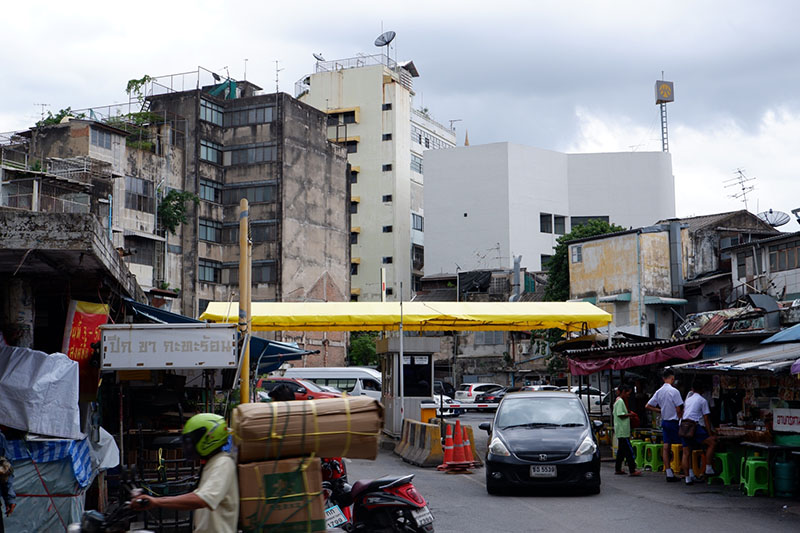
Yaowaraj Road.
But for Wan Pek, centuries-old animosities between West and East continue to ring true – he couldn’t stop bringing up the Opium Wars.
“Before, foreigners got the Chinese addicted to opium,” he said. “Now farangs are inciting Hongkongers to create more problems…I just want Hong Kong to be safe again.”
Thailand has one of the world’s largest – if not the largest – diaspora of overseas Chinese. About 9 million Chinese are believed to have settled in the kingdom, and that’s not counting their Sino-Thai descendants (look jeen).
Over the past centuries, they came to Thailand for various reasons, such as fleeing poverty, war, political strife, and natural disasters to seek new opportunities.
Though many learned uncles and aunties accepted an interview on the streets of Yaowaraj, many also refused. Some said they do not keep up with current events or refused to “talk about anything political.”
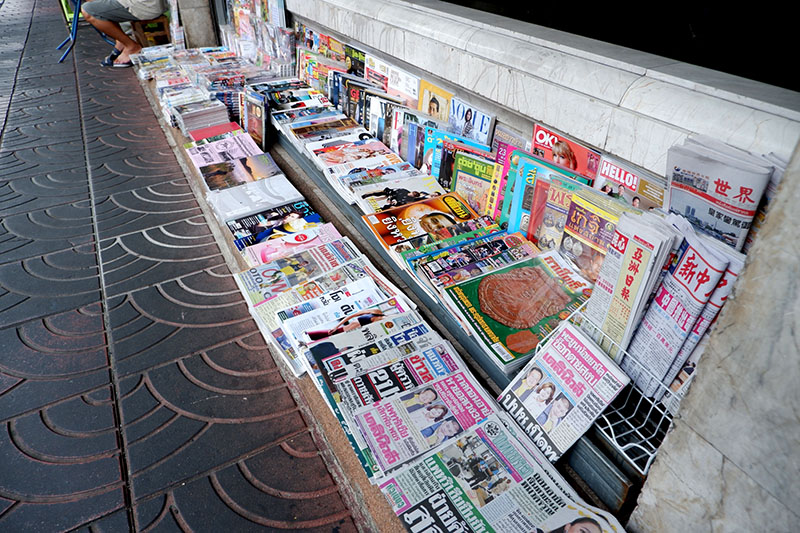
Further down the road, Porngam Sae-ngui, 57, runs a larger newspaper and magazine roadside shop. Unlike Wan Pek and his customer, Porngam gets her news from the international news sections of Thai newspapers – her go-to reads are analytical pieces in Manager Newspaper and Thai Rath.
“When you’re neutral, you can see both sides of the issue. I don’t believe everything I read, and I can tell if someone is trying to influence me,” she continued. “I would rather people read information from both sides, and then decide for themselves what to believe.”
Porngam said she doesn’t want to see bloodshed.
“On the one hand, I sympathize with Hong Kong. But I also understand China needs to rule on many aspects,” she said. “I just want there to be a peaceful dialogue. I don’t want things to escalate and China to send in the troops.”
Porngam wants to see more tourists shopping at Yaowaraj, but isn’t sure how the protests will influence the local economy.
“In the end, we’re all siblings with the same ethnic blood. Lives are more important than policies. I don’t want to see more Chinese blood shed,” Porngam said.
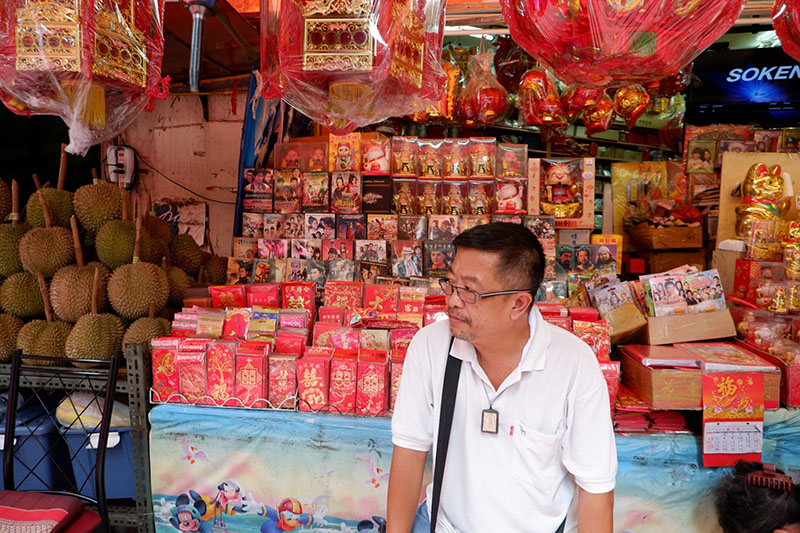
Wichet Lumsuwan.
On a side road off Yaowaraj, Wichet Lumsuwan, 48, sits at his stand selling durian, lucky envelopes, and waving cat figurines. Wichet’s nephew says he often likes to discuss politics with people around him.
“I’m in favor of Hong Kong,” Wichet said, “Especially after that Thai boxer went there to cause trouble.”
Thai boxer Arthit Ruenpech was allegedly part of a white-shirted mob that attacked Hong Kong protesters and commuters in July.
“Hong Kong and China share the same ethnicity, but Hong Kong was a colony so of course its culture is more Western. We know China is more conservative, and democratic Hong Kong can’t adjust to that kind of rule,” Wichet said.
Wichet has never been to China or Hong Kong himself, though he is descended from Chinese immigrants. He said he’s familiar with spotting propaganda from the Cold War days, during which he read both Thai and Chinese papers. Nowadays, he mostly watches Channel 3 news to get his info.
“I believe the idea of the Chinese being ‘poor commies’ still lingers among many. People are naturally afraid of this, or of becoming this, including Hongkongers,” he said.
For Wichet, only time will tell who’s on the right side of history, despite his sympathies for Hong Kong.
“Time will prove everything. The situation can change in an instant,” he said.
This is the first of a two-part series exploring Thai-Chinese views on the Hong Kong protests. In the next installment, we ask young Thai-Chinese what they think.
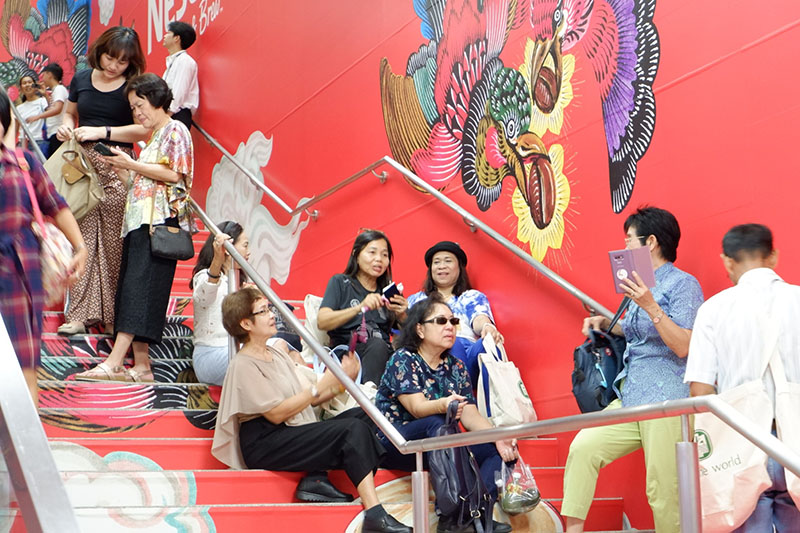
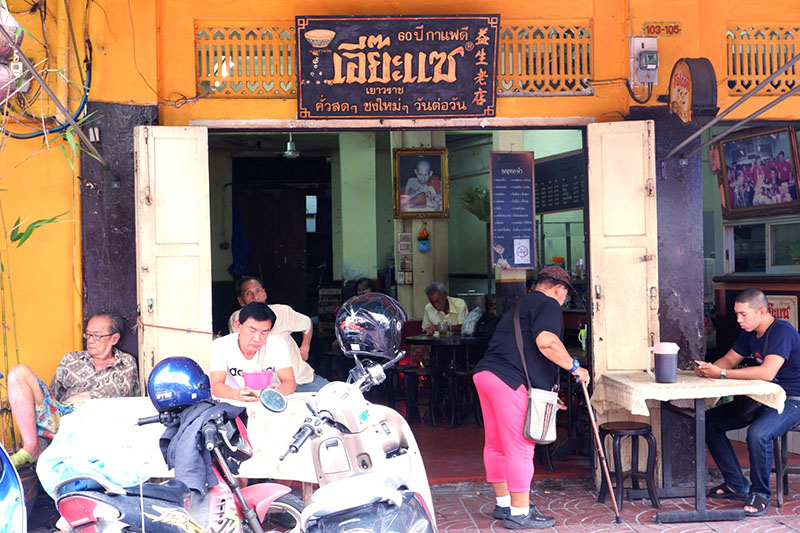
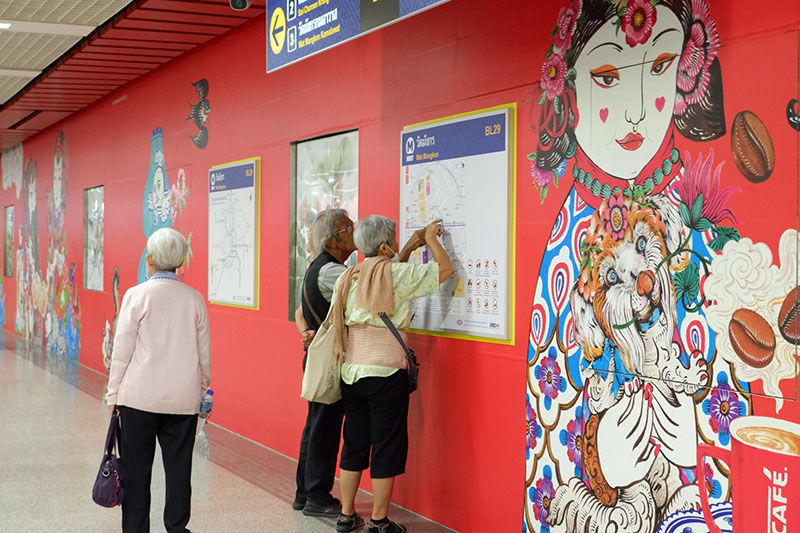
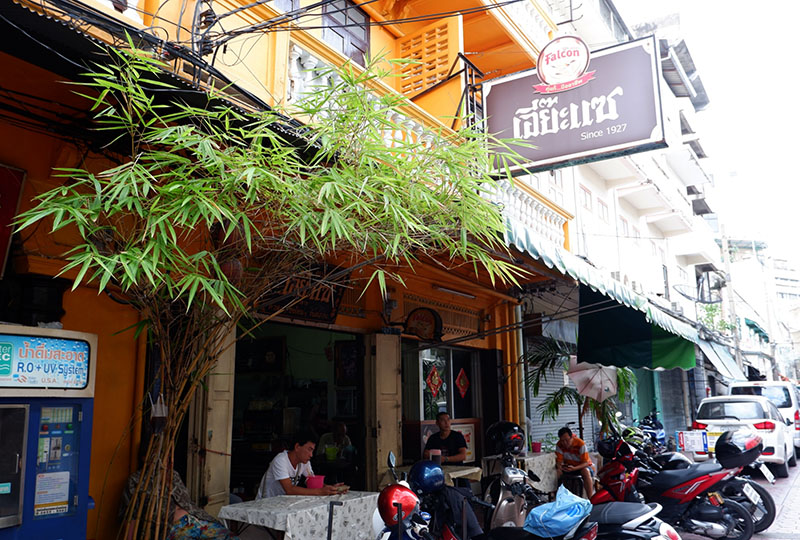
People crowd the MRT Wat Mangkorn station to take photos.The old Chalermburi movie theater, now demolished and used as a parking lot.Earsae Coffee Shop in Yaowaraj.
CHONBURI — An official on Wednesday confirmed two police auxiliaries beat up a motorcycle crash victim inside a hospital in Chonburi province earlier this month.
The officers were “reprimanded” for the assault, which was captured in CCTV footage that went viral yesterday, according to local administrator Pakasit Sueksongkram. Pakasit said the assaulted victim refused to stop at a checkpoint earlier and crashed into one of the police volunteers manning the barricade, seriously wounding him.
“I reprimanded them and told them that they should think before doing anything, because they are security officers,” Pakasit said, without naming the two men.
Police volunteers, or arsa, are civilians who typically support the main police force in tasks like manning checkpoints, patrolling, and directing traffic.
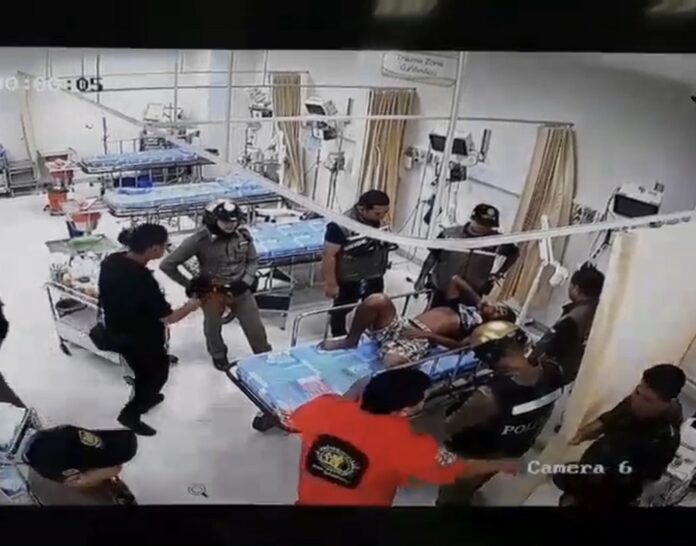
In the video, a group of policemen and police volunteers are seen standing around a man resting on a bed in an emergency room. Two of the volunteers then curtain off the bed and appear to punch the man repeatedly.
The video surfaced on the internet yesterday and drew numerous negative comments aimed at the two police volunteers. Pakasit said the incident took place on Aug. 18 at Burapha University Hospital.
Pakasit said the man was a member of a street racer gang, or dek van, who struck a police volunteer with his motorcycle and left him with two broken legs. The alleged gang member was also brought to hospital for non-serious injuries, where the volunteer’s friends caught up with him, according to Pakasit.
He added that the Chonburi district chief and the provincial governor have been informed of the assault, and may issue additional punishment to the two volunteers.
Speaking to Channel 3 in an interview, Burapha University Hospital director Suriya Prongnamjai said his staff, who were mostly women, were too intimidated to intervene.
Suriya added that medical personnel told the police and volunteers not to enter the emergency room, but to no avail.
“The staff themselves were frightened and demoralized,” the hospital director said.
Police spokesman Krissana Pattanacharoen said the two men seen punching the patient were not enlisted police officers, but added that a fact-finding committee would be convened to determine what happened.
“Although the assaulted man was a suspect, the police have no right to harm him,” the spokesman told reporters.
Col. Krissana also said the hospital is welcome to file criminal charges over the trespassing.
Once considered a sanctuary by law enforcement and criminal elements alike, medical facilities have become the settings of scuffles and assaults in recent months.
In May, at least 19 people were arrested for a gang fight at a hospital in Korat. Nine people were also arrested on similar charges a month earlier in the same province.
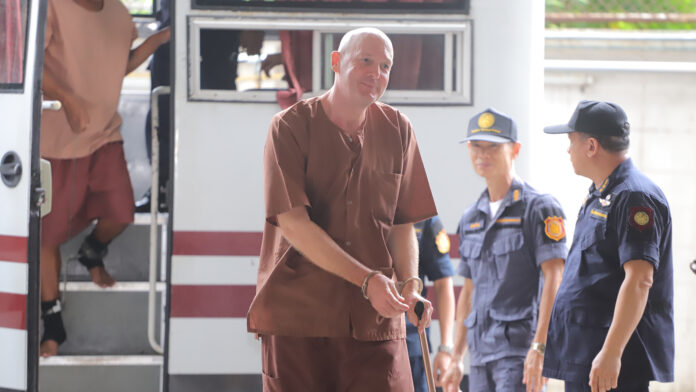
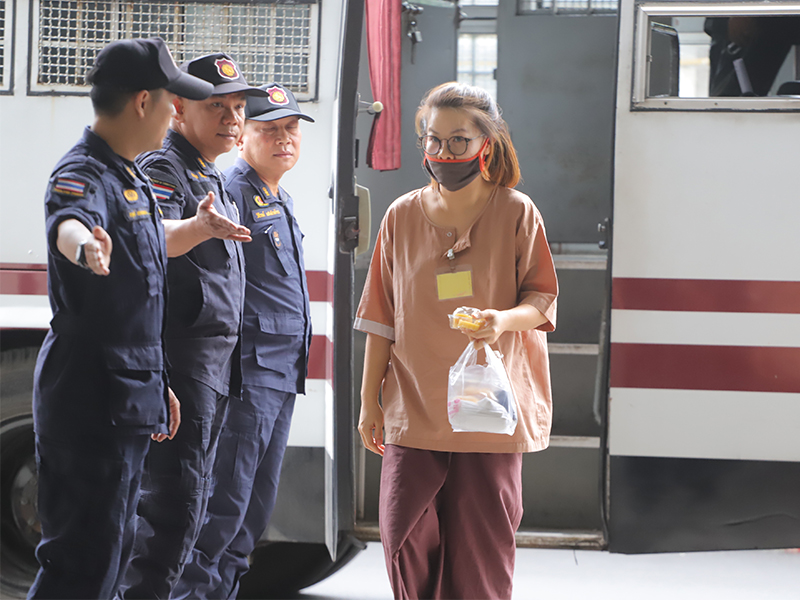
Johannes van Laarhoven at the Supreme Court on Aug. 27.
BANGKOK — A Dutch drug lord was sentenced to 50 years in prison Tuesday for laundering money connected to narcotics sales through Thailand.
The Supreme Court on Tuesday sentenced Johannes Petrus Maria van Laarhoven, 59, to 50 years in prison on 15 counts of money laundering. His wife, Mingkwan Kaen-in, 37, was also handed 11 years in prison for colluding with her husband.
In practise, van Laarhoven will only serve 20 years, the maximum period of imprisonment for money laundering possible under the law. Mingkwan’s jail term was also reduced to seven years and four months in consideration of her testimony.
The couple was arrested on July 23, 2017 at their house inside a luxury golf course in Sattahip, Chonburi.
The authorities, in cooperation with their Dutch counterparts, accused the couple of using a nominee registered in Cyprus to transfer more than 300 million baht made from illegal cannabis sales in the Netherlands. The funds were allegedly laundered into Thailand via banks in Germany, Luxembourg, and Singapore.
The couple initially denied the allegations and claimed that the money was made from “coffeeshops” in the Netherlands. But the claim failed to convince the court, which deemed 300 million baht to be an unreasonable amount of money to be generated from a coffee business.
“Coffeeshops” in the Netherlands may refer to establishments where the sale of recreational cannabis in small quantities is permitted, though the authorities have not released details on the legality of van Laarhoven’s business.
Legal proceedings against the couple began in the Court of First Instance in 2015, and moved to the Court of Appeals in 2017. Both courts found the couple guilty of money laundering.
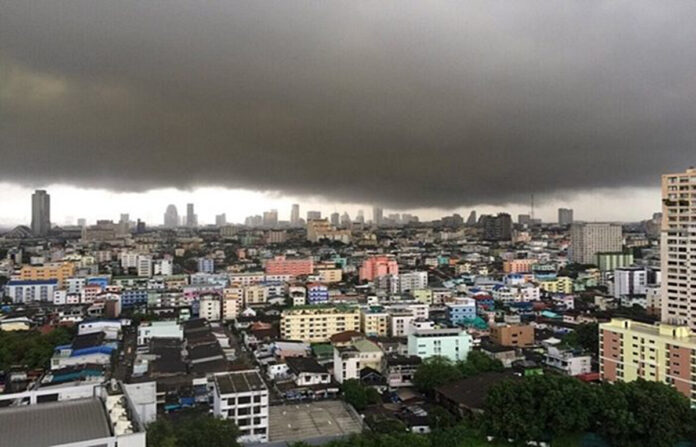
BANGKOK — A tropical storm gaining strength over the South China Sea is expected to shower Thailand over the weekend, the Thai Meteorological Department announced Wednesday.
Tropical storm Podul will shower the north and Isaan. Meanwhile southwestern monsoon winds from the Andaman Sea and the Gulf of Thailand will shower everything but those regions. So expect nationwide showers, from whichever storm.
Until Monday, Bangkok, the north, Isaan, and southern provinces along the Andaman Sea will see an 80 percent chance of rain. Eastern provinces should see a 70 percent chance, and the central and southern provinces along the Gulf of Thailand will see a 60 percent chance.
On Tuesday, Podul swept across Luzon in the Philippines and regained strength in the South China Sea. It’s projected to hit Hainan on Thursday before making its way to Vietnam and Laos.
On the weekend, its weakened form is expected to skirt Isaan and northern Thailand, bringing rain.
People living along the Andaman coast should take care, as waves could reach up to 3 meters high during the week.
Previously drought-stricken areas in the north, northeast, and central provinces could experience flash floods.
At the beginning of August, tropical storm Wipha skirted north and northeastern Thailand in the middle of a long drought that has dried up lakes, farmlands, and even parts of the Mekhong over the past few months.
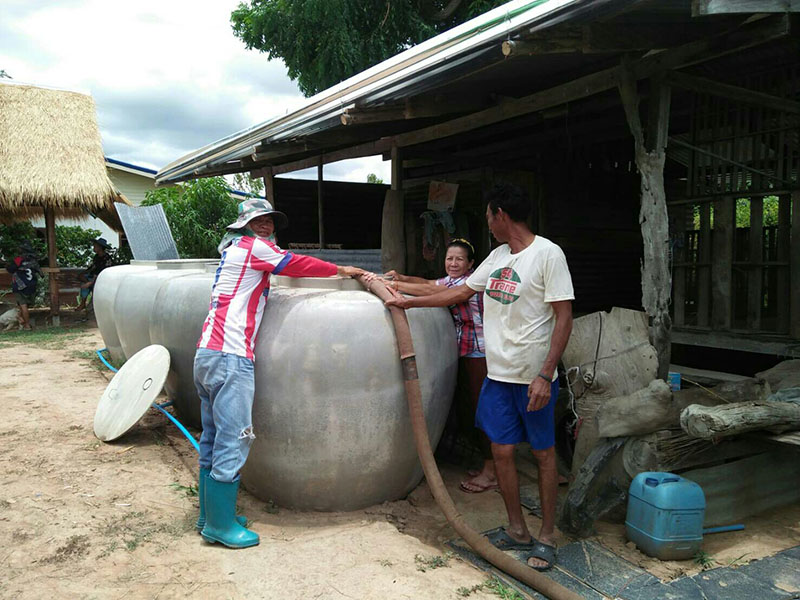
The Nakhon Ratchasima Office of Disaster Prevention and Mitigation reports that around 650,000 people have been affected by the drought, which has dried up 2,844,292 rai (455,086.72 hectares) of farmland. Local waterworks departments have had to deliver emergency water supplies to drought-stricken villages.
Nakhon Ratchasima farmland on Aug. 18, 2019.Local officials deliver water supplies to a village Aug. 28, 2019 in Nakhon Ratchasima.
BANGKOK — Blind artists will star in two plays this September, which were also penned by visually impaired artists.
One of the shows, “Nil’s Vision,” is based on the real life story of the musician Yongsan Yongkamol, tracing his transition from a childhood with full vision to a blind adulthood. Despite his visual impairment, the artist eventually becomes an internationally-acclaimed saxophonist.
The 50-minute show, which runs from Aug. 29 to Sept. 1, will feature live music arranged by Yongsan’s former professor Kritsada Reyes.
Another show, “Sunny Side Up,” blends the real stories of two women: a blind trainee psychologist Sarocha Kittisiripan, and bipolar theatre actress Lola Worakulsanti. Performed by both Sarocha and Lola themselves, the play rummages through their daily lives and respective experiences with physical and mental disabilities.
To add another dimension to the show, the performance features “scents” from scent designer Chalida Kunalai. “Sunny Side Up” will run from Sept. 12 to 22.
Both shows are part of the ongoing Performance Art Festival #8. The festival’s organizer, the Bangkok Art and Culture Center, said it wants to cast the spotlight on people with disabilities and break down barriers of misunderstanding.
Details of other shows and the festival schedule can be found online.
Tickets for “Nil’s Vision” cost 300 baht for adults, and 200 baht for students. Tickets for “Sunny Side Up” cost 550 baht for adults, and 350 baht for students and people with disabilities. Charity fundraising packages for “Sunny Side Up” are also available – they come with a ticket for the show and souvenirs, such as perfume.
“Performance Art Festival #8” runs from July 4 to Dec. 14 at the Bangkok Art and Culture Center. Every show will include Thai and English subtitles. Tickets can be obtained online or at the door. The venue is reachable by a short walk from BTS National Stadium or BTS Siam.
HONOLULU (AP) — Antonio de la Rosa doesn’t take it easy on his vacations. The Spaniard spent his summer paddling his way from California across the Pacific Ocean to Hawaii.
It took de la Rosa, who is from Valladolid, Spain, 76 days to paddle 2,500 miles (4,023 kilometers) while standing on a submarine-shaped craft he described as a paddleboat. The 21-foot-long (6.4-meter-long) vessel endured rough weather, including when Hurricane Flossie passed within 60 miles (200 kilometers).
He ate dehydrated food, using heated water, and sometimes fished. He paddled eight-to-10 hours daily and slept every night. But he was always tired because he woke up hourly to check on his gear.
It’s the kind of adventure, he loves. “I like it because it’s hard,” he said in Spanish on Monday from Honolulu.
His past adventure-vacations have included circumnavigating the 2,175 miles (3,500 kilometers) of the Iberian Peninsula coastline by paddle-surfing for 141 days and crossing Alaska’s Iditarod route for eight days on a bicycle with oversized tires made for snow and ice, according to his website .
He celebrated his 50th birthday at sea, his sister Vanesa de la Rosa explained from Spain. The siblings run an adventure tourism business in Madrid and a small hotel for athletes.
He said he was disappointed to see fishing gear refuse every day of his voyage — including nets and line
He used a tracking device to record every minute of his journey and called it a record because he believes no one has ever done what he accomplished. It’s a record because “I certify it,” he said with a laugh.
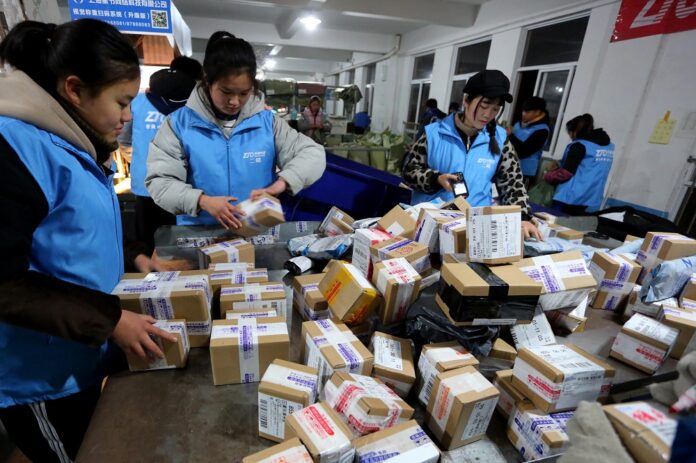
Workers sort parcels at an express delivery company on March 2, 2019, in Donghai County, east China's Jiangsu Province. (Xinhua/Zhang Kaihu)
NANJING (Xinhua) — A university in east China’s Jiangsu Province on Tuesday established the country’s first “courier college” to boost China’s fast-growing courier sector.
Based in Nanjing University of Posts and Telecommunications, the college was jointly set up by the university’s School of Modern Posts and Suning Logistics, the logistics arm of Chinese e-commerce giant Suning.
The college’s first students will be recruited from couriers across the country, who will receive skill training certificates after attending courses including “effective communication and stress management” and “safety management of express terminal,” said Sun Zhixin, dean of the school.
“Psychology and linguistics are among the skills that a good courier must master,” said Sun Anning, head of the province’s express association, while encouraging couriers to enhance their skills and improve the reputation of the profession.
Fueled by online shopping and take-out fever, China’s courier sector has experienced exponential growth. The number of China’s delivery staff grew 50 percent from 2016 to 2018, reaching around 3 million, according to a report jointly published by CBNData and Suning.
“More and more young people are joining the express delivery industry as couriers, but the mobility of this job remains high, mainly due to lack of career planning and social recognition,” said Jiang Bo, vice director of Jiangsu provincial postal administration.
In July, the Chinese government issued a notice to highlight vocational training of couriers and encourage cooperation between companies and educational institutions.