






























34.4 C
Bangkok
Monday, June 8, 2026
Home Blog Page 1517

China Ban on Some Textbooks Seen as Aimed at Uighur Culture

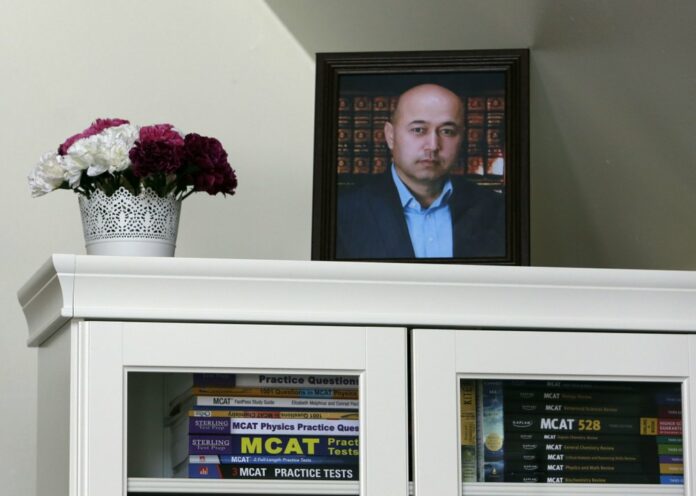
A portrait of Yalqun Rozi is seen atop a bookcase in his son and wife's apartment Thursday, April 18, 2019, in Philadelphia.(AP Photo/Jacqueline Larma)

BEIJING (AP) — For 15 years, Yalqun Rozi skillfully navigated state bureaucracies to publish textbooks that taught classic poems and folk tales to millions of his fellow minority Uighurs in China’s far western region of Xinjiang.

That all changed three years ago when the ruling Communist Party launched what it says is a campaign against ethnic separatism and religious extremism in Xinjiang. Suddenly even respected public figures like Rozi were being arrested, caught up in a crackdown that critics have said amounts to cultural genocide.

An estimated 1 million Uighurs have since been detained in internment camps and prisons across the region, and advocacy groups say that includes more than 400 prominent academics, writers, performers and artists. Critics say the government is targeting intellectuals as a way to dilute, or even erase, the Uighur culture, language and identity.

After being taken away by police in 2016, Rozi, 54, was sentenced to more than a decade in prison on charges of incitement to subvert state power.

As one of the first prominent people to be detained, Rozi’s story illustrates how even Uighurs who toed the party line and were accepted by the government have been rebranded enemies of the state amid the widening campaign of surveillance and detention underway in Xinjiang.

The family of a literary critic jailed in China is speaking out to bring attention to their fathers imprisonment and Beijing’s crackdown against Uighur culture. Yalqun Rozi was sentenced to 15 years in prison and his textbooks have been banned. (Aug. 27)
“He had many friends among government officials. He was able to use his connections to sell his books,” said Abduweli Ayup, a linguist who knew Rozi through a Uighur bookstore Ayup once ran. “Those books sold very well.”

China’s 11 million Uighurs are culturally, linguistically and religiously distinct from the country’s overwhelmingly ethnic Han majority, who have increasingly migrated to the resource-rich region and occupy most of the well-paid jobs and powerful government positions. Uighurs speak a Turkic language and many are practicing Muslims.

For decades, Uighur intellectuals maneuvered carefully, working to advance their culture while avoiding being tarred as separatists or extremists. They thrived even as the government periodically relaxed and tightened its grip on the region.
1000 6
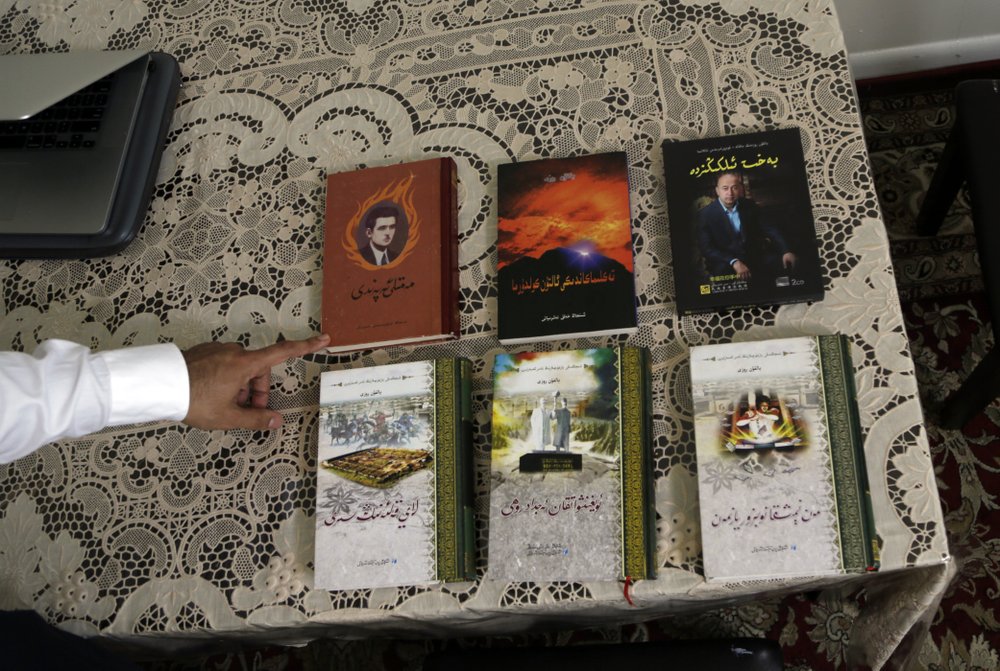
Kamalturk Yalqun displays material written by his father, Rozi, Thursday, April 18, 2019, in Philadelphia. (AP Photo/Jacqueline Larma)

Rozi’s friends, family, and former classmates describe him as sharp, disciplined and very careful, standing out for his political and business savvy. As a college student in the 1980s, he stayed away from the pro-democracy movements that were roiling China and avoided socializing with known activists.

He shot to fame among Uighurs after tangling with famous writers, winning people over during heated debates on television. He cultivated ties with state officials that allowed him to write on sensitive topics like Islam and Uighur identity.

Rozi urged his people to become educated to counter stereotypes of Uighurs as backward, exotic or extremist.

“It seemed like on TV and in state propaganda, all we did was sing and dance,” Rozi’s son Kamaltürk Yalqun said from Philadelphia, where he and other family members live in exile. “My father didn’t like this label. He wanted us to become entrepreneurs, scientists, intellectuals.”

When the government tapped Rozi in 2001 to head a committee in charge of compiling Uighur literature textbooks, he leapt at the chance.

He and his family moved into a housing compound with Xinjiang Education Press editors and schooling officials, debating world events over dinner with others in the tight-knit community of Uighur scholars and writers. Rozi kept a large study overflowing with books, shutting himself in on weekends to focus on writing and editing.

Rozi was accustomed to dealing with the government’s fears of an independent Uighur identity, and though he sometimes quarreled with censors, his works always made it to publication.

The family’s fortunes and those of the Uighurs as a whole took a dramatic turn after a string of terror attacks in Xinjiang in 2014, shortly after Chinese President Xi Jinping came to power. In response, Beijing kicked off its suffocating security crackdown.

Rozi was arrested soon after Chen Quanguo, a hard-line politician, became Xinjiang’s top official in 2016 and his books were pulled from shelves.

Soon his former colleagues at Xinjiang Education Press began disappearing, as did the officials who used to supervise his work. Colleges held political meetings to denounce “problematic textbooks,” including Rozi’s, calling them “treasonous” and a “great scourge” that poisoned Uighurs with ideas of splitting China.

“Those textbooks weren’t political at all,” Kamaltürk said. “There were things in there about taking pride in being ethnic Uighurs, and that’s what the Chinese government was upset with.”
5262AC6A 8547 4D7E 8FE1 3EA972906D2F 4
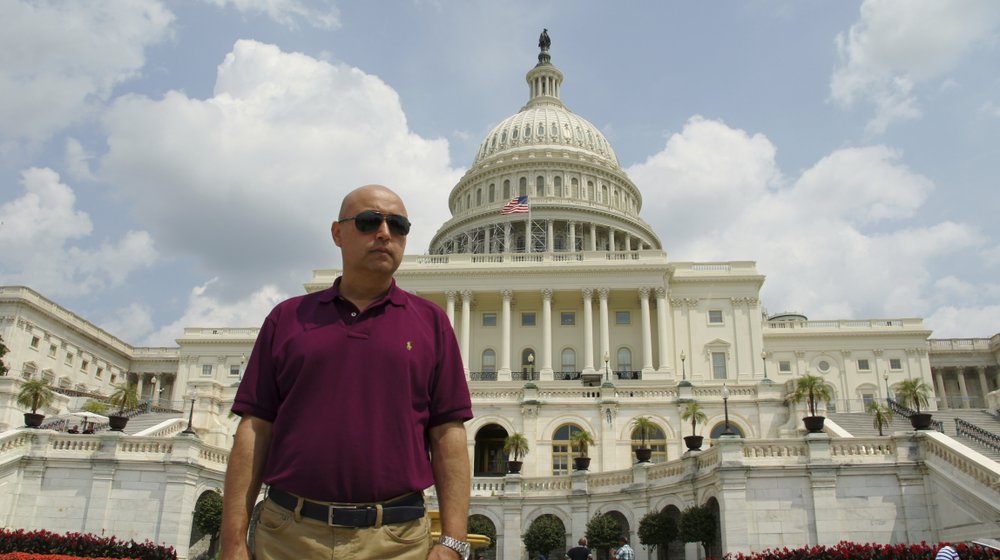
This Aug. 11, 2014, photo provided by his family shows Yalqun Rozi during a family trip to Washington. Rozi is one of over four hundred prominent Uighur academics, writers, performers and artists who have been detained, according to advocacy groups, joining an estimated one million people or more held in internment camps and prisons in China’s far western region of Xinjiang. (AP Photo/Yalqun Family)

The intensity of Beijing’s crackdown caught many by surprise, shocking even hardened dissidents.

“In retrospect, it was a signal,” said Abdurehim Dolet, Rozi’s close friend and former business partner who now lives in Turkey. “We all thought this was only temporary, that things would get better. He was made an example.”

The Chinese Foreign Ministry referred questions about Rozi’s case to regional authorities, who did not respond to a fax for comment.

Experts say the campaign against Rozi’s books is part of a systematic effort by Beijing to distance young Uighurs from their language and culture, including by putting thousands of Uighurs in Mandarin-only orphanages and boarding schools .

“It’s a slow process of cultural reengineering to reshape Uighur culture from top to bottom — to eradicate most fundamentally the Uighur language, or to erode it to the extent that among younger generations, it might potentially die out,” said James Leibold, a scholar of Chinese ethnic studies at LaTrobe University in Melbourne.

Today, Kamaltürk, his sister and mother are trying to draw attention to Rozi’s case from a cramped two-bedroom apartment in Philadelphia.

Kamaltürk, who once had the highest college entrance exam scores in Xinjiang and won a spot to study chemistry at China’s most prestigious university, has put dreams of medical school on hold to support his family. He now squeezes in time to lobby members of Congress between 14-hour days at a pharmaceutical company testing animal blood samples.

He’s creating a website dedicated to his father, and plans one day to finish translating what’s left of his father’s works into English to show the world why many Uighurs consider him among their most significant intellectuals alive.

One of Kamaltürk’s biggest regrets is that he didn’t take all of his father’s textbooks with him when he left China. He worries some may be lost forever.

“Nobody thought they could be a target, that they could vanish one day,” he said. “It’s shocking that they’re gone.”

___

Associated Press videojournalist Joseph Frederick contributed to this story from Philadelphia.

Advertisement

Costco Opens First Store on Chinese Mainland

Image: HuXijin_GT / Twitter

SHANGHAI (Xinhua) — U.S. based retail giant Costco Wholesale opened its first brick-and-mortar store on the Chinese mainland on Tuesday.

The 14,000-square-meter store is located in southwest Shanghai, with 3,400 stock-keeping units of 60 kinds of goods including household appliances, fresh food, daily necessities and travel accessories.

Customers can enjoy commodities with larger pack volumes and lower prices in the warehouse after paying a membership fee of 299 yuan (about 42 U.S. dollars) a year.

Prices of general merchandise in Costco are 30 to 60 percent lower than market prices and the food sold there is 10 to 20 percent cheaper, according to the retailer.

The store embraced surging customers on its first day, with customers spending up to two hours queuing to check out or waiting three hours to find a spot among the 1,200-space parking lot.

Tens of thousands of Chinese customers have registered memberships since July, which was beyond the store’s expectations.

“I will drive to experience the new store with my family next weekend,” said Liu Zheng, living in Hangzhou, capital of east China’s Zhejiang Province, which is more than 170 km from Shanghai.

On Tuesday afternoon, Costco announced on its official app that its business would be temporarily suspended in the afternoon to provide a better shopping experience. The retailer said customers who were still in the supermarket could continue to check out and the warehouse would not accept new customers until Wednesday.

Costco started its cross-border e-commerce business in the Chinese mainland market five years ago.

The mainland market has become mature and more customers can afford higher-quality goods, according to Richard Chang, senior vice president-Asia at Costco Wholesale.

Another retail giant Walmart opened its second Sam’s Club warehouse store in Shanghai earlier this year and will continue the store’s expansion in China to seize the huge opportunity of the upgraded consumption demand in the country.

Advertisement

Biden Says Racism in US is ‘White Man’s Problem’

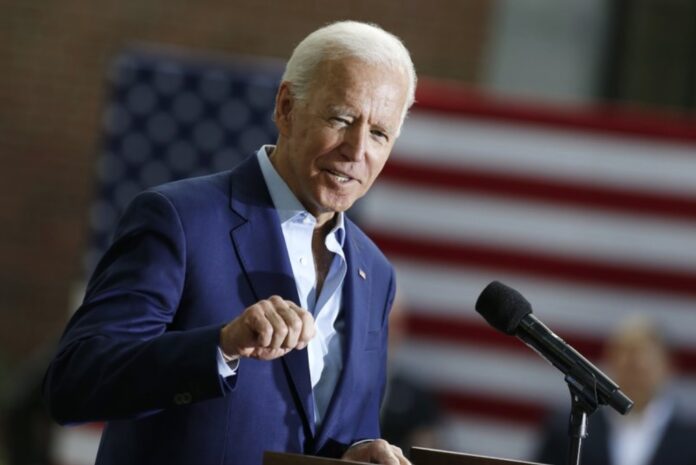
Democratic presidential candidate former Vice President Joe Biden speaks during a campaign event at Keene State College in Keene, N.H., Saturday, Aug. 24, 2019. (AP Photo/Michael Dwyer)

WASHINGTON (AP) — Racism in America is an institutional “white man’s problem visited on people of color,” Vice President Joe Biden said Tuesday, arguing that the way to attack the issue is to defeat President Donald Trump and hold him responsible for deepening the nation’s racial divide.

Taking aim at incendiary racial appeals by Trump, Biden said in an interview with a small group of reporters that a president’s words can “appeal to the worst damn instincts of human nature,” just as they can move markets or take a nation into war.

Biden is leading his Democratic challengers for the presidential nomination in almost all polls, largely because of the support of black voters. He has made appealing to them central to his candidacy and vowed to make maximizing black and Latino turnout an “overwhelming focus” of his effort. The interview, more than an hour long, focused largely on racial issues.

“White folks are the reason we have institutional racism,” Biden said. “There has always been racism in America. White supremacists have always existed, they still exist.” He added later that in his administration, it would “not be tolerated.”

By highlighting the nation’s racial tensions and placing blame on Trump, Biden is showing that he, too, is willing to make race a core campaign issue, but from the opposite perspective of the president. Turnout and enthusiasm among black voters will be critical for the Democratic nominee, notably to try to reclaim states like Pennsylvania, Michigan and Wisconsin. He also emphasized a crossover appeal to both black voters and non-college-educated white voters.

To accentuate his appeal to black voters, Biden said that he will advertise in black publications and engage with cultural institutions like the black church, black fraternities and sororities, and historically black colleges.

“The bad news is I have a long record. The good news is I have a long record,” Biden said when asked about his enduring support among black voters. “People know me — at least they think they know me. I think after all this time, I think they have a sense of what my character is, who I am.”

“I’ve never, ever, ever in my entire life been in a circumstance where I’ve ever felt uncomfortable being in the black community,” he added, suggesting that his familiarity was not matched by many of his competitors.

While he did not specify to whom he was referring, Biden said he believes there are “assertions and assumptions” made about black voters that he believes are inaccurate, and he said that “a lot of people haven’t spent much time in the community.”

Without mentioning her by name, Biden also referenced California Sen. Kamala Harris’ attack on him during the first presidential debate on the issue of busing as a solution to school desegregation.

“All I know is I don’t think anybody in the community thinks I am — what’s the phrase?” Biden asked, paraphrasing Harris’ comment that “I know you’re not a racist, Joe.”

“I don’t think anyone thinks that about me,” Biden said.

Biden was also asked whether he would select a woman or person of color as his running mate should he become the nominee. He said that while he would “preferably” do so, he is ultimately seeking a partner on the ticket who is “simpatico with what I stand for and what I want to get done.”

“Whomever I pick would be preferably someone who was of color and who was of a different gender, but I’m not making that commitment until I know that the person I’m dealing with I can completely, thoroughly trust, is authentic, and is on the same page.”

Looking ahead to the next Democratic debate in Houston in September, he said that he understands why he has a target on his back but cautioned that Democrats “shouldn’t be forming a circular firing squad and shooting” because it only helps Trump.

Trump’s reelection campaign dismissed Biden’s accusation that Trump had inflamed racial tensions in the country.

“Having moved on from the Russia Hoax, Democrats are now employing the oldest play in the Democrat playbook: falsely accusing their opponent of racism, extending it even to the President’s supporters. Calling half the country racist is not a winning strategy,” said Tim Murtaugh, the Trump campaign’s communications director.

Biden also said that the Democratic field would narrow and allow for more meaningful exchanges. In the current crowded field, he said it’s difficult to have any meaningful debate at all, calling it a “non-debate debate.”

Biden, who has been attacked most forcefully by Harris, said that he believed “those who made the most direct attacks on one another haven’t really benefited much by it at the end of the day.”

Advertisement

HK Police: 13 More Arrested for Protest ‘Illegal Activities’

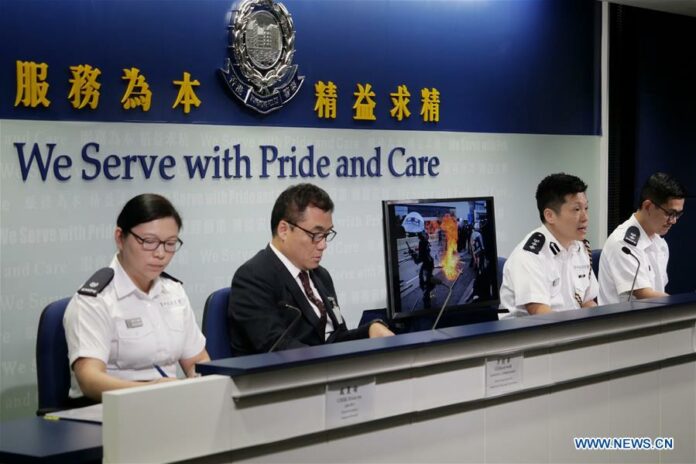
Tse Chun-chung (2nd R), chief superintendent of Hong Kong police public relations branch, shows a photo in which radical protesters attacked police officers with petrol bombs during a daily press conference in south China's Hong Kong, Aug. 27, 2019. (Xinhua/Wang Shen)

HONG KONG (Xinhua) — Hong Kong police said on Tuesday they had arrested another 13 suspects related to illegal activities in the past two months.

Police said 11 men and two women, aged 19 to 40, had been arrested in the past few days for offences including unlawful assembly, criminal damage, access to computer with criminal or dishonest intent, and possession of offensive weapons.

So far, more than 800 arrests had been made since June, when the protest first broke out.

Speaking at the daily press conference, Tse Chun-chung, chief superintendent of police public relations branch, said violence by radical protesters had escalated from setting up roadblocks to deliberately hurting police officers with deadly weapons, including steel balls, bricks, slingshots and petrol bombs.

Apart from targeting police officers, violence by radical protesters also hurt ordinary residents and journalists, Tse said.

“No illegal or violent behavior can be glorified or justified,” he said, adding that the police will not tolerate illegal activities including violence.

Advertisement

Mock Parliament Art Exhibit Questions ‘Return to Democracy’

BANGKOK — An art installation launched on Tuesday urge visitors to question whether a democracy has truly returned after five years of direct junta rule. 

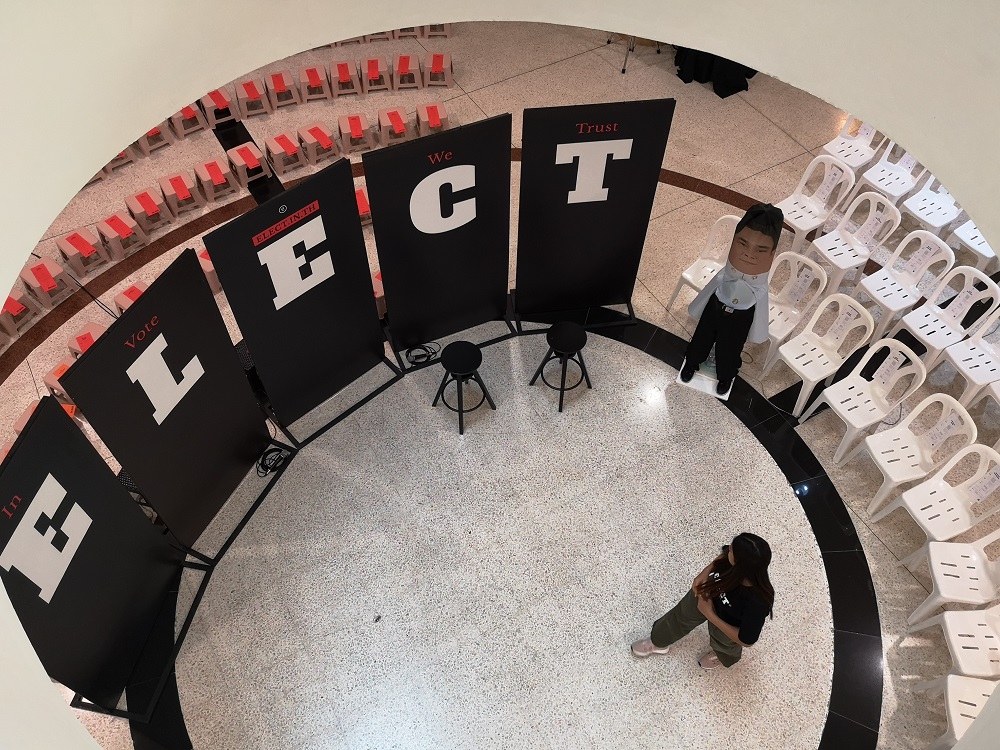
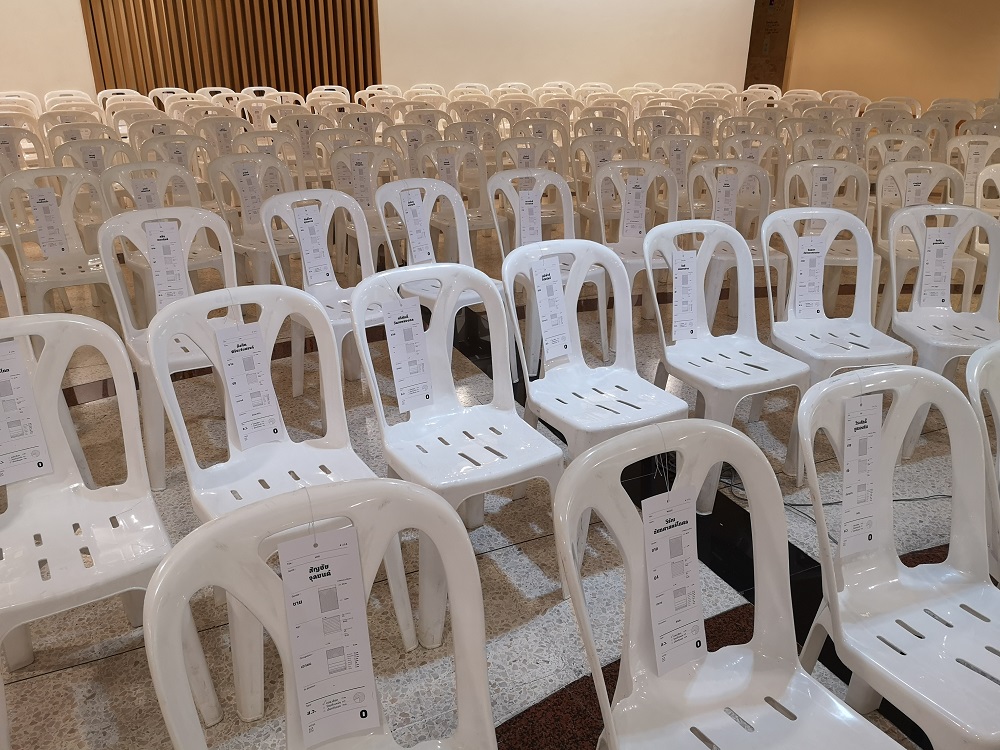
Running until Sunday at an art gallery in downtown Bangkok, highlights include a mock parliament of 250 plastic chairs with armrests and 500 stools with no armrest – symbolizing the unequal power 250 Senators handpicked by the junta have over 500 elected MPs. Stools representing the opposition MPs are also lower than the rest. 

“It turns out that the uncomfortable [MP] seats have more votes in support than the comfortable [senate] seats which have zero votes,” Punyisa Suptasan, a staff member at the exhibition, said. 

img 20190827 151656


Names of each parliament member is assigned to each seat. Other breakdowns are also available in pieces of paper attached to the seats.

 Only 10.8 percent of senators are women while nearly 90 per cent are men. Fifty-eight percent of senators are from the “Boomer” generation. Over three third of the appointed senate, or 35.6 percent, have military background.

 Elected MPs do not fare much better in terms of gender equality, with only 16 per cent women and 84 percent men. 

Interestingly enough, despite at least two MPs declaring themselves as LGBT, it didn’t show in the breakup at the exhibition organized by Punch Up, a data consultancy firm and The Matter, an online Thai-language news media.

 Then there is an emoji chart representing the 750 members of parliament for visitors to guess. Many show lips, most likely a reference to member of parliaments who pay lip service. Some also show the “See no evil, speak no evil, hear no evil” monkey emoji.

 “It represents the Democrat Party,” exhibition coordinator Warute Udomrut said. 

 You see baby emoji as well; Warute said it represent the young Future Forward Party.

img 20190827 142542

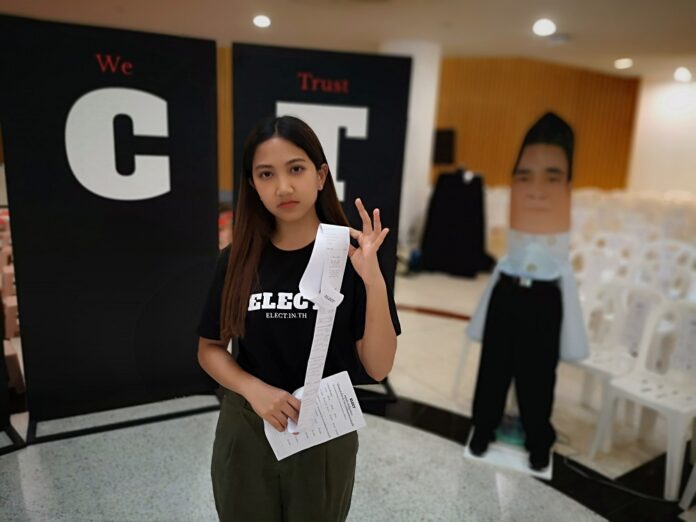
 Elsewhere in the exhibition, there is a long receipt where you can ask from the staff and peruse at the costs of the March general elections.

 All told, the elections and selections of members of parliament cost 5.38 billion baht. Thais people waited 1,875 days since the May 2014 military coup which was led by junta leader Gen Prayuth Chan-ocha before the elections.

 “Then we got the same man as prime minister,” 23-year-old staff member Punyisa said.

There is also an inflatable doll of former junta chairman Prayuth with voice recording of him addressing the parliament alternated with a generic snoring sound.

 “I want him to take a rest,” said Warute, the project coordinator.

‘ELECT after Election’ is located on the underground floor of Bangkok Arts and Culture Centre. The venue is accessible from BTS National Stadium. It runs from 10am to 9pm until Sep. 1, 2019. Entry is free. Call 094 436 4471 for more details.  

Advertisement

Housing Prices Leave No Room(s) for Bangkok’s Poor

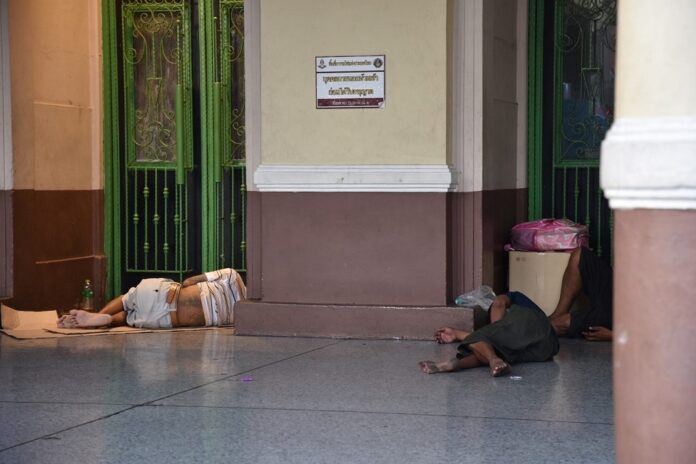
Homeless people sleep on the floor of Hualamphong Train Station in March 2019.

BANGKOK — As housing prices in Bangkok skyrocket, the authorities are struggling to provide enough low-cost housing for the poor, according to both real estate developers and welfare NGOs. 

An extra 300,000 units of low-cost housing are needed in Bangkok, but only 30,000 units are currently being constructed by the authorities, Pornarit Chounchaisit, president of the Thai Real Estate Association, says.

“Total mortgage transfers amounted to 80 trillion baht last year, but only five percent of that accounted for low-cost housing,” Pornarit said, speaking at a press conference organized by Habitat for Humanity, an NGO advocating for affordable housing for all. 

Despite economic slowdown, Pornarit said land prices in Bangkok are still appreciating. The lack of low-cost housing means secure home ownership is out of reach for Bangkok’s poor, who don’t have the assets to secure mortgages from banks.

“We can reduce construction costs, but land prices aren’t going down despite the economy,” Pornarit continued.

Giving an example of Bangkok’s competitive housing market, he said a former employee commuted for a total of four hours to and from work each day.

 “I gave him a sum of money and fired him. I told him to look for another job closer to home,” he said.

While Pornarit was speaking about the exclusion of the poor from Bangkok’s housing market, an academic on the same panel said that even he has struggled to find affordable housing. 

Poon Thiengburanathum, the deputy director of Chiang Mai University’s School of Public Policy, said he took out a 30-year mortgage for a modest 50-square-wah house (200 square meters) in Chiang Mai.

“It’s no fun,” Poon said.

But public housing may not be a feasible solution for Bangkok’s shortage of affordable housing, Tim Loke, the national director of Habitat for Humanity Thailand, warned. A Singaporean, Loke argued that different population sizes mean his home city-state’s successful public housing model cannot be duplicated in Thailand. While Singapore is home to around 5 million citizens, Thailand’s population is closer to 70 million.

In the run up to the March election, Khaosod English found that no political parties promoted issues directly helping the homeless, but often talked of affordable housing.

Advertisement

Teacher Denies Giving Urine-Infused Water to Students

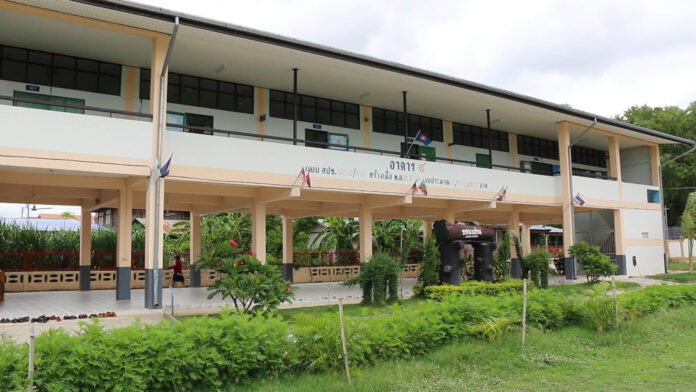
Chot Nong Kae School on Aug. 26.

KHON KAEN — A teacher was investigated Monday for allegedly prescribing urine-infused water to her students under the belief it would cure ailments.

Khon Kaen school district director Sanong Sudsaard said on Monday that a teacher at Chot Nong Kae School, whose name has been withheld, was summoned to testify over a Facebook comment in an urophagia group. In the comment, the teacher claimed to have given her pupils piddle-infused water to drink as a cure for indigestion.

“I always bring a mixture of urine and herbs to school. When my students become sick, I give them the mixture instead of medicine,” reads the now-deleted comment. “They usually come with stomach aches or fever. But once they’ve taken my magic formula, they feel better within half an hour.”

“I’ve tried it on almost 30 students, and it worked on everyone,” the comment continued.

The investigation is ongoing, during which the teacher is allowed to continue teaching. The school has not taken action against the teacher, though she has been instructed to stop giving the mixture to students.

Sanong said the teacher denied the veracity of her Facebook comment during the investigation, in which students and child protection officers have also participated. She claimed that she just wanted to boast in the group and revealed that the “magic formula” is in fact a mixture of herbal extracts such as pandan and yanang leaves.

The teacher is said to be inspired by Buddhist teachings.

“She is a dhamma practitioner who has studied herbs and Buddhist scriptures,” Sanong said. “She claimed that she got the idea from sacred texts, which mention the use of urine in curing diseases.”

Meanwhile, health officials warned against the consumption of bodily waste, which is currently a trend among folk medicine practitioners.

The Director-General of the Department of Medical Services, Somsak Akkslip, says the consumption of urine – which contains extraneous nutrients such as urea and sodium chloride – can lead to higher risks of high blood pressure, infection, and even cardiac arrest.

Advertisement

13 Rescued Great Danes Named by Palace

Photo: Watchdog Thailand / Facebook

BANGKOK — More than a dozen Great Danes rescued from starvation have been christened with names by the palace.

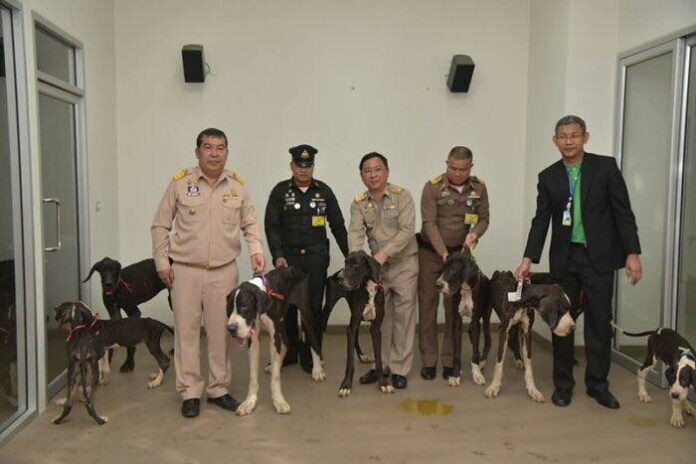
After rescuing 13 starving Great Danes from a farm on Aug. 19, Watchdog Thailand says the 8 females and 5 males are still recovering at the Kasetsart University Veterinary Teaching Hospital. Five are still in critical condition. On the bright side, they all have new names.

“The names were determined by the palace,” a representative from Watchdog Thailand said.

The five dogs still under close watch are named Batu, Bella, Kimberley, Araya and Dairy.

One male, Batu, aged 2 years and 3 months, is suffering from a bloated stomach. Five-month-old Bella has enteritis, while Kimberley has anemia. Araya has low albumin levels, and Dairy is suffering from malnutrition.

“All the dogs are underweight, and seem to have been deprived of food for about a month,” Kongsak Tiangtum, a veterinarian at the university said.

Bella, Kimberley, and Araya are most likely named after lookkreung Thai celebrities: Bella Campen, Kimberley Anne Woltemas Tiamsiri, and Araya Alberta Hargate.

The healthier group consists of males Bizarro, Toro, Mhor Sup, and Charlie. The females are named Briohny, Benlisa, Kasalong, and Cheryl. Kasalong is the name of a character from “Klin Kasalong,” a 2019 Channel 3 soap.

On Aug. 19, Watchdog Thailand raided a Pathum Thani farm where the 13 dogs were chained up without food. According to the organization, the farm owner said that he had tried to breed dogs for sale, but could not find buyers. He refused to give the dogs away because “he did not want them to be a burden on others” and that they “can die on their own.” 

The palace then took the dogs under royal care, sending aides to help Watchdog Thailand.

The Department of Livestock Development has filed an animal cruelty case against the owner. The Watchdog representative declined to name him.

Related stories:

Palace Helps Rescue 13 Great Danes from Starvation

Advertisement

King Tells Prayuth to Abide by His Oath

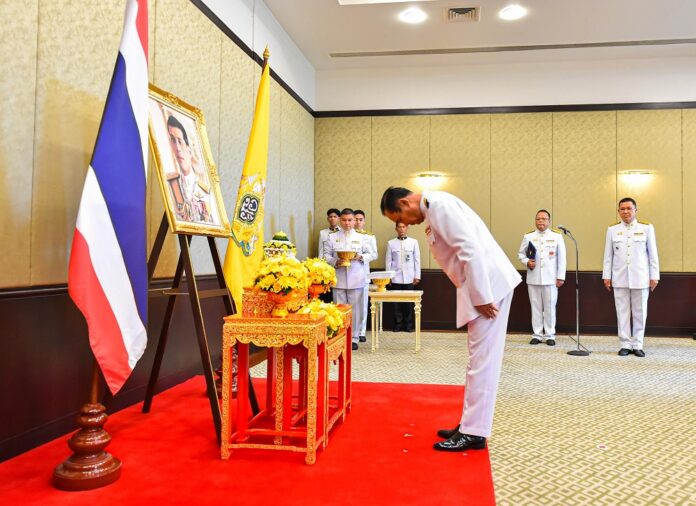
BANGKOK — His Majesty the King has instructed Prime Minister Prayuth Chan-ocha and his cabinet to hold true to their oath and solve the country’s problems earnestly.

In messages presented to cabinet members in an elaborate ceremony at Government House today, King Vajiralongkorn also expressed moral support for the government and urged it to be strong. The messages were personally signed by His Majesty the King.

Prayuth and the cabinet members received copies of the message one by one in front of a portrait of King Vajiralongkorn.

The monarch made no mention of the controversy surrounding Prayuth’s failure to deliver his oath of office in full as mandated by the constitution.

Prayuth skipped over a line – “I will also uphold and comply with the Constitution of the Kingdom in every aspect” – when he presented the new Cabinet to His Majesty the King on July 16.

Deputy prime minister Wissanu Krea-ngam said the ceremony today was not a “fix” of the swearing-in ceremony. Neither Wissanu nor any other government leader would explain why Prayuth omitted the line, which is included in Section 161 of the constitution.

The omission prompted several activists to file a complaint to a government watchdog agency, accusing Prayuth of violating the charter.

An official from the Ombudsman’s Office, where the complaint was lodged, announced today the issue will be forwarded to the Constitutional Court for formal deliberation.

The Ombudsman’s Office also said Prayuth told the agency he has “already completed” the oath upon being questioned.

Advertisement

Disney Execs Discuss Cultural Authenticity in ‘Mulan’

Liu Yifei plays the title role in Disney’s Mulan, coming in March 2020. Image: Disney

LOS ANGELES (Xinhua) — With the live action feature version of Disney’s “Mulan” slated for release next March, the official trailer has been screened to an appreciative audience.

The blockbuster, starring Liu Yifei in the lead role, is based on the Chinese legend of Hua Mulan and is a live action adaptation of Disney’s 1998 animated film of the same name. Its director Niki Caro and Disney executives discussed the film at the Mouse House’s D23 Expo held from Friday to Sunday.

“I’m most excited for the audience to see this movie on a truly epic scale,” Caro told the attendees at D23. “What drew me to this project was Mulan herself, her journey from village girl to soldier, to warrior, to hero,” she said.

Caro is the second female director hired by Disney to direct a film budgeted at over 100 million U.S. dollars. “Mulan” is one of Disney’s biggest budget films ever with a reported 300 million dollars.

Mulan, a beautiful, spirited young woman seeking to spare the life of her ailing father, disguises herself as a man to go to war in his place. Smart, brave and determined, she flouts tradition to embrace her true potential and blazes a trail of courage against their enemies.

For this mash-up of Disney’s animated “Mulan” film and the original Chinese legend, Disney adroitly side-stepped any concerns of potential “whitewashing” by auditioning more than 1,000 actresses of Chinese descent to find just the right lead to play Mulan who had the perfect mix of acting talent, martial arts training and likability.

They picked Chinese-American Liu Yifei and cast other leading Chinese actors, Donnie Yen, Jet Li, Gong Li and Jason Scott Lee.

As the No. 2 biggest movie market in the world, China is a major market for Disney. China’s movie box office revenue grew 9 percent to around 60.97 billion yuan (8.9 billion U.S. dollars) in 2018, becoming an essential part of the success of many Hollywood’s blockbusters.

Tackling a beloved legend from another culture can be fraught with peril if handled badly. Xinhua asked Disney executives how they approached a movie like “Mulan,” set in a different culture and country to ensure cultural integrity and authenticity.

“We spent a lot of time in the beginning with scholars, experts and people from the region. And we spent a great deal of time in China,” replied Sean Bailey, president of Walt Disney Studios Motion Picture Production, adding that the studio not only has a Chinese cast but also brought in a Chinese producer to make the movie with them.

S 41115968 1
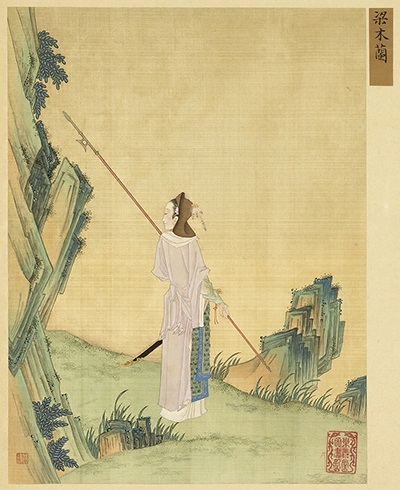
Mulan as depicted in the Qing era album “Gathering Gems of Beauty”

“What I’ve found when you are trying to make an authentic movie about China or the Middle East or Boston, is that if you put a lot of knowledgeable people in front of and behind the camera, they will tell you, ‘Hey, I think this is a little off’ or ‘I think you can improve a little there…,'” he explained.

Disney takes its mission to make universally-accessible and culturally-accurate movies very seriously, as evidenced by the popular stories of diverse cultures they have brought to the big screen, such as “Mulan,” “Coco,” “Moana,” and “Aladdin.”

Alan Horn, co-chairman and chief creative officer of The Walt Disney Studios, said, “In today’s social media environment, we get a lot of feedback. And we listen to it. We are aware of the importance of keeping a finger on the pulse of what happening out there.”

Bailey also assured the press, “We do a lot of work on the front end to be as smart about it as we can and populate the production as well as we can with knowledgeable people in front of and behind the camera.”

He added, clearly enthusiastic about Disney’s productions, “I love when these movies go out in the world … I love the values and the stories and impact they have on a huge audience.”

Horn pointed out audiences have a certain expectation of the Disney brand, no matter what culture they depict, “Audiences may not always know what they are going to see, but they know what they are not going to see. The Disney brand conveys a certain responsibility to the public to parents and families, to make them feel safe.”

When asked if Disney has any plans to do more Chinese stories, Horn told Xinhua, “The China market is obviously a large and important one and we care about the Chinese people and their history and traditions, so we will certainly continue to explore what other Chinese stories and legends might have universal appeal that we could bring to the screen.”

He chuckled, “We could run out of Marvel stories, so we are interested in stories from all over the world that can show us something different and special.”

He noted that it’s important to make movies that “have lasting value, that mean something, that touch people.” And smiling, he added, “And it never hurts to be funny.”

Story by Julia Pierrepont III, Gao Shan

Advertisement

Hot News

LATEST NEWS

Bangkok
overcast clouds
34.4 ° C
34.4 °
32.7 °
71 %
4.2kmh
99 %
Mon
33 °
Tue
34 °
Wed
35 °
Thu
31 °
Fri
30 °