29.4 C
Bangkok
Friday, June 5, 2026
Home Blog Page 1534

King Power Mahanakhon Presents Ultra-Luxury Living in Thailand’s Iconic Landmark Destination

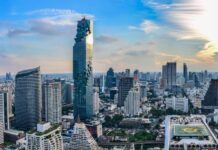
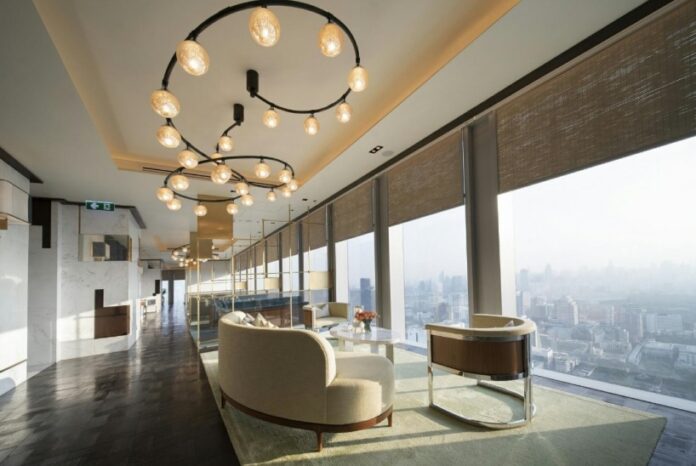
BANGKOK, 24 July 2019 – King Power Mahanakhon, Thailand’s iconic landmark destination recently opened its doors to brand new super luxury show units at The Ritz-Carlton Residences, Bangkok. Located in the heart of Bangkok’s Sathorn and Central Business District, the freehold residences are situated on the 23rd to 73rd floor of the iconic pixelated building. Units range from 2-4 bedrooms, with sizes from 135 square meters to 447 square meters. Interested owners also have the unique option of combining units on the 59th floor to create up to 1100 square meters of ultra-luxury living space. Steps away from Chong Nonsi BTS station, the opportunity to own a residence in the prestigious prime location is now available to those seeking an elegant urban lifestyle.

In addition to premium amenities and legendary service by the Ladies & Gentlemen of The Ritz-Carlton, units feature world-class bespoke interiors crafted by David Collins studio. Luxurious facilities include a 54th floor Residential Club Lounge where owners can enjoy a library, bar, dining area, kitchen, lounge area, boardroom and TV room. Owners will also have access to a fitness center, swimming pool, private cinema, mini-bar, billiard room, games room, and children’s room among other leisure amenities located on the 7th floor.

Marc Begassat, Managing Director of King Power Mahanakhon said, “It is truly a unique opportunity to own a residence within an iconic landmark, in one of Thailand’s tallest buildings. As we continue to create a destination that combines exceptional hospitality, award winning cuisine, and world class attractions, we look forward to offering owners a prestigious urban lifestyle experience that can only be found at King Power Mahanakhon.”

Within the same iconic building, the mixed-use property is also home to Mahanakhon SkyWalk, Thailand’s highest observation deck, three levels of King Power Duty Free and Retail, and Mahanakhon Bangkok SkyBar, Thailand’s highest restaurant and bar. In the next phase, the world’s first Orient Express Hotel will also be making its debut at the landmark destination, with signature dining venues including Mott32 and Mahanathi by David Thompson.

Available units at The Ritz-Carlton Residents, Bangkok start from 42 million THB. Exclusive privileges for purchasers include a King Power Crown membership, cash vouchers worth 50,000THB of catering services from Pullman Bangkok King Power Hotel, and 2 Premier League Football tickets at King Power Stadium, Leicester City, England.

For more information please visit https://residences.kingpowermahanakhon.co.th/or email: [email protected].

Advertisement

Opinion: The Illusion of Choice Under Thailand’s Fake Democracy

With a functioning opposition bloc in Parliament, it would be easy to say Thailand is transitioning back to semi-democracy. But there’s a case to be made that Thailand in 2019 remains a fake democracy.

Parliament’s upper house was selected by Gen. Prayuth Chan-ocha, the former junta leader who is now both prime minister and defence minister. No true democracy would allow a dictator to appoint virtually the whole senate, which ended up endorsing the dictator’s bid for a second term as prime minister earlier this year.

Prayuth arguably had no chance of becoming prime minister without the coup. It was the 2014 coup that enabled Prayuth to install himself in power for five years, before paving a political, judicial and legal system that set him up to continue as prime minister after the March general “election”. The current system should be called a fake democracy.

The risk of a possible coup by hawkish Army Chief Gen. Apirat Kongsompong means that any exercise of democratic rights, particularly the right to protest, will risk further military intervention.

In a country where fake luxury handbags and fake Rolexes are common, a counterfeit democracy might not be all that alarming. As long as a majority are happy with the illusion that Thailand is a democracy, what’s the point of making a fuss?

Fake democracy gives us an illusion of choice. Thailand had elections, even though the chances of the opposition winning were severely curtailed by electoral rules designed by lawmakers directly and indirectly chosen by the junta leader.

Fake democracy may be shoddy yet we have something that resembles an elected government. Prayuth goes to work every day for the good of the Thai people, some say.

The problem is that we never exercised real, meaningful electoral choice. We do not have real freedom but a fake freedom – an illusion of being really free. We are free as long as we do not overstep the boundaries set by the society.

Thailand enjoys neither genuine freedom of speech nor press freedom due to a draconian lese majeste law. Those who want to speak their mind freely have to leave the Kingdom for good and some do not feel safe even abroad.

Kyoto-based monarchy critic Pavin Chachavalpongpun claimed this week that an unidentified man tried to assault him in his flat. He has since been inactive on Facebook, where he criticizes the institution of the monarchy to over 170,000 followers.

Although the attack was unsuccessful according to Pavin, who told the tale during a symposium in the US earlier this week, the story has left some other exiled dissidents shaken. After all, two bodies of Laos-based republicans floated up the Mekong river late last year, while five more are missing and presumed dead.

“There is really no refuge for those seeking refuge,” wrote Korea-based former student activist Chanoknan Ruamsap, who fled Thailand two years ago after being accused of lese majeste for sharing a critical biography of King Rama X published by BBC. On Friday, she announced that her Facebook had been temporarily hacked. She can’t help but feel paranoid and suffers from insomnia.

Perhaps it’s less painful to simply be convinced that we have real democracy and freedom. That way we can be content, if not happy, and go about our daily routines without constantly feeling cheated and disappointed.

Advertisement

Snubbed by North Korea, Pompeo Hits Other Asian Turbulence

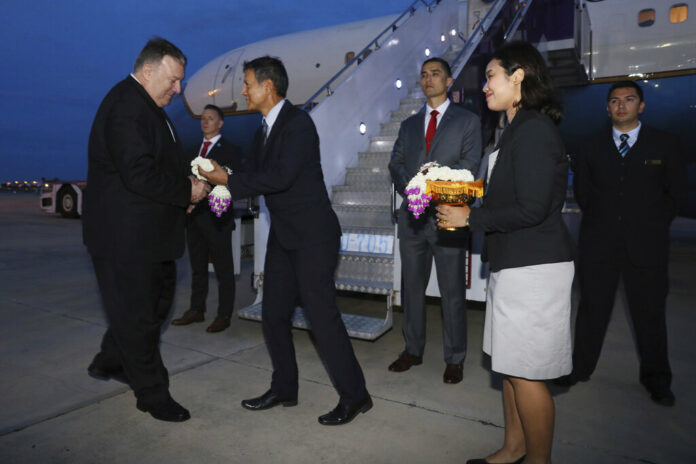
U.S. Secretary of State Mike Pompeo is presented with flowers as he boards his plane to depart for Australia from Don Mueang International Airport, in Bangkok, Thailand, Saturday, Aug. 3, 2019. Photo: Jonathan Ernst / Pool Photo via AP

BANGKOK — U.S. Secretary of State Mike Pompeo left Thailand on Saturday with his hopes for resuming nuclear talks with North Korea dashed, while facing an escalating trade war with China and a potentially devastating breakdown in relations between key American allies Japan and South Korea.

After three days in Bangkok that the Trump administration had expected could herald an end to the impasse in North Korea negotiations, Pompeo instead departed without progress on that front as Pyongyang continued to launch ballistic missiles, heightening unease over prospects for a denuclearization deal. Pompeo expressed disappointment that the North had sent neither its foreign minister nor a counterpart for the chief U.S. negotiator to the Thai capital.

“I always look forward to a chance to talk with him,” Pompeo said on Friday after it became clear he would not be seeing the North Koreans. “I wish they’d have come here. I think it would have given us an opportunity to have another set of conversations, and I hope it won’t be too long before I have a chance to do that.”

Yet despite what he and other U.S. officials say are ongoing lower-level contacts with Pyongyang, there is no date or venue set for a resumption in negotiations more than a month after President Donald Trump and North Korean leader Kim Jung Un met at the De-Militarized Zone separating the two Koreas. At that time, administration officials said they believed a new round of talks was just weeks away.

Four senior U.S. officials accompanying Pompeo to the annual Association of Southeast Asian Nations regional security forum said North Korea’s decision not to attend the conference, which has in the past served as venue for high-level engagement between the two countries, had been a surprise to both the Thai hosts and the other participants. One of those officials said the North’s absence was mentioned by every delegation that Pompeo and top U.S. envoy Stephen Biegun met with in Bangkok.

“Unfortunately, the North Koreans missed this opportunity,” said the official, who like the others was not authorized to discuss the closed-door discussions publicly and spoke on condition of anonymity. The official added that the North’s absence “probably hurts their own interests” and that its failure thus far to agree to a new round of negotiations “is not a positive or constructive response by them.”

Although Trump himself has downplayed the missile launches, this official said the recent tests — two of which took place during the ASEAN meeting — were unhelpful provocations that had been a “huge mistake” that caused “self-inflicted damage on their own part.” The official said that assessment was widely shared by U.S. partners and that the missile tests may have had the unintended consequence of galvanizing sentiment against the North.

Any convergence of opinion on the North may be one of the few positives to emerge on what had been a full and ambitious agenda for Pompeo in Bangkok.

As he arrived on Wednesday, trade talks between the U.S. and China concluded without result in Shanghai, and Trump then announced new tariffs on Chinese imports in a move that angered Beijing shortly after Pompeo met with China’s foreign minister. Then on Friday, Japan downgraded South Korea’s trade status, prompting a stern response from the South and escalatory steps by both sides that could jeopardize U.S. interests in both allied countries and more broadly in the Asia-Pacific.

As the situation between Seoul and Tokyo deteriorated on Friday, Pompeo hosted his Japanese and South Korean counterparts at an uncomfortable trilateral meeting on the sidelines of the ASEAN conference. Two senior U.S. officials involved in that discussion acknowledged the seriousness of the dispute but said it was encouraging that the meeting took place at all given the developments.

One of the two officials said the dispute would not affect cooperation on North Korea, while the other expressed hope that tensions could be eased without significant U.S. involvement. The second official said there is “no upside to getting in the middle of this” and suggested that a series of unspecified de-escalatory steps could be taken by each country to prevent the dispute from spiraling.

Story: Matthew Lee

Advertisement

Texas Governor: 20 Dead in El Paso Shopping Center Shooting

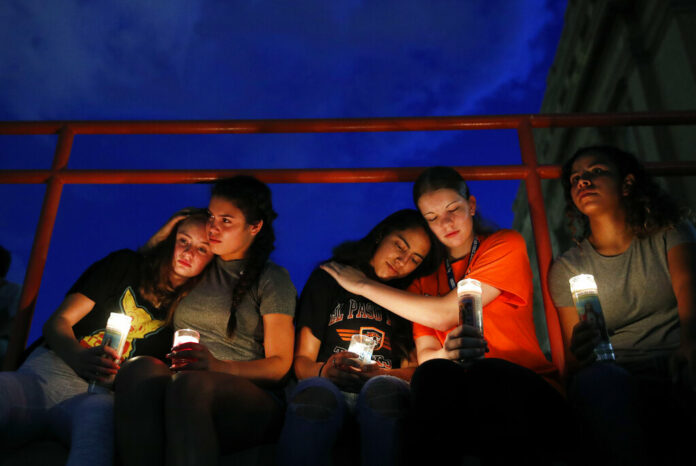
From left, Melody Stout, Hannah Payan, Aaliyah Alba, Sherie Gramlich and Laura Barrios comfort each other during a vigil for victims of the shooting Saturday, Aug. 3, 2019, in El Paso, Texas. Photo:John Locher / AP

EL PASO, Texas — A young gunman opened fire in an El Paso, Texas, shopping area packed with as many as 3,000 people during the busy back-to-school season Saturday, leaving 20 dead and more than two dozen injured.

Gov. Greg Abbott called the incident in the Texas border city “one of the most deadly days in the history of Texas.” Police said authorities were investigating if it was a hate crime.

The suspect was arrested without incident outside the Walmart near the Cielo Vista Mall, said El Paso Police Chief Greg Allen. Two law enforcement officials who spoke to The Associated Press on condition of anonymity identified the suspect as 21-year-old Patrick Crusius. El Paso police didn’t release his name at a news conference but confirmed the gunman is from Allen, near Dallas.

Many of the victims were shot at the Walmart, police said.

“The scene was a horrific one,” said Allen, adding that many of the 26 people who were hurt had life-threatening injuries.

The chief said police found a post online possibly written by the suspect.

“Right now we have a manifesto from this individual that indicates, to some degree, it has a nexus to potential hate crime,” Allen said.

The shooting came less than a week after a gunman opened fire on a California food festival. Santino William Legan, 19, killed three people and injured 13 others last Sunday at the popular Gilroy Garlic Festival, and died of a self-inflicted gunshot wound.

El Paso, which has about 680,000 residents, is in West Texas and sits across the border from Ciudad Juarez, Mexico.

Residents quickly volunteered to give blood to the injured after the shooting, and police and military members were helping people look for missing loved ones.

“It’s chaos right now,” said Austin Johnson, an Army medic at nearby Fort Bliss, who volunteered to help at the shopping center and later at a school serving as a reunification center.

Adriana Quezada, 39, said she was in the women’s clothing section of Walmart with her two children when she heard gunfire.

“But I thought they were hits, like roof construction,” she said of the shots.

Her 19-year-old daughter and 16-year-old son threw themselves to the ground, then ran out of the store through an emergency exit. They were not hurt, Quezada said.

She said she saw four men, dressed in black, moving together firing guns indiscriminately. Police later said they believed the suspect, who was armed with a rifle, was the only shooter.

Ryan Mielke, a spokesman for University Medical Center of El Paso, said 13 of the injured were brought to the hospital with injuries, including one who died. Two of the injured were children who were being transferred to El Paso Children’s Hospital, he said. He wouldn’t provide additional details on the victims.

Eleven other victims were being treated at Del Sol Medical Center, hospital spokesman Victor Guerrero said. Those victims’ ages ranged from 35 to 82, he said.

President Donald Trump tweeted: “God be with you all!”

At a candidate forum Saturday in Las Vegas, presidential candidate and former Texas congressman Beto O’Rourke, who is from El Paso, appeared a bit shaken after news of the shooting in his hometown was reported. The Democrat said the shooting shatters “any illusion that we have that progress is inevitable” on tackling gun violence.

He said he heard early reports that the shooter might have had a military-style weapon, saying we need to “keep that (expletive) on the battlefield. Do not bring it into our communities.”

El Paso Mayor Dee Margo said he knew the shooter was not from his town.

“It’s not what we’re about,” he said at the news conference with the governor and police chief. El Paso is nearly a 10-hour drive from Allen, where the suspect lives.

El Paso has become a focal point of the immigration debate, drawing Trump in February to argue that walling off the southern border would make the U.S. safer, while city residents and O’Rourke led thousands on a protest march past the barrier of barbed wire-topped fencing and towering metal slats.

O’Rourke stressed that border walls haven’t made his hometown safer. The city’s murder rate was less than half the national average in 2005, the year before the start of its border fence. Before the wall project started, El Paso had been rated one of the three safest major U.S. cities going back to 1997.

Heidi Beirich, director of the Southern Poverty Law Center’s Intelligence Project, also said the El Paso shooting suspect wasn’t on her group’s radar screen prior to the shooting.

“We had nothing in our files on him,” Beirich wrote in an email.

The shooting is the 21st mass killing in the United States in 2019, and the fifth public mass shooting. Before Saturday, 96 people had died in mass killings in 2019 — 26 of them in public mass shootings.

The AP/USATODAY/Northeastern University mass murder database tracks all U.S. homicides since 2006 involving four or more people killed, not including the offender, over a short period of time regardless of weapon, location, victim-offender relationship or motive. The database shows that the median age of a public mass shooter is 28, significantly lower than the median age of a person who commits a mass shooting of their family.

Since 2006, 11 mass shootings — not including Saturday’s — have been committed by men who are 21 or younger.

___

This story has been corrected to show that the suspect’s last name is Crusius, not Crucius.

___

Story: Cedar Attanasio, Michael Balsamo and Diana Heidgerd. Balsamo reported from Orlando, Florida, and Heidgerd from Dallas. Associated Press writers Martha Irvine in Chicago, Eric Tucker in Washington, D.C., Michelle L. Price in Las Vegas and Jeff Karoub in Detroit contributed. AP data editor Meghan Hoyer also reported from Washington, D.C.

Advertisement

Correction: Army Chief Did Not Blame Redshirts

On August 2, 2019, Khaosod English published an article which suggested Army Chief Gen. Apirat Kongsompong blamed the Redshirts for a series of bomb and arson attacks in Bangkok that day.
In fact, Gen. Apirat did not make any reference to the Redshirt movement. His original statements were that he believed the perpetrators were the same group of people who have been responsible for other similar attacks since 2006, without further elaboration.

We apologize to readers and Gen. Apirat for the misquotation, which we acknowledge was a serious blunder.

Measures will be taken to ensure such errors are not made again.

Advertisement

‘Faiyen’ Anti-Monarchy Musicians Seek Asylum in Paris

BANGKOK Five members of an anti-monarchy music band left their hideouts in Laos for France on Friday as they pledged to continue their cause.

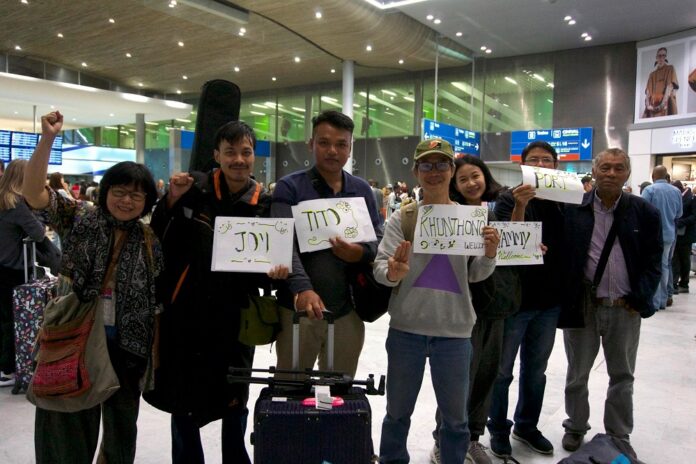
Photos of Faiyen members Nithiwat Wannasiri, Worravut Thueakchaiyaphum, Romchalee Sombulrattanakul, Parinya Cheewinkulpathom, and Trairong Sinseubpo arriving at Charles de Gaulle Airport surfaced yesterday. It is understood that the five will now proceed with seeking refugee status in France.

Nitiwat Wannasiri, arguably the most vocal of the band members, vowed not to live in quiet exile.

“I did not come to escape but came to continue the fight. The lives of comrades forced to disappear or be killed must not be in vain,” wrote Nithiwat on Facebook early Saturday morning, Bangkok time. He declined to comment when reached by a reporter. 

Against the background of a number of exiled republican dissidents being assassinated and abducted in recent months, overseas activists lobbied hard to secure the rescue of the musicians, who fled to Laos after the May 2014 coup.

“It’s been a stressful seven months of struggle to find a country in the democratic world that would recognize the importance of saving the lives of these political exiles in Laos. Seven months during which the lives of eight Thai people in political exile are presumed terminated,” one such activist involved in the effort wrote on Facebook.

Late last year, the bodies of two Laos-based republicans floated up the Thai side of the Mekong river in Nakhon Phanom province. At least six other exiled republicans are currently presumed missing. They include well-known Redshirt Surachai Danwattananusorn, who disappeared late last year in Laos. Many of his friends and followers believe he is dead.  

Not all Thais are pleased that the band is one step closer to security though. Nithiwat posted one scathing comment from a Thai woman living in France.

“You guys are hanging out together in France now. You guys are from hell. I work hard every day to pay tax but the [French] government admits only scum [into the country]… If I see you in Paris, I’ll spit on your faces,” wrote Facebook user Varisa Uenkaet. 

Nithiwat replied, “Bring it on!”   

France has become a hub of political fugitives, with at least nine Thais currently living there to avoid prosecution on royal defamation charges back home. 

Nitiwat and other exiles have said in previous interviews to the media that they lived in fear of retaliation from the Thai authorities. 

Earlier this week, fugitive academic Pavin Chachavalpongpun revealed that a masked assailant broke into his home in Japan and sprayed him with unknown chemical on July 8. Pavin, who often lashed out at the Thai royal family, said the attacker fled the scene after he and his partner gave chase.

Note: Some details in this article were omitted at the request of Khaosod’s management. 

Advertisement

Police Source: Two Southern Men ‘Confessed’ to Bangkok Bombings

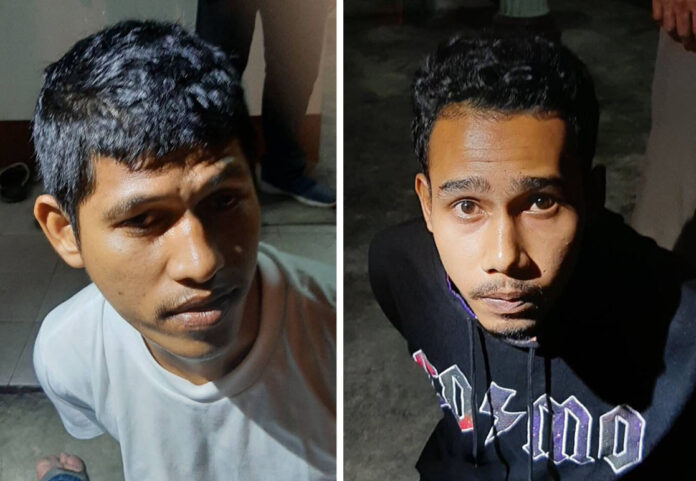
Wildun Maha, left, and Luai Sae-ngae, right, under police custody on Aug. 1, 2019.

BANGKOK — Two men have confessed to laying and detonating bombs around Bangkok in revenge for military operations in the Deep South, a police source told the media Saturday. 

According to a report on Channel 3 which was later disputed by the prime minister himself, Wildun Maha and Luai Sae-ngae – both natives of Narathiwat province – have confessed to the crimes of laying bombs and arson devices across Bangkok, most of which were detonated on Friday. 

The unnamed police source said the pair intended the bombing spree to be in retaliation for the death of a friend who died while under military custody in the southern region. 

The report said the two men were arrested Thursday night en route to Chumphon. Police had been on their tail for throwing suspected explosive devices at the Royal Thai Police headquarters earlier that day. 

Narathiwat and two other southern border provinces are home to a separatist movement believed to be responsible for numerous attacks on military and civilian targets over the past 15 years. 

But a spokeswoman for Prime Minister Prayuth Chan-ocha said the claim is false. Naruemol Pinyosinwan said police have yet to attribute any motive to the attacks. 

“The news is inaccurate,” Naruemol told reporters. “The investigators are still working quickly to collect evidence of the crime, and they will make formal announcements of their findings in the future. I’d like to ask the media to wait for the formal announcements from the police.”

A relative of one of the two men also told Post Today that they believe the pair might have confessed while under duress. 

The unnamed relative identified one of the two men as a Muslim cleric who has no prior history of violence, and added that their families have been unable to contact them since they were taken into custody.

The national police have identified neither the perpetrators nor their allegiance. Southern militants have been suspected of bringing their secessionist campaign north in the past, such as in the 2016 Mother’s Day bombing spree that killed four people. 

According to the latest police report, a total of ten devices exploded at five areas around Bangkok on Friday, while one device was defused on Thursday. What was previously suspected as arson at one location actually involved firebombs. 

The devices that went off:

  • A firebomb at a Miniso store inside Siam Square One around 4am
  • Four bombs at the Government Complex in Chaeng Wattana, where the Thai Armed Force headquarters and the Administrative Court are located
  • Three firebombs at markets on Soi Petchaburi 9
  • Two bombs at BTS Chong Nonsi and in front of King Power MahaNakhon building
  • One bomb at the Office of the Permanent Secretary of Defense on Sri Saman Road

A suspicious object found in front of the Royal Thai Police Headquarters on Thursday also turned out to be a real bomb, which was defused. Earlier reports mistook the bomb for a false alarm. 

Police have ruled another explosion at Soi Rama IX 57/1 as unrelated to the larger plot targeting key places around the city. Police said three teens, two of them minors, were charged for planting a ping-pong bomb in an incident involving a local gang feud. The bomb later exploded and injured three street cleaners.

Additional reporting Asaree Thaitrakulpanich 

Advertisement

MP Parina Says Thaksin Planted Bangkok Bombs

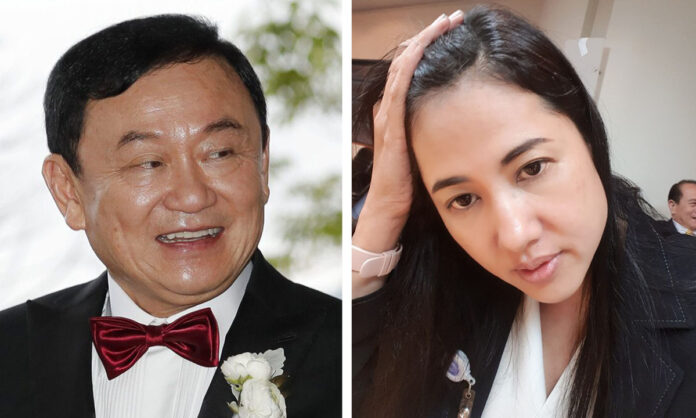
Left: In this Friday, March 22, 2019 file photo, Former Thai Prime Minister Thaksin Shinawatra welcomes his guests for the wedding of his youngest daughter Paetongtarn

BANGKOK — A pro-junta MP says she knows who’s behind the bombings that struck the capital yesterday, even before police have come out with conclusions – it’s Thaksin, of course.

In the aftermath of bombs striking four areas in Bangkok, Parina Kraikup of Phalang Pracharath Party is pointing the finger at ousted former PM Thaksin Shinawatra.

“Prime Minister Thaksin is a bad man. He has to learn when to lose. When he stopped torching the city, he started bombing it,” she wrote. “#Cruel.”

The post was accompanied by a picture of the national flag printed with the words “Stronger Together.” As usual, all negative comments were quickly deleted.

Parina has also posted in support of comments from Army Chief Gen. Apirat Kongsompong, who said yesterday that “a certain group” and those “controlling them” were behind the bombings.

Police have arrested two men who allegedly threw an explosive device Thursday night at the Royal Thai Police Headquarters on Rama I Road. Police Gen. Chakthip Chaijinda has declined to answer questions regarding the suspects as of Friday night.

Parina is known for being outspoken against her political opponents, calling attention to their attire, alleged abuse against former spouses, and for alleged lese-majeste. She’s even filed cybercrime cases against netizens.

In June 2019, Gen. Prayuth Chan-ocha became the 39th PM by running with Phalang Pracharath party in an election riddled with misinformation, fraud, and legal cases against political opponents.

On May 19, 2010 anti-government Redshirt protesters targeted CentralWorld and other buildings in the financial district of Bangkok as the military moved in and cracked down on their protest sites. A court acquitted two men of arson charges in 2014.

Related stories:

Parina Slams Future Forward MP’s Separation With Series of Commandments

Parina vs. Pannika: Pro-Prayuth MP Says Future Forward Rival’s Grad Photo Violates 112

Pantsuit-Gate II: Pro-Prayuth MP Piles on Rival’s Fashion

Pro-Junta MP Files Cybercrime Case Against Netizens

Advertisement

Asia-Pacific Ministers Push Dialogue to End Region’s Spats

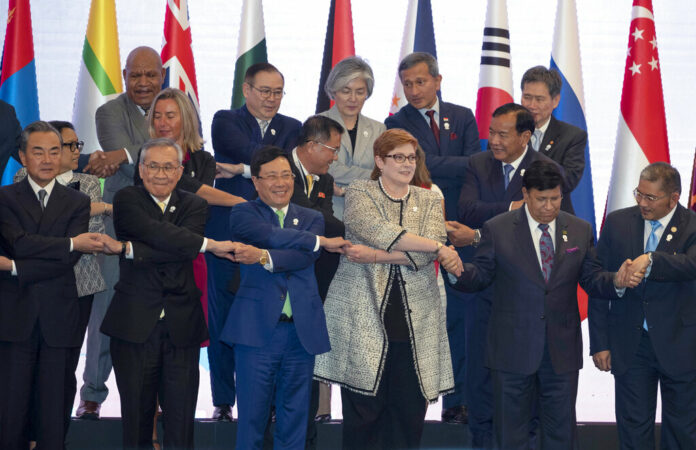
Foreign ministers, front row from left, China's Wang Yi, Thailand's Don Pramudwinai, Vietnam's Phạm Binh Minh, Australia's Marise Payne, Bangladesh's Abdul Momen and Brunei Second Minister of Foreign Affairs and Trade Erywan Yusof join hands for a group photo during the Association of Southeast Asian Nations (ASEAN) Regional Forum in Bangkok, Thailand, Friday, Aug. 2, 2019. Photo: Gemunu Amarasinghe / AP

BANGKOK — Asia-Pacific foreign ministers called for the peaceful resolution to regional disputes at Friday’s close of an annual security meeting, which was eclipsed by the U.S.-China rivalry and a deepening trade spat between Japan and South Korea.

Thai Foreign Minister Don Pramudwinai, who chaired the ASEAN Regional Forum, said members supported calls for the resumption of stalled denuclearization talks between the U.S. and North Korea, which have been clouded by Pyongyang’s recent missile launches.

The forum is an offshoot of annual meetings of the 10-member Association of Southeast Asian Nations that adds the participation of key dialogue partners such as the U.S., China, Japan and South Korea.

Tension between Japan and South Korea heated up the meetings, but Don said ministers pushed the two sides to advance talks to seek a compromise. He said the ongoing U.S.-China trade dispute also raised concern.

Japan earlier Friday removed South Korea from a “whitelist” of countries with preferential trade status, prompting Seoul to retaliate in kind. The dispute, with roots in long-standing bitterness over Japan’s actions toward Korea before and during World War II, threatens to disrupt Seoul’s electronics industry by hindering its purchase of semiconductor components.

“At the end of the day, it has to be a win-win. None of us believe in zero-sum efforts. There must be more efforts generated into talks to lessen friction and come up with acceptable solutions,” Don said at a news conference.

South Korea and Japan’s foreign ministers publicly traded barbs at a meeting earlier Friday with their ASEAN counterparts. They both later held talks with U.S. Secretary of State Mike Pompeo on the sidelines of the official meetings, where the enmity was visible. After about half an hour, all three came out of the room and stood in front of the cameras without saying a word and without even shaking hands.

The spat threatens to undo solidarity as Washington would like to present a united front in dealing with China and North Korea.

The U.S. and China rivalry also occupied the meeting’s attention, a day after President Donald Trump intensified pressure on China to reach a trade deal by announcing the imposition of new U.S. tariffs on Chinese imports.

Pompeo defended the tariffs in a speech Friday, saying China has taken advantage of trade. He hit out at Beijing for predatory trade practices and human rights abuses that harm economic development.

His Chinese counterpart, Wang Yi, slammed the new tariffs as damaging for trade talks. He also warned against U.S. interference, especially over China’s territorial claims in the contested South China Sea, saying Beijing will not let anyone stop its peaceful development.

Don acknowledged disputes among claimant countries amid efforts to map out a Code of Conduct governing the busy waterway, but said it was important for all parties to exercise self-restraint and work toward improving the situation in the area.

He said ASEAN’s Indo-Pacific engagement framework adopted by the region’s leaders in June doesn’t believe in domination of power but in every country being equal partners to share in the region’s prosperity.

A series of small bomb blasts in the Thai capital earlier Friday that injured four people caused some trepidation, but Thai officials dismissed the blasts as minor, isolated incidents, and they had no effect on the diplomatic get-together.

___

Story: Eileen Ng. Associated Press journalist Grant Peck contributed to the story.

Related stories:

ASEAN Thailand’s Key to Navigating US-China Rivalry: Ex-Foreign Minister

Advertisement

Former Human Rights Commissioner Wins Magsaysay Award

Activists, center Angkhana Neelapaijit, mark the 11th anniversary of the abduction of human rights lawyer Somchai Neelapaijit in Bangkok, 12 March 2015.

BANGKOK Former National Human Rights Commissioner Angkhana Neelapaijit was named a winner of the 2019 Ramon Magsaysay Award on Friday, for courageous service to the people and integrity in governance.

The announcement by the Ramon Magsaysay Award Foundation came only days after Angkhana, along with fellow commissioner Tuengja Deetes, announced their resignations as caretaker human rights commissioners amid speculation that the installation of a pro-junta government has made their work untenable.

Angkhana was in charge of investigating infringements on civil and political rights during the five tumultuous years under the military junta, which saw the powers of the commission downgraded.

Angkhana, one of five awardees, said she was honored and humbled to receive the award.

“Thanks to my family, colleagues and friends who always support and stand with me during all the difficult situations,” Angkhana wrote on her Facebook page before noon Friday.

Angkhana, 63, a former nurse, entered the human rights field a decade-and-a-half ago after her husband, human rights lawyer Somchai Neelapaijit, was forcibly disappeared in March 2004. No one has been punished for his disappearance. Earlier in 2006, Angkhana win the prestigious Gwangju Prize for Human Rights.

In a resignation letter posted on Facebook on Wednesday, Angkan wrote that the working environment “no longer enables constructive work and allows for a systematic protection of human rights”.

Angkhana said on the phone Friday that she will continue to advocate for human rights including issues regarding violations in the Deep South.

She added that she will push for amendments to the Enforced Disappearance and Anti-Torture Bill, whose content was diluted by the junta-appointed National Legislative Assembly before the elections. “It needs to be amended with input from civil society,” she stressed.

Past Thai laureates of the prestigious award include slum activist Prateep Ungsongtham Hata and family planning activist Meechai Viravaidya.

Related stories:

Vanished Lawyer Unforgotten 14 Years On – But Search Has Ended

Activists Mark 11th Anniversary of Human Rights Lawyer’s Abduction

Advertisement

Hot News

LATEST NEWS

Bangkok
overcast clouds
29.4 ° C
29.4 °
25.5 °
77 %
5.2kmh
100 %
Thu
29 °
Fri
35 °
Sat
37 °
Sun
35 °
Mon
35 °