32.8 C
Bangkok
Monday, June 29, 2026
Home Blog Page 1640

American Extradited to Australia Charged With Murder of Thai

This May 25, 2018 image from surveillance video released by the New South Wales Police Force shows Wachira "Mario" Phetmang, 33, entering a service station in South Hurstville, a suburb of Sydney. Photo: New South Wales Police via AP)

SYDNEY — Australian police on Sunday charged a man extradited from the United States with murder in the death of a Thai national, whose body was found bound and gagged on the side of a Sydney road.

Alex Dion, 38, was charged with the 2018 murder of Wachira “Mario” Phetmang after he arrived in Sydney from California under police guard.

The arrest warrant for Dion was issued in September while he already was in custody on a domestic violence charge in San Diego.

Read: Thai Found Beaten to Death in Sydney Suburb

Wachira’s body was discovered by a truck driver last June bound, gagged and wrapped in plastic, covered in a mattress protector. An autopsy of his body found he suffered more than 20 wounds to his head and had multiple skull fractures.

The 33-year-old former cafe and spa worker had been living in Australia for at least the last 10 years, and was a permanent resident at the time of his death. He was last seen alive on May 25 at a petrol station in the Sydney suburb of South Hurstville.

Dion, a U.S. national, is believed to have left Australia on May 27 — more than a week before the body was found and formal identification was made.

When Australian police held a news conference seeking the public’s help in the case, Dion called them and tried to blame an associate for Wachira’s killing, while also acknowledging that he had Wachira’s credit cards and cellphones with him in San Diego, according to the search warrant.

Dion told police that he had met Wachira at the gas station to buy meth but that he left when their associate showed up, a story police say is contradicted by surveillance footage.

Dion was refused bail and will appear at a court on Monday.

Advertisement

Removal of Fuel in Pool at Fukushima’s Melted Reactor Begins

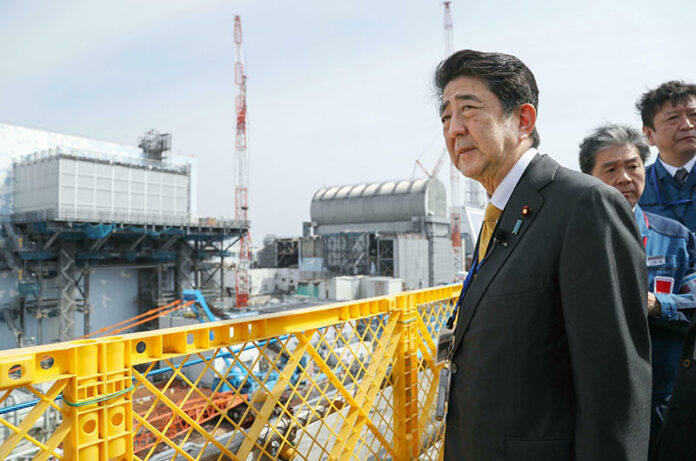
Japanese Prime Minister Shinzo Abe visits Fukushima Dai-ichi nuclear power plant in Okuma, Fukushima prefecture, Japan, Sunday, April 14, 2019, to inspect the reconstruction effort following the tsunami, quake and nuclear accident in 2011. Photo: Kyodo News via AP

TOKYO — The operator of the tsunami-wrecked Fukushima nuclear plant has begun removing fuel from a cooling pool at one of three reactors that melted down in the 2011 disaster, a milestone in the decades-long process to decommission the plant.

Tokyo Electric Power Co. said Monday that workers started removing the first of 566 used and unused fuel units stored in the pool at Unit 3. The fuel units in the pool located high up in reactor buildings are intact despite the disaster, but the pools are not enclosed, so removing the units to safer ground is crucial to avoid disaster in case of another major quake.

TEPCO says the removal at Unit 3 would take two years, followed by the two other reactors where about 1,000 fuel units remain in the storage pools.

Removing fuel units from the cooling pools comes ahead of the real challenge of removing melted fuel from inside the reactors, but details of how that might be done are still largely unknown. Removing the fuel in the cooling pools was delayed more than four years by mishaps, high radiation and radioactive debris from an explosion that occurred at the time of the reactor meltdown, underscoring the difficulties that remain.

Workers are remotely operating a crane built underneath a jelly roll-shaped roof cover to raise the fuel from a storage rack in the pool and place it into a protective cask. The whole process occurs underwater to prevent radiation leaks. Each cask will be filled with seven fuel units, then lifted from the pool and lowered to a truck that will transport the cask to a safer cooling pool elsewhere at the plant.

The work is carried out remotely from a control room about 500 meters (yards) away because of still-high radiation levels inside the reactor building that houses the pool.

About an hour after the work began Monday, the first fuel unit was safely stored inside the cask, TEPCO said.

“I believe everything is going well so far,” plant chief Tomohiko Isogai told Japan’s NHK television from Fukushima. “We will watch the progress at the site as we put safety first. Our goal is not to rush the process but to carefully proceed with the decommissioning work.”

In 2014, TEPCO safely removed all 1,535 fuel units from the storage pool at a fourth reactor that was idle and had no fuel inside its core when the March 11, 2011, earthquake and tsunami occurred.

Robotic probes have photographed and detected traces of damaged nuclear fuel in the three reactors that had meltdowns, but the exact location and other details of the melted fuel are largely unknown. Removing fuel from the cooling pools will help free up space for the subsequent removal of the melted fuel, though details of how to gain access to it are yet to be decided.

Experts say the melted fuel in the three reactors amounts to more than 800 tons.

In February, a remote-controlled robot with tongs removed pebbles of nuclear debris from the Unit 2 reactor but was unable to remove larger chunks, indicating a robot would need to be developed that can break the chunks into smaller pieces. Toshiba Corp.’s energy systems unit, which developed the robot, said the findings were key to determining the proper equipment and technologies needed to remove the melted fuel, the most challenging part of the decommissioning expected to take decades.

TEPCO and government officials plan to determine methods for removing the melted fuel from each of the three damaged reactors later this year so they can begin the process in 2021.

Story: Mari Yamaguchi

Advertisement

No Charges Filed Over Zipline Fall That Killed Canadian: Police

CHIANG MAI — Police on Sunday said charges have yet to be filed in the ongoing investigation into the death of a Canadian tourist who fell from a zipline in Chiang Mai.

Local police in Mae On district said they are inspecting all equipment that was used on the tourist when he fell to his death Saturday morning while riding the zipline, which is operated by Flight of the Gibbon in Mae Kam Pong. The local administrators have ordered the company to cease operation pending the investigation results.

Read: Canadian Dies After Falling From Zipline in Chiang Mai

Chiang Mai police chief Maj. Gen. Pichate Jiranantasin said today that investigators remain unable to file any charges, even though yesterday claimed a negligence charge had been filed. Further action apparently awaits a full autopsy and equipment inspection reports.

“I’ve ordered them to speed up the investigation as much as is possible,” he said.

Arkom Samana, a top local administrator, has issued an order to close the zipline service until further notice. The company’s operating license remains active.

Kriangkrai Seeha-amphai, company representative, told the authorities that its staff members would perform safety checks every morning. He added that the zipline had passed an engineering inspection just last month.

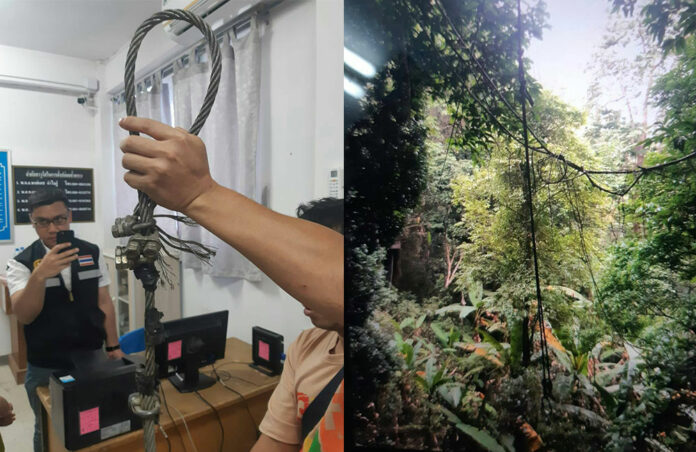
Police said the preliminary investigation suggests the zipline’s safety equipment could not hold the tourist’s weight and broke. Photos provided by the authorities show broken clamps and a steel wire that appears to have been ripped apart.

Although provincial police chief Pichate said earlier that the victim weighed as much as 180 kilograms, he clarified today that there was an error in initial reports he received from his subordinates. The victim’s weight is now estimated at about 120 kilograms.

The company has yet to release a public statement regarding the incident. According to the authorities, its representatives have pledged compensation and have cooperated with the investigation.

The Forest Department said it would send a team of rangers to investigate the scene this afternoon. In 2017, it filed a lawsuit against the company for encroaching on protected forest land.

Flight of the Gibbon has been operating since 2007 and claims on its website to be “the largest and most trusted Zipline experience in Asia.”

Authorities ordered the company to temporarily shut down in 2016 after three Israeli tourists, including a 7-year-old boy, were seriously injured after crashing into one another on a zipline and fell to the ground. In 2015, an American and a Chinese tourist were seriously hurt after colliding into each other, also on Flight of the Gibbon’ zipline. The American woman was blinded in one eye as a result.

Update: This article has been updated with additional information regarding the order to temporarily shut down the zipline and a comment from the company’s representative.

Advertisement

Pace of Bering Sea Changes Startles Scientists

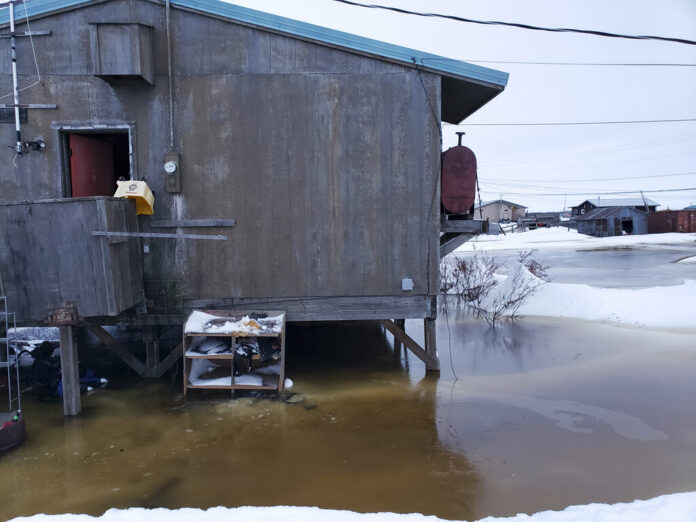
In this Feb. 12, 2019 photo provided by Philomena Keys, high water pushed up the Yukon River from the Bering Sea floods yards around homes in the western village of Kotlik, Alaska. Photo: Philomena Keys via AP

ANCHORAGE, Alaska — The Yupik Eskimo village of Kotlik on Alaska’s northwest coast relies on a cold, hard blanket of sea ice to protect homes from vicious winter Bering Sea storms.

Frigid north winds blow down from the Arctic Ocean, freeze saltwater and push sea ice south. The ice normally prevents waves from forming and locks onto beaches, walling off villages. But not this year.

In February, southwest winds brought warm air and turned thin sea ice into “snow cone ice” that melted or blew off. When a storm pounded Norton Sound, water on Feb. 12 surged up the Yukon River and into Kotlik, flooding low-lying homes. Lifelong resident Philomena Keyes, 37, awoke to knee-deep water outside her house.

“This is the first I experienced in my life, a flood that happened in the winter, in February,” Keyes said in a phone interview.

Winter storm surge flooding is the latest indication that something’s off-kilter around the Bering Strait, the gateway from the Pacific Ocean to the Arctic Ocean. Rapid, profound changes tied to high atmospheric temperatures, a direct result of climate change, may be reordering the region’s physical makeup. Ocean researchers are asking themselves if they’re witnessing the transformation of an ecosystem.

The Bering Sea last winter saw record-low sea ice. Climate models predicted less ice, but not this soon, said Seth Danielson, a physical oceanographer at the University of Alaska Fairbanks.

“The projections were saying we would’ve hit situations similar to what we saw last year, but not for another 40 or 50 years,” Danielson said.

Walruses and seals use sea ice to rest and give birth. Villagers use sea ice to hunt them. Sea ice is the primary habitat of polar bears. Algae that clings to the bottom of sea ice blooms in spring, dies and sinks, sending an infusion of food to clams, snails and sea worms on the ocean floor — the prey of gray whales, walruses and bearded seals.

Sea ice also affects commercially valuable fish. Sea ice historically has created a Bering Sea “cold pool,” an east-west barrier of extremely cold, salty water at the bottom of the wide, shallow continental shelf. The wall of cold water historically has concentrated Pacific cod and walleye pollock in the southeastern Bering Sea.

“It tends to extend from the Russian side to the northwest,” said Lyle Britt, a fisheries biologist for the National Oceanic and Atmospheric Administration. “It kind of comes down almost like a little hockey stick shape … through the center of the southeast Bering Sea.”

However, when Britt and other NOAA researchers last year conducted annual fish and ocean condition surveys, they got a big surprise: For the first time in 37 years, they found no cold pool.

Researchers found high concentrations of Pacific cod and walleye pollock in the northern Bering Sea. But the species that was supposed to be there, Arctic cod, was hardly found.

More than half the fish landed in U.S. waters come from the North Pacific, and most are caught in the Bering Sea. Chad See, executive director of the Freezer Longline Coalition, a trade association of vessels that target Pacific cod using baited lines, said members caught their quota last year but had to travel farther north.

“Does that mean that the stock is declining, is suffering because of the warming temperatures? Or is it that they’ve moved north and it’s still a vibrant fishery?” See said.

It’s too soon to conclude that atmosphere and ocean changes are due simply to climate change, said NOAA physical oceanographer Phyllis Stabeno, who has studied the Bering Sea for more than 30 years. The southern Bering Sea since 2000 has undergone multi-year stanzas of low and extensive ice, she said.

When sea ice in November began forming as usual, she expected a bounce-back this winter. Instead, warm winds in February mostly cleared the northern Bering Sea of sea ice through the Bering Strait into the Chukchi Sea.

“We’re in winter,” she said. “This is all supposed to be frozen.”

Formation of the cold pool is again in doubt. It could return in the future, but temperatures are trending upward with the rate of greenhouse gases entering the atmosphere.

Scientists say figuring out the ocean physics is far less of a challenge than projecting the biological ramifications.

“We sort of opened up this whole Pandora’s box of not really knowing how the ecosystem as a whole is going to adjust to that,” Danielson said.

The U.S. Fish and Wildlife Service and the National Park Service early last summer detected trouble. Resident called with reports of emaciated and dead seabirds.

Common murres, which can use up fat reserves and starve after three days without eating, fly hundreds miles to find fish schools or krill but were washing up dead on shore. Forktail storm petrels, fulmars, shearwaters, kittiwakes, auklets and puffins also died.

No one can say why. Seabird experts wonder whether the presence of more pollock and Pacific cod, which have voracious appetites and are far more efficient hunters of forage fish than seabirds, was a factor.

Dean Stockwell, a research associate professor at the University of Alaska Fairbanks with a specialty in phytoplankton, said the ocean changes have the potential to affect plant life at the bottom of the food web but it’s too soon to know.

Of immediate concern is whether warmer water will allow harmful algae containing toxins to stay viable long enough for shellfish to eat them and pass toxins to marine mammals and people. Toxins are being carried to the Arctic, Stockwell said.

“The question with global warming types of things is, ‘Can it get a foothold? Can they do damage?'” he said.

Seabird experts wonder if toxins played a role in recent seabird deaths by affecting their ability to forage.

No one has connected the dots, said Britt, the NOAA fisheries biologist.

“At the moment, nobody’s sitting with in-hand a comprehensive research study that covers the birds and the mammals and the fish and the zooplankton all in one synthesized report,” he said, adding that it will take researchers more time to figure out what’s going on.

Meantime, Kotlik resident Keyes is researching climate change effects in her coastal village of 650 as project coordinator for a team working under a Bureau of Indian Affairs program.

The absence of sea ice since mid-February meant taking land routes to visit nearby villages, she said. And seal hunters this spring found bearded seals to harvest but not near the village.

Like the cod fishermen, “They had to go farther north,” Keyes said.

Story: Dan Joling

Advertisement

Afternoon Tea and Siamese Fighting Fish? Why Not.

BANGKOK — Photographer Visarute Angkatavanich is exhibiting his famed images of Siamese fighting fish at Anantara Siam Bangkok Hotel until the end of May.

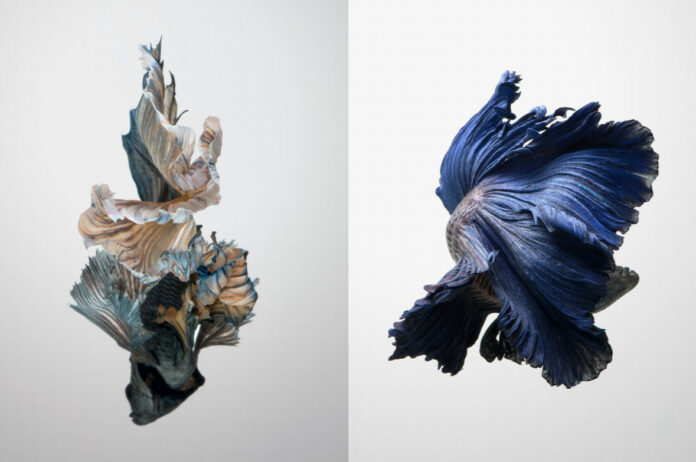
The exhibition, “The Beauty of Siam: Anantara Siamese Fighting Fish,” aims to present the fish through an abstract lens. Visarute is best known for his flowing images of the colorful species, which is native to Thailand and has recently been declared the national aquatic animal.

From a distance, the images appear almost as water-color paintings. Siamese fighting fish are merely an index-finger long but the 40 photos exhibited at the hotel are the size of movie posters, offering a new perspective on the aquatic animals.

Visarute Angkatavanich.

At the opening of the exhibition last week, Visarute explained that he has been fascinated by ornamental fish since he was young.

“No two Siamese fighting fish are alike,” said the photographer, adding that the uniqueness extends beyond the mere colours of the fish. “They have their own character even if they came from the same parents.”

The photographer has also published a photobook dedicated to capturing the nuances of Siamese fighting fish. Unlike most other fish, claims Visarute, each Siamese fighting fish has a distinctive identity.

To complement the exhibition, the hotel has created a special afternoon tea inspired by the colorful fish. The hotel’s executive pastry chef Ajinkya Soundankar pointed out, for instance, a multi-colored swiss roll served as part of the meal.

“When it comes to pastry, you eat with the eyes before tasting,” explained the chef.

Afternoon tea is served at 850 baht per set from 2 to 6pm from Monday to Friday. On Saturday and Sunday, an afternoon tea buffet is available at 950 baht. The exhibition and special afternoon tea runs until the end of May.

The Beauty of Siam: Anantara Siamese Fighting Fish” runs 10am to midnight from now until May 31 at the Anantara Siam Bangkok Hotel, which can be reached by a short walk from BTS Ratchadamri, exit 4. The exhibition will then be moved to the Anantara Riverside Bangkok Resort and Riverside Plaza and runs 10am to 10pm from June 5 to July 31. The hotel can be reached by a short taxi ride from BTS Talat Phlu.

Advertisement

Canadian Dies After Falling From Zipline in Chiang Mai

Rescue workers move the body of a Canadian tourist who died Saturday after falling from a zipline in Chiang Mai province.

CHIANG MAI — A Canadian tourist died Saturday after falling from a zipline in the northern province of Chiang Mai.

Police said the 25-year-old tourist fell to his death while riding a zipline in a forest at the popular tourist destination Mae Kam Pong. His safety locks broke, causing him to plunge more than 50 meters into a creek. He died at the scene.

Update: No Charges Filed Over Zipline Fall That Killed Canadian: Police

Zipline operator Flight of the Gibbon said it would take full responsibility and compensate the victim’s family.

Workers at the zipline service said the safety locks broke shortly after the tourist took off from the starting point. Police suspect that the safety equipment could not hold his weight, adding that they found only three cables installed to hold customers, while there would normally be at least eight lines of cables to ensure safety.

The operator’s website states that people weighing more than 125 kilograms are not allowed to ride. There has been a discrepancy in reports about the tourist’s weight.

Maj. Gen. Pichate Jiranantasin, provincial police chief, said by phone Saturday evening that the tourist weighed about 180 kilograms, adding that the operator has been charged with fatal negligence for allowing such a heavy person on the ride.

A friend of the victim’s family, who do not want to be identified, however told Khaosod English via email that the number is incorrect. Some news reports also claimed he weighed about 125 kilograms.

Since 2016, Chiang Mai officials promised to improve safety standards of the many adventure tourism sites in the province following a string of serious or fatal accidents – including accidents at this very zipline operator. Flight of the Gibbon was ordered a temporary shut down after three Israeli tourists were injured after colliding into one another on the zipline and falling to the ground.

The same company had also been investigated in 2017 for having some of its properties built on protected forest land.

Chiang Mai’s zipline fatalities last happened in 2015, when two Chinese tourists died after falling from two separate zipline attractions, operated by Skyline Adventure and Flying Squirrels. Another Chinese tourist was injured while riding the Flying Squirrels’ zipline in 2016.

Update: This article has been updated with additional information regarding a discrepancy in reports about the tourist’s weight.

Related stories:

Despite Safety Assurances, More Tourists Hurt at Adventure Attractions

Advertisement

Patong Beach Shops Engulfed in Fast-Moving Electrical Fire

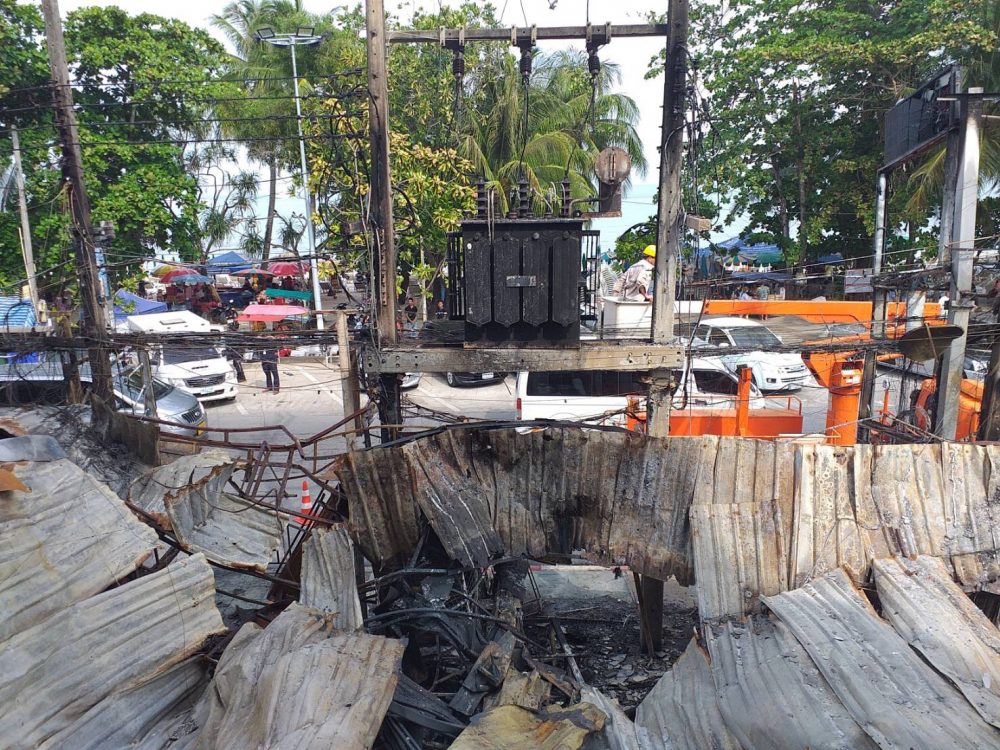
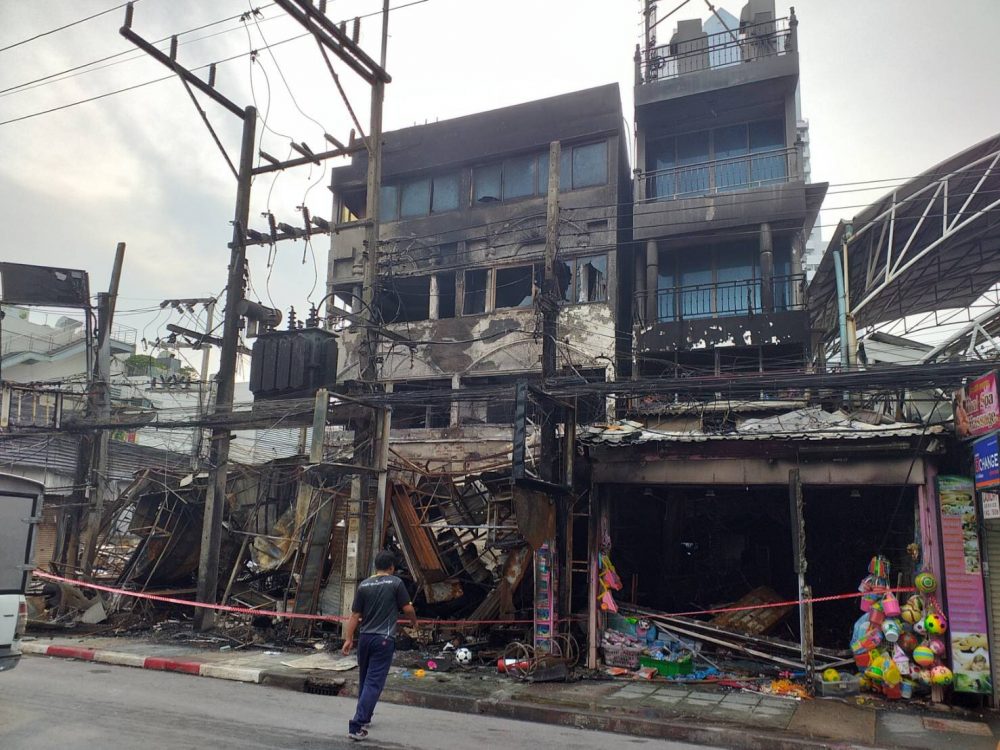
Firefighters combat a huge fire Friday night near Phuket’s Patong beach.

PHUKET — An explosion near a popular Phuket beach ignited a huge fire last night that caused 60 million baht in damages.

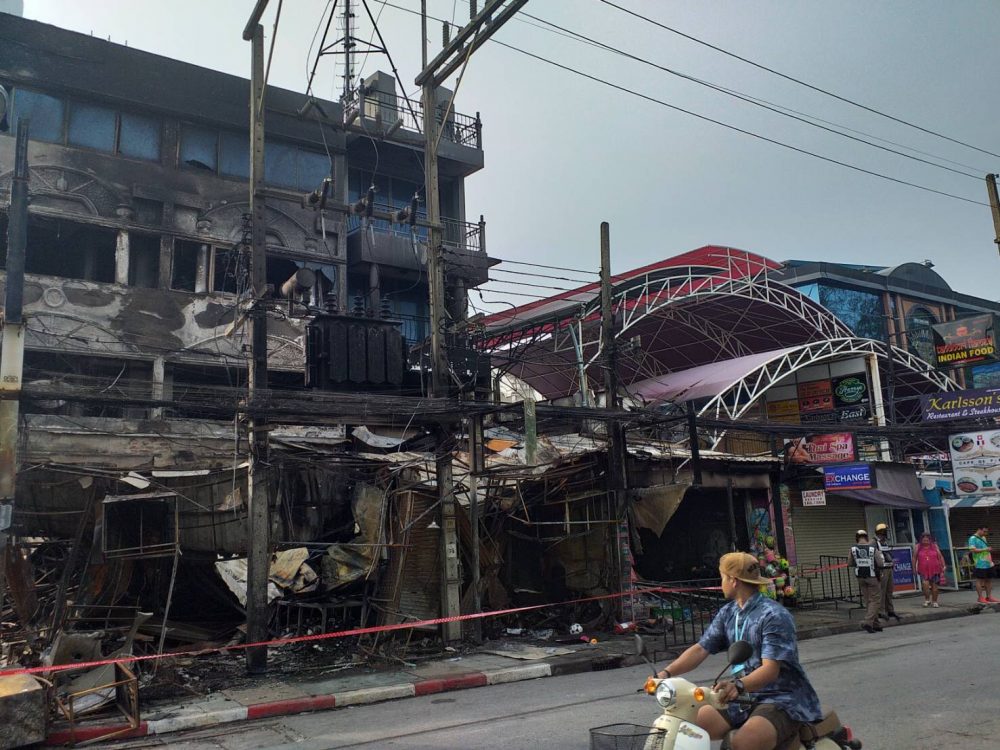
Local police said the fire broke out before 8pm on Friday at Thaweewong Road near Patong beach, before quickly spreading. Eight fire trucks responded to the call and firefighters spent more than three hours controlling the blaze, which engulfed a 3-storey shophouse and several nearby shops. There are no reports of casualties.

Col. Anothai Jindamanee, Patong police chief, said Saturday that the preliminary investigation suggests a transformer shorted, leading the fire to spread via power lines to the shops. He added that they’re still investigating what caused the short in the first place.

The fire occurred at a time when the area, famous for its nightlife, would typically be busy. It caused huge commotion as tourists were out shopping or splashing water in celebration of the Songkran festival, which started early in Phuket.

Eye-witnesses, mostly shoppers, said they heard what sounded like an explosion before seeing sparks fall from power lines onto a shop below.

S 4383324 e1555134832543 S 4383317 e1555134821563 S 4383313 e1555134810505

Advertisement

Opinion: Let’s Not Succumb to Political Hysteria

Leaders of Future Forward Party, Thanathorn Juangroongruangkit and Piyabutr Saengkanokkul, speak March 24 at a news conference in Bangkok.

Re•tention: Pravit RojanaphrukWitch hunt, paranoia and hysteria is gripping Juntaland.

This time, the witches – or demons – are the Future Forward Party duo comprised of leader Thanathorn Juangroogruangkit and the party secretary general Piyabutr Saengkanokkul. The people enraged by them believe they want to turn Thailand into a republic, or at least overthrow the monarchy.

As author Stacy Schiff of the book “The Witches: Suspicion, Betrayal and Hysteria in 1692 Salem” said of Salem puritans: “They defined themselves by what offended them”.

What offends those opposed to Thanathorn and Piyabutr is this: when a law lecturer at Thammasat University before becoming a politician last year, Piyabutr was a vocal opponent of the draconian lese majeste law and spoke critically about the monarchy.

Meanwhile Thanathorn (once a major shareholder and board member of Matichon Group, of which Khaosod English is part) helps to fund Same Sky Magazine, known for its critical coverage of the monarchy.

Fast Forward to the Party’s March 24 electoral success, where it swept 80 MP seats and became the third most successful political party. The two have become a real perceived threat.

As I type these words, all sorts of accusations, both true and false, are spreading along with hate speech on social media.

Where will this lead Thailand?

Thailand will get what it deserves. People have the choice to remain rational, calm and tolerant, or succumb to hysteria that may lead to a political purge – if not a new round of deadly political confrontation.

Over six million people voted for the party. The duo are public darlings and represent hope for a significant number of new voters. The public voted for the party to bring about change.

It’s unclear how Future Forward supporters will react if the two are handed guilty sentences, with Thanathorn charged with sedition for allegedly helping anti-junta activists “flee” back in 2015 and Piyabutr with violating the Computer Crimes Act.

Before the elections, the party reaffirmed time and again that it will not touch the controversial lese majeste law, which is a disappointment to this writer and some others. Yet it seems that even this assurance is not enough for those who want to prevent the two from entering politics as representatives of the people.

Some are pushing people like Piyabutr to leave Thailand, as if this country belongs to them alone. Never mind that the country has a population of nearly 70 million people.

Others are playing the anti-Chinese card, such as former supreme court judge Chuchart Srisaeng who wrote on Facebook on Monday that Thanathorn’s politics can be explained by his ancestors not being “real Thai.”

Things will likely get ugly in the weeks ahead as political parties from both sides of the political divide compete to form a governing coalition.

Responsible Thai citizens owe it to themselves and to their society to critically appraise cheap character assassinations. They should refuse to play a part in sinking Thailand into a deeper pool of irrationality, hate and political hysteria.

People can absolutely disagree with the political views of Thanathorn and Piyabutr. They can oppose the party’s policies. But any critical assessment or opposition should be based on facts rather than hearsay, on reasoning rather than hysteria – otherwise the biggest victim will not be Future Forward, but Thai society itself.

Advertisement

Picture Was Clear, But Black Hole’s Name a Little Fuzzy

This image released Wednesday, April 10, 2019, by Event Horizon Telescope shows a black hole. Scientists revealed the first image ever made of a black hole after assembling data gathered by a network of radio telescopes around the world. Image: Event Horizon Telescope Collaboration / Maunakea Observatories via AP

WASHINGTON — The newly pictured supermassive black hole is a beast with no name, at least not an official one. And what happens next could be cosmically confusing.

The team of astronomers who created the image of the black hole called it M87(asterisk). (The asterisk is silent.) A language professor has given it a name from a Hawaiian chant — Powehi — meaning “the adorned fathomless dark creation.” And the international group in charge of handing out astronomical names? It has never named a black hole.

The black hole in question is about 53 million light years away in the center of a galaxy called Messier 87, or M87 for short. On Wednesday, scientists revealed a picture they took of it using eight radio telescopes, the first time humans had actually seen one of the dense celestial objects that suck up everything around them, even light.

The International Astronomical Union usually takes care of names, but only for stuff inside our solar system and stars outside it. It doesn’t have a committee set up to handle other objects, like black holes, galaxies or nebulas.

The last time there was a similar situation, poor Pluto somehow got demoted to a dwarf planet, leading to public outcry, said Williams College astronomer Jay Pasachoff, a star-naming committee member.

Technically, our own galaxy — the Milky Way — has never been officially named by the IAU, said Rick Fienberg, an astronomer and press officer for the American Astronomical Society. He said, “that’s just a term that came down through history.”

“Virtually every object in the sky has more than one designation,” Fienberg said. “The constellations have their official IAU sanctioned names but in other cultures, they have other names.”

The gift of a name

When it comes to the black hole we saw this week , University of Hawaii-Hilo Hawaiian professor Larry Kimura stepped up even before the photo was unveiled.

Powehi (pronounced poh-veh-hee) is the black hole’s Hawaiian name, not its official name, explained Jessica Dempsey, who helped capture the black hole image as deputy director of the James Clerk Maxwell Telescope on Mauna Kea, Hawaii’s tallest mountain. Hawaii Gov. David Ige proclaimed April 10 as Powehi day, she said.

“This isn’t astronomers naming this,” she said. “This is coming from a cultural expert and language expert. This is him coming to the table and giving us a gift of this name. It’s a gift from Hawaiian culture and history, not the other way around.”

When asked about Kimura’s idea, IAU naming committee member Pasachoff said: “That’s the first I heard of it.”

Eric Mamajek, chairman of the IAU working group on star names, called it a “wonderful, thoughtful name.”

The Pluto situation

But Mamajek said his committee may not be the right one to grant the black hole a name. It only does stars.

“This is exactly the Pluto situation,” Pasachoff said.

In 2006, astronomers at the IAU were discussing naming a large object in our solar system that eventually got called Eris. It wasn’t considered a planet, so it wasn’t the job of the planet committee. But some experts pointed out that it was bigger than Pluto, which added some confusion.

The conference decided to reclassify planets, kicked Pluto out of the club of regular planets and made it join the newly established dwarf planets category with Eris, Pasachoff said.

More names coming

The same day the photograph of the black hole was unveiled, the IAU asked the public to choose between three names for an object astronomers call 2007 OR10. It’s an icy planetesimal that circles the sun but gets 100 times further from our star than Earth does.

The three proposed names are Gonggong, a Chinese water god with red hair and a serpent tail; Holle, a European winter goddess of fertility; and Vili, a Nordic deity and brother of Odin.

The IAU is trying to bring in more languages and cultures into the naming game, Pasachoff and Fienberg said. And soon the IAU will ask the public to help name 100 planets outside our solar system.

As astronomers gaze further into the cosmos, Pasachoff said, “we will need more names.”

Story: Seth Borenstein

Advertisement

Junta Gives Licence Payment Break to Telecom Giants

Photo: Dean Moriarty / Pixabay

BANGKOK — Junta leader Prayuth Chan-ocha has exercised his absolute power to extend the period for three telecom giants to pay their state licensing fees.

The order, announced in the Royal Gazette on Thursday, gives AIS, DTAC and True Corp a longer period to pay telecommunications licensing fees to the National Broadcasting and Telecommunication Commission. The three telecom giants are now able to pay their fees in 10 installments, instead of four.

Meanwhile, digital TV operators have the option to return of their licences completely when unable to pay the fees, where the refund may be negotiated.

While the order justifies the extension as aimed at easing the financial burdens of struggling telecoms corporations and TV operators, a reprieve for licensing fees is unprecedented.

“At present, it has become apparent that problems stemming from business competition in telecommunications and digital television …. have affected the income of honest business operators, which affects their ability to pay licensing fees,” read part of the order.

Digital TV operators will also be completely relieved of the last two months of licensing fees. The order will save the corporations a combined total of 13.6 billion baht in digital TV licensing fees.

The move was criticized by some as an instance of the state unfairly helping big businesses.

Somkiat Tangkitvanich, president of the independent Thailand Development Research Institute, took to Facebook on Tuesday to accuse the move as “giving ten billions of baht in benefits to the capitalists”.

“It damages trust in state contracts … the real power above the junta is big business groups,” wrote Somkiat, noting that the stock prices of AIS, DTAC and True Corp had been rising in anticipation of the order.

Advertisement

Hot News

LATEST NEWS

Bangkok
overcast clouds
32.8 ° C
32.8 °
32.7 °
91 %
6.4kmh
100 %
Mon
31 °
Tue
33 °
Wed
31 °
Thu
32 °
Fri
31 °