BANGKOK — The Raingurl herself will drop mellow house beats at a small Sathorn venue this summer.
Korean-American electronic music artist Yaeji will make her Bangkok debut in July at Glowfish Offices, concert promoter HUH? announcedThursday.
Expect soft vocals laid over house and hip-hop beats when 25-year-old Kathy Yaeji Lee comes to perform a one-night-only engagement. She’s a fixture in the vaporwave scene for bass-heavy, highly remixable tracks such as “Drink I’m Sippin On,” “Raingurl” and “One More.”
Vaporwave is a self-aware visual and musical style with a nostalgia for ‘80s and ‘90s retro tech. It skewers the overly corporate and consumerist culture and has been described as a critique of mainstream EDM music.
In her music video for “Last Breath,” Yaeji parodies a makeup blogger by applying cosmetics while the screen reads ”This product is called depression and it stays on for 24 hours.”
Tickets go on sale March 28 for 990 baht, then go up to 1,200 baht after that. Glowfish Offices are a five-minute walk from BTS Chong Nonsi.
The junta in April 2018 rolled out a revamped version of 'Nong Kiew Koy,' a mascot promoting national reconciliation, after the first was deemed too creepy.
BANGKOK — While “returning the happiness” has been the government’s motto for five years, the UN’s latest assessment found The Land of Smile pouting more than ever before.
Thailand dropped six spots to rank No. 52 of the 156 countries studied in the new World Happiness Report released Wednesday. It’s the lowest ranking held by the kingdom since it debuted at No. 18 when the annual report launched in 2012.
This year’s report, published just three days before the kingdom holds its first election in five years, draws upon global Gallup polling data to assess metrics including life expectancy, perceived corruption and freedom to make life decisions. This year’s theme put emphases on the quality of government, socially positive behaviors and improvements in information technology.
Finland was ranked the happiest country in the world for the second consecutive year. Last year’s report spotlighted the happiness of immigration populations in each country.
Rounding out the top five were Denmark, Norway, Iceland and the Netherlands, in that order.
Thailand was the second happiest country among ASEAN nations, following Singapore at No. 34. It had the second highest level of perceived corruption in the public and private sectors behind Malaysia.
The study also looked at the link between happiness and voting behaviors, finding that “happier people are not only more likely to engage in politics and vote, but are also more likely to vote for incumbent parties.”
The United States slipped one place to No. 19 and the United Kingdom moved up four spots to No. 15. The world’s least happy country was South Sudan.
SilkAir's new Boeing 737 Max 8 aircraft is seen through a viewing gallery window in 2017 parked on the ramp of Singapore's Changi International Airport. Photo: Wong Maye-E / Associated Press
Boeing’s grounded airliners are likely to be parked longer now that European and Canadian regulators plan to conduct their own reviews of changes the company is making after two of the jets crashed.
The Europeans and Canadians want to do more than simply take the U.S. Federal Aviation Administration’s word that alterations to a key flight-control system will make the 737 Max safer. Those reviews scramble an ambitious schedule set by Boeing and could undercut the FAA’s reputation around the world.
Boeing hopes by Monday to finish an update to software that can automatically point the nose of the plane sharply downward in some circumstances to avoid an aerodynamic stall, according to two people briefed on FAA presentations to congressional committees.
The FAA expects to certify Boeing’s modifications and plans for pilot training in April or May, one of the people said. Both spoke on the condition of anonymity because they were not authorized to speak about the briefings.
But there are clear doubts about meeting that timetable. Air Canada plans to remove the Boeing 737 Max from its schedule at least through July 1 and suspend some routes that it flew with the plane before it was grounded around the world last week.
American Airlines, Southwest Airlines and United Airlines, which are slightly less dependent on the Max than Air Canada, are juggling their fleets to fill in for grounded planes, but those carriers have still canceled some flights.
By international agreement, planes must be certified in the country where they are built. Regulators around the world have almost always accepted that country’s decision.
As a result, European airlines have flown Boeing jets with little independent review by the European Aviation Safety Agency, and U.S. airlines operate Airbus jets without a separate, lengthy certification process by the FAA.
That practice is being frayed, however, in the face of growing questions about the FAA’s certification of the Max. Critics question whether the agency relied too much on Boeing to vouch for critical safety matters and whether it understood the significance of a new automated flight-control system on the Max.
The FAA let the Boeing Max keep flying after preliminary findings from the Oct. 29 crash of a Lion Air Max 8 in Indonesia pointed to flight-control problems linked to the failure of a sensor. Boeing went to work on upgrading the software to, among other things, rely on more than one sensor and limit the system’s power to point the plane’s nose down without direction from the pilots.
The FAA’s assurance that the plane was still safe to fly was good enough for the rest of the world until an Ethiopian Airlines Max 8 crashed. Satellite data suggests both planes had similar, erratic flight paths before crashing minutes after takeoff.
Patrick Ky, the executive director of the European regulator, said his agency will look “very deeply, very closely” at the changes Boeing and the FAA suggest to fix the plane.
“I can guarantee to you that on our side we will not allow the aircraft to fly if we have not found acceptable answers to all our questions, whatever the FAA does,” he said.
The message was the same from Canada’s Transport minister, Marc Garneau.
“When that software change is ready, which is a number of weeks, we will in Canada – even if it is certified by the FAA – we will do our own certification,” he said.
Other countries could also conduct their own analysis of how much pilot training should be required on the Max. Ky noted that one Lion Air crew correctly disabled the plane’s malfunctioning flight-control system, but not the crew on the next flight, which crashed. He said pilots under stress might have forgotten details of a bulletin Boeing issued in November that reminded pilots about that procedure.
The FAA’s handling of issues around the Max jet have damaged its standing among other aviation regulators, said James Hall, former chairman of the National Transportation Safety Board.
The FAA will have to be more transparent about its investigation, and it should require that pilots train for the Max on flight simulators, Hall said, because “that is how pilots train today, not on iPads.”
John Hansman, an aeronautics professor at the Massachusetts Institute of Technology and chairman of an FAA research and engineering advisory committee, said separate approvals by Canada and the Europeans will reassure the public because those countries are seen as having no vested interest in the plane.
“It’s unfortunate because it will probably cause a delay, but it may be the right thing in the long haul,” Hansman said. He expects that the FAA will wait until other regulators finish their reviews before letting the Max fly again.
FAA spokesman Greg Martin would not comment on whether the agency’s reputation has been hurt by its approval of the Max, the crashes or the agency’s initial hesitation to ground the planes after the second crash.
Meanwhile, the FAA is getting a new chief. The White House said Tuesday that President Donald Trump will nominate former Delta Air Lines executive and pilot Stephen Dickson to head the agency. Daniel Elwell has been acting administrator since January 2018.
Boeing too is shifting personnel. This week, the company named the chief engineer of its commercial airplanes division to lead the company’s role in the investigations into the Oct. 29 crash of the Lion Air jet and the March 10 Ethiopian Airlines crash. The executive, John Hamilton, has experience in airplane design and regulatory standards.
From 2013 until early 2016, Hamilton oversaw the use of Boeing employees to perform some safety-certification work on behalf of the FAA. That program has come under criticism from critics including members of Congress.
The Justice Department is investigating the FAA’s oversight of Boeing, and a federal grand jury issued a subpoena to someone involved in the plane’s development. Transportation Secretary Elaine Chao formally directed her agency’s inspector general to audit the FAA’s handling of that process. Congressional committees are looking into the matter as well.
A Senate subcommittee will hold a hearing on Max and aviation safety on March 27.
The company declined to comment. The Max, the latest and most fuel-efficient version of the half-century-old 737, is Boeing’s best-selling plane, with more than 4,600 unfilled orders.
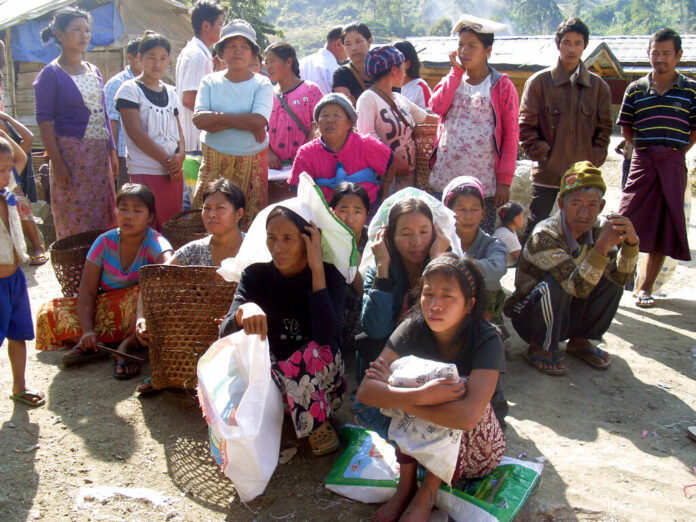
Kachin refugees wait for rations in 2013 at the Je Yang IDP camp, the biggest and closest camp to Laiza, Laiza, northeastern Myanmar. Photo: Yadana Htun / Associated Press
BANGKOK — Authorities in China and Myanmar are failing to stop the brutal trafficking of young women, often teenagers, from the conflict-ridden Kachin region for sexual slavery, according to a report by Human Rights Watch.
The report released Thursday says women are often tricked into traveling to China in search of work or kidnapped and held against their will to be sold as “brides” for Chinese men. Most of those taken hostage by Chinese families are locked up and raped, it says. Those who do escape are often obliged to leave children fathered by Chinese men behind.
The report urges authorities to do more to raise awareness about the risks of trafficking, provide more support for victims who return home, and to prosecute those guilty of crimes against them.
The 226 known cases of such trafficking in 2017 were only a fraction of the total number, since many victims are afraid or ashamed to come forward, especially given the lack of support from law enforcement or welfare services, the report says.
“Human Rights Watch’s research suggests the number of women and girls being trafficked is substantial and possibly growing,” it said.
The group interviewed 37 survivors of such crimes for the report. It said the women were sold to Chinese families for the equivalent of USD$3,000-$13,000 each. Twelve of those interviewed were under 18 when they were trafficked. The youngest was 14. It said 22 of them were held for a year or longer.
Often, the women are drugged and taken captive, left at the mercy of families with whom they can barely communicate.
“Most were locked in a room and raped repeatedly as the families that bought them wanted them to become pregnant,” said Heather Barr, author of the report and a co-director for women’s rights at Human Rights Watch.
The traffickers are able to lure women with false promises of jobs because of the lack of good options for making a living in camps for displaced people in northern Myanmar’s Kachin state.
As of September, there were about 100,000 people displaced inside Kachin, where the Kachin Independence Army, like other ethnic minority armed groups, has been fighting for greater autonomy for decades. Thousands of women and children have also fled their homes in neighboring Shan state, some across the border into China.
The porous border between southern China’s Yunnan province and northern Kachin facilitates such trafficking, and the relative shortage of marriageable women, thanks to Chinese traditions favoring male heirs over girls has left many families in China desperate for brides.
Although Chinese authorities have been battling trafficking inside China as well, the families who buy the women are almost never prosecuted, the report says.
Some foreign brides from neighboring countries go voluntarily.
But for many, the experience is harrowing. One interviewee, Ja Htoi Tsawm, was kidnapped while doing farm work in China to support her family and held captive for two years. While she was away her in-laws sold her house and put one of her children in an orphanage. Another of her four children died.
The report said that Myanmar police and other authorities refused interviews by Human Rights Watch although the Ministry of Social Welfare did provide some data. Myanmar anti-trafficking police said they handled 130 cases of trafficking, 96 of which involved women, in January-July 2018, the report said.
Of 820 successful prosecutions for trafficking in 2008-2013, 534 cases involved forced marriages and an even larger share were with China. The trafficking networks span China
Chinese authorities did not respond to requests for comment, it said.
The persisting conflict in areas of Myanmar has left millions of women and children vulnerable to great risk. U.N. investigators reported last fall on a fact-finding mission that found violence by the Myanmar military in Kachin, Shan and the western state of Rakhine. It cited allegations of crimes by the military and other security forces including murder, torture, pillaging, execution without due process, rape, sexual slavery and hostage taking.
Members of the Kachin Women’s Association, a group affiliated with the Kachin Independence Organization that helps victims, were quoted as saying that at times they lack the money to help provide and top up SIM cards needed to keep in contact with the women still stuck in China.
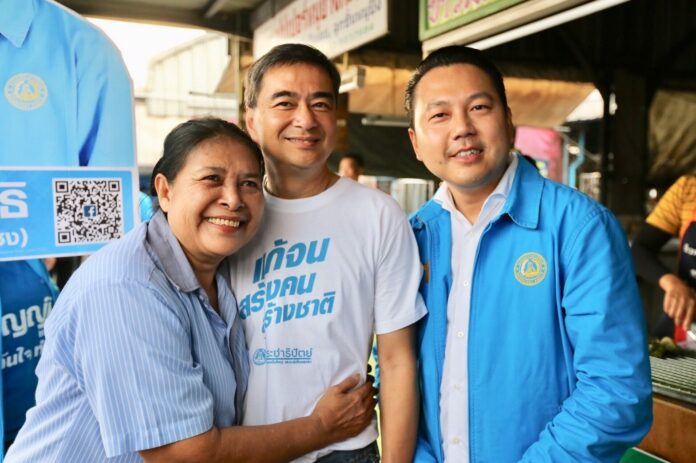
A woman hugs Democrat Party chairman Abhisit Vejjajiva during his campaign in Bangkok.
BANGKOK — Democrat chairman Abhisit Vejjajiva said Wednesday night his party has yet to endorse his announcement that he will not support the junta leader for another term in office.
Just two weeks after the Democrat leader declared with much fanfare that he would not join hands with junta chairman Prayuth Chan-ocha when the parliament votes for a new prime minister, Abhisit reopened the possibility of an alliance with the junta.
Abhisit was speaking amid an open rebellion from one of his MP candidates, Thaworn Senniam, who said Abhisit acted alone by making his announcement without the consent of other party members.
“Everything has to be subject to the party’s ideology. Thaworn is right in saying it wasn’t party consensus,” Abhisit, who served as a premier from 2008 to 2011, said in a televised interview. “But I already said the party’s consensus would come later, because there has to be a meeting between MPs and party executives.”
Abhisit’s announcement of non-cooperation with Prayuth on March 11 brought a mix of praise from his supporters, doubts from critics and fury from those who’d counted him an ally.
One such detractor was Thaworn, a veteran politician running for a seat in Songkhla, who said in an online video that the party had yet to convene and vote on its stance toward Prayuth’s candidacy.
A former Abhisit mentor also accused him of looking for his own political gain instead of helping Gen. Prayuth thwart the influence of their shared archnemesis, former leader Thaksin Shinawatra.
“I’m not an ungrateful man, but today Mr. Abhisit is leading the Democrat Party into a disaster,” former Democrat deputy chairman Suthep Thaugsuban wrote online last night. “I have my rights to criticize and express my opinions.”
The Democrat Party is Thailand’s oldest and for over two decades has been a reliable second-place finisher in general elections. Its ranks are a diverse collection of ideologies, from hardline pro-establishment agitators to young moderates who support democratic institutions.
As many Democrat politicians have publicly supported Prayuth’s coup in 2014, analysts also raised concerns in recent weeks that the party is at risk of a major defection. Abhisit maintained such an outcome is unlikely.
Abhisit told Amarin TV he’s confident other party members will come around to his position.
“I don’t believe any party will dare reach a consensus contrary to its own ideology,” Abhisit said.
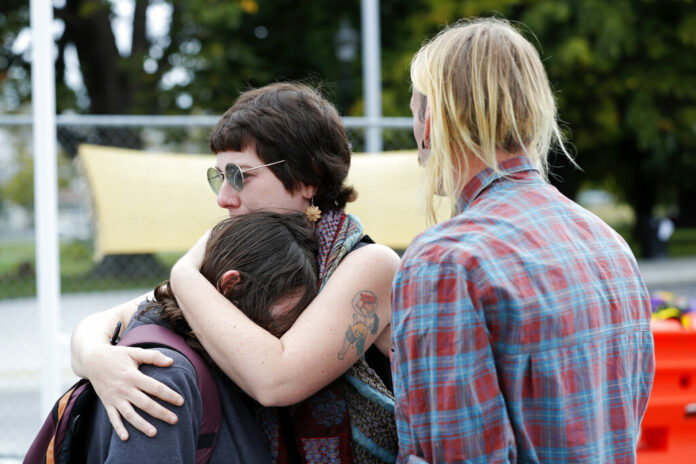
Mourners react as they pay their respects at a makeshift memorial outside Christchurch hospital in Christchurch, New Zealand, Saturday, March 16, 2019. Photo: Vincent Thian / Associated Press
CHRISTCHURCH, New Zealand — New Zealand police say they inadvertently charged the mosque terror suspect with the murder of a person who is still alive.
Police charged 28-year-old Australian Brenton Tarrant with a single, representative count of murder after 50 people were killed in Friday’s attack on two mosques in Christchurch.
But police on Thursday said in a statement they made an error on the charging sheet prepared for Tarrant’s first court appearance Saturday.
Police said they have spoken with the person incorrectly named on the document and have apologized, and said they would change the charge sheet.
Police did not offer further details of what went wrong or make anybody available for an interview.
The name of the person on the charging sheet has been suppressed by court order.
Officials have said more charges against Tarrant would likely follow.
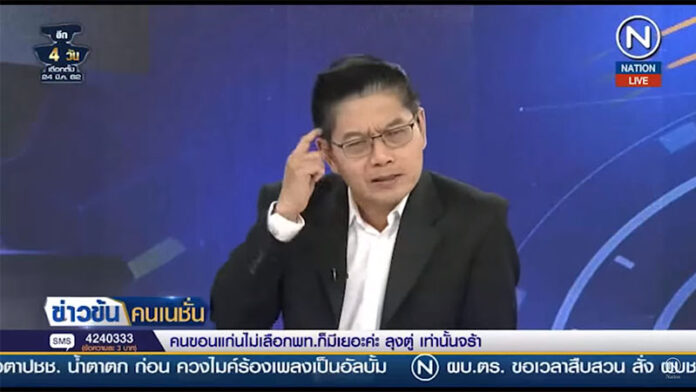
Kanok Ratwongsakul speaks Wednesday on Nation TV’s Khao Kon Khon Nation program.
BANGKOK — Nation TV says it did nothing wrong by airing a doctored audio clip presented as a damaging secret conversation and threatened to sue the head of a major political party for complaining about it.
The station director and host who aired the clip offered neither an apology nor retraction for broadcasting what was purported to be a surreptitiously recorded conversation between the leader of the Future Forward Party and fugitive former premier Thaksin Shinawatra.
Kanok Ratwongsakul, a host of the Khao Kon Khon Nation program, said during his Wednesday night show that Future Forward leader Thanathorn Juangroongruangkit is the one who should be apologizing to Nation TV. He then threatened him with legal action should he continue to “berate” the station.
“The clip spread among his disciples so much, people are saying that Kanok and the Nation have to apologize for creating a false clip. I don’t even know how to do that. … Shouldn’t Thanathorn apologize to Nation TV?” Kanok said.
Chatchai Pokogwai, managing director of Nation TV, said Thanathorn is free to file legal action against the station. He defended its journalism.
“I would like to stand firm on the Nation’s journalistic standards. … If Thanathorn does not stop accusing Nation TV and acting in a way that damages the organization or goes against the law, then I am also ready to take legal action against Thanathorn,” Chatchai said.
The station dealt a self-inflicted blow to its credibility Tuesday by airing uncritically the audio clip, which was easily proven a fake. The backlash was fierce online, where support for Thanathorn and his party run high among younger, connected voters.
The clip framed Thanathorn as secretly taking orders to dupe young voters from establishment bogeyman Thaksin. The audio was played while silhouettes clearly representing both men were shown on screen. Netizens quickly determined it was created by splicing sound from old clips found online.
Thanathorn strongly rebuked the station when a daytime program called him a day later to ask if it was indeed him in the doctored clips.
“I never thought a quality media agency would air a clip like this. Airing it shows that the ethics and quality of The Nation have fallen,” Thanathorn said in reply.
Kanok said Thanathorn’s response was uncalled for, since the daytime show called him out of “good intentions.”
“Khun Thanathorn didn’t just criticize, he berated the Nation. This was even though we reached out to him for an interview after we found out that the clip was doctored,” Kanok said. “Khun Thanathorn wasn’t prudent. He didn’t measure the timing of his words. … He should have asked, does P’Kanok of Khao Kon show know that it’s doctored?”
The financially distressed Nation Multimedia, which owns English-language The Nation newspaper, was acquired last yearby a news agency with an ultraconservative editorial slant.
Former Nation owner Sutthichai Yoon, a fixture on social media, said the station acted irresponsibly.
“If you just say, ‘Look, I found this thing but I don’t know if it’s real or not, you can decide for yourself,’ then you’re not doing your job as the media. There’s no need to have the media now because the media’s job is to filter information,” Sutthichai said in an interviewposted online. “How can you demand the right to be press if you do not filter and cross-check?”
Thought it seems no attempt was made to reach out to Thanathorn before the fake audio was broadcast, Kanok maintains it was an inadvertent error.
“I only aired it because it’s popular. I didn’t say, ‘Doesn’t that sound like Thanathorn? Doesn’t that sound like Thaksin? Isn’t this about teenagers being tricked easily?’ I said none of that,” Kanok said.
“Try and think a little bit, Thanathorn and Future Forward disciples. Why would our show knowingly air a doctored clip?” Kanok said.
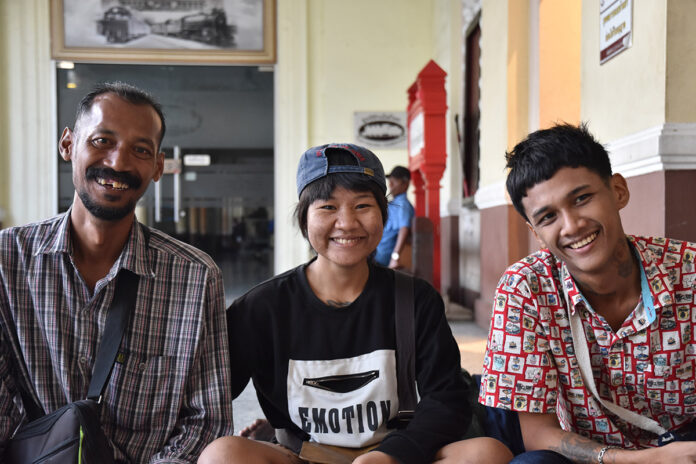
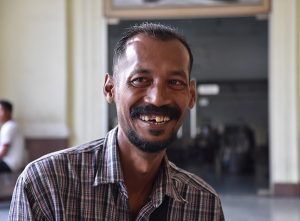
Suwit Nakprakong, at left, with others Friday at the Hua Lamphong Station, Bangkok.
Top: Suwit Nakprakong, at left, with others Friday at the Hua Lamphong Station, Bangkok.
BANGKOK — While many rush through the capital’s main train station on their way to somewhere, dozens of more regular guests linger at its fringes. For them, Hua Lamphong is what they are compelled to call home.
Outside, behind a row of European-style columns, Suwit Nakprakong has nothing bad to say about the five months he’s slept there. But the Yala-born 41-year-old was eager to discuss plans to journey home so that he could vote for a government that “cares about poor people.”
“I’ve decided who I’ll vote for,” he said on a recent afternoon. “My home is in Yala. I’ll go back there to vote. I’m saving money for transportation.”
All the rhetoric and promises of this election’s political campaigning have missed this neglected pool of voters – the homeless. Suwit said many of his acquaintances engage in daily political discussions and watch television inside the station to “keep up with what’s going on.”
Though they live on the margins, Suwit and the other Hua Lamphong homeless are enthusiastic about the election’s outcome despite little optimism they’ll be better represented in a society deeply prejudiced against them. Altogether they represent about 70,000 votes to candidates who, despite making vague pledges of support, have no policies to help them directly.
“They are actually very interested in politics, in the election, in the policies presented by the parties,” said Sittiphol Chuprajong, who works with the homeless for the Mirror Foundation. “We want to tell society that they’re also interested. Therefore, what the politicians ask or do should include their interests as well.”
Many may be prevented from voting in the kingdom’s first election in five years simply because they don’t know their rights.
Sittiphol Chuprajong, the Mirror Foundation staffer, on Friday at the Hua Lamphong Station.
“Most knew that there will be an election March 24, but they didn’t know about early voting,” Sittiphol said. “Most of them are not from Bangkok. … Many feel that going home would cost too much … or they don’t know where to stay because they’d left due to family problems.”
Boonrak Saengsawang, a 52-year-old from Ubon Ratchathani, is among those who won’t be casting a ballot Sunday.
“I’m very excited. I want to vote, but I lost my ID card, and I didn’t know about the early vote,” he said out in the parking lot. “So I think my right is lost this time.”
Living homeless intermittently for 15 years, Boonrak’s life reflects the bitter inequalities embedded in Thai society and inadequate efforts to uproot them, Sittiphol said.
More than 70,000 homeless lived throughout the kingdom in 2017, about 3,600 of which were in Bangkok, according to the Social Development and Welfare Department, which said the population had surged due to families’ declining fortunes.
Nearly a third of the homeless in 2016 lack ID cards, a requirement to vote, the Thai Health Promotion Foundation said.
No Way Out
During his years with the foundation, Sittiphol has found it difficult to get the public or government interested in homeless issues, mainly because of the ingrained prejudice against them.
“Most people believe homeless people are lazy people,” he said. “Our society sees things in black and white … We were taught that a bad life is caused by laziness, but most homeless people have worked hard their entire lives.”
That’s the case for Boonrak, who said that homelessness has deprived him of a normal life for nearly half his adult life. He travels between his hometown and Bangkok looking for enough work to get by. He often fails.
Boonrak Saengsawang on Friday at the Hua Lamphong Station.
“I go back to Ubon during the rice-harvesting season. When that ends, I’ll come back to Bangkok to find jobs,” he said, usually as a day laborer. “I still can’t find a job these days.”
While major parties have campaigned on promises to help the underprivileged, none has addressed homelessness. Representatives from several front-running parties offered ambiguous blanket vows to improve welfare when asked, but lacked detailed answers on how they would tackle the issue.
Sittiphol said he has seen just a few hopeful policies for homeless people and says those at the top don’t understand the issue enough to come up with effective measures.
“The problem is with the policies themselves and the commitment. They’re not realistic,” he said.
Sittiphol said unemployment and low wages are major problems which make it almost impossible for those in such circumstances to secure a decent job and survive on their own – let alone save money – without any support.
“When they’re paid very little, they can’t build any savings that would help improve their lives,” he said. “They are able to make it better only when they stay with family, but 90 percent of them can’t. Some spent lengthy periods in prison. Some were simply abandoned.”
Recent surveys conducted by the Thai Health Foundation found over half of homeless people were older than 40 or ill. About 70 percent suffered from mental health problems, and about 4 percent had severe disabilities. These factors limit their opportunities in the job market even more.
Homeless people queue up for free meals handed out Friday night near the parking lot of Hua Lamphong Station, which a foundation staffer says they receive daily from private organizations.
Asked about his party’s prescriptions for the homeless, Kobsak Pootrakul of the Phalang Pracharath Party answered with a prolonged silence before promoting the junta’s welfare card program for low-income Thais. The program offers monthly credit balances for specified expenses such as transportation and groceries to “provide a minimum wage to the people, to let them have both savings and money to get by every day.”
Critics have said the program’s many restrictions make it just another spending stimulus rather than sustainable source of help.
Phalang Pracharath previously promised to raise the daily minimum wage from the current 330 baht to up to 425 baht. After a major public backlash, it backtracked and said the increase wouldn’t cover workers who “have no skills.”
Kobsak said the government has already done well in providing other forms of welfare such as healthcare. However, a 2016 survey indicated that over half of homeless Thais can’t access healthcare due to their legal status or a lack of information.
Both Hua Lamphong residents Suwit and Boonrak said they have never sought welfare cards. They are also ineligible for free state healthcare in Bangkok for bureaucratic reasons: Boonrak lost his ID; Suwit’s residency is still registered in Yala.
Representatives from the Pheu Thai and Future Forward parties pledged to resolve and reform the identification process to make state welfare more accessible.
Acknowledging the problem, Pheu Thai spokeswoman Ladawan Wongsriwong said her party would try more to reach out to the underprivileged and educate them about their entitled benefits.
But she said the party would prioritize efforts to “return them to the family” or “encourage community support” to improving their lives, solutions Sittiphol thinks are “too romantic.”
“These people can’t stay with family. That’s why they leave to be on their own,” he said. “The solutions should be how to help them make it as an individual. Society has changed. … We can’t keep thinking that family must help each other these days.”
Suwit Nakprakong on Friday at the Hua Lamphong Station.
Suwit said he left his Yala home last year with a 9-year-old son because of unspecified family troubles. Head trauma from a nearly fatal accident has made him struggle to find a job since. His son sleeps beside him outside the station.
“I graduated from Siam Technology College and got a job, but I was laid off when I was 25. I was in a motorcycle crash,” he said, pointing to a large scar on the side of his head where his skull caved in.
When asked about homeless issues, most candidates quickly pivot the conversation to affordable housing.
Former factory worker Wanwipa Maison of Future Forward said that in addition to improving access to employment and education, her party would focus on making housing more affordable.
“People don’t have homes because of capitalism and a monopolized economy, which makes housing more expensive and difficult to access,” she said.
Phalang Pracharath’s Kobsak vows to continue the junta’s many housing programs, which he credits for successfully providing “affordable” accommodations, some of which he said cost “just 2,000 to 2,500 baht a month.”
Though the government pushed back against its findings, a Credit Suisse report recently declared Thailand had surpassed Russia and India to become the world’s most unequal nation.
Ramet Rattanachaweng spoke of the Democrat Party’s elaborate policies to address the gulf between the have-alots and have-nothings.
“We have pretty clear policies on how we will take care of low-income and underprivileged people,” he said. “The important thing is housing. … We need to provide them affordable and hygienic places to live.”
To achieve that, Ramet said his party would boost land ownership; create a special committee to oversee housing and urban development; build state housing and give tax breaks to those with low incomes.
When Ubon native Boonrak was asked why he can’t find a place if rents are as low as 2,000 baht, he replied “I don’t have money. Barely enough just for everyday food and groceries.”
Homeless campaigner Sittiphol said state housing is normally inaccessible, impractical and incompatible with their ability to make a living.
“Those designed by the government have stripped away their freedoms. They’re closed spaces that don’t allow them to come and go freely,” he said. “They’re also very far away. Homeless people operate as a community to find jobs. They tell others in the group when they find one. Living in government housing will cut them off from both the community and job market.”
And none of the politicians had answers on how to fix the overcrowded and poorly maintained government shelters for the homeless, elderly and abandoned.
Sittiphol said the government has no policy to build more despite being at full capacity and in poor condition.
“The shelters are very packed, and the number of caretakers and residents are disproportionate,” he said. “Many have died waiting to get in.”
Future Forward’s Wanwipa said expansion of state welfare, which is the bottom plank of her party’s platform, would trickle down to ease inequality and improve the lives of the homeless.
“If we can boost the economy and employment, and make the ability to have a job, a place to live [and] study for free fundamental, I think the improvement would be able to reach all groups of people,” she said.
While long-term measures for sustainable solutions are much in need, Sittiphol said there are many issues that could be directly addressed to the immediate benefit of homeless lives, most of whom can’t afford to fill their stomachs three times a day and are neglected by the state.
“The most urgent matter is how to help them have a good life quality on a daily basis. Have three meals a day. Have a decent bed and bathroom. Just these things can remarkably improve a person’s life,” he said. “Isn’t it very cruel of the government to let the people it says are under its care continue to fall down? .. Why don’t we have a baseline quality of life that everyone deserves?”
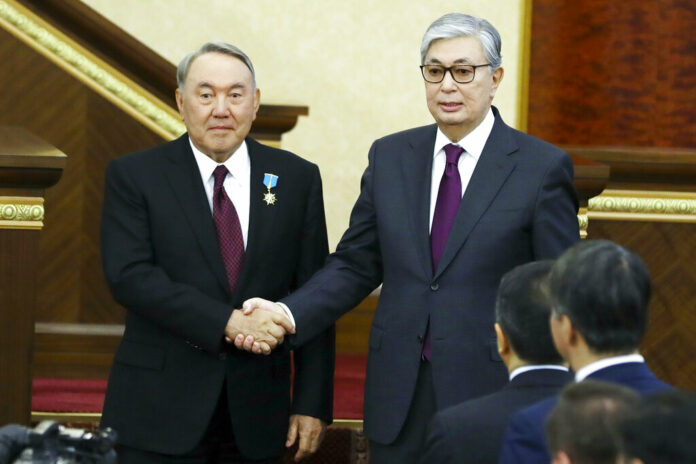
Kazakhstan's interim president Kassym-Jomart Tokayev, right, and outgoing Kazakh President Nursultan Nazarbayev shake hands after an inauguration ceremony in Astana, Kazakhstan, Wednesday, March 20, 2019. The speaker of Kazakhstan's parliament was sworn as interim president on Wednesday, a day after longtime leader Nursultan Nazarbayev abruptly resigned. (AP Photo)
MOSCOW — The eldest daughter of Kazakhstan’s outgoing long-time leader was appointed speaker of parliament on Wednesday, fueling speculation that she may succeed her father as president after next year’s election.
Her appointment comes a day after her father, 78-year-old Nursultan Nazarbayev, surprised many by announcing he was resigning after nearly 30 years in office – or all of Kazakhstan’s time as an independent nation. Nazarbayev said it was time for a new generation to rule.
Though Kassym-Jomart Tokayev, speaker of the upper chamber of parliament, was officially sworn in as interim president on Wednesday, Nazarbayev will likely continue to wield considerable influence in the oil-rich country as he remains chairman of the security council and leader of the ruling party. The question who will succeed him is, however, still open.
Tokayev’s suggestion at his swearing-in ceremony that the country’s capital Astana be renamed Nursultan to honor the country’s first and only president indicates that Nazarbayev will retain an unrivaled position as the national leader even after his resignation. The parliament promptly approved the name change.
That was further evidenced in the fact that the Kazakh Senate then voted to appoint Nazarbayev’s eldest daughter, Dariga Nazarbayeva, as the new speaker, making her the second most senior official in the country.
Lawmaker Byrganym Aytimova, in comments on the Tengri News website, credited her for “an impeccable attitude to the law, democratization of our country and access to information.”
Rumors about the resignation of Nazarbayev, who holds the honorary title of “Leader of the Nation,” and a possible plan for succession have been swirling for years. Speculation was rife that the president might be grooming his daughter, who has served as deputy prime minister. Nazarbayev, however, has not indicated that he has a successor in mind.
The surprise vote to name 55-year-old Nazarbayeva, who kept a low profile after she left the government in 2016, speaker has led many to believe she is going to be a leading contender in the 2020 presidential election.
Independent Central Asia analyst Arkady Dubnov told The Associated Press that Nazarbayev “is sending everyone a message that his daughter is getting ready to run.”
The eldest of Nazarbayev’s three daughters, Dariga has faced several corruption scandals and a divorce, which is something that may raise eyebrows in traditionally minded Kazakhstan during a presidential campaign.
Her father took the helm in Kazakhstan in 1989 when he became the Communist Party chief of what was then a republic of the Soviet Union. He was first elected its president weeks before the 1991 collapse of the Soviet Union that created a host of successor countries, including Russia and Ukraine.
He has been widely praised for maintaining stability and ethnic peace in Kazakhstan. Even though he has faced criticism for sidelining the political opposition and creating what is effectively a one-party state, the political regime that Nazarbayev has built is more liberal than the de-facto dictatorships in neighboring Central Asian countries.
Yet, Kazakhstan does not have a genuinely popular opposition movement, and whoever is nominated by the ruling party is likely to win.
Analyst Dubnov also suggested that the decision to promote his daughter can be seen as an attempt by Nazarbayev to secure the personal safety and business interests of his family.
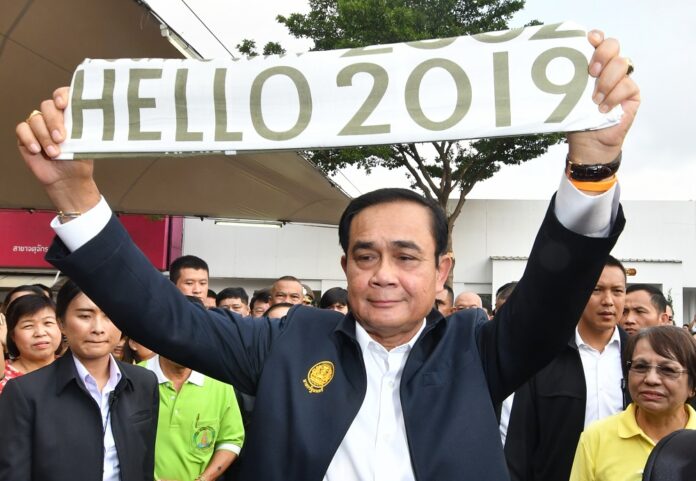
Hello 2019! Gen. Prayuth Chan-ocha during his visit to Chatuchak Weekend Market on Saturday.
BANGKOK — Prayuth Chan-ocha became prime minister in a very Thai way: He led a military coup.
Now after five years of running Thailand with absolute power, he’s seeking to hold on to the top job through the ballot box. The military’s thinly veiled proxy party has put forward Prayuth as its nominee for prime minister after Sunday’s election.
“He knows he can’t be a dictator like this forever,” said Prajak Kongkirati, a political science lecturer at Bangkok’s Thammasat University. “He wants to gain more legitimacy and that’s why he’s holding the elections. He wants to return as a prime minister under normal politics.”
After toppling the elected government in May 2014 with a pledge to “return happiness to the people,” Prayuth outlawed criticism of his regime and vowed the country would not have elections as long as there was dissent. He promised elections and then delayed them every year he was in power.
That’s given Prayuth time to smooth out some rough edges. He’s shed some awkward military stiffness, while still keeping a general’s swagger. He’s worn increasingly well-tailored suits – for which his wife takes credit – and, as pressure for an election mounted, largely transformed himself into the Thai equivalent of your typical baby-kissing politician.
He can boast some accomplishments during his time at the helm, most notably some cleanup of the aviation, fishing and wildlife industries – which had put Thailand at peril of foreign economic sanctions – along with stepping up the fight against human trafficking, which also risked trade retaliation.
Running the show has been fairly smooth though thanks to his government’s clampdown on opponents, the rubberstamp legislature he hand-picked and the law he enacted making all of his actions legal.
Should he remain prime minister after the election, he will be without what he refers to as his “special powers” and his patience could be tested as he has to deal with actual elected lawmakers who may be unwilling to dance to his tune.
“He has a strong personality – vigorous and direct. If he tries to become a politician, he could try to change but he would never really be able to change 100 percent,” said Supparuek Tongchairith, a veteran military beat reporter for Thai Rath, the country’s largest-circulation newspaper. “Because his boiling point is low, if anyone pokes at him, he will explode. And for him to sit in the parliament, I guarantee, he will run into troubles.”
Prayuth’s situation is inextricably tied to Thailand’s last 13 years of political tumult.
In one respect he has been the instrument of the conservative forces in society. They could not accept the rise of billionaire politician Thaksin Shinawatra, whose populist policies after being elected prime minister in 2001 threatened to unravel the country’s long-established power structure: Bangkok-oriented, devoted to the monarchy and safeguarded by the military.
Prayuth, 65, was born and raised in an army family at a military camp in the northeastern province of Nakhon Ratchasima. He attended a military preparatory school and graduated from Chulachomklao Royal Military Academy, Thailand’s West Point.
Prayuth was already a senior figure in the army when it staged a 2006 coup against Thaksin, justifying the putsch as a way to stop alleged abuse of power, self-enrichment and corruption by the prime minister that had triggered large protests. Some suggested that Thaksin sought to usurp the monarchy’s place in society.
Instead of easing tensions, the coup set off a bitter and often violent struggle for power between Thaksin’s supporters and his opponents. Thaksin had his fortune and newly empowered poor and rural followers on his side; arrayed against him were the courts and the military, deeply loyal to the monarchy, which traditionally has been the country’s most influential institution.
It was in this period that Prayuth climbed the ladder to the top of the military hierarchy. As commander of the First Army Region, he helped lead the bloody suppression of pro-Thaksin demonstrators in central Bangkok in 2010. In October that year, he became the army commander-in-chief.
After abandoning a sham effort to mediate between the Thaksin-backed government and its opponents who had been staging violent protests against it, Prayuth and the leaders of the other armed forces announced they were seizing power on May 22, 2014.
Prayuth and his junta spelled out their major tasks, including brokering national reconciliation and enacting reforms across society to save the nation from what it said was the inherent corruption of politicians.
While the leaders of the 2006 coup restored electoral democracy after about a year in power only to see Thaksin’s allies bounce back, it quickly became evident that this junta had no intention of allowing any Thaksin-allied party from coming to power again. It was also clear that any attempts at reconciliation were going to be one-sided.
Under Prayuth’s junta, called the National Council for Peace and Order, many civil liberties were curbed and military courts judged civilian political offenders. Government critics were summoned, or sometimes snatched off the streets, for “attitude adjustment” at army camps, a week or so in detention at an army base with a stern lecture to elicit a promise not to do it again. Longer term measures, such as a new constitution and election laws fashioned to handicap Thaksin’s political machine, were also enacted.
Prayuth, who was unanimously elected prime minister by his appointed legislature, has a famously quick temper and can bristle at anyone who questions him. Couple that with a sometimes off-color sense of humor and it can lead to verbal attacks, gaffes or just plain bizarre moments.
He’s jokingly told reporters he would have them executed, quipped that he might behead a soap opera star who called for elections, flung a banana peel at a cameraman and given an entire news conference in which he fondled the ear of a nearby sound technician.
Since the coup, the general has also drawn attention for his songwriting, penning a number of sappy ballads with nationalistic lyrics.
Prayuth – who has twin daughters, now grown, who for a time were in a pop band called Badz – has at times taken on the role of tough-love dad, especially during his weekly primetime television broadcast aired on all major stations, “Returning Happiness to the People.” The monologues can last an hour and half and touch on everything from the moral responsibility of youth to tips on cultivating orchids.
Yet allegations of nepotism against Prayuth’s own relatives have led to uncomfortable accusations of hypocrisy. After the coup, a company owned by one of Prayuth’s nephews that had no track record of projects was awarded lucrative army construction contracts. Prayuth’s brother, also a former high-ranking army man, drew criticism when it was revealed that he made another son who had no military experience an army officer.
Of course the most glaring contradiction may be Prayuth’s own transformation.
As it became more likely he would seek to stay on as prime minister, he began allying with the very politicians he initially declared were the targets of junta reforms and launched government handouts that were nearly carbon copies of Thaksin’s populist policies.
Early last year he made it clear, telling reporters: “I am no longer a soldier. Understood? I’m just a politician who used to be a soldier.”