30 C
Bangkok
Saturday, June 27, 2026
Home Blog Page 1680

‘Thundercat’ to Loose Funk, Soul on Bangkok Next Month

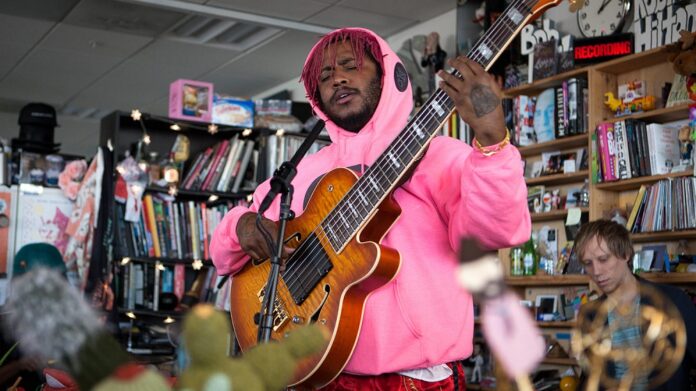
BANGKOK — Behind Kendrick Lamar’s “To Pimp a Butterfly” is groove and acid-jazz genius Thundercat.

Now, the American master bassist and singer is coming to Bangkok for a live show next month, local promoter Have You Heard announced Friday morning.

The gig will take place April 9 at Live Arena RCA.

Tickets start at 1,400 baht and go on sale Monday at Ticketmelon.

Thundercat is Stephen Lee Bruner from Los Angeles. He was first exposed to music at the age of 4 and he later joined ‘80s crossover thrash Suicidal Tendencies.

The 34-year-old artist in 2016 won a Grammy for best rap and singing performance for his work “These Walls.”

Bruner’s 23-track studio album “Drunk” features several guests such as Kendrick Lamar, Wiz Khalifa, Mac Miller, Michael McDonald and Pharrell.

Advertisement

Bangladesh: We’ll Become Unable to Take New Myanmar Refugees

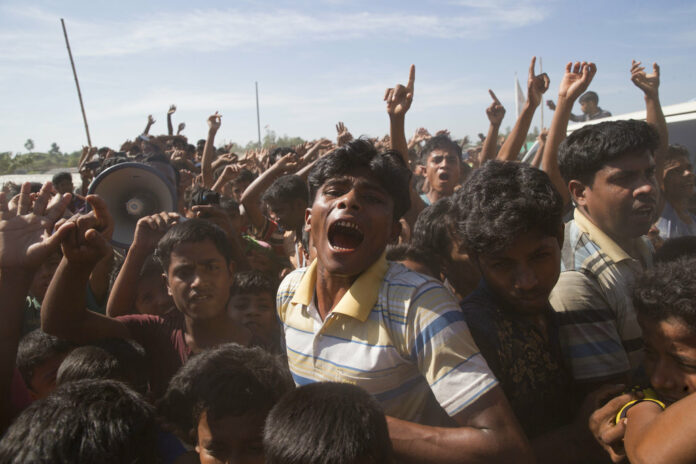
Rohingya refugees shout slogans during a protest against the repatriation process at Unchiprang refugee camp near Cox's Bazar, in Bangladesh, Thursday, Nov. 15, 2018. The head of Bangladesh's refugee commission said plans to begin a voluntary repatriation of Rohingya Muslim refugees to their native Myanmar on Thursday were scrapped after officials were unable to find anyone who wanted to return. (AP Photo/Dar Yasin)

UNITED NATIONS — Bangladesh’s foreign secretary said Thursday his country will need to stop accepting more refugees from Myanmar and accused its government of being “obstructionist” about bringing back more than 1 million Rohingya Muslims who have fled violence.

Myanmar, meanwhile, continued to insist it is taking steps toward their return. Its ambassador appealed for patience from the U.N. Security Council, but several members complained about what they saw as lagging progress nearly a year after a council delegation traveled to see the crisis firsthand.

After a renewed flare-up in violence in Myanmar’s northern Rakhine State, new refugees are still crossing the border to Bangladesh, Foreign Secretary Shahidul Haque said.

“As far as repatriation is concerned, the situation has gone far from bad to worse,” he told the council, adding that his country “would no longer be in a position to accommodate more people from Myanmar.”

He didn’t say when that might occur.

More than 700,000 Rohingya have fled to Bangladesh since August 2017, when Rohingya militants attacked Myanmar security forces in Rakhine, triggering a massive military retaliation that U.N. investigators have called genocide. The exodus came after hundreds of thousands of other Rohingya escaped previous bouts of violence and persecution.

Most people in Buddhist-majority Myanmar don’t accept the Rohingya Muslims as a native ethnic group. They are, instead, viewed as illegal immigrants from Bangladesh, though generations of Rohingya have lived in Myanmar.

Nearly all have been denied citizenship since 1982 and lack access to education and hospitals.

The U.N. General Assembly approved a resolution in December strongly condemning “gross human rights violations and abuses” committed against Myanmar’s Rohingya.

Myanmar’s government denies claims of genocide and ethnic cleansing. The country rejects the U.N. investigators’ work and the General Assembly resolution as biased.

Myanmar has made agreements with Bangladesh and U.N. agencies to repatriate the Rohingya, but it hasn’t happened.

A plan for refugees to begin returning last November was scrapped because officials couldn’t find anyone willing to go. Myanmar had said it was ready to receive them, but U.N. officials, human rights activists and others had called for waiting until the refugees’ safety in Myanmar could be assured.

The Bangladeshi foreign secretary said Thursday his country had “tried everything” with Myanmar but met with “hollow promises and various obstructionist approaches.”

He urged the Security Council to visit the Rohingya refugee camps again and set up “safe zones” for people of all backgrounds in conflict-torn parts of Myanmar.

Myanmar’s U.N. ambassador said his country was taking steps to facilitate the Rohingya’s return. The envoy, Hau Do Suan, pointed to three dozen small-scale community projects planned “as soon as the security condition permits” and to a recent investment fair meant to generate development in Rakhine.

“We seek your understanding of the practicality and possibilities on the ground,” Hau told the council, adding that building trust in Rakhine “takes time and patience, as well as courage.”

The Rohingya crisis has been a sensitive subject in the council, where Myanmar’s close ally China is among members with veto power. The council did visit Myanmar and Bangladesh last April and May, and members last summer urged stepping up efforts to enable the Rohingya to return.

Several countries on the council vented frustrations Thursday.

“The time has come for the government of Myanmar to assume its responsibility to protect its citizens” and for the council “to use all means at its disposal to make tangible progress,” said the Dominican Republic’s envoy, Jose Singer.

But Russia and China advised the group not to be strident.

“The international community should keep its patience,” Chinese Deputy Ambassador Wu Haitao said.

Story: Jennifer Peltz

Advertisement

US, North Korea Offer Dueling Accounts of Talks Breakdown

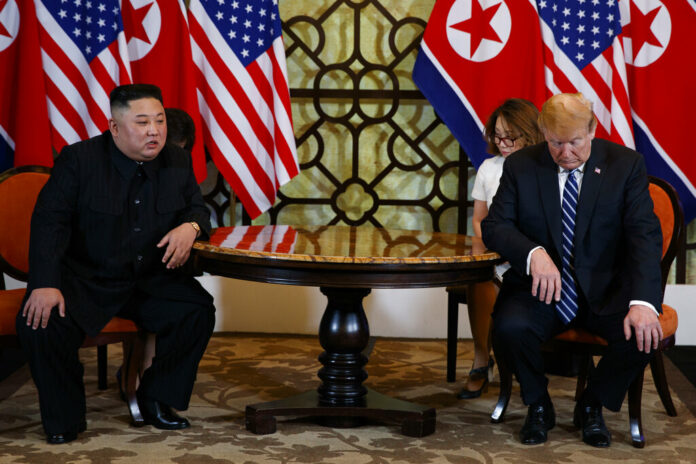
President Donald Trump meets North Korean leader Kim Jong Un, Thursday, Feb. 28, 2019, in Hanoi. (AP Photo/ Evan Vucci)

HANOI — In open dispute, the U.S. and North Korea offered contradictory accounts Thursday of why the summit between Donald Trump and Kim Jong Un broke down, though both pointed to punishing American sanctions as a sticking point in the high-stakes nuclear negotiation.

President Trump, who returned to the White House Thursday night, said before leaving Hanoi that the talks collapsed because North Korea’s leader insisted that all the sanctions the U.S. has imposed on Pyongyang be lifted without the North firmly committing to eliminate its nuclear arsenal.

But North Korea challenged that account, insisting it had asked only partial sanctions relief in exchange for shutting down its main nuclear complex. Foreign Minister Ri Yong Ho commented on the talks during an abruptly scheduled middle-of-the-night news conference after Trump was in the air.

Ri said the North was also ready to offer in writing a permanent halt of the country’s nuclear and intercontinental ballistic missile tests and Washington had wasted an opportunity that “may not come again.” He said the North’s position won’t change even if the United States offers to resume another round of dialogue.

On Friday, North Korea’s official news agency put a more positive spin on the summit, saying Trump and Kim “had a constructive and candid exchange of their opinions over the practical issues arising in opening up a new era of the improvement” of relations between the two nations.

Trump made no mention of the disagreement as he addressed U.S. troops during a stopover at Joint Base Elmendorf-Richardson in Alaska, though White House spokeswoman Sarah Sanders said he was aware of Ri’s comments.

Instead, Trump focused on U.S. military might and offered a broad warning to U.S. enemies.

“America does not seek conflict, but if we are forced to defend ourselves we will fight and we will win in an overwhelming fashion,” he declared.

Earlier on Thursday in Hanoi, Trump had told reporters the North had demanded a full removal of sanctions in exchange for shutting the Yongbyon nuclear facility. Trump said that there had been a proposed agreement “ready to be signed.” However, he said after the summit was cut short, “Sometimes you have to walk.”

The demise of the talks came after Trump and Kim had appeared ready to inch toward normalizing relations between their still technically warring nations.

The American leader had dampened expectations that the negotiations would yield an agreement by North Korea to take concrete steps toward ending a nuclear program that Pyongyang likely sees as its strongest security guarantee. However, Kim, when asked whether he was ready to denuclearize, had said, “If I’m not willing to do that I won’t be here right now.”

But hours after both nations had seemed hopeful of a deal of some kind, the two leaders’ motorcades roared away from the downtown Hanoi summit site within minutes of each other, lunch canceled and signing ceremony scuttled. The president’s closing news conference was hurriedly moved up, and he departed for Washington more than two hours ahead of schedule.

The breakdown denied Trump a much-needed triumph amid growing political turmoil back home and the path forward now appears uncertain. Trump insisted his relations with Kim remain warm, but he did not commit to having a third summit with the North Korean leader, saying a possible next meeting “may not be for a long time.”

Ri’s comments reflected the North Koreans’ disappointment, though there was a notable absence of bluster or threats by either side.

Both Trump and Secretary of State Mike Pompeo said significant progress had been made in Hanoi, but the two sides appeared to be galaxies apart on an agreement that would live up to stated American goals.

“Basically, they wanted the sanctions lifted in their entirety, and we couldn’t do that,” Trump told reporters.

Kim, he said, appeared willing to close his country’s main nuclear facility, the Yongbyon Nuclear Scientific Research Center, if the sanctions were lifted. But that would leave him with missiles, warheads and weapon systems, Pompeo said. There are also suspected hidden nuclear fuel production sites around the country.

“We couldn’t quite get there today,” Pompeo said, minimizing what seemed to be a chasm between the two sides.

Longstanding U.S. policy has insisted that U.S. sanctions on North Korea would not be lifted until that country committed to, if not concluded, complete, verifiable and irreversible denuclearization. Trump declined to restate that goal Thursday, insisting he wanted flexibility in talks with Kim.

Ri said North Korea proposed that U.S. and North Korean technicians jointly dismantle plutonium, uranium-enrichment and other nuclear material-making facilities at Yongbyon in the presence of U.S. experts.

He said it is “the biggest denuclearization measure that we can take” given the current status of mutual confidence between the two countries.

In return, Ri said North Korea asked the U.S. to lift five kinds of sanctions that are related to its civilian economy and public livelihoods.

The failure in Hanoi laid bare a risk in Trump’s negotiating style. Preferring one-on-one meetings with his foreign counterparts, his administration often eschews the staff-level work usually done in advance to assure a deal.

There was disappointment and alarm in South Korea, whose liberal leader has been a leading orchestrator of the nuclear diplomacy and who needs a breakthrough to restart lucrative engagement projects with the impoverished North. Yonhap news agency said that the clock on the Korean Peninsula’s security situation has “turned back to zero” and diplomacy is now “at a crossroads.”

The two leaders had seemed to find a point of agreement when Kim, who fielded questions from American journalists for the first time, was asked if the U.S. may open a liaison office in North Korea. Trump declared it “not a bad idea,” and Kim called it “welcomable.” Such an office would mark the first official U.S. presence in North Korea and a significant grant to a country that has long been deliberately starved of international recognition.

There had long been skepticism that Kim would be willing to give away the weapons his nation had spent decades developing and Pyongyang felt ensured its survival. But even after the summit ended, Trump praised Kim’s commitment to continue a moratorium on missile testing.

Story: Deb Riechmann, Hyung-jin Kim, Catherine Lucey

Advertisement

In a Summit First, Kim Jong Un Takes US Media Questions (Video)

HANOI — So here’s a bit of history made at President Donald Trump’s summit with Kim Jong Un: for what is almost certainly the first time, the North Korean leader actually answered an impromptu question from an American reporter.

Then just a little bit later, as if to prove it wasn’t a fluke, he did it again.

Looking confident and speaking in his typically gravelly voice, Kim didn’t miss a beat when asked by a member of the White House press pool about his outlook on the summit, saying “It’s too early to say. I won’t make predictions. But I instinctively feel that a good outcome will be produced.”

South Korea’s Unification Ministry, which deals with North Korean affairs, couldn’t confirm whether it was the first time Kim answered a question from a foreign journalist. But reporters didn’t get opportunities to ask questions of Kim during his three summits with South Korean President Moon Jae-in and his four meetings with Chinese President Xi Jinping.

Kim ignored questions shouted at him during his first summit with Trump last June in Singapore. In an earlier brush with foreign media at the opening of a war museum in Pyongyang in 2013, questions were shouted at him but not answered.

The first journalist to get his response on Thursday was David Nakamura of the Washington Post. As a pool reporter, he was allowed close access to the leaders as the representative of the White House press corps.

“I asked Kim Jong Un if he felt confident he could get a deal with @realDonaldTrump,” Nakamura tweeted. “He replied: ‘It’s too early to say. I would not say I’m pessimistic.'”

Soon after, as journalists were allowed to see the beginning of the final day of talks, Kim responded to several more questions from American reporters in the White House pool – including The Associated Press, Reuters and Bloomberg. He said he thought it would be a good idea to open a U.S. liaison office in Pyongyang and said through the interpreter that he wouldn’t be in Hanoi if he weren’t willing to discuss denuclearization.

The interpreters – Yun-hyang Lee, who also translated for Trump at his first meeting with Kim in Singapore, and Sin Hye Yong, for Kim – played a key role in the exchanges.
Shouted or unapproved questions are usually simply not translated to begin with. But with Trump responding, it appeared natural for Kim to follow suit. The interpreters interpreted. And Kim jumped right in.
Kim’s confident performance in Hanoi began as soon as he got off the train.

Despite the tight security that is the rule at summits, foreign media were allowed to get right up beside him as he got off his armored train at the Chinese border to switch to a limousine for the drive the rest of the way to Hanoi.

Story: Eric Talmadge

Advertisement

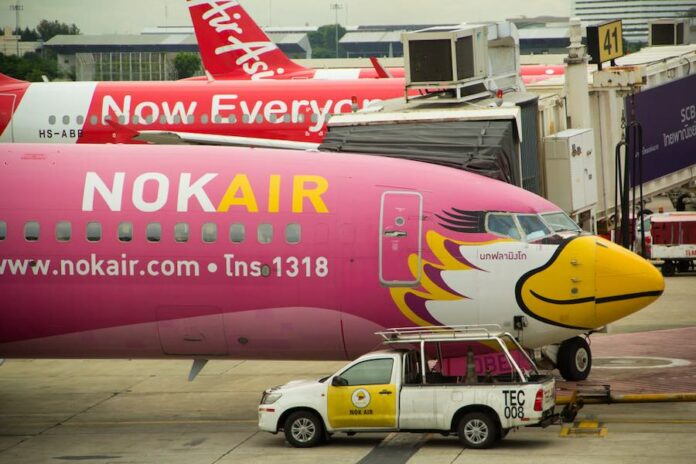
Regulator Warns AirAsia on Takeover of Nok Air

Image: Shutterstock

Update: AirAsia informed the Stock Exchange of Thailand on March 6 that it has withdrawn its offer to purchase Nok Air shares.

BANGKOK — A trade official warned Thursday that aviation giant AirAsia’s proposed acquisition of rival Nok Air may violate antitrust laws.

Though both firms have yet to confirm the deal, Trade Competition Commissioner Santichai Saratawanpad said any merger would require the permission of his office first. An unauthorized merger could be considered a monopoly and subjected to an initial fine of 200,000 baht plus additional fines of 10,000 baht per day, he said.

“The Trade Competition Commission has instructed its agency office to monitor the business merger of these two airlines closely,” Santichai said in a statement. “If we detect any violation of trade competition, we will punish them strictly and immediately in accordance with the laws.”

Santichai said AirAsia’s potential buyout of Nok falls under antitrust regulations because it involves a company with revenues of over 1 billion baht. Monopolies are illegal in Thailand under a 20-year-old law, but not one case has ever been successfully blocked.

In recent days the trade floor at Stock Exchange of Thailand has been awash with speculation about AirAsia’s plans to buy a majority stake in Nok from the Jurangkool family. Nok shares have increased in value by 42 percent since word of the takeover came out last week, up from 2.28 baht to 3.24 baht per share on the Thai exchange.

The Jurangkools own 53 percent of the airline’s shares, while national carrier Thai Airways is its second largest investor with a roughly 16 percent stake.

Operating out of Don Mueang Airport, low-cost carrier Nok Air has reported financial losses for the past several years as it has been beset by chronic delays and pilot strikes. The company released a statement earlier this week denying a takeover was imminent.

“The company would like to clarify that the company has not received any information about the aforementioned investment as reported in the news,” the airline said Monday.

But a statement from Asia Aviation, the owner of AirAsia, confirms it has put an offer on the table.

“The company is deliberating on the viability of the aforementioned investment, but no written agreement has been made, and there has been no action binding the company into buying or selling shares of Nok Air,” the Asia Aviation statement said.

Nok Air reported a loss of 970 million baht in 2018. Asia Aviation said it had net profits of 340 million baht in that year.

Advertisement

Thai Election for Dummies: Find Your Polling Place, Candidates – Right Now

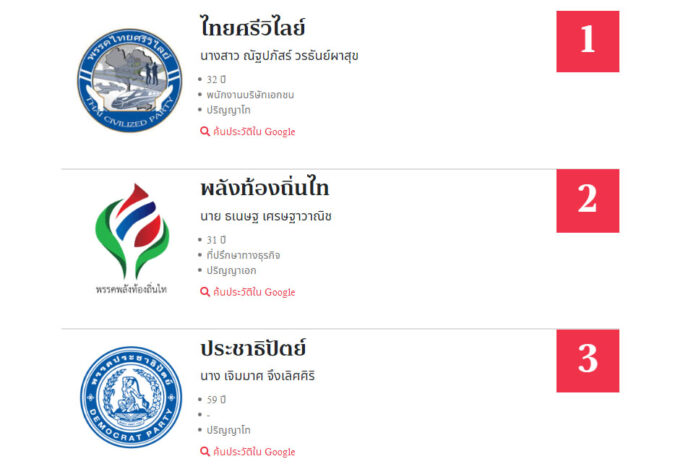
The first three candidates for Dusit district.

BANGKOK — Check where your polling station is and who will be on your ballot for next month’s election easily online.

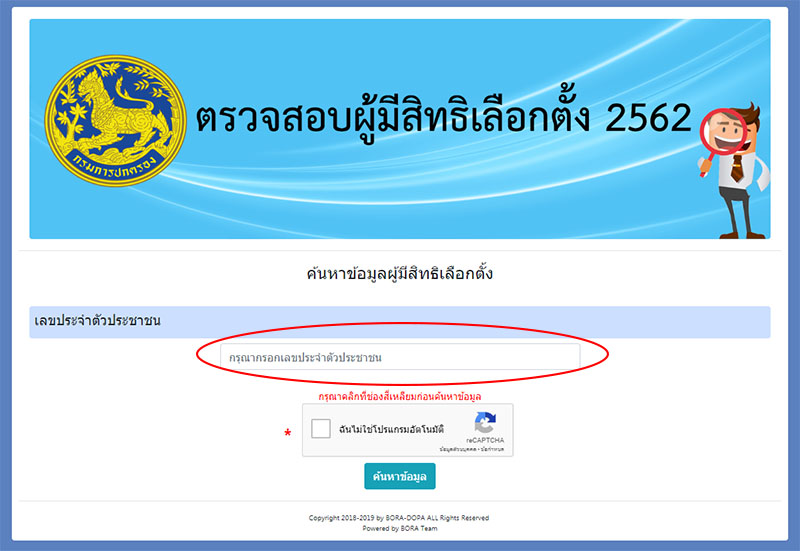
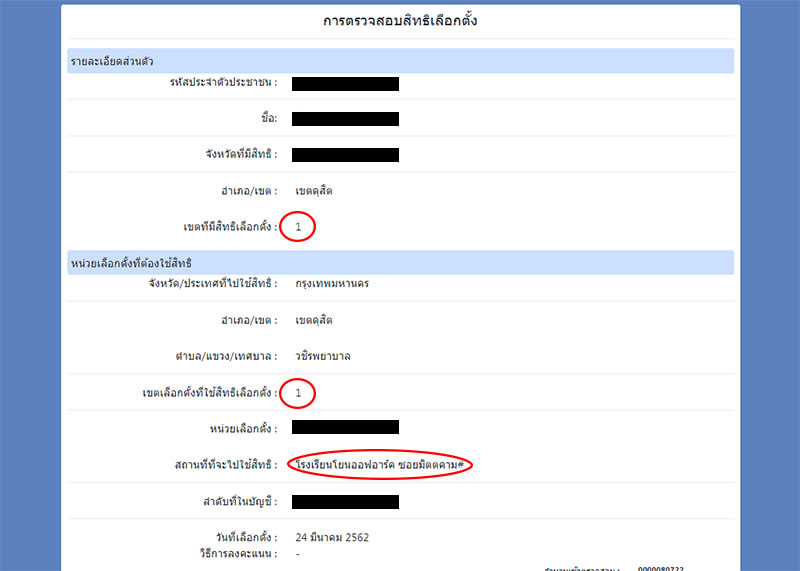
First, find your polling place using this tool provided by the Provincial Administration Department. Just enter your Citizen ID number and the district your home is registered. Be sure to note your voting district number – you’ll need that next.

Input your Citizen ID here.
The results page with district number and polling location circled.

This also works for those who have have registered to vote overseas March 4-16, whether by mail or at a Thai diplomatic mission.

Next, find out which candidates are running in your district. Use the Elect Voting tool to enter your registered home’s postal code, then select the district number obtained above.

For example, enter postal code 10300 for the Dusit district and then choose District 1 or 7 for the list.

Finally, those voting on Election Day shouldn’t forget to do so between 8am and 5pm on March 24!

Confused about which party stands for what? Read our guide. Need to check if you’re eligible to vote? See this one. Want a video explainer featuring dogs to explain this year’s mixed-member apportionment voting system? Viddy it here.

Related stories:

Thai Election for Dummies: Guide to the Parties

Thai Election for Dummies: How, When, Where to Cast Your Vote

Viral Video Uses Pooches to Explain Dog-Eat-Dog Thai Elections

Advertisement

New Junta Cyber Law Ripe For Abuse: Judge

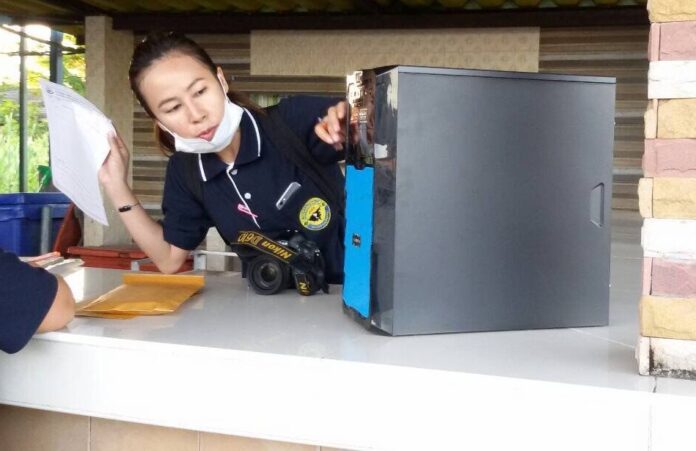
A DSI officer inspects a computer seized during a 2016 raid on a gambling den in Pattani province.

BANGKOK — The junta’s rubberstamp parliament on Thursday passed a law intended to protect online infrastructure that critics fear is open to abuses.

The first such legislation, the Cybersecurity Act calls for two commissions consisting of IT officials and military officers to monitor threat levels, improve security and blunt attacks on private and public entities. The bill was passed 133-0 after a two hours of debate.

The law also allows the new body to bypass the court and take unilateral action in the event of a “critical threat” against the country, raising concern the vague clause could be broadly interpreted to shut down legitimate criticism.

“It might be my pessimistic interpretation,” internet freedom advocate Arthit Suriyawongkul wrote online. “But based on past experience, I think it’s reasonable to expect the worst-case scenarios.”

Even a senior judge spoke out against the draft. Appeals Court judge Sriamporn Salikup told the media last week that the cybersecurity bill appears to “prioritize government security over the freedoms and liberties of the people.” He also warned that the legislation lacks clear checks and balances.

“It’s at the risk of causing severe damage to the liberty and freedom of the people, as I have already expressed concerns many times,” Sriamporn said.

#CyberCrime was trending on Twitter shortly after the news was announced.

Section 59 defines critical threats as attacks that could cripple the national infrastructure, cause massive damage to computer systems, spark widespread unrest or allow acts of terrorism to take place.

Events that force the authorities to enact “urgent measures” in order to defend the monarchy are also defined as critical threats in the same section.

Most worrying for rights activists is a provision that allows officials to take action without seeking court approval. Under the law, the authorities can resort to a wide range of powers, from seizing computers to entering facilities believed to be aiding in a perceived threat.

Rights advocates say the military government has already weaponized other security-related laws to crack down on free speech and activism.

Just earlier this month, a leader of the anti-junta Future Forward Party was charged with cyber crimes for allegedly spreading false info in his criticism of the regime.

A woman was arrested in 2015 after police identified her as being behind rumors on social media that Prayuth had transferred over 10 billion baht to a personal bank account in Singapore. The court acquitted her in 2018, saying her actions did not affect national security.

Advertisement

Samui Tunnel Linked to Virgin Islands Firm

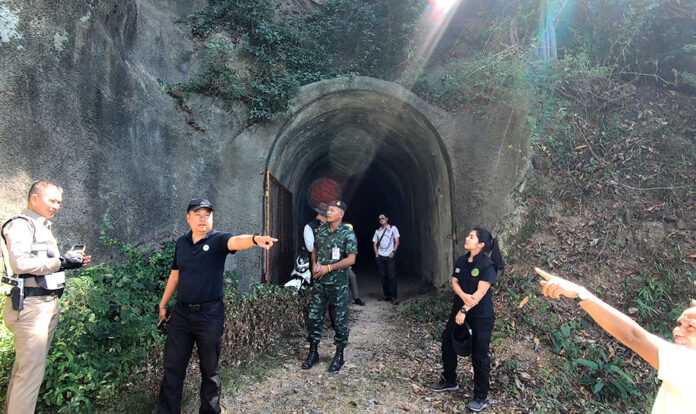
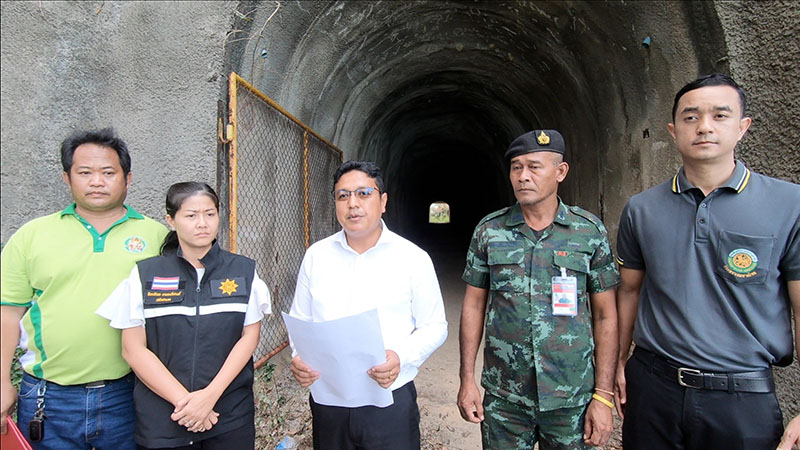
KOH SAMUI — The ownership of a tunnel whose origins have stumped Samui officials for a week have been traced in part to a company registered in the Caribbean.

The 100-meter tunnel, which may have been built illegally, has become something of a puzzle on the southern island since it was discovered Friday. Officials said Wednesday that it’s located on land owned by a company registered in Bangkok, a third of which is owned by a company registered in the British Virgin Islands.

The tunnel near the beach in the Mae Nam subdistrict belongs to the Baan Tai Beach Co. Ltd., whose shareholders include Thai-naturalized Westerners and a company registered in the British Virgin Islands, a popular tax shelter.

Although the tunnel was known to expat backpackers for decades, Thai authorities said they only learned of it earlier this month. They believe it was built in 2005.

q5 copy

Related stories:

Officials Still Don’t Know Who Built Koh Samui Tunnel

Tourists Drawn to Light at End of Samui Tunnel (Video)

Advertisement

Thai Net Skeptical About Democracy Monument ‘Renovation’

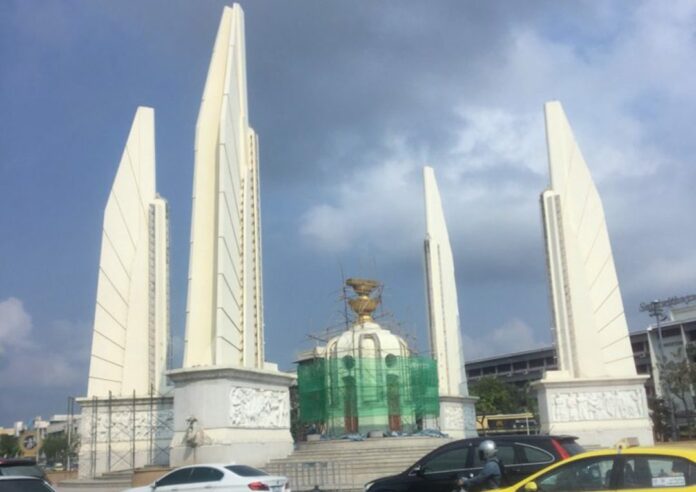
The Democracy Monument on Thursday. Photo: Matichon

BANGKOK — City Hall is having a hard time convincing the internet that one of Bangkok’s most recognized landmarks isn’t about to suffer the same fate as other monuments to Thai democracy.

Thai netizens appeared jittery Wednesday after photos spread showing the Democracy Monument, one of the last physical reminders of the end of absolute monarchy, covered with tarps and scaffolding. The city insisted it was only repainting the monument as part of plans to spruce up the grand avenue it sits on ahead of May’s coronation ceremony.

“We’d like to emphasize that there’s no political agenda in the renovation of the Democracy Monument,” said Sakchai Boonma, director of the Public Works Department. “The work will be fully completed in March.”

Read: Could Democracy Monument Be Razed? It’s Been Tried Before.

The photos, posted by Voice TV and shared more than 100 times as of Thursday afternoon, provoked anxiety following the disappearance two years ago of a plaque celebrating 1932’s democratic revolution that was replaced with one praising the monarchy. Late last year, a monument marking the defeat of an ultraroyalist counter-revolution was dismantled overnight in the capital district of Laksi.

Both were removed without explanation; speculating about their fates is taboo.

Some commentators likened the sight to representing a “broken democracy.”

“Will the offering tray be replaced with a tank?” user Kachatharn Hanhakhmee wrote, referring to the monument’s central feature symbolically venerating the constitution as a sacred object.

“It’s still under construction – since 1932,” user Patrick Stronger commented, citing the bloodless revolt that saw the nation transition to a constitutional monarchy.

“The Laksi Monument is now gone. In the photos is the next thing someone wants to make disappear,” user Munkong Jamsai wrote.

Due to legal concerns, Khaosod English has withheld some details from this story.

Related stories:

Monument Marking Defeat of Royalist Rebels Removed in Dead of Night

Revolution Plaque: Latest Casualty of 1932 Revolution’s Endangered Legacy

1932 Democratic Revolution Plaque Removed

Advertisement

Hanoi Postcard: Vietnam Tames Media Invasion but Sees Upside

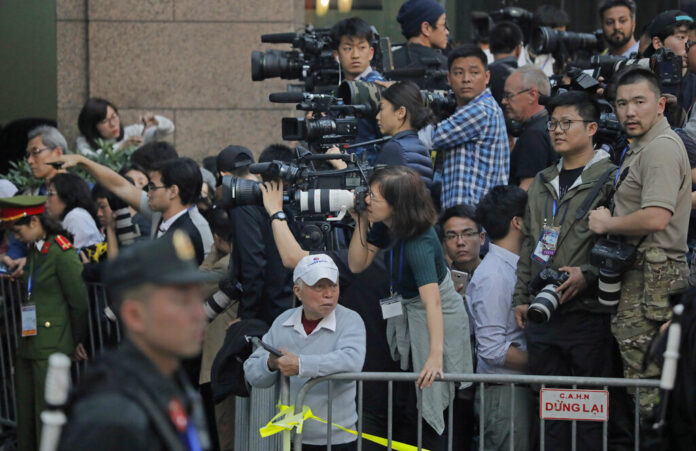
Journalists gather outside Metropole hotel Wednesday where U.S President Donald Trump and North Korean leader Kim Jong Un are to have their meeting in Hanoi, Vietnam. Photo: Vincent Yu / Associated Press

HANOI — Journalists covering the summit between President Donald Trump and North Korean leader Kim Jong Un may want freedom to work and food to fuel them through the long days, and they won’t hesitate to say so. But Vietnamese officials see an upside to hosting media from around the world.

In welcoming more than 2,600 foreign journalists, Vietnam has a unique opportunity to polish its image and, hopefully, boost tourism and investment. Vietnamese are keen to show themselves as members in good standing of the global community, to the extent of helping broker a major diplomatic entente as Kim and Trump meet for a second time to discuss North Korea’s nuclear program.

The number of journalists in Hanoi for this week’s meeting is just slightly short of the 3,000 who attended the leaders’ first meeting last year in Singapore.

Vietnam has much experience in hosting major events such as 2017’s Asia-Pacific Economic Cooperation meetings, said Foreign Ministry spokeswoman Le Thi Thu Hang, and Vietnam’s social and political stability is a plus in ensuring security.

Hanoi was chosen for the summit location roughly two weeks ago, and she said whatever bumps might occur would be the result of having very little time to prepare for the biggest number of foreign media to descend on Vietnam’s capital.

Reporters generally agree security during the summit is tight – maybe a bit too tight for their liking.

When Kim transferred at the China-Vietnam border from his personal train to an armored limousine for the two-and-a-half hour drive to Hanoi, Highway One was closed to traffic and thousands of police and military personnel were deployed along the route.

Whenever he or Trump ventures out from his Hanoi hotel, barricades ensure the streets along his route are deserted when his motorcade passes through.

While Kim’s travel plans and itineraries are routinely kept secret, getting information relating to Kim’s activities has been harder in Vietnam than it was in Singapore, said Peter Wang, who works for Taiwan’s Eastern Broadcasting Company.

“You can even follow Kim Jong Un, his personal activities, while he went out middle of the night in Singapore, all reporters when they knew the information, they could rush to the location trying to get a shot to film what Kim Jong Un did,” he said. “But here it’s very hard, they blocked the road a couple of blocks away and police are very strict.”

Some reporters received a rude awakening about their host’s priorities just before the leaders arrived in town. The White House press corps was forced to leave its established work space at the Melia Hotel after last-minute word that Kim would be staying there. The White House-based journalists now share space at the International Media Center.

Their ouster reportedly came at the request of the North Korean delegation. Some members of the elite press group were so irate at being turfed out that they posted their outrage on Twitter.

Hanoi Mayor Nguyen Duc Chung told city residents to be on their best behavior, noting the presence of foreign journalists.

In a message on the city’s website, he urged them “maintain and sustain Hanoians’ code of behavior, heighten the image of civilized, elegant, friendly and hospitable Vietnamese people and Hanoi residents in the eyes of international press and friends,” describing the Vietnamese capital as ” a city for peace which is safe and friendly.”

Friendly though it might be, he also pleaded for businesspeople to “refrain from hiking prices of goods and services during the summit.”

“This is the best opportunity to publicize the culture, development and image of Vietnam and capital Hanoi to the international community, maintaining peace and friendship,” his statement said.

All his exhortations, though, couldn’t tame Hanoi’s traffic.

Robert Costantini, the White House correspondent for Westwood One News, a U.S radio news network, found maneuvering on the streets a challenge.

“The traffic here is just kind of really amazing,” like nothing he had experienced before, he said. “All the people on motorbikes, and the bus will turn in front of them, and then they stop and try to squeeze through, it’s just amazing visually for me.”

Getting around in Hanoi is totally different than in the “very rigid and disciplined society” of Singapore, where he covered the first Trump-Kim summit, Costantini said.

However, in pondering the main attraction rather than the sideshows, a Finnish reporter who also covered the Singapore meeting saw a reason for the differences in the two summits.

“This is a different summit in all aspects, there was really excitement simply to see Kim Jong Un and his caravan coming through Singapore,” said Mika Hentunen, the U.S. correspondent of Finnish Broadcasting Company YLE. “Now there’s not that excitement anymore, now it’s like they want to have results, that’s why it’s more businesslike.”

Story: Tran Van Minh

Advertisement

Hot News

LATEST NEWS

Bangkok
scattered clouds
30 ° C
31.6 °
30 °
81 %
2.4kmh
47 %
Fri
30 °
Sat
37 °
Sun
36 °
Mon
36 °
Tue
34 °