























33.9 C
Bangkok
Friday, June 26, 2026
Home Blog Page 1686

Spike Lee, Marvel, Gaga Notch First Oscars at Academy Awards

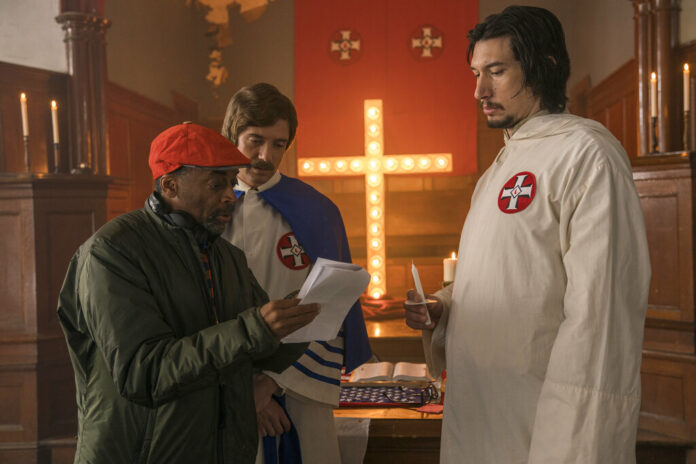
This image released by Focus Features shows director Spike Lee, left, with actors Topher Grace, center, and Adam Driver on the set of Lee's film "BlacKkKlansman." Photo: David Lee / Focus Features via Associated Press

LOS ANGELES — Spike Lee won his first competitive Oscar while the motion picture academy spread around awards for Ryan Coogler’s superhero sensation “Black Panther,” Alfonso Cuaron’s black-and-white personal epic “Roma,” and the Freddie Mercury biopic “Bohemian Rhapsody” at a brisk, hostless Oscars awash in historic wins for diversity.

Lee’s win for best adapted screenplay to his white supremacist drama “BlacKkKlansman” gave the Dolby Theatre ceremony Sunday its signature moment. The crowd rose in a standing ovation, Lee leapt into the arms of presenter Samuel L. Jackson and even the backstage press room burst into applause.

Lee, whose film including footage of President Donald Trump following the violent white supremacist protests in Charlottesville, Virginia, spoke about the upcoming election.

“The 2020 election is around the corner. Let’s all mobilize. Let’s be on the right side of history,” said Lee, who was given an honorary Oscar in 2015. “Let’s do the right thing! You knew I had to get that in there.”

“Bohemian Rhapsody,” which kicked off the ABC telecast with a performance by Queen, won four awards despite pans from many critics and sexual assault allegations against its director, Bryan Singer, who was fired in mid-production. Its star, Rami Malek, won best actor for his full-bodied and prosthetic teeth-aided performance, and the film was honored for editing, sound mixing and sound editing.

“We made a film about a gay man, an immigrant who lived his life unapologetically himself,” said Malek. “We’re longing for stories like this. I am the son of immigrants from Egypt. I’m a first-generation American, and part of my story is being written right now.”

The lush, big-budget craft of “Black Panther” won for Ruth Carter’s costume design, Hannah Beachler and Jay Hart’s production design, and Ludwig Göransson’s score. Beachler had been the first African-American to ever be nominated in the category. Beachler and Carter became just the second and third black women to win non-acting Oscars.

“It just means that we’ve opened the door,” Carter, a veteran costume designer, said backstage. “Finally, the door is wide open.”

Two years after winning for his role in “Moonlight,” Mahershala Ali won again for his supporting performance in the interracial road-trip drama “Green Book” – a role many said was really a lead. Ali is the second black actor to win two Oscars following Denzel Washington, who won for “Glory” and “Training Day.” Ali dedicated the award to his grandmother. “Green Book,” a film hailed by some as a throwback and criticized by others as retrograde, also took best original screenplay.

The night’s co-lead nominee “Roma,” which is favored to hand Netflix its first best picture win, notched Mexico’s first foreign language film Oscar. Cuaron also won best cinematography, becoming the first director to ever win for serving as his own director of photography. Cuaron referenced an especially international crop of nominees.

“When asked about the New Wave, Claude Chabrol said there are no waves, there is only the ocean,” said Cuaron, referring to the French filmmaker. “The nominees tonight have proven that we are a part of the same ocean.”

The wins for “Roma” gave Netflix its most significant awards yet, while “Black Panther” – along with best animated film winner “Spider-Man: Into the Spider Verse” – meant the first Academy Awards for Marvel, the most consistent blockbuster factor Hollywood has ever seen.

Queen launched Sunday’s ceremony with a medley of hits that gave the awards a distinctly Grammy-like flavor as Hollywood’s most prestigious ceremony sought to prove that it’s still “champion of the world” after last year’s record-low ratings.

To compensate for a lack of host, the motion picture academy leaned on its presenters, including an ornately outfitted Melissa McCarthy and David Tyree Henry and a Keegan-Michael Key who floated down like Mary Poppins. Following Queen, Tina Fey – alongside Amy Poehler and Maya Rudolph – welcomed the Dolby Theatre audience to “the one-millionth Academy Awards.”

Rudolph summarized a rocky Oscar preamble that featured numerous missteps and backtracks by the Academy of Motion Picture Arts and Sciences: “There is no host, there won’t be a popular movie category and Mexico is not paying for the wall.”

The trio then presented best supporting actress to Regina King for her pained matriarch in Barry Jenkins’ James Baldwin adaptation “If Beale Street Could Talk.” The crowd gave King a standing ovation for her first Oscar.

“To be standing here representing one of the greatest artist of our time, James Baldwin, is a little surreal,” said King. “James Baldwin birthed this baby.”

The inclusivity of the winners Sunday stood in stark contrast to the #OscarsSoWhite backlash that marked the 2016 and 2015 Oscars. Since then, the academy has worked to diversity its largely white and male membership, adding several thousand new members and opening the academy up internationally.

More women won Oscars than ever before. Still, this year’s nominations were criticized for not including a female best director nominee or a best-picture nominee directed by a woman.

Though the once presumed front-runner “A Star Is Born” appeared to flame out as awards season continued, it won, as expected, for the song “Shallow,” which Lady Gaga and Bradley Cooper performed during the ceremony. As she came off the stage, Cooper had his arm around Gaga as she asked, “Did I nail it?”

Best documentary went to Elizabeth Chai Vasarhelyi and Jimmy Chin’s “Free Solo,” which chronicles rock climber Alex Honnold’s famed, free solo ascent of Yosemite’s El Capitan, a 3,000-foot wall of sheer granite, without ropes or climbing equipment. “Free Solo” was among a handful of hugely successful documentaries last year including the nominated Ruth Bader Ginsberg documentary “RBG” and the snubbed Fred Rogers doc “Won’t You Be My Neighbor.”

“Thank you Alex Honnold for teaching us to believe in the impossible,” said Vasarhelyi. “This film is for everyone who believes in the impossible.”

Adam McKay’s Dick Cheney biopic “Vice” won makeup and hairstyling for its extensive physical transformations. The category was one of the four that the academy initially planned to present during a commercial break and as its winners – Greg Cannom, Kate Biscoe and Patricia Dehaney – dragged on in a litany of thank-yous, they were the first to have their microphone cut off.

To turn around ratings, Oscar producers pledged a shorter show. In the academy’s favor is a popular crop of nominees: “Bohemian Rhapsody,” ”A Star Is Born” and, most of all, “Black Panther” have all amassed huge sums in ticket sales. Typically, when there are box-office hits (like “Titanic”), more people watch the Oscars.

Story: Jake Coyle
Advertisement

Venezuela Standoff Turns Deadly as Troops Block Aid Delivery

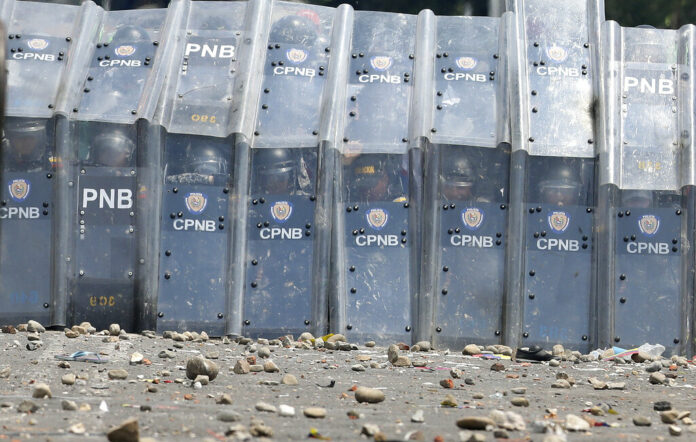
Officers of the Venezuela's Bolivarian National Police take cover behind their shields from a shower of rocks as they block the Simon Bolivar International Bridge on Saturday in La Parada near Cucuta, Colombia. Photo: Fernando Vergara / Associated Press

CUCUTA, Colombia — A U.S.-backed drive to deliver foreign aid to Venezuela met strong resistance as troops loyal to President Nicolas Maduro blocked the convoys at the border and fired tear gas on protesters in clashes that left two people dead and some 300 injured.

As night fell Saturday, opposition leader Juan Guaido refrained from asking supporters to continue risking their lives trying to break through the government’s barricades at the Colombian and Brazilian borders. Instead, he said he would meet U.S. Vice President Mike Pence on Monday in Bogota at an emergency meeting of mostly conservative Latin American governments to discuss Venezuela’s crisis.

But he did make one last appeal to troops to let the aid in and urged the international community to keep “all options open” in the fight to oust Maduro given Saturday’s violence.

“How many of you national guardsmen have a sick mother? How many have kids in school without food,” he said, standing alongside a warehouse in the Colombian city of Cucuta where 600 tons of mostly U.S.-supplied boxes of food and medicine have been stockpiled. “You don’t owe any obedience to a sadist…who celebrates the denial of humanitarian aid the country needs.”

Earlier, Maduro, who considers the aid part of a coup plot and has refused to let it in, struck a defiant tone, breaking diplomatic relations with Colombia, accusing its “fascist” government of serving as a staging ground for a U.S.-led effort to oust him from power and possibly a military invasion.

“My patience has run out,” Maduro said, speaking at a rally of red-shirted supporters in Caracas and giving Colombian diplomats 24 hours to leave the country.

Throughout the turbulent day Saturday, as police and protesters squared off on two bridges connecting Venezuela to Colombia, Guaido made repeated calls for the military to join him in the fight against Maduro’s “dictatorship.” Colombian authorities said more than 60 soldiers answered his call, deserting their posts in often-gripping fashion, though most were lower in rank and didn’t appear to dent the higher command’s continued loyalty to Maduro’s socialist government.

In one dramatic high point, a group of activists led by exiled lawmakers managed to escort three flatbed trucks of aid past the halfway point into Venezuela when they were repelled by security forces. In a flash the cargo caught fire, with some eyewitnesses claiming the National Guardsmen doused a tarp covering the boxes with gas before setting it on fire. As a black cloud rose above, the activists — protecting their faces from the fumes with vinegar-soaked cloths — unloaded the boxes by hand in a human chain stretching back to the Colombian side of the bridge.

“They burned the aid and fired on their own people,” said 39-year-old David Hernandez, who was hit in the forehead with a tear gas canister that left a bloody wound and growing welt. “That’s the definition of dictatorship.”

For weeks, U.S. President Donald Trump’s administration and its regional allies have been amassing emergency food and medical supplies on three of Venezuela’s borders with the aim of launching a “humanitarian avalanche.” It comes exactly one month after Guaido, in a direct challenge to Maduro’s rule, declared himself interim president at an outdoor rally.

Even as the 35-year-old lawmaker has won the backing of more than 50 governments around the world, he’s so far been unable to cause a major rift inside the military — Maduro’s last-remaining plank of support in a country ravaged by hyperinflation and widespread shortages.

Late Saturday, U.S. Secretary of State Mike Pompeo called on Venezuelan security forces to “do the right thing” by allowing humanitarian assistance into the country.

The clashes started well before Guaido straddled a semi-truck and waved to supporters in a ceremonial send-off of the aid convoy from Cucuta. In the Venezuelan border town of Urena, residents began removing yellow metal barricades and barbed wire blocking the Santander bridge. Some were masked youth who threw rocks and later commandeered a city bus and set it afire.

“We’re tired. There’s no work, nothing,” Andreina Montanez, 31, said as she sat on a curb recovering from the sting of tear gas used to disperse the crowd.

The single mom said she lost her job as a seamstress in December and had to console her 10-year-old daughter’s fears that she would be left orphaned when she decided to join Saturday’s protest.

“I told her I had to go out on the streets because there’s no bread,” she said. “But still, these soldiers are scary. It’s like they’re hunting us.”

At the Simon Bolivar bridge, a group of aid volunteers in blue vests calmly walked up to a police line and shook officers’ hands, appealing for them to join their fight.

But the goodwill was fleeting and a few hours later the volunteers were driven back with tear gas, triggering a stampede.

At least 60 members of security forces, most of them lower-ranked soldiers, deserted and took refuge inside Colombia, according to migration officials. One was a National Guard major. Colombian officials said 285 people were injured, most left with wounds caused by tear gas and metal pellets that Venezuelan security forces fired.

A video provided by Colombian authorities shows three soldiers at the Simon Bolivar bridge wading through a crowd with their assault rifles and pistols held above their heads in a sign of surrender. The young soldiers were then ordered to lie face down on the ground as migration officials urged angry onlookers to keep a safe distance.

“I’ve spent days thinking about this,” said one of the soldiers, whose identity was not immediately known. He called on his comrades to join him: “There is a lot of discontent inside the forces, but also lots of fear.”

Guaido, who has offered amnesty to soldiers who join the opposition’s fight, applauded their bravery, saying it was a sign that support for Maduro was crumbling. Later, he greeted five of the military members, who in turn offered a salute, calling the opposition leader Venezuela’s “constitutional president” and their commander in chief.

“They aren’t deserters,” Guaido said. “They’ve decided to put themselves on the side of the people and the constitution. … The arrival of liberty and democracy to Venezuela can’t be detained.”

Analysts warn that there may be no clear victor and humanitarian groups have criticized the opposition as using the aid as a political weapon.

“Today marked a further blow to the Maduro regime, but perhaps not the final blow that Guaido, the U.S. and Colombia were hoping for,” said Michael Shifter, president of the Inter-American Dialogue in Washington. “Threats and ultimatums from Washington directed to the generals may not be the best way to get them to flip. In fact, they are likely to have the opposite effect.”

International leaders including U.N. Secretary-General Antonio Guterres are appealing for the sides to avoid violence. But at least two people were killed and another 21 injured in the town of Santa Elena de Uairen, near the border with Brazil, according to local health officials.

Amid the sometimes-chaotic and hard-to-verify flow of information, opposition lawmakers and Guaido said the first shipment of humanitarian aid had crossed into Venezuela from Brazil — although reports from the ground revealed that two trucks carrying the aid had only inched up to the border itself.

Late Saturday, Guaido tweeted that the day’s events had obliged him to “propose in a formal manner to the international community that we keep all options open to liberate this country which struggles and will keep on struggling.”

Story: Christine Armario, Luis Andres Henao

Advertisement

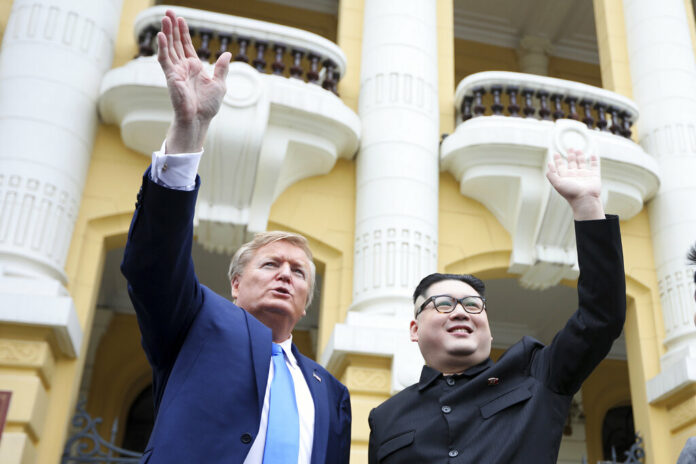
Kim, Trump Impersonators Draw Ire of Vietnam Authorities

U.S. President Donald Trump impersonator Russell White, at left, and Kim Jong-un impersonator Howard X pose for photos Friday outside the Opera House in Hanoi. Photo: Minh Hoang / Associated Press

HANOI — Vietnamese authorities are not amused by the antics of two impersonators of North Korean leader Kim Jong Un and President Donald Trump.

The duo has been making rounds of Hanoi, taking pictures with curious onlookers ahead of the second summit of the two leaders next week.

However, on late Friday, a Kim lookalike, the Hong Kong-based impersonator who uses the name Howard X, posted on Facebook that about 15 police or immigration officers demanded a mandatory “interview” with them following a talk they gave at the state-run VTC station.

“They then said that this was a very sensitive time in the city due to the Trump/Kim summit and that our impersonation was causing a ‘disturbance’ and … suggested that we do not do the impersonation in public for the duration of our stay as these presidents have many enemies and that it was for our own safety.”

According to Howard X, there was a back-and-forth with an unnamed Vietnamese officer who “did not seem pleased with my answer” and threatened the impersonators with deportation, saying they were breaking immigration rules. Finally, he said they were driven back to their hotel and told to stay put until authorities decide how to treat them.

“Although I am not surprised that I got detained for doing my impersonation in Vietnam, it’s still pretty annoying. What it shows is that Vietnam has a long way to go before they will be a developed country and I wonder if they ever will under these conditions,” he wrote on his Facebook page. “If the Vietnamese authorities are willing to give this kind of harassment over something as trivial as an impersonation to a high profile foreigner, imagine what all the Vietnamese artists, musicians, film producers and all the political activists have to endure for simply wanting to release a controversial film, songs or for simply speaking up about real injustices in this country.”

Vietnam is a tightly controlled communist country that tolerates no dissent.

Howard X was also questioned by Singaporean immigration authorities when he and his colleague appeared in the city-state for the first Kim-Trump summit last June.

The impersonator’s real name is Lee Howard Ho Wun.

Advertisement

Opinion: Anti-Communist Song Belongs in Thailand’s Past, Period

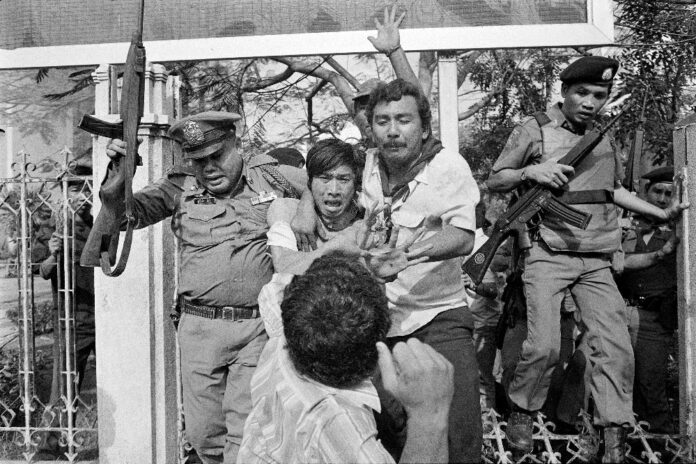
A man raises his fist to punch a captured student activist during a police crackdown at Thammasat University on Oct. 6, 1976. Witnesses said 'Scum of the Earth' was played during the massacre.

Re•tention: Pravit RojanaphrukIndoctrination isn’t what it used to be, not when competition for people’s ears and eyes has become so intense.

Army chief Gen. Apirat Kongsompong must have reached that disappointed conclusion after ordering 160 army radio stations to play Cold War-era propaganda songs in response to the mere suggestion by PM candidate Sudarat Keyuraphan that military spending would be cut 10 percent under a Pheu Thai Party government.

The hawkish army chief’s quick-draw response Monday was to suggest she listen to anti-Communist song “Nuk Paen Din.” The song, best translated as “Scum of the Earth,” was drilled into people’s heads by state and army radio in the latter half of the 1970s, toward the end of the communist insurgency which ceased in 1980 with a general amnesty granted to the weakened and divided rebels.

Today, communist China, Vietnam and Laos are good friends of Thailand, Chinese tourists are the largest group of tourists to Thailand and anti-communist laws were abolished two decades ago.

Yet Apirat thought it would be a brilliant idea to order all 160 army radios to air the song on a daily basis. His decision didn’t last beyond Monday. In fact it was rescinded within an hour or two.

Perhaps he realized how ineffective and futile such an attempt was. Perhaps the strong and immediate backlash on social media changed his mind very speedily.

No matter the reason behind the very quick U-turn, what took place earlier this week was a symbolic clash between a post-modern society and a dictatorial, militarized mentality.

As a number of people have noted on social media, even if the order persisted, it would have been very hard to grab the ears and eyes of the public, particularly the younger generation, which no longer sits passively to watch television or listen to radio.

Many stream it on demand, whether via Netflix or Spotify. They spend more time watching viral videos or reading Facebook posts from online friends and social media influencers on Twitter than passively waiting for the army to indoctrinate them through repeated airing of archaic propaganda songs.

Apirat’s boss learned it the hard way. Prayuth Chan-ocha’s Friday-evening TV monologues are far less than popular (and that’s an understatement), and even the junta leader himself has lamented more than once that his “show” is not getting due attention.

Basically, you can’t force people with one-way propaganda messages any longer, particularly listeners and viewers who don’t want to listen or watch. It’s simply crude and ineffective.

The clash between the two worlds will continue, and it will definitely take more than a crude attempt at indoctrination to win the hearts and minds of Thai people, particularly the younger people who likely have never heard such songs hatefully suggesting those who disagree with the state are enemies of the nation.

Despite Thailand being subjected to nearly five years of military rule since, Thai society remains pluralistic and challenges to military rule in the form of competing narratives, criticism, mockery, satire and just ignoring the army generals have thrived.

It’s simply not possible for the junta leader and his generals to drag Thailand back into the past to instill an obsolete Cold War mentality in people. Any further attempts are likely to be met not just with resistance, but ridicule and disdain, if not laughter.

Advertisement

From Bombers to Big Macs: Vietnam a Lesson in Reconciliation

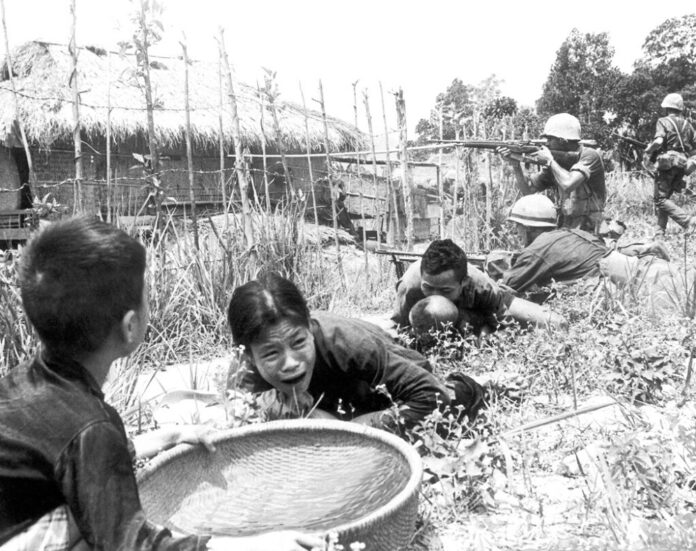
FILE - In this April 1965 under sniper fire, Vietnamese civilians duck for safety as U.S. Marines storm the village of My Son, near Da Nang in Vietnam searching for Viet Cong insurgents. Photo: Eddie Adams / Associated Press

HANOI — The Vietnamese capital once trembled as waves of American bombers unleashed their payloads, but when Kim Jong Un arrives here for his summit with President Donald Trump he won’t find rancor toward a former enemy. Instead the North Korean leader will get a glimpse at the potential rewards of reconciliation.

By the time the Vietnam War ended in 1975, tens of thousands of tons of explosives had been dropped on Hanoi and nearly two decades of fighting had killed 3 million Vietnamese and more than 58,000 Americans. Vietnam, though victorious, lay devastated by American firepower, with cities in ruins and fields and forests soaked in toxic herbicides and littered with unexploded ordnance.

Despite the conflict’s savagery, what followed was a remarkable rapprochement between wartime foes and it took merely 20 years to restore full relations.

Now some hope Vietnam will offer Kim a road map for his own detente with the United States and that the formerly besieged capital city will be the site of a dramatic resolution to one of the last remaining Cold War conflicts.

While North Korea remains America’s sworn enemy 65 years after the Korean War fighting ceased, Vietnam today stands as a burgeoning partner which even buys lethal U.S. weaponry. Bilateral trade has soared by 8,000 percent over the last two decades and billions of dollars in American investment flows into one of the world’s best performing economies.

And while North Koreans are still taught to loathe Americans by their country’s propaganda machine, in Vietnam there is little animosity.

“I was born after the war and only hear war stories from American films or books,” said Dinh Thanh Huyen, a 19-year-old university student who was waiting in line at a crowded McDonald’s in Hanoi. She said she was happy the former enemies have moved on. “History is for us to learn from, not to hold grudges.”

Kim could take note of the history of win-win rapprochement and how Vietnam’s communist leaders have allowed a capitalistic economy and an open door to the U.S. and other outsiders, all while not sacrificing their tight grip on power. Or he could allow it all to pass him by as he narrows his focus for the Feb. 27-28 summit on tit-for-tat bargaining over nuclear arms and economic sanctions.

U.S. Secretary of State Mike Pompeo spoke in Hanoi last year about “the once-unimaginable prosperity and partnership” the U.S. has come to enjoy with Vietnam and noted Vietnam was able maintain its form of government.

“I have a message for Chairman Kim Jong Un: President Trump believes your country can replicate this path. It’s yours to seize the moment,” he said. “This can be your miracle in North Korea as well.”

To be sure, Vietnam remains a one-party state with a poor human rights record where even moderate critics and dissenters are frequently jailed.

Since the first Trump-Kim summit last June in Singapore, a few small steps have already been taken along a timeline forged by the U.S.-Vietnamese thaw, including Pyongyang turning over remains of U.S. servicemen killed in the Korean War, the first such hand-over in more than a decade.


It was the same missing in action issue that heralded U.S.-Vietnamese reconciliation, with the repatriation of American war dead creating an environment for improvement in relations in other areas.

Next came step-by-step lifting of economic sanctions, as Washington encouraged Vietnam’s so-called “doi moi” reform, initiatives launched in 1986 to shed a state-run economy in favor of a market-oriented one open to foreigners.

North Korea has already shown interest in Vietnam’s reforms, sending students and official delegations who returned home with favorable reports. Having enjoyed close relations with North Korea since 1950, Vietnam could be the ideal go-between in nudging Pyongyang to re-engineer its disastrous economy and turn foes to friends.

“Vietnam’s model of development ‘doi moi’ is an important factor in the United States’ larger strategy of drawing North Korea out of its self-imposed isolation as part of the larger process of denuclearizing,” said Carlyle Thayer, a political scientist at The University of New South Wales.

But Thayer and other experts share strong reservations about how much of the U.S.-Vietnamese “miracle” can be duplicated. There are stark differences in the way the North Korea responded once the fighting stopped.

The North slammed shut its doors and slid into a Cold War bunker — and it remains one of the world’s most isolated nations. Vietnam, however, chose to put behind its tragic past and move forward.

Not long after the war, American journalists and official U.S. delegations were allowed entry to a poor, shabby Hanoi, its lovely French colonial buildings moldering from neglect. The only clothes many men had were the baggy green uniforms and pith helmets of the North Vietnamese army. Suspicion was palpable and Westerners, including journalists, were assigned minders to keep tabs on them.

Expecting a hostile reception, the Americans were stunned at the lack of animosity displayed by the average Vietnamese, even those who had lost loved ones to U.S. bombs. Returning American veterans were often signaled out for especially warm welcomes, sometimes tearfully embracing their onetime battlefield enemies while exchanging stories of suffering.

Making such scenes possible were a set of special circumstances. Some were geo-political: Vietnam badly needed a counter-balance that the U.S. could provide to its perennial enemy — neighboring China.

This has taken on special urgency in recent years as Beijing moves aggressively to claim large swaths of the South China Sea. Telling are the exchanges between the U.S. and Vietnamese coast guards and the provision of U.S. patrol boats. Last year the USS Carl Vinson, an American aircraft carrier, made a historic port call in Vietnam, the first of its kind since the war ended.

Vietnam also no longer faced a threat from the United States, whereas North Korea perceives that it does, making abandonment of its nuclear program difficult, perhaps even in exchange for the lifting of economic sanctions.

But an underlying human element was also at work.

“During the Vietnam War Hanoi always drew a distinction between the peace-loving American people and the imperialist American government,” Thayer said. “There was a basis for future reconciliation.”

The face-to-face encounters that followed, serving to ease mutual hostility, never occurred with North Korea. Instead, generations of North Korean children sat in classrooms looking at posters of Americans portrayed as big nosed goblins. A massive anti-American rally loomed large on the annual calendar.

“The Vietnamese saw over the years of our war that many American people and veterans spoke out against the war,” said Bob Mulholland, a prominent Vietnam combat veteran.

And there were powerful advocates of reconciliation, including Sens. John Kerry and the recently deceased John McCain as well as other veterans who quietly returned to Vietnam to help the shattered country.

Although the Vietnam War has begun to fade from the collective memory in both countries, it is not the “forgotten war” that the Korean conflict has long been known as. With peace and greater prosperity have come fresh connections forged by a younger generation.

Near the McDonald’s in Hanoi’s old quarter, not far from a Starbucks, the area is closed to traffic each weekend and entertainers, including American buskers, take to streets now strung with U.S. and North Korean flags. Vietnamese youth can be seen mingling with young American travelers.

Just a short stroll away, tourist Brian Walker was taking in Hanoi’s Military War Museum, fronted by the wreckage of an American B-52 shot down while bombing the city.

“For many Americans, it may be a country of a bloody war that we took part in,” said 28-year-old social worker from New York City. “But coming here, all I see is people with big smiles, good food and a beautiful landscape.”

Story: Denis D. Gray and Hua Dinh

Advertisement

‘Empire’ Producers Cut Smollett From Season’s Last Episodes

This image released by Fox shows Jussie Smollett, left, and Terrence Howard in a scene from the "The Depth of Grief" episode of "Empire." Photo: Chuck Hodes / Fox via AP

CHICAGO — Actor Jussie Smollett’s character on “Empire” will be removed from the final two episodes of this season in the wake of his arrest on charges that he staged a racist, anti-gay attack on himself last month in downtown Chicago, producers of the Fox TV show announced Friday.

The announcement came a day after Smollett turned himself in to police, appeared in court on a felony charge of disorderly conduct for allegedly filing a false police report, and left jail after posting bond.

“While these allegations are very disturbing, we are placing our trust in the legal system as the process plays,” ”Empire” executive producers Lee Daniels, Danny Strong, Brett Mahoney, Brian Grazer, Sanaa Hamri, Francie Calfo and Dennis Hammer said in a written statement. “We are also aware of the effects of this process on the cast and crew members who work on our show and to avoid further disruption on set, we have decided to remove the role of ‘Jamal’ from the final two episodes of the season.”

The series is on a midseason break and returns March 13 with nine episodes. The last two episodes of the fifth season were still being made when Smollett was charged. At this point, Smollett is part of the seven already completed episodes.

Smollett, who is black and gay, plays a gay character on the show that follows a black family as they navigate the ups and downs of the recording industry.

Police said Smollett planned the hoax because he was unhappy with his salary and wanted to promote his career. Before the attack, he also sent a letter that threatened him to the Chicago studio where “Empire” is shot, police said.

As authorities laid out their case against Smollett, the narrative that emerged Thursday sounded like that of a filmmaker who wrote, cast, directed and starred in a short movie.

Prosecutors said Smollett gave detailed instructions to the accomplices who helped him stage the attack in January, including telling them specific slurs to yell, urging them to shout “MAGA country” and even pointing out a surveillance camera that he thought would record the beating.

“I believe Mr. Smollett wanted it on camera,” police Superintendent Eddie Johnson told reporters at a Thursday morning news conference. “But unfortunately that particular camera wasn’t pointed in that direction.”

Smollett’s legal team issued a statement Thursday night, calling the actor a “man of impeccable character and integrity who fiercely and solemnly maintains his innocence.” The statement called Johnson’s news conference “an organized law enforcement spectacle.”

“The presumption of innocence, a bedrock in the search for justice, was trampled upon at the expense of Mr. Smollett,” the statement read.

Smollett is earning more than $100,000 per episode, according to a person familiar with the situation. The person spoke on condition of anonymity because salary details were involved. The studio declined to comment on the actor’s salary.

As is customary with a successful TV series, regular cast members on “Empire” received a boost in pay as part of contract extensions that followed the drama’s renewal for a second season, the person said.

Smollett is counted among the series regulars.

Advertisement

R. Kelly Arrested, Charged in Chicago With Sexual Abuse

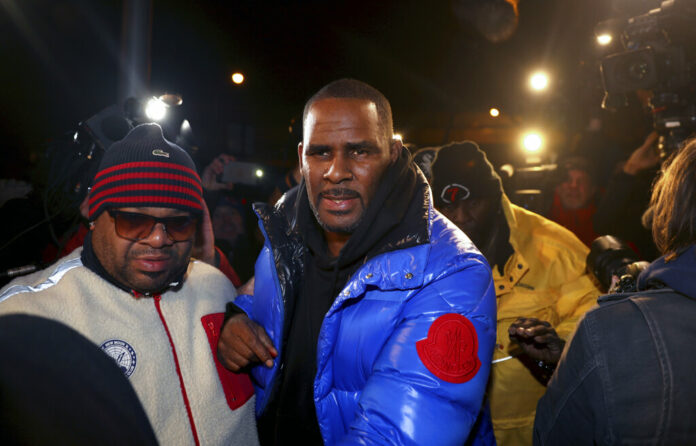
R. Kelly turns himself in at 1st District police headquarters in Chicago on Friday night. Photo: Chris Sweda / Chicago Tribune via AP

CHICAGO — R. Kelly, the R&B star who has been trailed for decades by allegations that he violated underage girls and women and held some as virtual slaves, was charged Friday with aggravated sexual abuse involving four victims, including at least three between the ages of 13 and 17.

In a brief appearance before reporters, Cook County State’s Attorney Kim Foxx announced the 10 counts against the 52-year-old Grammy winner, whose real name is Robert Kelly. She said the abuse dated back as far as 1998 and spanned more than a decade. She did not comment on the charges or take questions.

Kelly was driven to a Chicago police station in a dark colored van with heavily tinted rear windows around 8:15 p.m. Friday. He did not respond to questions from gathered reporters as he walked inside the building.

Police spokesman Anthony Guglielmi tweeted a short time later that Kelly was under arrest. He was expected to be held overnight before an appearance Saturday in bond court.

Kelly’s attorney, Steve Greenberg, told reporters following the singer’s arrest that one of the charges he faces appears to be tied to a decade-old child pornography case.

“Double jeopardy should bar that case,” Greenberg said. “He won that case.”

Kelly, who was acquitted of child pornography charges in 2008, has consistently denied any sexual misconduct.

Greenberg said he thinks prosecutors rushed to judgment Friday in charging Kelly, calling the singer “an innocent man.”

“Mr. Kelly is strong,” Greenberg added. “He’s got a lot of support and he’s going to be vindicated on all these charges.”

The arrest sets the stage for another #MeToo-era celebrity trial. Bill Cosby went to prison last year, and former Hollywood studio boss Harvey Weinstein is awaiting trial.

Best known for hits such as “I Believe I Can Fly,” Kelly was charged a week after Michael Avenatti, the attorney whose clients have included porn star Stormy Daniels, said he gave prosecutors new video evidence of the singer with an underage girl.

At a news conference earlier Friday in Chicago, Avenatti said a 14-year-old girl seen with R. Kelly on the video is among four victims mentioned in the indictment. He said the footage shows two separate scenes on two separate days at Kelly’s residence in the late 1990s.

During the video, both the victim and Kelly refer to her age 10 times, he said.

Avenatti said he represents six clients, including two victims, two parents and two people he describes as “knowing R. Kelly and being within his inner circle for the better part of 25 years.”

“I don’t know what the tape is,” Greenberg said of the video Avenatti gave prosecutors. “We haven’t seen it. No one’s showed us the tape.”

The new charges marked “a watershed moment,” Avenatti said, adding that he believes more than 10 other people associated with Kelly should be charged as “enablers” for helping with the assaults, transporting minors and covering up evidence.

The video surfaced during a 10-month investigation by Avenatti’s office. He told the AP that the person who provided the VHS tape knew both Kelly and the female in the video.

The jury in 2008 acquitted Kelly of child pornography charges that arose from a graphic video that prosecutors said showed him having sex with a girl as young as 13. He and the young woman allegedly seen with him denied they were in the 27-minute video, even though the picture quality was good and witnesses testified it was them, and she did not take the stand. Kelly could have gotten 15 years in prison.

Charging Kelly now for actions that occurred in the same time frame as the allegations from the 2008 trial suggests the accusers are cooperating this time and willing to testify.

Because the alleged victim 10 years ago denied that she was on the video and did not testify, the state’s attorney office had little recourse except to charge the lesser offense under Illinois law, child pornography, which required a lower standard of evidence.

Each count of the new charges carries up to seven years in prison. If Kelly is convicted on all 10 counts, a judge could decide that the sentences run one after the other — making it possible for him to receive up to 70 years behind bars. Probation is also an option under the statute.

Greenberg said he offered to sit down with prosecutors before charges were filed to discuss why the allegations were “baseless.” But they refused, he said.

“Unfortunately, they have succumbed to the court of public opinion, who’ve convicted him,” he said.

Legally and professionally, the walls began closing in on Kelly after the release of a BBC documentary about him last year and the multipart Lifetime documentary “Surviving R. Kelly,” which aired last month. Together they detailed allegations he was holding women against their will and running a “sex cult.”

#MeToo activists and a social media movement using the hashtag #MuteRKelly called on streaming services to drop Kelly’s music and promoters not to book any more concerts. Protesters demonstrated outside Kelly’s Chicago studio.

As recently as Thursday, two women held a news conference in New York to describe how Kelly picked them out of a crowd at a Baltimore after-party in the mid-1990s when they were underage. They said Kelly had sex with one of the teens when she was under the influence of marijuana and alcohol and could not consent.

Latresa Scaff and Rochelle Washington were joined by lawyer Gloria Allred when they told their story publicly for the first time.

In the indictment, the prosecution addressed the question of the statute of limitations, saying that even abuse that happened more than two decades ago falls within the charging window allowed under Illinois law. Victims typically have 20 years to report abuse, beginning when they turn 18.

The singer and songwriter, whose legal name is Robert Kelly, rose from poverty on Chicago’s South Side and has retained a sizable following. He has written numerous hits for himself and other artists, including Celine Dion, Michael Jackson and Lady Gaga. His collaborators have included Jay-Z and Usher.

Kelly broke into the R&B scene in 1993 with his first solo album, “12 Play,” which produced such popular sex-themed songs as “Bump N’ Grind” and “Your Body’s Callin’.”

Months after those successes, the then-27-year-old Kelly faced allegations he married 15-year-old Aaliyah, the R&B star who later died in a plane crash in the Bahamas. Kelly was the lead songwriter and producer of Aaliyah’s 1994 debut album.

Kelly and Aaliyah never confirmed the marriage, though Vibe magazine published a copy of the purported marriage license. Court documents later obtained by the Chicago Sun-Times showed Aaliyah admitted lying about her age on the license.

Jim DeRogatis, a longtime music critic for the Chicago Sun-Times, played a key role in drawing the attention of law enforcement to Kelly. In 2002, he received the sex tape in the mail that was central to Kelly’s 2008 trial. He turned it over to prosecutors. In 2017, DeRogatis wrote a story for BuzzFeed about the allegations Kelly was holding women against their will in Georgia.

Advertisement

Vote Voodoo: Magic Flows Through Thai Election Rituals

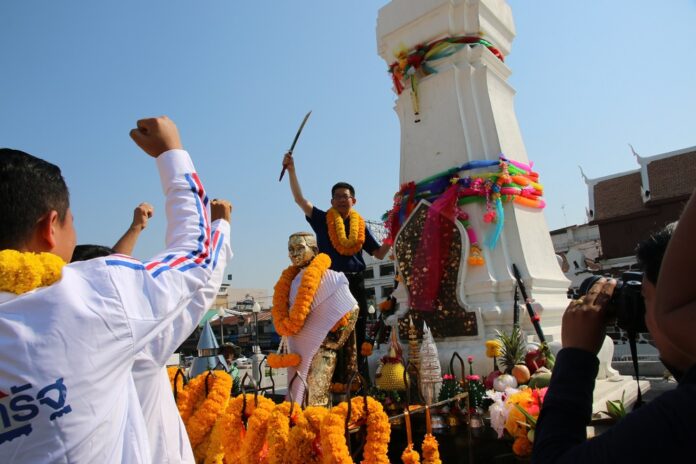
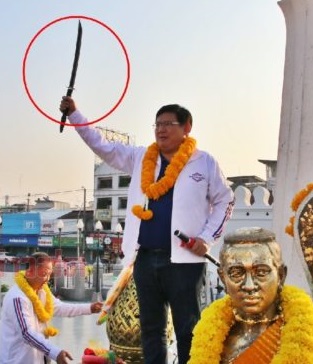
An MP candidate for Phalang Pracharat Party draws sword at a shrine in Korat on Thursday for good luck.

Above: An MP candidate for Phalang Pracharat Party draws sword at a shrine in Korat on Thursday for good luck.

BANGKOK — Critics already fume that junta chairman Prayuth Chan-ocha holds an unfair edge going into Election Day, from the 250 senators in hand and a publicly funded campaign to a little thing called absolute power.

Now he seems to have found even more assistance – a supernatural cosmic entity.

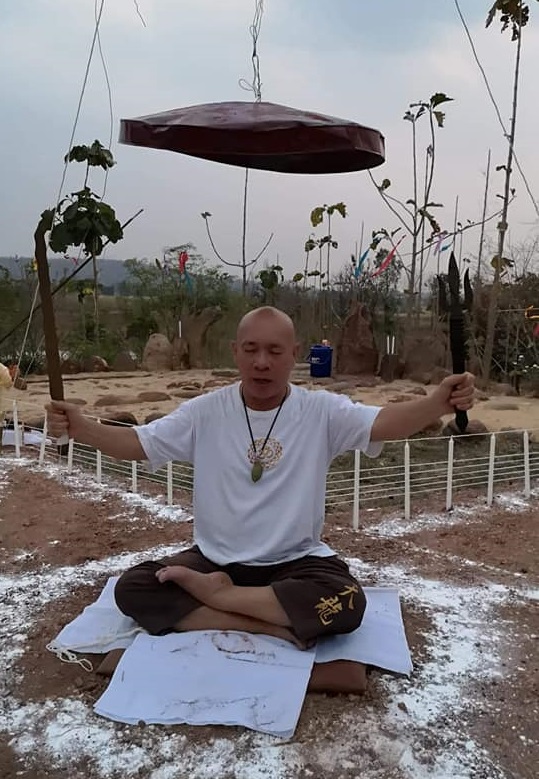
In a viral Facebook post that baffled many netizens, a former Thammasat University professor said he meditated and successfully tamed the “sacred power from the above” earlier this month. His wish for the higher power? That Prayuth get to serve another term as prime minister.

52582521 2035337923170005 3987767337792045056 n
Image: Suvinai Pornavalai / Facebook

“My first wish during the ritual for this country is I wish Gen. Prayuth Chan-ocha will continue to be prime minister, for the sake of peace in the country,” Suvinai Pornavalai, who taught political economy until his retirement in 2016, wrote Thursday.

As proof, he posted a photo of himself meditating cross-legged under what appears to be the lid cover for a lotus basin at a “dragon god shrine” in Chaiyaphum province.

Although Suvinai’s ceremony is an extreme example, politicians of nearly all stripes have called on the supernatural for luck on the road to March 24. Like all things Thai, politics and superstition have been entwined for as long as any remember.

Even the most iconic feature of electioneering – bright yellow marigolds worn as garlands by every MP hopeful – have a superstitious root. Thais believe the flower will bring fame because its Thai name daoruang sounds like the word roongruang, meaning glory and prosperity.

เทวัญลุยเขต3สุราษฎร์ ๑๙๐๒๒๒ 0013
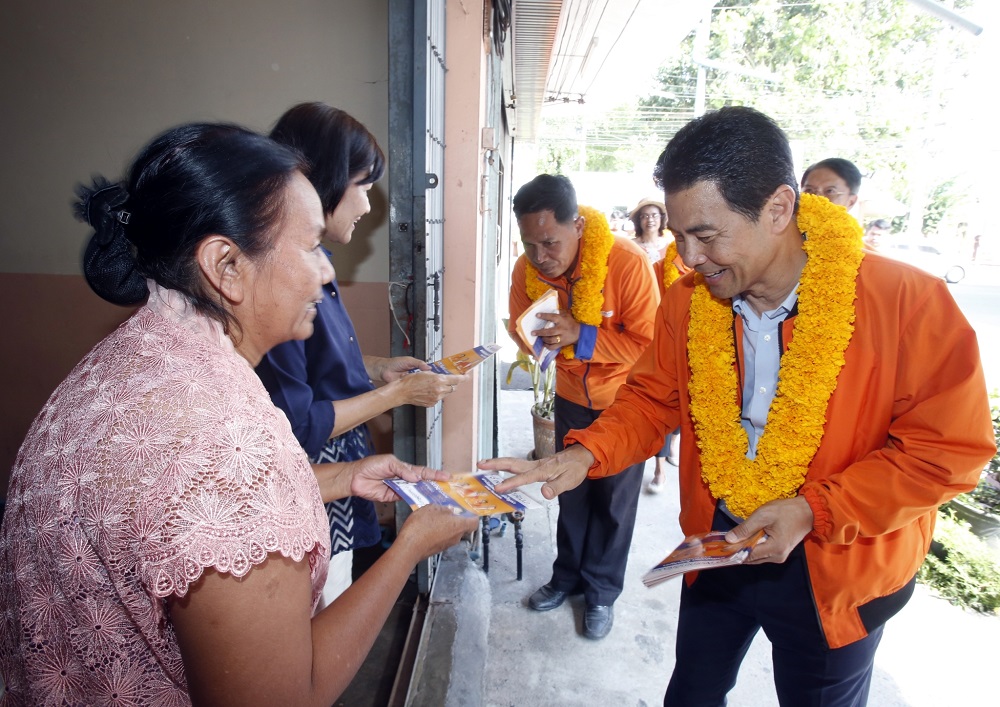
Wearing a marigold garland, an MP candidate for Chart Pattana Party canvasses for votes in Surat Thani.

The first step in the long road to the poll usually starts with calling for divine protection. Before they registered with the Election Commission, every major party, from Democrat to Pheu Thai, stopped by to pray at Bangkok’s City Pillar shrine for an auspicious beginning.

In fact, so many parties frequented the venue that two major rivals collided. Pheu Thai’s Sudarat Keyuraphan and Phalang Pracharat chairman Uttama Savanayana exchanged smiles and greetings there Feb. 4.

“Let’s compete in the game together,” Sudarat told Uttama at the shrine.

As the first building constructed in the capital over 200 years ago, the City Pillar is believed to hold special powers. Bangkok’s pillar also has a malevolent reputation due to the tale of a “curse” placed on the city’s fate there.

Read: The Curse That Haunted Bangkok 150 Years – Until Now?

But Bangkok’s divine aegis probably doesn’t extend outside its urban domain, which is why political parties pray at City Pillar shrines in other provinces when campaigning there. Some have special meaning for the parties.

For instance, the Democrats – whose strongest base is in the south – made offerings at Surat Thani’s 150-year-old city pillar shrine. Chart Thai Pattana Party also had its own ceremony at a shrine dedicated to King Naresuan’s victory over Burmese invaders in Suphanburi. The province is home of the late party founder Banharn Silpa-archa.

DemChiangMai27Jan
Image: Abhisit Vejjajiva / Facebook

Then of course there’s the Lady Suranaree statue in Korat’s city center – the gateway to the northeastern heartland. All parties stopping by have prayed there for luck, including even avowed secularist Thanathorn Juangroongruangkit, leader of Future Forward Party.

The pro-junta Phalang Pracharat Party had perhaps the most elaborate ceremony at the statue. Its MP candidates drew mock swords and shouted “Ya Mo, to war!” Ya Mo is a local nickname given to the lady, who reportedly led an attack on Laotian raiders in the old days.

However, one of the party candidates turned the ritual into a bad mojo. Former tech minister Suwit Maesincee was widely ridiculed on social media for drawing the sword with the blade inward, which Thai beliefs indicate a bad luck.

And while no party would admit it publicly, it’s an open secret major political parties consult their own astrologers.Some of these electorally savvy soothsayers have even publicized their predictions.

IMG 5931
Former IT minister Suwit Maesincee draws a sword at the wrong side.

Famed astrologer Warin Buawiratlert, who often appeared in ceremonies held by military generals, made clear where he stood recently:

“According to my reading of his fortune, it’s the same. It’s still duty of Gen. Prayuth. He will continue to do his duty. His duty is not yet over,” Warin said when a reporter asked whether he thought Prayuth would serve another term.

Others, like fortune teller Fongsanan Chamornchan, are more subtle. She prophesied that the next prime minister will be someone who’s previously held the job or another “important office” in the country, a criterion most candidates would meet.

Two well-known astrologers have also predicted possible “chaos” and “violence” breaking out after the poll, doubtless based on “reading” the minds of many Thais afraid of what uncertainty may follow.

Related stories: 

Red Lanterns Not Hung to Fix Junta Bad Luck: Govt

Dread Grips Nation as Uranus Enters Astrologically Perilous Position

Advertisement

Amid Loss of Leaders, Unknown Militant Rises in Philippines

This photo provided by Philippine National Police (PNP), shows militant Abu Sayyaf Group leader Hatib Hajan Sawadjaan in the PNP confidential report. Photo: Associated Press

MANILA, Philippines — Unlike many of his slain comrades, the touted new leader of the Islamic State group in the southern Philippines lacks the bravado, clan name or foreign training.

Not much is known about Hatib Hajan Sawadjaan, but the attacks attributed to him heralding his rise are distinctly savage: A deadly bombing, which authorities say was a suicide attack by a foreign militant couple, blasted through a packed Roman Catholic cathedral in the middle of a Mass.

The Jan. 27 attack, which killed 23 people and wounded about 100 others on southern Jolo Island, and another suspected suicide bombing on nearby Basilan Island last July that officials said he masterminded, put Sawadjaan in the crosshairs of the U.S.-led global campaign against extremism. It also comes at a time when the Islamic State group’s last enclave in eastern Syria is near its imminent downfall, signaling an end to the territorial rule of the self-declared “caliphate” that once stretched across much of Syria and Iraq.

A recent U.S. Department of Defense report to Congress said without elaborating that it believed Sawadjaan was the “acting emir,” or leader, in the Philippines of the Islamic State group, also known by its acronym ISIS. It added that no actual leader is confirmed to have been designated by the main ISIS command in the Middle East as of late last year.

Philippine Interior Secretary Eduardo Ano, however, said intelligence indicated that Sawadjaan, a Jolo-based commander of the brutal Abu Sayyaf extremist group, was installed as ISIS chief in a ceremony last year. Three other extremist groups were recognized as ISIS allies, he said.

Founded in the early 1990s as an offshoot of the decadeslong Muslim separatist rebellion in the south, the Abu Sayyaf lost its commanders early in battle, sending it to a violent path of extremism and criminality. It has been blacklisted, along with ISIS-linked local groups, as a extremist organization by the United States.

Now in his 60s, Sawadjaan is a late bloomer in the extremist underworld.

His turn at the helm came after dozens of commanders, some initially aligned with the al-Qaida movement and later with ISIS, were killed or captured in decades of military offensives. The biggest battle loss came in 2017 when several foreign and local commanders were killed as troops quelled a five-month siege by hundreds of militants in southern Marawi city.

Among those killed was Isnilon Hapilon, a fierce Abu Sayyaf leader, who was the first ISIS-designated leader in the Philippines.

“I think Sawadjaan rose in rank because of seniority and there were no other leaders left. Almost everyone had been wiped out,” said Ano, a former military chief who oversaw the Marawi offensives and now supervises the national police as interior secretary.

Largely confined to Jolo’s poverty-wracked mountain settlements all his life, Sawadjaan was not the well-connected and media-savvy strategist foreign groups would normally ally with to expand their reach. His rise shows how ISIS would latch on desperately to any militant who could provide a sanctuary and armed fighters as its last strongholds crumble in Syria, Ano said.

“For the ISIS to perpetuate their terror actions, they need a base, they need people. That’s the role of Sawadjaan,” Ano told The Associated Press in an interview. He estimated that Sawadjaan commands about 200 combatants and followers.

Sawadjaan was born to a peasant family in predominantly Muslim Jolo and only likely finished grade school. Poverty drove him to work as a lumberjack in the jungles off Patikul town, where he married a woman from Tanum, the mountain village where he would base his Abu Sayyaf faction years later, a military officer, who has closely monitored the Abu Sayyaf, told the AP on condition of anonymity because of the nature of his work.

As an elderly villager, he served as a local mosque preacher, earning him the religious sobriquet “hatib,” or sermon leader in Arabic, the officer said.

Sawadjaan first took up arms as a member of the Moro National Liberation Front, the largest Muslim secessionist group in the south of the largely Roman Catholic country, which went on to sign a 1996 Muslim autonomy deal with the government, according to the officer.

His commander was Radulan Sahiron, the locally popular one-armed rebel who broke away from the MNLF in 1992. They joined the Abu Sayyaf, which had just been organized by a Libyan-educated local militant, said MNLF leader Yusop Jikiri.

Sawadjaan would later part ways with Sahiron, including over Sahiron’s refusal to accomodate foreign militants for fear they’re a magnet for military airstrikes, said Abu Jihad, a former militant who has met Sawadjaan and was captured by troops. Abu Jihad described Sawadjaan as a folksy village elderly, who constantly lugged an M-16 rifle in his hinterland community but was friendly to visitors.

When fellow militants kidnapped a visiting American Muslim convert, Jeffrey Schilling, for ransom in August 2000, Sawadjaan stayed in the background but helped gather bamboos that were used to build huts for the militants and their hostage, Abu Jihad said.

“He can discuss local issues but didn’t have any wisdom on jihad,” he told AP by phone, referring to the militants’ concept of holy war. “He’s very accommodating. He’s the type who will not be hard to sway.”

Sawadjaan collaborated with diverse outlaws, both Islamic extremists and brigands, Ano said.

He harbored the foreign couple, believed by Philippine officials to be Indonesians, who detonated the bombs in the Jolo cathedral last month, as well as a militant believed to be an Arab known as Abu Kathir al-Maghribi, who died in the van blast that also killed 10 government militiamen and villagers in Basilan last year, Ano added.

A video obtained by police officials showed al-Maghribi in Sawadjaan’s camp last year before the foreign militant reportedly carried out the suicide attack in Basilan. The video was seen by The AP.

His daughter married a Malaysian militant known as Amin Baco, who has ISIS connections. His younger brother, Asman, also belonged to the Abu Sayyaf, according to a confidential police profile of Sawadjaan.

Sawadjaan and his men would later be implicated in the kidnappings of a German couple, two Canadian men, Schilling and a Jordanian journalist, Baker Atyani. Most were ransomed off or escaped but the Canadian men were separately beheaded on video by one of Sawadjaan’s militant nephews, Ben Yadah, according to military and police officials.

In the more than a year of jungle captivity under Sawadjaan’s group starting in June 2012, Atyani got a deep insight into the Abu Sayyaf and the man who sheltered other militants from Indonesia and Malaysia and fostered banditry in the blurry underworld of Islamic extremism in the volatile south. Atyani is believed to have been freed in exchange for ransom.

“It’s all money-driven, it’s not an ideology,” Atyani said. “However, he has sympathy for those who are allegedly fighting for a cause.”

Story: Jim Gomez

Advertisement

Israel Flying to Moon After SpaceX Launch

The SpaceX Falcon 9 rocket loaded with 10 Iridium NEXT communications satellites lifts off in 2017 from launch complex 40 at Space Launch Complex 4E at Vandenberg Air Force Base in California. Photo: SpaceX

CAPE CANAVERAL, Florida — An Israeli spacecraft rocketed toward the moon for the country’s first attempted lunar landing, following a launch Thursday night by SpaceX.

A communications satellite for Indonesia was the main cargo aboard the Falcon 9 rocket, which illuminated the sky as it took flight. But Israel’s privately funded lunar lander – a first not just for Israel but commercial space – generated the buzz.

Israel seeks to become only the fourth country to successfully land on the moon, after Russia, the U.S. and China. The spacecraft – called Beresheet, Hebrew for Genesis or “In The Beginning” – will take nearly two months to reach the moon.

“We thought it’s about time for a change, and we want to get little Israel all the way to the moon,” said Yonatan Winetraub, co-founder of Israel’s SpaceIL , a nonprofit organization behind the effort.

The moon, nearly full and glowing brightly, beckoned as it rose in the eastern sky. Within an hour after liftoff, Beresheet was already sending back data and had successfully deployed its landing legs, according to SpaceIL.

“We’ll keep analyzing the data, but bottom line is we entered the very exclusive group of countries that have launched a spacecraft to the moon,” said Yigal Harel, head of SpaceIL’s spacecraft program.

Prime Minister Benjamin Netanyahu was watching the launch live from the Israeli control center in Yehud, near Tel Aviv.

“This is a big step for Israel, but a giant step for Israeli technology,” he said.

The four-legged Beresheet, barely the size of a washing machine, will circle Earth in ever bigger loops until it’s captured by lunar gravity and goes into orbit around the moon. Touchdown would be April 11 at the Sea of Serenity.

NASA’s Apollo missions in the 1960s and 1970s took about three days to get astronauts to the moon, but they used monstrous Saturn V rockets. The USD$100 million Beresheet mission couldn’t afford its own rocket – even a little one – so the organizers opted for a ride share. That makes for a much longer trip; the moon right now is nearly 230,000 miles (370,000 kilometers) away.

“This is Uber-style space exploration, so we’re riding shotgun on the rocket,” Winetraub explained at a news conference on the eve of launch.

The U.S. Air Force also has a small research spacecraft aboard the rocket, for a one-year mission in orbit around Earth.

The Soviet Union was the first to put a spacecraft on the moon, Luna 2, in 1959. NASA followed with the Ranger 4 spacecraft in 1962. Last month, China became the first country to land on the far side of the moon.

Apollo 11 moonwalker Buzz Aldrin quickly offered congratulations following Thursday’s launch. So did NASA Administrator Jim Bridenstine, who called it “a historic step for all nations and commercial space as we look to extend our collaborations beyond low-Earth orbit and on to the moon.” NASA has a laser reflector aboard Beresheet and is offering its Deep Space Network for communication.

“All the best to @TeamSpaceIL as it starts its journey tonight on a @SpaceX #Falcon9 from Florida to my old stomping ground …the moon,” Aldrin tweeted.

The Beresheet mission originally was part of the Google Lunar XPrize competition and even made the final cut before the contest ended last year without a winner. The organizers decided to press ahead on their own, with donations from billionaires as well as schoolchildren.

Lunar surface operations are meant to last just two days. Beresheet will measure the magnetic field at the landing site, and send back data and pictures. A time capsule is aboard the lander – which includes a picture of Israeli astronaut Ilan Ramon, who died aboard space shuttle Columbia in 2003 – as well as a lunar library containing 30 million pages on a disk from the U.S.-based Arch Mission Foundation.

Ramon’s widow, Rona, was a big supporter of Beresheet; she died of cancer in December.

Following liftoff, SpaceX recovered the first-stage booster, which flew twice last year. The booster landed smoothly on an offshore ocean platform, after the hottest re-entry yet, according to SpaceX founder and chief executive Elon Musk. Sparks from burning metal were visible in the landing video.

Musk said the booster will fly a fourth time in April, during a launch abort test of the new crew Dragon capsule. No one will be aboard.

Story: Marcia Dunn

Advertisement

Hot News

LATEST NEWS

Bangkok
broken clouds
33.9 ° C
36.6 °
33.8 °
65 %
4.7kmh
52 %
Fri
36 °
Sat
36 °
Sun
37 °
Mon
37 °
Tue
36 °