37.8 C
Bangkok
Friday, June 26, 2026
Home Blog Page 1687

Bro Force: American and Thai Soldiers Chug Blood, Open Fire

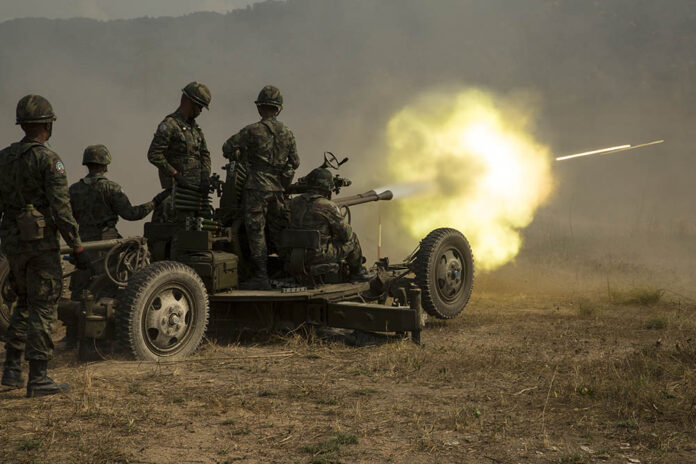
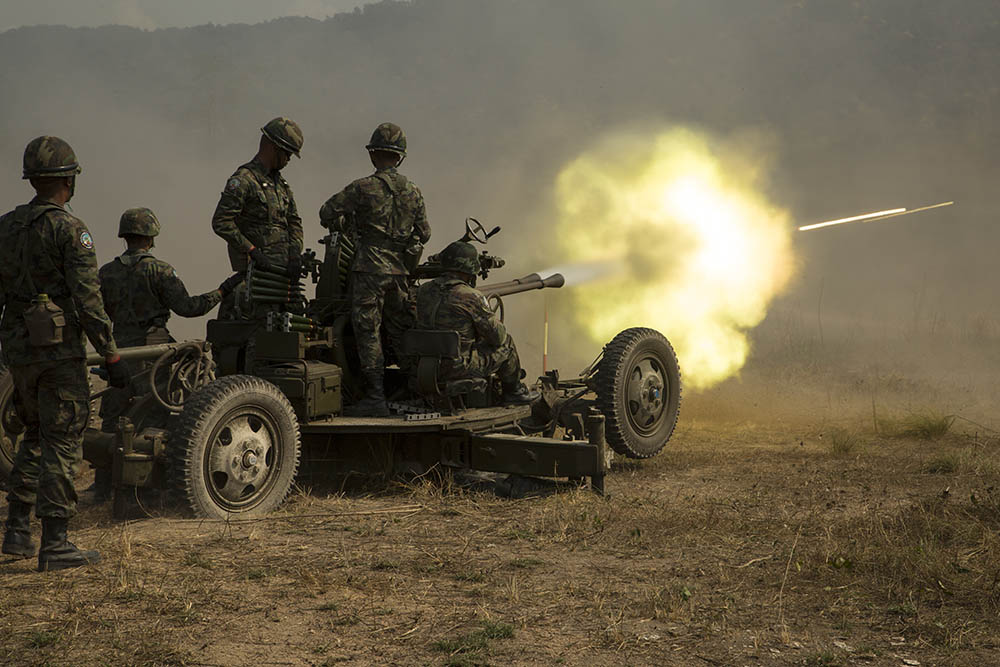
Royal Thai Marines fire a 37mm anti-aircraft gun during a combined arms live-fire exercise Thursday. Photo: Lance Cpl. Kenny Nunez / U.S. Marine Corps

The U.S. military describes Cobra Gold as “one of the largest theater security cooperation exercises in the Indo-Pacific.” It’s also a great chance for soldiers from Thailand and other regional allies to hang out, drink blood and blow stuff up with the world’s most powerful fighting force.

The United States backed off from fully committing in the wake of the 2014 coup, but in the face of rising Chinese influence, quickly resumed business as usual.

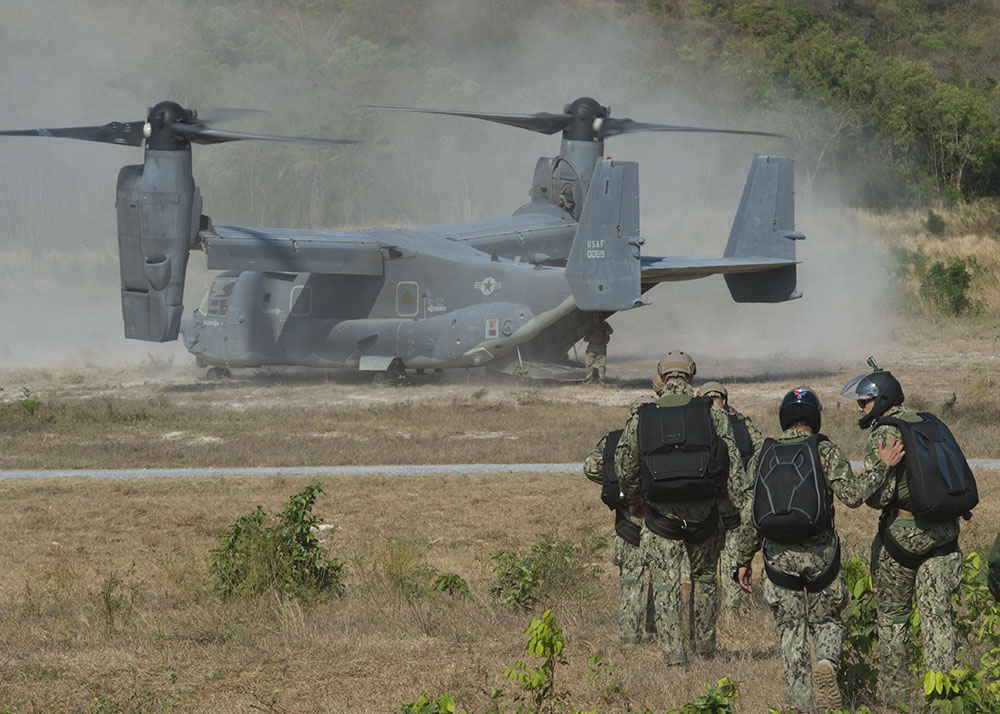
Here are some images and video clips from our reporters and the U.S. Army and Marines of the past week’s exercises, which included combined arms, live-fire exercises and simulated amphibious assaults as well as humanitarian assistance and disaster relief.

Royal Thai and U.S marines conduct jungle survival training on Feb. 14 in Chantaburi province. The ritual of drinking cobra blood is explained as an “alternative way to stay hydrated. Source: Staff Sgt. Matthew J. Bragg / U.S. Marine Corps

Royal Thai Marines fire a 37mm anti-aircraft gun during a combined arms live-fire exercise Thursday. Photo: Lance Cpl. Kenny Nunez / U.S. Marine Corps
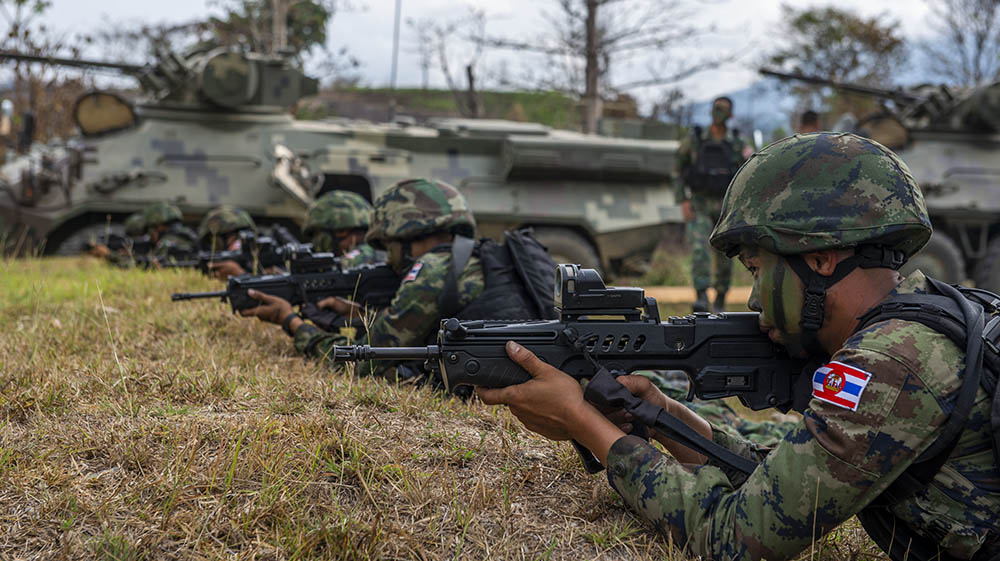
Royal Thai Marines rehearse their positions prior to conducting a combined arms live-fire exercise Thursday in Chanthaburi province. Photo: U.S. Marine Corps
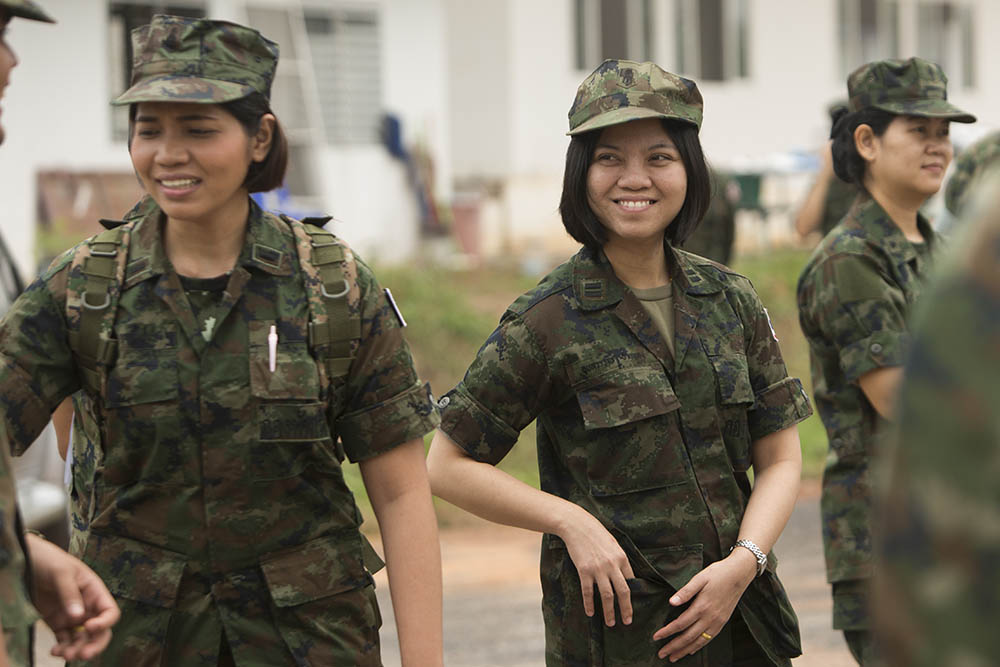
Members of the Royal Thai Army pose while observing the construction of a field hospital Tuesday in Chachoengsao province. Photo: Cpl. Breanna L. Weisenberger / U.S. Marine Corps
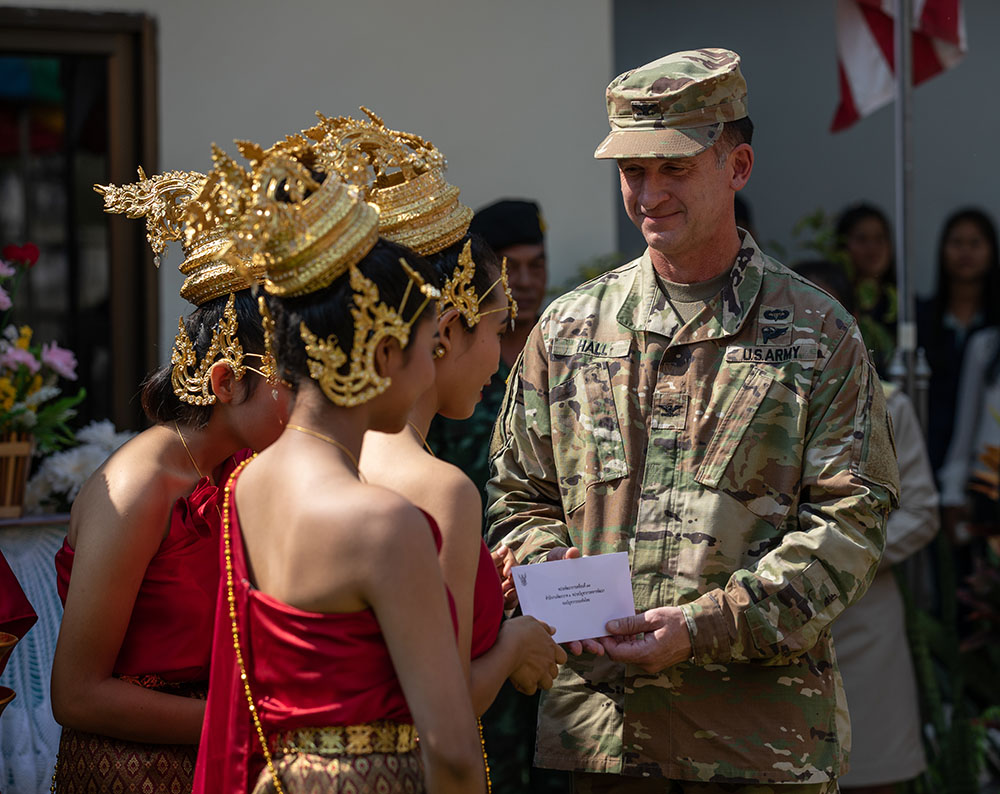
U.S. Army Col. Jerry Hall, US Army Pacific, hands an envelope to school children at a dedication ceremony for a new building at the Banchaladrakang School on Wednesday. Photo: U.S. Army
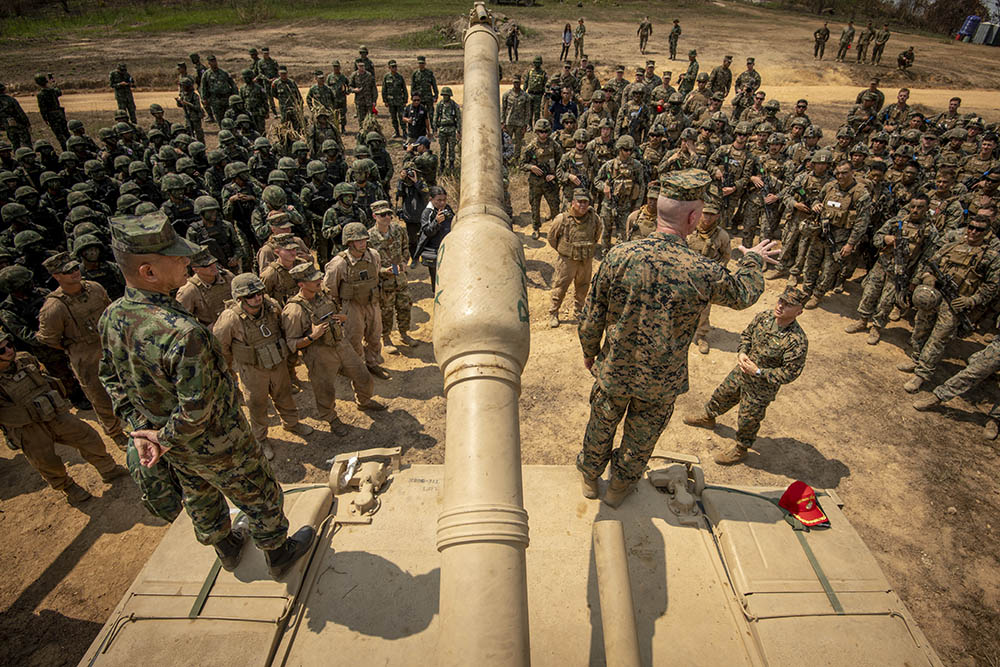
U.S. Marine Corps Lt. Gen. Eric Smith talks to the U.S. and Royal Thai Marines on top of a M1 Abrams after the combined arms live-fire exercise Wednesday in Chanthaburi province. Photo: U.S. Marine Corps
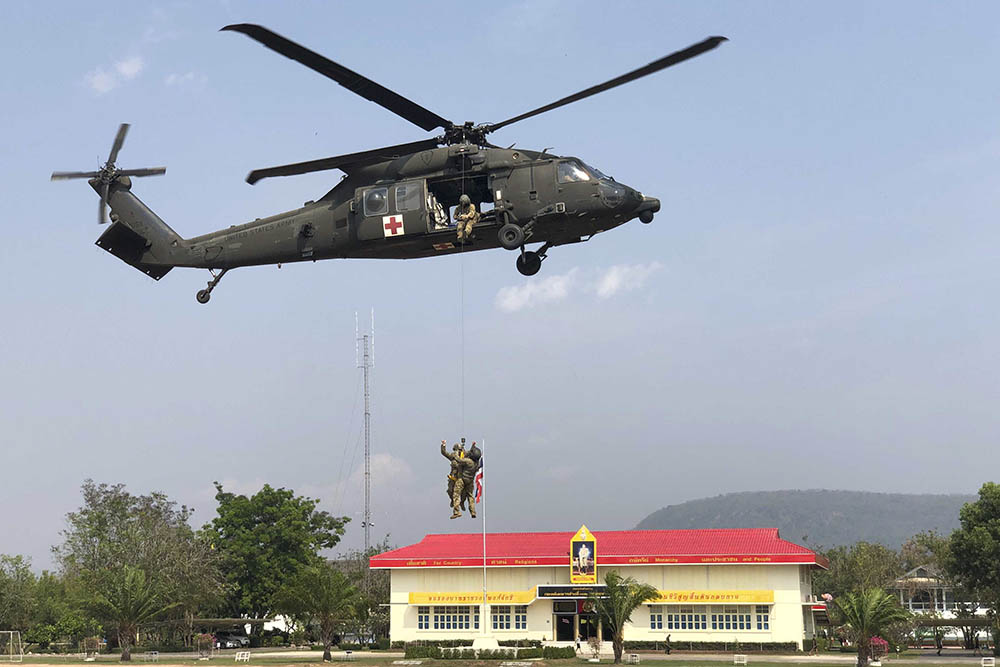
Soldiers with the 25th Aviation Regiment and 1-2 Stryker Brigade Combat Team conduct hoist training Sunday in Phitsanulok province. Photo: U.S. Army
Sailors assigned to an Explosive Ordnance Disposal Mobile Unit and the Royal Thai Navy participate in joint military free-fall training Thursday in Sattahip.
Sailors assigned to an Explosive Ordnance Disposal Mobile Unit and the Royal Thai Navy participate in joint military free-fall training Thursday in Sattahip. Photo: US Army
Photo: Khaosod
Photo: Khaosod
Photo: Khaosod
Photo: Khaosod
U.S. Marines with Charlie Company, 4th Tank Battalion, return from a combined arms live-fire in an M1A1 Abrams tank Thursday in SukhothaiPhoto: U.S. Marine Corps
Photo: Khaosod
Photo: Khaosod
Photo: Khaosod
Photo: Khaosod
U.S. Marines with Charlie Company, 4th Tank Battalion, return from a combined arms live-fire in an M1A1 Abrams tank Thursday in SukhothaiPhoto: U.S. Marine Corps

U.S. marines and Thai military conducted combined arms live fire training during exercise Thursday in Sukhothai province. Source: U.S. Marine Corps

Soldiers with Alpha Battery, 1st Brigade, 37th Field Artillery train together with their Royal Thai Army counterparts, sharing field artillery strategy and tactics. Source: U.S. Marine Corps


Battalion Landing Team, 1st Battalion, 4th Marine Regiment with the 31st US Marine Expeditionary Unit conducts a combined arms live-fire exercise on Feb. Wednesday in Chanthaburi province. Source: Sgt. Nicolas Cholula / U.S. Army

The US Air Force 8th Fighter Wing and Royal Thai Air Force, Wing 1, fly together to improve overall readiness and interoperability. Source: U.S. Army

Above: Soldiers with Alpha Battery, 1st Battalion, 37th Field Artillery Regiment, trained alongside their Thai counterparts Feb. 20 in Phitsanulok province. Source: U.S. Army

Above: U.S. Marines of the 4th Marine Regiment prepare for combined arms live-fire training Tuesday in Chanthaburi province. Source: Sgt. Nicolas Cholula / U.S. Army

Above: Japan Ground Self Defense Force members participate in the non-combat evacuation so partner nations can work together during humanitarian assistance and disaster response and security-type scenarios. Source: U.S. Army

Above: Weapons Company Marines participate in a live fire event with the Royal Thai Marine Corps on Feb. 13 in Chanthaburi province. Source: Lance Cpl. Tanner D. Lambert / U.S. Marine Corps


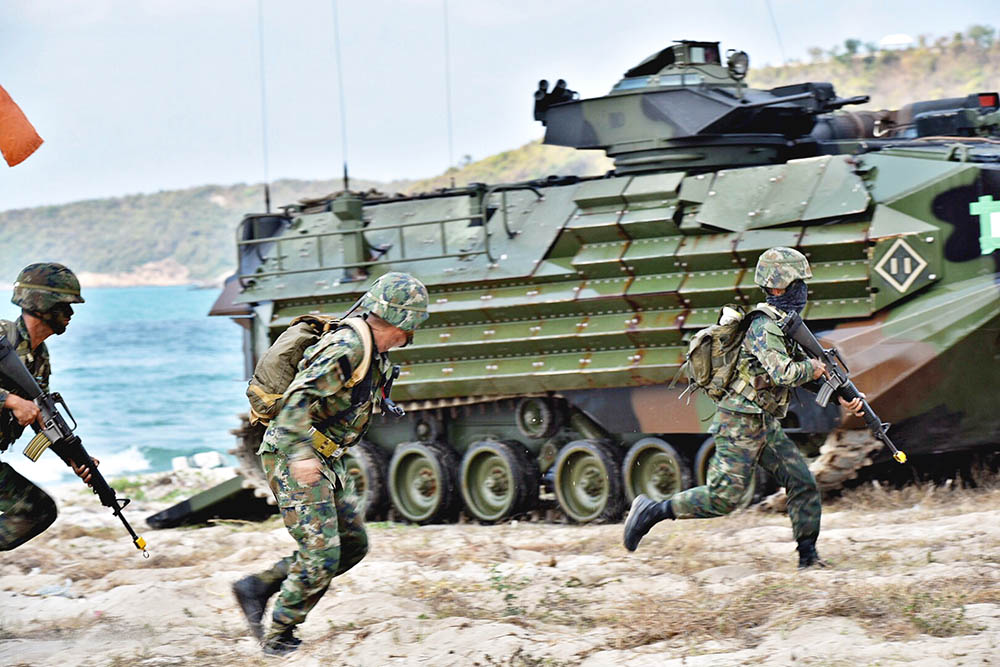
Above: Marines from Thailand, South Korea and the United States conduct an amphibious assault exercise on Feb. 16 at hat Yao Beach, Sattahip, in Chonburi province. Source: Sgt. Nicolas Cholula & Sgt. Timothy Valero / U.S. Army


Above: Marines from Thailand, South Korea and the United States conduct an amphibious assault exercise on Feb. 16 at Hat Yao Beach, Sattahip, in Chonburi province. Source: Sgt. Timothy Valero / U.S. Marine Corps


Advertisement

Tourists Drawn to Light at End of Samui Tunnel (Video)

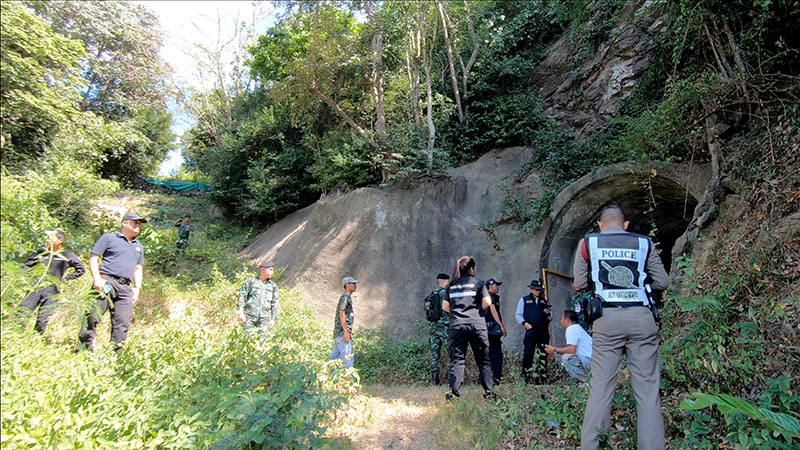
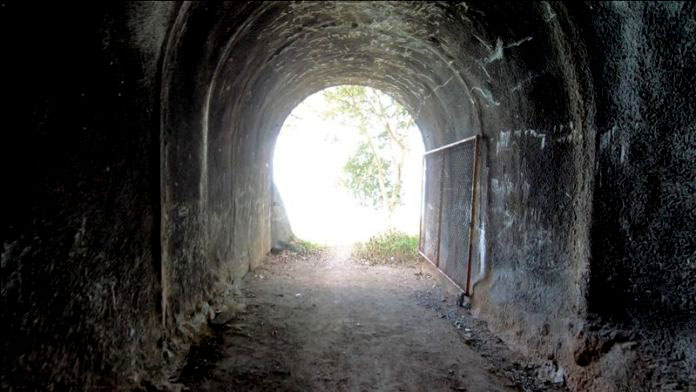
SURAT THANI — Jungle-trekking tourists have discovered a mysterious mountain tunnel on Koh Samui.

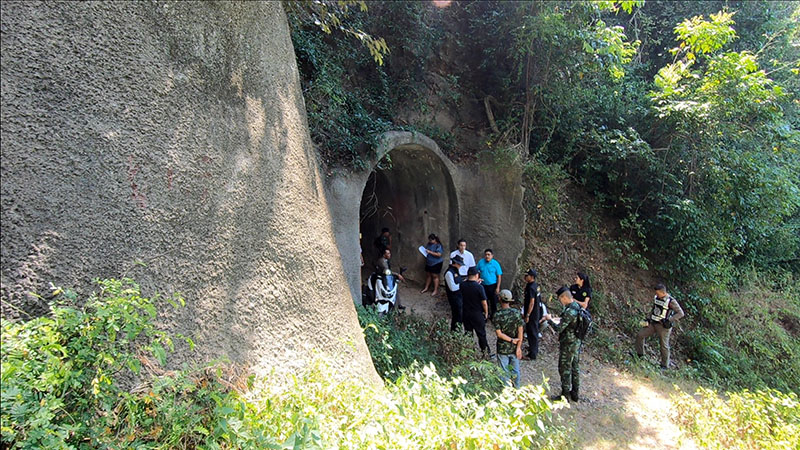
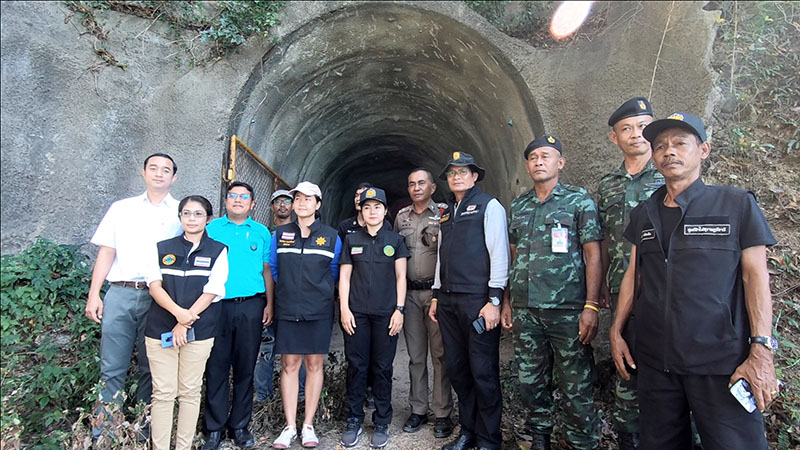
Local officials Friday were investigating the origins of a 100-meter concrete tunnel discovered by tourists in the island’s Mae Nam subdistrict.

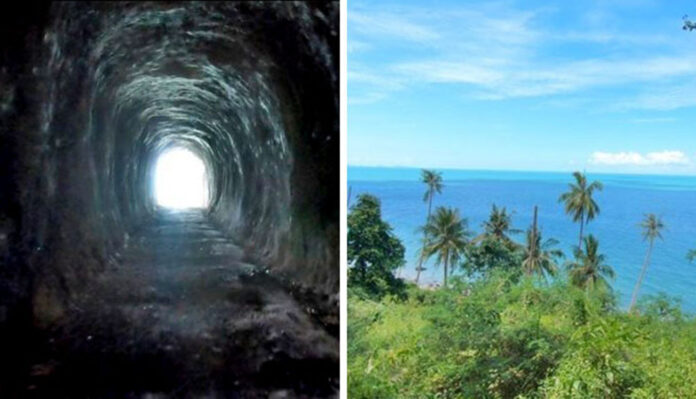
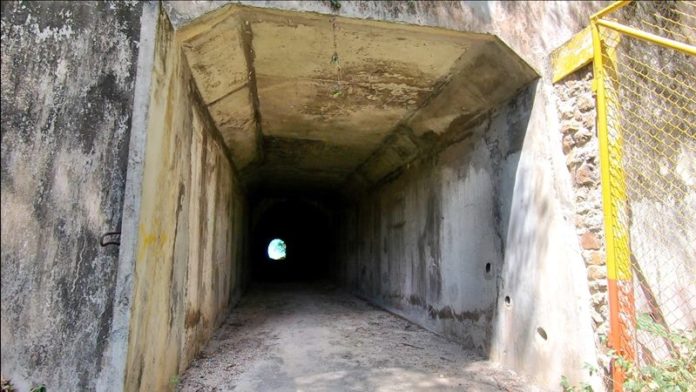
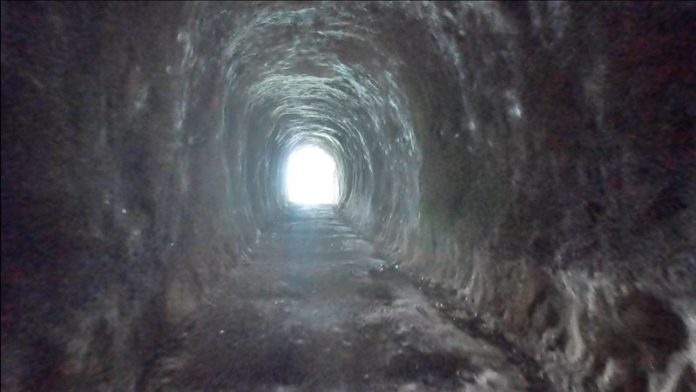
Approximately three meters in diameter, its entrance leads from a forested jungle area through about 100 meters of darkness. Walk to its end to find a beautiful vista of the ocean.

The tunnel, which could have been constructed for drainage, had a wire gate blocking the entrance. Officials say they don’t know who owns the land.

w4 copy w6 copy w7 copy

q2 q5 q6 q1 q8 1

Advertisement

Chicago’s Vast Camera Network Helped Solve Smollett Case

This image released by Fox shows Jussie Smollett, left, and A.Z. Kelsey in a scene from the
This image released by Fox shows Jussie Smollett, left, and A.Z. Kelsey in a scene from the "Pride" episode of "Empire" which originally aired on Oct. 10, 2018. Image: Associated Press

CHICAGO — Police tapped into Chicago’s vast network of surveillance cameras – and even some homeowners’ doorbell cameras – to track down two brothers who later claimed they were paid by “Empire” actor Jussie Smollett to stage an attack on him, the latest example of the city’s high-tech approach to public safety.

Officers said they reviewed video from more than four dozen cameras to trace the brothers’ movements before and after the reported attack, determining where they lived and who they were before arresting them a little more than two weeks later.

Smollett reported being beaten up by two men who shouted racist and anti-gay slurs and threw bleach on him. But his story fell apart when Abimbola and Olabinjo Osundairo – bodybuilders and aspiring actors whom Smollett knew from the “Empire” set and the gym – told police that Smollett paid them USD$3,500 to stage the attack because he was unhappy with his salary and wanted to promote his career.

Smollett was arrested Thursday and made his first court appearance. He was later released after posting the required 10 percent of the $100,000 bond.

Police Commander Edward Wodnicki, who heads the detective division that led the investigation, credited the camera network but also residents who shared information from their own cameras for helping to solve the case.

“That was super useful in this investigation,” he said of residents’ cooperation. “The city came together to investigate and help the police with this crime.”

The search went beyond surveillance cameras to include other electronic records. Detectives also reviewed in-car taxi videos, telephone logs, ride-share records and credit card records, according to a summary of the case released by prosecutors.

At first, police were puzzled when they could not find footage of the attack, which Smollett said occurred around 2 a.m. on Jan. 29 while he was walking home from a Subway sandwich shop.

Chicago has the most extensive video surveillance network in the U.S., with access to more than 32,000 cameras mounted on buildings, poles, train tunnels and buses – and even in businesses and private residences whose owners agree to opt into the system full-time. What’s more, authorities can track someone by linking those cameras at a sophisticated emergency command center, police stations or even from tablets in officers’ squad cars.

Police say Smollett deliberately staged the attack in a spot where he believed it would be captured on video, but “that particular camera wasn’t pointed in that direction,” Police Superintendent Eddie Johnson said Thursday.

But police soon found footage of two men walking in the area of the attack and interviewed more than 100 people seeking witnesses.

Using 35 police cameras and more than 20 private-sector cameras, investigators were able to trace the men’s movements after the attack, including footage of them getting into a cab, Wodnicki said. Detectives interviewed the cab driver, got video from inside the vehicle and followed it along a trail of cameras to the city’s North Side, where the brothers got out and began walking.

The private footage offered by residents included video from cameras embedded in doorbells that showed the men walking, police spokesman Anthony Guglielmi said.

After that, police tracked the men’s movements “backward to where they came from” before the attack, Wodnicki said – first walking, then to a cab and back to a ride-share car.

“That was the lead we needed to identify a person of interest,” Wodnicki said. “We were able to put a name to both individuals.”

Police found out the men had flown to Nigeria the same day as the reported attack and would return on Feb. 13. In the meantime, police executed more than 50 search warrants and subpoenas, including for phone and social media records.

The Osundairos were arrested when they got off the plane. Within two days, they were released without charges after detailing the alleged plot orchestrated by Smollett.

Although the camera network – which has raised privacy concerns among some civil liberties groups – was key, it was only one part of the investigation, Guglielmi said.

“Then they just did the police work,” he said. “It was a lot of digging.”

Story: Tammy Webber

Advertisement

Trouble With My Plane Justifies Arms Spending: Prayuth

Now everyone can fly? Junta chairman Prayuth Chan-ocha stretches his wings while joining a traditional southern dance Thursday in Krabi province.

KRABI — The retired general leading the military government tried turning lemons into lemonade Thursday, saying mechanical problems on his transport justified increased military spending.

Speaking hours after an engine problem forced his C-130 back to Bangkok, junta chairman Prayuth Chan-ocha said the plane was aging like other equipment owned by the armed forces that is in constant need of replacement. The air force said Friday the airplane had been in service nearly 40 years.

“The armed forces need to use a lot of money in purchasing all kinds of military hardware because they are becoming unusable,” the general told his supporters in Krabi province. “In the future, these aircraft will be used to assist the people. They aren’t only for the prime minister.”

Under the junta, the military has spent tens of billions of baht on weapons acquisitions ranging from jet fighters to submarines. Just earlier this month, the government approved 2.2 billion baht for more Chinese APCs and ammo.

Prayuth’s visit to the south was delayed by an hour and a half because of the malfunction. The junta leader made light of the situation.

“I came here out of love. Even if the plane was flying on just two propellers, I would still come here. I love everyone,” Gen. Prayuth said.

An air force spokesman said the C-130 that flew Prayuth’s delegates yesterday has been in operation since 1980.

“There was always the chance that an error could occur,” Lt. Gen. Pongsak Semachai said at a news conference.

The junta leader also lashed out at his opponents who took to social media wishing for his death.

“Some people wished that the plane would just crash. What the hell? I’m here just to see the people. Don’t wish me death,” Prayuth said. “Why do they hate me so much?”

Advertisement

Info Wars: Social Media Ripe Target For Thai Election Disinfo

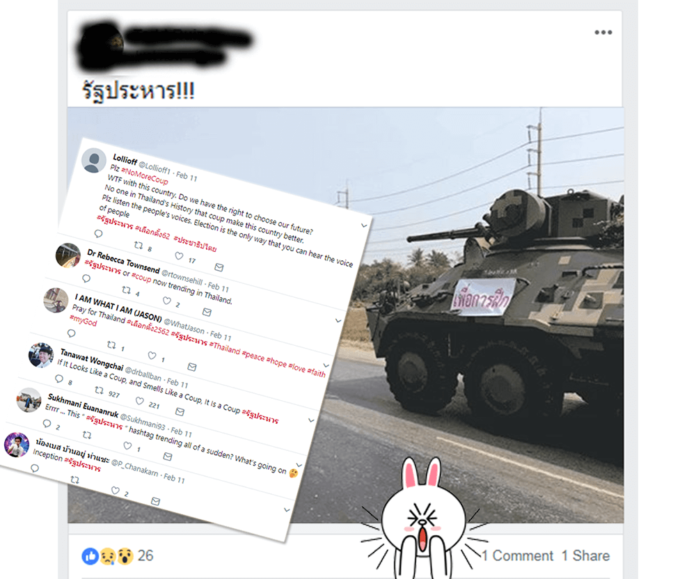
Coup fever struck Thai social media earlier in February following a perfect storm of true, partially true and outright false reports circulated online.

By Jintamas Saksornchai and Todd Ruiz

BANGKOK — First it was a photo of tanks on the move. Then came word that riot police were being urgently mobilized somewhere. Soon, coup fever was gripping the kingdom and trending atop Thai Twitter.

The ambiguous reports – based on a genuine photo, leaked document and forged order, that fueled an explosion of coup rumors earlier this month was a made-for-social media moment. A tangle of truths, half-truths and falsehoods, it was the kind of mess vexing tech platforms have been struggling – and often failing – to handle in the age of online disinformation.

With Thailand in its first election cycle in five years, the swarm of provocative news is gaining momentum. The false coup alarm drew swift junta demands the perpetrators be prosecuted. It came less than a week after a prime minister candidate accused a pro-junta Facebook group of digitally inserting into a damning video clip that spread over messaging app Line. On Thursday, a complaint was filed over an online report the junta leader plans to extend military conscription another two years.

Read: How Fake News and Disinfo Will Affect Thailand’s Election

And they’re unlikely to be the last episodes before March 24 – or after. Khaosod English reached out to Facebook, Line and Twitter to find out how they’ve secured their platforms against disinformation at a time ripe for sowing confusion and division among the public.

Twitter Singapore didn’t respond to inquiries, and Line refused to answer questions, saying vaguely that it would “follow rules and regulations including providing collaboration to related organizations.”

Facebook, which has experienced a collapse in trust ever since “fake news” entered the political lexicon, offered the most details. The company says it has fielded Thai-language screeners to review content, partnered with a domestic fact checker and turned its sights on education Thai netizens.

Because algorithms lack the necessary nuance, Facebook says its efforts still rely heavily on human eyes. It declined to say how many Thai-language content screeners it has employed directly or through contractors but said it has 15,000 “dedicated content reviewers” worldwide.

This month it has temporarily blocked any ads originating outside of Thailand that refer to “politicians, parties, ‘getting out the vote,’ and/or election suppression” domestically in run-up to Election Day.

The company also referenced an election workshop held earlier this month for Thai news organizations, though it was mostly used to promote the use of its products, including an hour-long tutorial on creating Instagram stories.

Facebook’s approach “includes finding and removing bad actors, blocking or removing fake accounts, limiting the spread of false news and misinformation, and bringing unprecedented transparency to political advertising,” the company said in a statement. “We have teams working on all upcoming elections in Asia-Pacific, including Thailand.”

Though the company provided few details about specific resources put in place, it said it plans to “set up new regional operations centers, focused on election integrity, including one in Singapore,” while working “closely with lawmakers, election commissions, fact-checkers, researchers, academics and civil society groups” to fight misinformation and deter voter suppression efforts.

Though light on details, Facebook did disclose that it has partnered with the Thai News Agency’s “Sure and Share Center” fact-checking program to expand its ability to help Thais spot falsehoods and disinformation.

Peerapon Anutarasoat, who has produced and hosted the program since its launch in 2015, said he was thankful for the opportunity to work with Facebook and reiterated the importance in building an informed society.

“I wanted to thank them for applying what they’ve learned from the phenomena that’s happened in many countries for the benefit of Thailand during the election,” he said. “They might also be able to learn new things from here as well.”

The company said it plans to follow up by promoting digital literacy in the kingdom this year through unspecified measures.

The kingdom’s populace is among the world’s most active on social media. In 2017, Thailand’s 49 million Facebook users ranked eighth in the world per capita. In the same year, it had 12 million Twitter users and more than 42 million Line users.

Line can be an especially pernicious vector given that the usual mechanisms for self-correction don’t work. Rumors can spread widely on a peer-to-peer basis without ever seeing sunlight.

It’s that reason that makes increasing the public’s online savviness important.

“Campaigning to increase people’s [media literacy] will make a positive impact, especially in the long run,” Peerapon said. “The more people are informed, the more resources we will have reserved to strengthen our mission instead of just chasing after fake news, case by case.”

The Gatekeepers

The Election Commission has cited disinformation for its decision to regulate social media for the first time.

Many have raised concerns that the commission’s regulations open the way for the authorities to censor and remove content they don’t like. Skepticism over free and fair elections has reached a boil after questionable moves to redraw the electoral map, disband parties and shut down critical broadcasting media.

As for government attempts – successful or not – to censor or remove content, Facebook insisted it is “transparent,” yet it only publishes raw numbers without detail. Those numbers show that requests from the Thai government hit a new peak during the last reporting period.

According to election commissioner Charungwith Phumma, his body has asked for social media platforms’ “cooperation” to remove “damaging content” when it is found. He did not elaborate on the criteria.

Google’s publishes a transparency report that likewise consists only of raw numbers, but identifies for “reasons.” It also found a surge in requests from the Thai government, with 150 removal requests in the first half of 2018, more than three times higher than the same period a year before. Ninety-seven percent of the requests were over “government criticism.”

Facebook insisted that it will only remove content that violates its safety standards, while content violating a nation’s laws would only be made unavailable in that country.

The platform’s report says 283 items found to violate the local lese-majeste law were restricted upon Thai request between January and June of last year. It’s unclear how many items in Thailand had been removed.

The Election Commission’s new rules, such as requiring candidates notify it before they campaign on social media, have sparked criticism they will quash free and open debate and discourage candidates from using the platforms to reach voters.

Political science professor Naruemon Thabchumpon said it will have a huge impact, especially on the estimated 6 million first-time voters.

“The people who use social media are the younger generations,” she said. “The question for Thailand is how to attract these people to leave their online world and go out to vote … because social media can spur popularity among them.”

She thinks the commission shouldn’t only focus on going after those who use social media for political purposes but also try do more proactive engagement to get the right information out to the public as fast and widely as possible to counter disinformation.

Advertisement

‘Miss Honey Eyes,’ Golden Age Screen Icon, Named National Artist

BANGKOK —  A cinematic heartthrob who became known as “Miss Honey Eyes” as the onscreen partner of Thailand’s most legendary star was named a national artist last night.

Petchara Chaowarat, 76, was named a national artist in the performing arts along with other 11 awardees in three different categories that also include the visual arts and literature.

The names were announced by Deputy Prime Minister Wissanu Krea-ngam, who is also a chairman of the National Cultural Commission.

Phetchara was among six artists in performance arts. They include Wiroj Weerawattananon (likay), Kan Chaowapong (nora dance), Sukhon Pornpiroon (international-style Thai music), Prapas Cholsaranon (entertainment and international-style Thai music) and Somsuk Kanjaruk (television lakorn).

For the visual arts, sculptor Shin Prasong, painter Parin Tantisuk, fashion designer Kampun Srisai and interior architect Kongsak Yutavesi were recognized.

The literature category saw two authors elevated: Chamlong Fangcholjit and Saneh Sangsuk.

Petchara remains the best known of them all. She became an icon in the golden age of Thai cinema, starring in nearly 300 movies in the 1960s and 1970s. She’s best known for co-starring in more than 100 films with Mitr Chaibancha – the acting legend who died filming falling from a helicopter in 1970 while filming the climax of what would be his final film. They even earned a couple’s nickname, “Mitr-Petchara.”

Today Petchara is blind from having spent so many hours exposed to bright set lights. She had disappeared from the public eye for 30 years before re-emerging in 2009.

Related stories:

Art Out of Time: How a French Cinephile Became a Thai Cinema Expert

Advertisement

Gem Mogul’s Persian Food Shines on Silom

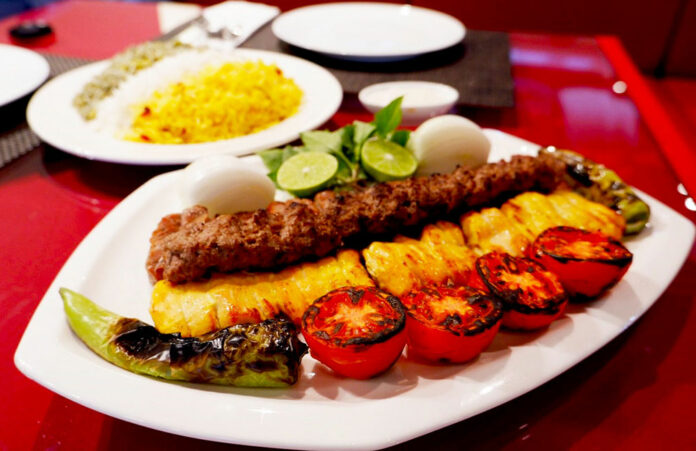
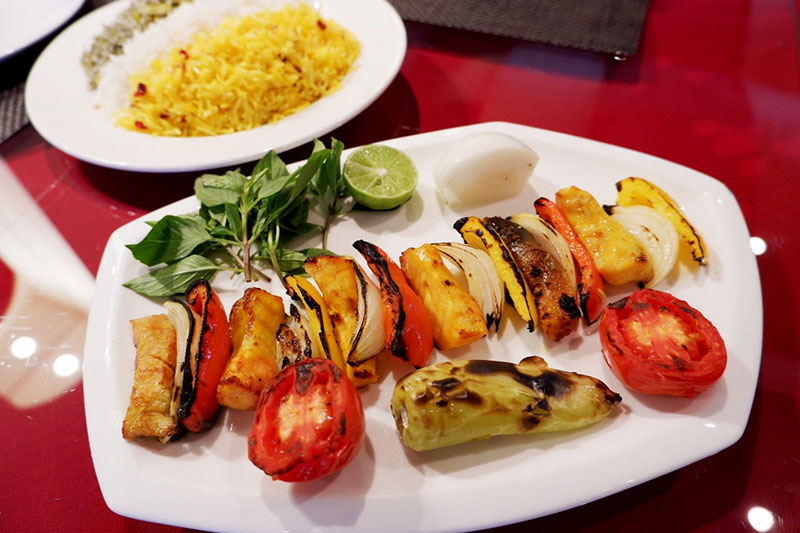
Mixed kebab (600 baht), with vegetable rice, saffron berry rice and white rice in background.

BANGKOK — Most days of the week, an Iranian mining mogul has his employees pick up his dinner from one restaurant – his own.

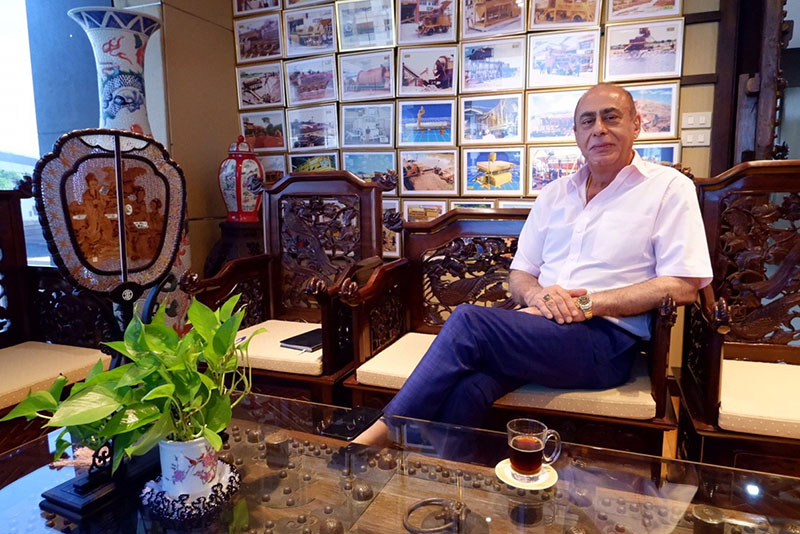
“I don’t care about profit. My main income is something else,” Fillip Sharifi says dismissively as he twirls his fingers – one of which is ringed in 10-carat tsavorite mined from Kenya.

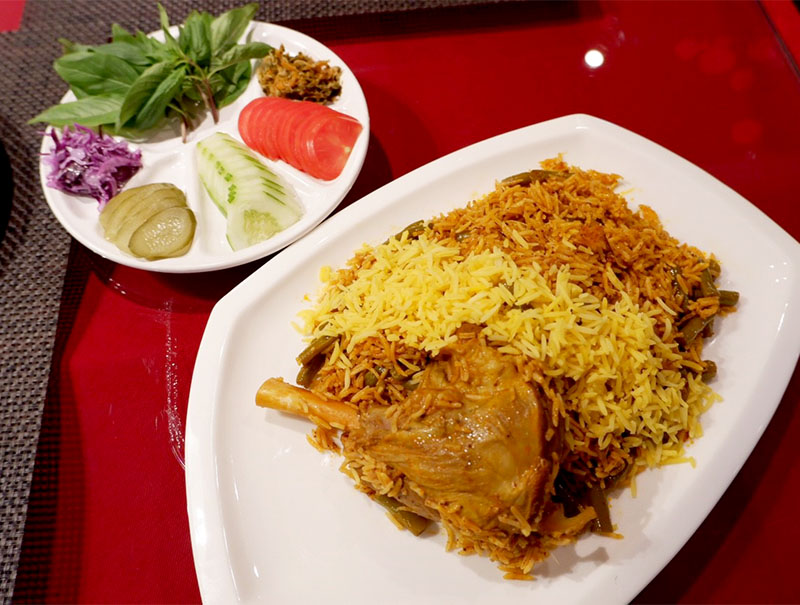
Sharifi is an Iranian-born billionaire who fled to the United States after the 1979 Revolution, and describes Persian House – a restaurant located on Pan Road off lower Silom – as his own dining room. There, generous heaps of saffron rice and lamb kebabs are served at palatable prices as part of the 69-year-old’s quest to introduce Thais to loubia polo ba mahichen gosfand (rice with lamb shank).

Fillip Sharifi at his Dove Group offices.

“Sixty years ago, Thai people didn’t know what pizza was. But then someone introduced it to the market. My primary objective is to introduce authentic Persian food to Thai people,” said the restaurant owner and CEO of mining conglomerate Dove Group.

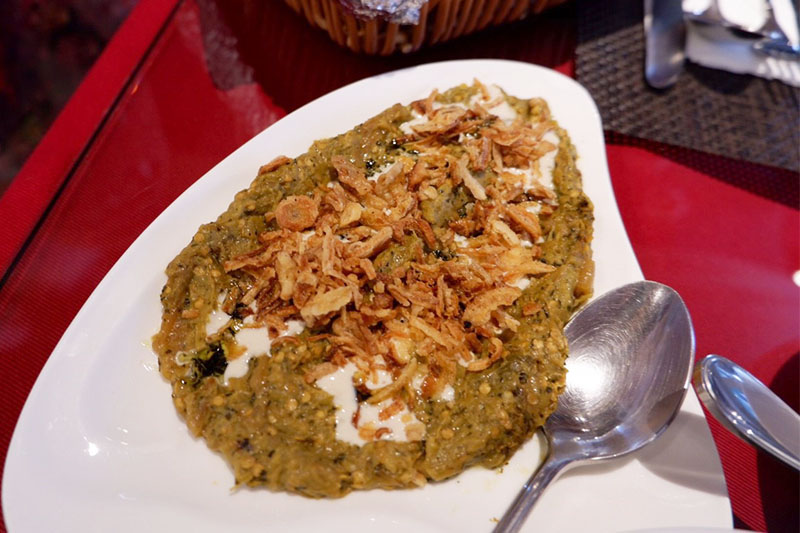
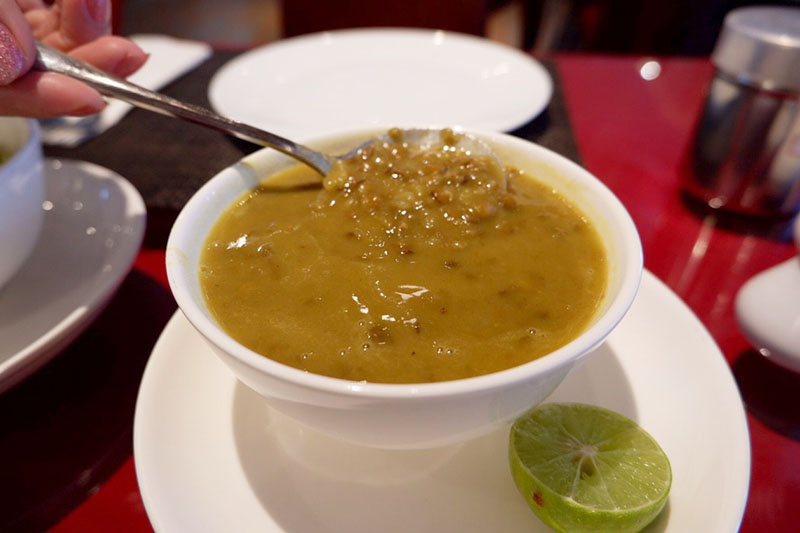
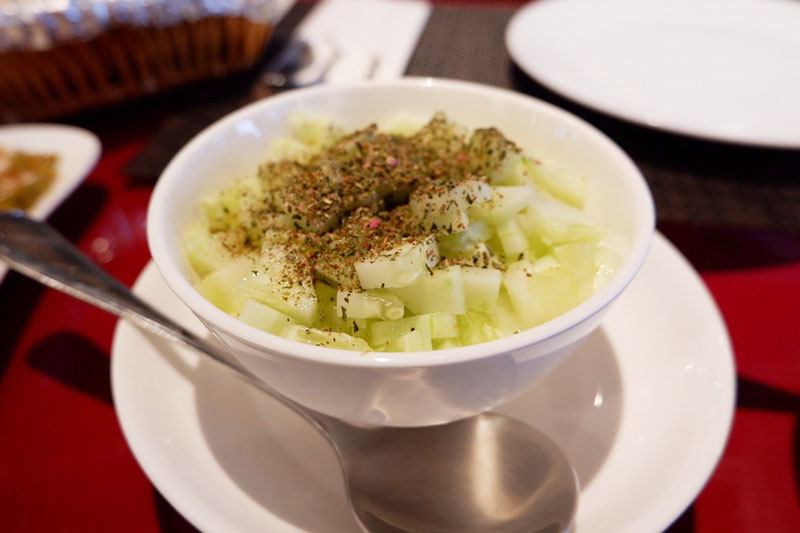
Be prepared for hearty, sharable shovelfuls of saffron rice at Persian House. It boasts a large vegetarian selection, including masto khiar (80 baht), a refreshing yogurt and cucumber appetizer, as well as the incredibly creamy kashk e bademjan (200 baht), an eggplant dip topped with fried onion, a perfect match with the Iranian naan (60 baht). The adasi (100 baht) is a lentil soup that might be too heavy and bland for Thai tongues, but the tabouli (150 baht) is a tangy mound of zest.

Clockwise from top left: Iranian naan (60 baht), tabouli (150 baht), masto khiar (80 baht) and kashk e bademjan (200 baht).

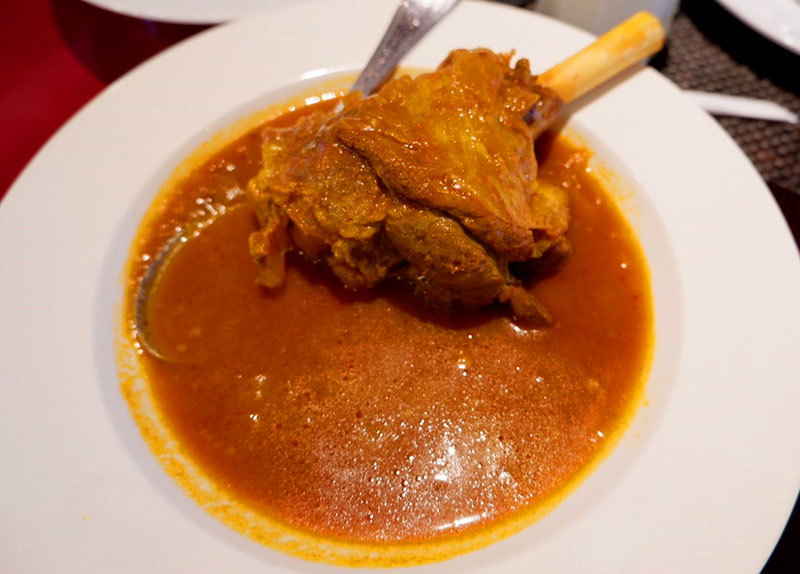
Rice lovers, rejoice with the loubia polo, or saffron rice with string beans (220 baht). Get that with lamb stew khoreshte gousht (500 baht) in which an entire shank comes swimming in sauce and falling off the bone. Or skip the mutton and go with the khoresht ghormeh sabzi, a beef stew served with dried limes, kidney beans and fenugreek (250 baht).

Loubia polo ba mahichen gosfand (750 baht).

Lamb at Persian House is noticeably less what Thais call kao, or a raw, gamey odor.

It may take several people to finish off the family-size loubia polo ba mahichen gosfand, which is a pile of saffron rice with a lamb shank buried inside (750 baht). The mixed kebab (650 baht) is also good for sharing, offering a row of barbequed chicken, lamb and beef with grilled veggies.

Stugeon kebab, or mahi sefid kebab (390 baht)
Sturgeon kebab, or mahi sefid kebab (390 baht)

For a lighter meal, try the sturgeon: whether as a grilled fillet with rice (sabzi polo ba mahi sefid, 450 baht) or kebab (mahi sefid kebab, 390 baht).

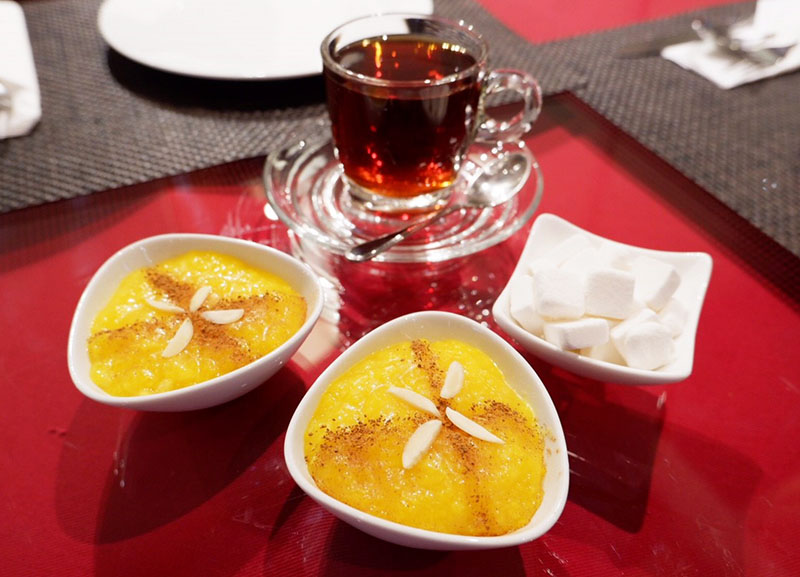
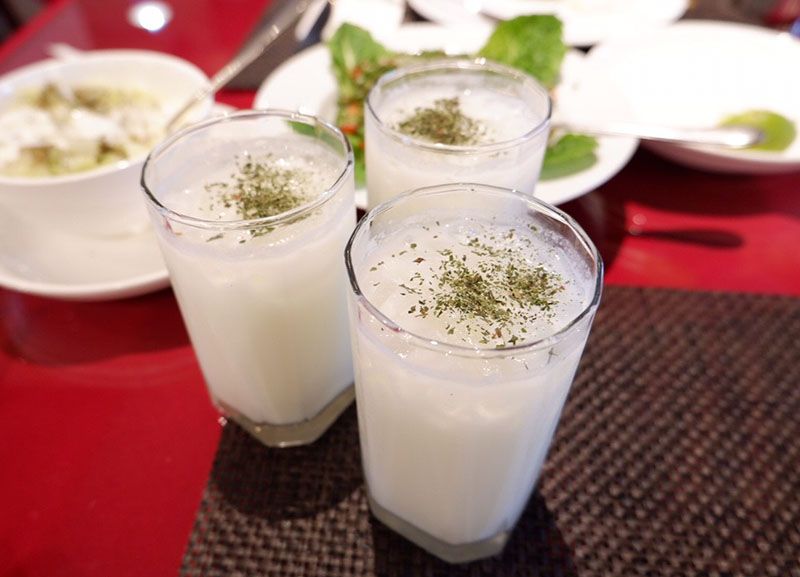
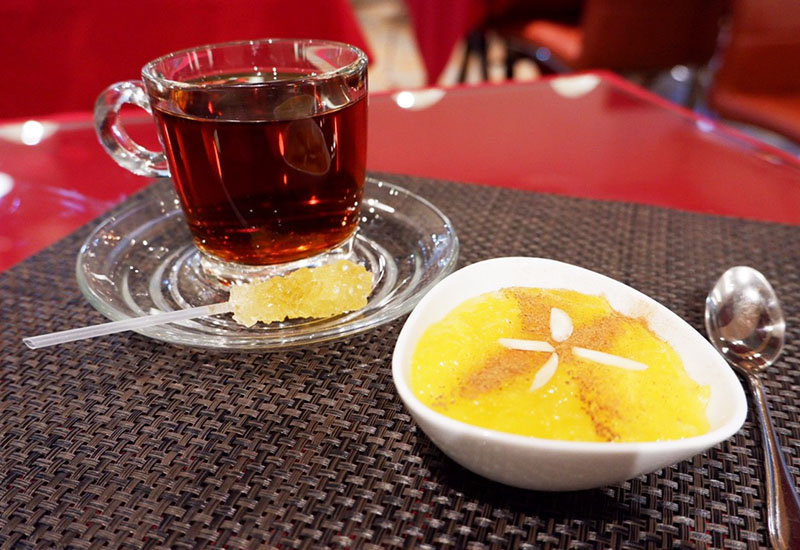
The salty yogurt doogh drink (40 baht/glass, 70 baht/bottle) might be an unfamiliar flavor for Thais. Finish everything off with a fragrant, black Persian tea (40 baht/cup, 70 baht/pot). The only dessert is a saffron rice pudding topped with cinnamon, sholeh zard (60 baht). It’s light and worth a try.

Indeed, forget what you know about Middle Eastern food in Bangkok when eating at Persian House. Having lived in Thailand 30 years, Sharifi wrinkles his face in distaste at the mention of Soi Arab, comparing it to “Thai food in New York.”

Black Persian tea (40 baht/cup, 70 baht/pot) with sholeh zard, a saffrom rice pudding topped with cinnamon (60 baht).

“These owners want to make fast income, so they cut down the quality of the food. One of them sells for 250 [baht], so the other pushes down their price to 240 [baht],” said Sharifi, who made his wealth selling mining equipment, gold and gems and is now looking at diversifying into products such as pistachios, herbal viagra and dates.

“It’s not a sophisticated mentality,” he added, slightly shaking his head in dismay.

If not grown on the restaurant’s rooftop, all ingredients for Persian House are shipped by air from Iran – from the basmati rice and saffron to the sturgeon.

“What I have built here, I don’t forget it. I live in this country, I love this country. I want to give back to Thailand. I want the best for Thailand,” he said.

25620221 190221 0064

Tabouli (150 baht).
Tabouli (150 baht).
Lamb shank, or Khoreshte gousht (500 baht)
Khoresht ghormeh sabzi, a beef stew served with dried limes, kidney beans and fenugreek (250 baht).
Mixed kebab (600 baht).
Kashk e bademjan (200 baht).
Sturgeon fillet with persian rice, or sabzi polo ba mahi sefid (450 baht).
25620221 190221 0017 copy
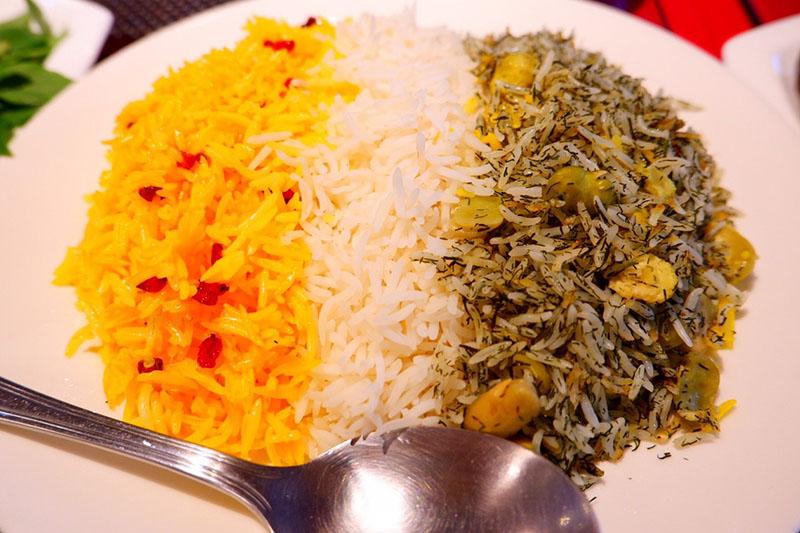
Saffron rice with berries, white basmati rice and vegetable rice.
Adasi (100 baht).
Adasi (100 baht).
Masto khiar (80 baht)
Doogh (40 baht).
Doogh (40 baht).
Black Persian tea (40 baht/cup, 70 baht/pot) with sholeh zard, a saffrom rice pudding topped with cinnamon (60 baht).

25620221 190221 0065 25620221 190221 0067

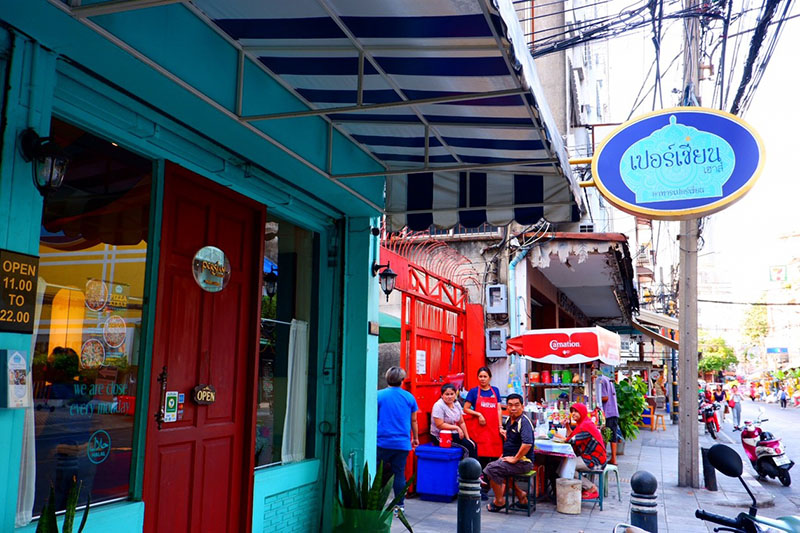
Persian House is open 11am to 10pm every day except Monday. Located on Pan Road only a few hundred meters from Wat Kaek or Wat Phra Si Maha Utama Devi, it’s about a 10 minute walk from BTS Surasak. This take on Persian House was based on a single hosted vis

Advertisement

Thai FDA Scrambles to Make Medical Weed a Reality

BANGKOK — The sudden reality of legal, medical marijuana this week has only added new urgency to questions about what is legal for whom, where and when.

The Food and Drug Administration, which is tasked with regulating the industry, voiced confidence Thursday that everything will be ready to accommodate its roll out despite concerns raised by experts over how patients and growers can practically benefit.

FDA officials met today with medical experts to discuss the next steps for the medical use and research use of marijuana and kratom, which officially became legal Monday. The administration’s chief executive said a course was being readied for doctors interested in prescribing cannabis, as was a briefing on the law’s implementation that will go out tomorrow to health officials nationwide.

Tares Krassanairawiwong said he welcomed comments from the experts.

“There are concerns over whether patients will be able to receive treatment without disruption, and on the development of the system, from production and regulations … to accommodate the transition period until the use of medical marijuana is fully ready,” he said.

Similar to the ad-hoc process of introducing medical marijuana elsewhere, much remains to be figured out – or made up as they go along.

Tares said the experts’ suggestions on issues such as ensuring an adequate supply and patient access would be forwarded to the narcotics board tomorrow for consideration. The Narcotics Control Board must review any regulatory moves.

According to Tares, the Health Ministry has instructed the departments overseeing both modern and traditional medicine to develop a short course for those wanting to prescribe marijuana. The law empowers practitioners of Thai traditional medicine to prescribe cannabis treatments as well as certified medical professionals. He did not say when those programs would be rolled out.

Coming Out of the Shadows

Several issues have been raised about an amnesty program that was hastily put in place days before the law came into effect. It gave those already possessing marijuana for legitimate uses 90 days to notify the authorities and avoid prosecution – and hang onto their stash.

Experts however see many complicating factors.

Panthep Puapongpan of a university cannabis treatment institute said the law fails to provide clear guidelines for what will happen after the 90 days expires, which might discourage patients from coming out from the “underground.”

“In these 90 days, how much restrictions will be imposed on the patients? If this is not clear, they won’t dare come out to register,” said Panthep, dean of the Rangsit Institute of Integrative Medicine and Anti-Aging.

The government just may not be able to supply enough legal, medical-grade cannabis in that time, he said.

“If there’s not enough, there’s concern that if patients use up their stock; what will happen to them?” he said.

Chulalongkorn University neurologist Thiravat Hemachudha, a legalization proponent who gave input to the legislature, said his main concern was that those who were producing medical marijuana illegally may now be forced to stop.

“If they want these people to register, they should loosen up the regulations to allow them to cultivate marijuana again,” he said. “From my understanding of the current version of the law, there’s no way available to them.”

The law says only government agencies, certified medical professionals, educational institutions and registered agricultural co-ops are eligible to cultivate or distribute cannabis. Thiravat said restrictions should be relaxed so that individual farmers can grow the plant.

Tares, the FDA chief, said patients with medical certificates for valid illnesses covered by the law could be allowed to possess marijuana beyond the 90-day amnesty period. He added that officials are also considering ways to bring farmers who are already growing into the system.

Advertisement

Cop-Buffalo Showdown Enthralls Internet Because What?

SONGKHLA — A gun at his hip, police captain Puripan Suwannarat squared off against his adversary on a sunny afternoon. Despite favoring a long stick to his sidearm, he walked away from the duel standing – with a buffalo in tow.
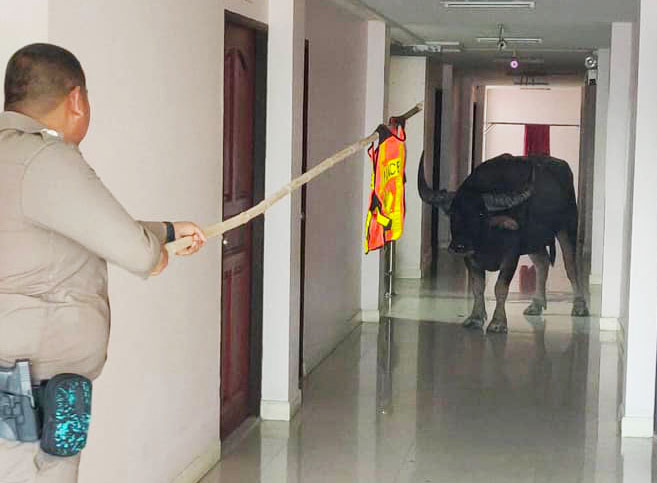
Photos showing Puripan confronting an agitated buffalo inside an apartment building in the southern province of Songkhla have captivated social media since Wednesday. In the images, he holds a long wood pole toward a buffalo that’s assumed a defensive crouch in a residential hallway. The would-be bullfighter’s pics have spawned countless jokes and left many puzzled over what led to the encounter.

Puripan himself gave a simple reason for posting them – he needed to convince his wife that he had a good reason for being late.

“I’m coming home a bit late, darling,” he wrote in the post, tagging his wife. “I have to take a buffalo out of an apartment and to its pen.”

วันนี้เข้าร้อยเวร202 สภ.เมืองสงขลา พี่กลับบ้านช้าหน่อยนะที่รัก ต้องพาควายออกจากอพาร์ตเมนต์ เอาไปเข้าคอกก่อนนะ

โพสต์โดย Puripan Suwannarat เมื่อ วันพุธที่ 20 กุมภาพันธ์ 2019

Since buffaloes also stand in for idiots in Thai reckoning, the post went viral with many commentators announcing they had “found” their friends. The photos were shared 9,500 times as of Thursday afternoon.
What led the buffalo into the narrow hallway? Capt. Puripan could not answer.
“When I arrived, it was already inside,” Puripan, who’s been on the force for 12 years, said in an interview today.

But a building maid said that a buffalo fight outside spilled into the building after one injured animal sought sanctuary inside with another in hot pursuit. The two hostile animals put their horns through several walls, she said, as they tried to gore each other.

Puripan said he eventually lured the buffalo out by “baiting” it with a brightly colored police vest.

Puripan said he had to post the photos to avoid grief at home because he was supposed to leave work by 4pm, but the trespassing buffalo emergency kept him on duty till 5pm.

“She found it funny, too,” the policeman said, adding that the animal was extracted without harm.

Advertisement

Lawyer Likens R. Kelly to Beethoven to Explain Studio Move

This June 13, 2008 file photo shows R&B singer R. Kelly, arriving at 3the Cook County Criminal Court Building in Chicago. Photo: M. Spencer Green / Associated Press

CHICAGO — R&B singer R. Kelly is moving out of his Chicago recording studio because a judge has stymied his creativity by barring him from working there overnight due to building-code violations, his lawyer said Wednesday.

Cook County Judge Patrice Ball-Reed has effectively ordered the Grammy Award-winning artist “not to be creative between 9:00 p.m. and 9:00 a.m.,” attorney Steve Greenberg said.

“R. Kelly can never be creative and do his job under these circumstances,” he said in a statement.

He compared Kelly to Ludwig van Beethoven, Winston Churchill, Sigmund Freud and one of the Beatles, who he said did some of their best work overnight, too.

“John Lennon,” Greenberg said, “spent 24 hours a day in bed while recording.”

Among the violations cited by inspectors was evidence the industrial space was used as a residence.

The judge recently refused a request by Kelly to let him work longer into the night at the studio, which is part of a warehouse building on the city’s West Side.

The dispute over studio access comes amid allegations of sexual misconduct by Kelly, all of which he has denied. A recent Lifetime documentary series, “Surviving R. Kelly,” looked at old allegations against Kelly and made some new ones.

Greenberg, in his statement, called the judge’s order a “vindictive and baseless reaction to unsubstantiated claims of decades old misconduct.” He added that some people are reaching conclusions about the allegations prematurely.

“There are three countries that presume an accused to be guilty and require him to prove his innocence – North Korea, China and Myanmar,” the attorney said. “The public should not rush to judgment.”

Advertisement

Hot News

LATEST NEWS

Bangkok
broken clouds
37.8 ° C
37.8 °
36.6 °
54 %
3.7kmh
71 %
Fri
38 °
Sat
36 °
Sun
37 °
Mon
37 °
Tue
36 °