Chadchart Sittipunt walks along a railtrack in Bangkok on Jan. 27, 2019.
BANGKOK — Former transport minister and subject of countless memes Chadchart Sittipunt confirmed Tuesday he won’t compete in the election as a parliamentary candidate despite being nominated for the premiership.
Explaining his absence from Pheu Thai Party’s list of contenders, Chadchart told reporters he believes himself unsuitable for the legislative branch. The 52-year-old was nominated last week as one of the party’s three prime minister candidates.
“I know myself, what I’m good at and what I’m not good at,” Chadchart said. “I know myself that I’m not good at everything. I can only play a role I’m good at.”
Pheu Thai sec-gen Phumtham Wechayachai also confirmed Chadchart won’t be running for an MP seat.
Chadchart, a former engineering lecturer, was appointed by the Yingluck Shinawatra’s administration to serve as a transport minister in 2012, a job he kept until Yingluck dissolved the parliament a year later. He never ran in any election.
He rose to fame after making abrupt inspection at various modes of transport, from a public bus to trains. Chadchart also proposed an ambitious project of constructing extensive high-speed rail lines and new train tracks across the country, though the court shot it down due to budget concerns.
But the well-built Chadchart was perhaps best known for being elevated to internet uber-meme in 2013 as the “World’s Strongest Minister” akin to the digital deification of Chuck Norris.
Speaking to reporters today, Chadchart said he left doors to political offices open, including the governorship of Bangkok.
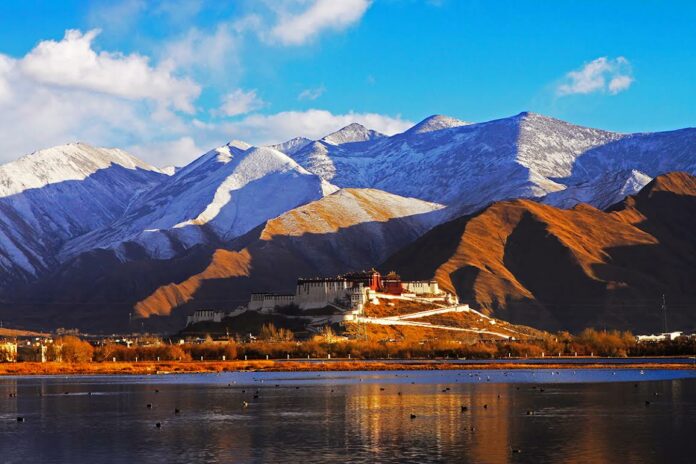
The Tibetan Potala Palace sits beneath the enormity of Mt. Everest. Photo: Xinhua News Agency / Courtesy
KATHMANDU, Nepal — One-third of Himalayan glaciers will melt by the end of the century due to climate change, threatening water sources for 1.9 billion people, even if current efforts to reduce climate change succeed, an assessment warns.
If global efforts to curb climate change fail, the impact could be far worse: a loss of two-thirds of the region’s glaciers by 2100, said the Hindu Kush Himalaya Assessment released Monday by the International Centre for Integrated Mountain Development.
“Global warming is on track to transform the frigid, glacier-covered mountain peaks of the Hindu Kush Himalayas cutting across eight countries to bare rocks in a little less than a century,” said Philippus Wester of the center, who led the report.
The five-year study looked at the effects of climate change on a region that cuts across Asia through Afghanistan, Pakistan, India, Nepal, China, Bhutan, Bangladesh and Myanmar. The area, which includes the world’s tallest mountain peaks, has glaciers that feed into river systems including the Indus, Ganges, Yangtze, Irrawaddy and Mekong.
The assessment said that the impact of the melting could range from flooding from the increased runoff to increased air pollution from black carbon and dust deposited on the glaciers.
Saleemul Huq, director of the International Center for Climate Change and Development, an environmental research center in Dhaka, described the findings of the report as “very alarming,” especially for downstream nations such as Bangladesh.
“All the countries affected need to prioritize tackling this upcoming problem before it reaches crisis proportions,” he said in an email. Huq was one of the study’s external reviewers.
The study said that even if the most ambitious Paris climate accord goal of limiting global warming to 1.5 degrees Celsius (2.7 degrees Fahrenheit) by the end of the century were met, more than a third of the region’s glaciers will be lost. If the global rise in temperature were 2 C (3.6 F), two-thirds of Himalayan glaciers will melt, it said.
The 2015 Paris Agreement was a landmark moment in international diplomacy, bringing together governments with vastly different views to tackle global warming. It set a headline target of keeping average global temperatures from rising by more than 2 C, or 1.5 C if possible.
According to a recent report by the Intergovernmental Panel on Climate Change, emissions of the most abundant greenhouse gas, carbon dioxide, would need to be reduced to a level the planet can absorb – known as net zero – by 2050 to keep global warming at 1.5 C as envisaged in the agreement.
The International Centre for Integrated Mountain Development said the study included work by more than 350 researchers and policy experts from 22 countries. It said it had 210 authors and 125 external reviewers.
The Kathmandu-based center said it receives donations from regional countries, non-regional countries such as Australia, Austria, Norway, Switzerland and the United Kingdom, and other international programs such as USAID.
Puttipong Punnakan speaks Tuesday at the Government House in Bangkok.
BANGKOK — Military government spokesman Puttipong Punnakan announced Tuesday that he was resigning to join the pro-junta Palang Pracharat Party.
Today is Puttipong’s last day working at the Government House after submitting his resignation letter Monday, saying it would be inappropriate to stay on since he would be competing in the general election.
“If I do both jobs at the same time, it may not be appropriate and could cause confusion,” he said today.
On Friday, Prime Minister and junta leader Gen. Prayuth Chan-ocha angrily insisted he would not resign or step down despite the pending election.
Some have called for the coup leader to step down into a caretaker role as he is expected to accept Palang Pracharat’s nomination to serve as prime minister after the March 24 election.
Four of his cabinet members who became senior party officials recently resigned as well.
Puttipong was a senior figure in anti-government street protests that helped bring down the civilian government in 2014. No replacement has been named for his position.
BANGKOK — An over 150-year-old shophouse where ships were once repaired has become a go-to brunch spot since it was recently taken over by a Singaporean cafe and eatery.
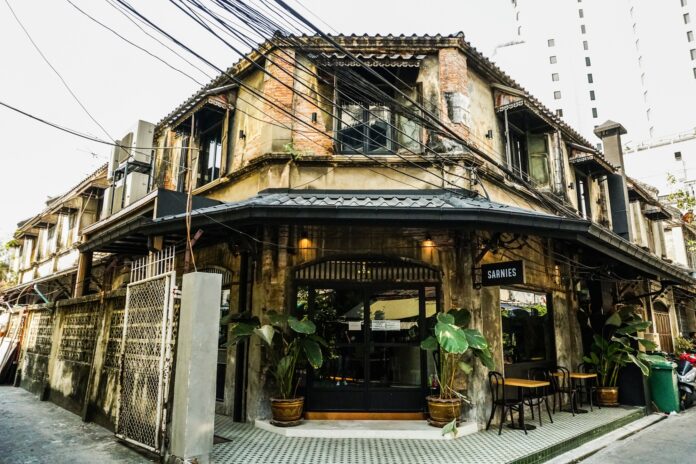
Sarnies Cafe may sound familiar to those who’ve been to the city-state’s Central Business District, where it draws fashionable crowds with quality coffee and big sandwiches. Now the hip hangout has found its north into wonderfully distressed-looking digs in the Bangkok riverside area off Charoen Krung Road.
Transforming what had been an empty, two-story shophouse, Sarnies Bangkok opened in late December with designs blending rustic style with a modern touch perfect for welcoming cafe crawlers.
Renovations were kept to a minimum on the 19th-century building, meaning authentic vintage charm oozes from exposed bricks, weathered concrete and peeling teak.
It took only a week for the place to find an audience and go from a few dozen daily customers to hitting its 400 maximum capacity. The place’s partners said they barely put any work into marketing and relied mostly on word of mouth and social media.
Despite it being 10am on a recent weekday, the venue’s first floor was already occupied by a mixed crowd hunkered over cups of coffee or brunch. Two men walked in and were told by the barista to “please make yourselves comfortable.”
The shophouse before Sarnies Bangkok took over. Photo: Sarnies Bangkok / Courtesy
“In terms of cafes, we want to bring something special to Bangkok,” said barista Eric Chan, who’s also a partner. “When you think of a cafe that serves brunch, there are not too many of them in Bangkok. Nothing with a full-scale menu, usually. That makes our brand quite unique.”
The original Sarnies Cafe was opened in 2011 by Ben Lee, an Australian banker. Lee said he did so because he couldn’t find a good sandwich in Singapore. It soon expanded beyond not only “sarnies,” British slang for sandwiches, but also caffeinated drinks and other brunch items.
“It’s funny because the brand is called Sarnies, but we do a lot more than sandwiches,” Eric said. “We wanna check all the right boxes. Good Coffee. Good Food. Eventually at night time we want to launch dinner too.”
Still in its “soft opening,” Sarnies Bangkok already offers a variety of fare.
The highlight is an classic English dish called Fry-up (450 baht) which comes with a big bowl filled with eggs (fried, poached or scrambled), home-cured smoked bacon, spicy northern Thai sausage aka sai ua, baked beans, roasted tomatoes, sauteed mushrooms and sourdough bread.
“It’s perfect for post-hungover,” general manager Nick Chong said as the hearty dish hit the table at a recent hosted tasting.
Fry-up (450 baht)
Some localized dishes take “a little bit of a different spin” from the original branch. They include Tom Yum Eggs Benedict (320 baht) and Krapao Brisket Hash (320 baht). The assortment of breads are picked up daily from Amantee, a French bakery in the Rama III area. Salmon and bacon are from artisan meat distributor Sloane’s.
“A lot of ideas behind the menu are to celebrate the local ingredients,” Nick said.
Apart from traditional coffee drinks such as espresso, lattes and cappuccinos, there are some specials worth trying: Iced orange mocha (homemade chocolate sauce infused with orange zest for 140 baht) and iced coconut long black (long black made with fresh coconut water for 140 baht).
The beans come from several places around the world including Thailand’s Lampang province, Laos, Brazil and Panama. They’re roasted weekly by A Stimulant by Sarnies located up Soi Sukhumvit 39.
Capturing the eco-friendly moment, iced drinks at Sarnies are served with reusable metal straws. For takeaway drinks, they are made of biodegradable plastic.
Vegetarians can choose a CB&J (cashew butter, natural local honey, roasted grapes, thyme on sourdough for 280 baht), Triple-Cheese Sarnies (triple cheese toast, sun-dried tomatoes, braised aubergine and baby spinach on sourdough for 300 baht) and Avocado Loaded Toast (smashed avocado, feta cheese, roasted tomatoes and dukkah on sourdough for 320 baht).
Not satisfied with any of the above? Try the Pimp My Breakfast options to mix and match your favorite sides, from smashed avocado and sauteed mushrooms to flank steak, charred mackerel and smoked salmon.
While the place is known for coffee and brunch, a surprising number of passers-by walked in to pick up A F**king Good Brownie (140 baht) or Chunky Choc-Chip Cookie (140 baht), which are baked in-house. The intense, fudgy brownies and cookies are perfect for a bite when they’re sprinkled with sea salt flakes on top to cut through the sweetness.
Sarnies Bangkokis located on Soi Charoen Krung 44, only a few minutes walk from BTS Saphan Taksin. It currently opens 8am to 5:30pm daily with plans to add later hours for dinner and drinks in the future.
Fry-up and iced orange mocha
Partners of Sarnies bangkok, From left, Nick Chong, Eric Chan, Taya Rogers and Mika Chunuonsee
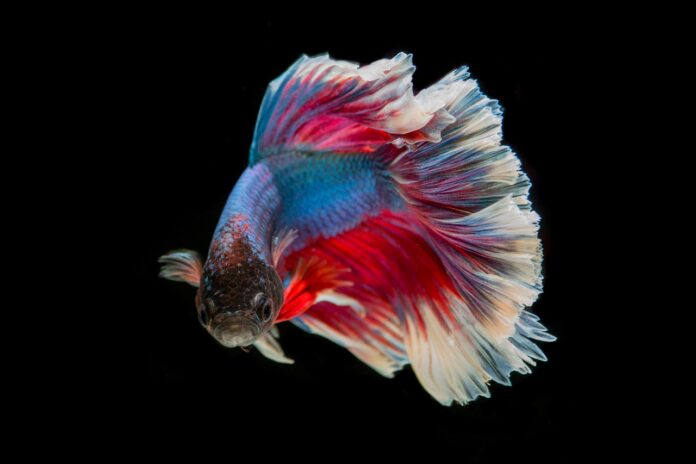
BANGKOK — The cabinet on Tuesday approved the Siamese fighting fish to become Thailand’s national aquatic animal.
Grisada Boonrach, agriculture and cooperatives minister, said the colorful and violently territorial fish was chosen as it’s a native, unique species to the kingdom’s waters and an important animal for Thailand’s economy.
The decision came after the National Identity Committee, which promotes Thai cultural pride, forwarded its endorsement of the fighting fish in December to the cabinet.
The Siamese fighting fish was registered as intangible cultural heritage by the Cultural Ministry in 2013. Its designation as Thailand’s national aquatic animal could help boost both conservation efforts and commercial breeding.
Its bright colors makes the fish popular in home and office aquariums, while the aggression between males make them popular with gamblers.
The fish is the first national aquatic animal to be designated. Elephants are, of course, the kingdom’s national animal.
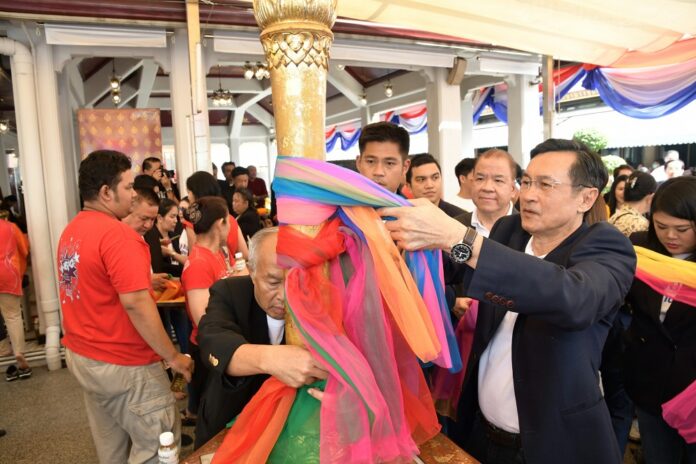
Thai Raksa Chart Party members pray at the City Pillar Shrine for luck Tuesday before registering as candidates for the March election.
BANGKOK — When it comes to who will run the country, a party allied with former leader Thaksin Shinawatra is keeping some of its cards close to the vest.
While other major parties have identified who will be their prime minister candidates, Thai Raksa Chart Party said it would reveal its list “at an appropriate time.” All parties have until Friday to disclose their candidates, who don’t need not be seeking elective office.
“But let me confirm we have it,” party chairman Preechapol Pongpanich told reporters today. “We have already discussed this, but we do not wish to disclose the details at this moment.”
Preechapol was speaking at the Election Commission office where Thai Raksa Chart politicians were registering as MP candidates. They included big names in the Redshirt movement like Chaturon Chaisang and Nattawut Saikua.
Preechapol believes his party will net at least 50 seats in the election set for March 24.
Thai Raksa Chart is in the same coalition with other pro-Thaksin parties like Pheu Thai and Prachachart. Those two parties have already announced their prime minister candidates, as has their archrival, the Democrat Party.
Pheu Thai last week named a former popular transport minister Chadchart Sittipan, former health minister Sudarat Keyuraphan and former justice minister Chaikasem Nitisiri. The Democrats nominated longtime leader and ex-prime minister Abhisit Vejjajiva.
The current constitution – drafted by junta lawmakers and approved by a majority of voters in 2016 – permits unelected individuals to become “outsider prime ministers.” Each party contending in the poll can list up to three candidates. They do not have to belong to any party.
A pro-junta party last week invited junta chairman Prayuth Chan-ocha to run as its candidate. Although the regime leader has repeatedly expressed his desire to serve another term, Prayuth said he would give his answer Friday.
LAMPANG — A large fish released into a public park by temple-goers turned out to be the predatorial Amazonian arapaima, officials said Monday.
The well-intended release at a large pond located inside Nong Krathing Park sparked a hunt for the fish due to concerns that the alien species could damage local ecology, fishery official Samatchai Thongkamchum told reporters.
The fish in question is a 30 kilogram arapaima native to the Amazons, which is considered an an aggressive predator and an invasive species to Thai waters, Samatchai said.
Authorities were alerted about the creature after a man posted on a Facebook group for Lampang locals that he made merits on Friday by releasing an Amazonian fish into the pond. Many Thai Buddhists believe freeing animals like fish and birds into the wild contributes to good karma.
But netizens soon identified the fish as the predatorial arapaima and the post went viral.
Samatchai said the fishery department will bring in fishing experts to locate and capture the arapaima.
PATHUM THANI — An outdoor DJ dance fest is going one day instead of two for its fifth birthday next month and is looking to expand the fun beyond house and techno.
This March, Kolour in the Park will return to the lakeside venue in northern metro Bangkok with three stages of music, art installations, food trucks, swimming and free Thai massages.
This year though, organizer Kolour will do something different in terms of music. Festival co-founder Coran Maloney said it will go beyond the usual genres that have defined Bangkok’s party scene.
“A brand new Park stage will have a total lineup of live performances and artists, spanning electronic and indie with influences of disco, jazz, house, hip hop, electronica and instrumental,” Coran said.
The event, which has been held over two days annually since 2015, will be scaled down to one to “ensure the richest and most immersive experiences.”
Music lineup highlights include Belgian techno DJ-producer Charlotte de Witte, Jamaica-born R&B and jazz artist Masego and electronic musician SG Lewis.
The list continues with tech and house DJ Eskuche from New York, South African electronic artist Floyd Lavine and Yung Bae, a future funk producer whoperformed in Bangkok last year. Local artists joining the stage will include Boris Rubin, Dan Buri, Gramaphone Children and Kuroten.
Boutique bars and food stalls will pop up along with roaming performance art. Those who tire of dancing can get free Thai massages.
The event is limited to people over 20. Tickets range from 1,500 baht to 2,900 baht and can be purchasedonline.
The festival takes place March 2 at Thai Wake Park in Pathum Thani province, a 45-minute drive from downtown Bangkok. A shuttle bus service will be available from the Ekkamai Bus Station next door to BTS Ekkamai.
In this Jan. 15, 2019, photo, Cha Ji Won, a 24-year-old YouTuber who runs a channel called "Korean Womyn." speaks during an interview in Seoul, South Korea. Photo: Jung Yoon Kim / Associated Press
SEOUL — As she pursued her dream of becoming a fashion model, veering for years between extreme dieting and overeating, Park I Seul realized she had a problem: She was not tall and skinny, like typical runway models, nor was she big enough to be a plus-size model.
She also realized that the only way to meet South Korea’s lofty beauty standards was for her to continuously deny who she truly is.
So Park, 25, began calling herself a “natural size model” — a nearly unheard of term in South Korea — which she defines as someone with the same kind of body you see in daily life, as opposed to a difficult-to-attain ideal. She began to get work, and she started a popular YouTube channel where she introduces fashions for women who look more like her than like the women in fashion magazines.
Her newfound positive view of her body makes her part of a growing movement by South Korean women to resist what they see as extreme pressure to look a certain way.
Hundreds of young women have taken to social media with the hashtag “talcorset,” or take off the corset, to encourage others to free themselves from social stereotypes about their appearance that they feel have long bound them.
Park recently held what she called a “nondiscriminatory” fashion show in Seoul, where models varied in height and weight confidently strode across the stage. Other women have posted online photos or video clips showing themselves cutting their hair short, destroying their beauty products and going to school or work without makeup.
In South Korea, a woman weighing over 50 kilograms (110 pounds) is considered by many to be chubby, regardless of how tall she is.
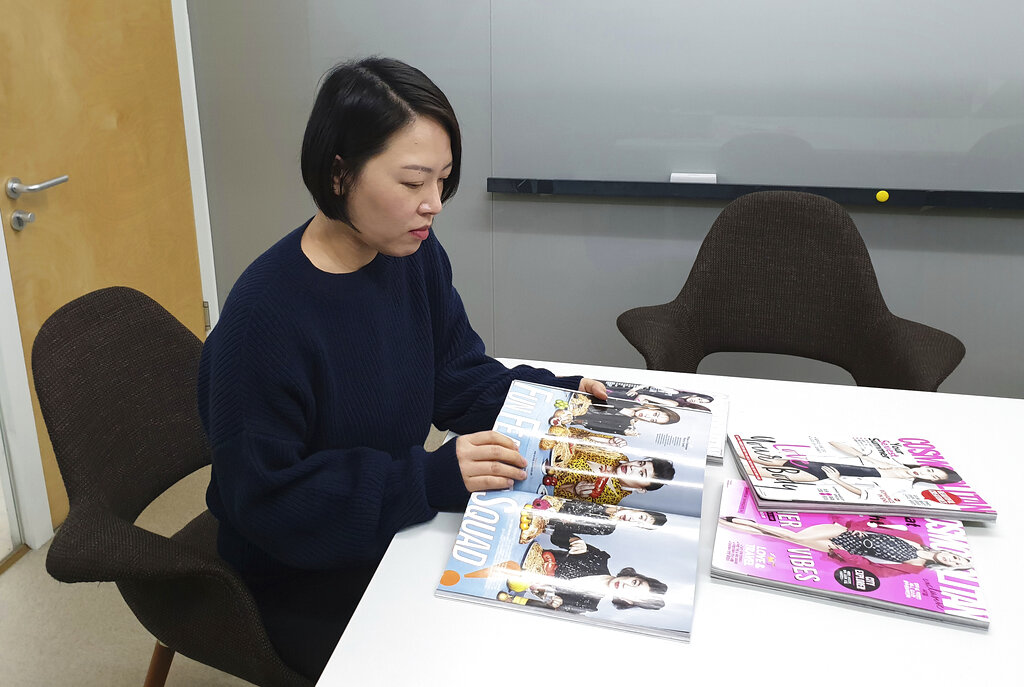
In this Jan. 23, 2019, photo, Park Jiehyun, features director at Cosmopolitan Korea, watches fashion magazine during an interview in Seoul, South Korea. Photo: Jung Yoon Kim / Associated Press
Park herself is 165 centimeters (5 feet 5 inches) tall and weighs 62 kilograms (137 pounds), which she says puts her far from the minimum 170 centimeters (5 feet 7 inches) and 40 to 48 kilograms (88 to 106 pounds) weight that conventional fashion models have; she’s also nowhere near the XL and above sizes demanded for plus-size models.
“I used to think that my fat body wasn’t the real me and that living in such a body wasn’t my real life. I kept denying myself. I believed that my life would only become happy after I lost weight,” Park said. “I’ve come to think that I look good enough just the way I am.”
South Korea is a deeply conservative country, and experts say its patriarchal society encourages rampant sexism. It had the largest gender pay gap among developed countries in 2017, according to the Organization for Economic Co-operation and Development, and ranks 115th out of 149 nations in the World Economic Forum’s global index of overall gender parity in 2018, among the lowest-ranking G-20 countries.
This Jan. 23, 2019, photo, shows the Cosmopolitan Korea Magazine cover with a popular South Korean comedian Lee Young-ja during an interview of Park Jiehyun, features director at Cosmopolitan Korea, in Seoul, South Korea. Photo: Jung Yoon Kim / Associated Press
According to a 2018 survey by Saramin, a leading South Korean recruitment website, 57 percent of human resources managers at South Korean companies agreed that job applicants’ appearances influenced their evaluations. The survey also showed that female applicants are more affected by their looks on their job evaluations than male applicants.
As more women begin to embrace feminism, there’s also a new willingness to challenge strict South Korean societal demands that force women to take extreme care of their looks, according to Sohn Hee-jeong, a researcher at the Institute of Gender Studies at Yonsei University in Seoul.
Consider, for instance, a video by Cha Ji Won, a 24-year-old YouTuber who runs a channel called “Korean Womyn.” The video, which has gotten more than 720,000 views, shows her daily routine after she stopped obsessing over her hair and wearing makeup every day and began choosing and wearing comfortable clothes. It now takes her half the time to prepare to go outside as in the past, and she says she eats whatever she wants and doesn’t think about calories.
“I hoped that by letting other women know that there is someone like me, I could remind them that they don’t have to care too much (about how they look) and spend so much money and time on their appearance,” Cha said in an interview.
The movement can also be found in schools.
An 18-year-old high school senior who wished to be identified only by her last name, Hong, because of worries about her future studies recently exposed a series of lectures at her all girls’ school that promoted a focus on women’s appearance as they entered college. The lecture titles included, “Makeup for college freshmen,” ”Fashion styling for college freshmen” and “How to make a healthy body figure.”
Hong objected to her high school recommending classes that appeared to encourage female students to “take care” of their appearance. Hong and some other students contacted journalists to complain about the lectures, prompting the school to remove the classes.
Hong said she put on makeup for the first time when she was in elementary school and was wearing full makeup by high school. She no longer wears makeup and questions why women must always be judged on how they look. However, many children are ashamed of what in Korean is called ssaeng-eol, or bare face, Hong says, and won’t go outside without makeup.
South Korea has the world’s highest ratio of plastic surgeons per capita, according to a report by the International Society of Plastic Surgery in 2016. According to 2015 statistics by Gallup Korea, about one third of South Korean women between 19 and 29 said they’ve had plastic surgery.
“I think (South Korean women) want to look perfect,” said Park Jiehyun, feature?s director at Cosmopolitan Korea, a popular fashion magazine. “They believe they should have a nice body and skin, beautiful eyes, nose and mouth, and even sleek hair with a perfect hairline. They also want to have good style.”
But Park says rising feminist movements and changing values among South Korean women are redirecting her industry’s depiction of beauty.
In its December issue, Cosmopolitan Korea featured a popular South Korean comedian, Lee Young-ja, as the cover model. Lee is larger than the typical skinny cover models the magazine uses.
Still, there’s often intense beauty pressure at work.
Choi Min Jeong, a former employee at a beverage company, still remembers her boss telling her that she had to work harder because she wasn’t as beautiful as a popular South Korean actress.
“Although he said it as a joke, I thought it was ridiculous that he said it when … my job was unrelated to appearance,” Choi said.
Airline companies often demand a stricter dress code for female flight attendants, according to Kwon Su Jeong, a Seoul councilwoman who has worked for Asiana, a major South Korean airline, for 24 years. Kwon is currently on a leave of absence to work in the city council.
“They control everything, from your hairstyle to the color of your lipstick and nails to the length and shape of your earrings,” Kwon said.
Although Asiana eased a “skirts-only” rule in 2013, many flight attendants still wear them because of worries of negative performance appraisals, Kwon said. Asiana strongly denied that it makes unfair demands or puts pressure on its employees regarding attire or appearance.
Kwon said the company’s upper management wants its flight attendants to uphold an image of a graceful, beautiful Asian woman who provides sincere service to customers. Because the company cares a lot about the appearance of its female employees it puts subtle pressure on them to have cosmetic procedures, she said.
“Although the company is rigid about taking a day off because of injury at work, it is more lenient about taking time off for cosmetic procedures,” Kwon said.
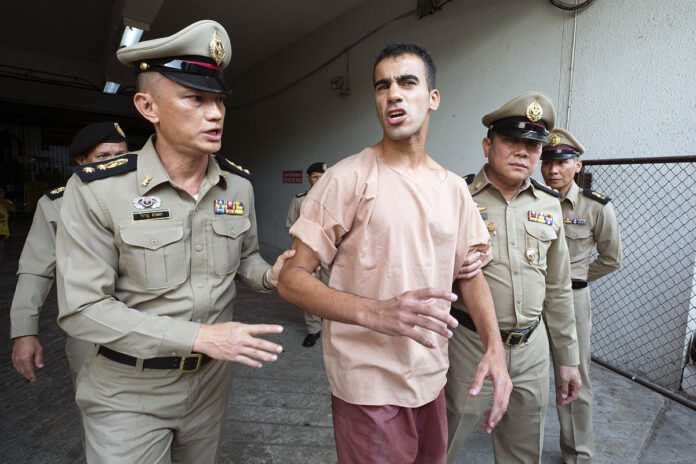
Bahraini Hakeem al-Araibi, center, leaves the criminal court in Bangkok, Thailand, Bangkok, Thailand, Monday, Feb. 4, 2019. The soccer player who has refugee status in Australia told a Thai court Monday that he refuses to be voluntarily extradited to Bahrain, which has asked for his return to serve a prison sentence for a crime he denies committing. Photo: Wason Wanichakorn / AP
BANGKOK — Hakeem AlAraibi and Rahaf Alqunun are two different cases, the head of Thai immigration said Monday as pressure mounts for Thailand to free the former rather than extradite him to Bahrain.
Lt. Gen. Surachate “Big Joke” Hakparn said the recent case of the young Saudi woman briefly held then allowed to depart a refugee cannot be compared to that of refugee athlete AlAraibi because the latter was the subject of an arrest warrant justifying his detention.
“Hakeem’s case is different from Rahaf Mohamed Alqunun from Saudi Arabia’s case because Hakeem had an arrest warrant out for him, but she did not. What’s more, Hakeem was the subject of an extradition request,” Surachate said.
Alqunun was guaranteed safe passage by Hakparn after she barricaded herself in a Suvarnabhumi Airport transit lounge rather than be forcibly deported back to her Saudi family. Thai officials reversed course under tremendous public scrutiny brought by Alqunun pleading her case over social media. She was successfully resettled in Canada within days after Surachate said he would not “send someone to their death.”
On Monday the Thai Criminal Court ruled that Bahraini footballer AlAraibi could appeal his extradition to Bahrain, where his supporters say he risks persecution on trumped-up charges. His next hearing was set for late April.
Australia’s ambassador to Thailand, who appeared at the court Monday with AlAraibi, said in a statement that Bahrain had never requested AlAraibi’s extradition in the four years he has lived in Australia.
“As soon as Hakeem and his wife travelled to Thailand for their honeymoon, the Government of Bahrain expedited its coordination with the Thai Government to have Hakeem arrested and commence extradition proceedings immediately,” the statement reads. “The actions of the Bahraini Government have put Thailand in a very difficult position. In particular, during what is an important year for the people and country of Thailand.”
Australia has urged Thailand to exercise its legal authority to release AlAraibi. Australian Foreign Minister Marise Payne said the Thai attorney-general has confirmed that the Extradition Act allows for such discretion.
She said this was also confirmed by prosecutors at yesterday’s hearing.
Bahrain says AlAraibi vandalized a police station and is a fugitive from justice. AlAraibi, who fled the kingdom in 2014, says he was playing in a televised match the day the government says he committed the crime. Australia granted him asylum in 2017.
AlAraibi was allegedly tortured by Bahraini authorities for his brother’s political actions and sentenced to a decade in jail for the alleged vandalism.