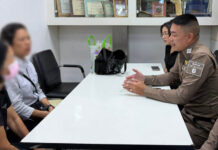
A file photo of police commandos training in March 2018.
BANGKOK — A special police division set up to protect the monarchy in October was renamed Monday to serve as a personal bodyguard unit under His Majesty the King.
In three separate orders published last night, the Special Service Division became the Ratchawallop Police Retainers, King’s Guards 904; with a new command structure and broader responsibilities.
The change was announced in two Royal Gazette decrees signed by junta chairman Prayuth Chan-ocha and a police order signed by deputy junta leader Prawit Wongsuwan.
The documents said the unit’s duties involve protecting the monarchy and coordinating with the royal palace for more efficient operation. Maj. Gen. Torsak Sukvimol will continue to lead the Ratchawallop Police Retainers, King’s Guards 904. Its jurisdiction covers the entire country.
The name is a reference to the Ratchawallop, a guard corps traditionally known for its close relationship with ruling monarchs. The number 904 is the police codeword assigned to King Vajiralongkorn when he was the Crown Prince.
A new subunit, called the Special Affairs Division, was also added to the structure. Its responsibilities include VIP protection for members of the Royal Family and running a mass volunteer group initiated by King Vajiralongkorn. It will also serve as a liaison between the volunteers and police, and train local police in VIP protection.
Furthermore, the division is tasked with evaluating the volunteer affairs, VIP protection and other assigned duties.
The volunteer group, called Chit Arsa, was created by the current monarch to perform a wide range of civic works, from cleaning the streets and canals to organizing events dedicated to the monarchy.
Hundreds of thousands of people are reported to belong to the network – which some analysts compare to the rural-based Village Scouts during the Cold War.
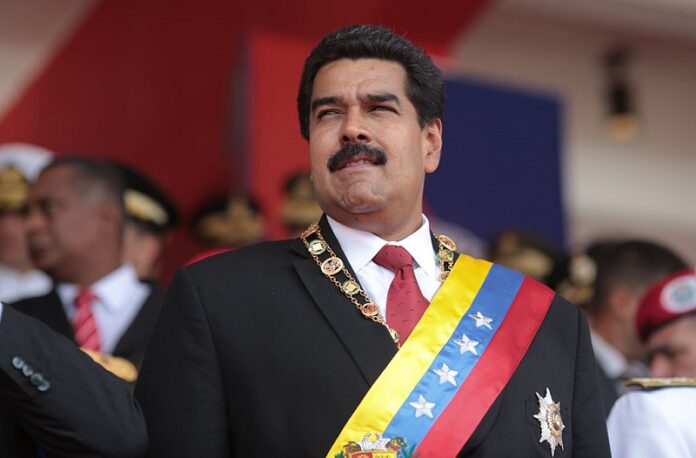
President Nicolas Maduro seen here in 2015 in Caracas, Venezuela. Photo: Hugoshi / Wikimedia Commons
WASHINGTON — The Trump administration on Monday sanctioned Venezuela’s state-owned oil company, ratcheting up pressure on socialist President Nicolas Maduro to cede power to the U.S.-backed opposition in the oil-rich nation in South America.
The action means Maduro’s embattled government would lose access to one of its most important sources of income and foreign currency along with about USD$7 billion in assets of the state-owned company, Petroleos De Venezuela S.A.
Hours after the White House announced the sanctions, Maduro went on state TV and called the U.S. action “immoral, criminal.” In words directed at President Donald Trump, he said, “Hands off Venezuela!”
The sanctions follow the unusual decision by more than 20 countries, including the U.S., to recognize the opposition leader of the National Assembly, Juan Guaido, as the interim president of Venezuela. Maduro was re-elected last year in an election widely seen as fraudulent. The once prosperous nation has been in an economic collapse, with several million citizens fleeing to neighboring countries.
“We have continued to expose the corruption of Maduro and his cronies, and today’s action ensures they can no longer loot the assets of the Venezuelan people,” national security adviser John Bolton said at a White House news conference to announce the sanctions with Treasury Secretary Steven Mnuchin.
Bolton said he expects Monday’s actions against PDVSA – the acronym for the state-owned oil company – will result in more than $11 billion in lost export proceeds during the next year.
Oil production – the lifeblood of Venezuela’s economy – has been collapsing for years. Despite sitting atop the world’s largest reserves, Venezuela currently pumps just a third of the 3.5 million barrels a day it did when the late Hugo Chavez took power in 1999.
The nation’s refining capacity has also declined because of poor maintenance and lack of skilled personnel. That has left it reliant on Citgo, the Houston-based refining arm of PDVSA, to refine the oil and send gasoline back to Venezuela to meet domestic needs.
“They have just lost that source,” said Russ Dallen, managing partner of Caracas Capital, a brokerage company.
Venezuela is very reliant on the U.S. for its oil revenue, sending 41 percent of its oil exports to the U.S. Maduro can divert the roughly 500,000 barrels per day of oil currently being sold to Gulf Coast refineries to markets in Russia, China, India, Malaysia and Thailand.
But processing international financial transactions is hard without going through the U.S. or European banks. Transport costs would also jump because Venezuela’s ports aren’t well-equipped to load supertankers for transporting oil to distant markets.
That means the country, which depends almost entirely on oil exports for hard currency, will be able to purchase even less food and other imports, potentially worsening shortages and deepening its economic collapse.
Outside the PDVSA headquarters in Caracas, office workers lining up to board red company buses were seeking information about the immediate impact of the U.S. sanctions. As he hurried home with his two children, one employee told The Associated Press that the sanctions signaled tough times ahead.
“Things are going to get difficult,” said the man, who refused to identify himself by name because he feared reprisals from the company. “The United States is one of the few buyers who pays for the oil up front, and it’s probably where most of our income comes from.”
Mnuchin said any money that U.S. entities use to buy Venezuelan oil will go into a blocked account in the United States, not the Maduro government.
He said if PDVSA wants to see the sanctions lifted, there would have to be a speedy transfer of control to the interim, U.S.-backed president and a democratically elected government that is “committed to taking concrete and meaningful actions to combat corruption.”
He said the Treasury Department has taken steps to allow refineries to continue importing oil from Venezuela temporarily. Also, he said Citgo will be able to continue importing oil as long as the revenue is sent to the blocked account in the United States.
“This is a country that is very rich in oil resources,” Mnuchin said. “There is no reason why these resources shouldn’t be used for the economic benefit of the people there.”
Mnuchin said he did not expect the sanctions would cause U.S. consumers to see higher prices at gas pumps.
The American Fuel & Petrochemical Manufacturers, which represents 95 percent of the refining sector, has lobbied hard during the past two years against any sanctions that would disrupt imports of Venezuelan oil. The association issued a statement saying it supported the Trump administration’s goal to bring change to Venezuela.
“To that end, we will work with the administration to minimize any unnecessary disruptions or negative impacts to the market and American consumers,” the association said.
Mnuchin insisted the sanctions would have only a “modest” impact on U.S. refineries because Venezuelan oil exports to the U.S. have declined steadily over the years, falling particularly sharply over the past decade as its production plummeted amid its long economic and political crisis.
The U.S. imported less than 500,000 barrels a day of Venezuelan crude and petroleum products in 2017, down from more than 1.2 million barrels a day in 2008, according to the Energy Information Administration.
Still, Venezuela has consistently been the third- or fourth-largest supplier of crude oil to the United States, and any disruption of imports could be costly for refiners. In 2017, the most recent year that data were available, Venezuela accounted for about 6 percent of U.S. crude imports. Valero and Citgo are among the largest importers of Venezuelan crude.
A visitor stands in front of stock trading boards at a private stock market gallery Jan. 17 in Kuala Lumpur, Malaysia. Photo: Yam G-Jun / Associated Press
SINGAPORE — Asian markets were lower on Tuesday after the U.S. Justice Department unsealed criminal charges against China’s Huawei, its subsidiaries and a top executive ahead of trade talks.
Keeping Score
Thailand’s SET traded at 1,622.24 on Tuesday morning, a loss of 0.17 percent. Japan’s Nikkei 225 index tumbled 1 percent to 20,448.47 and the Kospi in South Korea shed 0.4 percent to 2,169.42. Hong Kong’s Hang Seng index was 0.8 percent lower at 27,370.58. The Shanghai Composite index fell 1 percent to 2,572.39. Australia’s S&P ASX 200, reopening after a holiday, eased 0.6 percent to 5,870.80. Stocks fell in Taiwan and Singapore but rose in Indonesia.
Wall Street
U.S. stocks fell Monday on signs that slowing Chinese growth was affecting corporate America. Caterpillar, considered an economic bellwether, reported weaker-than-expected earnings for the fourth quarter of 2018. The company said it expects the growth of construction equipment sales in China to be flat this year. Chipmaker Nvidia slashed its fourth-quarter revenue estimate, citing slowing demand in China among other reasons. The S&P 500 index lost 0.8 percent to 2,643.85. The Dow Jones Industrial Average was down 0.8 percent at 24,528.22 and the Nasdaq composite gave up 1.1 percent to 7,085.68. The Russell 2000 index of smaller company stocks lost 0.6 percent to 1,473.54.
Huawei Charges
The U.S. criminal charges against Chinese tech giant Huawei allege that it violated U.S. sanctions by using a Hong Kong shell company to sell equipment in Iran. The company is also accused of stealing trade secrets, including technology behind a robotic device that T-Mobile used to test smartphones. Several of Huawei’s subsidiaries and its chief financial officer Meng Wanzhou were to also face criminal charges. Meng was arrested while changing flights in Canada last month. China has demanded her release and warned of retaliation against American and Canadian executives.
US-China Talks
According to Bloomberg, Treasury Secretary Steven Mnuchin said at a briefing Monday that President Donald Trump is set to meet Chinese Vice Premier Liu He in Washington. Negotiators from both countries are expected to sit down for two days of trade talks starting Wednesday. While a meeting with Trump may show that the U.S. is serious about striking a deal, charges against Huawei could cast a cloud over negotiations going forward.
Analyst’s Take
Charges against Huawei “illustrate the risks attached to the U.S.-China relationship,” DBS Group Research strategists Philip Wee and Eugene Leow said in a commentary. “The actions by the DOJ show that it would not be enough for China to buy more U.S. goods. America wants China to make structural reforms especially on its intellectual property practices,” they added.
Energy
Benchmark U.S. crude added 20 cents to $52.19 per barrel in electronic trading on the New York Mercantile Exchange. It dropped $1.70 to settle at $51.99 per barrel on Monday. Brent crude, used to price international oils, rose 15 cents to $59.96 per barrel. It lost $1.78 to $59.81 per barrel in London.
Currencies
The dollar was trading at 109.12 yen down from 109.35 yen late Monday. The euro strengthened to $1.1430 from $1.1428.
Starbucks CEO Howard Schultz speaks in 2017 at the Starbucks annual shareholders meeting in Seattle. Photo: Elaine Thompson / Associated Press
NEW YORK — Some of the most influential forces in Democratic politics revolted Monday against former Starbucks CEO Howard Schultz’s prospective presidential bid, insisting that an independent run would unintentionally help President Donald Trump win another four years in office.
The critics included the Democratic chairman of Schultz’s home state, another billionaire businessman who long flirted with an independent run of his own, former President Barack Obama’s chief strategist, and the most powerful super PAC in Democratic politics.
“If Schultz entered the race as an independent, we would consider him a target. … We would do everything we can to ensure that his candidacy is unsuccessful,” said Patrick McHugh, executive director of Priorities USA, which spent nearly USD$200 million in the 2016 presidential contest.
Specifically, he seized on Schultz’s apparent willingness to cut entitlement programs such as Medicare and Social Security to narrow the federal deficit.
“The bottom line,” McHugh said, “is that I don’t think Americans are looking for another selfish billionaire to enter the race.”
The intense pushback in the early days of the 2020 campaign reflects the passion Democrats are bringing to the race to deny Trump a second term. Rank-and-file voters and party officials alike are anxious about any hurdle that would prevent them from seizing on Trump’s unpopularity.
While no independent has won the presidency since George Washington, Democrats fear that Schultz would almost certainly split their vote and give Trump an easier path to re-election. Yet Democrats concede that they had few tools to dissuade Schultz from launching an independent campaign – as he told CBS’ “60 Minutes” on Sunday he was considering – though many were skeptical that he would actually follow through.
Schultz felt the passion of the anti-Trump resistance moments after he took the stage Monday evening in New York City to promote his new book.
“Don’t help elect Trump, you egotistical billionaire!” a protester shouted before being ejected by security.
In an interview with The Associated Press after the appearance, he acknowledged that his prospective run might be “threatening” to some Democrats, but said, “my heart’s in the right place.”
The 65-year-old billionaire confirmed that he has identified as a Democrat his entire life. But Schultz suggested his moderate approach might attract a significant number of Republican voters frustrated with Trump in addition to Democrats turned off by the party’s embrace of liberal policies, such as universal health care and free tuition at public universities.
“Who’s to say that lifelong Republicans given the choice between Donald Trump and a far-left liberal, progressive Democrat – if they had a better choice where are they going to go?” he asked. “My views are squarely in the middle.”
Schultz said he would make his decision in the “summer-fall” after spending the coming months traveling around the country – in part promoting a new book – to test whether there’s interest in an independent presidential candidate, according to a person familiar with his planning. Asked how much of his personal fortune he’d be willing to spend on the election, he said only: “I’m going to do what’s necessary.”
Schultz’s team has polled on the viability of a third-party run and believes there is an opening, though they have not shared the specifics of their internal surveys.
He’s being advised by a team with experience in both parties, including Steve Schmidt, who worked on Republican John McCain’s 2008 presidential campaign, and former Obama adviser Bill Burton, who joined Schultz at his Monday appearance in New York.
Schultz’s team also includes Republican pollster Greg Strimple, GOP strategist Brooks Kochvar, former journalist Erin McPike and Rajiv Chandrasekaran, another former journalist who has worked closely with Schultz since 2015.
Yet history – and the reality of a political system designed to favor major-party candidates – suggests that Schultz may do little more than play spoiler should he decide to run. Bloomberg, who studied the possibility of an independent run of his own in the past, offered Schultz a direct message based on his own experience.
“The data was very clear and very consistent. Given the strong pull of partisanship and the realities of the electoral college system, there is no way an independent can win. That is truer today than ever before,” Bloomberg, who is considering a Democratic 2020 bid, said in a statement.
He continued: “In 2020, the great likelihood is that an independent would just split the anti-Trump vote and end up re-electing the president. That’s a risk I refused to run in 2016, and we can’t afford to run it now.”
The angry voices were far and wide, and they included Obama’s former chief strategist, David Axelrod, along with Democrats from Schultz’s home state.
“If Schultz decides to run as an independent,” Axelrod tweeted, Trump “should give Starbucks their Trump Tower space rent free! It would be a gift.”
Tina Podlodowski, the Democratic chairwoman in Washington state, where Schultz has lived for decades, discouraged him from running as an independent.
“A billionaire buying his way out of the entire primary process does not strengthen democracy,” she said. “It only makes it more likely that our democracy will be further strained under another four years of President Donald Trump.”
Perhaps trying to elevate Schultz, who is not well known among Democratic primary voters, Trump himself weighed in on Monday, tweeting that Schultz “doesn’t have the ‘guts’ to run for President!”
The Seattle billionaire was in New York Monday to promote his latest book, “From the Ground Up: A Journey to Reimagine the Promise of America.” After New York, he has stops this week in Tempe, Arizona; Seattle; and San Francisco – but no dates listed for the early voting states of Iowa or New Hampshire.
On paper, Schultz offers a number of qualities that might appeal to voters. He grew up in public housing in New York City’s Brooklyn borough and became the first person in his family to graduate from college.
He’s also been a longtime Democratic donor, contributing to the campaigns of Obama, Hillary Clinton, New York Sen. Chuck Schumer, and Washington Sens. Patty Murray and Maria Cantwell, among others. In Monday’s interview, he said McCain was the only Republican he had ever donated money to.
The soft-spoken businessman has also criticized Trump, telling employees that the president was creating “chaos” and hurting business; calling Trump’s tax cuts for corporations unnecessary and reckless; and vowing to hire 10,000 refugees after Trump issued an executive order banning travel from seven mostly Muslim nations.
The Democratic National Committee declined to address Schultz directly. Spokeswoman Xochitl Hinojosa offered only this response: “We are focused on defeating Donald Trump, and anyone who shares that goal should vote for the Democrat nominee in 2020.”
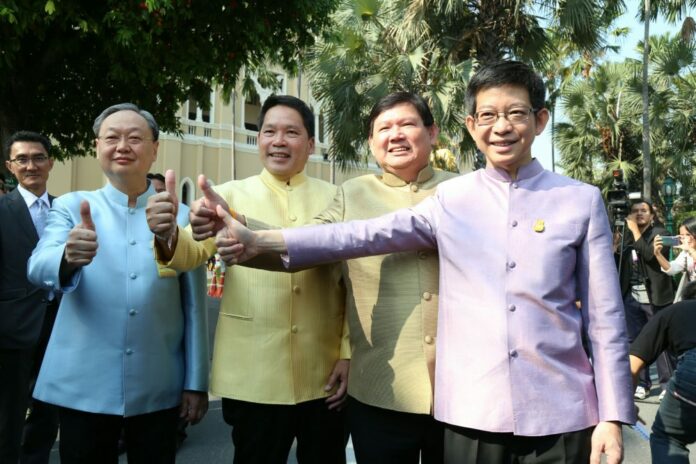
From left, Commerce Minister Sontirat Sontijirawong, Industry Minister Uttama Savanayana, Science and Technology Minister Suvit Maesincee, and Kobsak Pootrakool from the Prime Minister’s Office.
BANGKOK — Four members of a pro-junta political party announced Tuesday that they will resign from their cabinet posts in the military government to devote themselves to campaigning.
After months of enduring criticism for their dual roles, the four men, led by Palang Pracharat Party leader and Industry Minister Uttama Savanayana, said their resignations would be effective Wednesday.
The party is expected to nominate junta leader Gen. Prayuth Chan-ocha to serve as prime minister by the Feb. 4 nomination deadline or as early as Friday.
The other three ministers to announce their resignations are Science and Technology Minister Suvit Maesincee, a deputy party leader; Commerce Minister Sontirat Sontijirawong, Palang Pracharat’s secretary general; and Kobsak Pootrakool from the Prime Minister’s Office, who is a party spokesman.
The four can now devote themselves full time to campaigning in the run-up to general elections slated for March 24.
Commoner Party leader Lertsak Kamkongsak speaks Monday in Bangkok.
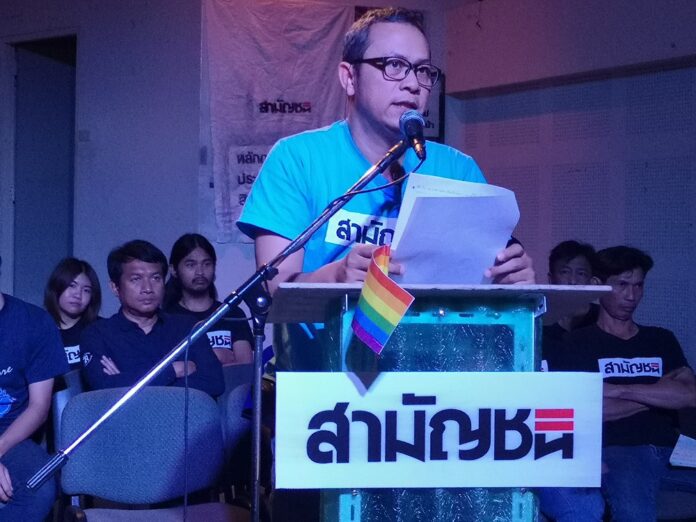
BANGKOK — The Commoner Party announced its policy platform Monday which would include doing away with appointed provincial governors, creating a welfare state, decriminalizing the cultivation of marijuana and decommissioning dams for solar energy.
This was a contrast with the fact that the party will likely be unable to field a candidate in Bangkok, aiming instead for sending 17 constituency-based candidates upcountry and five party-list MP candidates.
Chumaporn Taengkiang, deputy leader of the new leftist progressive party, said no votes would be wasted, however.
“No single vote in the ballot booth will be wasted compared to five years of loss [under the military regime]. If we get 100, 300 or 500 votes, that’s progress,” Chutima said when asked how to convince Thais to vote for his party instead of those with higher chances of getting MPs into parliament.
Under current calculations, at least 75,000 votes if not more would be needed for a party to win one party-list MP seat.
The party only has 2,000 members, and with a week left before the deadline, it has so far obtained only 200 of the 500 members needed by law to fill in a candidate in Bangkok. Environmentalist Lertsak Kamkongsak, the party leader, has only 63 followers on Twitter compared to the more than 27,000 followers of Thanathorn Juangroongruangkit, the leader of newly-founded Future Forward Party.
Lertsak said the party would push for long-term policies and vowed it would exist for a century.
Among its bold policies are replacing appointed governors and district chiefs with elected local representatives, dissolving the International Security Command Operation, or ISOC, and ending the use of coal power plants. It also aims to ensure that at least 60 percent of tax remains in the province where it was collected, introduce a 361-day paid maternal leave program and a minimum annual vacation of 21 days for workers.
Asked about the controversial lese majeste law and whether the party supports the abolition of the death penalty, the party was less clear.
“We have deliberated on the issue but haven’t reached a decision yet,” Chutima said, acknowledging that the two are controversial even for their self-styled leftist progressive party.
Lertsak said that at least 17 MP candidates would compete in the March 24 general elections in the following provinces, mostly in the northeast: Sakon Nakhon, Kalasin, Surin, Nong Bua and Lamphu. In the north, the party will compete in Chiang Mai and Chiang Rai.
With a Commoner Party candidate for Bangkok looking unlikely, Lertsak acknowledged it was unsure if the Election Commission would allow the party to campaign in the capital after they’re all filed Feb 8.
Under current elections laws, drafted and approved by the military junta’s rubber stamp parliament, voters can only vote for a party if it has a candidate based in the constituency.
“I regret that we couldn’t do it on time to send an MP candidate in Bangkok,” Lertsak said.
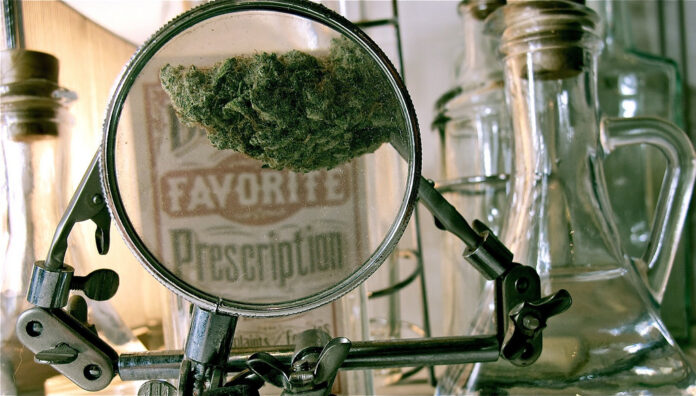
BANGKOK — Junta chairman Prayuth Chan-ocha on Monday banned applications for patents related to commercial uses of marijuana until a new law on medical cannabis is enforced.
In an order issued under Section 44 of the 2014 interim charter, which allows Gen. Prayuth to enact any laws he deems fit, the director of the intellectual properties agency must either throw out all pending patents that involve cannabis or remove marijuana from those patents within 90 days.
Members of the public can file requests to patent cannabis strains again when a new legislation authorizing medical uses of marijuana is formally enacted.
A lawmaker behind the legislation that would legalize the use of medical marijuana said Prayuth was simply confirming what the laws already said.
“The pending patents are illegal because they violate Section 9 of the [intellectual property] law, which bans patents of narcotic substances,” Somchai Sawangkan said by phone. “This problem is now considered solved by the law.”
The news came months after marijuana legalization activists discovered that foreign pharmaceuticals were applying for broad patents covering all strains of cannabis. The revelation prompted outcry that domestic uses of medical marijuana would be severely restricted by existing patents.
In response to the criticism, the Intellectual Property Department said in January that the pending requests could stay while the agency consults with legal experts on the best course of action.
Somchai said Prayuth’s order today settles any debate. He also noted that the law does not ban foreign pharmaceuticals from seeking patents on marijuana strains after medical cannabis is legalized.
“Anyone can file for patents. They are not barring anyone,” the lawmaker said. “Everyone is entitled to the same rights.”
A law on medical marijuana was recently greenlit by the interim parliament in December, but it would not be considered in effect until His Majesty the King signs it into laws.
King Vajiralongkorn can deliberate on the law as long as he wishes, Somchai said, adding that the process typically takes about 45 to 90 days.
BANGKOK — Make Penthouse Brunch the highlight of your Sunday and immerse in a one-of-a-kind brunch experience above the city. Conceived and designed as a private penthouse that holds permanent open house for those who share a passion for life with the irrepressible imagined host, The Penthouse now presents its solution to the quandary of what to do on Sunday: #PENTHOUSEBRUNCH
Let Chef de Cuisine Andrew Dickie and team prepare you with premium surf and turf selections made with handpicked ingredients and organic produce at The Grill on Level 34. The Penthouse Brunch features premium quality meats and tomahawks, grilled to perfection at an open grill station along with fresh seafood selections such as salmon steaks, Hokkaido scallops and oysters.
Bask in the live entertainment atmosphere featuring acoustic music performance by The Selby Brothers covering classic hits of the past and present.
BANGKOK — It is time for Hiroshima oysters! These highly-prized marine delicacies have been sourced straight from the coast of Japan’s Hiroshima Prefecture and transformed into three delectable dishes by Toshiyuki Okabe, our Japanese Chef de Cuisine. They will be served exclusively at Soba Factory, Bangkok Marriott Marquis Queen’s Park, from 1 February to 30 March 2019 for lunch and dinner.
Hiroshima oysters have been highly valued in Japan since ancient times. The coast of the Hiroshima Bay provides the perfect conditions for oysters to flourish, as fresh water from the Ota River meets the sheltered Seto Inland Sea, creating an abundance of nutritious plankton that oysters feed on. As a result, this region now produces up to 60 percent of the oysters exported from Japan each year.
Chef Toshiyuki Okabe selects only the finest, freshest and most succulent Hiroshima oysters to serve at Soba Factory. His three authentic Japanese dishes include: “Kaki Nanban Soba” – hot soba noodles with grilled oysters in nanban soup (THB 350++), “Kaki Tsuke Soba” – cold soba noodles with grilled oysters and soup (THB 350++) and “Kaki Furai” – deep-fried oysters (THB 250++).
All three special dishes are available at Soba Factory, Bangkok Marriott Marquis Queen’s Park on Sukhumvit Soi 22, from 1 February to 30 March 2019 for lunch (12.00 to 14.30 hrs) and dinner (17.30 to 22.00 hrs).
For more information and reservations, please contact +66 (0) 2 059 5999 or email [email protected].
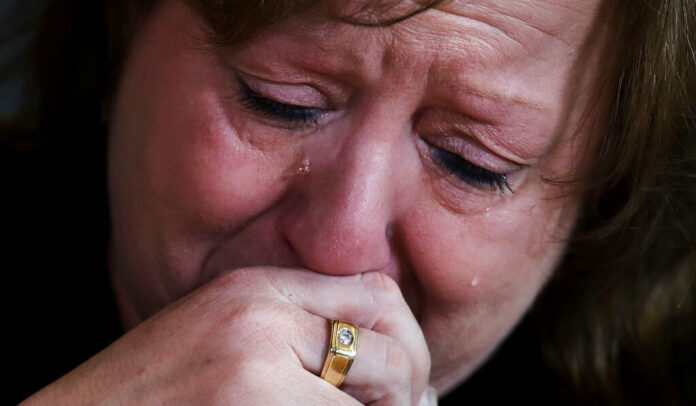
Terri Osborne, a police dispatcher in Hudson, Mass., cries as she talks about the loss of her son, to an opioid overdose in July 2018, during a group support meeting during her lunch break in Hudson, Massachusetts. Photo: Charles Krupa / Associated Press
MARLBOROUGH, Massachusetts — The moms meet in a parking lot overlooking the little white funeral home and watch the mourners drifting toward the chapel doors – a familiar scene, beginning again.
Cheryl Juaire taps nervously on her steering wheel.
“Are we ready?” she asks the two other mothers leaning into the window of her SUV.
The wake starting inside is for a stranger, another young man consumed by the great American plague. These women drove nearly two hours to shepherd his mother into their club, its thousands of members all bound by the same hell: They are parents of the dead from addiction, tasked with the unnatural act of burying their children at a rate unprecedented in modern American history.
“I’m going to stay in the car,” one mother says. “I just can’t go in.”
“I get it,” Cheryl assures her.
Cheryl, the leader of this unhappy welcoming committee, fishes a sympathy card out of her purse. She bought some in bulk not long ago and was stunned to find this was the last one left.
Each card equals another set of parents, their lives clawed apart by the opioid epidemic. Many are broke from paying for treatment or raising their grandchildren at retirement age. Some have been diagnosed with post-traumatic stress disorder.
The chaos of addiction consumed their lives. Then the chaos ended with a funeral, and the quiet proved far worse.
Cheryl reads newspapers hunting for obituaries and searches social media for the newly bereaved, to invite them into the fold. You are not alone in guilt and grief and regret and rage, she needs them all to know. It has become her own kind of addiction, a habit to quiet the demons.
Her son, Corey Merrill, overdosed on heroin at 23 years old in 2011, just as the crisis was turning into catastrophe. She had thought using drugs was a failure of morality and gumption. Back then much of America thought the same – that addiction was merely a bad choice.
So, no, she had told Corey, he couldn’t stay with her because she hadn’t raised him that way, and he’d slept instead on a park bench.
Then he died alone, and she slowly arrived at the sickening realization that addiction is a disease she hadn’t understood, and because she hadn’t understood it, she couldn’t save him. She didn’t even know he needed saving.
Now this is her penance: wake after wake, mother after mother, trying to spare them the solitary torment that almost killed her.
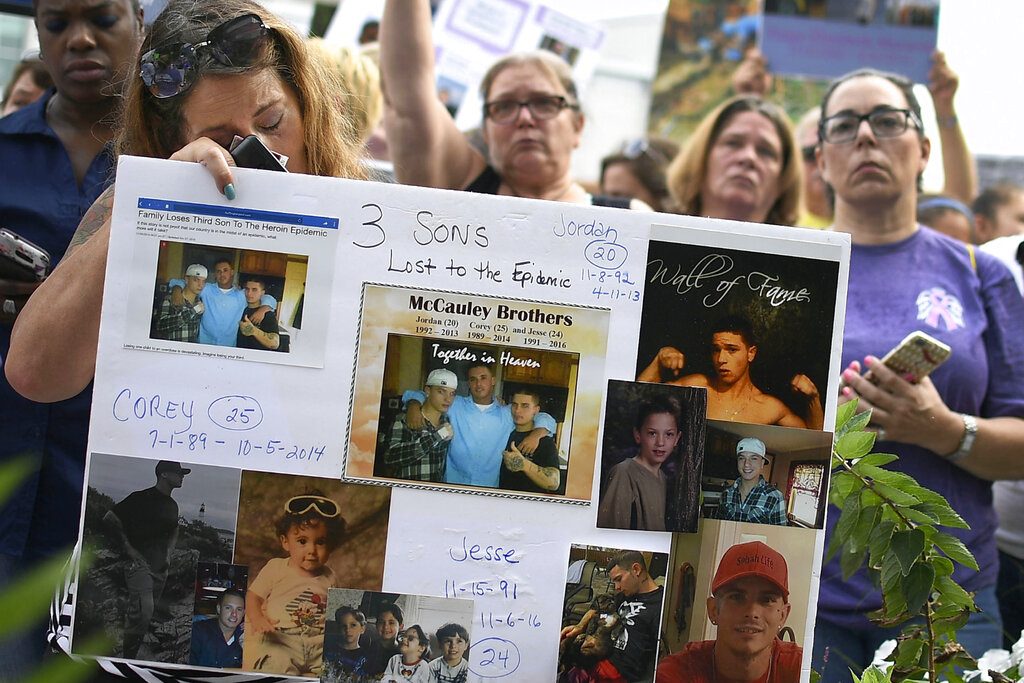
Jeanmarie McCauley, left, of Rockland, Massachusetts, rests her head on a sign she made of her three children who died within three years to drug addiction, as family and friends who lost loved ones to OxyContin and opioid overdoses stage a protest outside the headquarters of Purdue Pharma in August in Stamford, Connecticut. Photo: Jessica Hill / Associated Press
Cheryl straightens the gold cross around her neck, smooths her bob, freshly dyed chestnut brown to hide hints of gray, and climbs out of the car.
“That mom gave birth to that child,” she says. “When those doors close today, and they put her son in the ground, it’s not the end for her. It’s just the beginning.”
Earlier in the week, four bereaved mothers who make up the board of Cheryl’s nonprofit met poolside at one of their homes on a suburban cul-de-sac in Wrentham. A white sign was staked out front in the grass, with #2069 printed in black. That’s the number of people opioids killed in Massachusetts in just one year, one state’s slice of the more than 400,000 who have died in the U.S. since the epidemic began in 1999.
Overdoses now kill more each year than guns or breast cancer or AIDS at its peak. They kill more than the entire Vietnam War. They kill nearly 200 people a day on average, the equivalent of a 9/11 every few weeks. “One analogy that can sometimes get people’s attention is that it’s like an airplane full of commuters crashing every single day,” one mother offered as the group struggled to somehow depict the magnitude of their mission.
And yet it feels to these mothers that the world is getting tired of hearing about all their dead kids.
They led a campaign of thousands across America to send President Donald Trump photos of their children, all mailed last Feb. 10 to reach him by Valentine’s Day. They expected the president to say, or tweet, that he heard them and would do something. They expected media coverage from coast to coast – that people would look into their children’s eyes and be so enraged they’d march in the streets.
But there were no marches for them. That Valentine’s Day, 17 people were gunned down at Marjory Stoneman Douglas High School in Florida, consuming political and public attention. Cheryl grieves for the parents who lost a child there. But she did the math, and that many people will die from drugs by the time this three-hour board meeting concludes.
“Where is the outrage for us?” she asks. “Our kids are still dying, and the only thing I can do is try to pick up the pieces for the moms once they do.”
Her organization’s official name is “Team Sharing.” But she usually just says: “My Moms.”
When she started this group on Facebook three years ago there were only seven members, all mothers near her home in Marlborough, Massachusetts. Then another parent joined and another, as overdoses became the leading cause of death for young Americans, dragging down the nation’s overall life expectancy three years in a row for the first time in a century.
Now Cheryl, 60, begins each day at dawn in her recliner, before her part-time job as a receptionist at a church, studying a 25-page document, single-spaced, that lists the hundreds of Team Sharing members and details about their children. Some on her list have lost two children to drugs. One lost three. One lost four.
On a recent Sunday afternoon, Cheryl got a call from a mother who had already buried one addicted son, and she was screaming, incomprehensible. Cheryl sped to her house to find that her second son had overdosed in a bedroom upstairs. The paramedics were still there, and Cheryl held this mother as they carried his body out into the coroner’s truck.
Many parents of the dead try to channel their grief into change. The nation knows how to fix this, they insist; all that’s missing is the will. “Let the junkies die,” they’ve heard people say, even though the American Medical Association, the American Society of Addiction Medicine and the surgeon general all define addiction as a chronic brain disease that is, like some cancers and diabetes, fueled by a mix of genetics, behaviors and environment. The surgeon general notes that unlike those with cancer or diabetes, only about 10 percent of those with addiction get effective treatment.
This coalition of mothers believes the epidemic is unfolding much like AIDS did, with a society indifferent toward people believed to have brought their deaths upon themselves. That disease killed unabated by the thousands until masses started protesting.
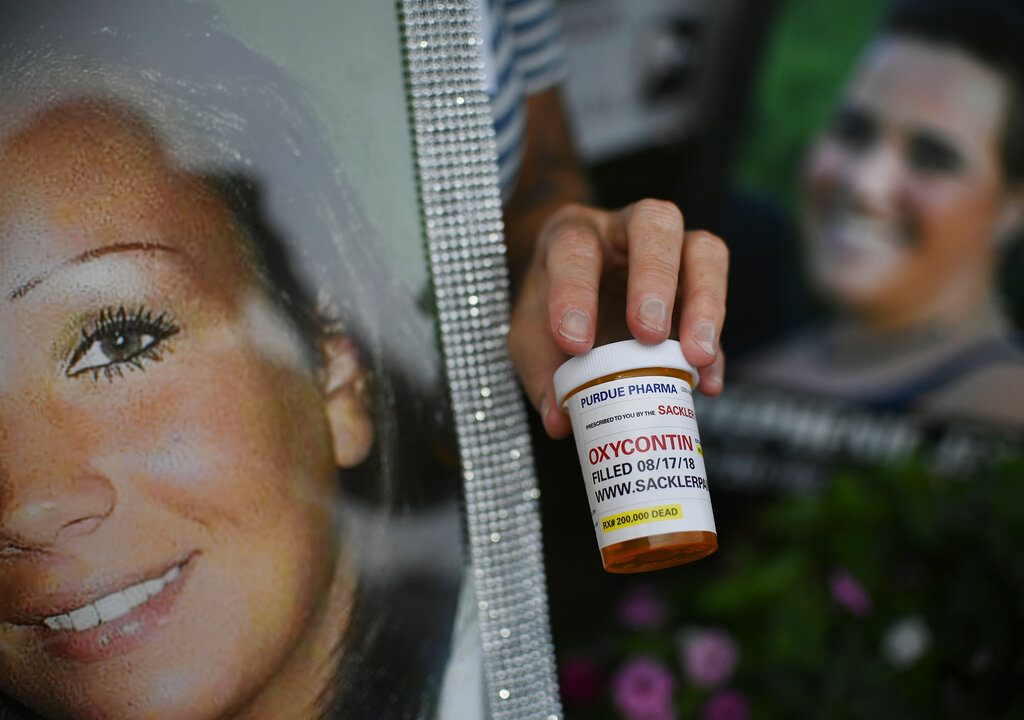
So these parents testify before Congress, tell their stories in school gymnasiums and cry on local television news. They proselytize at rallies, warning that any family could be next, and see crowds filled with people who’ve already learned that the hard way. Cheryl led a picket outside Purdue Pharma, whose mass marketing of the powerful painkiller OxyContin helped unleash the crisis.
“What more do we have to do?” she wonders.
Cheryl doesn’t like to talk about politics. Both Republicans and Democrats have failed to stop this, she says. She voted for Trump, who declared a public health emergency in 2017, and remains hopeful that he’ll keep his promise to end the scourge.
Last year, Congress passed a legislative package designed to combat the crisis and appropriated $8.5 billion, a figure experts say is a welcome step but far short of the sustained funding required to build the necessary treatment infrastructure. During the AIDS crisis, the federal government increased funding by tens of billions, says Keith Humphreys, a Stanford University professor and drug policy expert. “The opioid epidemic is as serious as that one and will require similar resources.”
A woman holds a prescription drug bottle with a label in protest of Purdue Pharma and its product OxyContin outside the company’s headquarters in August in Stamford, Connecticut. Photo: Jessica Hill / Associated Press
It overwhelms Cheryl to think of all the things the nation needs to do to solve this, and so she tries to focus on what she knows.
She knows parents with no money left to bury their children; the ashes sit in cardboard boxes. So the first agenda item at her board meeting this week is to decide how much to donate for headstones and urns. Her board members grimace.
There’s Cindy Wyman, who used to knock on drug dealers’ doors carrying a picture of her daughter. And Lynn Wencus, whose son emptied her bank account and pawned her wedding ring and still she borrowed against her 401(k) to pay for treatment. She once drove him to buy heroin because he was desperate to get into a detox facility that would only take patients with drugs in their system. She sat next to him as he shot up, holding overdose reversal medication and weeping.
“That’s what we were willing to do to save our kids,” Lynn says. “And even at that, it wasn’t enough.”
They dreaded the phone call for years. For Cheryl, it came in the middle of the night, from her oldest son, Bobby, a police officer.
“Mom, Corey’s dead,” he said. Cheryl felt her knees buckle.
That call is her marker in time: There was her normal life before it and her life now, which includes an unwanted expertise in burying young Americans.
Maybe, she suggests to the board, they should give parents $500 to help bury their first child and $1,000 for their second?
Lynn rubs her temples and groans. “Second child,” she repeats. “Oh God.”
“I know,” Cheryl says. And then, before she could stop it, her mind wandered down into the basement of a funeral home and she was shopping for caskets seven years ago. On that worst day of her life, her oldest son, the officer, collapsed weeping. Her middle son, Sean, was still addicted to the “happy pills” Corey had introduced him to. And Cheryl felt helpless to fix any of it.
She had stood at her son’s wake, shaking hands, smiling awkwardly – unaware that the fog would lift and the reality would crush her until she wished she would die, too.
When Corey was born, Cheryl had pulled his bassinet next to her bed and slept with her hand on his back, counting his heartbeats. She’d had her first two sons young, but Corey was planned. She always feared she would lose him.
“I just felt life was never going to be good for me,” she says. “And then something so good came along.”
Corey’s father left when the boy was 5, and for a few years it was just Cheryl and her sons. Corey slept in her bed every night. Four years later, she met Peter Juaire, a firefighter, and was smitten.
With a new husband there were new rules to follow; Corey was a jokester, always playing pranks, and didn’t like rules. He had been a Boy Scout and Little Leaguer, then he dropped out of high school and it all spiraled quickly. Cheryl saw him for the first time in shackles when he was arrested on a drug charge at 18. “That’s my baby,” she wailed, and the guards had to hold her up. Then he was in and out of detoxes and jails and called her sometimes to say he had nowhere to go.
Peter, a recovering alcoholic who got sober 31 years ago, thought Corey had to hit bottom, so Cheryl told Corey he couldn’t stay with them. Now when she envisions her son sometimes, he’s sleeping on a bench.
“Do you ever regret it?” she asked her husband once. No, he responded. Not that part. But he had made other mistakes long before, when Corey was young, and they didn’t get along.
Corey eventually went to rehab and moved into a sober living house, and Cheryl thought the nightmare was behind them – until the call came.
At first, she found herself going to the cemetery alone to lie down on his grave. She liked to imagine his bones and worried she was going insane.
She constructed a shrine by her front door, with piles of things she found and thought Corey had sent as signs: feathers, flowers, quarters.
She obsessed over whether he’d died believing he disappointed her and prayed he might come to her in a dream. He did once; she was washing dishes and turned from the sink and there he was, smiling, his baby daughter on his hip. Then “poof, he was gone,” and she feared that her sadness scared him away.
She wasn’t suicidal, exactly; she just didn’t want to live. She started drinking. She walked out onto the porch drunk one night and looked up at the stars and was overcome with guilt for seeing such beauty when her son would never see another sky. She collapsed to the ground and laid there begging God to kill her, until her husband came out, picked her up and put her in bed.
“I was watching her go away from me,” remembers Peter. “The road she was going on, I didn’t see us lasting.”
She heard from friends less and less until she stopped hearing from them at all. Years passed in isolation, until an invitation arrived to a dinner party with seven mothers whose children all died from overdoses. They sat talking for hours and confessed: They had felt compelled to sleep on their children’s graves, collected feathers they thought were sent from heaven, and begged God to kill them, too.
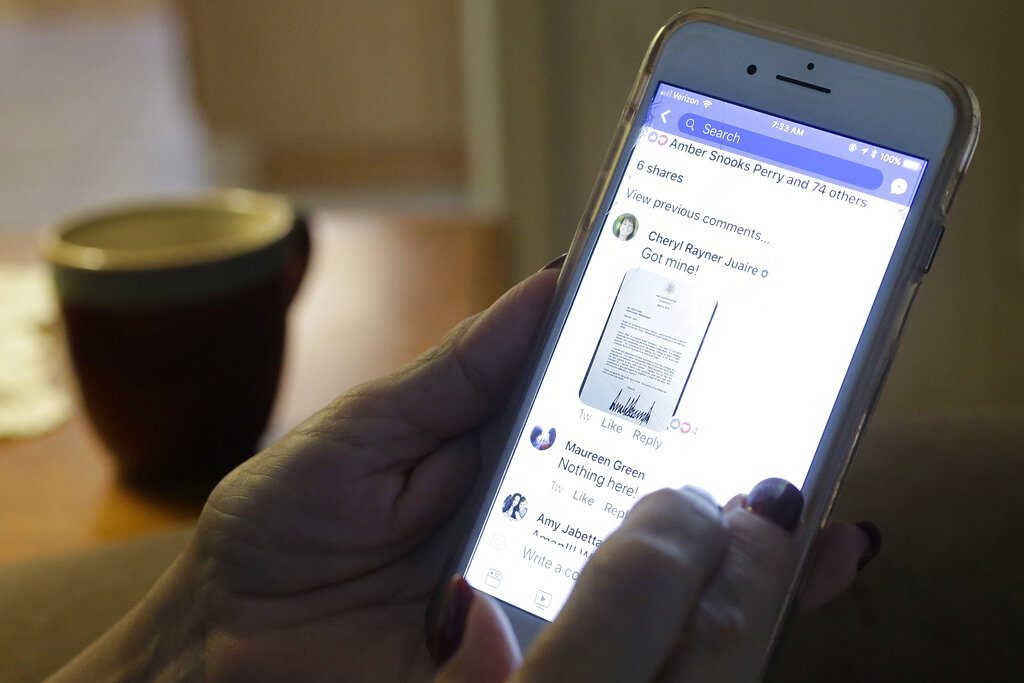
Cheryl Juaire, who lost her 23-year-old son to an opioid overdose in 2011, uses her phone to communicate with a group of other parents who have lost their children to overdoses, at her home in June in Marlborough, Massachusetts. Photo: Steven Senne / Associated Press
Cheryl went home that night and soon started her group.
“You’re not insane,” the moms tell each other.
Some tattoo their children’s ashes into their flesh. Some see mediums to try to connect with them. They share pictures of the sky and swear they see their children’s faces in the clouds.
Many worry people will forget their children or prefer to pretend they never existed, so Cheryl begins each morning acknowledging the parents whose kids were born that day, and the ones who died on it. She feels their rhythms: The first year is numbness, the second pure hell. She can tell which moms have been drinking, which have stopped leaving the house. “She’s a hard one,” she’ll say, making a mental note to keep a close watch.
She does this from the moment she wakes up until she falls asleep, sometimes phone in hand. Her husband tells her he’s worried it consumes her, but she shrugs and smiles at him.
Staying busy with other mothers means she doesn’t have to think about what she didn’t do for her own son.
All of that is what brought Cheryl to the little white funeral home in New Hampshire, a state with the nation’s fifth-highest rate of overdose deaths.
She had called in the troops: Cyndi Wood and Kay Scarpone, mothers of Marines who came home from the service changed men. All three women grew up in the same town, but they were never friends until heroin claimed their sons and lashed them together.
“All these beautiful lives,” moans Cyndi, who decides she can’t bear another wake and retreats back to the car. She pulls out a picture of her 20-year-old son Brandon, his cheeks rosy and his shirt collared. She was at the cemetery placing flowers on his grave recently and met another mother, visiting her son who had died of cancer. The woman asked Cyndi how her son died, and before she thought about it she blurted out, “An accident.” The instinct surprised her, like she’d absorbed the world’s stigma that being the mother of a drug addict is better kept a shameful secret.
“You feel alone when you lose a child like this,” she says.
Cheryl draws close to Kay as they walk together into the chapel, and she drops the sympathy card in a basket. She avoids settling her eyes on the photos of the person this young man had been or his wide-eyed child or the mourners shaking their heads because it didn’t have to end this way. The dam had broken at a recent funeral, and Cheryl had left the chapel sobbing.
“Break down later,” she tells herself, because she is supposed to be the strong one to show that life can exist after this.
Little is known about the long-term psychological implications for the hundreds of thousands of mothers and fathers who have buried their children since the opioid epidemic began. Grassroots organizations for these families are sporadic, funded mostly by bake sales and 5k races and spread out in pockets of the country at random, usually where someone like Cheryl lost a child and decided to start one.
The Partnership for Drug-Free Kids last year tried to drum up support on Capitol Hill for $10 million to establish a family support program so parents would not have to navigate the misery of addiction and death alone, says Marcia Lee Taylor, the organization’s chief policy officer. It got no traction.
“Who is saving us?” Cheryl wonders. “Nobody.”
Inside the little chapel, she folds her arms around this grieving mother. There is an electricity between women who’ve lost their children that no one else can feel, Cheryl swears, like they can sense each other in crowds.
“I shouldn’t be burying my son,” the woman says.
“You are not alone. We lost our kids, too,” Cheryl tells her, and the mother nods.
“We’re not going to have anyone left,” she says.
On the drive back home, Cheryl marvels at the sunny sky. Beautiful, she says. Maybe it’s a gift from Corey. Then she checks her phone and frowns. She was hoping for a message from another mother who recently lost her child. A mutual friend had asked Cheryl to call her, and she’s fretting now because she hasn’t heard back.
Two years ago, a member of her group told her about a mother who had just lost a son. Cheryl considered cold-calling her but didn’t want to intrude. The woman killed herself two days later, on her son’s birthday.
Regret tormented Cheryl – “What if I had called her first? Would that have made a difference?” – so she put the questions to her group on their Facebook page. They told her not to feel responsible; some told her she had saved their lives. “I know how this woman was feeling,” wrote one mother who had lost two children. “We don’t want to be on this journey.” A few months later, that mother killed herself, too.
These are the stakes for Cheryl, the keeper of so many parents’ grief. As she left the funeral home, dozens of them were starting to gather at a group member’s lake house for a potluck like any other, except the cars outside had bumper stickers or license plates commemorating lives cut short: “Jenn 29,” ”Joey 22.” And nametags read: “Debbie, Jay’s mom,” ”Lois, Robbie’s mom.”
Team Sharing’s annual party is one of Cheryl’s favorite days of the year. But to get there, she has to drive past the apartment building where her son died.
The first time she’d absentmindedly followed the GPS and suddenly there it was. “No, no, no, this can’t be happening,” she thought, and then: “Oh God, if only I’d understood. Why didn’t I spend more time with him? Ask him what was going on in his mind? Why? Why? Why?”
Now, as she passes the building again, she can’t resist the urge to pull into the parking lot. There’s the dumpster where Peter had hastily thrown the bedsheets before he let her go inside. A second-story window leads to the bedroom where Cheryl had curled on a bare mattress, imagining the imprint of Corey’s body. She remembers there were needles everywhere, even though she’d always thought he was scared of needles.
“When I’m sitting here and I’m all alone and I’m looking up at it, I don’t want to know, but I do want to know, but I don’t want to know what his last thoughts were. Was he in pain? Did he feel it? Did he know he was dying? Did he call my name?” she asks.
Most of the time, with the help of her moms, she manages not to think about it. And she has reasons to be hopeful.
Last May, personalized letters began arriving in her members’ mailboxes from the White House; they take that as a sign that the president was moved by all their Valentines. Her middle son, Sean, is in recovery and helps others struggling to get clean. Bobby, the officer, found a letter Corey had sent him and got his signature tattooed on his arm; the permanence helped him find peace.
Corey’s daughter, 4 months old when he died, is 8 and has her father’s green eyes. Cheryl takes her to the cemetery on his birthdays, sets up a little table, and they sing and eat cake. And her marriage survived. Peter accepts the shrine by the front door and her need to spend all day on the phone, talking to her moms.
She shakes her head to dislodge the tears. “OK,” she says. “I get to go to a party.”
In the SUV with a bumper sticker of her son’s name, Cheryl heads for the lake house. As she scribbles on her nametag, “Cheryl, Corey’s mom,” and stamps it to her heart, another mother steps out to take a phone call.
Three years ago, when a nurse at the hospital told this woman her son was dead from an overdose, she’d begged her to rip out her heart and give it to him. Now, her other son was on the phone, out of his mind. He just relapsed, he tells her, and he worries he won’t make it this time.
The mother tells a friend to thank Cheryl, and she quietly slips away.