






























32.8 C
Bangkok
Saturday, June 27, 2026
Home Blog Page 1719

Monk Killings Add Poison to Already Toxic Deep South

Buddhists and Muslims march Tuesday to protest attacks on civilians in Narathiwat province.

BANGKOK — When two monks were killed on holy ground in Thailand’s Deep South one week ago, virtually every human rights group from Human Rights Watch to the local Cross Cross Cultural Foundation denounced the violence as unacceptable. That didn’t stop a Buddhist monk from taking to social media three days later to stoke grievances by claiming the opposite.

“What’s the use of having rights activists? Or are they all dead? Soldiers are shot, they remain quiet. Villagers are shot, they remain quiet. Monks are shot, they remain quiet,” the Buddhist monk wrote Monday on Facebook under the name Phra Ajarn Frank Power of Awakening Chayakaro. “When the joen are caught, they shout out to protect the joen.”

Joen is a euphemism employed as a catch-all to describe Malay-Muslim separatists and is akin to “goons” or “bandits.”

The monks’ murders have further inflamed inter-religious and ethnic tensions, with activists and scholars comparing the current climate to a festering wound of distrust in which both sides only see and remember what they want.

“It’s like festering pus,” said Wichai Kanchanasuwon, director of the Peace Studies Institute at Prince of Songkla University in Hat Yai city. Wichai has for years sought peaceful resolution of separatist-related violence in the three southernmost provinces of Pattani, Yala and Narathiwat.

'What’s the use of having rights activists? Or are they all dead? Soldiers are shot they remain quiet. Villagers are shot they remain quiet. Monks are shot they remain quiet. When the goons are caught, they shout out to protect the goons,' an account named Phra Ajarn Frank Power of Awakening Chayakaro wrote Monday on Facebook.
‘What’s the use of having rights activists? Or are they all dead? Soldiers are shot, they remain quiet. Villagers are shot, they remain quiet. Monks are shot, they remain quiet. When the goons are caught, they shout out to protect the goons,’ an account named Phra Ajarn Frank Power of Awakening Chayakaro wrote Monday on Facebook.

Both a local and Buddhist, Wichai said Buddhists have become enraged by the attacks one week ago which left two monks dead and two injured, with some calling for swift retaliation.

“But they have forgotten to look at the fact that three Muslim religious leaders have also been killed recently,” he said, adding that it doesn’t seem to register as big news or create a stir of the same magnitude in Thai society when such thing happens, which is predominantly Buddhist.

On the other side, Wichai said some Muslim religious leaders have floated conspiracy theories, questioning whether it was in fact a “false flag” operation by the state to sow more hatred against them.

“They said the temple wasn’t that far from an army outpost, and no culprits have been arrested so far,” Wichai said.

Wichai has been monitoring the use of social media and said rising hatred has become widespread in Thai society.

He likened it to filling a jug about to burst.

“Violence doesn’t solve problems. In the end more innocent people will die, not the extremists,” he said.

That includes messages such as those stoking resentment toward human rights groups which have spoken out about abuses, including torture and the execution of suspects without due process.

Caught in the crossfire has been leading human rights figure Angkhana Neelapaijit, caretaker National Human Rights Commissioner. Angkhana is a Muslim from Bangkok whose husband, a rights lawyer, vanished and was presumably killed 15 years ago.

She said Thursday that she had been a target of many social media attacks due to the issues she promotes, for which she is accused of siding with the separatists.

“Our job is to verify the facts and make proposals,” Angkhana said. Last year, she even lodged a police complaint over threatening speech made against her.

“They posted my photos and asked why a person like me should live,” she said.

Angkhana fears that people of the two religions and ethnicities will increasingly hate one another as the conflict continues unabated. More than 7,000 people have been killed in the past 15 years of conflict, according to monitors.

Also subscribing to the festering wound analogy is Pornpen Khongkachonkiet, director of Cross Cultural Foundation, a human rights advocacy group that has promoted rights and published reports of system torture practiced by the Thai military.

Pornpen believes hate speech on social media wouldn’t be effective was there no mutual anger and frustration simmering beneath the surface.

“This uneasiness cannot be activated by online media alone. There must be a germ festering,” she said.

Human rights activists working in the south are often branded as useless if not as assisting enemies of the Thai state when they defend the civil and political rights of Thai-Malay Muslims prosecutes by authorities.

Pornpen acknowledged that it is disturbing for Buddhists to see bullet holes in monks’ alms bowls. She added the pictures of the bullet holes cut deep into the hearts of many Buddhists, but that most do not remember images of mosques being attacked or Muslim religious leaders being shot to death.
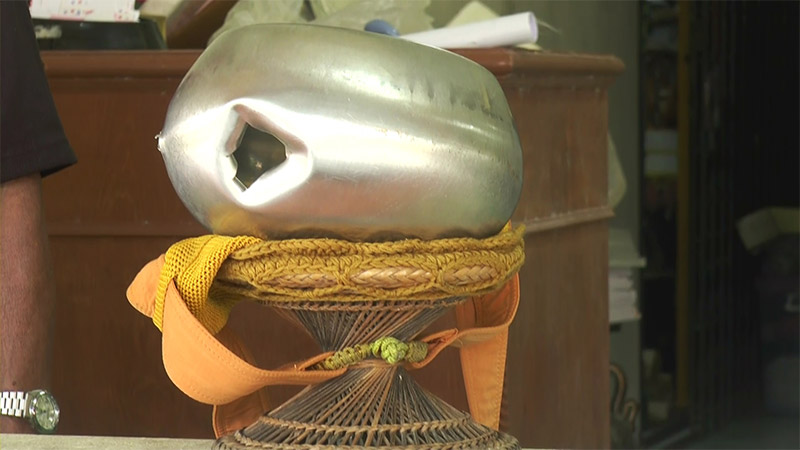
A monk's alms bowl purportedly hit by a bullet in last week's attack on a temple in Narathiwat province is displayed after the attack.
A monk’s alms bowl purportedly hit by a bullet in last week’s attack on a temple in Narathiwat province is displayed after the attack.

The commissioner suspects that some of the hate speech has been planted by extremists on both sides to stoke division.

Such speech prevails online on both sides of the divide, where public Facebook groups such as “We Love Buddhism and Hate Islam” exist. Though it only boasts about 180 members, it exemplifies the incendiary language used in the conflict. On the other hand, Facebook pages such as “We love Buddhism” recount the issue from the other side.

On the page – which has more than 25,000 likes – a Yala province monk in a short video posted the day after the attacks, said he’d been threatened with death by Thai-Malay Muslim youths who told him not to go out for alms in the morning.

His message of being ignored, saying such complaints are ignored by the mass media, struck a chord.

In under a week, the video was watched more than 345,000 times and shared almost 12,000 times.

Advertisement

FIFA Asks Thai Premier to Release Bahraini Soccer Player

Hakeem Ali Mohamed Ali AlAraibi led in handcuffs at the Thai Criminal Court.
Hakeem Ali Mohamed Ali AlAraibi in December led in handcuffs at the Thai Criminal Court.

The Thai government has been asked by FIFA’s leadership to release a Bahraini soccer player who is in detention while embroiled in extradition proceedings despite having refugee status in Australia.

FIFA Secretary General Fatma Samoura called for an urgent “humane outcome” to the case of Hakeem al-Araibi, who lives in Melbourne but was arrested while on vacation in Thailand last month on an Interpol notice.

Bahrain wants its former national team player returned to serve a 10-year prison sentence that was handed down in absentia after he was accused of vandalizing a police station — a charge he denies.

In an emailed letter, Samoura asked Thai Prime Minister Prayut Chan-o-cha “to take the necessary steps to ensure that Mr. AI-Araibi is allowed to return safely to Australia at the earliest possible moment, in accordance with the relevant international standards.

“We strongly believe that this course of action will do justice not only to Thailand’s obligations under international law, but also to basic human and humanitarian values, which we know your country and government hold dear.”

The Asian Football Confederation, which is led by Sheikh Salman Bin Ibrahim Al-Khalifa, a member of Bahrain’s royal family, would not say if it endorsed the appeal from FIFA. AFC spokesman Colin Gibson said in a written response that the governing body “is working with FIFA on this issue … along with other stakeholders.”

Bahrain has a Shiite majority but is ruled by a Sunni monarchy, and has a reputation for harsh repression since its failed “Arab Spring” uprising in 2011. Al-Araibi has said he believed he was targeted for arrest because of his Shiite faith and because his brother was politically active in Bahrain.

Al-Araibi has said he was tortured in Bahrain after his 2012 arrest and fled in 2014 to Australia, which granted him political asylum in 2017 and where he now plays for Melbourne’s Pascoe Vale Football Club.

“This situation should not have arisen in particular, since Mr. AI-Araibi now lives, works and plays as a professional footballer in Australia, where he has been accorded refugee status,” Samoura wrote in her letter to the Thai premier.

“When according refugee status to Mr. AI-Araibi, the Australian authorities concluded that Mr. AI-Araibi is at serious risk of mistreatment in his home country. As stated publicly on several occasions, FIFA is therefore respectfully urging the authorities of the Kingdom of Thailand to take the necessary steps to ensure that Mr. AI-Araibi is allowed to return safely to Australia at the earliest possible moment, in accordance with the relevant international standards.”

Samoura said she wants to meet the Thai government with player union officials.

“We look forward to your timely response on this urgent request and sincerely thank you for your efforts towards a humane outcome of this matter,” Samoura said.

Story: Rob Harris

Advertisement

Escaping Bangkok: One Dam Day in Nakhon Nayok

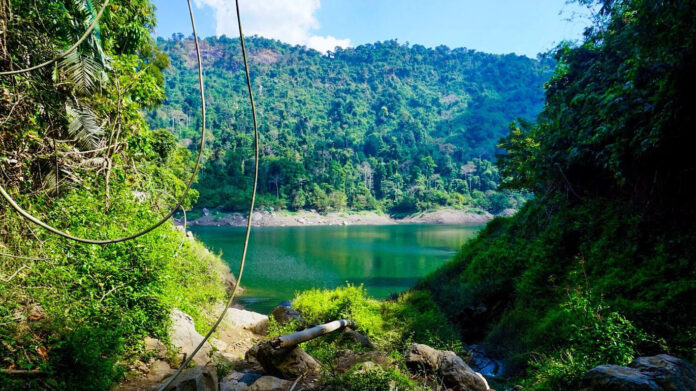
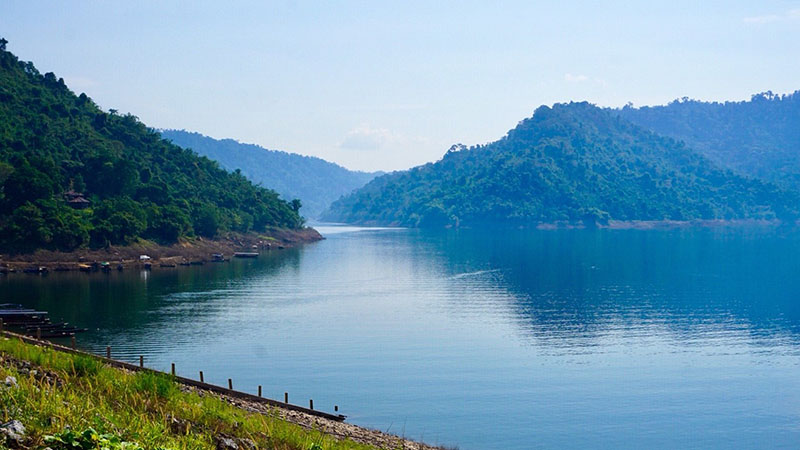
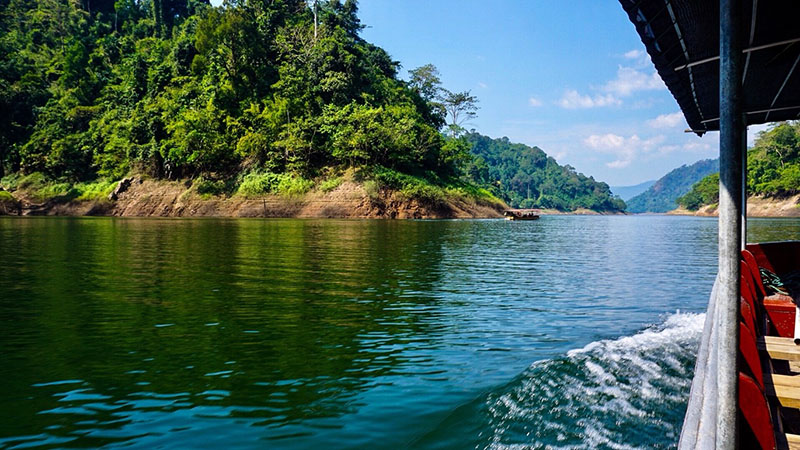
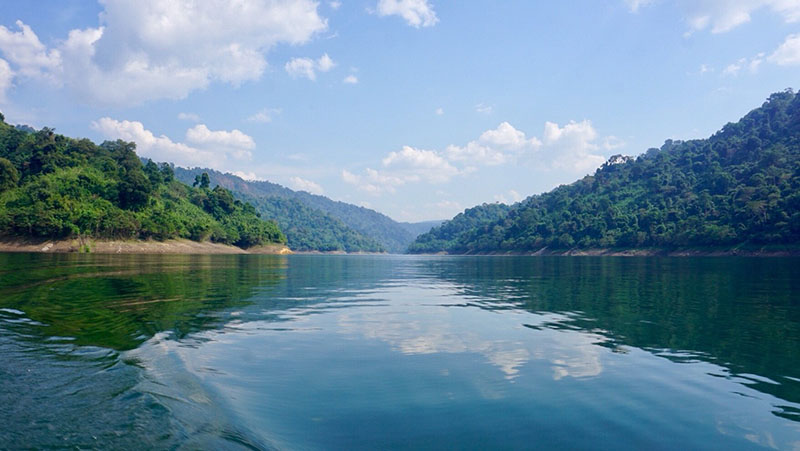
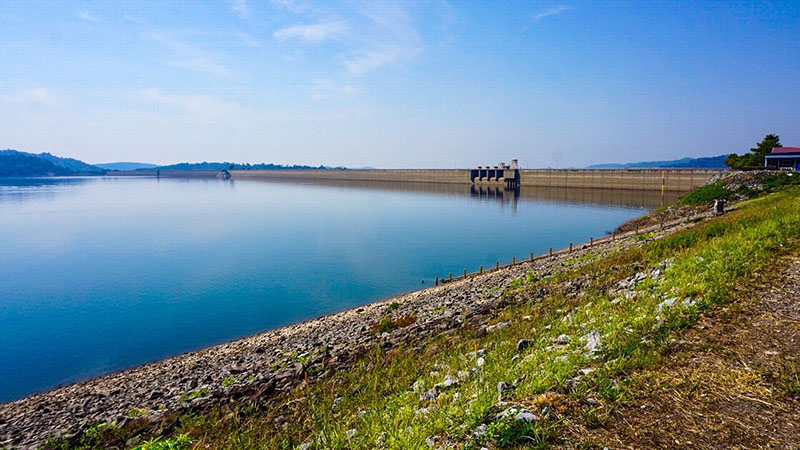
Top: A view of the Khun Dan Prakarn Chon Dam reservoir in January.

Top: A view of the Khun Dan Prakarn Chon Dam reservoir in January.

Photos by Jintamas Saksornchai

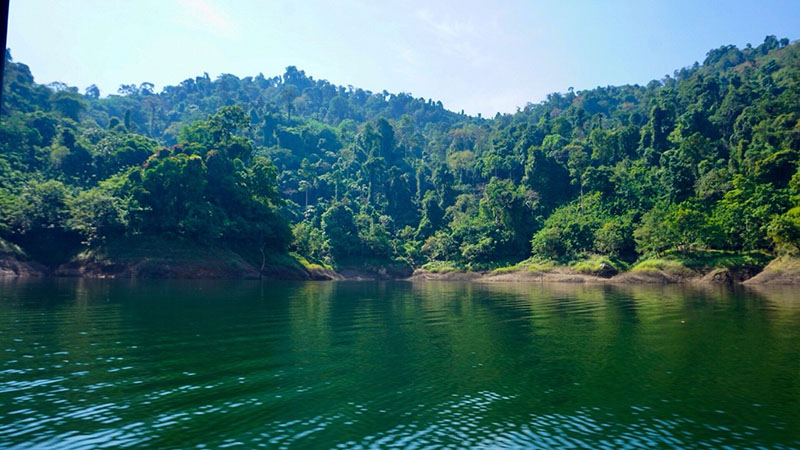
Two hours by car from Bangkok is a slow-life town where a huge dam watches over sun-soaked roads lined with yellow cotton trees. It’s an easy road-trip destination from the capital to a place where one can cruise around a reservoir shaded by mountains and waterfalls before grabbing a hearty lunch.

Nakhon Nayok, a fortress-town province since the Ayutthaya era, isn’t likely to be a first or fourth recommendation for a weekend getaway, but the 10th smallest province is just right for a low-key weekend for those bored of Hua Hin’s beaches but without the gas or time to zoom all the way to Korat.

Getting There

From northern metro Bangkok, Pathum Thani actually, head out northeast on Route 305 via the Rangsit-Nakhon Nayok Road. After about an hour and a half under clear road conditions, look for Nakhon Nayok city, a familiar-looking cluster of markets with a Tesco Lotus where the highway meets Suwannason Road.

Most lodgings are found either in the city or on the 3049 and 4016 roads near the dams and waterfalls to the northeast of the city, with bookings available via the usual online services for anything from 500 baht to 600 baht for a simple 2.5-star room to 2,500 baht for a private bungalow with a river view.

Things to Do

Much Dam Water

Head out northeast from town along a 20-kilometer stretch of road to find the trove of falls and the reservoir.

It took 10 years to build the Khun Dan Prakarn Chon Dam, but when it opened in 2009, it was an engineering marvel 2.6 kilometers long. It holds the claim of being the longest dam in the world to be made of a particular blend of concrete and generates about 28 million kWh of power annually for the province.

Taking advantage of this artificial lake presents several options – cruise, golf cart or tram – for everyone from active adventurers to seniors with limited mobility. The dam is open 6am to 6pm daily.

Dual pricing at Khun Kan Prakan Chon Dam.

For the boat tour, the first cruises depart about 7am with the last heading out at 5pm. To find the pier, follow signs leading to the dam to find the welcome center. Look for a shack with large signs advertising reservoir cruises by the parking lot.

Tickets are, unfortunately, set at dual pricing. Up to seven Thais can rent a boat for 1,500 baht, with 200 baht for each additional person. Five foreigners however must pay 2,000 baht for the same boat, plus 400 baht for each additional. For mixed groups, Thais and foreigners pay the separate rates.

Khun Dan Prakarn Chon Dam.

There, staff lead visitors down a flight of stairs to boats docked by the reservoir’s shore. Take a minute to admire the breathtaking view of the dam that reaches across the vast blue expanse of water. Once aboard, settle into a wooden plank seat while the boat operator sits at the back and maneuvers the boat propeller. The waters are calm and ride smooth here.

Views of the reservoir from the trail leading up to Khlong Khram Waterfall.
Khlong Khram Waterfall.

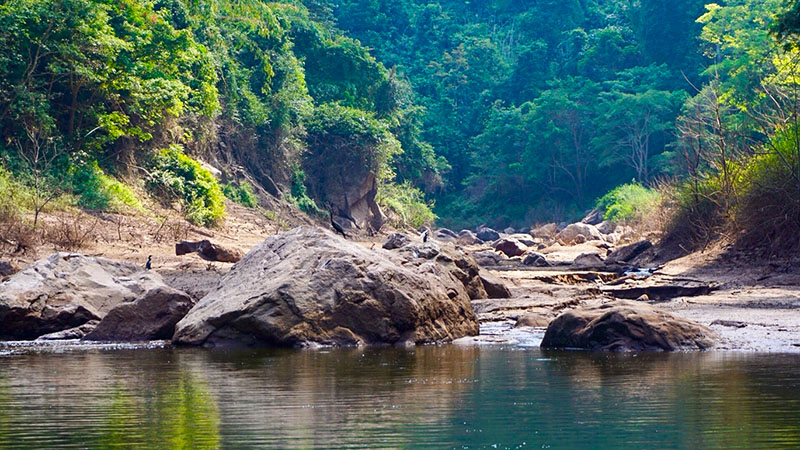
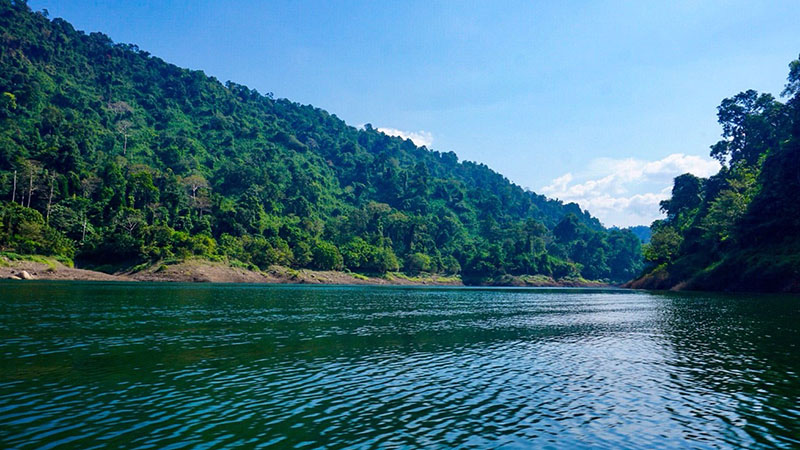
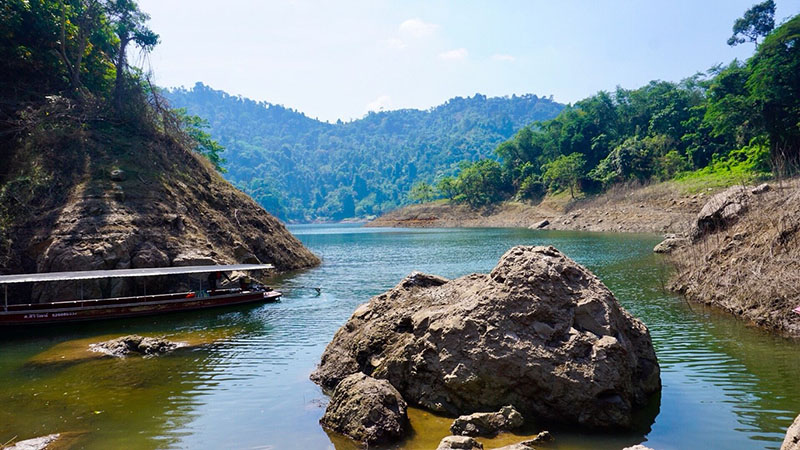
In the morning, catch clouds of mist rolling across the flat, calm water. As the day progresses, light glints across the wind-dimpled emerald surface. As the tour continues around the reservoir, see slope after slope of jungle appear. In the dry winter month of January, low water levels leave a dry strip of grass near the shoreline. Oriental darters, a species of water bird, glide across the surface, diving to snatch fish before alighting on the shore to sun, wings outstretched.

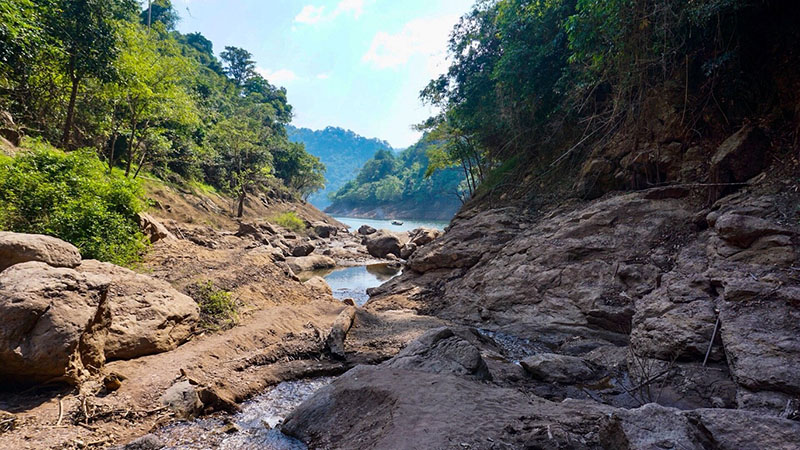
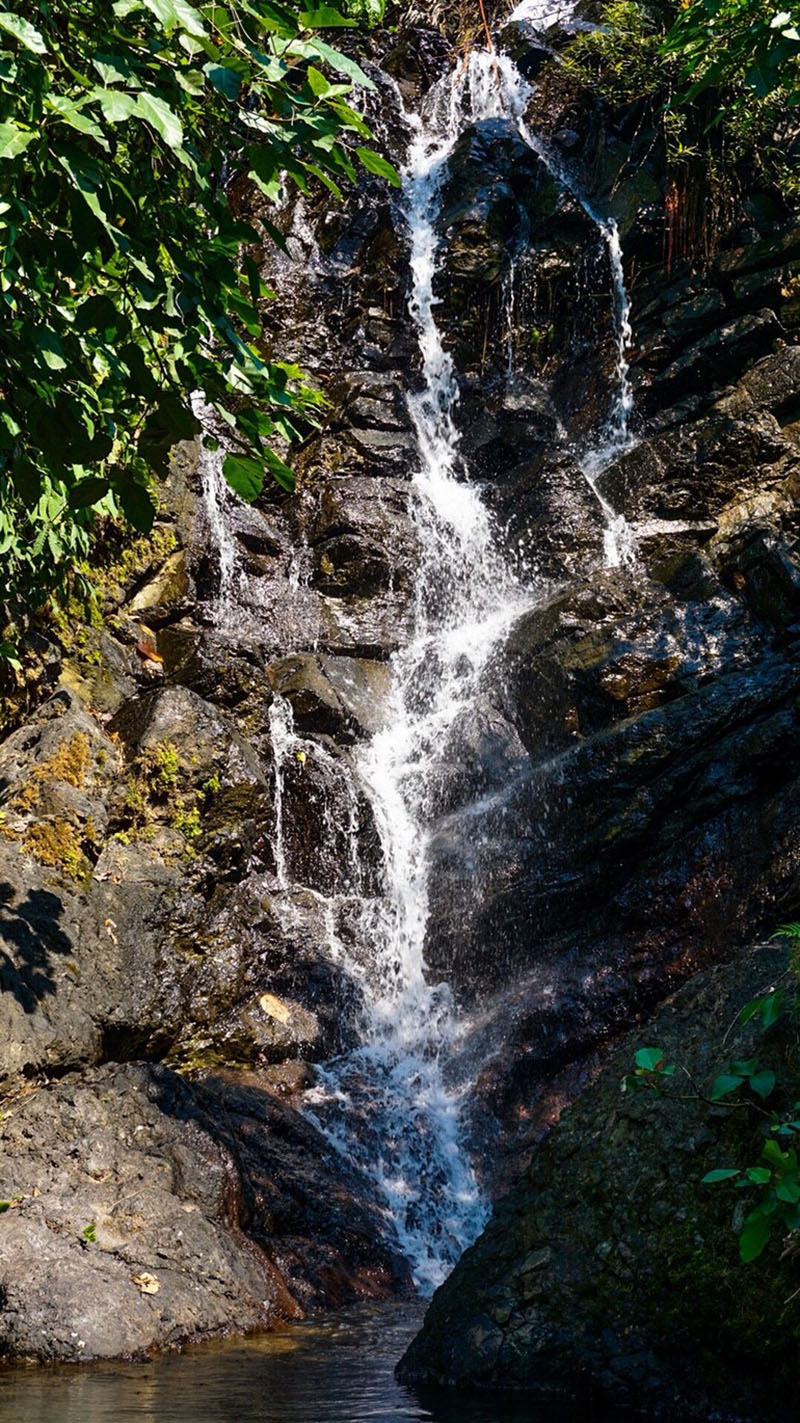
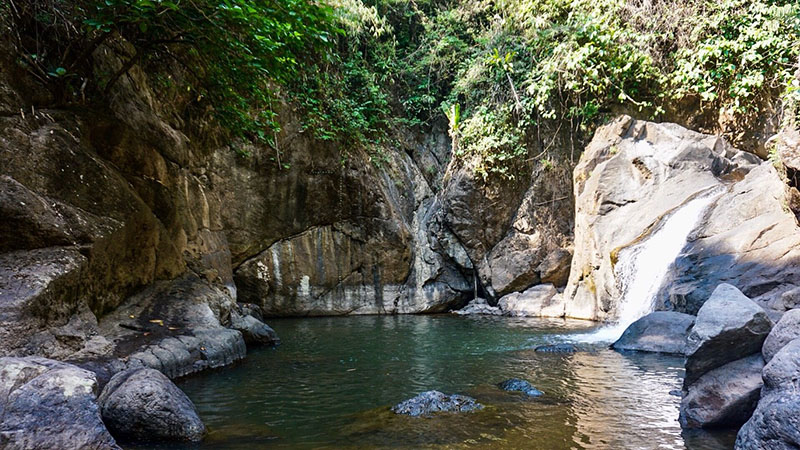
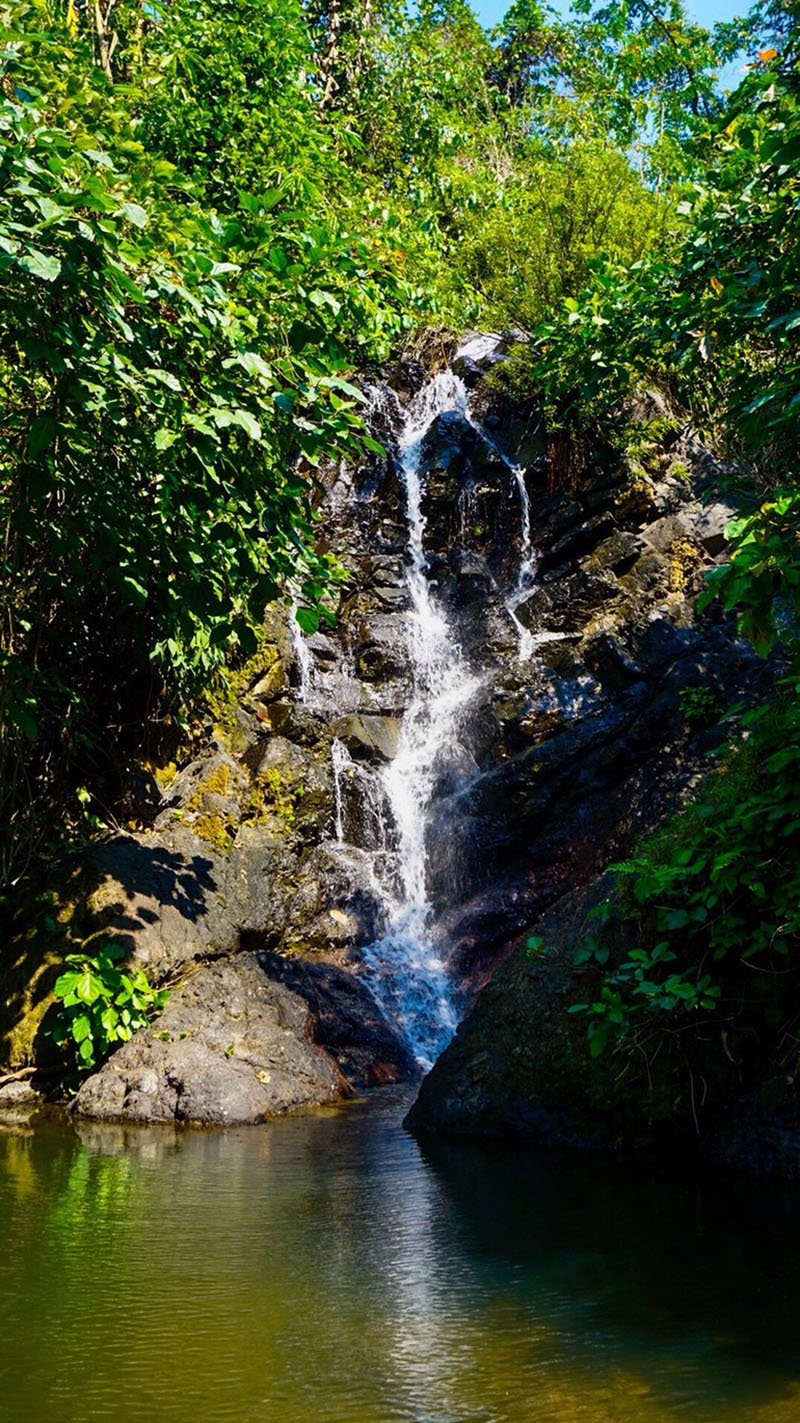
The boat makes several stops at different waterfalls, including Khlong Kram and Chong Lom. Expect to trek across boulders and exposed mud beds for a few hundred meters to get to them (do it barefoot or with washable hiking sandals). Although the waterfall’s stream is quite weak during the dry months, the weather isn’t too hot and the cool streams are fun to splash around in as neon butterflies dart around you.

Depending on how fast or slow one goes, the tour will run a little under or over three hours.

DAM 190115 0014

Alternatively, skip the boat fees and ride a golf cart up and down the long dam. A four-person cart costs 350 baht for an hour, and a six-person cart costs 500 baht for the same amount of time. Riding a tram around the dam is by far the cheapest option, costing 30 baht for a 30 minute trip.

More Water to Fall

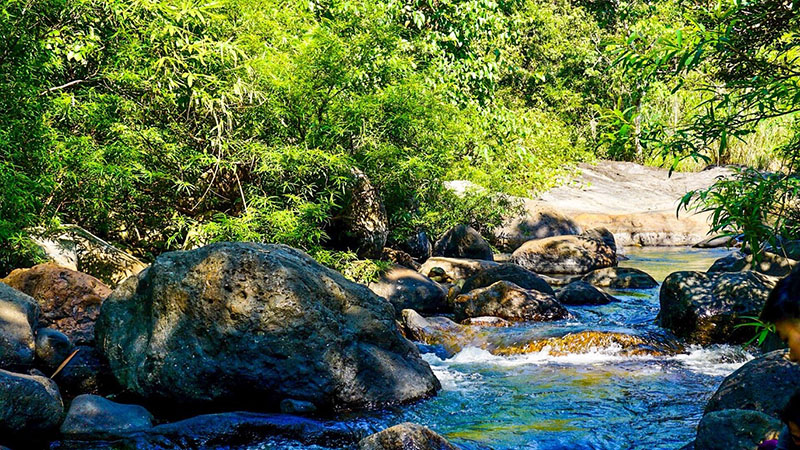
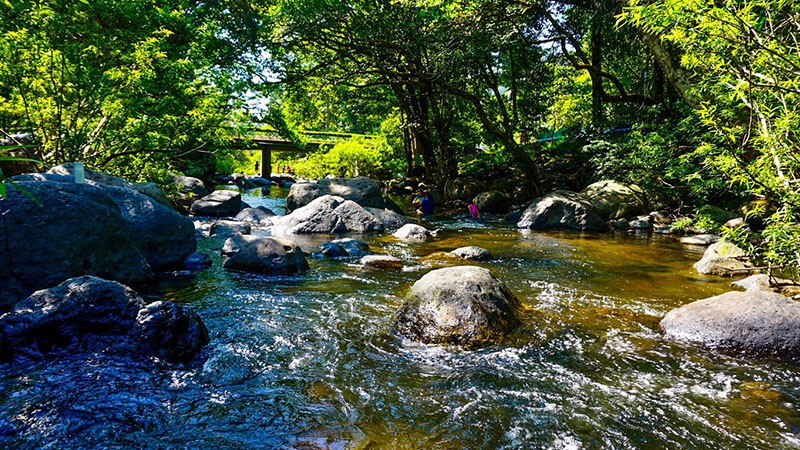
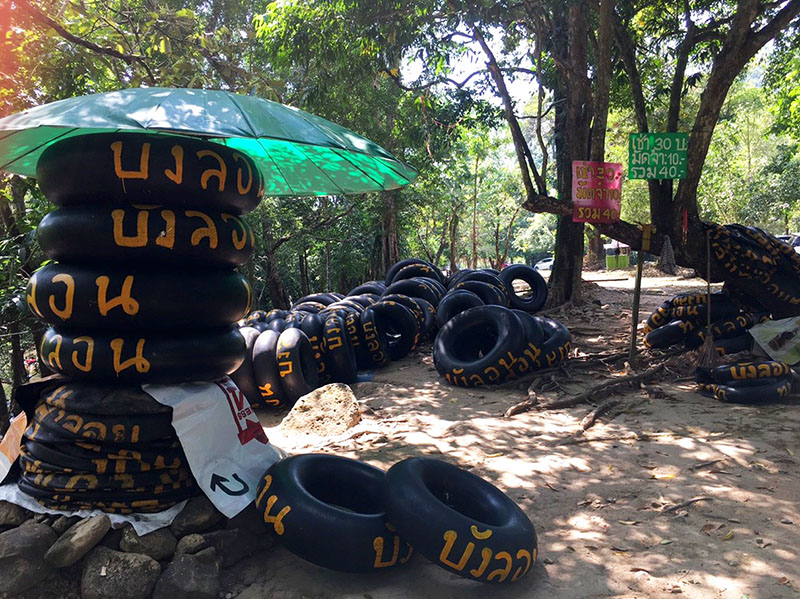
Not enough waterfalls? Stop by the Sarika Waterfall or Wang Ta Krai Waterfall, the latter of which has ample space for picnics and sunning on rocks or dipping tired toes into rushing waters. Eager swimmers should rent or bring their own inner tubes to float merrily downstream.

Entry to Wang Ta Krai is 20 baht per person on foot. Cars with eight people or fewer pay 150 baht. Thais and foreigners pay the same price.

Food Time

On the way back to Bangkok, be sure to stop for some plum mangoes – mayong chid – for snacking or souvenirs. For quick eats, any number of the folksy, roadside eateries should do, usually Thai restaurants with names and menus on big cola brand signs.

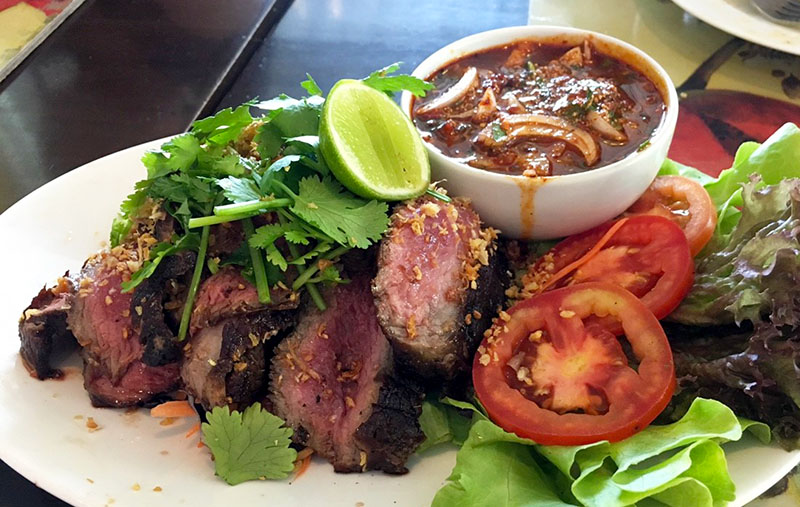
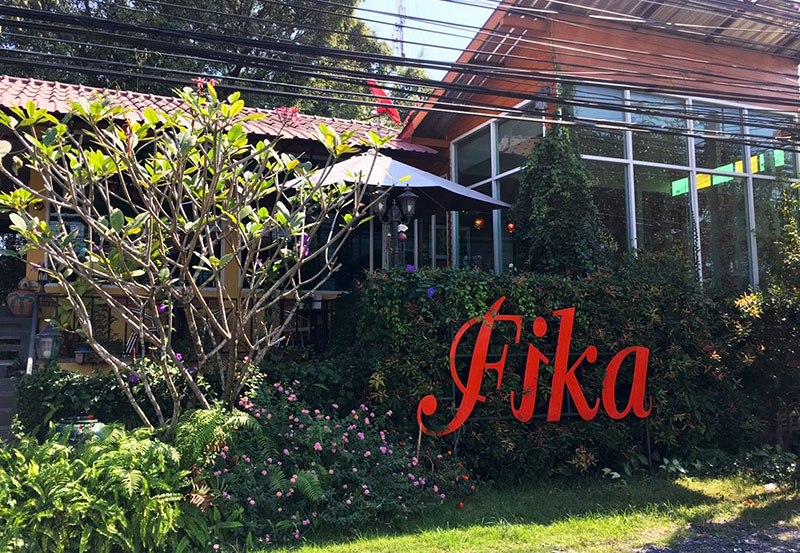
Those hankering for Western food can have at least a dish at Bee’s Cafe and Fika where plates of pasta are under 200 baht, quality kho-khun T-bone runs 479 baht or the unmissable grilled kho-khun beef with homemade jim-jaew Isaan sauce (399 baht), open since 2011.

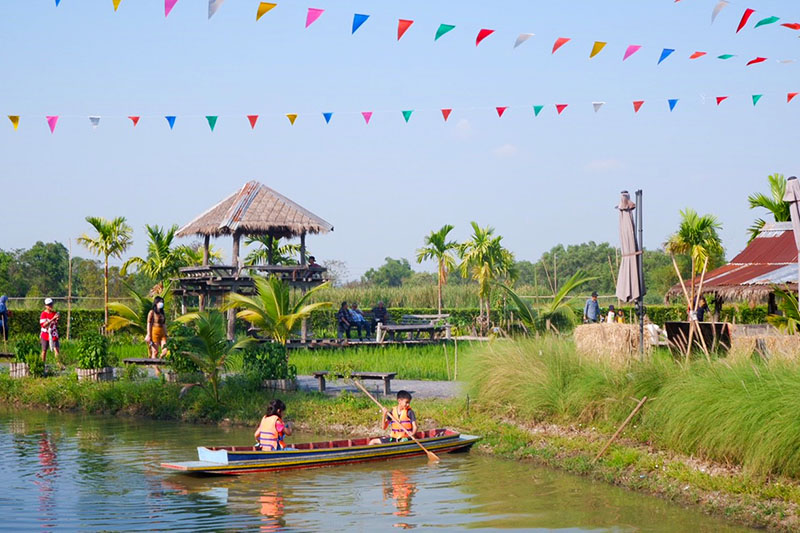
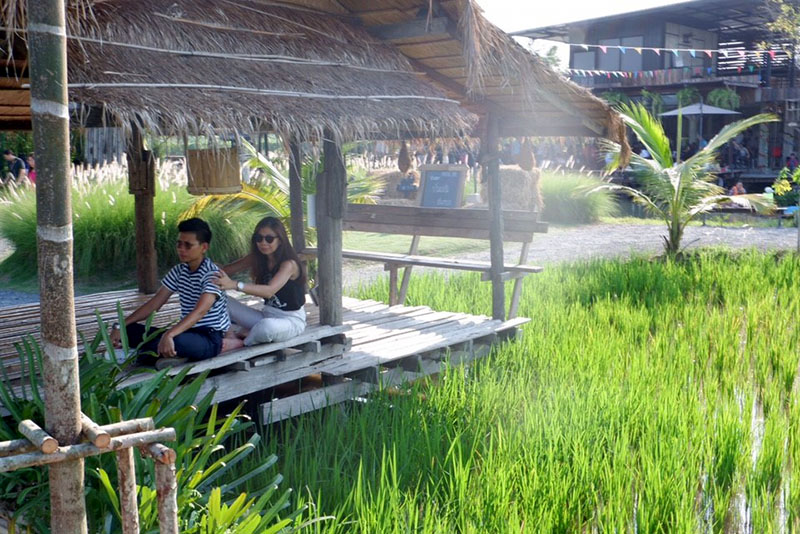
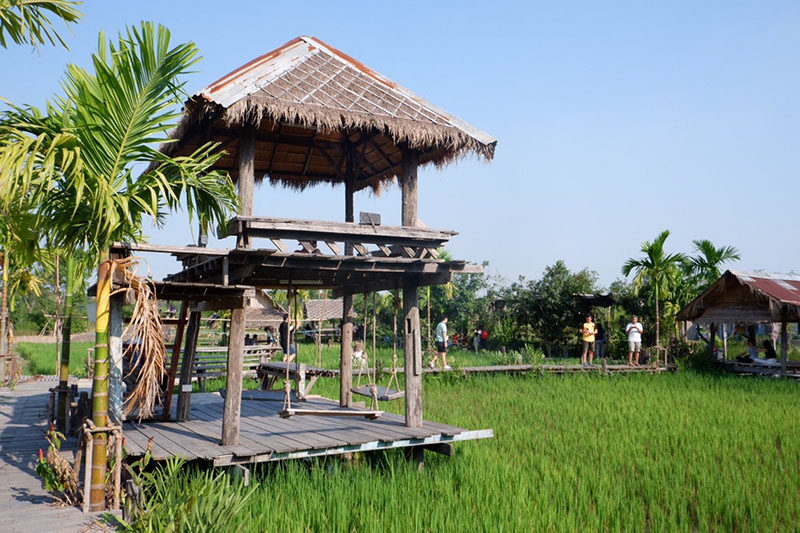
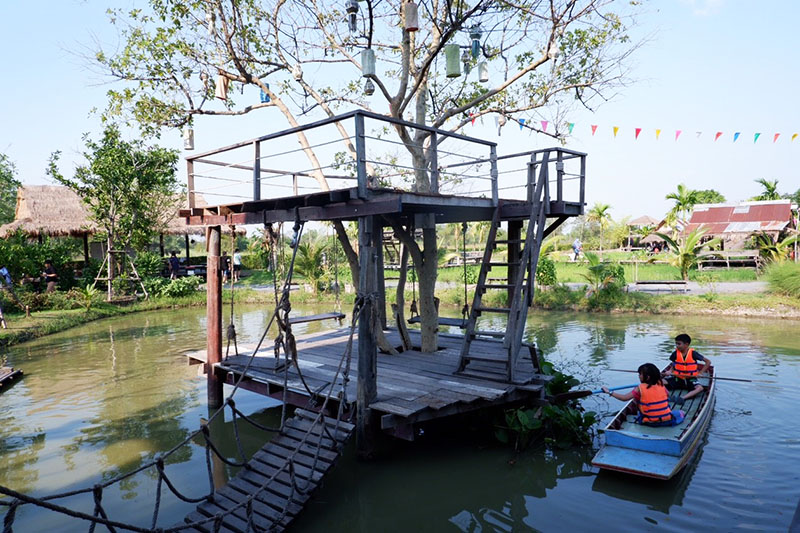
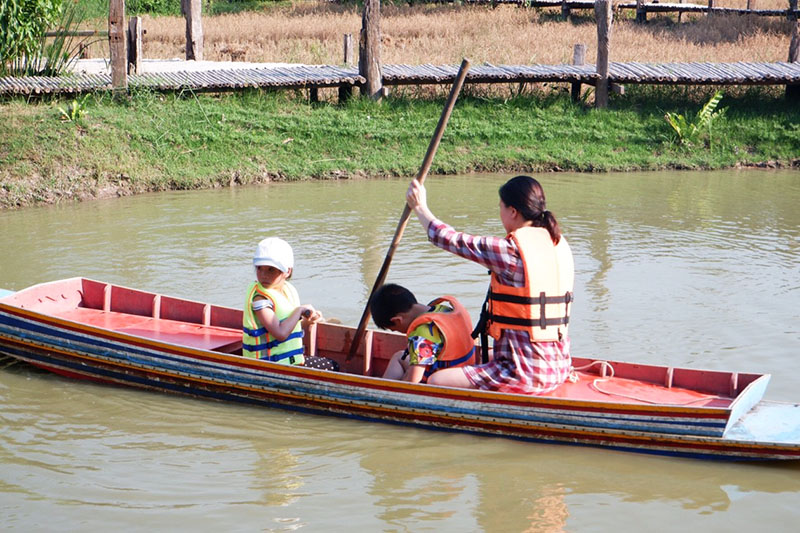
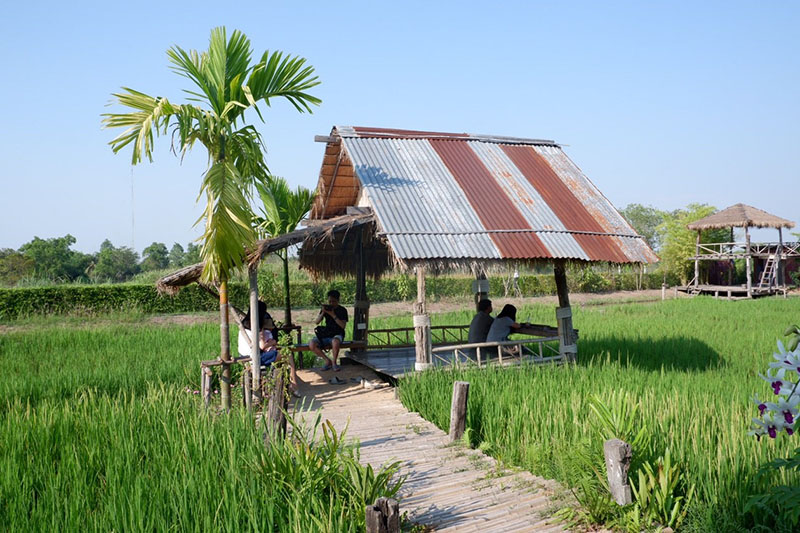
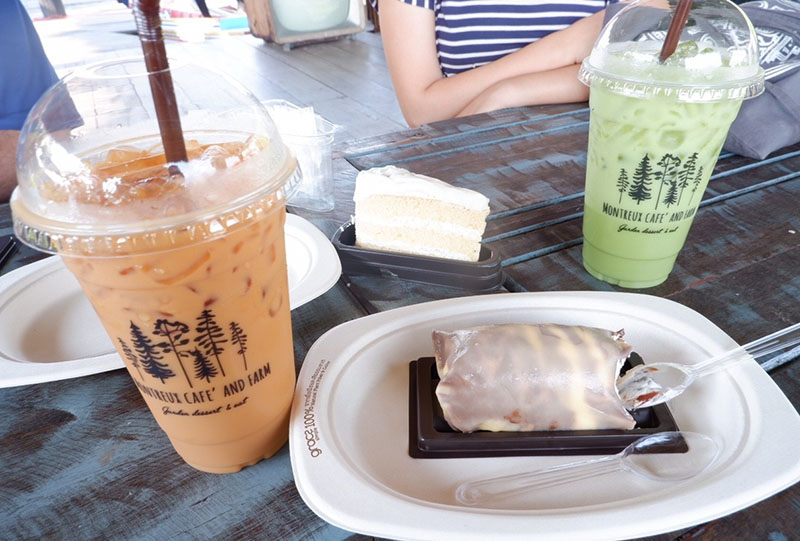
Or check out the photogenic Montreux Cafe and Farm, near the border between Nakhon Nayok and Pathum Thani. Avoid the too-sweet drinks, but do take a walk around the interconnected bamboo walkways over water and muddy rice paddies which connect an open-air cafe, boat dock, activity areas for children, a greenhouse, a chicken pen and a duck pond.

This article is completely unsponsored editorial content, with all visits unannounced and uncompensated.

Related stories:

Thai Desserts Modern But Unpretentious at Ayutthaya Cafe

Burnt out on Tourist Traps? Keep it Real in Chanthaboon (Photos)

Advertisement

Photos of Actor Chris Hemsworth Filming in Ratchaburi Go Viral

Chonburi governor Chaiyawut Chan with Chris Hemsworth. Photo: Chaiyawut Chan/ Facebook

RATCHABURI — When the God of Thunder descended upon the mountains of a local national park, a fanboying government official shared the photos to viral fame.

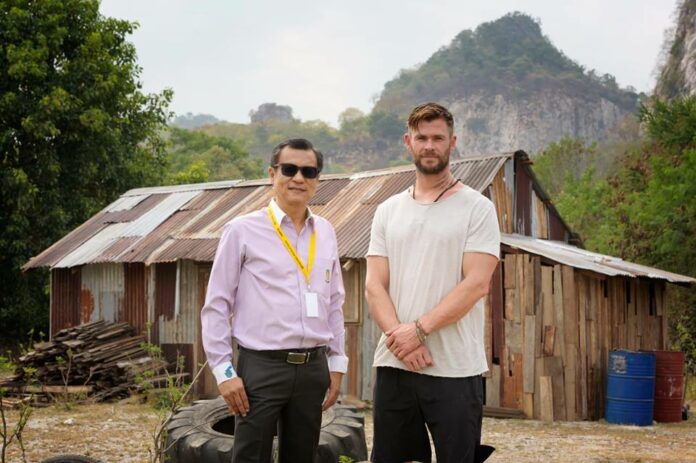
Chonburi governor Chaiyawut Chan rushed to take photos with actor Chris Hemsworth, best known for his role as Thor in Marvel’s superhero films. Hemsworth is in Khao Ngu Stone Park for the filming of his new movie “Dhaka.”

“I went to Khao Ngu the other day to meet Chris Hemsworth, the handsome, muscular actor from Hollywood film ‘Thor,’” Chaiyawut wrote. “This movie has been allowed to be filmed here by the Ministry of Culture. I expect the movie to be worth at least 300 million baht and to help promote Ratchaburi tourism.”

Chaiyawut posted the photos Wednesday on Facebook, which have since gone viral. By Friday morning, they had garnered more than 6,000 likes and 2,500 shares. He said the scenes in Khao Ngu are of Hemsworth’s character in his home in Australia.

Chaiyawut also incorrectly compared it to the filming of the “Lord of the Rings” trilogy, which he said was shot in Zhangjiajie National Forest in China.

“You tried to show off. This is embarrassing. [“Lord of the Rings”] was filmed in New Zealand. It’s “Avatar” that was filmed in Zhangjiajie,” Facebook user Kritdikorn Wongswangpanich said.

“Dhaka” follows the story of a mercenary out to rescue an Indian boy, and is being filmed in Bangkok, Phuket, Ratchaburi, Nakhon Pathom and Samut Sakhon. Directed by Sam Hargrave, it will be released on Netflix in 2019.

Related stories:

Schwarzenegger Photobombs Thai Tourists at Eiffel Tower

Advertisement

TWG Tea Celebrates Chinese New Year With Cha King Tea (Sponsored)

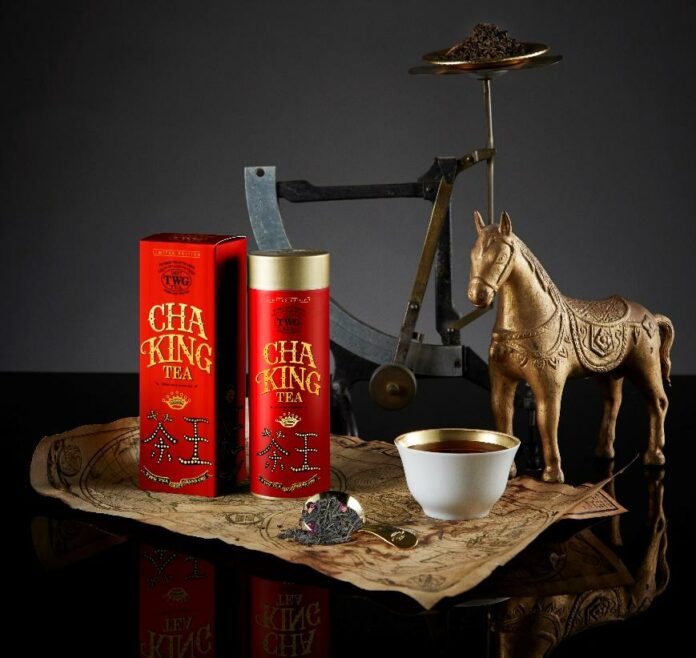
For centuries, tea has shaped landscapes and geography, cultures and traditions, destinies and desires. A noble beverage with mysterious beginnings, TWG Tea welcomes the New Year with the Cha King™ Tea from the Haute Couture Tea Collection®, a remarkably fine green tea enhanced by a scattering of rare silver needles, balanced with notes of citrus and a lingering floral aftertaste – a poetic blend evocative of the Cha King, the first manuscript written about this time-honoured beverage.

C:\Users\dell\Downloads\2.jpg

Embark on an extraordinary voyage as you unravel the hidden mysteries of tea through time and history. Crossing continents, tea is now a universal language and a private expression of individualism, breaking through cultural barriers and spreading across different parts of the world from cha in Mandarin and Korean, ocha in Japanese, chay in Persian, Russian, Hindi, chai in Swahili, teh in Javanese, tee in Afrikaans, te in Sinhala, to shay in Arabic.

d Q 54Vy8TtqD48JK6S88ua0frf5GL qbr3bkgN140hJAaBEX35lDh0InhNsKhNKNwSL0lo9tnakEnBLpllexDXrlR76b

Integral to the ancient trade along the Silk Road, tea has transcended time and distance, bringing together people from Eastern Europe, the Middle East, Central Asia and the Far East and transporting tea lovers on a voyage of discovery across continents.

Capturing hundreds of years of tea tales and legends, Cha King Tea showcases a contemporary design with a nod to the illustrious heritage of tea traditions in elegant hues of scarlet red and gold – a juxtaposition of the traditional and modernity. A magnificent treasure perfect for fond family celebrations this New Year.

The Cha King Tea in TWG Tea Haute Couture Tea Collection retails at 1,360 baht. Available at all TWG Tea Salons & Boutiques in Thailand from February 2019.

Note to editors: No royalties payable if TWG Tea is stated as the source. More images are available upon request.

About TWG Tea

TWG Tea, the finest luxury tea brand in the world, was established in Singapore and celebrates the year 1837 when the island became a trading post for teas, spices and fine epicurean products. TWG Tea, which stands for The Wellbeing Group, was founded by Taha Bouqdib, Maranda Barnes and Rith Aum-Stievenard in 2008 as a luxury concept that incorporates unique and original retail outlets, exquisite tea rooms and an international distribution network to professionals. Committed to offering teas directly from source gardens, TWG Tea’s collection is the largest in the world, with fine harvests from every tea producing country and exclusive hand crafted tea blends. Internationally recognised as a true innovator with the creation of new varieties of tea every season in collaboration with the world’s most renowned estates, TWG Tea also offers exquisite signature modern tea accessories and delicate tea-infused sweets and savouries.

After launching its first Singapore tea salon & boutique at Republic Plaza in 2008, TWG Tea has opened in iconic destinations such as ION Orchard, Marina Bay Sands and Takashimaya Singapore. Expanding its presence internationally, TWG Tea has heralded the opening of exquisite Tea Salons & Boutiques in Bangkok, Dubai, Guangzhou, Hong Kong, Kuala Lumpur, Taipei, Tokyo, Manila, Jakarta and Shanghai.  In addition, TWG Tea’s exclusive collection of the finest teas of the world is available from TWG Tea Boutiques in Harrods Knightsbridge, London and Dean & DeLuca Madison Ave, New York. The premier tea supplier to the finest hotels, restaurants and international airlines, TWG Tea is retailed around the world in gourmet épiceries, including El Corte Ingles in Portugal, Feinkost Kaefer in Germany, David Jones in Australia and GUM in Moscow, Russia, and served in Business Class, First Class and Suites and in the Lounges of Singapore Airlines and Nippon Airways.

TWG Teas are available in Singapore, Australia, Azerbaijan, Belgium, Cambodia, Canada, China, the Czech Republic, Denmark, Estonia, Germany, Hong Kong, India, Indonesia, Japan, Kuwait, Malaysia, Maldives, Mauritius, Mexico, Morocco, New Caledonia, New Zealand, Pakistan, Philippines, Portugal, Qatar, Russia, Saudi Arabia, Seychelles, South Africa, South Korea, Spain, Taiwan, Thailand, Turkey, Ukraine, the United Arab Emirates, the United Kingdom, the United States of America, and Vietnam. European online orders can be made at www.Harrods.com; online orders within the USA can be made at www.DeanDeluca.com; Canadian orders may be made online at www.VansingDG.com; worldwide online orders can be made directly from the TWG Tea e-Boutique and m-Boutique at TWGTea.com.

Advertisement

Japan, Iran Advance to Asian Cup Semifinals

DUBAI, United Arab Emirates — Japan and Iran became the first two teams to advance to the Asian Cup semifinals on Thursday.

Four-time champion Japan eliminated Vietnam 1-0 in their quarterfinal before three-time winner Iran cruised past China 3-0.

The two unbeaten winners are set to meet in the semis on Monday.

In Dubai, midfielder Ritsu Doan converted a penalty with a low left-foot shot in the 57th minute to give Japan its fifth win in five games, all by a one-goal margin.

“It is clean sheet and we go through to the next round, that is the most important.” Japan captain Maya Yoshida said. “We need to improve a lot, attacking side and defensive side as well. I feel real confidence with that. But we have to be more clinical, we have to think of more details and we can handle it.”

In Abu Dhabi, Iran took control with a couple of first-half goals.

Mehdi Taremi scored his third goal of the tournament to give Iran the lead and Sardar Azmoun doubled the advantage with his fourth.

Karim Ansarifard finished it off in second-half injury time.

Iran, the highest-ranked team in Asia, is yet to concede a goal while scoring 12 in the tournament.

For China coach Marcello Lippi, who won the 2006 World Cup with Italy, the loss provided a bitter end to his two-year reign.

Iran is coached by another heavyweight, former Real Madrid boss Carlos Queiroz, who still has a chance to win a title before his contract ends after the tournament.

Video reviews were introduced at the Asian Cup on Thursday for the rest of the tournament, and disallowed a first-half goal by Yoshida. VAR revealed the ball hit his arm.

Later on, it was used before the lone goal in the second half, confirming Bui Tien Dung’s foul on Doan in the area.

Outsider Vietnam made the knockout stage only as the final, fourth-best third-place team from the group stage and knocked out Jordan in a penalty shootout in the round of 16.

Vietnam goalkeeper Dang Van Lam was happy with the team’s achievement.

“We’re OK with this result,” he said. “Our country and our fans, I think, they are very happy.”

Defending champion Australia faces the United Arab Emirates while South Korea meets Qatar in the remaining two quarterfinals on Friday.

Advertisement

River City Bangkok Offers Special Discount at Exhibition by Taiwan’s National Palace Museum (Sponsored)

The exhibition was launched on October 18 last year to critical acclaim and was received with phenomenal feedback from both local and international audience. Highlights include digital presentations of ancient paintings of fabric from royal households of various dynasties, becoming the first interactive exhibition in Southeast Asia that incorporates multimedia and virtual reality techniques to fully engage the viewers.

The exhibition includes “Up the River During Qingming” in multimedia format, VR-enhanced “Roaming through Fantasy Land”, “Marvels in the Sea” that implements Interactive Multimedia technique, “Giuseppe Castiglione” that is presented with Augmented Reality, the Interactive Multimedia “Summer Lotus” and others.

Kids and families are treated with various thrilling activities such as “A Hundred Horses Co-Creative Installation” where hand-drawn horses are immediately made digitally alive to run freely in the augmented landscape in the backdrop, screening of animation film about the NPM Guardians led by Monkey King from Vietnam, porcelain pigs from the Han Dynasty and Madam Tang from the Tang Dynasty that join force in a special space mission.

“Up the River During Qingming” is on view at RCB Galleria, Level 2 of River City Bangkok. Don a quipao or a traditional Chinese outfit to get special discounts on admission: 290 baht for adults (from 350 baht) and 170 baht for children and students (from 200 baht), from January 28-February 12, 2019. Entry tickets are available from www.thaiticketmajor.com. For more information, contact River City Bangkok at (+66) 2 237 0077-8 and website http://bit.ly/2yKFThC.

Advertisement

FLEC: Showcase of Thailand’s Efforts to Enhance Fishermen’s Quality of Life

Strong partnerships have been a driving force behind Thailand’s transition toward becoming IUU free country. Fishermen Life Enhancement Center (FLEC) is among many of the public-private cooperations aiming to tackle human rights issues in Thai fishery industry.

The project was set up in 2016 by five organizations, including the Fish Marketing Organization; Ministry of Agriculture and Cooperatives; Department of Labour Protection and Welfare; Family Planning Association of Thailand; Stella Maris Centre Songkhla and Charoen Pokphand Foods, to be a neutral party that ensure equal treatment. In addition, it also upgrades living standards of fishermen in Songkhla province, where 20,000 of them are situated.

5Z9rhV4oEghWlL

FLEC provides a “One-Stop Service” for workers in Thai fishery industry and their families, offering education, health improvement programs, skill development courses, translation supports, and religion activities as well as being coordinator between fishermen, particularly migrant workers, and government agencies.

Last year, FLEC offered legal consultant to 38 victims of human trafficking and abuse. Moreover, it also carried out proactive training courses on labour rights and occupational health and safety to migrant workers. Its other service included first aids training and medical kits distribution to 2,000 fishermen from 76 ships.

It also supports their families by giving education opportunity to migrant children in line with UN Sustainable Development Goals No.4 ; Quality Education, offering basic education to about 30 children at the center each year.

Iy40wOZZ8LzFofzUZxPBHMetRDNqjQFZ7p T21 K04c8u 5EoCnFl0Pa

The learning program has been very successful, since 12 children of migrant workers were able to continue study at kindergarten and elementary school levels in a local municipal school in Songkhla province last year.

Others family support programs includes family planning course, vegetable growing course, religion study, and etc.

These successful activities help the center to gain recognition and trust from the migrant workers, who spread FLEC’s news via word of mouth to their fellow workers and family members, resulting growing numbers of users each year. The average visiting frequency is at 35 times per month.

Even though, the European Commission already lifted Thailand’s Yellow Card for illegal fishing. The center would like to stress that all relevant parties will need to carry on their works and cooperating even more to eliminate human trafficking, child labour, forced labour and any forms of illegal acts from Thai seafood supply chain for good as well as improving quality of life to all fishermen.

YDMYpMO QlkoduHF2fUw93qlc0uDL wdVzi35oQ8EFo1hXFlqoeuDvR6lNkUrrfA76I6gI4tEtvQavuwCdYpyCkBtBBJKAguLQ7fwhiDFudScYBbK JjPyCbfMRa6

FLEC believes that strong partnership is vital for Thailand in order to move toward and IUU-free country and, therefore, the center is looking to further strengthen the relationship with workers to become “a friend that all workers can trust”.

By Nattaya Petcharat, Project Coordinator at Stella Maris Songkla Center and FLEC’s committee

Advertisement

Rare Pangolins Languish in China Wildlife Rescue System

A tree pangolin (Manis tricuspis) seen here in 2009 in central Democratic Republic of the Congo. Photo: Valerius Tygart / Wikimedia Commons

WASHINGTON — When Chinese police found them in the trunk of a smuggler’s car, 33 of the trafficked pangolins – endangered scaly mammals from southern China – were still alive, wrapped in plastic bags soaked with their own urine.

But the fate of the creatures – whose scales are worth nearly their weight in silver on the black market – was not a happy one. Every last pangolin died in government captivity within a few months of the August 2017 seizure.

A pioneering environmental nonprofit in Beijing has launched an investigation, called “counting pangolins,” to figure out what happens to such animals recovered from the illegal wildlife trade. Its findings so far highlight discrepancies between environmental laws and outcomes.

China is hardly unique. The number of environmental laws on the books worldwide has increased 38-fold since 1972, according to an exhaustive U.N. Environment report released Thursday. But the political will and capacity to enforce those laws often lags – undermining global efforts to curb issues like wildlife trafficking, air pollution and climate change, the report found.

“The law doesn’t self-execute,” said Carl Bruch, a study co-author and director of international programs at the Environmental Law Institute in Washington, D.C.

Each of the 33 pangolins transferred to the care of a government-run wildlife rescue center in China’s Guangxi province died within three months – according to records obtained by the nonprofit China Biodiversity Conservation and Green Development Foundation and shown to the Associated Press.

What’s still unclear is what happened to their bodies.

Pangolins are insect-eating, scaly mammals – playfully described by the International Union for Conservation of Nature as “resembling an artichoke with legs and a tail.” Their scales – made of keratin, the same material in human finger nails – are in high demand for Chinese traditional medicine, to purportedly cure arthritis, promote breast-feeding for mothers, and boost male virility, although there is no scientific backing for these beliefs.

The price of pangolin scales in China has risen from $11 per kilogram (2.2 pounds) in the 1990s to $470 in 2014, according to researchers at Beijing Forestry University.

Scientists have designated all eight species of pangolins as being at risk of extinction – four species in Asia, and four in Africa. More than 1 million pangolins were trafficked between 2004 and 2014 – for their scales, meat and blood – with China and Vietnam as the largest markets. In the last two decades, the number of pangolins worldwide has dropped by about 90 percent.

In 2016, the Convention on International Trade in Endangered Species of Wild Fauna and Flora (CITES) adopted a worldwide ban on commercial trade in pangolins, and China later approved that ban. Pangolins are also listed as a protected species in China. While Chinese state-run media have publicized a few high-profile poacher busts, watchdogs say a thriving black market for endangered-animal parts persists.

In November 2017, customs officials in Shenzhen seized 13.1 tons (11.9 metric tonnes) of pangolin scales – reportedly the largest-ever seizure of scales from Africa – according to state media. The penalties offenders face are not always publicized, but in another case involving a smaller shipment of scales, two smugglers received prison sentences of five years, state media said.

“It’s significant that China has adopted laws against trade in many endangered species, but the law itself isn’t enough to protect a species from extinction,” said Jinfeng Zhou, director of the China Biodiversity Conservation and Green Development Foundation.

Zhou wants the government to issue public records tracking all living and dead pangolins seized by authorities – and to offer evidence that contraband, including pangolin scales, is destroyed before it enters black markets.

“We are determined to know what happens to the pangolins,” said Sophia Zhang, a researcher at the biodiversity group. After reading news reports about the August 2017 poaching bust, she filed information requests to government agencies and traveled to Guangxi to visit the wildlife rescue center.

The Guangxi Forestry Department, which manages the wildlife rescue center, declined AP’s requests for an interview and comment. China’s state-run news service Xinhua reported in December 2018 that China remains committed to stopping pangolin trafficking, noting there were 209 pangolin smuggling busts from 2007 to 2016.

Less official attention has been paid to what happens after these busts.

In Guangxi, Zhang saw that pangolins were kept in small cages and fed cat food at the wildlife center, whereas wild pangolins eat termites. She said she had tried to coordinate with Save Vietnam’s Wildlife, a nonprofit, to bring shipments of termites to feed the pangolins, but the center declined the offer.

After the animals died, the center wouldn’t reveal what happened to their scaly bodies. But in other instances, the same center has turned over live pangolins to industry groups – including a steel factory in Guangdong province and a farm associated with a Chinese traditional medicine center in Jiangxi province. The government released this information on its web site.

In response to an information request from Zhang, the Guangxi Forestry Department sent copies of the licenses held by these organizations for handling pangolins. The reason for transferring pangolins remains unclear.

“We want the wildlife center to provide a full explanation,” Zhang said. “We know the trade in pangolins is very lucrative. The public should be able to know what happens.”

The biodiversity nonprofit has filed information requests about trafficked wildlife in nearly 30 Chinese provinces and has attempted to verify what happens to pangolin scales seized by customs officials. Zhang said wildlife rescue centers need better training to properly handle live animals.

“China has a rather complete set of environmental laws,” said Barbara Finamore, the senior strategic director for Asia at the Natural Resources Defense Council in Washington, DC. “But environmental laws are not worth the paper they’re written on unless there’s also strong enforcement and oversight.”

Countries large and small, rich and poor, have passed extensive green legislation since the Rio Earth Summit in 1992. “The world has made incredible progress in adopting environmental laws and environmental impact assessments, in creating environmental ministries and agencies,” said Bruch, co-author of the U.N. report.

Now comes the hard part.

“The legal framework is there in an enormous number of countries,” said Deborah Seligsohn, a political scientist focusing on environmental policy at Villanova University. “But once you have all these laws, you need trained and willing personnel to actually enforce them. You need boots on the ground.”

Green mandates often go unfunded, said Barney Long, director of species conservation at Global Wildlife Conservation, a nonprofit group in Austin, Texas. “Many countries have laws stating the minimum number of park rangers that should be patrolling per square mile in national parks and protected areas. But these aren’t implemented if sufficient money isn’t appropriated.”

Non-governmental groups – like the biodiversity nonprofit in Beijing – try to help close the gap between environmental laws and enforcement action. But in many countries, this is dangerous work. In 2017, at least 207 environmental defenders – including forest rangers, advocates, journalists, and inspectors – were murdered for performing such work, according to Global Witness, a research and advocacy group based in Washington, D.C. and London.

There are some bright spots, experts say.

China is gradually releasing more environmental data to the public, especially on air pollution, even as the government clamps down on other forms of information. And more officials are being held accountable, said Jennifer Turner, director of the Woodrow Wilson Center’s China Environment Forum in Washington, D.C. “Before local officials were only evaluated on economic performance – but now it’s harder to hide from environmental sins.”

Story: Christina Larson

Advertisement

Bangkok Taco Bell Fans Binge on Comfort Food, and Possibly, Regret

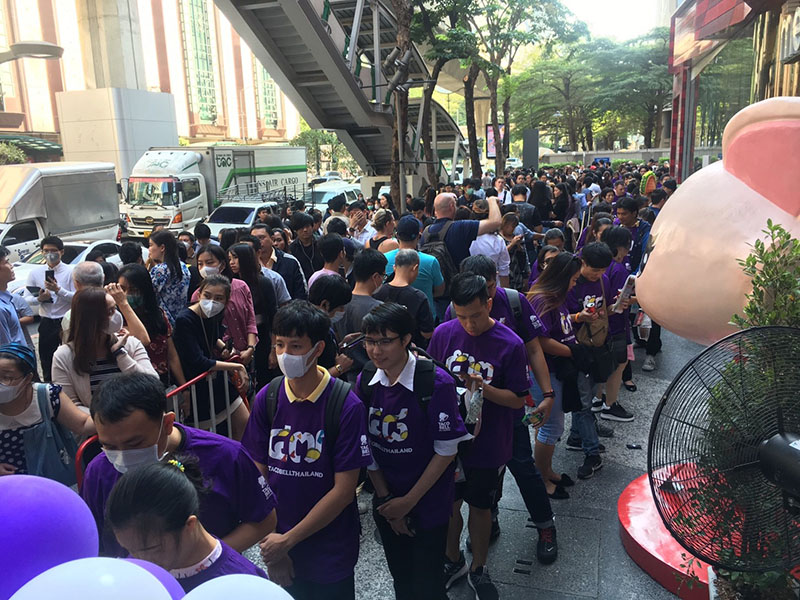
BANGKOK — For almost three hours, Junior stood eagerly waiting in line. After the 27 people before him were served, he would be sinking his teeth into a greasy taco like he did during his teen years in the American midwest.

The last time “Junior”, 18, ate Taco Bell was two years ago, when he would down burritos after school as an exchange student in Grand Haven, Michigan. Thursday morning, he was the 28th customer to queue up for the official opening this morning at Thailand’s first branch of the Tex-Mex fast food chain at The Mercury Ville shopping mall on Chit Lom Road. Other Thai customers in line echoed Junior’s sentiments – they were waiting out of nostalgia for time they lived in the United States.

Little did Junior know that he would bond with No. 32 and 33 in line.

“We’re like, top 30!” No. 32 said, laughing with his new bro-friends. “We just met him in line now.”

For No. 33, it was his first time at Taco Bell – but he said he had found a new source of comfort food.

“It’s great. All I order here is pizza, McDonald’s, so this is a great alternative,” No. 33 said. “This would totally be a great drunk food, man!”

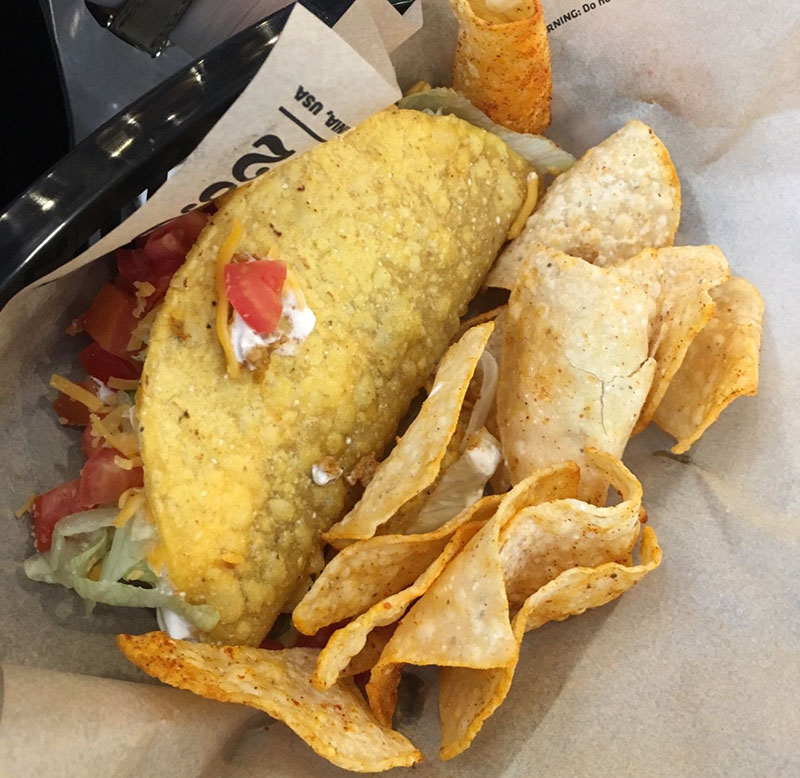
No. 32 ordered almost everything off the menu to share with both No. 33 and his new buddy Junior.

“I’ve been waiting for this place to open for two years. They announced it way earlier, but in the past year it’s been hyped a lot,” he said, demolishing a hard taco.

No 32., an ethnic Russian from New York’s Brighton Beach neighborhood, said he was glad there’s now a cheap alternative to Mexican food in Bangkok, even if he did enjoy other restaurants which have sprung up.20190124 190125 0013

“Sunrise Tacos is overpriced. It’s such a ripoff,” No. 32 said, echoing a popular sentiment. “My favorite place is Tacos and Salsa in On Nut, but that’s for premium-quality food.”

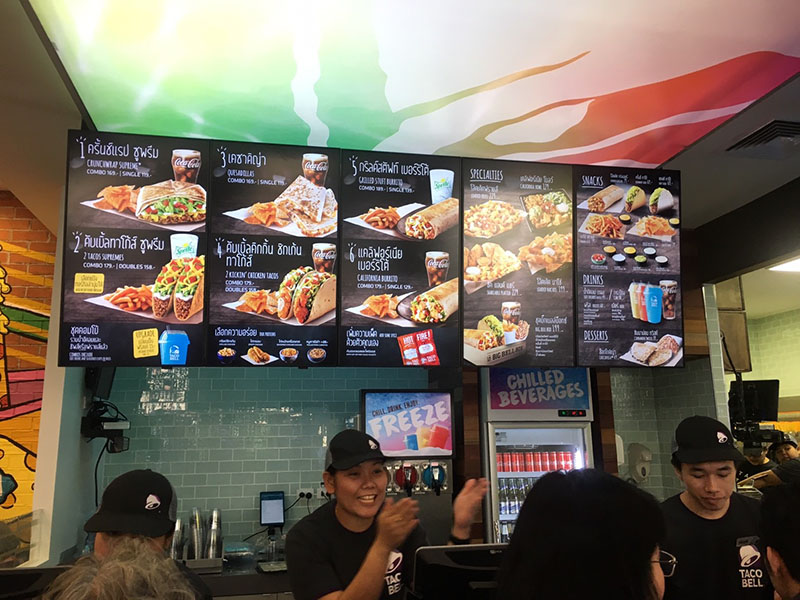
No 32.  said he compared the prices in Bangkok with those back in the states and was satisfied. A review of the menu found some items roughly a third more expensive than their American equivalents. “Double Tacos” are 158 baht (USD$5), while US restaurants sell them for the equivalent of 106 baht. However, other dishes like a Crunchwrap Supreme (114 baht) are about the same.
20190124 190125 0006

The difference is in the servings: There are no XXL Grilled Stuft burritos; the non-XXL Thai version is 139 baht.

Most who have counted Taco Bell a guilty pleasure would admit Taco Bell is about face-stuffing quantity rather than quality that can leave one with a lingering sense of regret.

The chicken taco filling – no beef served yet, the chain says – tastes like the meat layer scraped off of a cafeteria lasagna, and Thai palates will beg for some lime to cut through the creamy greasiness of a chicken quesadilla.

The overall aftertaste is one that leaves the impulse to “make a run to the border” both satisfied yet also staved off for some time. At least until the next drunken stop for sustenance between night clubs, or morning-after hangover remedy.20190124 190125 0001

Like No. 33 said, it’s great drunk food – so long as one’s inebriated between 10am and 10pm.

Expect long queues – as is the case for many foreign chain imports – for the next few weeks.

Taco Bell hopes to expand to 40 branches across Thailand by 2022.

Taco Bell is open 10am to 10pm daily on the ground floor of The Mercury Ville Chidlom shopping mall, which can be reached on foot via skywalk from BTS Chit Lom.

20190124 190125 0013 20190124 190125 0009 20190124 190125 0007 20190124 190125 0003 20190124 190125 0002

Advertisement

Hot News

LATEST NEWS

Bangkok
overcast clouds
32.8 ° C
36.6 °
32.7 °
68 %
3.3kmh
100 %
Sat
37 °
Sun
36 °
Mon
35 °
Tue
34 °
Wed
33 °