30 C
Bangkok
Friday, June 26, 2026
Home Blog Page 1723

Sacred Water Sources Sought for Coronation Rituals

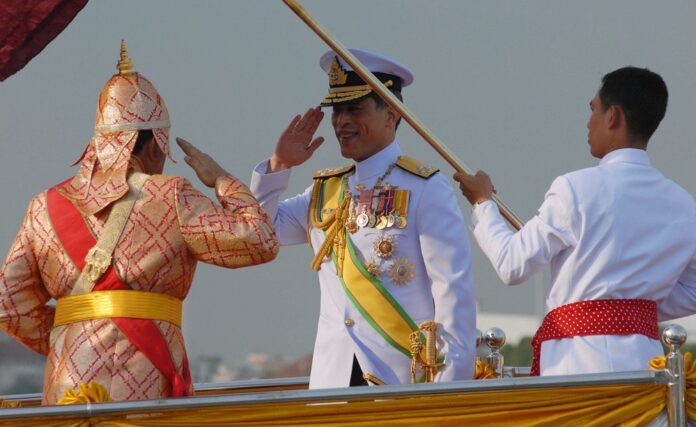
A file photo of King Vajiralongkorn.

BANGKOK — More than 100 water sources throughout Thailand are being evaluated for use in the royal coronation, the government said Tuesday.

Officials are visiting 107 rivers, streams and rivulets to see which are most ideal for drawing holy water to be used in rituals set to take place in May.

In accordance with longstanding traditions, the sacred water will be used to anoint King Vajiralongkorn as the new monarch when the ceremony commences May 4.

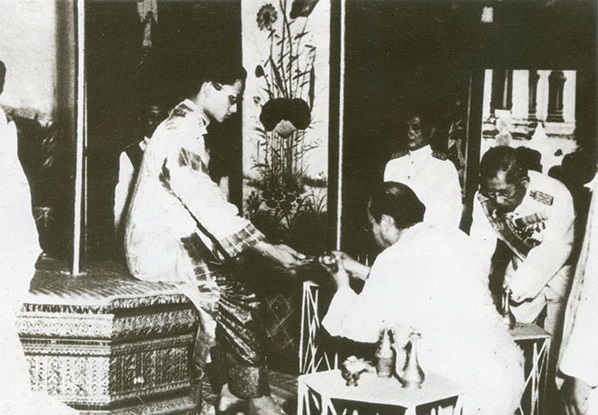
When King Bhumibol, the late father of the current monarch, was crowned in 1950, his holy water was drawn from from 18 sources in 18 different provinces.

dlf01140162p1
A priest pours sacred water on King Bhumibol’s hand at his coronation in May 1950.

Although King Vajiralongkorn ascended the throne in December following his father’s death two months earlier, he is not considered a formal monarch under Thai tradition until he is crowned in elaborate rituals which date back to the 13th century.

The national Buddhist authority announced last week that a bud from a sacred Bodhi tree in Sri Lanka will be brought to Ayutthaya on Feb. 19 and grown there to celebrate the coronation.

The Bodhi tree in question is believed to be descended from one planted about 2,000 years ago by the famed Buddhist king Ashoka the Great.

Advertisement

Bangkok’s Marvel Theme Park Goes Bust After 7 Months

SAMUT PRAKAN — Southeast Asia’s first Marvel Entertainment theme park is going out of business just seven months after opening.

Marvel Experience Thailand, a 20,000sqm theme park complex which cost 1 billion baht to build at Mega Bangna, will close Jan. 30, the company announced Monday.

Director Prachuap Ucchin of Demeter Corp. PCL, which owns 37.5 percent of the theme park, wrote in a Monday filing to the Stock Exchange of Thailand Monday that a majority of shareholders had voted to shut the park.

“Hero Experience experienced financial problems and project management that did not go according to plan,” Prachuap wrote in the statement.

Read: Seize Your Heroic Destiny at Marvel Experience Bangna

Calls to Hero Experience and CEO Noppadon Chirasanti went unanswered.

The news was met with little surprised reactions online, where many cited the venue’s high costs of admission – 1,500 baht for adults and 1,350 baht for children – as a fatal flaw. Others noted that, whether due to licensing deal or choice, it was focused on Marvel’s comic books rather than the more popular film franchise.

The latent schadenfreude ran hot and cold.

“You had a good thing in your hand, and you drove it to bankruptcy, what a shame,” Wachira Mahothorn wrote in a Facebook comment that received more than 500 likes. “What were you thinking of with the high ticket fees for people to go in and buy stuff? The rides weren’t memorable enough to be viral. … You flopped due to the high prices and undetailed sculptures.”

The quality of the sculptures of comic book characters which were placed throughout the complex were ridiculed heavily.

IMG 3526

“Think of the 320 baht daily wage of Thais when you set the ticket prices. I’m a true Marvel fan, and I can’t make myself buy a ticket to set foot in that place,” Nantapop Tiemkum wrote, “I’m also afraid the sculptures look like they came from a temple fair.”

Marvel Experience will remain open daily for one week until Jan. 29, with last admission at 6pm. The Marvel Experience launched in 2014 in the United States and opened in Bangkok on June 29.

“To all Agents of S.H.I.E.L.D., the Marvel Experience Thailand had assigned you a mission to protect the world alongside the Marvel heroes,” read the announcement posted last night to the Marvel Experience Thailand page. “Today, the S.H.I.E.L.D. organization would like to announce that the mission is about to be complete.”

IMG 3514

Related stories:

Seize Your Heroic Destiny at Marvel Experience Bangna

Advertisement

New York R&B Artist Mac Ayres to Give Bangkok ‘Something to Feel’

BANGKOK — A music hall will transform into a soulful dance floor as a young New York talent comes to the capital.

After releasing his debut album late last year, 21-year-old American singer-songwriter Mac Ayres will bring his refreshing R&B and soul combination to Bangkok, indie gig promoter Have You Heard? announced Monday.

Ayres’ gig will take place March 6 at Live Arena Voice Space.

Early-bird tickets are 990 baht, while regular tickets are 1,290 baht. They can be purchased online from 10am on Wednesday.

Ayres, 22, is a multi-instrumentalist from Long Island, New York. He released of his debut studio album “Something to Feel” in September. His music is influenced by several artists such as neo-soul artist D’Angelo, rapper J Dilla and singer-songwriter Stevie Wonder.

Advertisement

Tokyo Court Rejects Ex-Nissan Chair Ghosn’s Bail Request

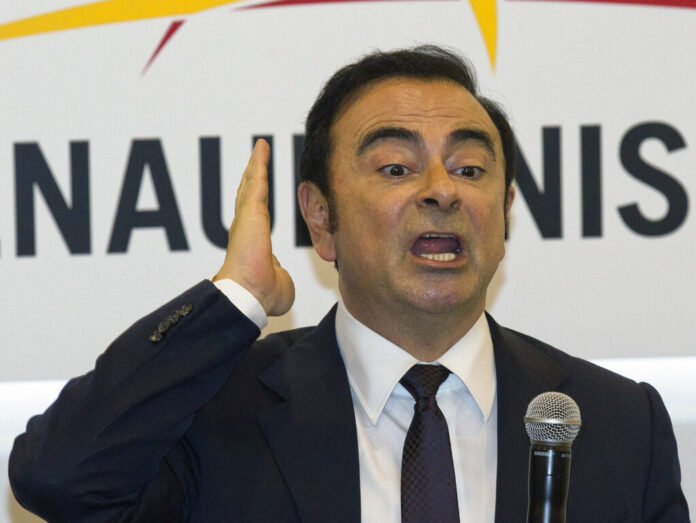
Then Renault-Nissan's CEO Carlos Ghosn speaks in 2016 during a press conference held at Auto China 2016 in Beijing, China. Photo: Ng Han Guan / Associated Press

TOKYO — A court in Tokyo on Tuesday rejected former Nissan chairman Carlos Ghosn’s latest request for bail, made more than two months after his arrest.

The decision by the Tokyo District Court came a day after Ghosn promised to wear an electronic monitoring ankle bracelet, give up his passport and pay for security guards approved by prosecutors to gain release from a Tokyo detention center.

The court announced its decision in a written statement.

Ghosn, 64, has been in custody since Nov. 19. He was due for a bail hearing Monday. A Tokyo court rejected an earlier request for bail last week. His lawyers were expected to appeal the decision, as they have earlier rejections of Ghosn’s requests to get out of detention.

Ghosn, who led Nissan Motor Co. for two decades, has been charged with falsifying financial reports, in underreporting his compensation from Nissan over eight years, and with breach of trust, centering on allegations Ghosn had Nissan shoulder investment losses and pay a Saudi businessman.

Ghosn says he is innocent as the compensation was never decided, Nissan didn’t suffer losses and the payment was for legitimate services.

Advertisement

Teen in MAGA Hat Video Says He Tried to Calm Tension

FRANKFORT, Ky. (AP) — A Native American organizer of a march in Washington, D.C., says he felt compelled to get between a group of black religious activists and largely white students with his ceremonial drum to defuse a potentially dangerous situation.

But, the teen at the center of a video confrontation says he did nothing to provoke anyone and also sought to calm the situation.

Nathan Phillips, an elder in the Omaha Tribe and a Vietnam veteran, on Sunday recounted for The Associated Press how he came to be surrounded by a group of students from a Catholic boys’ high school in Kentucky in an encounter captured on videos that are circulating online. The student identified himself in an email Sunday evening as junior Nick Sandmann of Covington Catholic High School in Kentucky.

An official working with the family confirmed Sandmann’s identity, speaking on condition of anonymity because the source didn’t want to distract from the teen’s statement.

Sandmann says students were waiting at the Lincoln Memorial for buses to return to Kentucky on Friday when four African-American protesters there began insulting them.

Videos being shared on social media show members of the activist group yelling insults at the students, who taunt them in return, and students chanting, laughing and jeering as Phillips sings and plays the drum.

Sandman says the students began yelling “school spirit chants” to drown out the protesters and he did not hear students chant anything “hateful or racist at any time.”

The Diocese of Covington and Covington Catholic High School released a statement that can be found on the front page of the school’s website reading:

“We condemn the actions of the Covington Catholic High School students towards Nathan Phillips specifically, and Native Americans in general, Jan. 18, after the March for Life, in Washington, D.C. We extend our deepest apologies to Mr. Phillips. This behavior is opposed to the Church’s teachings on the dignity and respect of the human person. The matter is being investigated and we will take appropriate action, up to and including expulsion. We know this incident also has tainted the entire witness of the March for Life and express our most sincere apologies to all those who attended the March and all those who support the pro-life movement.”

According to the school’s website, the group of students was in Washington, D.C., for March For Life 2019 from Jan. 17-19.

An extended video of the encounter shows Phillips and some of the men he was with approach the teens, while Phillips was beating his drum.

Some of the teens involved in the encounter have spoken out, saying the incident was not what it seemed.

A letter sent to the CBS affiliate in Cincinnati, Local 12, from a Covington Catholic student, and shared by our sister station WKYT, addresses the incident, and reads, in part:
“… We decided to do some cheers to pass time. In the midst of our cheers, we were approached by a group of adults led by Nathan Phillips, with Phillips beating his drum. They forced their way into the center of our group. … He came to stand in front of one of my classmates who stood where he was, smiling and enjoying the experience. … It was not until later that we discovered they would incriminate us as a publicity stunt. As a result, my friend faces expulsion for simply standing still and our entire school is being disparaged for a crime we did not commit…”

Phillips was participating in Friday’s Indigenous Peoples March. The students had attended the March for Life rally the same day.

Members of the Omaha Tribe gathered at the Nebraska State Capitol Sunday afternoon to protest the way Phillips was treated.

Advertisement

Tennis Players Can Cause Quite a Racket by Smashing Rackets

MELBOURNE, Australia — Way behind in a match he soon would lose, Alexander Zverev leaned forward in his Australian Open sideline seat to repeatedly, and violently, crack his racket against the court with a reverberating THWACK – one, two, three, four, five, six, seven, eight times in all, before throwing down the offending, and now-mangled, piece of equipment.

Caused quite a, well, racket.

“I heard it,” said Zverev’s opponent Monday, 2016 Wimbledon finalist Milos Raonic. “I don’t think I looked over. I think it was pretty clear what was going on.”

It certainly was not unusual. Smashing, spiking, bouncing or otherwise harming rackets is the most public form of anger, um, mismanagement in professional tennis, done all the time by all kinds of players, whether they are men or women, famous or unknown, seeded or otherwise, winning or losing. Over the first week of the Australian Open, Naomi Osaka, Dominic Thiem, Ryan Harrison and Daniil Medvedev, just to name a few, joined Zverev in producing GIF-worthy outbursts.

For better or for worse, racket-breaking is as inescapable an element of the sport as forehands and backhands, often revealing frustration, sometimes reversing the course of a contest, usually resulting in a fine of thousands of dollars, and even – as was the case with Serena Williams during her U.S. Open final loss to Osaka last September – occasionally costing a player a point (in Williams’ case, because of an earlier warning).

“I love it!” exclaimed Henri Leconte, the 1988 French Open runner-up.

“I mean, sure, it’s not good for kids to see,” he said. “But sometimes, it’s very important to show emotion. … In my generation, we had so many players who did that: John McEnroe was doing it a lot; Goran Ivanisevic was breaking rackets. Sometimes, when you see your opponent doing that, you say: ‘Oh, he’s really upset. That’s good.’ But if you were playing McEnroe, you were in trouble, because he played better afterward.”

Current players will cite McEnroe or Andy Roddick or Marat Safin, among others, when the subject is raised. They’ll talk about all-time classic displays, such as three-time major champion Stan Wawrinka’s signature move of bending a racket in half over his knee, the way a Major League Baseball slugger might try to break a bat. Or Marcos Baghdatis reaching into his bag for additional rackets during a changeover at the 2012 Australian Open (in a match against Wawrinka), until he’d slammed four and discarded them. Or Benoit Paire and his multiple-racket, sitting-then-standing tantrum (in a match against Baghdatis) that drew $16,500 in fines, more than double his prize money from last year’s Washington tournament.

“If we see a guy break a racket, someone will say to me, ‘Ah, yours was better,'” said Baghdatis, the 2006 runner-up in Melbourne.

“There are worse things. For me, it’s something that it’s fun to see. It’s good for tennis. There is some character and it should be like that,” he said. “You have a bad day at the office, (and) you have a fight with your wife. You have a fight with your brother, your mother, your sister, your father. It’s the way life is. Sometimes you have bad days and it just comes out.”

Leconte is hardly the only one who wonders about what sort of example is being set for children who are watching, especially those who play tennis.

“It’s become all too commonplace. And it seems like other players see it happening and they think, ‘Oh, this is OK to do.’ I think it’s bad modeling, and the rackets are obviously expensive,” said Tracy Austin, the 1979 and 1981 U.S. Open champion. “Emoting is good. We want to see personalities. But actually being destructive is not helpful for anybody.”

Ernests Gulbis, a former top-10 player known for raising racket abuse to an art form, says he wishes he could avoid ever doing it again.

He also admits that’s not likely.

“Sometimes the emotions just take over. It’s a fight. It’s like a gladiator fight. It’s not like you’re laying in bed and can just be relaxed,” Gulbis said. “Emotions just come out. I’m against it, personally, because you can fix your problems on court in a different way. But to be honest, sometimes it helps.”

That’s a popular take.

“It made me feel better. I was very angry, so I let my anger out,” Zverev said Monday.

Didn’t do him a bit of good on the scoreboard, though.

He was trailing Raonic 6-1, 4-1 when he destroyed his racket at a changeover, then proceeded to drop the next two games and the third set, too.

But Osaka, who’ll play in the quarterfinals Wednesday, did appear to get a boost from her racket fling while losing the opening set of what became a three-set victory.

“For me, I tend to keep a lot of things bottled up. I just felt like in that moment, sort of releasing it was easier than just keeping it inside,” Osaka said, “and then maybe I would have dwelled on it for longer.”

Top-ranked Novak Djokovic is a firm believer that the direction of a match can change with a well-timed to-do.

So the 14-time Grand Slam champion is hardly shy about chucking the tool of his trade when the inspiration strikes.

“At times in my career, these kind of situations, when I would scream or throw a racket, it would kind of wake me up and help me to just kind of free myself from that pressure that is just building throughout the match,” Djokovic said. “But there are times when it doesn’t help.”

Crowd reactions vary.

Fans are sometimes seen begging a player to hand over a messed-up racket as a keepsake. Yet when Djokovic shattered a frame by pounding it against the French Open’s red clay last year, spectators whistled and booed.

“I’m not proud of doing that, to be honest. I don’t like doing that,” he said. “But at times, it happens.”

Story: Howard Fendrich

Advertisement

Asian Cup: Japan Tops Saudi Arabia, Australia Wins Shootout

Japan's defender Takehiro Tomiyasu, second right, celebrates Monday after scoring the opening goal during the AFC Asian Cup round of 16 soccer match between Japan and Saudi Arabia at the Sharjah Stadium in Sharjah, United Arab Emirates. Photo: Hassan Ammar / Associated Press

SHARJAH, United Arab Emirates — Title contenders Japan and Australia scraped through tough last-16 games at the Asian Cup on Monday, joined by the host team United Arab Emirates.

Japan advanced to the uarterfinals by beating Saudi Arabia 1-0, while defending champion Australia needed penalties to get past Uzbekistan.

Takehiro Tomiyasu scored for Japan with a header in the 20th minute and the Saudis created few chances despite having more than 75 percent of the possession against a defense-first Japan team.

“In our team, we share the same idea that even when our opponent keeps the ball, if we carefully defend at the end-line, we should be able to defend without any problem,” defender Yuto Nagatomo said. “Our opponents held the ball for long periods, but our view was that we let them hold the ball.”

Japan, which is looking to win a record fifth Asian Cup title, will next face Vietnam, the lowest ranked of the six teams to qualify so far for the quarterfinals.

Saudi Arabia has not reached the quarterfinals in 12 years. Coach Juan Antonio Pizzi’s contract was due to expire after the tournament and he said it hadn’t been renewed.

“No one has talked to me from the Saudi federation about that,” the Argentine coach said. “We played most of the time today in their half and we controlled the ball and had position, but we lacked the final touch and determination to transfer the position into goals.”

Official attendance figures put the crowd at just 6,832 as the Asian Cup continued to be notable for banks of empty seats and echoing chants.

Australia struggled to create chances as a drab game against Uzbekistan ended 0-0 after extra time, before winning the shootout 4-2.

On his return from a hamstring injury, Mathew Leckie scored the winning penalty.

Shooting second for Australia, Aziz Behich saw his penalty saved but goalkeeper Mathew Ryan – shifting from side to side on his line to distract Uzbekistan’s penalty takers – stopped two Uzbek shots to put Australia ahead and allow Leckie to seal the win.

Uzbekistan almost scored early on when Ryan kept out Eldor Shomurodov’s shot, while Australia wasted second-half opportunities by shooting straight at goalkeeper Ignaty Nesterov. Defeat in the last 16 would have marked Australia’s worst Asian Cup result.

Australia is part-way through a rebuild under coach Graham Arnold after veteran players such as Mile Jedinak and Tim Cahill retired from international football following last year’s World Cup. Since joining the Asian confederation in 2006, Australia has played eight games in the knockout stages, with five of those going to extra time.

Australia’s quarterfinal opposition will be the United Arab Emirates after the host side beat Kyrgyzstan 3-2 after extra time.

Kyrgyzstan missed a string of chances at 2-1 down in the second half before Tursunali Rustamov’s stoppage-time header sent the game to extra time. The UAE took the win after Ahmed Khalil’s penalty, awarded for a shove on a teammate, but narrowly avoided penalties only when Kyrgyzstan hit the crossbar with 10 seconds remaining.

The UAE is aiming to live up to its third-place result from 2015, and reached the final the last time it hosted the tournament in 1996.

Advertisement

Reinvented Legacy: Nazi’s Paintings Fund Foundation for Jews

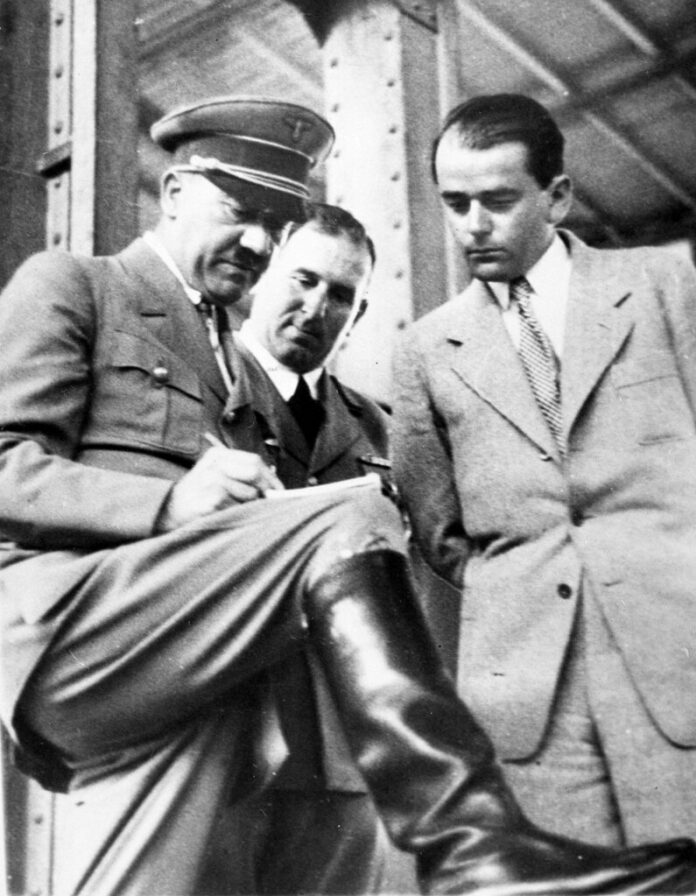
In this file photo dated Feb. 19, 1937, German Chancellor Adolf Hitler, left, discusses plans for building a convention hall at Nuremberg with Lord Mayor Willy Liebel, centre, and Prof. Albert Speer, right, at Nuremberg, Germany. Photo: Associated Press

BERLIN — When Hilde Schramm inherited several paintings collected by her father, Hitler’s chief architect and Armaments Minister Albert Speer, she was only sure of one thing: she didn’t want them.

Despite determining they probably hadn’t been looted from Jews during World War II, she wanted their legacy to somehow benefit others. So she huddled with friends around a rickety green table at her home-office in Berlin and came up with a plan to sell them and use the proceeds to support Jewish women’s creative projects in Germany.

In 1994, that became the Zurueckgeben foundation, a project for which Schramm is receiving an Obermayer German Jewish History Award on Monday. The honor was established by an American Jewish philanthropist to recognize the efforts of non-Jewish Germans to keep alive their nation’s Jewish cultural past.

The foundation’s name translates as “return” or “give back” but also can mean “restitution,” and Schramm said it was intentionally chosen to emphasize its goal of raising awareness at a time when looted Jewish property and art was a little talked-about issue.

“It was very much our point with this word ‘Zurueckgeben,’ which in a way is a provocation, because in a way nobody really can give back, to raise consciousness about the injury that had been done very broadly in Germany,” she told The Associated Press.

Today, there’s a wider understanding that the Nazis plundered precious artworks and other property from Europe’s Jews, partially because of recent stepped-up German government efforts to identify heirs and organize restitution, and the popular 2014 Hollywood film “The Monuments Men.”

But most of the focus has been on the big-ticket items like precious paintings and sculptures. Schramm’s foundation encourages Germans to take stock of the more mundane items in their households and question where they came from.

In part it’s to fight the cliche perpetrated by the Nazis that all Jews were rich and powerful, and also to dispel the notion that only the Nazi elite profited at the expense of the Jews.

“Let it come close to your families and look at what other ways the German population did profit. When Jews were expelled from their jobs, of course non-Jewish Germans could take their job,” Schramm said. “It’s not only the question of real objects being robbed but their whole existence … this is to raise awareness that it did reach almost every family, a kind of involvement or profiting.”

Because it’s almost impossible to determine the original owners of smaller items like cutlery and furniture, donors to the foundation often give a symbolic amount to Zurueckgeben, or sell the items and give the proceeds.

Since it began, hundreds of Germans have donated and the foundation has been able to pay out some 500,000 euros ($570,000) in grants to support more than 130 Jewish women’s projects. Those include a children’s theater, exhibitions, dance shows, books and films.

The 82-year-old Schramm, a former Greens party state lawmaker as well as an educator and author, has been involved in several other projects related to Nazi-era commemoration and atonement. She was previously honored by Berlin with the Moses Mendelssohn Prize, named after the Jewish philosopher and given to honor people for fostering tolerance.

She has also helped organize a nonprofit association to support projects in Greece after the Greek financial crisis, and has hosted seven refugees from Afghanistan and Syria in her own home. That followed German Chancellor Angela Merkel’s decision to open the country’s borders to more than 1 million migrants in 2015-16.

“Wherever I went, whatever I did, I saw something which was a blind spot and I took it up,” she said.

Schramm was only 9 when the war ended. Even though she was there at times with her father as he rubbed elbows with Hitler and other top Nazis, she said the persecution of the Jews was not something she was aware of.

“I had no idea,” she said, pausing contemplatively before adding: “But perhaps I didn’t want to have an idea. I don’t know.”

Unlike many other top Nazis, who committed suicide or were executed after the war, Albert Speer served 20 years in a Berlin prison for war crimes after being convicted in the Nuremberg trials. At his trial, Speer, who died in 1981 in London, accepted moral responsibility but insisted he had not known of the Holocaust — a contention that many have questioned.

Schramm was able to talk with him and confront him with her questions, which was an opportunity she said a lot of the donors to her foundation never had with their families.
“In a way, I always felt in a good situation, as I knew what my father had been and what he had done very soon,” she said. “Many men and women of my generation, they had no answer what their family had done.”

Schramm’s award is one of six being presented by the organization established in 2000 by Albert Obermayer, whose grandparents were all German, after he was inspired by the help he received from Germans in researching his roots. Obermayer died in 2016.

Advertisement

DNA Links Mekong Corpse to Monarchy Foe: Family

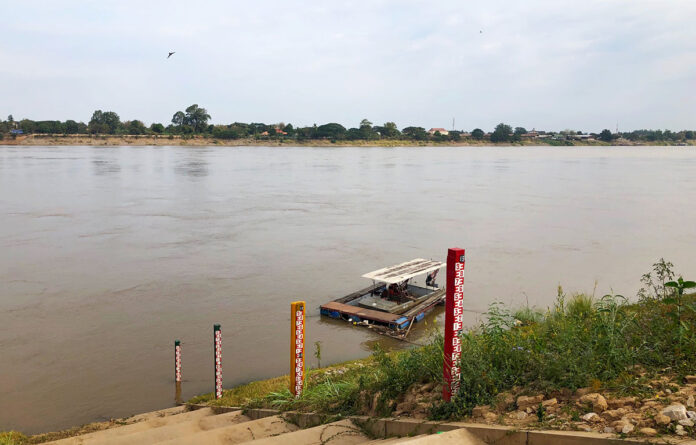
Posts mark water levels in the Mekong River on Jan. 15 in Nong Khai province.

BANGKOK — The son of one of three missing republicans said Monday that police have concluded that a mutilated body found in the Mekong River was his father.

The man, who spoke on condition of anonymity, said he was contacted Monday by the Institute of Forensic Science after preliminary DNA results identified him as the son of “Phoo Chana,” the assumed name of one of three exiled anti-monarchists who went missing last month in Laos.

A representative of the institute said Monday they, by policy, could not comment or confirm the news.

Update: 2nd Mutilated Body Linked to Anti-Monarchist Aide

Like other exiled monarchy critics, the 57-year-old had lived there in exile since the 2014 coup.

He was an aide of well-known monarchy opponent Surachai Danwattananusorn. After Surachai, Phoo Chana and a third man who went by the name “Kasalong” were reported missing, at least two bodies washed ashore on the Thai side of the Mekong River border in Nakhon Phanom province just before New Year’s.

The man identifying himself as Phoo Chana’s son said by phone Monday that he asked police why they needed to interview him. He said they told him that DNA samples taken from one of the bodies suggested he was a relation.

“The [formal DNA] report is not out yet, but basically that’s what I was told,” said the man, who asked not to be identified for security purposes.

The real identities of Phoo Chana and Kasalong are unknown.

The wife of Surachai, Pranee Dawattanusorn, said by phone Monday that the other body found looked too young to be her husband. She added that no one from the family had submitted DNA samples. Police are investigating whether the other body is that of Kasalong.

Pranee said she wants to file a missing persons report to police in Laos but could not afford the trip and is concerned about her security. She believes her husband was either killed and buried somewhere or may still be alive.

“Maybe he is still just being detained. Surachai doesn’t deserve to be murdered with cruelty. He is relatively well-known. Some said he has been saved and is safe,” said Pranee, who lost contact with Surachai on Dec 10.

Read: Police Won’t Say if Mutilated Body is Missing Republican

The three are the latest opponents of the Thai monarchy, some of whom have called for the kingdom to become a republic, to disappear and be presumed dead.

Ko Tee, a radio host and Redshirt firebrand, was reportedly abducted by 10 Thai-speaking men in black in July 2017. A year earlier, a lesser-known dissident, Ittipon Sukpaen, aka DJ Sunho, disappeared and was never seen again.

Fear of being targeted has spread through the dissident community. A young anti-monarchist in Laos who also fled Thailand after the coup said by phone Sunday that he has to move locations every four days for fear of being forcibly disappeared. He has also complained of having no success finding a nation to grant him political asylum.

There were notes of defiance, as well. Political activist Waaddao Chumaporn wrote online Monday afternoon to pray for the souls of the missing three, adding: “We shall not forget how each life has suffered in order to ignite continued work for justice.”

Kyoto-based exiled academic Pavin Chachavalpongpun wrote online to urge exiles to flee “urgently” from the neighboring countries to a third country in light of the reported DNA results.

Correction: An earlier version of this story stated incorrectly that the bodies were recovered in Nong Khai province. In fact, they were discovered in Nakhon Phanom province.

Advertisement

‘Pho Keene Great’ Restaurant Allowed to Open

Photo: Pho Keene Great / Facebook

KEENE, New Hampshire — Officials in a New Hampshire city have approved a restaurant sign that initially was removed over concerns that it sounded profane.

The name of the Vietnamese restaurant in a public building next to City Hall in Keene is a play on words. It calls itself by the name of a soup, which in English is spelled Pho and is pronounced “fuh,” followed by the words “Keene Great.” It’s scheduled to open March 1.

“What do we serve? Where do we serve it? How does it taste? The answer is Pho Keene Great,” the restaurant’s website reads.

City Manager Elizabeth Dragon said in an email the sign was approved Friday and is in compliance. She said no one had submitted written permission to put up any sign until Jan. 4.

Dragon said officials decided to let the community “decide what they think of the sign and how they interpret it.”

Advertisement

Hot News

LATEST NEWS

Bangkok
scattered clouds
30 ° C
32.2 °
30 °
80 %
2kmh
48 %
Fri
31 °
Sat
36 °
Sun
36 °
Mon
36 °
Tue
34 °