26.1 C
Bangkok
Saturday, June 20, 2026
Home Blog Page 1741

2-Year-Old Boy’s Body Found in Sugarcane Field

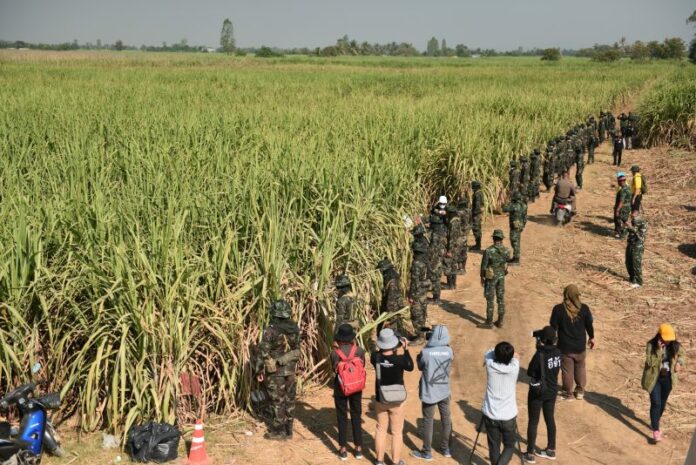
SUPHAN BURI — The body of a 2-year-old boy who had been missing for more than a week was found Tuesday afternoon in a sugarcane field.

After the search operation entered its ninth day, Sului Piew’s body was discovered at about 4:45pm, about 5 kilometers from where he was reported missing.

There were no immediate details about the cause of Sului’s death. The boy’s body was being retrieved and will be handed to forensic authorities.

Sului went missing Dec. 17 while he was out playing with a friend near a sugarcane plantation in Suphan Buri province, who her parents that the boy had been abducted.

Related stories:

Search for Missing Boy in Suphan Buri Field Enters 9th Day

Elephants Join Search for Missing 2-Year-Old Boy

Advertisement

Case Against Academics Who Defied Assembly Ban Dropped

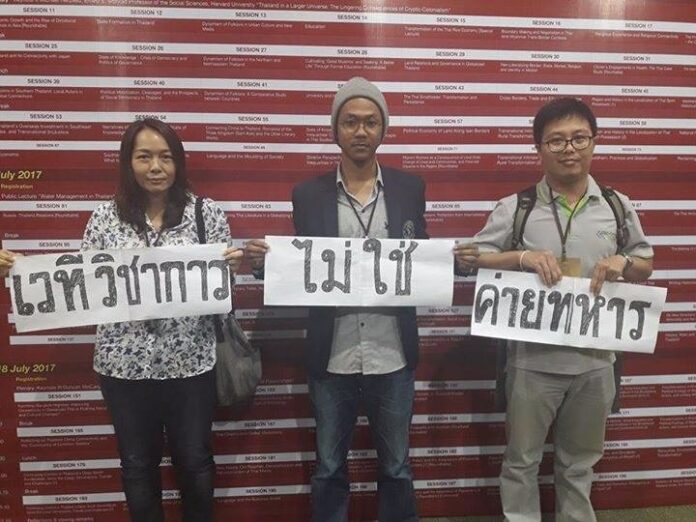
Pakawadee Veerapaspong, left, and two others hold placards in 2017.

CHIANG MAI — A district court in the north of Thailand said Tuesday it had dismissed a case against five academics and students charged with violating the junta’s ban on political gatherings of more than four people.

The Chiang Mai court cited that the ban had been lifted by junta leader Gen. Prayuth Chan-ocha. The ban, also known as junta order No. 3/2015 was lifted earlier this month.

Among the five charged, some were holding placards stating “academic panels are not a military base” in defiance of the ban on political gatherings during an International Thai Studies Conference in July 2017.

The five include anthropologist Chayan Vaddhanaphuti, writer and translator Pakawadee Veerapaspong and three Chiang Mai University students.

Advertisement

Did 2018 Usher in a Creeping Tech Dystopia?

Phil Schiller, Apple's senior vice president of worldwide marketing, speaks about the Apple iPhone XS and Apple iPhone XS Max at the Steve Jobs Theater during an event to announce new Apple products Wednesday, Sept. 12, 2018, in Cupertino, California. Photo: Marcio Jose Sanchez / Associated Press

W

e may remember 2018 as the year when technology’s dystopian potential became clear, from Facebook’s role enabling the harvesting of our personal data for election interference to a seemingly unending series of revelations about the dark side of Silicon Valley’s connect-everything ethos.

The list is long: High-tech tools for immigration crackdowns. Fears of smartphone addiction. YouTube algorithms that steer youths into extremism. An experiment in gene-edited babies.

Doorbells and concert venues that can pinpoint individual faces and alert police. Repurposing genealogy websites to hunt for crime suspects based on a relative’s DNA. Automated systems that keep tabs of workers’ movements and habits. Electric cars in Shanghai transmitting their every movement to the government.

It’s been enough to exhaust even the most imaginative sci-fi visionaries.

“It doesn’t so much feel like we’re living in the future now, as that we’re living in a retro-future,” novelist William Gibson wrote this month on Twitter. “A dark, goofy ’90s retro-future.”

More awaits us in 2019, as surveillance and data-collection efforts ramp up and artificial intelligence systems start sounding more humanreading facial expressions and generating fake video images so realistic that it will be harder to detect malicious distortions of the truth.

But there are also countermeasures afoot in Congress and state government – and even among tech-firm employees who are more active about ensuring their work is put to positive ends.

“Something that was heartening this year was that accompanying this parade of scandals was a growing public awareness that there’s an accountability crisis in tech,” said Meredith Whittaker, a co-founder of New York University’s AI Now Institute for studying the social implications of artificial intelligence.

The group has compiled a long list of what made 2018 so ominous, though many are examples of the public simply becoming newly aware of problems that have built up for years. Among the most troubling cases was the revelation in March that political data-mining firm Cambridge Analytica swept up personal information of millions of Facebook users for the purpose of manipulating national elections.

“It really helped wake up people to the fact that these systems are actually touching the core of our lives and shaping our social institutions,” Whittaker said.

That was on top of other Facebook disasters, including its role in fomenting violence in Myanmar , major data breaches and ongoing concerns about its hosting of fake accounts for Russian propaganda.

It wasn’t just Facebook. Google attracted concern about its continuous surveillance of users after The Associated Press reported that it was tracking people’s movements whether they like it or not.

It also faced internal dissent over its collaboration with the U.S. military to create drones with “computer vision” to help find battlefield targets and a secret proposal to launch a censored search engine in China. And it unveiled a remarkably human-like voice assistant that sounds so real that people on the other end of the phone didn’t know they were talking to a computer.

Those and other concerns bubbled up in December as lawmakers grilled Google CEO Sundar Pichai at a congressional hearing – a sequel to similar public reckonings this year with Facebook CEO Mark Zuckerberg and other tech executives.

“It was necessary to convene this hearing because of the widening gap of distrust between technology companies and the American people,” Republican House Majority Leader Kevin McCarthy said.

Internet pioneer Vint Cerf said he and other engineers never imagined their vision of a worldwide network of connected computers would morph 45 years later into a surveillance system that collects personal information or a propaganda machine that could sway elections.

“We were just trying to get it to work,” recalled Cerf, who is now Google’s chief internet evangelist. “But now that it’s in the hands of the general public, there are people who … want it to work in a way that obviously does harm, or benefits themselves, or disrupts the political system. So we are going to have to deal with that.”

Contrary to futuristic fears of “super-intelligent” robots taking control, the real dangers of our tech era have crept in more prosaically – often in the form of tech innovations we welcomed for making life more convenient.

Part of experts’ concern about the leap into connecting every home device to the internet and letting computers do our work is that the technology is still buggy and influenced by human errors and prejudices. Uber and Tesla were investigated for fatal self-driving car crashes in March, IBM came under scrutiny for working with New York City police to build a facial recognition system that can detect ethnicity, and Amazon took heat for supplying its own flawed facial recognition service to law enforcement agencies.

In some cases, opposition to the tech industry’s rush to apply its newest innovations to questionable commercial uses has come from its own employees. Google workers helped scuttle the company’s Pentagon drone contract, and workers at Amazon, Microsoft and Salesforce sought to cancel their companies’ contracts to supply tech services to immigration authorities.

“It became obvious to a lot of people that the rhetoric of doing good and benefiting society and ‘Don’t be evil’ was not what these companies were actually living up to,” said Whittaker, who is also a research scientist at Google who founded its Open Research group.

At the same time, even some titans of technology have been sounding alarms. Prominent engineers and designers have increasingly spoken out about shielding children from the habit-forming tech products they helped create.

And then there’s Microsoft President Brad Smith, who in December called for regulating facial recognition technology so that the “year 2024 doesn’t look like a page” from George Orwell’s “1984.”

In a blog post and a Washington speech, Smith painted a bleak vision of all-seeing government surveillance systems forcing dissidents to hide in darkened rooms “to tap in code with hand signals on each other’s arms.”

To avoid such an Orwellian scenario, Smith advocates regulating technology so that anyone about to subject themselves to surveillance is properly notified. But privacy advocates argue that’s not enough.

Such debates are already happening in states like Illinois, where a strict facial recognition law has faced tech industry challenges, and California, which in 2018 passed the nation’s most far-reaching law to give consumers more control over their personal data. It takes effect in 2020.

The issue could find new attention in Congress next year as more Republicans warm up to the idea of basic online privacy regulations and the incoming Democratic House majority takes a more skeptical approach to tech firms that many liberal politicians once viewed as allies – and prolific campaign donors.

The “leave them alone” approach of the early internet era won’t work anymore, said Rep. David Cicilline, a Rhode Island Democrat poised to take the helm of the House’s antitrust subcommittee.

“We’re seeing now some of the consequences of the abuses that can occur in these platforms if they remain unregulated without meaningful oversight or enforcement,” Cicilline said.

Too much regulation may bring its own undesirable side effects, Cerf warned.

“It’s funny in a way because this online environment was supposed to remove friction from our ability to transact,” he said. “If in our desire, if not zeal, to protect people’s privacy we throw sand in the gears of everything, we may end up with a very secure system that doesn’t work very well.”

Story: Matt O’Brien

Advertisement

Thailand Engages With Others, Not Just China: Foreign Ministry

Prime Minister Gen. Prayuth Chan-ocha with Chinese President Xi Jinping on Sept. 4, 2017, at the BRICS summit in Xiamen, China.

BANGKOK — The Foreign Ministry on Tuesday issued a statement rejecting criticism that the kingdom has become too close to China at the expense of its ties with the European Union and the United States.

It came after former deputy prime minister Pridiyathorn Devakula made the remarks Monday. Pridiyathorn served as a deputy leader after the 2014 coup under junta head Gen. Prayuth Chan-ocha.

Read: Prayuth’s Ex-Deputy Says Junta Leader Shouldn’t Be PM Again 

The foreign ministry said Thailand’s foreign policy under the current military regime places importance on “maintaining balance” among superpowers and key allies by forging “constructive strategies” with “mutual respect, mutual trust and mutual benefits.”

“Thailand has forged close ties in all dimensions with the US, China, Japan, India and Australia, be they political, economic or social,” the statement read, adding that Prayuth was invited to visit the White House in 2017 as an example, and citing the opening of the Thai consulate in Fukuoka, Japan.

The statement said the European Union decided to revive its high-level ties with Thailand in December 2017, which led to Prayuth’s visits to the United Kingdom, France and Germany and to attend the ASEM Summit in Brussels, Belgium this year.

“Leaders of all countries received the prime minister and the entourage well and this led to tangible results,” the statement read, adding that trade, economic cooperation and investment from both state and private sectors gained as a result.

The Foreign Ministry added that Thailand supports multilateralism and respects international laws.

Advertisement

Merry X’Mas! Parliament Unanimously Passes Medical Marijuana

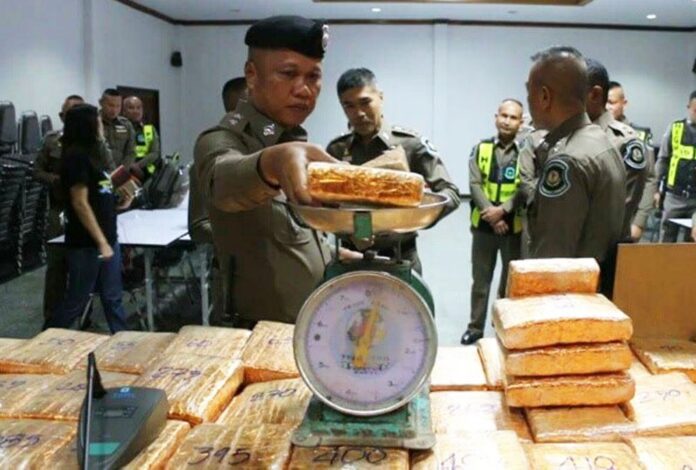
Khon Kaen police measure marijuana seized from suspected drug mules in May.

BANGKOK — After a years-long struggle and multiple hold-ups, a proposal to legalize marijuana for medical use passed the last legal hurdle required Tuesday and is on its way to become the law of the land.

In a unanimous vote of 166-0, the interim parliament approved the amendment of narcotics laws to permit the use of cannabis for medical treatment and research in its third and final session deliberating the bill. Thirteen lawmakers abstained.

Those permitted to possess marijuana under the new bill include researchers, Red Cross officials, traditional Thai practitioners, local farmers approved by the state, operators of transnational transportation and foreign patients who require medical marijuana for their treatment.

Bill sponsor Somchai Sawangkan thanked parliament after the meeting and said he considers the amendment a New Year’s present to all Thais.

The law also calls for a designation of areas where kratom could be consumed, medically and recreationally, without legal repercussion, and areas where marijuana can be cultivated under supervision of the Narcotics Control Board.

And there’s also amnesty for individuals who already currently possess cannabis intended for medical use, given that they register the substances with the Food and Drug Administration within 90 days after the law is enacted.

Unsanctioned possession of marijuana will remain illegal, punishable by up to five years in prison. The sentence goes up to 15 years for possession of over 10 kilograms.

It is not yet clear when the law will come into effect, but legislation is typically enacted within a month after the parliament approves it.

While medical cannabis advocates and activists will surely celebrate the news, one proponent of the bill voiced concern at the parliament’s decision.

Panthep Phuaphongphan, a medicine professor at Rangsit University, wrote online that the amendment might end up causing legal confusion because officials have not yet clearly answered whether foreign pharmaceuticals were permitted to patent certain strains of Thai cannabis.

Foreign pharma have made a quiet push to seize control of the yet-nascent industry through patent applications filed before the law passed.

Advertisement

Japan Stocks Plunge, Other Asia Markets Fall After US Losses

Asian Stocks Fall After IMF Downgrades Economic Outlook
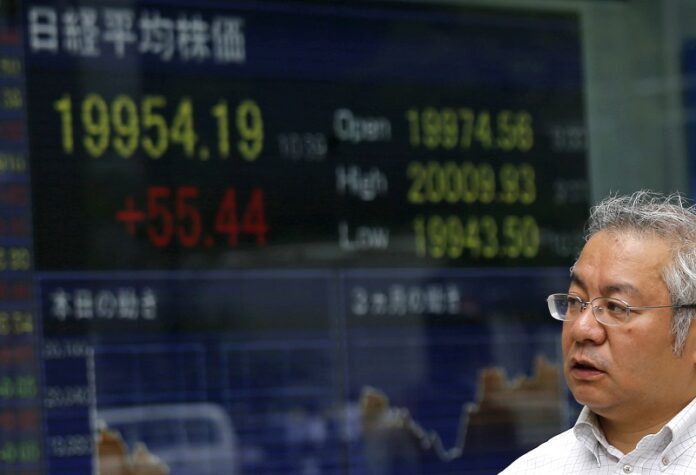
A man walks past an electronic stock board showing Japan's Nikkei 225 index at a securities firm in 2017 in Tokyo. Photo: Shuji Kajiyama / Associated Press

BEIJING — Japanese stocks plunged Tuesday and other Asian markets declined following heavy Wall Street losses triggered by President Donald Trump’s attack on the U.S. central bank.

The Nikkei 225 fell by an unusually wide margin of 4.8 percent to 19,189.00. The Shanghai Composite Index lost 2.3 percent to 2,469.28. Benchmarks in Thailand and Taiwan also declined.

Markets in Hong Kong, Australia and South Korea were closed for Christmas.

Wall Street indexes fell more than 2 percent on Monday after Trump said on Twitter the Federal Reserve was the U.S. economy’s “only problem.” Efforts by Treasury Secretary Steven Mnuchin to calm investor fears only seemed to make matters worse.

U.S. stocks are track for their worst December since 1931 during the Great Depression. Shanghai is down almost 25 percent this year, while Tokyo, Hong Kong and other markets are on track to end 2018 down more than 10 percent.

Markets have been roiled by concerns about a slowing global economy, the trade dispute with China and another interest rate increase by the Fed.

Trump’s Monday morning tweet heightened fears about the economy being destabilized by a president who wants control over the Fed. Its board members are nominated by the president but make decisions independently of the White House. The board’s chairman, Jerome Powell, was nominated by Trump last year.

“The only problem our economy has is the Fed,” the president said on Twitter. “They don’t have a feel for the Market, they don’t understand necessary Trade Wars or Strong Dollars or even Democrat Shutdowns over Borders. The Fed is like a powerful golfer who can’t score because he has no touch – he can’t putt!”

The Standard & Poor’s 500 index slid 2.7 percent to 2,351.10. The benchmark index is down 19.8 percent from its peak on Sept. 20, close to the 20 percent drop that would officially mean the end of the longest bull market for stocks in modern history – a run of nearly 10 years.

The Dow Jones Industrial Average sank 2.9 percent to 21,792.20. The Nasdaq skidded 2.2 percent to 6,192.92.

On Sunday, Mnuchin made a round of calls to the heads of the six largest U.S. banks, but the move only raised new concerns about the economy.

Most economists expect U.S. economic growth to slow in 2019, not slide into a full-blown recession. But the president has voiced his anger over the Fed’s decision to raise its key short-term rate four times in 2018. That is intended to prevent the economy from overheating.

Technology stocks, health care companies and banks took some of the heaviest losses in Monday’s sell-off. Wells Fargo slid 3.4 percent, Microsoft 4.2 percent and Johnson & Johnson 4.1 percent.

U.S. markets reopen Wednesday.

In energy markets, Brent crude, used to price international oils, lost 9 cents to USD$50.68 per barrel in London. The contract plummeted $3.33 on Monday to close at $50.77.

In currency trading, the dollar declined to 110.13 yen from Monday’s 110.45 yen. The euro advanced to $1.1417 from $1.1405.

Story: Joe McDonald

Advertisement

Somber Christmas, Prayers in Tsunami-Hit Indonesian Region

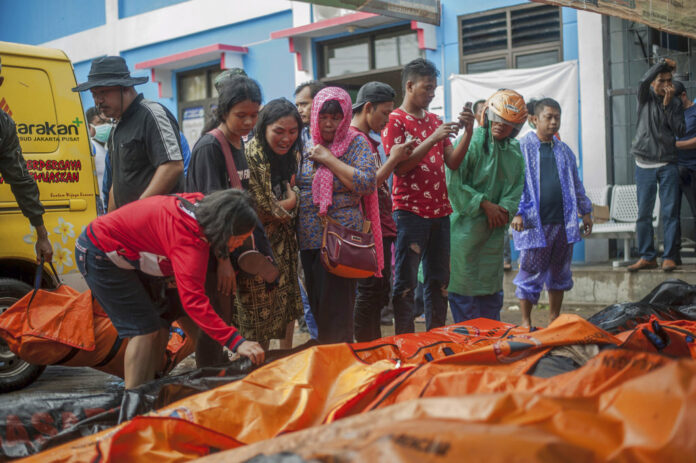
People search for relatives Sunday among the bodies of tsunami victims in Carita, Indonesia. Photo: Fauzy Chaniago / Associated Press

SUMUR, Indonesia — The Christmas holiday was somber with prayers for tsunami victims in the Indonesian region hit by waves that struck without warning Saturday night.

Markus Taekz said his Rahmat Pentecostal Church in the hard-hit area of Carita did not celebrate with joyous music.

Instead, he said only about 100 people showed up for the Christmas Eve service, usually attended by double that number, because many people had left the area for the capital, Jakarta, or other areas away from the disaster zone.

“This is an unusual situation because we have a very bad disaster that killed hundreds of our sisters and brothers in Banten,” he said, referring to the Javanese province. “So our celebration is full of grief.”

Church leaders called on Christians across Indonesia, the world’s most populous Muslim nation, to pray for victims of the tsunami.

The death toll had climbed to 373 late Monday with more than 1,400 people injured and at least 128 missing after the tsunami slammed into western Java and southern Sumatra without warning, smashing homes to pieces and sweeping people into the sea.

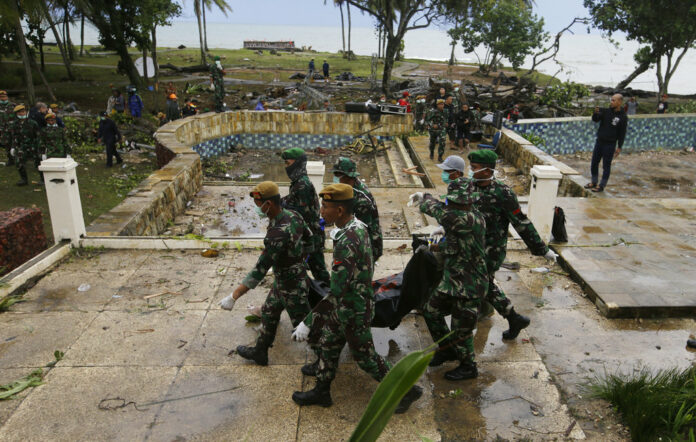
Military troops, government personnel and volunteers were searching along debris-strewn beaches. Where victims were found, yellow, orange and black body bags were laid out, and weeping relatives identified the dead.

The waves followed an eruption and apparent landslide on Anak Krakatau, or “Child of Krakatoa,” a volcanic island that formed in the early part of the 20th century near the site of the cataclysmic 1883 eruption of Krakatoa.

Hotels and hundreds of homes were heavily damaged by the waves. Chunks of broken concrete and splintered wood littered coastal areas.

Indonesian President Joko Widodo, who faces what promises to be a tough re-election campaign next year, vowed to have all tsunami-detection equipment replaced or repaired.

Sutopo Purwo Nugroho, spokesman for Indonesia Disaster Mitigation Agency, acknowledged on Twitter that the country’s network of detection buoys had been out of order since 2012 because of vandalism and budget shortfalls.

But the head of Indonesia’s Meteorology, Climatology and Geophysics Agency, Dwikorita Karnawati, said the tsunami was caused by Krakatau’s volcanic activity and so could not have been picked up by the agency’s sensors, which monitor the conventional earthquakes responsible for more than 90 percent of Indonesia’s tsunamis.

The tsunami was probably caused by the collapse of a big section of the volcano’s slope, said Gegar Prasetya, co-founder of the Tsunami Research Center Indonesia. Anak Krakatau been erupting since June and did so again 24 minutes before the tsunami, the geophysics agency said.

Indonesia, a vast archipelago of more than 17,000 islands and home to 260 million people, lies along the Ring of Fire, an arc of volcanoes and fault lines in the Pacific Basin.

The eruption of Krakatoa in the 19th century killed more than 30,000 people and hurled so much ash that it turned day to night in the area and reduced global temperatures. Thousands were believed killed by a quake and tsunami that hit Sulawesi island in September, and an earlier quake on the island of Lombok killed 505 people in August.

Story: Niniek Karmini

Advertisement

California Governor Pardons 5 Cambodian Refugees

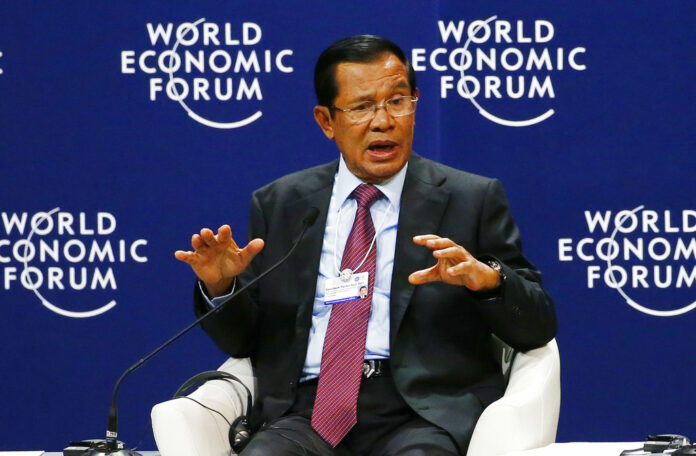
Prime Minister Hun Sen of Cambodia gestures as he talks about his vision for the Mekong region in the World Economic Forum on ASEAN at the National Convention Center Wednesday, Sept. 12, 2018 in Hanoi, Vietnam. Photo: Bullit Marquez / Associated Press

SACRAMENTO, California — California Gov. Jerry Brown has pardoned five refugees from Cambodia and another immigrant from Honduras who faced the possibility of deportation because of their criminal convictions.

The pardons were among more than 250 clemency decisions announced by the governor on Christmas Eve.

According to Brown’s office, the five Cambodians entered the country when they were 5 or younger.

The pardons don’t automatically stop deportation proceedings, but they eliminate the state convictions on which federal authorities might base deportation decisions. That gives the men’s lawyers strong legal arguments before immigration judges to try to prevent their removal from the country.

Advertisement

Mexico: Helicopter Crash Claims Puebla Governor, Ex-Governor

Rafael Moreno Valle, candidate of the
Rafael Moreno Valle, candidate of the "Compromiso por Puebla" party coalition, flashes two thumbs up IN 2010 after casting his vote during state elections in Puebla, Mexico. Photo: Joel Merino / Associated Press

MEXICO CITY — A husband-and-wife political power couple who were the current and ex-governors of the central Mexican state of Puebla died in a Christmas Eve helicopter crash, officials announced.

Mexico’s political class was stunned by the deaths of Gov. Martha Erika Alonso and ex-Gov. Rafael Moreno Valle, a prominent figure in the opposition National Action Party who had vied unsuccessfully for the party’s presidential nomination and its internal leadership. He was currently a federal senator for the party.

Two pilots and a third passenger also died.

The Agusta 109 helicopter fell about 10 minutes after taking off from a heliport within the city of Puebla on a flight to Mexico City.

It crashed in the municipality of Santa Maria Coronango, which is about 3.5 miles (5.5 kilometers) north of the city’s main airport on the western outskirts, federal Public Security Secretary Alfonso Durazo told a news conference.

Images of the crash showed a shattered, still smoldering aircraft on the edge of a scorched patch of cornfield.

Both federal and state officials said they had opened investigations into the cause — a potentially sensitive case because President Andres Manuel Lopez Obrador’s Morena party had challenged the validity of Alonso’s election in July. She was sworn in 10 days ago after independent electoral authorities dismissed the challenge.

State spokesman Maximiliano Cortazar demanded a “transparent, impartial and independent” investigation.

Lopez Obrador expressed his “deepest condolences” via Twitter to the family of on Monday evening.

Moreno Valle governed the central state from 2011 to 2017 and was currently a federal senator. Opponents alleged that he had manipulated the election to hand power to his wife.

Government agencies and scores of officials, including former President Enrique Pena Nieto, also expressed condolences via statements and social media.

Advertisement

Thai Tsunami Warning System Works Despite Damage: Minister

Indonesian soldiers carry the bodies of tsunami victims Monday at a beach resort in Tanjung Lesung Indonesia. Photo: Achmad Ibrahim / Associated Press

BANGKOK — Thailand’s tsunami warning system is operational despite one of the two detection buoy lines on the Andaman sea having been recently damaged by a trawler, Interior Minister Gen. Anupong Paochinda said Tuesday.

Anupong reassured the public after a deadly tsunami hits Indonesia’s Sunda Strait without warning on Sunday, killing more than 280 people.

The Interior Minister said the line of detection buoys, which was accidentally damaged, will have to be reinstalled, adding that the government is ready to deploy it. He did not say when they’d be replaced, but added that warnings would be issued if there was a tsunami.

Anupong said there will be more frequent emergency evacuation drills and wanted to assured the local people and tourists that a timely evacuation will be made if there’s an incident.

Advertisement

Hot News

LATEST NEWS

Bangkok
overcast clouds
26.1 ° C
26.1 °
26.1 °
93 %
1.8kmh
100 %
Sat
33 °
Sun
35 °
Mon
37 °
Tue
37 °
Wed
36 °