BANGKOK — For its second year, Bangkok Block Party will throw a bigger event running two days in the heart of the city.
Siam Paragon, Siam Center and the skywalk connecting Siam Discovery and MBK Center will be packed with music fans and artists at three stages for hip-hop, electronic and heavy rock.
The international lineup highlights include Chicago indie trio Autograf, Dublin hip-hop act Rejjie Snow, poetic rapper Jesse James Solomon and many more. Local acts from the former block party such as underground punk rock group The Greed and hardcore act License to Kill will headline.
Not only music, expect food, drinks, workshops and pop-up tattoo parlors.
Bangkok Block Partyruns noon to midnight on Jan. 19 and Jan. 20 at Siam Paragon, Siam Center and the Siam Discovery-MBK Center skywalk.
Tickets for one day are 900 baht and 1,500 baht for both days. They are available online and at BTS Skytrain ticketing booths.
The block party, led by hip-hop crew Blaq Lyte, took place for the first time earlier this year at A Square on Soi Sukhumvit 26 with more than 50 music acts.
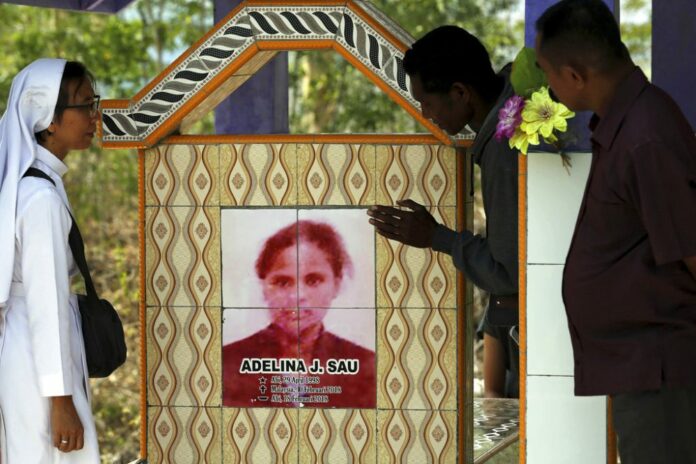
In this Oct. 21, 2018, photo, Sister Laurentina, left, stands next to the tombstone of Adelina Sau in Abi village in West Timor, Indonesia. Photoซ Tatan Syuflana / Associated Press
FATUKOKO, Indonesia — The stranger showed up at the girl’s door one night with a tantalizing job offer: Give up your world, and I will give you a future.
It was a chance for 16-year-old Marselina Neonbota to leave her isolated village in one of the poorest parts of Indonesia for neighboring Malaysia, where some migrant workers can earn more in a few years than in a lifetime at home. A way out for a girl so hungry for a life beyond subsistence farming that she walked 22 kilometers (14 miles) every day to the schoolhouse and back.
She grabbed the opportunity — and disappeared.
The cheerful child known to her family as Lina joined the army of Indonesians who migrate every year to wealthier countries in Asia and the Middle East for work. Thousands come home in coffins, or vanish. Among them, possibly hundreds of trafficked girls have quietly disappeared from the impoverished western half of Timor island and elsewhere in Indonesia’s East Nusa Tenggara province.
The National Agency for Placement and Protection of Indonesian Workers has counted more than 2,600 cases of dead or missing Indonesian migrants since 2014. And even those numbers mostly leave out people like Lina who are recruited illegally — an estimated 30 percent of Indonesia’s 6.2 million migrant workers.
On that night in 2010, Lina didn’t seem to sense the danger posed by the stranger named Sarah. But Lina’s great-aunt and great-uncle, who had raised her, were hesitant.
Sarah insisted they could trust her; she was related to the village chief. And Lina would only be gone two years.
Lina’s aunt, Teresia Tasoin, knew a Malaysian salary could support the whole family. Her husband — fighting both a teenager’s excitement and a crushing headache — doubted he could stop Lina from going.
Still, the couple wanted to hold a Catholic prayer service for Lina before she left. Sarah promised she would only take Lina to the provincial capital of Kupang for one night to organize her paperwork, then bring her back the next day. It was a lie.
Less than one hour after Sarah walked into their home, she walked back out with Lina. And just like that, their girl was gone.
Looking back on it now, Tasoin crumbles under the weight of what-ifs. “I regret it,” she says through tears.
“I regret letting her go.”
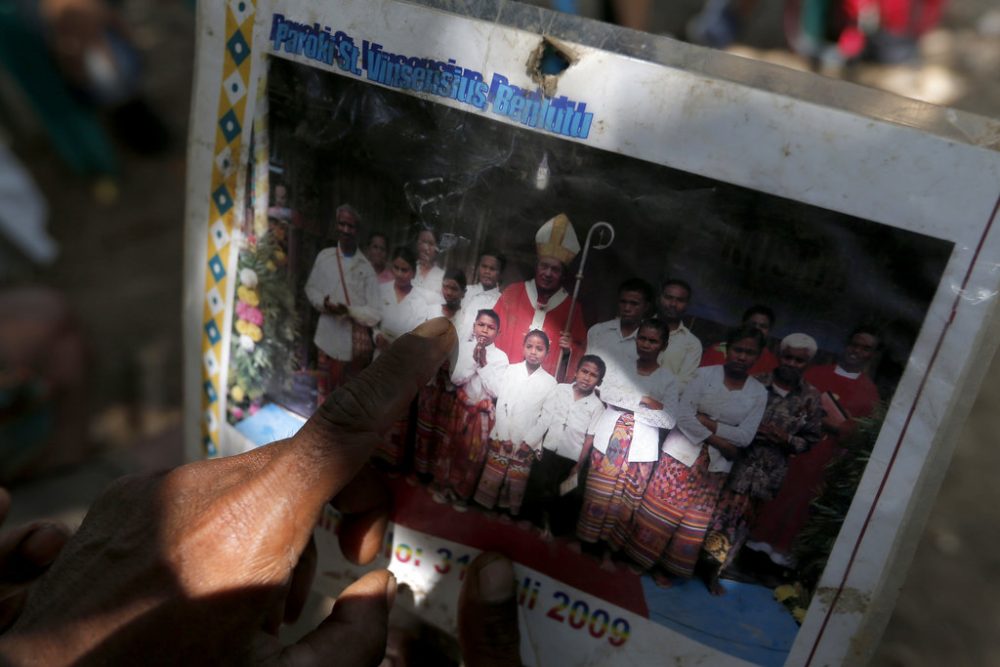
In this Oct. 23, 2018, photo, Laurencius Kollo holds up a photograph taken in July 2009, which shows Marselina Neonbota, (third from left) posing with the district Bishop. Photo: Tatan Syuflana / Associated Press
___
When it comes to tracking the fate of migrants, Asia is the blackest of black holes.
It has more migrants than any region on earth, with millions traveling within Asia and to the Mideast for work. Yet it has the least data on those who vanish. In an exclusive tally, The Associated Press found more than 8,000 cases of dead and missing migrants in Asia and the Mideast since 2014, in addition to the 2,700 listed by the U.N.’s International Organization for Migration. More than 2,000 unearthed by the AP were from the Philippines alone. And countless other cases are never reported.
These workers reflect part of the hidden toll of global migration. An AP investigation documented at least 61,135 migrants dead or missing worldwide over the same period, a tally that keeps rising. That’s more than double the number found by the IOM, the only group that has tried to count them.
While it’s not clear how many left for jobs, in general workers make up about two-thirds of international migrants, according to the International Labor Organization; the rest are fleeing everything from drug violence to war and famine. Migrants may die on perilous journeys through deserts or at sea, while many others like Lina disappear into networks that traffic in people.
In deeply Christian East Nusa Tenggara, the church has become one of the few advocates for the dead and disappeared. With the impoverished province home to the highest number of trafficking cases in the country, nuns and priests have transformed themselves into counter-trafficking crusaders.
Inside a little church across from Lina’s house, Sister Laurentina is praying before a riveted crowd. Slight and soft-spoken, the nun — who like many Indonesians goes by only one name — is nonetheless a giant presence before the parishioners. There is danger in trusting illegal recruiters, she warns. There is death.
Her words are not hyperbole. She waits at the airport for the arrival of nearly every migrant worker’s corpse that is flown back to Kupang, a ritual that has earned her the nickname “Sister Cargo.” One day after her warning to parishioners, she will be back at the airport, praying over the 89th coffin this year that has returned from Malaysia with the remains of a local migrant. Some die from accidents or illness, she says. Others from neglect and abuse.
Laurentina is one of the few people in West Timor even trying to track the missing. Since 2012, she has traveled across the island to educate villagers on the dangers of traffickers. She has held at least 20 meetings this year alone.
Laurentina asks each audience if anyone has lost contact with a relative who migrated for work. And at every meeting, for six years, at least one or two people have told her: Yes, my child is missing. Most are girls.
The remoteness of West Timor and a lack of education mean many people just don’t understand the danger. But even for those who do, a trip through the drought-punished region makes clear why they risk their lives to leave.
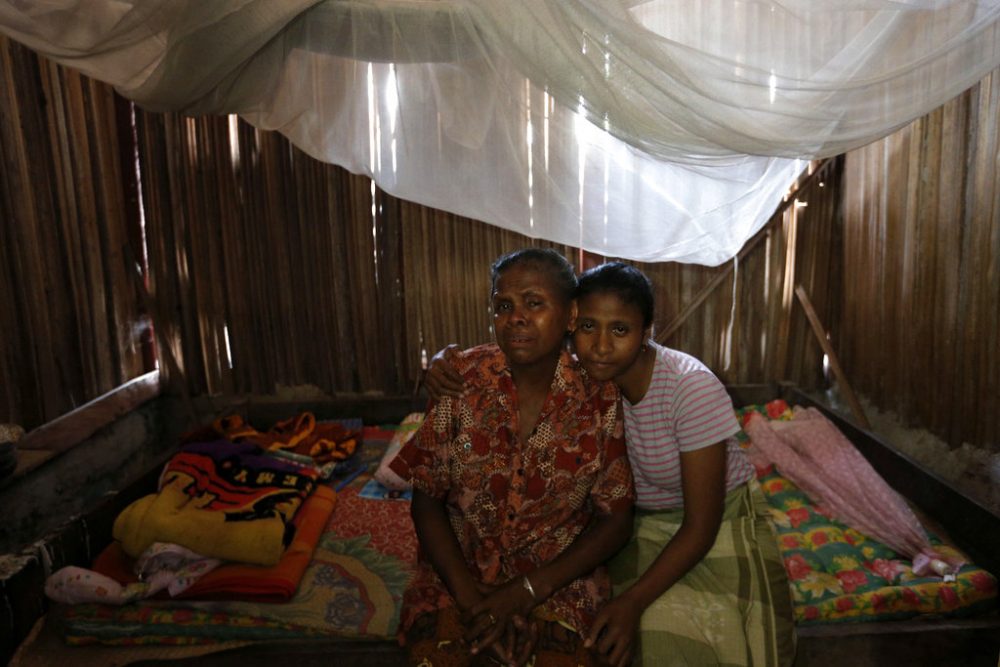
In this Oct. 21, 2018, photo, Yohanna Banunaek, left, is comforted by her daughter Yeti, in Abi village in West Timor, Indonesia, while they grieve the loss of Adelina Sau, Banunaek’s other daughter. Photo: Tatan Syuflana / Associated Press
Gnarled trees cling to barren hills. Many of the rivers have run dry. Emaciated dogs lick desperately at cracked-open coconuts lying on the dusty ground.
With no real industry here, generations of villagers have migrated to Malaysia to work as maids or on plantations. But in the past few years, migrant trafficking has picked up, as traffickers move to the most remote areas in search of fresh, unsuspecting prey. Many victims end up overworked and underpaid, and some are forced into prostitution.
In the village of Oe’Ekam, priest Maximus Amfotis watches as locals line up at a water tank, filling containers some will have to lug several kilometers home. He regularly hears of local teens migrating to Malaysia for work, never to return. There was a new case just two weeks ago, he says. The cycle seems endless.
“If we cannot stop this problem,” he says, “I fear that the current generation will be lost.”
___
Unlike Lina, Orance Faot was betrayed by her own flesh and blood.
The road to her house is so rocky that by the time you arrive, it feels like you’ve gone through an hours-long earthquake. The sunny, hardworking girl was just 14 when she traveled down that same rocky path four years ago on a motorbike bound for Kupang.
That morning, Orance told the grandmother she lived with, Margarita Oematan, that she was going with her older cousin Yeni to a priest’s house to study the Bible. When she failed to return, her uncle went looking for her. He walked as far as the river where she sometimes swam, but found no trace of his niece or Yeni. A driver later told the family that the girls had hired a bike.
When the family finally got hold of Yeni, she denied knowing what had happened to Orance. But the Faots suspected Yeni had turned Orance over to a recruiter. Eventually, they did something few here do — they went to the police.
In much of West Timor’s remote interior, electricity, phones and cars are a luxury. So absolute is the isolation that some islanders have never even seen the sea. So when a child goes missing, many families don’t know who can help.
Families also hesitate to contact officials because they often accept payment from the recruiters, who exploit a tradition known as okomama. The practice involves placing a small gift — a bit of money or betel nut — in a basket in exchange for a favor. The offering is a show of respect. It is also a contract.
The Faots, though, say they never received anything for Orance.
Yeni told police she had introduced Orance to a Chinese man, according to an investigator. The Chinese man told officials he had handed Orance over to a recruiter who often sends girls to work as maids in Malaysia. But the recruiter — who would later be convicted in a different trafficking case — denied knowing Orance, said the investigator, who spoke anonymously because he was not authorized to discuss the case.
Orance’s case is hardly an anomaly, the investigator says. In his visits to nearly 150 villages, most of the families he’s interviewed say they have lost contact with at least one relative who migrated for work. And most of the missing, he says, are girls.
The fact that Orance appears to have been lured by her own cousin is also typical. Field recruiters almost always have some connection to their victims, making them seem trustworthy. For each person they hand over, a field recruiter gets anywhere from a few hundred to more than a thousand dollars from agents up the chain, police and experts say.
Officials searched immigration records for Orance, without success. That’s not surprising, as traffickers often falsify names, birthdays and addresses on migration papers.
Finding these girls is virtually impossible, says Among Resi, head of the IOM’s counter-trafficking and labor migration unit in Indonesia. The families have almost no details on where their child has gone. They rarely even have a photo.
The assumption, Resi says, is that many of the girls are trapped in their employers’ homes. Domestic workers are highly vulnerable to abuse, because they toil behind closed doors for families who often take their passports to stop them from fleeing. Other girls, Resi says, may have run away and ended up in abusive relationships or encountered other dangers.
Some answers to the fate of the missing can be found by talking to those who returned. Yunita Besi, the daughter of a village chief, was 18 when she went with a recruiter promising work as a maid in Malaysia. For months, she says, she and a group of girls were bounced from one locked house to another, forbidden from going outside or using phones. Those who broke the rules, she says, were beaten.
She eventually ended up in the port town of Dumai, and knew she’d soon be shipped to Malaysia. One day, when the security guards were away, she managed to call her father. He ordered her to put the recruiter on the line, then threatened to call the police if his daughter was not released. Yunita was set free.
Orance’s family is still hoping for a call of their own. But after four years of silence, much of that hope has given way to dread.
In their home today, Orance exists only on paper. A report card cataloguing her cleverness. A school photo capturing her big brown eyes. A birth certificate memorializing the day she entered their world, and a police report memorializing the day she left.
“So many coffins are coming back with bodies,” Oematan says. “I’m always afraid that someday, it will be Orance inside one.”
___
Adelina Sau’s long journey home came in a shrink-wrapped coffin marked “Fragile.”
Her grave lies along the side of a lonely road. Staring out from the tombstone’s tiles is a blurry picture of her face, an image taken from a photo a cop snapped of her passport.
That grainy picture-of-a-picture is the only photo of Adelina that her family has. A copy hangs on the wall of their tin-roofed house, above a few sacks of rice that will feed the family half the year. The rest of the time, they will survive on their corn and cassava crops.
Tall and sturdy, Adelina was strong enough as a child to help her parents lug buckets of rice from the farm to their home. Though obedient, she grew tired of their poverty, and envied her friend’s new clothes.
So Adelina got excited when a recruiter visited her house in 2013, offering a babysitting job in Malaysia for $200 a month. At 15, Adelina was too young to legally migrate for work, but the recruiter promised he would take care of her documents. Which is how Adelina entered Malaysia on a passport listing her age as six years older, her family says.
The recruiter’s other promises fell apart. Adelina returned home after a year, having been paid just $200 total.
A few weeks later, another recruiter came knocking.
This time, her family says, it was a neighbor’s friend named Flora. She offered Adelina a job as a maid in Malaysia, an offer flatly rejected by Adelina’s mother, Yohanna Banunaek. Her daughter had just been cheated by the last recruiter, she told Flora.
But the next morning, while Banunaek was working on the farm, Flora returned to the house and left with Adelina.
When Banunaek came home, she was frantic. She ordered a relative of Flora’s to try and contact her. A week later, she says, a gift from Flora arrived: Around $30. The family never heard from her again. They didn’t report Adelina’s disappearance because they didn’t know how.
A year passed with no news. Still, in 2015, Adelina’s sister, Yeti, accepted a job as a babysitter in Malaysia. Two years later, Yeti returned home safely, having been paid what she was promised. For her, the deal had been a dream. For Adelina, a nightmare.
Word of Adelina’s fate finally arrived in February this year. So painful were the details that her mother couldn’t eat for a week.
Adelina had been working as a maid for a Malaysian family when a local lawmaker’s office received a tip from neighbors who suspected she was being abused. Officials found bruises on her head and face and infected wounds on her hand and legs, police said. She was hospitalized, but died the next day. An autopsy found septicemia and cited possible abuse and neglect.
A grim photo of Adelina on local news sites showed her sleeping outside the home on a ragged mat near the family’s dog. A 59-year-old woman was charged with murder. Her trial is pending.
Adelina’s parents kept their daughter’s coffin inside their home for two days before laying her to rest.
A few months later, Yeti gave birth to a baby girl. She named her Adelina. Banunaek believes the baby holds her daughter’s soul.
Banunaek clings to this belief, and to the sweet memories of her lost girl. Along with the blurry photo, there’s little else she has left.
___
Five years after Lina went missing, the military paid a chance visit to her village. Lina’s uncle, Laurencius Kollo, told them about the night his niece walked out the door with Sarah. The soldiers alerted the police, who took an official report.
Kollo and his wife waited for news. It never came.
The years dragged on. Kollo prayed every night for his niece’s return. He would walk and walk around the village to try and release his pain.
And then, one day in March this year, word arrived that a neighbor’s daughter was returning home from Malaysia. Maybe, Kollo thought, Lina was coming with her.
In a rush of hope and excitement, the frail 69-year-old climbed a tree to pick some betel leaves. As he clung to the branches, he watched the sun set and daydreamed about Lina. Maybe this would be the day he could finally hug her.
Lost in his memories, Kollo slipped. He crashed to the earth and blacked out.
When he awoke, his arm was broken. And so was his heart.
A portrait of Kriangsak Pengpanich is shown at his funeral Thursday.
BANGKOK — A naval Special Forces cadet died in a freak accident while training off the coast of Trat province, the navy said Thursday.
Kriangsak Pengpanich, 22, was swimming Wednesday in the open sea when a carnivorous, shallow-water fish struck him in the neck at high speed, the navy said in a statement. Kriangsak, who served in the marine corps, was pronounced dead at the hospital.
The cadet was undergoing a 60-hour training course to join the Recons, an elite amphibious unit operating under the Navy when he was struck by the needlefish.
A photo released by the navy shows a seaman posing with the needlefish. Image: Wassana Nanuam / Facebook
Although needlefish are not naturally aggressive toward humans, there have been rare cases of fatal encounters, usually involving children.
Marine ecologist Thon Thamrongnawasawat posted online that it’s the first time he had heard of an attack by needlefish in Thailand.
A funeral for Kriangsak will be held through Tuesday in the Sattahip district of Chonburi province.
Kantapong Huadsri was being taken to the Criminal Court Wednesday after police inquiry.
BANGKOK — A police officer who shot and killed a French national Wednesday has been charged and jailed after a court denied his release on bail.
Investigators said former Lumpini police Kantapong Huadsri would be held at the Criminal Court for 12 days pending the outcome into an investigation into charges of murder and weapons-related counts in the death of 41-year-old Djamel Malik Ait Kaki, who was killed inside an office building near BTS Nana yesterday morning.
The 49-year-old former station squad leader has confessed to the crime, police said. He was deemed a flight risk and denied bail. The court said he would not appeal the decision.
Ait Kaki got into a bar brawl over a woman yesterday with Kantapong, who was reportedly angry that he lost the fight. Kantapong followed and shot the victim dead in front of a Dunkin’ Donuts stall in the Trendy Office and Plaza in Soi Sukhumvit 13.
A Lion Air Boeing 737 Max 8 lands in January in Papua province, Indonesia. Image: Raja Video Id / YouTube
DALLAS — The CEO of United Airlines says his pilots don’t need any additional training on the new Boeing jet that is at the center of the investigation into a deadly crash in Indonesia.
Oscar Munoz says that’s because United’s pilots are prepared to respond to problems that might surface with automated systems on modern planes.
“When any trouble arises, our pilots are trained to fly the damn aircraft, period,” Munoz told reporters Wednesday.
He said pilots are taught to disconnect automated systems, fly the plane by hand, and gain altitude to buy time while they trouble-shoot problems. He said the Boeing 737 MAX is safe and reliable.
The remarks were Munoz’s first public comments about the plane since the Oct. 29 Lion Air accident, which killed 189 people when the Boeing 737 MAX plunged into the Java Sea.
Indonesian investigators are examining the role of faulty sensor readings from an anti-stall system that repeatedly pushed the nose of the Lion Air jet down. Information from a preliminary report indicates that the pilots tried to counter the downward pitch and deal with other cockpit warnings but lost control of the plane a few minutes after takeoff.
United, American Airlines and Southwest Airlines all use the new Boeing model, which was first delivered to airlines around the world last year.
Pilots at American and Southwest complained that they were not told about a new feature that could push the nose of the plane down automatically based on a sensor measurement. The pilots’ union at American has asked for additional training on the anti-stall system. American said it has added information about the system to its regular pilot-refresher training.
Munoz’s comments came during a wide-ranging call with reporters in which he announced new international flights from San Francisco, boasted about United’s performance on the stock market this year — its shares are up more than 30 percent while many other airlines stocks are down — and criticized an Italian carrier’s plan to launch more flights to the U.S.
Air Italy is 49 percent owned by Qatar Airways, which United, American and Delta have accused of unfair competition due to heavy subsidies from its government. In January, the Trump administration and Qatar reached an agreement under which Qatar Airways will eventually disclose more details about its finances.
In a side letter to the deal, Qatar Airways said it was not considering new flights to the U.S. from third countries. Munoz said Air Italy’s planned flights from Milan to Los Angeles and San Francisco would violate the agreement and amount to “kind of an in-your-face” to the Trump administration.
STRASBOURG, France — French authorities have issued a wanted poster and are calling for witnesses amid a massive manhunt for the suspected shooter nearly 24 hours after a deadly attack at the Strasbourg Christmas market.
A photo of Cherif Chekatt, 29, who was born in Strasbourg, was distributed publicly Wednesday evening.
The poster warns: “Dangerous individual, above all do not intervene.” It asks anyone with information that could help locate him to contact authorities.
Chekatt has been on the run since allegedly spraying gunfire at the city’s famous Christmas market on Tuesday night, killing two and leaving one person brain-dead. A dozen others were injured.
Hundreds of police and soldiers were combing Strasbourg in a search of him, blocking bridges that cross the border into Germany. Prime Minister Edouard Philippe announced a strengthening of security forces to secure Christmas markets.
After the verdicts, U.S. Attorney for Minnesota Erica MacDonald called the sex trafficking operation one of largest, most sophisticated transnational sex rings ever dismantled on Wednesday, Dec. 12, 2018, in St. Paul, Minn. Five people on trial for an alleged ring that prosecutors said sold Thai women for sex in the U.S. were convicted Wednesday on sex trafficking charges. (Stephen Montemayor/Star Tribune via AP)
ST. PAUL, Minnesota — Five people on trial for an alleged ring that prosecutors said sold Thai women for sex in the U.S. were convicted Wednesday on sex trafficking charges.
A federal jury in Minnesota found all five guilty of conspiracy to commit sex trafficking and other charges, the Star Tribune reported. Jurors returned their verdict just a day after receiving the case.
The defendants were Michael Morris, 65, of Seal Beach, California; Pawinee Unpradit, 46, of Dallas; Saowapha Thinram, 44, of Hutto, Texas; Thoucharin Ruttanamongkongul, 35, of Chicago; and Waralee Wanless, 39, of Colony, Texas.
Prosecutors alleged during the six-week trial that the defendants, along with 34 co-conspirators, ran a sex trafficking operation that lasted more than a decade and crossed borders.
Government attorneys called it a case of “modern day sex slavery,” with Thai women forced to have sex with multiple men daily to pay off “bondage debts” owed to traffickers for help coming to the U.S. Some victims testified during the trial.
Prosecutors said the victims were misled about how much they owed. The women were threatened if they tried to leave the business, prosecutors alleged.
Defense attorneys for all five contended the women were willful participants.
Paul Engh, an attorney for Thinram, predicted all five defendants will appeal.
CHACHOENGSAO — Wracked with grief at the news of their son’s death in France in a suspected terror attack, a sobbing Sukree Seubsaman and Yok-rhang Seubsaman declined to talk to reporters Wednesday.
Instead, 73-year-old Suchart Seubsaman came out to talk about the twist of fate that led to his nephew being shot dead in front of his wife on the first day of their French vacation in Strasbourg.
“Actually they were going to go to Paris, but because of the [yellow jacket] protests, they went to that city instead,” Suchart said. “But then this happened unexpectedly.”
Anuphong Seubsaman, a 45-year-old noodle factory owner from Chachoengsao, was among at least three people killed and 13 wounded in Place Kleber, the city’s central square, after a suspected extremist opened fire on crowds attending an evening Christmas market.
Suchart said that Anuphong and his wife Naiyana Seubsaman helped run the family noodle factory east of the capital and sold clothes in Bangkok’s Pratunam area. The couple loved to travel abroad for leisure and also to find clothing to sell, he said.
The factory continued to operate today while the family awaits help from the Foreign Affairs Ministry and their insurance company to bring back Anuphong home. The couple had no children.
“Unfortunately a Thai person was killed, and I offer my condolences to Khun Anuphong’s family,” Foreign Affairs Minister Don Pramudwinai said Wednesday.
Don said no other Thais were injured, and that the consulate in Paris would offer assistance to Anuphong’s widow, Naiyana Seubsaman, who was with him on the trip.
“This news directly affects Thais, but there are not a lot of Thais in Strasbourg, unlike in Paris,” Don said.
Anuphong was shot in the head outside a restaurant while Naiyana escaped injury. The couple was traveling alone and not with children as some outlets initially reported, the minister added.
According to local police, the 29-year-old gunman, Cherif Chekatt, was born and raised in Strasbourg and was on an extremist watch list. He has a long record of 25 criminal cases and remains at large.
A witness on the scene said they tried to save Anuphong and carried him into the restaurant, but he was too far gone.
BANGKOK — In case there’s any doubt whether the cockroaches creeping into your home are edible, health officials weighed in Wednesday with a reminder: They’re not.
The Bureau of Non-Communicable Diseases today played down the nutritional value of the insects’ shiny brown bodies and hairy legs in a statement warning people against consuming them – at least those that emerge from sewer pipes.
“First, you have to understand that domestic cockroaches and farm-grown cockroaches are different. Some roaches are safer,” said Piti Mongkalangkun, a bureau expert.
The reason for this seemingly unneeded bulletin? A slew of online tabloid reports that a giant Chinese farm was turning roaches into medicine to solve all manner of ills, from the common cold and stomach ache to hair loss. They were even being made into diet pills.
Piti explained that the domestic roach is infested with bacteria because they “just eat everything.”
He further crushed hopes by saying no evidence exists of roach-based hair loss remedies. However, one might be able to lose weight if they switch to insect-only protein sources, he offered.
Again, to summarize: Household roaches are teeming with diseases and eating them is a great way to get sick.
French soldiers patrol Wednesday in the railway station of the city of Strasbourg following a shooting, eastern France. Photo: Christophe Ena / Associated Press
STRASBOURG, France — Two police officials have identified the suspected Strasbourg gunman as 29-year-old Cherif Chekatt.
One police source said Chekatt’s criminal record mentions 25 judicial cases, including several serious cases of robbery.
The official said his apartment was searched by police on Tuesday morning – hours before the shooting – in an investigation for attempted murder. He was not at home at the time.
The two officials spoke anonymously because they were not allowed to speak publicly on an ongoing investigation.
The suspect was still on the run on Wednesday after he fired gunshots near the famous Christmas market of Strasbourg, killing three and wounding at least 13.