36.1 C
Bangkok
Sunday, June 21, 2026
Home Blog Page 1781

Rare, Two-Headed Snake in Virginia Has Died: Expert

Photo: JD Kleopfer / Facebook

WAYNESBORO, Virginia — A wildlife expert says a rare, two-headed snake found several months ago in Virginia near the nation’s capital has died.

The Washington Post reports state herpetologist JD Kleopfer said in a Facebook post this week that the snake had died. He says it passed away peacefully last week for no apparent reason and was discovered dead one morning.

The Copperhead snake was found in a northern Virginia neighborhood in September.

The Wildlife Center of Virginia previously said in a statement that an examination of the reptile found it had two tracheas and two esophagi, but shared one heart and a set of lungs. Biologists believe both heads were capable of biting and distributing venom.

Kleopfer says two-headed snakes are rare because they don’t live long in the wild.

Advertisement

WikiLeaks’ Assange Faces Charges, Lawyer Says He’d Fight

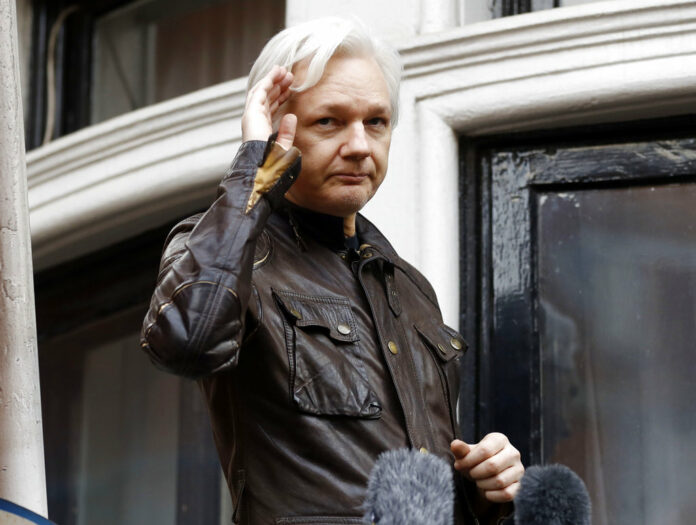
In this May 19, 2017, file photo, WikiLeaks founder Julian Assange greets supporters from a balcony of the Ecuadorian embassy in London. Photo: Frank Augstein / Associated Press

WASHINGTON — WikiLeaks founder Julian Assange will not willingly travel to the United States to face charges filed under seal against him, one of his lawyers said Friday, foreshadowing a possible fight over extradition for a central figure in the U.S. special counsel’s Russia-Trump investigation.

Assange, who has taken cover in the Ecuadorian Embassy in London, where he has been granted asylum, has speculated publicly for years that the Justice Department had brought secret criminal charges against him for revealing highly sensitive government information on his website.

That hypothesis appeared closer to reality after prosecutors, in an errant court filing in an unrelated case, inadvertently revealed the existence of sealed charges. The filing, discovered Thursday night, said the charges and arrest warrant “would need to remain sealed until Assange is arrested in connection with the charges in the criminal complaint and can therefore no longer evade or avoid arrest and extradition in this matter.”

A person familiar with the matter, speaking on condition of anonymity because the case had not been made public, confirmed that charges had been filed under seal. The exact charges Assange faces and when they might be unsealed remained uncertain Friday.

Any charges against him could help illuminate whether Russia coordinated with the Trump campaign to sway the 2016 presidential election. They also would suggest that, after years of internal Justice Department wrangling, prosecutors have decided to take a more aggressive tack against WikiLeaks.

A criminal case also holds the potential to expose the practices of a radical transparency activist who has been under U.S. government scrutiny for years and at the center of some of the most explosive disclosures of stolen information in the last decade.

Those include thousands of military and State Department cables from Army Pvt. Bradley (now Chelsea) Manning, secret CIA hacking tools, and most recently and notoriously, Democratic emails that were published in the weeks before the 2016 presidential election and that U.S. intelligence officials say had been hacked by Russia.

Federal special counsel Robert Mueller, who has already charged 12 Russian military intelligence officers with hacking, has been investigating whether any Trump associates had advance knowledge of the stolen emails.

Assange could be an important link for Mueller as he looks to establish exactly how WikiLeaks came to receive the emails, and why its release of the communications — on the same day a highly damaging video of Trump from a decade earlier surfaced publicly — appeared timed to boost his campaign.

Assange, 47, has resided in the Ecuadorian Embassy under a grant of asylum for more than six years to avoid being extradited to Sweden, where he was accused of sex crimes, or to the United States, whose government he has repeatedly humbled with mass disclosures of classified information.

The Australian was once a welcome guest at the embassy, which takes up part of the ground floor of a stucco-fronted apartment in London’s posh Knightsbridge neighborhood. But his relationship with his hosts has soured over the years amid reports of espionage, erratic behavior and diplomatic unease.

Barry Pollack, a Washington lawyer for Assange, said he expected Ecuador to “comply with its obligations” to preserve asylum for him, though he acknowledged a concern that the county could revoke his asylum, expel him from the embassy and extradite him to the U.S.

“The burden should not shift to Mr. Assange to have to defend against criminal charges when what he has been accused of doing is what journalists do every day,” Pollack said. “They publish truthful information because the public has a right to know and consider that information and understand what its government and institutions are doing.”

The charges came to light in an unrelated court filing from a federal prosecutor in Virginia, who was attempting to keep sealed a separate case involving a man accused of coercing a minor for sex.

The three-page filing contained two references to Assange, including one sentence that said “due to the sophistication of the defendant and the publicity surrounding the case, no other procedure is likely to keep confidential the fact that Assange has been charged.”

It was not immediately clear why Assange’s name was included in the document. Joshua Stueve, a spokesman for the Justice Department’s Eastern District of Virginia said, “The court filing was made in error. That was not the intended name for this filing.”

The filing was discovered by Seamus Hughes, a terrorism expert at the Program on Extremism at George Washington University, who posted it on Twitter hours after The Wall Street Journal reported that the Justice Department was preparing to prosecute Assange.

The case at issue concerns a defendant named Seitu Sulayman Kokayi, a 29-year-old teacher who has since been indicted in Virginia on charges of enticing a 15-year-old girl to commit sex acts and to produce child pornography. There doesn’t appear to be any connection between Assange and Kokayi.

The since-unsealed document, a motion filed in late August asking to keep Kokayi’s case secret, mentions Assange in two boilerplate sections, suggesting a copy-and-paste error or that his name was inadvertently left in a template used for the common filings.

The filing suggests prosecutors have reason to believe they will be able to arrest and extradite Assange.

Ecuadorian officials say they have cut off his high-speed internet access and will restore it only if he agrees to stop interfering in the affairs of Ecuador’s partners, such as the U.S. and Spain. He is allowed to use the embassy’s WiFi, though it is unclear if he doing so. Officials have also imposed a series of other restrictions on Assange’s activities and visitors, and ordered him to clean after his cat.

Carlos Poveda, Assange’s lawyer in Ecuador, said he suspects Ecuador has been maneuvering to kick Assange out of the embassy through the stricter new living requirements it recently imposed.

He said possible U.S. charges, however, are proof his client remains under threat, and he called on Ecuador’s government to uphold Assange’s asylum protections. He said Ecuador would be responsible if anything happened to Assange.

With shrinking options — an Ecuadorian lawsuit seeking to reverse the restrictions was recently turned down — WikiLeaks announced in September that former spokesman Kristinn Hrafnsson, an Icelandic journalist who has long served as one of Assange’s lieutenants, would take over as editor-in-chief.

In a brief interview in Reykjavik, Iceland, Hrafnsson called the U.S. news “a very black day for journalism.”


Advertisement

Argentine Submarine Missing a Year Found Deep in Atlantic: Officials

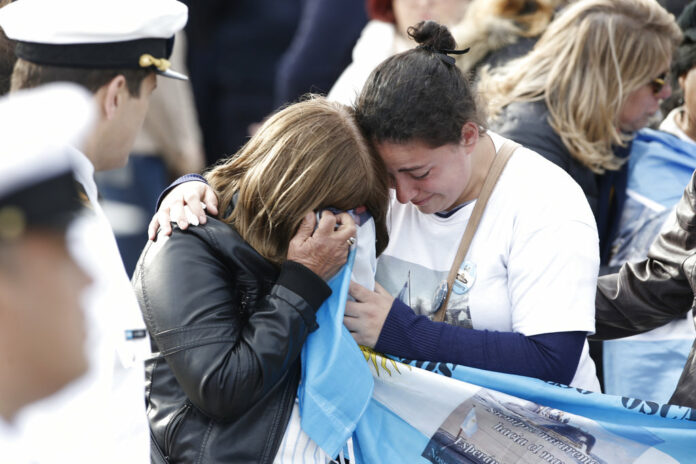
Relatives of the missing crew of the ARA San Juan submarine, embrace in mourning after a ceremony remembering the one year anniversary of the disappearance of the submarine, at the Navy base in Mar del Plata, Argentina, Thursday, Nov. 15, 2018. Photo: Vicente Robles / Associated Press

BUENOS AIRES, Argentina — Argentina’s navy announced early Saturday that searchers found the missing submarine ARA San Juan deep in the Atlantic a year after it disappeared with 44 crewmen aboard.

The vessel was detected 800 meters (2,625 feet) deep in waters off the Valdes Peninsula in Argentine Patagonia, the statement said.

The navy said a “positive identification” had been made by a remote-operated submersible from the American ship Ocean Infinity, which was hired for the latest search for the missing vessel.

The discovery was announced just two days after families of the missing sailors held a commemoration one year after the sub disappeared on Nov. 15, 2017.

On Thursday, on the anniversary of the disappearance, President Mauricio Macri said the families of the submariners should not feel alone and delivered an “absolute and non-negotiable commitment” to find “the truth.”

Macri promised a full investigation after the submarine was lost. Federal police raided naval bases and other buildings last January as part of the probe, soon after the government dismissed the head of the navy.

The San Juan was returning to its base in the coastal city of Mar del Plata when contact was lost.

Argentina gave up hope of finding survivors after an intense search aided by 18 countries, but the navy has continued searching for the vessel.

The German-built diesel-electric TR-1700 class submarine was commissioned in the mid-1980s and was most recently refitted between 2008 and 2014. During the $12 million retrofitting, the vessel was cut in half and had its engines and batteries replaced. Experts said refits can be difficult because they involve integrating systems produced by different manufacturers, and even the tiniest mistake during the cutting phase can put the safety of the ship and crew at risk.

The navy said previously the captain reported on Nov. 15 that water entered the snorkel and caused one of the sub’s batteries to short-circuit. The captain later communicated that it had been contained.

Some hours later, an explosion was detected near the time and place where the San Juan was last heard from. The navy said the blast could have been caused by a “concentration of hydrogen” triggered by the battery problem reported by the captain.
Advertisement

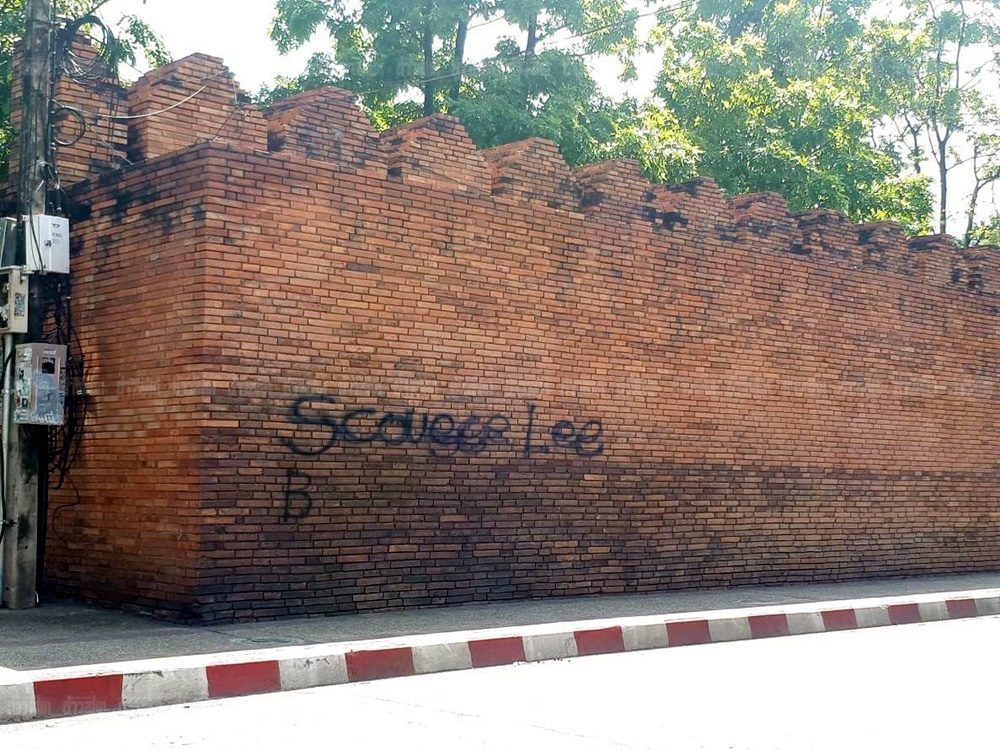
No Jail Time for Tourists Who Vandalized Chiang Mai Wall

Lee Furlong, right, and Brittney Schneider, left, at the Tha Pae Gate wall Oct. 18.

CHIANG MAI — Chiang Mai police on Saturday said the two tourists who vandalized a historic wall avoided jail time and will likely fly home after paying 100,000 baht fines.

Col. Teerasak Sriprasert of Chiang Mai City police today said Briton Lee Furlong and Canadian Brittney Schneider were initially sentenced to two years in prison and 200,000 baht fines for tagging a wall at the city’s historic Tha Phae Gate. Their sentences were halved as they confessed.

Read: Farangs Face Hard Time For Chiang Mai Vandalism

Rather than jail time, both were given two years of parole, Teerasak said. He doesn’t know whether they are allowed to fly back home, but following protocol, they will be released after paying the fines.

Furlong and Schneider, both 23, were arrested hours after the wall was seen with “Scouser Lee B” in black spray paint on it last month. “Scouser” is British slang for a Liverpool native. Furlong is originally from Liverpool.

The maximum penalty for vandalizing a historical site is 10 years in jail and a 1 million-baht fine.

Tha Phae Gate is believed to be originally built in 1296. The gate and wall seen today is a product of reproduction in 1985 based on a photograph of the gate from 1879.

441634

Advertisement

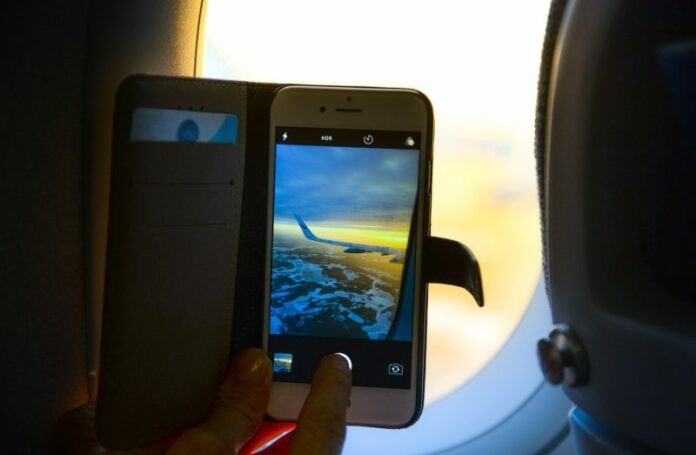
Using Phones on Planes is Safe – But For Now, Don’t Make Calls

We used to have to turn our phones off and store them when we flew commercially, but now can keep them on as long as they are in Airplane Mode. Why? What’s changed? Weren’t planes supposed to fall out of the sky should some forgetful flier leave their phone on? And what really would happen if everyone started yakking away during cross-country flights?

Connecting Calls Via Cell Towers

First some basics on how cellphone systems work. When you make or receive a call, your phone looks for the closest cell tower to connect to. Each tower services an area (a “cell”) that may be as large as 50 miles in radius over flat terrain, or smaller than a mile in radius in hilly areas or dense urban zones.

As you move from one cell to another, say on your daily commute, your cellphone call gets handed off from one tower to the next. It requires a fair bit of work on the part of the overall system to make these transitions seem seamless to you. There are also built-in expectations about how often these handoffs should happen (not very), the speed of the user (highway speeds at most), and your altitude (somewhere near the ground).

Cellular use on a plane at cruising altitude breaks all three of these expectations. Simply put, calls in the sky may interfere with the proper functioning of this complex system – particularly if a couple hundred passengers all had their cellular radios on – such that users on the ground are affected.

So, for now, the US Federal Communications Commission restricts cellular use on airplanes.

But what’s the risk?

That all sounds like a service issue, not a safety one. What would happen if someone kept their phone’s cellular functions on while enjoying the view at 30,000 feet? Likely, nothing. And that’s a good thing, since even when their use was completely banned, people left them on all the time, whether intentionally or not.

But there is a non-negligible risk that using your phone could interfere with critical systems on the plane.

Although most modern phones no longer do this, GSM (2G) phones were notorious for interfering with other electronic systems. Former owners will recall the “buzz” you heard in your stereo or speakerphone when making a call. Now, imagine this buzz being picked up by a sensitive navigation system. You don’t need to be technically minded to understand that might not be good.

Researchers found that electromagnetic emissions from personal electronic devices can interfere with a plane’s systems. Specifically, those in the 800-900 MHz range can interfere with unshielded cockpit instrumentation. This is a particular issue on older aircraft. Newer planes are designed to deal with the huge amount of electronics the flying public takes onto airplanes.

Airplanes are incredibly complex machines, filled with electronics and critical systems required to perform the modern miracle that is flight. The thing about complex systems is that it’s usually impossible to test how safe they are under every conceivable contingency. Given how many new phones come on the market each year, it would be challenging to test how each and every model might interfere with the systems on each aircraft in the commercial fleet worldwide. So airplane manufacturers work to “harden” the critical systems on their planes to make them less susceptible to interference from electronics.

Switch Your Phone to Airplane Mode

Cellphones used to be just that, a phone. You used it to call and text people. Arguably, the “phone” is now the least used function — think about the time you spend making calls versus everything else you do with it. So frequent fliers chafed at having to put their phone away for hours.

Although the FCC governs the use of cellular phones on planes, the Federal Aviation Administration governs the use of electronic devices on planes. If a device doesn’t interfere with the aircraft’s communication or navigation systems, it can be used on planes. People were using laptops, cameras, video players, tablets, electronic games and so on, so why not smartphones? After all, this single device now performs the functions of all those others. Hence, the FAA ruled they may be used, but only if the cellular radio was switched off. Enter Airplane Mode.

By adding Airplane Mode, device manufacturers have made our lives easier. When you flip on this feature, it turns off your phone’s cellular radio so you can’t make phone calls or text. It also turns off WiFi and Bluetooth, but both of those can be re-enabled and used on planes.

Airlines continue to innovate. Delta, for example, offers free access to certain messaging apps like Facebook Messenger and WhatsApp, which work over WiFi. But cellular texting, which needs the cellular radio, is still prohibited.

Of course some people still want to be able to make phone calls while in flight. Sadly for those of us in the flying public who don’t want to sit next to someone loudly blabbing away all the way from New York to LA, this day may come. Airlines are experimenting with “picocells,” which are like mini, low-power cell towers within the plane itself. Since this is the closest “tower” a phone on a plane would find, it would not connect to any towers on the ground, eliminating the FCC’s concerns. Your call would be routed like a VoIP call using the plane’s onboard internet provider system.

As for how to keep the rest of us from erupting like Samuel L. Jackson, “Enough is enough! I’ve had it with these [daggone] cell phones on this [daggone] plane!” – perhaps airlines will create “cell-free zones” like the ones in trains and other public places.

Story: Sven Bilen / The Conversation via AP

Advertisement

New Property Tax Rates Passed by Thai Assembly

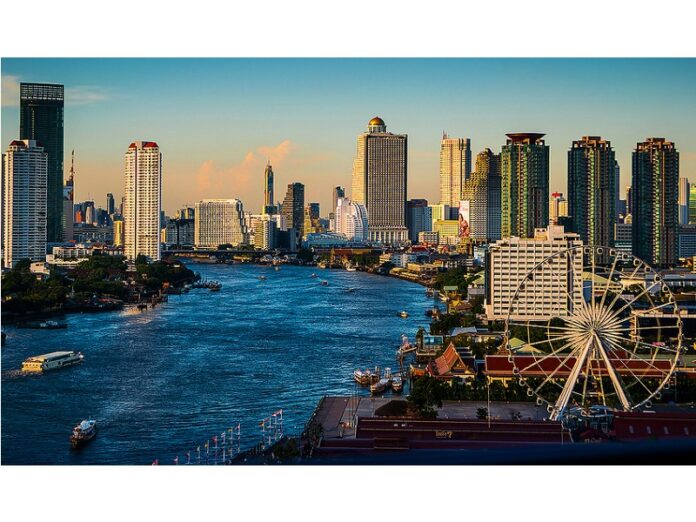
The Bangkok skyline in 2013.

BANGKOK — A new land and building tax bill passed Friday by the junta-appointed National Legislative Assembly that will come to effect January 2020.

The new tax covers agricultural, residential, commercial and undeveloped property. It was passed 169-0 with two abstentions.

Farmland will be taxed on a graduated scale based on its value. Those owning farmland worth up to 50 million baht will be taxed annually at 0.02 percent of the land’s estimated value.

Those with holdings valued at 75 million to 100 million baht will pay 0.03 percent, while those with land worth 100 million to 500 million baht will be taxed at 0.05 percent.

Hardest hit are owners of undeveloped tracts, who will be taxed at 0.3 percent of the value per annum. That rate will tick up an additional 0.3 percent every three years the land remains used until it caps at 3 percent.

Residential land and houses worth up to 50 million baht will pay a 0.02 percent annual tax on the property’s value, an equivalent of 200 baht per every 1 million baht. Homes and land worth 50 million to 75 million baht will be taxed 0.03 percent. If worth 75 to 100 million baht, the annual rate will be 0.05 percent. If more than 100 million baht, the annual tax rate increases to 0.1 percent.

Primary residences worth no more than 50 million baht will be exempt. If owners own only a building, tax will be exempt if the estimated price is not over 10 million baht.

Owners of commercial property valued under 50 million baht will be taxed at the rate of 0.3 percent. If it’s valued between 50 million to 200 million baht, it will be subjected to a 0.4 percent tax, or 4,000 baht per 1 million baht in value. Commercial property worth between 200 million and 1 billion baht will be taxed by 0.5 percent. Those between 1 billion to 5 billion baht will be taxed at 0.6 percent, while those over 5 billion will be subject to 0.7 percent tax.

In the first three years after the law comes into effect, ordinary land and building owners as well as agricultural land owners will remain exempt.

Advertisement

Has the BTS Collected Millions in Fares for Unbuilt Stations?

Photo: BTS Skytrain / Facebook

BANGKOK — Commuters shouldn’t hold their breaths for two additional BTS stations they’ve been paying for since the first trains rolled out nearly 20 years ago.

Despite racking up potentially billions of baht by including BTS Sena Ruam on the Sukhumvit Line and BTS Suksa Witthaya on the Silom Line in its fare table, the BTS has no plans to build them at this time.

The system operator said Friday the unbuilt stations are still being evaluated for their environmental impact and passenger value, three years to the month after saying they would be completed in 2018.

No time frame can be promised, a BTS representative said today. Meanwhile fares charged for the ghost stations will remain in place even though no work has begun.

Unlike travel between any other two stations, commuters passing the two planned stations – say from BTS Chong Nonsi to Surasak, or BTS Ari to Saphan Khwai – pay fares equivalent to two stations instead of one.

The two ghost stations have been factored into the popular rail system’s fares since the service opened. If just half of the 2.96 billion trips taken since 1999 passed them, when the system was much smaller, the revenues could theoretical add up to several billion baht.

Passengers today pay between 3 baht and 7 baht to pass them; meaning the operator could have easily reaped over 600 million baht from 2017’s 129,533,597 trips by that same reasoning.

The matter came to public attention a few years back when someone complained online about the more expensive fares between the two imaginary stations. The company was criticized heavily for charging for two stations that don’t exist.

The company responded by saying fares are based on distance, not the number of stations. BTS Executive director Anat Arbhabhirama reiterated that this past August.

Looking at a map calls those claims into question.

Thanoochai Hoonniwat, director of City Hall’s Traffic and Transport Department, has said its concession requires the operator to charge fares by distance. He said the two incomplete stations lie between those that are quite far apart: 2.3 kilometers from Ari to Saphan Khwai, and 1.7 kilometers from Chong Nonsi to Surasak. He said that justifies the more expensive fares, even if there is no station in between.

According to Google Maps, the distance from Ari and Saphan Khwai is 1.5 kilometers, not 2.3 kilometers. And Chong Nonsi to Surasak is 1.2 kilometers, not 1.7 kilometers.

Traveling similar distances between other stations also costs less. A trip from Siam to Ratchadamri – also 1.2 kilometers – costs 16 baht. So is the 1.6-kilometer journey from Bang Wa to Wutthakat.

Compared again to the 23-baht from Chong Nonsi to Surasak, distance doesn’t appear to matter much.

Advertisement

Last Khmer Rouge Leaders Guilty of Genocide, Get Life Terms

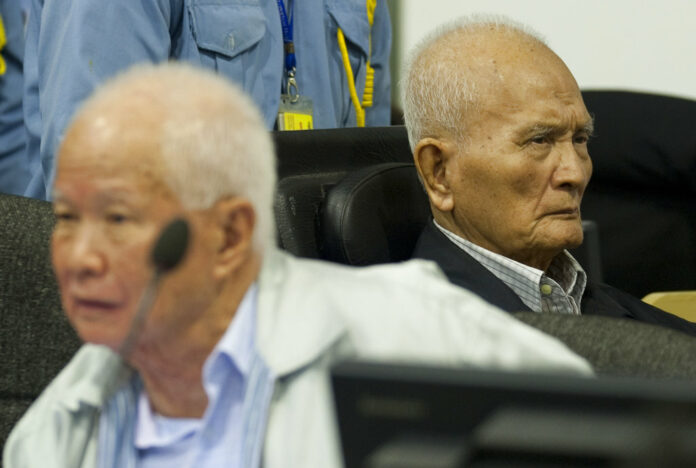
Khieu Samphan, at left, former Khmer Rouge head of state, and Nuon Chea, at right, who was the Khmer Rouge's chief ideologist and No. 2 leader, sit in the court hall at the U.N.-backed war crimes tribunal in Phnom Penh in an October 2013 file photo released by the Extraordinary Chambers in the Courts of Cambodia. Photo: Mark Peters / Extraordinary Chambers in the Courts of Cambodia via AP

PHNOM PENH — The last surviving leaders of the communist Khmer Rouge regime that brutally ruled Cambodia in the 1970s were convicted of genocide, crimes against humanity and war crimes Friday by an international tribunal.

Nuon Chea and Khieu Samphan were sentenced to life in prison, the same punishment they are already serving after earlier convictions at a previous trial for crimes against humanity connected with forced transfers and mass disappearances. Cambodia has no death penalty.

Both men have suggested they were targets of political persecution. Nuon Chea was considered the main ideologist of the Khmer Rouge and the right-hand man of the group’s late leader, Pol Pot, while Khieu Samphan served as the head of state, presenting a moderate veneer as the public face for the highly secretive group.

The verdict read aloud in the courtroom by Judge Nil Nonn established that the Khmer Rouge committed genocide against the Vietnamese and Cham minorities. Scholars had debated whether suppression of the Chams, a Muslim ethnic minority whose members had put up a small but futile resistance against the Khmer Rouge, amounted to genocide.

Members of the Cham community were among the large crowd of spectators who attended Friday’s session.

The court found Khieu Samphan not guilty of genocide against the Cham, for insuffient evidence, though he was convicted of genocide against the Vietnamese under the principle of joint criminal enterprise, which holds individuals responsible for actions attributed to a group to which they belong.

The Khmer Rouge sought to achieve an agrarian utopia by emptying the cities to establish vast rural communes. Instead their radical policies led to what has been termed “auto-genocide” through starvation, overwork and execution.

The crimes against humanity convictions covered activities at work camps and cooperatives established by the Khmer Rouge. These offenses comprised murder, extermination, deportation, enslavement, imprisonment, torture, persecution on political, religious and racial grounds, attacks on human dignity, enforced disappearances, forced transfers, forced marriages and rape.

The breaches of the Geneva Convention governing war crimes included willful killing, torture or inhumane treatment.

One of the spectators at Friday’s hearing was 65-year-old Sum Rithy, who said he had been jailed for nearly two years under the Khmer Rouge, who accused him of being a spy for the CIA. His life was spared only because he was a skilled mechanic who could maintain engines and generators for his captors.

Rithy said three of his siblings were killed by the Khmer Rouge, also accused of being CIA spies, while his father died of starvation.

“Today, I am very happy that the both Khmer Rouge leaders were sentenced to life in prison. The verdict was fair enough for me and other Cambodian victims,” he said. “Last night, I could not sleep because I was afraid that Nuon Chea and Khieu Samphan could die before this verdict was announced.”

Nuon Chea, 92, was brought by ambulance and Khieu Samphan by van to the courthouse from the nearby prison where they are held. The prison and the courthouse were custom built for the use of the tribunal, which is officially called the Extraordinary Chambers in the Courts of Cambodia, or ECCC.

Nuon Chea, who suffers heart problems, was allowed to move from the hearing room to a separate holding room. Khieu Samphan, 87, was present for the entire hearing and with the help of two security guards stood as his sentence was read, showing no obvious emotion.

Lawyers for Nuon Chea said they would appeal, and Khieu Samphan was expected to do the same.

In addition to the two, the tribunal in 2010 convicted Kaing Guek Eav, known as Duch, who as head of the Khmer Rouge prison system ran the infamous Tuol Sleng torture center in Phnom Penh.

There are fears that politics will thwart the tribunal from undertaking any further prosecutions.

Cambodia’s long-serving, autocratic Prime Minister Hun Sen has declared he will allow no further case to go forward, claiming they would cause instability. Hun Sen was a Khmer Rouge commander who defected when the group was in power and was installed in government after the Khmer Rouge were ousted by a Vietnamese invasion.

Initial work had been done on two more cases involving four middle-ranking members of the Khmer Rouge, but they have been scuttled or bottled up by the tribunal, which is a hybrid court in which Cambodian prosecutors and judges are paired with international counterparts.

The failure to have more extensive proceeding has discomfited some observers, but others point to the tribunal’s accomplishments.

“International tribunals are better than the alternative, impunity. They will always be political and fall short of expectations,” Alexander Hinton, an anthropology professor at Rutgers University and author of two books about the tribunal, said ahead of Friday’s verdicts. “But justice is usually delivered, even if at times, as has been the case with the ECCC, it staggers across the finish line.”

Story: Sopheng Cheang

Advertisement

Bangkok’s Tallest Building Opens Skywalk

BANGKOK — The nation’s tallest skyscraper now has the highest rooftop bar and skywalks in the kingdom.

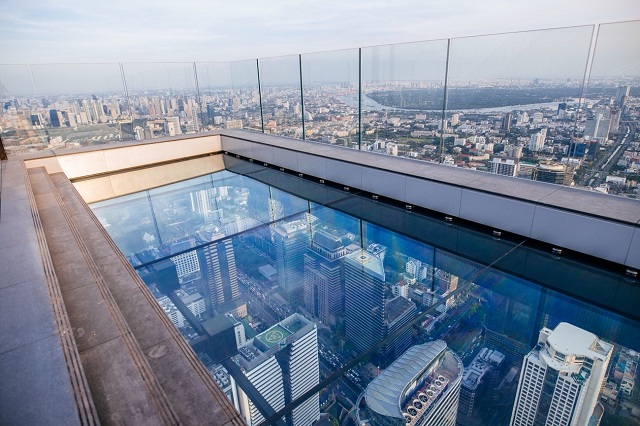
The MahaNakhon Skywalk, sitting 314 meters up the King Power ManaNakhon skyscraper, opens to the public today.

The skywalks are located on the 74th, 75th and 78th floors. The 74th floor is an indoor observation deck that offers augmented reality looks at tourist attractions in Bangkok.

The 75th floor has a glass elevator which leads to the rooftop and an outdoor observation deck on the 78th floor.

Visit the the topmost floor and step onto the Glass Tray, a transparent floor for heartstopping views straight down. Up another flight of steps sits The Peak, a platform offering a 360-degree view. Have a drink to calm your nerves at what’s billed as the highest rooftop bar in Thailand.

QXA3z Qrq0SS4AQDipo5Zl42zUbH 1Sb6HQYI1khlh8i dlN5ljyU5D9BihxzkXjQCR2uFYUGqpdTS7it4 yRr AePSCDqJAMBsiDHCBN4c6FnJuPifkKy v5aZQvsqzuBtim2g

MahaNakhon Skywalk is open to the public 10am to midnight daily. The MahaNakhon building is located on Narathiwas Road at BTS Chong Nonsi.

Tickets to the skywalk? They come at two levels: 850 baht tickets offer access to the 74th floor, while 1,050 baht tickets offer access to all the three floors (74th, 75th and 78th).

iEAPnbA00k m9fUT i v5VhNty2f 8qnngqF Zm3Rn0CesaK Dte9PzOHhg29fEIrRZSktZqNsjv uPgG4jk0QG2O4P2gQXCu5 ucv44AIeuTLklfl4cS3A5WMdf8Oo6V4g4EFy

King Power MahaNakhon, formerly MahaNakhon, opened in 2016 and became the tallest skyscraper. It exceeds the Baiyoke II Tower by 10 meters to become the tallest building at a height of 314 meters. Its claim could be short-lived, however, depending on if and when the Rama IX Super Tower is completed, which would dwarf MahaNakhon at 615 meters.

Related stories:

Duty Free Giant to Buy Bangkok’s Tallest Building

Nativist Learns MahaNakhon Designed by Top Foreign Architect, Complains to Govt

Bangkok’s New Tallest Celebrates With Monday Light Shows

Advertisement

OB/GYN Accused of Raping Patients in Nakhon Sawan

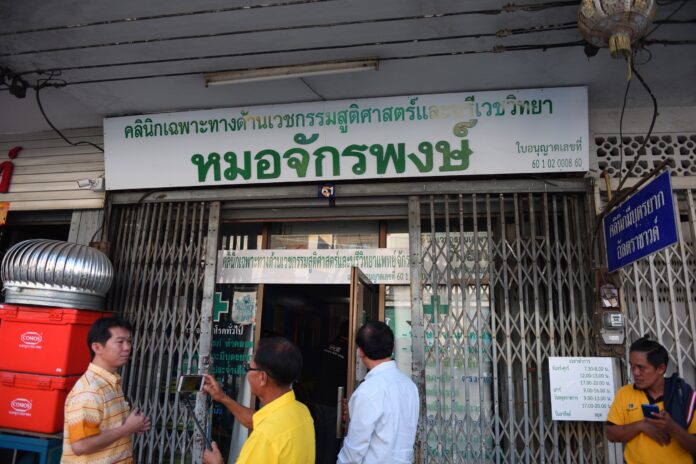
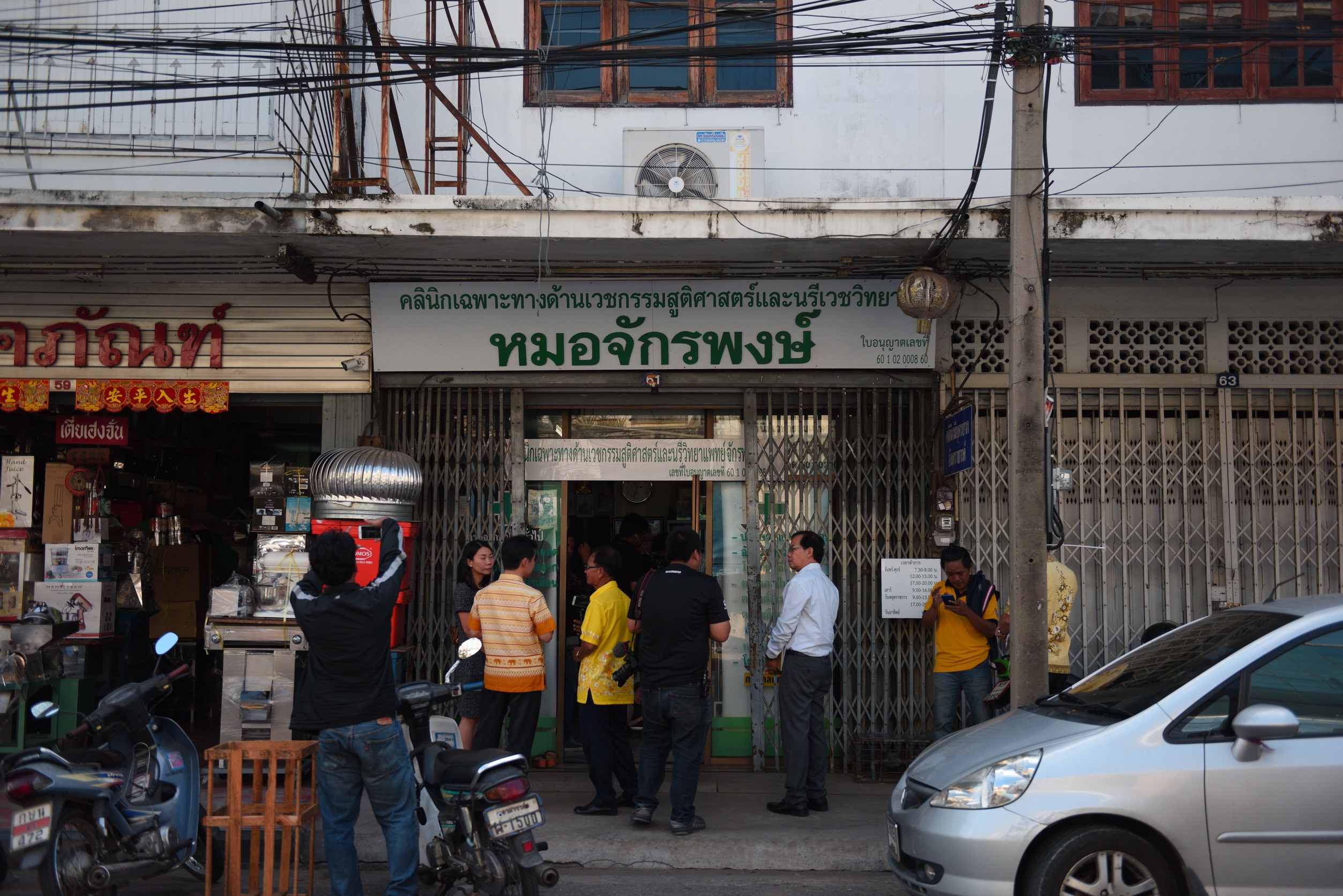
The Dr. Chakkrapong Clinic Friday on Matulee Road in Nakhon Sawan city.

NAKHON SAWAN — An attorney said Friday she will bring legal action against a gynecologist who allegedly raped dozens of women on the job.

Complaining of police inaction, the lawyer said she will assemble the case against 53-year-old Chakkaphong Leelaporn after many women came forward to accuse him of assaulting them during examinations at his clinic in the central province of Nakhon Sawan.

“At least 20 women have been either raped or victims of obscene acts,” Saranya Wangsookcharoen, a lawyer with a large online following, said by phone Friday. “Some of them came to the clinic because they were having fertility problems. But they got their breasts squeezed and sucked on instead.”

Saranya said many victims were willing to talk.

“Today I’m drawing up the case for prosecution by gathering evidence and getting more victims to come forward and talk. We won’t wait for the police anymore. They are slow,” the lawyer said.

Chakkaphong faces possible charges including committing obscene acts against someone older than 15 while using force and rape. The doctor turned himself into police for questioning Thursday.

S 24387743
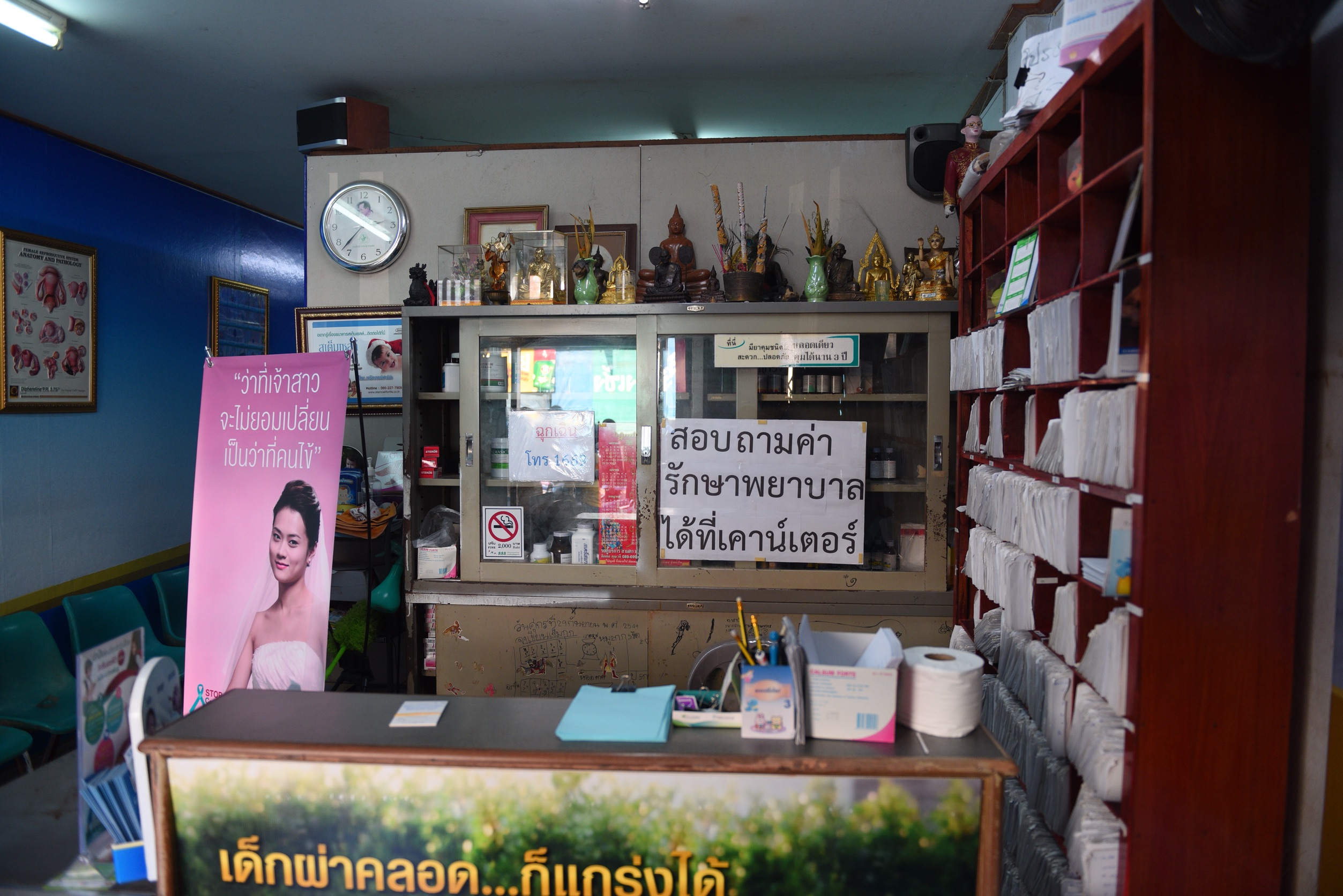
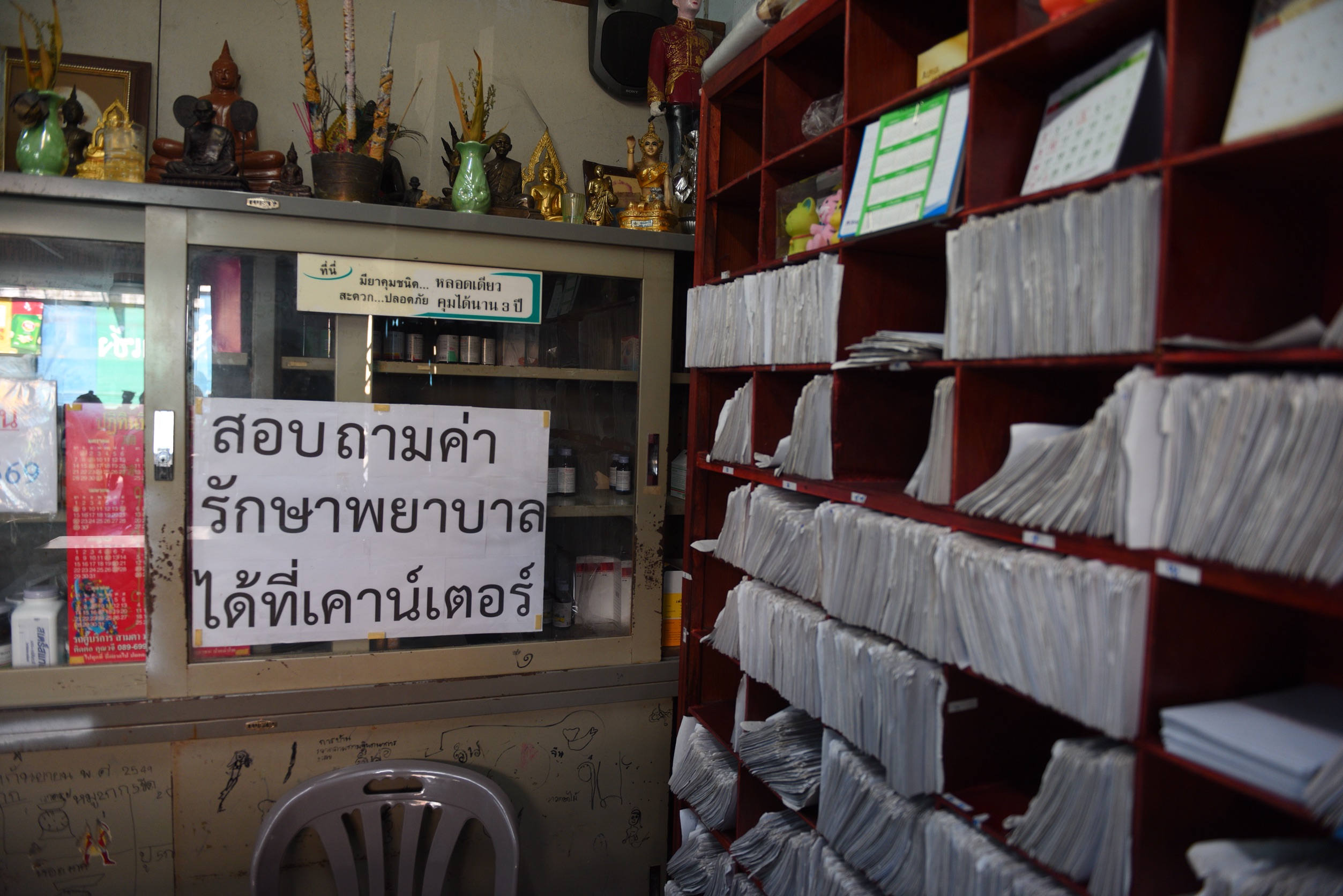
Inside the Dr. Chakkrapong Clinic Friday.

Capt. Ratchapol Kwunseng of Nakhon Sawan police said no physical evidence remained when she was examined 10 days after the alleged assault. Police said they would not arrest the doctor because he lived in the area.

Calls to the clinic Friday went unanswered. But speaking Friday at the police station, Chakkraphong denied the charges but told reporters he would not answer questions.

“I can’t reveal anything about ethics-related matters right now,” Chakkraphong said. “I will continue to work and fight this case. I would be very willing to cooperate with the Medical Council if they come investigate. I stand by that I was treating her and this is a misunderstanding on the patient’s part.”

He did try to explain his use of intimate language in messages to the patient who first accused him.

“I don’t want to talk much about it because I pity the victim so much. She might commit suicide or get too stressed,” Chakkraphong said. “I was in contact with her but it was all talk about technical medical talk. I called her ‘baby’ and ‘my love’ to speed up the healing process.”

Chakkaphong said he would only defend himself further in court.

S 24387748
Inside the Dr. Chakkrapong Clinic Friday.

Routine Visit

The initial accuser is a 29-year-old woman who said she went to Chakkaphong’s clinic Sept. 5 for a checkup after experiencing menstrual pain. The visit was uneventful, but she returned later that month to treat a rash.

According to Saranya, the victim said the doctor began rubbing his penis on her vagina and pressing down on her stomach while she was being examined with her feet in the stirrups. The doctor then allegedly said he would “recommend the correct way for sexual intercourse” at which point she yelled at him to stop, saying she was in pain.

The accuser said he proceeded to get atop her while she struggled, penetrating her with his fingers, mouth, penis and objects for about 20 minutes.

Saranya shared screenshots of chats said to be between the patient and doctor in which he allegedly explained that he was attempting to sexually arouse her to make the procedure less painful. He also claimed to have used a fake penis.

“Putting a fake penis inside was a way to decrease pain because the pleasure hormones are released,” one message reads.

S 24387737
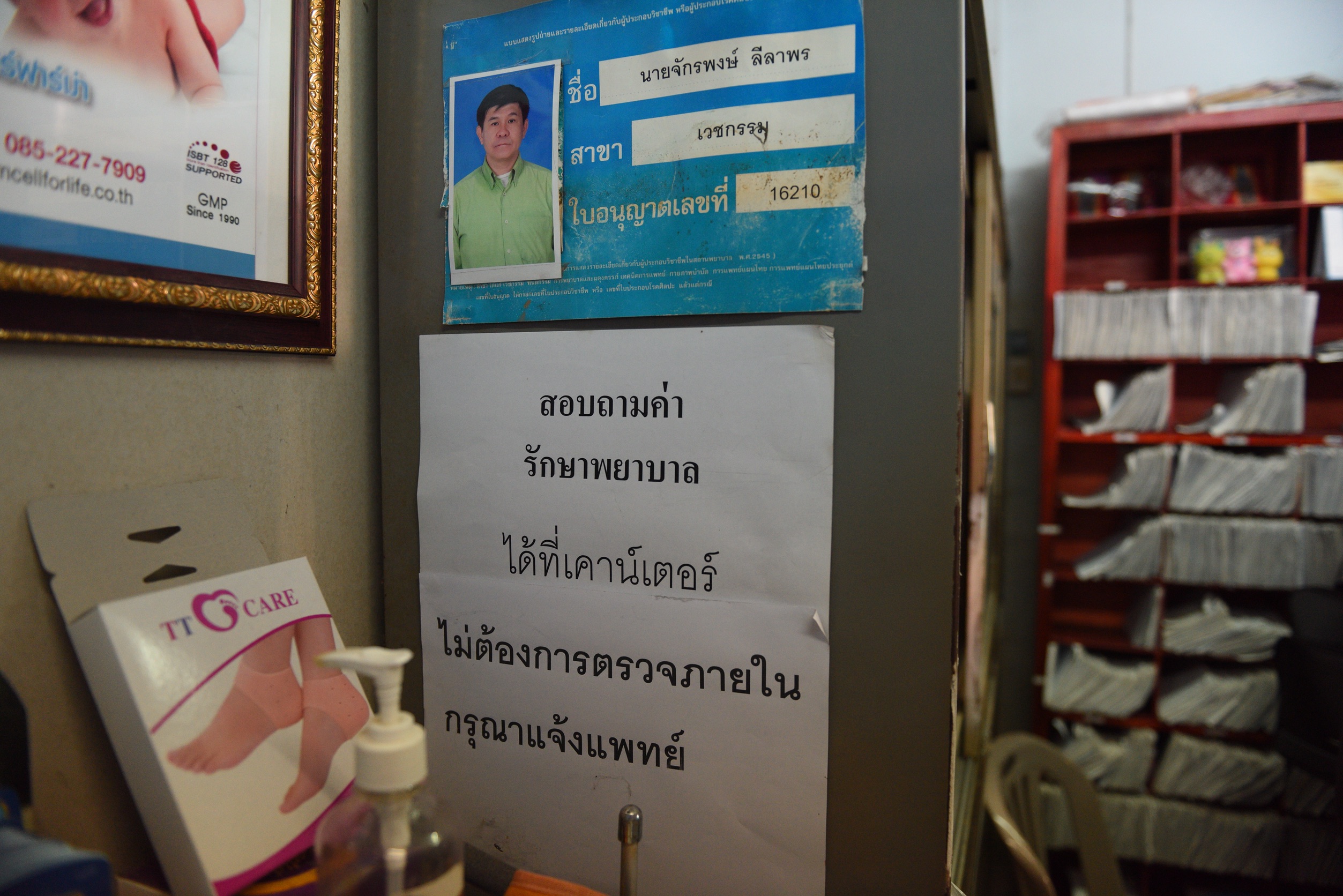
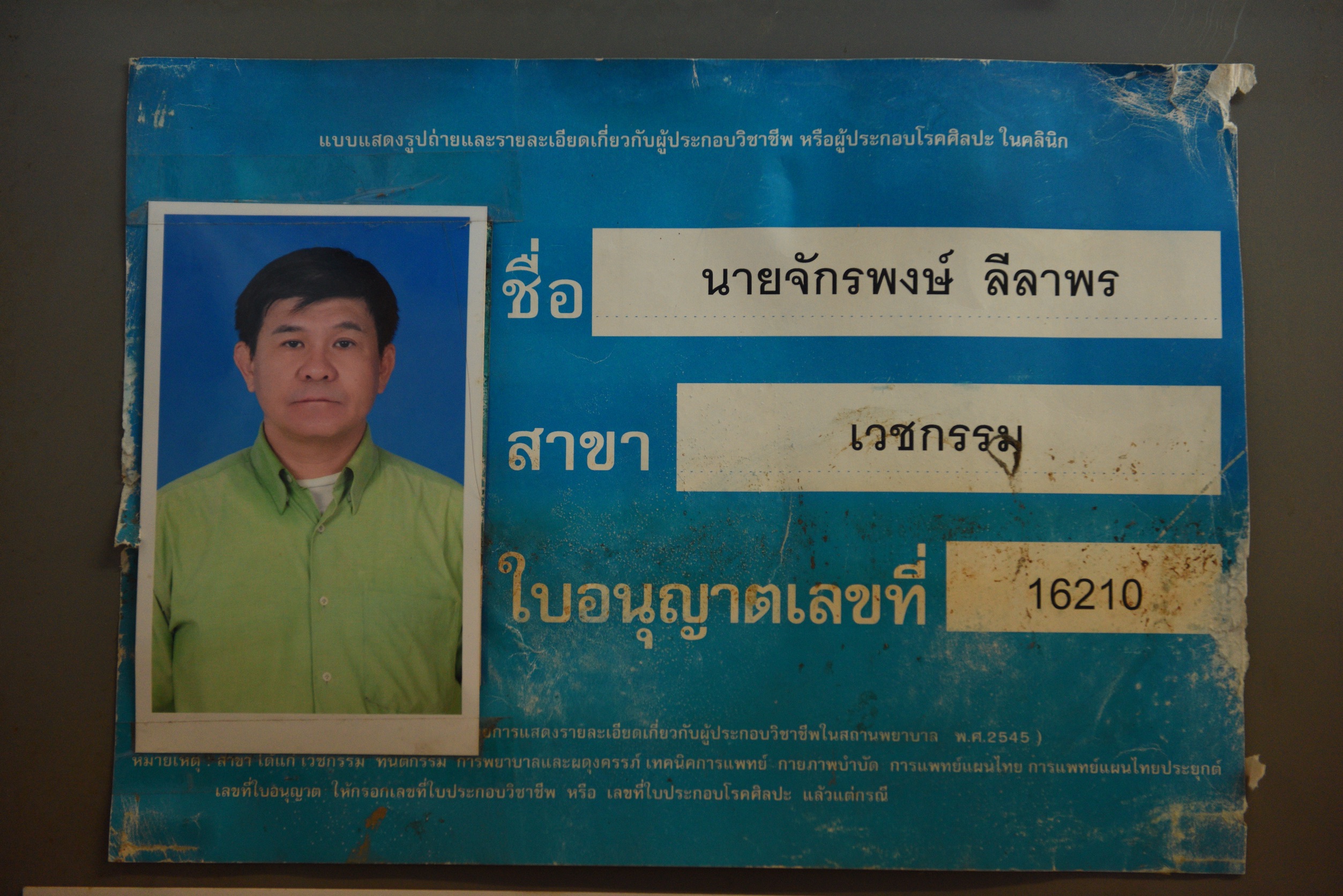
A card identifying Chakkrapong Leelaporn as the physician at his clinic.

The doctor also allegedly transferred 50,000 baht, and then 300,000 baht to the victim in order to get her to drop the case, accompanied by an apology and words of love.

“Please allow me to continue taking care of patients,” the doctor wrote in the chat. “Call the police and tell them you’re dropping the case. … I still love you, okay?”

In case it needed refuting, a number of doctors stepped forward to confirm that the use of a fake penis is unheard of in the OB/GYN community.

“I’ve never heard of using a fake penis. We use speculi,” said Wissanu Prasertsom, a doctor who serves as secretary general of the Association of Private Clinics.

Panadda Wongpoodee, the head of the women’s advocacy group who brought the case to Saranya’s attention, said the doctor was a serial abuser.

“This isn’t the first time this happened. This happened many times, but everyone was too afraid to speak up because he is a doctor,” she said Wednesday. “The victim is very depressed and is currently afraid of of men. Her family is very worried about her.”

S 24387739

The president of the Royal Thai College of Obstetricians and Gynecologists, Pisek Loompikanon, said sexual assault and failing to follow medical procedures can result in an investigation by the national Medical Council. The council’s secretary general said they would investigate the case upon receiving a complaint.

He said the matter would be discussed at a meeting two weeks from now.

Appearing on television, Saranya defended her client against those who would blame the victim.

“We women trust doctors. How would we think that he was putting his penis in instead of medical instruments?” she said. “She didn’t want to go to the police in the first place. She didn’t want a criminal case or to tell her story to police over and over again. She also didn’t think she had evidence.”

“Some people are saying, how come the victim has the doctor’s Line if they weren’t flirting around? I say, when you go to the doctor, don’t you ever fill out your contact information?” Saranya said. “They never did and have never dated.”

S 24387742 S 24387744

Advertisement

Hot News

LATEST NEWS

Bangkok
broken clouds
36.1 ° C
36.6 °
35.5 °
57 %
3kmh
65 %
Sun
35 °
Mon
37 °
Tue
37 °
Wed
37 °
Thu
37 °