


























30.5 C
Bangkok
Saturday, June 27, 2026
Home Blog Page 193

When Critics of the Thai–Cambodian War Are Compared to “Worms Inside Their Own Home”

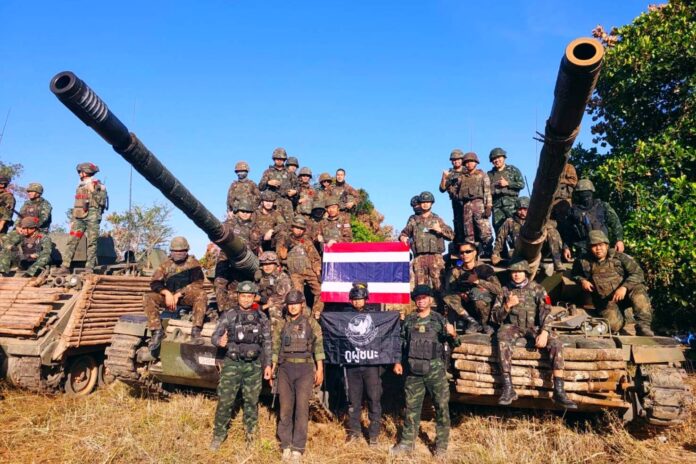
Thai soldiers pose for a group photo holding a sign reading “We are the victors” at Chong Rayi, also known as Hill 284, in Kap Choeng district, Surin province, a disputed area along the Thai-Cambodian border, on Dec. 29, 2025.

T he other day, I read an article by Mr. Surawich Verawan on Manager Online, published on December 25, 2025, titled “Hun Sen Builds a Nation with Grey Money.” One passage mentioned me, saying:

“Most Cambodian media do not perform a watchdog role. Instead, they manufacture legitimacy for the regime. Investigative reporting on casinos or call centers is almost nonexistent. Journalists who try to dig deeper are often intimidated or silenced. This crippled media freedom is not a side effect, but a key mechanism that sustains the power structure.

“We will never see Cambodian media like Baitong Haeng, Atthakrit Saengsuk, or Pravit Rojanaphruk, nor will we ever see Cambodian academics like Supalak Kanjanakhundee. I don’t know whether they maintain unity out of fear of state power [allow me to correct Mr. Surawich’s typo from ‘we’ to ‘they’], or out of national consciousness. But they work as a team, unlike us, who seem to have worms living in our own home.

“If anyone follows the news and looks at their social media, you’ll see a high degree of unity. Their voices move in the same direction as their government’s narrative of being victims. Many people post that Cambodia wants peace. There are movements among Cambodians abroad calling for peace, making Thailand appear to be the aggressor—even though Thailand is merely defending its sovereignty. Cambodians dare to call for peace even while their BM-21 rockets continue to bombard Thailand indiscriminately due to poor accuracy…”

Mr. Surawich’s comparison of me and two others in his column or article on Manager Online to “worms inside our own home” is an exercise of freedom of criticism, which is legitimate. I respect Mr. Surawich Verawan’s perspective. However, I would like to clarify here that I—and I believe the other two mentioned may feel the same—do love our country as well. We simply love Thailand in a different way, through different means.

The question I want to ask Mr. Surawich and Thai society has become? What kind of patriotism is when waging war with a neighbouring country is seen as a good thing by ultra-nationalist Thais, mocking the corpses of soldiers from a neighboring country is considered normal, and turning our neighbour into our enemies never questioned widely in Thai society.

It is ultra-nationalism that does not tolerate internal criticism from fellow citizens—when the nation goes astray or makes mistakes—and instead alienate them and turning them into ‘the other’ by labeling them as traitors, “Thai with Cambodian hearts,” spies, or even “worms inside their own home”

These days, many people seem to love their country by placing “unity” above right and wrong, above morality, decency, and above humanity.

Is it ultra-nationalism that blindly indulges the nation, like spoiling a child—so much so that no criticism, no questioning, no scolding of the child is allowed no matter how he behaves?

Let me ask honestly: Mr. Surawich is a senior journalist with many readers and admirers. Does he believe that all Thai journalists, in every media outlet, should think and express themselves in exactly the same way—whether on the issue of Thai–Cambodian war or on any other issue? If so, then one state-controlled media would suffice. Why waste budget and time on diverse media voices? We journalists should just find other professions, and society should simply consume a single narrative, believe it without question, stay ‘united’, and sing the national anthem together at midnight on January 1, 2026, as is being campaigned for now.

A society that has no space for diverse opinions and does not value dissent is no different from a monocrop plantation. When pests or locusts descend, the entire field risks being wiped out. Diversity of thought is like biodiversity—it builds resilience. Intellectual diversity builds immunity for society.

A society where everyone thinks the same way is a fragile society—an unlivable one even—at risk of becoming fascist. Even fascist or totalitarian societies still have dissenters; they simply must either keep silent or flee into exile. Is this the ideal society envisioned by people like Mr. Surawich?

(As for Cambodia, its media freedom is known to be extremely limited. Reporters Without Borders (RSF), which publishes the annual World Press Freedom Index, ranked Cambodia 161st out of 180 countries in 2025. Thailand, in the same year—in which I was one of those invited by RSF to participate in the evaluation of Thai press freedom index for about a decade now—was ranked 85th.

Therefore, it is not surprising that Cambodian media appear “united.” It is a false unity, under severe constraints on press freedom. Even on such critical matters as how many Cambodian soldiers died during the 19-day border war, the Cambodian media dare not press the state for answers. Mr. Surawich, do you really think this is normal, or truly admirable “unity”?

P.S. Thailand still has serious problems with genuine freedom of expression, as seen in the number of lese majeste refugees in Europe and those in prison here in Thailand. As for Cambodia, its real opposition leader cannot even live in the country and must remain in exile in France. So this is not genuine unity in any sense.)

If the fact that just three Thais with some public voice dare to question the true objectives of the Thai–Cambodian war, and to question its legitimacy, causes such disturbance and outrage, I fear that Thai society is losing its way and drifting further toward a semi-fascist path.

I do not love my country any less than you do. I simply love it with a longer-term vision—asking what kind of Thailand we want in the future—rather than obsessing over short-term issues, seeing only the trees and not the forest. To me, the nation’s most important element is its people, not launching wars over a few square kilometers of disputed territory.

I want to see Thailand with friendly neighbours, supporting one another, growing together economically, in tourism, and in other areas—not surrounded by enemies who curse, obstruct, and undermine one another 24 hours a day, forever. That is why I do not agree with resolving border disputes through military force.

Every Thai and Cambodian military and civilian life has value. I am deeply saddened that at least around a hundred lives were lost on both sides of the border during the 19-day war. They will not be coming home for New Year two days from now.

You can love your country without hating others or turning neighbours into enemies—if you choose patience, reason, and wisdom in solving problems.

___
Advertisement

Chinese Tourist Reports Cash Theft by Transgender Women in Pattaya

A Chinese tourist files a complaint with Pattaya City police after reporting a cash theft at a resort in Pattaya, Thailand, early Dec. 30, 2025.

PATTAYA — A Chinese tourist reported to police that he was robbed of about $765 by two transgender women at a resort in Pattaya, authorities said Tuesday.

The 43-year-old man told Pattaya City police he lost 5,350 yuan, or about 20,000 baht ($765), after inviting the two to his room in the early hours of December 30. Police said he filed the complaint at about 3:20 a.m.

According to police, the man said he placed the cash on a table in the room while drinking with the pair. He later discovered the money missing and the two women gone. He said he later spotted them walking along the beach, detained one and called police.

ladyboys chinese2
A Thai transgender woman walks into Pattaya City Police Station to be questioned by investigators in connection with a reported theft involving a Chinese tourist on Dec. 30, 2025.

One suspect, identified by police as Phanurat Akhana, 16, denied the allegation during questioning. She told investigators she had previously exchanged contact information with the tourist and agreed to meet him to drink together, negotiating a fee of 4,000 baht ($125) per person. She said the group later went outside to find food, but the man chased her, pulled her hair and accused her of theft.

Phanurat said she did not take the money and was helping search for it when the confrontation occurred. Police said she agreed to compensation under pressure but asked for time to gather evidence to prove her innocence.

Police said Phanurat is being held while officers search for the second woman, who they believe took the money, to face possible charges under Thai law.

__

Advertisement

Chinese FM Blasts US Arms Sale to Taiwan as Military Drills Unfold

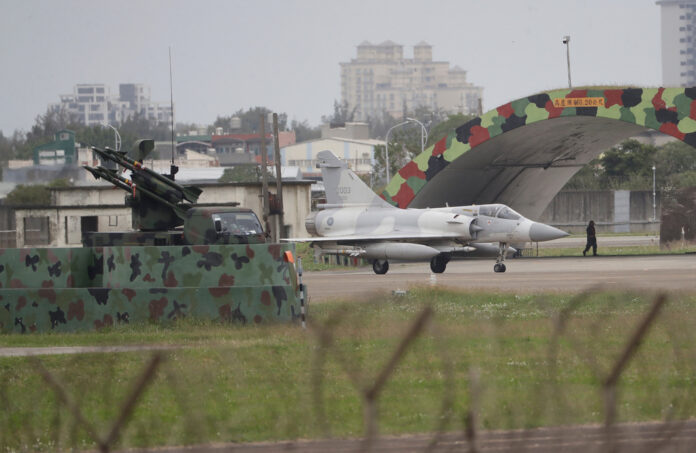
A Taiwan's Mirage 2000 fighter jet moves past airplane fort at an airbase in Hsinchu, northern Taiwan, Tuesday, Dec. 30, 2025. (AP Photo/Chiang Ying-ying)

BEIJING (AP) — China’s foreign minister on Tuesday slammed a record U.S. arms sale to Taiwan as Beijing conducted the second day of military drills around the island it has long claimed as its own.

Wang Yi, the most senior Chinese official to comment on the sales so far, also blasted the “pro-independence forces in Taiwan” and Japan’s leaders during an end-of-the-year diplomatic event in Beijing.

“In response to the continuous provocations by pro-independence forces in Taiwan and the large-scale U.S. arms sales to Taiwan, we must resolutely oppose and strongly counter them,” Wang said while reviewing a year of diplomacy by Asia’s largest and most influential nation.

He reiterated China’s aim for a “complete reunification” with Taiwan, a self-ruled island that split from China during a civil war in 1949 and evolved into a multiparty democracy.

Taiwan’s government argues the island was never part of China in its current form under the Communist Party and Beijing’s sovereignty claims are illegitimate.

AP25364204122074
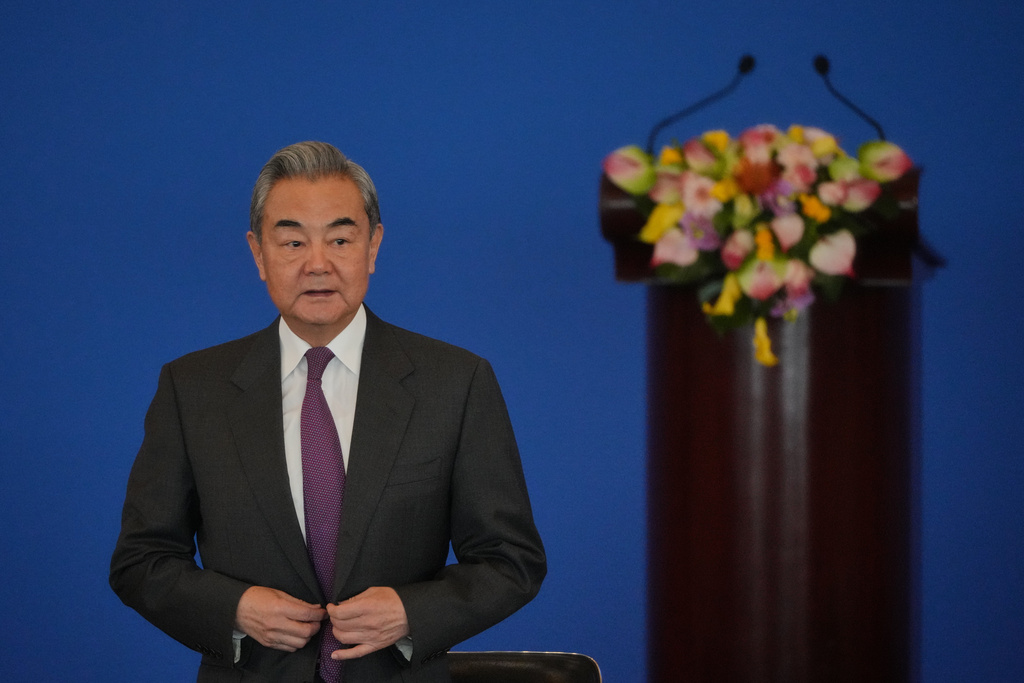
China’s Foreign Minister Wang Yi looks as he arrives to deliver an opening speech for the annual symposium on the international situation and China’s foreign relations held by China Institute of International Studies at the Diaoyutai State Guesthouse, in Beijing, Tuesday, Dec. 30, 2025. (AP Photo/Andy Wong)

Military package rankles China

The package valued at more than $11 billion that was announced earlier this month by the U.S. State Department amounts to the largest U.S. arms sale to Taiwan. It includes missiles, drones, artillery systems and military software.

The U.S. is obligated by its own laws to provide Taiwan with the means to defend itself. President Donald Trump has ramped up pressure on the self-ruled island to buy more U.S. military equipment, even suggesting Taiwan should spend up to 10% of its GDP on defense.

China responded to the sale by launching two days of military drills around Taiwan on Monday. The exercises also are largely seen as a rebuke to Sanae Takaichi, the new Japanese prime minister, who inflamed Beijing last month by implying Japan could militarily intervene over Taiwan.

“Japan, which launched the war of aggression against China, not only fails to deeply reflect on the numerous crimes it committed, but its current leaders also openly challenge China’s territorial sovereignty, the historical conclusions of World War II and the postwar international order,” Wang said, adding that China “must be highly vigilant against the resurgence of Japanese militarism.”

AP25364099669909
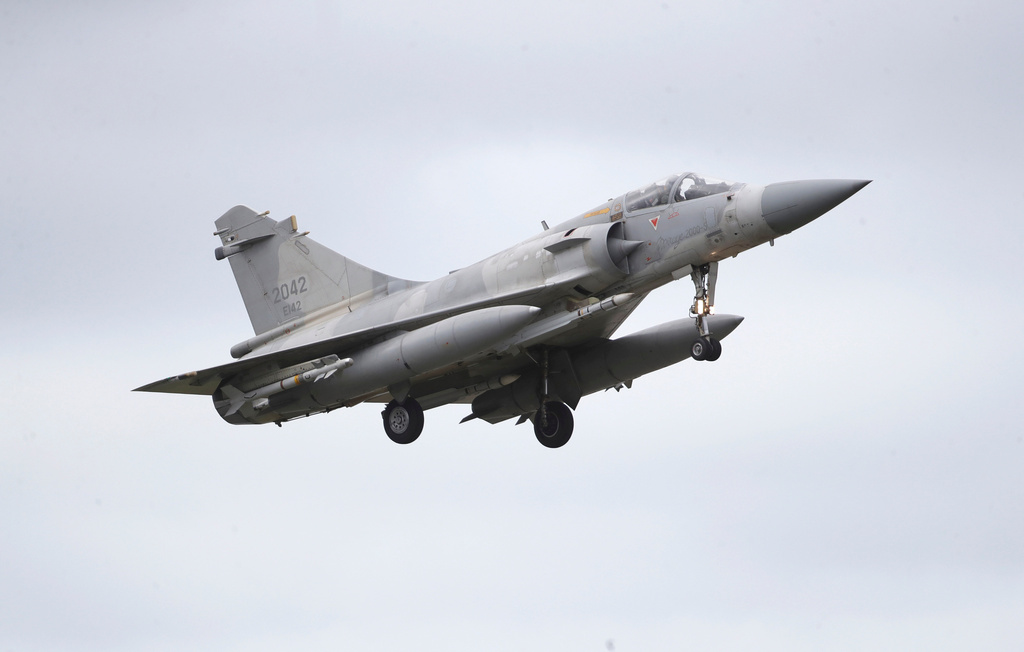
A Taiwan’s Mirage 2000 fighter jet flies back to an airbase in Hsinchu, northern Taiwan, Tuesday, Dec. 30, 2025. (AP Photo/Chiang Ying-ying)

Other diplomatic initiatives reviewed

In his speech reviewing China’s diplomatic highlights for the year, Wang also mentioned Israel’s war in Gaza, welcoming international efforts to facilitate a ceasefire but insisting that more needs to be done.

“The world still owes Palestine justice,” Wang said. “The Palestinian question cannot be marginalized again, and the Palestinian people’s cause for democratic and legitimate rights cannot end in vain.”

China maintains strong relations with Israel and the Palestinian Authority and backs the two-state solution, under which Israel and Palestine would exist as independent states.

Wang also emphasized China’s aim to facilitate a peace agreement between Russia and Ukraine. Beijing says it is impartial in the war but in practice signals support for Moscow through frequent state visits and joint military drills.

Wang mediated talks between top diplomats from Thailand and Cambodia earlier this week, which the leaders said helped consolidate a ceasefire between the two neighbors after months of fighting.

The meetings represented China’s latest efforts to strengthen its role as an international mediator and particularly its influence in Asian regional crises. As China grows into an economic and political force globally, Beijing has spent the past decade and more working in various ways to increase its voice as a third party in diplomatic matters.

__

Advertisement

Four Injured in Pattaya Nightclub Brawl; Chinese Suspect in Custody

Pattaya City Police transport a Chinese suspect to the Pattaya City Police Station for questioning on Monday, Dec. 29, 2025. The individual was arrested in connection with a late-night stabbing that left four people injured.

PATTAYA — Thai police have arrested a Chinese national following a late-night stabbing spree outside a nightlife venue that left four people injured, including three security guards.

The incident occurred just before midnight Sunday in front of “Chill,” an establishment on South Pattaya Road. According to investigators, the suspect, identified as 36-year-old Chen, allegedly attacked the guards after they intervened in a verbal dispute he was having with a woman inside the bar.

Pattaya City Police responded to the scene to find three security staff members suffering from knife wounds. Wichit, 50, was hospitalized in serious condition with a deep chest wound. Two other guards, Thitisak, 20, and Kiatphan, 50, sustained injuries to the arm and thigh, respectively. All three were rushed to Pattaya City Hospital.

pattaya stab2
Pattaya police escort a 36-year-old Chinese national into custody following a violent altercation outside a nightclub on South Pattaya Road, Monday, Dec. 29, 2025.

A second Chinese national, identified only by the surname Hu, 28, was also found at the scene with blunt-force injuries and was treated at Jomtien Hospital.

Following a manhunt, Pattaya Police Chief Col. Aneak Srathongyu announced that Chen was apprehended Monday afternoon at a boxing gym. Authorities seized a white Toyota Altis rental car used in his escape and the clothing worn during the attack.

Police say Chen confessed to the assault, claiming he was “dissatisfied” with the guards’ intervention. He reportedly left the bar to retrieve a sharpened metal rod before returning to attack the staff. Chen has been charged with assault causing injury.

The arrest was a coordinated effort between Pattaya City Police, Chonburi Immigration, and Tourist Police.

__

Advertisement

Thai Political Candidate Arrested in Massive Drug Laundering Raid

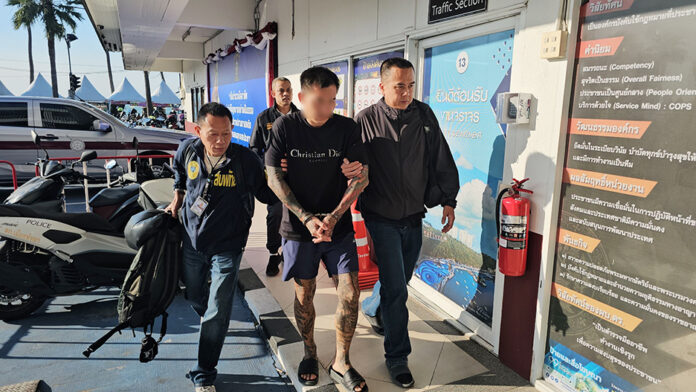
Police officers escort Boonrit Raoroongroj, a parliamentary candidate for the People’s Party, for interrogation at the Narcotics Suppression Bureau in Bangkok on Monday, Dec. 29, 2025.

BANGKOK — Thai narcotics police on Monday arrested a parliamentary candidate from the prominent opposition People’s Party as part of a sweeping multi-province crackdown on a drug trafficking network accused of laundering more than 20 billion baht ($632 million).

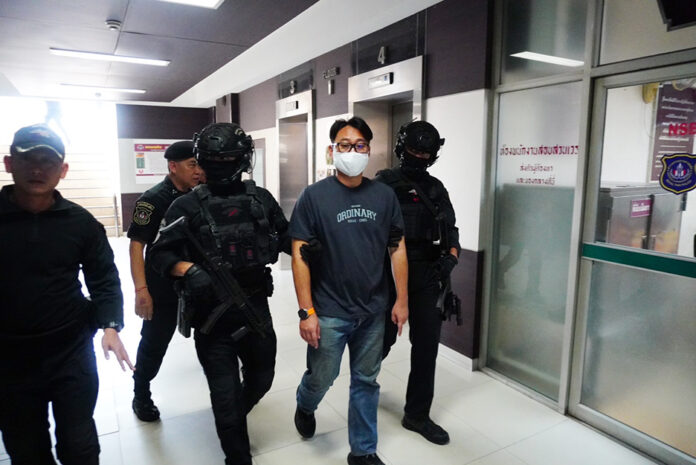
The operation, codenamed “Black Mirror TKP,” involved over 120 officers and special tactical units raiding 22 locations across five provinces, including Bangkok, Nonthaburi, and Pathum Thani. Authorities aimed to dismantle the “TKP” network, which allegedly used shell logistics companies to clean drug money.

The most high-profile arrest occurred in Bangkok’s Taling Chan district, where police apprehended Boonrit Raoroongroj, a People’s Party candidate for the Thon Buri district. His arrest comes just days after he officially registered for the upcoming general election on December 27.

“I want to apologize to the People’s Party for the impact this has caused,” Boonrit told reporters while being escorted into custody. “I deny any involvement in drug money laundering, though I admit to being a director in one of the companies named in the investigation.”

The People’s Party, a popular progressive movement, has campaigned heavily on a “No Grey Area” slogan, promising to purge criminal influence from Thai politics. Boonrit acknowledged that his arrest violated this core policy, stating he likely “cannot continue his political career.”

PP drugs1
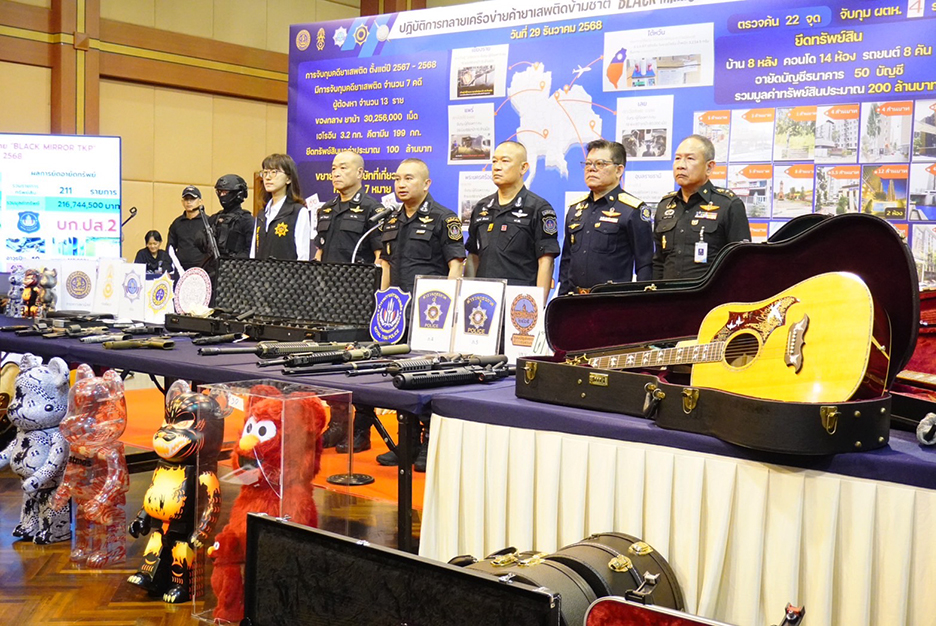
Lt. Gen. Archayon Kraithong, Commissioner of the Narcotics Suppression Bureau, displays seized luxury items and evidence during a press conference at the Narcotics Suppression Bureau headquarters in Bangkok on Monday, Dec. 29, 2025.

Lieutenant General Archayon Kraithong, Commissioner of the Narcotics Suppression Bureau (NSB), said the investigation began in February 2025 after the arrest of Lao drug traffickers near the border. Follow-up investigations linked the group to four logistics firms that shared directors but conducted no actual business.

“These companies saw a turnover of 20 billion baht across 50 bank accounts,” said Police General Samran Nualma, Deputy National Police Chief. “The money flow is directly linked to drug trafficking syndicates.”

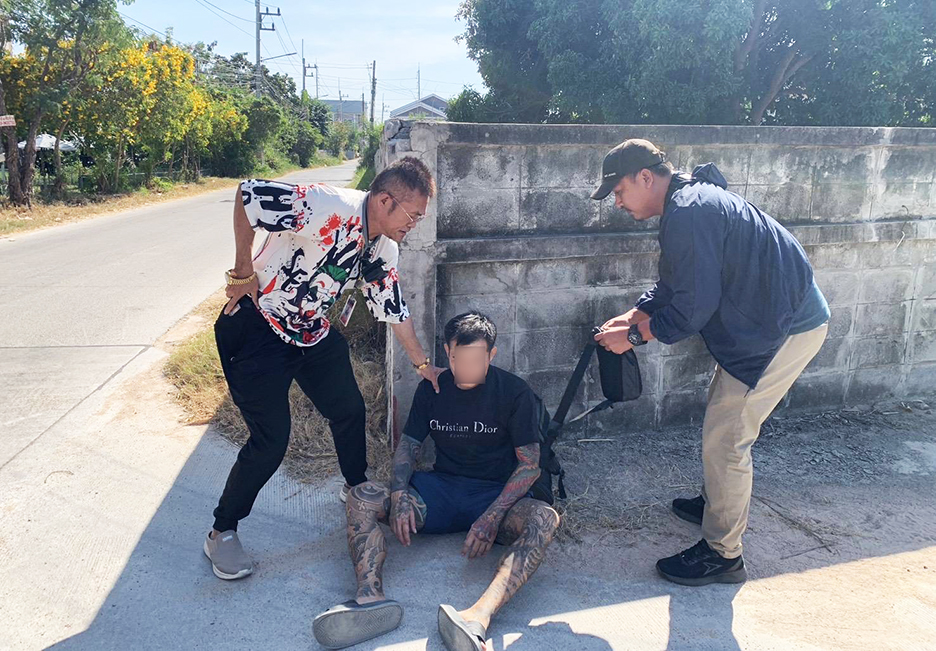
In addition to Boonrit, police arrested a Thai man and his Lao wife at a luxury European-style villa. Officers seized two luxury cars, 11 handguns, five rifles, and 1 million baht ($32,000) in cash. The couple reportedly admitted to registering the companies but could not explain their business operations.

Boonrit remains in custody on charges of joint money laundering and drug-related offenses. Police say financial records show he received monthly payments from the network, a claim the candidate disputes.

___

Advertisement

Thai–Cambodian Truce Comes Too Late for Khao San Road New Year Businesses

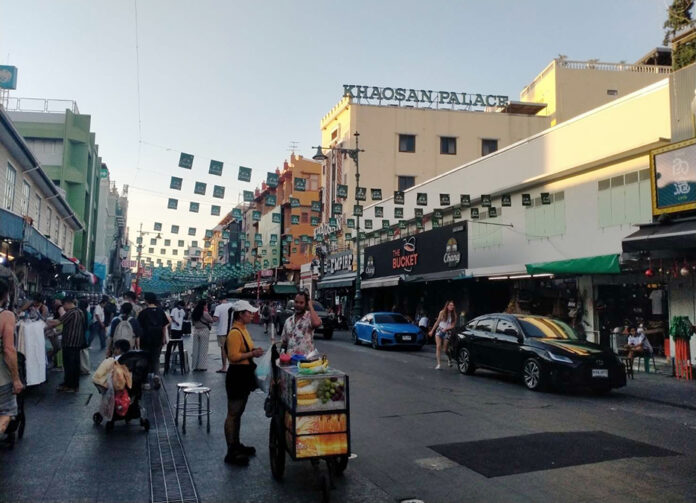
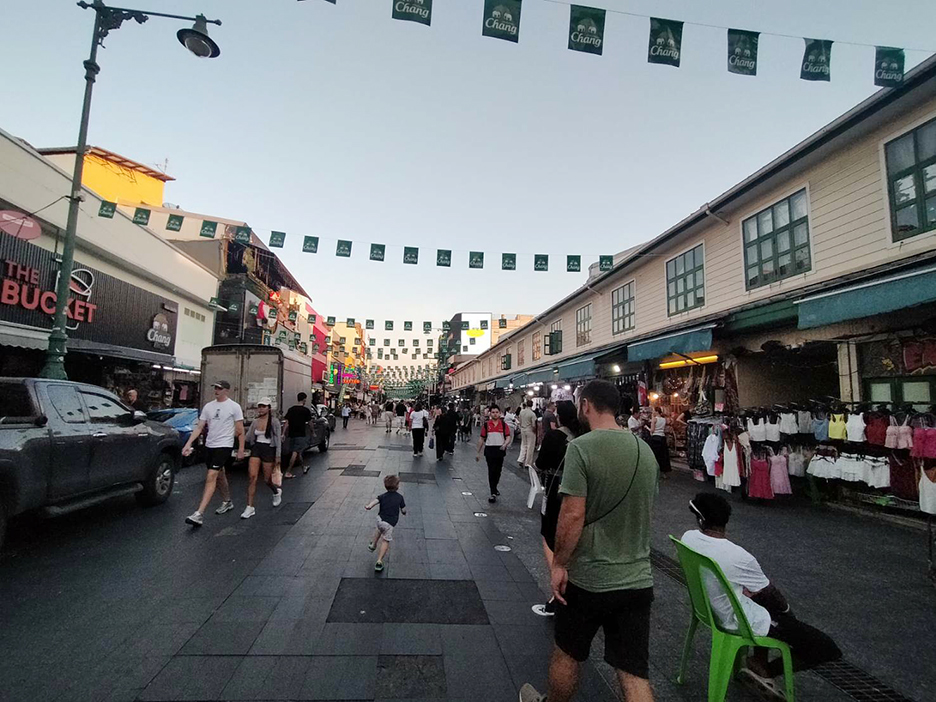
Tourists walk along Khao San Road in Bangkok, Thailand, on Dec. 29, 2025. The Khaosan Business Association says hotel bookings are down about 30% from normal levels. (KHAOSOD Photo/Phanom Khongcharoen)

BANGKOK — A ceasefire agreement between Thailand and Cambodia has come too late to revive New Year celebrations on Bangkok’s famed Khao San Road, where businesses report sharply lower hotel bookings and subdued crowds amid regional tensions and economic uncertainty.

Hotel occupancy on Khao San Road and nearby areas stood at about 70% to 80% in the final week of 2025, down from near-full capacity typically seen from early December in previous years, said Sa-nga Ruangwattanakul, president of the Khaosan Business Association. He said bookings are down about 30% from normal levels.

“This is the worst situation since tourism began recovering after the easing of COVID-19,” Sa-nga said.


Most reservations are from foreign tourists planning to spend New Year’s Eve in Thailand, while domestic spending has weakened sharply since the fourth quarter of the year, he said. Small businesses have relied heavily on the government’s “Khon La Khrueng Plus” subsidy program, but activity has slowed again since the funds were fully used.

New Year countdown events on Khao San Road will run from 7 p.m. on December 31 through 1 a.m. on January 1, featuring traditional Thai performances.

Organizers estimate about 20,000 Thai and foreign visitors will pass through the area, generating 20 million to 30 million baht ($636,000 to $954,000) in spending — less than half the roughly 50 million baht ($1.6 million) or more typically seen in past years.

Security measures have been tightened, with increased checks at entry points, expanded CCTV coverage and more security personnel, Sa-nga said. Authorities will also strictly prohibit alcohol sales to heavily intoxicated customers.

khaosan road2
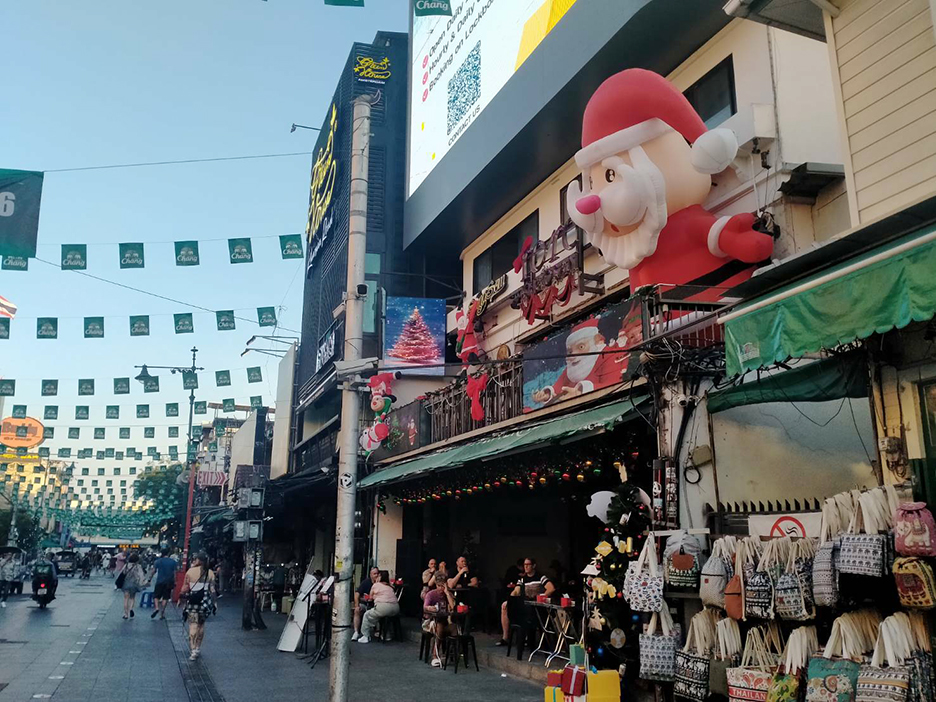
Shops on Khao San Road are decorated for Christmas and New Year in Bangkok, Thailand, on Dec. 29, 2025, but the atmosphere on the street remains subdued. (KHAOSOD Photo/Phanom Khongcharoen)

Several factors have dampened the New Year atmosphere, Sa-nga said, citing tensions along the Thailand–Cambodia border that have made some foreign tourists wary and prompted them to choose alternative destinations such as Japan, Vietnam or China.

Wealthier Thai travelers are also increasingly opting to travel abroad, particularly to Japan, where a weaker yen has lowered costs, or to China, which offers cheaper travel than Thailand’s beach destinations.

A trip to China during the holiday period can cost about 10,000 baht ($290), including flights and accommodation, compared with more than 20,000 baht ($580) for a trip to Phuket, he said.

khaosan road1
Tourists walk along Khao San Road in Bangkok, Thailand, on Dec. 29, 2025. Shop owners say the atmosphere has been unusually subdued, with far fewer visitors than last year. Tourists walk along Khao San Road in Bangkok, Thailand, on Dec. 29, 2025. The Khaosan Business Association says hotel bookings are down about 30% from normal levels. (KHAOSOD Photo/Phanom Khongcharoen)

Domestic political uncertainty ahead of elections, a slow economic recovery at home and abroad, and concerns about future income have also led consumers to cut spending by 20% to 30% from normal levels, he added.

Although Thailand and Cambodia have agreed to halt hostilities, Sa-nga said the deal has had little impact on travel decisions at this stage.

“Tourists have already made and paid for their plans,” he said. “If an agreement had been reached before December, more foreign tourists might have chosen Thailand. With just days left before the New Year, there is very little that can be done now.”

____

Advertisement

Missing Swiss Man With Alzheimer’s Found Far From Home in Thailand

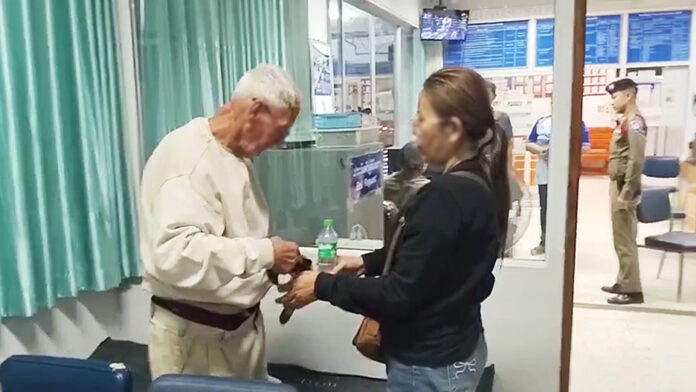
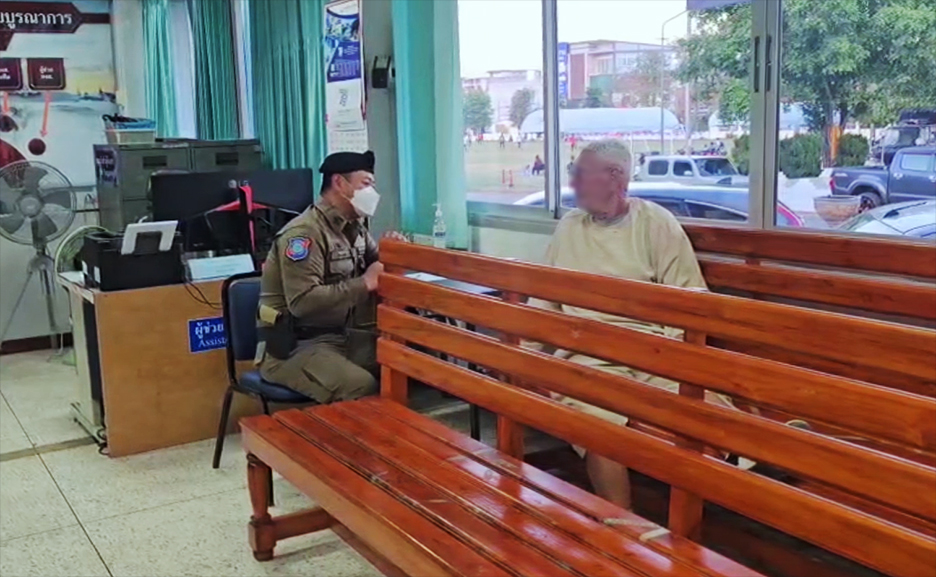
The Thai wife of a Swiss man reported missing arrives from Nong Bua Lamphu province to take him home at Lom Sak Police Station in Phetchabun province, Thailand, Dec. 29, 2025.

PHETCHABUN — A Swiss man with Alzheimer’s disease who went missing for four days from his home in northeastern Thailand was found about 250 kilometers away after local residents brought him to a police station, authorities said.

The man was discovered wandering in Lom Sak district of Phetchabun province and taken to police on December 29 after residents reported he appeared confused and unable to communicate, said Pol. Col. Theerasak Sarnapusitsant, superintendent of Lom Sak police.

Police said the man had no identification and was unable to give his name or address. Officers found only two keys on him — one for a Ford vehicle and another for a Honda motorcycle — and attempts to communicate through an interpreter were unsuccessful due to his apparent memory loss.

Police and tourist officers cared for the man while trying to locate his family, providing food, water and shelter as they posted appeals on social media.

swiss nong bua1
A police officer speaks with a Swiss man who was reported missing after being found wandering, at Lom Sak Police Station in Phetchabun province, Thailand, Dec. 29, 2025.

Authorities later received information that the man had been seen earlier with a blue Honda Scoopy i motorcycle bearing license plates from Nong Bua Lamphu province. Police traced the registration to a foreign resident in Suwannakhuha district, Nong Bua Lamphu, and contacted local community leaders, who reached the man’s Thai wife.

The wife told police her husband, identified as Ernst, a Swiss national with Alzheimer’s disease, had ridden his motorcycle away from home four days earlier. The family had filed a missing person report and did not expect he could travel such a long distance, crossing several mountain routes.

She and other relatives traveled to Lom Sak police station later that day and took him home, thanking officers and residents who helped locate and care for him.

___

Advertisement

China, Cambodia, Thailand FMs Meet as Beijing Eyes Bigger Dispute Role

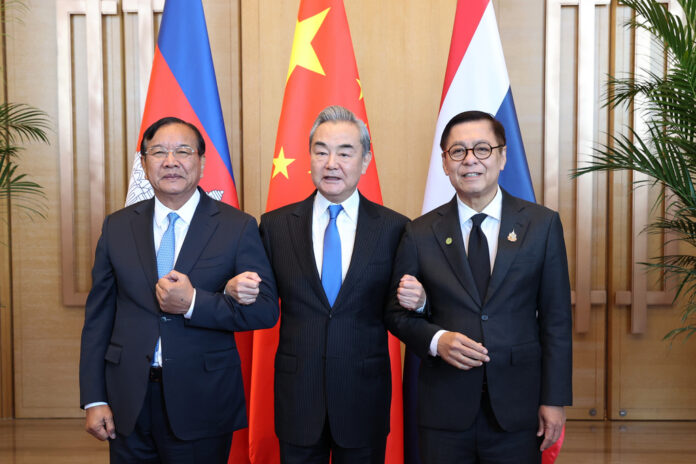
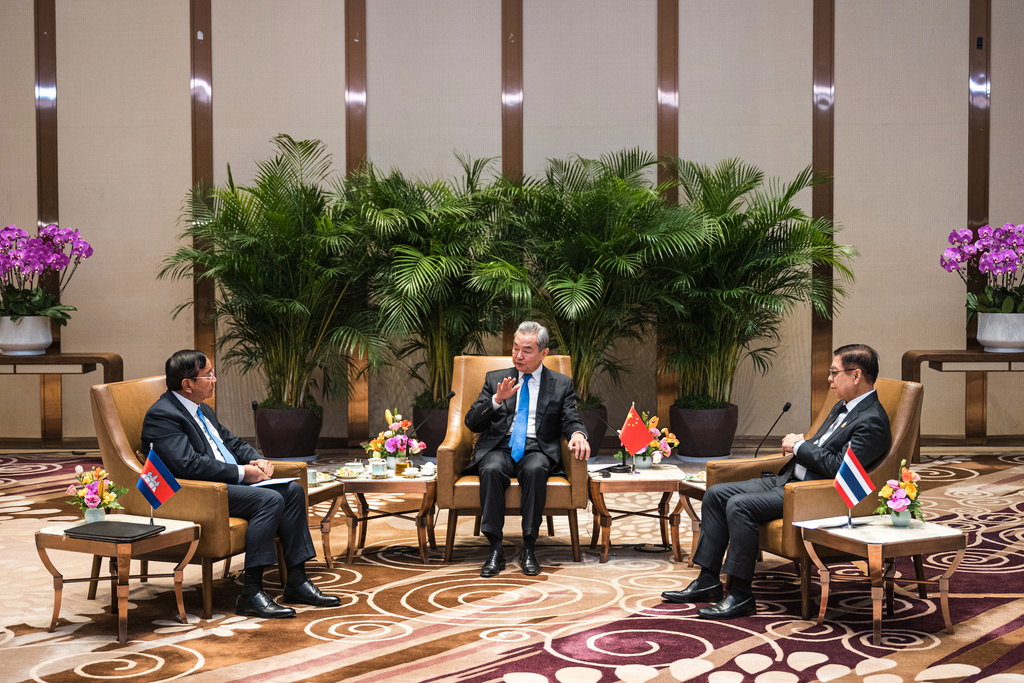
Cambodia's Foreign Minister Prak Sokhonn, left, Thai counterpart Sihasak Phuangketkeow, right, and Chinese counterpart Wang Yi pose for a photograph in Yunnan province, China, Monday, Dec. 29, 2025. (AKP via AP)

HONG KONG (AP) — Foreign ministers from Cambodia and Thailand convened with their Chinese counterpart on Monday as the Beijing government, building on its expanding presence in the world diplomatic arena, sought to play a stronger mediating role in the violent border dispute between the two Southeast Asian countries.

The trilateral meeting, held in a southwestern Chinese province north of the contested border, came two days after Thailand and Cambodia signed a fresh ceasefire agreement to end weeks of fighting that killed more than 100 people and forced the evacuation of hundreds of thousands on both sides of the border.

“We haven’t resolved everything, but I think we are making progress in the right direction and we have to keep up the momentum,” Thai Foreign Minister Sihasak Phuangketkeow told reporters after the meeting in Yunnan province. He said chief priorities are to ensure a sustained ceasefire and continue rebuilding trust.

AP25363144875974
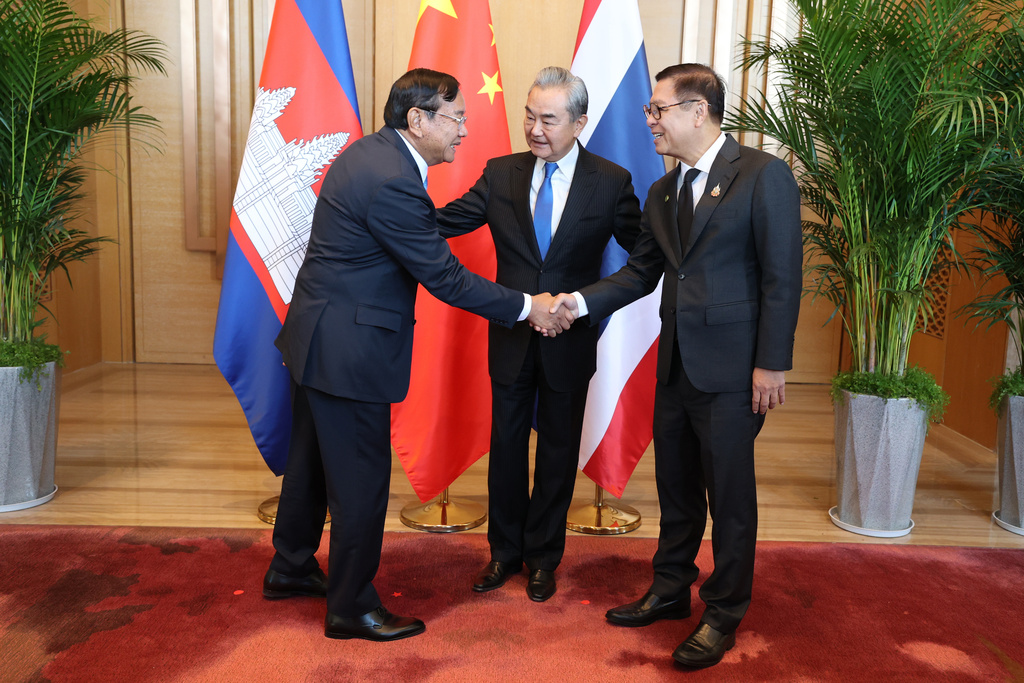
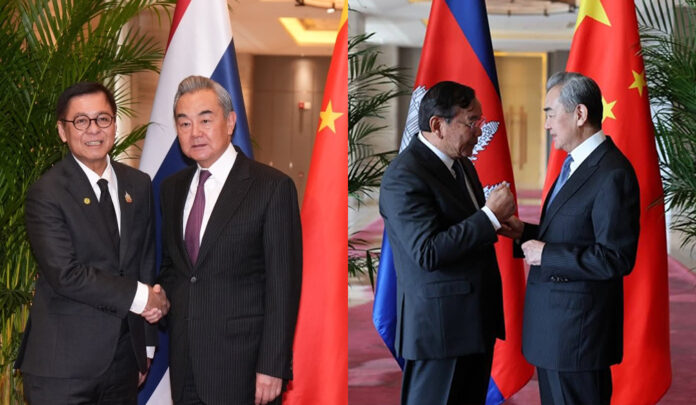
Cambodia’s Foreign Minister Prak Sokhonn, left, shakes hands with Thai counterpart Sihasak Phuangketkeow, right, in front of China’s counterpart Wang Yi in Yunnan province, China, Monday, Dec. 29, 2025. (AKP via AP)

It was noteworthy that the meeting was held in Yunnan, much nearer to the dispute and to Southeast Asia, rather than in Beijing, the Chinese capital and seat of government about 1,300 miles (2,500 kilometers) northeast.

The meetings represented China’s latest efforts to strengthen its role as an international mediator and, in particular, its influence in Asian regional crises. As China grows and becomes more of an economic and political force regionally and globally, Beijing has spent the past decade and more working in various ways to increase its voice as a third party in diplomatic matters.

Hopes for peace expressed

During the meeting Monday, Chinese Foreign Minister Wang Yi called for joint efforts to promote regional peace, stability and development — language typical for China in such situations.

“Allowing the flames of war to be reignited is absolutely not what the people of the two countries want and not what China, as your friend, wants to see. Therefore, we should resolutely look ahead and move forward,” Wang said.

Cambodian Foreign Minister Prak Sokhonn said he believed the latest ceasefire would last and would create an environment for both nations to resume previously agreed-upon ways to settle differences, according to a Chinese interpreter. Sihasak also expressed hopes for peace with neighboring countries, the interpreter said.

After the meeting, Chinese official news agency Xinhua quoted Wang as saying the two nations reached a consensus to move forward with the ceasefire without reversal, maintain dialogue and restore ties between the two countries step by step.

A statement released by Xinhua, the Cambodian state news agency Agence Kampuchea Presse and the Thai Foreign Ministry said the three sides had in-depth exchanges on maintaining the ceasefire. The next key step, it said: to work toward resuming normal exchanges. China said it was ready to provide immediate humanitarian assistance for displaced residents.

AP25363151885489
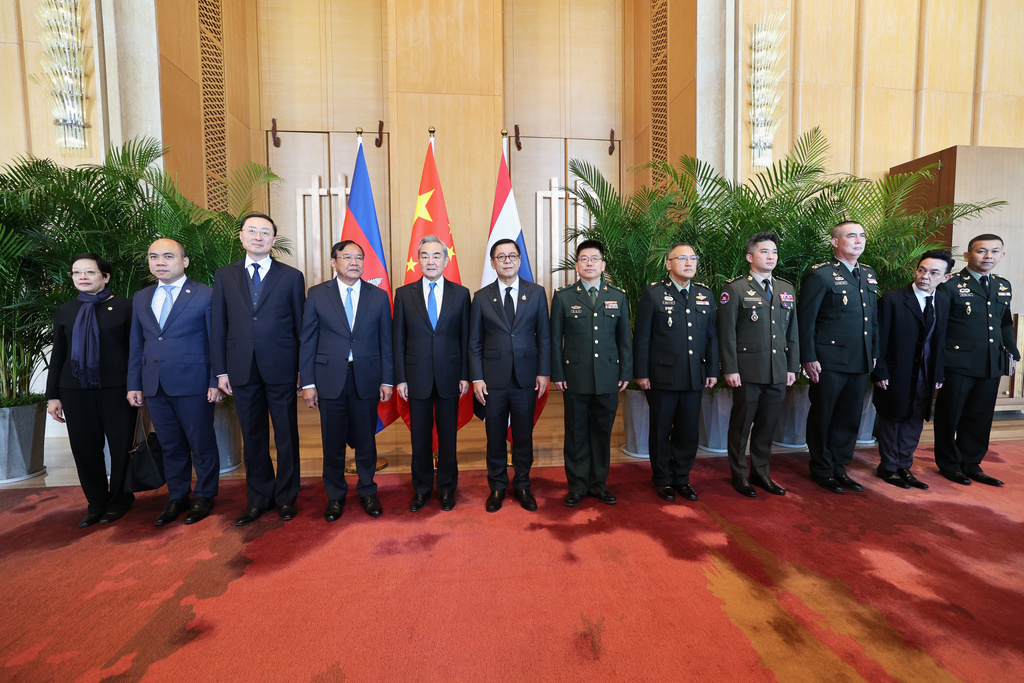
Cambodia’s Foreign Minister Prak Sokhonn, fourth from left, poses for photographs together with his counterparts, China’s Wang Yi, fifth from left, and Thailand’s Sihasak Phuangketkeow, sixth from left, as accompanied by meeting delegation members in Yunnan province of China, Monday, Dec. 29, 2025. (AKP via AP)

The two Southeast Asian countries, alongside China, also agreed to take more robust measures to combat transnational crimes, including telecom and online scams, the statement said.

Sihasak and Prak Sokhonn had also held separate meetings with Wang on Sunday, the first day of the two-day gathering.

Disputes persist

The two Southeast Asian countries originally reached a ceasefire in July. It was brokered by Malaysia and pushed through under pressure from U.S. President Donald Trump, who threatened to withhold trade privileges unless Thailand and Cambodia agreed. The preliminary pact was followed by a more detailed October agreement.

But Thailand and Cambodia carried on a bitter propaganda war, with minor, cross-border violence continuing. The tensions erupted into heavy fighting in early December.

The Saturday agreement calls for Thailand, after the ceasefire has held for 72 hours, to repatriate 18 Cambodian soldiers who have been held prisoner since the earlier fighting in July. Their release has been a major demand of the Cambodian side.

AP25364149945838
In this photo released by Xinhua News Agency, China’s Foreign Minister Wang Yi, center, speaks as he hold a meeting with his Cambodia counterpart Prak Sokhonn, left, and Thailand’s counterpart Sihasak Phuangketkeow, right, in Yuxi in southwest China’s Yunnan province on Monday, Dec. 29, 2025. (Wang Guansen/Xinhua via AP)

The agreement also calls on both sides to adhere to international agreements against deploying land mines, a major concern of Thailand.

The Thai Foreign Ministry on Monday said in a statement that its country would consider the release of 18 Cambodian soldiers after the ceasefire observation period and requested, in turn, that Cambodia facilitate the return of Thais along the border.

Also Monday, Cambodian Prime Minister Hun Manet issued a statement to all Cambodian combatants along the Thai border. “Even though we can still fight,” he said, “as a small country we still have nothing to gain from prolonging the fighting for a long time.”

___

Advertisement

BRAND’S Essence of Chicken Continues “Brain Fatigue, Don’t Drive” Campaign for New Year 2026

BRAND’S Essence of Chicken, under Suntory Beverage & Food (Thailand) Co., Ltd., in collaboration with the Highway Police Division, the Traffic Police Division and Chiang Mai Provincial Police, continues the “Brain Fatigue, Don’t Drive, Take a Break and Drink BRAND’S” road safety campaign for New Year 2026 long-holiday period, promoting safe driving and distributing 45,000 bottles nationwide, The campaign is further supported through major retail collaborations, including 7-Eleven, Jiffy, and Mini Big C.

Picture2 18

Miss Jaturaporn Thanapornsungsuth, VP – Head of Marketing (Thailand & Indochina) said “BRAND’S Essence of Chicken is committed to road safety during the New Year travel season. Partnership with the Highway Police Division, the Traffic Police Division and Chiang Mai Provincial Police promotes public awareness and responsible driving. For New Year 2026, BRAND’S is providing 45,000 bottles enriched with Carnosine and Vitamin B12, distributed between December 29, 2025 – January 2, 2026. Throughout 2025, a total of 130,000 bottles has been distributed. Travelers can pick up products at public service points nationwide, with promotions through 7-Eleven, Jiffy and Mini Big C from November 24, 2025 – January 3, 2026”

Picture3 16

Police Major General Pornsak Laorujiralai, Commander of the Highway Police Division, said “the Highway Police Division has prepared measures to ensure safe travel, with public service points nationwide and support from the campaign to encourage rest and alertness. The Highway Police are ready to assist 24 hours a day via Hotline 1193”

Police Major General Damrongsak Swang-ngam, Commander of the Traffic Police Division, added “the Traffic Police Division has prepared additional officers, strengthened operations in high-risk zones, and joined the campaign to remind the public of rest and mindful driving, distributing products at rest stops and petrol stations to help drivers stay alert and reduce fatigue”

Advertisement

​It’s Time for China to Prove It Can Broker Peace Between Thailand and Cambodia

Combination photo showing Chinese Foreign Minister Wang Yi meeting with Thai FM Sihasak Phuangketkeow (left) and meeting with Cambodian Deputy Prime Minister and FM Prak Sokhonn in Yuxi, Yunnan, on Dec. 28, 2025.

O n Saturday, following the implementation of the 72-hour ceasefire, I spoke with Al Jazeera, Russia’s RT News, and the UK’s Channel 4. A recurring theme in these interviews was the shadow of the regional superpower: What is China’s true role here?

​As I told Channel 4, Thailand and Cambodia are effectively in China’s “backyard.” Beijing has no interest in seeing its neighbours—and major investment partners—engaged in a hot war. Today, the focus shifts to Yunnan province, where Thai Foreign Minister Sihasak Phuangketkeow and Cambodian Foreign Minister Prak Sokhonn are meeting under the facilitation of Wang Yi, the Chinese Foreign Minister. They are racing against a clock that expires at noon tomorrow, December 30.

​The Credibility Gap

​While Beijing positions itself as the “adult in the room,” many in Thailand remain unconvinced of its neutrality. Cambodia has long been viewed as a semi-satellite state of China, with its monarchy receiving regular medical care in Beijing and its government receiving vocal support from the Chinese ambassador in Phnom Penh during earlier clashes.

​For many Thais, Cambodia serves as a cautionary tale of what happens when a nation leans too heavily on one superpower. China now faces a test: can it transcend its “special relationship” with Cambodia to act as a truly impartial mediator?

​The “War for Votes”

​Domestic politics are inseparable from these border skirmishes. PM Anutin Charnvirakul likely views a sustained ceasefire as a necessary political win ahead of the February 2026 general election. However, he is walking a nationalist tightrope. In an election cycle, no Thai politician can afford to appear “weak” on sovereignty, yet the economic and human cost of continued fighting is becoming impossible to ignore.

​Today in Yunnan is about more than just a border line; it is about China proving it can lead where others have faltered, and about whether Thai leadership can transition from “war-drunk” rhetoric to a stable, albeit uneasy, peace, or Truce.

__

Advertisement

Hot News

LATEST NEWS

Bangkok
overcast clouds
30.5 ° C
32.2 °
30.5 °
76 %
4.9kmh
100 %
Sat
30 °
Sun
35 °
Mon
35 °
Tue
33 °
Wed
32 °