




























30.5 C
Bangkok
Wednesday, June 17, 2026
Home Blog Page 2057

No Dress Code, but Plenty of References to #Metoo at Oscars

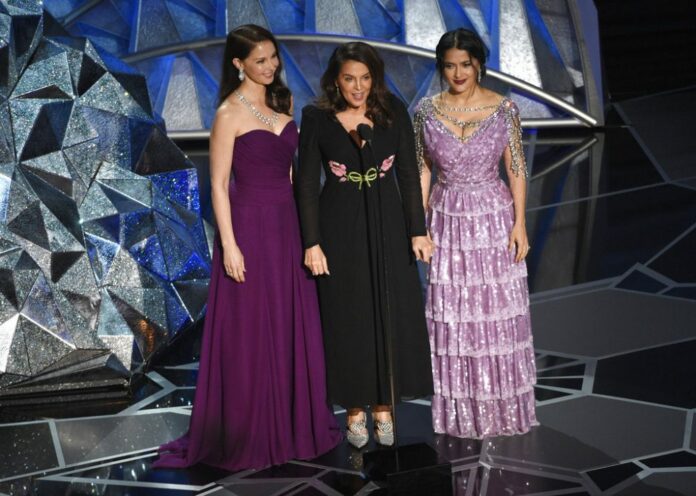
Ashley Judd, from left, Annabella Sciorra and Salma Hayek speak at the Oscars on Sunday, March 4, 2018, at the Dolby Theatre in Los Angeles. Photo: Chris Pizzello / Invision / AP

LOS ANGELES — There was no #MeToo or Time’s Up dress code on the Oscar red carpet. But the topic was, to no one’s surprise, a major talking point of the evening — and host Jimmy Kimmel got right to it in his opening monologue.

“Here’s how clueless Hollywood is about women,” Kimmel said. “We made a movie called ‘What Women Want’ and it starred Mel Gibson.”

Mixing the serious theme with a little humor, Kimmel said the world was watching — and that Hollywood needed to set an example.

“If we can stop sexual harassment in the workplace, women will only ever have to deal with harassment all the time, every place else they go,” he quipped.

And he evoked the now-disgraced name of Harvey Weinstein, whose sexual misconduct — revealed late last year — launched the stunning reckoning that has spread to other areas of society in just a few months. For years one of the biggest players at the Oscars, Weinstein has now been thrown out of the academy. Kimmel marveled that the only other person ever kicked out was a character actor who shared screeners.

The most emotional #MeToo moment, though, came courtesy of actresses Ashley Judd, Annabella Sciorra and Salma Hayek, three women who were instrumental in the unfolding Weinstein revelations. They came onstage to introduce a montage that celebrated diversity in cinematic storytelling — including gender and race.

Judd, whose accusations appeared in the first New York Times article about Weinstein, spoke about “new voices, different voices, OUR voices.”

“Time’s Up!” she said.

On the red carpet, one of the many guests speaking about #MeToo was the founder of the movement, Tarana Burke.

“We did the dress code thing, and now we’re doing the work,” Burke told The Associated Press. “The plan is to continue to do this work to give people resources.”

But elsewhere on the carpet, an uncomfortable drama was playing out, as a number of stars appeared to spurn Ryan Seacrest, the E! anchor who has recently been accused of sexual misconduct — including groping — by a stylist who worked for him. Timothee Chalamet, Viola Davis, Armie Hammer, Margot Robbie and others appeared to pass him over. Some stars did speak to him, including nominees Allison Janney, Christopher Plummer and Mary J. Blige, who noted in another interview that Seacrest was “fighting for his identity.”

Seacrest has denied the allegations and E! has stood by him. But many on Twitter complained about reports that the network had instituted a 30-second delay to prevent awkward confrontations. The network said that it was “business as usual. As always, we tape multiple sources of content simultaneously to deliver the best possible show, and there are often brief delays between interviews.”

Burke, before the awards, had said Seacrest shouldn’t be on the carpet, putting stars in an awkward position. “We shouldn’t have to make those choices of, ‘Do we or don’t we?'” she told Variety.

E! was already under fire at the Golden Globes in January, where actress Eva Longoria used her interview to criticize the network over a pay equity dispute involving former anchor Catt Sadler.

Story: Jocelyn Noveck
Advertisement

Election Projections in Italy Point to Hung Parliament

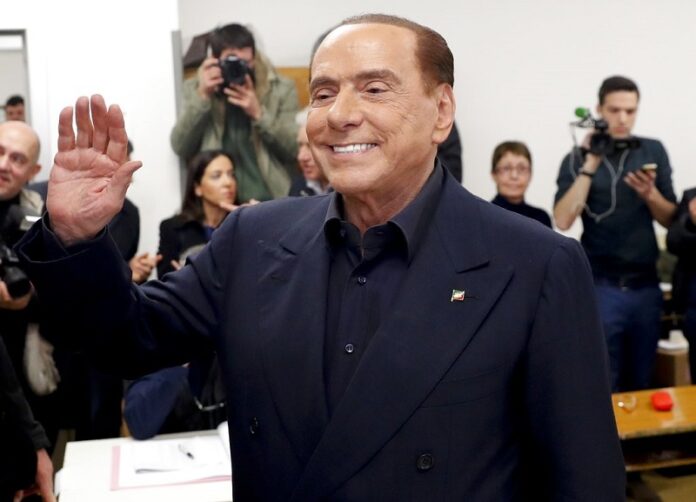
Italian former premier and leader of Forza Italia (Go Italy) party Silvio Berlusconi waves at a polling station Sunday in Milan, Italy. Photo: Antonio Calanni / Associated Press

ROME — Election projections in Italy early Monday showed a center-right coalition that includes an anti-migrant party edging past the populist 5-Star Movement, but no single bloc or party with the support to win a majority in Parliament.

If confirmed by official results, the outcome could set the stage for weeks of political haggling to forge a new government

An RAI State TV projection from Sunday’s election showed the center-right bloc in front with 35.5 percent and the center-left, which includes the Democratic Party leading the current government, lagging at 23 percent.

The anti-establishment 5-Star Movement had 32.5 percent.

Another projection that looked only at how parties fared had the 5-Star Movement snagging 31.8 percent of the vote, but far from the threshold it needed to form a government.

The anti-immigrant, euroskeptic League of Matteo Salvini had 15.9 percent of the vote and its main center-right partner, former Premier Silvio Berlusconi’s Forza Italia, came in at 14.2 percent. The Democratic Party had just 19.6 percent.

“Despite a stronger than expected performance, the M5S (Five-Stars) are still far away from securing an absolute majority,” Wolfango Piccoli, a London-based analyst with Teneo Intelligence, wrote.

Piccoli noted that Berlusconi and Salvini had forged a “gentleman’s agreement” stating that if their bloc secured a majority of the vote, whichever of their parties received more support could pick Italy’s next premier.

Berlusconi cannot hold public office now due to a tax fraud conviction and tapped European Parliament President Antonio Tajani as his choice for premier. Salvini wants the job for himself.

Like Piccoli, other analysts said the election appeared to have dealt Italy a hung Parliament – and weeks or even months of political negotiations to line up a governing coalition of rival forces appeared likely.

“Ungovernable Italy” was how Italian daily newspaper La Stampa headlined its election summary.

Political analyst Lorenzo Codogno of London-based LC Macro Advisors commented: “Financial markets are likely to take these figures negatively.” He added that a hung Parliament would make it “extremely difficult for a narrow mainstream coalition to have the numbers to govern.”

How the seats ultimately are sorted out could determine if Italy is swept up in the euroskeptic and far-right sentiment that has emerged in much of Europe.

The campaigning in Italy was marked by neo-fascist rhetoric and anti-migrant violence that culminated in a shooting spree last month that targeted African migrants and injured six.

The 5-Star Movement in principle opposes allying with other parties in government and wants to rule alone, if it wins its first premiership. But the 5-Stars’ candidate for premier, 31-year-old Luigi Di Maio, has shown some openness to potential partners.

One of his chief aides, Alessandro Di Battista, in exultant remarks to supporters early Monday, indicated they were open to talking to potential government partners.

With Salvini gunning for the premiership himself, some pro-European analysts had envisioned a possible “nightmare scenario” of an extremist alliance among the 5-Stars, the League and the right-wing Brothers of Italy.

Steve Bannon, right-wing populist architect of Donald Trump’s White House campaign, was in Rome this weekend, cheering on the populists.

“I think if they create a coalition among all the populists it would be fantastic, it would terrify Brussels and pierce it in its heart,” Bannon was quoted as saying in Sunday’s Corriere della Sera newspaper.

Story: Frances D’Emilio, Coleen Barry

Advertisement

Oscars 2018: ‘Dunkirk,’ ‘Coco’ and ‘A Fantastic Woman’ Win

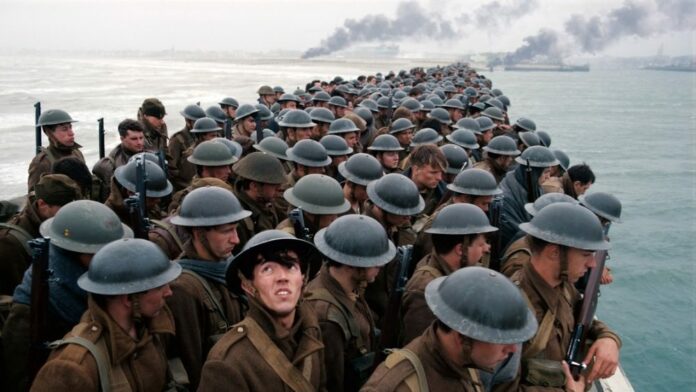
'Dunkirk'
LOS ANGELES — Toggling between Hollywood’s past sins and its changing future, the 90th Academy Awards confronted the post-Harvey Weinstein era in a ceremony punctuated by political moments and historic wins, including Netflix’s first feature-film award and the transgender drama “A Fantastic Woman” winning best foreign language film.

Christopher Nolan’s World War II epic “Dunkirk” led all nominees with three awards for its technical craft: editing, sound editing and sound design. But the early awards were spread around widely in a year lacking a clear front-runner.

Host Jimmy Kimmel got the Oscars underway Sunday at the Dolby Theatre in Los Angeles with an opening monologue that mixed Weinstein punchlines with earnest comments about reforming gender equality in Hollywood. And of course, Kimmel — returning to the scene of the flub — dove straight into material about last year’s infamous best-picture mix-up.

“I do want to mention, this year, when you hear your name called, don’t get up right away,” said Kimmel. “Give us a minute.”

But while Kimmel spent a few moments on the fiasco known as Envelopegate, he expended far more minutes frankly and soberly discussing the parade of sexual harassment allegations that have coursed through the movie business in the wake of the revelations regarding Weinstein. He also spoke straightforwardly about the industry’s poor record for female directors and equal pay.

“We can’t let bad behavior slide anymore,” said Kimmel. “The world is watching us.”

Gesturing to a giant statue on the stage, he praised Oscar, himself for keeping “his hands where you can see them” and for having “no penis at all.” But Kimmel introduced the broadcast as “a night for positivity,” and cited, among other things, the box-office sensation of “Black Panther.”

“I remember a time when the major studios didn’t believe a woman or a minority could open a super hero movie — and the reason I remember that time is because it was March of last year,” said Kimmel.

The night’s acting honors are considered fairly locked for nominees, and things began as expected. Two widely admired veterans won their first Oscars: Allison Janney (“I, Tonya”) took best supporting actress and Sam Rockwell (“Three Billboards Outside Ebbing, Missouri”) won best supporting actor.

“I did it all by myself,” deadpanned Janney, who added after a pause: “Nothing could be further from the truth.”

Rockwell dedicated his award to his late friend and fellow New York actor Philip Seymour Hoffman, who died in 2014. “For my buddy, Phil Hoffman,” said Rockwell, raising his Oscar.

Kimmel, with stopwatch in hand, also emphasized keeping acceptance speeches short. He promised the shortest speech would win a Jet Ski. Go long, and winners might get Lakeith Stansfield screaming “Get out!” as the actor briefly reprised his character from the Oscar-nominated “Get Out” on stage.

Early wins went to makeup that adorned Gary Oldman’s Winston Churchill in “Darkest Hour” and the period costume design of “Phantom Thread.” Guillermo del Toro’s monster fable “The Shape of Water,” which came in with a leading 13 nods, took best production design.

Best documentary went to Netflix’s “Icarus,” Bryan Fogel’s investigation into doping in sports, aided by the assistance of Grigory Rodchenkov, the head of the Russian anti-doping laboratory who candidly discussed the doping scheme under Vladimir Putin. It’s the first feature film Oscar for Netflix. Fogel dedicated the award to Rodchenkov, “our fearless whistleblower who now lives in grave danger.”

“At least now we know Putin didn’t rig this election,” said Kimmel after the “Icarus” win.

In another topical moment, Pakistan-born comedian Kumail Nanjiani joined Kenyan-born Lupita Nyong’o to salute the so-called Dreamers — immigrants brought to the U.S. illegally as children and here without permanent protection from deportation. “Dreams are the foundation of Hollywood and dreams are the foundation of America. And, so, to all the Dreamers out there, we stand with you,” Nanjiani said.

Later, Pixar’s colorful ode to Mexican culture “Coco” won best animated film. Best foreign language film went to Chile’s “A Fantastic Woman,” Sebastian Lelio’s drama starring transgender actress Daniela Vega.

“The biggest thank you of all to the people of Mexico,” said director Lee Unkrich to loud applause. “Marginalized people deserve to feel like they belong. Representation matters.”

The ceremony is the crescendo of one of Hollywood’s most turbulent awards seasons ever — one that saw cascading allegations of sexual harassment topple movie moguls, upended Oscar campaigns and new movements launched to improve gender equality throughout the industry.

No Golden Globes-style fashion protest was held by organizers of Time’s Up, the initiative begun by several hundred prominent women in entertainment to combat sexual harassment. Their goals go beyond red carpets, organizers said in the lead-up to the Oscars. “We did the dress code thing and now we’re doing the work,” said #MeToo founder Tarana Burke on the red carpet.

Yet the #MeToo movement is sure to have a prominent place in the awards. Greta Gerwig (“Lady Bird”) is just the fifth woman nominated for best director. Rachel Morrison “Mudbound” is the first woman nominated for best cinematography. Ashley Judd, the first big-name actress to go on the record with allegations of sexual misconduct against Weinstein, is among the scheduled presenters.

The parade of sexual harassment allegations has made the normal superficial red carpet a place of sometimes more serious discussion than attire. Scrutiny was falling Sunday on E! host Ryan Seacrest after his former stylist, Suzie Hardy, alleged sexual harassment against the red-carpet regular. Seacrest has denied it and E! has supported him. Best supporting actress Oscar nominee Mary J. Blige said Seacrest is “fighting for his life right now.”

It’s been an unusually lengthy — and often unpredictable — awards season, already an increasingly protracted horse race begun as most of the contenders bowed at film festivals last September. The Academy Awards were moved a week later this year because of the Olympics.

Twenty years ago, a “Titanic” sweep won record ratings for the Oscar broadcast. But ratings have recently been declining. Last year’s show drew 32.9 million viewers for ABC, a four percent drop from the prior year. Even more worrisome was a slide in the key demographic of adults aged 18-49, whose viewership was down 14 percent from 2016.

Movie attendance also hit a 24-year low in 2017. But this year is already off to a strong start, thanks largely to Ryan Coogler’s “Black Panther,” which many analysts believe will play a prominent role at next year’s Oscars. In three weeks, it has already grossed about $500 million domestically. The film’s star, Chadwick Boseman, was placed front-and-center, at the Dolby Theatre.

This year, the academy prohibited the PwC accountants who handle the envelopes from using cellphones or social media during the show. Neither of the PwC representatives involved in the mishap last year, Brian Cullinan or Martha Ruiz, will return to the show.

However, multiple reports say that Warren Beatty and Faye Dunaway will be returning to again present best picture, a year after they announced “La La Land” as the winner instead of “Moonlight,” because Cullinan handed them the wrong envelope. The “Bonnie and Clyde” duo will, 12 months later, get “take two.”

With just a few minutes before the show started, Kimmel and his team emerged from his dressing room chanting, “Let’s get it right this time!”

Story: Jake Coyle

Advertisement

Cardinal Pell Facing Australian Court on Sex Abuse Charges

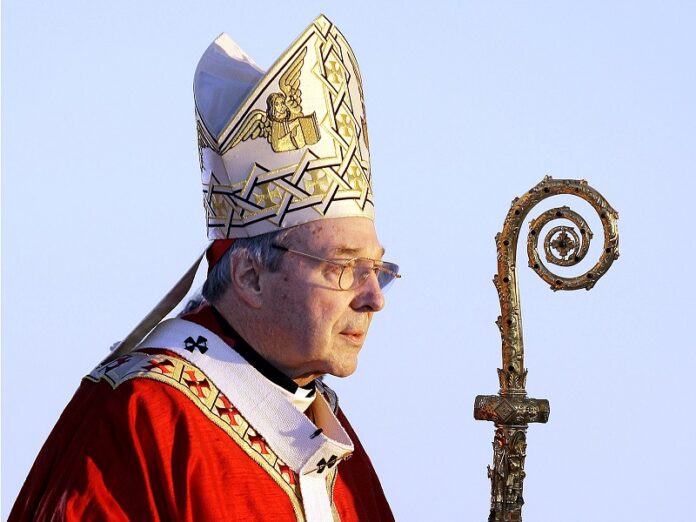
Cardinal George Pell walks onto the stage for the opening mass for World Youth Day in 2008 in Sydney, Australia. Photo: Rick Rycroft / Associated Press

MELBOURNE, Australia — Wearing his clerical collar, the most senior Vatican official ever charged in the Catholic Church sex abuse crisis appeared in an Australian court Monday for a hearing to determine whether prosecutors have sufficient evidence to put him on trial.

Australian Cardinal George Pell’s committal hearing in the Melbourne Magistrates Court before Magistrate Belinda Wallington is scheduled to take up to a month, with testimony of alleged victims to be suppressed from publication.

Pell arrived by car and was flanked by police and one of his lawyers, Paul Galbally, as he walked through a large group of media and into the court security screening area. He remained silent as he entered.

He emptied his pockets before walking through a security metal detector and a security guard frisked him in a routine procedure, patting down Pell’s light-colored coat, black shirt and black trousers. Pell indicated to the guard that had no objection to the examination.

Other security guards ensured the public kept their distance from the 76-year-old cleric in the foyers of the seven-floor downtown court house in Australia’s second-largest city where he was once archbishop.

Pope Francis’ former finance minister was charged in June of last year with sexually abusing multiple people in his Australian home state of Victoria. The details of the allegations against the cardinal have yet to be released to the public, though police have described the charges as “historical” sexual assault offenses – meaning the crimes that are alleged to have occurred decades ago.

Defense lawyer Robert Richter accused police who investigated Pell of failing to follow guidelines for investigating prominent people.

Richter told Wallington that a former judge had prepared a report on how police should investigate prominent people such as Pell.

“It is a guide to police about how to fairly investigate claims against prominent people,” Richter said.

“We say that was not followed because there was a presumption of guilt,” Richter added.

Richter also said police had 21 witness statements provided by the defense that were favorable to the cardinal.

“These documents are certainly relevant to the alleged offences,” Richter said.

“I know it doesn’t suit the prosecution because they are exculpatory of the cardinal,” he added.

The case places both the cardinal and the pope in potentially perilous territory. For Pell, the charges are a threat to his freedom, his reputation and his career. For Francis, they are a threat to his credibility, given that he famously promised a “zero tolerance” policy for sex abuse in the church. Advocates for abuse victims have long railed against Francis’ decision to appoint Pell to the high-ranking position in the first place.

When Pell was promoted in 2014, he was already facing allegations that he had mishandled cases of clergy abuse during his time as archbishop of Melbourne and, later, Sydney.

Pell has not yet entered a plea. But his lawyers have told the court that the cardinal plans to formally plead not guilty if he is ordered to stand trial.

One of the charges was withdrawn last week because the accuser had recently died.

Pell was silent throughout a 25-minute hearing that began with Prosecutor Mark Gibson amending dates and wording of charges.

The cardinal sat in the first of two rows of public seating behind his four lawyers in a cramped, wood-paneled courtroom in which reporters far outnumbered members of the public.

Gibson told Wallington that complainants would give evidence by a video link. Richter said he did not object to the complainants not attending court in person.

Their testimony beginning in the afternoon is not open to the public or media.

Richter told Wallington that given Pell’s age and medical condition, it was important that he be allowed to be accompanied in court by a supporter. Richter did not detail Pell’s health.

Richter told Wallington he understood the prosecution “has an objection to that support person being a priest, although I can’t understand that.”

But Gibson replied: “That’s not quite right.”

Pell’s lawyers told the court last month that the allegations stemmed from publicity surrounding a national inquiry into child abuse three years ago.

His lawyer, Ruth Shann, said the first complainant approached police in 2015, 40 years after the alleged crimes, in response to media reports about Australia’s Royal Commission into Institutional Responses to Child Sexual Abuse.

Australia’s longest-running royal commission – which is the country’s highest form of inquiry – had been investigating since 2012 how the Catholic Church and other institutions responded to sexual abuse of children in Australia over 90 years. The inquiry issued its final report in December.

Pell testified to the inquiry in a video link from the Vatican in 2016 about his time as a priest and bishop in Australia. He did not attend in person because of medical problems.

Shann said the first complaint set off a chain of events with others making allegations against Pell. None had previously complained to anyone, Shann said.

After years of alleged cover-ups and silence from the church over its pedophilia scandal, abuse survivors and their advocates have hailed the prosecution of Pell as a monumental shift in the way society is responding to the crisis.

So far, Francis has withheld judgment of Pell, saying he wants to wait for Australian justice to run its course. And he did not force the cardinal to resign. Pell said he intends to continue his work as a prefect of the church’s economy ministry once the case is resolved.

Story: Rod McGuirk

Advertisement

Oscars 2018: Cultural Powerhouse ‘Coco’ Wins Best Animation

Miguel Lafourcade, left, and Natalia Lafourcade perform "Remember Me" from "Coco" at the Oscars on Sunday, March 4, 2018, at the Dolby Theatre in Los Angeles. Photo: Chris Pizzello / Invision / AP)

LOS ANGELES — “Coco,” the tear-jerking adventure tale of a Mexican boy who learns the importance of honoring his ancestors after getting stuck in an eye-popping netherworld of the dead, won the Oscar for best animated feature on Sunday.

The Pixar film, one of the largest U.S. productions ever to feature an almost entirely Latino cast, struck a chord among audience members unaccustomed to seeing their culture so accurately and tenderly reflected on the big screen.

“With ‘Coco’ we tried to take a step forward toward a world where all children can grow up seeing characters in movies that look and talk and live like they do,” Director Lee Unkrich said during his acceptance speech. “Marginalized people deserve to feel like they belong. Representation matters.”

He said the biggest “thank you” goes to the people of Mexico for their “endlessly beautiful culture and traditions.”

Appropriately, the round of speeches ended with a message in Spanish from Anthony Gonzalez, who plays 12-year-old Miguel in the film.

“Muchisimas gracias a todos y que viva Mexico!” he said. In English, that means, “Many thanks to everyone and long live Mexico!”

“Coco” was widely considered the front-runner in the animation category, taking home a Golden Globe and sweeping the Annie Awards with 11 wins. For the Oscar, it beat out “Loving Vincent,” ”The Breadwinner,” ”Ferdinand,” and “Boss Baby.”

It also was a box-office smash, experiencing the fourth best Thanksgiving weekend ever with an estimated $72.9 million.

“Coco” tells the story of 12-year-old Miguel, whose dream of becoming a musician clashes with a family prohibition going back generations. After a confrontation with his family, Miguel becomes trapped in the Land of the Dead, where his long-dead ancestors help return him to the land of the living.

It’s been described as a love letter to Mexican culture and the holiday known as Day of the Dead, which honors relatives who have died.

The film’s vocal cast includes Gael Garcia Bernal, Benjamin Bratt, Edward James Olmos, Renee Victor and Cheech Marin.

“Coco” also was praised for its music. Earlier in the evening, Bernal, Miguel and Natalia Lafourcade sang the nominated “Remember Me” as traditional Mexican dancers surrounded them.

There was no mention in the acceptance speeches of Pixar co-founder John Lasseter, who is taking a “six-month sabbatical” after acknowledging “missteps” in his workplace behavior.

Story: Amanda Lee Myers

Advertisement

Roger Bannister, 1st to Run 1 Mile Under 4 Minutes, 88

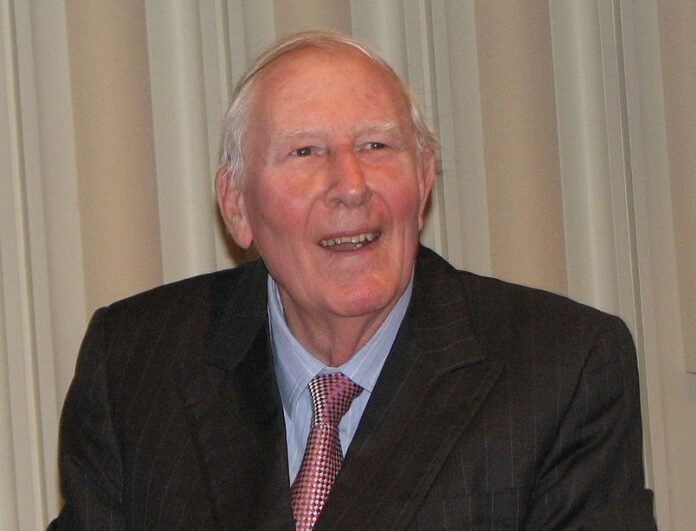
Roger Bannister in 2009. Photo: Pruneau / Wikimedia Commons

LONDON — Roger Bannister, who as a lanky medical student at Oxford in 1954 electrified the sports world and lifted postwar England’s spirits when he became the first athlete to run a mile in under 4 minutes, has died at 88.

Bannister died Saturday in Oxford, the city where he accomplished the feat many had thought impossible. He had been slowed in recent years by Parkinson’s disease and, before that, an ankle shattered in a 1975 auto accident.

On a typically cool, wet and blustery English day in May nearly 64 years ago, Bannister put on his spikes and ran four laps around a cinder track in 3 minutes, 59.4 seconds, for one of the defining sporting achievements of the 20th century.

The image of the young Bannister – head tilted back, eyes closed and mouth agape as he strained across the finishing tape – captured the public’s imagination, made him a global celebrity and boosted the morale of Britons still suffering through austerity measures.

Bannister soon retired from competition and went on to a long and distinguished career in medicine, and his mark was broken over and over again, with the world record for the mile now at 3:43.13. But he was a national hero to the end.

Prime Minister Theresa May saluted Bannister as a “British sporting icon whose achievements were an inspiration to us all.”

While he will forever be remembered for his running, Bannister said he considered his contributions to neurology more satisfying.

“I wouldn’t claim to have made any great discoveries, but at any rate I satisfactorily inched forward in our knowledge of a particular aspect of medicine,” he said. “I’m far more content with that than I am about any of the running I did earlier.”

Olympic gold medalist Sebastian Coe, president of the IAAF, the international sports governing body, said Bannister’s death was a “day of intense sadness both for our nation and for all of us in athletics.”

“There is not a single athlete of my generation who was not inspired by Roger and his achievements both on and off the track,” Coe tweeted.

On the day he made history, May 6, 1954, Bannister looked up at the white-and-red English flag whipping in the wind atop a church and figured he would have to call off the attempt. But then, shortly after 6 p.m., the wind subsided, and the race was on.

With two friends running with him as pacesetters, Bannister churned around Oxford’s Iffley Road track, his long arms and legs pumping, his lungs gasping for air. He put on a furious kick over the final 300 yards and nearly collapsed as he crossed the finish line.

The announcer read out the time:

“3…”

The rest was drowned out by the roar of the crowd. The 3 was all that mattered.

Bannister followed up his milestone a few months later by beating Australia’s John Landy in the “Miracle Mile” or “Mile of the Century” at the Empire Games in Vancouver, British Columbia, with both men clocked at under 4 minutes. Bannister regarded that as his greatest race because it came against his fiercest rival.

“It’s amazing that more people have climbed Mount Everest than have broken the 4-minute mile,” Bannister said in an interview with The Associated Press in 2012.

Bannister was born on March 23, 1929, in the London borough of Harrow. At the outbreak of World War II, the family moved to the city of Bath, where Bannister sometimes ran to and from school.

His passion for running took off in 1945 when his father took him to a track meet at London’s White City Stadium, built to host the 1908 Olympics. He resolved to take up running seriously at Oxford.

At the 1952 Helsinki Games, Bannister was considered the favorite for the gold in the 1,500 meters – the shorter metric-mile distance run in the Olympics. But the organizers added an extra round of heats, meaning he would have to run on three consecutive days. With his rhythm thrown off, Bannister finished fourth.

Criticized by the British press and disappointed in his own performance, he decided to keep running, dedicating himself to beating the 4-minute mile.

At the time, Bannister was a full-time medical student and had to juggle his studies with his training. By modern standards, his daily half-hour workout was remarkably light.

Sweden’s Gunder Hagg came tantalizingly close to breaking the 4-minute mile in 1945, when he ran 4:01.4. But time and again, runners came up short. Hagg’s record was still the time to beat nine years later.

Bannister was undaunted.

“There was no logic in my mind that if you can run a mile in 4 minutes, 1 and 2/5ths, you can’t run it in 3:59,” he said. “I knew enough medicine and physiology to know it wasn’t a physical barrier, but I think it had become a psychological barrier.”

Bannister, Landy and American miler Wes Santee were all threatening to break the mark.

“As it became clear that somebody was going to do it, I felt that I would prefer it to be me,” Bannister said.

He also wanted to deliver something special for his country.

“I thought it would be right for Britain to try to get this,” he said in 2012. “There was a feeling of patriotism. Our new queen had been crowned the year before, Everest had been climbed in 1953.”

The record lasted just 46 days. Landy ran 3:57.9.

The current record has been held by Morocco’s Hicham El Guerrouj since 1999.

Bannister was chosen Sports Illustrated’s first Sportsman of the Year in 1954.

Later, as chairman of Britain’s Sports Council from 1971 to 1974, he developed the first test for anabolic steroids. In 2012, he edited the ninth edition of a textbook on nervous-system disease.

He said his most treasured trophy was the lifetime achievement award he received in 2005 from the American Academy of Neurology. He was knighted for his medical work in 1975.

Late in life, he walked with crutches inside his home and used a wheelchair outdoors.

Bannister married Moyra Jacobsson, an artist, in 1955. They had two sons and two daughters and lived in a modest home minutes from the track where he made history.

Story: Chris Lehourites

Advertisement

Go Russian Into Pattaya in Debut of Khaosod English The Show

Follow editor Todd Ruiz and reporter Teeranai Charuvastra into the mean streets of Pattaya, Thailand, as they search for Russians arrested for conducting “advanced sex training” in the city.

There, in a coastal enclave infamous for vice, endemic corruption and transnational crime, they also claimed to have dirt on powerful Russian figures suspected of roles in interfering in the 2016 US election, not to mention evidence that would “bring down” Donald Trump.

Go behind the headlines in a riveting and entertaining account of the reporting that went into our recent stories in the debut episode of Khaosod English: The Show.

You can listen by several ways below or download it in MP3 format.


Related stories:

Pattaya Cops Crash Sex Class by Russian ‘Sex Guru’ and ‘Oligarch Hunter’

Khaosod English Exclusive: Russians in Thai Jail Offer Secrets on Trump Election For US Asylum

Read Letter Offering Evidence of Russian Meddling Just Delivered to US Embassy

Russians Offering US Election Secrets For American Protection Moved to Bangkok

Advertisement

How Video Review in Soccer Could Operate at the World Cup

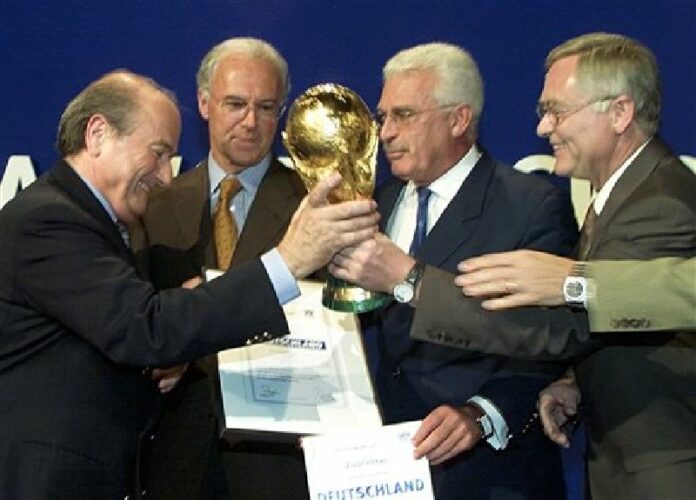
In this July 6, 2000, file photo, FIFA President Sepp Blatter, left, hands over a copy of the soccer World Cup trophy to the German bid team, Franz Beckenbauer, second from left, Fedor Radmann, second from right, and Horst R. Schmidt, right, after FIFA announced that Germany will host the soccer World Cup 2006, in Zurich, Switzerland. Photo: Michel Euler / Associated Press

ZURICH — Video review is going to help referees at the World Cup, bringing soccer’s biggest event into line with U.S. pro sports.

FIFA’s rule-making panel voted on Saturday to update the game’s 155-year-old laws and allow for video assistant referees (VAR).

It clears FIFA to adopt VAR for the World Cup in Russia at a meeting of its ruling council on March 16.

Trials in competitions worldwide, including top European leagues in Germany and Italy, have provoked controversies.

Reviews have been slower than promised – sometimes lasting minutes – and communication inside stadiums is often confusing.

Still, FIFA President Gianni Infantino believes soccer cannot ignore a chance to make more accurate decisions.

Here are some things to know about soccer’s embrace of high-tech help for referees:


When Can it Be Used? 

To correct “clear and obvious errors” and “serious missed incidents.”

This means incidents involving goals scored, the award of penalty kicks, red cards, and cases of referees showing cards to the wrong player.

FIFA focused on these four potential game-changing situations before live trials began in 2016.

The rules panel, known as IFAB, clarified the phrase “serious missed incidents” introduced on Saturday typically refers to violent off-the-ball clashes that were always open to review.


How Does a Review Happen? 

There is two-way communication between the referee on the field and the VAR, who is also a qualified referee and watches play in real-time and replays on a bank of television screens.

Referees can discreetly ask for an opinion, and a VAR can offer advice. Players, coaches and fans need not know an incident is being checked.

If an incident is formally reviewed, the referee should signal it on the field making the sign of a TV screen with his hands.

FIFA wants referees to let a phase of play continue before stopping the action for review.

If an offside is suspected, referee assistants are advised to delay raising their flag and let play unfold. A goal that stems from an offside position can be overruled, but a promising attack is lost if it was wrongly halted too soon.

The natural breaks in play after a goal is scored, a penalty kick is awarded, or a red card is shown, all allow VAR time to review the action.

Who Decides? 

FIFA and IFAB insist the referee on the field has ultimate authority which should not be compromised.

Therefore, the referee must have access to a TV screen near the touchline to personally review an incident.

This way, players will respect the referee for controlling his decision, FIFA refereeing chairman Pierluigi Collina said on Saturday.


More Accuracy

FIFA says research from around 1,000 games in live trials shows that accuracy of decisions improved – from around 93 percent to 98.8 percent.

VAR has not entirely eliminated clear errors. However, FIFA-appointed researchers say they happen once in every 19 games instead of in every third game.


Communicating Decisions

Infantino acknowledged VAR “is not perfect” yet and a final protocol detailing how it should operate has not been published.

Communication between referees and teams, and to fans in stadiums, has been a problem in trials. Fans have often not known why reviews are called for, nor why they take so long.

Frustration has built because the flow of soccer also does not lend itself to review stoppages, nor can referees broadcast their decision.

FIFA knows it must give World Cup teams, fans and broadcasters more information.

However, it does not mean replaying incidents on stadium big screens during a review.

Instead, FIFA is working to publish messages quickly on the screens, technology innovations director Johannes Holzmueller said.

Only after the referee takes a final decision will a selected replay be broadcast in the stadium.


Technology Suppliers

FIFA expects to sign contracts by mid-May with technology providers equipping the overall VAR system.

A control center for specialist VAR teams needs to be fitted out with hardware in Moscow, at the same base where international broadcasters will run their World Cup operations.

Holzmueller said a back-up room needs to be equipped at each of the 12 stadiums across Russia.

Around 15 companies have worked with FIFA in trials. A strong contender is the Hawk-Eye system from Britain widely used in tennis’ and soccer’s goal-line technology.

A separate contract will oversee communications directly linking referees to VARs. Software deals could focus on a specific detail such as on-screen graphics to calibrating the offside line.

Story: Graham Dunbar

Advertisement

Voranai: Friends of General Prayuth

Junta leader Prayuth Chan-ocha is the aorta nourishing a heart comprised of faces from across the red-yellow political divide in T-shirts worn by members of the newly registered Phure Chart Thai Party, which extols national reconciliation as its main objective.

Voranai Vanijaka

Key members of the Pheu Thai Party visited Thaksin Shinawatra in Singapore, and perhaps also elsewhere. These weren’t just friendly calls by old-time pals; there was a political motive behind it. The general election is coming – later rather than sooner – but it’s coming.

Suthep Thaugsuban may be setting up a political party to support General Prayuth Chan-ocha, or perhaps he’s not. Speculation is still up in the air, and the former leader of the protest – which brought in the tanks to oust the Yingluck Shinawatra government in the 2014 military coup d’etat – is playing coy.

But rest assured, there’s nothing the junta leader – who recently told the kingdom he was no longer a military man but now a politician – would love more than to win the election. Not even a couple more Chinese submarines could match this appetite.

The game has begun and team leaders are picking their players. Sweet talk. Promises of cabinet posts. Appeals to loyalty. Downright coercion. Whatever it takes. Get the key political players on your side.

Thaksin has to keep what Gen. Prayuth aims to take, namely; the game-changing political players under his patronage. Unlike his initial ascent to power, the general doesn’t want to use tanks but members of parliament. If the general election is pushed back, then it’s only because the general has yet to secure enough MPs.

Again, even though the new constitution almost guarantees the prime minister will be handpicked, it’s so much better to actually win votes. Democratic legitimacy, even if ill-gotten, is still something everyone wants. Even North Korea calls itself the Democratic People’s Republic of Korea.

It’s a game that has been played before.

Crucial to ushering the Democrat Party of Abhisit Vejjajiva into power in December 2008 was a group called Friends of Newin. Newin Chidchob was a powerful politician with over 30 members of the House of Representatives under his patronage. Formerly, he was one of Thaksin’s main political allies.

Following the dissolution of Thaksin’s People’s Power Party in 2008, which saw many of its executives banned from politics, Newin’s group broke ranks and threw their lot in with the Democrats. In doing so, high-ranking group members won ministerial positions within the Democrat-led coalition government. As well, other smaller factions also splintered off, giving the Democrats the numbers needed to form a government.

Just setting up a political party to support Gen. Prayuth isn’t going to win an election, not unless tanks are parked at the voting booths. To win any election, one must first and foremost win the favor of key political players. To win the Thai election, one must win the loyalty of regional strongmen in the north and northeast of the country. To win these bigwigs over, one must take them from Thaksin.

There are three reasons to enter politics, in no particular order. First is the sincere desire to serve the country and its people. Second is pride and the third is greed, two of man’s three favorite deadly sins, the fourth being lust, but this is also in no particular order. Now, if you dear readers have managed to stop laughing at the first reason for entering politics, we shall lock it in a drawer. Perhaps there are such politicians, but they are too few and far in between.

That leaves us with pride and greed. Neither of which can be satisfied without becoming part of the ruling government. To wear that white uniform, styled after 19th century European military fashion, in this tropical, global-warming frying pan where the sun feels like a whip on bare skin.

To have people kowtowing all around, calling you “your excellency.” To have your chauffeured super car led by a police motorcade. To put your signature to public sector projects and grant concessions to families, friends and business partners.

It’s an offer most difficult to refuse. The question for political players then becomes, who’s most likely to make dreams come true in February 2019 (or maybe later), Thaksin or Gen. Prayuth?

Whose friend would you want to be?

Advertisement

Hunt for Missing Malaysian Plane Likely to End in June

A girl has her face painted during the Day of Remembrance for MH370 event in Kuala Lumpur, Malaysia, Saturday, March 3, 2018. The remembrance event marked the fourth anniversary of the jet's March 8, 2014, disappearance. (AP Photo/Vincent Thian)

KUALA LUMPUR — The search for Malaysia Airlines Flight 370 by a U.S. company will likely end in June, a Malaysian official said, as families of passengers marked the fourth anniversary of the plane’s disappearance with renewed hope that the world’s biggest aviation mystery will be solved.

Malaysia inked a “no cure, no fee” deal with Houston, Texas-based Ocean Infinity in January to resume the hunt for the plane, a year after the official search in the southern Indian Ocean by Malaysia, Australia and China was called off.

Ocean Infinity started the search on Jan. 22 and has 90 search days to look for the plane. Malaysia’s civil aviation chief, Azharuddin Abdul Rahman, said the 90-day term will spread over a few months because the search vessel has to refuel in Australia and bad weather could be a factor.

Azharuddin said Saturday the search is going smoothly and is expected to end by mid-June.

“The whole world, including the next of kin, have (new) hope to find the plane for closure,” he told reporters at a remembrance event at a shopping mall near Kuala Lumpur. “For the aviation world, we want to know what exactly happened to the plane.”

Officials have said there was an 85 percent chance of finding the debris in a new 25,000-square-kilometer (9,650-square-mile) search area — roughly the size of Vermont — identified by experts.

If the mission is successful within three months, payment will be made based on the size of the area searched. Malaysia says it will pay Ocean Infinity $20 million for 5,000 square kilometers (1,930 square miles) of a successful search, $30 million for 15,000 square kilometers (5,790 square miles), $50 million for 25,000 square kilometers (9,653 square miles) and $70 million if the plane or flight recorders are found beyond the identified area.

The plane vanished March 8, 2014, while flying from Kuala Lumpur to Beijing with 239 people on board.

The official search was extremely difficult because no transmissions were received from the aircraft after its first 38 minutes of flight. Systems designed to automatically transmit the flight’s position failed to work after this point, according to a final report issued in January 2017 by the Australian Transport Safety Board.

Family members lit candles on a stage Saturday and observed a moment of silence during the three-hour event. Most are split over whether the search will be fruitful.

“It doesn’t renew (any hope) because I also have to be realistic. It has been four years,” said Intan Maizura Othman, whose husband was a flight attendant on the plane. She was pregnant when the plane disappeared and attended the event with her now 4-year-old son.

Jiang Hui of China, whose mother was on board the plane, said that he was grateful for Ocean Infinity’s courage to mount the search, but that he hopes it will not be the end if the mission fails. He proposed for a public fund to be set up to continue the search.

“Without a search, there will be no truth,” Jiang said.

Story: Eileen Ng

Advertisement

Hot News

LATEST NEWS

Bangkok
overcast clouds
30.5 ° C
30.5 °
30.5 °
99 %
3.5kmh
100 %
Tue
31 °
Wed
34 °
Thu
34 °
Fri
36 °
Sat
36 °