
























32.3 C
Bangkok
Monday, June 8, 2026
Home Blog Page 2496

Turkey Blasts Claimed by Kurdish Militants; Country Mourns

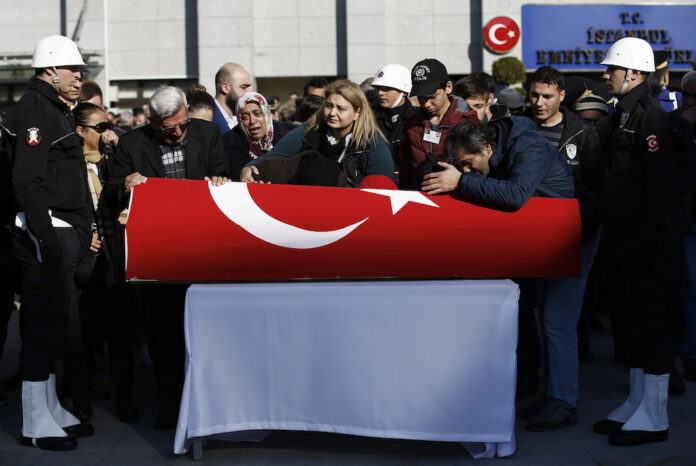
Family members mourn as ministers and colleagues attend a memorial for police officers killed outside the Besiktas football club stadium late Saturday, in Istanbul. Photo: Emrah Gurel / AP.

ISTANBUL — Turkey declared a national day of mourning and paid tribute to the dead Sunday after two bombings in Istanbul killed 38 people and wounded 155 others near a soccer stadium. The carnage was claimed by a Turkey-based Kurdish militant group.

The Kurdistan Freedom Falcons, or TAK, said two of its members had sacrificed their lives in the Saturday night attack that targeted security forces outside the Besiktas stadium shortly after the conclusion of a match.

“Two of our comrades were heroically martyred in the attack,” according to a statement posted on TAK’s website.

It described the blasts as reprisal for state violence in the southeast and the ongoing imprisonment of Abdullah Ocalan, the leader of the Kurdistan Workers’ Party, or PKK. TAK is considered by authorities as a PKK offshoot.

The twin car-and-suicide bombings near the stadium enraged top officials, including President Recep Tayyip Erdogan, who vowed to hunt down the perpetrators. The attack was the latest large-scale assault to traumatize a nation confronting an array of security threats.

Turkey is a NATO member and a partner in the U.S.-led war against the Islamic State group.

The attack targeted police officers, killing 30 of them along with seven civilians and an unidentified person, Turkish Interior Minister Suleyman Soylu told reporters. He said 13 people had been arrested in connection with the “terrorist” act.

In an address at a funeral for the slain police officers before TAK’s statement was released, a furious Soylu condemned Kurdish rebels and their allies in the West, referring to the PKK as “animals.”

“Have you accomplished anything beyond being the servants, pawns and hit men of certain dark forces, of your dark Western partners?” he asked.

Turkish officials didn’t make any further comments after the TAK claim of responsibility was posted.

The battle between the PKK and the Turkish state has resulted in the deaths of tens of thousands of citizens. Turkish officials frequently accuse the West of supporting the Kurdish insurgency and of interfering in Ankara’s fight against the militants.

Erdogan vowed his country would fight “the curse of terrorism till the end” after paying a visit to some of the wounded at Haseki Hospital in Istanbul.

Hundreds of flag-carrying demonstrators marched along Istanbul’s coastline toward the stadium at the heart of the blast area. Flags flew at half-staff across the country and at Turkey’s foreign missions. Passers-by placed flowers on barriers surrounding the soccer stadium.

The first and larger explosion took place about 10:30 p.m. Saturday after Besiktas beat Bursaspor 2-1 in the Turkish Super League. Erdogan said the attack’s timing aimed to maximize the loss of life, but most fans had left before the detonation.

Soylu said the first blast was caused by a passing vehicle that detonated in an area where police special forces were located at the stadium exit. A riot police bus appears to have been the target. Moments later, a person who had been stopped in nearby Macka Park committed suicide by triggering explosives, according to the minister.

He said 136 people remained hospitalized Sunday after the attack, including 14 in intensive care.

TAK claimed the Turkish people weren’t their target but warned “no one should expect a comfortable life” as long as the ruling party “continues to torture the mothers of Kurdistan every day.”

Armed conflict between the Turkish state and Kurdish militants resumed in July 2015 after peace talks unraveled. While much of the violence has concentrated in the impoverished and pre-dominantly Kurdish southeast, it has also spread to other cities, including the capital, Ankara, where TAK has claimed February and March suicide bombings.

Experts have determined that up to 400 kilograms (880 pounds) of explosives were used in the car bomb, Deputy Prime Minister Numan Kurtulmus told CNN Turk.

To the mournful sound of trumpets, funeral services were held at Istanbul’s police headquarters for some of the slain officers. Their comrades solemnly carried the coffins, which were draped in the Turkish flag, as a sea of mourners wept around them.

Erdogan presided over a security meeting after the funeral ceremony and hospital visit.

Soccer fans proved their resilience by showing up to watch a game pitting Istanbul’s Galatasaray and Gaziantepspor at a different stadium.

“What happened last night was extremely saddening but they need to know that Turkish people will not yield to such things,” Galatasaray supporter Erkan Duman told The Associated Press. “It’s not like we will give up things, especially things we love, just because they want us to.”

Turkey has witnessed a spate of IS and Kurdish-linked attacks this year. Saturday’s bombings were one of the bloodiest to hit Istanbul, a city at the crossroads of Europe and Asia, until recently a popular tourist destination.

That changed after a series of IS-linked suicide bombings targeting tourists, including a sophisticated attack on the city’s Ataturk Airport in June that killed 44 people and wounded scores of others. PKK-linked militants have claimed other deadly attacks in Ankara, Istanbul and areas in southeast Turkey.

A state of emergency is in force following a failed July 15 coup attempt and the resulting government crackdown on alleged coup sympathizers has landed thousands in jail and forced tens of thousands of people from their jobs. Critics call the move a witch hunt.

Story: Dominique Soguel
Advertisement

Panel Puzzles Over Thailand’s 84-Year Split Between Dictatorship, Democracy

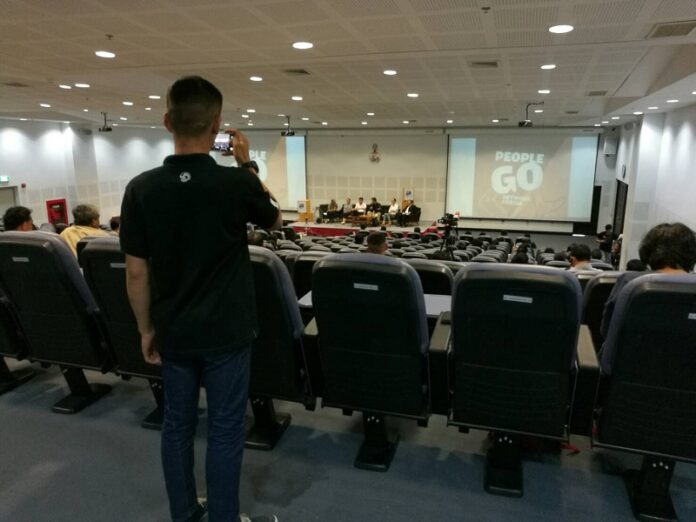
An unidentified man photographs audience members throughout a discussion of Thailand's uneasy relationship with democracy on Saturday at Chulalongkorn University in Bangkok.

BANGKOK Since 1932, when Thailand officially entered the company of democratic nations, its citizens have spent more years living under dictators than democracy.

That was a reminder shared by Bundit Chanrojanakit, a Ramkhamhaeng University political science professor at a panel discussion on Thailand’s search for democracy Saturday at Chulalongkorn University.

Organized by the Internet Law Reform Dialogue, or iLaw, the panel held as part of a broader conference on social issues this weekend drew about 70 people to hear speakers take turns defending the virtues of a democratic system and examining its shortfalls in Thailand.

Read: Censorship is Acceptable Compromise at Chula Conference on Social Issues

As it proceeded, a man took pictures of the crowd from different angles. When it came time for questions and comments at the end, the moderator asked if he should turn off the Facebook Live stream so participants could speak freely.

It was arranged in place of a more pointed panel organized by a student pro-democracy group to dissect the constitution pushed through earlier this year by the military regime. That session, planned by the New Democracy Movement, was canceled under pressure by the authorities.

Chulalongkorn University historian Suthachai Yimprasert said democracy is the least evil of systems because people can disagree and find solutions together. He said dictatorship also has a mechanism to solve conflicts, but it is based on coercion.

He added that some Thais say electoral democracy is “four-second democracy,” because voters only have power in that fleeting span of time when casting a ballot, because power shifts into the hands of elected politicians afterward.

“This is still better than not even having a second of democracy,” Suthachai told the audience.

Chiang Mai University law lecturer Somchai Preechasilpakul made a specific reference to junta-leader-cum-premier Gen. Prayuth Chan-ocha, saying no democratic regime would point a finger and order people to do various things such as exercise.

Somchai was making reference to Prayuth’s recent pet project of “Workout Wednesdays” for government officials, which has carried over into public events where he has instructed crowds to spontaneously exercise.

Human rights around the world, such as the U.S. Civil Rights Movement which improved the status of black Americans, have only advanced under democratic systems, according to Pongkwan Swasdipakdi of Thammasat University.

Pongkwan, a lecturer in Thammasat’s political science department, added that Thais should think about why some support military coups and see them as legitimate.

Yuthaporn Isarachai, vice rector of Sukhothai Thammathirat Open University said the fact some still doubt if Thailand is suited for democracy means the nation must do more to deepen its democratic roots.

Advertisement

Bombing at Egypt’s Coptic Christian Cathedral Kills 25

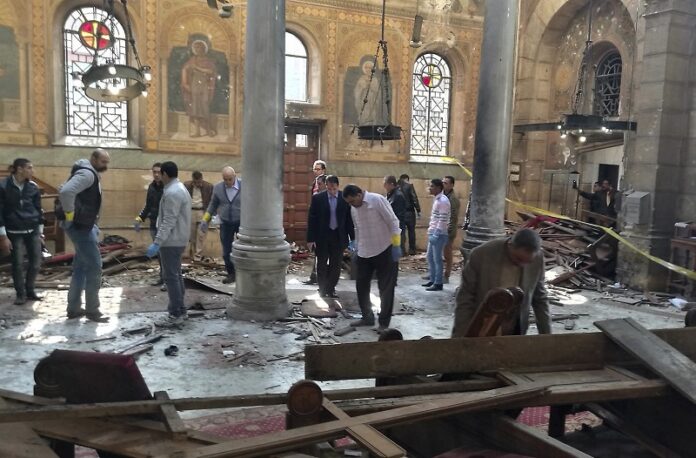
Egyptian security forces examine the scene inside St. Mark Cathedral in central Cairo, following a bombing on Sunday. Photo: Omar El-Hady / Associated Press

CAIRO — A bombing at a chapel adjacent to Egypt’s main Coptic Christian cathedral killed 25 people and wounded another 49 during Sunday mass, in one of the deadliest attacks carried out against the religious minority in recent memory.

The attack came two days after a bomb elsewhere in Cairo killed six policemen, an assault claimed by a shadowy group that authorities say is linked to the outlawed Muslim Brotherhood. Islamic militants have targeted Christians in the past, including a New Year’s Day bombing at a church in the Mediterranean city of Alexandria in 2011 that killed at least 21 people.

Egypt’s official MENA news agency said an assailant lobbed a bomb into a chapel close to the outer wall of St Mark’s Cathedral, seat of Egypt’s Orthodox Christian church and home to the office of its spiritual leader, Pope Tawadros II, who is currently visiting Greece.

Egyptian state TV and the Health Ministry gave the casualty toll.

Witnesses said the explosion may have been caused by an explosive device planted inside the chapel. Conflicting accounts are common in the immediate aftermath of attacks.

The blast took place as a Sunday mass being held in the chapel was about to end and coincided with a national holiday in Egypt marking the birth of Islam’s Prophet Muhammad. Most of the victims are thought to be women and children.

State television aired calls by several Cairo hospitals for blood donations.

An Associated Press reporter who arrived at the scene shortly after the blast saw blood-stained pews and shards of glass scattered across the chapel’s floor. Men and women wailed and cried outside. AP photos showed a broken pair of ladies’ spectacles on the ground next to a girl’s boots with leopard spots and a pink ribbon.

“I found bodies, many of them women, lying on the pews. It was a horrible scene,” said cathedral worker Attiya Mahrous, who rushed to the chapel after he heard the blast. His clothes and hands were stained with blood and his hair matted with dust.

“I saw a headless woman being carried away,” Mariam Shenouda said as she pounded her chest in grief. “Everyone was in a state of shock. We were scooping up people’s flesh off the floor,” she said.

“There were children. What have they done to deserve this? I wish I had died with them instead of seeing these scenes,” she added.

There was no immediate claim of responsibility for Sunday’s attack, which has drawn a flurry of condemnations by government and religious leaders as well as assertions of unity between Egypt’s Muslim majority and Christians, who account for about 10 percent of the country’s 92 million people. A crowd of several hundreds gathered outside the cathedral to condemn the attack, as scores of policemen sealed off the area.

Egypt has seen a wave of attacks by Islamic militants since the military overthrew President Mohammed Morsi, a freely elected leader who hailed from the Brotherhood, in 2013. Many of Morsi’s supporters blamed Christians for supporting the overthrow, and scores of churches and other Christian-owned properties in southern Egypt were ransacked that year.

The authorities have since 2013 waged a sweeping crackdown, jailing thousands of mostly Islamist dissidents and killing hundreds in clashes sparked by demonstrations.

Egypt’s Christians have long complained of discrimination in Egypt, contending they are denied top jobs in a wide range of fields, including academia and security apparatuses. Many Christians were relieved when Morsi and his Muslim Brotherhood were ousted in 2013 after just one year in power.

The church and many Christians have since rallied behind el-Sissi, although there have been growing voices of dissent within the community, arguing that little has changed in their lives under his rule, with their churches and property frequently attacked or torched by mobs of villagers led by militants in provinces south of Cairo.

Story: Mariam Fam, Hamza Hendawi

Advertisement

Twin Blasts Near Istanbul Stadium Kill 29, Wound 166

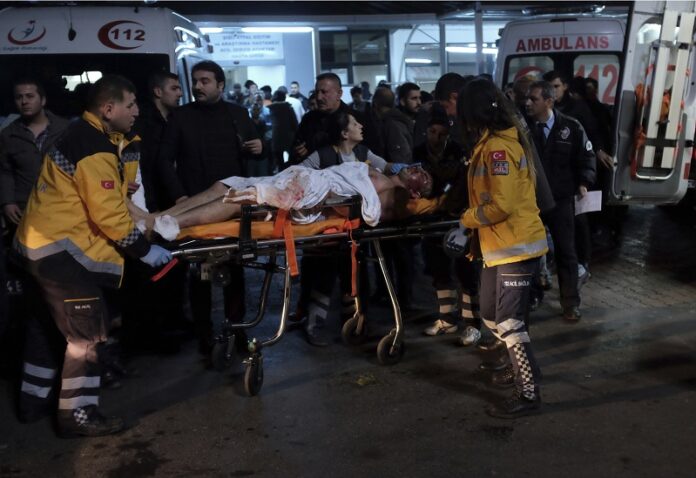
Rescue and medics carry a wounded person after attacks in Istanbul, late Saturday. Photo: Cansu Alkaya / Associated Press

ISTANBUL — Twin attacks by a suicide bomber and a car bomber near an Istanbul soccer stadium Saturday night killed 29 people and wounded 166 others in the latest large-scale assault to traumatize a nation confronting an array of security threats.

The bombs targeted police officers, killing 27 of them along with two civilians, Turkey’s Interior Minister Suleyman Soylu told reporters early Sunday. He added that 10 people had been arrested in connection with the “terrorist attack.”

The civilian death toll was lower because fans had already left the newly built Vodafone Arena Stadium after the soccer match when the blasts occurred. Witnesses also heard gunfire after the explosions.

“We have once again witnessed tonight in Istanbul the ugly face of terror which tramples on every value and decency,” Turkish President Recep Tayyip Erdogan said in a statement.

The first bomb went off just outside the facility known popularly as Besiktas Stadium after the local team and neighborhood. The second blast that came moments later was attributed by authorities to a suicide bomber.

Police cordoned off the area as smoke rose from behind the stadium and ambulances began ferrying the wounded to hospitals. Glass from the blown-out windows of nearby buildings littered the pavement.

There was no immediate claim of responsibility. This year, Istanbul has witnessed a spate of attacks attributed by authorities to the Islamic State group or claimed by Kurdish militants. A state of emergency is in force following a failed July 15 coup attempt.

Soylu acknowledged the country was struggling against “many elements” trying to compromise its fight against terrorism.

Turkey is a partner in the U.S.-led coalition against the Islamic State and its armed forces are active in neighboring Syria and Iraq. It is also facing a renewed conflict with an outlawed Kurdish movement in the southeast.

Ned Price, a spokesman for the White House National Security Council, said Washington condemns the attack in “the strongest terms.”

“We stand together with Turkey, our NATO Ally, against all terrorists who threaten Turkey, the United States, and global peace and stability,” Price said in a statement.

A taxi driver at the site of the Istanbul bombings said their force made him hit his head on the taximeter and that his ears were still ringing from the blasts and screaming that followed.

“Amid the screams I heard an officer saying ‘do not shout! Do not make them (the perpetrators) be satisfied,” said Ismail Coskun.

The first and larger explosion took place about 7:30 p.m. GMT after the home team Besiktas beat visitor Bursaspor 2-1 in the Turkish Super League. Erdogan said the timing of the attack aimed to maximize the loss of life and vowed the nation would overcome terrorism.

Soylu said the first explosion was caused by a passing vehicle that detonated in an area where police special forces were located at the stadium exit right after the match. A riot police bus appears to have been the target.

Kurdish militants often target security forces while Islamic State-linked attacks have targeted tourists and the broader public.

Deputy Prime Minister Numan Kurtulmus said a person who had been stopped in the nearby Macka Park committed suicide by triggering explosives.

Investigators, including Istanbul Police Chief Mustafa Caliskan, were quickly on the scene. Forensic experts in white uniforms scoured the vicinity of the stadium and the vast park where the suicide bombing took place.

The Besiktas sports club “strongly condemned” the attack and said an employee of one of its stores was among the fatalities, as well as a member of its congress who was also responsible for security at the stadium.

Bursaspor reported that none of the wounded were fans and issued a statement wishing “a speedy recovery to our wounded citizens.”

Health Minister Recep Akdag said six of the wounded remained in intensive care, with three of them in critical condition.

Aleksander Ceferin, president of European soccer’s governing body UEFA, and European Union Enlargement Commissioner Johannes Hahn, also made statements condemning the attack.

“Violence has no place in a democratic society,” Hahn wrote on Twitter.

EU foreign policy chief Federica Mogherini expressed the bloc’s “solidarity with Turkish citizens'”

The U.S. Consulate General in Istanbul, meanwhile, urged its citizens to avoid the area which is also home to a Ritz Carlton hotel.

Turkey’s radio and television board issued a temporary coverage ban citing national security concerns. It said “to avoid broadcasts that can result in public fear, panic or chaos, or that will serve the aims of terrorist organizations.”

Story: Dominque Soguel, Cinar Kiper, Ayse Wieting and Mehmet Guzel, Rob Harris

Advertisement

Censorship is Acceptable Compromise at Chula Conference on Social Issues

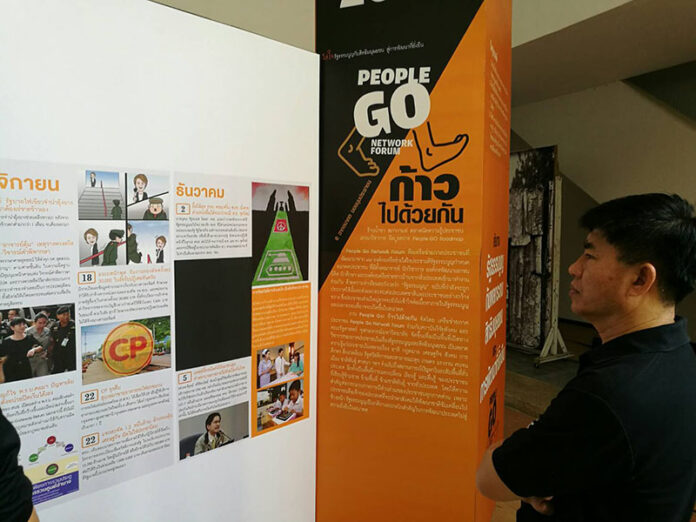
Black paper covers portions of informational displays at a conference on social issues Saturday at Chulalongkorn University in Bangkok.

BANGKOK — On Constitution Day, a two-day conference and workshops on social issues went ahead Saturday with one notable exception: a panel on politics and democracy.

Hosted by Chulalongkorn University’s Faculty of Political Science, which was pressured to drop the panel in question, 109 organizations participated in the People Go Network Forum, which otherwise went ahead as planned, though black paper was used covering portions of an informational display about lese majeste prosecutions.

Siriphorn Chaiphet of the Thai Volunteer Service Foundation said she was content most activities were allowed to proceed by the military regime and university, despite the last-minute cancelation of the panel under pressure from the university and authorities.

“We take a long-term view,” she said at Saturday’s conference, which addressed issues including politics, economics, education and the environment. “The struggle will continue for much longer.

It was the first semi-political event held since a year of national mourning was declared upon the death of His Majesty the Late King Bhumibol in October.

Siriphon said there’s an urgent need to rally rural residents of different political alignments to fight on issues such as adverse impacts by the mining industry and more.

She said the military called the organizer Friday night asking for further details about the event.

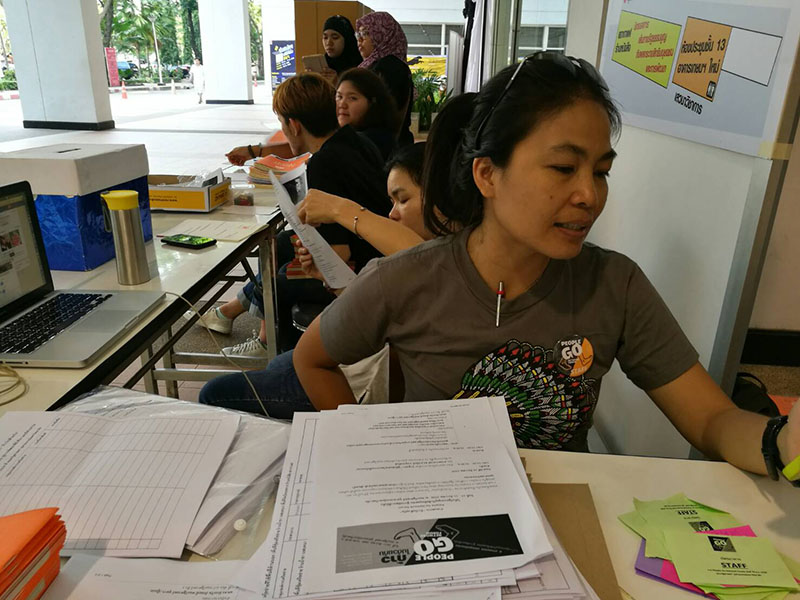
Siriphorn Chaiphet of the Thai Volunteer Service Foundation registers visitors to the People Go Network Forum on Saturday at Chulalongkorn University in Bangkok.

Of the canceled event organized by a student pro-democracy group opposed to military rule, she said compromise was inevitable.

“We can’t do much under the circumstances. But the Faculty of Political Science has at least provided a space for civil society,” Siriphorn said.

Members of the New Democracy Movement had planned to discuss the junta-sponsored charter passed under pressure in an August referendum.

Siriphon said they were just one the organizers among the network, some of whom are pro-democracy and others who are not.

Rangsiman Rome, a student leader of the New Democracy Movement, said he believed the Faculty of Political Science changed its mind after having earlier given a green light because it was afraid it would invite trouble for them.

The situation is such that there will be less space for political expression next year under the extended mourning period, according to Unusorn Unno, dean of Thammasat University’s Sociology Faculty, who’s involved in an academic civil rights group.

“The junta’s men are also increasingly inserting themselves into institutional structures,” he said of the appointment of three generals into the new Privy Council.

Anusorn said rural citizens facing various problems are unable to act because of the curbing of civil and political rights. He said there’s a growing desperation, and  the situation is likely to become more severe.

Censorship was palpable over at an area of standing exhibition panels, where three issues were plastered over by black paper.

A source who asked not to be named due to the sensitivity of the situation said the three censored texts had to do with people prosecuted under the lese majeste law, including that of Jatupat “Pai” Boonpattararaksa, who was charged with defaming the monarchy for sharing an online biography of the new King produced by BBC Thai one week ago.

When the conference wraps Sunday, the network said it will release a declaration detailing its issues and demands.

Advertisement

Go Paperless, Live the Change, Be the Social Contract

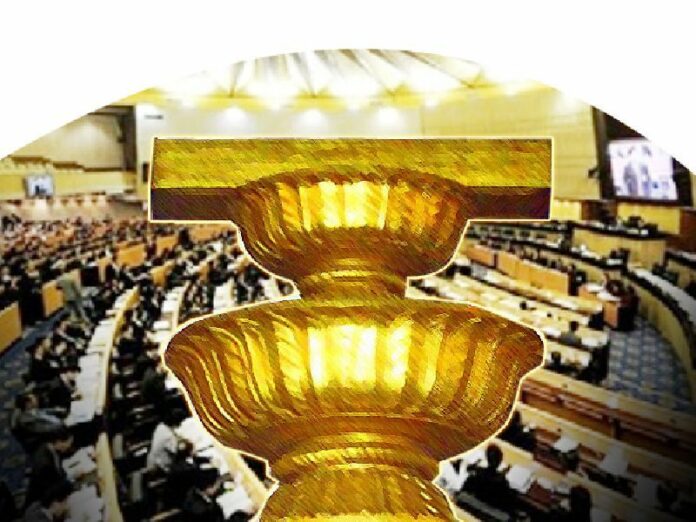
The symbolic representation of democracy and the Thai Constitution, which sits atop the Democracy Monument in Bangkok

Retention

Today is Constitution Day. To many it means just another day off work despite the fact that for two decades after the 1932 revolt, it was celebrated with a festival that two years later even added a beauty pageant.

A Friday poll claimed that 81.5 percent of its respondents have never read a constitution. If true, they deserve some sympathy. During the 84 years since the end absolute monarchy, Thailand has gone through 19 of them and is about to launch No. 20. Calling each a “permanent constitution” is a joke with a punchline repeated every four years, on average.

This means a typical Bangkok bus is in service longer than the average constitution.

Put simply, so many hours and money have gone into writing and rewriting one charter after another, and I haven’t met anyone who believes the next “permanent constitution,” written by junta-appointed drafters and passed in a less-than-fair referendum, will be the last.

That time – and fat, taxpayer-sourced salaries for the drafters – if put to other endeavors, could easily have gone to building the kind of lasting mega-edifices that would please any dictator, or possibly some schools or hospitals to the benefit of the people.

Thailand needs a constitution, a written charter which serves as a social contract. The problem is, what is supposed to be the venerable “Law of the Land” is crumpled and tossed aside so often and with such disregard it no longer carries and deep meaning to the average citizen.

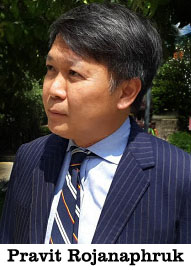
Pravit RojanaphrukInstead they have become merely a set of temporary rules written after military coups and expected to last until the next coup.

Many citizens, except maybe law students, politicians, activists or political-beat journalists, feel alienated by the ephemeral nature of Thailand’s permanent constitution to the point where they couldn’t care less. Instead of being a sacred social contract citizens can recite with pride, the Thai constitution is a technical text best left to pundits.

While rewriting our social contract is a seemingly never-ending process, we have neglected to create an unwritten social contract that would be more lasting: democratic culture, respect for the rights and opinion of others and tolerance.

Some may say this is impossible, particularly given that we have diminishing freedoms and democracy, but people can foster a democratic culture by encouraging greater participation and respect for differing political views in their immediate social milieu independent of the larger political context, or what’s written in the latest permanent constitution. Each of us can foster and defend these values in our own ways, no matter how small, and no matter what’s written that authored by the junta.

The culture of queuing is one example of success. Forty or thirty years ago, queuing was not observed in Thailand, but many Thais over the decades have learned to fall in line and wait their turn. The same can be said of littering, or respecting the rights of nonsmokers in public areas. Improvements have been achieved over the past few decades.

We have learned to adopt these new norms, and there’s no reason we cannot create a more democratic Thailand where respect for human rights, tolerance and freedom of expression are deeply ingrained in our culture. It can be achieved if we put in just half the effort and time spent writing one permanent constitution after another.

Advertisement

Army Says 6 Drug Smugglers Killed in Chiang Mai

BANGKOK — Six drug smugglers were fatally shot in a gunbattle in northern Thailand when they were confronted by soldiers, the military said.

An army statement said the soldiers were tipped off about a drug smuggling route in the northern province of Chiang Mai. When they saw a group of men with backpacks hiking past their stakeout late Wednesday night, they ordered them to stop for an inspection but were met with gunfire.

It said six of the men were killed and two wounded in a 15-minute firefight. Soldiers seized 554,000 methamphetamine tablets, 30 kilograms of heroin, 1 kilogram of opium, an AK-47 assault rifle and a short-barreled rifle, it said. Several suspects were believed to have escaped and were being pursued.

Northern Thailand is part of the infamous drug production area known as the Golden Triangle where the borders of Thailand, Laos and Myanmar meet. Long a major source of opium and its refined product, heroin, the area especially Myanmar now is also notorious for the production of methamphetamine.

Advertisement

Longtime Gambian Ruler Refuses to Step Aside

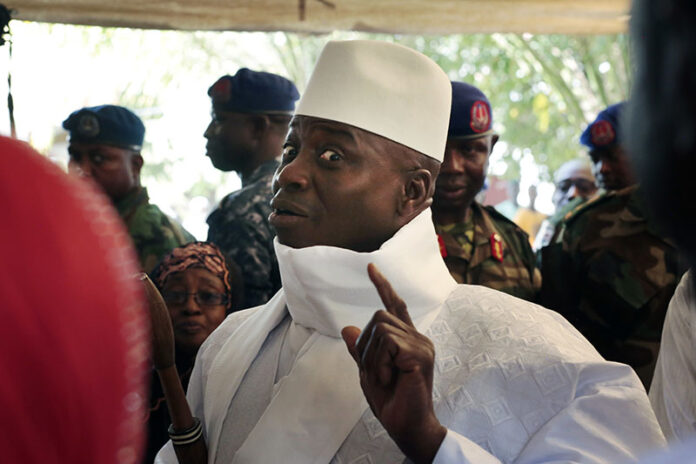
Gambia's president Yahya Jammeh shows his inked finger Dec. 1 before voting in Banjul, Gambia. Photo: Jerome Delay / Associated Press

DAKAR, Senegal — Gambia’s ruler of more than 22 years announced late Friday that he no longer accepts defeat in the country’s presidential election, reversing course a week after he conceded to his rival.

In a speech on state television, President Yahya Jammeh said that investigations since the Dec. 1 vote have revealed a number of voting irregularities that he called unacceptable.

“I hereby reject the results in totality,” he said in his address that aired late Friday. “Let me repeat: I will not accept the results based on what has happened.”

Only one week ago, a jovial Jammeh was filmed on state television calling opposition candidate Adama Barrow to wish him the best.

“You are the elected president of The Gambia, and I wish you all the best,” Jammeh told Barrow at the time. “I have no ill will.”

The dramatic about-face was certain to spark outrage among the opposition and the tens of thousands of Gambians living in exile abroad. Already in the week since Jammeh had been defeated, several dozen political prisoners had been released on bail.

“We are deeply concerned by reports of belated objections to the Gambian election results raised by President Jammeh,” said Babatunde Olugboji, deputy program director at Human Rights Watch. “The international community, notably (regional bloc) ECOWAS and the African Union, should loudly protest any unlawful attempt to subvert the will of the Gambian people.”

The U.S. government also condemned Jammeh’s rejection of the election result, calling it an attempt to remain in power illegitimately.

“The people have spoken and it is time for Gambians to come together to ensure a peaceful transition to President-elect Barrow,” said State Department spokesman Mark Toner in a statement.

It remained unclear whether the tiny country of 1.9 million people would accept Jammeh’s continued rule. As news spread last week of his defeat, Gambians took to the streets — singing, dancing and shouting “Freedom!”

Under Jammeh’s rule, the country surrounded almost entirely by Senegal has become notorious for its abysmal human rights record as well as the president’s erratic behavior.

The Jammeh regime has long been accused of imprisoning, torturing and killing its opponents, according to human rights groups. He also has issued increasingly virulent statements against sexual minorities, vowing to slit the throats of gay men.

In 2007, Jammeh claimed to have developed a cure for AIDS that involved an herbal body rub and bananas. Alarming public health experts, he insisted patients stop taking antiretroviral medications so his remedy could have an effect.

He also has increasingly isolated Gambia, whose economy has long been dependent on tourism. In 2013 he exited the Commonwealth, a group made up mostly of former British colonies, branding it a “neo-colonial institution.” And in October, Jammeh said Gambia would leave the International Criminal Court, which he dismissed as the ‘International Caucasian Court.'”

In his speech Friday, Jammeh said some figures in the results had been transposed and that voter turnout had been suppressed.

“Our investigations reveal that in some cases voters were told that the opposition has already won and that there was no need for them to vote and, out of anger, some of them returned home,” he said.

Advertisement

Obama Orders Review of Election Hacking

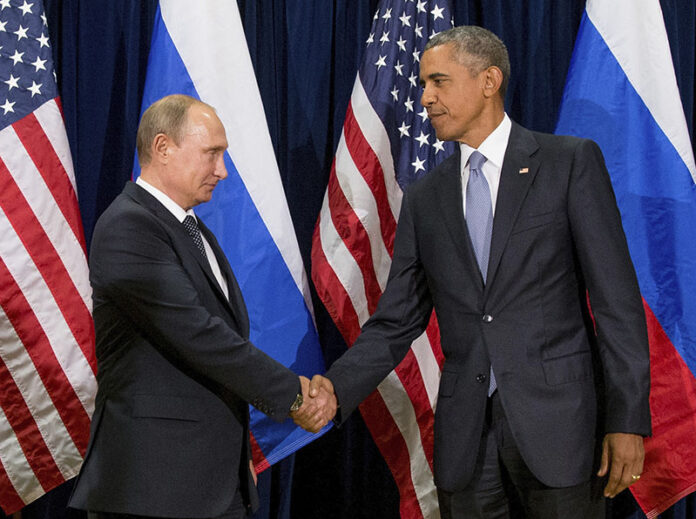
President Barack Obama shakes hands with Russian President President Vladimir Putin before a September 2015 bilateral meeting at United Nations headquarters. Photo: Andrew Harnik / Associated Press

WASHINGTON — President Barack Obama has ordered intelligence officials to conduct a broad review of election-season cyberattacks, including the email hacks that rattled the presidential campaign and raised fresh concerns about Russia’s meddling in U.S. elections, the White House said Friday.

The review, led by intelligence agencies, will be a “deep dive” into a possible pattern of increased “malicious cyber activity” timed to the campaign season, White House spokesman Eric Schultz said. The review will look at the tactics, targets, key actors and the U.S. government’s response to the recent email hacks, as well as incidents reported in past elections, he said.

The president ordered up the report earlier this week and asked that it be completed before he leaves office next month, Schultz said.

“The president wanted this done under his watch because he takes it very seriously,” he said. “We are committed to ensuring the integrity of our elections.”

U.S. intelligence officials have accused Russia of hacking into Democratic officials’ email accounts in an attempt to interfere with the presidential campaign. The Washington Post reported Friday that the CIA has concluded that Russia aimed specifically to help Donald Trump win the presidency.

The Post said the CIA presented its assessment to senators last week. The newspaper’s report cited anonymous U.S. officials who were briefed on that closed-door meeting.

Trump’s transition team was dismissive of the hacking claims Friday night, releasing a statement referring to intelligence agents as “the same people that said Saddam Hussein had weapons of mass destruction.”

The Kremlin has rejected the hacking accusations.

In the months leading up to the election, email accounts of Democratic Party officials and a top Hillary Clinton campaign aide were breached, emails leaked and embarrassing and private emails posted online. Many Democrats believe the hackings benefited Trump’s bid. Trump has downplayed the possibility that Russia was involved.

Schultz said the president sought the probe as a way of improving U.S. defense against cyberattacks and was not intending to question the legitimacy of Trump’s victory.

“This is not an effort to challenge the outcome of the election,” Schultz said.

Obama’s move comes as Democratic lawmakers have been pushing Obama to declassify more information about Russia’srole, fearing that Trump, who has promised a warmer relationship with Moscow, may not prioritize the issue.

Given Trump’s statements, “there is an added urgency to the need for a thorough review before President Obama leaves office next month,” said Rep. Adam Schiff, D-Calif., senior Democrat on the House intelligence committee. If the administration doesn’t respond “forcefully” to such actions, “we can expect to see a lot more of this in the near future,” he said.

The White House said it would make portions of the report public and would brief lawmakers and relevant state officials on the findings.

It emphasized the report would not focus solely on Russian operations or hacks involving Clinton campaign chairman John Podesta and Democratic National Committee accounts. Schultz stressed officials would be reviewing incidents going back to the 2008 presidential campaign, when the campaigns of Sen. John McCain and Obama were breached by hackers.

Intelligence officials have said Obama and Republican presidential nominee Mitt Romney were targets of Chinese cyberattacks four years later.

Story: Kathleen Hennessey

Advertisement

American Tourist Alleging Bangkok Abduction Speaks Out

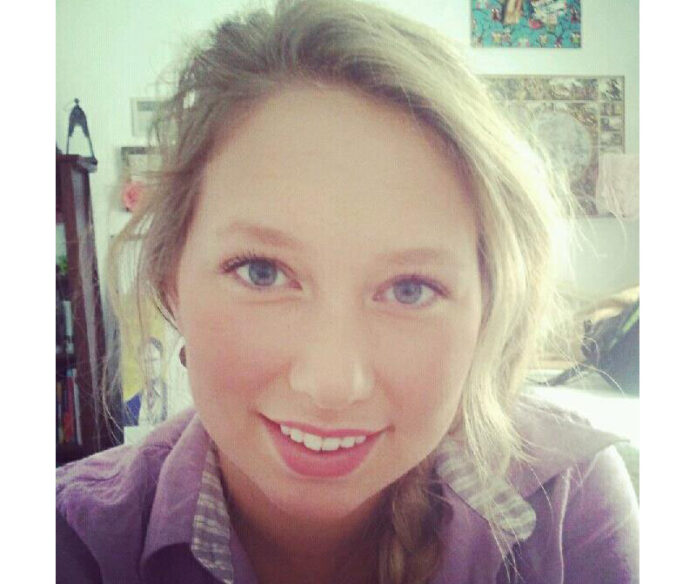
Alexandra Fairfield in a 2012 Facebook photo.

BANGKOK — One moment Alexandra Fairfield says she was dancing at a bar Saturday night in the Silom area. The next, the 26-year-old said, everything went foggy and she was taken to a windowless room where a man attempted to sexually assault her.

Addressing questions raised after reports based on a family member’s account appeared in the media, Fairfield recounted Friday dramatic details of a struggle with an attacker she described as wearing a tan uniform that ended with her escaping by leaping from a balcony.

“I was able to break free from the ropes that were binding my forearms, though I acted as if I were still bound,” Fairfield, now back in the United States, said in an online interview. “When he picked me up to a standing position, I began punching him, aiming for his nose with the heel of my hand, as this does the most damage.”

She said putting up a fight made the difference.

“I believe I took him by surprise and he fell,” she said. “Once he was on the ground, I started kicking him.”

Fairfield’s harrowing tale of attempted rape was first shared by her sister on Facebook, which got picked up by a local news station in Michigan. Then, as things do, that story was re-reported online in Thailand in both Thai and English. Certain elements of the account by Samantha Joe Moore struck some as implausible: that she hid in a bush for seven hours and assertion the attacker was “likely a part of the royal family.”

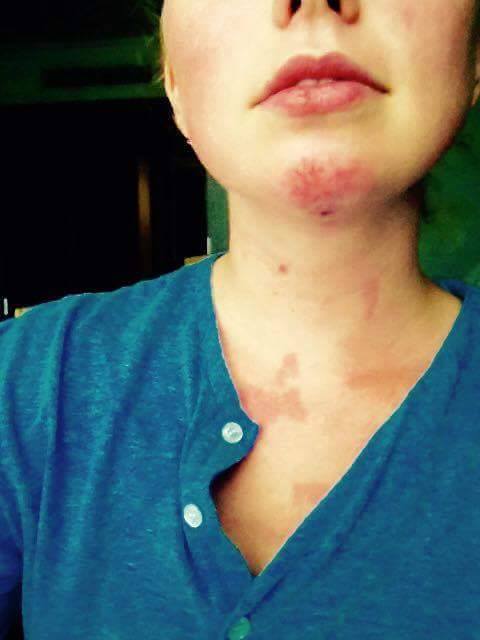
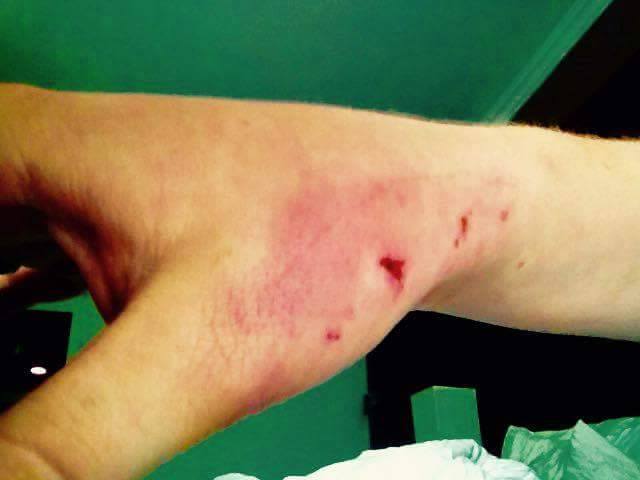
Images said to be wounds sustained by Alexandra Fairfield posted Tuesday to Facebook.

Giving her own account for the first time to the media in Thailand, Fairfield insists the assault took place.

Her claim the attacker could be linked to the police force prompted the opening of an investigation, but a police spokesman on Friday cast doubt on her story.

“There is no evidence that points to what she has claimed,” Col. Krissana Pattanacharoen said.

Fairfield said she did not file any report to the police because she didn’t trust them.

Despite that, Krissana said they probed her claim as reported in the media but nothing turned up.

“Even though there was no complaint, we looked into the matter, but there were no details,” he said. “Anyone who has a clue is welcome to alert us.”

The only thing Col. Krissana said he could confirm was that Fairfield entered and left Thailand on a tourist visa.

According to an account of the attack she posted early Friday morning, Fairfield said she was dancing at a club not far from her hotel where she met a group consisting of two Thai women, a Thai man and white foreigner.

“The boy showed up later,” she wrote. “He was wearing a tan military-looking outfit.”

They bought her some shots, and that’s when things went hazy. She said they took her in a car to another club where a live band was playing and she was led to a room where the alleged assault happened.

After jumping off a balcony, she described passing through what looked like a parking structure until she reached a large road where she hid in some bushes until the sun rose, eventually getting help from two foreigners who put her in a cab back to the Pullman G Hotel.

“I remember seeing a white sign with black letters ‘S….. Plaza.’ Again I did not have my glasses so I am not sure what the S was,” she wrote.

Her family also posted photos said to be of her injuries.

Images said to be wounds sustained by Alexandra Fairfield posted Tuesday to Facebook.

During the next few days, Fairfield said she tried to fly out of Thailand while hiding from her attacker, who she believes wielded police connections to block her departure.

“I did not tell anyone I was taken by a law enforcement officer, that was false reporting [by the media]. What I do know is that he had on a tan uniform,” Fairfield said. “I also believe he had the police looking for me after my escape. That is why I did not file any official reports, I needed to get back to the USA as soon as possible.”

When she tried to board a United Airlines flight on Tuesday, Fairfield said her booking was canceled without explanation, and the staff would not issue or sell new tickets on the spot.

“They had told us to book online, but the booking was closed, this was about one-and-a-half hours before departure,” she said.

A GoFundMe crowdfunding effort launched by her family to help her return home raised almost USD$8,000, far exceeding the stated goal of $3,000. In a message posted online early Friday morning, Fairfield said the money would be donated to International Justice Mission, an anti-trafficking nonprofit that has operations in Thailand.

Fairfield eventually secured a flight and arrived home Wednesday. Moore, her sister, said she’s recovering from the alleged assault.

“She is definitely traumatized, but getting lots of rest back home,” Moore said.

Advertisement

Hot News

LATEST NEWS

Bangkok
overcast clouds
32.3 ° C
33.3 °
30 °
80 %
5kmh
100 %
Mon
32 °
Tue
37 °
Wed
35 °
Thu
34 °
Fri
32 °