27.7 C
Bangkok
Thursday, July 2, 2026
Home Blog Page 2748

Fatal Benz Crash Case Reaches Prosecutor’s Office

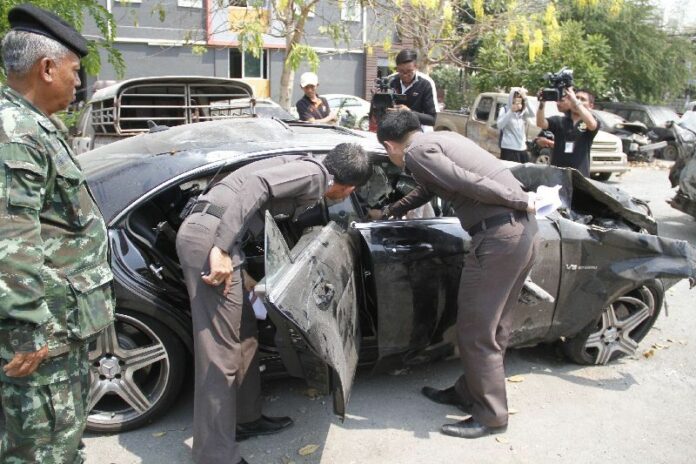
Officers at Phra-Inracha Police Station on Mar. 17 morning inspect a Mercedes-Benz involved in a fatal highway crash.

AYUTTHAYA — Police today sent prosecutors their case against a wealthy businessman responsible for deaths of two graduate students in a fiery crash a month and a half ago.

The case file names eight charges against Jenphop Viraporn, 37, including fatal reckless driving, driving under the influence, speeding and refusing to cooperate with law enforcement for the March 13 crash, which garnered widespread attention and complaints authorities had slow-walked the case.


Cops Promise to Send Jenphop Case to Prosecutor This Month


The 686-page case was sent Tuesday to attorney general.

Deputy national police chief Pongsapat Pongcharoen said they declined a request from the families of the victims to charge Jenphop with premeditated murder.

Pongsapat said they lacked evidence to prove the suspect, who was driving 257kph at the time, intended to kill anyone.

“There’s no evidence pointing to the suspect’s intention to kill others, so we did not file this additional charge,” Police Gen. Pongsapat said. 

He added that 52 witnesses will testify at the trial. 

Jenphop, who like his father owns a luxury car company, is currently free on bail. 

After plowing through a toll booth without slowing down, Jenphop slammed his Mercedes into the back of a Ford Fiesta on a highway in Ayutthaya province, killing 32-year-old Krissana Thaworn and Thantapat Horsaengchai, 34. Both victims were graduates at a Buddhist university; Krissana was about to receive his degree, while Thantapat was set to embark on a pilgrimage in India. 

Police have come under criticism online and off for their slow handling of the investigation; Jenphop was allowed to refuse a sobriety test and was not questioned or charged until four days had passed. 

That led to complaints police were shielding Jenphop from justice as in other high profile cases involving the wealthy and well-connected.

Police have since attempted some damage control. The investigators who failed to test Jenphop for drug and alcohol were removed from their posts and subjected to a disciplinary inquiry, and the suspect is now charged with driving under the influence. 


Related stories:

Businessman Charged for Fatal Collision Amid Mounting Criticism

Officers In Charge of Ayutthaya Deadly Collision Removed

Jenphop Plowed Through Toll Booth Before Deadly Crash (Video)

Fresh Charge Against Jenphop as Model Student Victims Laid to Rest


Teeranai Charuvastra can be reached at [email protected] and @Teeranai_C.


\

Advertisement

April to End With Showers, Forecaster Says

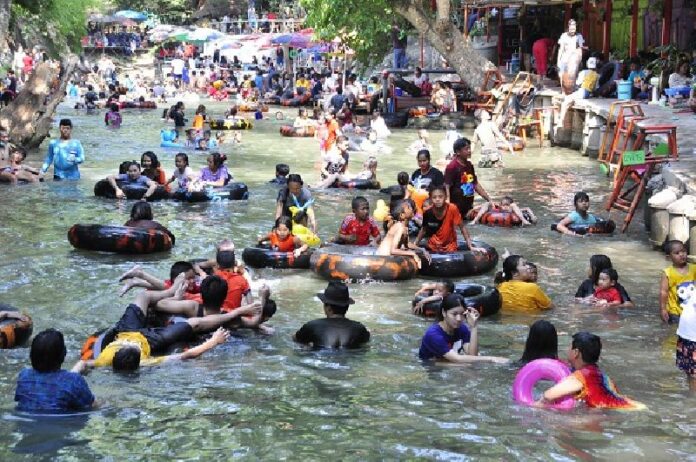
Thousands of tourists per day cool off at Wangnen falls, seen here Monday, in Nakhon Ratchasima.

BANGKOK — This hot month will soon end with a splash, as meteorologists promise rain will fall all over Thailand on Friday.

After peaking at 40C, April will have a happy ending, as weather forecast models predict rain will fall Friday and Saturday nationwide, according to Royon Jitdorn of the Hydro and Agro Informatics Institute. Some rain could begin as soon as today in some parts of the northeast, he added.

He also predicted unusual an amount of rain later this year in November, after the wet season has usually come to an end.


Related stories:

40-Degree Plus Songkran Expected

Hot, Hot, Hot: Prepare for 39C in Bangkok


Advertisement

Landmines: Myanmar’s Hidden Menace

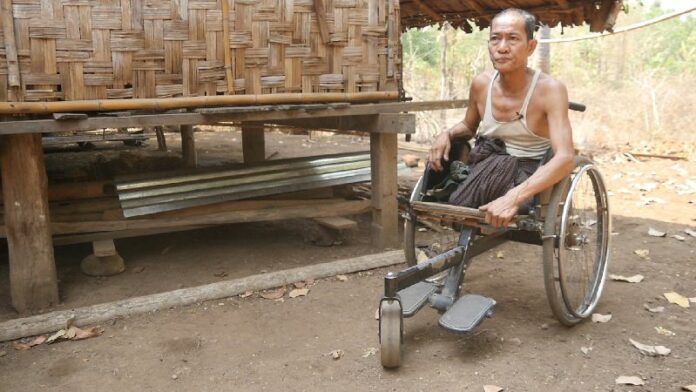
Kyar Khin, a farmer in Aung Chan Thar village in Kyaukkyi township in eastern Myanmar’s Kayin State, lost both his legs following a land mine injury. Photo: David Doyle / Myanmar Now

KYAUKKYI, Myanmar — Two years ago, Kyar Yin was in the forest near his village collecting bamboo to sell when he stepped on a landmine.

Alone and his left leg badly injured, the 56-year-old farmer was forced to take drastic action.

“I sat up and pulled out my knife and started to cut my leg away myself,” he said. “It hurt so much, but I kept cutting the meat from my leg and throwing it away.

“I had no choice but to cut my leg by myself because if I didn’t, it would get worse.”

Aung Chan Thar, Kyar Yin’s village in Kyaukkyi township in eastern Myanmar’s Kayin State, was once the frontline in a bitter conflict, once dubbed the world’s longest-running civil war, between the Karen National Union (KNU) and the Myanmar military.

As is common in Myanmar’s ethnic conflicts, land mines were a weapon of choice for both sides and the jungle around Aung Chan Thar is littered with them.

But the forest also provides the villagers, many of whom survive on subsistence farming and trading in products from the rainforest, with everything – from wood and leaves for their homes to betel nuts and bamboo to sell at the market.

Every time the villagers enter the forest, they are conscious that their lives are at risk, a situation faced by millions of villagers in Myanmar’s conflict-scarred ethnic borderlands.

Across Myanmar, hundreds fall victim to this hidden weapon every year. According to Landmine Monitor, Myanmar is the third worst country in the world for annual landmine casualties. There were at least 3,745 reported casualties between 1999 and the end of 2014, though it is thought the real figure could be much higher.

Today, Kyar Yin envisages a different use for his knife.

“If I met the people who made me like this, I would want to kill them with my own knife,” he said, leaning against a tree to take the weight off his wooden prosthetic leg.

Five Legs Between Six People

Kyar Yin is not alone in having been maimed by landmines: six members of his family, including himself, have also been injured. They have five legs between them.

Kyar Yin’s brother Kyar Khin was in the jungle with his wife collecting bamboo when he stepped on a mine. He lost both his legs.

“I remember it was raining, and there was a lot of blood,” he says. “My wife put me on my side and covered my lower half with a blanket.”

Men are most commonly the victims of landmines around Aung Chan Thar because they are normally the ones working in the forest. Kyar Khin, a father of four, now struggles to provide for his family.

“My wife is finding money at the moment,” he says. “She collects leaves and she sells those. It is not enough… Sometimes, I make bamboo baskets. I can earn 500 Kyats (15 baht) a day. With the leftover money, I buy my medicine.”

Kyar Khin’s cousin Ngwe Yin was the village’s first land mine victim 40 years ago.

Standing in the bamboo field where she lost her right leg, she points to the spot where she was injured and recalls how when her mother and aunt came to help her, they too stood on land mines.

“My aunt lost both of her legs, and my mother had severe injuries to her abdomen and face,” she says.

Since her injury, she says 20 people have been killed and 12 more disabled by landmines in the village of 700 people.

Fuelled By Conflict

Kyar Yin, Kyar Khin and Ngwe Yin all blame the Karen National Union for the landmines that injured them. They accuse the KNU of not just laying landmines in the conflict with the Tatmadaw, Myanmar’s army, but also to protect teak trees that they did not want villagers to cut down, and as a punishment for not paying taxes.

A KNU spokesman said both the KNU and the Tatmadaw had laid land mines in the area. However, he denied the group had used mines to protect trees or as a punishment against villagers.

Myanmar’s ethnic armed conflicts are at the heart of the landmine issue, and much hope rests on getting all ethnic armed groups to sign up to the Nationwide Ceasefire Agreement.

“If all the stakeholders are signing the ceasefire agreement then the landmine issue will be automatically included,” National League for Democracy patron Tin Oo told Myanmar Now.

“We are very hopeful during this government this land mine issue will be sorted out.”

When Will They Be Cleared?

International NGOs are ready to start the process of clearing land mines, but to date not a single landmine has been officially removed.

Ingeborg Moa, acting country director for Norwegian People’s Aid, said before Myanmar began its democratic transition in 2011, you could not even use the phrase “landmine” when talking to government officials.

“We would rather talk about ‘threats to life and health’ as a sort of code-word for these hazards,” she says.

“This has completely changed, and both the authorities and the different ethnic armed organisations are now willing to discuss landmines and mine-clearance issues openly with us.”

Norwegian People’s Aid has carried out broad surveys to try and gather information on where land mines may be located, but has not been given the green light to carry out the technical surveys that would specifically locate the devices.

Moa says the progress already made in achieving peace – eight armed groups signed the NCA in October last year – is enough to start landmine clearance procedures.

Life-Long Impact

For the villagers in Kyaukkyi township, the sooner something happens the better. They say land mines do not just cause physical loss, but also lasting psychological damage.

In Kawt Byinn village, Ngwe Yee, 31, provides counselling to disabled people. She was 21 when, in November 2004, she was taking food to her parents in the forest and her bicycle hit a landmine. She lost her right leg.

She says: “Most people (with land mine disabilities) just stay at home; they don’t normally go out and work because they are depressed. A lot of the men become alcoholics.

“So I say to the girls: ‘Let’s go out sometimes, this is not shameful. We can go out together and we can be involved in social activities’.”

Ngwe Yee is putting on a brave face. The mine not only shattered her leg but also her dreams of running her own shop.

“Now I have no dream anymore, because I can’t do it,” she said, sitting outside her parents’ home, with tears welling in her eyes.

“Though I am not feeling very good myself, I cannot show this to other disabled people because I am supposed to help them. I need to stay strong in front of them.”

Story: David Doyle

Related stories:

Smart Rats Sniff Out Cambodian Mine Fields

Elephant Injured By Land Mine on Thai-Myanmar Border 

Advertisement

Tourist in Yoga Airplane Altercation Allowed to Fly to Korea

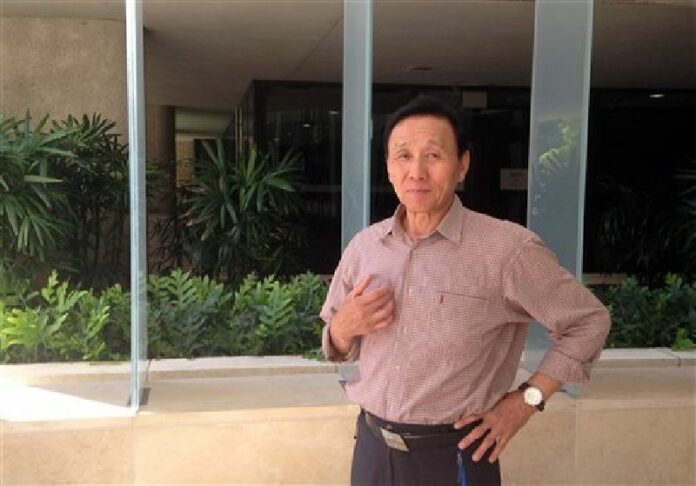
In this Thursday, April 21, 2016 file photo, Hyongtae Pae stands outside the federal courthouse in Honolulu, after pleading guilty to interfering with a flight crew. Photo: Jennifer Sinco Kelleher / Associated Press

HONOLULU — A tourist whose desire to do yoga on a plane led to his arrest is being allowed to leave Hawaii and return home to South Korea.

U.S. Magistrate Judge Kevin Chang previously allowed Hyongtae Pae to be released on bond, but prevented him from leaving the state because of concerns about him being on a plane again.

On Monday, Chang made the modification after Pae's defense attorney asked that Pae return to the Honolulu Federal Detention Center. Jin Tae "JT" Kim said his client can't afford to keep staying in a bed and breakfast or to pay to see a doctor for more medication.

Pae and his wife were celebrating their 40th wedding anniversary with a Hawaii vacation and the couple was headed home when he was arrested.

According to court records, Pae didn't want to sit in his seat during the meal service on last month's flight from Honolulu to Tokyo, so he went to the back of the plane to do yoga and meditate. Authorities say he refused to return to his seat, threatened crew members and passengers and shoved his wife. The pilot turned the plane around and returned to Honolulu. Pae told authorities after his arrest that he hadn't slept in 11 days.

He pleaded guilty last week to interfering with a flight crew. As part of a plea agreement, he's expected to be sentenced to time served, which was about 12 days in jail and to pay about USD$43,600 (1.5 million baht) restitution to United Airlines.

Medication has improved Pae's mental state and he's well-rested, Kim said last week.

Through an interpreter, Pae promised that he will return for his sentence, which is scheduled for July. He must also pay USD$1,250 (44,000 baht) cash as a deposit before he leaves Honolulu. "I swear to God," he said, pledging to return.

Assistant U.S. Attorney Darren Ching objected to the arrangement, saying it provides little incentive for Pae to return. He said that once Pae leaves, "that will be the last we ever see of Mr. Pae."

Chang noted that Pae is 72 years old, doesn't speak English and has no family or friends in Hawaii. Returning him to incarceration because of his financial and medication problems wouldn't be appropriate, Chang said.

"He may fly back to Korea, but he must come back to Hawaii," Chang said, adding that Pae is restricted from any other airline travel.

Story: Jennifer Sinco Kelleher / Associated Press


Advertisement

Regional Monitors In, International Monitors Out for Charter Vote

By Pravit Rojanaphruk
Senior Staff Writer

BANGKOK — A regional election monitoring group based in Bangkok plans to field up to 10 people to observe the August charter referendum, while the European Union will sit it out.

If the political climate permits, the Asian Network for Free Elections will dispatch a limited number of monitors for the vote on the constitution written and promoted under military supervision, a process its executive director warns will lose credibility unless free discussion is guaranteed.

“After a very difficult debate, we’re approaching the Thai referendum cautiously,” said Ichal Supriadi. “We’re going to limit the number of observers to a maximum of 10. It may be reduced again depending on the pre-referendum environment.”
The network normally sends sends dozens of observers on each of their missions.

Supriadi said the matter has yet be finalized with the Election Commission and could change given the political situation.

For its part, the European Union’s mission in Bangkok confirmed Monday that no European observers will be sent as requested by some, such as leaders of the Redshirt movement.

Supriadi expressed concern about the level of freedom for Thais to debate and deliberate on the merits of the charter, given a law just enacted which threatens 10 years in prison to anyone found guilty of “distorting” its contents.

Comparing the charter to a product, he said people should be free to debate its quality.

“I think everybody should be able to speak about the referendum,” he said, adding that the freedoms of assembly and expression are essential for a free and fair vote.

The fact that political gatherings are still banned by the junta also undermines the credibility of any ballot, Supriadi said.

“I cannot imagine if different countries have different styles of referendum. It’s a wake-up call for the government and the Election Commission to ensure a more transparent referendum. It’s about the confidence and credibility of the process,” he said.

The observers from his organization, Supriadi said, would be drawn from different Asian nations and would arrive to begin their work a month prior to the referendum now slated for Aug. 7.

A veteran elections observer who asked not to be named claimed the European Union will send a few informal observers without formal accreditation.

In his understanding, formal approval for an E.U. delegation was not sought over concern about conditions which might be imposed by Thai authorities.

The press office for the European Union in Bangkok wrote Monday to confirm that it “does not look like there will be an election observation mission for the referendum to Thailand.”

The United States is “not aware of any request by Thai authorities for ‎international observers,” according to embassy spokeswoman Melissa Sweeney.

Pongsak Chanon, chairman of We Watch Thailand, a local election observation network, said the group hopes to field 50 Thai observers for two months prior to the referendum.

No plan has been finalized and depends on whether they can obtain funding.

Pongsak said it would be helpful if the European Union and United Nations would send observers.

“It would be good. It would help deter the government from doing things that may not be transparent. They will hesitate from doing something blatantly,” Pongsak said.

Michael Bak, advisor to the United Nations Resident Coordinator for Thailand, said election observers would only be sent if the government of a member country made a request, or the Security Council to do so.

He added so far no request have been made by the military government of Thailand.

Correction: An earlier version of this article misidentified Michael Bak as United Nations Resident Coordinator. Bak is in fact advisor to the UN Resident Coordinator.


.


\

Advertisement

Regional Monitors In, International Monitors Out for Charter Vote

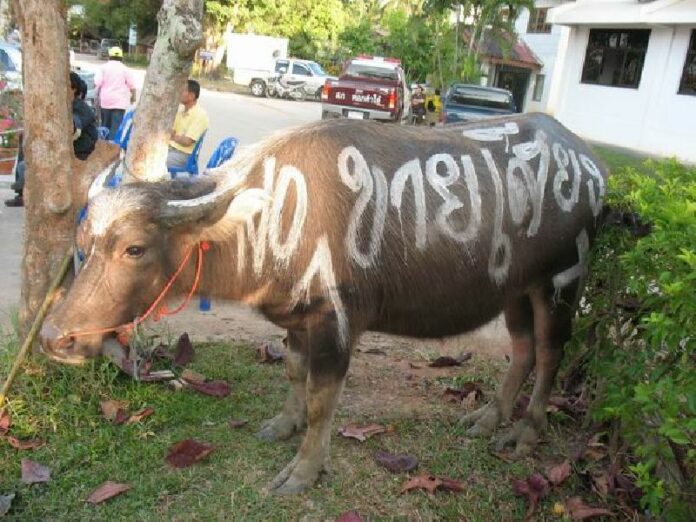
Graffiti on a buffalo urges no corruption in the 2007 general election in a photo taken by the Asian Network for Free Elections

By Pravit Rojanaphruk
Senior Staff Writer

BANGKOK — A regional election monitoring group based in Bangkok plans to field up to 10 people to observe the August charter referendum, while the European Union will sit it out.

If the political climate permits, the Asian Network for Free Elections will dispatch a limited number of monitors for the vote on the constitution written and promoted under military supervision, a process its executive director warns will lose credibility unless free discussion is guaranteed.

“After a very difficult debate, we’re approaching the Thai referendum cautiously,” said Ichal Supriadi. “We’re going to limit the number of observers to a maximum of 10. It may be reduced again depending on the pre-referendum environment.”

The network normally sends sends dozens of observers on each of their missions.

Supriadi said the matter has yet be finalized with the Election Commission and could change given the political situation.

For its part, the European Union’s mission in Bangkok confirmed Monday that no European observers will be sent as requested by some, such as leaders of the Redshirt movement.

Supriadi expressed concern about the level of freedom for Thais to debate and deliberate on the merits of the charter, given a law just enacted which threatens 10 years in prison to anyone found guilty of “distorting” its contents.

Comparing the charter to a product, he said people should be free to debate its quality.

“I think everybody should be able to speak about the referendum,” he said, adding that the freedoms of assembly and expression are essential for a free and fair vote.

The fact that political gatherings are still banned by the junta also undermines the credibility of any ballot, Supriadi said.

“I cannot imagine if different countries have different styles of referendum. It’s a wake-up call for the government and the Election Commission to ensure a more transparent referendum. It’s about the confidence and credibility of the process,” he said.

The observers from his organization, Supriadi said, would be drawn from different Asian nations and would arrive to begin their work a month prior to the referendum now slated for Aug. 7.

A veteran elections observer who asked not to be named claimed the European Union will send a few informal observers without formal accreditation.

In his understanding, formal approval for an E.U. delegation was not sought over concern about conditions which might be imposed by Thai authorities.

The press office for the European Union in Bangkok wrote Monday to confirm that it “does not look like there will be an election observation mission for the referendum to Thailand.”

The United States is “not aware of any request by Thai authorities for ‎international observers,” according to embassy spokeswoman Melissa Sweeney.

Pongsak Chanon, chairman of We Watch Thailand, a local election observation network, said the group hopes to field 50 Thai observers for two months prior to the referendum.

No plan has been finalized and depends on whether they can obtain funding.

Pongsak said it would be helpful if the European Union and United Nations would send observers.

“It would be good. It would help deter the government from doing things that may not be transparent. They will hesitate from doing something blatantly,” Pongsak said.

Michael Bak, advisor to the United Nations Resident Coordinator for Thailand, said election observers would only be sent if the government of a member country made a request, or the Security Council to do so.

He added so far no request have been made by the military government of Thailand.

Correction: An earlier version of this article misidentified Michael Bak as United Nations Resident Coordinator. Bak is in fact advisor to the UN Resident Coordinator.

Advertisement

Jet Ski Crash Kills Tourist in Pattaya

A file photo of a jet ski involved in an unrelated collision last April.

PATTAYA — A Chinese man was killed today when his jet ski collided with a speedboat off the coast of Pattaya.

The 26-year-old man was riding a rented jet ski with a Thai instructor when it crashed into an oncoming boat near Koh Larn, police said. The tourist died at hospital, while the 25-year-old instructor was injured.

It was unclear who was at fault in the incident. Pattaya City Police Station commander Sukthat Pumpanmuang said police are questioning the boat driver and owner to find out what happened before they press any charges.

“We are still investigating. We have not charged anyone yet,” Col. Sukthat said, adding that marine authorities are also involved in the inquiry. 


Related stories:

Tourist Speed Boat Sinks Off Pattaya Coast

Indian Tourist Decapitated By Pattaya Speedboat

'Drunk' Captain Grounds Tourist Boat on Pattaya Beach

'Navigation Error' Leads To Pattaya Deadly Ferry Sinking


Teeranai Charuvastra can be reached at [email protected] and @Teeranai_C.


\

Advertisement

Junta Says it Has Proof Thaksin Behind Smear Campaign – But It’s Classified

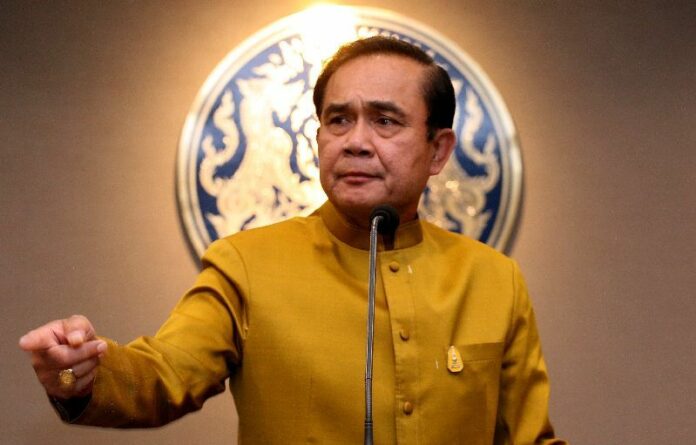
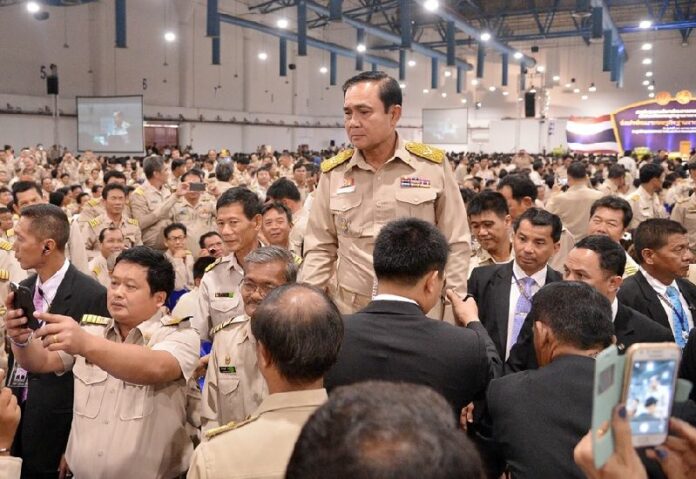
Junta chairman and Prime Minister Gen. Prayuth Chan-ocha stands tall for a selfie with uniformed bureaucrats Monday in Bangkok.

BANGKOK — The junta said today it can prove, once and for all, that former Prime Minister Thaksin Shinawatra has paid foreign lobbyists to sabotage Thailand’s reputation and destabilize the military government.

But that proof is classified, for now. 

“We have already collected some documents, but it’s just we cannot disclose them at the moment,” junta spokesman Piyapong Klinpan said at a Monday news conference. 

The regime’s claim comes amid a war of words between Thaksin and junta chairman Prayuth Chan-ocha, which opened Thursday when the general accused the influential former premier of plotting anti-government protests and manipulating Thai politics via his lobbyists. 


Prayuth Names Thaksin as Plotter Behind Protests 


“Who’s doing this? Who’s supporting them? Who’s plotting all this?” Gen. Prayuth said. “Firstly, it’s foreign lobbyists. Who? Thaksin!”  

A day later, Thaksin, who has stayed largely silent following the May 2014 coup that removed his allies from power, hit back by denying the allegation on Facebook. 

“I’d like to say this: I do not need to waste my money and hire anyone to expose the behavior of the Thai Prime Minister and damage the image of Thailand in the process,” Thaksin wrote. “History has always shown that all dictators … will eventually meet their own doom.” 

The post, written with unusually strong language that Thaksin has avoided since the coup, went viral and gained more than 100,000 likes within 24 hours.

The exchange was the first instance of direct sniping between Thaksin, who remains the de facto leader of his political dynasty, and Prayuth, who toppled a pro-Thaksin government. Until Friday, the two men had made references to each other in public speeches, but, true to the Thai value of maintaining a conciliatory tone, had refrained from calling each other out.

With Thaksin’s supporters demanding Prayuth back up his accusation with evidence, the junta’s National Council for Peace and Order, or NCPO, is now doubling down by claiming the evidence exists, albeit behind closed doors.

“Whether Mr. Thaksin’s activities are related to hiring lobbyists – as I think they are – as the prime minister has already said,” Piyapong said. “But as for the details of the documents, the NCPO would like to keep them confidential for now, so that we won’t play into the hands of people who challenge us.” 

Deputy Prime Minister Prawit Wongsuwan gave somewhat more specific details about the alleged evidence, saying that it was “foreign media” who exposed Thaksin’s link to the lobbyists.

“He [Prayuth] spoke based on the information that foreigners published,” Gen. Prawit told reporters Monday. “He didn’t come up with it on his own. Foreign media wrote about it.”

The general did not identify any specific report. 


Related stories:

Prayuth Promises Not to Arrest Thaksin at Lee Kuan Yew's Funeral

Prayuth Asks Media To Stop Reporting About Thaksin

Official Calls Thaksin’s Speech ‘Dog Bites Man’ Story 

Don't Vote For 'Previous Politicians,' Prayuth Advises Nation


Teeranai Charuvastra can be reached at [email protected] and @Teeranai_C.


\

Advertisement

Cambodian Royal Turtle Nearly Extinct

In this June 24, 2015, photo released by Wildlife Conservation Society, a Cambodian Royal Turtle walks on the sand of Sre Ambel river bank, in Koh Kong province, in western Phnom Penh, Cambodia. Photo: Wildlife Conservation Society / Associated Press

PHNOM PENH — Cambodia's Royal Turtle is nearly extinct, with fewer than 10 left in the wild, because increased sand dredging and illegal clearance of flooded forest have shrunk its habitat, a conservationist group warned Monday.

The New York-based Wildlife Conservation Society said in a statement that for several years the small remaining population of Royal Turtles, "perhaps numbering fewer than 10,' have been successfully protected in the Sre Ambel river system by a joint project of the government's Fishery Administration and WCS.

But a recent increase in disturbance along the river system in Koh Khang province, the only place the turtle is still found in Cambodia, is putting the species at great risk, it said.

The Royal Turtle is one of the world's 25 most endangered tortoises and freshwater turtles. Also known as the Southern River terrapin, the Royal Turtle is so named because in historical times only the royal family could consume its eggs. The species was designated as Cambodia's national reptile in 2005.

This year the project team observed a decline in the turtle's nesting. "We believe this is caused by increased sand dredging, wood transportation along the nesting habitat, and illegal clearance of flooded forest disturbing the females during the breeding season", said In Hul, the project coordinator.

Only one nest was located this year, compared to four last year. "This is very worrying and if it continues it will be potentially putting the species at high risk of extinction," he said.

The Royal Turtle was believed extinct in Cambodia until 2000 when a small population was re-discovered. In 2001, the government and WCS began a project to search for and protect nests. They have saved 39 nests with a total of 564 eggs that resulted in 382 hatchlings. Although the hatchlings are taken into captivity to be raised and released into the wild later, the loss of habitat reduces their chances to survive, officials say.

Story: Associated Press


Advertisement

Activist to Sue Over Tiger Temple Zoo Permit

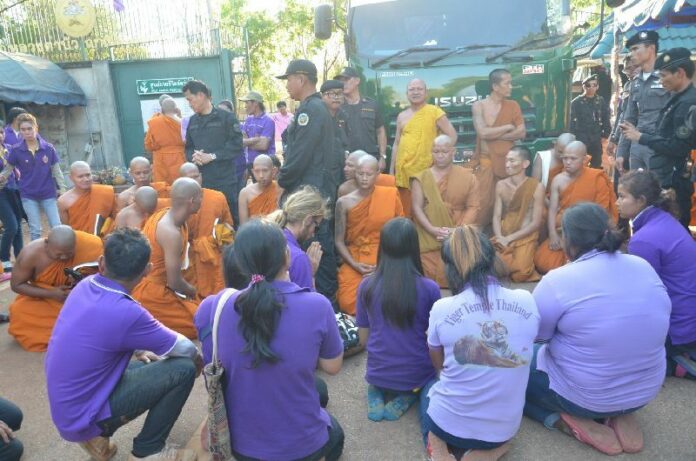
Monks and volunteers block government vehicles in April 2015 from leaving a commercial wildlife center operating as a temple in Kanchanaburi province.

KANCHANABURI — An animal rights NGO said today it would take the authorities to the court for granting a zoo permit to a temple notorious for operating an illegal, commercial wildlife business.

Activist Edwin Wiek said Monday the lawsuit would be a “last resort” in his efforts to stop Wat Pha Luang Ta Bua Yanasampanno, aka the Tiger Temple, from getting the long-sought permit that would legalize its operations.


Tiger Temple to Reapply After Zoo Permit Denied


“What happened is a clear violation of the regulations, because there are so many pending cases against the temple” said Wiek, who heads Wildlife Friends of Thailand. 

He did not say when he would file the civil suit.

Pressured by animal welfare activists and an international outcry, authorities have for years waged a reluctant battle against the influential Tiger Temple on wildlife-related charges, such as illegally keeping tigers and other protected species. 

The temple, which has bred an untold number of tigers in captivity, has also sold at least three of its big cats, but insists it was done legally.

Wildlife officials have made slow progress. After declaring again in January that it would remove all tigers from the temple, which caters to tourists willing to pay to touch the animals, only 10 of the 147 animals have been removed.

\

Wildlife officials on Feb. 23 load a tiger onto a truck at the ‘Tiger Temple’ in Kanchanaburi province.

The zoo permit would allow the Tiger Temple to legally keep its tigers, and even buy those 10 back from wildlife authorities, said Saiyood Pengboonchoo, a lawyer for the temple. 

“Once the cages are completed, we will get the tigers back,” Saiyood said by telephone Monday. 

He said the Department of National Parks approved the zoo permit Thursday, and he estimated that the 25 million-baht zoo would be completed within two years. 

Saiyood added that the zoo will be registered under a separate private enterprise, called Tiger Temple Co., to stave off any potential backlash from religious authorities.

“The bureaucracy doesn’t want the temple involved in this because it would look bad,” Saiyood said.

Asked who will head the company, the lawyer said Tiger Temple abbot Phra Wisutthisarathen will appoint a disciple to head the enterprise.

Wiek, whose organization has campaigned against the Tiger Temple’s wildlife business for years, said his assessment in January that the battle had been won was overly optimistic.

“My feeling for this issue, well, the Department of National Parks seemed to be very serious in the past about many cases,” Wiek said. “But why aren’t they taking any action against the Tiger Temple? I feel disappointed in the department and in the police.” 


Related stories:

5 More Big Cats Removed from ‘Tiger Temple’

5 Big Cats Removed Overnight from 'Tiger Temple'

‘Tiger Temple’ to Sue NatGeo Over Damning Report

Temple Refuses to Release Tigers, Again

Asian Black Bears Seized From Thailand's Tiger Temple

Thailand's Tiger Temple Ordered to Give up Tigers


Teeranai Charuvastra can be reached at [email protected] and @Teeranai_C.


\

Advertisement

Hot News

LATEST NEWS

Bangkok
overcast clouds
27.7 ° C
27.7 °
27.7 °
83 %
2.3kmh
100 %
Thu
36 °
Fri
34 °
Sat
28 °
Sun
28 °
Mon
31 °