30.5 C
Bangkok
Sunday, June 28, 2026
Home Blog Page 2790

Ruling in Somsak Jeam v. Thammasat Shelved Indefinitely

Somsak Jeamteerasakul speaks at a March 2013 panel discussion in Bangkok. Photo: Prachatai / YouTube

By Teeranai Charuvastra
Staff Reporter

BANGKOK — A ruling in a wrongful termination suit brought by fugitive university professor Somsak Jeamteerasakul against Thammasat University has been indefinitely postponed, his lawyer said.

The Administrative Court was scheduled to rule Tuesday on whether Thammasat unfairly dismissed Somsak after he went into exile in France as alleged by the former professor, who is a frequent critic of the monarchy and fled Thailand shortly after the May 2014 coup.

His lawyer, Pavinee Chumsri, said the court has placed its ruling on indefinite hold without explanation. The decision comes days after the head judge on the panel hearing the case signaled his support for Somsak’s claim.


Thammasat Dismissed Somsak Jeam Unfairly, Judge Agrees


Somsak filed the lawsuit in September, seven months after he was expelled in absentia by the university for failing to appear without tendering his resignation 15 days prior to his absence.

Somsak’s lawyer argued that his client could neither report to work nor properly submit his resignation because he had fled the country in fear of his safety. The former historian was wanted by authorities for defaming the Royal Family, a crime punishable by up to 15 years in prison. He now resides in France.

The postponement came less than a week after the head judge in the case expressed his support for Somsak’s argument at a March 1 hearing.

“I believe the tribunal should consider repealing the order of Thammasat University that expelled Mr. Somsak,” the judge said in his legal opinion of the suit’s merits.

The court will set a new date for its decision in the future, Somsak’s attorney Pavinee said Friday, according to the website of Thai Lawyers for Human Rights, the organization she works for.


Teeranai Charuvastra can be reached at [email protected] and @Teeranai_C.

Follow Khaosod English on Facebook and Twitter for news, politics and more from Thailand. To reach Khaosod English about this article or another matter, please contact us by e-mail at [email protected].


Follow @KhaosodEnglish

\

Advertisement

Ray Tomlinson, Inventor of Modern Email, 74

An undated photo provided by Raytheon BBN Technologies shows Raymond Tomlinson. Tomlinson, the inventor of modern email and selector of the "@" Photo: Raytheon via the Internet Hall of Fame / Associated Press.


Raymond Tomlinson, the inventor of modern email and a technological leader, has died, his employer said Sunday.

Tomlinson died Saturday, the Raytheon Co. said; the details were not immediately available.

Email existed in a limited capacity before Tomlinson in that electronic messages could be shared amid multiple people within a limited framework. But until his invention in 1971 of the first network person-to-person email, there was no way to send something to a specific person at a specific address.

Tomlinson wrote and sent the first email on the ARPANET system, a computer network that was created for the U.S. government that is considered a precursor to the Internet. Tomlinson also contributed to the network's development, among numerous other pioneering technologies in the programming world.

At the time, few people had personal computers. The popularity of personal email wouldn't take off until years later and would ultimately become an integral part of modern life.

"It wasn't an assignment at all, he was just fooling around; he was looking for something to do with ARPANET," Raytheon spokeswoman Joyce Kuzman said.

The first email was sent between two machines that were side-by-side. Tomlinson said in a company interview that the test messages were "entirely forgettable and I have, therefore, forgotten them." But when he was satisfied that the program seemed to work, he announced it via his own invention by sending a message to co-workers explaining how to use it.

"I'm often asked 'Did I know what I was doing?" Tomlinson said in his speech when he was inducted into the Internet Hall of Fame. "The answer is: Yeah I knew exactly what I was doing. I just had no notion whatsoever about what the ultimate impact would be."

Tomlinson is the one who chose the "@" symbol to connect the username with the destination address and it has now become a cultural icon.

"It is a symbol that probably would have gone away if not for email," Kuzman said.

The symbol has become so important in modern culture that MoMA's Department of Architecture and Design added the symbol into its collection in 2010, with credits to Tomlinson.

Tomlinson held electrical engineering degrees from Rensselaer Polytechnic Institute and the Massachusetts Institute of Technology. And despite being a famed programmer and recipient of numerous awards and accolades, co-workers described as humble and modest.

"People just loved to work with him," Kuzman said. "He was so patient and generous with his time … He was just a really nice, down-to-earth, good guy."

Harry Forsdick, who commuted for 15 years with Tomlinson, said he was the best programmer at the company and many younger engineers aspired to be like him. He described him as a "nerdy guy from MIT" who didn't thrive on the glory that came later in his career but that it was well-deserved.

"Like many inventors, the invention for which he is known, email, probably represents less of his talent and imagination than many other ideas and projects he worked on over his career," Forsdick said.

Tomlinson was hired by Bolt Beranek and Newman, known as BBN, in 1967. It was later acquired by Raytheon Co., where he still worked at the time of his death, as a principal scientist.

He lived in Lincoln, Massachusetts, where he raised miniature sheep with his partner. Attempts to contact his family were unsuccessful.

While more general email protocols were later developed and adopted, Tomlinson's contributions were never forgotten.

"He was pretty philosophical about it all," Kuzman said. "And was surprisingly not addicted to email."

Story: Sarah Skidmore Sell / Associated Press

Advertisement

Maldives' Young Democracy Sliding Back to Autocracy

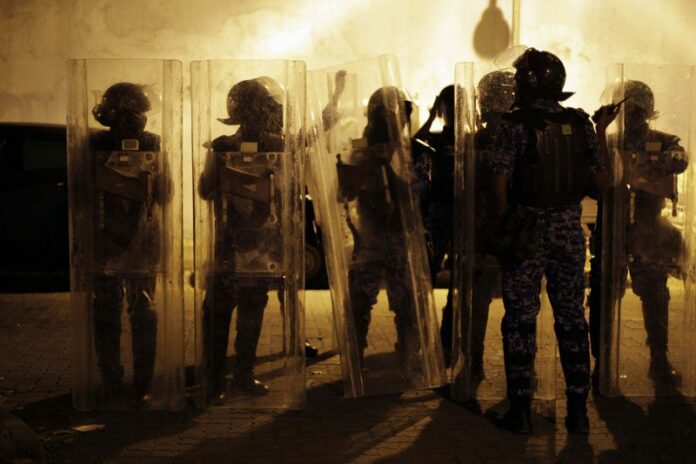
Riot policemen block an area with shields during a protest by supporters of Maldives former President Mohamed Nasheed in November 2013 near the parliament in Male, Maldives. Photo: Sinan Hussain / Associated Press

COLOMBO, Sri Lanka — With most opposition leaders in jail or exile, public protests tightly controlled and courts rendering verdicts decried for lack of due process, the Maldives has nearly slid back to where it was eight years ago: an autocratic state that quashes dissent.

Since assuming power in this Indian Ocean archipelago nation of luxurious seaside resorts just over two years ago, President Yameen Abdul Gayoom has tightened his grip on this fledgling democracy with virtually no challenger.

The opposition is in disarray and freedoms have been restricted. Mohamed Nasheed, a pro-democracy activist who won the 2008 elections, has been sentenced to 13 years in prison, and two defense ministers, including one of Gayoom's allies who fell out of favor, have been given long prison terms. Street protests are banned and rallies that are permitted in restricted places are poorly attended.

Even two of Gayoom's vice presidents have been voted out by allied lawmakers in Parliament. The first fled the country and the second has been arrested for attempting to assassinate the president in a mysterious blast on his speedboat.

"If the ruling party doesn't allow the opposition to function, again the concept of democracy is flawed," said Abbas Faiz, Amnesty International's Maldives researcher. "In today's Maldives the reality is this."


\
Former Maldives President and current opposition leader Mohamed Nasheed, in white, tussles with policemen who stopped him from speaking to journalists Feb. 23, 2015, in Male, Maldives. Photo : Sinan Hussain / Associated Press

The U.S. State Department has called for an end to politically motivated trials and urged the country to "restore confidence and a commitment to democracy and human rights."

It's been a depressing downward spiral for this young democracy of 1,200 coral islands that in 2008 was brimming with hope after holding its first multiparty election, ending the autocratic 30-year rule of Gayoom's half-brother.

During his time in office, Nasheed faced conflicts with the judiciary and bureaucracy. His handling of disputes and controversial steps like locking up the Supreme Court and arresting opposition politicians raised questions about his own abuse of power. His ordering of the arrest of a top sitting judge in 2013 and holding him in secret detention triggered weeks of protests.

Nasheed resigned amid the public outcry and after losing support from a section of the military, but he then battled Gayoom in a contentious 2013 election. The Supreme Court annulled the first round results that showed Nasheed in the lead, and police then delayed a revote giving Gayoom enough time to form a winning coalition.

Gayoom, 56, has steadily concentrated power in his hands and tried to sideline opponents.

After governing coalition party leader resort owner Gasim Ibrahim defected to the opposition last year, his properties were seized by the government and his bank accounts frozen. He fled the country and returned several months later in support of Gayoom's government, and won court cases that gave him back control of his properties and accounts.

Last month, Sheikh Imran Abdulla, leader of the country's conservative Islamic party, was sentenced to a 12-year jail term for instigating violence in a speech during an anti-government protest last year.

Even Gayoom's allies aren't safe. His running mate in the 2013 election was voted out by Parliament and Gayoom appointed an ambitious young loyalist to the post. But within months the new deputy was arrested for plotting to assassinate Gayoom in a blast aboard the presidential speedboat. The government insists it was a bomb but FBI investigators said there is no such evidence. No vice president has been appointed since.

Gayoom also plans to make defamation a criminal offense amid series of media reports and opposition statements implicating him in corruption and money laundering — charges he denies.

Government spokesman Ibrahim Hussain Shihab says democracy is still evolving in the country and that it welcomes support from the international community.

"Maldives is a young democracy; it has one of the most liberal constitutions in the region," he said. "We have independent institutions as well but they are still at the stage of building capacity. The capacity itself is not ideal. We want to work toward that."

In response to criticism from international organizations for failing to protect democratic principles, Shihab acknowledged that the country "may be lacking."

"What we need is guidance and support to rectify problems inherent in this young democracy," he said. "We are open to international support."

The European Union is working with the Maldives to improve its democracy, but recent events raise serious concerns, said Paul Godfrey, the EU's deputy head of mission for Sri Lanka and Maldives.

"We have seen a movement backward from the election in 2013," Godfrey said, "which under the current circumstances don't give us confidence that there could be a free and fair election in 2018."

Story: Krishan Francis / Associated Press

Advertisement

Donald Trump’s Message

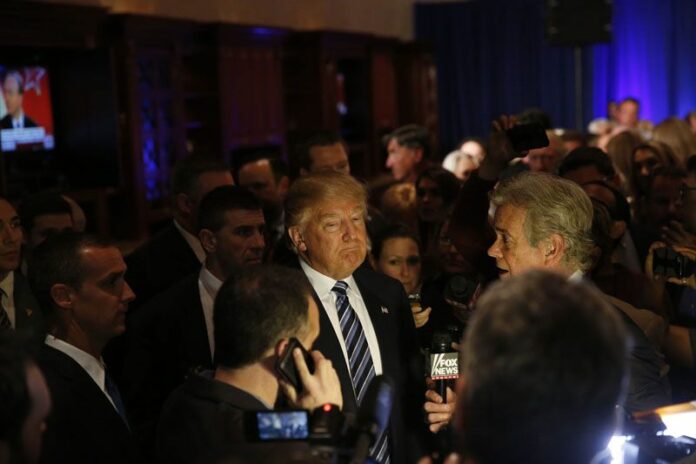
Republican presidential candidate Donald Trump speaks to the media Saturday in Florida. Photo: Brynn Anderson / Associated Press

By Joseph S. Nye

CAMBRIDGE – Donald Trump’s lead in the race for the Republican Party’s nomination as its presidential candidate in November has caused consternation. The Republican establishment fears he will not be able to defeat Hillary Clinton, the likely Democratic nominee. But some observers worry more about the prospect of a Trump presidency. Some even see Trump as a potential American Mussolini.

Whatever its problems, the United States today is not like Italy in 1922. The Constitution’s institutional checks and balances, together with an impartial legal system, are likely to constrain even a reality-TV showman. The real danger is not that Trump will do what he says if he reaches the White House, but the damage caused by what he says as he tries to get there.

Leaders are judged not only on the effectiveness of their decisions, but also by the meaning that they create and teach to their followers. Most leaders gain support by appealing to the existing identity and solidarity of their groups. But great leaders educate their followers about the world beyond their immediate group.

After World War II, during which Germany had invaded France for the third time in 70 years, the French leader Jean Monnet decided that revenge upon a defeated Germany would produce yet another tragedy. Instead, he invented a plan for the gradual development of the institutions that evolved into the European Union, which has helped make such a war unthinkable.

Or, to take another example of great leadership, Nelson Mandela could easily have chosen to define his group as black South Africans and sought revenge for the injustice of decades of apartheid and his own imprisonment. Instead, he worked tirelessly to expand the identity of his followers both by words and deeds.

In one famous symbolic gesture, he appeared at a rugby game wearing the jersey of the South African Springboks, a team that had previously signified South African white supremacy. Contrast Mandela’s efforts to teach his followers about a broader identity with the narrow approach taken by Robert Mugabe next door in Zimbabwe. Unlike Mandela, Mugabe used colonial-era grievances to build support, and now is relying on force to remain in power.

In the US today, while the economy is growing and the unemployment rate is at a low 4.9%, many feel excluded from the country’s prosperity. Many blame rising inequality over the past few decades on foreigners, rather than technology, and it is easy to rally opposition both to immigration and globalization. In addition to economic populism, a significant minority of the population also feels threatened by cultural changes related to race, culture, and ethnicity, even though much of this is not new.

The next president will have to educate Americans about how to deal with a globalization process that many find threatening. National identities are imagined communities in the sense that few people have direct experience of the other members. For the past century or two, the nation-state has been the imagined community that people are willing to die for, and most leaders have regarded their primary obligations to be national. This is inescapable, but it is not enough in a globalizing world.

In a world of globalization, many people belong to a number of imagined communities – local, regional, national, cosmopolitan – that are overlapping circles sustained by the Internet and inexpensive travel. Diasporas are now connected across national borders. Professional groups like lawyers have transnational standards. Activist groups ranging from environmentalists to terrorists also connect across borders. Sovereignty is no longer as absolute as it once seemed.

Former President Bill Clinton has said that he regrets his failure to respond adequately to the genocide in Rwanda in 1994, although he was not alone. Had Clinton tried to send US troops, he would have encountered stiff resistance in Congress. Good leaders today are often caught between their cosmopolitan inclinations and their more traditional obligations to the people who elect them – as German Chancellor Angela Merkel has discovered in the wake of her brave leadership on the refugee crisis last summer.

In a world in which people are organized primarily in national communities, a purely cosmopolitan ideal is unrealistic. We see this in widespread resistance to acceptance of immigration. For a leader to say there is an obligation to equalize incomes globally is not a credible obligation, but to say that more should be done to reduce poverty and disease and help those in need can help to educate followers.

Words matter. As the philosopher Kwame Anthony Appiah puts it, “Thou shalt not kill is a test you take pass-fail. Honor thy father and thy mother admits of gradations.” The same is true of cosmopolitanism versus insularity.

As the world watches the US presidential candidates wrestle with issues of protectionism, immigration, global public health, climate change, and international cooperation, we should ask what aspect of American identities they are appealing to and whether they are educating followers about broader meanings. Are they stretching Americans’ sense of identity as best they can or just appealing to their narrowest interests?

Trump’s proposal to bar Muslims from entering the US and his demands that Mexico pay for a wall to stop migration would be unlikely to pass constitutional or political muster were he elected President. Then again, many of his proposals are not policies designed to be implemented, but slogans crafted to appeal to an insular populist mood among a segment of the population.

Given his lack of a strong ideological core and his celebration of “the art of the deal,” Trump might even prove to be a pragmatic president, despite his narcissism. But good leaders help us define who we are. On that score, Trump has already failed.
 

Joseph S. Nye is a former US assistant secretary of defense and chairman of the U.S. National Intelligence Council, is University Professor at Harvard University. He is the author of 'Is the American Century Over?'

Copyright 2016, Project Syndicate

Advertisement

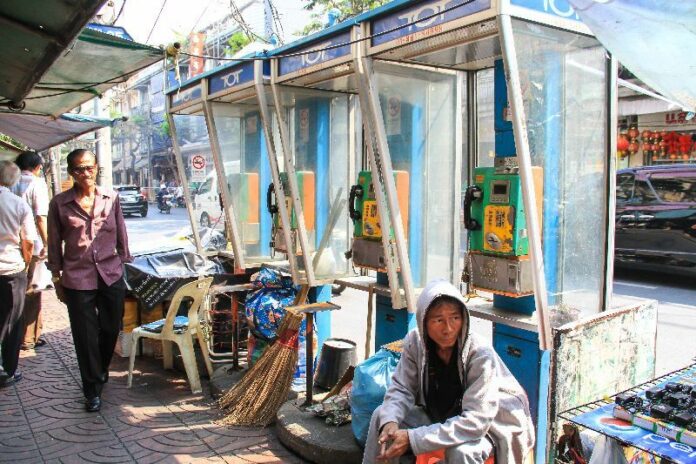
A Salute to Bangkok’s Latest Endangered Species: Phone Booths (Photos)

Vendors and street sweepers store their goods in phone stalls Thursday around Phadung Dao and Charoen Krung roads in Bangkok.

BANGKOK — Red and blue they stand in plexiglass and aluminum and plastic, abandoned and overlooked by eyes accustomed to ignoring them.

Many bear the marks of vandalism; many are broken. But as wandering through parts of Bangkok on Thursday found, the ubiquitous and familiar structures of line-based telephony have found new purposes.

Bangkok’s public telephone booths, 4,000 of which are slated for demolition, have become canvases for graffiti, message boards, garbage dumps, shelters for vendors and storage for merchants. Sometimes they even shelter the homeless, two-legged or four.


Read: Bangkok to Say Goodbye to Telephone Booths


And some, despite seeming obsolete in the smartphone age, maintain an unexpected use: A few city folks were spotted inserting coins, dialing numbers, holding the comically large handset to their ear and speaking into it for a minute or two.

But our divorce from the phone booth past is inevitable. It wasn’t them – it was us. We became enamored of younger, more immediate and intimate technology.

While a cursory review finds payphones have been entirely removed in many countries, including Belgium, Jordan and Sweden, some cities have found creative alternatives. New York replaced them with Wi-Fi hotspots; Osaka turned some into goldfish aquariums. In London, some have been converted into solar-powered recharging stations.

In its announcement this past Monday, City Hall said it was removing them for the sake of a tidier city, saying that they either don’t work, block walkways or are illegally installed.

How many will be left remains unclear, but more details will be announced after district offices are notified and discussions held with the two companies which own most: TOT PLC and True Corp., according to Phuwadol Samankongsak of the Public Works Department.

Before they join gas lamps, horse hitches, street cars and newspaper racks as common urban sights swept away by time and technology, here’s a tribute to the telephone booth.

1457254610 IMG 7293 2
At Soi Phra Chan and Maharaj Road
1457254293 IMG 7174 2
At the corner of Soi Nana and Rama IV Road
1457254660 IMG 7295 2
At Soi Phra Chan and Maharaj Road
1457254699 IMG 7298 2
At Wat Mahathat on Maharaj Road
1457254752 IMG 7299 2
Royal Thai Navy Club House
1457254151 IMG 7155 2
Outside Bangkok Railway Station Hua Lamphong
1457254856 IMG 7286 2
Soi Charoen Krung 17
1457254188 IMG 7164 2
Outside the Krungkasem Srikrung Hotel
\
BTS Mo Chit
\
At Momee Junction, where Rama IV Road turns into Charoen Krung Road
\
Soi Padung Dao and Charoen Krung Road
\
Suapa Market
\
On Maharaj Road
\
Near a bus stop at Chatuchak Park
\
Hua Lamphong Train Station

Related stories:

Bangkok to Say Goodbye to Telephone Booths

Advertisement

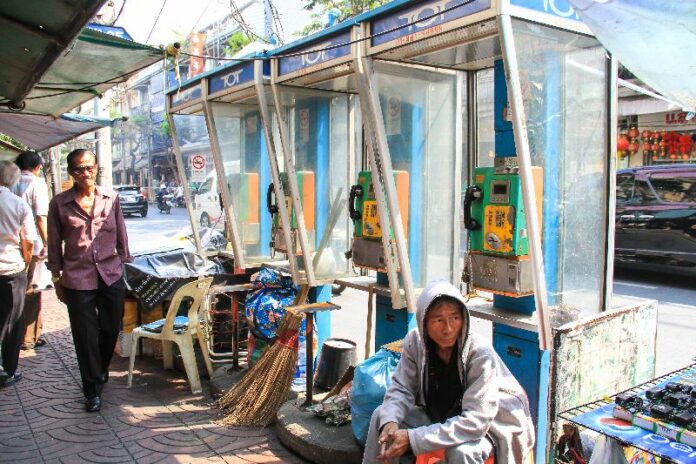
A Salute to Bangkok's Latest Endangered Species: Phone Booths (Photos)

Vendors and street sweepers store their goods in phone stalls Thursday around Phadung Dao and Charoen Krung roads in Bangkok.

BANGKOK — Red and blue they stand in plexiglass and aluminum and plastic, abandoned and overlooked by eyes accustomed to ignoring them.

Many bear the marks of vandalism; many are broken. But as wandering through parts of Bangkok on Thursday found, the ubiquitous and familiar structures of line-based telephony have found new purposes.

Bangkok’s public telephone booths, 4,000 of which are slated for demolition, have become canvases for graffiti, message boards, garbage dumps, shelters for vendors and storage for merchants. Sometimes they even shelter the homeless, two-legged or four.


Read: Bangkok to Say Goodbye to Telephone Booths


And some, despite seeming obsolete in the smartphone age, maintain an unexpected use: A few city folks were spotted inserting coins, dialing numbers, holding the comically large handset to their ear and speaking into it for a minute or two.

But our divorce from the phone booth past is inevitable. It wasn’t them it was us. We became enamored of younger, more immediate and intimate technology.

While a cursory review finds payphones have been entirely removed in many countries, including Belgium, Jordan and Sweden, some cities have found creative alternatives. New York replaced them with Wi-Fi hotspots; Osaka turned some into goldfish aquariums. In London, some have been converted into solar-powered recharging stations.

In its announcement this past Monday, City Hall said it was removing them for the sake of a tidier city, saying that they either don’t work, block walkways or are illegally installed.

How many will be left remains unclear, but more details will be announced after district offices are notified and discussions held with the two companies which own most: TOT PLC and True Corp., according to Phuwadol Samankongsak of the Public Works Department.

Before they join gas lamps, horse hitches, street cars and newspaper racks as common urban sights swept away by time and technology, here’s a tribute to the telephone booth.
 

\
At Soi Phra Chan and Maharaj Road

\
At the corner of Soi Nana and Rama IV Road

\
At Soi Phra Chan and Maharaj Road

\
At Wat Mahathat on Maharaj Road

\
Royal Thai Navy Club House

\
Outside Bangkok Railway Station Hua Lamphong

\
Soi Charoen Krung 17

\
Outside the Krungkasem Srikrung Hotel

\
BTS Mo Chit

\
At Momee Junction, where Rama IV Road turns into Charoen Krung Road

\
Soi Padung Dao and Charoen Krung Road

\
Suapa Market

\
On 
Maharaj Road

\
Near a bus stop at Chatuchak Park

\
Hua Lamphong Train Station


Related stories:

Bangkok to Say Goodbye to Telephone Booths

Advertisement

Dog Pops Up in Driver's Seat when Semi Crashes in Minnesota

This Friday, March 4, 2016 photo shows a semi-truck with a dog in the driver's seat that crashed at a convenience store in Mankato, Minn. Photo: David Stegora / Associated Press

MANKATO, Minnesota — One dog apparently has learned a new trick: how to drive a semi-truck.

Customers at a Minnesota gas station saw a golden Labrador retriever appear to drive the semi across a road Friday.

Mankato police say the idling truck apparently was put into gear, then went through a parking lot, across the street and over a curb.

The Free Press of Mankato reports a passer-by discovered the dog sitting in the driver's seat when he jumped into the truck to stop it.

David Stegora was at the store when he heard the truck smash into a tree and a parked car. He couldn't see the driver, but saw the dog climb up near the driver's side.

Police say the truck was taken off the road. The driver had left the unoccupied truck running in a nearby parking lot.

Story: Associated Press

To reach us about this article or another matter, please contact us by e-mail at: [email protected].

Follow Khaosod English on Facebook and Twitter for news, politics and more from Thailand.

Follow @KhaosodEnglish

\

Advertisement

Groups to Defy Ban on Debating Draft Charter

A graphic announcing changes to a Feb. 28 meeting organized by a group seeking to stage public debates about the proposed constitution before it goes to voters in July. Prachamati, whose website Sunday appears to be unavailable, is one group which plans to stage such events despite them being banned by the ruling junta.

By Pravit Rojanaphruk
Senior Staff Writer

BANGKOK — Critical assessments of the draft charter will continue being made despite the crackdown on dissent, said the coordinator of a group seeking public deliberation on its merits.

Last Sunday on Feb. 28, Yingcheep Atchanont’s group Prachamati was denied access to use the Bangkok Art and Culture Centre after police and soldiers told the venue’s administrator that the group’s activities may constitute a political gathering of five or more peeople, which is banned by the military junta.

“We will continue to go ahead, even if it risks breaking the law,” said Yingcheep, who eventually held a discussion at an alternative venue but said such circumstances are undermining the credibility of the adoption process. “As a result, the next charter may not be regarded as legitimate. But we can’t stop, as we have to foster participation.”

Two days later on March 1, Deputy Prime Minister Wissanu Krea-ngam left no room for doubt by announcing the junta considers illegal any public deliberation except for official events held by the Election Commission.

\That ban on any discussion or campaigning organized by the public isn’t stopping those who believe it is necessary to adopting the law of the land.

Pro-democracy activist group New Democracy Movement also vows to defy the ban or any restriction imposed to prevent them from critically assessing the junta-sponsored draft charter, which goes to voters for adoption or rejection in July. Since its first draft was released in late January, the military government has blocked any critical discussion.

“We will push for our space despite being forbidden,” said Rangsiman Rome, one of the group’s student leaders.

It’s become clear, Rangsiman said, that the junta considers its mission to be pushing for the public endorsement of the draft charter and believes the only space for expression is that which supports the document. That despite wide criticism of it as undemocratic and a means of deepning the military’s hold over the nation.

The Election Commission has proposed those who want to criticize the draft charter can do so at its official events. Rangsiman said the group will use such a venue if it proves fair but will also stage their own public activities after the draft charter's final form is released at the end of March.

Democracy activist Sombat Boonngam-anong, who led a campaign against the previous junta-sponsored draft charter in 2007, said there’s even less space for dissent this time.

“This is not fair. More space should be opened. No country is doing what the [election commission] has suggested,” he said, predicting that keeping people off the streets will only see them further adopt social media to express their displeasure.

Rangsiman agreed, saying the proliferation of social media will be crucial for people for sharing critical views on the topic and will prove difficult for the junta to counter or control.

Related stories:

The Good, Bad and Ugly of Junta’s ‘Anti-Corruption’ Constitution


Advertisement

At Mrauk-U, Living Heritage and Crumbling Splendor in Need of Conservation

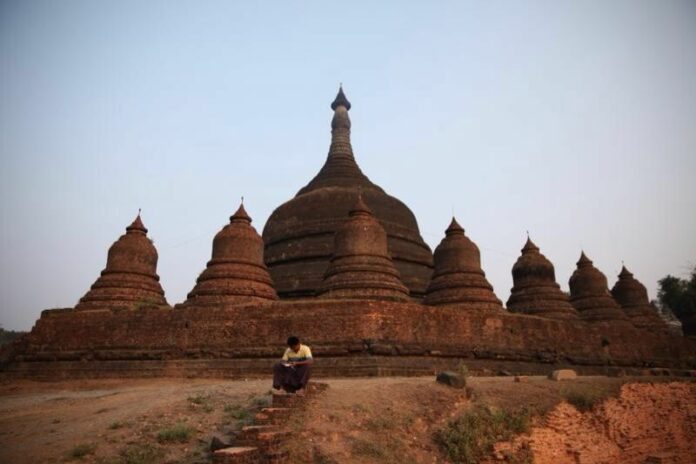
A local man reads a booklet in front of a Marauk-U pagoda. Photo: Thin Lei Win / Myanmar Now

MRAUK-U, Rakhine State — The archeological museum chronicling the ancient Arakan kingdom of Mrauk-U, one of Myanmar’s most important cultural sites, is housed in an unassuming, one-story building with a worn-out sign that has letters missing.

Located on the old palace grounds, it has one main room and three side rooms where you can find intricate stone carvings, exquisite bronze Buddhas and beautiful glazed tiles. Some of the art on display dates back to the 8th century, while much stems from 15th and 16th centuries, when the Arakan Kingdom of Mrauk-U, located in the north of present-day Rakhine State, was at its zenith. 

Low-ceilinged, badly lit, devoid of visitors and with the treasures displayed in a seemingly random manner, the state of the museum reflects the state of this ancient city – full of forgotten, magnificent ruins in urgent need of concerted conservation efforts.

\

 Sun rises over the temples of Mrauk-U, Rakhine State. Photo: Thin Lei Win / Myanmar Now

I actually didn’t come to the town of Mrauk-U on a recent visit to enjoy the sights, but to attend and help moderate the 4th ethnic media conference held here. I also planned to interview Rakhine villagers affected by the December fighting between the rebels of the Arakan Army and the military. The latter plan, however, was scuttled by Myanmar’s notoriously vague and confusing bureaucracy

To visit the affected villages, I was told; I needed permission from the Rakhine State Ministry of Information in Sittwe. But once there, I was informed I needed permission from four other offices, including the Ministry of Border Affairs and Ministry of Immigration and Population, a requirement for which there was no time. In Mrauk-U, the township administrator simply suggested I travel back to Sittwe to gain the necessary authorizations.

Determined not to waste my trip, I decided to visit Mrauk-U, a legendary but difficult to reach heritage site I had long wanted to visit. What I found was a small, dusty but lively town situated among the crumbling splendor of 15th and 16th century Buddhist temples.

\

Intricate carvings of Buddhist scenes are seen in the hallways of the Sitthaung Temple in Mrauk-U. Photo: Thin Lei Win / Myanmar Now

Old-World Feel

The Buddhist zedis in Mrauk-U are dark, its bricks stained with moss as a result of the region’s hot summers and heavy monsoon season. This gives the stupas a more austere, old-world feel, unlike the heavily gilded ones common in Myanmar. Some no longer have roofs and many have vegetation growing around the temples and Buddha statues, reinforcing the feeling that you are seeing things through a filter, or have been transported to a bygone era.

Inside, they evoke awe, with long, secluded stone passageways decorated with intricately carved figurines and thousands of Buddhas in varying shapes and sizes. There aren’t as many pagodas here as in Bagan, the ancient Buddhist complex in central Myanmar, where the authorities have evicted villages from the archeological zone to promote tourism and hotel construction by well-connected companies.

Here, the history is exists amid a bustling ethnic Rakhine community, creating a unique sense of a continued and living history. Mrauk-U was the capital of the Arakan Kingdom, which fell in 1784 to the Burmese Konbaung Dynasty. At the height of their power, Arakanese kings controlled an area covering parts of eastern Bengal, modern-day Rakhine State and western part of lower Myanmar.

Compared to Bagan, Mrauk-U gets a tiny fraction of tourists, partly due to the difficulty of getting there. There are no direct flights and the only way to the site is a three-hour boat ride from Rakhine’s capital Sittwe on the Mrauk-U River, or a lengthy car journey. The uncertainty ahead of the Nov. 8 elections deterred many tourists this year too, locals say, while the town suffered its worst floods in 50 years six months ago, damaging local businesses and worsening the dusty, pot-holed roads.

Another deterrent – one that locals don’t like talk about – is the 2012 communal violence in Mrauk-U and other northern Rakhine townships, which left both Rohingya Muslims and Rakhine Buddhist communities deeply scarred and segregated, and has made international headlines ever since.


Conservation and Restoration, Not Renovation

One of the most famous and impressive sites is the Shitthaung Temple, meaning “80,000 Images”, built in 1535, where five passageways boast 80,000 buddha images, statues and carvings.

Despite its beauty, ill-planned renovation to the temple several years ago by local authorities provides a warning of what could occur if construction methods are applied that damage the historic structures. At Shitthaung stupa, the top was rebuilt using concrete, at odds with the rest of the building material. Not only does it look new and out of place, locals say it is not going to age the same way.


\

Buddha figures seated around Pisi Pagoda, Mrauk-U. Photo: Thin Lei Win / Myanmar Now


Therein lies the dilemma facing Mrauk-U. It sorely needs support and funding to maintain its rich cultural heritage, which are deteriorating rapidly. But if it is to retain its heritage, it is crucially important that ancient structures are conserved and restored, not renovated – as overzealous officials did to many ancient temples in Bagan until they are barely distinguishable from new ones.

In 2014, UNESCO officials began discussions with Myanmar on Bagan’s listing as a World Heritage site, but efforts were complicated by the former junta’s controversial renovations – once called a ‘Disney-style fantasy’ by UN officials – hotel expansion and forced evictions of villages.

At Mrauk-U, archeologists and conservation experts, not bureaucrats and construction companies, should be leading conservation and restoration efforts.

“There’s a plethora of challenges facing conservation of ancient buildings. The city of Mrauk-U was once Southeast Asia’s greatest fortified cantonment,” Khin Than, chairperson of the Mrauk-U Ancient Cultural Heritage Conservation Group, told Myitmakha News Agency recently.

“Tenders were put out for restorations of areas of Mrauk-U, but a great deal of highly valued Rakhine (Arakan) cultural handiworks – found in pagodas, walls and brick walls – were destroyed as those carrying out the restorations were not archaeologists.”

Funding is another major challenge. The same news story said the Rakhine State government had allocated 600 million kyats (17.4 million baht) for conservation for 2015-16 fiscal year to cover the sprawling area with hundreds of temples and other structures.

As we left the archeological museum and palace grounds, we chanced upon a group of men building a wire fence around a pond.

\

An ogre figure stands on the edge of a recently unearthed pond at Mrauk-U palace grounds. Photo: Thin Lei Win / Myanmar Now

Called “Nan Thar Kan” or a pond for palace residents, they recently unearthed the square pond using those funds. The work revealed a stone tablet, stone carvings of a deity and an ogre in each corner (as protection, apparently) and a cascade of old bricks leading down into it. What looked like an ordinary pond is now transformed into a beautiful, historic site.

A supervisor there said at least 10 more feet of sand still needed to be removed to completely uncover the pond. When will that happen, I asked? “We don’t know because we don’t know if, or when we will get more funding,” he said.

Story: Thin Lei Win

To reach us about this article or another matter, please contact us by e-mail at: [email protected].

Follow Khaosod English on Facebook and Twitter for news, politics and more from Thailand.

Follow @KhaosodEnglish

\

Advertisement

China Looks to Ramp up Internet Growth, and its Controls

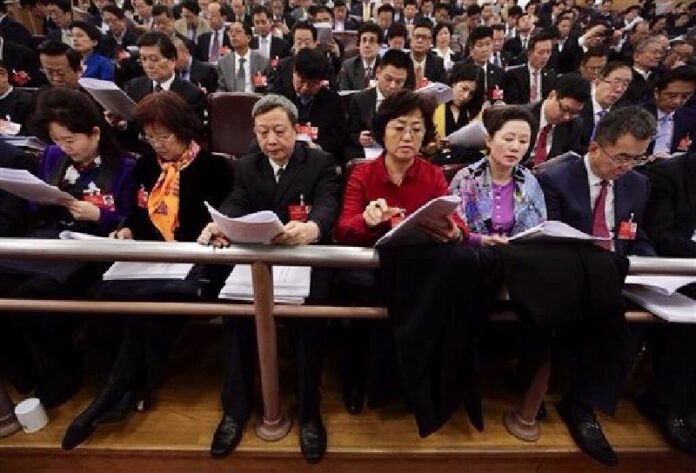
Delegates read the work report delivered by Chinese Premier Li Keqiang during the opening session of the annual National People's Congress at the Great Hall of the People in Beijing, Saturday, March 5, 2016. Photo: Andy Wong / Associated Press

BEIJING — China's government has highlighted big data, encryption technology and "core technologies" such as semiconductors as the key elements of its push to grow into a tech powerhouse, according to a new five-year plan released Saturday that envisages the Internet as a major source of growth as well as a potential risk.

Even as it highlighted the need to improve Internet infrastructure to rural areas and unlock the digital economy's potential, Chinese economic planners called for a more secure and better managed Web, with enhanced Internet control systems, Internet security laws and real-name registration policies.

Chinese officials including Internet czar Lu Wei have played down concerns over what critics have described as China's expanding Web censorship, saying that it is the Chinese government's sovereign prerogative and a necessary measure to maintain domestic order.

China's development plan calls for a better cybersecurity approval system and more "precise" Web management to "clean up illegal and bad information."
The plan also calls for a multilateral, democratic, transparent and international governance system and active participation in international Internet governance efforts.

Premier Li Keqiang highlighted the promise of the Internet, saying Saturday that various traditional sectors, ranging from manufacturing to government to health care, need to connect to the Web and raise their efficiency as part of an overarching national strategy called "Internet Plus." He vowed to raise research and technology spending to account for 2.5 percent of gross domestic product in the five years through 2020, which he said would mark a "remarkable achievement."

The five-year plan calls for all families in large cities to have access to 100 megabyte-per-second Internet service and broadband coverage reaching 98 percent of the population in incorporated villages.

At the same time, Chinese leaders, wary of over-relying on foreign technology, will seek to boost China's homegrown industry and cut down on imports — a strategy that has drawn complaints from trade partners like the United States.

Similar to previous years, when Chinese leaders highlighted industries such as e-commerce as a growth focus, the new draft of China's development plan specifically elevated big data and cloud computing, relatively new and promising fields that Chinese industry experts view as not yet cornered by U.S. companies that dominate other parts of the technology market.

The plan also calls for China to catch up on "core" technologies such as semiconductors and basic computer parts and software, as well as encryption technology.

China's campaign to beef up its chip technology has encountered political resistance from the United States. China's national chip champion, Tsinghua Unigroup, said last month that it would abandon its attempt to acquire a stake in California data storage firm Western Digital, the second deal it has scrapped because of opposition from U.S. regulators who do not want sensitive technology to fall into Chinese hands.

Story: Gerry Shih / Associated Press

To reach us about this article or another matter, please contact us by e-mail at: [email protected].

Follow Khaosod English on Facebook and Twitter for news, politics and more from Thailand.

Follow @KhaosodEnglish

\

Advertisement

Hot News

LATEST NEWS

Bangkok
overcast clouds
30.5 ° C
32.2 °
30.5 °
76 %
4.9kmh
100 %
Sat
30 °
Sun
35 °
Mon
35 °
Tue
33 °
Wed
32 °