A large Plan B Media billboard in Bangkok's downtown district displays the Thai flag.
BANGKOK — Thailand’s business leaders are sounding alarms as political turmoil threatens to stall the economy just as the crucial year-end period approaches. Although the ruling Pheu Thai Party has conceded to becoming the opposition and parliament is scheduled to elect a new prime minister on September 5, the prospect of a minority government still risks creating a budget crisis that could undermine economic recovery.
Budget Crisis Deepens
Thailand has disbursed only 50% of its fiscal 2025 budget after nearly 11 months—well below the 60% historical average. Kriangkrai Tiannukul, chairman of the Federation of Thai Industries, warned that prolonged instability will prevent the government from providing essential economic support when businesses need it most.
Trade Collapse Accelerates
The political paralysis is already hitting trade hard. Cross-border commerce with Cambodia has shrunk 10% this year, with July exports crashing 97% to just 370 million baht. “Entrepreneurs need immediate support, so we need a functioning government as soon as possible,” Kriangkrai said.
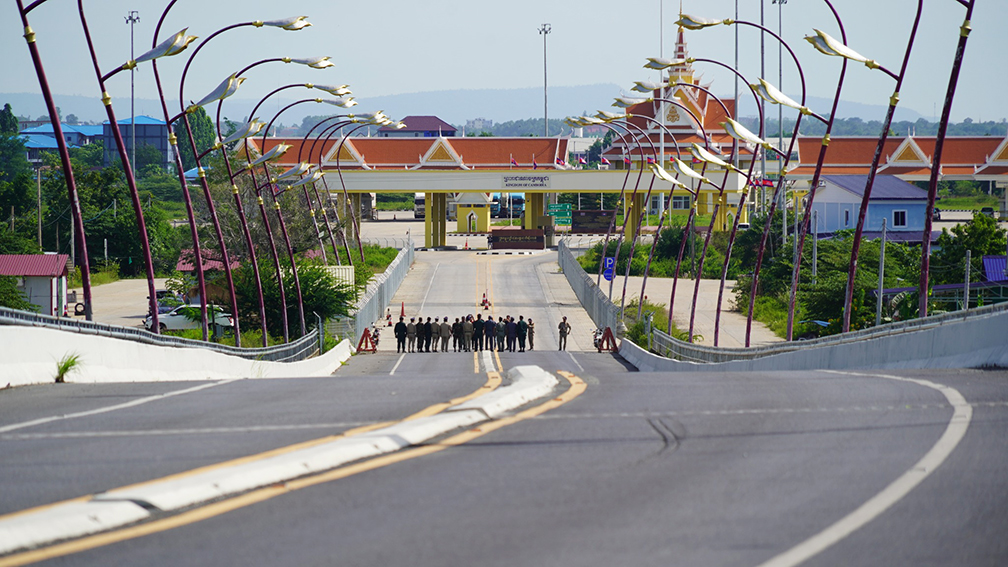
The road in front of the Thai-Cambodia border checkpoint stands empty and quiet after Thailand implemented relaxation measures allowing cross-border vehicle movement for 5 days, but Cambodia continues to reject the proposal, July 21, 2025.
Credit Rating at Risk
Thai Bankers Association chairman Payong Srivanich warns the crisis could trigger a credit rating downgrade, as fiscal spending stalls and corporate investment decisions freeze. The economic slowdown, compounded by political instability, poses serious risks to Thailand’s financial standing.
Year-End Recovery in Jeopardy
Tourism and hospitality leaders fear the worst impact is yet to come. The critical fourth quarter—when government stimulus typically boosts the economy—faces major disruption if parliament dissolves. Despite forecasts of 35-36 million tourist arrivals in 2025, restaurant and hotel operators warn that budget paralysis could derail the sector’s recovery.
Business Leaders Back Compromise
Thai Chamber of Commerce chairman Poj Aramwattananon supports a four-month transitional government as the best path forward. “Businesses want clarity: a legitimate government accepted internationally and capable of running the economy,” he said. While not perfect, this compromise could provide the short-term stability needed to prevent economic damage while political issues resolve.
Bangkok, 3 September 2025 — Forvis Mazars Thailand, a leading international audit, tax, and advisory firm, offers services to support businesses undergoing audits by the Thai Revenue Department, providing guidance and effective assistance throughout the audit process. Aware that tax refund claims often trigger thorough inspections by the Thai Revenue Department, the firm works closely with clients to ensure audit readiness through clear documentation, professional communication, and strategic coordination.
Tax audits, especially those linked to Corporate Income Tax (CIT), Withholding Tax (WHT), Value-Added Tax (VAT), or Stamp Duty (SD) can be time-consuming and complex. Even companies that don’t request refunds may be selected for review due to irregularities such as inconsistent tax reporting, volatile income and expenses, or high retained earnings. Forvis Mazars Thailand’s latest advisory outlines key strategies to help businesses speed up tax refund audits more efficiently.
“Tax refund audits don’t have to be a painful process,” said Vachirawit Kaew-udom, Director, Tax Controversy and Dispute Resolution Services, Forvis Mazars Thailand. “When businesses understand their tax positions, prepare documents thoroughly, and maintain a cooperative attitude, they can significantly reduce audit timelines and improve outcomes.”
The firm advises businesses to take a proactive and strategic approach when applying for tax refunds. This begins with a deep understanding of their own operations and tax and accounting treatments, enabling clear and confident communication with tax officers. Equally important is having all relevant documents well-organized and ready for submission, which helps avoid delays and unnecessary back-and-forth.
Maintaining a respectful and professional relationship with tax authorities, following up regularly, and responding promptly to requests can significantly improve the audit experience. Forvis Mazars also encourages businesses to be realistic about potential audit outcomes and avoid disputing every issue, especially when errors are evident. Engaging a qualified tax advisor is strongly recommended, as expert guidance can help navigate complex regulations, identify risks early, and ensure a smoother, faster refund process.
Forvis Mazars Thailand offers tailored tax advisory services to support businesses throughout the refund process—from risk assessment and documentation to negotiation and resolution. Our team is here to help businesses navigate these challenges. The firm’s deep expertise in Thai tax regulations and audit procedures positions it as a trusted partner for companies seeking efficient and compliant outcomes.
“Our goal is to help businesses move through the refund process with confidence and clarity,” Vachirawit added. “With the right strategy and support, companies can avoid delays and focus on growth.”
This initiative reflects Forvis Mazars Thailand’s broader commitment to delivering client-centric solutions and strengthening its position in the Thai market. As part of its growth strategy, the firm continues to invest in tax advisory, financial consulting, and audit services to meet the evolving needs of Thai businesses.
About Forvis Mazars
Forvis Mazars operates in over 100 countries. In Thailand, the company provides accounting outsourcing, audit, tax, legal, and financial advisory services to clients from diverse industries and countries. Its comprehensive services meet the current and future needs of clients worldwide, consistently delivering exceptional experiences.
Atrial fibrillation affects millions of people worldwide, causing irregular heartbeats that can significantly impact quality of life. Understanding this common heart condition and knowing where to find quality atrial fibrillation treatment is essential for maintaining optimal health. This comprehensive guide explores everything you need to know about Atrial Fibrillation, from recognizing symptoms to finding expert care.
Atrial fibrillation, commonly known as AFib, is the most prevalent type of irregular heartbeat (arrhythmia) affecting people worldwide. This condition occurs when the heart’s upper chambers (atria) beat chaotically and irregularly, disrupting the normal coordination with the lower chambers (ventricles).
Atrial fibrillation is closely associated with an ECG or EKG. A standard ECG (also called an EKG) is the most commonly used test to diagnose atrial fibrillation. It records the heart’s electrical signals and helps identify the irregular rhythm that is characteristic of atrial fibrillation.
Symptoms of Atrial Fibrillation
Early recognition of atrial fibrillation symptoms is vital for timely treatment and complication prevention. Some people experience no symptoms at all while others face symptoms that significantly affect daily life.
Heart palpitations : racing, fluttering, or skipping beats, often described as the heart “flopping like a fish”
Fatigue : due to inefficient blood circulation
Shortness of breath : especially during activity or when lying down
Chest pain or discomfort : from pressure to sharp stabbing pain
Dizziness or lightheadedness : caused by reduced brain blood flow
Confusion or difficulty concentrating
Swelling in legs, ankles, or feet : due to fluid retention
Causes of Atrial Fibrillation
Understanding the root causes of atrial fibrillation allows for better prevention and treatment. The condition often results from a combination of medical, lifestyle, and environmental factors.
Age-Related Factors
Advancing age is a major risk factor for atrial fibrillation, as natural changes in the heart’s electrical system occur over time. The risk of developing atrial fibrillation doubles with each decade after age 55, making age one of the most common underlying contributors.
Cardiovascular Conditions
Several heart-related issues are direct atrial fibrillation causes. High blood pressure (hypertension) forces the heart to work harder, potentially leading to atrial enlargement and rhythm disturbances. Coronary artery disease, heart valve problems, and prior heart attacks also disrupt the heart’s electrical pathways and contribute to atrial fibrillation.
Metabolic and Endocrine Disorders
Metabolic conditions like diabetes and thyroid imbalances are also important atrial fibrillation causes. For example, hyperthyroidism can accelerate heart rate and trigger irregular rhythms, while obesity promotes inflammation and structural changes in the heart.
Lifestyle Factors
Unhealthy habits are frequent atrial fibrillation causes or triggers. Excessive alcohol consumption is a well-known factor. Sleep apnea, intense physical activity, high caffeine intake, and chronic stress can also provoke atrial fibrillation episodes, particularly in individuals with pre-existing vulnerabilities.
Treatment for Atrial Fibrillation
Treating atrial fibrillation effectively requires a personalized, multi-faceted approach. The main goals are to control heart rate, restore normal rhythm, and prevent stroke or other complications.
Medications for Rate Control
Drugs like beta-blockers and calcium channel blockers help slow the heart rate, improving symptoms and reducing strain on the heart.
Medications for Rhythm Control
Antiarrhythmic drugs work to restore and maintain a normal heart rhythm, especially in patients with recurrent atrial fibrillation episodes.
Electrical or Chemical Cardioversion
Used to reset the heart’s rhythm back to normal. This may be done in a hospital setting and is often preceded by imaging or ECG.
Treatment of Underlying Conditions
Managing causes such as hypertension, thyroid disease, or sleep apnea is essential for long-term atrial fibrillation control.
Lifestyle Modifications
Weight management, regular exercise, reducing alcohol and caffeine intake, managing stress, and improving sleep hygiene can enhance treatment effectiveness.
Personalized Atrial Fibrillation Care at Phyathai Hospital
Atrial fibrillation (AFib) is the most common type of irregular heartbeat, causing the heart to beat rapidly and unpredictably. Symptoms may include palpitations, fatigue, dizziness, or sometimes no symptoms at all. Without proper treatment, atrial fibrillation can increase the risk of stroke and other serious complications.
For expatriates in Thailand, personalized atrial fibrillation care can be a challenge. Phyathai Hospital stands out for its high standards, expert staff, and international focus. If you’re experiencing atrial fibrillation symptoms or need expert care in Thailand, early diagnosis and proper management can drastically improve your quality of life and reduce stroke risk.
Zip lining is one of the popular tourist activities in Pai District, Mae Hong Son Province.
MAE HONG SON — Pai police are investigating a tourism business operator following an incident where an 8-year-old Israeli girl fell from a zip line attraction in Pai District, Mae Hong Son Province, sustaining serious injuries.
Mr. Ran, the child’s father, filed a complaint with Pai Police Station on September 1, the day of the accident. He reported that he had taken his family, including two children, to a tourist attraction near Yunlai, Ban Santichon, Wiang Tai Subdistrict, Pai District. While his daughter was using the zip line, she fell to the ground, suffering a broken leg and fractured hip bone. She was transferred for treatment at a hospital in Chiang Mai Province.
Doctors have successfully performed surgery and she is now out of danger and recovering.
Investigation and Shutdown
On September 3, tourist police and local officials inspected the accident site and found that the operator had already partially dismantled the zip line equipment. Authorities ordered the operator to cease all zip line services and completely remove risky structures within 30 days from September 3 onwards. Follow-up inspections will be conducted when the deadline expires.
The operator announced on the Facebook page of Pha Long Dao Resort & Cafe that zip line services will be permanently closed.
Officials inspect the establishment where an Israeli girl fell from a zip line and was seriously injured at Ban Santichon, Wiang Tai Subdistrict, Pai District, Mae Hong Son Province on September 3, 2025.
Legal Compliance Review
Authorities are investigating whether the attraction complied with legal requirements. Generally, zip line operators must obtain permits and maintain several documents, including:
Land use rights documentation with proper title deeds
Construction plans and building permits for the zip line facility
Tour guide licenses and insurance coverage as required by tourism law
Zip line safety standards documentation and regulations
Customer registration records
Daily equipment and system inspection logs
Safety standard certificates for equipment
Officials inspect the establishment where an Israeli girl fell from a zip line and was seriously injured at Ban Santichon, Wiang Tai Subdistrict, Pai District, Mae Hong Son Province on September 3, 2025.
The investigators will focus on verifying whether the business separated adult and children’s equipment, as children wearing adult-sized gear could slip out due to size differences. Equipment and harnesses must meet standards with proper certification from relevant agencies. Most operators use Petzl brand equipment from France, which meets European and international standards.
The agency that issued permits to this establishment could also face charges if found negligent in their oversight responsibilities.
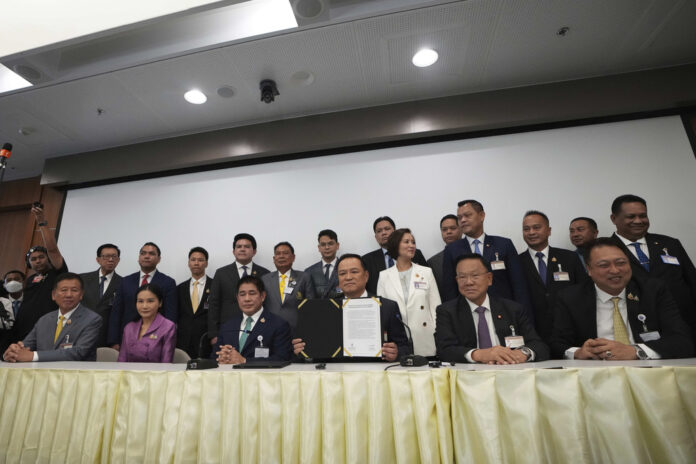
Leader of Bhumjai Thai Party Anutin Charnvirakul, fourth left in front, shows the signed Memorandum of Understanding between his coalition parties and the People's party at Parliament in Bangkok, Thailand, Wednesday, Sept. 3, 2025. (AP Photo/Sakchai Lalit)
By PAPITCHAYA SCHWARZ and GRANT PECK Associated Press
BANGKOK (AP) — Thailand, which has been under a caretaker government since last week, saw competing efforts to resolve its political crisis on Wednesday, as the country’s main opposition party agreed to support its rival to be the next prime minister while the party in power said it wants a new election.
The Pheu Thai party, which heads the caretaker government, announced it was asking the country’s king to dissolve Parliament and call a new poll instead of having the current House of Representatives vote for a new prime minister.
No date has yet been set for a vote in Parliament, nor was it clear if the king would endorse dissolution.
The Constitutional Court last week dismissed Paetongtarn Shinawatra as prime minister for breaching ethics laws in a phone call with Cambodia’s Senate President Hun Sen about tensions over competing claims along their border, which erupted into a deadly five-day armed conflict in July.
King Maha Vajiralongkorn alone is empowered to dissolve Parliament. However, the Council of State, which advises the government on legal matters, suggested that a caretaker prime minister cannot call for dissolution unless a vote for a new prime minister reaches a deadlock.
The opposition People’s Party, the biggest party in Parliament, announced Wednesday morning that its lawmakers would vote to appoint Anutin Charnvirakul, leader of the Bhumjaithai party, as the next prime minister.
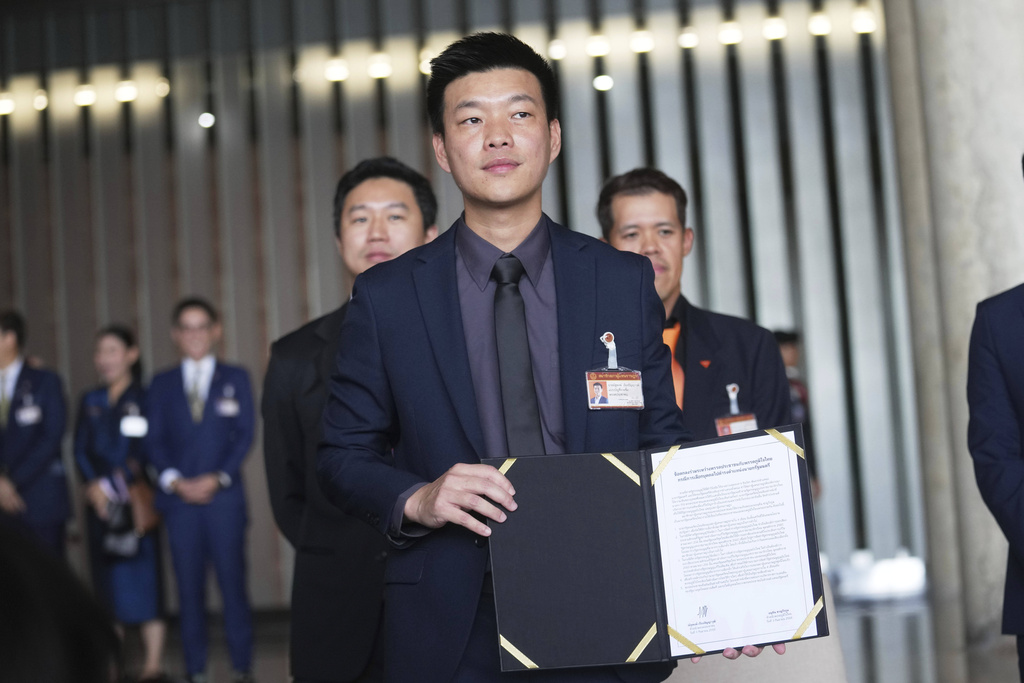
Leader of People’s Party, Natthaphong Ruengpanyawut shows the signed Memorandum of Understanding between his party and Bhumjai Thai Party at Parliament in Bangkok, Thailand, Wednesday, Sept. 3, 2025. (AP Photo/Sakchai Lalit)
People’s Party leader Natthaphong Ruengpanyawut said that the Pheu Thai party had failed to govern effectively in its two years in power.
However, its support is contingent on conditions specified in an agreement signed by Anutin, including that the prospective new government must dissolve the House of Representatives within four months and call a general election.
An Anutin-led government would also commit to organizing a referendum on constitutional amendments to allow the drafting of a new constitution by an elected constituent assembly. The People’s Party has long sought changes in the constitution — which was imposed during a military government — to make it more democratic.
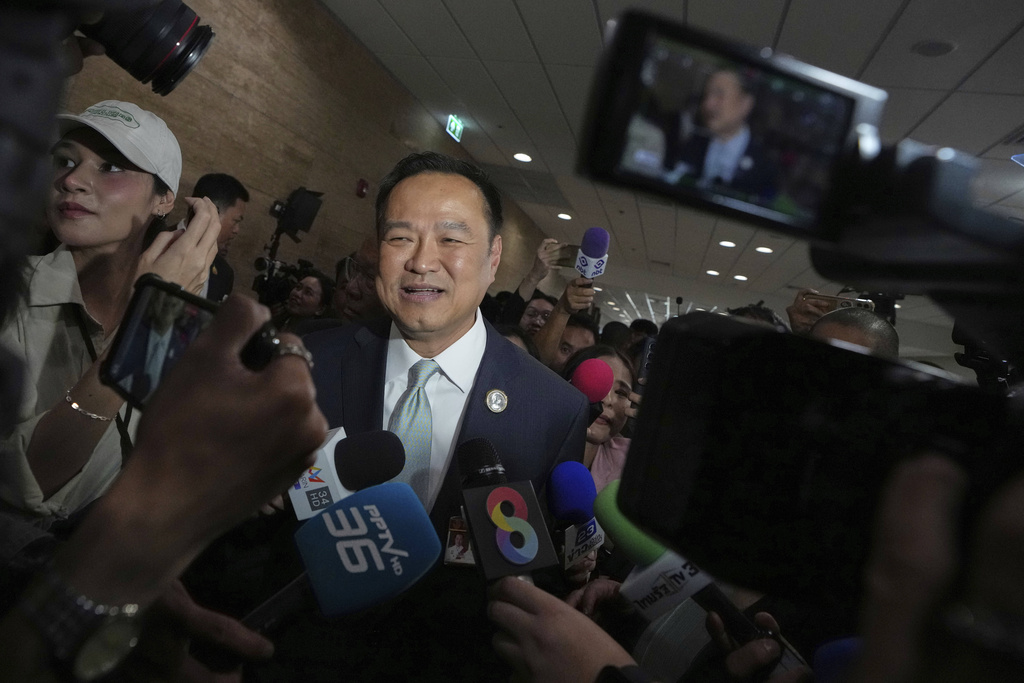
Leader of Bhumjai Thai Party Anutin Charnvirakul leaves after a press conference at Parliament in Bangkok, Thailand, Wednesday, Sept. 3, 2025. (AP Photo/Sakchai Lalit)
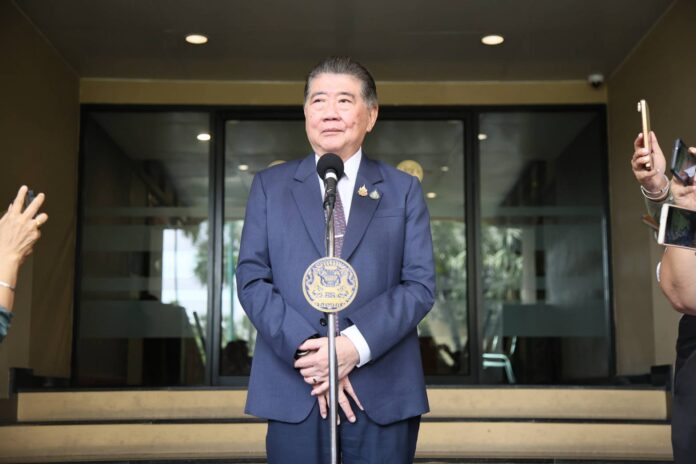
Acting Prime Minister Phumtham Wechayachai, who asked for a royal decree to dissolve Parliament, warned of economic repercussions of a prolonged political crisis. “With all of these problems, our lawmakers think we should return power to the people and let the people decide,” he said.
The People’s Party, then operating under the name the Move Forward Party, had won the most seats in the 2023 election, but was kept from taking power when a joint vote of the House and the Senate failed to approve its candidate. Senators, who were appointed by a military government and were strong supporters of Thailand’s royalist conservative establishment, voted against the progressive party because they opposed its policy of seeking reforms to the monarchy.
The Pheu Thai party then had one of its candidates, real estate executive Srettha Thavisin, approved as prime minister to lead a coalition government. But he served just a year before the Constitutional Court dismissed him from office for ethical violations.
Srettha’s replacement Paetongtarn, former Prime Minister Thaksin Shinawatra’s daughter, also lasted just a year in office. But even before she was forced out, her government was greatly weakened when Anutin’s’s Bhumjaithai Party abandoned her coalition right after her controversial call in June with Cambodia’s Hun Sen. Its withdrawal left Pheu Thai’s coalition with just a tiny and unstable majority in Parliament.
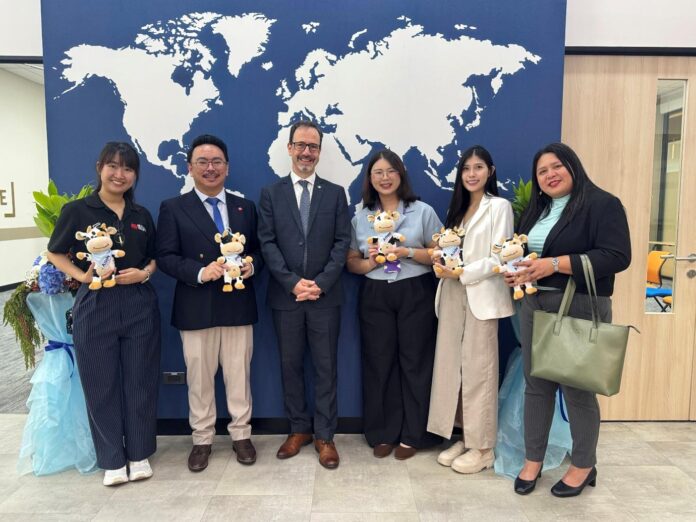
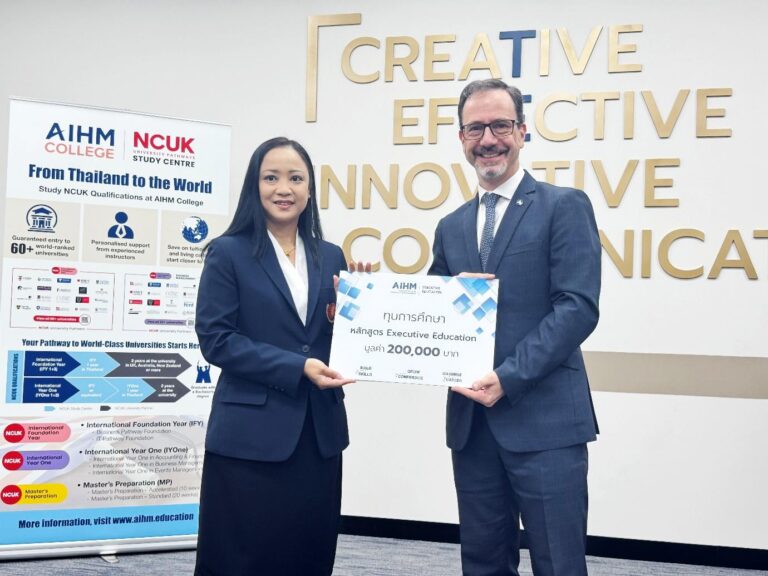
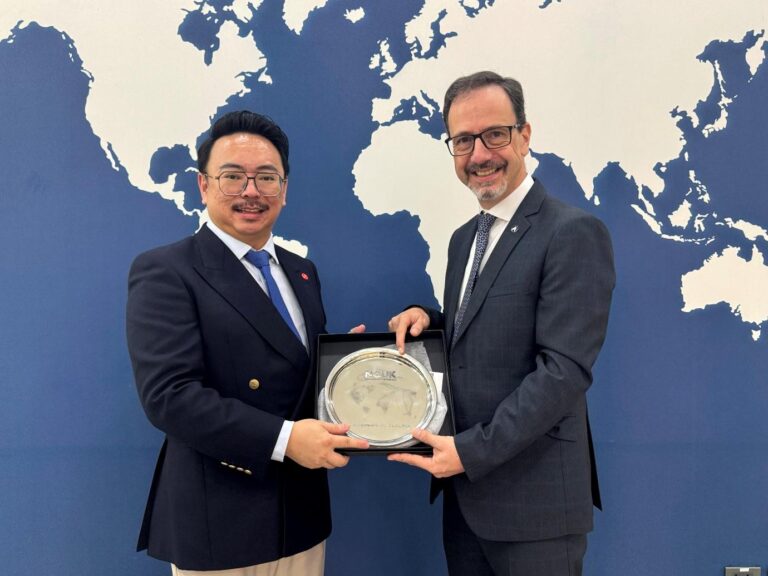
The Asian Institute of Hospitality & Management (AIHM), under Minor Education, today announced the official launch of its partnership with NCUK, becoming a full NCUK Centre in Bangkok.
After successfully piloting the program with its first cohort of 10 students earlier this year, AIHM is now officially delivering the NCUK International Foundation Year in Business. This program provides students in Thailand and Southeast Asia with a direct pathway to leading universities in the UK, Australia, Canada, and New Zealand.
“Over the past five years, AIHM has established itself as a premier higher education institute in hospitality management, inspired by Swiss academic standards and modern pedagogy,” said Chris Meylan, Chief Operating Officer of Minor Education.“With NCUK, we are expanding beyond hospitality to meet the growing demand for international business education. Students can now begin their journey in Bangkok, benefit from AIHM’s world-class teaching environment, and transfer abroad with guaranteed progression opportunities.”
As part of its long-term vision, AIHM will also extend its NCUK offering to include the International Year One and Master’s Preparation programs. These additional pathways reflect AIHM’s commitment to its tagline: “From Thailand to the World.”
“This partnership allows us to prepare students from across Asia with the skills, confidence, and global mindset to succeed in their studies overseas,” Meylan added.
The launch event was attended by representatives from the British Embassy, NCUK executives, education agents, and members of the press.
With this new chapter, AIHM reinforces its mission to diversify academic offerings, expand beyond hospitality, and create life-changing opportunities for students aspiring to study abroad.
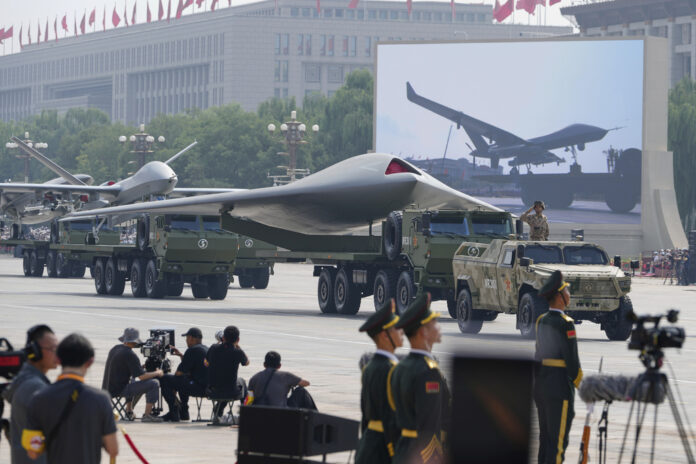
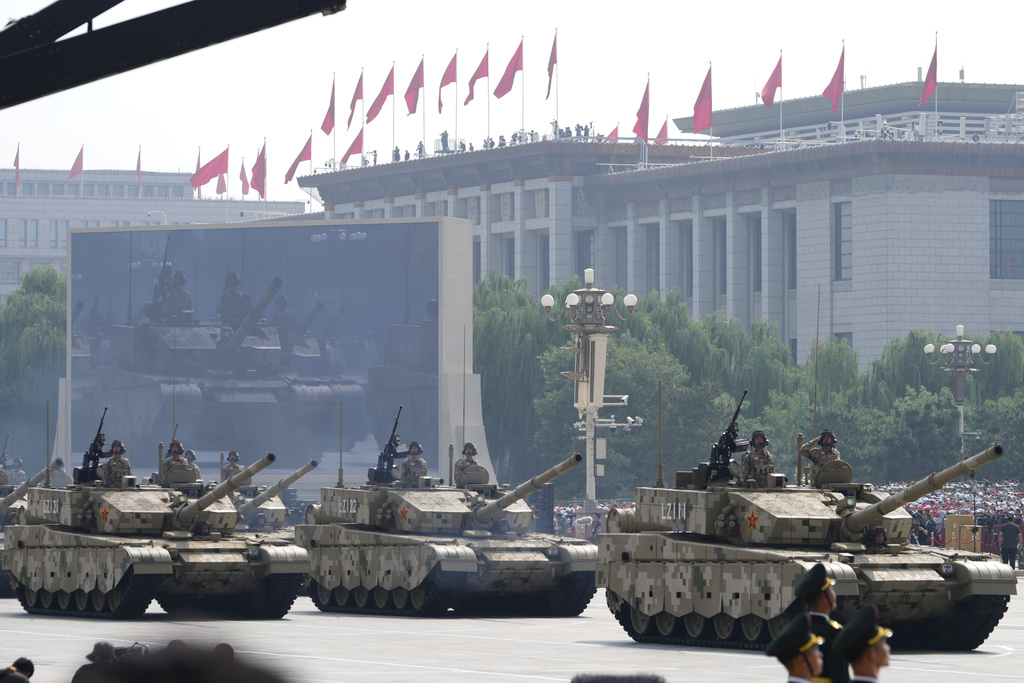
Military equipment passes during the military parade to commemorate the 80th anniversary of Japan's World War II surrender held in front of Tiananmen Gate in Beijing, Wednesday, Sept. 3, 2025. (AP Photo/Ng Han Guan)
BEIJING (AP) — Chinese leader Xi Jinping said humanity must choose between peace and war and dialogue and confrontation in a speech Wednesday before a major military parade marking the 80th anniversary of the end of World War II.
Xi started a brief address by remembering the Chinese veterans of the war and called for the eradication of the roots of war to prevent history from repeating itself. But his main message was forward looking: Today, China is strong, fears no one and is ready to take a leading role in the world.
“The Chinese people are a people that are not afraid of violence and are self-reliant and strong,” he said. “We will adhere to the path of peaceful development and work hand in hand with people of all countries to build a community with a shared future for mankind.”
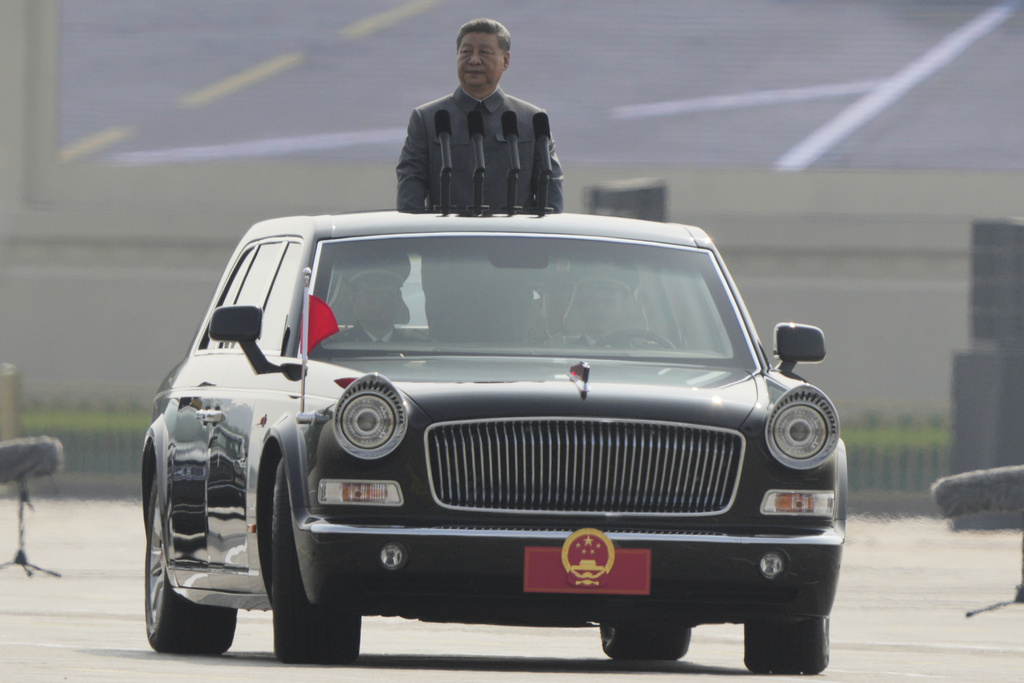
Chinese President Xi Jinping inspects the troops ahead of a military parade to commemorate the 80th anniversary of Japan’s World War II surrender held in front of Tiananmen Gate in Beijing, Wednesday, Sept. 3, 2025. (AP Photo/Andy Wong)
A limousine ride and modern military hardware
The parade, which lasted about 90 minutes, showcased missiles, fighter jets and other military hardware, some of it displayed publicly for the first time.
The event began with troops marching in rhythmic lockstep, their boots echoing off the pavement, to be reviewed by Xi, who heads China’s military as chairman of the Central Military Commission.
Xi rode by the entire length of their formations along Beijing’s central Chang’an Avenue in a classic black limousine. He stood up through the vehicle’s sunroof with four microphones lined in front of him and greeted flanks of personnel as he passed them and rows of armaments and military vehicles.
They shouted back mottos in unison such as “We serve the people.”
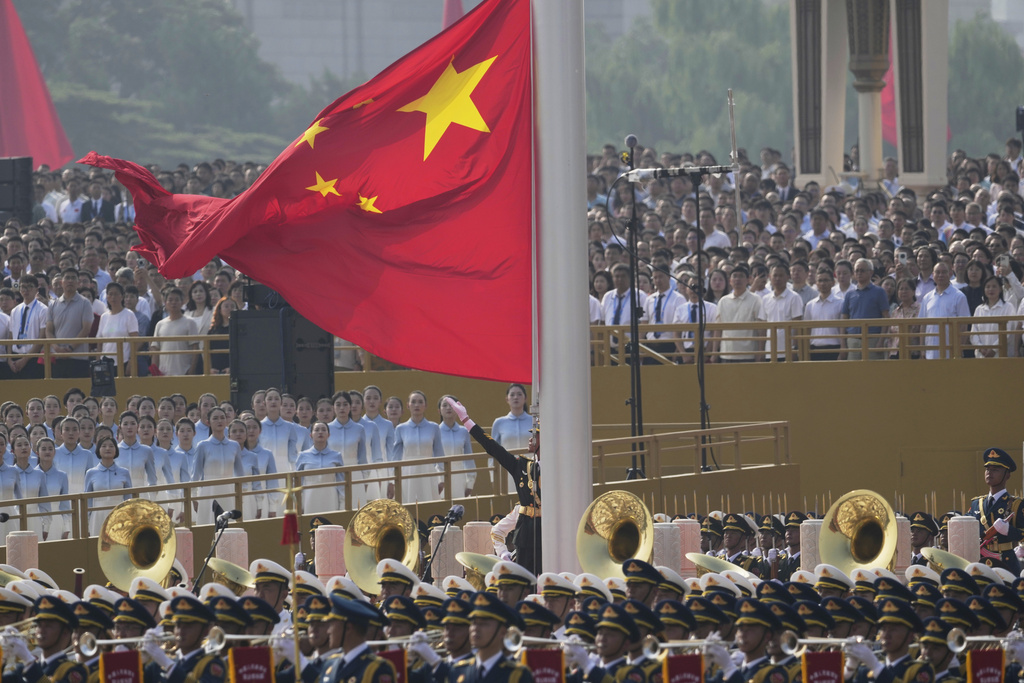
The Chinese flag is raised ahead of a military parade to commemorate the 80th anniversary of Japan’s World War II surrender held in front of Tiananmen Gate in Beijing, Wednesday, Sept. 3, 2025. (AP Photo/Ng Han Guan)
Drone submarines and hypersonic missiles
Highlights of the weaponry in the parade included:
Hypersonic missiles designed to take out ships at sea. They are of particular concern to the U.S. Navy, which patrols the western Pacific from its 7th Fleet headquarters in Japan.
Underwater drones including the AJX002, a long, black, tube-shaped craft that looks like a narrow submarine with a rear propeller.
A new intercontinental ballistic missile, the DF-61, which could carry nuclear warheads to distant targets.
Helicopters take part in a military parade to commemorate the 80th anniversary of Japan’s World War II surrender held in front of Tiananmen Gate in Beijing, Wednesday, Sept. 3, 2025. (AP Photo/Andy Wong)
Fighter jets and bombers flew across the sky, some painting rows of different-colored exhaust in unison. Helicopters flew in formation, one group of 26 spelling out the number “80” for the war’s anniversary year.
Before Xi spoke, the ceremony began with an 80-gun artillery salute, followed by the national anthem, the “March of the Volunteers,” a song composed in 1935 during the early years of resistance against invading Japanese forces.
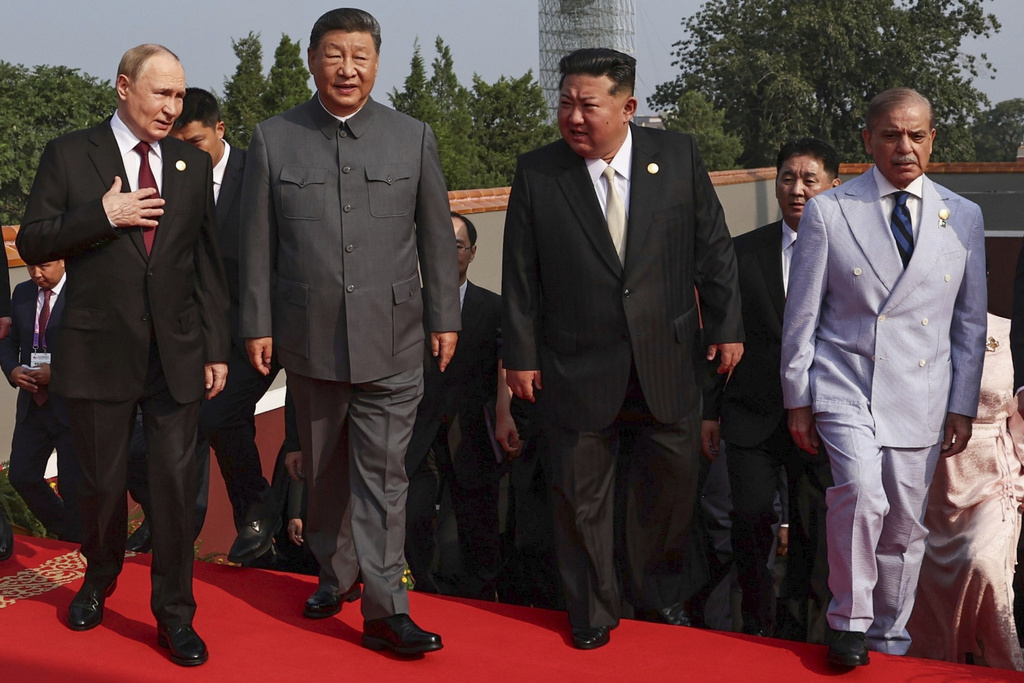
From left, Russian President Vladimir Putin, Chinese President Xi Jinping, North Korean leader Kim Jong Un and Pakistani Prime Minister Shehbaz Sharif arrive at a military parade to commemorate the 80th anniversary of Japan’s World War II surrender held in front of Tiananmen Gate in Beijing, China, Wednesday, Sept. 3, 2025. (Alexander Kazakov, Sputnik, Kremlin Pool Photo via AP)
Putin and Kim flanked Xi as they made their way to the platform overlooking Tiananmen Square. They paused to shake hands with five WWII veterans, some older than 100.
As the parade got underway, U.S. President Donald Trump said on social media that the big question is whether Xi will recognize the contributions of Americans who fought in the war.
“Please give my warmest regards to Vladimir Putin, and Kim Jong Un, as you conspire against The United States of America,” he added.
The U.S. eyed the gathering of the three leaders warily, as well as a 10-nation summit meeting in China on Monday that brought together Xi, Putin and Indian Prime Minister Narendra Modi.
Xi’s remarks did not mention the U.S. by name but expressed his gratitude to foreign countries that helped China resist the Japanese invasion.
A display of military strength for its own people
Domestically, the commemoration of the anniversary is a way to show the progress made by China, which was a major front in the war where millions died as a result of Japan’s invasion.
Armoured vehicles take part in a military parade to commemorate the 80th anniversary of Japan’s World War II surrender held in front of Tiananmen Gate in Beijing, Wednesday, Sept. 3, 2025. (AP Photo/Ng Han Guan)
The military parade was also a show of strength to boost support for the Communist Party and its leader, Xi, domestically and a way to portray itself as a global alternative to the American-dominated postwar era.
“The Chinese people’s rejuvenation cannot be blocked, and the noble goal of the peaceful development of human civilization must triumph,” Xi said at the end of his speech.
The marching formations from the People’s Liberation Army ranged from traditional army and navy units to new ones such as a cyberspace unit that oversees information security.
The PLA was a heroic military “the people and the Party can trust and rely on completely,” Xi said, adding that the army’s task was to safeguard the country’s sovereignty and unification, a reference to China’s claim over the self-ruled island of Taiwan.
Acting Prime Minister Phumtham Wechayachai speaks at Government House on September 3, confirming he submitted a royal petition to dissolve parliament on September 2, 2025. (KHAOSOD Photo/Chavalit Panyong)
In the end, the hatred towards Bhumjaithai Party leader Anutin Charnveerakul and the perception that he was a junior figure under former PM Thaksin Shinawatra, almost like a former subordinate of Thaksin, who is now trying to compete for power.
This led to the Pheu Thai Party now pushing for the dissolution of Parliament. As for the People’s Party, yesterday’s actions seemed like an attempt to gauge the reaction from the Pheu Thai Party if they were to choose Anutin and what the Pheu Thai Party would do.
The powers-that-be in Pheu Thai probably see Anutin as having broken away and attempting to take over the role of a middleman or deep-state agent to prevent the Move Forward Party from forming a government and gaining power.
P.S. Right now, Anutin is projecting an air of self-confidence, and is hoping that the dissolution of Parliament will somehow not succeed.
Anna Wintour appears at The Metropolitan Museum of Art's Costume Institute benefit gala in New York on May 6, 2019, left, and Chloe Malle appears at The Metropolitan Museum of Art's Costume Institute benefit gala in New York on May 1, 2023. (Photos by Evan Agostini/Invision/AP)
NEW YORK (AP) — Anna Wintour ended weeks of fashion-world speculation Tuesday when she named Chloe Malle her successor as head of editorial content at Vogue — but the most powerful person in the business isn’t going anywhere.
Wintour, 75, remains chief content officer for Condé Nast and global editorial director of American Vogue and the magazine’s 27 other editions. Malle, editor of Vogue.com, may be stepping into Wintour’s low-heeled slingbacks but she’ll report to the original wearer while taking over day-to-day editorial and creative operations at the U.S. edition. And gone is the storied “editor-in-chief” title that Wintour held for nearly 40 years.
Malle, 39, is the daughter of actor Candice Bergen and the late French director Louis Malle. She joined Vogue as social editor in 2011, moved on to contributing editor in 2016 and has held her current position since 2023. She steered all digital content for Vogue. In June, Malle interviewed the then-Lauren Sánchez ahead of her wedding to Jeff Bezos.
“Vogue has already shaped who I am, now I’m excited at the prospect of shaping Vogue,” Malle said in the announcement.
Anna Wintour attends The Metropolitan Museum of Art’s Costume Institute benefit gala celebrating the opening of the “Superfine: Tailoring Black Style” exhibition on Monday, May 5, 2025, in New York. (Photo by Evan Agostini/Invision/AP)
Malle had emerged as a front-runner
Since late June, when Wintour told staff that she was giving up her title, a handful of names to succeed her were tossed around. Among them were Eva Chen, vice president of fashion partnerships at Meta; Nicole Phelps, global director of Vogue Runway and Vogue Business; and Sara Moonves, editor-in-chief of W magazine.
Other names that floated about soon after the job went up for grabs are Vogue’s fashion news director Mark Holgate, British Vogue’s head of editorial content Chioma Nnadi and Vogue.com’s digital style director Leah Faye Cooper. Malle and Nnadi co-host the Vogue podcast, “The Run-Through with Vogue.”
The news that Malle got the job comes ahead of the latest round of shows at New York Fashion Week, starting next week, and amid the Venice Film Festival, which includes a new documentary about her father. Her appointment is effective immediately. Malle’s mother, funnily enough, once played Vogue editor-in-chief Enid Frick on “Sex and the City” with some very Wintour-like characteristics.
Malle, a Brown graduate and mother of two young kids, has been outspoken about her liberal-leaning politics, just as Wintour has.
FILE – Candice Bergen, right, and her daughter Chloe Malle arrive at the 76th annual Golden Globe Awards at the Beverly Hilton Hotel on Jan. 6, 2019, in Beverly Hills, Calif. (Photo by Jordan Strauss/Invision/AP, File)
“I actually love working with Anna, because I love someone telling me exactly what needs to be done and exactly what she thinks about something,” Malle said in a recent profile by the Independent. “There’s no indecision. There’s no ambiguity.”
Vogue’s past, and future
Vogue was founded as a society journal 134 years ago. After Condé Nast acquired it in 1909, it became a traditional industry mainstay with models on the cover, static close-up photography done in studios and a focus on high fashion and heavy makeup.
Wintour, a risk-taker who took over the title in 1988, saw the mass appeal in a broader approach. She expanded international editions, elevated fashion’s connections to pop culture and began putting celebrities, athletes, music stars and politicians on the covers. Wintour went for a high-low approach to fashion and favored storytelling in photo shoots done outdoors.
She embraced then-emerging designers, including Marc Jacobs, John Galliano and Alexander McQueen, through initiatives like the CFDA/Vogue Fashion Fund. And she transformed the Met Gala from a small, private fundraiser to a global event and fashion’s most important night.
Considered the fashion bible, American Vogue has had several notable editors throughout its history. Preceding Wintour were Diana Vreeland (1963 to 1971) and Grace Mirabella (1971 to 1988), among others.
“Chloe has proven often that she can find the balance between American Vogue’s long, singular history and its future on the front lines of the new,” Wintour said in the statement on Malle’s appointment.
FILE – Joan Rivers, Paloma Picasso and Vogue editor Anna Wintour attend a benefit dinner for the American Suicide Foundation at the Waldorf Astoria in New York on May 3, 1991. (AP Photo/Luiz Ribeiro, File)
Under Malle’s leadership, direct traffic to Vogue.com doubled, with massive growth across all key metrics, according to the statement on her new job. Site traffic now consistently reaches 14.5 million unique visitors monthly.
The retirement of the editor-in-chief title brings Vogue in line with changes throughout the Condé Nast universe. When Radhika Jones stepped down as Vanity Fair’s editor-in-chief earlier this year, her role was replaced by a “global editorial director,” found in Mark Guiducci. (Guiducci himself was tapped from Vogue, where he served most recently as creative editorial director.) American Vogue joins most every market where Condé Nast operates in the change to a head of editorial content, who reports to a global editorial director.
Though Vogue has editions spanning the world, from Britain and France to China and India, Malle’s focus will be on American Vogue.
Anna Wintour’s own future
As Condé Nast’s chief content officer, Wintour will continue to oversee every brand, including Vogue, Wired, Vanity Fair, GQ, AD, Condé Nast Traveler, Glamour, Bon Appétit, Tatler, World of Interiors, Allure and more, with the exception of The New Yorker, where editor David Remnick retains control.
Wintour herself does have a boss. She reports to Roger Lynch, CEO of Condé Nast.
“In effect, the addition of a new editorial lead for Vogue US will allow Wintour greater time and flexibility to support the other global markets that Condé Nast serves,” said a Vogue statement in June.
“And it goes without saying,” Wintour joked back then, “that I plan to remain Vogue’s tennis and theater editor in perpetuity.” She’s been a regular at this year’s US Open, as in past years.
She’ll remain at the helm of the annual Met Gala, a major fundraiser for the fashion wing of the Metropolitan Museum of Art. And she’ll stay involved in Vogue World, a traveling fashion and cultural event the magazine began in 2022.
Wintour explained the editor-in-chief shift this way:
“Anybody in a creative field knows how essential it is never to stop growing in one’s work. When I became the editor of Vogue, I was eager to prove to all who might listen that there was a new, exciting way to imagine an American fashion magazine,” she told staff.
“Now, I find that my greatest pleasure is helping the next generation of impassioned editors storm the field with their own ideas, supported by a new, exciting view of what a major media company can be,” she said.
Police arrest a Nigerian man and his Thai wife at their condominium room on Sri Nakarin Road in Samrong Nuea subdistrict, Muang district, Samut Prakan province on September 2, 2025.
BANGKOK — A Nigerian man who illegally entered Thailand was arrested along with his Thai wife on Tuesday for drug trafficking operations in the Sukhumvit district.
Mr. Ukwe, 33, a Nigerian national, and his Thai wife Ms. Kesini, 30, were arrested at their condominium room on Sri Nakarin Road in Samrong Nuea subdistrict, Muang district, Samut Prakan province on September 2. The arrest followed a Metropolitan Police investigation that revealed the couple’s drug trafficking activities in the Sukhumvit area.
Officers from the Child and Women Welfare Division conducted surveillance operations that led to the suspects’ capture at their residence. Authorities seized 99 grams of Category 2 narcotics (cocaine), three mobile phones, and other evidence. Police also confiscated assets related to serious drug offenses valued at over 700,000 baht ($21,660).
Police question a Nigerian suspect for drug trafficking at Samrong Nuea Police Station, Samut Prakan province on September 2, 2025.
Both suspects confessed to illegally entering Thailand through natural border crossings in Nong Khai province. They admitted to purchasing drugs in the Sukhumvit area and distributing them in the Sri Nakarin district, with the woman renting the room and opening bank accounts to receive drug money transfers.
Police charged both suspects with jointly trafficking Category 2 narcotics (cocaine) by possession for distribution without authorization, constituting commercial activity that promotes drug proliferation among the public.
The Nigerian man faces additional charges as a foreign national for entering and remaining in Thailand without permission or with expired authorization. Both suspects have been transferred to Samrong Nuea Police Station investigators for legal proceedings.