30 C
Bangkok
Saturday, June 27, 2026
Home Blog Page 3019

66-Year-Old Bookseller Sentenced to 3 Years for Lese Majeste

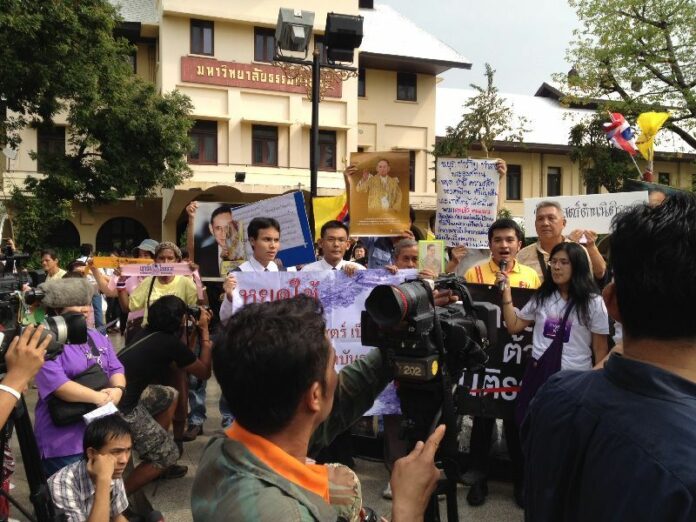
Hardline royalists rally in support of Thailand's lese majeste law at Thammasat University in Bangkok, 2 February 2012 [photo by Matichon]

(Prachatai English)

BANGKOK – An Appeal Court on Wednesday sentenced a 66-year-old bookseller to two years in jail under Thailand's lese majeste law for selling a banned book. 

Bangkok’s Southern Criminal Court on Wednesday morning overturned the Court of First Instance’s ruling to acquit the defendant, who was accused of violating Article 112 of the Criminal Code, a law known as lese majeste law, and sentenced him to three years imprisonment. 

The jail term was reduced to two years because the defendant was cooperative during the trial. However, the court did not suspend the jail term.

Read the rest of the story here


Note: Khaosod English is not responsible for content on other websites.

Advertisement

Ivory Holders Rush to Meet Thai Government Deadline

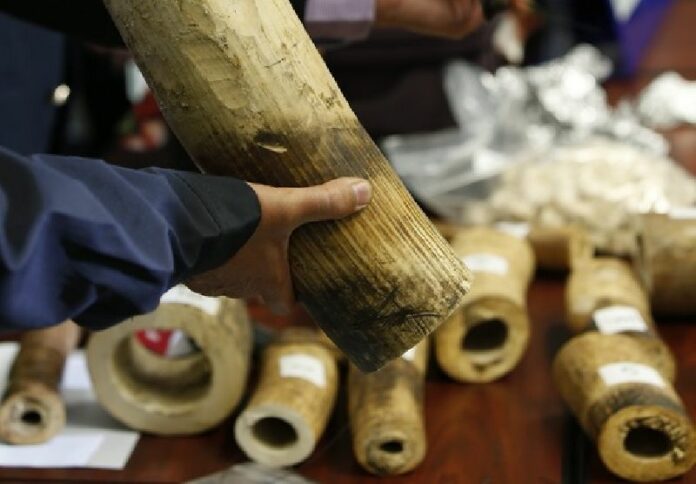
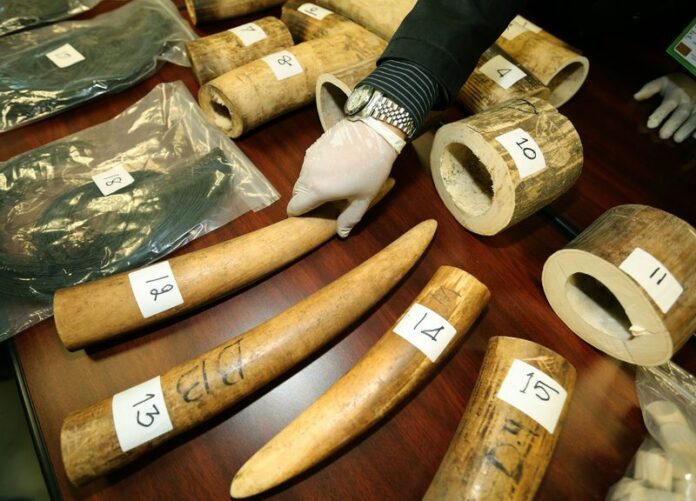
Thai customs officers display confiscated smuggled African elephant tusks during a press conference at Suvarnabhumi Airport in Bangkok, 17 April 2015. EPA/NARONG SANGNAK

BANGKOK (DPA) — Some 3,000 ivory collectors rushed to declare their holdings on the last day of a Thai government plan aimed at curbing the international trade in elephant tusks, reports said Wednesday.

Private owners of ivory products were required to list each item with the Department of National Parks, Wildlife and Plant Conservation by Tuesday or face a fine of up to 3 million baht (93,000 dollars).

\
Thai customs officers display confiscated smuggled African elephant tusks during a press conference at Suvarnabhumi Airport in Bangkok, 17 April 2015. EPA/NARONG SANGNAK

Ivory shop owners who fail to report their inventory before the deadline face a fine of up to 6 million baht and three years in prison.

More than 25,000 ivory collectors, including the 3,000 who reported Tuesday, have declared about 155 tonnes of ivory objects, including more than 23,300 pieces of tusk, since the new Thai elephant ivory law came into force on January 22, according to department director-general Nipon Chotiban.

"We've received good cooperation from all stakeholders," the Bangkok Post quoted Nipon as saying. "Such success is beyond our expectations."

He estimated that fewer than 30 percent of all ivory items nationwide remain to be reported to authorities.

The new ivory law was passed after the Convention on International Trade in Endangered Species of Wild Fauna and Flora (Cites) threatened to impose an international wildlife trade ban on Thailand, a member of Cites, if it failed to crack down on the illegal ivory trade.

On Monday the Thai Customs Department announced it had seized its biggest-ever haul of illegally imported African ivory at Bangkok's main port, including 739 tusks with an estimated value of 200 million baht.


For comments, or corrections to this article please contact: [email protected]

You can also find Khaosod English on Twitter and Facebook
http://twitter.com/KhaosodEnglish
http://www.facebook.com/KhaosodEnglish


Advertisement

Ivory Holders Rush to Meet Thai Government Deadline


A Thai customs officer displays some of the seized smuggled African elephant tusks before a press conference at the Customs Department inside the Suvarnabhumi Airport in Bangkok, Thailand, 17 April 2015. EPA/NARONG SANGNAK

BANGKOK (DPA) — Some 3,000 ivory collectors rushed to declare their holdings on the last day of a Thai government plan aimed at curbing the international trade in elephant tusks, reports said Wednesday.

Private owners of ivory products were required to list each item with the Department of National Parks, Wildlife and Plant Conservation by Tuesday or face a fine of up to 3 million baht (93,000 dollars).

\
Thai customs officers display confiscated smuggled African elephant tusks during a press conference at Suvarnabhumi Airport in Bangkok, 17 April 2015. EPA/NARONG SANGNAK

Ivory shop owners who fail to report their inventory before the deadline face a fine of up to 6 million baht and three years in prison.

More than 25,000 ivory collectors, including the 3,000 who reported Tuesday, have declared about 155 tonnes of ivory objects, including more than 23,300 pieces of tusk, since the new Thai elephant ivory law came into force on January 22, according to department director-general Nipon Chotiban.

"We've received good cooperation from all stakeholders," the Bangkok Post quoted Nipon as saying. "Such success is beyond our expectations."

He estimated that fewer than 30 percent of all ivory items nationwide remain to be reported to authorities.

The new ivory law was passed after the Convention on International Trade in Endangered Species of Wild Fauna and Flora (Cites) threatened to impose an international wildlife trade ban on Thailand, a member of Cites, if it failed to crack down on the illegal ivory trade.

On Monday the Thai Customs Department announced it had seized its biggest-ever haul of illegally imported African ivory at Bangkok's main port, including 739 tusks with an estimated value of 200 million baht.


For comments, or corrections to this article please contact: [email protected]

You can also find Khaosod English on Twitter and Facebook
http://twitter.com/KhaosodEnglish
http://www.facebook.com/KhaosodEnglish


Advertisement

Thai School Director Transferred for Banning Hijab

First year students at Rajabhat Songkhla University, September 2014. [Photo: Estafan Naranode].

BANGKOK — The director of a public school in southern Thailand has been transferred from her post after barring Muslim students from wearing hijabs in school, a government official said today.

The director of Baan Nai Yong School, Wisutsri Yungpongsapat, had claimed that the traditional Islamic head coverings violated state regulations for student uniforms.

Yet according to  sec-gen of the Office of the Basic Education Commission (OBEC), state regulations allow Muslim students to wear hijabs in public schools, as long as the cloth is a plain color, not longer than 120 cm in length, and pinned together under the chin of the wearer. 

"I believe that director of the school was new in her post, so she did not have understanding about identity, so she imposed the ban, and caused protests in the area," the OBEC sec-gen, Kamol Rodklai, told reporters yesterday.

Baan Nai Yong School is located in Phang Nga province in southern Thailand, where Muslims make up a sizable portion of the population in contrast to the rest of the Buddhist-dominated country.

Kamol said the school director has been transferred and the ban, which drew protests from local Muslim residents and activists, has been repealed. 

In an interview last week with White News, a Thai TV channel focused on issues related to Islam, Witsutri said the ban was necessary to prevent "divisions" at the school. 

"Muslim children can veil their heads at home. When they are at school, they have to obey the school regulations," Wisutsri was quoted as saying by White News. "Don't bring divisions to my school. Nowadays, there's already problem in the three southern provinces, isn't that enough?" 

Wisutsri was referring to the decade-long insurgency in Pattani, Yala, and Narathiwat – a region known as the Deep South – where militants have been battling with security officers to form a breakaway Islamic state. More than 6,200 people have been killed in the Deep South since the separatist violence broke out in early 2004. 

Waedueramae Mamingi, director of the Central Islamic Committee of Thailand (CICOT) in Pattani, told Khaosod he has been discussing the hijab ban with state officials in Phang Ngao province. Waedueramae said he hoped other school directors will understand that such a ban is unacceptable and violates both state regulations and the Islamic faith.

"You cannot force Muslim students not to wear the hijab, because the doctrine of Islam commands all Muslim women who are above 7 year old to wear the hijab," Waedueramae said. "There is no exception. In schools, women must wear hijabs. If they do not do so, it's a sin." 

On 20 April, junta chairman and Prime Minister Prayuth Chan-ocha said public schools in the south should not impose rules that encroach on the identity of local Muslims, though he expressed concern that wearing a niqab, a veil that covers most or all of the face, may affect public security.

"Veiling that hides the face and the eyes may sometimes have an impact on security. You have to understand that," said Gen. Prayuth, who came to power in the May 2014 military coup. "In the past, there were incidents of perpetrators harming security officers by disguising themselves as women wearing face veils. Sometimes, men covered their faces like that. You have to sympathize with the security officers." 

Related coverage:
Buddhists Protest Mosque Construction in Northern Thailand 


For comments, or corrections to this article please contact: [email protected]

You can also find Khaosod English on Twitter and Facebook
http://twitter.com/KhaosodEnglish
http://www.facebook.com/KhaosodEnglish

Advertisement

Migrant Workers Instructed to Wear ID Wristbands

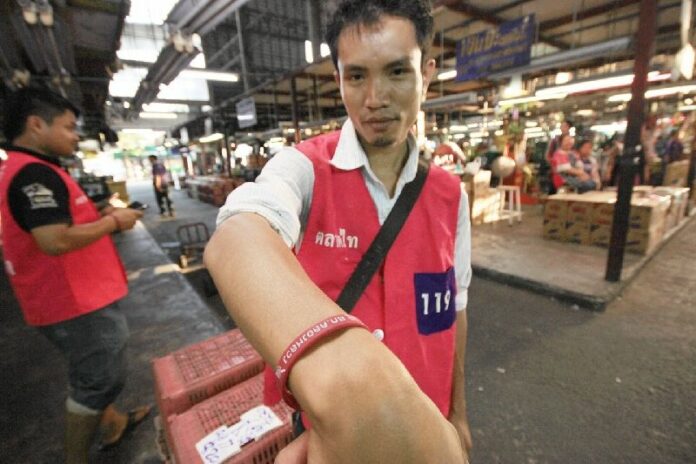
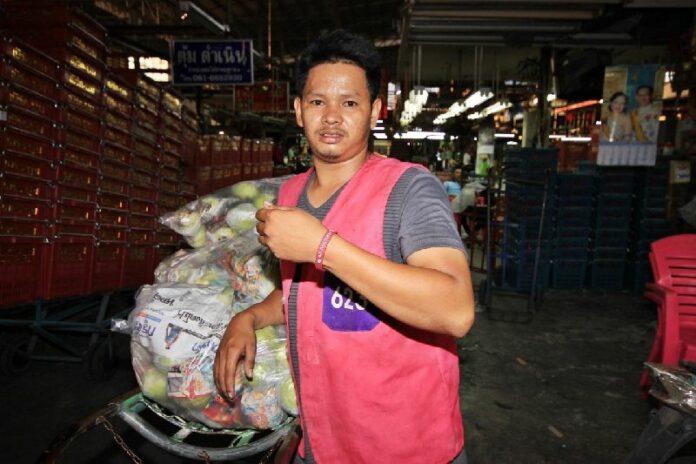
A foreign worker showing his registered bracelet at Talaad Tai in Pathum Thani, 22 April 2015.

PATHUM THANI — In an effort to crackdown on undocumented immigrants, police in Pathum Thani have instructed migrant workers in a major market to wear wristbands indicating they have been properly registered.

Pol.Maj.Gen. Montri Yimyaem, commander of Pathum Thani Police, said that workers from neighboring countries who have registered with police will be required to wear the dark red wristbands in public places.

\
A foreign worker showing his registered bracelet at Talaad Tai in Pathum Thani, 22 April 2015.

The market, Talaad Tai, has at least 3,500 vendors and is a particularly "risky area," staffed by many unregistered foreign workers, Pol.Maj.Gen. Montri said during an inspection of the market today. Human traffickers are also known to be active in the vicinity.

"Talaad Tai is an area that has problems with human trafficking, uses of alien workforce, prostitution, and begging," Pol.Maj.Gen. Montri told reporters. "We are issuing the wristbands as a model for other areas that have alien workers to reduce crime in the area, and increase security for the people.”

Since dispatching a task force to regulate foreign workers in Talaad Tai on 4 April, police have arrested 171 Burmese, Cambodian, and Laotian nationals on charges related to illegal entry and working without permit in Thailand.

Nine Thai employers have also been arrested for hiring foreign workers without proper permits, while six others have been arrested for providing shelter to illegal migrant workers, said Pol.Maj.Gen. Ake Angsananond, deputy commander of the Royal Thai Police.

\
Police inspect migrant workers at Talaad Tai in Pathum Thani province, 22 April 2015.

"The commander of the Royal Thai Police has instructed us to take actions in issues about human trafficking and alien workforce," Pol.Maj.Gen. Ake said, "Those issues are considered important problems that must be solved urgently." 

He added that any citizen who possesses information about human trafficking, forced labor, or prostitution in the Talaad Tai area should immediately contact police at the 24-hour hotline 1191.

The crackdown on Talaad Tai was prompted by junta chairman and Prime Minister Prayuth Chan-ocha’s instructions earlier this month to eradicate prostitution, illegal immigration, begging, and narcotic sales at the market.

"Officials have been neglecting these problems, in areas around Talaad Tai, and even in the entire province of Pathum Thani," Gen. Prayuth said on 3 April. "I have already warned them of their potential punishment. I gave them a deadline: within the end of this month, there must not be any prostitution or begging, because they cause damage [to the society]."

There are over a million immigrants living and working in Thailand illegally, mostly from neighboring countries such as Myanmar, Laos, and Cambodia. 

Due to their lack of legal protection, the immigrants are often vulnerable to exploitation and human trafficking. 

Early this morning at 2am, a pick-up truck carrying Cambodian nationals crashed in the nearby province of Prachinburi, wounding at least ten passengers, according to police reports. The injured include women and children, police say.

Police officers in Prachinburi say they suspect the passengers entered the country illegally, as none of the Cambodians carried ID documents or work permits. Police are investigating the incident and looking for the driver, who fled the scene before officers arrived. 


For comments, or corrections to this article please contact: [email protected]

You can also find Khaosod English on Twitter and Facebook
http://twitter.com/KhaosodEnglish
http://www.facebook.com/KhaosodEnglish

Advertisement

Migrant Workers Instructed to Wear ID Wristbands

A foreign worker showing his registered bracelet at Talaad Tai in Pathum Thani, 22 April 2015.

PATHUM THANI — In an effort to crackdown on undocumented immigrants, police in Pathum Thani have instructed migrant workers in a major market to wear wristbands indicating they have been properly registered.

Pol.Maj.Gen. Montri Yimyaem, commander of Pathum Thani Police, said that workers from neighboring countries who have registered with police will be required to wear the dark red wristbands in public places.

\
A foreign worker showing his registered bracelet at Talaad Tai in Pathum Thani, 22 April 2015.

The market, Talaad Tai, has at least 3,500 vendors and is a particularly "risky area," staffed by many unregistered foreign workers, Pol.Maj.Gen. Montri said during an inspection of the market today. Human traffickers are also known to be active in the vicinity.

"Talaad Tai is an area that has problems with human trafficking, uses of alien workforce, prostitution, and begging," Pol.Maj.Gen. Montri told reporters. "We are issuing the wristbands as a model for other areas that have alien workers to reduce crime in the area, and increase security for the people.”

Since dispatching a task force to regulate foreign workers in Talaad Tai on 4 April, police have arrested 171 Burmese, Cambodian, and Laotian nationals on charges related to illegal entry and working without permit in Thailand.

Nine Thai employers have also been arrested for hiring foreign workers without proper permits, while six others have been arrested for providing shelter to illegal migrant workers, said Pol.Maj.Gen. Ake Angsananond, deputy commander of the Royal Thai Police.

\
Police inspect migrant workers at Talaad Tai in Pathum Thani province, 22 April 2015.

"The commander of the Royal Thai Police has instructed us to take actions in issues about human trafficking and alien workforce," Pol.Maj.Gen. Ake said, "Those issues are considered important problems that must be solved urgently." 

He added that any citizen who possesses information about human trafficking, forced labor, or prostitution in the Talaad Tai area should immediately contact police at the 24-hour hotline 1191.

The crackdown on Talaad Tai was prompted by junta chairman and Prime Minister Prayuth Chan-ocha’s instructions earlier this month to eradicate prostitution, illegal immigration, begging, and narcotic sales at the market.

"Officials have been neglecting these problems, in areas around Talaad Tai, and even in the entire province of Pathum Thani," Gen. Prayuth said on 3 April. "I have already warned them of their potential punishment. I gave them a deadline: within the end of this month, there must not be any prostitution or begging, because they cause damage [to the society]."

There are over a million immigrants living and working in Thailand illegally, mostly from neighboring countries such as Myanmar, Laos, and Cambodia. 

Due to their lack of legal protection, the immigrants are often vulnerable to exploitation and human trafficking. 

Early this morning at 2am, a pick-up truck carrying Cambodian nationals crashed in the nearby province of Prachinburi, wounding at least ten passengers, according to police reports. The injured include women and children, police say.

Police officers in Prachinburi say they suspect the passengers entered the country illegally, as none of the Cambodians carried ID documents or work permits. Police are investigating the incident and looking for the driver, who fled the scene before officers arrived. 


For comments, or corrections to this article please contact: [email protected]

You can also find Khaosod English on Twitter and Facebook
http://twitter.com/KhaosodEnglish
http://www.facebook.com/KhaosodEnglish

Advertisement

Prawit: Unelected Prime Minister 'Not a Big Deal'

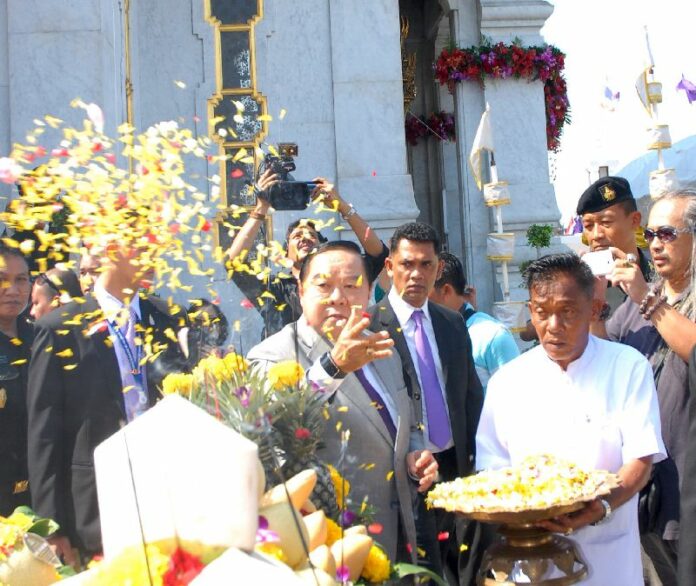
Gen. Prawit Wongsuwan at a ceremony to mark the 233rd anniversary of Bangkok on 21 April 2015. ​

BANGKOK — A leader of Thailand's military junta has downplayed concerns over a clause in the new constitution that will allow an unelected Prime Minister to take office.

Contrary to previous 'permanent' constitutions in recent decades, the new charter, which is being debated by the junta's reform council this week, will not explicitly require Prime Ministers to be elected Members of Parliament. The current draft only stipulates that a Prime Minister be appointed by a majority of MPs. 

According to Gen. Prawit Wongsuwan, deputy chairman of the ruling National Council for Peace and Order (NCPO), the clause is meant to "open a channel" for MPs to select an "appropriate or neutral" individual to serve as Prime Minister in the event of a political deadlock.

\
The National Reform Council (NRC) debating the new charter at Parliament House on 21 April 2015.


He told reporters he believes MPs will not resort to appointing an unelected Prime Minister unless it is absolutely necessary to do so. 

"I think it is not a big deal at all," said Gen. Prawit, who also serves as Minister of Defense and Deputy Prime Minister. "Normally, MPs will just select MPs from political parties [to be Prime Minister]."

The clause is seen as a victory for the conservative movement that campaigned against the elected government toppled in the May 2014 coup d'etat. Ushering in an unelected "outsider" Prime Minister was one of the protesters' chief demands.

In May 2014, the movement’s leaders asked the Senate to unilaterally appoint an “outsider” PM after Yingluck Shinawatra was ousted in a court ruling. The Senate refused, prompting the anti-government protesters to prepare for a "Final Battle" to topple the government. The military stepped in and staged a coup several days later. 

After seizing power, the junta dissolved the 2007 charter and appointed the Constitutional Drafting Committee (CDC) to write a new one. Their draft is currently being debated by the junta-appointed National Reform Council (NRC) this week. The NRC has the authority to suggest amendments to the draft, which is expected to be finalized by September of this year.

Critics say the current draft will weaken democratic institutions and political parties in Thailand. In addition to allowing for an unelected PM, the new draft calls for an appointed Senate and other poweful unelected "watchdog" agencies. 

Speaking at the debate, NRC member Direk Tuengfang said he disagrees with the idea of "unelected Prime Minister."

"No one will believe you that such open-ended language will solve any crisis," Direk said. "It will only open a special opportunity to pressure the parliament. In the end, we will have Prime Ministers who do not come from elections by the people."

He also urged the CDC to make the Senate fully-elected, and warned that the current draft of the constitution risks inviting more political conflicts and protests.

"I can predict for you that if this constitution is enacted, in a few years time, there will be a coup d'etat again. We will be stuck in this cycle. Why don't we just do the right thing? If we are to give so much power to the Senate, we should make the Senate come from the people. Therefore, I want the CDC to walk in the right direction," Direk said.

For much of the past decade, Thailand has been locked in a power struggle between mostly rural supporters of former Prime Minister Thaksin Shinawatra and traditional elite in Bangkok.


For comments, or corrections to this article please contact: [email protected]

You can also find Khaosod English on Twitter and Facebook
http://twitter.com/KhaosodEnglish
http://www.facebook.com/KhaosodEnglish

Advertisement

Prawit: Unelected Prime Minister 'Not a Big Deal'

BANGKOK — A leader of Thailand's military junta has downplayed concerns over a clause in the new constitution that will allow an unelected Prime Minister to take office.

Contrary to previous 'permanent' constitutions in recent decades, the new charter, which is being debated by the junta's reform council this week, will not explicitly require Prime Ministers to be elected Members of Parliament. The current draft only stipulates that a Prime Minister be appointed by a majority of MPs. 

According to Gen. Prawit Wongsuwan, deputy chairman of the ruling National Council for Peace and Order (NCPO), the clause is meant to "open a channel" for MPs to select an "appropriate or neutral" individual to serve as Prime Minister in the event of a political deadlock.

\
Gen. Prawit Wongsuwan at a ceremony to mark the 233rd anniversary of Bangkok on 21 April 2015. ​

He told reporters he believes MPs will not resort to appointing an unelected Prime Minister unless it is absolutely necessary to do so. 

"I think it is not a big deal at all," said Gen. Prawit, who also serves as Minister of Defense and Deputy Prime Minister. "Normally, MPs will just select MPs from political parties [to be Prime Minister]."

The clause is seen as a victory for the conservative movement that campaigned against the elected government toppled in the May 2014 coup d'etat. Ushering in an unelected "outsider" Prime Minister was one of the protesters' chief demands.

In May 2014, the movement’s leaders asked the Senate to unilaterally appoint an “outsider” PM after Yingluck Shinawatra was ousted in a court ruling. The Senate refused, prompting the anti-government protesters to prepare for a "Final Battle" to topple the government. The military stepped in and staged a coup several days later. 

After seizing power, the junta dissolved the 2007 charter and appointed the Constitutional Drafting Committee (CDC) to write a new one. Their draft is currently being debated by the junta-appointed National Reform Council (NRC) this week. The NRC has the authority to suggest amendments to the draft, which is expected to be finalized by September of this year.

Critics say the current draft will weaken democratic institutions and political parties in Thailand. In addition to allowing for an unelected PM, the new draft calls for an appointed Senate and other poweful unelected "watchdog" agencies. 

Speaking at the debate, NRC member Direk Tuengfang said he disagrees with the idea of "unelected Prime Minister."

"No one will believe you that such open-ended language will solve any crisis," Direk said. "It will only open a special opportunity to pressure the parliament. In the end, we will have Prime Ministers who do not come from elections by the people."

He also urged the CDC to make the Senate fully-elected, and warned that the current draft of the constitution risks inviting more political conflicts and protests.

"I can predict for you that if this constitution is enacted, in a few years time, there will be a coup d'etat again. We will be stuck in this cycle. Why don't we just do the right thing? If we are to give so much power to the Senate, we should make the Senate come from the people. Therefore, I want the CDC to walk in the right direction," Direk said.

For much of the past decade, Thailand has been locked in a power struggle between mostly rural supporters of former Prime Minister Thaksin Shinawatra and traditional elite in Bangkok.


For comments, or corrections to this article please contact: [email protected]

You can also find Khaosod English on Twitter and Facebook
http://twitter.com/KhaosodEnglish
http://www.facebook.com/KhaosodEnglish

Advertisement

2010 Crackdown: Suthep Submits Evidence of Blackshirts to NACC

Suthep Thaugsuban (center) arriving at the NACC on 21 April 2015.

BANGKOK — Former deputy Prime Minister Suthep Thaugsuban has submitted further evidence to Thailand's national anti-graft agency about the shadowy militants who fought with security officers during the military crackdown on Redshirt protesters in 2010.

The evidence was submitted as part of Suthep's defense against charges filed by the National Anti-Corruption Commission (NACC), which is seeking to retroactively impeach Suthep and former Prime Minister Abhisit Vejjajiva for authorizing the military crackdown in 2010 that left at least 90 people dead, mostly civilians. 

\
Suthep 
Thaugsuban (center) arriving at the NACC on 21 April 2015.

After speaking to NACC representatives for nearly three hours today, Suthep emerged and told reporters that he presented the agency with video footage and photos of the so-called Blackshirt militants who fought with soldiers during the crackdown that lasted from April to May 2010. 

"I showed the clip so that the NACC will see with its own eyes what really happened, what the Blackshirts were like, what kind of weapons they used," said Suthep, who joined the monkhood last year after leading six months of anti-government protests that culminated in the May 2014 coup.

"This event happened so long ago," he continued. "People have forgotten about it already. They can't remember what it was like on those days. They have forgotten about the nightmares that Bangkok people have."

The crackdown followed weeks of street protests in Bangkok by Redshirt demonstrators who were demanding a fresh election from Abhisit. The protests were eventually called off after the Redshirt leadership surrendered to authorities on 19 May 2010.

The Abhisit government and military commanders have repeatedly blamed the Blackshirts for the crackdown violence, despite several court inquests that have attributed civilian deaths to soldiers, some of whom shot indiscriminately into crowds of unarmed protesters. 

\
Soldiers fire rubber bullets at Redshirt protesters near Ratchadamnoen Avenue in Bangkok, 10 April 2010.

Speaking to reporters today, Suthep insisted that the military operation was an appropriate response to the situation encountered by authorities. He described the military operation on 10 April 2010, which left 25 people dead, as an attempt by security officers "to ask the protesters to return the traffic area." The violence, he said, did not start until Blackshirt militants allied with the protesters attacked security officers, leading to injuries and fatalities.

After that initial attempt to disperse the crowds of Redshirts failed, the government decided to change tactics in May and surround the protesters with checkpoints, Suthep said. 

"We tried to block demonstrations, new protesters, the flow of weapons, and uses of infrastructure in the area. We wanted to pressure them into calling off the protest on their own," Suthep said. "But they fired M79 grenades onto skytrain stations and the area around Lumpini Park. Security officers and innocent civilians were killed. So, we could not only man checkpoints. We were forced to send forces to control the area. We had no choice. That's why the event [the final assault] on 19 May took place."

Suthep conceded that security officers used live ammunition in the operation, but said soldiers only used the weapons to defend themselves and the public from the Blackshirt militants.

"There were rules guiding the use of firearms in necessary situations, such as protecting the lives of state officials and innocent people," Suthep told reporters. Soldiers were not authorized to "take lives of the targets," he said.

He also vowed to contest the charges filed by the NACC to the very end.

"I am ready to enter justice procedure. I am not concerned. I will not run anywhere. A Thai person must respect Thai laws." 

If the NACC proceeds with the case, Thailand's junta-appointed legislature will vote on whether to impeach the former Democrat Party politicians and thereby ban them from politics for five years. If they are found guilty, Abhisit and Suthep will be the first state officials to be held responsible for the 2010 crackdown.

Although Redshirt leaders have repeatedly denied any connection to the Blackshirts, a number of activists have privately acknowledged that militants were allied to their movement and provided a necessary self-defence against the military.

The identity of the Blackshirts has never been independently verified, though police arrested five men and one woman suspected of belonging to the militant cell last September. The group is awaiting trial in Bangkok prisons.  

 
For comments, or corrections to this article please contact[email protected]

You can also find Khaosod English on Twitter and Facebook
http://twitter.com/KhaosodEnglish
http://www.facebook.com/KhaosodEnglish

Advertisement

2010 Crackdown: Suthep Submits Evidence of Blackshirts to NACC

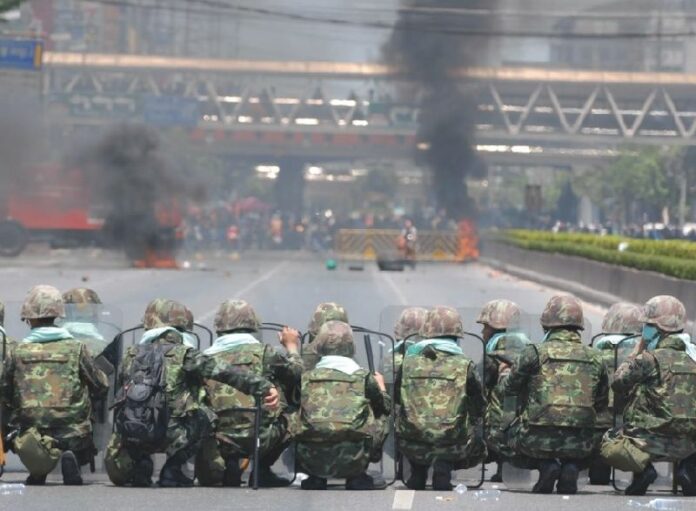
Soldiers faced off with Redshirt demonstrators on Rama IV Road in Bangkok, 14 May 2010.

BANGKOK — Former deputy Prime Minister Suthep Thaugsuban has submitted further evidence to Thailand's national anti-graft agency about the shadowy militants who fought with security officers during the military crackdown on Redshirt protesters in 2010.

The evidence was submitted as part of Suthep's defense against charges filed by the National Anti-Corruption Commission (NACC), which is seeking to retroactively impeach Suthep and former Prime Minister Abhisit Vejjajiva for authorizing the military crackdown in 2010 that left at least 90 people dead, mostly civilians. 

\
Suthep
Thaugsuban (center) arriving at the NACC on 21 April 2015.

After speaking to NACC representatives for nearly three hours today, Suthep emerged and told reporters that he presented the agency with video footage and photos of the so-called Blackshirt militants who fought with soldiers during the crackdown that lasted from April to May 2010. 

"I showed the clip so that the NACC will see with its own eyes what really happened, what the Blackshirts were like, what kind of weapons they used," said Suthep, who joined the monkhood last year after leading six months of anti-government protests that culminated in the May 2014 coup.

"This event happened so long ago," he continued. "People have forgotten about it already. They can't remember what it was like on those days. They have forgotten about the nightmares that Bangkok people have."

The crackdown followed weeks of street protests in Bangkok by Redshirt demonstrators who were demanding a fresh election from Abhisit. The protests were eventually called off after the Redshirt leadership surrendered to authorities on 19 May 2010.

The Abhisit government and military commanders have repeatedly blamed the Blackshirts for the crackdown violence, despite several court inquests that have attributed civilian deaths to soldiers, some of whom shot indiscriminately into crowds of unarmed protesters. 

\
Soldiers fire rubber bullets at Redshirt protesters near Ratchadamnoen Avenue in Bangkok, 10 April 2010.

Speaking to reporters today, Suthep insisted that the military operation was an appropriate response to the situation encountered by authorities. He described the military operation on 10 April 2010, which left 25 people dead, as an attempt by security officers "to ask the protesters to return the traffic area." The violence, he said, did not start until Blackshirt militants allied with the protesters attacked security officers, leading to injuries and fatalities.

After that initial attempt to disperse the crowds of Redshirts failed, the government decided to change tactics in May and surround the protesters with checkpoints, Suthep said. 

"We tried to block demonstrations, new protesters, the flow of weapons, and uses of infrastructure in the area. We wanted to pressure them into calling off the protest on their own," Suthep said. "But they fired M79 grenades onto skytrain stations and the area around Lumpini Park. Security officers and innocent civilians were killed. So, we could not only man checkpoints. We were forced to send forces to control the area. We had no choice. That's why the event [the final assault] on 19 May took place."

Suthep conceded that security officers used live ammunition in the operation, but said soldiers only used the weapons to defend themselves and the public from the Blackshirt militants.

"There were rules guiding the use of firearms in necessary situations, such as protecting the lives of state officials and innocent people," Suthep told reporters. Soldiers were not authorized to "take lives of the targets," he said.

He also vowed to contest the charges filed by the NACC to the very end.

"I am ready to enter justice procedure. I am not concerned. I will not run anywhere. A Thai person must respect Thai laws." 

If the NACC proceeds with the case, Thailand's junta-appointed legislature will vote on whether to impeach the former Democrat Party politicians and thereby ban them from politics for five years. If they are found guilty, Abhisit and Suthep will be the first state officials to be held responsible for the 2010 crackdown.

Although Redshirt leaders have repeatedly denied any connection to the Blackshirts, a number of activists have privately acknowledged that militants were allied to their movement and provided a necessary self-defence against the military.

The identity of the Blackshirts has never been independently verified, though police arrested five men and one woman suspected of belonging to the militant cell last September. The group is awaiting trial in Bangkok prisons.  

 
For comments, or corrections to this article please contact[email protected]

You can also find Khaosod English on Twitter and Facebook
http://twitter.com/KhaosodEnglish
http://www.facebook.com/KhaosodEnglish

Advertisement

Hot News

LATEST NEWS

Bangkok
scattered clouds
30 ° C
31.6 °
30 °
81 %
2.4kmh
47 %
Fri
30 °
Sat
37 °
Sun
36 °
Mon
36 °
Tue
34 °