31.6 C
Bangkok
Monday, June 22, 2026
Home Blog Page 3128

Chiang Mai Students' Anti-Coup 'Lunch Talk' Cancelled

Chiang Mai University cleaning staff erasing anti-coup graffiti, 26 November 2014

BANGKOK – Student activists in Chiang Mai province called off a symbolic anti-coup "lunch talk" after soldiers were deployed at their university this morning.

The students previously posted an announcement on the social media inviting members of the public to have lunch with them and discuss the political situation in post-coup Thailand in front of Faculty of Laws building at Chiang Mai University. 

Dozens of soldiers arrived at the university this morning, presumably to block any activity by the anti-coup students. The students then decided to cancel the event. 

Nevertheless, graffiti with the words "No Coup" were spotted in three locations inside the university campus at around 9 am today. They were later removed by the university's cleaning staff. 

Leaflet arrest

Meanwhile, a man is under arrest in Bangkok for allegedly paid a motorcyclist to dump flyers with anti-coup remarks around Democracy Monument on Ratchadamnoen Avenue in the early morning of 23 November. 

The man, Sittithat Laowanichthanapha, was reportedly arrested by a group of soldiers at his residence in Bangkok last night. 

Security officers say Sittithat confessed to making the leaflets on his own to voice his opposition to the 22 May military coup. Sittithat reportedly told the soldiers he hired a motorcyclist to distribute the flyers on his behalf, and added that he had no political connection to any party. 

Gen. Prawit Wongsuwan, Deputy Prime Minister and a member of the military junta, announced Sittithat's arrest in a press conference this morning, but declined to give any further details. 

Since staging the coup against the elected government on 22 May 2014, the junta's National Council of Peace and Order (NCPO) has banned any public protest against its regime, and tried those who violate the ban under the military tribunal, where appeals are not permitted. 

The junta's intolerance for any dissent has led the New York-based Human Rights Watch (HRW) to criticise the NCPO for its failure to respect basic rights of Thai people in its statement yesterday.

“Respect for fundamental freedoms and democracy in Thailand under military rule has fallen into an apparently bottomless pit,” Brad Adams, Asia director at HRW in the statement, “Six months after the coup, criticism is systematically prosecuted, political activity is banned, media is censored, and dissidents are tried in military courts."

Read more: Universities Told To Curb Students' Anti-Coup Protests


For comments, or corrections to this article please contact: [email protected]

You can also find Khaosod English on Twitter and Facebook
http://twitter.com/KhaosodEnglish
http://www.facebook.com/KhaosodEnglish

Advertisement

Human Rights Watch: Thailand Unending Repression 6 Months Post-Coup

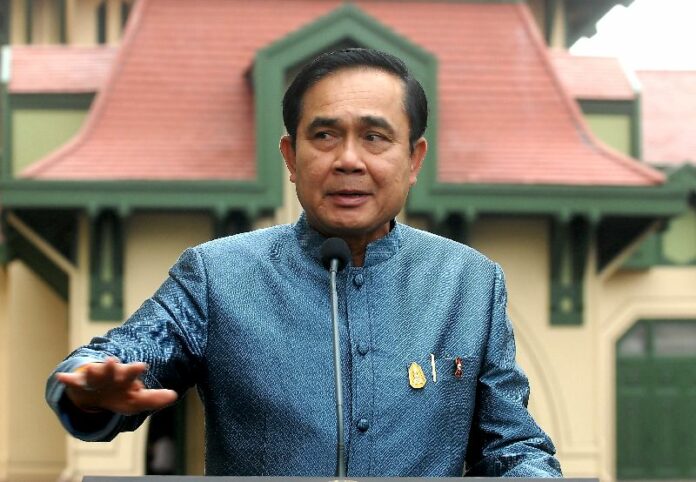
Gen. Prayuth Chan-ocha, military junta chairman and Prime Minister of Thailand, 25 November 2014

(Human Rights Watch)

NEW YORK – Thailand’s military government is severely repressing fundamental rights and freedoms six months after its May 22, 2014 coup. The ruling National Council for Peace and Order (NCPO) has shown no genuine signs of restoring democratic civilian rule.

“Respect for fundamental freedoms and democracy in Thailand under military rule has fallen into an apparently bottomless pit,” said Brad Adams, Asia director at Human Rights Watch. “Six months after the coup, criticism is systematically prosecuted, political activity is banned, media is censored, and dissidents are tried in military courts.”

Protesters who express disagreement with the junta—such as by showing the three-finger salute used in “The Hunger Games” movies as an act of defiance, putting duct tape or a hand over their mouths in public or in photos posted on Facebook—face a possible two-year prison term. Coup leader Gen. Prayuth Chan-ocha, now prime minister and NCPO chairman, announced on November 17 that criticizing or obstructing him, the government, or the NCPO was unacceptable. He also undermined his claims about a road map to return to civilian democratic rule through free and credible elections, saying on November 21: “Don’t ask me to give you democracy and elections. This is not the right time.” Prayuth then added that the enforcement of martial law would continue “as long as necessary.”

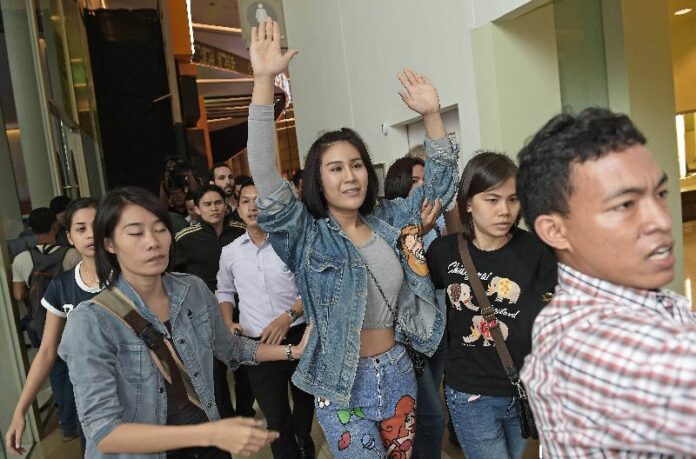
The junta’s intolerance was exemplified on November 19 in northeastern Khon Kaen province when military authorities arrested five university students for standing up during a speech by Prayuth and revealing t-shirts emblazoned with “Don’t Want a Coup” in Thai. They then raised their hands to give the three-fingered salute, a symbol of resistance in Thailand since the coup. Shortly after the students were taken away to a nearby military camp, Prayuth announced, “Anyone else want to protest?” During interrogations, military authorities threatened the students with a military court trial for violating martial law and expulsion from their state-run university. However, after a public outcry, the five students were released without charge on November 20.

Two days later, another student was arrested for showing the three-finger salute at a Bangkok cinema. She was detained and interrogated at the Bangkok Army Club for several hours before being released without charge. In Chiang Mai, Loei, and other provinces, soldiers and police have summoned activists and students who posted self-portraits on Facebook holding up a three-finger salute and ordered them to sign agreements to cease all “anti-coup activities.”

The 1st Police Region commissioner, Maj. Gen. Amnuay Nimmano, told the media that people are not allowed to oppose the sovereign authority of the NCPO.

Suppression of Free Expression and Public Assembly
As part of its crackdown and attempt to maintain its hold on power, the junta has repeatedly vowed to prosecute critics of the monarchy, in violation of the right to freedom of speech, Human Rights Watch said. Thai authorities have frequently used the offense of lese majeste (insulting the monarchy) under article 112 of the penal code to intimidate, arrest, and prosecute people accused of criticizing the king and members of the royal family. At least 14 new lese majeste cases are pending in the Bangkok military court and in criminal courts around Thailand. On November 18, the Bangkok military court sentenced online radio host Kathawut Bunpitak to five years in prison for insulting the king. On November 24, the Bangkok military court jailed website editor, known by his penname as Somsak Pakdeedech, four years and six months for publishing an article that Thai authorities deemed to defame the monarchy. Under martial law, a military court verdict is final and cannot be appealed. The Bangkok criminal court continues to deny bail applications for Patiwat Saraiyaem and Pornthip Munkong, who were arrested on August 14 and 15 respectively for their participation in “The Wolf Bride”—a play considered by the military authorities to be insulting to the monarchy.

On November 12, national police chief Pol. Gen. Somyot Poompanmuang announced a ban on the book “A Kingdom in Crisis: Thailand’s Struggle for Democracy in the Twenty-First Century,” written by former Reuters journalist Andrew MacGregor Marshall. The police said the book insulted and fomented hatred of members of the royal family. Using powers under the 2007 Printing Act, the police ordered the seizure and destruction of copies of the book. Violators of the ban are liable to a prison term of up to three years.

Since the coup, the NCPO has enforced a broad ban on discussion about political issues, including topics related to democracy, freedom, and human rights, Human Rights Watch said. On November 21, soldiers entered Burapha University in the eastern province of Chonburi and forced the university to cancel a “Rights and Freedom of the People” seminar organized by students activists. On November 22, Chulalongkorn University canceled a seminar on the topic “Desirable Parliamentary System for Democratic System” that was hosted by the Institute of Human Rights and Peace Studies because the organizers had not received prior permission to hold the seminar from the NCPO.  

The junta has also tightened restrictions on media. On November 13, Lt. Gen. Suchai Pongput, the NCPO-appointed head of a special committee to monitor media, said that reporting needed to be controlled to ensure reconciliation in society: “We do not limit media freedom but freedom must be within limits.” The military pressured Thai PBS TV to remove Nattaya Wawweerakhup from the talk show “Voices of the People That Must Be Heard Before the Reform” after she allowed participants on a November 8 program to criticize the coup and raise concerns about repression under military rule.

The NCPO’s suppression of free expression and public assembly makes the government’s self-proclaimed “reform” process into a sham that lacks broad-based participation and strictly follows the junta’s guidelines, Human Rights Watch said. Public forums on issues such as land reform, forest conservation, energy policy, and tax policy have been canceled by the military citing concerns that the discussions could fuel social divisions. Any gathering of more than five people can be prohibited under martial law.

The NCPO has also targeted activists who disagree with the NCPO’s reform process. For example, local military authorities summoned 16 activists in northeastern Thailand to report to them after 12 human rights and civil society organizations issued a statement on November 3 that they would not participate in the reform process initiated by the NCPO, whose legitimacy and authority they questioned. Some of those summoned reported as ordered and were released following questioning and after promising not to engage in any further political activities. Some were compelled to publicly recant their views and issue a statement to that effect on Facebook.

On November 9, the military arrested and briefly detained Professor Prapart Pintobtang, a political scientist from Chulalongkorn University, and three activists after they attempted to organize a march against the NCPO’s forestry policy, which Prapart and colleagues believe could lead to forced evictions of many poor villagers across Thailand.

“Instead of a path toward the return of democracy, the junta is tightening its grip on free speech and any public criticism,” Adams said. “Simply offering an opinion on politics can land a person in military court and prison. The junta needs to reverse course and revoke martial law, end rights abuses, and take concrete steps towards democratic elections if it wants to persuade the international community it’s not a dictatorship.”

Advertisement

Southern Unrest: Roadside Bomb Injures Teacher Bodyguards

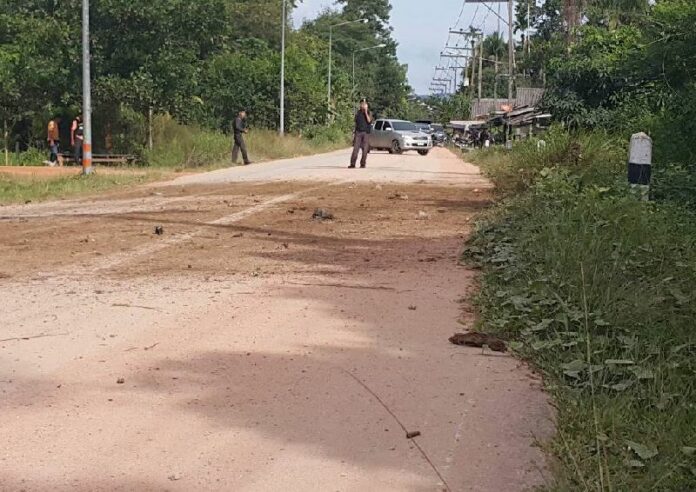
The site where a roadside bomb injured two body guards who were escorting a group of teachers to their school in Narathiwat province, 25 Nov 2014.

NARATHIWAT – Police say a roadside bomb planted by separatist insurgents has wounded two bodyguards who were escorting a group of teachers to their school in Narathiwat province today.

The explosion reportedly took place at around 2.30 pm on Sukirin-Wang Road in Wang district, when a convoy of school teachers and security officers were passing by. 

The blast injured two armed volunteers who were riding a motorcycle ahead of the convoy, police say. Medical workers at Wang Hospital say they are in “critical condition.”

According to Pol.Lt. Kraiwit Somboon, a police officer at Wang Police Station, the IED was most likely planted by Islamic insurgents who were attempting to harm the public school teachers, presumably because they are viewed as instruments of a state education system teaching Buddhism to local children.

"We believe it's an attempt to cause daily attacks by those who have ill intention, with the goal of assassinating the agents of the state," Pol.Lt. Kraiwit said. He added that the suspected militants managed to slip away before security forces could react. 

More than 170 public school teachers in Pattani, Yala, and Narathiwat – an area known as the Deep South – have been killed since separatist unrest broke out in 2004. In total, more than 6,000 people have died in the insurgency, which has been waged by a variety of Islamic groups seeking to revive the independent Pattani sultanate that was incorporated into modern Thailand in the early 20th century. 

The conflict is also fueled by ethnic and religious differences; in contrast to the rest of country, where the vast majority of Thais are Buddhist, the Deep South is dominated by Muslims who speak a Malaysian dialect and often consider themselves to be Malay, not Thai.


For comments, or corrections to this article please contact: [email protected]

You can also find Khaosod English on Twitter and Facebook
http://twitter.com/KhaosodEnglish
http://www.facebook.com/KhaosodEnglish

Advertisement

Bangkok Post Reporter Retracts Interview With Yingluck

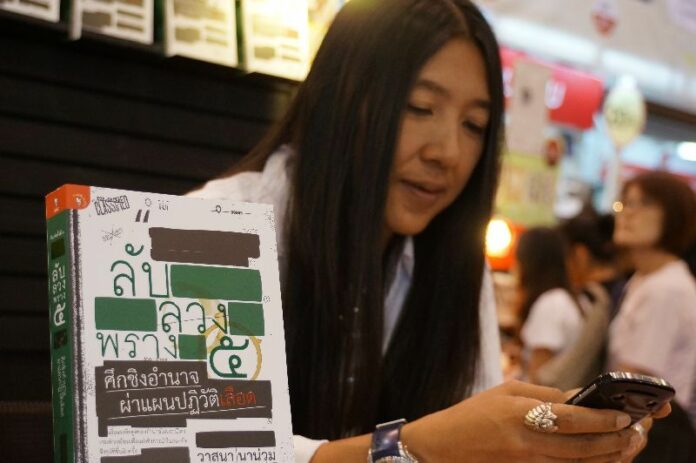
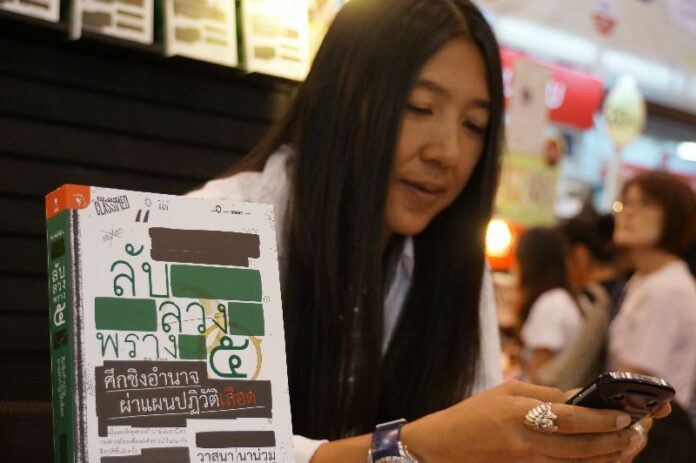
Wassana Nanuam gives autographs for her books at the national book fair in Bangkok, 8 April 2012.

BANGKOK – The Bangkok Post has pulled an article in which a reporter claimed to have interviewed former Prime Minister Yingluck Shinawatra.

The Bangkok Post, Thailand's most established English-language newspaper, published "Yingluck Saw the Coup Coming" by Wassana Nanuam on 24 November.

Billed as the first interview with Ms. Yingluck since the military staged a coup against her government on 22 May 2014, the piece gained considerable attention almost immediately after it was made available. 

Ms. Yingluck was quoted as saying that she was contemplating running in the next election, and that since her first day as Prime Minister she had expected to be ousted either by the military or by one of Thailand's "independent agencies." The remarks were considered unusually strong for the former PM, who is known for her modest and vague speeches. 

In the article, Yingluck went as far as criticising the military coup, which was by led by former army chief Gen. Prayuth Chan-ocha: "It's the same as if the people handed me the car keys and said I must drive and lead the country. Then suddenly, someone points a gun at my head and tells me to get out of the car while I'm at the wheel driving the people forward."

The article was later removed from the Bangkok Post's website and its author, Wassana Nanuam, later wrote on her Facebook that the piece was not based on an interview with Yingluck. Rather, the article was drawn from bits and pieces of private conversations with the former leader, Wassana wrote. 

"I just wanted to present lighthearted and colourful angles [of former PM Yingluck]. I didn't want to focus on politics," Wassana wrote. "Let me insist that this is not an interview. It's a recollection of lighthearted and colourful topics about the former Madam Prime Minister."

According to Wassana, the editors at Bangkok Post"misunderstood" the intention of her article when they edited the piece.

"They may have looked at the heavy angles and raised them into points that are different to what the author intended to present, but I recognise it as the error on my own part."

She concluded, "I'd like to take responsibility for any [errors] that were caused by the lack of clear communication from my article. I know that I will be criticised and scolded by many sides."

A self-styled "military reporter," Wassana is known to be close with many high-ranking generals in the Thai armed forces, including Gen. Prayuth, who is now ruling Thailand as chairman of the military junta and Prime Minister. 

She has published numerous books based on the "inside information" she has accumulated from her influential sources. Her most recent work, "The Path of the Tiger: Prayuth Chan-ocha," was published in October by Matichon Group, the company that owns Khaosod English.

Yingluck became the first female Prime Minister of Thailand after she won a landslide election in July 2011, thanks largely to votes from supporters of her older brother, the influential former PM Thaksin Shinawatra.

Anti-government protests that erupted in November 2013 prompted Yingluck to dissolve Parliament a month later and call for a snap election to be held in February. However, protesters blocked the election and successfully paved the way for the Constitutional Court to invalidate the poll on the grounds that the votes did not take place across the country on the same day.

The same court later ousted Yingluck from the premiership in early May on charges of abuse of power, forcing her to hand over the seat to her deputy, Niwatthamrong Boonsongpaisan. Niwatthamrong was eventually toppled by the military coup on 22 May 2014. 

Yingluck spent several days in military detention after the coup and has kept a relatively low profile ever since. She has consistently refrained from speaking to the press, presumably to comply with the agreement not to partake in any political activities that she reportedly signed in order to secure her release from military detention. 

The former leader has not publicly reacted to the "interview" by Wassana. 

Meanwhile, Gen. Prayuth, the chairman of the military junta, said today that Yingluck is free to run in the election if Thailand's Election Commission approves her application, and suggested that he would not be "troubled" if she won. 

"If she can run, people are free to vote for her. It's not my business. I'm not a voter," Gen. Prayuth said. 

For comments, or corrections to this article please contact: [email protected]

You can also find Khaosod English on Twitter and Facebook
http://twitter.com/KhaosodEnglish
http://www.facebook.com/KhaosodEnglish

Advertisement

Bangkok Post Reporter Retracts Interview With Yingluck

Wassana Nanuam gives autographs for her books at the national book fair in Bangkok, 8 April 2012.

BANGKOK – The Bangkok Post has pulled an article in which a reporter claimed to have interviewed former Prime Minister Yingluck Shinawatra.

The Bangkok Post, Thailand’s most established English-language newspaper, published “Yingluck Saw the Coup Coming” by Wassana Nanuam on 24 November.
Billed as the first interview with Ms. Yingluck since the military staged a coup against her government on 22 May 2014, the piece gained considerable attention almost immediately after it was made available.

Ms. Yingluck was quoted as saying that she was contemplating running in the next election, and that since her first day as Prime Minister she had expected to be ousted either by the military or by one of Thailand’s “independent agencies.” The remarks were considered unusually strong for the former PM, who is known for her modest and vague speeches.

In the article, Yingluck went as far as criticising the military coup, which was by led by former army chief Gen. Prayuth Chan-ocha: “It’s the same as if the people handed me the car keys and said I must drive and lead the country. Then suddenly, someone points a gun at my head and tells me to get out of the car while I’m at the wheel driving the people forward.”

The article was later removed from the Bangkok Post’s website and its author, Wassana Nanuam, later wrote on her Facebook that the piece was not based on an interview with Yingluck. Rather, the article was drawn from bits and pieces of private conversations with the former leader, Wassana wrote.

“I just wanted to present lighthearted and colourful angles [of former PM Yingluck]. I didn’t want to focus on politics,” Wassana wrote. “Let me insist that this is not an interview. It’s a recollection of lighthearted and colourful topics about the former Madam Prime Minister.”

According to Wassana, the editors at Bangkok Post “misunderstood” the intention of her article when they edited the piece.

“They may have looked at the heavy angles and raised them into points that are different to what the author intended to present, but I recognise it as the error on my own part.”

She concluded, “I’d like to take responsibility for any [errors] that were caused by the lack of clear communication from my article. I know that I will be criticised and scolded by many sides.”

A self-styled “military reporter,” Wassana is known to be close with many high-ranking generals in the Thai armed forces, including Gen. Prayuth, who is now ruling Thailand as chairman of the military junta and Prime Minister.

She has published numerous books based on the “inside information” she has accumulated from her influential sources. Her most recent work, “The Path of the Tiger: Prayuth Chan-ocha,” was published in October by Matichon Group, the company that owns Khaosod English.

The former leader, who became the first female Prime Minister of Thailand after she won a landslide election in July 2011, has not publicly reacted to the “interview” by Wassana.

Meanwhile, Gen. Prayuth, the chairman of the military junta, said today that Yingluck is free to run in the election if Thailand’s Election Commission approves her application.

“If she can run, people are free to vote for her. It’s not my business. I’m not a voter,” Gen. Prayuth said.

For comments, or corrections to this article please contact: [email protected]

You can also find Khaosod English on Twitter and Facebook
http://twitter.com/KhaosodEnglish
http://www.facebook.com/KhaosodEnglish

Advertisement

'Black Money Scammers' Busted In Pathum Thani

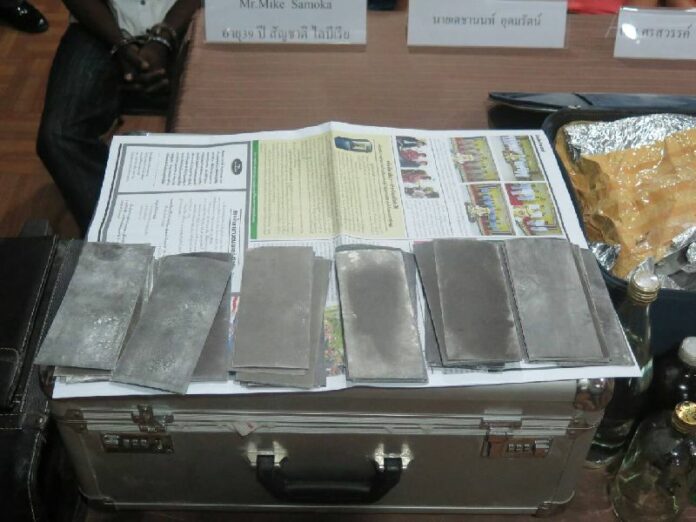
Photo of the "blackened money" allegedly used by the suspects in their scam.

PATHUM THANI – Police say they have arrested a group of Thais and Sierra Leonean who defrauded more than 640,000 baht from a Thai man in a "black money scam."

According to Pol.Maj.Gen. Montri Yimyaem, the four suspects, three Thais and one Sierra Leonean, told a 49-year-old man that they possessed a large bulk of "black money," blackened Pound Sterlings allegedly funneled by the Western governments to Sierra Leone during its civil wars in the 1990s.

Pol.Maj.Gen. Montri said the four suspects told the victim that the money could only be "cleaned" of its special black ink by a certain cleaning device, but the machine needed an expensive repair because it could turn the "black money" usable. The four suspects then reportedly promised that they will return a two-percent cut of the "cleaned money" to the victim if he agreed to pay for the repair. 

The scheme is in fact an decades-old fraud known as "black money scam," as there is no such thing as the blackened money in the first place, Pol.Maj.Gen. Montri said at the press conference today. 

"After the victim paid more than 640,000 baht to the suspects, the suspects disappeared, and he could not contact them, that is how he knew he was fooled. So he sought help from the police," Pol.Maj.Gen. Montri said.

All of the suspects were arrested yesterday, while a raid on one of the suspects' residence turned up certain amount of black-coloured paper, chemicals, and phony money-cleaning devices, the officer said at the press conference. 

"The suspects confessed to the crime," Pol.Maj.Gen. Montri added. 

Pol.Maj.Gen. Montri also urged members of the public who may have been duped by the suspects to come forward and press additional charges at Chualongkorn Police Station in Pathum Thani province. 


For comments, or corrections to this article please contact: [email protected]

You can also find Khaosod English on Twitter and Facebook
http://twitter.com/KhaosodEnglish
http://www.facebook.com/KhaosodEnglish

Advertisement

Universities Told To Curb Students' Anti-Coup Protests

Natcha Kong-udom, a first year student at Bangkok University, was arrested by police after she began flashing the three-finger salute in Siam Paragon's cinema, 20 Nov 2014.

BANGKOK – Stung by a surge of anti-coup protests organised by students in the past week, Thailand's military government has instructed state universities across the country to prevent any further "inappropriate political expression" on their campuses.

Sutthasri Wongsaman, permanent secretary of the Ministry of Education, said the measure was adopted after a meeting between the Ministry and the chairman of the military junta, Gen. Prayuth Chan-ocha, on 21 November. 

"We have instructed [the officials] across the country to monitor the situation in a more aggressive way, in order to prevent children and youths from displaying inappropriate political expression in the future," Sutthasri said yesterday. 

The measure followed a turbulent week in which five student activists from Khon Kaen University interrupted a speech by Gen. Prayuth in Khon Kaen province on 19 November, and flashed the forbidden "three-finger salute", an anti-coup gesture inspired by "The Hunger Games" movies. 

On the next day, police arrested two more student activists in Bangkok for attempting to organise a mass screening of the latest installment of "The Hunger Games" trilogy, "Mockingjay – Part One." Another student was also arrested for raising the three-finger salute in the lobby of a cinema where the film was being shown. 

The latest public act of defiance against the junta took place yesterday, when eight students distributed leaflets with the text from an anti-authoritarian poem at Thammasat University in Bangkok's historic district, prompting nearby police officers to arrest them. 

According to Sutthasri, Gen. Prayuth, who also serves as Prime Minister, has personally instructed her to closely monitor the situation of student activists "expressing their opinions, especially their three-finger salutes."

"I think they have the rights to display political expression, but I also think they must consider whether it is appropriate," Sutthasri told reporters yesterday. "So I have assigned the OHEC (Office of the Higher Education Commission) to remind the universities of these dissenting students to consider about appropriateness, and to bear in mind that expression can be done, but they must also respect the rights of other people."

After seizing power from the elected government on 22 May 2014, the junta, formally known as the National Council of Peace and Order (NCPO), has banned any public protest against its rule, censored the media, and tried some of those who violate the protest ban in military court, where appeals are not permitted. 

The NCPO also outlawed the "three-finger salute" after anti-coup activists adopted the gesture in late May to protest against the 22 May coup. 

The student protests against the military junta in Bangkok have largely been coordinated by the Thai Student Centre for Democracy (TSCD) and the League of Liberal Thammasat for Democracy (LLTD). However, a majority of students in Thailand have not participated in the anti-coup movement. 

Meanwhile, Suwapan Tanyuwattana, Minister of the Office of Prime Minister, said Gen. Prayuth is planning to open a public forum for the anti-coup student activists to voice their opinions. 

"We have told the NRC (National Reform Council) and Prajadhipok Institute to study about the forms of public forum that students can discuss and exchange their ideas, so that they express their courage, use their energy, and use their knowledge in the fullest way," Suwapan said. "I expect that in the next several days we will have a clearer direction about this."

The forum would not require a repeal of martial law, which was imposed over the entire nation by the junta in May, Suwapan said.


For comments, or corrections to this article please contact: [email protected]

You can also find Khaosod English on Twitter and Facebook
http://twitter.com/KhaosodEnglish
http://www.facebook.com/KhaosodEnglish

Advertisement

Thai Army Chief Plays Down Fears of ISIS Threats

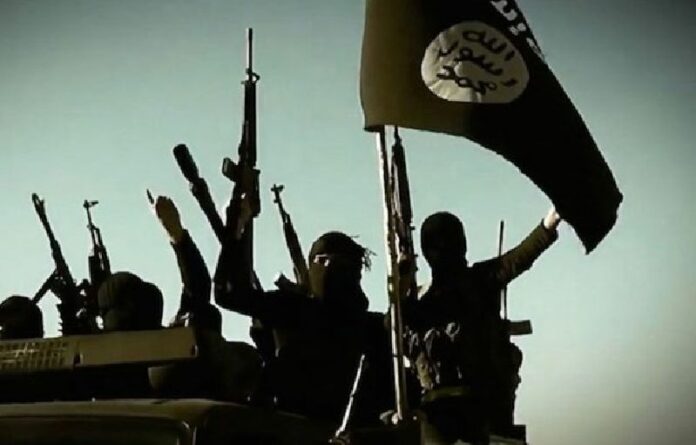
A 2014 screenshot of propaganda video published by the ISIS.

BANGKOK – The Thai army chief has assured the public that, unlike some other Southeast Asian nations, Thailand is not immediately threatened by the rise of the Islamic State movement.

Gen. Udomdet Sitabutr delivered the comment today just before he boarded a plane to attend an international security summit between members of the Association of Southeast Asian Nations (ASEAN) in Hanoi, Vietnam. 

"We are monitoring the expansion of the ISIS or IS terrorist movement in our neighbour countries, but there is no such thing in Thailand so far," said Gen. Udomdet. "However, we will continue to monitor the issue constantly."

Gen. Udomdet added that the ASEAN summit, which is taking between from 25-29 November, is aiming to establish a better coordination among member countries to fight terror movements and share vital intelligence.  

The rise of the Islamic State, also known as the Islamic State in Iraq and Syria (ISIS), has raised concern among ASEAN countries in recent months due to reports that the movement is recruiting sympathisers from Malaysia and Indonesia to fight in their "holy war" in the Middle East. 

According to Gen. Udomdet, discussions at the ASEAN summit in Hanoi will not only focus on a war on terror in the region, but also humanitarian issues.

"We want to focus on humanitarian assistance in the events of natural disasters," the army chief told reporters. "This trip will bring better cooperation. We will improve our relation and cooperation even further."


For comments, or corrections to this article please contact: [email protected]

You can also find Khaosod English on Twitter and Facebook
http://twitter.com/KhaosodEnglish
http://www.facebook.com/KhaosodEnglish

Advertisement

'Mind Research' To Instill Thai Junta Leader's Teaching Underway

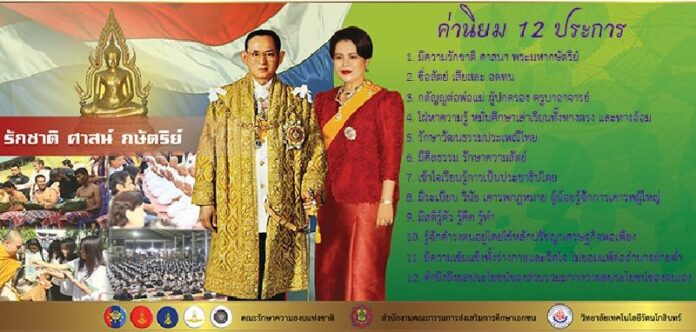
An example of the Twelve Values banners public schools are required to hang in classrooms.

BANGKOK – A top education official has claimed that psychological research is being conducted to persuade Thai students to live their lives in accordance with the teachings of the leader of Thailand's military junta.

According to Sutthasri Wongsaman, permanent secretary of the Ministry of Education, the Ministry is working closely with the National Research Commission of Thailand (NRCT) to better promote a "practical adoption" of the "Twelve Values," a series of morals that Gen. Prayuth Chan-ocha, chairman of the military junta, says all Thais should adopt. 

The research is aimed at students in schools and colleges across the country, Sutthasri said yesterday. 

"Previous research by the NRCT discovers that, to alter the behaviour of humans, memorising text or singing isn't enough," Sutthasri said. "It also requires a practical adoption, so we can teach children and youths to know about their duty under the democratic principle [sic]."

Sutthasri added that she wants to see "the concepts of the Twelve Values really reaching the students." However, she did not elaborate further about the nature or scope of the research 

Gen. Prayuth unveiled the "Twelve Values" during one of his televised addresses in July, two months after he seized power from the elected government on 22 May 2014 and imposed martial law over the entire country. 

The "Twelve Values" are as follows: 

1. Loyalty to the Nation, the Religion, and the Monarchy
2. Honesty, sacrifice, endurance, and noble ideology for the greater good
3. Gratitude for parents, guardians, and teachers
4. Diligence in acquiring knowledge, via school studies and other methods
5. Preserving the Thai customs and tradition
6. Morality and good will for others
7. Correct understanding of democracy with the King as Head of State
8. Discipline, respect for law, and obedience to the older citizens
9. Constant consciousness to practice good deeds all the time, as taught by His Majesty the King
10. Practice of Self-Sufficient Economy in accordance with the teaching of His Majesty the King
11. Physical and mental strength. Refusal to surrender to religious sins.
12. Uphold the interest of the nation over oneself.

Gen. Prayuth's teachings have been promoted extensively by the state media. In the past months, Thai authorities have produced a pop song and poetic renditions of the Twelve Values, while a film based on the values is expected to hit the theaters on 6 December.

To ensure that all Thais will take the Twelve Values to heart, authorities have also instructed public schools and state agencies to hang banners listing Gen. Prayuth’s words of wisdom on their premises. 

Sutthasri, the education official, also told reporters yesterday that the military junta has instructed state universities across the nation to curb anti-coup demonstrations to comply with the junta's ban on any public protest against its regime. 


For comments, or corrections to this article please contact: [email protected]

You can also find Khaosod English on Twitter and Facebook
http://twitter.com/KhaosodEnglish
http://www.facebook.com/KhaosodEnglish

Advertisement

Swiss Man 'Commits Suicide' In Chonburi

CHONBURI – A Swiss national has committed suicide in his residence in Chonburi province, police say.

The 69-year-old was found dead in the toilet of his residence in Banglamung district by his Thai wife at around 3.30 pm today, according to the police. Emergency responders say the man died from cuts to his wrists and neck. 

Khaosod English is withholding the identity of the deceased until it is confirmed that his family has been notified.

The Swiss man's wife told police that he had been living in Thailand for six years and was recently diagnosed of "lung infection." According to his wife, the Swiss man became very stressed, having convinced himself that he would not survive the disease.

"My husband said he did not want to see the doctor because if he were to die, he would rather die at home," the woman said, "He said he did not want to die like a dog."

After returning home from a hospital visit today, the Swiss locked himself in the restroom and stayed there for a long time, prompting his family to call for help and discover him dead in the toilet, his wife informed the police.

Pol.Col. Somkid Hiangsatien, the officer in charge of the investigation, said police are not treating the incident as suspicious, though he stressed that the police are waiting for an autopsy report of the deceased to establish a clear cause of death.


For comments, or corrections to this article please contact: [email protected]

You can also find Khaosod English on Twitter and Facebook
http://twitter.com/KhaosodEnglish
http://www.facebook.com/KhaosodEnglish

Advertisement

Hot News

LATEST NEWS

Bangkok
overcast clouds
31.6 ° C
34.4 °
31.6 °
74 %
2.8kmh
100 %
Mon
31 °
Tue
36 °
Wed
38 °
Thu
36 °
Fri
36 °