29.4 C
Bangkok
Tuesday, July 7, 2026
Home Blog Page 3263

Military Court Denies Anti-Coup Leader’s Release on Bail

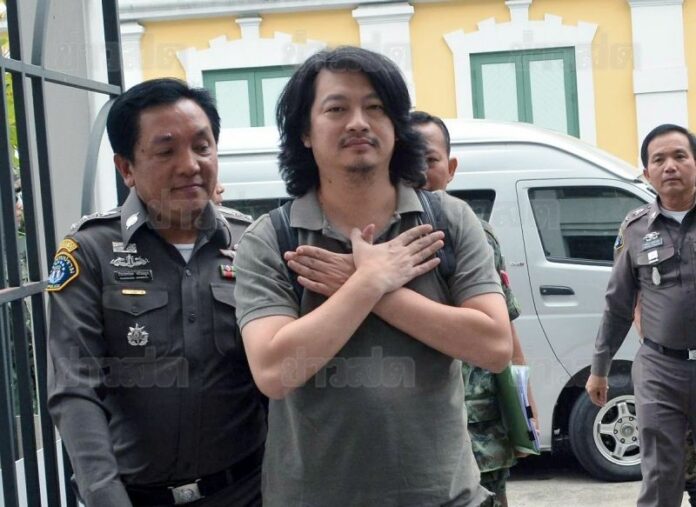
Veteran Redshirt activist Sombat Boonngamanong was denied release on bail by military judges on June 12, 2014. They said he posed a threat to national security.

BANGKOK — Thailand’s martial court has denied a veteran Redshirt activist and anti-coup leader release on bail, citing his threat to national security.

Sombat Boonngamanong was arrested on 5 June in Chonburi province after hiding from the military for two weeks to avoid a summons order. Instead of turning himself in, Mr. Sombat wrote on his social media, "Catch me if you can.”

While in hiding, Mr. Sombat organized a number of flash anti-coup protests over social media.

After his arrest, Mr. Sombat was charged with inciting unrest, violating the Computer Crimes Act, and defying an order to report to the junta. 

Today, the military court ordered that Mr. Sombat be held for 12 more days in the Bangkok Remand Prison.

Mr. Sombat’s relatives and the Thai Lawyers for Human Rights tried to bail Mr. Sombat out, offering 400,000 baht and a statement promising that he will follow the junta’s laws.

However, a constitutional arbitrator stated that Mr. Sombat’s release could directly affect national securit and thus could not be permitted.

The military may extend Mr. Sombat's detainment four times, up to a total of 48 days.

Mr. Sombat was also an active campaigner against the last military coup in September 2006, when he a co-founded the 19 September Network Against Coup D'etat. He later split from the network and founded his own group, "Thais Say No," whose members adopted red shirts as their trademark, preceding today's Redshirt movement by a year. 

For comments, or corrections to this article please contact: [email protected]

You can also find Khaosod English on Twitter and Facebook
http://twitter.com/KhaosodEnglish
http://www.facebook.com/KhaosodEnglish


Advertisement

Iraqi Parliament Fails to Meet as Jihadists Push Towards Baghdad

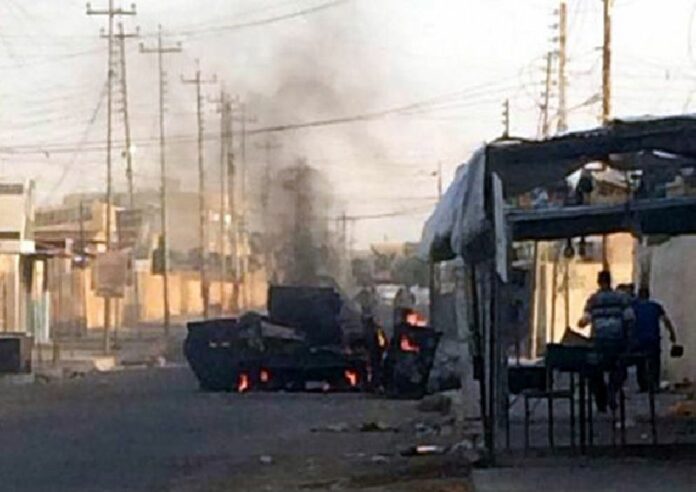
CAIRO (DPA) — The Iraqi parliament Thursday adjourned a session to vote on declaring a nationwide state of emergency due to lack of quorum, even as radical jihadists pressed ahead towards the capital Baghdad.

No date has been set for the next parliamentary meeting, independent Alsumaria TV said, a fiasco set to deepen Iraq's political and security woes.

Prime Minister Nuri al-Maliki and President Jalal Talibini had asked for declaring the state of emergency to grant the government sweeping powers to halt lightening advances by Sunni militants of the Islamic State in Iraq and the Levant (ISIL).

Critics of al-Maliki, a Shiite who has been in power since 2006, accuse him of monopolizing power and taking advantage of a military campaign against what he calls "terrorism" to marginalize the country's Sunni minority.

The parliament has been in a state of gridlock as rival politicians seem increasingly sceptical about the agenda of al-Maliki, who is seeking a third term as prime minister after his party secured the most seats in parliament following last month's elections.

The latest blow to al-Maliki comes amid reports that ISIL has pushed deep into the province of Diyala, some 75 kilometres south of Baghdad.

An ISIL leader has called on the jihadist group's insurgents to advance on Baghdad.

"March on Baghdad … where we have a score that must be settled," Abu Mohammed al-Adnani, the ISIL spokesman, said in an audio message posted on a jihadist website.

"Don't give up an inch you have liberated unless on your dead bodies."

Al-Adnani said his followers had seized military hardware, including jets and tanks, from the government troops in a series of recent daring raids in Iraq.

Earlier this week, the radical Sunni group took control of the northern province of Nineveh, including Mosul, Iraq's second largest city.

ISIL later captured parts of the Salah al-Din, north of Baghdad, sparking regional and international fears about the creation of a militant enclave that would stretch across Syria and Iraq.

According to Iraqi media, government troops, backed by warplanes, Thursday regained the central city of Tikrit, the hometown of late dictator Saddam Hussein, a day after militants seized it.

The report could not be immediately verified.

ISIL has controled Fallujah since January, a populous city in the western province of Anbar.

The group has also taken advantage of the conflict in neighbouring Syria, where it holds a considerable part in the east along the border with Iraq.

In Mosul, 31 truck drivers from Turkey that had been held hostage by ISIL militants since they seized the city have been released, CNN Turk and a labour union association reported.

Nearly 50 diplomatic staff from the consul office in Mosul are reportedly still being held.

Baghdad has said it would allow the United States to launch airstrikes against the militants, the Wall Street Journal reported, citing unnamed US officials.

The Obama administration was considering a range of options, including airstrikes carried out by drones or manned aircraft, senior US officials told the newspaper.

Iraq has previously requested the loan of US drones for its own forces to deploy against the militants, but Washington has so far refused.

Iraq has seen increasing violence over the last year, much of it blamed on ISIL and aimed at security forces and Shiite civilians.

The Shiite-led government's response, with security sweeps and mass arrests, has alienated Iraq's Sunni community from which ISIL and other rebel groups draw their support.

Advertisement

16 Reported Killed As US Drones Resume Pakistan Strikes

A file photo shows a US Air Force MQ-1 Predator unmanned aerial vehicle flying over California, USA, Jan. 7, 2012. US drones killed 16 Islamist militants at their hideouts in north-western Pakistan on Thursday, in the first strikes by the unmanned aircraft in almost six months. (U.S. Air Force photo by Tech. Sgt. Effrain Lopez/Released)
ISLAMABAD (DPA) — US drones killed 16 Islamist militants at their hideouts in north-western Pakistan, in the first strikes by the unmanned aircraft in almost six months, officials said Thursday.
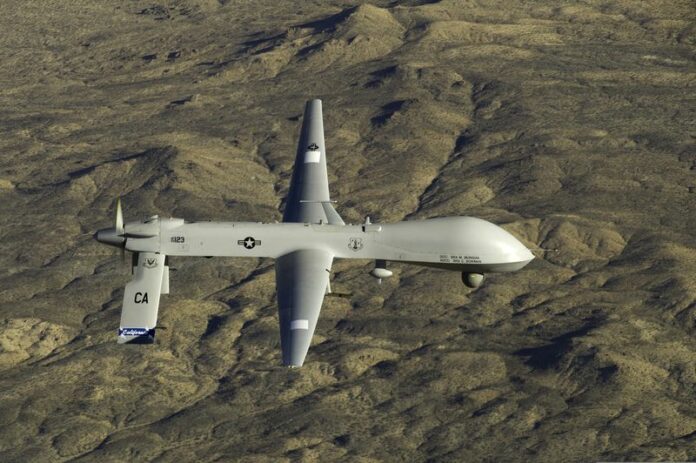
Drones fired around 20 missiles at two separate locations in North Waziristan tribal district near the Afghan border, destroying compounds and vehicles allegedly used by militants, security officials said.

At least 10 suspected members of the Haqqani group of Afghan Taliban were killed in strikes early Thursday in the Dandy Darpa Khel area.

Overnight, six militants, including Uzbek members of the Taliban, were killed in a separate drone attack in the Ghulam Khan area of North Waziristan, officials said.

The attacks occurred after Islamic Movement of Uzbekistan (IMU) – a group of Central Asian militants affiliated with al-Qaeda – said its fighters staged a siege of country's busiest airport on Sunday night.

Pakistani officials investigating the attack said they suspected most of the attackers were Uzbek or of Central Asian origin.

Prime Minister Nawaz Sharif asked the United States last year to halt drone strikes as the premier tried to persuade "reconcilable" Taliban into a peace process.

But his efforts ended without making significant headway and the raid of Karachi airport, followed by military air strikes, seems to have signalled an end to any prospects of a peace deal.

"It looks like Sharif and his team are running out of patience," said Peshawar-based security expert Fida Khan.
 

Advertisement

Junta: Free Movie Screening Campaign Is Not Populism

(Prachatai English)

BANGKOK — A Thai military junta spokesman said on Thursday that the free screening of the patriotic historical movie "King Naresuan 5" should not be called populism and that the free seats are from the “kindness” of the private sector.

Col Winthai Suvaree, spokesman of the National Council for Peace and Order (NCPO), said calling this campaign “populism” is not fair to the military and the private sector who showed their “kindness” for the “public interest for the Thai people,” Wassana Nanuam, military affairs reporter of the Bangkok Post, reported on her personal Facebook page.  

Read more here


Note: Khaosod English is not responsible for content on other websites.

Advertisement

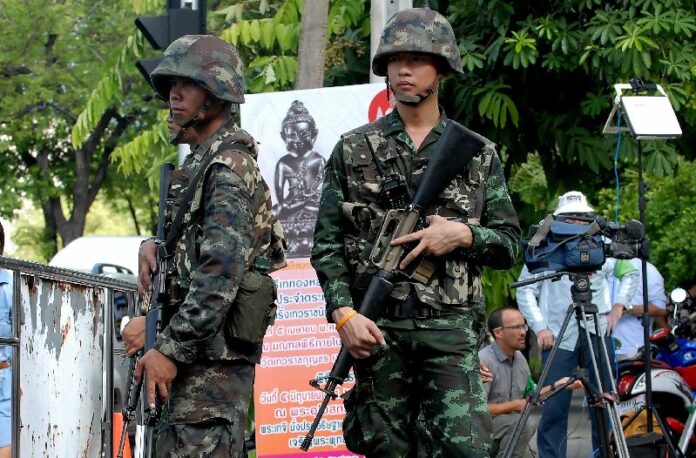
Thai Junta Says it Doesn’t Like the Word “Coup”

BANGKOK — In an ongoing effort to soften the public perception of its military takeover on 22 May, the Thai military junta has announced it does not like the word “coup.”

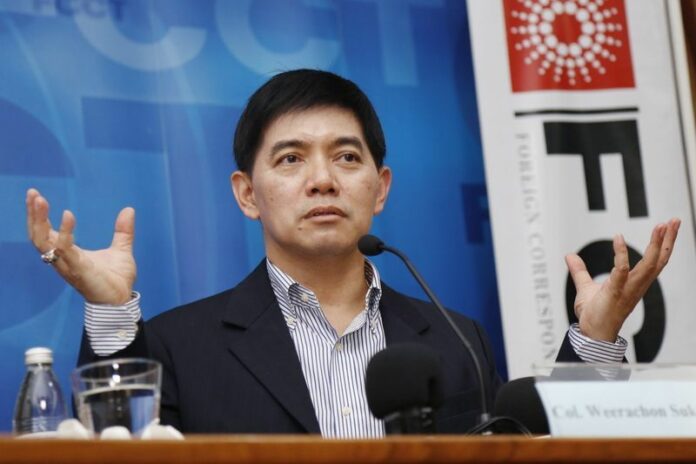
“I try not to use the word coup, because I feel that what we are doing at the moment is quite different, completely different than what happened in the past,” a spokesperson for the junta’s National Council for Peace and Order (NCPO) said at the Foreign Correspondent’s Club in Bangkok last night.

Col. Werachon Sukondhapatipak said he preferred to use the phrase “military intervention.”

Since becoming a constitutional democracy in 1932, Thailand has experienced 22 coup attempts, 13 of which were successful. The Thai army staged its most recent putsch last month and has since announced plans to govern the country until October, after which it will appoint an interim government to carry out national reforms. The junta says elections will not be held for at least another 15 months, and only if “conditions are stable.”

There is wide agreement that this military takeover is different from the most recent coup in 2006 — but not because it is less “coup-like” as Col. Werachon suggested.

Rather, many experts have observed that this military takeover is different because the junta is exercising its authoritarian powers more harshly and extensively than in any coup in Thailand's recent past.

“This is worse than previous coups,” a political science lecturer at university in Bangkok told Khaosod English. “Because in [1991 and 2006], the military held onto power for a short time and then they organized a technocrat government to take care of all these economic issues for them. The NCPO on the other hand, their actions look more like the military regimes of the 1950s and 1960s."

The NCPO says it plans to maintain control of the country’s administration until October, which is the longest any junta has held onto power since 1971. The coupmakers say it was necessary to seize power in order to resolve the political conflict that led to paralysing street protests and sporadic violence between Thailand's rival political factions over the past six months. 

Since seizing power, the junta has banned all forms of peaceful political expression, raided homes without search warrants, censored the media, and summoned and detained hundreds of politicians and activists, all under the banner of "returning happiness to the Thai people."

Last night, the NCPO spokesperson said he doesn't like the word "detention” either. 

“I don’t like the word detention,” Col. Werachon said, “Because the conditions that happen are quite different.” 

He went on to list the amenities provided to detainees, which include “air conditioning,” “good food,” and “all kinds of activities that make the time pass quickly.”

“Is this detention?” Col. Werachon asked.

Col. Werachon said the army bars detainees from having any contact with the outside world in order to provide them with a “cooling-off period. This is a necessary part of the junta’s goal to reconcile the country’s political divisions and “return happiness to the people, he said.

“We talk to them, we try to convince them to put the country’s interests before their own,” Col. Werachon said.  “We don’t want them to have information from the outside. We just want them to be on their own.”

Many of those who have been released from military custody have confirmed that they were treated well, aside from being aggressively interrogated and subjected to various forms of “psychological warfare.”

However, those who do not report to the military soon after receiving a summons order can face up to two years in prison. A well-known Redshirt leader and anti-coup activist, Sombat Boonngamanong, is expected to face trial in martial court for defying a summons order and organising anti-coup protests on social media. Col. Werachon said he does not consider Mr. Sombat to be a "political prisoner." 

The military has released the majority of its detainees within seven days, which is the upper limit under martial law. However, Human Rights Watch has identified at least one case in which a Redshirt activist has been held in an undisclosed location for more than two weeks.

Col. Werachon said that no more than 15 people are currently being held by the military.

“We ask people to refrain from expressing any political views because we believe that this is not the time,” said Col. Werachon. “We are trying to adjust the mood and tone of society.” 

 
For comments, or corrections to this article please contact:[email protected]

You can also find Khaosod English on Twitter and Facebook
http://twitter.com/KhaosodEnglish
http://www.facebook.com/KhaosodEnglish

Advertisement

Khon Kaen Model Raises Questions in the Northeast

(The Isaan Record)

KHON KAEN – Since the May 22 coup d’état, Thailand’s military has tried to sweep the country clean of weapons to quell fears of a violent uprising. But in Isaan, the heartland of the Red Shirts, some of the soldiers’ actions have raised doubts about the military’s intentions. Red Shirts here believe that the military may be wrongly framing peaceful Red Shirts as violent terrorists in a high-profile legal case, which could set the stage for a wider crackdown on Red Shirts in the region.

On May 23, soldiers raided an apartment building in Khon Kaen city and arrested around twenty people allegedly involved in a terrorist plot. The military claims the plot, known as the ‘Khon Kaen Model,’ was designed to incite violence in Khon Kaen. In the following days, they arrested additional suspects in their homes, bringing the total number of the accused to twenty-four.

Read the rest of the story here


Note: Khaosod English is not responsible for content on other websites.

Advertisement

Thai Junta Says it Doesn’t Like the Word 'Coup'

Thai army spokesman Colonel Werachon Sukondhapatipak speaks during a press conference at the Foreign Correspondents' Club of Thailand (FCCT) in Bangkok, 11 June 2014. EPA/LUONG THAI LINH

BANGKOK — In an ongoing effort to soften the public perception of its military takeover on 22 May, the Thai military junta has announced it does not like the word “coup.”

"I try not to use the word coup, because I feel that what we are doing at the moment is quite different, completely different than what happened in the past," a spokesperson for the junta’s National Council for Peace and Order (NCPO) said last night.

Col. Werachon Sukondhapatipak said he preferred to use the phrase "military intervention."

Since becoming a constitutional democracy in 1932, Thailand has experienced 22 coup attempts, 13 of which were successful. The Thai army staged its most recent putsch last month and has announced plans to govern the country until October, after which it will appoint an interim government to carry out national reforms. The junta says elections will not be held for at least another 15 months, and only if "conditions are stable."

There is wide agreement that this military takeover is different from the most recent coup in 2006 — but not because it is less coup-like as Col. Werachon suggested.

Rather, many experts have observed that the current junta is exercising its authoritarian powers more harshly and extensively than military rulers in Thailand's recent past.

"This is worse than previous coups," a political science lecturer at university in Bangkok told Khaosod English. "Because in [1991 and 2006], the military held onto power for a short time and then they organized a technocrat government to take care of all these economic issues for them. The NCPO on the other hand, their actions look more like the military regimes of the 1950s and 1960s."

The NCPO says it plans to maintain control of the country’s administration until October, which is the longest any junta has held onto power since 1971. The coupmakers say it was necessary to seize power in order to resolve the political conflict that led to street protests and sporadic violence between Thailand's rival political factions over the past six months. 

Since seizing power, the junta has banned all forms of peaceful political expression, raided homes without search warrants, censored the media, and summoned and detained hundreds of politicians and activists, all under the banner of "returning happiness to the Thai people."

Last night, the NCPO spokesperson said he doesn't like the word "detention" either. 

"I don’t like the word detention," Col. Werachon said, "Because the conditions that happen are quite different." 

He went on to list the amenities provided to detainees, which include “air conditioning,” “good food,” and “all kinds of activities that make the time pass quickly.”

"Is this detention?" Col. Werachon asked.

Col. Werachon said the army bars detainees from having any contact with the outside world in order to provide them with a "cooling-off period." This is a necessary part of the junta’s goal to reconcile the country’s political divisions and "return happiness" to the people, he said.

"We talk to them, we try to convince them to put the country’s interests before their own," Col. Werachon said.  “"We don’t want them to have information from the outside. We just want them to be on their own."

Many of those who have been released from military custody have confirmed that they were treated well, aside from being aggressively interrogated.

However, those who do not report to the military soon after receiving a summons order can face up to two years in prison. A well-known Redshirt leader and anti-coup activist, Sombat Boonngamanong, is expected to face trial in martial court for defying a summons order and organising anti-coup protests on social media. Col. Werachon said he does not consider Mr. Sombat to be a "political prisoner." 

The military has released the majority of its detainees within seven days, which is the upper limit under martial law. However, Human Rights Watch has identified at least one case in which a Redshirt activist has been held in an undisclosed location for more than two weeks.

Col. Werachon said that no more than 15 people are currently being held by the military.

"We ask people to refrain from expressing any political views because we believe that this is not the time," he said. "We are trying to adjust the mood and tone of society." 

(Reporting by Sally Mairs)


For comments, or corrections to this article please contact:[email protected]

You can also find Khaosod English on Twitter and Facebook
http://twitter.com/KhaosodEnglish
http://www.facebook.com/KhaosodEnglish
Advertisement

Thai Junta Holding 10 to 15 People For "Cooling Off"

BANGKOK (DPA) — Thailand's junta is currently holding between 10 and 15 people of the 300 summoned since the May 22 coup, a military spokesman said late Wednesday.

"At the moment there are 10-plus people remaining in army accommodation, less than 15," said Colonel Werachon Sukondhapatipak, spokesman for the ruling National Council for Peace and Order (NCPO).

The majority of the more than 300 politicians, activists, academics and journalists summoned for "talks" have been released, Werachon told an audience at the Foreign Correspondents Club of Thailand.

The detentions, often in undisclosed locations with no access allowed to relatives, have sparked criticisms from human rights groups.    

The NCPO spokesman said those held were provided with air-conditioned rooms, good food and entertainment.

"We talk to them," Werachon said. "We try to tell them to put the country before their own interests. We prefer to call it a cooling-off period than detention."

Army chief General Prayuth Chan-ocha has said he staged the coup to put an end to mounting violence accompanying nearly seven months of street protests in Bangkok and a resulting political deadlock.

Thailand has been under martial law since May 20, allowing authorities to detain people for up to seven days without charges.

Among the people summoned by the junta was former prime minister Yingluck Shinawatra, whom the army said was never formally detained.

"Yingluck was invited for a conversation and then was allowed to go home on the same day," Werachon said.

Advertisement

Suthep Calls Off 10,000 Baht Per Seat Dinner Party

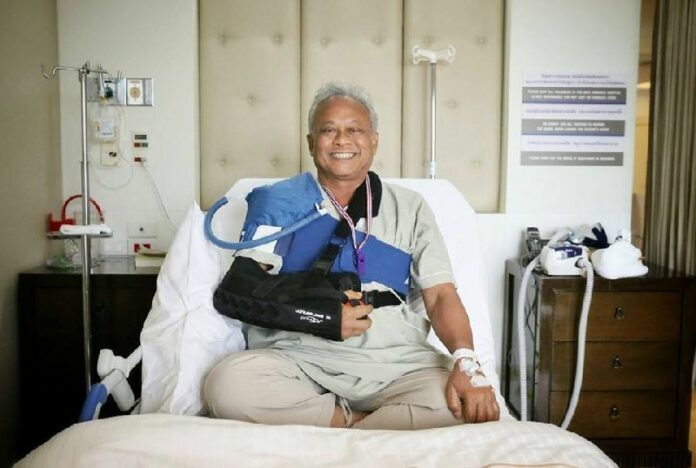
Suthep Thaugsuban after undergoing shoulder surgery for too many fist pumps as leader of the anti-government PCAD, 12 June 2014.

BANGKOK — Former leader of the anti-government protests Suthep Thaugsuban has indefinitely postponed the fundraiser dinner originally scheduled for this Saturday.

"I thank you all for booking and buying the ticket for 'Dinner With Senior Village Headman [Mr. Suthep's nickname]' on Saturday the 14th," Mr. Suthep wrote on his Facebook, "But there have been reasonable calls for reconsideration of the event, and I have concluded that the event may not be in accordance with the martial law and orders of the National Council For Peace and Order (NCPO)."

"Furthermore, it may let some people to exploit the opportunity and stage activities to cause damage to our country," he continued, "Therefore, I have postponed the Dinner With Senior Village Headman until appropriate situation."

Those who have bought the tickets, which cost 10,000 baht per seat, can apply for a refund, Mr. Suthep said.

The dinner was supposed to take place at an exclusive club in central Bangkok. The former leader of the People's Committee for Absolute Democracy With the King As Head of State (PCAD) billed the dinner as an opportunity to raise money for PCAD supporters who have were injured over the group's six-month campaign against the former government.

PCAD will find "other ways" to assist the injured protesters, now that the dinner party has been cancelled, Mr. Suthep insisted. "Please do not worry."

In another Facebook post, Mr. Suthep said the operation on his right shoulder has been successful. The PCAD leader, who is currently recovering from the surgery at Bangkok Hospital, said the injury was caused by 'fist pumping' too many times over the past six months.

PCAD's protests came to an end when the military staged a coup on 22 May and toppled the government that PCAD had been seeking to depose for months. 


For comments, or corrections to this article please contact: [email protected]

You can also find Khaosod English on Twitter and Facebook
http://twitter.com/KhaosodEnglish
http://www.facebook.com/KhaosodEnglish

Advertisement

Two Charged With Lèse Majesté After Reporting to Military

(Prachatai English)

Two men were charged with lèse majesté after being detained for seven days by the military. The court denied their bail requests. 
 
On Tuesday, police charged Chaleaw J. and Kathawut B. under Article 112 of the Criminal Code or the lèse majesté law. They were denied bail and sent to Bangkok Remand Prison.  
 
Read more of the story.
 
Note: Khaosod English is not responsible for content on other websites.
Advertisement

Hot News

LATEST NEWS

Bangkok
overcast clouds
29.4 ° C
29.4 °
26.6 °
77 %
2.7kmh
99 %
Tue
35 °
Wed
36 °
Thu
33 °
Fri
32 °
Sat
28 °